Linda's Literary Home

Category: Elizabeth Barrett Browning

  • Elizabeth Barrett Browning’s Sonnet 14 “If thou must love me, let it be for nought”

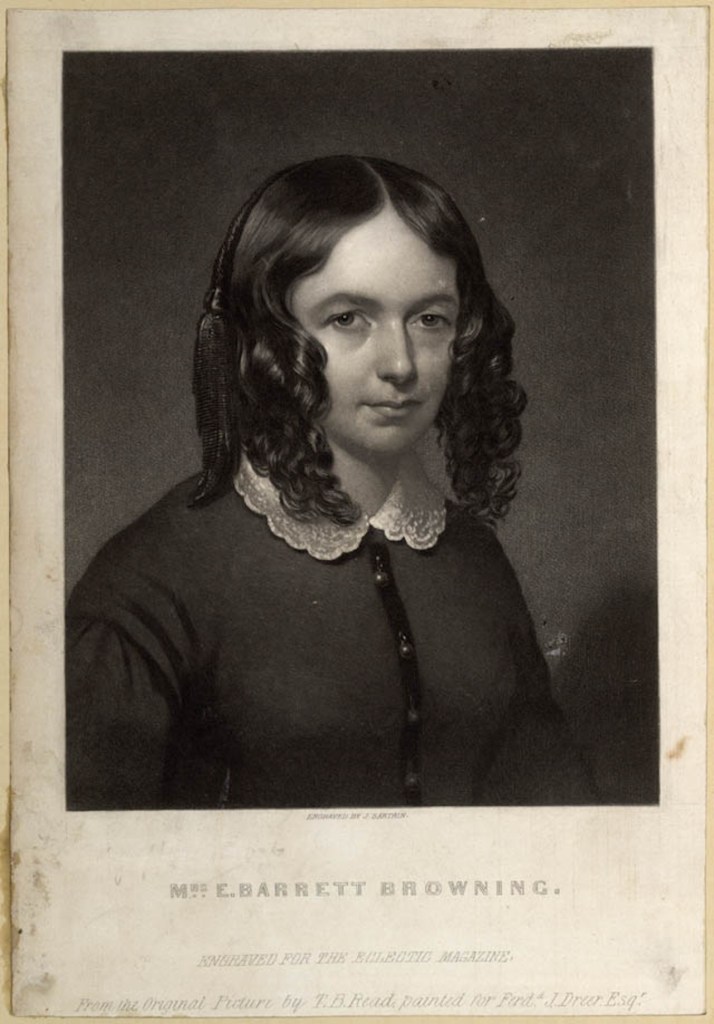
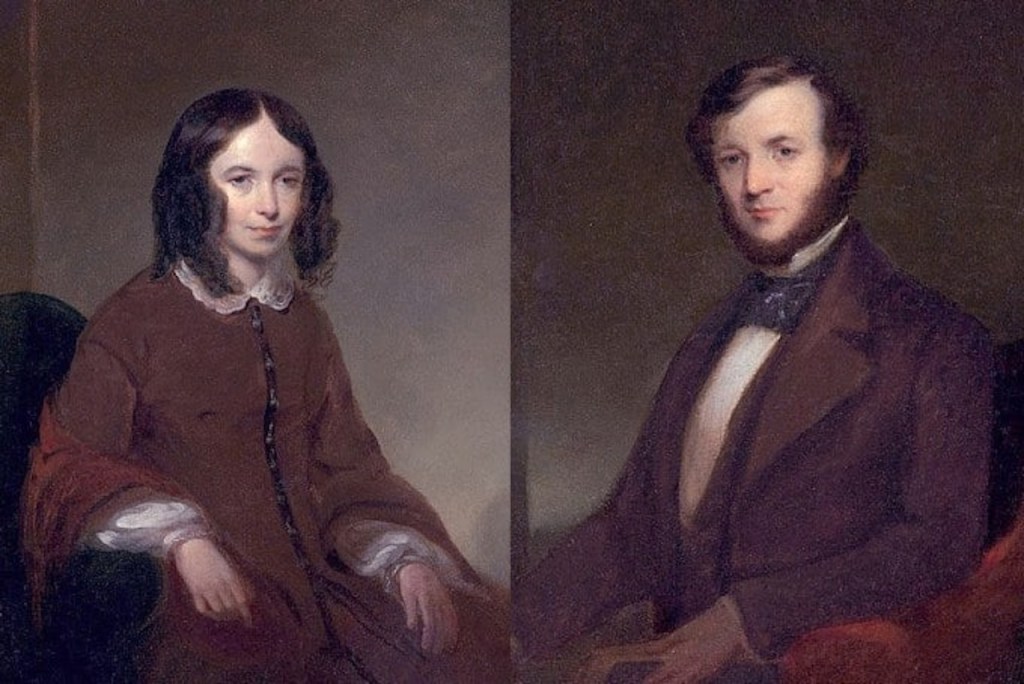
    Image: Elizabeth Barrett Browning and Robert Browning – 1852. Portraits painted by Thomas Buchanan Read

    Elizabeth Barrett Browning’s Sonnet 14 “If thou must love me, let it be for nought”

    In sonnet 14, Elizabeth Barrett Browning’s speaker is insisting that her suitor love her only for the sake of love, not for her physical qualities such as her smiling lips or the soft manner in which she speaks.

    Introduction with Text of Sonnet 14 “If thou must love me, let it be for nought”

    The speaker in this sonnet from Elizabeth Barrett Browning’s classic Sonnets from the Portuguese is now graciously receiving her suitor’s affection.  Nevertheless, she also feels it necessary to make him aware that she expects that their budding relationship should not only continue to grow but should become permanent.  She therefore delineates the nature of the love she anticipates that the two will share.

    Sonnet 14 “If thou must love me, let it be for nought”

    If thou must love me, let it be for nought
    Except for love’s sake only. Do not say
    “I love her for her smile—her look—her way
    Of speaking gently,—for a trick of thought
    That falls in well with mine, and certes brought
    A sense of pleasant ease on such a day”—
    For these things in themselves, Belovèd, may
    Be changed, or change for thee,—and love, so wrought,
    May be unwrought so. Neither love me for
    Thine own dear pity’s wiping my cheeks dry,—
    A creature might forget to weep, who bore
    Thy comfort long, and lose thy love thereby!
    But love me for love’s sake, that evermore
    Thou mayst love on, through love’s eternity.

    Commentary on Sonnet 14 “If thou must love me, let it be for nought”

    The speaker insists that her beloved offer her affection only based on love and not for any physical qualities that she demonstrates, including the way she smiles or the manner in which she speaks.

    First Quatrain:  Continuing to Remain Somewhat Tentative

    If thou must love me, let it be for nought
    Except for love’s sake only. Do not say
    “I love her for her smile—her look—her way
    Of speaking gently,—for a trick of thought

    The speaker’s tentativeness continues,  even though she seems to be contemplating the much desired joy of such a love relationship.  Her continued procrastination remains as a shield for her heart, in case the relationship ends.   She is signaling the likelihood of her acceptance by affirming, “If thou must love me,” but not with the oft-touted insulting phrase, if-you-really-love-me.

    The uncomplicated, single term “must” declares that a change is in the offing.  It demonstrates that she now realizes the true nature of this man’s love, although she cannot bring herself to have total faith that some feature in her nature could never assert itself and thus spoil such a love that seems to be so true.

    The speaker is requesting pragmatically that he love her for love alone, and not because of  the physical, therefore superficial, qualities that too often attract lovers.  She does not desire that her lover to be in love merely with the physical qualities she possesses such as her smile and speaking manner.

    Second Quatrain: Contempt for the Superficial

    That falls in well with mine, and certes brought
    A sense of pleasant ease on such a day”—
    For these things in themselves, Belovèd, may
    Be changed, or change for thee,—and love, so wrought,

    The speaker then is unveiling her reason for being dismayed by superficial kinds of attention that often engages lovers.  Those qualities too often prove to be “a trick of thought.”  Suppose that her smile be pleasant to him one day but not so much the next day.  If he were fixed upon such a smile, she fears his feeling for her would diminish.

    The speaker does not wish that her partner’s love to be guided only by mood.  She suspects that if she offers him a pleasant glance but later offers a melancholy sorrow his love for her may become negatively affected.  

    Also, her speech to him may from time to time vary and not always offer him the same level of delight.  She knows she will not always be able to engage in conversation that is brimming only with joyful pleasantries.

    The speaker comprehends well that love based on change cannot maintain a lasting, steadfast love relationship.  Thus she is letting him know that she is aware that the physical is very likely to change, but true love should not change; love should remain constant.  She wants to let him know that she can only engage in an unconditional love that is founded on unchanging affection.

    First Tercet:  Accepting No Pity

    May be unwrought so. Neither love me for
    Thine own dear pity’s wiping my cheeks dry,—
    A creature might forget to weep, who bore

    The speaker is offering an additional demand that he not love her with pity in his heart.  She has often explored the reaches of the melancholy that has caused her to shed tears often and for long periods of time.  And if his love were tainted with pity and sympathy for her sorrowful lot, what would occur with that pity, were she to “forget to weep”?

    She reasons that if or when she likely becomes a happily, contented woman, her beloved would then have one less reason to continue to love her, if he had allowed his love for her to include the negativity of pity and sympathy.

    Second Tercet:   Love for Love’s Sake Alone

    Thy comfort long, and lose thy love thereby!
    But love me for love’s sake, that evermore
    Thou mayst love on, through love’s eternity.

    The speaker deems it very important to make her paramour aware that she wants to be loved for no reason other than that she exists.  If she is loved because of physical features, or because of the fact that she has deeply suffered and somehow now deserves to be content, true, lasting love could never continue to remain.

    Therefore, if her beloved will love her as she requests and just love her for “love’s sake,” she is convinced that their love will exist “through love’s eternity.”  She has weighed the calamity of false starts, and she makes it clear that she wishes to avoid the pain of a failed relationship.


  • Elizabeth Barrett Browning’s Sonnet 13 “And wilt thou have me fashion into speech”

    Image: Elizabeth Barrett Browning – NPG, London

    Elizabeth Barrett Browning’s Sonnet 13 “And wilt thou have me fashion into speech

    The speaker in sonnet 13 muses on the idea of composing a verse about her newly found emotion but hesitates for fear of touching the grief she suffers. 

    Introduction with Text of Sonnet 13 “And wilt thou have me fashion into speech”

    In Elizabeth Barrett Browning’s sonnet 13 from Sonnets from the Portuguese, the speaker attempts to respond to her suitor’s encouragement to transcribe her feelings for him in a poem, but she does not yet believe she is ready to plumb the depths of her feelings.

    Sonnet 13 “And wilt thou have me fashion into speech”

    And wilt thou have me fashion into speech
    The love I bear thee, finding words enough,
    And hold the torch out, while the winds are rough,
    Between our faces, to cast light on each?
    I drop it at thy feet. I cannot teach
    My hand to hold my spirit so far off
    From myself—me—that I should bring thee proof
    In words, of love hid in me out of reach.
    Nay, let the silence of my womanhood
    Commend my woman-love to thy belief,—
    Seeing that I stand unwon, however wooed,
    And rend the garment of my life, in brief,
    By a most dauntless, voiceless fortitude,
    Lest one touch of this heart convey its grief.

    Commentary on Sonnet 13 “And wilt thou have me fashion into speech”

    The speaker in sonnet 13 muses on the idea of composing a verse about her newly found emotion of love, but she hesitates for she fears touching the grief that still confronts her.

    First Quatrain:  Should She Express Her Love?

    And wilt thou have me fashion into speech
    The love I bear thee, finding words enough,
    And hold the torch out, while the winds are rough,
    Between our faces, to cast light on each?

    The speaker beseeches her beloved wondering if she should “fashion into speech” how she feels about him. She feels that she may not yet be ready to express verbally the feelings that are beginning to move her. Undoubtedly, she believes that outward verbal expression may hamper her unique emotions.

    If she translated her feelings into words, she fears they would behave as a “torch” and would “cast light on each” of their faces.  However, that would happen only if the wind did not blow out their fire. 

    She believes she must protect her increasing emotion from all outside forces; therefore, she opens with a question. She cannot be certain that remaining silent is any longer the proper way to behave.

    Second Quatrain:  Unsteadied by Emotion

    I drop it at thy feet. I cannot teach
    My hand to hold my spirit so far off
    From myself—me—that I should bring thee proof
    In words, of love hid in me out of reach.

    The speaker then dramatically asserts that she, “drop[s] at [his] feet”; she does this because she cannot remain steady in his presence, as she is overcome with emotion. She becomes so agitated with the notion of love, and she cannot calm down in order to write what might be coherent about her intense feelings.

    The sonnet suggests that her beloved has asked the poet/speaker for a poem about her feelings for him; however, she believes that her love is so profoundly heartfelt that she may not be able to shapes its significance in words.

    The speaker feels that she cannot perceive the appropriate images for they are, “hid in me out of reach.” She feels that she must wait for a time when she has found enough tranquility to be able to “fashion into speech” the complex, deep feelings she is experiencing because of her love for this man.

    First Tercet:   Remaining Self-Aware

    Nay, let the silence of my womanhood
    Commend my woman-love to thy belief,—
    Seeing that I stand unwon, however wooed,

    The speaker concludes therefore that “the silence of [her] womanhood” will have to function to persuade him that she does possess those deep feeling of love for him.  She confesses  that she has remained a bit distant from her beloved, when she says she is “unwon.” 

    Although he has “wooed” her, she feels that she must keep a portion of her self out of sight for very deeply personal reasons. She must make sure she stays present and connected in her own self.

    Second Tercet:   Dramatizing the Depth of Pain

    And rend the garment of my life, in brief,
    By a most dauntless, voiceless fortitude,
    Lest one touch of this heart convey its grief.

    The sonnet sequence has dramatized the depth of the pain and melancholy the speaker has endured her entire life-long. She is still suffering that same pain and sadness. She thus again reveals that if she too soon tries to place her feeling into a poem, she would perhaps only “convey [her heart’s] grief.”

    The speaker remains fearful of the notion that “a most dauntless, voiceless fortitude” could impede the power with which she is being propelled toward completely accepting the current relationship with her new-found belovèd.

  • Elizabeth Barrett Browning’s Sonnet 12 “Indeed this very love which is my boast”

    Image: Elizabeth Barrett and Robert Browning – Two Poets in Love

    Elizabeth Barrett Browning’s Sonnet 12 “Indeed this very love which is my boast”

    In sonnet 12 from Elizabeth Barrett Browning’s “Sonnets from the Portuguese,” her speaker is becoming more comfortable, realizing that she is truly loved by her suitor.  Still she gives him all credit for her ability to love as deeply as she does.

    Introduction with Text of Sonnet 12 “Indeed this very love which is my boast”

    Elizabeth Barrett Browning’s sonnet 12 from Sonnets from the Portuguese portrays the speaker as she muses on the happiness of having fallen in love with one so illustrious and accomplished as is her suitor.

    Sonnet 12 “Indeed this very love which is my boast”

    Indeed this very love which is my boast,
    And which, when rising up from breast to brow,
    Doth crown me with a ruby large enow
    To draw men’s eyes and prove the inner cost,—
    This love even, all my worth, to the uttermost,
    I should not love withal, unless that thou
    Hadst set me an example, shown me how,
    When first thine earnest eyes with mine were crossed,
    And love called love. And thus, I cannot speak
    Of love even, as a good thing of my own:
    Thy soul hath snatched up mine all faint and weak,
    And placed it by thee on a golden throne,—
    And that I love (O soul, we must be meek!)
    Is by thee only, whom I love alone.

    Commentary on Sonnet 12 “Indeed this very love which is my boast”

    Elizabeth Barrett Browning’s speaker in this sonnet is musing on her good fortune to have attracted the attention of a man, who is without doubt above her class status.  And what is more important is that he has accomplished much and is recognized as a excellent poet.

    First Quatrain:  The Effects of Love

    Indeed this very love which is my boast,
    And which, when rising up from breast to brow,
    Doth crown me with a ruby large enow
    To draw men’s eyes and prove the inner cost,—

    The speaker recognizes the effects of the love she is experiencing.  She flushes red-cheeked as she muses on her good luck.  She believes it entirely appropriate that she “boast” because of her good fortune.  She thinks that whoever sees her can understand that she is glowing with love from “breast to brow” because of her wonderful, dynamic suitor. 

    The speaker reports that her heart has gained speed, rushing to her face the blood results in the blushing that announces to the world that she is in love.  She no longer can keep private her joy at being loved.  Her feelings have become too full, too great to contain with a neutral pose.

    Second Quatrain:  Learning Deep Love

    This love even, all my worth, to the uttermost,
    I should not love withal, unless that thou
    Hadst set me an example, shown me how,
    When first thine earnest eyes with mine were crossed,

    Then the speaker declares something truly astonishing: she admits that without her beloved teaching her how to love at such a depth, she would not have been able to do so.  Without his example, she would never have understood how love can completely engulf the heart and mind.

    The speaker gradually little by little is coming to comprehend the importance of her burgeoning affection.  She now begins to realize the glorious state of affairs that actually started as soon as their eyes first connected in their first love’s deep glance.

    First Tercet:  Naming the Emotion

    And love called love. And thus, I cannot speak
    Of love even, as a good thing of my own:
    Thy soul hath snatched up mine all faint and weak,

    The speaker realized for the first time the beauty of naming that magnificent emotion “love”—for it was then that for her, indeed, “love called love”—only at that momentous occasion when the pair of lovers first looked deeply into each other’s eyes.

    Not only was the emotion labeled, but the feeling itself was also brought forth. The emotion resided within her deep heart; her beloved brought the emotion into her open consciousness. 

    She finds that she still “cannot speak” about love without acknowledging the existence, the existential presence, of her beloved. For her, love and her suitor are virtually synonymous because he “snatched up” her soul at a time that it was “all faint and weak.”

    Second Tercet:  Liberating a Weak Spirit

    And placed it by thee on a golden throne,—
    And that I love (O soul, we must be meek!)
    Is by thee only, whom I love alone.

    After liberating her faint, weak soul, her suitor raised her and set her beside him, “on a golden throne.” Metaphorically, she likens the bliss of his love to a royal asset of high value—an apt comparison because of all the many references to royalty she has employed to describe her suitor.

    The speaker again bestows all credit to her suitor for the being able to love as profoundly as she does.  She even tells her own soul that “we must be meek.”  The speaker never wants to lose the humility she was blessed with.  She never wants to forget that her own soul is the repository of all love.

  • Elizabeth Barrett Browning’s Sonnet 11 “And therefore if to love can be desert”

    Image: Elizabeth Barrett Browning – Library of Congress

    Elizabeth Barrett Browning’s Sonnet 11 “And therefore if to love can be desert”

    The speaker is still walking the path to self-acceptance, still looking for the courage to believe in her own good fortune at finding a love that she wants to deserve.

    Introduction and Text of Sonnet 11: “And therefore if to love can be desert”

    Elizabeth Barrett Browning’s sonnet 11 from Sonnets from the Portuguese features the continued philosophizing of the obsessed speaker as she falls in love while trying to justify that love to herself and to her belovèd.

    Sonnet 11 “And therefore if to love can be desert”

    And therefore if to love can be desert,
    I am not all unworthy. Cheeks as pale
    As these you see, and trembling knees that fail
    To bear the burden of a heavy heart,—
    This weary minstrel-life that once was girt
    To climb Aornus, and can scarce avail
    To pipe now ‘gainst the valley nightingale
    A melancholy music,—why advert
    To these things? O Belovèd, it is plain
    I am not of thy worth nor for thy place!
    And yet, because I love thee, I obtain
    From that same love this vindicating grace,
    To live on still in love, and yet in vain,—
    To bless thee, yet renounce thee to thy face.

    Reading

    Commentary on Sonnet 11 “And therefore if to love can be desert”

    The speaker remains reluctant to engage in her own self-acceptance.  She is still looking for enough courage to accept her own good fortune in finding a love of which she desire to become deserving .

    First Quatrain:  Berating Her Own Value

    And therefore if to love can be desert,
    I am not all unworthy. Cheeks as pale
    As these you see, and trembling knees that fail
    To bear the burden of a heavy heart,

    The speaker, who so often has devalued her own self worth, now continues to evolve toward accepting the idea that she might, in fact, be “not all unworthy.”  She contends that if the ability to love can be deserved, as an award for goodness or service, she feels that it just might be possible for her to have enough importance to accept the love of one so obviously above her in status and accomplishments.

    Again, however, she begins her litany of flaws; she has pale cheeks, and her knees tremble so that she can hardly “bear the burden of a heavy heart.”  She continues her string of self-deprecations into the second quatrain and first tercet.

    Second Quatrain:  To Accomplish Great Things

    This weary minstrel-life that once was girt
    To climb Aornus, and can scarce avail
    To pipe now ‘gainst the valley nightingale
    A melancholy music,—why advert

    The speaker has lived a “weary minstrel-life,” and while she once thought of accomplishing great things, as Alexander the Great had taken Aornus, she now finds herself barely able to compose a few melancholy poems.  She finds it difficult even to compete “’gainst the valley nightingale.” 

    However, she has also decided, while both thinking of and obsessing over these negative aspects of the life, to reconsider her possibilities.   She realizes that she is merely distracting herself from more important issues by continuing to retain negative thoughts about which she spends too much time obsessing.

    First Tercet: Concentration on Negativity

    To these things? O Belovèd, it is plain
    I am not of thy worth nor for thy place!
    And yet, because I love thee, I obtain

    Thus the speaker asks herself, “why advert / / To these things?”  Indeed, why concentrate on the past negativity, as such a glorious future has been heralded? She then directly addresses her suitor, claiming, “O Belovèd, it is plain / I am not of thy worth.” 

    She still insists on making it known how aware she is that she is not of her suitor’s status. However, she is now willing to consider that they might be able to grow a relationship.

    Second Tercet: Advancing a Philosophical Position

    From that same love this vindicating grace,
    To live on still in love, and yet in vain,—
    To bless thee, yet renounce thee to thy face.

    The speaker advances an odd philosophical position that because she loves the man, that love will offer her “vindicating grace.”  Thus, she can accept his love and love him while still allowing herself to believe that such a love is “in vain” and that she can still “bless” him with her love, while simultaneously she can “renounce [him] to [his] face.”

    The speaker’s complex of accepting and rejecting allows her to continue to believe she is both worthy yet somehow not quite worthy of this love.  She cannot forsake the notion that she can never be equal to him.  

    Yet, she can accept his love and the prospect that somehow, somewhere beyond her ability to grasp it is the possibility that despite all of her flaws, she ultimately is deserving of such a great and glorious love.

  • Elizabeth Barrett Browning’s Sonnet 9:  “Can it be right to give what I can give?”

    Image: Elizabeth Barrett Browning – NPG, London

    Elizabeth Barrett Browning’s Sonnet 9:  “Can it be right to give what I can give?”

    Continuing her lamentations over the gap in societal station between her suitor and herself, the speaker wonders if she has anything to offer the suitor. But after exaggerating that distance, she attempts to close it up by emphasizing just how much she does love him.

    Introduction and Text of Sonnet 9:  “Can it be right to give what I can give?”

    Sonnet 9, from Elizabeth Barrett Browning’s Sonnets from the Portuguese, seems to offer the speaker’s strongest rebuttal against the pairing of herself and her beloved.   She seems most adamant that he leave her; yet in her inflexible demeanor screams the opposite of what she seems to be urging upon her lover.

    Her dramatic reversal offers the strongest expression of the intensity of the love she actually feels for her beloved suitor.  Despite having nearly dismissed him, she, in fact, lets him know how utterly and desperately she wants him to stay.

    Sonnet 9:  “Can it be right to give what I can give?”

    Can it be right to give what I can give?
    To let thee sit beneath the fall of tears
    As salt as mine, and hear the sighing years
    Re-sighing on my lips renunciative
    Through those infrequent smiles which fail to live
    For all thy adjurations? O my fears,
    That this can scarce be right! We are not peers,
    So to be lovers; and I own, and grieve,
    That givers of such gifts as mine are, must
    Be counted with the ungenerous. Out, alas!
    I will not soil thy purple with my dust,
    Nor breathe my poison on thy Venice-glass,
    Nor give thee any love—which were unjust.
    Beloved, I only love thee! let it pass.  

    Reading  

    Commentary on Sonnet 9:  “Can it be right to give what I can give?”

    As she continues to bemoan the gap between the social stations of her suitor and herself, the speaker wonders if she has anything to offer her belovèd.

    First Quatrain:  Only Sorrow to Offer

    Can it be right to give what I can give?
    To let thee sit beneath the fall of tears
    As salt as mine, and hear the sighing years
    Re-sighing on my lips renunciative

    In Elizabeth Barrett Browning’s ninth sonnet of the sequence, the speaker begins with a question, asking if it even appropriate for her consider giving her beloved the paltry gifts that she possesses.

    She then explains what she has to offer; through a bit of exaggeration, she contends that all she has to offer is her sorrow. If her suitor continues with her, he will have to suffer watching her continue to cry and moan. 

    And he will have to listen to her sighs again and again. Her “lips” are like a renunciant, who has given up all desire for worldly gain and material achievement; thus, she deems herself unworthy of one so accomplished in worldly matters as her suitor is.

    Second Quatrain:  Seldom Smiling Lips

    Through those infrequent smiles which fail to live
    For all thy adjurations? O my fears,
    That this can scarce be right! We are not peers,
    So to be lovers; and I own, and grieve,

    The speaker’s lips have seldom smiled, and they even now seem incapable of acquiring the smiling habit, despite the attentions she is now receiving from her suitor.  She is afraid that such an unbalanced situation is unfair to her lover; thus she laments the likelihood that pairing with him could be appropriate. Continuing she exclaims that they are no “peers.”  

    She allows her disdain of her lowly station compared to his to dominate her concerns and her rhetoric.  Because they are “not peers,” she cannot fathom how they can be lovers, yet it seems that such is the nature of their maturing relationship.  She feels that she must confess that the gap between them continues to taunt her and to cause her to “grieve.”

    First Tercet:  Copious Tears

    That givers of such gifts as mine are, must
    Be counted with the ungenerous. Out, alas!
    I will not soil thy purple with my dust,

    The speaker spells out her concern that by giving him such gifts as copious tears and unsmiling lips she has to be reckoned as an individual lacking in generosity. She wishes it were otherwise; she would like to give gifts as rich as the ones she receives.

    But because she is incapable of returning equal treasure, she again insists that her lover leave her; she cries out demanding he turn away from her. Again, elevating her lover to the status of royalty, she insists that she does not wish to tarnish his royalty with her lowly, common status.

    Second Tercet:  Self-Argument

    Nor breathe my poison on thy Venice-glass,
    Nor give thee any love—which were unjust.
    Beloved, I only love thee! let it pass.

    She likens her station in life to a poisonous atmosphere, with which she does not want to mar his higher class status  She will not allow her lowly station to sully his higher class.  But then she goes much too far, saying, “[n]or give thee any love.” She immediately reverses herself, averring that she was wrong in making such a statement. Thus, she asserts, “Belovèd, I only love thee! let it pass.” 

    She finally admits without reservation that she loves him and asks him to forget the protestations she has made.  She asks him to “let it pass,” or forget that she has made such suggestions that he should leave her; she wants nothing more than that he stay.

    By earlier protesting so vehemently that they are not a suitable pair and then reversing herself so completely so quickly, she has created a fascinating little drama that expresses her love while laying special emphasis on the that love’s intensity.

  • Elizabeth Barrett Browning’s Sonnet 8 “What can I give thee back, O liberal”

    Image: Elizabeth Barrett Browning – Getty Images

    Elizabeth Barrett Browning’s Sonnet 8 “What can I give thee back, O liberal”

    The speaker continues to deny her good fortune as she reveals her gratitude for the attention of her illustrious suitor; she begins to accept her lot but reluctantly.

    Introduction and Text of Sonnet 8 “What can I give thee back, O liberal”

    Sonnet 8 from Elizabeth Barrett Browning’s Sonnets from the Portuguese finds the speaker continuing to doubt and deny her great fortune in attracting such an accomplished and generous suitor.  However, she is slowly beginning to accept the possibility that this amazing man could have affection for her.

    Sonnet 8 “What can I give thee back, O liberal”

    What can I give thee back, O liberal
    And princely giver, who hast brought the gold
    And purple of thine heart, unstained, untold,
    And laid them on the outside of the wall
    For such as I to take or leave withal,
    In unexpected largesse? am I cold,
    Ungrateful, that for these most manifold
    High gifts, I render nothing back at all?
    Not so; not cold,—but very poor instead.
    Ask God who knows. For frequent tears have run
    The colors from my life, and left so dead
    And pale a stuff, it were not fitly done
    To give the same as pillow to thy head.
    Go farther! let it serve to trample on.

    Reading 

    Commentary on Sonnet 8 “What can I give thee back, O liberal”

    The speaker continues to deny her good fortune as she reveals her gratitude for the attention of her illustrious suitor; she begins to accept her lot but reluctantly.

    First Quatrain:  Baffled by Attention

    What can I give thee back, O liberal
    And princely giver, who hast brought the gold
    And purple of thine heart, unstained, untold,
    And laid them on the outside of the wall

    The speaker once again finds herself baffled by the attention she receives from one who is so much above her station in life. He has given her so much, being a “liberal / And princely giver.”  The term “liberal” here means openly generous.

    Her suitor has brought his valuable poetry to her along with his own upper-class qualities and manners. She metaphorically assigns all of those gifts to the status of “gold and purple,” the colors of royalty, and she locates them “outside the wall.”

    The suitor romances her by serenading her under her window, and she is astonished by the good fortune she is experiencing.  She cannot comprehend how one so delicate and lowly positioned as herself can merit the attention she continues to garner from this handsome, accomplished poet.

    Second Quatrain:  Rejecting or Accepting

    For such as I to take or leave withal,
    In unexpected largesse? am I cold,
    Ungrateful, that for these most manifold
    High gifts, I render nothing back at all? 

    The handsome suitor provides the speaker with the choice of taking his affections and attentions or rejecting them, and she is very grateful for all she receives even as she regrets that she has nothing to offer in return.  She declaims: “I render nothing back at all?”  She frames her lack into a question that answers itself, implying that even though she may seem “ungrateful,” nothing could be further from the truth.

    The rhetorical intensity achieved through dramatizing her feelings in a rhetorical question enhances not only the sonnet’s artistry but also adds dimension to those same feelings.  The rhetorical question device magnifies the emotion.  Instead of employing overused expressions along the lines of “definitely” or “very,” the speaker uses the rhetorical question  to fuse the poetic tools into a dramatic expression that fairly explodes with emotion.

    First Tercet:  No Lack of Passion

    Not so; not cold,—but very poor instead.
    Ask God who knows. For frequent tears have run
    The colors from my life, and left so dead

    The speaker, however, does not leave the question open to possible misinterpretation; she then quite starkly answers, “No so; not cold.” She does not lack passion about the gifts her suitor bestows upon her; she is merely “very poor instead.”

    She insists that it is “God who knows” the extent of her poverty as well as the depth of her gratitude. She then admits that through much shedding of tears, she has caused the details of her life to fade as clothing rinsed many times in water would become “pale a stuff.”

    Second Tercet:  Low Self Esteem

    And pale a stuff, it were not fitly done
    To give the same as pillow to thy head.
    Go farther! let it serve to trample on.

    The speaker’s lack of a colorful life, her lowly station, her simplicity of expression have all combined to make her denigrate herself before the higher class suitor with whom she feels compelled to contrast herself.

    She is still not able to reconcile her lack to his plenty, and again she wants to urge him to go from her because she feels her lack is worth so little that it might “serve to trample on.”  Her hopes and dreams she will keep hidden until they can override the reality of her personal lack of experience and life station.

  • Elizabeth Barrett Browning’s Sonnet 7 “The face of all the world is changed, I think”

    Image: Elizabeth Barrett Browning – Getty Images

    Elizabeth Barrett Browning’s Sonnet 7 “The face of all the world is changed, I think

    Elizabeth Barrett Browning’s sonnet 7, The face of all the world is changed, I think, offers a tribute to the speaker’s lover, who has wrought deep and lasting important changes in the speaker’s life.

    Introduction with Text of Sonnet 7 “The face of all the world is changed, I think”

    Elizabeth Barrett Browning’s sonnet #7, “The face of all the world is changed, I think,” from Sonnets from the Portuguese expresses the speaker’s astonishment and delight at a new awareness she is sensing.

    She has begun to notice that her situation is in the process of a unique transformation, and she, therefore, wishes to extend her gratitude to her belovèd suitor for these marvelous, soul-inspiring changes in her life.

    Sonnet 7 “The face of all the world is changed, I think”

    The face of all the world is changed, I think,
    Since first I heard the footsteps of thy soul
    Move still, oh, still, beside me, as they stole
    Betwixt me and the dreadful outer brink
    Of obvious death, where I, who thought to sink,
    Was caught up into love, and taught the whole
    Of life in a new rhythm. The cup of dole
    God gave for baptism, I am fain to drink,
    And praise its sweetness, Sweet, with thee anear.
    The names of country, heaven, are changed away
    For where thou art or shalt be, there or here;
    And this … this lute and song … loved yesterday,
    (The singing angels know) are only dear
    Because thy name moves right in what they say.

    Reading  

    Commentary on Sonnet 7 “The face of all the world is changed, I think”

    Elizabeth Barrett Browning’s sonnet 7, “The face of all the world is changed, I think,” focuses specifically on the tribute to the speaker’s belovèd partner in love, who has wrought deep and lasting important changes in her life.  

    In fact, the entire sonnet sequence performs the awe-inspiring task of recording the evolution of the poet’s life transformation after meeting and becoming the partner of her belovèd life mate.

    First Quatrain:  The Speaker’s Changing Environment

    The face of all the world is changed, I think,
    Since first I heard the footsteps of thy soul
    Move still, oh, still, beside me, as they stole
    Betwixt me and the dreadful outer brink

    The emotional speaker notes that all things in her environs have changed their appearance because of her new outlook after having become aware of her new love. Lovers traditionally begin to see the world through rose-colored glasses upon falling in love.  The happiness in the heart spreads like a lovely, fragrant flower garden throughout the lover’s whole being.

    Every ordinary object takes on a brilliant, rosy glow that flows like a gentle river from the happiness in the heart of the romantic lover.This deep-thinking speaker asserts that her lover has placed himself between her and the terrible “death.”

    Heretofore, she had sensed that all she had to look forward to was more misery and ultimately the act of leaving her physical body.  That mindset had continued to engulf her being her whole lifelong. 

    But now the “footsteps” of her belovèd suitor have been so gentle that they seemed to be the soft sounds of his soul approaching her.  His meaning for her has become deep and abiding, spreading meaning and joy in her life.

    Second Quatrain:   Doomed Without Love

    Of obvious death, where I, who thought to sink,
    Was caught up into love, and taught the whole
    Of life in a new rhythm. The cup of dole
    God gave for baptism, I am fain to drink,

    The speaker had been convinced that without such a love to save her she would be doomed to “obvious death.” She finds herself suddenly transported to a new world, a new “life in a new rhythm” with the arrival of her belovèd suitor. 

    She has been so mired in sadness that it seemed that she was being “baptized” in that mindset, as one drowning in one’s own fears and tears.However, the melancholy speaker finds herself reluctant to allow herself complete immersion in her newfound happiness, but still she has to admit that her new status is overcoming her prior terror.She is beginning slowly to change her doubts to delightful possibilities.

    First Tercet:   A Universal Change

    And praise its sweetness, Sweet, with thee anear.
    The names of country, heaven, are changed away
    For where thou art or shalt be, there or here;

    The speaker must extol the “sweetness” that she receives from her new belovèd swain. Because he is beside her, she has changed in a universal way—”names of country, heaven, are changed away.” 

    Nothing is the same, even the ordinary names of things seem altered and in a good way; all of her old cheerless, dreary life is transforming utterly, and she finally seems to become able to enjoy and appreciate this transformation.The more confident speaker is now willing to entertain the notion that he will remain by her side to delight her life permanently, throughout time and space.

    Second Tercet:  The Singing of Angels

    And this … this lute and song … loved yesterday,
    (The singing angels know) are only dear
    Because thy name moves right in what they say.

    The glad speaker hears the angels singing in the voice of her belovèd suitor.Even as she loved his poems and music before this new awakening of love between the two, she has now become even more enamored with those art forms after only a brief period of time has passed. His very name motivates the speaker in a heavenly manner.  As the angels sing and heavenly music delights her, she realizes that her belovèd has brought about her pleasant state of mind.

    The thankful speaker wants to give him all the tribute he deserves. She feels that she cannot exaggerate the magnitude  of his effect on her state of being and thinking.And everything she knows and feels now fills her heart and mind with new life.

    Earlier in her life, she had become convinced that she could never experience the joy and fulfillment that she sees herself heading into now because of this special, accomplished man.

    With such an important transformation, she now senses that she cannot say enough to express the value of such an vital act for her well-being and growth. She has only words of love to express her state of mind, and she works mightily to make those words the best, placed in the best order with as much emphasis as she can garner.

  • Elizabeth Barrett Browning’s Sonnet 6  “Go from me. Yet I feel that I shall stand”

    Image: Elizabeth Barrett Browning – Getty Images

    Elizabeth Barrett Browning’s Sonnet 6  “Go from me. Yet I feel that I shall stand”

    Elizabeth Barrett Browning’s sonnet 6 is a clever seduction sonnet; as the speaker seems to be giving the suitor every reason to leave her, she is also giving him very good reasons to remain.

    Introduction and Text of Sonnet 6  “Go from me. Yet I feel that I shall stand”

    Elizabeth Barrett Browning’s sonnet 6 from Sonnets from the Portuguese may be thought of as the seeming reversal of a seduction theme.  At first the speaker seems to be dismissing her lover.  But as she continues, she shows just how close they already are.

    The speaker’s revelation that he will always be with her, even though she has sent him away from the relationship, is bolstered by many instances of intensity that is surely meant to keep the love attracted instead of repelling him.

    Sonnet 6  “Go from me. Yet I feel that I shall stand”

    Go from me. Yet I feel that I shall stand
    Hence forward in thy shadow. Nevermore
    Alone upon the threshold of my door
    Of individual life, I shall command
    The uses of my soul, nor lift my hand
    Serenely in the sunshine as before,
    Without the sense of that which I forbore—
    Thy touch upon the palm. The widest land
    Doom takes to part us, leaves thy heart in mine
    With pulses that beat double. What I do
    And what I dream include thee, as the wine
    Must taste of its own grapes. And when I sue
    God for myself, He hears that name of thine,
    And sees within my eyes the tears of two.

    Reading:  

    Commentary on Sonnet 6 “Go from me. Yet I feel that I shall stand”

    This sonnet is a clever seduction sonnet; as the speaker seems to be giving the suitor every reason to leave her, she is also giving him very good reasons that they should remain together.

    She is always trying to convince herself more than her suitor, for she already intuits that he believes their union is meant to be.  He knows the depth of his love for her. But she must convince herself that that depth is genuine.

    First Quatrain:  No Equal Partnership

    Go from me. Yet I feel that I shall stand
    Hence forward in thy shadow. Nevermore
    Alone upon the threshold of my door
    Of individual life, I shall command

    In Elizabeth Barrett Browning’s sonnet 6 from Sonnets from the Portuguese, the speaker is commanding her beloved to leave her.  As she has protested in earlier sonnets, she does not believe she is equal to his stature, and such a match could not withstand the scrutiny of their class society. 

    But the clever speaker also hastens to add that his spirit will always remain with her, and she will henceforth be “[n]evermore / Alone upon the threshold of my door / Of individual life.”

    That the speaker once met and touched one so esteemed will continue to play as a presence in her mind and heart.  She is grateful for the opportunity just to have briefly known him, but she cannot presume that they could have a permanent relationship.

    Second Quatrain:  Never to Forget

    The uses of my soul, nor lift my hand
    Serenely in the sunshine as before,
    Without the sense of that which I forbore—
    Thy touch upon the palm. The widest land

    The speaker continues the thought that her beloved’s presence will remain with her as she commands her own soul’s activities.  Even as she may “lift [her] hand” and view it in the sunlight, she will be reminded that a wonderful man once held it and touched “the palm.”

    The speaker has married herself so securely to her beloved’s essence that she avows that she cannot henceforth be without him.  As she attempts to convince herself that such a life will suffice, she also attempts to convince her beloved that they are already inseparable.

    First Tercet:  Metaphysically Together Always

    Doom takes to part us, leaves thy heart in mine
    With pulses that beat double. What I do
    And what I dream include thee, as the wine

    No matter how far apart the two may travel, no matter how many miles the landscape “doom[s]” them to separation, their two hearts will forever beat together, as “pulses that beat double.” 

    Everything she does in future will include him, and in her every dream, he will appear.  She is binding them together on the metaphysical level, where such bonds can never be broken, as they can on the physical level of being.

    Second Tercet:  Prayers That Include Her Beloved

    Must taste of its own grapes. And when I sue
    God for myself, He hears that name of thine,
    And sees within my eyes the tears of two.

    They will be a union as close as grapes and wine: “as the wine / / Must taste of its own grapes.” Her juxtaposition of wine and tears becomes symbolic of their liquid love, running together as any stream to the sea.

    And when she supplicates to God, she will always include the name of her beloved. She will never be able to pray only for herself but will always pray for him as well. And when the speaker sheds tears before God, she will be shedding “the tears of two.”  In her spiritual life, the two are already bound together.

    Her life will be so bound together with her beloved that there is no need for him to remain with her physically, and she has given reasons that he should depart and not feel any pangs of sorrow for her. 

    In fact, he will not be leaving her if they are so closely united already.  They can never be parted despite any measure of physical distance. While the speaker seems to be giving the suitor every opportunity to leave her by exaggerating their union, her pleadings also reveal that she is giving him every reason to remain with her. 

    If they are already as close and wine and grapes, and she adores him so greatly as to continue to remember that he touched her palm, such strong love and adoration would be difficult to turn down.

    Despite the class differences that superficially separate them, the speaker must somehow come to understand that their parting is not an option.  The metaphysical level of being must be explored for the sake of reality.

  • Elizabeth Barrett Browning’s Sonnet 3 “Unlike are we, unlike, O princely Heart!”

    Image:  Elizabeth Barrett Browning –  Getty Images

    Elizabeth Barrett Browning’s Sonnet 3 “Unlike are we, unlike, O princely Heart!”

    The speaker in Elizabeth Barrett Browning’s sonnet 3 muses on how unlikely it seems that a plain individual such as herself would begin a relationship with a person who has attracted royalty.

    Introduction and Text of Sonnet 3  “Unlike are we, unlike, O princely Heart!”

    The speaker of Elizabeth Barrett Browning’s sonnet 3 from Sonnets from the Portuguese contemplates the differences between her belovèd and her humble self.  She continues her study of unlikely love employing the use of the Petrarchan sonnet form for the sequence.  

    The speaker thus is dramatizing her musings as they focus on her relationship with her belovèd partner. She explores her many doubts and self-deprecation seeming to be looking for a reason to change her mind about what seems to be an impossible liaison.

    Sonnet 3 “Unlike are we, unlike, O princely Heart!”

    Unlike are we, unlike, O princely Heart!
    Unlike our uses and our destinies.
    Our ministering two angels look surprise
    On one another, as they strike athwart
    Their wings in passing. Thou, bethink thee, art
    A guest for queens to social pageantries,
    With gages from a hundred brighter eyes
    Than tears even can make mine, to play thy part
    Of chief musician. What hast thou to do
    With looking from the lattice-lights at me,
    A poor, tired, wandering singer, singing through
    The dark, and leaning up a cypress tree?
    The chrism is on thine head,—on mine, the dew,—
    And Death must dig the level where these agree.

    Commentary on Sonnet 3:  “Unlike are we, unlike, O princely Heart!”

    The speaker in sonnet 3 is musing on how unlikely it seems that an unknown simple individual such as herself could attract and begin a relationship with a person who has attracted the attention and respect of royalty.

    First Quatrain:  Contemplating Differences

    Unlike are we, unlike, O princely Heart!
    Unlike our uses and our destinies.
    Our ministering two angels look surprise
    On one another, as they strike athwart

    The speaker begins with an excited utterance.  The humble speaker and her newly formed romantic partner perform very different roles in life; thus, they would naturally be on the road to very different “destinies,” one would assume, as the speaker seems to do.  The speaker then paints a fantastic image wherein a pair of angels look with surprise, “On one another, as they strike athwart / / Their wings in passing.” 

    This unusual pair of lovers possesses very different guardian angels, and those angels find themselves taken aback that such a couple with very differing stations in life should come together. Even more remarkable is that they seem to begin to flourish as they engaging in their new relationship.  The angels’ wings begin fluttering, as they questioningly peer upon the unlikely couple.

    Second Quatrain:  A Guest of Royalty

    Their wings in passing. Thou, bethink thee, art
    A guest for queens to social pageantries,
    With gages from a hundred brighter eyes
    Than tears even can make mine, to play thy part

    The speaker reports that her new belovèd has often been the guest of royalty at their social events—something this speaker could never have accomplished. The speaker is only a shy and retiring individual; she thus offers the contrast between her own social station and skills to that of one who has shined so brightly as to attract the acceptance into the company of kings and queens.

    The speaker assumes that the folks he surely meets at the spectacular affairs of royalty no doubt look at him with “a hundred brighter eyes” than her own.   Even her tears cannot be enough to render her eyes as bright as what he must experience at such high level social affairs.

    First Tercet:  Her Lowly Self

    Of chief musician. What hast thou to do
    With looking from the lattice-lights at me,
    A poor, tired, wandering singer, singing through

    The speaker then contends that unlike her lowly self, her new found love has played the role of “chief musician” at those gatherings of royalty.  She, therefore, must question the notion that he would even bother to give her a second thought, after encountering the glamor and glitz of upper class events. 

    The speaker then puts the question to her romantic partner in order to become informed as to why one such as he would be “looking from the lattice-lights” at one such as herself. 

    The speaker wants to know why one who can so easily attract and associate with royalty can at the same time seem to be like a commoner, as he “lean[s] up a cypress tree,” while peering up at her through her shaded-window.

    She seems to harbor a suspicion that her new relationship might be based on some frivolous curiosity instead of genuine interest and affection. Thus, she continues to muse and examines all aspects of this new liaison, until she feels comfortable in allowing herself to enjoy the relationship.

    Second Tercet:  A Precious Oil

    The dark, and leaning up a cypress tree?
    The chrism is on thine head,—on mine, the dew,—
    And Death must dig the level where these agree.

    Finally, the speaker declaims that her loved one sustains  “chrism” on his head, but she possesses only “dew.” The precious oil coming together with only plain dew boggles her mind; thus, she evokes the image, “Death must dig the level where these agree.”   

    On the earthly plane and in a definitely class based society, the speaker cannot reconcile the differences between herself and her beloved.  She therefore suggests that she will just allow “Death” to establish the meaning and purpose of this seemingly bizarre, but happy, occurrence.

  • Elizabeth Barrett Browning’s Sonnet 5  “I lift my heavy heart up solemnly”

    Image: Elizabeth Barrett Browning – NPG, London

    Elizabeth Barrett Browning’s Sonnet 5 from Sonnets from the Portuguese focuses on the speaker’s lack of confidence that her budding relationship will continue to grow.

    Introduction with Text of Sonnet 5 “I lift my heavy heart up solemnly”

    The speaker’s lack of confidence in her own value as a person and poet makes her doubt that  budding relationship will continue to blossom.  

    Her little dramas continue to exude her lack of self esteem, while she also makes it known the she holds her beloved in the highest regard.  Likely she feels unworthy of such an accomplished individual.

    Sonnet 5 “I lift my heavy heart up solemnly”

    I lift my heavy heart up solemnly,
    As once Electra her sepulchral urn,
    And, looking in thine eyes, I overturn
    The ashes at thy feet. Behold and see
    What a great heap of grief lay hid in me,
    And how the red wild sparkles dimly burn
    Through the ashen greyness. If thy foot in scorn
    Could tread them out to darkness utterly,
    It might be well perhaps. But if instead
    Thou wait beside me for the wind to blow
    The grey dust up,… those laurels on thine head,
    O My beloved, will not shield thee so,
    That none of all the fires shall scorch and shred
    The hair beneath. Stand further off then! Go.

    Reading  

    Commentary on Sonnet 5  “I lift my heavy heart up solemnly”

    The speaker in sonnet 5 focuses on her lack of confidence that her budding relationship will continue to grow.

    First Quatrain:  Dramatic Ashes

    I lift my heavy heart up solemnly,
    As once Electra her sepulchral urn,
    And, looking in thine eyes, I overturn
    The ashes at thy feet. Behold and see

    In the first quatrain of Sonnet 5 from Elizabeth Barrett Browning’s Sonnets from the Portuguese, the speaker likens her heart to the urn held by Electra, who thought she was holding the ashes of her dead brother Orestes in Sophocles’ tragic Greek play, Electra. The speaker is raising the “sepulchral urn” of her heart to her beloved, and then suddenly, she spills the ashes at his feet. She commands him to look at those ashes.

    The speaker has established in her opening sonnets that not only is she but a humble poet shielded from the eyes of society, but she is also one who has suffered greatly from physical maladies as well as mental anguish.  She has suffered thinking that she may never have the opportunity to love and be loved.

    Second Quatrain:  Dropping Grief

    What a great heap of grief lay hid in me,
    And how the red wild sparkles dimly burn
    Through the ashen greyness. If thy foot in scorn
    Could tread them out to darkness utterly

    The speaker continues the metaphor of her heart as filled with ashes by commanding her beloved to look and see, “What a great heap of grief lay hid in me.” She metaphorically compares the ashes held within the urn of her heart to her grief.

    Now she has dropped those ashes of grief at the feet of her beloved. But she notices that there seem to be some live coals in the heap of ashes; her grief is still burning “through the ashen greyness.”  She speculates that if her beloved could stomp out the remaining burning coals of her grief, that might be all well and good.

    First Tercet:  Burning Coals of Grief

    It might be well perhaps. But if instead
    Thou wait beside me for the wind to blow
    The grey dust up,… those laurels on thine head,

    If, however, he does not tread on those burning coals of grief and merely remains still beside her, the wind will stir up those ashes, and they may land on the head of the beloved, a head that is garlanded with laurels.

    It will be remembered that the speaker has, in the two preceding sonnets, made it clear that her beloved has prestige and the attention of royalty. Thus, he is as one who is declared a winner with the reward of laurels.

    Second Tercet:  In the Throes of Sorrow

    O My beloved, will not shield thee so,
    That none of all the fires shall scorch and shred
    The hair beneath. Stand further off then! Go.

    The speaker avers that even those laurels will not be able to protect his hair from being singed, once the wind has blown those live coals upon his head. She therefore bids him, “Stand farther off then! go.”

    In the throes of incredible sorrow, the speaker is awakening slowly to the possibility that she can be loved by someone whom she deems her superior in every way. Her head is bare, not garlanded with laurels as is his.

    She must give him leave to forsake her because she believes that he will do so after he fully comprehends who she really is.   Although she, of course, hopes he will protest and remain beside her, she does not want to deceive herself, falsely believing that he will, in fact, remain with her.