Linda's Literary Home

Category: Emily Dickinson

  • Emily Dickinson’s “I have a Bird in spring”

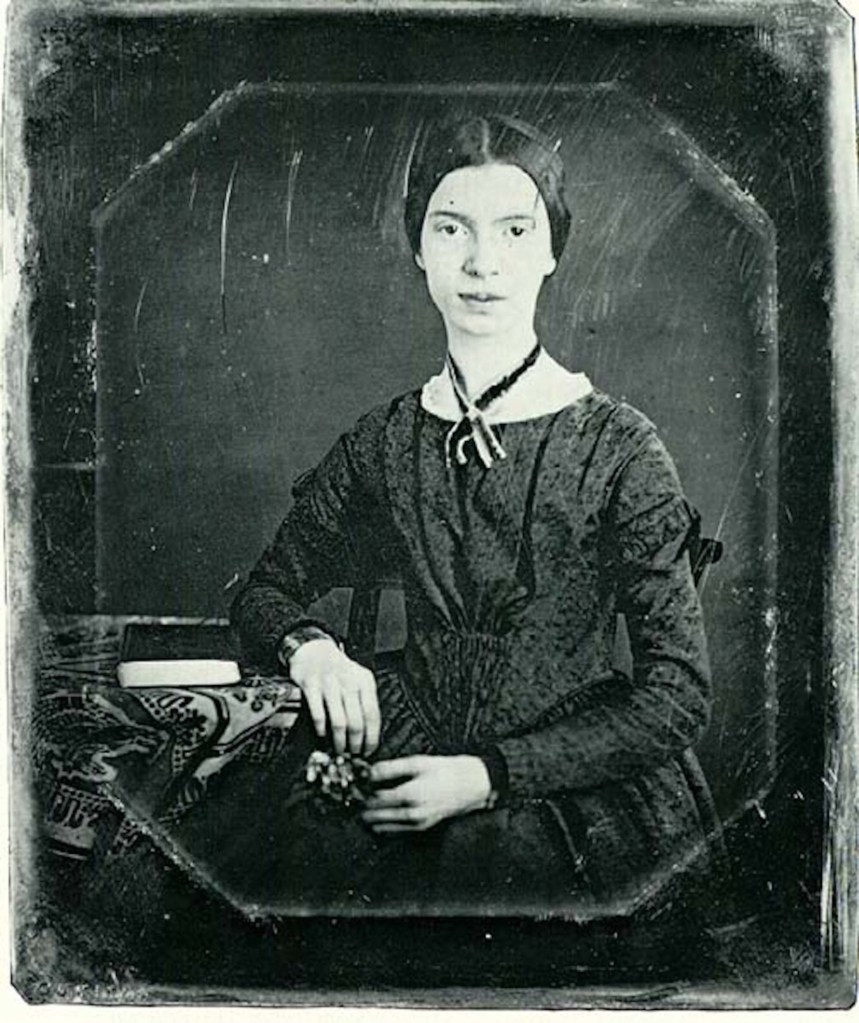
    Image: Emily Dickinson – Amherst College – This daguerrotype circa 1847 at age 17 is likely the only authentic, extant image of the poet.

    Emily Dickinson’s “I have a Bird in spring”

    Emily Dickinson’s riddle-poem “I have a Bird in spring” features the speaker’s musing on her ability to sense existence beyond the earthly, material level of physical reality. She also expresses her confidence that the “Bird” she possesses is not one that she could ever lose.

    Introduction with Text of “I have a Bird in spring”

    Emily Dickinson’s “I have a Bird in spring” exemplifies the poet’s oft-employed strategy of creating little dramas that not only function as poems, but they also work well as fascinating riddles.

    The speaker never states the name of this strange bird that can fly away from her and then return bringing her new melodies from far beyond the sea.  

    This metaphoric avian winging its way beyond a metaphoric sea possesses the delicious power to calm any doubts and fears that might molest the speaker. That a mere bird could retain such seemingly magical powers renders this Dickinsonian riddle one of her most profound and most captivating little dramas.

    I have a Bird in spring

    I have a Bird in spring
    Which for myself doth sing  –
    The spring decoys.
    And as the summer nears  –
    And as the Rose appears,
    Robin is gone.

    Yet do I not repine
    Knowing that Bird of mine
    Though flown  –
    Learneth beyond the sea
    Melody new for me
    And will return.

    Fast in safer hand
    Held in a truer Land
    Are mine  –
    And though they now depart,
    Tell I my doubting heart
    They’re thine.

    In a serener Bright,
    In a more golden light
    I see
    Each little doubt and fear,
    Each little discord here
    Removed.

    Then will I not repine,
    Knowing that Bird of mine
    Though flown
    Shall in distant tree
    Bright melody for me
    Return.

    Reading of “I have a Bird in spring”  

    Commentary on “I have a Bird in spring”

    The speaker muses on and dramatizes the activity of a metaphoric bird that can bring to her wonderful bits of information from beyond the material level of existence.

    First Stanza:  A Strange Bird

    I have a Bird in spring
    Which for myself doth sing  –
    The spring decoys.
    And as the summer nears  –
    And as the Rose appears,
    Robin is gone.

    The speaker begins employing a rather straight forward claim that becomes ever more mysterious as she continues.  She reports that she is in possession of “a Bird in spring.” However, that “Bird” sings for her alone.  Such a statement remains intriguing because it seems obvious that birds sing for everyone, or rather perhaps they sing for no one but themselves and likely other birds.  

    Even if this speaker is creating her little ditty about a pet bird that she keeps in a cage, that bird likely would not sing simply for his care-taker.  Paul Laurence Dunbar’s speaker has averred in his poem “Sympathy” that he “knows why the caged bird sings,” and the bird does not sing only for the one who has caged him.

    Thus, the puzzle continues to plays out. Why is this “Bird” singing only for his owner/care-taker?  Thus, the speaker then asserts that as spring moves on, the season lures her away from her “Bird.” But then as she moves into summer, she becomes attracted by the beauty of “the Rose,” but then her “Bird,” whom she now calls “Robin” has flown away.

    The first stanza leaves the audience cogitating on such a mystifying conundrum:  an unusual bird that seems to belong to a person, simply up and disappears as the season of spring with all of its lushness has captured the individual’s attention and as roses are starting to blow forth for summer.

    Second Stanza:  Not a “bird”  – but a “Bird”

    Yet do I not repine
    Knowing that Bird of mine
    Though flown  –
    Learneth beyond the sea
    Melody new for me
    And will return.

    The speaker then offers yet another surprising claim.  She reports that she does not worry that the bird has vanished.  She remains confident that this special “Bird” has simply winged its way “beyond the sea” where he will accrue some new melodies. 

    The bird with his newly learned repertoire will then return to her.  Once again, the speaker has offered an even more puzzling event for the audience to ponder.  Her rare bird has apparently flown away, but the avian’s owner/care-taker seems to remain convinced that he will fly back to her.  The likelihood of any person recognizing the same bird that had flown far way from her remains next to nil.  

    As thousands of birds appear and fly away chirping throughout the land or landing in trees, the ability to distinguish the same bird as the exact one that flew away and then returned would be a stunning feat.

    The speaker’s claim seems ridiculous—however,  it may not be ridiculous because that “Bird” that she owns is not a “bird.” Instead the avian referred to by the speaker is, in fact, a “Bird.”  It is thus a metaphorical bird.  And because he is a metaphoric not a literal bird, the audience has to rethink all those claims that seemed so terribly unusual. 

    In order to take this confusing discourse seriously, the reader must interpret a metaphorical bird. How can a bird be metaphorical?   The speaker is calling a bird a “Bird,” and that figurative “Bird”  is not a literal bird.

    Third Stanza:  Divine Creator as Muse

    Fast in safer hand
    Held in a truer Land
    Are mine  –
    And though they now depart,
    Tell I my doubting heart
    They’re thine.

    The speaker then makes it clear that this metaphorical “Bird” is her muse.  Her muse thus retains the qualities, features, and aspects of her soul.  Those soul qualities and functions permit her to fashion a new creation, such as her magnificent other “sky,” which includes her marvelously perpetual “garden” of poetry.  Thus, the speaker creates her garden of verse, where she can spend her time, her effort, and her love.  In this metaphysical world, she can continue to  fashion a different world.  

    Even as she lives in the world of physical, material, earthly existence, because she communes with her inner being—her soul which is a spark of the Ultimate Creator (God)—she can create just the Creator does.

    Her soul—through the instrumentality of her metaphysical “Bird”— bestows on her the ability to comprehend that fact that she along with her talent remains secure in the presence of the Divine Creator.  

    The speaker, her soul, her muse, and her talent are all “Held in a truer Land”—a metaphorical, cosmic location that remains more real because it is ever existing as well as eternally present, unlike the planet called Earth, on which immortality and eternity do not exist.  

    Aging, fading, destruction, and death obtain on the physical level of existence, for example, on such place as the Earth planet.  The speaker’s compendium of joy includes her mental abilities, her writing talent, and her love and appreciation of beauty, poetry, and the arts and science.

    This compendium the speaker has fashioned into  a metaphorical, metaphysical “Bird” is secured “fast” by a “safer hand.”   The speaker’s Heavenly Father, Divine Creator (God) guides and guards her in myriad mystery-making ways.  She remains aware, however, that she follows that guidance through faith because she continues to work and ponder with a “doubting heart.”  

    However, she informs her doubting heart that the compendium of joyous qualities, metaphorically fashioned into her “Bird,” still belong to her.  Though at times they may seem to move beyond her sight, her strong faith keeps her mind convinced that immortality and eternity belong to her.

    As the Shakespearean sonneteer, who often complains about periods of creative dryness that afflict him, this speaker confesses that certain entities and events of spring and summer may distract her, allowing her “Bird” to seem to fly off and disappear for long whiles.   Nevertheless, she finds relief through the understanding that her talent is merely resting and likely experiencing further development somewhere out of her vision.

    Her “Bird” is just off somewhere learning new melodies for her to sing and fashion into new dramas.  Even more important is that she need not entertain doubts about the return of that special bird.  They will return to her because “They’re [hers].”  What belongs to her, she cannot lose.

    Fourth Stanza:  Seeing through Mystic Eyes

    In a serener Bright,
    In a more golden light
    I see
    Each little doubt and fear,
    Each little discord here
    Removed.

    The speaker moves on detailing the reasoning that allows her to be sure that her “Bird” will return to her.   During her periods of clear sight which she at times experiences even with the absence of her “Bird,” she can sense in a “more golden light” that all her doubts, worries, fears, and discordant thoughts “here” can be removed.  

    As she remains living upon this Earth planet, she acknowledges that her fears will likely persist in attacking her. However, because of her assurance of her own divinity through her the power of her soul—that spark of the Divine Creator—she remains capable of realizing that those trials and tribulations brought on by the dualities and pairs of opposites of Earth life are time-stamped.

    In opposition to the temporal, her soul power is permanent without any limitation or stamp of time.  The speaker possesses to ability to perceive through mystic eyes in a “serener Bright” and “golden light.”   These cosmic lights bestow upon her the ability to quiet her doubting heart.

    She possesses the awareness that Eternity and Immortality are hers.  Her capacity to continue creating her own “sky” and “garden” remains absolute—the knowledge of the Absolute has the power to quiet and even eliminate fears and doubts.

    Fifth Stanza:  The Virtue of Patience

    Then will I not repine,
    Knowing that Bird of mine
    Though flown
    Shall in distant tree
    Bright melody for me
    Return.

    The speaker can finally report that she will no longer fuss and fret if her “Bird” remains away from her for extended periods.  She will remain confident that he will return to her and bring with him beautiful, glowing melodies.  

    Even though that “Bird of [hers]” may retain a inclination for disappearing from her sight, she is sure that her own consciousness is simply being distracted by other entities and events of “spring” and “summer.”   Those warm seasonal activities just permit her “Bird” to flutter deep into the darkened areas of her mental sphere.

    The speaker experiences great joy in creating her little dramatic pieces, and also once again similar to the Shakespearean sonneteer, she possesses the great ability to create her dramas even as she appears to be experiencing a blockage in the flowing of her words.  

    Incubation and Writing

    Writing teachers and rhetoricians explain the concept of incubation as a stage of the writing process, a period of time when the writer seems not to be thinking directly about his writing project but to be allowing his thoughts to quietly proliferate, even as he goes about performing other activities. 

    Dickinson and the Shakespearean sonneteer, as creative writers, were able to use that concept for creating their little dramas, even as they, no doubt, chafed under their seeming inability to create.

    Dickinson’s mystic sight afforded her an even stronger talent for delivering her mind to performance because she knew her soul to be immortal, and she was able to see mystically beyond the physical, Earth-level of being.   The Shakespeare writer’s faith was strong enough to render him nearly as capable as Dickinson, as his “Muse” sonnet sequence (Part 1 and Part 2) testifies.
  • Emily Dickinson’s “There is another sky”

    Image: Emily Dickinson – Amherst College – This daguerrotype circa 1847 at age 17 is likely the only authentic, extant image of the poet.

    Emily Dickinson’s “There is another sky”

    Emily Dickinson’s “There is another sky” reveals the speaker’s confidence in her creation of a world of beauty that will exist in perpetuity.  She is envisioning a world beyond the physical level of existence, where permanence prevails in things of beauty.

    Introduction with Text of “There is another sky”

    Emily Dickinson’s “There is another sky” is an American-Innovative sonnet. Each line is short, featuring only 3 to 5 metric feet, and with Dickinson’s characteristic slant or near rime; the rime scheme plays out roughly, ABCBCDECFCGHIH.  

    This American-Innovative sonnet thematically sections itself into two quatrains and a sestet, making it a gentle melding of the English (Shakespeare) and Italian (Petrarchan) sonnets.  The speaker of the poem is previewing  her intention to establish a world where the pairs of opposites do not obstruct the lives of the inhabitants.  

    Such beloved features and qualities of life, such as beauty, peace, harmony, balance, and love will hold sway uninterrupted by pesky things like change and disfigurement in her newly created “garden.”   On a second note, she is also inviting her brother to enter her new garden that exists under a different sky so that he too may enjoy the divinely fragranced atmosphere of her new creation.

    On the literal level, the poet is creating a speaker who is announcing her audacious plan to create a brand new world with her poetry.  It will be such a special place so other-worldly that nothing  unpleasant that exists in earthly reality will exist there.  

    Because everything she creates will be based on her imagination and intuition, she can fashion her “garden” to grow anything she finds feasible.  That she anticipates no arrival of “frost,’ she can guarantee that flowers will not “fade.” Also leaves will be able to remain “ever green.”  

    Posing as a invitation, Dickinson’s little drama serves as a clever ruse to persuade her brother to come and experience her poetry.  By promising him a whole new, different world, she no doubt hopes he will be more likely to take her up on her offer.

    There is another sky

    There is another sky,
    Ever serene and fair,
    And there is another sunshine,
    Though it be darkness there;
    Never mind faded forests, Austin,
    Never mind silent fields –
    Here is a little forest,
    Whose leaf is ever green;
    Here is a brighter garden,
    Where not a frost has been;
    In its unfading flowers
    I hear the bright bee hum:
    Prithee, my brother,
    Into my garden come!

    Reading of “There is another sky” 

    Commentary on “There is another sky”

    Emily Dickinson’s “There is another sky” reveals an attitude dramatized in the Shakespeare sonnets: the poet’s confidence in her creation of a world of beauty that will last forever.

    The poem is a literal invitation from the poet to her brother Austin to read her poetry, where she is erecting a new place to exist, a beautiful garden free of the decay that literal gardens must undergo.

    First Quatrain:  Physical Sky vs Metaphysical Sky

    There is another sky,
    Ever serene and fair,
    And there is another sunshine,
    Though it be darkness there;

    In the first quatrain, the speaker begins by alerting readers that in addition to the “sky” and “sunshine” that already experience on the earthly level, there exist a different sky and a different sunshine.

    The other sky about which the speaker is declaiming is always “serene and fair.  Thus, no thunder storms or dark clouds intrude into this new sky’s space.  The beauty and calmness of a clear blue sky offer an inviting and intriguing possibility.

    The speaker then announces the existence of “another sunshine.”  But this sunshine seems to have the magic and delicious power to shining even through the darkness.  This claim is the first flag that the speaker will be referring to a mystical or metaphysical place that only the soul can perceive.

    Behind the darkness of closed eyes, the only “sunshine” or light that can be seen is that of the spiritual eye.  Although the speaker cannot guarantee that her entire audience will be able to see such “sunshine,” she is sure that on a mental level they can imagine such a heavenly place.

    Second Quatrain:  No Fading in the Metaphysical Universe


    Never mind faded forests, Austin,
    Never mind silent fields –
    Here is a little forest,
    Whose leaf is ever green;

    The speaker then directly addresses someone, admonishing him to pay no attention to “faded forests.” She then the addresses the individual by name, “Austin. ” Austin is the name of Dickinson’s brother. She then admonishes Austin to ignore the “silent fields.”

    The reason that Austin should ignore those faded forests and silent fields is that in this place to which she is inviting him, the “little forest” presents leaves that remain perpetually green.  And the fields will remain perpetually filled with fruitful crops, never having to lie fallow.

    While dropping hints throughout, he speaker remains illusive regarding the whereabouts of this place where the sky, the sun, forests and fields, and leaves all behave differently from that of the physical universe that humanity must experience on the earthly plane.

    Sestet:  Invitation to the Metaphysical Garden

    Here is a brighter garden,
    Where not a frost has been;
    In its unfading flowers
    I hear the bright bee hum:
    Prithee, my brother,
    Into my garden come!

    The speaker now offers some further description of this new place with a new sky and new sun;  she then states that that place is “a brighter garden.” As earthly gardens are bright, mystical or metaphysical gardens remain even brighter.

    In the metaphysical garden, there is never a fear of “frost” that kills earthly plants with its sting.  Flowers will not fade because of frost or from simply aging.  The magic of her garden will guarantee that the beauty of the flowers will bloom forth in perpetuity.

    Because of the ability of the flowers to remain “unfading,” bees will always be able to partake of their nectar any time they choose.  Thus, the speaker avers that she can “hear the bright bee hum.”  

    The bright bee is, no doubt, brighter than the ordinary, earthly, literal bee.  And because of the permanence of her newly created metaphysical garden, she can listen to the pleasant hum any time she wishes.

    In the final couplet, the speaker sets forth the clear invitation to her brother, virtually begging him to come into her garden.  She employs the archaic expression “[p]rithee” (conflation of “pray thee”) to emphasize her desire that he take her up on her offer to visit her “garden.”

    On the literal level, the poet has created a speaker who extends an invitation to the poet’s brother to read her poems.  She has offered an alluring set of reasons to try to capture the brother’s imagination and interest.  

    And to her other readers, the poet has created a speaker to extend that same invitation, as she hopes the notion of a new, permanent, created world will capture their imaginations also.

    Dickinson Riddles

    Emily Dickinson’s  American-Innovative sonnet “There is another sky” is one of the poet’s many riddles.  Her speaker never states directly that the garden is her poetry, but still, she is inviting her brother in to read her poems. 

    The speaker continues to imply throughout the sonnet that she has constructed a whole new world, where things can live unmolested by the irritants that exist on the physical plane of life.  The sky can remain “serene and fair”—no storms, tornadoes, hurricanes, heavy rainstorms that frighten and damage.

    And the sunshine can present itself even through the darkness. Forests never fade and die out, and the fields remain always bursting with life; they never lie fallow or turn to dust as on the real, earthy plane—that literal world. 

    The trees can enjoy wearing green leaves and never have to drop them after they turn all brown or rusty. The speaker is privy to all these utopian-sounding acts because she has created it. 

    And like the master writer of the Shakespeare sonnets, Dickinson’s speaker knows that she has fashioned out of crude, earthly nature an art that will provide pleasure in perpetuity to the minds and hearts of those who have the ability to imagine and intuit along with her.

    This speaker further demonstrates a certain level of cheek and courage by inviting her own brother into her creation.  While she no doubt quietly wonders if he will be as impressed as she is, she shows a certain level of confidence by offering such an invitation.

    Full Image: Emily Dickinson – Amherst College – This daguerrotype circa 1847 at age 17 is likely the only authentic, extant image of the poet.
  • Emily Dickinson’s “After great pain, a formal feeling comes”

    Emily Dickinson’s “After great pain, a formal feeling comes”

    Emily Dickinson’s “After great pain, a formal feeling comes” is the poem equivalent of a sculpture carved to represent grief; the poet has metaphorically carved from the rock of suffering a remarkable statue of the human mind that has experienced severe agony.

    Introduction and Text of “After great pain, a formal feeling comes”

    The speaker in Emily Dickinson’s “After great pain, a formal feeling comes” (number 341 in Thomas H. Johnson’s Complete Poems) is creating an intense drama that sets in center stage the bitter agony involved in experiencing utter torment. 

    The speaker does not name the origin of the certain type of “pain,” because she takes as her purpose only the illumination of the effect she is exploring.  If the individual is grieving because of losing a loved one to death or possibly to the breaking up of a friendship, pain will affect that individual in a similar manner to one surfing from an fatal illness.  The result of pain regardless of the cause is the issue, not the cause itself.

    The tragedy of cause may be held in abeyance and explored separately.  When pain itself is explored, it is not also necessary to make clear the original cause for the onset of the pain.  The issue of pain itself and how the human heart and mind respond to that stimulus offer a sufficient quantity of material on which to focus.

    The poem plays out in three stanzas; the first and third stand in quatrains, while the middle stanza is displayed in a cinquain. The poem features a masterful dramatization, resembling a sculpture set in stone.  This poem testifies to the greatness of Emily Dickinson, not only as a poet but also as a lay psychologist.

    That the poet was able to sculpt her poem from the stone of grief demonstrates her versatility and the ability to envision and craft into images the language of the heart and mind.

    After great pain, a formal feeling comes –

    After great pain, a formal feeling comes –
    The Nerves sit ceremonious, like Tombs –
    The stiff Heart questions was it He, that bore,
    And Yesterday, or Centuries before?

    The Feet, mechanical, go round –
    Of Ground, or Air, or Ought –
    A Wooden Way
    Regardless grown,
    A Quartz contentment, like a stone –

    This is the Hour of Lead –
    Remembered, if outlived,
    As Freezing persons, recollect the Snow –
    First – Chill – then Stupor – then the letting go –

    Reading of “After great pain, a formal feeling comes” 

    Commentary on “After great pain, a formal feeling comes”

    The images that represent hardness, stillness, and cold combine to create the substance out of which this intense drama grows into existence.  The images, while mostly concentrated in the visual, however, bleed over into the other senses.   One can virtually hear the hardness and stiffness that afflict the heart and mind as the individual suffers the great agony described so colorfully and precisely. 

    First Stanza:  Stunned by the Onset of Grief

    After great pain, a formal feeling comes –
    The Nerves sit ceremonious, like Tombs –
    The stiff Heart questions was it He, that bore,
    And Yesterday, or Centuries before?

    The speaker begins the scene with a rather dramatic claim that after the experience of some great event causing suffering, a state of solemnity visits the heart and mind of the sufferer.  This simple claim puts a label on the stunned feeling which has accompanied the sudden arrival of grief.  

    That grief results from having experienced some great tragic terror or torment, and that intense feeling can be described as “formal,” as the next step of trying to accept and overcome that pain must be taken.  The opposite emotion would then necessarily be “informal,” wherein the individual would remain content or perhaps even in the neutrality of emotion that would cause not feeling at all.  

    The usual non-suffering consciousness retains no special form, as it spreads out over the heart and mind, formless, shapeless, and unrecognized until nudged into existence by its opposite—or near opposite.    The neutrally existing emotion remains neutral or unfeeling until it is forced by circumstances to feel in order to act.

    After the suffering begins, the consciousness becomes aware of itself as it begins to feel the sensations of cold, hard, and/or stiff, as in the colorful image, the “Nerves sit ceremonious, like Tombs.”   Time then lets loose its strict hold on consciousness, prompted by the intensity of feeling.  

    The suffering victim can fanaticize that she has been feeling this new way for an eternity.   The personified heart begins to pose questions to the mind, trying to distinguish just how long the pain has been afflicting it: did it happen yesterday or was it ages ago? Such a “stiff Heart” can no longer sense time—minutes, day, years all seem irrelevant to the individual suffering from fierce agony because in such distress, it seems that such a state will never end.

    Second Stanza:  The Expansion of Formal Stiffness throughout Body and Mind

    The Feet, mechanical, go round –
    Of Ground, or Air, or Ought –
    A Wooden Way
    Regardless grown,
    A Quartz contentment, like a stone –

    The sufferer may seem to pass through her hours and days as would an automaton.  The stiffness seems to expand throughout the body from the heart to the feet that are no longer driven by organic impulse but by some “mechanical” motor.  They go but without purpose or desire.

    The suffering individual seems to be just “going through the motions” of living, or rather existing, for she has become incapable of sensitive living.  Her life has become “Wooden”; she pays no attention to important details.  She might as well be “a stone”—her ability to enjoy “contentment” is simply like a piece of “Quartz”—inanimate, hard, and cold.  She has become a cliché, attempting to carve out her existence on this newly found pice of rock that she has experienced as inordinate pain.

    Third Stanza:  Uncertainty of Outliving the Trauma

    This is the Hour of Lead –
    Remembered, if outlived,
    As Freezing persons, recollect the Snow –
    First – Chill – then Stupor – then the letting go –

    This horrendous suffering has effected this hard, cold, stiff formality, and it has morphed into a dreadful “Hour of Lead, ” causing time to transform into an ocean of lead.  The navigator on such a sea finds it virtually impossible to move forward.

    Such pain must be overcome, if the individual is to continue living her life.  Thus, the speaker must reach some satisfactory conclusion.  So she arrives at the possibility that if the suffering soul can just manage to live through the painful event, she will still remember the experience.  

    The question then becomes how will looking back and recalling such pain affect the person’s life in future time.  The speaker decides that recalling such an event will resemble remembering almost dying from freezing to death in the snow.

    First, she will recall the freezing chill.  Then she will remember nearly losing consciousness and remaining in a stupefied state of awareness.   And finally she will realize that she can hold on no longer, and then she will allow herself simply to relax let go of all thoughts involving the trauma.  As she remained in the throes of torment, the sufferer could not be assured that she could live through the event.  

    However, if she does outlive the tragedy, according to her conclusion, she should be able to look back and recall the pain as a cold, hard, stiff substance that stiffened her until she finally managed to control and lose the consciousness that felt that unendurable misery.

  • Emily Dickinson’s “Because I could not stop for Death”

    Image: Emily Dickinson  This daguerrotype, circa 1847 at age 17,  is likely the only authentic, extant image of the poet.

    Emily Dickinson’s “Because I could not stop for Death”

    Emily Dickinson’s mystical drama features a carriage driver who appears to be a gentleman caller.  The speaker abandons both her work and leisure in order to accompany the kind gentleman on a carriage ride.  Dickinson’s mystical tendencies are on pull display in this poem.

    Introduction with Text of “Because I could not stop for Death”

    Emily Dickinson’s mystical drama “Because I could not stop for Death” plays out with a carriage driver who appears to be a gentleman calling on a lady for an evening outing.  The speaker leaves off her work as well as her leisure activities in order to accompany the gentleman on the carriage ride to their unspecified festivities.

    Certain childhood memories occasionally spur poets to compose verse that is thus influenced by such musing on past memories.  Examples of such nostalgic daydreaming include Dylan Thomas’ “Fern Hill,” Theodore Roethke’s “My Papa’s Waltz,” and a nearly perfect American-Innovative sonnet by Robert Hayden “Those Winter Sundays.” 

    In Emily Dickinson’s “Because I could not stop for Death,” the speaker is also gazing back into her past, but this occasion is a much more momentous musing than merely an ordinary childhood recollection.  The speaker in this memory poem is recalling the day she died. 

    The speaker frames the occasion as a metaphoric carriage ride with Death as the gentleman caller. This speaker is peering intuitively into the plane of existence well beyond that of the earth and into the eternal, spiritual level of being.

    Interestingly, the procession that the carriage ride follows seems to be echoing the concept that in the process of leaving the physical body at death, the mental faculty encased in the soul, experiences past scenes from its current existence. 

    Examples of such past-experienced scenes include the riding by a school and observing that the children were playing at recess; then, they drive by a field of grain and observe the sunset. These are scenes that the speaker has undoubtedly experienced during her current incarnational lifetime.

    Because I could not stop for Death

    Because I could not stop for Death –
    He kindly stopped for me –
    The Carriage held but just Ourselves –
    And Immortality.

    We slowly drove – He knew no haste,
    And I had put away
    My labor and my leisure too,
    For His Civility –

    We passed the School, where Children strove
    At recess – in the ring –
    We passed the Fields of Gazing Grain –
    We passed the Setting Sun –

    Or rather – He passed Us –
    The Dews drew quivering and chill –
    For only Gossamer, my Gown –
    My Tippet – only Tulle –

    We paused before a House that seemed
    A Swelling of the Ground –
    The Roof was scarcely visible –
    The Cornice – in the Ground –

    Since then – ’tis centuries – and yet
    Feels shorter than the Day
    I first surmised the Horses’ Heads
    Were toward Eternity –

    Reading of “Because I could not stop for Death” 

    Commentary on “Because I could not stop for Death”

    The speaker avers that she had no inclination to stop what she was doing for the sake of “Death.”  Nevertheless, Death—as a kindly carriage driver, appearing to be a gentleman caller—was polite enough to invite her to join him on an outing.  

    Because of this kind gentleman’s polite demeanor, the speaker gladly leaves off both her ordinary, daily work plus her free time hours in order to accompany the gentleman on what portends to be a simple, pleasant carriage ride, perhaps including some evening social event.

    First Stanza: An Unorthodox Carriage Ride

    Because I could not stop for Death –
    He kindly stopped for me –
    The Carriage held but just Ourselves –
    And Immortality.

    In the first stanza, the speaker claims startlingly that she was unable to avail herself to cease her work and leave off her free time for a certain gentleman, whom she names “Death.”

    However, that gentleman Death had no problem in stopping for her, and he did so in such a polite fashion that she readily acquiesced to his kindness and agreed to join him for a carriage ride. 

    The speaker offers an additional shocking remark, noting that the carriage, in which the speaker and gentleman caller Death rode, was transporting not only the speaker and the gentleman but also one other passenger—”Immortality.”  Thus, the speaker has begun to dramatize an utterly unorthodox buggy ride. 

    The kind gentleman Death has picked up the speaker as if she were his date for a simple carriage ride through the countryside, but something otherworldly intrudes immediately with the presence of the third passenger.

    By personifying “Death” as a gentleman caller, the speaker imparts to that act a certain level of rationality that levels out fear and trepidation usually associated with the idea of dying.  

    Second Stanza:  The Gentleman Caller

    We slowly drove – He knew no haste,
    And I had put away
    My labor and my leisure too,
    For His Civility –

    The speaker then describes her momentous event. She has not only ceased her ordinary work, but she has also concluded her leisure–certainly not unusual for someone who dies.

    The gentleman caller Death has been so persuasive in suggesting a carriage ride that the speaker has easily complied with his suggestion. This kind and gracious man was in no hurry; instead, he offered a rhythmically methodical ushering into realms of peace and quiet.

    Third Stanza: A Review of a Life Lived

    We passed the School, where Children strove
    At recess – in the ring –
    We passed the Fields of Gazing Grain –
    We passed the Setting Sun –

    Next, the speaker reports that she was able to observe children playing at school during recess. She also views cornfields or perhaps fields of wheat.  She, then, views the setting of the sun. 

    The images observed by the speaker may be interpreted as symbols of three stages in each human life:  (1) children playing representing childhood, (2) the growing fields of grain symbolizing adulthood, and (3) the setting sun representing old age.

    The imagery also brings to mind the well-known concept that a dying person may experience the passing of scenes from one’s life before the mind’s eye.   The experience of viewing of past scenic memories from the dying person’s life seems likely to be for the purpose of readying the human soul for its next incarnation.

    Fourth Stanza:  The Passing Scenes

    Or rather – He passed Us –
    The Dews drew quivering and chill –
    For only Gossamer, my Gown –
    My Tippet – only Tulle –

    The speaker reveals that she is dressed in very light clothing.  On the one hand, she experiences a chill at witnessing the startling images passing before her sight.  But is it the light clothing or is it some other phenomenon causing the chill?

    Then on the other hand, it seems that instead of the carriage passing those scenes she has described of children playing, grain growing, and sun setting, those scenes may actually be passing the carriage riders.  The uncertainly regarding this turn of events once again supports the commonly held notion that the speaker is viewing her life passing before her eyes.

    Fifth Stanza:  The Pause

    We paused before a House that seemed
    A Swelling of the Ground –
    The Roof was scarcely visible –
    The Cornice – in the Ground –

    By now, the carriage has almost reached its destination, and instead of a gala or festive outing, it is the speaker’s gravesite before which the carriage has momentarily stopped. 

    Apparently, without shock or surprise, the speaker now dramatically unveils the image of the grave:  she sees a mound of dirt, but she cannot see the roof of the building that she expected, and any ornamental moulding that might have decorated the house also remains out of the sight of the speaker who assumes it is “in the Ground.”

    Sixth Stanza: Looking Back from Eternity

    Since then – ’tis centuries – and yet
    Feels shorter than the Day
    I first surmised the Horses’ Heads
    Were toward Eternity –

    In the final scene, the speaker is calmly reporting that she remains now—and has been all along—centuries in future time. She speaks plainly from her cosmic, eternal home on the spiritual/astral level of being. She has been reporting only on how events seemed to go on the day she died, that is, that day that her soul left its physical encasement.

    She recalls what she saw only briefly just after leaving her physical encasement (body). Yet, the time from the day she died to her time now centuries later feels to her soul as if it were a very short period of time. 

    The time that has passed, though it may be centuries, seems to the speaker relatively shorter than the earthly day of 24 hours.  The speaker avers that on that day the heads of the horses drawing the carriage were pointing “toward Eternity.” 

    The speaker has unequivocally described through metaphor and metaphysical terminology the transition from life to death. That third occupant of the carriage offered the assurance that the speaker’s soul had left the body but continued to exist beyond that body.

  • Two Winter Poems: Emily Dickinson’s “Winter is good – his Hoar Delights” and “Like Brooms of Steel”

    Image: Emily Dickinson – Amherst College  – This daguerrotype of the poet at age 17 is likely the only extant authentic image of Emily Dickinson.

    Two Winter Poems: Emily Dickinson’s “Winter is good – his Hoar Delights” and “Like Brooms of Steel”

    For Emily Dickinson, the seasons offered ample opportunities for verse creation, and her love for all of the seasons is quite evident in her poems.  However, her poetic dramas become especially deep and profound in her winter poems.

    First Winter Poem: “Winter is good – his Hoar Delights”

    Emily Dickinson creates speakers who are every bit as a tricky as Robert Frost’s tricky speakers. Her two-stanza, eight-line lyric announcing, “Winter is good” attests to the poet’s skill of seemingly praising while showing disdain in the same breath.

    The rime scheme of “Winter is good – his Hoar Delights” enforces the slant rime predilection with the ABAB approximation in each stanza.  All of the rimes are near or  slant in the first stanza, while the second boasts a perfect rime in Rose/goes.

    Winter is good – his Hoar Delights

    Winter is good – his Hoar Delights
    Italic flavor yield –
    To Intellects inebriate
    With Summer, or the World –

    Generic as a Quarry
    And hearty – as a Rose –
    Invited with Asperity
    But welcome when he goes.

    Commentary on “Winter is good – his Hoar Delights”

    Emily Dickinson loved all of the seasons, and she found them inspiringly colorful in their many differing attributes.  These seasonal characteristics gave this observant poet much material for her creative little dramas.

    First Stanza: Winter’s Buried Charms

    Winter is good – his Hoar Delights
    Italic flavor yield –
    To Intellects inebriate
    With Summer, or the World –

    The speaker claims rather blandly that “Winter is good” but quickly adds not so plainly that his frost is delightful. That winter’s frost would delight one, however, depends on the individual’s ability to achieve a level of drunkenness with “Summer” or “the World.” 

    For those who fancy summer and become “inebriat[ed]” with the warm season’s charms, winter takes some digging to unearth its buried charm.  And the speaker knows that most folks will never bother to attempt to find anything charming about the season they least favor.

    But those frozen frosts will “yield” their “Italic flavor” to those who are perceptive and desirous enough to pursue any “Delights” that may be held there.  The warmth of the Italian climate renders the summer flavors a madness held in check by an other-worldliness provided by the northern climes.

    The speaker’s knowledge of the climate of Italy need be only superficial to assist in making the implications this speaker makes.  Becoming drunk with winter, therefore, is a very different sport from finding oneself inebriated with summer, which can be, especially with Dickinson, akin to spiritual intoxication.

    Second Stanza: Repository of Fine Qualities

    Generic as a Quarry
    And hearty – as a Rose –
    Invited with Asperity
    But welcome when he goes.

    Nevertheless, the speaker, before her hard-hitting yet softly-applied critique, makes it clear that winter holds much to be honored; after all, the season is “Generic as a Quarry / And hearty – as a Rose.”  It generates enough genuine qualities to be considered a repository like a stone quarry that can be mined for all types of valuable rocks, gems, and granite.

    The season is “hearty” in the same manner that a lovely flower is “hearty.” The rose, although it can be a fickle and finicky plant to cultivate, provides a strength of beauty that rivals other blossoms.    That the freezing season is replete with beauty and its motivating natural elements render it a fertile time for the fertile mind of the poet.

    But despite the useful and luxuriant possibilities of winter, even the mind that is perceptive enough to appreciate its magnanimity has to be relieved when that frozen season leaves the premises or as the speaker so refreshingly puts it, he is “welcome when he goes.” The paradox of being “welcome” when “he goes” offers an apt conclusion to this tongue-in-cheek, left-handed praise of the coldest season.  

    The speaker leaves the reader assured that although she recognizes and even loves winter, she can well do without his more stark realities as she welcomes spring and welcomes saying good-bye to the winter months.

    Second Winter Poem: “Like Brooms of Steel”

    Emily Dickinson’s “Like Brooms of Steel” features the riddle-like metaphoric usage that the poet so often employs.  She playfully turns the natural elements of snow and wind into brooms made of steel and allows them to sweep the streets, while the coldness draws stillness through the landscape.

    Like Brooms of Steel

    Like Brooms of Steel
    The Snow and Wind
    Had swept the Winter Street –
    The House was hooked
    The Sun sent out
    Faint Deputies of Heat —
    Where rode the Bird
    The Silence tied
    His ample — plodding Steed
    The Apple in the Cellar snug
    Was all the one that played.

    Commentary  on “Like Brooms of Steel”

    For Emily Dickinson the seasons offered ample opportunities for verse creation, and her love for all of the seasons is quite evident in her poems.  However, her poetic dramas become especially deep and profound in her winter poems.

    First Movement:   The Nature of Things in Winter

    Like Brooms of Steel
    The Snow and Wind
    Had swept the Winter Street —

    The speaker has been observing and musing on the nature of things in winter. She finally speaks and makes the remarkable claim that the “Winter Street” looks as if it has been swept by “Brooms of Steel.” The “Snow and Wind” are the agencies that have behaved like those hard, industrial brooms.  In Dickinson’s time were decidedly absent those big plows we have today that come rumbling down the streets, county roads, and interstates.

    But those simple natural elements of snow and wind have moved the snow down the street in such a way that it looks as if it has been swept with a broom. And not just a straw broom would do, but it had to be a steel broom, an anomaly even in Dickinson’s century.

    Second Movement:  House as Big Warm Rug

    The House was hooked
    The Sun sent out
    Faint Deputies of Heat –

    The speaker then remarks about “the House,” which looked as if it had been, “hooked.” She is referring to the process of creating a rug with a loom that employs a hook.  The house is like a big warm rug as “The Sun sent out / Faint Deputies of Heat.” Of course, the sun will always be sending out heat, but this speaker looks upon those dribbles of warmth as mere “Deputies.”  They are sent in place of the sheriff, who will not appear until summer, or late spring at the most.

    Third Movement:  A Tree Steed

    Where rode the Bird
    The Silence tied
    His ample – plodding Steed

    The speaker then spies a bird, who seems to have ridden in on a “plodding Steed.” But the steed has been stilled by “silence”—denoting that the steed was indeed a tall tree. The tree is silenced by fall having blown away all of his leaves. He no longer rustles in the wind, but he does serve as a useful vehicle for both bird and poet.

    Fourth Movement:   Silent, Frozen

    The Apple in the Cellar snug
    Was all the one that played.

    The winter scene is filled with things that are still, silent, frozen in place by those agents of cold. The still bird sits in the still tree, silent, waiting in the frozen atmosphere. The musing speaker detects both silence and stillness and makes them vibrant with an inner, spiritual movement.

    Yet, the speaker has to confess that the only real movement, things that might be said to have “played” that cold day, belongs to the “Apple in the Cellar.” The apple is “snug,” wrapped in tissue paper, preserved for the long winter months. 

    Or perhaps even some apple wine is “snug” in its bottle, and might even be a better candidate for playing.  But they differ greatly from those outdoor creatures; those apples possess a level of warmth that allows them to play, although the irony of such playing might intrigue and tickle the fancy of the musing mind that deigns to contemplate the icy bitterness of winter.

    Misplaced Line Alters Meaning

    A number of sites that offer this poem—for example, bartleby.com—misplace the line, “The Apple in the Cellar snug,” relocating it after “Faint Deputies of Heat.”

    This alteration changes the meaning of the poem:  Dickinson’s poem makes it clear that it is the “apple” that is the only one who played.  While it might seem more sensible to say a horse played instead of an apple, that is not what the original poem states.   And, in actuality, the apple does, in fact, do some moving as it will begin to decay even though it is securely wrapped for winter and stored in the cellar.

    The problem is, however, that the speaker has said that silence has “tied” or stilled the steed; he is not moving, which means that the bird is not moving. So to claim that the steed is playing gives motion to the bird, which the speaker claims is still.

    The only thing that makes sense is that the speaker is exaggerating the stillness by saying that the snug apple is playing. The irony of a playing apple does not contradict the stillness that the speaker is painting, while the playing steed would violate and confuse that meaning.

    Full daguerrotype image of Dickinson at age 17

    🕉

    You are welcome to join me on the following social media:
    TruthSocial, Locals, Gettr, X, Bluesky, Facebook, Pinterest 

    🕉

    Share

  • Emily Dickinson’s “Nature – the Gentlest Mother is”

    Image: Emily Dickinson – Amherst College – Daguerrotype of the poet at age 17, circa 1847 – likely the only authentic, extant likeness of the poet

    Emily Dickinson’s “Nature – the Gentlest Mother is”

    In a unique mystical voice, Emily Dickinson’s speaker is dramatizing a number of the many ways in which Mother Nature takes care of her children.  Dickinson’s keep observation and knowledge of science allowed her the ability to skillfully create her little dramas about her surroundings.

    Introduction with Text of “Nature – the Gentlest Mother is”

    Emily Dickinson’s love of nature was deep and abiding.  Along with her intense study of and research in the sciences, she observed her surroundings keenly and those activities bestowed on her the ability to render into art her amazingly beautiful and accurate statements regarding how nature functions.

    Dickinson discovered the careful nurturing as well as the softly discipling forces of nature, and she observed those qualities in both the animal and plant kingdoms.  Those natural qualities motivated a deep affection for the workings of all of God’s creation.

    This poem contrasts greatly with her riddle-poems, for it states explicitly the target of her observation—nature.  After he clear statement of focus, she demonstrates how keen were her powers of observation and then how skillful she was in transforming those observations into art.

    Nature – the Gentlest Mother is

    Nature – the Gentlest Mother is,
    Impatient of no Child –
    The feeblest – or the waywardest –
    Her Admonition mild –

    In Forest – and the Hill –
    By Traveller – be heard –
    Restraining Rampant Squirrel –
    Or too impetuous Bird –

    How fair Her Conversation –
    A Summer Afternoon –
    Her Household – Her Assembly –
    And when the Sun go down –

    Her Voice among the Aisles
    Incite the timid prayer
    Of the minutest Cricket –
    The most unworthy Flower –

    When all the Children sleep –
    She turns as long away
    As will suffice to light Her lamps –
    Then bending from the Sky –

    With infinite Affection –
    And infiniter Care –
    Her Golden finger on Her lip –
    Wills Silence – Everywhere –

    Commentary on “Nature – the Gentlest Mother is”

    Emily Dickinson’s speaker is employing her unique mystical voice as she dramatizes a catalogue of the myriad ways in which Mother Nature nurtures the beings under her care.  She has determined that the Mother that mothers nature uses the softest touch, thus earning the title of “Gentlest Mother.”

    First Stanza:  The Mothering from Mother Nature

    Nature – the Gentlest Mother is,
    Impatient of no Child –
    The feeblest – or the waywardest –
    Her Admonition mild –

    The speaker in Emily Dickinson’s “Nature – the Gentlest Mother is assigns to Mother Nature the superb quality of “Gentlest Mother.”

    The speaker is also reporting to her audience that this gentlest of mothers has abundant patience in dealing with her charges.

    Mother Nature, this gentlest mother, guides in an even tempered way those who are the weakest.  And she addresses and corrects in a “mild” manner those who are the most recalcitrant.

    Second Stanza:  Disciplining Methods

    In Forest – and the Hill –
    By Traveller – be heard –
    Restraining Rampant Squirrel –
    Or too impetuous Bird

    As Mother Nature’s human progeny moves over the hills and go riding through the woodlands, they are apt to hear that Gentlest Mother as she restrains an excited “Squirrel,” or as she tones down a very tempestuous bird.

    The speaker expresses the natural behavior of animals in terms of the disciplining methods used by the “Gentlest Mother.”

    Animal behavior quite often requires that a higher force guide them in their impetuousness.  And thus the gentlest mother deals with them as they require.  In her tenderness, they are permitted to flourish and to grow.  In their life span, they remain in the embrace of the mother’s caring, tender arms.

    Third Stanza:  Measured Ways

    How fair Her Conversation –
    A Summer Afternoon –
    Her Household – Her Assembly –
    And when the Sun go down –

    The speaker observes that this gentlest mother’s discussions with her charges always remains completely balanced.

    The speaker relates how on a beautifully peaceful summer afternoon this perfect mother maintained her “Household,” while gathering together all the fine qualities of her very being, and those of her little family.

    The speaker then commences her next idea in this stanza but leaves it conclusion in the fourth stanza.  The skillful placement of this statement permits the action taken in “And when the Sun do down” to become finalized; then, she moves on the remainder of the thought.

    Fourth Stanza:  Bringing Forth Prayer

    Her Voice among the Aisles
    Incite the timid prayer
    Of the minutest Cricket –
    The most unworthy Flower –

    The speaker places this gentlest Mother “among the Aisles” from where she can bring forth from the attendees their “timid prayer.”

    In an earlier poem, the poet has reported that her “church” remains where the creatures of nature abide; they luckily appear nearby her home which serves her as her cloister:

    Some keep the Sabbath going to Church –
    I keep it, staying at Home –
    With a Bobolink for a Chorister –
    And an Orchard, for a Dome

    Therefore, in this fourth stanza of “Nature – the Gentlest Mother is,” her speaker can assert that this gentlest Mother may be found bringing forth a prayer from the smallest “Cricket” and “The most unworthy Flower.”

    Naturally, the human notion of “unworthy” cannot be not applied to the evaluation by this  gentlest mother, because she accepts all prayers equally.  She applies the same level of justice to all of her children.

    Fifth Stanza:  Dousing the Lights for Sleep

    When all the Children sleep –
    She turns as long away
    As will suffice to light Her lamps –
    Then bending from the Sky –

    As the day progresses to its end—”when all the Children sleep”—this gentlest mother quietly moves to put one her lamps. And of course those lamps are the moon and stars.

    Here again in this stanza, the speaker begins an idea, but then again puts off its conclusion to the next stanza.

    The speaker has begun the thought of the mother “bending” from her perch in the heavens. She thus travels very far to light her lamps, and then she must return to her children.

    Sixth Stanza:  Hushing for Slumber

    With infinite Affection –
    And infiniter Care –
    Her Golden finger on Her lip –
    Wills Silence – Everywhere –

    It is with great affection and tender care that this gentlest mother moves her “Golden finger” to her lips, signaling for “silence.”  Night is now embracing her children who are spread far and wide.

    The mother now calls for silence so that her charges may peacefully slumber.  The mother bestows on them a great stillness that is night time, so that they may rest from the day’s activities. And so that they they recharge for the coming events of the coming day.

    (Note:  To see a Dickinson hand-written version of this poem, please visit “Nature – the Gentlest Mother is“)

  • Emily Dickinson’s “Publication – is the Auction”

    Image: Emily Dickinson – Amherst College – Daguerrotype of the poet at age 17, circa 1847 – likely the only authentic, extant image of the poet

    Emily Dickinson’s “Publication – is the Auction”

    Emily Dickinson’s “Publication – is the Auction” remains one of the poet’s starkest statements on  the value of authenticity in creative effort—in her case the writing of poetry. 

    Introduction and Text of Emily Dickinson’s “Publication – is the Auction”

    In her poem “Publication – is the Auction,” Emily Dickinson has created a speaker who is musing on the issue of allowing one’s inner thoughts to be made public through publication in media, including newspapers, magazines, or books.

    Ultimately, she is saying that remaining true to one’s values and beliefs is more important than writing to sell to a wide audience.  Dickinson’s spirituality, contingent upon mysticism, gave her the strong will to continue exploring the world for truth and then telling it without reservation.

    Her speaker avers that publication of literary works can even become a threat to one’s inner life, as achievement is so often shunted aside solely for the purpose of increasing sales.  Her speaker engages metaphors and images in areas of commerce and religion in order to approach a notion of purity.

    Her speaker feels that reverence for one’s mental faculties will naturally garner restraint that will ethically prevent rash decisions to expose one’s inner talent to a world interested primarily in financial achievement over literary accomplishments. 

    Publication – is the Auction

    Publication – is the Auction
    Of the Mind of Man –
    Poverty – be justifying
    For so foul a thing

    Possibly – but We – would rather
    From Our Garret go
    White – unto the White Creator –
    Than invest – Our Snow –

    Thought belong to Him who gave it –
    Then – to Him Who bear
    Its Corporeal illustration – Sell
    The Royal Air –

    In the Parcel – Be the Merchant
    Of the Heavenly Grace –
    But reduce no Human Spirit
    To Disgrace of Price –

    Commentary on “Publication – is the Auction”

    Emily Dickinson published very few poems during her lifetime.  Although she seemed to seek publication as she first conversed with Thomas  Wentworth Higginson, her ultimate goal was to produce a body of work the meant something for her soul.  She seemed to learn very quickly and early that publication had its pitfalls, and it seems that she struggled to avoid them.

    Stanza 1: “Publication – is the Auction”

    Publication – is the Auction
    Of the Mind of Man –
    Poverty – be justifying
    For so foul a thing

    The speaker opens with a candid statement that publishing is tantamount to selling one’s soul.  Although she buffers the claim by inserting “Mind” instead of soul, the ultimate meaning of inner awareness becomes more comparable to soul-awareness than mere mental capacity and observance.

    The speaker avers that selling one’s words is equal to selling one’s own consciousness, not merely the paper, ink, and stream of words across a page.  Such an insistence makes it abundantly clear that such a sale cannot be justified.  In fact, remaining in “Poverty” is better than engaging in “so foul a thing” as selling one’s inner being.

    The speaker then is implying that the creative writer’s mind becomes a mere object that is diminished by such a sordid undertaking.  The economy with which the speaker has presented such a sapient idea demonstrates the strength her metaphor is exerting.

    One can imagine an auctioneer rattling off numbers above the head of man, who is selling his head’s contents to the highest bidder.  Such a scenario mocks the very notion of trying to sell one’s wares that have come into being through deep thought about spiritually vital things.

    One might question such a strong stance against publication for money, but it is important to keep in mind that the speaker is no doubt referring to the creation and sale of poetry.  The genesis of poetry remains a very different one from writing expository and informative essays and/or news articles.  

    Even the writing of fiction such as plays, short stories, or novels carries a different moral impact.  If the speaker were focusing on those genres, the poem would have undoubtedly taken a very different approach.

    Stanza 2: “Possibly – but We – would rather”

    Possibly – but We – would rather
    From Our Garret go
    White – unto the White Creator –
    Than invest – Our Snow –

    In the second  stanza, the speaker switches from the general to the personal.  Employing the editorial “We,” she asserts that despite the possibly of living in poverty, first principles and ethics remain inviolable.

    Thus, if the poet must leave her “Garret”—symbol for poverty—she need not go rushing toward the marketplace.  Instead, she can and must associate herself with purity: she employs “White” as a symbol of that purity.  Thus, rather than “invest” her “Snow”—another symbol of purity as well as a metaphor for her creative writing pieces—she will go toward the “White Creator”—the Ultimate symbol of purity.

    Investing one’s “Snow” signals turning one’s purity (works of art) into money, and such an exchange would cause those works and the mind that created them to become contaminated.  Imagine handling a ball of snow—it does not remain snow but instead it melts into a pool of water.

    Although water is a useful commodity, after melting from snow the original element has lost its original defining qualities.  A work of art/poem may become further damaged even by the process of being readied for publication: how often have we heard writers lament that their original words were changed by an editor?

    The speaker then is asserting that she prefers total obscurity to the compromise  demanded by attempts at publication. And she is not asserting this stance out fear but instead out of fidelity to her ethical position regarding her sacred principles and values.

    She is implying rather strongly that remaining in poverty is the better way to preserve her inner dedication to truth; that way she need never make excuses for losing spiritual purity.

    Stanza 3: “Thought belong to Him who gave it”

    Thought belong to Him who gave it –
    Then – to Him Who bear
    Its Corporeal illustration – Sell
    The Royal Air –

    The speaker now offers her most profound reason for eschewing publication:  because all thought belongs to the Ultimate Reality or God.  God owns all thought just as He owns all of the air we breathe.  Selling thought then becomes tantamount to selling air—a truly absurd notion, easily assimilated and understood.

    The writer/artist becomes an instrument of the Divine, a steward not a proprietor.  Ownership is not conferred by merely having taken a thought and shaped it into a poem;  the Divine Poet, who awarded the poem to the poet, still owns the work.

    Stanza 4: “In the Parcel – Be the Merchant”

    In the Parcel – Be the Merchant
    Of the Heavenly Grace –
    But reduce no Human Spirit
    To Disgrace of Price –

    In the final stanza, the speaker commands her audience of artists—and likely most important herself as a poet—to accept the package (the art work/poem but think of it as coming from its Divine Source.  By thinking thusly, the poet/artist can happily continue to create—as the Great Creator does—but without the stain conferred by the fickle marketplace.

    The artist must remain true to her own inner values, and the most natural and divine way to do that is to realize their Source—create for the original Creator alone; the art that is thus produced will reflect only love, beauty, and truth. These qualities are the only ones with which the true artist can contend, for they remain free from taint, stain, and corruption that surge by trying to please multifaceted humankind.

  • Life Sketch of Emily Dickinson

    Image: Emily Dickinson  – Amherst College – Daguerrotype of the poet at age 17, circa 1847 – likely the only authentic, extant likeness of the poet

    Life Sketch of Emily Dickinson

    Dickinson lived a solitary life that in many ways paralleled that of a religious monastic. She passed her life in quiet contemplation, becoming addicted to creating little dramas resulting in her fascicles of 1775 poems, with subject matter ranging from flowers to the concept of immortality.

    Nineteenth-Century American Poet

    Emily Dickinson may be the most famous American poet of the nineteenth century. Her poems focus on a number of topics—some considered her “flood subjects”—including death, philosophy of life, immortality, riddles, birds, flowers, sunsets, people, and many others. 

    She fashioned little manuscripts—bundles of poems called “fascicles”—totaling 1775 poems, and enough letters to result in three published volumes [1]. Her active mind and mystical intuition [2] led her to pen some of the most brilliant poetry ever written, well-crafted and filled with insight into nature, humanity, and even scientific subjects. 

    Her poem “The Brain — is wider than the Sky” demonstrates a deep understanding of the nature of the human mind in its relationship to the Ultimate Reality (God).  This poem dramatizes a spiritual truth: the human brain is the seat of ultimate wisdom. 

    In yoga philosophy, the highest center of consciousness is the “thousand-petaled lotus” in the brain. The lotus is the flower metaphorically representing the opening of the center of consciousness upon God-union, a state in which the human soul unites consciously with the Over-Soul (God).

    In Autobiography of a Yogi, Paramahansa Yogananda, “Father of Yoga in the West,” explains, 

    The seventh center, the ‘thousand-petaled lotus’ in the brain, is the throne of the Infinite Consciousness. In the state of divine illumination, the yogi is said to perceive Brahma or God the Creator as Padmaja, ‘the One born of the lotus’. [3]

    While it is not likely that Dickinson studied any form of yoga, nor that she was even acquainted with the Bhagavad Gita, which was just being introduced in America during her lifetime, her insight into certain concepts suggests that she possessed an extraordinary mental gift.

    A contemporary of Dickinson’s, the philosopher Ralph Waldo Emerson, had studied Eastern philosophy, including the Gita, and he had some knowledge of the Vedas. But Dickinson’s awareness came from pure intuition on her part.

    A Cloistered Life

    Emily Dickinson’s quiet, solitary life resembled in many ways that of a cloistered monastic; she has even been referred to as the “Nun of Amherst” [4].  Biographers have described her life as reclusive, even hermit-like. She employed her hours and minutes, studying scripture, becoming well-versed in Judeo-Christian biblical lore and concepts. 

    As a child and young adult, the poet had attended church with her parents and siblings. Later in her life, she chose to cloister herself, which resulted in the development of her mystical powers.  

    She paid her close attention to the details of nature including birds, flowers, and the transitioning of the seasons.  She also observed closely the visitors to her family home, but as time wore on, she seldom met with them on a personal level. 

    During her monastic period of life, Dickinson engaged in the  contemplation of important questions, such as the purpose of life, how human beings should live, and above all how they should worship. 

    Thus, Dickinson choose to live a reclusive life, avoiding social activities as much as possible.  Her reclusiveness extended to her decision to “keep the sabbath” by staying home instead of attending church services.  

    Dickinson created a speaker who explores that decision in her poem, “Some keep the Sabbath going to Church”:

    Some keep the Sabbath going to Church –
    I keep it, staying at Home –
    With a Bobolink for a Chorister –
    And an Orchard, for a Dome –

    Some keep the Sabbath in Surplice –
    I just wear my Wings –
    And instead of tolling the Bell, for Church,
    Our little Sexton – sings.

    God preaches, a noted Clergyman –
    And the sermon is never long,
    So instead of getting to Heaven, at last –
    I’m going, all along.

    Reading of “Some keep the Sabbath going to Church” 

    This poem celebrates and emphasizes the belief held by “the nun of Amherst” that merely by staying home and worshipping, she could go to heaven all along instead of waiting.

    In this poem, the speaker renders God’s creations, not those of mankind’s, the instruments of worship—a bird serves the position of the choir director, and fruit trees serve as the roof of her church. As a worshiper, she wears her metaphorical “wings” instead of a church sanctioned garment. 

    And the most impressive part of this speaker’s “church service” is that God is doing the preaching, delivering short sermons, which offer the worshiper more time to meditate, instead of merely listening to the learned words delivered by the customary clergyman.

    No Death for the Soul

    Emily Dickinson became deeply interested in pursuing the knowledge about what happens to the human soul after death. Whenever she heard of a death, she was very eager to hear what the dying person said or did while in the process of dying—that is, while the soul is in the process of transitioning out of the physical encasement (body). 

    As Dickinson’s eight-year-old nephew Gilbert, son of her brother Austin, lay dying, she heard him utter words suggesting to her that the boy’s soul was a being escorted from its physical encasement by angels. 

    Dickinson’s study of death and dying led her to believe in the concept of immortality, a topic often referred to as her “flood subject.”  Her poem “Because I could not stop for Death” represents her conclusion about dying.

    The speaker in this little drama portrays death as a gentleman caller, arriving to escort a lady out for the evening; the journey symbolizes the idea that one’s life passes before one’s gaze during the process of dying. 

    But she quickly passes over the final cemetery scene, and the conflation of time seems like a dream, as the speaker reports that she is still riding with the “Horses’ Heads” “toward Eternity.”  

    Dickinson believed in immortality more certainly than most of the other conventionally religious members of her generation did.   Her intense studies and contemplations surely led to meditation on the Creator (God).  Her insights into life and immortality cannot be explained any other way.

    Images:  

    Edward Dickinson 
    Emily Norcross Dickinson 
    Austin Dickinson 
    Lavinia Dickinson

    New England Family

    Emily Elizabeth Dickinson was born on December 10, 1830, in Amherst, Massachusetts, to Edward Dickinson and Emily Norcross Dickinson.  Emily was the second child of three:  her older brother Austin was born April 16, 1829, and her younger sister Lavinia was born February 28, 1833.  The poet died on May 15, 1886. 

    The Dickinson New England heritage was strong, including her paternal grandfather, Samuel Dickinson, who was one of the founders of Amherst College.  

    Her father was a lawyer, who was elected to and served one term in the state legislature (1837-1839); later between 1852 and 1855, he served one term in the U.S. House of Representative as a representative of Massachusetts.

    Education

    Dickinson attended elementary school in a one room building until she was sent to Amherst Academy, which later became Amherst College.  The school boasted the ability to offer college level courses in the sciences from astronomy to zoology. 

    The poet enjoyed her school years, and her poems testify to the skill with which she mastered the academic lessons.

    After a seven year stint at Amherst Academy, she then entered Mount Holyoke Female Seminary in the fall of 1847, remaining at the seminary for only a year. 

    Much speculation abounds regarding the poet’s early departure from formal education—from the atmosphere of religiosity at the school to the simple fact that the seminary could offer nothing new or important for the sharp minded Dickinson to learn.  

    Dickinson was quite content to leave formal education in order to stay home.  Likely her reclusiveness was beginning, and she felt deeply the need to control her own learning. She was convinced she had to ability to schedule her own life activities.

    As a stay-at-home daughter in 19th-century New England, Dickinson was expected to tackle her share of domestic duties, including housework, likely to help prepare said daughters for handling their own homes after marriage. 

    It is likely that the poet quite early discerned that her life would not be the traditional one of a householder; she has even suggested as much in a letter to her friend Abiah Root: “God keep me from what they call households.” 

    Spiritual Reclusiveness

    In her householder-in-training position, however, Dickinson especially disdained the rôle as host to the many guests visiting the family.   Her father’s position in community service required his family to entertain often.

    The poet/mystic found such entertaining mind-boggling, and all that time spent with others meant less time for her own creative, more rewarding,  efforts.    By this time in her life, she was surely discovering the joy of soul-discovery through her art.

    Although many have speculated that Dickinson’s dismissal of and aversion to the prevailing religious metaphor suggested that she embraced atheism, quite the opposite is evident as her poems testify to her deep spiritual awareness that far exceeds the religious rhetoric of the period.  

    In fact, Dickinson was, no doubt, discovering that her intuition about all things spiritual demonstrated an sensitivity that far exceeded that of any of her family’s and compatriots’ abilities.  Thus, her focus became her poetry—her main interest in life.

    Emily Dickinson’s life of poetry remains the focus of many researchers, and much speculation still abounds regarding some of the most known facts about her.  

    For example, after the age of seventeen, even as she remained cloistered in her father’s home, rarely moving from the house beyond the front gate, she  yet created some of the wisest, deepest poetry ever produced anywhere at any time.  

    Dickinson’s works, however, reflect a journey to understand the human heart and mind—not necessarily the worldly ways of humanity.

    Regardless of Emily’s personal reasons for living nun-like, readers continue to find much to admire, enjoy, and appreciate about her poems.  Though her poems often seem baffling upon first encounter, they reward those who stay with each poem and dig out the nuggets of wisdom.

    The difficulty with Dickinson’s poems rests in her minimalism and her unconventional grammatical/technical style.  Editors who have tried to regularize her unorthodox scribbling have, however, only managed to lose some of her nuanced meanings.

    Publication

    Only a handful of Dickinson’s poems appeared in print during her lifetime; it was only after her death that her sister Vinnie discovered the bundles of poems, called fascicles, in the poet’s room.  A total of 1775 individual poems have since that time made their way to publication. 

    The first publications of her works to appear were gathered and edited by Mabel Loomis Todd, a supposed paramour of the poet’s brother Austin, and the editor Thomas Wentworth Higginson. 

    Unfortunately, Todd and Higginson altered Dickinson’s unique works to the point of changing the meanings of her poems.   Even the regularization of her technical achievements with grammar and punctuation erased some of the high achievement that the poet had so creatively accomplished.

    Readers can thank Thomas H. Johnson [5], who in the mid-1950s went to work at restoring the poet’s poems to their original—at least near— original forms. 

    Johnson’s valuable work restored Dickinson’s many dashes, spacings, and other grammar/mechanical features that earlier editors had “corrected” for the poet—corrections that actually resulted in the obliteration of the poetic achievement reached by Dickinson’s mystically brilliant talent.

    Sources

    [1] Richard B. Sewall.  The Life of Emily Dickinson.  Farrar, Straus, Giroux.  New York.  1987. Print.

    [2]  Virginia L. Paddock.  Madness as Metaphor: A Study of Mysticism in the Life and Art of Emily Dickinson. 1991. Ball State University. Ph.D. Dissertation. Cardinal Scholar. 

    [3] Paramahansa Yogananda. Autobiography of a Yogi.  Self-Realization Fellowship. 1974. Print.

    [4]  Susan Vanzanten.  “‘A Quiet Passion’ and the Myth of Emily Dickinson.”  Collegeville Institute: Bear!ngs Online.  June 1, 2017.

    [5]  Thomas H. Johnson, editor.  The Complete Poems of Emily Dickinson.  Little, Brown and Company.  Boston.  1960. Print.

    Commentaries on Poems by Emily Dickinson

    This room in my literary home holds links to poems written by Emily Dickinson along with commentaries on the poems.  

    Poems with Commentaries

    1.  Nature – the Gentlest Mother is 
    2. Two Winter Poems:   “Winter is good – his Hoar Delights” and  “Like Brooms of Steel”
    3.  Because I could not stop for Death 
    4.  After great pain, a formal feeling comes 
    5.  There is another Sky 
    6.  I have a Bird in spring 
    7.  It did not surprise me 
    8.  A Bird came down the Walk 
    9.  Frequently the woods are pink 
    10.  The feet of people walking home 
    11.  He touched me, so I live to know 
    12.  There’s been a Death, in the Opposite House 
    13.  Summer for thee, grant I may be 
    14.  All these my banners be 
    15.  The Soul selects her own Society 
    16.  Publication – is the Auction 
    17. I had a guinea golden
    18. Joy to have merited the Pain