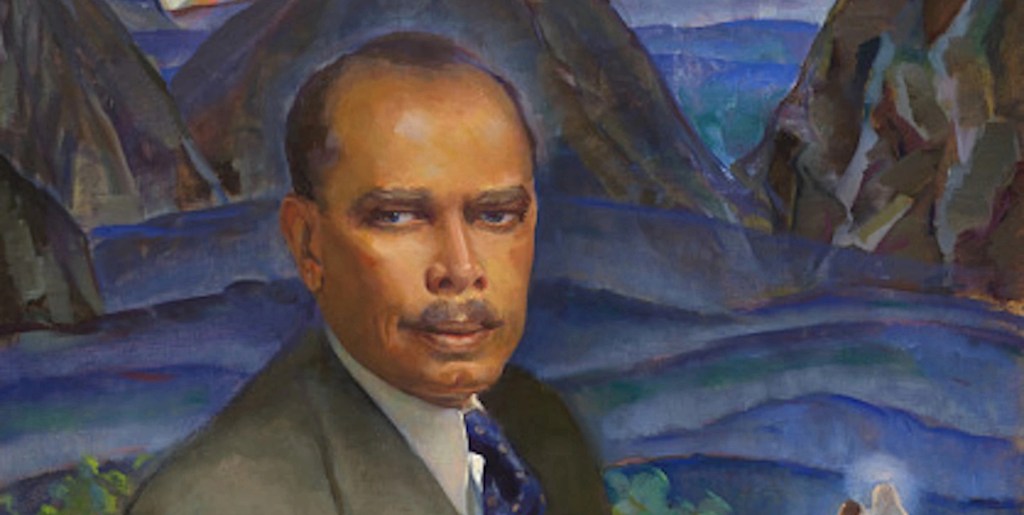
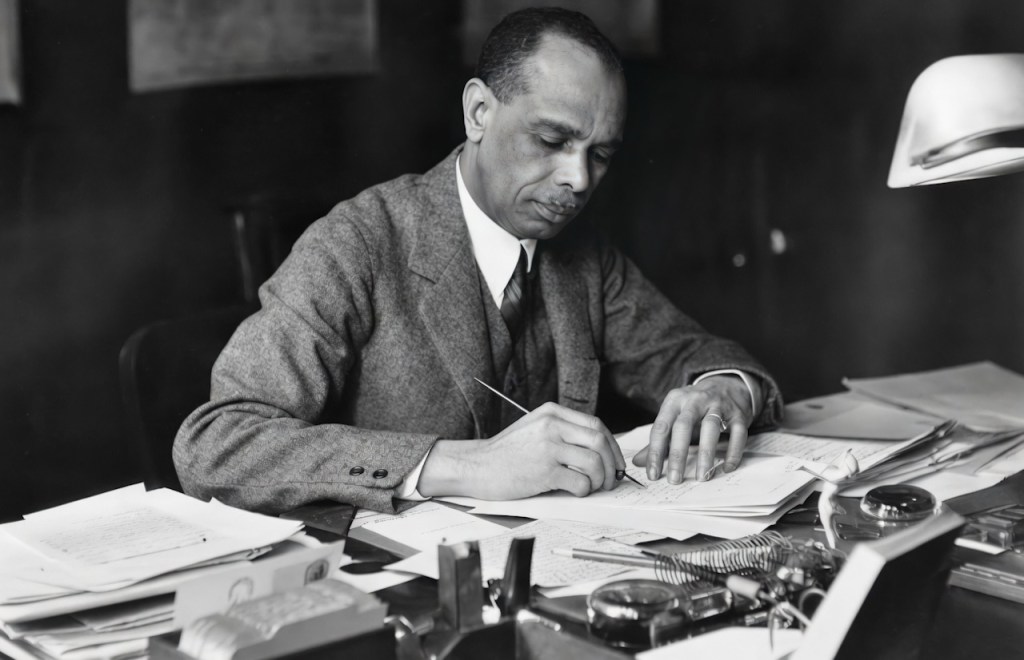
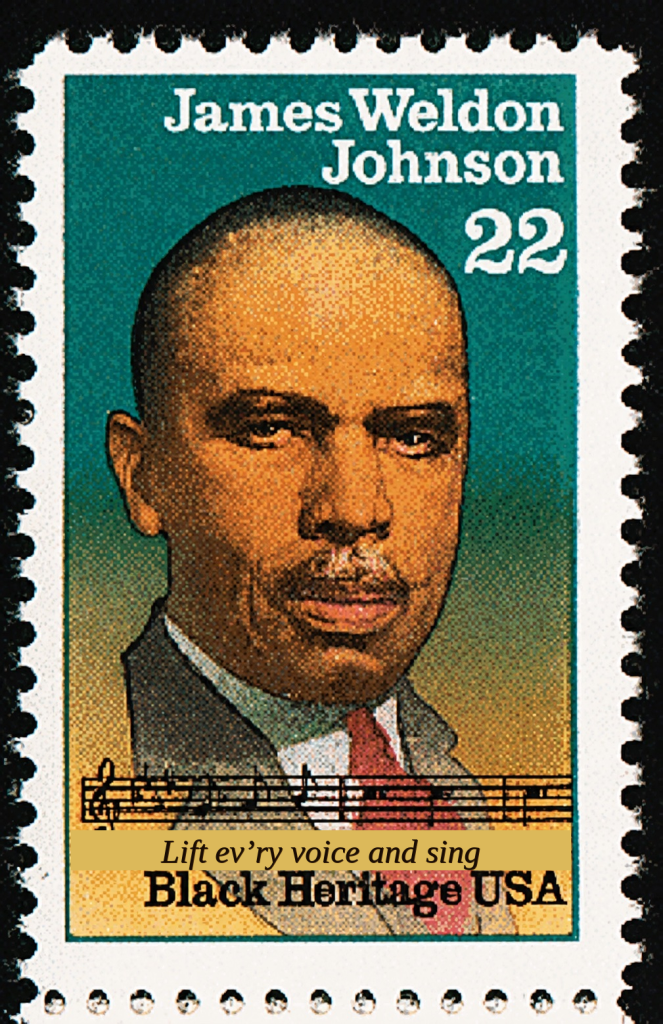
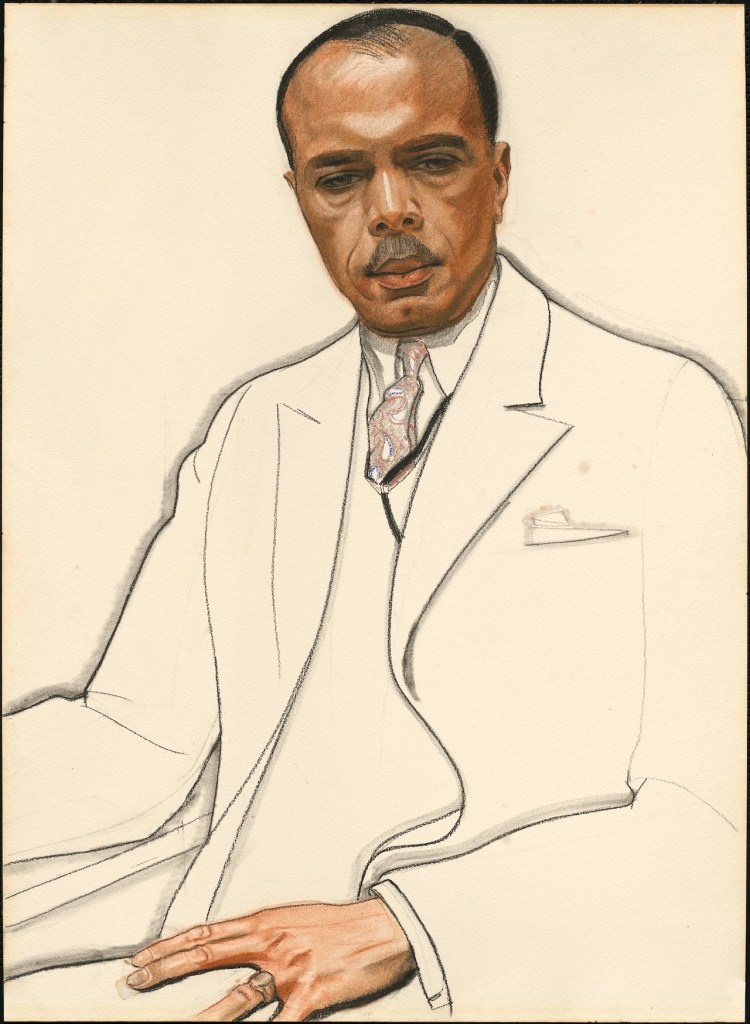
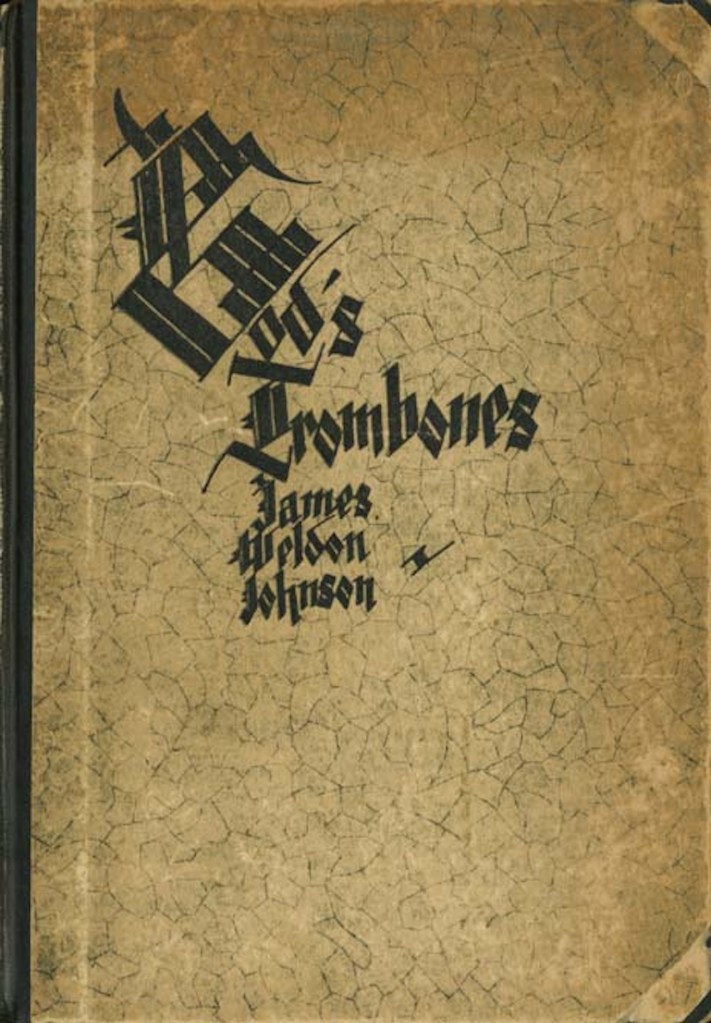
Jacksonville, Florida, native James Weldon Johnson composed his tribute to his adopted New York City in a surprising Petrarchan sonnet. He reveals the features of city life that he came to love and appreciate and that he will sorely miss after he dies.
Introduction with Text of “My City”
James Weldon Johnson’s “My City” is a Petrarchan or Italian sonnet, with the traditional rime scheme: in the octave ABBACDDC and in the sestet DEDEGG. The poem features unexpected claims that diverge radically from what readers have come to anticipate in a poem offering a personal, heartfelt tribute.
Although Johnson was born in Jacksonville, Florida, he lived a portion of his life in New York City, and as this poem attests, he came to love his adopted city. He appreciated even the aspects of city life that many find challenging, for example, the crowd of people throning the streets day and night.
He even appreciated the opportunity to experience the slums that the Manhattan borough had to offer. That his speaker is accounting for what he will miss most by dying, he is offering a unique type of tribute to the city the he came to love and appreciate.
My City
When I come down to sleep death’s endless night, The threshold of the unknown dark to cross, What to me then will be the keenest loss, When this bright world blurs on my fading sight? Will it be that no more I shall see the trees Or smell the flowers or hear the singing birds Or watch the flashing streams or patient herds? No, I am sure it will be none of these.
But, ah! Manhattan’s sights and sounds, her smells, Her crowds, her throbbing force, the thrill that comes From being of her a part, her subtle spells, Her shining towers, her avenues, her slums— O God! the stark, unutterable pity, To be dead, and never again behold my city!
Commentary on “My City”
Poet James Weldon Johnson was a native of Jacksonville, Florida, but this poem offers a tribute to his adopted city, New York City.
Octave: What Will Be His Greatest Loss?
When I come down to sleep death’s endless night, The threshold of the unknown dark to cross, What to me then will be the keenest loss, When this bright world blurs on my fading sight? Will it be that no more I shall see the trees Or smell the flowers or hear the singing birds Or watch the flashing streams or patient herds? No, I am sure it will be none of these.
To begin his tribute to New York City, the speaker poses two questions in the octave: the first question seeks the answer to what he will consider his greatest loss as he experiences death; the second question merely offers a suggestion as to what his great loss might entail.
The speaker asks his first question, posing it poetically: he seeks to ascertain and express what he will feel his greatest loss to be after he has died, leaving “this bright world” but a fading memory in his mind’s eye.
He places on display his abiding love for this world by calling it “this bright world.” By thus labeling the world “bright,” the speaker makes clear that he has a high regard for God’s creation, which he will regret leaving.
He then dramatically and richly portrays death, labeling that state metaphorically “sleep” and giving it the property of “endless night.” He further labels the crossing over from life to death as as “threshold of the unknown dark.”
With the second question, he asks if he might mourn the fact that he no longer has the ability to “see trees,” nor does he possess the capability of “smell[ing] the flowers.”
He continues musing on the possibilities of his greatest losses and avers that the inability to listen to birds singing would also cause him great pain, which might be his greatest loss.
The speaker then adds two further possibilities: “watch[ing] the flashing streams” or unhurriedly observing the “patient herds.” The reader will take note that all of these many possible losses stem from the things of nature, ordinarily observed in a bucolic setting.
Recalling that the title of the poem is “My City,” the reader will not be shocked that the speaker then answers his own question asserting that he is quite certain he will not consider any of these losses his greatest.
Although leaving them will be painful, because he does enjoy all of those natural gifts from God, he know that none of them cause him as much sorrow as some other loss, yet to be named.
Sestet: Losing the Sights, Sound, Smells of His City
But, ah! Manhattan’s sights and sounds, her smells, Her crowds, her throbbing force, the thrill that comes From being of her a part, her subtle spells, Her shining towers, her avenues, her slums— O God! the stark, unutterable pity, To be dead, and never again behold my city!
In the sestet, the speaker pronounces with an emphatic, fervent anguish that it is “Manhattan” that he will most long for, after death has taken him from this world.
The speaker then enumerates the features that entice him and engender in him his deep love for his city: he remains spellbound and holds deep affection the sights, sounds, and smells of “Manhattan,” which is the most densely populated borough of New York City.
Thus, he adores all those crowds of people streaming through the streets of that borough. In addition to all of these Manhattan things, the speaker will also experience the forfeiture of continuing to experience the “shining towers,” the avenues and even the slums.
Although some of the items in this catalogue are not especially beautiful nor are they particularly inspiring, specifically to those engrossed in a rustic setting, this speaker possesses an abiding love for those things. He is, therefore, dreading the fact that death will dispossess him of the continued pleasure they have so long afforded him.
In the speaker’s final outcry, as he verbalizes his mourning, his readers/listeners will understand the melancholy dramatized in his voice. He cries out to his Beloved Lord that it will be such a damnable shame that after he shuffles off the mortal coil, he will never again be able to see his beloved city.
James Weldon Johnson’s “O Black and Unknown Bards”
Johnson’s speaker dramatizes his amazement that slaves could have produced a music that would uplift of a entire race from debasement to spiritual attunement.
Introduction and Text of Poem, “O Black and Unknown Bards”
The speaker in James Weldon Johnson’s “O Black and Unknown Bards” celebrates the important spiritual achievement that mere slaves, oft thought the lowest rung on the ladder of society, managed to leave for future generations.
The poet James Weldon Johnson has well understood that through their spiritual singing to the Divine, these slaves were striving to unite their souls with God—the only true way to overcome all adversity.
O Black and Unknown Bards
O black and unknown bards of long ago, How came your lips to touch the sacred fire? How, in your darkness, did you come to know The power and beauty of the minstrel’s lyre? Who first from midst his bonds lifted his eyes? Who first from out the still watch, lone and long, Feeling the ancient faith of prophets rise Within his dark-kept soul, burst into song?
Heart of what slave poured out such melody As “Steal away to Jesus”? On its strains His spirit must have nightly floated free, Though still about his hands he felt his chains. Who heard great “Jordan roll”? Whose starward eye Saw chariot “swing low”? And who was he That breathed that comforting, melodic sigh, “Nobody knows de trouble I see”?
What merely living clod, what captive thing, Could up toward God through all its darkness grope, And find within its deadened heart to sing These songs of sorrow, love and faith, and hope? How did it catch that subtle undertone, That note in music heard not with the ears? How sound the elusive reed so seldom blown, Which stirs the soul or melts the heart to tears.
Not that great German master in his dream Of harmonies that thundered amongst the stars At the creation, ever heard a theme Nobler than “Go down, Moses.” Mark its bars How like a mighty trumpet-call they stir The blood. Such are the notes that men have sung Going to valorous deeds; such tones there were That helped make history when Time was young.
There is a wide, wide wonder in it all, That from degraded rest and servile toil The fiery spirit of the seer should call These simple children of the sun and soil. O black slave singers, gone, forgot, unfamed, You—you alone, of all the long, long line Of those who’ve sung untaught, unknown, unnamed, Have stretched out upward, seeking the divine.
You sang not deeds of heroes or of kings; No chant of bloody war, no exulting pean Of arms-won triumphs; but your humble strings You touched in chord with music empyrean. You sang far better than you knew; the songs That for your listeners’ hungry hearts sufficed Still live,—but more than this to you belongs: You sang a race from wood and stone to Christ.
Commentary on “O Black and Unknown Bards”
James Weldon Johnson’s speaker is dramatizing his amazed fascination that slaves could have created a music that would uplift of a downtrodden race from debasement to spiritual attunement.
First Stanza: The Genius of Slaves
O black and unknown bards of long ago, How came your lips to touch the sacred fire? How, in your darkness, did you come to know The power and beauty of the minstrel’s lyre? Who first from midst his bonds lifted his eyes? Who first from out the still watch, lone and long, Feeling the ancient faith of prophets rise Within his dark-kept soul, burst into song?
The speaker wonders how black slaves had the ability to fashion those beautiful, soulfilled songs. These songs have revealed that these musicians were in tune with a heavenly realm, not of this earth. They somehow came to understand and create with, “The power and beauty f the minstrel’s lyre.”
Although his questions cannot be answered, as they are essentially rhetorical in nature, he uses them to state quite clearly that these individuals were in tune with part of themselves that many fail to realize even exists.
The body may be whipped and suffer, but the soul cannot be beaten, nor can it suffer. The uplifting nature of these wonderful soulful hymns demonstrates the power of the spirit over the body.
The speaker then queries, “Who first from midst the bonds lifted his eye?” He knows that instead of lifting the eye, the natural, common tendency is to pity oneself and continue to look downward, become hate filled and angry at one’s fellow humans for their ignorance.
The speaker is aware that the beautiful songs unveil a spiritual level of being that can only be cherished and treasured for their qualities. The speaker understands that instead of self-pity and angst, these soul singers were looking to God with a faith that might seem to lost.
Second Stanza: A Free Ranging Spirit
Heart of what slave poured out such melody As “Steal away to Jesus”? On its strains His spirit must have nightly floated free, Though still about his hands he felt his chains. Who heard great “Jordan roll”? Whose starward eye Saw chariot “swing low”? And who was he That breathed that comforting, melodic sigh, “Nobody knows de trouble I see”?
In the second stanza, the speaker refers to four widely sung spiritual: “Steal Away to Jesus,” “Roll, Jordan, Roll,” and “Swing Low, Sweet Chariot,” and “Nobody Knows the Trouble I’ve Seen,” and he again wonders what slave could have created such an astounding tune.
The speaker then guesses that whoever the composer was, “His spirit must have nightly floated free.” The capacity for musical freedom as he continued to suffer his body bound in chains amazes the speaker, who becomes convinced that only a strong, abiding faith could have led the songwriter to such brilliance.
The speaker then alludes to the well-known spiritual, “Nobody knows de trouble I see,” as he asserts that the composer of this hymn felt the comforting, melodic sigh deep in his eing. The speaker, through his musing and questioning, is celebrating the wonderfully inspirational tone of these famous hymns.
Third Stanza: The Mystery of Moving in Chains
What merely living clod, what captive thing, Could up toward God through all its darkness grope, And find within its deadened heart to sing These songs of sorrow, love and faith, and hope? How did it catch that subtle undertone, That note in music heard not with the ears? How sound the elusive reed so seldom blown, Which stirs the soul or melts the heart to tears.
The speaker reports with his following question that those slave/hymn writers were considered mere property: “What merely living clod, what captive thing, / Could toward God through all it darkness grope . . . ?”
The question suggests that those slaves were considered little more than mounds of unconscious clay, as they were required to function as the property of other men.
In the face of such degradation, these singer/songwriters managed to compose their lyrics that sing eternally Godward. The divinity of the words cannot be missed by the perceptive observer as James Weldon Johnson was.
The speaker wonders how these sufferers with likely “deadened hearts,” managed to produce songs heard “not with the ears.” He wonders how such suffering souls could have, “sound[ed] the elusive reed so seldom blown.” He is aware that their sound was so majestic that “melts the heart.”
Fourth Stanza: Marvelous Spiritual That Helped Write History
Not that great German master in his dream Of harmonies that thundered amongst the stars At the creation, ever heard a theme Nobler than “Go down, Moses.” Mark its bars How like a mighty trumpet-call they stir The blood. Such are the notes that men have sung Going to valorous deeds; such tones there were That helped make history when Time was young.
The speaker avers that is not even likely the great German composer, no doubt referring to Mozart, could have created a song, “Nobler than ‘Go down, Moses’.” He notes that its “bars / How like a mighty trumpet call they stir / The blood.”
The speaker compares those notes to the songs that military men have employed as they perform heroic valorous deeds. He states that the music of these marvelous spirituals helped write history.
Fifth Stanza: The Fiery Spirit of Servitude
There is a wide, wide wonder in it all, That from degraded rest and servile toil The fiery spirit of the seer should call These simple children of the sun and soil. O black slave singers, gone, forgot, unfamed, You—you alone, of all the long, long line Of those who’ve sung untaught, unknown, unnamed, Have stretched out upward, seeking the divine.
The speaker again stresses the strange fact that those so depressed with the servitude of toil were able to display their fiery spirit, these simple children, these black slaves, who are gone, forgotten, unknown, yet they were capable of “stretch[ing ] out upward, seeking the divine.”
They did not allow their souls to become degraded by seeking to acquire only physical comfort; these glorious forbearers looked Godward and acquired a measure of immortality that even the more well-known composers will likely not soon know.
Sixth Stanza: Slave Singer and the Blissful Reality of Spirit
You sang not deeds of heroes or of kings; No chant of bloody war, no exulting pean Of arms-won triumphs; but your humble strings You touched in chord with music empyrean. You sang far better than you knew; the songs That for your listeners’ hungry hearts sufficed Still live,—but more than this to you belongs: You sang a race from wood and stone to Christ.
Finally, the speaker notes that these slave singers did not compose lays about the deeds of kings and cultural heroes. They did not sing for the purpose glorifying battle. They did not offer “exulting pean.” But they did “touch[ ] in chord with music empyrean.” Yet, they were not aware that they “sang far better than [they] knew.”
Those slave/singers created hymns that continue to live on. Their musical creations were so vital that they “sang a race from wood and stone to Christ.” Their spiritual songs have lifted their fellows and generations to come from mere physical existence to the blissful reality of spirit.
James Weldon Johnson’s “The Creation” remains a marvelous example of the poet’s depth of spirituality as well as his skilled craftsmanship at creating speakers who perform in his poetry compositions.
Introduction with Text of “The Creation”
In James Weldon Johnson’s “The Creation,” the speaker dramatizes Genesis chapter 1, verses 1-25. The speaker employs the voice of a Southern preacher, exemplified by the lines, “Down in a cypress swamp” and “Like a mammy bending over her baby.”
The Wintley Phipps recitation of James Weldon Johnson’s “The Creation” is magnificent. Phipps performs a perfect interpretation of Johnson’s poem. The experience of listening to a fine poem always adds a nuance of meaning that a simple quiet reading lacks.
The Creation
And God stepped out on space, And he looked around and said: I’m lonely— I’ll make me a world.
And far as the eye of God could see Darkness covered everything, Blacker than a hundred midnights Down in a cypress swamp.
Then God smiled, And the light broke, And the darkness rolled up on one side, And the light stood shining on the other, And God said: That’s good!
Then God reached out and took the light in his hands, And God rolled the light around in his hands Until he made the sun; And he set that sun a-blazing in the heavens. And the light that was left from making the sun God gathered it up in a shining ball And flung it against the darkness, Spangling the night with the moon and stars. Then down between The darkness and the light He hurled the world; And God said: That’s good!
Then God himself stepped down— And the sun was on his right hand, And the moon was on his left; The stars were clustered about his head, And the earth was under his feet. And God walked, and where he trod His footsteps hollowed the valleys out And bulged the mountains up.
Then he stopped and looked and saw That the earth was hot and barren. So God stepped over to the edge of the world And he spat out the seven seas— He batted his eyes, and the lightnings flashed— He clapped his hands, and the thunders rolled— And the waters above the earth came down, The cooling waters came down.
Then the green grass sprouted, And the little red flowers blossomed, The pine tree pointed his finger to the sky, And the oak spread out his arms, The lakes cuddled down in the hollows of the ground, And the rivers ran down to the sea; And God smiled again, And the rainbow appeared, And curled itself around his shoulder.
Then God raised his arm and he waved his hand Over the sea and over the land, And he said: Bring forth! Bring forth! And quicker than God could drop his hand, Fishes and fowls And beasts and birds Swam the rivers and the seas, Roamed the forests and the woods, And split the air with their wings. And God said: That’s good!
Then God walked around, And God looked around On all that he had made. He looked at his sun, And he looked at his moon, And he looked at his little stars; He looked on his world With all its living things, And God said: I’m lonely still.
Then God sat down— On the side of a hill where he could think; By a deep, wide river he sat down; With his head in his hands, God thought and thought, Till he thought: I’ll make me a man!
Up from the bed of the river God scooped the clay; And by the bank of the river He kneeled him down; And there the great God Almighty Who lit the sun and fixed it in the sky, Who flung the stars to the most far corner of the night, Who rounded the earth in the middle of his hand; This great God, Like a mammy bending over her baby, Kneeled down in the dust Toiling over a lump of clay Till he shaped it in is his own image;
Then into it he blew the breath of life, And man became a living soul. Amen. Amen.
Wintley Phipps’ recitation of “The Creation”
Commentary on “The Creation”
Johnson’s speaker offers an imaginative, dramatic rendering of the origin of creation, based on the creation story in Genesis from the King James Version of the Holy Bible.
First and Second Stanzas: Personification of God
And God stepped out on space, And he looked around and said: I’m lonely— I’ll make me a world.
And far as the eye of God could see Darkness covered everything, Blacker than a hundred midnights Down in a cypress swamp.
The speaker personifies God, giving the Deity the very human quality of loneliness and having Him “step [ ] out on space,” where He observes the vastness and decides, “I’m lonely / I’ll make me a world.”
The corresponding Genesis verse states,”In the beginning God created the heaven and the earth.” Johnson’s speaker gives God anthropomorphic qualities in order metaphorically explain the process of creation as revealed in the Holy Scripture.
In Genesis, the darkness was on the face of the deep, because the world was formless. Johnson’s speaker dramatically describes pre-creation as “blacker than a hundred midnights / Down in a cypress swamp.” Of course, the speaker knows that his audience, likely his congregation, would be able to visualize that cypress swamp darkness.
Third and Fourth Stanzas: Calling for Light
Then God smiled, And the light broke, And the darkness rolled up on one side, And the light stood shining on the other, And God said: That’s good!
Then God reached out and took the light in his hands, And God rolled the light around in his hands Until he made the sun; And he set that sun a-blazing in the heavens. And the light that was left from making the sun God gathered it up in a shining ball And flung it against the darkness, Spangling the night with the moon and stars. Then down between The darkness and the light He hurled the world; And God said: That’s good!
Genesis reveals that God called for light by heralding, “Let there be light.” Johnson’s speaker creatively allows that first light to beam when God smiled. In addition, the speaker metaphorically has the light causing the darkness to “roll [ ] up on one side” while “light stood shining on the other.”
To all this drama, God says, “That’s good!” Johnson’s speaker makes God an even more active entity than the Genesis version, where instead of speaking, God’s thoughts are exposed: “God saw the light, and it was good.” At this point, only God could have had that thought.
The speaker then takes the liberty of having God create the sun by taking light in his hands and rolling the light into a ball and setting the sun “a-blazing in the heavens.” Using the light remaining after making the sun, God gathered it up in “a shining ball / And flung it against the darkness / Spangling the night with the moon and stars.”
The importance of light motivates Johnson’s speaker to elaborate on the creation of the earth’s only source of light. And again, as is repeated in Genesis, the speaker has God aver, “That’s good!”
Fifth and Sixth Stanzas: The Significance of the Sun
Then God himself stepped down— And the sun was on his right hand, And the moon was on his left; The stars were clustered about his head, And the earth was under his feet. And God walked, and where he trod His footsteps hollowed the valleys out And bulged the mountains up.
Then he stopped and looked and saw That the earth was hot and barren. So God stepped over to the edge of the world And he spat out the seven seas— He batted his eyes, and the lightnings flashed— He clapped his hands, and the thunders rolled— And the waters above the earth came down, The cooling waters came down.
The importance of the sun is further emphasized as the speaker continues his drama. God begins to walk on the earth with the sun “on his right hand / And the moon on his left.” And the stars were “clustered about his head.”
As God walked on the earth, His feet “hollowed the valleys out / And bulged the mountains up.” Genesis more vaguely reveals God’s creation process than this speaker, who imaginatively fills in the gaps as he creates his own creation myth.
In Genesis, God separates the heavens from the earth. This speaker has God spitting out the seven seas and after clapping His hands, the thunder begins and rain comes down, “cooling waters came down.”
Seventh and Eighth Stanzas: Nature Comes into Being
Then the green grass sprouted, And the little red flowers blossomed, The pine tree pointed his finger to the sky, And the oak spread out his arms, The lakes cuddled down in the hollows of the ground, And the rivers ran down to the sea; And God smiled again, And the rainbow appeared, And curled itself around his shoulder.
Then God raised his arm and he waved his hand Over the sea and over the land, And he said: Bring forth! Bring forth! And quicker than God could drop his hand, Fishes and fowls And beasts and birds Swam the rivers and the seas, Roamed the forests and the woods, And split the air with their wings. And God said: That’s good!
After the rain, grasses appear, and “little red flowers blossomed” and “A pine tree “pointed his finger to the sky.” This speaker gives specific details again not found in Genesis. He has the oak “spread out his arms.”
He has lakes appearing as they “cuddled down in the hollows of the ground.” He has rivers running to the ocean, and God smiling as “a rainbow appeared / And curled itself around his shoulder.”
In his eighth stanza, the speaker has God creating “Fishes and fowls / And beasts and birds.” God creates by raising His arm and waving His hand and commanding, “Bring forth! Bring forth!” Again, God evaluates His creation, declaring, “That’s good!”
Ninth and Tenth Stanzas: A Lonely God
Then God walked around, And God looked around On all that he had made. He looked at his sun, And he looked at his moon, And he looked at his little stars; He looked on his world With all its living things, And God said: I’m lonely still.
Then God sat down— On the side of a hill where he could think; By a deep, wide river he sat down; With his head in his hands, God thought and thought, Till he thought: I’ll make me a man!
The speaker says that God walked about and observed all that He had created. Nevertheless, just as before He created all these things, God again found Himself lonely. Of course, Genesis does not anthropomorphize God; thus, there are no claims in Scripture that God was ever lonely.
In trying to understand the mind of God, the human mind assigns human qualities to the Deity. As long as one realizes the limitation of such assignment, no problem occurs and much understanding can be gained through metaphor and personification.
God then sits down to think about how to assuage His loneliness. Just as a man would do, He sits by a river with His head in His hands, thinking and thinking, and He finally gets the thought to make a man.
Eleventh and Twelfth Stanzas: Bodies of Clay
Up from the bed of the river God scooped the clay; And by the bank of the river He kneeled him down; And there the great God Almighty Who lit the sun and fixed it in the sky, Who flung the stars to the most far corner of the night, Who rounded the earth in the middle of his hand; This great God, Like a mammy bending over her baby, Kneeled down in the dust Toiling over a lump of clay Till he shaped it in is his own image;
Then into it he blew the breath of life, And man became a living soul. Amen. Amen.
The speaker now has God create the first human being by “scoop[ing] the clay from the riverbed.” He employs the image of a mammy bending over her baby while she kneeled down in the dust working over a lump of clay. God shaped this lump of clay in his own image, as Genesis says, “Let us make man in our image, after our likeness.”
Finally, God blew the breath of life into the body of the clay God-like image, and “man became a living soul.” At this point, the speaker/preacher concludes his drama/sermon with the traditional, “Amen. Amen.”
The speaker in Johnson’s sonnet, “Mother Night,” likens his own existence and protection to that of the planets—all are created and protected by the same Divine Entity. Thus his soul remains a spark from the Original Divine Flame.
Introduction with Text of “Mother Night”
James Weldon Johnson’s “Mother Night,” a Petrarchan (or Italian) sonnet, metaphorically dramatizes night as the calm union of the soul with the Oversoul or the individual self with Divine Self.
The speaker, influenced by Eastern as well as Christian philosophical tenets, draws a parallel between the conflict of day and night in the cosmos and his own struggle with the pairs of opposites in his earthly sojourn. This sonnet’s form offers polished Petrarchan rime-scheme: ABBAABBA in the octave, and CDECDE in the sestet.
Mother Night
Eternities before the first-born day, Or ere the first sun fledged his wings of flame, Calm Night, the everlasting and the same, A brooding mother over chaos lay. And whirling suns shall blaze and then decay, Shall run their fiery courses and then claim The haven of the darkness whence they came; Back to Nirvanic peace shall grope their way.
So when my feeble sun of life burns out, And sounded is the hour for my long sleep, I shall, full weary of the feverish light, Welcome the darkness without fear or doubt, And heavy-lidded, I shall softly creep Into the quiet bosom of the Night.
Commentary on “Mother Night”
All creation is protected by its Creator, Who performs in various guises somewhat like a mother bird, who protects her progeny. Nighttime is the time for rest, peaceful contemplation, and retreat from the hustle and bustle of day time activities.
Thus, nighttime may be perceived as a protecting entity that offers solace and comfort to those in need and those who wish for such qualities in their lives.
First Quatrain: Existence Was Brooding before the First Created Day
Eternities before the first-born day, Or ere the first sun fledged his wings of flame, Calm Night, the everlasting and the same, A brooding mother over chaos lay.
Like a brooding mother, that is, a mother bird who is sitting on her brood of eggs and then who continues to protect and keep them warm as baby birds, “Calm Night” kept watch over the unmanifested entity until the first-born day, before the first planets were created and hurled into activity: “ere the first sun fledged his wings of flame.”
The mature planet of the sun is like a bird that is now flying off on its own, after having been tenderly nurtured by its mother.
Mother Night tenderly nurtured the growing cosmos that ultimately resulted in planets and people. Johnson’s metaphoric Night represents the non-vibratory realm of reality where nothing is manifested, and only the mind of God exists in that vibrationless realm.
There is no creation only a peaceful possibility, a potential. Until God chooses to create beings to populate His cosmos, He simply broods like a mother over chaos.
Here the term chaos does not refer to our modern usage of confusion and disorder but to infinite formlessness. The term originates from the Greek Khaos, indicating a dark void from which the gods originated.
Second Quatrain: The Projection of Light as It Creates the Cosmos
And whirling suns shall blaze and then decay, Shall run their fiery courses and then claim The haven of the darkness whence they came; Back to Nirvanic peace shall grope their way.
The second quatrain describes the plight of whirling suns as they “blaze and then decay.” Those planets of fire will eventually burn out and after they do, they will return “[b]ack to Nirvanic peace.”
The speaker employs the term Nirvanic, adjectival form for “Nirvana,” the Buddhist term for God-union, which is “Samadhi” in Hinduism, “Salvation” in Christianity, and “Fana” in Sufism, the mystical branch of Islam.
The speaker cleverly plays by punning “whirling suns,” whereas sun puns son. With God as Mother Night, Her suns (sons) will “run their fiery courses” (live their passionate lives) and then recede back into the arms of the brooding mother or God.
First Tercet: The Individual Self as It Careens Toward Oblivion
So when my feeble sun of life burns out, And sounded is the hour for my long sleep, I shall, full weary of the feverish light,
The sestet then shifts from the cosmos to the speaker himself, a son of the night mother. The speaker vows that he will react to his death a certain way, but he does not clarify that way yet, but merely sets up the conditions for his final claim.
As his life comes to an end, as he knows that it “is the hour for [his] long sleep,” he will be fully aware that his life is ebbing.
Second Tercet: Faith That Leads the Faithful toward Their True Home
Welcome the darkness without fear or doubt, And heavy-lidded, I shall softly creep Into the quiet bosom of the Night.
And the speaker will “[w]elcome the darkness without fear or doubt.” His strong faith and intuition allow him to realize that his soul is going home.
This speaker has mused long and hard upon the profundities that puzzle every thinking brain. He has contemplated what science has discovered about the nature of the created Cosmos.
The speaker has likewise compared the knowledge of scientists to that of the tenets of religion and philosophy. And the result of his in depth study now allows him to formulate a pathway to Divine Reality.
This prescient speaker has come to understand that his own soul is simply a spark of the Divine Flame, Who has fashioned out of chaos a marvelous entity of joy, peace, hope, and love.
This speaker’s eyelids may droop, but his soul is ever ensconced in the omnipresent protection of the beautiful mother, the Mother Night—who parallels the Blessèd Divine Reality—who will throughout eternity continue to brood over and fiercely guide and guard her beloved son.
James Weldon Johnson’s “Lift Ev’ry Voice and Sing”
James Weldon Johnson penned the poem “Lift Ev’ry Voice and Sing” in 1900 to celebrate the birthday anniversary of the great emancipator, President Abraham Lincoln.
Introduction and Text of “Lift Ev’ry Voice and Sing”
After James Weldon Johnson wrote the poem “Lift Ev’ry Voice and Sing” in 1900 to celebrate the birthday anniversary of the great emancipator, President Abraham Lincoln, his brother John Rosamond Johnson composed the musical melody for the poem.
The song was later entered into the United States Congressional Record, and in 1919, the National Association for Advancement of Colored People (NAACP) selected the song to serve as the “Negro National Hymn (Anthem)”—also referred to as the “Black National Anthem.” The NAACP employed the song as a cry for unity during the civil rights struggles of the 1950s and 1960s.
The poem shares a common theme with the American National Anthem, “The Star Spangled Banner”; both works celebrate and offer gratitude to the Divine Belovèd (God) for the rewards of freedom and individual liberty.
Johnson’s poem is especially significant for the black experience, including liberation from slavery and the subsequent struggle against the Black Codes and Jim Crow laws that the Democratic Party continued to enforce to foster segregation and denigration of the former slaves and their descendants after the American Civil War (1861–1865).
Lift Ev’ry Voice and Sing
Lift every voice and sing, Till earth and heaven ring, Ring with the harmonies of Liberty; Let our rejoicing rise High as the list’ning skies, Let it resound loud as the rolling sea. Sing a song full of the faith that the dark past has taught us, Sing a song full of the hope that the present has brought us; Facing the rising sun of our new day begun, Let us march on till victory is won.
Stony the road we trod, Bitter the chast’ning rod, Felt in the days when hope unborn had died; Yet with a steady beat, Have not our weary feet Come to the place for which our fathers sighed? We have come over a way that with tears has been watered. We have come, treading our path through the blood of the slaughtered, Out from the gloomy past, Till now we stand at last Where the white gleam of our bright star is cast.
God of our weary years, God of our silent tears, Thou who hast brought us thus far on the way; Thou who hast by Thy might, Led us into the light, Keep us forever in the path, we pray. Lest our feet stray from the places, our God, where we met Thee, Lest our hearts, drunk with the wine of the world, we forget Thee; Shadowed beneath Thy hand, May we forever stand, True to our God, True to our native land.
Reading by Phylicia Rashad
Commentary on “Lift Ev’ry Voice and Sing”
James Weldon Johnson’s “Lift Ev’ry Voice and Sing,” also known as the Negro National Anthem and the Negro National Hymn, was sung publicly for the first time on February 2, 1900, by a choir of 500 children at the Stanton School in Jacksonville, Florida.
Johnson was serving as principal of the school at the time, and the occasion was a celebration of the birthday anniversary of President Abraham Lincoln.
First Stanza: Sing Joyfully, Loudly with Determination
Lift every voice and sing, Till earth and heaven ring, Ring with the harmonies of Liberty; Let our rejoicing rise High as the list’ning skies, Let it resound loud as the rolling sea. Sing a song full of the faith that the dark past has taught us, Sing a song full of the hope that the present has brought us; Facing the rising sun of our new day begun, Let us march on till victory is won.
The speaker begins by enjoining his listeners to sing joyfully and loudly in order to raise their voices to the Heavens. Such thankful voices should spread throughout the seascape and sky. The joy of singing about freedom can become infectious, as it uprights the minds and hearts of the downtrodden.
The singing must be filled with the joy and faith that these people have been taught in the past, even during times that were dark with many shames. But that singing must also ring out with the hope they must foster as they look to the present and future for better times.
The speaker/singer encourages his hearers/listeners to continue their struggle until they meet with victory over oppression. He insists that victory is not the final reward, but victory for freedom will demand constant vigilance, eternally watching and fighting to maintain that precious commodity.
The human race in all its various hues and shades has learned nothing, if not that there is never a guarantee of freedom without effort. Keeping that emphasis on constant effort must remain part of every generation’s thinking and behavior.
There are always groups afoot, conspiring to take the freedom and property of others. Lest defeat be snatched from the jaws of victory, each human being must remain watchful to protect their hard-won freedoms.
As the third American president, Thomas Jefferson, averred in his 1787 letter to the son-in-law of John Adams, William Stephens Smith:
. . . what country can preserve it’s liberties if their rulers are not warned from time to time that their people preserve the spirit of resistance? Let them take arms. . . . The tree of liberty must be refreshed from time to time with the blood of patriots and tyrants.
While celebrating the joy of great accomplishments, it is often prudent to acknowledge that there is no such thing as heaven on earth. Perfection must be left for heaven, while life on earth will always entail certain risks and require vigilance.
Second Stanza: Remaining Undeterred by Tears and Death
Stony the road we trod, Bitter the chast’ning rod, Felt in the days when hope unborn had died; Yet with a steady beat, Have not our weary feet Come to the place for which our fathers sighed? We have come over a way that with tears has been watered. We have come, treading our path through the blood of the slaughtered, Out from the gloomy past, Till now we stand at last Where the white gleam of our bright star is cast.
The speaker reminds his listeners of the difficulties they have faced. The road has been “stony”—not impossible to travel but not at all easy. And he does not anticipate the travel will become any easier, especially without the proper attitudes and behavior.
Their struggles made having hope a weary task, but through unwavering courage and much hard work, they know they have gained certain goals and have the ability to hold on to them; thus, they must celebrate and be thankful for all the strides forward that they have achieved.
They have continued their march, undeterred by tears and even death. They have traveled on despite the blood shed, the gloom, and the often dashed hopes and dreams.
They now can see that they stand in the much desired light of both hope and faith. That faith gleams like a “bright star” and casts light on all those who strive for it.
They can finally visualize and realize that their struggles have resulted from faith, hope, and have resulted in a certain measure of success in the achievement of freedom.
Third Stanza: Prayer, Devotion, and Gratitude
God of our weary years, God of our silent tears, Thou who hast brought us thus far on the way; Thou who hast by Thy might, Led us into the light, Keep us forever in the path, we pray. Lest our feet stray from the places, our God, where we met Thee, Lest our hearts, drunk with the wine of the world, we forget Thee; Shadowed beneath Thy hand, May we forever stand, True to our God, True to our native land.
In the third and final movement, the speaker offers a prayer of gratitude to the Divine Reality (God). The speaker/singer recognizes that the Creator (God as Father) has always guided them as they have been met with struggles for freedom. They have come through all the “weary years with silent tears.”
The speaker/singer acknowledges that with the love and guidance of the Divine Reality (God), they have been led into the light, and he fervently prays that they will continue down the bright path of righteousness that leads to and maintains individual liberty.
The speaker asks of his Divine Creator that he have the ability to keep his feet from straying away from His mercy and guidance. He knows that only his deep faith can continue to guide and guard him through the vicissitudes of life’s trials and tribulations.
He also petitions the Divine Guide to assist them all and not allow them to descend into drunkenness with worldly affairs that would divert their attention away from the Only Reality.
With this concluding, holy image—”Shadowed beneath [God’s] hand”—the speaker places his life, his trust, and his faith in the only Hand that matters. This celebration in song offers a historical glimpse into the enduring qualities that always mattered most in achieving improvements in the human condition.
As all hymns turn hearts and minds Godward, this important song remains a necessary part of American history, uplifting the spiritual stature of all who experience the performance of its sentiment.
The poet James Weldon Johnson has created a speaker whose baby son gets a wild-eyed stare that can look “through the ceiling of the room, and beyond,” leading the father to suspect that he might have a budding poet to contend with.
Introduction with Text of “A Poet to His Baby Son”
James Weldon Johnson’s speaker in “A Poet to His Baby Son” offers a tongue-in-cheek complaint that his baby son might be contemplating becoming, like his father, a poet.
A Poet to His Baby Son
Tiny bit of humanity, Blessed with your mother’s face, And cursed with your father’s mind.
I say cursed with your father’s mind, Because you can lie so long and so quietly on your back, Playing with the dimpled big toe of your left foot, And looking away, Through the ceiling of the room, and beyond. Can it be that already you are thinking of being a poet?
Why don’t you kick and howl, And make the neighbors talk about “That damned baby next door,” And make up your mind forthwith To grow up and be a banker Or a politician or some other sort of go-getter Or—?—whatever you decide upon, Rid yourself of these incipient thoughts About being a poet.
For poets no longer are makers of songs, Chanters of the gold and purple harvest, Sayers of the glories of earth and sky, Of the sweet pain of love And the keen joy of living; No longer dreamers of the essential dreams, And interpreters of the eternal truth, Through the eternal beauty. Poets these days are unfortunate fellows. Baffled in trying to say old things in a new way Or new things in an old language, They talk abracadabra In an unknown tongue, Each one fashioning for himself A wordy world of shadow problems, And as a self-imagined Atlas, Struggling under it with puny legs and arms, Groaning out incoherent complaints at his load.
My son, this is no time nor place for a poet; Grow up and join the big, busy crowd That scrambles for what it thinks it wants Out of this old world which is—as it is— And, probably, always will be.
Take the advice of a father who knows: You cannot begin too young Not to be a poet.
Commentary on “A Poet to His Baby Son”
The speaker’s baby son gets a wild-eyed stare that seems so penetrating that it can look through things. The speaker playfully then muses that the kid might be demonstrating qualities that could lead him to becoming a poet, like his father. The speaker appears to be somewhat dismayed by that thought, for he is concerned about the current trend in poetry’s emphasis on non-poetic subjects.
First Stanza: A Distressing Possibility
Tiny bit of humanity, Blessed with your mother’s face, And cursed with your father’s mind.
In the opening three-line stanza, the speaker is having a little talk with his infant son. He calls the baby boy a “[t]iny bit of humanity” and describes him as looking like his mother but thinking like his father. The speaker is happy with the first quality but distressed over the second.
Second Stanza: Poetry as a Curse
I say cursed with your father’s mind, Because you can lie so long and so quietly on your back, Playing with the dimpled big toe of your left foot, And looking away, Through the ceiling of the room, and beyond. Can it be that already you are thinking of being a poet?
The speaker is so distressed over the fact that the baby has his “father’s mind” that he calls the child “cursed” with that quality, repeating that lined in both the opening stanza and the second.
The speaker then begins his exposition of the reason for thinking the baby may be cursed. Before dropping the bombshell though, he relates that the baby can do baby things like lying quietly for extended periods on his little back, while playing with toes. These are a little-baby activities that the speaker finds charming.
But the speaker also senses a musing quality in the baby’s stare; the little one seems to be staring with such contemplation that he can see through the “ceiling” and “beyond.” This searching stare suggest to the poet that his baby is contemplating becoming a poet when he grows up.
Third Stanza: Anything but Poetry!
Why don’t you kick and howl, And make the neighbors talk about “That damned baby next door,” And make up your mind forthwith To grow up and be a banker Or a politician or some other sort of go-getter Or—?—whatever you decide upon, Rid yourself of these incipient thoughts About being a poet.
The speaker then rhetorically queries his son, suggesting that he “kick and howl” and annoy the neighbors to get them to exclaim and swear because of the unwelcome noise. Such behavior he suggests would ensure that his son might decide to be a enthusiastic individual and become some professional such as a “banker” or even a “politician.”
The speaker insists that no matter what the kid does, he should never ever consider the notion of becoming a poet. Because the father is a poet, he would know all of the disadvantages that profession can confer.
Fourth Stanza: The Modernist Bent
For poets no longer are makers of songs, Chanters of the gold and purple harvest, Sayers of the glories of earth and sky, Of the sweet pain of love And the keen joy of living; No longer dreamers of the essential dreams, And interpreters of the eternal truth, Through the eternal beauty. Poets these days are unfortunate fellows. Baffled in trying to say old things in a new way Or new things in an old language, They talk abracadabra In an unknown tongue, Each one fashioning for himself A wordy world of shadow problems, And as a self-imagined Atlas, Struggling under it with puny legs and arms, Groaning out incoherent complaints at his load.
In the longest stanza, the speaker details his reason for dissuading his son from becoming a poet. The poet/speaker is decrying the modernist bent of poets.
These modernists do not compose songs of beauty, such as those of “the gold and purple harvest.” They avoid remarking and making any references to “the glories of earth and sky.” These poets seem to avoid taking note of their environment.
But worse still is that these modernist poets are no longer interested in exploring and dramatizing love with all of its joys and sorrows. They no longer compose songs devoted to revealing the joy just living can offer. They seem to have ceased dreaming about essential realities. These new poets avoid interpreting”eternal truth / Through the eternal beauty.”
Instead of all these endearing qualities that have infused and sustained poetry and poetry lovers for centuries, these new poets have become “unfortunate fellows.” They have become confused and display only befuddlement stammering out ” old things in a new way.”
The poet describes the claptrap of modernist poetry: They speak a kind of magician logic in a made-up language. They are no longer individuals with self-determination.
These modernists are fabricating a word-salad world of “shadow problems.” They represent themselves as “a self-imagined Atlas” “with puny legs and arms.” They bitch and moan about their victimhood.
Fifth Stanza: Not a Good Place for Poets
My son, this is no time nor place for a poet; Grow up and join the big, busy crowd That scrambles for what it thinks it wants Out of this old world which is—as it is— And, probably, always will be.
It is then for the reasons spelled out in stanza four that the poet proclaims that in the current environment and with unhealthy, nasty trend, it is simply not a good time nor place to become a poet.v
He suggests to the infant that he grow up and join the genuine activity of trying to be successful in acquiring what the needs and want, trying to have actual achievements, instead of bemoaning the lie of predetermined failure. The speaker asserts that this world will always be this same old world. And this poet/speaker’s experience tells him that it is not currently a place for a poet.
Sixth Stanza: The Voice of Experience
Take the advice of a father who knows: You cannot begin too young Not to be a poet.
Finally, the poet/father/speaker admonishes the baby son to follow his warning because it is coming from “a father who knows.” He then cleverly turns his phrasing: “You cannot begin too young / Not to be a poet.”
The Trend of Victimology in Poetry
This poem is playful, yet serious. The speaker is only musing on the possibility that his son is contemplating becoming a poet, but he uses the poem as a forum to express his dismay at the way poetry was becoming a cesspool of victimology and self-aggrandizement at the expense of truth and beauty. This poet was living during the period of time that saw identity politics beginning to take hold of the arts.
James Weldon Johnson’s poem, “Fifty Years,” recalls the struggle for civil rights in America that began with President Abraham Lincoln proclaiming the end of slavery with the Emancipation Proclamation.
Introduction and Text of “Fifty Years”
James Weldon Johnson begins his commemorative poem, “Fifty Years,” with the epigraph, “(1863–1913) On the Fiftieth Anniversary of the Signing of the Emancipation Proclamation.“
The speaker is paying homage to the many abolitionists who helped end slavery. And while many citizens still held the view that their black brothers and sisters should remain second class citizens, the speaker offers the rationale for the blessings of equality and respect among all citizens.
This speaker possesses a cosmic view of historical procedure, and he shares his awareness with his compatriots of all shades of skin color that God is always in control, and freedom must ring for those who seek it and work to maintain it—a view that remains as operative today as it did back in the early twentieth century.
Fifty Years
“(1863–1913) On the Fiftieth Anniversary of the Signing of the Emancipation Proclamation.“
O brothers mine, to-day we stand Where half a century sweeps our ken, Since God, through Lincoln’s ready hand, Struck off our bonds and made us men.
Just fifty years—a winter’s day— As runs the history of a race; Yet, as we look back o’er the way, How distant seems our starting place!
Look farther back! Three centuries! To where a naked, shivering score, Snatched from their haunts across the seas, Stood, wild-eyed, on Virginia’s shore.
This land is ours by right of birth, This land is ours by right of toil; We helped to turn its virgin earth, Our sweat is in its fruitful soil.
Where once the tangled forest stood,— Where flourished once rank weed and thorn,— Behold the path-traced, peaceful wood, The cotton white, the yellow corn.
To gain these fruits that have been earned, To hold these fields that have been won, Our arms have strained, our backs have burned, Bent bare beneath a ruthless sun.
That Banner which is now the type Of victory on field and flood— Remember, its first crimson stripe Was dyed by Attuckss’ willing blood.
And never yet has come the cry— When that fair flag has been assailed— For men to do, for men to die, That we have faltered or have failed.
We’ve helped to bear it, rent and torn, Through many a hot-breath’d battle breeze Held in our hands, it has been borne And planted far across the seas.
And never yet,—O haughty Land, Let us, at least, for this be praised— Has one black, treason-guided hand Ever against that flag been raised.
Then should we speak but servile words, Or shall we hang our heads in shame? Stand back of new-come foreign hordes, And fear our heritage to claim?
No! stand erect and without fear, And for our foes let this suffice— We’ve bought a rightful sonship here, And we have more than paid the price.
And yet, my brothers, well I know The tethered feet, the pinioned wings, The spirit bowed beneath the blow, The heart grown faint from wounds and stings;
The staggering force of brutish might, That strikes and leaves us stunned and dazed; The long, vain waiting through the night To hear some voice for justice raised.
Full well I know the hour when hope Sinks dead, and ’round us everywhere Hangs stifling darkness, and we grope With hands uplifted in despair.
Courage! Look out, beyond, and see The far horizon’s beckoning span! Faith in your God-known destiny! We are a part of some great plan.
Because the tongues of Garrison And Phillips now are cold in death, Think you their work can be undone? Or quenched the fires lit by their breath?
Think you that John Brown’s spirit stops? That Lovejoy was but idly slain? Or do you think those precious drops From Lincoln’s heart were shed in vain?
That for which millions prayed and sighed, That for which tens of thousands fought, For which so many freely died, God cannot let it come to naught.
Commentary on “Fifty Years”
This speaker of this poem is offering a tribute to the struggle for civil rights in America that began with President Abraham Lincoln proclaiming the end of slavery with the Emancipation Proclamation, as he cites several of the most noted abolitionists.
Stanza 1 – Stanza 3: Celebrating 50 Years Since the Emancipation Proclamation
James Weldon Johnson’s narrator of “Fifty Years” is celebrating the fiftieth anniversary of President Abraham Lincoln’s affixing his signature to the Emancipation Proclamation [1], beginning the long process of ending slavery in the United States. The speaker addresses the sufferers of slavery as well as his own contemporaries, “brothers,” many who are the descendants of slaves.
Johnson’s speaker is dramatizing the signing the Emancipation Proclamation, implying that President Lincoln had erased the vicious practice of slavery and raised the status of the slaves to manhood—a status they had been denied.
The speaker looks back in time as he compares those “fifty years” to a “winter’s day.” Historically, fifty years is, indeed, short, but this half century has been like a very cold season of winter for this Africans and their descendants.
Johnson then takes the reader/listener even farther back in time with the disconcerting image of the slave standing, “naked, shivering,” who were “[s]natched from their haunts across the seas,” and who “[s]tood, wild-eyed, on Virginia’s shore.”
Stanza 4 – Stanza 6: Proudly Claiming a Heritage
Proudly and rightly, the speaker decrees, “this land is ours by right of birth”; he and his ancestors have developed the fallow earth with their “sweat,” which has resulted in “fruitful soil.”
Instead of merely,”tangled forest,” now, through their labor there are “peaceful wood,” cotton, and corn fields yielding valuable products for the American people. The speaker claims that to turn this nature-wild land into a domesticated home, “[o]ur arms have strained, our backs have burned, / Bent bare beneath a ruthless sun.”
Stanza 7 – Stanza 9: Dramatizing Patriotism
The speaker dramatizes the patriotism of his fellows who have died fighting for America even before it recognized them as equal patriots and full citizens. His allusion to Crispus Attucks [2], the first patriot to die in the American Revolutionary War, offers a stark reminder: “Remember, its first crimson stripe / Was dyed by Attucks’ willing blood.”
The speaker highlights the fact that Attucks died willingly for his country, not forced because he was a slave. He stresses that this race of American patriots has always stepped forward to defend America, even in foreign wars.
Stanza 10 – Stanza 12: They Have Already Secured Their Rights
The speaker is adamant in reporting to a land still roiled in racism (Johnson was writing this 1913) that at no time has “one black, treason-guided hand / Ever against that flag been raised.”
Because of the genuine qualities that his African American brothers and sisters have demonstrated since the founding of America, the speaker maintains that they do not deserve to “hang [their] heads in shame” or “speak but servile word,” or be timid in claiming their heritage as true, patriotic Americans.
Therefore, the speaker demands that his contemporaries, “stand erect and without fear.” They have procured the right to their “sonship here,” and they have tendered more than should be required of anyone.
The speaker never makes light of the black experience in America; he knows very well the physical and mental humiliation that his fellow patriots have suffered—as well as the broken spirit. He is aware of the deep levels of discouragement such treatment causes. He understands that there are always times that all one can rely on is prayer.
However, this speaker also understands that such oppression cannot endure. He, therefore, commands his listeners to become fearless and to look forward to the future and retain “[f]aith in your God-known destiny! / We are a part of some great plan.”
The speaker then alludes to William Lloyd Garrison [3] and Wendell Phillips [4], two strong abolitionists. He inquires, rhetorically, if his fellows believe that the “fire lit by their breath” could be snuffed out.
He further asks if his brothers can imagine that the spirit of John Brown [5] and Elijah Lovejoy [6] has become lifeless and departed. He wants them to consider the death of Abraham Lincoln [7] —did the great emancipator die “in vain”?
The speaker delivers an affirmation that all of those great abolitionists and the great emancipator did not resist only to die in vain.
He insists, “millions have prayed” for and “tens of thousands have fought” for and “many freely died,” so that dark-skinned people could know the equality they deserved. And of most importance, he treasures and maintains an abiding faith that, “God cannot let it come to naught.”
In addition to poetry, James Weldon Johnson also composed many songs that have become popular. His bluesy poem/song “Sence You Went Away” features a southern dialect and captures the melancholy that surrounds the individual who has lost a loved one.
Introduction and Text “Sence You Went Away”
James Weldon Johnson’s “Sence You Went Away” creates a speaker/singer who bemoans the loss of a loved one. The poem/song consists of four stanzas, each with the rime scheme AAAB, wherein the final line constitutes the refrain in which the speaker reveals the reason for his melancholy.
The repetition of “seems lak to me” and “sence you went away” emphasizes the pain and sorrow the speaker is experiencing. The refrain becomes a chant-like repetition as he progresses through his report of all that is making him sad. And he is addressing his expressions of sorrow to the individual, who is now absent from his life.
As a poem this works quite well, and as a song it works even more nicely. The poem/song’s use of dialect gives it an authenticity that increases the communication of pain and sorrow. The speaker/singer incorporates and inflicts his sorrow on the world around him, while at the same time making it clear that these transformations are happening within himself.
Sence You Went Away
Seems lak to me de stars don’t shine so bright, Seems lak to me de sun done loss his light, Seems lak to me der’s nothin’ goin’ right, Sence you went away.
Seems lak to me de sky ain’t half so blue, Seems lak to me dat eve’ything wants you, Seems lak to me I don’t know what to do, Sence you went away.
Seems lak to me dat eve’ything is wrong, Seems lak to me de day’s jes twice ez long, Seems lak to me de bird’s forgot his song, Sence you went away.
Seems lak to me I jes can’t he’p but sigh, Seems lak to me ma th’oat keeps gittin’ dry, Seems lak to me a tear stays in ma eye, Sence you went away.
Commentary on “Sence You Went Away”
James Weldon Johnson, an accomplished poet, also composed many songs that have become quite popular. His bluesy “Sence You Went Away” features a southern dialect. Johnson was a Southerner, having been born in 1871 and raised in Jacksonville, Florida, only relocating to New York in 1901.
First Stanza: Expressing Sorrow
Seems lak to me de stars don’t shine so bright, Seems lak to me de sun done loss his light, Seems lak to me der’s nothin’ goin’ right, Sence you went away.
The speaker is addressing an individual, who is likely a former lover or very good friend. The speaker expresses his sorrow by reporting that both the sun and stars do not seem to be shedding light now because of the absence of the addressee. The reader/listener learns nothing about the person who has gone away, only that the speaker’s life has been adversely affected by the loved one’s absence.
Not only do the speaker’s eyes seem no longer to perceive light, but he also feels that nothing in his life is proceeding correctly. He makes it clear that he is not asserting that the world itself has changed; he is merely revealing how things “seem” to him as he repeats throughout the poem, “seems lak to me,” that is, “seems like to me.”
Second Stanza: Absence of Sun
Seems lak to me de sky ain’t half so blue, Seems lak to me dat eve’ything wants you, Seems lak to me I don’t know what to do, Sence you went away.
The absence of sun and starlight affect the shade of the blue sky, which is now presenting itself as only “half” its normal shade. Everything reminds him that he is missing his belovèd. It even appears that everything he sees and does yearns to have this individual back in its purview.
The speaker’s intense exaggeration emphasizes his desire for the return of his missing loved one. Everywhere he looks he sees merely an absence that causes him pain and suffering. He even confesses that he feels unable to decide what he should be doing, if anything at all.
Third Stanza: Nothing Is Right
Seems lak to me dat eve’ything is wrong, Seems lak to me de day’s jes twice ez long, Seems lak to me de bird’s forgot his song, Sence you went away.
Again, the speaker/singer asserts that nothing seems right for him anymore; thus, he feels that “ev’ything is wrong.” And he reveals that time seems to lag because of his sorrow. Pain and suffering cause the human mind and heart to feel time as an oppressor, and that kind of oppression makes minutes seem like hours and days like weeks.
Nature in the form of singing birds is lost on him, and he thus suggests that those birds have even forgotten to sings. His melancholy grays out all of his senses, especially seeing and hearing. Life has lost its luster, light has escaped him, and even pleasant sounds are no longer detectable. And still again, he repeats the reason for his feeling that everything is so wrong in his life.
Fourth Stanza: Fog of Sorrow
Seems lak to me I jes can’t he’p but sigh, Seems lak to me ma th’oat keeps gittin’ dry, Seems lak to me a tear stays in ma eye, Sence you went away.
Finally, the speaker reveals his own behavior has been influenced by the sad fact that the addressee has gone away. He cannot seem to stop sighing, and his throat dries up. He also continue to weep, as he endures the pain of loss.
His physical functions are out of kilter: what needs to be wet is dry, and what needs to be dry is wet. The speaker’s world has transformed into a melancholy fog of sorrow and disorientation—all because his belovèd has gone away.
Kris Delmhorst’s Musical Version of Johnson’s Lyric
There are extant several different musical versions of James Weldon Johnson’s lyric “Sence You Went Away.” I suggest that Kris Delmhorst’s rendition fits perfectly with the sentiment and atmosphere of that lyric. While the other versions are entertaining and well-done, Delmhorst’s version and her singing remain the best in accomplishing the task of capturing the exact feeling of Johnson’s lyric.
Kris Delmhorst singing her version of Johnson’s “Sense You Went Away”
James Weldon Johnson’s funeral oration, “Go Down Death,” offers one the most beautiful and heartfelt expressions of the soul’s journey through life.
Introduction and Text of “Go Down Death”
The epigraph to James Weldon Johnson’s poem, “Go Down Death,” from God’s Trombones: Seven Negro Sermons in Verse, identifies the poem as a dramatic “funeral oration.” This dramatization of the soul’s journey from life to death and beyond remains one of the most beautiful metaphoric expressions on the subject.
The poem, “Go Down Death,” features ten versagraphs in which a pastor ministers to a grieving family. The uplifting sermon remains an example of Johnson’s marvelous craftsmanship with words and profound ideas regarding life and death.
Go Down Death
(A Funeral Sermon)
Weep not, weep not, She is not dead; She’s resting in the bosom of Jesus. Heart-broken husband—weep no more; Grief-stricken son—weep no more; Left-lonesome daughter —weep no more; She only just gone home.
Day before yesterday morning, God was looking down from his great, high heaven, Looking down on all his children, And his eye fell on Sister Caroline, Tossing on her bed of pain. And God’s big heart was touched with pity, With the everlasting pity.
And God sat back on his throne, And he commanded that tall, bright angel standing at his right hand: Call me Death! And that tall, bright angel cried in a voice That broke like a clap of thunder: Call Death!—Call Death! And the echo sounded down the streets of heaven Till it reached away back to that shadowy place, Where Death waits with his pale, white horses.
And Death heard the summons, And he leaped on his fastest horse, Pale as a sheet in the moonlight. Up the golden street Death galloped, And the hooves of his horses struck fire from the gold, But they didn’t make no sound. Up Death rode to the Great White Throne, And waited for God’s command.
And God said: Go down, Death, go down, Go down to Savannah, Georgia, Down in Yamacraw, And find Sister Caroline. She’s borne the burden and heat of the day, She’s labored long in my vineyard, And she’s tired— She’s weary— Go down, Death, and bring her to me.
And Death didn’t say a word, But he loosed the reins on his pale, white horse, And he clamped the spurs to his bloodless sides, And out and down he rode, Through heaven’s pearly gates, Past suns and moons and stars; on Death rode, Leaving the lightning’s flash behind; Straight down he came.
While we were watching round her bed, She turned her eyes and looked away, She saw what we couldn’t see; She saw Old Death. She saw Old Death Coming like a falling star. But Death didn’t frighten Sister Caroline; He looked to her like a welcome friend. And she whispered to us: I’m going home, And she smiled and closed her eyes.
And Death took her up like a baby, And she lay in his icy arms, But she didn’t feel no chill. And death began to ride again— Up beyond the evening star, Into the glittering light of glory, On to the Great White Throne. And there he laid Sister Caroline On the loving breast of Jesus.
And Jesus took his own hand and wiped away her tears, And he smoothed the furrows from her face, And the angels sang a little song, And Jesus rocked her in his arms, And kept a-saying: Take your rest, Take your rest.
Weep not—weep not, She is not dead; She’s resting in the bosom of Jesus.
Wintley Phipps’ amazing recitation of “Go Down, Death”
Commentary on “Go Down Death”
James Weldon Johnson’s “Go Down Death,” a dramatization of the soul’s journey from life to death and beyond, remains one of the most beautiful metaphoric expressions on the subject.
First Versagraph: A Command not to Weep
Weep not, weep not, She is not dead; She’s resting in the bosom of Jesus. Heart-broken husband—weep no more; Grief-stricken son—weep no more; Left-lonesome daughter —weep no more; She only just gone home.
The often rhythmic, deeply dramatic oration begins with a refrain, “Weep not, weep not.” This command is directed to the family of a deceased woman, who is survived by a “Heart-broken husband, a Grief-stricken son, and a Left-lonesome daughter.”
The minister delivering the funeral sermon tasks himself with convincing the grieving family that their loved one is not dead, because she is resting in the bosom of Jesus, and she has only just gone home.
Second Versagraph: God’s Pity and What’s Often Forgotten
Day before yesterday morning, God was looking down from his great, high heaven, Looking down on all his children, And his eye fell on Sister Caroline, Tossing on her bed of pain. And God’s big heart was touched with pity, With the everlasting pity.
The minister creates a beautiful narrative beginning on the day just before the beloved died. He says that God was looking down from his great, high heaven, and He happened to glimpse Sister Caroline, who was “tossing on her bed of pain.” God in His great mercy was filled “with everlasting pity.”
The minister weaves a beautiful narrative designed not only to relieve the pain of the mourners but also to let them know a truth that is so often forgotten at the time of loss and grieving at death.
Third Versagraph: A Creature not to be Feared
And God sat back on his throne, And he commanded that tall, bright angel standing at his right hand: Call me Death! And that tall, bright angel cried in a voice That broke like a clap of thunder: Call Death!—Call Death! And the echo sounded down the streets of heaven Till it reached away back to that shadowy place, Where Death waits with his pale, white horses.
God instructed His “tall, bright angel” standing on His right to summon Death. The angel then summoned Death from the darkness in which he is always waiting with his pack of white horses.
Death is now becoming an anthropomorphic creature who will perform a function directed by God. If God is directing the creative Death, then mourners will begin to understand that Death is not a creature to be feared, only to be understood as a servant of the Belovèd Lord.
Fourth Versagraph: Death before the Great White Throne
And Death heard the summons, And he leaped on his fastest horse, Pale as a sheet in the moonlight. Up the golden street Death galloped, And the hooves of his horses struck fire from the gold, But they didn’t make no sound. Up Death rode to the Great White Throne, And waited for God’s command.
Hearing the call, Death leaps on his fastest stead. Death is pale in the moonlight, but he continues on, speeding down the golden street. And although the horses’ hooves “struck fire f rom the the gold,” no sound emanated from the clash. Finally, Death arrives at the Great White Throne, where he waits for God to give him his orders.
Fifth Versagraph: Death Goes down to Georgia
And God said: Go down, Death, go down, Go down to Savannah, Georgia, Down in Yamacraw, And find Sister Caroline. She’s borne the burden and heat of the day, She’s labored long in my vineyard, And she’s tired— She’s weary— Go down, Death, and bring her to me.
God commands Death to travel down to Georgia in Savannah. There he must find “Sister Caroline.” The poor sister has suffered for a long time; she has been a valiant laborer for God. Now she has grown too tired and too debilitated to continue on in her present incarnation.
Thus, God instructs Death to fetch the soul of Sister Caroline to Him. Knowing that Death is simply the conveyance employed by the Blessèd Creator to bring His children home is a concept that can bring comfort and relief to the mourners.
Sixth Versagraph: Death Obeys God’s Command
And Death didn’t say a word, But he loosed the reins on his pale, white horse, And he clamped the spurs to his bloodless sides, And out and down he rode, Through heaven’s pearly gates, Past suns and moons and stars; on Death rode, Leaving the lightning’s flash behind; Straight down he came.
Without uttering a sound, Death immediately complies with God’s command. Death rides out through “the pearly gates, / Past suns and moons and stars.” He heads straight down to Sister Caroline, to whom God had directed him.
Understanding the nature of God’s servant “Death” continues to build hope and understanding in the heart of the mourners. Their grieving can be assuaged and directed to a whole new arena of theological thought and practice.
Seventh Versagraph: Welcoming God’s Emissary
While we were watching round her bed, She turned her eyes and looked away, She saw what we couldn’t see; She saw Old Death. She saw Old Death Coming like a falling star. But Death didn’t frighten Sister Caroline; He looked to her like a welcome friend. And she whispered to us: I’m going home, And she smiled and closed her eyes.
Upon seeing Death approaching, Sister Caroline welcomes him as if he were an old friend, and she informs the others who were standing around her, ministering to her, that she was not afraid. Sister Caroline then tells them she is going home, as she smiles and closes her eyes for the last time.
By seeing that the dying soul can be so accepting of her new circumstance of leaving the physical body and the earth level of existence, the mourners continue to grow in acceptance as they become capable of letting their grief go. They can replace grief with the joy of knowing God and God’s ways.
That God simply uses Death for his own purposes goes a long way to healing the misunderstanding that one life on earth is all each soul has. The physical level of being becomes a mere step in the evolution through which the soul passes on its way back to its permanent home in God.
Eighth Versagraph: The Soul Moving into the Astral World
And Death took her up like a baby, And she lay in his icy arms, But she didn’t feel no chill. And death began to ride again— Up beyond the evening star, Into the glittering light of glory, On to the Great White Throne. And there he laid Sister Caroline On the loving breast of Jesus.
Death then takes Sister Caroline in his arms as he would a baby. Even though Death’s arm were icy, she experiences no cold. Sister is now able to feel with her astral body, not her physical encasement.
Again Death rides beyond the physical evening star and on into the astral light of “glory.” He approaches the great throne of God and commits the soul of Sister Caroline to the loving care of Christ.
Ninth Versagraph: Sister Shed Delusion of Earth Life
And Jesus took his own hand and wiped away her tears, And he smoothed the furrows from her face, And the angels sang a little song, And Jesus rocked her in his arms, And kept a-saying: Take your rest, Take your rest.
Jesus brushes away all sorrow from the soul of Sister Caroline. She soothes her, and she loses the deep furrows that marred her face, after long living in the world of sorrows and trials. The angels then serenade her as Christ comforts her. Sister Caroline can finally rest from her all her trials and tribulations; she can now shed the delusion that kept her hidebound as she passed through life on the physical plane.
Tenth Versagraph: Repeated Command not to Weep
Weep not—weep not, She is not dead; She’s resting in the bosom of Jesus.
The minister then repeats his opening refrain, “Weep not—weep not, / She is not dead; / She’s resting in the bosom of Jesus.” The refrain becomes a chant that will relieve all souls of pain and headache. Resting in the bosom of Christ will now become the aspiration for all listeners as they begin to understand truly that, “she is not dead.”
They will become aware that if Sister Caroline is not dead, neither will they die, when the time to leave this earth comes. They will understand that their own souls can look forward to resting in the arms of Jesus the Christ.
A poetic retelling of the story about Noah and the Ark, this dramatic poem is one of Johnson’s seven sermons in verse from his collection, God’s Trombones. At certain points in the story, the narrator offers his own interpretations, embellishing the tale and adding further interesting features.
Introduction and Text of “Noah Built the Ark”
James Weldon Johnson’s “Noah Built the Ark” offers an entertaining and educational experience in poetry. Johnson’s clear vision in biblical lore is on full display in his narrative retelling of the Noah and the Ark story from Genesis 6:9–9:17 KJV. The poet is offering an oratory tone in the style of a southern black preacher. His retelling features such plain language that even a child can understand the images and events immediately.
Johnson brought out his collection God’s Trombones: Seven Negro Sermons in Verse in 1927. The collection begins with a prayer, “Listen Lord–A Prayer,” and then features seven verse-sermons, “The Creation,” “The Prodigal Son,” “Go Down Death,” “Noah Built the Ark,” “The Crucifixion,” “Let My People Go,” and “The Judgment Day.”
During his lifetime, Johnson had attended many church services throughout the South, and he was inspired by the oratorical style of the many black preachers, whose preaching he admired. A Southerner himself born in Jacksonville, Florida, Johnson had an ear for dialect and rhythms in speech. All of his poetry is enhanced by his talent for language and its specialties of speech.
Noah Built the Ark
In the cool of the day— God was walking— Around in the Garden of Eden. And except for the beasts, eating in the fields, And except for the birds, flying through the trees, The garden looked like it was deserted. And God called out and said: Adam, Adam, where art thou? And Adam, with Eve behind his back, Came out from where he was hiding. And God said: Adam, What hast thou done? Thou hast eaten of the tree! And Adam, With his head hung down, Blamed it on the woman.
For after God made the first man Adam, He breathed a sleep upon him; Then he took out of Adam one of his ribs, And out of that rib made woman. And God put the man and woman together In the beautiful Garden of Eden, With nothing to do the whole day long But play all around in the garden. And God called Adam before him, And he said to him; Listen now, Adam, Of all the fruit in the garden you can eat, Except of the tree of knowledge; For the day thou eatest of that tree, Thou shalt surely die.
Then pretty soon along came Satan. Old Satan came like a snake in the grass To try out his tricks on the woman. I imagine I can see Old Satan now A-sidling up to the woman, I imagine the first word Satan said was: Eve, you’re surely good looking. I imagine he brought her a present, too,— And, if there was such a thing in those ancient days, He brought her a looking-glass.
And Eve and Satan got friendly— Then Eve got to walking on shaky ground; Don’t ever get friendly with Satan.— And they started to talk about the garden, And Satan said: Tell me, how do you like The fruit on the nice, tall, blooming tree Standing in the middle of the garden? And Eve said: That’s the forbidden fruit, Which if we eat we die.
And Satan laughed a devilish little laugh, And he said to the woman: God’s fooling you, Eve; That’s the sweetest fruit in the garden, I know you can eat that forbidden fruit, And I know that you will not die.
And Eve looked at the forbidden fruit, And it was red and ripe and juicy. And Eve took a taste, and she offered it to Adam, And Adam wasn’t able to refuse; So he took a bite, and they both sat down And ate the forbidden fruit.— Back there, six thousand years ago, Man first fell by woman— Lord, and he’s doing the same today.
And that’s how sin got into this world. And man, as he multiplied on the earth, Increased in wickedness and sin. He went on down from sin to sin, From wickedness to wickedness, Murder and lust and violence, All kinds of fornications, Till the earth was corrupt and rotten with flesh, An abomination in God’s sight.
And God was angry at the sins of men. And God got sorry that he ever made man. And he said: I will destroy him. I’ll bring down judgment on him with a flood. I’ll destroy ev’rything on the face of the earth, Man, beasts and birds, and creeping things. And he did— Ev’rything but the fishes.
But Noah was a just and righteous man. Noah walked and talked with God. And, one day, God said to Noah, He said: Noah, build thee an ark. Build it out of gopher wood. Build it good and strong. Pitch it within and pitch it without. And build it according to the measurements That I will give to thee. Build it for you and all your house, And to save the seeds of life on earth; For I’m going to send down a mighty flood To destroy this wicked world
And Noah commenced to work on the ark. And he worked for about one hundred years. And ev’ry day the crowd came round To make fun of Old Man Noah. And they laughed and they said: Tell us, old man, Where do you expect to sail that boat Up here amongst the hills?
But Noah kept on a-working. And ev’ry once in a while Old Noah would stop, He’d lay down his hammer and lay down his saw, And take his staff in hand; And with his long, white beard a-flying in the wind, And the gospel light a-gleaming from his eye, Old Noah would preach God’s word:
Sinners, oh, sinners, Repent, for the judgment is at hand. Sinners, oh, sinners, Repent, for the time is drawing nigh. God’s wrath is gathering in the sky. God’s a-going to rain down rain on rain. God’s a-going to loosen up the bottom of the deep, And drown this wicked world. Sinners, repent while yet there’s time For God to change his mind.
Some smart young fellow said: This old man’s Got water on the brain. And the crowd all laughed—Lord, but didn’t they laugh; And they paid no mind to Noah, But kept on sinning just the same.
One bright and sunny morning, Not a cloud nowhere to be seen, God said to Noah: Get in the ark! And Noah and his folks all got in the ark, And all the animals, two by two, A he and a she marched in. Then God said: Noah, Bar the door! And Noah barred the door.
And a little black spot begun to spread, Like a bottle of ink spilling over the sky; And the thunder rolled like a rumbling drum; And the lightning jumped from pole to pole; And it rained down rain, rain, rain, Great God, but didn’t it rain! For forty days and forty nights Waters poured down and waters gushed up; And the dry land turned to sea. And the old ark-a she begun to ride; The old ark-a she begun to rock; Sinners came a-running down to the ark; Sinners came a-swimming all round the ark; Sinners pleaded and sinners prayed— Sinners wept and sinners wailed— But Noah’d done barred the door.
And the trees and the hills and the mountain tops Slipped underneath the waters. And the old ark sailed that lonely sea— For twelve long months she sailed that sea, A sea without a shore.
Then the waters begun to settle down, And the ark touched bottom on the tallest peak Of old Mount Ararat. The dove brought Noah the olive leaf, And Noah when he saw that the grass was green, Opened up the ark, and they all climbed down, The folks, and the animals, two by two, Down from the mount to the valley. And Noah wept and fell on his face And hugged and kissed the dry ground.
And then— God hung out his rainbow cross the sky, And he said to Noah: That’s my sign! No more will I judge the world by flood— Next time I’ll rain down fire.
Recitation of “Noah Built the Ark”:
Commentary on “Noah Built the Ark”
While the basic story remains a parallel to the original, the narrator offers his own embellishments at certain points that any listener will recognize as departures from the biblical version. This embellishments stem from the narrator’s personal interpretations of the image and events.
First Movement: Original Creation
The actual story featuring Noah and the ark begins in the third movement; the narrator first builds up to the purpose for Noah having to build the ark. Thus, the opening scenes show God just after having created Adam and Eve, summoning them to hold them responsible for their disobedience.
God knows that they have done the one and only thing He had told them not to do: they have eaten of the “tree of knowledge.” God had told them if they disobeyed this one rule, they would die.
Unfortunately, Satan had persuaded Eve to eat of the fruit, making her believe that God was lying to her. Thus, she ate and convinced Adam to eat, and soon they had lost their paradise in Eden.
The narrator creatively describes the characters in his narrative in colorful ways, for example he had “Old Satan” “[a]-silding up the woman.” Then Satan, who moves “like a snake in the grass,” appeals to the woman’s vanity telling her “you’re surely good looking” and then imagining that Satan gave Eve a gift of a “looking-glass” to emphasize her vanity.
Second Movement: Satan’s Seduction
The narrator now goes into some detail as he has Satan seducing Eve to commit the one sin she had been warned against. Satan belts forth a “devilish little laugh” upon hearing that God had told that pair that they would die if they ate of the forbidden fruit. Satan tells Eve, “God’s fooling you.” He then tells her that the fruit she is forbidden is the “sweetest fruit in the garden” and insists that she can enjoy that fruit without dying.
Eve is convinced, eats the fruit, convinces Adam to eat the fruit, and “Man first fell by woman— / Lord, and he’s doing the same today.” The narrator jokingly demonstrates the rift that began between man and woman with the committing of the original sin.
So now mankind multiplied upon the earth, and not only did people increase, but “wickedness and sin” also increased, and kept on increasing until the corruption became “[a]n abomination in God’s sight.”
Third Movement: Corruption and Anger
The corruption made God angry, and the narrator states that “God got sorry that he ever made man.” And then God decides to destroy mankind by flooding the earth. The narrator says that God planned to destroy all life on earth—except “the fishes.”
The narrator is inserting a bit of comedy into his narration because he knows everyone already is aware that God, in fact, instructed Noah to save all animal life. The claim that God would save only the “fishes” is funny, though, because the fishes are the only life forms that can live in the water, a fact that would obviate the necessity of bringing a pair of them into the ark for saving, as was done with the land animals.
Because Noah was not a man of sin and corruption but a “just and righteous man,” who “walked and talked with God,” God chooses Noah to be his instrument in saving a portion of His Creation.
Thus, God instructs Noah to build an ark for which God gives specific instructions: to be made of gopherwood, “good and strong,” pitched inside and out, and according to the dimensions handed down by the Creator.
God tells Noah that He is going to send down a flood to “destroy this wicked world.” But the house/family of Noah would be spared, and God wanted Noah to help Him “save the seeds of life on earth.”
Noah then obeys God’s command, begins building the ark, working for “one hundred years,” experiencing ridicule daily as folks “make fun of Old Man Noah,” quipping, “Where do you expect to sail that boat / Up here amongst the hills?”
Fourth Movement: Building and Preaching
Noah remains undeterred, working on the ark, but every now and then, he would cease his ark building and offer a sermon. In his sermon, he would tell the “sinners” that they needed to repent because God was going to send “rain down rain on rain.”
Because of all the sinning and corruption, God’s wrath would “drown this wicked world.” Noah encourages the sinners to turn their lives around while there is still time for “God to change his mind.” In response to Noah, a laughing young reprobate quips: “This old man’s / Got water on the brain.” And then everyone else laughs.
Paying no attention to Noah’s warning, they keep on sinning. Then on a bright, sunny morning, the day had come. God instructs Noah to gather pairs of animals and take them along with his family into the ark and “Bar the door!” Then similar to ink spilling over a page, a black spot in the sky begins to spread, and the rain begins—pouring rain for forty days and night.
And many sinners come to the ark “a-running” and “a-swimming” around the ark, pleading to be let in, but it is too late. Though the sinners continue to weep and wail, “Noah’d done barred the door.”
Fifth Movement: The Promise
The narrator then describes the flooded earth, where trees, hills, mountain tops all “slipped underneath the waters.” And for “twelve long months,” the ark sails on a sea that possesses no shore.
Finally, the waters begin to recede, and ark settles down on the tall peak of Mount Ararat. A dove appears to Noah with an olive leaf, altering him that the flood is over, and anew beginning is at hand for all of the inmates of the Ark.
After leaving the ark, the righteous Noah “wept and fell on his face / And hugged and kissed the dry ground.” God then stretches a “rainbow across the sky” and promises Noah that the rainbow would be his reminder that He would never again “judge the world by flood.”
But then God warns that “Next time I’ll rain down fire.” Throughout his retelling of the Noah and the Ark story, the narrator has often added embellishments stemming from his own idiosyncratic interpretations.
The narrator’s final embellishment that God promised to end the world next by fire cannot be found in the biblical KJV version of that tale, but many instances in that version of the Holy Scripture do imply that God might employ the fire element the next time He feels compelled to destroy His Creation.