Linda's Literary Home

Category: Langston Hughes

  • Langston Hughes’ “Night Funeral in Harlem”

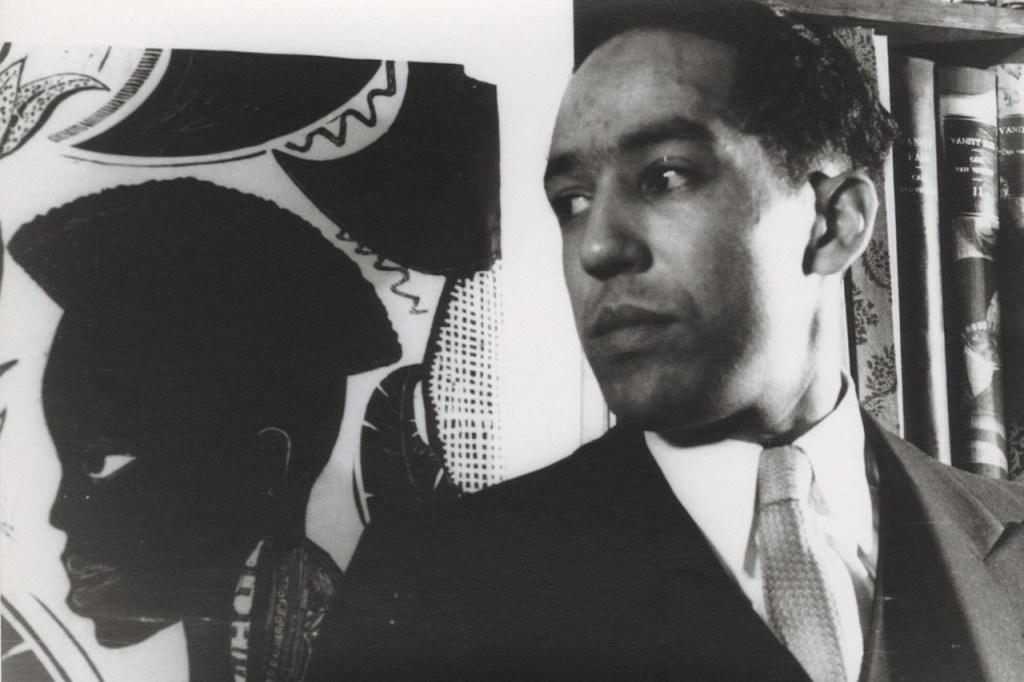
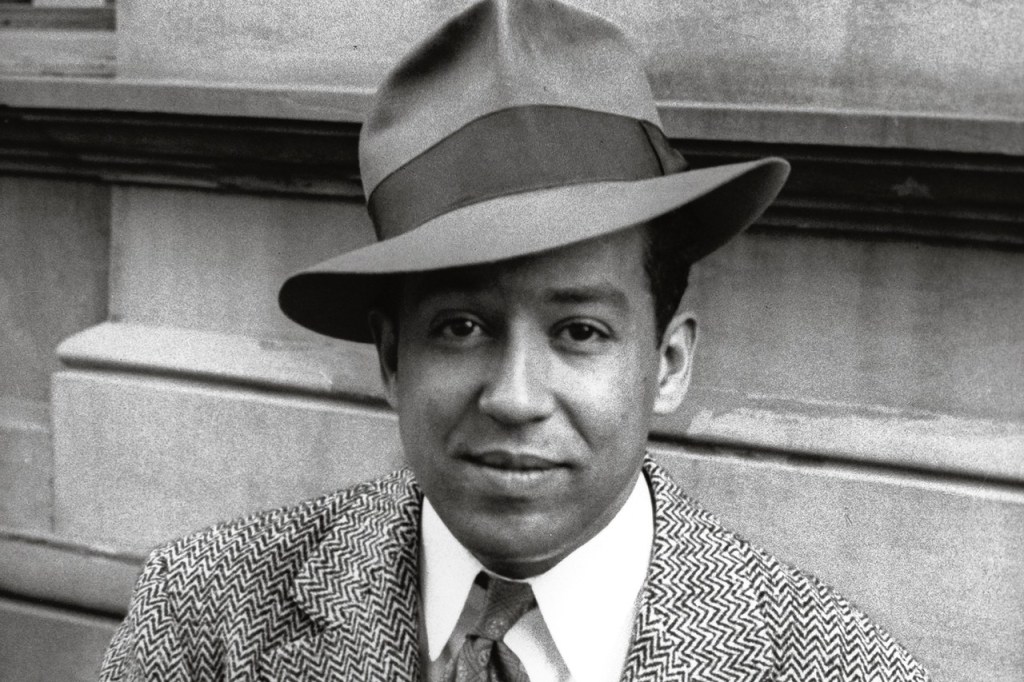
    Langston Hughes - https://www.newyorker.com/magazine/2015/02/23/sojourner - Photograph by Carl Van Vechten / Carl Van Vechten Trust / Beinecke Library, Yale - 1280
    Image: Langston Hughes – Photograph by Carl Van Vechten / Carl Van Vechten Trust / Beinecke Library, Yale – 1280

    Langston Hughes’ “Night Funeral in Harlem”

    The speaker in Langston Hughes’ “Night Funeral in Harlem” wonders how this poor dead boy’s friends and relatives are able to afford such a lavish funeral.

    Introduction and Text of “Night Funeral in Harlem”

    Langston Hughes’ “Night Funeral in Harlem” is an example of the poet’s affinity for the blues. He employs a form that includes the blues flavor, allowing the reader to hear a mournful voice that implies issues that he never actually discusses.

    The speaker’s questions are more than mere decoration, and their implications attempt to make a political and sociological, as well as religious, evaluation. The poem’s form features an inconsistent conglomeration of rimed stanzas, with varied refrains.

    Night Funeral in Harlem

         Night funeral
         In Harlem:

         Where did they get
         Them two fine cars?

    Insurance man, he did not pay—
    His insurance lapsed the other day—
    Yet they got a satin box
    for his head to lay.

         Night funeral
         In Harlem:

         Who was it sent
         That wreath of flowers?

    Them flowers came
    from that poor boy’s friends—
    They’ll want flowers, too,
    When they meet their ends.

         Night funeral
         in Harlem:

         Who preached that
         Black boy to his grave?

    Old preacher man
    Preached that boy away—
    Charged Five Dollars
    His girl friend had to pay.

         Night funeral
         In Harlem:

    When it was all over
    And the lid shut on his head
    and the organ had done played
    and the last prayers been said
    and six pallbearers
    Carried him out for dead
    And off down Lenox Avenue
    That long black hearse done sped,
         The street light
         At his corner
         Shined just like a tear—
    That boy that they was mournin’
    Was so dear, so dear
    To them folks that brought the flowers,
    To that girl who paid the preacher man—
    It was all their tears that made
         That poor boy’s
         Funeral grand.

         Night funeral
         In Harlem.

    Reading:  

    Commentary on “Night Funeral in Harlem”

    The speaker in Langston Hughes’ “Night Funeral in Harlem” jabs insults at these mourners as he wonders how this poor dead boy’s friends and relatives are able to afford such a lavish funeral.

    First Movement:  An Critical Observer

         Night funeral
         In Harlem:

         Where did they get
         Them two fine cars?

    Insurance man, he did not pay—
    His insurance lapsed the other day—
    Yet they got a satin box
    for his head to lay.

         Night funeral
         In Harlem:

         Who was it sent
         That wreath of flowers?

    The speaker begins with his refrain that features his subject, “Night funeral / In Harlem.” He then shoots in his first question that is ultimately insulting to the mourners. The speaker wonders, “Where did they get / Them two fine cars?” 

    The speaker’s dialect is intended to reveal him as an intimate with the mourners, yet his questions actually separate him from them. If he is one of them, why does he have to ask where the cars come from? His concern, therefore, comes across as disingenuous.

    The speaker then introduces the “insurance man,” who might be the reason for the “fine cars,” but no, the poor boy’s “insurance lapsed the other day.” Again, the speaker’s knowledge of the particulars of the situation clash; he knows the people well enough to know that their insurance lapsed, but yet not well enough to know who, in fact, is paying for the lavish funeral. 

    And then the speaker offers a further bit of incongruity that these poor folks have managed to supply a “satin box / for [the deceased’s] head to lay.” The speaker offers these incongruities but never manages to make clear his purpose.

    Second Movement:  A Question of Integrity

    Them flowers came
    from that poor boy’s friends—
    They’ll want flowers, too,
    When they meet their ends.

         Night funeral
         in Harlem:

         Who preached that
         Black boy to his grave?

    The speaker again introduces his next stanza with a variation on the opening refrain: “Night funeral / In Harlem: / / Who was it sent / That wreath of flowers?” Again, the speaker reveals that his distance from the mourners is so great that he has to ask about the flowers. But then he admits that he does actually know that the flowers came from “that poor boy’s friends.”

    But the speaker then insults those friends by accusing them of sending them only because “They’ll want flowers, too, / When they meet their ends,” and also implying that he wonders how those friends paid for the flowers.

    Third Movement:  Is Race Really the Issue?

    Night funeral
      Night funeral
         in Harlem:

         Who preached that
         Black boy to his grave?

    Old preacher man
    Preached that boy away—
    Charged Five Dollars
    His girl friend had to pay.

    The third stanza’s opening varied refrain asks, “Who preached that / Black boy to his grave?” He reveals for the first time that the deceased is black but does not clarify why he should offer the race of the dead at this point.  

    The had been implying that the deceased was black all along by using stereotypical Black English and placing the funeral in Harlem, which was heavily populated by African Americans at the time that the poet was writing.

    The preacher is portrayed then as a money-grubber, charging five dollars to “preach[ ] that boy away,” and the poor boy’s girlfriend had to pay the preacher the five dollar charge.  Again, how it is that the speaker knows the girlfriend paid the preacher, but that he does not know who paid for two limousines, casket, flowers?

    Fourth Movement:   Despite the Insults

        Night funeral
         In Harlem:

    When it was all over
    And the lid shut on his head
    and the organ had done played
    and the last prayers been said
    and six pallbearers
    Carried him out for dead
    And off down Lenox Avenue
    That long black hearse done sped,
         The street light
         At his corner
         Shined just like a tear—
    That boy that they was mournin’
    Was so dear, so dear
    To them folks that brought the flowers,
    To that girl who paid the preacher man—
    It was all their tears that made
         That poor boy’s
         Funeral grand.

         Night funeral
         In Harlem.

    The final stanza is a rather flabby summation of what has happened during this Harlem funeral at night. The opening refrain merely reiterates the subject, “Night funeral / In Harlem.”

    Gone is the additional commentary as appeared in the three opening refrains, but the speaker does leave the affair on a compassionate note; at least he can admit, “It was all their tears that made / That poor boy’s / Funeral grand.”  

    Despite his probing, insulting questions, he finally admits that the importance of the event is that it shows the love the mourners had for their dearly departed.
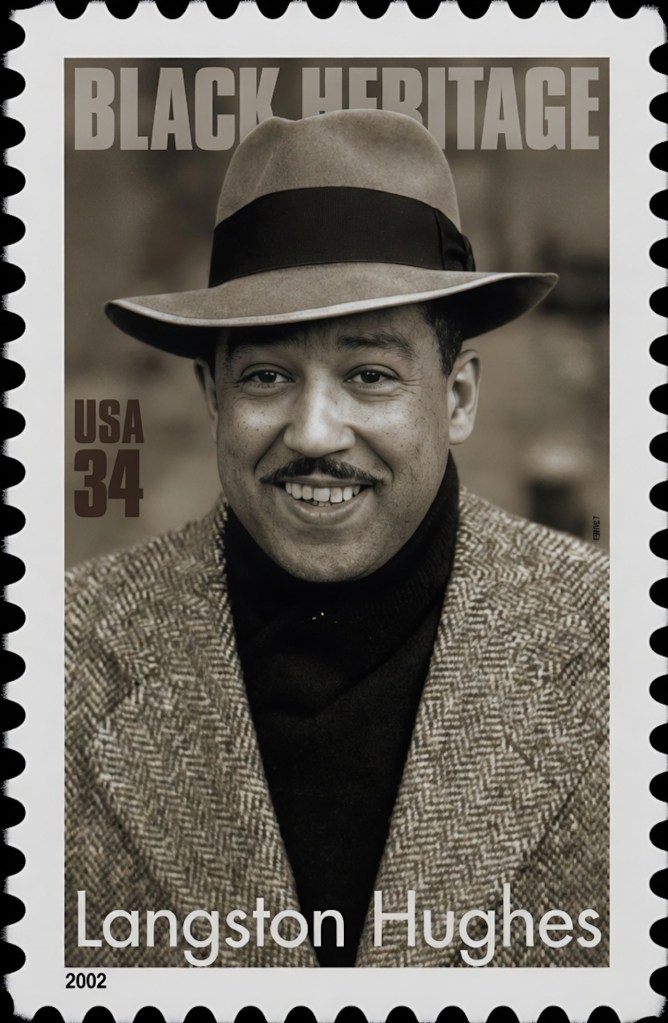
    Image:  Langston Hughes - Commemorative Stamp  http://usstampgallery.com/view.php?id=0787693b268f0944d0264088b300c02721d73814&Langston_Hughes&st=Langston%20Hughes&ss=&t=&s=8&syear=&eyear=  US Stamp Gallery
    Image: Langston Hughes – Commemorative Stamp  – US Stamp Gallery
  • Langston Hughes’ “Madam’s Calling Cards”

    Image: Langston Hughes - Eakins Press Foundation - photo by Carl Van Vechten (1880-1964) https://www.sfgate.com/entertainment/article/Inspired-by-poet-Hughes-Influential-writer-was-2875941.php
    Image: Langston Hughes – Eakins Press Foundation – photo by Carl Van Vechten (1880-1964)

    Langston Hughes’ “Madam’s Calling Cards”

    Alberta K. Johnson is a character in Langston Hughes’ twelve-poem set called “Madam to You.” In this poem, she has herself some name cards printed up.

    Introduction with Text of “Madam’s Calling Cards”

    One of Langston Hughes’ great strengths as poet was his ability to advance character studies.  He brings his characters to life by demonstrating their human quirkiness.  In this series of studies of the character Alberta K. Johnson, Hughes has fashioned a fascinating little set of dramas that entertain as well as enlighten.

    Langston Hughes’ poem “Madam’s Calling Cards” is from a twelve-poem series, titled “Madam to You,” which offers a character study of a woman named Alberta K. Johnson.  The character, Alberta K. Johnson, always insists that people call her “Madam.” Each poem in the “Madam to You” series uses a personality quirk of Alberta’s to convey some aspect of her character. 

    The other titles of the poems in the series are “Madam’s Past History,” “Madam and her Madam,” “Madam and the Rent Man,” “Madam and the Number Writer,” “Madam and the Phone Bill,” “Madam and the Charity Child,” “Madam and the Fortune Teller,” “Madam and the Wrong Visitor,” “Madam and the Minister,” “Madam and the Might-Have-Been,” and “Madam and the Census Man.” 

    The poem, “Madam’s Calling Cards,” consists of five quatrains, each with the rime scheme, ABCB.  The chief feature of the character Madam Alberta K. Johnson is how down to earth she is, while at the same time wishing to assert an air of distinction.

    Madam’s Calling Cards

    I had some cards printed
    The other day.
    They cost me more
    Than I wanted to pay.

    I told the man
    I wasn’t no mint,
    But I hankered to see
    My name in print.

    MADAM JOHNSON,
    ALBERTA K.
    He said, Your name looks good
    Madam’d that way.

    Shall I use Old English
    Or a Roman letter?
    I said, Use American.
    American’s better.

    There’s nothing foreign
    To my pedigree:
    Alberta K. Johnson—
    American that’s me.


    Reading

    Commentary on “Madam’s Calling Cards”

    Alberta K. Johnson is a character in Langston Hughes’ twelve-poem set called “Madam to You.” In this poem, she has herself some name cards printed up.  Seeing her name in print seems to set her off from the crowd.  She wishes to assert that fact that she is special.

    Yet at the same time she wishes to assert her common status as an American, emphasizing that she has no foreign pedigree.  Of course, Alberta is opining well before the Reverend Jesse Jackson persuaded Americans to assign a foreign pedigree to all black Americans.

    First Stanza:  Wanted to See Name in Print

    I had some cards printed
    The other day.
    They cost me more
    Than I wanted to pay.

    Alberta K. Johnson is speaking; she tells her listeners that a few days ago, she had some cards printed, and it cost more than she had hoped to pay for such a printing job.  Alberta speaks quite plainly—even if she does so in riming quatrains.  Alberta just wanted to see her name in print, so she hatched the idea of having “calling cards” printed.

    Second Stanza:  Too Expensive!

    I told the man
    I wasn’t no mint,
    But I hankered to see
    My name in print.

    Alberta continues to elaborate on the situation, involving the process of having her cards printed. She reports her conversation with the printer of the cards. She was not happy about how expensive it was just to get her cards printed.  She told the printer that she wasn’t a “mint.”  Even though her funds were limited, still she wanted to see her name printed somewhere.

    Therefore, she settled on having a card printed up, and of course that meant  she had to spring for this expenditure.  Because she continued to desire seeing her name in print,  she continued with the transaction, despite its exorbitant pricing.

    Third Stanza:   Supplying the Ego 

    MADAM JOHNSON,
    ALBERTA K.
    He said, Your name looks good
    Madam’d that way.

    Alberta then shifts to the process of readying the type for printing. She had her named specified, “MADAM JOHNSON, ALBERTA K.”   The printer remarks that her name, with the Madam attached to it and all.  Of course, it is only natural that the printer would encourage her in her expensive endeavor; after all, he is being paid to supply Alberta’s ego with an object.  

    Thus, the printer tells Alberta that her name looks good, as he employs the term “Madam’d”; her name with Madam affix to it became all madamed up.  Alberta no doubt wholeheartedly approves.

    Fourth Stanza:  American Style

    Shall I use Old English
    Or a Roman letter?
    I said, Use American.
    American’s better.

    The printer asks Alberta what style of lettering she prefers, for example, “Old English” or “Roman”; Alberta replies that she wants him to “Use American.”   She insists that “American’s better.”  

    Of course, she is unaware that there is no particular type called “American.” She was simply confused by the foreign sounding “Old English” and “Roman,” which are, of course, part of the American style. 

    Fifth Stanza:   Not a Foreigner

    There’s nothing foreign
    To my pedigree:
    Alberta K. Johnson—
    American that’s me.

    Alberta then repeats and emphasizes the importance of keeping her calling cards lettered in the American style. She insists that “there is nothing foreign” about “[her] pedigree.”  She then repeats her name “Alberta K. Johnson” and again restates her nationality, “American that’s me.”

  • Langston Hughes’ “Cross”

    Langston Hughes -  https://www.newyorker.com/magazine/2015/02/23/sojourner -  Photograph by Carl Van Vechten / Carl Van Vechten Trust / Beinecke Library, Yale - 1280
    Image: Langston Hughes – Photograph by Carl Van Vechten / Carl Van Vechten Trust / Beinecke Library, Yale – 1280

    Langston Hughes’ “Cross”

    The speaker in Langston Hughes’ “Cross” laments having been born to biracial parents, a white father and a black mother.  But the poem merely dramatizes stereotypes, and that reliance limits its achievement. This poem fails to exemplify the true achievement of this poet.

    Introduction with Text of “Cross”

    The speaker in Langston Hughes’ “Cross” is lamenting having been born to a mixed racial couple, a white father and a black mother.The title implies two meanings: he is the “cross” between two individuals, as are all human beings a cross between their parents.  But this speaker’s special situation of being a cross between two races causes him to suffer a burden, as in the idiom “cross to bear” [1].

    The poet, Langston Hughes, who penned this piece, was black and so were both of his parents:  about his parents, Hughes has remarked [2], “My father was a darker brown. My mother an olive-yellow.”

    Thus, he is not speaking from the experience of a mixed race individual but instead is relying on stereotypes as he explores the possible, and perhaps even, likely feelings of a biracial man.

    Cross

    My old man’s a white old man
    And my old mother’s black.
    If ever I cursed my white old man
    I take my curses back.

    If ever I cursed my black old mother
    And wished she were in hell,
    I’m sorry for that evil wish
    And now I wish her well

    My old man died in a fine big house.
    My ma died in a shack.
    I wonder where I’m going to die,
    Being neither white nor black? 

    Commentary on “Cross”

    One of Langston Hughes’ less successful pieces, his poem “Cross” does not dramatize the true feelings of a mixed race man.  The piece, instead, relies heavily on mere stereotypes, such as a rich white father and a poor black mother—rich father dying in a mansion, poor mother dying in a shack.  Supposedly, this situation leaves the biracial speaker wondering where he will die because he, incongruously, considers himself of neither race (of course, he is of both.)

    First Stanza:  Cursing the Father

    My old man’s a white old man
    And my old mother’s black.
    If ever I cursed my white old man
    I take my curses back.

    The speaker commences his lament by reporting that his father is white while his mother is black.  The speaker is thus an adult looking back over the events of his life as he remembers them, but it remains unclear how old the speaker may be at the time of his musing.  

    It may be assumed that he has seen enough of life to find that being a biracial individual can be a burdensome experience; thus, he is claiming he has had a heavy cross to bear during his lifetime.

    The speaker then admits that in the past he has spoken ill of his “white old man,” but now he has had a change of heart and wants to retract those inflammatory words.  The speaker offers no reason for his changing his mind about his father, but the poem moves along with a fine, rhythmic, well-rimed clip.

    While speculation about the motives or intentions [3] of a speaker in poem may remain unhelpful or even counterproductive, one can quietly assume that the speaker has just decided that forgiveness leaves the conscience more peaceful than hanging on to a grievance.  

    Because the poem relies only on stereotypes of what life is like for a mixed race individual, it is likely that the poet is just configuring his words to fill out his poem with possible riming sounds that move along in a pleasant meter.

    Second Stanza:  Cursing the Mother

    If ever I cursed my black old mother
    And wished she were in hell,
    I’m sorry for that evil wish
    And now I wish her well

    As the speaker has formerly “cursed” his father, he has also “cursed” his mother, even wished her to be condemned to “hell.”  But again as with his father, he now wants to retract those curses.  And with the old black mother, he now even “wishes her well.”

    The speaker did not wish his father well; he wished only to take back his curses that he has hurled at the old man.  Therefore, the speaker renders a least a tittle more affection for the mother.

    This situation is quite understandable:  the speaker was likely raised by the mother, thus in reality, he identifies more with his black racial makeup than his white.  Plus the very nature of motherhood more than fatherhood lends itself to more affection [4] by most children.

    Third Stanza:   Remaining in Confusion

    My old man died in a fine big house.
    My ma died in a shack.
    I wonder where I’m going to die,
    Being neither white nor black? 

    Somewhat vaguely, the speaker is suggesting that he was not raised by both parents, perhaps even by neither.  Stereotypically, he has his father, the “white old men,” die in a “fine big house.”  So he, at least, knows where his father lived, unless he is merely guessing, based on stereotype.

    Stereotype again intact, he has his “black old mother” dying “in a shack.”  Again, it remains unclear if the speaker was raised by the mother, even though that is likely.  If the speaker was raised by his mother, he would likely assume that he would die as she did.

    If the speaker had been raised by the father in a “fine big house,” again he would assume that he would die as his father did.  These assumptions suggest that the speaker has accomplished a life that is not quite as rich as his father’s but not quite as poor as his mother’s.  The speaker’s socio-economic status is ultimately irrelevant, however.  

    That the speaker sees himself as “neither white nor black” poses an important question, however:  why does he not think of himself as both white and black?  Biologically, he is, in fact, both white and black. What would that acceptance imply for the speaker’s confusion?

    Such speculation goes beyond the scope of this poem or any commentary about it; the poet, Langston Hughes, had no doubt been acquainted with individuals who expressed such mixed feelings.  

    Still, because Hughes was a master craftsman, who composed many fine, genuine pieces of writing, the poem clips along at an entertaining pace, even though it lacks the luster of a poem [5], such as Hughes’ “The Negro Speaks of Rivers,” which truly offers enlightenment of its subject.

    Facts and Feelings

    While each individual is entitled to his own feelings, opinions, and thoughts, he is not entitled to the facts surrounding and/or motivating those feelings, opinions, and thoughts. For example, if a black individual claims that he feels depressed, angry, or outraged because racism keeps him from attaining his goal of becoming a lawyer, we must believe his claim that he feels that way.

    However, we do not have to accept his reason for his feelings, because lawyers come in all races; there are two black justices currently serving on the U.S. Supreme Court.  So he is perfectly free to believe that racism is the cause of his feelings, but just because he believes it does not make it true. 

    The question then would arise, what is causing him to fail to understand that there must be other reasons—not racism—that he has failed to achieve his goal of entering the legal profession?  Similarly, the biracial fellow in “Cross” is entitled to feel that he is confused because he is not black or white.  But the fact of the matter is that he is both black and white.  

    So the next question for him might be, what are you doing to address your ongoing confusion from your black-and-whiteness?   One might argue that in all cases, stereotypical responses to issues actually prevent the ability to properly address those issues.  One cannot solve a problem that has been misidentified.

    Sources

    [1] Curators. “cross to bear.” Farlex Dictionary of Idioms. 2015.

    [2] Denise Low & T. F. Pecore Weso.  “Langston Hughes on His Racial and Ethnic Background.”  Kansas History.  2004.

    [3]  Nasrullah Mambrol.  “Intentional Fallacy.”   Literary Theory and Criticism.  March 17, 2016.

    [4]  Paramahansa Yogananda.  “Beauty and Joy, Grace and Refuge: Living in the Presence of the Mother Divine: Discover the Feminine Aspect of God.”  Self-Realization Fellowship Official Website.  Accessed October 31, 2023.

    [5]  Linda Sue Grimes.  “Langston Hughes’ ‘The Negro Speaks of Rivers’.”  Linda’s Literary Home.  February 11, 2026.

    The Cross of Barry Soetoro

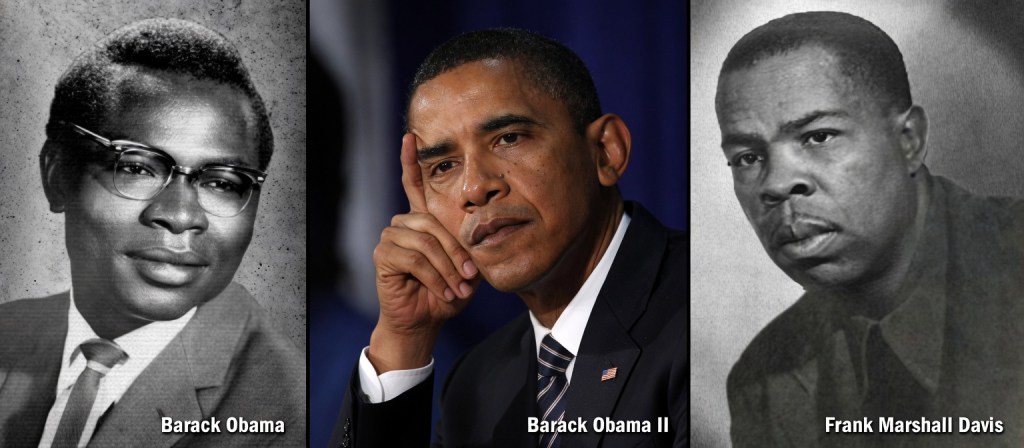
    Image: Obama I Obama II Davis – Alchetron.

    The poet Langston Hughes did not experience life as a biracial individual, because both of his parents were black.  Thus, the poet has created a character in his poem to attempt to make a statement about biracial individuals. 

    Hughes’ poem is not entirely successful in making that statement:  the poem depends only on a stereotype, the one that offers the notion that biracial individuals will remain confused because they cannot figure out with which race they should identify.

    Barack Obama, in his biographical, Bill Ayers-ghost-written Dreams from My Father, claims to have suffered the same confusion, but because he was raised by the white side of his family, he clearly absorbed the values of the white, communist ideological spectrum to which that family ascribed.  

    Obama’s attempt to identify as “black” came as he discovered the advantages of that now politically advantaged identity group.  Also, instead of sporting the name of his likely true biological father, Frank Marshall Davis, Obama achieves an even further boost at being a cosmopolitan, world citizen, with the ability to jokingly assert that he has a “funny name.”  

    In order to achieve that joking stance, Obama changed the name he had been using, “Barry Soetoro,” to “Barack Obama”—”Barry” just didn’t quite fit the joke of the “funny name.”

    The vagueness and hypocrisy of taking a stance with which one is not wholly familiar results in formless, vague imagery.  Therefore, in Hughes’ “Cross,” the speaker remains a vague, unformed figure.  And such a figure cannot convey a fully formed notion of what it is actually like to have lived life as a biracial individual. 

    The speaker’s goal in Langston Hughes’ “Cross” like that of “Barack Obama” is to air a grievance in hopes of achieving an unearned status, not to honestly inform.  As Obama remains a crepuscular figure on the horizon, Hughes’ poem remains a mere glance at a stereotype—not even close to what a poem needs to be to communicate its message.

  • Langston Hughes’ “Mother to Son”

    Image: Langston Hughes - Eakins Press Foundation - photo by Carl Van Vechten (1880-1964) https://www.sfgate.com/entertainment/article/Inspired-by-poet-Hughes-Influential-writer-was-2875941.php
    Image: Langston Hughes – Eakins Press Foundation – photo by Carl Van Vechten (1880-1964)

    Langston Hughes’ “Mother to Son”

    Comparing her life to a stairway in an extended metaphor in Langston Hughes’ “Mother to Son,” a mother encourages her son to face life, despite its difficulties. 

    Introduction with Text of “Mother to Son”

    The speaker in Langston Hughes’ narrative poem “Mother to Son” is engaging the literary device known as the dramatic monologue, a poetic device employed with expertise by the English poet, Robert Browning. In Langton Hughes’ narrative, a ghetto mother is advising her son about his direction in life. 

    She is employing a ghetto dialect, a device Langston Hughes has often used as he dramatizes his characters. This mother wishes to guide her son in the right direction in life and encourage him to face the challenges he will sure face.  

    She thus employs the metaphor of climbing a difficult stairway which compares to her hard life struggles.  Her stairway was not made of “crystal,” and instead, it offered her a series of challenged that she had to face and overcome.

    Mother to Son

    Well, son, I’ll tell you:
    Life for me ain’t been no crystal stair.
    It’s had tacks in it,
    And splinters,
    And boards torn up,
    And places with no carpet on the floor—
    Bare.
    But all the time
    I’se been a-climbin’ on,
    And reachin’ landin’s,
    And turnin’ corners,
    And sometimes goin’ in the dark
    Where there ain’t been no light.
    So, boy, don’t you turn back.
    Don’t you set down on the steps.
    ‘Cause you finds it’s kinder hard.
    Don’t you fall now—
    For I’se still goin’, honey,
    I’se still climbin’,
    And life for me ain’t been no crystal stair.

    Commentary on “Mother to Son”

    Comparing her life to a stairway in an extended metaphor, a mother in this poem encourages her son to face life, even though it can be full of difficulties with twists and turns.

    First Movement:  A Stairway Metaphor

    Well, son, I’ll tell you:
    Life for me ain’t been no crystal stair.
    It’s had tacks in it,
    And splinters,
    And boards torn up,
    And places with no carpet on the floor—
    Bare.
    But all the time
    I’se been a-climbin’ on,
    And reachin’ landin’s,
    And turnin’ corners,

    Addressing her son with advice based on her own life, the mother in this poem begins by fashioning a metaphor of her life as a stairway.  She asserts that although it has not been easy to climb these step through life, she has never permitted herself the cowardly act of not striving to climb to the next higher step.   She then exclaims, “Life for me ain’t been no crystal stair. “

    The “crystal stair” emphasizes an imaginary pathway with ease, comfort, and even beauty.  The “crystal” would likely render the climb smooth and clear, much less difficult.  Such stairway would with comfort and remain without the slog that she has had to suffer.  

    The stairway that this mother has climbed has been full of difficulties, metaphorically rendered by “tacks and splinters.”  Often as she landed on certain steps, the step did not even feature the softness of carpet that would has also made the walk less arduous on the feet and legs. 

    And as in life with its many tumultuous twists and turns,  the stairway the mother has has to negotiate has yielded its many drastic and difficult share of trials and tribulations.  However, she emphasizes the fact that she has never just thrown up her hand and quit climbing, regardless of how difficult and steep the climb was; instead, she insists, “I’se been a-climbin’ on.”  

    And she has continued to make progress by being rewarded for her effort as she was “reachin’ landin’s / and turnin’ corners.” These features on the stairway—landings and corners—are parts of the extended metaphor as they are real features of a literal stairway.  Reaching each landing, thus, represents the real-life achievements that the mother has made as she vigilantly struggled. 

    Second Movement:  The Mother’s Advice 

    And sometimes goin’ in the dark
    Where there ain’t been no light.
    So, boy, don’t you turn back.
    Don’t you set down on the steps.
    ‘Cause you finds it’s kinder hard.
    Don’t you fall now—
    For I’se still goin’, honey,
    I’se still climbin’,
    And life for me ain’t been no crystal stair.

    The mother then counsels her son, admonishing him not to quit climbing his own stairway and not to just sit down and give up. 

    She has experienced much darkness on her climb up the stairway; however, she recommends that her son now allow anything to dishearten him.  Even though life can be difficult, he must continue to struggle on.  He must never give up on life, despite all the trials and tribulations that might come his way.

    The mother is striving to convince her son that he must continue to metaphorically climb that metaphoric stairway that is his life. The metaphorical  act of sitting down on a step means giving up and then failing to confront the hardships that he will be required to overpower.

    Then three times, the mother reiterates that she has never permitted herself to give up on the fights to meet the challenges on her own life stairway.  She insists that she has kept on climbing, and she is still in the process of climbing that stairway.  She keeps on climbing. And she has no regrets that is continuing to climb.

    The mother also repeats the line in which she first employed the stairway metaphor: “Life for me ain’t been no crystal stair,” in the second and last lines.  

    The mothers has used her own experience to try to instill in her son the important idea that despite all the difficult challenges that life might throw in one’s way, the continued effort to strive boldly and tenaciously offers the only pathway that will take an individual to victory. 

    A Simple, Poignant Classic Poem

    The simply poignancy of Langston Hughes’ “Mother to Son” has resulted in the poem’s becoming a classic.  Hughes’ employment of the ghetto dialect adds vitality and accuracy to the poem. The son never speaks in the poem so the audience cannot know what he might have said or done to motivate the advice given by his mother.  

    Even whether the son understands and/or agrees with that advice cannot be known. But such facts are not germane to the wisdom of the advice.  Such advice would always be appropriate in spite of any problems that the mother and son might have been experiencing.  

    Hypothetical issues such as gang-life, poverty, or drug abuse remain largely irrelevant when placed up against the traditional values of trying to behave well and become all that one can be despite one’s original circumstances in life.

    The narrative’s actual function is to impart the very uncomplicated yet highly profound idea that no one should ever relinquish the struggle to better oneself and one’s lot in life.  In the struggle of life, each individual must soldier on to vanquish each challenge or hardship. 

    The true winners, without fail, assert that they have gathered small achievements in life as they have completed each step of their journey. Continuing  to climb is always, at least, half the battle.

    If life has not bestowed upon you a cushy “crystal stair,” you must climb it nevertheless, and even in spite of the “splinters and tacks.”  The act of climbing is far more vital to success than the physical reality of what the stairway is made of.

  • Langston Hughes’ “Theme for English B”

    Image: Langston Hughes – Poetry Foundation

    Langston Hughes’ “Theme for English B”

    Langston Hughes’ “Theme for English B” dramatizes the brainstorming session of a speaker who is a non-traditional college student.  He has been given the assignment to write a paper about himself that is true.  He muses on how to go about producing a page that the instructor will understand.

    Note on Usage: “Negro,” “Colored,” and “Black”: Before the late 1980s in the United States, the terms “Negro,” “colored,” and “black” were accepted widely in American English parlance.   While the term “Negro” had started to lose its popularity in the 1960s, it wasn’t until 1988 that the Reverend Jesse Jackson began insisting that Americans adopt the phrase “African American.”  The earlier, more accurate terms were the custom at the time that Langston Hughes was writing.

    Introduction with Text of “Theme for English B”

    The speaker is a non-traditional, older student in a college English class who has been given the assignment to write a paper that “come[s] out of you.” The instructor has insisted that the paper will be “true” if the student simply writes from his own heart, mind, and experience, but the speaker remains a bit skeptical of that claim, thinking that maybe he is unsure that it is “that simple.

    Theme for English B

    The instructor said,

        Go home and write
        a page tonight.
        And let that page come out of you—
        Then, it will be true.

    I wonder if it’s that simple?
    I am twenty-two, colored, born in Winston-Salem.
    I went to school there, then Durham, then here
    to this college on the hill above Harlem.
    I am the only colored student in my class.
    The steps from the hill lead down into Harlem,
    through a park, then I cross St. Nicholas,
    Eighth Avenue, Seventh, and I come to the Y,
    the Harlem Branch Y, where I take the elevator
    up to my room, sit down, and write this page:

    It’s not easy to know what is true for you or me
    at twenty-two, my age. But I guess I’m what
    I feel and see and hear, Harlem, I hear you:
    hear you, hear me—we two—you, me, talk on this page.
    (I hear New York, too.) Me—who?
    Well, I like to eat, sleep, drink, and be in love.
    I like to work, read, learn, and understand life.
    I like a pipe for a Christmas present,
    or records—Bessie, bop, or Bach.
    I guess being colored doesn’t make me not like
    the same things other folks like who are other races.
    So will my page be colored that I write?

    Being me, it will not be white.
    But it will be
    a part of you, instructor.
    You are white—
    yet a part of me, as I am a part of you.
    That’s American.
    Sometimes perhaps you don’t want to be a part of me.
    Nor do I often want to be a part of you.
    But we are, that’s true!
    As I learn from you,
    I guess you learn from me—
    although you’re older—and white—
    and somewhat more free.

    This is my page for English B.

    Reading of “Theme for English B” 

    Commentary on “Theme for English B”

    In Langston Hughes’ “Theme for English B,” the speaker is musing on how to write a college essay about himself, after receiving the instructor’s assignment in his English class. The issue of race intrudes on the speaker’s thoughts, and he offers his experienced observation about the supposed differences between the races.

    First Movement:  Not a Simple Assignment

    The instructor said,

        Go home and write
        a page tonight.
        And let that page come out of you—
        Then, it will be true.

    I wonder if it’s that simple?
    I am twenty-two, colored, born in Winston-Salem.
    I went to school there, then Durham, then here
    to this college on the hill above Harlem.
    I am the only colored student in my class.

    The speaker begins his musing by brainstorming, listing the reasons that the assignment may not be so simple as the instructor has made it sound. The student/speaker is only “twenty-two,” but he is older than most of the other students in his class.

    He was born in Winston-Salem, North Carolina, where he attended school until he moved to New York. The speaker is now attending college in Harlem. He is the only “colored” student in the class. Despite the fact that the majority of the population of Harlem was African American, it was still a time when few of them attended college.

    Second Movement:  A Brainstorming Tactic

    The steps from the hill lead down into Harlem,
    through a park, then I cross St. Nicholas,
    Eighth Avenue, Seventh, and I come to the Y,
    the Harlem Branch Y, where I take the elevator
    up to my room, sit down, and write this page:

    As the speaker begins to write, he traces the route that he takes from the college to his apartment. This step in his composition process seems to be a delaying tactic—a brainstorming activity just to get started thinking on the issue. He no doubt intuits that during the process of writing one thing leads to another, and he is thereby likely hoping that the trivial will lead to the profound.

    Third Movement:  Musing on What Is True

    It’s not easy to know what is true for you or me
    at twenty-two, my age. But I guess I’m what
    I feel and see and hear, Harlem, I hear you:
    hear you, hear me—we two—you, me, talk on this page.
    (I hear New York, too.) Me—who?

    Well, I like to eat, sleep, drink, and be in love.
    I like to work, read, learn, and understand life.
    I like a pipe for a Christmas present,
    or records—Bessie, bop, or Bach.

    The speaker then turns his attention to what might be “true” for himself and what might be “true” for a white instructor. It crosses his mind that the differences between them might be too great for the instructor to understand and appreciate a “colored” student’s experience.

    Nevertheless, the speaker begins to examine what he feels is genuine for himself. He then guesses that what he sees helps make him what he is—a brilliant recovery from what might have sounded only like stalling in the brainstorming session that began his composition.

    By tracing the route he takes to school, he has opened up the possibilities for what he sees and hears. What he sees and hears is Harlem as he somewhat awkwardly spills out his thinking.  He hears himself, he hears his instructor, and now he has to “talk on this page” to this instructor. He hears “New York,” but then he circles back to himself with a question, implying a query into who he actually is.

    The answer to his question is important because the assignment, after all, is to produce a piece of writing that tells the instructor who the student is, what he hopes for, and what is in his heart and mind.  The instructor has intimated that if the student writer will search his own heart and mind, he will then write what is “true,” that is, what is genuine and accurate without obfuscation and guile. The speaker then moves on to catalogue what he likes: sleeping, eating, drinking, and being in love.

    Furthermore, the speaker enjoys such activities as working, reading, learning, and he likes to “understand life”—all fine qualities that would likely impress a university instructor. He also likes to receive “a pipe for a Christmas present.”

    Finally, the speaker lists other items that he enjoys getting such as records for Christmas because he enjoys listening to music. His taste in music turns out to be rather eclectic from “Bessie, bop, or Bach.” He must be simply gleeful that his music preferences create an interesting sounding alliterative series of names.

    Fourth Movement:  Communication between Black and White

    I guess being colored doesn’t make me not like
    the same things other folks like who are other races.
    So will my page be colored that I write?

    The opening two lines of this movement present the observation that this young man has tentatively made in his life, so he frames that observation as a “guess”—he surmises that race does not dictate what an individual “likes.”

    Still as a young man, the speaker continues to wonder if how he feels and what he says will register with his white instructor. He, therefore, wonders if what he writes will be “colored.”

    The speaker is contemplating what he believes is genuine for himself as the instructor has suggested, but he remains unsure that he can be understood by a white instructor if his words reveal him as “colored.”

    Fifth Movement:   Racial Boundaries

    Being me, it will not be white.
    But it will be
    a part of you, instructor.
    You are white—
    yet a part of me, as I am a part of you.
    That’s American.
    Sometimes perhaps you don’t want to be a part of me.
    Nor do I often want to be a part of you.
    But we are, that’s true!
    As I learn from you,
    I guess you learn from me—
    although you’re older—and white—
    and somewhat more free.

    This is my page for English B.

    The speaker then insists that what he writes will “not be white.” Yet it must still be part of the instructor. Although he is black and the instructor is white, they are surely still part of each other because “That’s American.”

    Yet the speaker does remain aware that often whites do not want to be part of blacks, and he is also aware that the reverse is equally true. Despite those racial boundaries of separation, the speaker believes that they are still part of each other, whether they accept it or not.

    Finally, the speaker concludes with a very significant discernment: the black student learns from the white instructor, and the white instructor can also learn from the black student, even if the instructor is older, white, and “somewhat more free” than the black student.

    The speaker concludes by offering the explicit statement, “This is my page for English B.” He seems to feel that he has likely exhausted his exploration for the true, genuine, and accurate for this English assignment.

    The Speaker of the Poem

    Lest readers are tempted to take this poem as autobiography, a perusal of Hughes’ autobiographical work, The Big Sea, should disabuse them of that error.   In that first autobiography (his second was I Wonder as I Wander), the poet describes his college days at Lincoln University, located in “the rolling hills of Pennsylvania,” not “on the hill above Harlem.” 

    Hughes does not broach any subject as mundane as an English class assignment as he describes his rough and tumble days at Lincoln. Also, Hughes was born in Joplin, Missouri, not “Winston-Salem.”  

    It is useful to remember that poets seldom write autobiographical details; they often create characters, as playwrights do.  Hughes does take the opportunity in this piece to make a statement about race relations, a topic that he explored his whole life.  But the speaker of a poem and the poet are often not the same, and to understand and appreciate the poem that fact must be kept in mind.

    Controversy over the Phrase “African American”

    The controversy surrounding the appellation, “African American,” reached an important pinnacle after Teresa Heinz Kerry, Caucasian wife of the 2004 presidential candidate and former senator John Kerry, identified herself as “African American.”

    Teresa Heinz was born and raised in Mozambique, which is a country in Africa. Having been a resident of the USA since 1963, she qualifies most assuredly as an “African American.” The fact that she is white demonstrates the inaccuracy that Rev. Jackson foisted upon the black population of the United States of America, as he attempted to euphemize terms that need no euphemism.

    Sources

    Video:  Dramatic Interpretation of “Theme for English B”  

  • Langston Hughes’ “Goodbye, Christ”

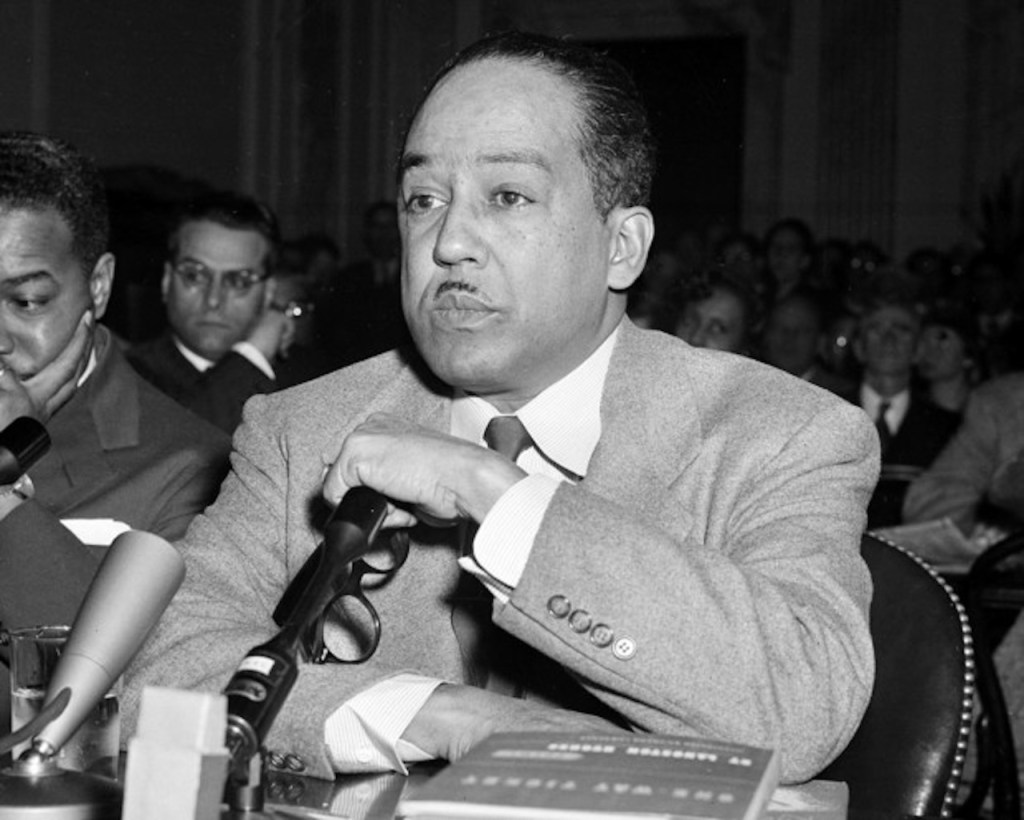
    Image:  Langston Hughes– Appearing before Joseph McCarthy’s Senate Permanent Subcommittee on Investigations – March 24, 1953

    Note on Term Usage:  Before the late 1980s in the United States, the terms “Negro,” “colored,” and “black” were accepted widely in American English parlance.   While the term “Negro” had started to lose it popularity in the 1960s, it wasn’t until 1988 that the Reverend Jesse Jackson began insisting that Americans adopt the phrase “African American.”  The earlier more accurate terms were the custom at the time that Langston Hughes was writing.

    Langston Hughes’ “Goodbye, Christ”

    Langston Hughes wrote “Goodbye, Christ” in 1931. It was published in a statist publication called “The Negro Worker” in 1932, but Hughes later withdrew it from publication.

    Introduction with Text of “Goodbye, Christ”

    Nine years after the publication of Langston Hughes’ “Goodbye, Christ,” on January 1, 1941, the poet was scheduled to deliver a talk about Negro folk songs at the Pasadena Hotel. Members of Aimee Semple McPherson’s Temple of the Four Square Gospel picketed the hotel with a sound truck playing “God Bless America.”   

    Likely those members of the McPherson temple became aware of the poem because McPherson is mentioned in it. The protestors passed out copies of Hughes’ poem, “Goodbye, Christ,” even though they had not secured permission to copy and distribute it. 

    A few weeks later, The Saturday Evening Post, heretofore no friend to black writers, also mentioned in the poem, also printed the poem without permission. The poem had received little attention until these two events.  

    But Hughes had been criticized for his “revolutionary” writings and apparent sympathy for the Soviet form of government. On March 24, 1953, Hughes was called to testify before the Joseph McCarthy’s Senate Permanent Subcommittee on Investigations.

    Goodbye, Christ

    Listen, Christ,
    You did alright in your day, I reckon-
    But that day’s gone now.
    They ghosted you up a swell story, too,
    Called it Bible-
    But it’s dead now,
    The popes and the preachers’ve
    Made too much money from it.
    They’ve sold you to too many
    Kings, generals, robbers, and killers-
    Even to the Tzar and the Cossacks,
    Even to Rockefeller’s Church,
    Even to THE SATURDAY EVENING POST.
    You ain’t no good no more.
    They’ve pawned you
    Till you’ve done wore out.
    Goodbye,
    Christ Jesus Lord God Jehova,
    Beat it on away from here now.
    Make way for a new guy with no religion at all-
    A real guy named
    Marx Communist Lenin Peasant Stalin Worker ME-
    I said, ME!
    Go ahead on now,
    You’re getting in the way of things, Lord.
    And please take Saint Gandhi with you when you go,
    And Saint Pope Pius,
    And Saint Aimee McPherson,
    And big black Saint Becton
    Of the Consecrated Dime.
    And step on the gas, Christ!
    Move!
    Don’t be so slow about movin?
    The world is mine from now on-
    And nobody’s gonna sell ME
    To a king, or a general,
    Or a millionaire.

    Commentary on “Goodbye, Christ”

    Langston Hughes’ poem “Goodbye, Christ” is a dramatic monologue. The speaker is addressing Christ, telling him to leave because He is no longer wanted. The speaker is employing irony and sarcasm to express his distrust and disapproval of the many people, including the clergy, who have used religion only for financial gain.

    Serving God or Mammon 

    In the first verse paragraph (versagraph), the speaker explains to Christ that things are different now from the way they were back in Christ’s day; the speaker figures that back then Christ’s presence might have been appreciated, but now “[t]he popes and the preachers’ve / Made too much money from [your story].”  

    And that complaint is addressed in the poem that certain individuals and organizations have used the name of Christ to make money: “They’ve pawned you / Till you’ve done wore out.”  

    The speaker makes it clear that it is not only Christianity that has been desecrated, for he also includes Hinduism when he tells Christ “please take Saint Gandhi with you when you go.”  It is not only white people like McPherson, but also “big black Saint Becton,” a charlatan preacher Hughes mentions in his autobiography, The Big Sea

    Hughes is, in no way, repudiating Jesus Christ and true religion. He is, however, excoriating those whom he considers charlatans, who have profited only financially without highlighting the true meaning of Christ’s (or other religions’) teachings. 

    Langston Hughes on “Goodbye, Christ” 

    In editor Faith Berry’s Good Morning Revolution: Uncollected Writing of Langston Hughes, Berry brings together a large collection of writings for which Hughes did not seek wide publication.  Some of his early politically statist-leaning poems, which had appeared in obscure publications, managed to circulate, and Hughes was labeled a Communist, which he always denied in his speeches. 

    About “Goodbye, Christ,” Hughes has explained that he had withdrawn the poem from publication, but it had appeared without his permission and knowledge.  Hughes also insisted that he had never been a member of the Communist Party.  He went so far as to say he wished Christ would return to save humanity, which was in dire need of saving, as it could not save itself. 

    Earlier in his immaturity, Hughes had believed that the communist form of government would be more favorable to black people, but he became aware that his VIP treatment in Russia was a ruse, calculated to make people of color think that communism was friendlier to them than capitalism while ultimately hoodwinking them just as the Democratic Party did later on in the century.  (Also see Carol Swain’s “The Inconvenient Truth about the Democratic Party”)

    In his senate committee testimony on March 24, 1953, Hughes makes his political inclinations clear that he had never read any book on the theory of socialism and communism.  Also, he had not delved into the stances of the Republican and Democrat parties in the United States.

    Hughes claimed that his interest in politics was prompted solely by his emotion.  Only through his own emotions had he glanced at what politics might have to offer him in figuring out personal issues with society.  So in “Goodbye, Christ,” the following versagraph likely defines the poet’s attitude at its emotional depths:

    Goodbye,
    Christ Jesus Lord God Jehova,
    Beat it on away from here now.
    Make way for a new guy with no religion at all—
    -A real guy named
    Marx Communist Lenin Peasant Stalin Worker ME—
    I said, ME!

    Hughes spent a year in Russia and came back to America writing glowing reports of the wonderful equalities enjoyed by all Russians, which many critics wrongly interpreted to indicate that Hughes became a communist.   On January 1, 1941, Hughes wrote the following clear-eyed explanation that should once and for all put to rest the notion that his poem was meant to serve blasphemous purposes:

    “Goodbye, Christ” does not represent my personal viewpoint.  It was long ago withdrawn from circulation and has been reprinted recently without my knowledge or consent.  I would not now use such a technique of approach since I feel that a mere poem is quite unable to compete in the power to shock with the current horrors of war and oppression abroad in the greater part of the world.

    I have never been a member of the Communist party.  Furthermore, I have come to believe that no system of ethics, religion, morals, or government is of permanent value which does not first start with and change the human heart.  Mortal frailty, greed, and error know no boundary lines.  

    The explosives of war do not care whose hand fashions them.  Certainly, both Marxists and Christians can be cruel.  Would that Christ came back to save us all. We do not know how to save ourselves. (my emphasis added) —from  Good Morning Revolution: Uncollected Writing of Langston Hughes, page 149.

    The Importance of Understanding the Irony in “Goodbye, Christ”

    While it may be difficult for devout Christians, who love Christ and his teachings, to read such seemingly blasphemous writing, it is important to distinguish between the literal and the figurative:  Hughes’ “Goodbye, Christ” must be read through the lens of irony and sarcasm, and realized as a statement against the financial usurpation of religion, and not a repudiation of Christ and the great spiritual masters of all religions.

    It should be remembered that Hughes’ seemingly blasphemous poem simply creates a character who was speaking ironically, even sarcastically, in order to call out the actual despicable blasphemers who desecrate true religion with duplicity and chicanery.

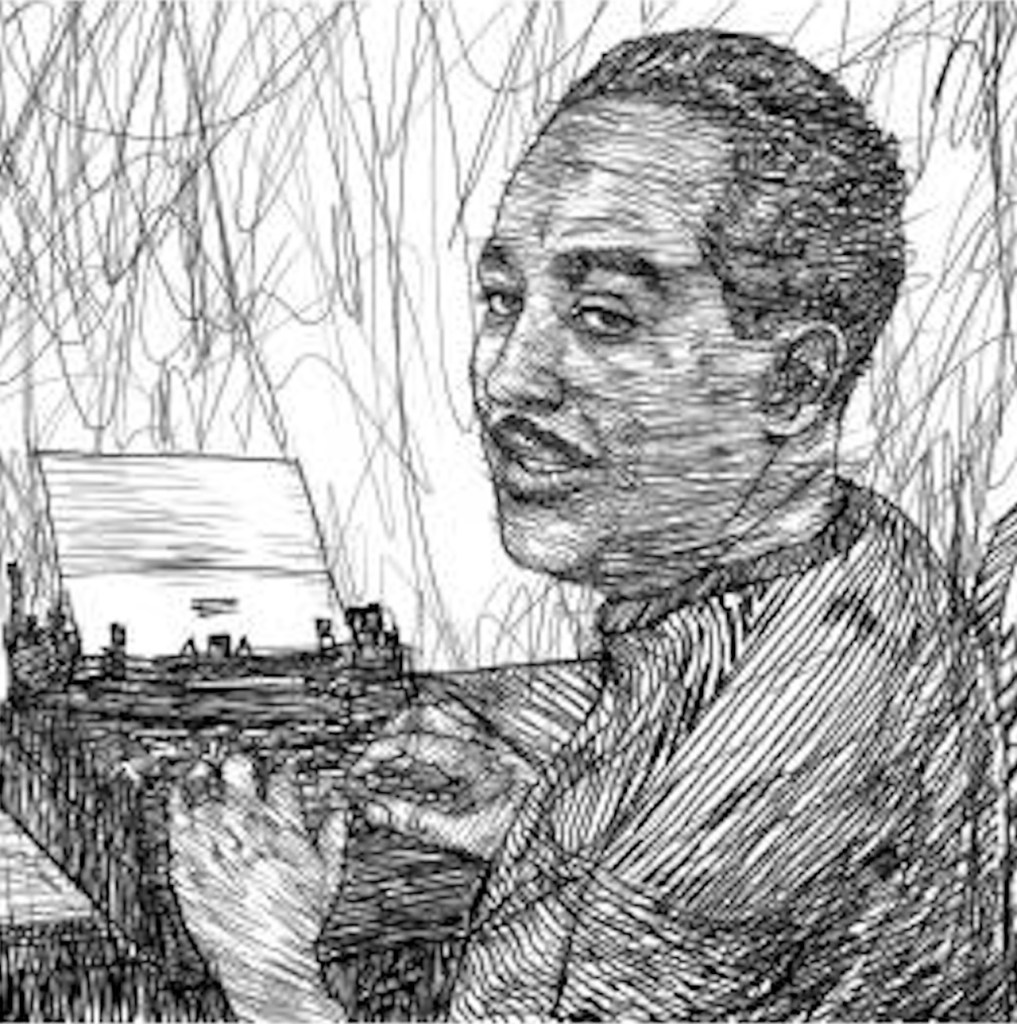
    Image:  Ink Drawing of Langston Hughes– Ink Portrait – Fabrizio Cassett

  • Langston Hughes’ “Harlem”

    Image: Langston Hughes - Carl Van Vechten Eakins Press Foundation photo by Carl Van Vechten (1880-1964) https://www.sfgate.com/entertainment/article/Inspired-by-poet-Hughes-Influential-writer-was-2875941.php
    Image: Langston Hughes – Eakins Press Foundation – photo by Carl Van Vechten (1880-1964)

    Langston Hughes’ “Harlem”

    Langston Hughes’ “Harlem” examines the potential effects of having to postpone dreams or goals.  The result of such delay may present itself in numerous ways, and the speaker explores them in this poem through colorful imagery in five dramatic similes and one explosive metaphor.

    Introduction with Text of “Harlem”

    The title of Langston Hughes’ “Harlem” may be considered somewhat ironic.  The Harlem Renaissance became a colorful, vibrant period of flourishing in literary, musical, visual, and other forms of art.    Several civil rights activists, including the excellent poet/activist James Weldon Johnson, were active contributors to this flourishing movement.

    The irony, however, rests in that fact that many dreams, especially of black American artists, were being realized as never before, yet, the poem engages in speculation about the events that may transpire if dreams are postponed, remaining unrealized.

    Still, on the other hand, systemic racism in America was not eliminated until enactment of the Civil Right Act of 1964.  Thus Hughes’ speaker was quite timely in speculation that much of the black population was still being subjected to unfavorable conditions, including having to postpone certain dreams of equality of opportunity.

    Because this poem’s speaker makes no mention of anything referring to race or ethnicity, the poem’s “dream” could be any desired goal held by any member of any race or ethnic group. 

    The message of this poem can be applied to any “dream” or “goal” that would have to be postponed, especially if postponed by coercion or unfair competition. The poem’s universal message is what makes it a great poem.

    This poem appears in Langston Hughes’ 1951 collection, Montage of a Dream Deferred.  The theme of the poem explores the mental and emotional states that the human mind might undergo if forced to postpose or abandon one’s heartfelt dreams and life goals.   The poem primarily employs similes but concludes with one explosive metaphor to convey its impact.

    The speaker opens the poem questioning what happens when a dream has to be postponed.  He moves on to make four further inquiries; he then provides a suggestion and finally concludes with a shocking, explosive question.   The inquiries that employ the use of similes turn out to be rhetorical questions; answers to these questions are actually featured within the questions themselves.  

    This strategy leaves no doubt about the answers to those questions.  They are yes/no questions, and the obvious answer is yes in all cases.  As “yes or no” questions, they require no further elaboration.  The speaker’s point of view on the issue is quite clear:  he holds the notion that a dream postponed indefinitely can result in all sorts of damage, including death. 

    The similes— “like a raisin in the sun,” “like a sore,” “like rotten meat,” “like a syrupy sweet,” “like a heavy load”—form the questioning pattern, with the final simile, however,  expressed as a suggestion.  Then the metaphor in the conclusion bursts forth with, “or does it explode?“—the most volatile question of all—therefore it receives added italic emphasis.

    No one wants to postpone a dream, that is, a goal, regardless of whether it is to buy a new phone or start that new career.  But what happens to that dream if it does have to be put off for any reason?  Maybe it just languishes in the back of the mind or maybe it causes the individual to behave in a destructive manner. 

    In roughly 50 words, the speaker has explored a human phenomenon that most, if not all human beings, have experienced in their time on earth.  The degree of intensity to which each dream deferred has been subjected is the main theme of the poem.  With colorful imagery presented through rhetorical questions, the speaker has created a memorable drama, focusing on a universal human condition.

    Harlem

    What happens to a dream deferred?

    Does it dry up
    like a raisin in the sun?
    Or fester like a sore—
    And then run?
    Does it stink like rotten meat?
    Or crust and sugar over—
    like a syrupy sweet?

    Maybe it just sags
    like a heavy load.

    Or does it explode?

    Commentary on “Harlem”

    Langston Hughes’ poem features several perfect rimes in “sun-run,” “meat-sweet,” “load-explode.” The poem employs images: “raisin in the sun,” “fester like a sore,” “stink like rotten meat.”   Even the metaphor that contains no noun suggests the subliminal vision of an exploding bomb which includes all the five senses for which the imagery is employed.

    First Movement:  The Delaying

    What happens to a dream deferred?

    Most mature, well-adjusted, thinking human beings entertain dreams and goals that they strive to achieve. This poem full of questions begins with a question seeking to know what events might occur after a dream has been postponed: what might such a delay cause the dreamer to do?

    Although it surely must be assumed that the “dream” referred to in this poem is one vital to human nature and dignity, such as the desire for individual freedom, personal security, and individual achievement, in reality, it does not matter what the dream is, because each person reacts differently to different circumstances.

    Some human minds and hearts are more patient than others. What may set off a volatile reaction from one person may be well tolerated by another.  Still, dreams and goals are so important to the life of the dreamer that they occupy the dreamer’s attention in the consciousness much of the time during the day and possibly even in sleep.

    It is, therefore, little wonder that if the dreamer hits a roadblock that stalls his/her continuing on the path to fulfillment of a goal, s/he may become disturbed.  The speaker in the poem is exploring a range of possible outcomes that may be experienced by differing personalities.

    Second Movement: The Drying Up

    Does it dry up
    like a raisin in the sun?

    After a dream or goal is allowed to “dry up like a raisin in the sun,” that dream or goal will lose its value. A raisin is a sweet, nutritious food but left out in the sun, it will harden and lose its flavor as well as its nutritional value.  The life’s goal of a human being performs a vital role in making that person a successful, contributing member to the culture and society of the human race.

    However, if an individual is put off over and over again, admonished that s/he simply has to wait for society’s laws and attitudes to change before s/he can start a business, or become a doctor, lawyer, teacher, or artist, that individual is likely to wither away or “dry up,” particularly emotionally and mentally.

    The speaker wishes to place into the consciousness of society that the notion of delaying the dreams of individuals will become an impediment to progress. Talent and ingenuity require nurturing. not being postponed.

    Desire to flourish must be encouraged, not kept in the dark of indifference. The drying up of human talent and energy is a waste of human capital; thus the slogan “a mind is a terrible thing to waste” offers a useful claim as well as a clever advertisement for colleges.

    The waste of that mind not only affects the individual, but it also affects the entire community and eventually the whole of society.  If a country continues to denigrate its native talent, that country is bound to fail.

    Third Movement:  The Festering

    Or fester like a sore—
    And then run?

    The speaker then considers another issue that might arise from a delayed dream; instead of drying up, maybe it will run like a sore that has festered and become all pus infused. We all want our sores to dry up; we do not want them to fester and continue to run.

    Restless dissatisfaction might occur if a dream festers and runs. The innocent dreamer might transform into a criminal, perpetrating criminal offenses against whom or what s/he believes to be standing in the way of his/her dreams.  Again, the whole of society is lessened by such behavior.

    Fourth Movement:  The Stinking

    Does it stink like rotten meat?

    Rotten meat gives off a definite, unpleasant odor. A dream allowed to lie untended in the mind might decay and give off the stench of unfulfilled desires. The unpleasant odor comes from the dead dream, just as the stink spreads from rotten animal flesh.

    The “rotten meat” simile is particularly powerful. The stench of decayed flesh remains nearly unbearable to the human nostrils. The speaker has grown particularly suspicious that deferred dreams can ever produce anything resembling a pleasant outcome.

    Fifth Movement:  The Crusting Over

    Or crust and sugar over—
    like a syrupy sweet?

    The dried accumulation that forms on syrup or honey bottles left unused for quite some time presents as an unpleasant crust. It is the lack of use has caused that unpleasant accumulation.

    The contents of the bottle will become unusable if left long enough, and so it becomes with dreams. Elderly folks often complain that they failed to pursue certain dreams when they were young, and now those dreams have become a bitter memory, a crusty accumulation at the top their bottle of life.  The crusted over dreams may present themselves as emotions of hatred, doubt, anger, and despair.

    Sixth Movement:  The Sagging

    Maybe it just sags
    like a heavy load.

    This stanza does not pose a question; it offers a suggestion that perhaps the postponed dream just bends because of the “heavy load” of deferral. The dreamer has become lazy and lethargic, even clumsy, as s/he trudges along under the heavy load that has become a mighty burden.

    The dream continues to weigh heavily on the mind of the dreamer who keeps on wondering what s/he might have accomplished, if given the opportunity. Thus from carrying the burden of doubt, the dreamer may become depressed even lacking the ability to be at all productive.

    Seventh Movement: The Exploding

    Or does it explode?

    All of the possibilities heretofore mentioned in the similes and in the sagging heavy load suggestion of suffering a dream deferred are deficient, shoddy, even possibly life-threatening. While negative in their description, all of the earlier questions imply a certain level of tolerance.

    The deferral of those dreams referred to in the similes have affected mostly the dreamer. But the question metaphorically expressed in the final line becomes literally and definitely explosively life-threatening, not only to the dreamer but to his/her surroundings.

    The speaker asks, “does it explode?” Bombs explode—as well as anything in a container in which pressure has built up to the point that the container is no longer capable of expanding to accommodate that pressure.  If the dreamers no longer harbor a shred of hope for their dreams, they may become such a container under pressure.  They may figuratively become a human bomb by employing a destructive device that can maim and kill others in the person’s vicinity.

    Miserable dreamers full of despair, grief, and hopelessness may engage in any number of dangerous, life-threatening acts, as they try to hold responsible those they consider to blame for their inability to realize their dreams and life goals.

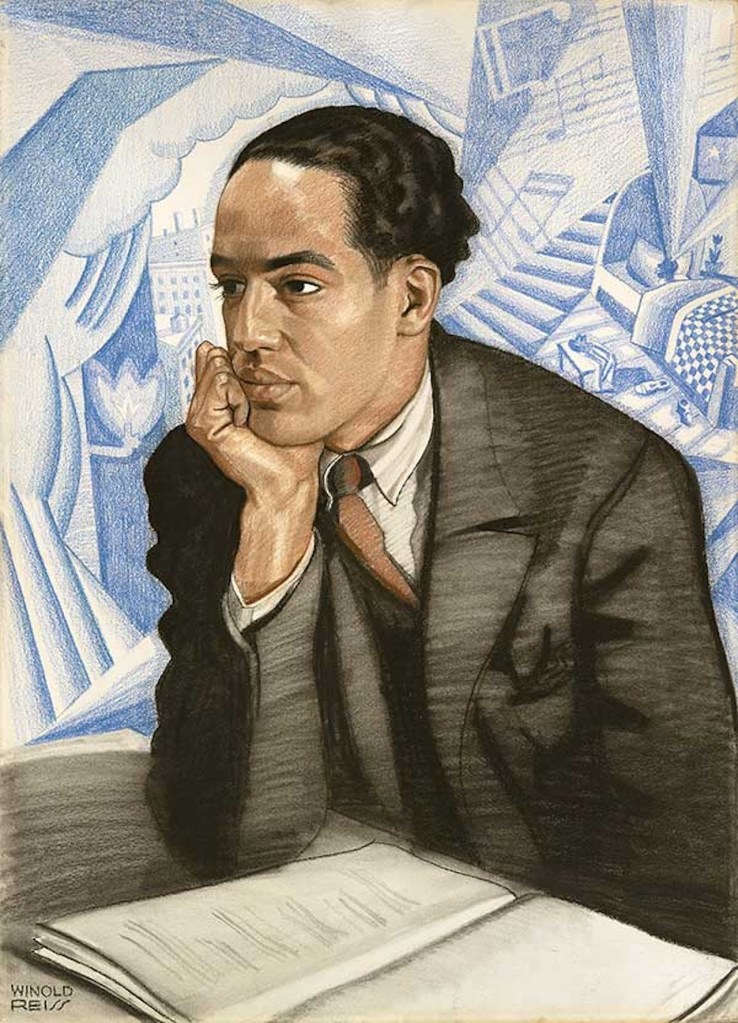
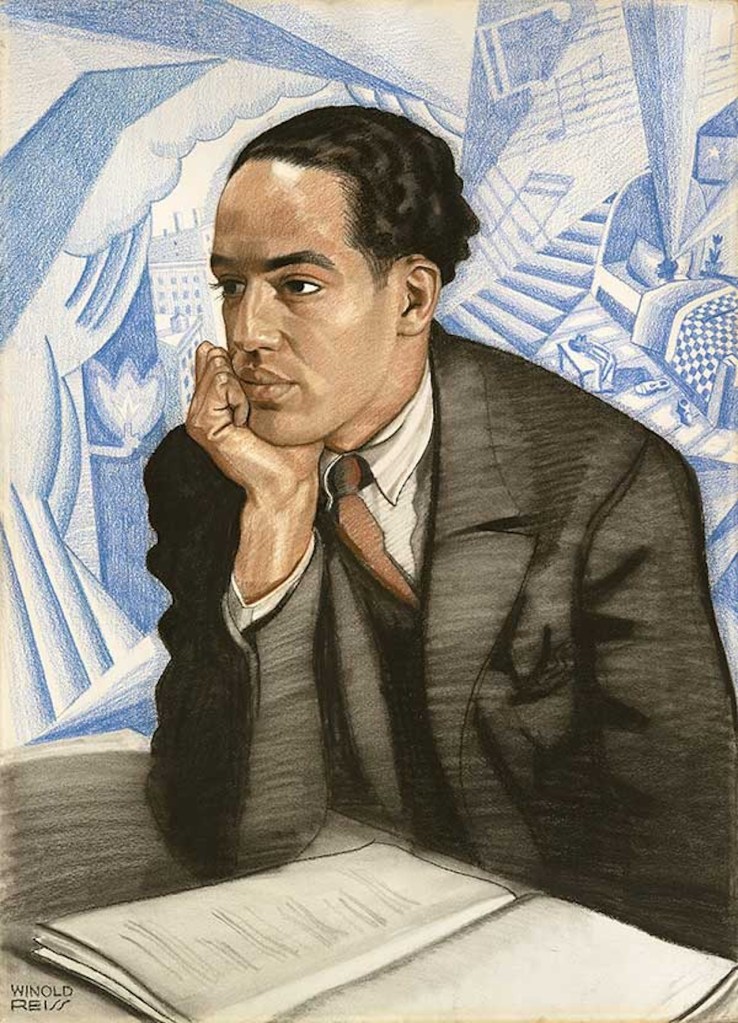
    Image:  Portrait of  Langston Hughes – Winold Reiss – National Portrait Gallery


    Video: Langston Hughes: Leading Voice of the Harlem Renaissance | Biography

    🕉

    You are welcome to join me on the following social media:
    TruthSocial, Locals, Gettr, X, Bluesky, Facebook, Pinterest 

    🕉

    Share

  • Langston Hughes’ “The Negro Speaks of Rivers”

    Image:  Langston Hughes.  Library of Congress. Photographer Gordon Parks 

    Langston Hughes’ “The Negro Speaks of Rivers”

    Langston Hughes’ speaker in “The Negro Speaks of Rivers” displays his message in five versagraphic movements, thematically exploring his soul experience with a “cosmic voice,” which includes and unites all of humanity.

    Introduction and Text of “The Negro Speaks of Rivers”

    Langston Hughes’ speaker in “The Negro Speaks of Rivers” displays his message with a “cosmic voice,” which includes and unites all of humanity.  The poem plays out in five versagraphic movements, focusing on the theme of soul exploration.

    The Cosmic Voice in Poetry

    Writers, especially poets, often employ the “cosmic voice” in order to provide a deep and wide view of historical events and vast swaths of space.  A device called the omniscient speaker is often used in fiction; that voice is similar to the cosmic voice but much more limited.

    Time and space may stretch or contract as needed as the cosmic seer narrates what he experiences.  The “cosmic voice” may come to a poet through a vivid imagination; however, it transcends the imagination as a truth teller.   Only a few poets have been blessed with such a voice; examples are Emily Dickinson, Rabindranath Tagore, Paramahansa Yogananda, and to a limited degree Walt Whitman.

    The cosmic voice imparts truth through deep intuition.  The soul of the speaker employing the cosmic voice is, even if only temporarily as is the case with Langston Hughes, becomes aware of its vast and profound knowledge.  The cosmic voice speaks from a place far beyond ordinary sense awareness.  

    Individuals who comprehend the cosmic voice are bequeathed a consciousness far beyond their own sense awareness and thus comprehend the unity of all created things.  Those individuals are heralded into the realm of the Cosmic Creator and often remain transformed beings for having experienced that Sacred Locus.

    Langston Hughes and the Cosmic Voice

    The voice employed in “The Negro Speaks of Rivers” is not a whining, complaining one so often heard in the protest voices of activists; instead Hughes is employing the cosmic voice—the voice of the soul that knows itself to be a divine entity.  That voice speaks with inherent authority; it reports its intuitions so that others might hear and regain their own experiences through its guidance.

    Langston Hughes’ speaker in “The Negro Speaks of Rivers” imparts his discourse in five versagraphic movements.  His theme explores with the cosmic voice that unites all of humanity.  

    The vital lines that serve as a refrain—”I’ve known rivers” and “My soul has grown deep like the rivers”—work like a chant, instilling in the listener the truth that the speaker wishes to impart.  That Langston Hughes was able to employ a cosmic voice in a poem at age seventeen is quite remarkable.  

    Although some of his later work, even as much of it remained important and very entertaining, descended into the banal and at times even slipshod, no one can deny his marvelous accomplishment with this early poem in which he speaks as a master craftsman.

    The Negro Speaks of Rivers 

    I’ve known rivers:
    I’ve known rivers ancient as the world and older than the flow
    of human blood in human veins.

    My soul has grown deep like the rivers.

    I bathed in the Euphrates when dawns were young.
    I built my hut near the Congo and it lulled me to sleep.
    I looked upon the Nile and raised the pyramids above it.
    I heard the singing of the Mississippi when Abe Lincoln
         went down to New Orleans, and I’ve seen its muddy
         bosom turn all golden in the sunset.

    I’ve known rivers:
    Ancient, dusky rivers.

    My soul has grown deep like the rivers.

    Reading:   Langston Hughes reads his poem “The Negro Speaks of Rivers”

    Commentary on “The Negro Speaks of Rivers”

    Langston Hughes’ speaker in “The Negro Speaks of Rivers” stands as high testimony to the poet’s ability to craft genuine, heartfelt poetry.  To have composed such a profound piece of art at such an early age bespeaks a literary marvel.

    First Movement:  The River as a Symbol

    I’ve known rivers:
    I’ve known rivers ancient as the world and older than the flow
    of human blood in human veins.

    The poem opens with the speaker remarking rather nonchalantly that he has experienced the natural phenomenon known as “rivers.”  He has no doubt observed rivers flowing in their channels, and he has become aware that rivers flow through the earth as blood flows through the veins of human beings.  

    Both flowing rivers and flowing blood must be ancient, but the speaker intuits that the flow of the rivers surely predates that of the appearance of the human being upon the planet. The river image becomes a symbol linking all of humanity from the pre-historic era to the present day.   

    As the “river” has served to carry the physical encasements (bodies) and mental bodies over the rough terrain of land and rocks, the symbolic river carries the soul on its Divine journey.   Readers and listeners will easily intuit the significance of the speaker’s focus as it ranges far beyond the boundaries of the physical, material universe.

    Second Movement:  Intuitive Awareness

    My soul has grown deep like the rivers.

    This line indicates that the speaker has become aware that through his own soul he can intuit historical events, places, and people, who have existed from the beginning to time.  The line becomes a refrain and will be encountered again in the poem because of its great importance.  

    It becomes quite obvious that the speaker would not have been able to know literally the rivers of antiquity that he claims to “know.”  However, through his soul, or mystical awareness, he can.  Thus, he again employs the cosmic, thus mystical, voice to fashion his assertion.

    Third Movement: Historical Unity

    I bathed in the Euphrates when dawns were young.
    I built my hut near the Congo and it lulled me to sleep.
    I looked upon the Nile and raised the pyramids above it.
    I heard the singing of the Mississippi when Abe Lincoln
         went down to New Orleans, and I’ve seen its muddy
         bosom turn all golden in the sunset.

    The speaker claims that he “bathed in the Euphrates” at the dawning of Western civilization.  From the Euphrates to the Mississippi Rivers, the speaker offers a huge expansion of time and place.  

    In biblical times to present time, he lays claim to knowledge, again impossible except for soul consciousness. Awareness through the soul is unlimited, unlike the limitations of body and mind.  The speaker could not have experienced the Euphrates when “dawns were young.”  

    But the cosmic voice of the speaker can place itself at any point along the time line of civilization or cosmic creation. In claiming to have built his “hut near the Congo,” the speaker continues his cosmic, mystically inspired journey.  He “looked upon the Nile”  and “raised the pyramids” only as a cosmic-voiced speaker.

    People of all times and climes have been influenced by the river experience.  The speaker can thus unite all races, nationalities, creeds, and religions in his gathering of historic experiences within which all those peoples have lived.   And he accomplishes this feat through employment of the symbolic force of the “river.” 

    Emphasizing the American experience, the speaker claims to have “heard the singing of the Mississippi when Abe Lincoln / went / down to New Orleans . . . .”   The allusion to President Abraham Lincoln reminds the reader of the process of slave emancipation.

    As with all the rivers mentioned, the Mississippi River, an American river, stands as a symbol of the blood of the human race—not naturally segregated into color and national categories. The American Mississippi River, as the earlier mention of rivers has done, symbolizes the human blood of the human race—the only race that scientifically exists.

    Fourth Movement:  A Soul Chant

    I’ve known rivers:
    Ancient, dusky rivers.

    Because of the importance of the “river” as a symbol, the speaker repeats the line, “I’ve known rivers.”  Like the line, “My soul has grown deep like the rivers,” this one also  serves as a refrain.   If the speaker had chanted the line many more times, the poem’s delightful charm would have even been enhanced—that line is that crucial!

    The soul, the river, the depth of the soul and the river—all force history to yield a mighty blessing on those who have “known rivers,”  and whose souls have grown deep like those rivers. 

    Thus the speaker offers a brief description of how those river appear:  they are extremely old, and they are mystically dark, a measure that alludes to the dark-skinned race with graceful precision, even as it holds all races as having experienced the nature of the mystic river.

    Fifth Movement: Life Force and the Symbol of the River

    My soul has grown deep like the rivers.

    The speaker’s soul has grown profoundly deep like the rivers and along with the rivers.  Civilizations have grown up and grown deep along rivers all over Planet Earth. The soul that possesses the body is the life force informing and maintaining that body. 

    Likewise, rivers streaming through the earth give life force to civilizations and also assist in maintaining those civilization with the products and supplies that river travel has allowed over the centuries.

    The speaker is taking his own identity from the energetic force of the soul and the river force of the earth.  The children of the Divine Creative Reality (God) all spring forth from a common ancestry, a symbolic set of original parents.   It has always been rivers that link all of those ancestors as the blood in their veins links them into one family—the Human Race.

    The cosmic voice of a young poet—who happened possess the darker hue of skin along the color spectrum—has rendered a statement that could enlighten and reconnect all peoples if only they could listen with their own cosmic awareness.  

    At the soul level, all human beings remain eternally linked as children of the Great Divine River King (God). That River God flows in the blood of His offspring. And that same River God flows in the rivers of the planet on which they find themselves too often segregated by ignorance of their own common being as sparks of the Divine.

    Instead of identifying with the perishable body and changeable mind that too often rule, the simple act of identifying with their own cosmic nature would allow individuals to experience the cosmic voice of their own soul. The simple poet named Langston Hughes has offered a useful template for viewing the world through a cosmic lens in his nearly perfect poem.

    🕉

    You are welcome to join me on the following social media:
    TruthSocial, Locals, Gettr, X, Bluesky, Facebook, Pinterest 

    🕉

    Share

  • Langston Hughes

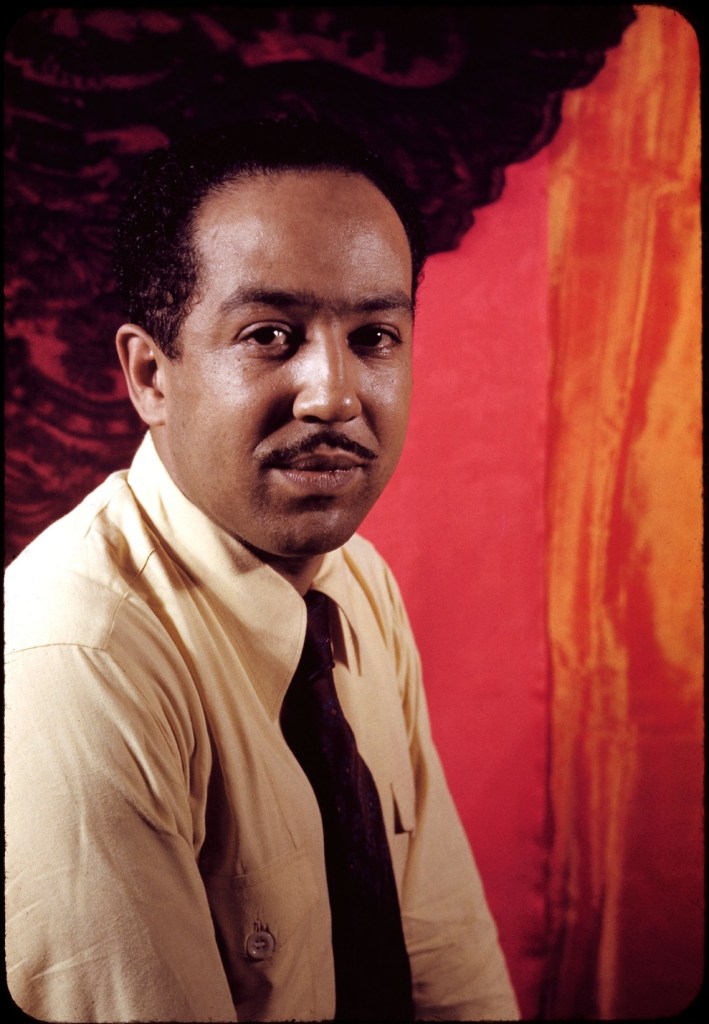
    Image: Langston Hughes  Carl Van Vechten Trust / Beinecke Library, Yale

    Life Sketch of Langston Hughes

    Hoyt W. Fuller, critic, editor, and founder of the Organization of Black American Culture (OBAC), has pointed out that Langston Hughes possessed a “deceptive and profound simplicity.”  Fuller insists that understanding these qualities in Hughes is key to understanding and appreciating his poetry.

    Early Life and Education

    On February 1, 1902, Langston Hughes was born in Joplin, Missouri, to James Nathaniel Hughes and Caroline Mercer Langston. The poet’s full name is James Mercer Langston Hughes. His parents divorced when Langston was very young, and he was raised primarily by his grandmother in Lawrence, Kansas [1].    In his first autobiography, The Big Sea, Hughes reveals,

    My grandmother raised me until I was twelve years old.  Sometimes I was with my mother, but not often.  My mother and father had separated.  And my mother, who worked, always traveled about a great deal, looking for a better job.

     When I first started to school, I was with my mother a while in Topeka. (And later, for a summer in Colorado, and another in Kansas City.)  She was a stenographer for a colored lawyer in Topeka, named Mr. Guy.  She rented a room near his office, downtown. So I went to a “white” school in the downtown district.[2]

    The poet’s father James Hughes had studied law and had planned to practice, but Jim Crow laws prevented him from taking the bar exam.  The elder Hughes then moved to Mexico, where not only was he admitted to the bar, but he also became very successful through the practice of law.  

    Langstons’ father’s financial success allowed him to become the owner of much property in Mexico City, where nearby he purchased and resided on a huge ranch in the hills.  He also became a money lender and foreclosed on mortgages.

    About his father, the poet has remarked, “my father was interested in making money to keep.”  This attitude contrasted with his mother and his stepfather, who were interested in making money to spend.  Thus, his mother and stepfather moved around a great deal to take advantage of better employment.

    In 1920, Langston Hughes graduated from Central High School in Cleveland, Ohio.  He had hopes of attending Columbia University to study to become a writer, but his father refused to pay for his son’s schooling unless the younger Hughes studied engineering. 

    Hughes started his university studies at Columbia but stayed for only a year.  He found racism at the school intolerable, so he left the university and took a number of jobs to support himself.  

    In 1929, Hughes completed his university studies at Lincoln University in Pennsylvania.   The school pays tribute to their most famous graduate with a library named in his honor, Langston Hughes Memorial Library [3].

    Full Image: Langston Hughes  Carl Van Vechten Trust / Beinecke Library, Yale

    Poetry

    Langston Hughes opens his first autobiography, The Big Sea, by reporting on a melodramatic event: he is tossing into the ocean one by one all the books he had studied while at Columbia University.  

    He had recently joined the large merchant ship S. S. Malone as a seaman; he was only twenty-one years old, and he made up his mind that nothing would ever again happen to him that he did not want to have happen.  

    He became intent on  securing his own freedom with his little dramatic ritual of unloading his college books into the ocean.  In the life of Langston Hughes, one poetic act often led to another.   Four years before this important, liberating act, however, the poet had traveled to Mexico to visit his father to ask for financial assistance to attend the university.  

    But he reports that his visits with his father in Mexico were mostly unsatisfactory; he could not identify with his father’s mindset.  His father hated his own race of people, and he was interested only in making money.  However, Langston needed his father’s financial support, so he spent time with him in Mexico.

    On this particular trip, while Hughes was only seventeen years old, the poet composed one of his most anthologized poems “The Negro Speaks of Rivers.”  He gives details of his inspiration for this poem in The Big Sea; he wrote the poem “just outside of St. Louis, as the train rolled toward Texas”:

    It came about in this way.  All day on the train I had been thinking about my father and his strong dislike of his own people.   I didn’t understand it, because I was a Negro, and I liked Negroes very much.

    He then describes meeting a number of blacks who had come “up from the South” as he worked at one of his “happiest jobs” at a soda fountain.   He reports that he enjoyed “hearing them talk, listening to the thunderclaps of their laughter, to their trouble, to their discussions of the war and the men who had gone to Europe from the Jim Crow South, their complaints over the high rent. . . .”   To Hughes, these people seemed to be the “gayest and bravest people possible” as they worked “trying to get somewhere in the world.”

    Crossing the Mississippi River at sunset, Hughes peered out of the Pullman window and saw “the great muddy river flowing down toward the heart of the South,” and he started musing on “what the river, the old Mississippi, has meant to Negroes in the past.”  

    He mused on the tragedy of slaves being sold down the river as the “worst fate” that a slave could suffer.  He then began musing on President Abraham Lincoln’s having rafted on the Mississippi down to New Orleans.  Lincoln had seen “slavery at it worst, and had decided within himself that it should be removed from American life.”

    Hughes’ musing in this creative reverie then turned to additional rivers that had affected the lives of members of his ethnicity: the Congo, the Niger, and the Nile.  And then the thought came to him: “I’ve known rivers.”  

    He wrote down that one line on an envelope holding the letter from his father which he carried in his pocket, and then within the next fifteen minutes, he had composed his magnificent poem, which he titled “The Negro Speaks of Rivers.”

    As one of the most important creative contributors to the Harlem Renaissance, Hughes has offered many poems to the American literary canon.  A small sample of his poems include “A Mother to Son,”  “Madame’s Calling Cards,” “Theme for English B,” “Night Funeral in Harlem,”  “Goodbye, Christ,” and “Cross.”

    Supporting Himself by Writing

    Langston Hughes has been most noted as a poet, and he managed to finish his college education after being awarded a full scholarship based on his proficiency as a poet.  After receiving his B.A. degree in 1929, he continued to publish widely, earning for himself the achievement of being a writer, who was able to support himself as an adult solely with his writings [4].

    In addition to poetry, which remained his first love, Hughes published three novels, Not without Laughter (1932), Scottsboro Limited (1932), and The Ways of White Folks (1934).   In 1935, Hughes was awarded a Guggenheim Fellowship.  The Gilpin Players (Karamu House) produced six of the poet’s plays in 1936 and 1937.  Hughes founded the Negro Theater in Los Angeles in 1939 and composed the script “Way Down South.”

    Hughes published eight collections of poems; he also published four books of fiction and six books for children and teens.  He added three books of humor to his resume as well as two autobiographies.  He also wrote essays and a number of books on black history.  As a prominent figure in the civil rights movement, he traveled and lectured widely throughout the world [5].

    Illness and Death

    In 1967,  at the Stuyvesant Polyclinic in New York City, Hughes submitted to t0 a surgical procedure to treat prostate cancer.  The surgery was a tragic failure, and he died from complications arising from that medical procedure [6].  Hughes’ body underwent cremation, and his ashes remain interred at the Schomburg Center for Research in Black Culture in Harlem, under the floor of the foyer in the institute.  

    The artwork on the flooring features a medallion of a human being formed by rivers and includes the line, “My soul has grown deep like the rivers,” from the poet’s inspirational poem “The Negro Speaks of Rivers.”

    Sources

    [1] Editors.  “Langston Hughes: 1902–1967.”  Poetry Foundation.  Accessed January 12, 2026.

    [2] Langston Hughes.  The Big Sea: An Autobiography.  Thunder’s Mouth Press.  New York.  1940. 1986. Print.

    [3] Editors.  “About the Library.”  Lincoln University.  Accessed January 12, 2026.

    [4] Langston Hughes.  I Wonder as I Wander: An Autobiographical Journey.  Thunder’s Mouth Press.  New York.  1956. 1986. Print.

    [5] Curators.  The Langston Hughes Society.  Horsham, Pennsylvania.  Accessed January 12, 2026.

    [6] Editors.  “Langston Hughes.”  Encyclopedia of Cleveland History: Case Western Reserve University.  Accessed January 12, 2026.

    Image: Langston Hughes – Poetry Foundation

    Commentaries on Langston Hughes Poems

    1. The Negro Speaks of Rivers
    2. Harlem
    3. Goodbye, Christ
    4. Theme for English B 
    5. A Mother to Son
    6. Cross
    7. Madam’s Calling Card 
    8. Night Funeral in Harlem

    Note on Term Usage:  Before the late 1980s in the United States, the terms “Negro,” “colored,” and “black” were accepted widely in American English parlance.   While the term “Negro” had started to lose it popularity in the 1960s, it wasn’t until 1988 that the Reverend Jesse Jackson began insisting that Americans adopt the phrase “African American.”  The earlier more accurate terms were the custom at the time that Langston Hughes was writing.

    Image: Langston Hughes.    Portrait by Winold Reiss (1886–1953) – National Portrait Gallery, Smithsonian Institution.