I enjoy watching the cooking shows on TV, and as I watch, I constantly muse on how to convert their traditional uses of meat, eggs, milk, butter, and cheese to vegan versions. An example of this musing resulted in my “Vegan Meatloaf” that looks a lot like the meatloaf my mother used to make and tastes as yummy.
In addition to following a vegetarian diet, I also try to eat more alkalizing than acidifying foods. Most vegetables and fruits, some nuts, and pseudo grains are alkalizing; therefore, my recipes frequently call for sprouted grains to replace regular whole grains; however, I do use whole-wheat flour and unbleached organic flour occasionally, especially for biscuits and gravy.
I replace regular salt with sea salt, refined sugar with agave nectar, stevia, or raw sugar, depending on the recipe, and soy milk with coconut milk.
This kind of cooking requires experimentation, and these webpages, as well as my published cookbook, feature the recipes that I have tried and deemed successful—although I continue to think of my cooking as experimental because I hardly ever make a dish the same way twice.
And my dishes always have a rather ragged look about them that I call rustic. The pictures that accompany some of the recipes will show you exactly what I mean by “rustic.” They are tasty, however!
Thank you for taking this experimental culinary journey with me!
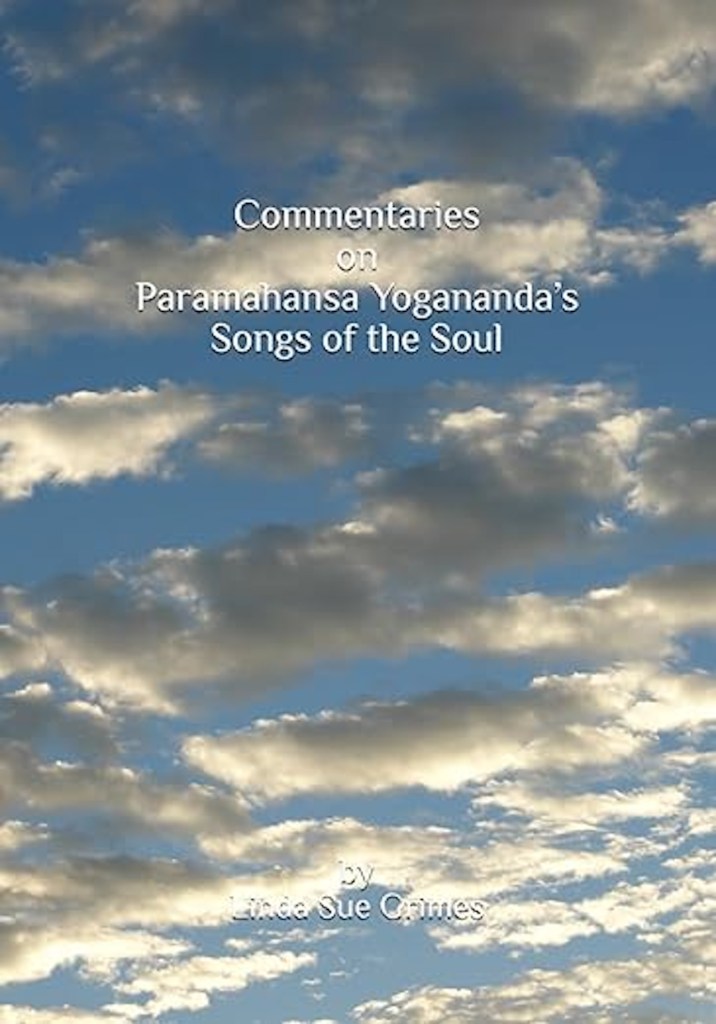
Commentaries on Paramahansa Yogananda’s Songs of the Soul
Each time my father, mother, friends Do loudly claim they did me tend, I wake from sleep to sweetly hear That Thou alone didst help me here. —from Paramahansa Yogananda’s “One Friend”
for Ron Grimes, my soul mate with whom I travel the spiritual path
This collection of personal commentaries is a companion to the book of spiritual poems, Songs of the Soul, written by Paramahansa Yogananda, the “Father of Yoga in the West.” While these commentaries offer elucidation of each poem, they cannot offer the beauty and majesty experienced by reading the poems themselves.
I have included only an excerpt from each poem preceding each commentary. I, therefore, humbly suggest that you acquire a copy of the great guru’s poems to experience them for yourself, along with my commentaries.
Paramahansa Yogananda’s Songs of the Soul is available at the Self-Realization Fellowship bookstore, Amazon, Barnes & Noble, and other online outlets, as well as in bookstores everywhere.
These commentaries are my personal responses to the poems in Paramahansa Yogananda’s Songs of the Soul. If they assist any reader in understanding the poetic language on a deeper level, then that is a bonus, for my only purpose is to offer my own personal, humble reading.
Brief Publishing History of Songs of the Soul
The first version of Paramahansa Yogananda’s Songs of the Soul appeared in 1923. He continued to revise the poems during the 1920s and 1930s, and the definitive revision that was authorized by the great guru was published in 1983, featuring many restored lines that had been excised from the first publication of the text.
The 1923 version of the collection of poems appears online at Internet Archive. For my commentaries, I rely on the printed text of the 1983 version; the current printing year for that version is 2014.The 1983 printing offers the final approved versions of these poems.
Special Purpose of the Poems in Songs of the Soul
The poems in Songs of the Soul come to the world not as mere literary pieces that elucidate and share common human experiences as most ordinary successful poems do, but these mystical poems also serve as inspirational guidance to enhance the study of the yoga techniques disseminated by the great guru, Paramahansa Yogananda.
He came to the West, specifically to Boston, Massachusetts, in the United States of America, to share his deep knowledge of yoga through techniques that lead the mind to conscious awareness of God, a phenomenon that he called “self-realization.”
The great guru published a series of lessons that contain the essence of his teaching as well as practical techniques of Kriya Yoga. His organization, Self-Realization Fellowship, has continued to publish collections of his talks in both print and audio format that he gave nationwide during the 1920s, 1930s, 1940s, and 1950s.
In addition to Songs of the Soul, the great guru/poet offers mystical poetic expressions in two other publications, Whispers from Eternity and Metaphysical Meditations, both of which serve in the same capacity that Songs of the Soul does, to assist the spiritual aspirant on the journey along the spiritual path.
This section features the commentaries, one for each of the 101 poems in Songs of the Soul. Each commentary is preceded by a brief introduction and excerpt from the poem. Here I am offering the first commentaries, each with an excerpt from the poem.
1. “Consecration”
In the opening poem, titled “Consecration,” the speaker humbly offers his works to his Creator. He offers the love from his soul to the One Who gives him his life and his creative ability, as he dedicates his poems to the Divine Reality or God.
Introduction and Excerpt from “Consecration”
Paramahansa Yogananda, the great guru/poet and founder of Self-Realization Fellowship, known as the “Father of Yoga in the West,” dedicates his book of mystical poems, Songs of the Soul, to his earthly father and consecrates it by offering it to his Heavenly Father (God—the Divine Creator). In dedicating his collection to his earthly father, the great guru writes,
Dedicated to my earthly father, who has helped me in all my spiritual work in India and America
The first poem appearing in the great yogi-poet’s book of spiritual poems is an American (innovative) sonnet, featuring two sestets and a couplet with the rime scheme AABBCC DDEFGGHH.
The first sestet is composed of three rimed couplets; the second sestet features two rimed couplets and one unrimed couplet that occupies the middle of the sestet.
This innovative form of the sonnet is perfectly fitted to the subject matter and purpose of the Indian yogi, who has come to America to minister to the waiting souls, yearning for the benefits of the ancient yogic techniques in which the great guru will instruct them.
The ancient Hindu yogic concepts offer assistance to Westerners in understanding their own spiritual traditions, including the dominant Christianity of which many are already devotees.
Excerpt from “Consecration”
At Thy feet I come to shower All my full heart’s rhyming* flower: Of Thy breath born, By Thy love grown, Through my lonely seeking found, By hands Thou gavest plucked and bound . . .
*The spelling, “rhyme,” was introduced into English by Dr. Samuel Johnson through an etymological error. As most editors require the Johnson-altered spelling of this poetic device, the text of Songs of the Soul also adheres to that requirement featuring the spelling, “rhyming.” However, when I employ that term in my commentaries, I use the original spelling, “rime.”
Commentary
These spiritual poems begin with their consecration, a special dedication that offers them not only to the world but to God, the Ultimate Reality and Cosmic Father, Mother, Friend, Creator of all that is created.
First Sestet: Dedication of Poetic Effort
The speaker proclaims that he has come to allow his power of poetry to fall at the feet of his Divine Belovèd Creator. He then avers that the poems as well as the poet himself are from God Himself.
The Divine Belovèd has breathed life into the poems that have grown out of the speaker’s love for the Divine. The speaker has suffered great loneliness in his life before uniting with his Divine Belovèd.
The spiritually striving speaker, however, has earnestly searched for and worked to strengthen his ability to unite with the Divine Creator, and he has been successful in attaining that great blessing.
The speaker/devotee is now offering that success to his Divine Friend because he knows that God is the ultimate reason for his capabilities to accomplish all of his worthwhile goals. As he feels, works, and creates as a devotee, he gives all to God, without Whom nothing that is would ever be.
Second Sestet: Poems for the Divine
In the second sestet, the speaker asserts that he has composed these poems for the Belovèd Creator. The collection of inspirational poetic works placed in these pages contains the essence of the guru-poet’s life and accomplishments made possible by the Supreme Spirit.
The writer asserts that from his life he has chosen the most pertinent events and experiences which will illuminate and inform the purpose of these poems.
The speaker is metaphorically spreading wide the petals of his soul-flowers to allow “their humble perfume” to waft generously.
He is offering these works not merely as personal effusions of shared experience for the purpose of entertainment or self-expression but for the upliftment and soul guidance of others, especially for his own devoted followers.
His intended audience remains the followers of his teachings, for he knows they will continue to require his guidance as they advance on their spiritual paths.
The Couplet: Humbly Returning a Gift
The speaker then with prayer-folded hands addresses the Divine directly, averring that he is in reality only returning to his Divine Belovèd that which already belongs to that Belovèd. He knows that as a writer he is only the instrument that the Great Poet has used to create these poems.
As the humble writer, he takes no credit for his works but gives it all to the Prime Creator. This humble poet/speaker then gives a stern command to his Heavenly Father, “Receive!”
As a spark of the Divine Father himself, this mystically advanced speaker/poet discerns that he has the familial right to command his Great Father Poet to accept the gift that the devotee has created through the assistance of the Divine Poet.
2. “The Garden of the New Year”
In “The Garden of the New Year,” the speaker celebrates the prospect of looking forward with enthusiastic preparation to live “life ideally!”
Introduction and Excerpt from “The Garden of the New Year”
The ancient tradition of creating New Year’s resolutions has situated itself in much of Western culture, as well as Eastern culture. As a matter of fact, world culture participates in this subtle ritual either directly or indirectly. This tradition demonstrates that hope is ever present in the human heart.
Humanity is always searching for a better way, a better life that offers prosperity, peace, and solace. Although every human heart craves those comforts, each culture has fashioned its own way of achieving them. And by extension, each individual mind and heart follows its own way through life’s vicissitudes.
The second poem is titled “The Garden of the New Year.” This poem dramatizes the theme of welcoming the New Year, using the metaphor of the garden where the devotee is instructed to pull out “weeds of old worries” and plant “only seeds of joys and achievements.”
The pulling out of weeds from the garden of life is a perfect metaphor for the concept of a New Year’s resolution. We make those resolutions for improvement and to improve we often find that we must eliminate certain behaviors in order to instill better ones.
The poem features five unrimed versagraphs*, of which the final two are excerpted.
Excerpt from “The Garden of the New Year”
. . . The New Year whispers: “Awaken your habit-dulled spirit To zestful new effort. Rest not till th’ eternal freedom is won And ever-pursuing karma outwitted!”
With joy-enlivened, unendingly united mind Let us all dance forward, hand in hand, To reach the Halcyon Home Whence we shall wander no more . . .
*The term, “versagraph,” is a conflation of “verse paragraph,” the traditional unit of lines for free verse poetry. I coined the term for use in my poem commentaries.
Commentary
This poem is celebrating living life “ideally,” through changing behavior that has limited that ability in the past.
First Versagraph: Out with the Old and in with the New
The speaker is addressing his listeners/readers as he asserts that the old year has left us, while the New Year is arriving. The old year did spread its “sorrow and laughter,” yet the New Year holds promises of brighter encouragement and hope.
The New Year’s “song-voice” offers grace to the senses, while commanding, “Refashion life ideally!”
This notion is universally played out as many people fashion New Year’s resolutions, hoping to improve their lives in the coming year. Because most people are always seeking to improve their situations, they determine how to do so and resolve that they will follow a new path that will lead to a better place.
Second Versagraph: Abandoning the Weed to Plant New Seeds
In the second versagraph, the speaker employs the garden metaphor to liken the old problematic ways to weeds that must be plucked out so that the new ways can be planted and grow.
The speaker instructs the metaphoric gardener to pull out the weeds of “old worries” and in their place plant “seeds of joys and achievements.” Instead of allowing the weeds of doubt and wrong actions to continue growing, the spiritual gardener must plant seeds of “good actions and thoughts, all noble desires.”
Third Versagraph: The Garden Metaphor
Continuing the garden metaphor, the speaker advises the spiritual aspirant to “sow in the fresh soil of each new day / Those valiant seeds.” After having sown those worthy seeds, the spiritual gardener must “water and tend them.”
The perfect metaphor for one’s life is the garden with its life-giving entities as well as its weeds. As one tends a garden, one must tend one’s life as well to make them both the best environment for life to thrive. By careful attention to the worthy, good seeds of attitudes and habits, the devotee’s life will become “fragrant / With rare flowering qualities.”
Fourth Versagraph: New Year as Spiritual Guide
The speaker then personifies the New Year as a spiritual guide who gives sage advice through whispers, admonishing the devotees to employ real effort to wake up their sleeping spirit that has become “habit-dulled.” This new spiritual guide advises the spiritual aspirant to continue struggling until their “eternal freedom” is gained.
The spiritual searchers must work, revise their lives, and continue their study until they have “outwitted” karma, the result of cause and effect that has kept them earth-bound and restless for aeons.
The beckoning New Year always promises a new chance to change old ways. But the seekers must do their part. They must cling to their spiritual path, and as soon as they veer off, they must return again and again until they have reached their goal.
Fifth Versagraph: A Benediction of Encouragement
The speaker then offers a benediction of encouragement, giving the uplifting nudge to all those spiritual aspirants who wish to improve their lives, especially their ability to follow their spiritual paths. The speaker invites all devotees to “dance forward” together “With joy-enlivened, unendingly united mind.”
The speaker reminds his listeners that their goal is to unite their souls with their Divine Beloved Who awaits them in their “Halcyon Home.” And once they achieve that Union, they will need no long venture out into the uncertainty and dangers as they exist on the physical plane.
The New Year always holds the promise, but the spiritual aspirant must do the heavy lifting to achieve the lofty goal of self-realization.
3. “My Soul Is Marching On”
This amazing poem, “My Soul Is Marching On,” offers a refrain which devotees can chant and feel uplifted in times of lagging interest and seeming spiritual dryness.
Introduction and Excerpt from “My Soul Is Marching On”
The poem, “My Soul Is Marching On,” offers five stanzas, each with the refrain, “But still my soul is marching on!” The poem demonstrates the soul’s power in contrast with the weaker powers of entities from nature. For example, as strong as the light of the sun may be, it vanishes at night, and will eventually be extinguished altogether in the long, long run of aeons of time.
Unlike those seemingly forceful, yet ultimately, much weaker physical, natural creatures, the soul of each individual human being remains a strong, vital, eternal, immortal force that will keep marching on throughout all time—throughout all of Eternity.
Devotees who have chosen the path toward self-realization may sometimes feel discouraged as they tread the path, feeling that they do not seem to be making any progress. But Paramahansa Yogananda’s poetic power comes to rescue them, giving in his poem a marvelous repeated line that the devotee can keep in mind and repeat when those pesky times of discouragement float across the mind.
Included here are the epigram and first two stanza of the poem, “My Soul Is Marching On.”
Excerpt from “My Soul Is Marching On”
Never be discouraged by this motion picture of life. Salvation is for all. Just remember that no matter what happens to you, still your soul is marching on. No matter where you go, your wandering footsteps will lead you back to God. There is no other way to go.
The shining stars are sunk in darkness deep, The weary sun is dead at night, The moon’s soft smile doth fade anon; But still my soul is marching on!
The grinding wheel of time hath crushed Full many a life of moon and star, And many a brightly smiling morn; But still my soul is marching on! . . .
Commentary
Before beginning his encouraging drama of renewal, Paramahansa Yogananda offers an epigram that prefaces the poem by stating forthrightly its intended purpose. In case the reader may fail to grasp the drama of the poetic performance, the epigram will leave no one in doubt.
The Epigram: A Balm to the Marching Soul
The great guru avers that there is no other reality but the soul’s forward march. Despite all circumstance to the contrary, the soul will, in fact, continue its march.
The devotee simply has to come to realize that fact that all “wandering footsteps” return to their home in the Divine. The guru then states unequivocally, “There is no other way to go.”
This amazing, inspiring statement culminates in the refrain that allows the devotee to take into mind a chant for upliftment anytime, anywhere it is needed.
First Stanza: The Soul Marches on in Darkness
The speaker begins by asserting that the bright bodies of the stars, sun, and moon are often hidden. The stars seem to sink into the black backdrop of the sky, or even remain hidden by day, as if never to be seen again, yet other times, they are completely invisible.
The largest dominant star of all—the sun—also seems to completely vanish from the sight of world-weary inhabitants of planet Earth. The sun seems to be “weary” as it has crossed the diurnal sky and then sinks out of sight.
The moon whose glow remains less bright compared to the sun, nevertheless, also fades out of sight. All of these bright orbs of such tremendous magnitude glow and fade, for they are mere physical beings.
The speaker then adds his marvelous, encouraging claim that becomes his refrain—”But still my soul is marching on!” The speaker will continue repeating this vital assertion as he dramatizes his poem to encourage and uplift devotees whose spirits may from time-to-time lag.
This refrain will then ring in their souls and urge them to keep marching because their souls are already continuing that march.
Second Stanza: Nothing Physical Can Halt the Spiritual
The speaker then reports that time has already smashed moons and stars and obliterated them from existence. Many cycles of creation and recreation have come and gone from the annals of eternity.
That eventuality remains the nature of physical creation: it emerges from the depths of the body of the Divine Creator and then later is taken back into that Divine Body, disappearing as if they had never been.
But regardless of what happens on the physical level, the soul remains an existing Entity throughout Eternity. The soul of each individual continues its journey. It makes no difference on which planet it may appear; it may continue from planet to planet, if necessary, as it marches back to its Creator.
That soul will continue its march to the Divine, despite all cosmic activity. Nothing can prevent the soul’s forward march, nothing can stop the marching soul, and nothing can hinder that march. The refrain shall again and again ring in the mind of the devotee who has begun this march to self-realization.
Third Stanza: The Evanescence of Nature
The speaker then reports on other natural phenomena. Marvelous, beautiful flowers have offered their colorful blooms to the eyes of humankind, but then they invariably fade and shrivel up to nothingness. The evanescence of beauty remains a conundrum for the mind of humankind.
Like the beauty yielding flowers, the gigantic trees offer their “bounty” for only a while, and then they too sink into nothingness. The naturally appearing entities that feed the human mind as well as the human body all mysteriously come under ” time’s scythe,” appearing and disappearing again and again.
But the soul again remains in contrast to these wonderful natural entities. The soul continues its eternal march, unlike the outer physical realities of flowers and trees.
The human soul will continue its march, as will the invisible souls of those seemingly vanishing nature’s living beings. The refrain must take hold in the mind of the devotee, who in times of lagging interest and self-doubt will chant its truth and become re-invigorated.
Fourth Stanza: As Physical Life Fades, The Soul Continues Unabated
All of the great emissaries sent by the Divine Creator continue to speed by. Vast swaths of time also speed by as creation seems to remain on a collision course with ultimate disaster.
The human being must remain in a perpetually vigilant state of mind just to remain alive in this dangerous and pestilent-filled world. Even human against human remains a continued concern as “man’s inhumanity to man” prevails in very age in every nation of planet Earth.
But the speaker is not only referring to the small planet at a short period of time; he is speaking cosmically of the entire history of all Creation. He is averring that being born a human being at any time in history brings that individual soul into the same arena of struggle.
As each human being lets fling his arrows in battle, the individual finds that all of his “arrows” have been used up. He finds his life ebbing away.
But again, while the physical body remains the battle ground of trials and tribulations, the soul is unaffected. It will continue on its path back to its Divine Haven, where it will no longer need those arrows. The devotee will continue to chant this truth again and again to spark his march to greater heights.
Fifth Stanza: The Refrain Must Remain
The speaker has observed that his fight with nature has been a fierce one. Failures have blocked his way. He has experienced the ravages of death’s destruction. He has had to face obstructions blocking “his path.”
All of nature has conspired to “block [his] path.” Nature has always been a challenging force, but the human being who has determined to overcome the ravages of nature will find that his “fight” is stronger than that of nature, despite the fact that nature remains a “jealous” power.
The soul continues to march to its home in God, where it will never again have to face the fading of beautiful light, the vanishing of colorful flowers, the failures that obstruct and slow one’s pace.
The soul will continue to march, to study, to practice, to meditate, and to pray until it at last experiences success, until it as last finds itself totally awake in the arms of the Blessed Divine Over-Soul, from which it has come. The devotee will continue to hear that amazingly uplifting line and continue to know that his/her “soul is marching on!”
Dedicated with my love and gratitude to my sweet Ron
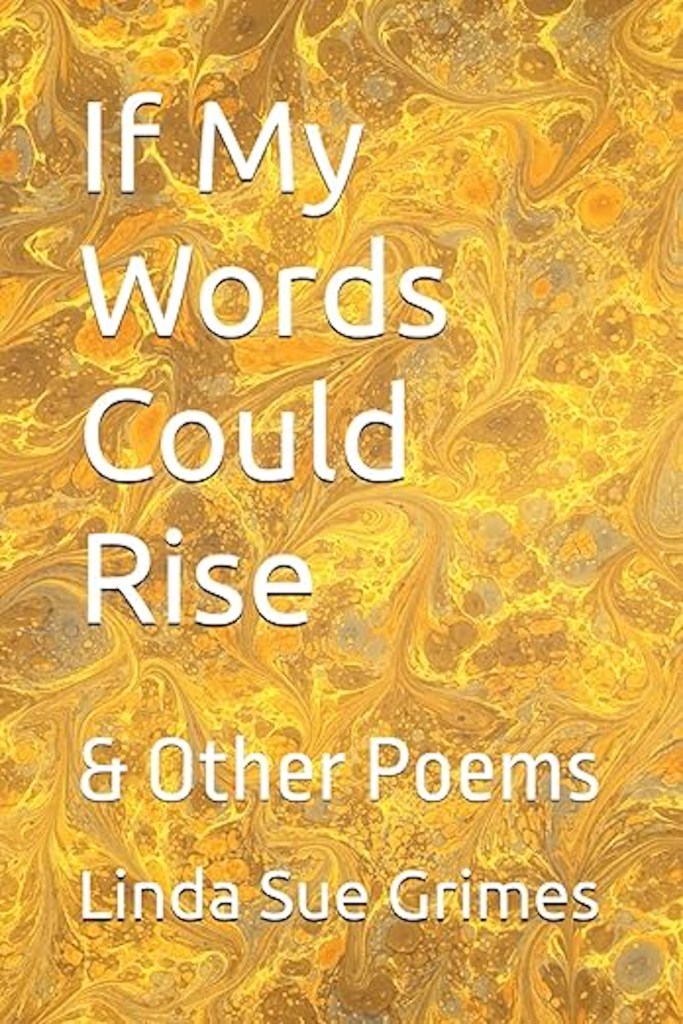
The following poems appear in my collection titledIf My Words Could Rise, available on Amazon as paperback or Kindle.
1 If My Words Could Rise
Dedicated to my sweet Ron
If my words could rise Like smoke They would form your face In the clouds They would hang In the tops of the trees Looking for a nest Where a mother bird sits On eggs The color of your eyes
2 In the Tops of the Trees
“As soon as you hear the sound of marching in the tops of the trees, then attack, for God has attacked in front of you to defeat the Philistine army.” —2 Samuel 5:25 Common English Bible
–for the moldman, who screeched, “That’s my line!”
No, dude, that is not your line! No matter how many times Or with how much spit You spew it.
Trees and their tops And the words they live in Belong to all of us. Go! Dig your hole–grovel in your slime.
3 Dreams and Days
“His tongue cuts / Slices of meat / From the hearts / And livers / Of those / Who would love him” – “Between Slices of Bread” —from Linda Sue Grimes’ At the End of the Road
I quote myself, well then, I quote myself — I include multitudes — Uncle Walt taught me that much.
The man in the poem Cannot bring himself to say Or to pray about his own lividness He shuts out spaces and commas Lives in his own relevance.
He murders his own children With his viper attitude And nibbles the ankles Of prostitutes Who erase his will to power on.
You have seen him Perhaps did not recognize him — He has sat in your parlor Sipping your coffee Dusting off his duplicitous moves —
He fears death but not yours He imagines you at the bottom Of a cold, black ocean Your tongue bait for the fishes His Bolshevik brain conjures.
Your freedom is a fantasy If you remain too close to his heat Get your life back – get your love back Where God made you in his image And you are close to seeing it.
4 Flesh and Desire
“Humankind cannot bear very much reality.” —T. S. Eliot
Into the fire of wisdom, thoughts go to perish. “Get thee behind me, Satan!” Christ commands. But we still wobble behind the Devil Hoping to be snatched from the arms of death In time for supper and for the many tomorrows We image we still possess. In the valley of dreck and poison, I have lived Even as I knew better or thought I did. No, I am not here to testify. Although a word or two of testimony May slip out every line or so! I can pound sand with the best of them. But I can also bitch and moan. Where is the beginning of joy and rectitude? One might ask. Where is the promise? O, come on! You know where the promise is . . . Yes, just testing the waters and they are warm. Every time I delay, I am warned. Just pray And wait and listen close and tight to the hum In the brain. I will follow. I will follow close. Yes, I will. And flesh with its crude desire Will no longer taint the years With their distractions. The mercy of Spirit will wipe my tears.
In dreams we happen to meet On some mystic, planetary hill — Poetry eludes us yet we commence Talking about the sham progress Bleeding hearts have inflicted.
The professor in you wants to align Wokeward but you cannot bring yourself To spring into the claptrap that clamped Shut on Ginsbergian filth, deviance And that mayhem of hairy irrelevance.
You think of your children Wading into the waters of vipers Nipping their ankles Snapping their necks Erasing their freedom and will.
You would have those you love Experience their own close calls — You crashed into your own As you flew those planes Over the Pacific, fighting that war —
Facing death, watching death Take soldier after soldier Leaving you with the intuition Outcomes cannot be guaranteed By bureaucratic Bolsheviks.
Only freedom of opportunity Guarantees free will remains free And life continues to beget life In the magnolious scheme that God Made man after His Own image.
4 Bone Couplets
“Flesh of my flesh, bone of my bone…” —Anne Bradstreet
They outshine the flesh in the reign of desire Where pink like a blush goes on shining like fire. Fat necked imbeciles, brain-numbed and wrong On every backboned thought that ever ran along The confines of the apple of Adam sweetened In the birdless cage rump-driven and weakened. Greed and swagger click the gangling matter Knuckles cling and circle each limb to tatter. Hipbones narrow in the faulty weather. The bare truth flies out on filth-tinged feather. Bring me back to the place where life can stand! Let me feel the smooth relief of pounding sand! This belly swore it would unburden the green. Within the sulking skull it makes its way to preen. In the sweet toned laughter where children move And every old fart says he will not prove Until the night breaks over those who pray And every chime kinks the ear heaven to delay. Relevant as an old donkey on an extended beach The moon sinks into ripe flesh as if to teach Those angry cells to leave off all that hunger. No years will ease—no one will grow younger Than the moth whose flame has singed his wings Clacking bare truth to the mercy of things.
5 A Terrible Fish
“In me she has drowned a young girl, and in me an old woman Rises toward her day after day, like a terrible fish. —Sylvia Plath’s “Mirror”
The nightmare repeats itself: A daughter clamped tight to each foot Pulling her down under The brute waters of the dark, deep lake — She gasps — imagines she’s drowning While her husband watching from the levy Wrings his hands, faints in the heavy fog. A terrible fish looms under her nose; She smells blood dripping From a dozen hooks dangling From his mouth. His eyeballs slide out easy As the drawer of a cash register. Each eye-socket a window To her own soul — $ bills With little jackpots on them Jump up and dance like clowns Poking out their tongues, Flapping signs of slogans With hammers, sickles, swastikas — She believes – ¡Sí, se puede! Morning shivers her awake again, Stumbling to the bathroom Where the mirror flashes In her face that same terrible fish That has been catching her dreams And throwing them back As she chases each $, Never quite able to grasp enough.
“When the yogi, like a tortoise withdrawing its limbs, can fully retire his senses from the objects of perception, his wisdom manifests steadiness.” —Bhagavad Gita II:58
Will you still love me if I finish first?
Slow as I am to you whose speed is your god, I move. Admiring really your shell-less existence— On my back it’s sometimes hard to right myself. In the soup they call me a delicacy, So I praise vegetarians, Though I myself sometimes snap At insects, small fish, & moving fingers.
But what’s a creature so heavy-laden to do?
O, lest I sound maudlin Or sorry for my webbed feet, I withdraw my questions Along with my head & legs And drop out of your race.
2 Starvers
for K. R.
She starves Her body & her mind Stands vacant haunted She’s dying To be thin She’s not Concerned With curves She wants Angles Points Narrow Hollow Spaces What she craves All starvers Understand A bulge around the middle Is a sin against God Thighs that spread out over a chair bottom Make you sick Breasts that mound under a sweater Make you gutter for breath Round arms full face big calves wide hips double chin A mighty army marching over your skeleton Capturing your pleasures Holding your life hostage You’re a prisoner in a guardhouse A dog in a pound Weight and measurement Are not useful tools They are obsessions She has starved Her body Thin But she cannot Exorcise that last Ghost of flesh That ghost that keeps adjusting the damn mirror that throws Back a size in your face a size that screams Just a little smaller Just a little thinner And then Everything Will be OK . . .
8 Metaphysical Reminders
Where that brain stores its loot There stands a cabin by the river, Where it dreamed a body too good For flesh and bones, Too good for breath and blood Where the clock spills stars, Hands that milk until honey flows, And a mouth that torches neck to toe.
And as it worked itself out there On that bed of river mud Squeezing and kneading Lust from every pore, As hips pushed and crushed, The end of an era seemed at hand, And if you slept through the night, You would awake with the clock And a note on your pillow Telling you to get yourself out of there— The river is rising.
24 Greek Skin
for my mother’s father, Gus Johnson
In a Kentucky coal mine he fell across the track and a loaded coal car cut off his right arm.
This world offers no shelter to nervous pilgrims; this world takes a dim view of pain even as it inflicts it, as if some people were meant to starve, as if some people were meant to speak English with a Greek accent, but my mother loved him so much that his death became her deepest grief, and when she crossed the bridge that connects this world with his, I hope he met and greeted her with both arms, he won’t let her fall through a hole in the sky, will he? And though he never had the chance to speak a word to me, I think he must have been a multitude of races and climates, my blood senses his Greek skin was tinged with Africa, my mother’s darkness and my father’s whiteness left me an odd shade of gray. It’s not so much confusion as an unwillingness to pray— Yet many fold their hands when trees lash in the violent air.
But if he knew my concern, he could wipe from my mind the dust that blew in from faraway places where they cut down all the trees and cut off the hands of innocent thieves and Greek slaves slaughtered each other to entertain a Roman tyrant.
92 Alex as Artist
It’s a dog’s life.
When he curls up beside me on the couch and settles into steady breathing, his ease of comfort flows like a polished sonnet. He has mastered the art of comfort.
When I cook, he perfects his craft of begging. Taking bits of food off the ends of fingers requires precise placement of teeth and tongue. He’s mastered the art of eating.
Some say he’s cowardly, but he’s just careful. The artist’s eye and ear perceive the world to be a dangerous place, so he’s crafty to run from loud noises and sudden moves.
Some say he’s dumb, but he’s just deliberate. He wants to keep body and soul together and retire a well-matured craftsman.
Unlike schemers, shams, and fantasizers, he takes his art quite literally,
and he has learned to simplify: beg food, bark, and sleep sleep sleep.
Since publication of Turtle Woman & Other Poems, I have revised “Alex as Artist” into the form of an American-Innovative sonnet:
Alex as Artist
It’s a dog’s life.
When he curls up beside me on the couch and settles into steady breathing, his ease of comfort flows like a polished sonnet. He has mastered the art of comfort.
When I cook, he perfects his craft of begging. Taking bits of food off the ends of fingers requires precise placement of teeth and tongue. He’s mastered the art of eating.
Some say he’s cowardly, but he’s just careful. The artist’s eye and ear perceive the world to be a dangerous place, so he’s crafty to run from loud noises and sudden moves.
Some say he’s dumb, but he’s just deliberate. He wants to keep body and soul together and retire a well-matured craftsman.
Unlike schemers, shams, and fantasizers, he takes his art quite literally, and he has learned to simplify: beg food, bark, and sleep sleep sleep.
To Thee I humbly offer my songs That Thou hast given me
Introduction
These poems grow out of my experience serving as harmonium player/chant leader for our Nashville Self-Realization Fellowship Sunday Readings Service.
I title this collection Command Performance for I have attempted to retire from the chant leader position, offering it to other devotees, but no one thus far wishes to take it from me.
And often I have come to the chapel Readings Service, thinking I would merely be attending, only to find that the scheduled chant leader was unavailable and so the service leader would prevail upon me to fill the void; thus, another “command performance.”
I reason that Guruji Paramahansa Yogananda is commanding me to continue performing this function, as long as I am capable.
Poems from Chants
These original poem were all inspired by the chant, whose title is offered following the poem title.
Who says, She is Dark?
—after “Thousands of Suns and Moons”
Her smile beams With the rays Of a millions suns.
Her skin glows With the light Of a million moons.
Who says, She is dark?
Only those who refuse To open their eye To her light.
Joy, Joy, Joy!
—after “Ever New Joy”
Joy, joy, joy— Morning has broken in joy. Light of starlight, hiding Behind the sun.
Joy, joy, joy— Evening calls the faithful To rest from a full day’s labor Practiced by Divine decree.
Joy, joy, joy— Night covers maya’s delusion So the spiritual eye May bound in brilliance.
Thou art That
—after “Hymn to Brahma”
Beyond my thoughts, Beyond my ideas, Beyond my knowledge, Far beyond my wisdom— Thou are That.
Beyond my body, Beyond my mind, Beyond my energy, One with my soul— Thou art That.
Drowning in Glory
—after “I Am the Bubble, Make Me the Sea”
You wake my senses to clear sight, glorious sound, Intelligent touch, pure fragrance, tempered taste. You wake my senses by drowning them in Glory Inundating them in the silence of Your vastness, Spilling on them the majestic light show Of Your body, bound by boundlessness.
In the ocean of Your love, my bubble heart Contracts and expands to eternity. My restless brain shrinks and extends Its reach to unknown realms of wisdom. My soul knows itself in the crash of breaking worlds Where it stands unshaken hand in hand with You. As You do, so I wish to do forever, Drowning in the Glory of Your sacred presence.
Into my garden of weeds Come, Eternal Gardener— Teach me to plant and prune fine foliage. Show me where to set the lilies and tulips And where the roses should grow. Guide my choices of herbs and vegetables. Give me knowledge of fertilizer and fences.
Into my garden of words Come, Eternal Poet— Make my poems exude divine ardor. Fashion my thoughts to bow at your feet. Make my images spout living waters From an enlightened fount To refresh all who dip a cup.
2 In My Spiritual Garden
In my spiritual garden I walk with you when the sun is medicine And the rain suckles the beets and corn. I walk with you between the rows of memories Where love holds you between peppers and tomatoes.
I walk with you along the fence And touch your hand and step across Thinking of you as I pick the peas, Still thinking of you as I weed The beans and cucumbers.
I walk with you and with every silent step And every moment of your absence That would weaken the faith of one Less in love, my love grows deep Like the roots of the bamboo and my love Grows straight like the stalks of asparagus.
In my spiritual garden I will always grow you In the medicine sun and the suckling rain.
3 Divine Gardner
After we scoop the soil over the seeds & sprinkle the water & pluck the weeds,
you will tend the growing & tempt the eye with green & yellow peppers, & tempt the tongue with onions & corn, & invite us to taste your flesh in cucumbers & tomatoes.
I will stand at the edge of the garden, my lips & tongue tending the silence I learn to thank you with.
4 My Divine Beloved
When spring comes Tilling the ground I will plant seeds And think of you You are earth You build my body.
When spring comes Showering young plants I will sing with raindrops And think of you You are water You carry my life.
When spring comes Warming my limbs I will brown my skin And think of you You are fire You inflame my heart.
When spring comes Swirling on the wind I will lean into it And think of you You are air You clear my mind.
When spring comes Rising from winter’s tomb I will sing devotion And think of you You are my Divine Beloved You revive my soul.
5Your Divine Love
My heart is a lake I swim in, But I want to float in the ocean of your love.
My mind is a sky I fly through, But I want to soar through your omniscient love.
My soul is an undiscovered star, But I want to find it shining in your flaming love.
My dream spreads out in all directions, Searching for the boundary of your Divine Love.
6 Cosmic Beloved
Though my heart is fickle And strays from you, You never stray from me. Your love for me Never waivers.
You came to me in youth’s naiveté And married my folly, And for a time I slept without rest In the arms of a splintering sorrow Deep within a cave of madness. When I emerged from that black night, You greeted me as my daughter. You blessed the rest of my life With a holy union when you became My true mate with whom I rest In the cave of a peaceful heart. And you greet me as my son.
When I go off from time to time To carouse with the lesser lights Of poets and painters and dabblers In pursuit of knowledge, You become each one of them So you can stay by my side—





 Linda's Literary Home