Linda's Literary Home

Category: Uncategorized

  • Elizabeth Barrett Browning’s Sonnet 10 “Yet, love, mere love, is beautiful indeed”

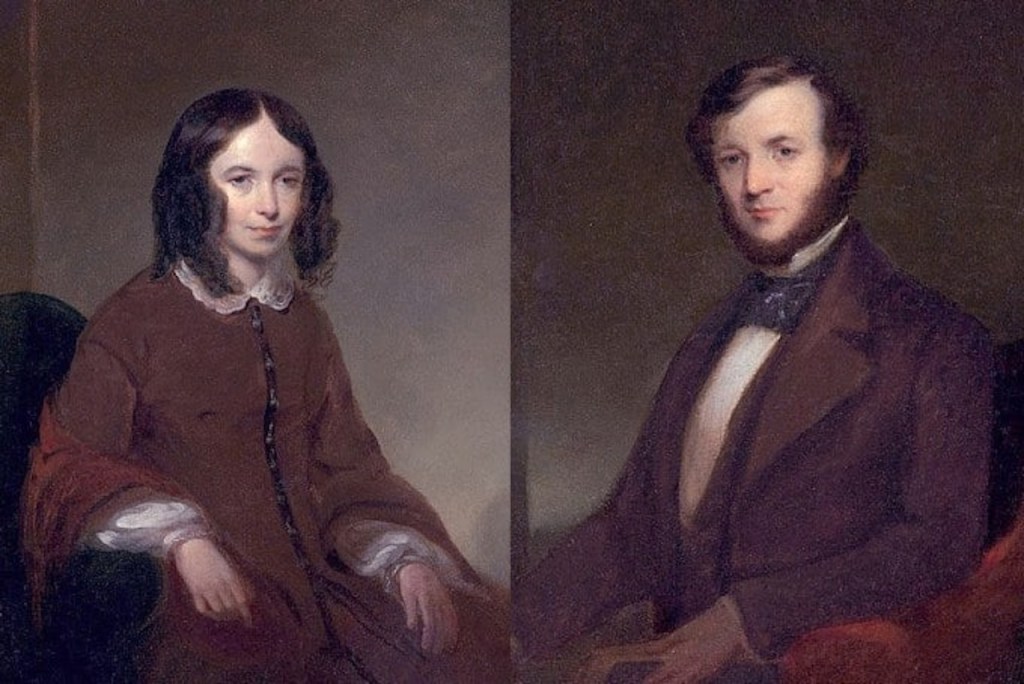
    Image: Elizabeth Barrett Browning and Robert Browning – 1852. Portraits painted by Thomas Buchanan Read

    Elizabeth Barrett Browning’s Sonnet 10 “Yet, love, mere love, is beautiful indeed”

    The speaker of sonnet 10 is beginning to reason that despite her flaws, the transformative power of love can change her negative, dismissive attitude.

    Introduction and Text of Sonnet 10 “Yet, love, mere love, is beautiful indeed”

    Elizabeth Barrett Browning’s sonnet 10 from Sonnets from the Portuguese finds the speaker’s attitude slowly but surely evolving.  She is now allowing herself to reason that if God can love his lowliest creatures, surely a man can love a flawed woman.  Thus, through that magic power, those flaws may be overcome.

    Sonnet 10  “Yet, love, mere love, is beautiful indeed”

    Yet, love, mere love, is beautiful indeed
    And worthy of acceptation. Fire is bright,
    Let temple burn, or flax; an equal light
    Leaps in the flame from cedar-plank or weed:
    And love is fire. And when I say at need
    I love thee … mark! … I love thee—in thy sight
    I stand transfigured, glorified aright,
    With conscience of the new rays that proceed
    Out of my face toward thine. There’s nothing low
    In love, when love the lowest: meanest creatures
    Who love God, God accepts while loving so.
    And what I feel, across the inferior features
    Of what I am, doth flash itself, and show
    How that great work of Love enhances Nature’s.

    Reading  

    Commentary on Sonnet 10 “Yet, love, mere love, is beautiful indeed”

    The speaker of sonnet 10 is beginning to reason that despite her flaws, the transformative power of love can change her negative, dismissive attitude.  As she begins to turn her negativity around, she puts on a brighter glow of enthusiasm.

    First Quatrain:  The Value of Love

    Yet, love, mere love, is beautiful indeed
    And worthy of acceptation. Fire is bright,
    Let temple burn, or flax; an equal light
    Leaps in the flame from cedar-plank or weed:

    The speaker begins to focus on the value of love, finding that emotion to be “beautiful” and even “worthy of acceptation.” She likens love to fire and finds love to be “bright” as love is also a flame in the heart and mind.  She contends that the power of fire and the light it emits remains the same force regardless of the fuel that feeds it—whether it is “from cedar-plank” or even if it is from “weed.” 

    Thus, the melancholy speaker is beginning to believe that her suitor’s love can burn as bright even if she is the motivation, although she metaphorically considers herself to be the weed rather than the cedar-plank.

    Second Quatrain:  Fire and Love

    And love is fire. And when I say at need
    I love thee … mark! … I love thee—in thy sight
    I stand transfigured, glorified aright,
    With conscience of the new rays that proceed

    The speaker continues the metaphorical comparison of love to fire and boldly states that love is, indeed, fire.  She audaciously proclaims her love for her suitor and contends that by saying she loves him, she transforms her lowly self, and thereby she can arise transformed and even reflect an honest kind of glory.  The awareness of the vibrations of love that exude from her being causes her to be magnified and made better than she normally believes herself to be.

    First Tercet:  God’s Love

    Out of my face toward thine. There’s nothing low
    In love, when love the lowest: meanest creatures
    Who love God, God accepts while loving so.

    The speaker avers that there is nothing about love that is “low.”  God loves all of his creatures, even the lowliest.  The speaker is evolving toward true acceptance of her suitor’s attention and affection, but she has to convince her doubting mind that there exist sufficiently good reasons for her to change her negative outlook.

    Obviously, the speaker has no intention of changing her beliefs in her own low station in life.  She carries her past in the heart and mind, and all of her tears and sorrows have permanently tainted her own view of herself.  But she can turn toward acceptance and allow herself to be loved, and through that love, she can, at least, bask in its joy as a chilled person would bask in sunshine.

    Second Tercet:  The Transformative Powers of Love

    And what I feel, across the inferior features
    Of what I am, doth flash itself, and show
    How that great work of Love enhances Nature’s.

    The speaker will continue to think of herself as inferior, but because she can now believe that one as illustrious as her suitor can love her, she is opening her heart and mind to the possibility of the transformative powers of love.  She still insists on her inferiority, asserting that she possesses “inferior features.”  

    And she must “feel” her way across such ingrained realities.  But she also can now affirm that the power of love is so great that it can enhance the qualities and feature of Nature itself.  Such a power demands respect, and the speaker is awakening to that reality.

  • Without the Waves

    Image:  The Pacific Ocean – Encinitas, CA – Photo by Ron Grimes

    Without the Waves

    I exist without the cosmic shadow,
    But it could not live bereft of me;
    As the sea exists without the waves,
    But they breathe not without the sea.

    —from “Samadhi” by Paramahansa Yogananda

    “Be still, and know that I am God.” — from Psalm 46:10

    In Memoriam:  Bill Craig
    August 8, 1954 — February 6, 2025

    Without the waves——I exist only as boundless sea.
    God’s boundless love has stemmed the tide.
    God’s bliss is mine——deep, wide, eternally free.

    No more hemmed round in time, space, and memory,
    My soul will now and always in sacred Light abide.
    Without the waves——I exist only as boundless sea.

    Satan’s veil is shed——my soul’s eye now can see
    Only holy Light no shadow can ever hide.
    God’s bliss is mine——deep, wide, eternally free.

    My soul unborn of flesh, not changed through history—
    Like Christ I stand up to the trial that would divide.
    Without the waves——I exist only as boundless sea.

    I listen only to angelic voices singing to me.
    Lesser music has vanished——noise has died.
    God’s bliss is mine——deep, wide, eternally free.

    I take no thought for I live in celestial unity——
    From former failures no need to hide.
    Without the waves——I exist only as boundless sea.
    God’s bliss is mine——deep, wide, eternally free.

  • Woven on a Veil of Love

    Image:  Krishna/Radha – Symbol of Divine Love

    Woven on a Veil of Love

    Through joyous mists, through shadow tears,
    We weave our bond upon a veil of Love.
    In twilight’s glow, our souls now learning
    To seek the Eternal for which we are yearning.

    On childlike dreams, we rise and roam,
    Where starlit paths lead to our home.
    Guided by whispers from the Divine,
    Guarded by Love’s mystic shrine.

    Our dawn prayers— like embers—soar
    Gathering light from realms before.
    On sacred beams, our spirits stand
    In Love’s enchanted land.

    From cosmic sparks, Love’s brilliance gleams
    Creation’s birth in silver thought streams.
    Our searching minds—our souls entwined—
    The Love our hearts so need to find.

  • Emily Dickinson’s “He touched me, so I live to know” 

    Image: Emily Dickinson – Amherst College – Daguerrotype of the poet at age 17, circa 1847 – likely the only authentic, extant likeness of the poet

    Emily Dickinson’s “He touched me, so I live to know” 

    Emily Dickinson’s “He touched me, so I live to know” dramatizes an experience in mystical union with the Divine Reality. Often interpreted and examined as madness, Dickinson’s mystical proclivities more easily and thoroughly explain her elliptical writings.

    Introduction with Text of “He touched me, so I live to know”

    Emily Dickinson’s many experiences in mystical union [1] with the Divine Spiritual Reality reveal that the poet was working from an extraordinary state of awareness.   Often interpreted and examined as madness or extreme idiosyncrasy, Dickinson’s mystical proclivities more easily and thoroughly explain her elliptical writings than total reliance on the physical and mental levels of being.

    While Dickinson must be perceived primarily as an accomplished poet and not an avatar of perfect knowledge, her mystical proclivities are difficult to deny.  For example, superficial observers of this poem are wont to report that the speaker is describing her happy experience of engaging in a physical tryst with a lover. 

    But the “lover” trope is often used by those who experience the mystical union with the Divine, for example, Saint Terese of Ávila’s ecstasy is metaphorically expressed as similar to “erotic intensity  [2].

    Instead of physical bodies uniting, however, the mystical experience is the uniting of the individual soul and the Divine Creator or God. Because the physical union offers intense pleasure, it makes a useful metaphor for the even more intense pleasure experienced during mystical union.  

    While understanding the union metaphorically is perfectly acceptable and logical, it is absurd to misunderstand and think those two very different experiences are identical.  It is helpful to remember that a metaphor is useful in that it likens two very different entities.

    The purpose of the physical, sexual union exists for procreation, that is, the continuation of the generations of humanity, while the mystical union remains the true goal of each human soul.  

    Paramahansa Yogananda and the avatars all of faiths have taught that the true purpose of life  [3] is to find and unite the individual soul with the Over-Soul, Divine Reality, or God.

    As the spiritual scientist, Sant Rajinder Singh Ji Maharaj, has elucidated [4], “It is important to recognize that this human existence has a purpose, that we are here to grow spiritually, to know God, and to merge back in God.”

    He touched me, so I live to know

    He touched me, so I live to know
    That such a day, permitted so,
    I groped upon his breast –
    It was a boundless place to me
    And silenced, as the awful sea
    Puts minor streams to rest.

    And now, I’m different from before,
    As if I breathed superior air –
    Or brushed a Royal Gown –
    My feet, too, that had wandered so –
    My Gypsy face – transfigured now –
    To tenderer Renown –

    Into this Port, if I might come,
    Rebecca, to Jerusalem,
    Would not so ravished turn –
    Nor Persian, baffled at her shrine
    Lift such a sign
    To her imperial Sun.

    Reading 

    Commentary on “He touched me, so I live to know”

    The speaker is describing the mystical experience that has transfigured her mind, her heart, even her entire life.   Likely, this poem was the poet’s first attempt to delve into that particular theme that had such a profound influence on her ability to compose poetry.

    First Stanza:  The Visitation

    He touched me, so I live to know
    That such a day, permitted so,
    I groped upon his breast –
    It was a boundless place to me
    And silenced, as the awful sea
    Puts minor streams to rest.

    The speaker begins by announcing that she has been visited by the Divine Reality.  Her union with the Mystical Creative Force caused her to feel that her living is now more intense and vital than it had ever been before this momentous realization.

    The speaker now is aware that such a soul-realizing event can actually happen to mere mortals.  The reality of His presence makes her feel that during this visitation she was “groping” upon an enormous entity.   Her consciousness has become unbounded by her heretofore mental and physicals encasements.

    Because God’s body remains inside and outside of creation, that Entity in human terms is a vast area of space and matter, and as the individual human soul unites with that Entity it experiences the enormity of that Form.

    The speaker then likens the experience to a “minor stream” such as a river that flows into the ocean.   Paramahansa Yogananda likens the little human body to a “bubble” and the God to the ocean, and in his chant he commands the Divine Reality:  “I am the bubble, make me the sea”  [5].

    The speaker in Dickinson’s “He touched me, so I live to know” is experiencing a time that God had made her the sea; she was a tiny bubble, and for a time, she experienced being the sea.

    Second Stanza:  The Transformation

    And now, I’m different from before,
    As if I breathed superior air –
    Or brushed a Royal Gown –
    My feet, too, that had wandered so –
    My Gypsy face – transfigured now –
    To tenderer Renown –

    After her mystical experience, the speaker now realizes that she is “different”; she has been transformed and feels that now even her breathing has been clarified and elevated.  She also likens her new awareness to touching a “Royal Gown.”  

    The speaker is describing an event that, in fact, cannot be translated into language; thus, she must metaphorically compare the ineffable to physical things and experiences that come closest to expressing her experience. 

    She then reports that her feet now seem more firmly planted, as before they had remained roaming in delusion.  Her face also has been transformed from a roaming, inquisitive face of to something kind, pleasant, and staid.

    Third Stanza:  The Reality of Permanence

    Into this Port, if I might come,
    Rebecca, to Jerusalem,
    Would not so ravished turn –
    Nor Persian, baffled at her shrine
    Lift such a sign
    To her imperial Sun.

    The speaker then contrasts her journey along with its destination to the biblical character, Rebekah, who traveled to the home of Isaac to become his wife, and to some nameless “Persian” whose prayerful pleadings remained somewhat superficial.

    Instead of such worldly experiences, this speaker insists that she has become aware of the permanence bestowed by this amazing event that has captured her. Her port, if she understands if correctly, leads to the immortality upon which she has long mused and upon which she strongly insists is a reality.  

    Her mystical experience has now confirmed for her that the Afterlife is real and that she has visited and now knows in her soul that the Creator of the Cosmos is directing and guarding her. 

    Sources

    [1] Virginia L. Paddock.  Madness as Metaphor: A Study of Mysticism in the Life and Art of Emily Dickinson. 1991. Ball State University. Ph.D. Dissertation. Cardinal Scholar.

    [2] Editors.  “The Ecstasy of Saint Teresa.” The Archive for Research in Archetypal Symbolism.  Accessed March 21, 2023.

    [3] Paramahansa Yogananda.  “The purpose of Life.”  Self-Realization Fellowship.  Accessed March 21, 2023.

    [4] Sant Rajinder Singh Ji Maharaj.  “What is the purpose of this life?.” Science of Spirituality.  Accessed March 21, 2023.

    [5]  Nuns of Self-Realization Fellowship.  Chanting: “I am the bubble, make me the sea.” YouTube.  Accessed March 21, 2023.

    🕉

    You are welcome to join me on the following social media:
    TruthSocial, Locals, Gettr, X, Bluesky, Facebook, Pinterest 

    🕉

    Share