Linda's Literary Home

Category: William Butler Yeats

  • William Butler Yeats’ “The Second Coming”

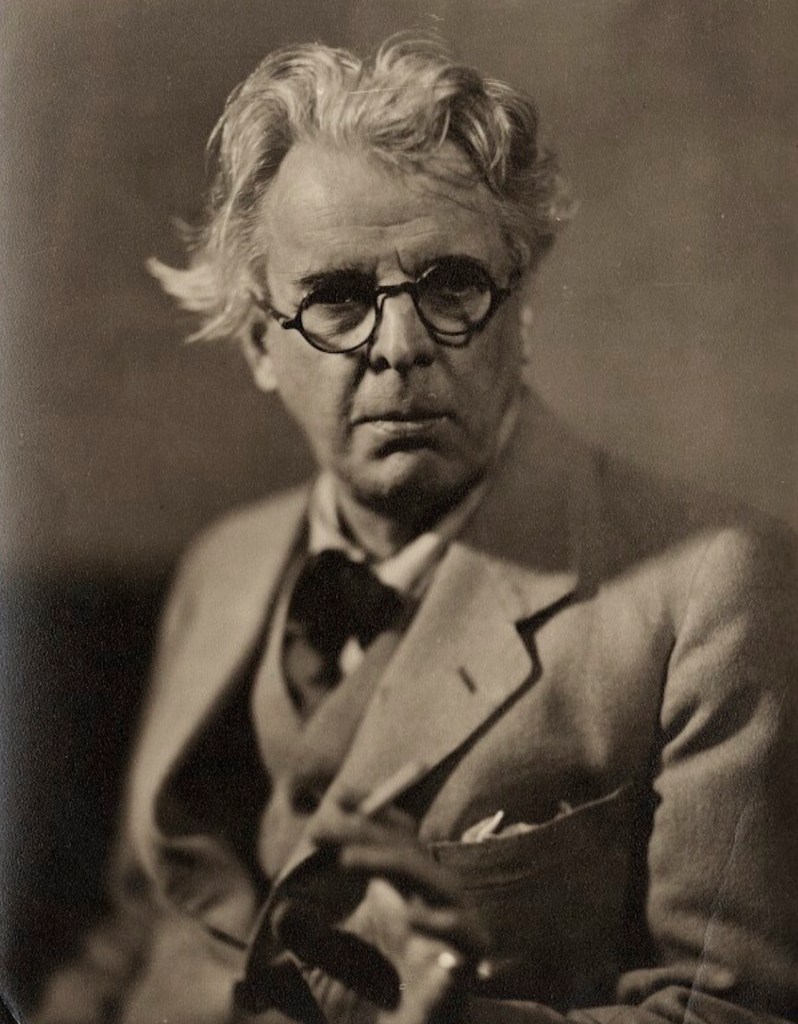
    Image: William Butler Yeats – Howard Coster – National Portrait Galley, London

    William Butler Yeats’ “The Second Coming”

    William Butler Yeats’ “The Second Coming” remains one of the most widely misunderstood poems of the 20th century. Many scholars and critics have failed to criticize the exaggeration in the first stanza and the absurd metaphor in the second stanza, which render a potentially fine poem a critical failure.

    Introduction with Text of “The Second Coming”

    Poems, in order to communicate, must be as logical as the purpose and content require. For example, if the poet wishes to comment on or criticize an issue, he must adhere to physical facts in his poetic drama. If the poet wishes to emote, equivocate, or demonstrate the chaotic nature of his cosmic thinking, he may legitimately do so without much seeming sense.

    For example, Robert Bly’s lines—”Sometimes a man walks by a pond, and a hand / Reaches out and pulls him in” / / “The pond was lonely, or needed / Calcium, bones would do,”—are ludicrous [1] on every level.   Even if one explicates the speaker’s personifying the pond, the lines remain absurd, at least in part because if a person needs calcium, grabbing the bones of another human being will not take care of that deficiency. 

    The absurdity of a lake needing “calcium” should be abundantly clear on its face.  Nevertheless, the image of the lake grabbing a man may ultimately be accepted as the funny nonsense that it is.   William Butler Yeats’ “The Second Coming” cannot be dismissed so easily; while the Yeats poem does not depict the universe as totally chaotic, it does bemoan that fact that events seem to be leading society to armageddon.

    The absurdity surrounding the metaphor of the “rough beast” in the Yeats poem renders the musing on world events without practical substance.

    The Second Coming

    Turning and turning in the widening gyre   
    The falcon cannot hear the falconer;
    Things fall apart; the centre cannot hold;
    Mere anarchy is loosed upon the world,
    The blood-dimmed tide is loosed, and everywhere   
    The ceremony of innocence is drowned;
    The best lack all conviction, while the worst   
    Are full of passionate intensity. 

    Surely some revelation is at hand;
    Surely the Second Coming is at hand.   
    The Second Coming! Hardly are those words out  
    When a vast image out of Spiritus Mundi
    Troubles my sight: somewhere in sands of the desert   
    A shape with lion body and the head of a man,   
    A gaze blank and pitiless as the sun,   
    Is moving its slow thighs, while all about it   
    Reel shadows of the indignant desert birds.   
    The darkness drops again; but now I know   
    That twenty centuries of stony sleep
    Were vexed to nightmare by a rocking cradle,  
    And what rough beast, its hour come round at last,   
    Slouches towards Bethlehem to be born? 

    Commentary on “The Second Coming”

    William Butler Yeats’ “The Second Coming” remains one of the most widely anthologized poems in world literature.  Yet its hyperbole in the first stanza and ludicrous “rough beast” metaphor in the second stanza result in a blur of unworkable speculation.

    First Stanza: Sorrowful over Chaos

    Turning and turning in the widening gyre   
    The falcon cannot hear the falconer;
    Things fall apart; the centre cannot hold;
    Mere anarchy is loosed upon the world,
    The blood-dimmed tide is loosed, and everywhere   
    The ceremony of innocence is drowned;
    The best lack all conviction, while the worst   
    Are full of passionate intensity. 

    The speaker is sorrowing over the chaos of world events that have left in their wake many dead people.  Clashes of groups of ideologues have wreaked havoc, and much blood shed has smeared the tranquil lives of innocent people who wish to live quiet, productive lives. 

    The speaker likens the seemingly out of control situation of society to a falconer losing control of the falcon as he attempts to tame it.   Everyday life has become chaotic as corrupt governments have spurred revolutions.  Lack of respect for leadership has left a vacuum which is filled with force and violence.

    The overstated claim that “The best lack all conviction, while the worst / Are full of passionate intensity” should have alerted the poet that he needed to rinse out the generic hyperbole in favor of more accuracy on the world stage.  

    Such a blanket, unqualified statement, especially in a poem, lacks the ring of truth:  it simply cannot be true that the “best lack all conviction.”  Surely, some the best still retain some level of conviction, or else improvement could never be expected.  

    It also cannot be true that all the worst are passionate; some of the worst are likely not passionate at all but remain sycophantic, indifferent followers.  Any reader should be wary of such all-inclusive, absolutist statements in both prose and poetry.  

    Anytime a writer subsumes an entirety with the terms “all,” “none,” “everything,” “everyone,” “always,” or “never,” the reader should question the statement for its accuracy.  All too often such terms are signals for stereotypes, which produce the same inaccuracy as groupthink.

    Second Stanza: What Revelation?

    Surely some revelation is at hand;
    Surely the Second Coming is at hand.   
    The Second Coming! Hardly are those words out  
    When a vast image out of Spiritus Mundi
    Troubles my sight: somewhere in sands of the desert   
    A shape with lion body and the head of a man,   
    A gaze blank and pitiless as the sun,   
    Is moving its slow thighs, while all about it   
    Reel shadows of the indignant desert birds.   
    The darkness drops again; but now I know   
    That twenty centuries of stony sleep
    Were vexed to nightmare by a rocking cradle,  
    And what rough beast, its hour come round at last,   
    Slouches towards Bethlehem to be born? 

    The idea of “some revelation” leads the speaker to the mythological second coming of Christ.  So he speculates on what a second coming might entail.  However, instead of “Christ,” the speaker conjures the notion that an Egyptian-Sphinx-like character with ill-intent might arrive instead.  

    Therefore, in place of a second coming of godliness and virtue, as is the purpose of the original second coming, the speaker wonders:  what if the actual second coming will be more like an Anti-Christ?  What if all this chaos of bloodshed and disarray has been brought on by the opposite of Christian virtue?

    Postmodern Absurdity and the “Rough Beast”

    The “rough beast” in Yeats’ “The Second Coming” is an aberration of imagination, not a viable symbol for what Yeats’ speaker thought he was achieving in his critique of culture. If, as the postmodernists contend, there is no order [2] in the universe and nothing really makes any sense anyway, then it becomes perfectly fine to write nonsense. 

    Because this poet is a contemporary of modernism but not postmodernism [3], William Butler Yeats’ poetry and poetics do not quite devolve to the level of postmodern angst that blankets everything with the nonsensical.  Yet, his manifesto titled A Vision is, undoubtedly, one of the contributing factors to that line of meretricious ideology. 

    Hazarding a Guess Can Be Hazardous

    The first stanza of Yeats’ “The Second Coming” begins by metaphorically comparing a falconer losing control of the falcon to nations and governments losing control because of the current world disorder, in which “[t]hings fall apart; the centre cannot hold.” 

    Political factions employ these lines against their opposition during the time in which their opposition is in power, as they spew forth praise for their own order that somehow magically appears with their taking the seat of power.

    The poem has been co-opted by the political class so often that Dorian Lynskey, overviewing the poem in his essay, “‘Things fall apart’: the Apocalyptic Appeal of WB Yeats’s The Second Coming,” writes, “There was apparently no geopolitical drama to which it could not be applied” [4].

    The second stanza dramatizes the speaker’s musing about a revelation that has popped into his head, and he likens that revelation to the second coming of Christ; however, this time the coming, he speculates, may be something much different.  

    The speaker does not know what the second coming will herald, but he does not mind hazarding a dramatic guess about the possibility.   Thus, he guesses that the entity of a new “second coming” would likely be something that resembles the Egyptian sphinx; it would not be the return of the Christ with the return of virtue but perhaps its opposite—vice. 

    The speaker concludes his guess with an allusion to the birth of such an entity as he likens the Blessed Virgin Mother to the “rough beast.”   The Blessèd Virgin Mother, as a newfangled, postmodern creature, will be “slouching toward Bethlehem” because that is the location to which the first coming came.  

    The allusion to “Bethlehem” functions solely as a vague juxtaposition to the phrase “second coming” in hopes that the reader will make the connection that the first coming and the second coming may have something in common.  The speaker speculates that at this very moment wherein the speaker is doing his speculation some “rough beast” might be pregnant with the creature of the “second coming.” 

    And as the time arrives for the creature to be born, the rough beast will go “slouching” towards its lair to give birth to this “second coming” creature: “its hour come round at last” refers to the rough beast being in labor. 

    The Flaw of Yeats’ “The Second Coming” 

    The speaker then poses the nonsensical question: “And what rough beast, its hour come round at last, / Slouches towards Bethlehem to be born?”   In order to make the case that the speaker wishes to make, these last two lines should be restructured in one of two ways: 

    And what rough beast, its hour come round at last,
    Slouches towards Bethlehem to give birth? 

     or

    And what rough beast’s babe, its time come at last,
    Is in transport to Bethlehem to be born?

    An unborn being cannot “slouch” toward a destination.  The pregnant mother of the unborn being can “slouch” toward a destination.   But the speaker is not contemplating the nature of the rough beast’s mother; he is contemplating the nature of the rough beast itself.  

    The speaker does not suggest that the literal Sphinx will travel to Bethlehem. He is merely implying that a Sphinx-like creature might resemble the creature of the second coming.  Once an individual has discounted the return of Jesus the Christ as a literal or even spiritual fact, one might offer personal speculation about just what a second coming would look like. 

    It is doubtful that anyone would argue that the poem is dramatizing a literal birth, rather than a spiritual or metaphorical one.    It is also unreasonable to argue that the speaker of this poem—or Yeats for that matter—thought that the second coming actually referred to the Sphinx.   A ridiculous image develops from the fabrication of the Sphinx moving toward Bethlehem. Yeats was more prudent than that. 

    Exaggerated Importance of Poem

    William Butler Yeats composed a manifesto to display his worldview and poetics titled A Vision, in which he set down certain tenets of his thoughts on poetry, creativity, and world history.   Although seemingly taken quite seriously by some Yeatsian scholars, A Vision is of little value in understanding either meaning in poetry or the meaning of the world, particularly in terms of historical events.  

    An important example of Yeats’ misunderstanding of world cycles is his explanation of the cyclical nature of history, exemplified with what he called “gyres” (pronounced with a hard “g.”)  Two particular points in the Yeatsian explanation demonstrate the fallacy of his thinking:

    1. In his diagram, Yeats set the position of the gyres inaccurately; they should not be intersecting but instead one should rest  one on top of the other:  cycles shrink and enlarge in scope; they do not overlap, as they would have to do if the Yeatsian model were accurate. 

    Image :  Gyres – Inaccurate Configuration from A Vision
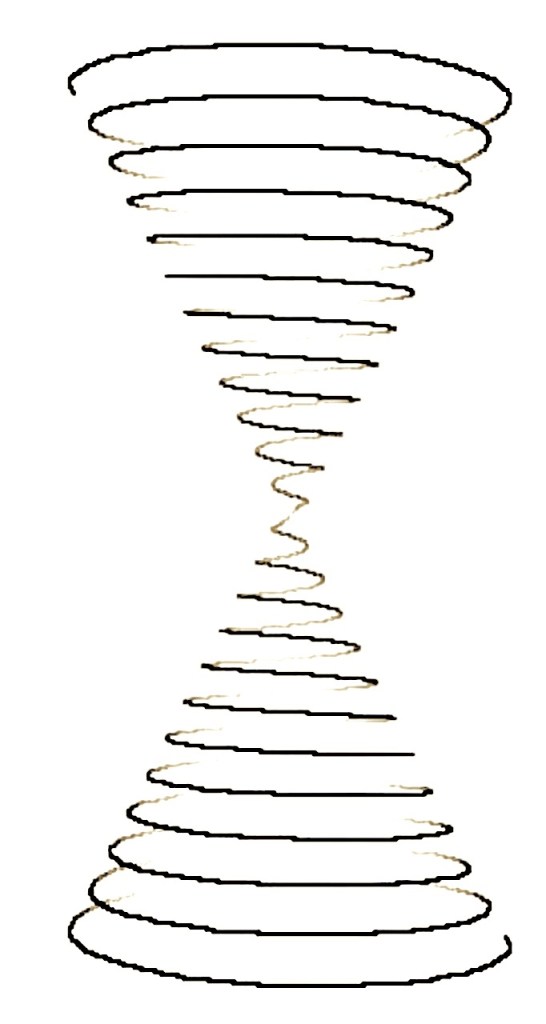
    Image:  Gyres –  Accurate Configuration

    2.  In the traditional Second Coming, Christ is figured to come again but as an adult, not as in infant as is implied in Yeats’ poem “The Second Coming.”

    Of great significance in Yeats’ poem is the “rough beast,” apparently the Anti-Christ, who has not been born yet.  And most problematic is that the rough beast is “slouch[ing] towards Bethlehem to be born.”  The question is, how can such a creature be slouching if it has not yet been born?  There is no indication the speaker wishes to attribute this second coming fiasco to the mother of the rough beast.

    This illogical event is never mentioned by critics who seem to accept the slouching as a possible occurrence.  On this score, it seems critics and scholars have lent the poem an unusually wide and encompassing poetic license.

    The Accurate Meaning of the Second Coming

    Paramahansa Yogananda has explained in depth the original, spiritual meaning of the phrase “the second coming”[5] which does not signify the literal coming again of Jesus the Christ, but the spiritual awakening of each individual soul to its Divine Nature through the Christ Consciousness.  

    Paramahansa Yogananda summarizes his two volume work The Second Coming of Christ: The Resurrection of the Christ Within You:

    In titling this work The Second Coming of Christ, I am not referring to a literal return of Jesus to earth . . . 

    A thousand Christs sent to earth would not redeem its people unless they themselves become Christlike by purifying and expanding their individual consciousness to receive therein the second coming of the Christ Consciousness, as was manifested in Jesus . . . 

    Contact with this Consciousness, experienced in the ever new joy of meditation, will be the real second coming of Christ—and it will take place right in the devotee’s own consciousness. (my emphasis added)

    Interestingly, knowledge of the meaning of that phrase “the second coming” as explained by Paramahansa Yogananda renders unnecessary the musings of Yeats’ poem “The Second Coming”and most other speculation about the subject. Still, the poem as an artifact of 20th century thinking remains an important object for study. 

    Sources

    [1]  Linda Sue Grimes.  “Robert Bly’s ‘The Cat in the Kitchen’ and ‘Driving to Town Late to Mail a Letter’.”  Linda’s Literary Home. December 24, 2025. 

    [2]  David Solway.  “The Origins of Postmodernitis.”  PJ Media.  March 25, 2011.  

    [3]  Linda Sue Grimes. “Poetry and Politics under the Influence of Postmodernism.” Linda’s Literary Home.  Accessed December 3, 2025.

    [4]  Dorian Lynsey. “‘Things fall apart’: the Apocalyptic Appeal of WB Yeats’s The Second Coming.” The Guardian.  May 30, 2020.

    [5]  Editors. “The Truth Hidden in the GospelsSelf-Realization Fellowship. Accessed October 27, 2023.

  • William Butler Yeats’ “Sailing to Byzantium”

    Image:  William Butler Yeats

    William Butler Yeats’ “Sailing to Byzantium”

    William Butler Yeats’ “Sailing to Byzantium” is a profound meditation on aging, art, and the quest for spiritual transcendence, despite his failure to clearly grasp the Eastern religious/philosophical concepts he strived to portray.

    Introduction and Excerpt from “Sailing to Byzantium”

    William Butler Yeats’ “Sailing to Byzantium” is a profound meditation on aging, art, and the quest for spiritual transcendence. However, despite Yeats’ deep engagement with Eastern religion and philosophy, his interpretation and application of these concepts in his poetry often reveal a “Romantic misunderstanding,” as T.S. Eliot astutely observed. 

    This misunderstanding is clearly evident in “Sailing to Byzantium,” especially in its fourth stanza, where Yeats’ vision of eternal existence through art diverges significantly from Eastern religious/philosophical principles.

    Yeats wrote “Sailing to Byzantium” in 1926, at the age of 61,  as a reflection on the aging process and the spiritual journey required to maintain vitality in the face of physical decline. 

    Sailing to Byzantium

    That is no country for old men. The young
    In one another’s arms, birds in the trees
    —Those dying generations—at their song,
    The salmon-falls, the mackerel-crowded seas,
    Fish, flesh, or fowl, commend all summer long
    Whatever is begotten, born, and dies.
    Caught in that sensual music all neglect
    Monuments of unageing intellect.

    An aged man is but a paltry thing,
    A tattered coat upon a stick, unless
    Soul clap its hands and sing, and louder sing
    For every tatter in its mortal dress,
    Nor is there singing school but studying
    Monuments of its own magnificence;
    And therefore I have sailed the seas and come
    To the holy city of Byzantium.

    O sages standing in God’s holy fire
    As in the gold mosaic of a wall,
    Come from the holy fire, perne in a gyre,
    And be the singing-masters of my soul.
    Consume my heart away; sick with desire
    And fastened to a dying animal
    It knows not what it is; and gather me
    Into the artifice of eternity.

    Once out of nature I shall never take
    My bodily form from any natural thing,
    But such a form as Grecian goldsmiths make
    Of hammered gold and gold enamelling
    To keep a drowsy Emperor awake;
    Or set upon a golden bough to sing
    To lords and ladies of Byzantium
    Of what is past, or passing, or to come.

    Commentary on “Sailing to Byzantium”

    The poem “Sailing to Byzantium” uses a journey to Byzantium (Constantinople now Istanbul,) as a metaphor for a spiritual quest, with the speaker seeking to transcend the limitations of the mortal body and achieve a form of immortality through art.

    First Stanza:  Contrasting Vividly

    That is no country for old men. The young
    In one another’s arms, birds in the trees
    —Those dying generations—at their song,
    The salmon-falls, the mackerel-crowded seas,
    Fish, flesh, or fowl, commend all summer long
    Whatever is begotten, born, and dies.
    Caught in that sensual music all neglect
    Monuments of unageing intellect.

    The opening stanza of “Sailing to Byzantium” presents a vivid contrast between the vitality of youth and the poet’s sense of alienation from the natural world as he ages. Yeats paints a picture of a country teeming with life, where “The young / In one another’s arms, birds in the trees” and “the mackerel-crowded seas” represent the cyclical nature of life and death. 

    The phrase “Those dying generations” underscores the transient nature of all living things, a concept that aligns with Eastern philosophy’s emphasis on impermanence.  However, Yeats’ reaction to this natural cycle reveals a departure from Eastern thought. 

    While Buddhism and Hinduism often advocate for acceptance of life’s impermanence, Yeats expresses a desire to escape it. His assertion that “all neglect / Monuments of unageing intellect” suggests a privileging of human intellect and art over the natural world, a distinctly Western perspective that contradicts the Eastern emphasis on harmony with nature.

    Second Stanza:  Aging and the Quest for Renewal

    An aged man is but a paltry thing,
    A tattered coat upon a stick, unless
    Soul clap its hands and sing, and louder sing
    For every tatter in its mortal dress,
    Nor is there singing school but studying
    Monuments of its own magnificence;
    And therefore I have sailed the seas and come
    To the holy city of Byzantium.

    In the second stanza, Yeats further develops the theme of aging and the quest for spiritual renewal. The image of an aged man as “a paltry thing, / A tattered coat upon a stick” vividly conveys the physical deterioration that comes with age. However, Yeats proposes that this decline can be transcended if the soul can “clap its hands and sing, and louder sing / For every tatter in its mortal dress.”

    This concept of the soul triumphing over bodily decay echoes certain Eastern philosophical ideas, particularly the Hindu concept of the soul, which is the eternal self, transcending the physical body. 

    However, Yeats’ emphasis on the soul’s need to “sing” and study “Monuments of its own magnificence” reveals a more Western, ego-centric approach to spiritual transcendence. In contrast, many Eastern philosophies advocate for the dissolution of the ego and the realization of the soul’s unity with the Divine Reality.

    Third Stanza:  The Concept of Transformation 

    O sages standing in God’s holy fire
    As in the gold mosaic of a wall,
    Come from the holy fire, perne in a gyre,
    And be the singing-masters of my soul.
    Consume my heart away; sick with desire
    And fastened to a dying animal
    It knows not what it is; and gather me
    Into the artifice of eternity.

    The third stanza introduces the “sages standing in God’s holy fire,” whom the speaker implores to be the “singing-masters of my soul.”  This imagery draws on both Western and Eastern concepts, blending Christian imagery of holy fire with the Eastern idea of spiritual masters or gurus. The speaker’s desire to have his heart consumed away and to be gathered into “the artifice of eternity” reflects a yearning for spiritual transformation.

    However, Yeats’ conception of this transformation as an “artifice” created by sages diverges from Eastern philosophical traditions.  In many Eastern spiritual practices, enlightenment or liberation is seen not as an artificial state created by external forces, but as the realization of one’s true nature, of uniting the individual soul with the Oversoul, or God.  Yeats’ portrayal suggests a more Western, interventionist approach to spiritual transformation.

    Fourth Stanza: Romantic Misunderstanding

    Once out of nature I shall never take
    My bodily form from any natural thing,
    But such a form as Grecian goldsmiths make
    Of hammered gold and gold enamelling
    To keep a drowsy Emperor awake;
    Or set upon a golden bough to sing
    To lords and ladies of Byzantium
    Of what is past, or passing, or to come.

    The final stanza of “Sailing to Byzantium” most clearly demonstrates Yeats’ “Romantic misunderstanding” of Eastern philosophy. Here, the speaker envisions his eternal form not as a dissolution into God-consciousness (self-realization), as many Eastern traditions insist, but as a golden artifact created by “Grecian goldsmiths.”  This vision of immortality through art is fundamentally at odds with Eastern concepts of liberation from the cycle of birth and death.

    Yeats’ desire to take a form “Of hammered gold and gold enamelling” to entertain “lords and ladies of Byzantium” reveals a distinctly Western preoccupation with individual identity and artistic legacy. This contrasts sharply with Eastern religious/philosophical concepts such as the Buddhist non-self upon entering nirvana or the Hindu idea of samadhi or liberation from cycles of death and rebirth.

    Furthermore, the speaker’s intention to “sing / To lords and ladies of Byzantium / Of what is past, or passing, or to come” suggests a linear view of time that is more aligned with Western thought than with the cyclical time concepts expounded in Eastern religion/philosophy.

    While “Sailing to Byzantium” is undoubtedly a masterpiece of poetic craft, it also reveals the limitations of Yeats’ understanding and application of Eastern philosophical concepts. 

    His vision of spiritual transcendence, particularly as expressed in the fourth stanza, remains rooted in Western ideas of individual immortality and artistic legacy, rather than the Eastern concepts of ego dissolution and unity with the Divine Creator. 

    This “Romantic misunderstanding” of Eastern philosophy, as Eliot termed it, is indeed on full display in this poem, showcasing both the brilliance of Yeats’ poetic vision and the cultural limitations that shaped his interpretation of Eastern thought.

    🕉

    You are welcome to join me on the following social media:
    TruthSocial, Locals, Gettr, X, Bluesky, Facebook, Pinterest 

    🕉

    Share

  • William Butler Yeats’ “The Fisherman”

    William Butler Yeats’ “The Fisherman”

    The speaker in William Butler Yeats’ “The Fisherman” is dramatically promoting a style of poetry that will become and remain meaningful to and beloved by the common folk.

    Introduction with Text of “The Fisherman”

    William Butler Yeats’ poem “The Fisherman” appears in the poet’s The Wild Swans at Coole, which was brought out in 1919. The poet’s collection features many of his most widely anthologized poems.

    In “The Fisherman,” Yeats has created a speaker who is voicing a call for a genuine school of art for the common folk, an art that dramatizes the beauty and truth inherent in all great art. 

    The speaker is also decrying the cultural suicide being perpetrated by charlatans in art as well as their cohorts who are power-hungry politicians.  He thus reveals contempt for fakes and frauds, while promoting an ideal that he strongly believes should be steering art and the cultural life of the nation.

    Every nation throughout history has suffered from these same issues, as toppling governments and bloody wars testify.  The poets have often spoken up, calling out names and insisting on reforms.  

    Despite the fact that poetry’s first function arises from personal experience, political controversy often intrudes into the realm of the personal and that is when poets are compelled to use their platform for activism.

    Care must be taken, however, that the poet not become a brazen tool for propaganda. As an accomplished world poet and former Irish senator [1], Yeats possessed the acumen to broach issues of art, poetry, culture, and politics.

    The former politician and literary Nobel Laureate [2] boasts numerous works that address culture and politics: “The Fisherman” remains one of the most colorful and culturally significant poems of the era.

    The Fisherman

    Although I can see him still,
    The freckled man who goes
    To a grey place on a hill
    In grey Connemara clothes
    At dawn to cast his flies,
    It’s long since I began
    To call up to the eyes
    This wise and simple man.
    All day I’d looked in the face
    What I had hoped ’twould be
    To write for my own race  
    And the reality;  
    The living men that I hate,
    The dead man that I loved,
    The craven man in his seat,
    The insolent unreproved,
    And no knave brought to book  
    Who has won a drunken cheer,  
    The witty man and his joke
    Aimed at the commonest ear,
    The clever man who cries
    The catch-cries of the clown,
    The beating down of the wise
    And great Art beaten down.

    Maybe a twelvemonth since
    Suddenly I began,  
    In scorn of this audience,  
    Imagining a man
    And his sun-freckled face,  
    And grey Connemara cloth,
    Climbing up to a place  
    Where stone is dark under froth,
    And the down turn of his wrist
    When the flies drop in the stream:
    A man who does not exist,
    A man who is but a dream;
    And cried, “Before I am old
    I shall have written him one
    Poem maybe as cold
    And passionate as the dawn.”

    Reading of “The Fisherman”

    Commentary on “The Fisherman”

    The speaker in William Butler Yeats’ poem is heralding a style of poetry that will be beloved by the common folk.  He makes his contempt for charlatans known. He encourages the ideals that he believes must guide culture and art.  Yeats was a promoter of the style of art that he thought was closest to the hearts and minds of the Irish.

    First Movement:  Recalling an Admired Man

    Although I can see him still,
    The freckled man who goes
    To a grey place on a hill
    In grey Connemara clothes
    At dawn to cast his flies,
    It’s long since I began
    To call up to the eyes
    This wise and simple man.

    The speaker appears to be remembering a special man whom he has respected: “[t]he freckled man” wearing “Connemara clothes.”  This man has been in the habit of fishing at a “gray place on a hill.”  

    The speaker implies that in his mind’s eye, he can still perceive the man. And it may also be that the speaker literally meets the man occasionally in the village. However,  the speaker has not as of late mused upon the man.

    The speaker admires the man’s simple ways.  He assumes that the man is “wise and simple.”  The speaker then continues to cogitate upon those very same qualities as he continues his message.

    The speaker entertains a deep desire to praise the virtues of simplicity and wisdom.  He has observed those qualities in the folks who are doing ordinary, simple everyday tasks.

    Second Movement:  Researching History

    All day I’d looked in the face
    What I had hoped ’twould be
    To write for my own race  
    And the reality;  
    The living men that I hate,
    The dead man that I loved,
    The craven man in his seat,
    The insolent unreproved,

    The speaker has determined that he will make a plan to write for his own people, including the real experiences they all undergo.  With the plan in mind, he has begun to research the history of his nation and its people.  The speaker asserts that he hopes to reveal the reality of the lived experience of his fellow citizens. 

     Such a reality should well acquit itself and at the same time demonstrate and dramatize the exact truths that future generations will be likely to undergo.The speaker offers a catalogue of qualities that the men who make up the current political landscape have put on display.  

    Some of those men will be the recipients of his ire.  He brazenly states that there are living men whom he hates.  He then contrasts that negative emotion with its opposite by emphasizing that there is as well the “dead man that [he] loved.” 

    The speaker continues in his enflamed hatred by asserting that the “craven” exist while the “insolent” remain unrestricted in their perfidy. The speaker believes that by contrasting good and evil, he can demonstrate the efficacy of the arrival of a steady virtue upon which to build a better art and poetry that can represent Irish culture more faithfully and honestly.

    Third Movement:  The Guilty Avoiding Justice

    And no knave brought to book  
    Who has won a drunken cheer,  
    The witty man and his joke
    Aimed at the commonest ear,
    The clever man who cries
    The catch-cries of the clown,
    The beating down of the wise
    And great Art beaten down.

    The speaker continues referring to the rogues and knaves, who have thus far evaded justice though guilty. The speaker loathes those frauds who have “won a drunken cheer,” even as they have remained undeserving of celebrity and honor.  

    The speaker makes it clear that there is a sector of despicable characters who damage, cheapen, and pile shame on the culture.   The speaker accuses such unscrupulous scoundrels of attempting to destroy the art of the nation. 

    They, in effect, denigrate “the wise” as they dismantle the “great Art” that they have inherited.  The speaker grieves that these killers of culture have succeeded in their perfidy. Thus, he is calling attention to their misdeeds. He is proposing a change in focus in order to improve values.  He is not suggesting censorship of the charlatans.

    Fourth Movement:  Cultural Assassins

    Maybe a twelvemonth since
    Suddenly I began,  
    In scorn of this audience,  
    Imagining a man
    And his sun-freckled face,  
    And grey Connemara cloth,
    Climbing up to a place  
    Where stone is dark under froth,

    The speaker then reports that for a while he has been incubating the idea of creating an uncomplicated, “sun-freckled face”—the man in “Connemara cloth.”   For his effort, he has thus far received only “scorn” from the ilk of those culture killers and unscrupulous reprobates.

    Nevertheless, the speaker has been pressing on, striving to envision a simple fisherman, who “climb[s] up to a place / Where stone is dark with froth,” a natural place that continues to be pristine and still remains alluring.

    The speaker is crafting a symbolic being whom he can describe and on whom he can bestow the qualities that he deems must become and remain an important part of the natural art, belonging to the people of his environs.

    Fifth Movement:  The Importance of Simplicity

    And the down turn of his wrist
    When the flies drop in the stream:
    A man who does not exist,
    A man who is but a dream;
    And cried, “Before I am old
    I shall have written him one
    Poem maybe as cold
    And passionate as the dawn.”

    The speaker visualizes the fisherman’s wrist movement as the man casts his line into the water. He admits that this man does not yet exist, because  he is still “but a dream.”  The speaker’s keen sensibility is strong enough to bring to life such a simple, rustic character.  He is urged then to take all pains to bring such a character to life.

    Thus, while the poet is still young enough to use his God-given imagination, he vows to take on the task of writing this fisherman into existence and to compose for the man a poem “as cold / And passionate as the dawn.”   The speaker continues to muse on simplicity.  He passionately desires to create a new ideal that will produce meaningful, original, dramatic poetry.

    He insists that that new poetry must be able to speak with genuine originality and that it thus should become a harbinger of the beginning of a new era in art of poetry. The speaker hopes to accomplish all of this despite the wrong-headedness and power-grabbing of too many of the political phonies—and despite the fraudulent deceivers whose selfishness is spreading the destruction of their own culture.

    Sources

    [1]  Editors. “William Butler Yeats.” Poetry Foundation.  Accessed October 3, 2023.

    [2]  Daniel Mulhall. “W.B. Yeats and the Ireland of his time.” Embassy of Ireland.  Accessed October 3, 2023.

  • William Butler Yeats’ “The Indian upon God”

    Image 1:  Williams Butler Yeats – Chicago History Museum

    William Butler Yeats’ “The Indian upon God”

    Alluding to the Genesis concept of the image of God, the speaker parallels the Eastern spiritual tradition of pantheism to dramatize the full implication of that venerable concept.

    Introduction with Text of “The Indian upon God”

    William Butler Yeats’ poem “The Indian upon God” is displayed in ten riming couplets.   The theme of the poem dramatizes the biblical concept that God made man in His own image: 

    So God created man in his own image, in the image of God created he him; male and female created he them… (King James Version, Genesis 1:27).

    The full implication of this fascinating dictum is that God, in fact, created all of creation after His own image.   And while—because of the influence of postmodernism—that concept often receives short shrift in Western art culture, Eastern culture has long embraced it fully.

    William Butler Yeats became fascinated by Eastern philosophy and religion.  And while Yeats also fell victim to the “romantic misunderstanding” of many of the concepts pointed out by T. S. Eliot, Yeats still managed to dramatize certain ideas appropriately.

    This poem “The Indian upon God” remains one of his most accurate offerings from among the pieces that he based upon his take on Eastern philosophy.

    The Indian upon God

    I passed along the water’s edge below the humid trees,
    My spirit rocked in evening light, the rushes round my knees,
    My spirit rocked in sleep and sighs; and saw the moorfowl pace
    All dripping on a grassy slope, and saw them cease to chase
    Each other round in circles, and heard the eldest speak:
    Who holds the world between His bill and made us strong or weak
    Is an undying moorfowl, and He lives beyond the sky.
    The rains are from His dripping wing, the moonbeams from His eye.
    I passed a little further on and heard a lotus talk: 
    Who made the world and ruleth it, He hangeth on a stalk,
    For I am in His image made, and all this tinkling tide
    Is but a sliding drop of rain between His petals wide.
    A little way within the gloom a roebuck raised his eyes
    Brimful of starlight, and he said: The Stamper of the Skies,  
    He is a gentle roebuck; for how else, I pray, could He
    Conceive a thing so sad and soft, a gentle thing like me?
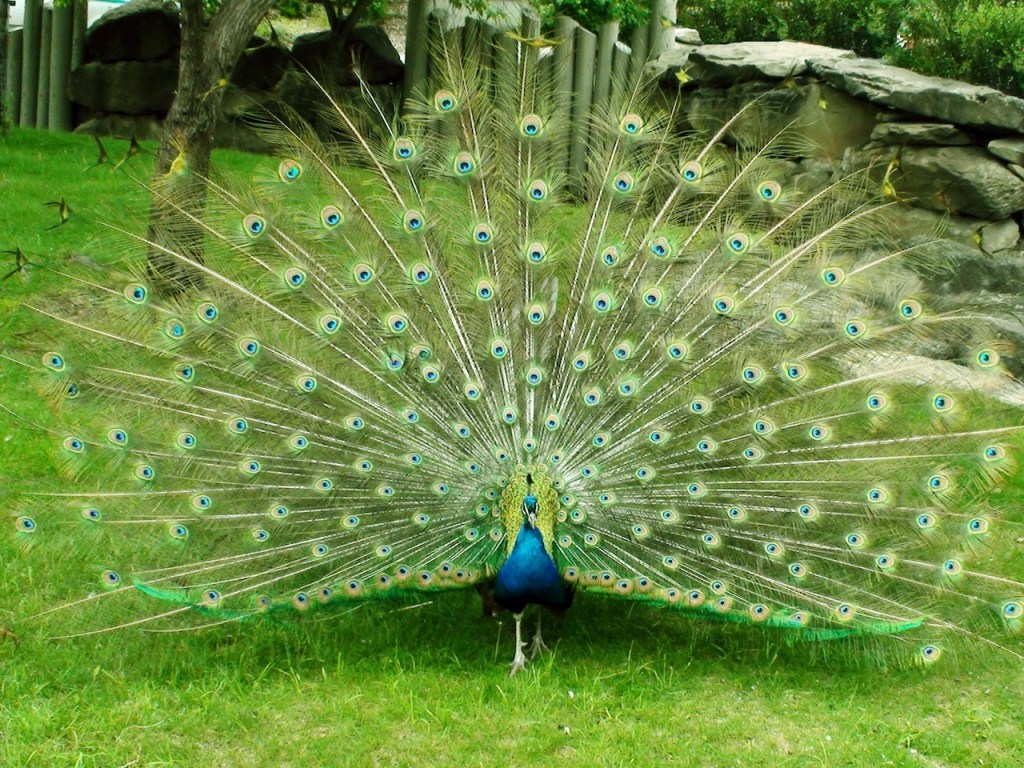
    I passed a little further on and heard a peacock say:
    Who made the grass and made the worms and made my feathers gay,
    He is a monstrous peacock, and He waveth all the night      
    His languid tail above us, lit with myriad spots of light.   

    Commentary on “The Indian upon God”

    The speaker is paralleling the Eastern spiritual tradition of pantheism to dramatize the full impact of that venerable concept presented in Genesis:  creation—including  all created beings along with humankind—is created in the image of the Creator (God).

    Image 2:   Moorfowl Bird Guides

    First Movement:  The Moorfowl

    I passed along the water’s edge below the humid trees,
    My spirit rocked in evening light, the rushes round my knees,
    My spirit rocked in sleep and sighs; and saw the moorfowl pace
    All dripping on a grassy slope, and saw them cease to chase
    Each other round in circles, and heard the eldest speak:
    Who holds the world between His bill and made us strong or weak
    Is an undying moorfowl, and He lives beyond the sky.
    The rains are from His dripping wing, the moonbeams from His eye. 

    The speaker of the poem opens his musings by placing himself alongside a body of water as he walks under trees that he senses to have been moistened likely by a recent rain. In a meditative mood, he muses on the spiritual atmosphere of his locus.  

    He spies some birds pacing about and begins to consider how the moorfowl would elucidate his existence if he could do so in words.  He continues musing on the birds as they are leisurely moving about.

    Finally, the speaker, in his mind’s ear, imagines that the oldest bird begins to declaim about his existence.  That discourse is roughly paraphrased by the following:  

    my Maker is an immortal moorfowl, Who has created all the world, and He remains hidden behind His skyey perch from where He sends the rains and lights His creation with “His eye.”

    The moorfowl visualizes his Creator as a glorious version of himself.  His Creator possesses a “bill” and a “wing,” and the rains drop from His wings, while the moonbeams shoot from His eye.

    Image 3 Lotus – Photo by Ron Grimes

    Second Movement:  Lotus

    I passed a little further on and heard a lotus talk: 
    Who made the world and ruleth it, He hangeth on a stalk,
    For I am in His image made, and all this tinkling tide
    Is but a sliding drop of rain between His petals wide. 

    The speaker then moves on a short distance and begins his musing on what a lotus might say in explaining his origin: thus, the lotus also holds forth about his Creator:  

    my Maker and the ruler of the world “hang[s] on a stalk.”  I am made in His image, and this rain He is sending from between His enormous petals

    The lotus also describes his Creator as an embellished version of himself.  His Creator “hangeth on a stalk,” just as the lotus flower does, and his Maker also causes the rain to fall.  

    And similar to the moorfowl’s conception that the rain drips from the Supreme Moorfowl’s wings, the lotus’ Creator lets the rain “slide” between His petals. 

    Image 4: Roebuck – iStock

    Third Movement: Roebuck

    A little way within the gloom a roebuck raised his eyes
    Brimful of starlight, and he said: The Stamper of the Skies,  
    He is a gentle roebuck; for how else, I pray, could He
    Conceive a thing so sad and soft, a gentle thing like me? 

    The speaker continues on and crafts the fulmination of a roebuck, whose eyes were full of “starlight,” as he, too, explains his creative origin, labeling his Maker, “The Stamper of the Skies“:

    the creator of the world is a tender and mild roebuck, who else could have thought to fashion such a being as myself who remains so sorrowful yet so softly gentle?

    The roebuck concludes that his Creator has to be like himself in order to be able to fashion his unique characteristics of sadness, softness, and gentleness.  It is noteworthy that the roebuck makes his claim through a rhetorical question, which appears to humble his claim yet at the same time gives it particular emphasis.

    Image 5: Peacock – Animal Wildlife

    Fourth Movement:  Peacock

    I passed a little further on and heard a peacock say:
    Who made the grass and made the worms and made my feathers gay,
    He is a monstrous peacock, and He waveth all the night      
    His languid tail above us, lit with myriad spots of light. 

    The speaker moves farther along, and listening to a peacock, he muses that the bird would describe his origin as the following: 

    I was created by a huge peacock who also created all vegetation and all other animals.  My Maker moves His bright features through the sky, from where He sends to us the light from the stars.

    Again, the animal describes his Creator in terms of his own characteristics. The peacock, however, verges on the boastful with his description, claiming that the “monstrous peacock,” or more glorious version of himself, also made the grass and worms.  

    The peacock implies that his Creator has made these creatures for the sake of the peacock.  And the peacock also likens his beautiful tail feathers to stars hanging in the skies.

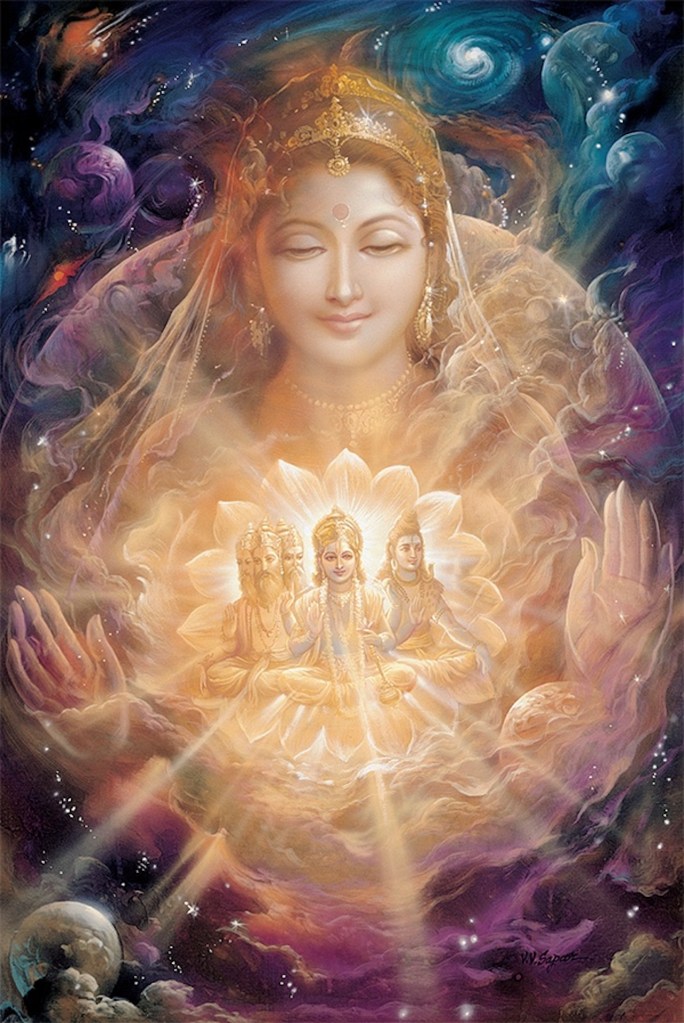
    Image 6: Divine Mother  – Self-Realization Fellowship

    Creation: Image of the Divine

    The philosophy portrayed in William Butler Yeats’ poem is pantheism, the concept that God is everything.  If man (humankind) correctly discerns that God created human beings in His image, then God, in fact, created everything else that exists in His image.  

    If all things are reflections of one Creator, then each thing created can rightly aver that it is made in the image of the Divine. Pantheism is also logically monotheism:  all of creation taken together is one entity.  

    The monotheistic religions of empirical reality—as opposed to that of the  mythological Greek and Roman pantheon of gods—all expound the nature of God as a trinity—one being expressing in three aspects.  For example, in Hinduism the trinity is Sat-Tat-Aum (also expressed as Sat-Chit-Ananda).  The Christian trinity is expressed a Father-Son-Holy Spirit.

    All of the five major world religions—Hinduism, Buddhism, Judaism, Christianity, and Islam—are monotheistic.  Hinduism is often mistakenly referred to a a polytheistic religion by commentators who confuse the names for the various aspects of God as separate gods. 

    Capitalizing Pronouns Referring to God

    The King Jame Version of the Holy Bible does not capitalize the pronouns referring to God; that custom is a 19th century invention.   However, I usually capitalize pronouns referring to the Deity to make clear that such references are, in fact, referring to God.   In this commentary,  I have capitalized the pronouns primarily to make clear that the various individuals are referring to their Maker or God.

  • William Butler Yeats

    Image:  William Butler Yeats NPG, London

    Life Sketch of William Butler Yeats

    William Butler Yeats possessed a lifelong dedication to the cultural and political rebirth of Ireland. He experienced life as a poet, playwright, and senator as he lived during turbulent shifts in Irish politics.  He had a lifelong unquenchable thirst for artistic and spiritual truth.

    William Butler Yeats remains one of the most influential literary figures of the modern era.  His canon, which includes examples of his interest in Eastern philosophy, Irish folklore, and the vicissitudes of life, eventually resulted in the production of various literary forms such as poetry, drama, and essays [1].

    Early Life and Education

    Born on June 13, 1865, in Sandymount, County Dublin, William Butler Yeats was raised in a household that placed a high value on intellectual curiosity bolstered by cultural heritage.

    His father, John Butler Yeats, was a skilled portrait painter, and his mother, Susan Pollexfen, created an environment steeped in Irish history and folklore. His early exposure to art, literature, and the stories of ancient Ireland instilled in Yeats a deep appreciation for myth and legend that would later become central themes in his work.

    As a young man, Yeats attended the Metropolitan School of Art in Dublin, where he developed keen observational skills and his ability to capture what he saw into dramatic literary form such as poetry and plays. 

    His early attempts to write poetry were heavily influenced by Romanticism, and he found inspiration in the rich treasure house of Irish mythology and the natural world. These early experiences laid the groundwork for a lifelong exploration of the interplay between the tangible and the transcendent [2].

    The Celtic Revival

    In the 1880s and 1890s, Yeats became as a principal figure in the Celtic Revival—a cultural movement, aimed at reclaiming Ireland’s heritage from centuries of British domination. 

    Along with contemporaries such as Lady Gregory and Edward Martyn, Yeats sought to regain Irish identity through renewed interest and influence of its ancient myths and folklore.   Yeats’ first poetry collections, including The Wanderings of Oisin and Other Poems (1889), offered a vision of Ireland as a land of fantastic beauty and heroic legend.

    Yeats’ involvement in the Irish literary revival was not merely rhetorical and philosophical; he assisted in the founding of the National Literary Society and became a driving force behind the establishment of the Abbey Theatre, which became the center stage for modern Irish drama. 

    Through the Abbey Theatre, Yeats teamed up with playwrights and dramatists to stage works, combining Irish mythology with contemporary social and political issues; thus he became responsible for creating a distinctly Irish voice in the performing arts [3].

    Changing Style and Interest in the Mysticism

    As Yeats’ career progressed, his creative writings faced an important transformation.  As he moved away from his early Romanticism, he took up themes of aging, disillusionment, and the search for spiritual meaning. This shift was influenced by his increasing interest in Eastern Philosophy and mystical traditions. 

    Yeats’ lifelong engagement with esoteric philosophy—ranging from Theosophy to the study of Eastern Philosophy—found expression in poems such as “The Second Coming” (1919) and “The Indian upon God” (1927). These works reflect a mind grappling with the decline of traditional values and the potential for rebirth through art and myth.

    Yeats’ fascination with mysticism was not a mere intellectual exercise; it became deeply personal. He was a member of the Hermetic Order of the Golden Dawn, an organization dedicated to the study and practice of magical rituals and mysticism. 

    This involvement influenced his poems with symbolic imagery and complex mythological references that continue to captivate readers. The cyclical view of history that Yeats espoused—wherein civilizations rise, decay, and ultimately transform—became a recurring theme of his later work.

    Unfortunately, Yeats’ study of Eastern Philosophy/Religion at times led him astray.  Some of his works demonstrated that he failed to understand [4] the most important aspects of the concepts that he tried to portray in his poems. 

    While his poem “The Indian upon God” accurately reflects Eastern tenets, his “The Second Coming” and “Lapis Lazuli” go far astray.  The bulk of his understanding of Eastern philosophical and religious concepts may be described no less than by the term assigned  by T. S. Eliot “romantic misunderstanding.”

    Politics and the Poet in Society

    The early twentieth century was a period of political upheaval in Ireland, and Yeats became increasingly involved with the nationalist movement.   Even though he never fully aligned himself with any particular political party, his writings and public statements often reflected a profound concern for the fate of his country. His poetry became the main medium through which he expressed hope but also anxiety about the future of his country.

    Poems such as “Easter 1916” suggest that whatever happens no one can deny that those rebels will have died for their dreams. This speaker still cannot completely commit to those dreams. All he can admit is that everything has changed and “A terrible beauty is born.”

    The Yeatsian musing of drama ultimately finds only that things have changed. The speaker cannot say if they have changed for better for worse. He and his generation will have to wait to see how that “terrible beauty” matures.   However, this duality—of destruction and creation—reflects the eternal cycles that he so frequently explored in his verse.

    Beyond his poetry, Yeats contributed directly to the political life of his nation. He served from 1922-1928 in the senate of the newly formed Irish Free State [5].  Although he was often seen as an outsider by both traditional nationalists and modernists, Yeats’ presence in the Senate suggested a belief in the vital role that artists and intellectuals play in shaping public discourse and guiding cultural evolution.

    Image b: Yeats and Gonne  

    Personal Life and Love

    Yeats’ personal life was distressed by a long, unrequited love for Maud Gonne [6], an Irish revolutionary and actress. His feelings for Gonne inspired many of his poems, imbuing them with themes of love, loss, and longing. Gonne’s rejection of his marriage proposals did not deter Yeats from writing some of his most passionate poetry, where she often appears as a muse or an ideal.

    Later in life, Yeats married Georgie Hyde-Lees, who not only became his companion but also a collaborator in his mystical explorations. They had two children, Anne and Michael, and their family life was documented in some of Yeats’ more personal poems, such as “A Prayer for My Daughter” and “The Circus Animals’ Desertion.”

    The Alignment of Myth and Modernity

    A central aspect of Yeats’ enduring appeal is his ability to weave together disparate strands of experience—myth and modernity, beauty and decay, hope and despair—into a coherent vision of the human condition. His poetry often reads as if it were both a dream and a prophecy, a blend of personal reflection and universal truth. 

    For instance, in “Sailing to Byzantium,” Yeats contrasts the ephemeral nature of the physical world with the possibility of spiritual transcendence [7]. The poem’s vivid imagery and rhythmic cadence invite readers to contemplate the eternal in the midst of the temporal, a duality that lies at the heart of Yeats’ artistic endeavor.

    Yeats’ engagement with myth was not limited to the realm of poetry; it also informed his political and cultural projects. By reviving ancient Irish legends and traditions, he sought to restore a sense of identity and continuity to a country grappling with the forces of modernity and colonialism. His poem “The Fisherman” offers an example of this engagement.

    His work with the Abbey Theatre was driven by the conviction that drama rooted in myth could foster a national spirit and provide a counterpoint to the homogenizing effects of globalization. In this way, Yeats not only redefined the poetic landscape but also contributed to a broader cultural renaissance in Ireland.

    An Enduring Influence on Literature and Beyond

    The influence of William Butler Yeats extends far beyond the confines of his own time. His exploration of spiritual and metaphysical themes paved the way for subsequent generations of poets and writers who sought to reconcile the material and the mystical. In the decades following his death, critics and scholars have revisited his work, probing its layers of symbolism and historical context to uncover new meanings and insights.

    Contemporary literary critics often highlight the innovative structure and language of Yeats’ later poetry, noting how his use of recurring symbols and motifs creates a dense network of associations that invites endless interpretation. 

    His ability to encapsulate the complexities of Irish identity, the ravages of time, and the interplay between art and life continues to resonate in today’s discussions of literature and culture. 

    Moreover, Yeats’ political engagement and his belief in the transformative power of art have inspired not only writers but also activists and cultural leaders who view the arts as a vital force for social change [8].

    That political engagement, however, begs for a caveat.  As postmodernism crept ever nearer the hearts of the contemporary artists, the loss of skill and lack of interest in truth began to blight both poetry and criticism.  That postmodern mind-set has little hope of heralding and power to transform society for the better.

    Yeats’ Legacy

    William Butler Yeats’ life and work remain a testament to the power of art to illuminate the deepest mysteries of existence. From his early days steeped in Irish folklore to his later explorations of mystical symbolism and political transformation, he navigated the tumultuous currents of change with a keen and reflective mind. His ability to articulate the paradoxes of beauty and decay, hope and despair, has left an indelible mark on the world of literature.

    Yeats’ legacy is a reminder that art is not merely a reflection of life but also can serve as an agent of transformation, when steeped in desire for truth. His vision of history as a series of cyclic renewals, his embrace of the occult and the mythical, and his commitment to cultural and political renewal have all contributed to a body of work that continues to inspire and challenge readers. In celebrating Yeats, one celebrates the eternal quest for meaning—a quest that, like his poetry, transcends time and place.

    Through his poetic innovations and his fervent commitment to the rebirth of Irish culture, William Butler Yeats carved out a unique space in the annals of literary history. His words continue to echo in classrooms, theaters, and the hearts of those who dare to dream beyond the confines of the everyday routine. 

    Death

    In his later years, Yeats’ poetry grew increasingly reflective and introspective. The themes of mortality, the nature of artistic creation, and the inexorable passage of time became ever more emphasized. 

    Works such as The Tower (1928) and The Winding Stair and Other Poems (1933) reveal a man deeply aware of his own aging and the inevitable approach of death. Yet, even as he grappled with the transient nature of human life, he remained committed to the idea that art could capture eternal truths.

    Despite experiencing poor health, Yeats continued to write and speak out on matters of art, politics, and philosophy until his final days. On the French Riviera, he spent his last months in quiet musing, as he sought solace and reflection away from the public eye. 

    On January 28, 1939, in Menton, France, [9] William Butler Yeats passed away peacefully . The world mourned not just the passing of a literary giant, but also the departure of a visionary who had continually challenged and enriched the cultural landscape of Ireland and beyond. 

    One of the most profound memorial poems to Yeats is W. H. Auden’s “In Memory of W. B. Yeats.”  The following excerpt contains some of the poem’s most memorable lines, for example, “Mad Ireland hurt you into poetry”:

    You were silly like us; your gift survived it all:
    The parish of rich women, physical decay,
    Yourself. Mad Ireland hurt you into poetry.
    Now Ireland has her madness and her weather still,
    For poetry makes nothing happen: it survives
    In the valley of its making where executives
    Would never want to tamper, flows on south
    From ranches of isolation and the busy griefs,
    Raw towns that we believe and die in; it survives,
    A way of happening, a mouth.

    Sources

    [1]  Richard Ellmann. Yeats. New York. Oxford University Press, 1989.

    [2]  Mark Fryer. The Life of W.B. Yeats: A Critical Biography. London. Bloomsbury Academic. 2001.

    [3]  A. Norman Jeffares. The Cambridge Companion to W.B. Yeats.  Cambridge University Press, 2006.

    [4]  Linda S. Grimes.  “William Butler Yeats’ Transformations of Eastern Religious Concepts.”  Ball State University. PhD Dissertation. 1987. 

    [5] Editors.  “W. B. Yeats:  Irish Author and Poet.”  Britannica.  Accessed February 22, 2025.

    [6] Lisa Fortin Jackson.  “Great Irish Romances: W.B. Yeats and Maud Gonne.”  Wild Geese.  February 4, 2014.

    [7]  C. S. Lieber. The Collected Works of W.B. Yeats. New York. Knopf.  1963.

    [8] William Butler Yeats. The Collected Poems of W.B. Yeats. Edited by Richard J. Finneran, New York. 2009.

    [9] Editors.  “William Butler Yeats.”  Biography. August 17, 2020.

    Commentaries on Yeats Poems

    • The Indian upon God” This poem is displayed in ten riming couplets. The theme of the poem dramatizes the biblical concept that God made man in His own image.
    • The Fisherman” In “The Fisherman,” Yeats has created a speaker who is voicing a call for genuine art for the common folk, an art that dramatizes the beauty and truth inherent in all great art.
    • The Second Coming” One of the most overrated and misunderstood works of the Western literary canon.
    • Sailing to Byzantium” This poem is a profound meditation on aging, art, and the quest for spiritual transcendence, despite his failure to clearly grasp the Eastern religious/philosophical concepts he strived to portray.
    • “Leda and the Swan”  Focuses on the ancient Greek myth, wherein the woman, Leda, wife of Tyndareus, was impregnated by the god Zeus in disguise as a swan. Yeats’ speaker is musing regarding the nature of such an act and how it might have impacted Leda’s mental capacities afterward.
    • “Among School Children”  One of Yeats’ most anthologized poems, this poem features numerous allusions to ancient Greek mythology and philosophy. Yeats was always a thinker, even if not always a clear thinking one.
    • “Lapis Lazuli”  In this poem,  William Butler Yeats has his speaker explore the issue of peace and tranquility despite a chaotic environment.