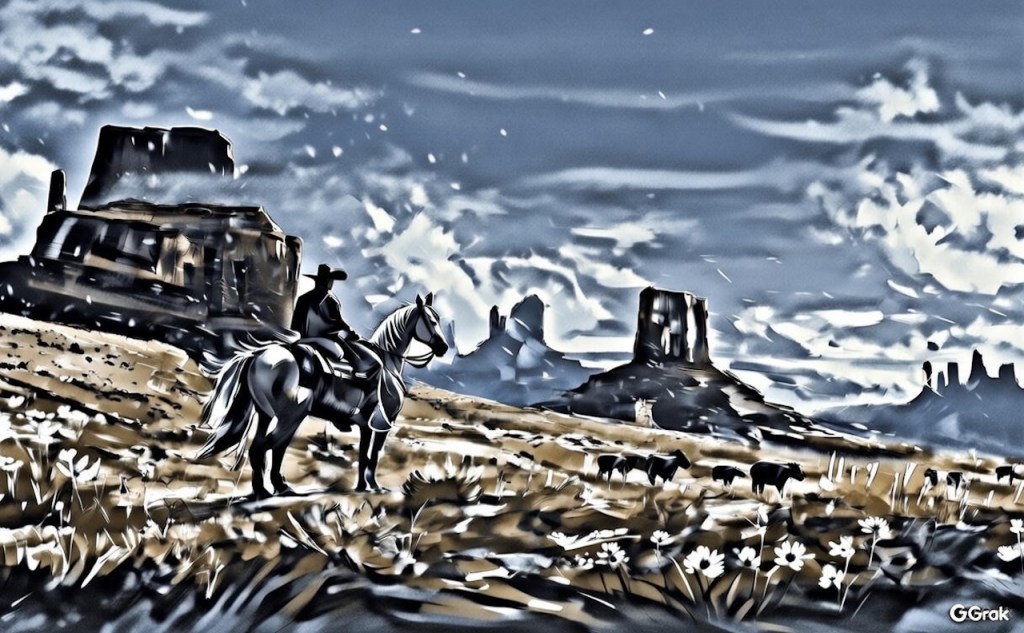
Image: Created by Grok
An Introduction to Cowboy Poetry
Cowboy poetry is a uniquely American literary expression rooted in the lived experience of cattle hands, ranchers, and range-riders in the Western United States. Its origins trace back to the post–Civil War era cattle drives, when cowboys spent long, lonely hours on the open range.
In such conditions——spending weeks or months on the trail, under vast skies and silent plains——verse and song offered a way to pass time, reflect on home, commemorate events, and give shape to emotional lives shaped by isolation, danger, and hope [1]. Much of this early poetry existed only in oral form: recited around campfires, in bunkhouses, or during long night watches.
Formally, cowboy poetry draws on traditions of balladry and folk verse. Its characteristic features include narrative structure, end rime, regular meter, and simple, direct language.
The subject matter often centers on horses, cattle, weather, labor, friendship, loneliness, the wide-open landscape, and the moral challenges of frontier life [2]. The language is accessible, the tone often unpretentious, and the verse often intended to be read aloud or sung, rather than reserved for print-only audiences.
Cowboy Voices
Among the foundational figures of the cowboy poetry tradition is Badger Clark (1883–1957). Settling in South Dakota, Clark became the state’s first poet laureate. His early collection Sun and Saddle Leather (1915) and poems like “A Cowboy’s Prayer” evoke the solitude, majesty, [3] and spiritual connection to land that define much cowboy verse.
Another important early contributor is E. A. Brininstool (Earl Alonzo Brininstool, 1870–1953) [4]. Though not a working cowboy himself, he deeply immersed in Western and rodeo culture, producing poems and historical-poetic works that helped bring cowboy themes into print and preserve the memory of a fading frontier world.
S. Omar Barker (1894–1985), born in New Mexico, provided another voice: a rancher, legislator, teacher [5], and poet whose works such as Buckaroo Ballads and Rawhide Rhymes captured ranch life during a period of transition, preserving its rhythms and stories for new audiences.
In the mid-to-late twentieth century, Buck Ramsey (1938–1998) revitalized the tradition. After a ranching accident left him paralyzed, Ramsey turned to poetry and music to chronicle his memories of working ranch life——blending authenticity, nostalgia, and spiritual reflection in long narrative poems that helped shape modern cowboy-poetry revival [6].
David Althouse: Cowboy Poetry and Western Fiction
Finally, a contemporary example is David Althouse, who represents a living continuation and adaptation of Western literary tradition.
David Althouse is a native Oklahoman——raised amid hunting, fishing, horseback riding, and other outdoor life. His deep affinity for the landscapes, history, and culture of the American West informs both his poetry and his novels [7]. He has remarked that he finds home “hiking old trails, scaling the slopes, traversing the mesas,” immersing himself in the “sights, sounds, and scents of the West”——and translating them into stories and poems.
Althouse’s published novels include the following:
- Hawk Eyes, (Wolfpack Publishing 2016) A Western historical novel from Althouse, featuring youth, survival, and justice in a rugged frontier milieu.
- The Guns of Frank Eaton (Wolfpack Publishing 2017), which tells the story of Frank Eaton’s quest for vengeance across the lawless territories of the post-Civil War West. In vivid, action-rich prose, the novel evokes the dangers, moral codes, and harsh beauty of frontier life.
- Ghost Knights of New Orleans (Next Chapter 2019), a novel that extends his Western interest into a broader historical-fiction narrative: in this work Althouse merges Civil War era intrigue, frontier themes, and broader historical complexity, demonstrating how the legacy of the West can interweave with national histories.
Althouse’s dual role——as poet and novelist——illustrates a continuing evolution of the Western literary tradition. While cowboy poetry remains rooted in verse and oral imagery, authors like Althouse enrich the genre by offering full-length fictional narratives that engage with Western history, myth, and landscape, preserving and reimagining frontier life for contemporary readers.
Continuity and Cultural Significance
The work of poets from Badger Clark and Brininstool to Barker and Ramsey——and more recently to David Althouse——shows how cowboy poetry has evolved from ephemeral oral verse to printed poetry, and finally into novels of Western historical fiction. This evolution underscores how the memories of the frontier continue to resonate across generations, adapting to new forms while retaining core themes: the land, labor, hardship, freedom, memory, and spirituality.
Cowboy poetry and Western fiction together serve as a living archive of a vanished but still deeply influential way of life ——a way of life that shaped the American West and, through literary art form, continues to shape our national imagination.
National Cowboy Poetry Gathering
Every January, fans of cowboy poetry and Western heritage hold a convocation for the National Cowboy Poetry Gathering in Elko, Nevada. The Gathering——first held in 1985——now stretches over a week and features poetry and music performances, workshops in storytelling, gear-making, cooking and traditional crafts, film screenings, dancing, open-mike sessions, and folk-art exhibits.
The 2026 dates are January 26–31, which will be the 41st year for this meeting. Tickets are available from the Western Folklife Center, whose site offers more information about the organization and the gathering.
Sources
[1] Paul A. Carlson. “Cowboy Poetry and the Cattle Drive Tradition.” National Geographic History. 2018.
[2] James Hoy. “Cowboy Poetry.” Encyclopedia of the Great Plains. University of Nebraska–Lincoln. 2011.
[3] David Kindy. “Saddle Up With Badger Clark, America’s Original Cowboy Poet.” Smithsonian Magazine. 2020.
[4] Curators. “Biography of E. A. Brininstool.” BYU Library. Accessed December 6, 2025.
[5] Stephen Zimmer. “S. Omar Barker — The Cowboy’s Poet.” Ranching Heritage Association. February 17, 2022.
[6] Susan Kouyomjian and Laurie E. Jasinski. “Ramsey, Buck (Kenneth Melvin) (1938–1998).” Texas State Historical Association. Published: December 5, 2006. Updated: September 27, 2015.
[7] Curators. “About David Althouse.” Wolfpack Publishing. 2025.
Commentaries on Cowboy Poetry
- David Althouse’s “How Pecos Bill Saved Christmas” The legendary hero, Pecos Bill, gargling with nitroglycerin and chewing on habanero peppers, saved Christmas one year. Accompanied by his horse, Widow Maker, Pecos Bill performs his extreme acts throughout cowboy folklore.
- David Althouse’s “Cowboy Christmas Carol” A “hard-bitten ol’ cowpoke” experiences a mystical experience that changes his heart in the Christmas ballad. He will carry his new change of heart into his daily cow poking life as he honors “the Great Trail Boss in the Sky.”
- A. B. “Banjo” Paterson’s “Clancy of the Overflow” A city-dweller, painting a picture of dirt, noise, and hustling about in the city, imagines what his life would be like if he could trade places with a drover (cowboy) in the outback, where life would be grounded in nature with many pleasurable sights and sounds.
- Buck Ramsey’s “Christmas Waltz” This poem/song dramatizes a holiday celebration on the ranch. The participants all join in a joyful preparation for their celebration as they keep their faith central and focused.
- Badger Clark’s “A Cowboy’s Prayer” Badger Clark’s ballad consists of four riming octets, nostalgically dramatizing a celebration of his gratitude to God for his way of life.
- S. Omar Barker’s “A Cowboy’s Christmas Prayer” This poem features a humble cowpoke, who is not accustomed to praying but is offering his heart-felt supplication at Christmas time. As he prays, he reveals the qualities and issues of his life that are most important to him.
- S. Omar Barker’s “Three Wise Men” This Christmas poem dramatizes a tale about three lonesome cowboys camped far out on the prairie. Because they are so far from home, they hanker to be celebrating Christmas in the tradition way.
- E. A. Brininstool’s “Christmas Week in Sagebrush” E. A. Brininstool’s “Christmas Week in Sagebrush” dramatizes the activities offered in the little town of Sagebrush as the cow pokes, their families, and friends do some shopping and spending.
- Henry Lawson’s “Ballad of the Drover” In Henry Lawson’s “Ballad of the Drover,” the sound of camp gear clanging as the horses thunder along becomes a melancholy image and refrain.
- Brad McClain’s “Cowboy Christmas” From McClain’s internet website dedicated to his Christian faith and affinity for cowboy culture God’s Horseback Gospel.
- Stephen Vincent Benét’s “The Ballad of William Sycamore” Not strictly a cowboy poem, Benét’s ballad, however, offers the mind-set of an individual close to the land, preferring the rural life to the urban.
 Linda's Literary Home