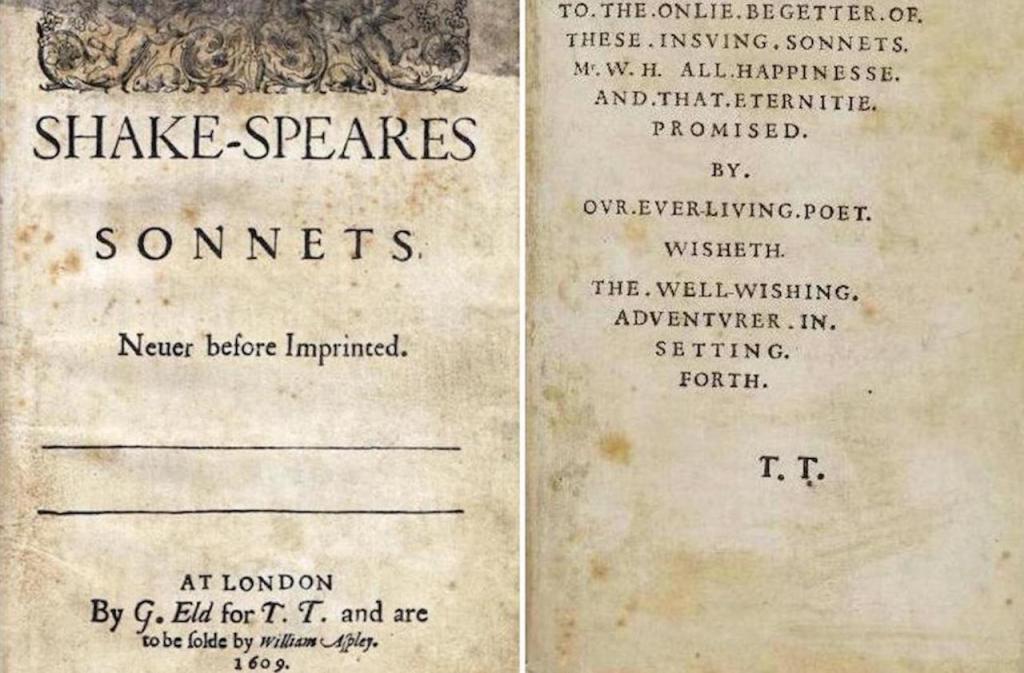
Image: Shake-speares Sonnets Hank Whittemore’s Shakespeare Blog
The Marriage Sonnets
From the classic 154 Shakespeare sonnet sequence, the “Marriage Sonnets” 1—17 features a speaker, attempting to persuade a young man to marry and produces beautiful children. Oxfordians, who hold that the actual Shakespeare writer was Edward de Vere, 17th Earl of Oxford, suggest that the young man is probably Henry Wriothesley, the third Earl of Southhampton and that the speaker of sonnets 1–17 is striving to convince the young earl to marry Elizabeth de Vere, the eldest daughter of Edward de Vere.
Shakespeare Sonnet 1 “From fairest creatures we desire increase”
The first sonnet “From fairest creatures we desire increase” focuses on persuading a young man to marry and procreate beautiful offspring; the speaker continues that engagement in sonnets 1–17.
Introduction and Text of Sonnet 1 “From fairest creatures we desire increase”
While the Shakespeare canon is most noted for its plays, including Hamlet, Macbeth, A Midsummer Night’s Dream, The Taming of the Shew, Romeo and Juliet, and many others, the Shakespeare writer’s literary masterpieces also feature a sequence of 154 masterfully crafted sonnets.
Despite the wide-spread tendency to categorize the sonnets thematically into two groups, the first 126 focusing on a young man and the remainder focusing on an illicit affair with “dark lady,” the actual thematic structure supports three distinct groups:
- The Marriage Sonnets (often miscategorized in “Fair Youth”): 1–17
- The Muse Sonnets (often mistaken as “Fair Youth Sonnets”): 18–126
- The Dark Lady Sonnets: 127–154
The first group—The Marriage Sonnets 1–17—clearly addresses a young man, as the speaker pleads with him to marry and produce beautiful children, who will look like the young man and continue his legacy of well-pleasing features. This group is often merged with the second and labeled “The Fair Youth Sonnets.”
The second group—The Muse Sonnets—mistakenly thought to be addressing the same young man but for a different purpose focuses on the theme of creativity and the place of the muse in the creative process. Because no “fair youth” or any other person appears in the bulk of that thematic group, 18–126, I have relabeled that group to more accurately reflect its theme.
Instead of addressing a young man or any other person, the speaker in “The Muse Sonnets” is speaking variously to his muse, to his talent, to his soul, and even at times to the sonnets themselves.
Sonnet 1 “From fairest creatures we desire increase” resides within the thematic category known as “The Marriage Sonnets,” containing sonnets 1–17. The speaker in “The Marriage Sonnets” is pursuing his purpose with dramatic flair and creativity. He is striving to convince a young man that the latter should marry and produce lovely offspring.
The speaker engages many different strategies in his attempt to persuade the young man to marry, appealing sometimes to his vanity and sometimes to his sense of duty. The creativity of the speaker secures each sonnet’s drama as the sequence offers entertainment as well as enlightenment in poetry creation.
Sonnet 1 “From fairest creatures we desire increase”
From fairest creatures we desire increase
That thereby beauty’s rose might never die,
But as the riper should by time decease,
His tender heir might bear his memory:
But thou contracted to thine own bright eyes,
Feed’st thy light’s flame with self-substantial fuel,
Making a famine where abundance lies,
Thyself thy foe, to thy sweet self too cruel.
Thou that art now the world’s fresh ornament
And only herald to the gaudy spring,
Within thine own bud buriest thy content,
And, tender churl, mak’st waste in niggarding.
Pity the world, or else this glutton be,
To eat the world’s due, by the grave and thee.
Original Text
Better Reading
Commentary on Sonnet 1 “From fairest creatures we desire increase”
The speaker begins to ply his persuasive wiles on the young man to marry, conceive, and produce lovely offspring. In this opening sonnet, the speaker is informing the young man that nature itself as well as humanity possess the innate wish to have beautiful people propagate their kind.
First Quatrain: The Desire for Continued Beauty
From fairest creatures we desire increase
That thereby beauty’s rose might never die,
But as the riper should by time decease,
His tender heir might bear his memory:
The speaker makes the bold claim that nature plus humanity—an entity that the speaker conflates into “we”—possess hopes and wishes that beautiful people of pleasing demeanor fill the world with pleasing specimens after their own kind.
The speaker, likening the young man’s loveliness to a “rose,” is opining that this young man, whom he is addressing, shines forth all those proper physical qualities that need to be replicated.
The speaker thus is taking up a campaign to nudge this beautiful young specimen to marry and produce children that will be as beautiful as the young man is. As the speaker compares the young man’s loveliness to a rose, he strives to persuade the young man that also just like the beauty of the rose, his beauty will wither and die.
However, if the young man will simply accept and follow this more experienced, older man’s advice, he will allow his beauty to be passed on to a new generation, and in place of “by time decrease,” the young man will cause the beauty of the “fairest” kind to increase in the world. If the young man will cause lovely children, who resemble him to be born and inhabit the planet, he will be giving nature and humanity what it most desires.
Second Quatrain: A Selfish Young Man
But thou contracted to thine own bright eyes,
Feed’st thy light’s flame with self-substantial fuel,
Making a famine where abundance lies,
Thyself thy foe, to thy sweet self too cruel.
As the clever speaker continues his persuasion, he then chides the young man, accusing him of being selfish. His stingy ways bespeak an ill-formed character, who wishes to bask in his own self adulation. He berates the young man for desiring to look only at his own beautiful features, such as his “bright eyes.”
The speaker finds it inappropriate that the young man simply continues to delight in his own self-esteem, increasing his own beauty while he continues to remain stingy in passing it on to others.
The speaker then engages in some exaggeration, implying that the young man’s conceited ways are starving the world. They are bringing on “a famine” even in the midst of the youngster’s “abundance”—a plenteous supply that he should be willing to share.
If, instead of remaining selfish, the young man will marry, he can yield forth children, who will present that same loveliness to the world that he already has done. The speaker tries to convince the young man that he is in fact only impeding his own interests by his selfish desire to retain his beautiful qualities only for himself.
The speaker has affected a façade of sorrow to implore the young man to believe that he has become his own worst enemy; ultimately, according to the speaker, the young man is just being unkind to his own “sweet self.” The speaker has no compunction about employing flattery and cunning to fulfill his ultimate purpose.
Third Quatrain: Appeal to Vanity
Thou that art now the world’s fresh ornament
And only herald to the gaudy spring,
Within thine own bud buriest thy content,
And, tender churl, mak’st waste in niggarding.
The speaker seems convinced that accusations of selfishness may be a winning strategy in appealing to the young man’s sense of duty; thus he pulls at the strings of his leanings toward vanity.
Because the young man is only one individual, he will remain only one—and then within himself “bur[y] his content”—if he remains unmarried and fails to spring off lovely, pleasing children. The speaker addresses the young man as “tender churl.” Now, he is nearly begging the young man to cease wasting his time and energy by focusing so selfishly only on himself.
Because the young man’s qualities are so valuable, worth so much more than simple temporary beauty, he must correct the possible loss of those qualities to the world by reproducing more like himself. The young man’s following the older man’s advice would keep a rather bad situation from occurring.
The Couplet: Usurping a World Starving for Beauty
Pity the world, or else this glutton be,
To eat the world’s due, by the grave and thee.
Finally, speaker concludes his entreaty, by summing up his complaint in a rather blunt manner. Again, he wishes to make the young man believe that his failure to marry and reproduce makes him a usurper of the world’s resources.
According to the speaker’s claims, possessing beauty, loveliness, charm, and all forms of pleasing qualities places on the possessor the duty to replenish the world with those same qualities. The young man should marry and produce children, not only for his own sense of immortality but for sake of society—nature and humanity—that desires such increase.
If, however, this young man continues to reject the counsel of the speaker, he will not only swindle the world, but he will also shortchange himself and discover himself alone facing nothing but “the grave.”
Shakespeare Sonnet 2 “When forty winters shall besiege thy brow”
Shakespeare sonnet 2 from the “Marriage Sonnets” finds the speaker again begging the young man to marry and spring off lovely children, before he becomes too old and decrepit to achieve that goal, one that the speaker insists is of utmost importance for the young man and society.
Introduction with Text of Sonnet 2 “When forty winters shall besiege thy brow”
In the second installment of the “Marriage Sonnets” from the Shakespeare 154-sonnet sequence, the speaker continues his attempt to convince the young man to take a wife and add to the next generation his own beautiful children. The speaker admonishes the young man to act before he begins his descent into old age, wherein he will lose his youthful vitality and his physical beauty.
This clever, creative speaker will continue to concoct many dramatic arguments as he strives to persuade this young man that his life will be much happier if he will only accept the older man’s counsel regarding marriage and family creation.
This speaker will often be appealing to the young man’s vanity as well as his sense of duty. His choice of persuasive tactics offers a clue about the speaker’s own relationship with those qualities.
Sonnet 2 “When forty winters shall besiege thy brow”
When forty winters shall besiege thy brow
And dig deep trenches in thy beauty’s field,
Thy youth’s proud livery, so gaz’d on now,
Will be a tatter’d weed, of small worth held:
Then being ask’d, where all thy beauty lies,
Where all the treasure of thy lusty days,
To say, within thine own deep-sunken eyes,
Were an all-eating shame and thriftless praise.
How much more praise deserv’d thy beauty’s use,
If thou couldst answer ‘This fair child of mine
Shall sum my count, and make my old excuse,’
Proving his beauty by succession thine!
This were to be new made when thou art old,
And see thy blood warm when thou feel’st it cold.
Original Text
Better Reading
Commentary Shakespeare Sonnet 2 “When forty winters shall besiege thy brow”
The speaker in Shakespeare sonnet 2 continues to urge the young man to marry and procreate before he grows too old and decrepit. The speaker is adamant that the young man pass on his pleasing qualities to a new generation.
First Quatrain: Old Age
When forty winters shall besiege thy brow
And dig deep trenches in thy beauty’s field,
Thy youth’s proud livery, so gaz’d on now,
Will be a tatter’d weed, of small worth held:
A man’s life expectancy in Britain during the late 16th and early 17th centuries was about fifty-five years; thus, at the age of forty, an individual was considered old. By employing a metaphor that turns the young man’s “brow” into a plowed cornfield, the speaker is offering a disturbing image of a wrinkled old face that resembles a plowed cornfield with “deep trenches.”
The speaker hopes to use this unsightly spectacle to convince the young man that time is flying. He is aware that the young man, as a target of his pleading, has shown considerable pride in his youthful, handsome appearance.
Thus in reminding the young man that one day in future his handsome, blemish-free, unlined face will be relegated to a “tatter’d weed,” the speaker hopes to enhance the points of his argument. Such a weed face will be worthless in trying to attract a bride.
The sly nature of this speaker continues to emerge as he attempts to engage the young man with his clever rhetorical flourishes. The speaker is continuing to appeal to the young man, focusing on qualities that he feels are most vulnerable to the speaker’s argument and persuasion.
The speaker’s audience may likely be guessing just what the speaker wants to achieve for himself by having the young man give in to his persuasion. At first glance, it seems that the speaker has nothing special to gain from having the young man follow his advice, except perhaps the pleasure of knowing he had the ability to persuade.
Second Quatrain: Treasures Stashed in a Withering Face
Then being ask’d, where all thy beauty lies,
Where all the treasure of thy lusty days,
To say, within thine own deep-sunken eyes,
Were an all-eating shame and thriftless praise.
The speaker now warns the young fellow that if he continues to remain without an heir to all of his admirable qualities, the young man will have to reap the displeasure of having his beautiful, natural treasures socked away in a withering, old, ugly face.
The young fellow’s reason for pride in his handsome countenance will stop dead in its tracks without an heir to keep on display that beautiful face. The speaker simulates frustration that the young man remains so selfish as he steals from the world the benefits of the beauty that the young man has to offer.
Because he is refusing to pass on those favorable qualities for the benefit of society and even the culture, the insolent youth is portrayed as callous and self-absorbed—qualities that the speaker plans to establish in the mind of the young man as dreadfully despicable.
The speaker is demonstrating how deeply he pities the young man for allowing himself to experience a future possessing a deep-trenched face without an heir who could so easily replace his youthful beauty.
Third Quatrain: Continuing the Upbraiding
How much more praise deserv’d thy beauty’s use,
If thou couldst answer ‘This fair child of mine
Shall sum my count, and make my old excuse,’
Proving his beauty by succession thine!
The speaker continues to chide the young man. He dramatizes the contrast that exists between producing a child now to not producing one. If the young man follows the speaker’s counsel and produces lovely children now in his youthful, vital time of life, the young man will be able to take comfort in the fact that he has bestowed on the world a gift that reflects well upon the father.
By offering the world and society the marvelous qualities which will enhance the next generation, the young man is doing his sacred duty, as well as guaranteeing comfort in his golden years. The young man’s beautiful heirs will remain a testament to the future that this father was a handsome, vital man.
If, however, the young fellow continues his obstinate ways of remaining single and childless, he will have to meet the future with a wrinkled old face that resembles a plowed cornfield, and he will possess nothing substantial as he descends into death.
The Couplet: Producing Offspring to Retain Youth
This were to be new made when thou art old,
And see thy blood warm when thou feel’st it cold.
In the couplet, the speaker wraps up his persuasion by stressing that the young man will keep some part of his own youthful beauty by wisely producing lovely offspring who will possess the ability to not only mimic his handsome features but who will also carry on his name.
After the young man unavoidably moves into old age, he will be able to take comfort in the fact that he can experience the joy that splendid children with warm blood coursing through their veins bring to their sire.
The speaker insists that the young man will feel that he has been reinvigorated; the speaker asserts that the young man will be “new made,” simply by seeing his living children. Having those children will mean that he will remain fortified against the inescapable horrible coldness of old age.
Not only does the speaker desire to use the young man’s vanity to convince him, but he also believes that he must create a scenario in which the young man himself will need to be comforted in his old age.
The speaker likely hopes that coldness of old age scenario will strengthen his argumentation. The claim that old age is a period of cold horror is nothing but fabrication.
But the speaker remains desperate to convince the young man that he must marry and procreate. Thus the speaker continues to concoct any likely event in order to gain the upper hand and ultimately win the argument.
Shakespeare Sonnet 3 “Look in thy glass and tell the face thou viewest”
Shakespeare sonnet 3 “Look in thy glass and tell the face thou viewest” from the “Marriage Sonnets” focuses on the young man’s image in the mirror. The speaker is appealing to the young man’s vanity as he continues his persuasive efforts to convince the fellow to marry and have children.
Introduction with Text of Sonnet 3 “Look in thy glass and tell the face thou viewest”
As in sonnets 1 and 2, the speaker in Shakespeare sonnet 3 from the classic Shakespeare 154-sonnet sequence is pleading with the young man to marry and produce children in order to pass on his handsome features. The speaker employs many tactics of persuasion as he tries to convince the young man to marry and spring off fine looking progeny.
The speaker’s clever repartee is often amusing as well as entertaining and, as it seems the sly speaker possesses an unlimited number of rhetorical tricks that he so freely employs. The speaker’s ability to argue and persuade is outdone only by his poetic ability to create colorful scenarios of drama.
As this speaker argues, he often attempt to direct his arguments for humanitarian purposes. Fortunately, this speaker never condescends to foolish comparisons but instead keeps his images appropriate as well as fresh.
Sonnet 3 Look in thy glass and tell the face thou viewest
Look in thy glass and tell the face thou viewest
Now is the time that face should form another;
Whose fresh repair if now thou not renewest,
Thou dost beguile the world, unbless some mother.
For where is she so fair whose unear’d womb
Disdains the tillage of thy husbandry?
Or who is he so fond will be the tomb,
Of his self-love to stop posterity?
Thou art thy mother’s glass and she in thee
Calls back the lovely April of her prime;
So thou through windows of thine age shalt see,
Despite of wrinkles this thy golden time.
But if thou live, remember’d not to be,
Die single and thine image dies with thee.
Original Text
Better Reading
Commentary on Sonnet 3 “Look in thy glass and tell the face thou viewest”
Shakespeare sonnet 3 from the “Marriage Sonnets” concentrates on the young man’s image in the looking-glass, as the speaker exploits the young man vanity for persuasive purposes.
First Quatrain: Checking out the Face in the Mirror
Look in thy glass and tell the face thou viewest
Now is the time that face should form another;
Whose fresh repair if now thou not renewest,
Thou dost beguile the world, unbless some mother.
In the first quatrain, the speaker begins by demanding that the young man carefully peruse his own face in the looking-glass and tell himself, as he does, that the time is now here for him to produce offspring whose faces will be similar to his own.
The speaker wants the young man to believe that if the young fellow does not produce more faces like his own, he will be cheating others, and that includes the mother of those new infants who will inherit his prepossessing qualities. The speaker is playing on the young man’s sympathy by insisting that the young man’s failure to reproduce children will “unbless some mother.”
The young fellow will prevent some mother from experiencing the blessings of giving birth and receiving the glory of offering to the world a new generation. The speaker again puts on display his clever ability to unveil arguments and persuasion that would not only be useful to the young man but would uplift others as well.
Second Quatrain: Questions to Persuade
For where is she so fair whose unear’d womb
Disdains the tillage of thy husbandry?
Or who is he so fond will be the tomb,
Of his self-love to stop posterity?
As he so often does, the speaker is again employing questions as he tries to persuade the young man to accept his wise counsel that the young fellow marry and procreate. The speaker insists that his advice is not only quite reasonable, but it is also the only moral and ethical thing to do.
The speaker believes that he must make his argument so well-constructed and accurate that the young fellow cannot possibly disagree with him. The speaker is totally convinced that his own stance on the issue is the only accurate one.
In this second quatrain, the speaker asks the young man whether the latter thinks it could be possible that some young lady exists who would not be open to the chance of serving as the mother of the young man’s beautiful offspring.
The speaker then brings up the issue again of the young man’s hesitance, querying him if there could be any right thinking young fellow so selfish and self-centered that he would keep the next generation from entering life.
Third Quatrain: Same Beauty as His Mother
Thou art thy mother’s glass and she in thee
Calls back the lovely April of her prime;
So thou through windows of thine age shalt see,
Despite of wrinkles this thy golden time.
The speaker then begs the young man to think about his relationship to his own mother, reminding him that he has inherited his beauty from his mother. It is because his own mother had the good fortune to have given birth to him—this handsome young man—that she can be put in mind of her own youth, just by looking at her fine looking son.
It should seem quite logical then that after the young man has lived to old age, he will possess the ability to experience his own “April” or “prime,” simply by gazing upon the beautiful, well-formed faces of his own lovely, pleasing offspring.
The speaker’s idea of remaining youthful and full of life are dependent upon the next generation, or in order to remain persuasive, so he would insist the young man also believe. Sometimes individuals will employ an argument simply because the claim may sound feasible, even if the truth of the claim has been yet to be determined.
The Couplet: The Young Man’s Image
But if thou live, remember’d not to be,
Die single and thine image dies with thee.
For the entirety of sonnet 3, the speaker has squarely focused on the young man’s physical appearance, as he appears while peering into a look-glass. The speaker reminds the young fellow of his own youthful appearance and the young man’s mother’s comely looks when she was young. He also points out that the young man now reflects those good looks.
As he focuses directly on image, the speaker hopes to motivate the young man through the strength of the young fellow’s ego. By shining a bright light on the young man’s physical image, the speaker hopes to create a moral sense of duty in the young man. If the young fellow refuses to procreate pleasing children, his beautiful image will die as he dies.
The speaker is appealing to the universal human urge for immortality, as he attempts to persuade the young man that his own immortality depends upon creating images made after his own.
Shakespeare Sonnet 4 “Unthrifty loveliness, why dost thou spend”
Shakespeare sonnet 4 “Unthrifty loveliness, why dost thou spend” from “The Marriage Sonnets” in the classic Shakespeare 154-sonnet sequence, finds the speaker engaging a finance metaphor to enhance the drama of his argument.
Introduction with Text of Sonnet 4 “Unthrifty loveliness, why dost thou spend”
The speaker of Shakespeare’s thematic group the “Marriage Sonnets” in the classic Shakespeare 154-sonnet sequence is using a different metaphor for each poem as he goes on with his one theme of trying to convince this handsome young man to take a wife and reproduce lovely offspring. The speaker wants the young man to bestow upon his progeny his own pleasing, comely qualities.
Sonnet 4 engages a finance/inheritance metaphor, including issues involving lending and spending as it uses terms such as “spend,” “unthrifty,” “sum,” “bounteous largess,” “executor,” and “audit.”
In the “Marriage Sonnets,” the sly speaker is displaying his desire to have the young man marry and produce pleasant, comely children, as he continues to present his persuasive technique in little sonnet dramas.
Each drama not only attempts to entice the young man, but it also entertains readers and listeners with its brilliant set of metaphors and images. The speaker is as resourceful as he is creative in fashioning his arguments. He often takes advantage of the young man’s sense of responsibility as well as his character flaw of vanity.
Sonnet 4 “Unthrifty loveliness, why dost thou spend”
Unthrifty loveliness, why dost thou spend
Upon thy self thy beauty’s legacy?
Nature’s bequest gives nothing, but doth lend,
And being frank she lends to those are free:
Then, beauteous niggard, why dost thou abuse
The bounteous largess given thee to give?
Profitless usurer, why dost thou use
So great a sum of sums, yet canst not live?
For having traffic with thy self alone,
Thou of thy self thy sweet self dost deceive:
Then how when nature calls thee to be gone,
What acceptable audit canst thou leave?
Thy unused beauty must be tombed with thee,
Which, used, lives th’ executor to be.
Original Text
Better Reading
Commentary on Sonnet 4 “Unthrifty loveliness, why dost thou spend”
This sly speaker presents his little drama employing a useful finance metaphor in this entertaining sonnet drama. He continues to invent colorful scenarios that entertain as well as persuade and convince.
First Quatrain: Why Remain so Selfish?
Unthrifty loveliness, why dost thou spend
Upon thy self thy beauty’s legacy?
Nature’s bequest gives nothing, but doth lend,
And being frank she lends to those are free:
The speaker begins by asking the young man why he continues to spend his pleasing qualities for only his own self-centered pleasures. He then tells the young fellow that nature has not merely placed in him his good qualities for himself alone, but instead, Mother Nature has simply put on loan those qualities to the young man.
Mother Nature has freely allowed the young man to borrow those pleasing features. The speaker asserts that the young man did not have to earn his handsome characteristics from nature. However, the young man does have the duty to pass those fine qualities on to the next generation. Nature has only begun those qualities in him.
Attempting to appeal to the young man’s sense of duty and to his vanity, the speaker creates his money or financial metaphor to engage the young man’s interest and help him better understand the nature of his argument. As a counselor, this speaker feels that he must gather all of his strongest arguments to convince the young man just how serious the situation is.
Second Quatrain: Misusing His Beauty
Then, beauteous niggard, why dost thou abuse
The bounteous largess given thee to give?
Profitless usurer, why dost thou use
So great a sum of sums, yet canst not live?
The speaker chides the young fellow by calling him “beauteous niggard”—selfish lovely one. The speaker insists on knowing why the young man continues to misuse his “bounteous largess.” Attempting to shame the young fellow by claiming that he is misusing his fine qualities, the speaker thinks he can motivate the young man to do as the speaker feels his should.
The speaker has clearly delineated his motives and intentions in the three opening sonnets: that he is in the progress of convincing the young man to take a wife and produces offspring. Thus the speaker can now permit his metaphor to engage without even naming the exact terms involved, such as marrying and reproducing.
The speaker then again is accusing the young fellow of misbehaving as would a “Profitless usurer,” relying on the finance metaphor. The speaker continues to upbraid the young fellow for storing up his wealth of pleasing features, while instead he should be employing them for the greater good of himself and for the world.
The young man’s failure to employ his God-given gifts properly is rendered even worse because he cannot hold on to those gifts forever. The speaker continues to push the notion of the brevity of the span of life as he attempts to impress upon the young man that the situation is quite urgent.
Third Quatrain: Selfishness
For having traffic with thy self alone,
Thou of thy self thy sweet self dost deceive:
Then how when nature calls thee to be gone,
What acceptable audit canst thou leave?
In the third quatrain, the speaker again rebukes the young fellow for his selfish behavior for which the speaker is so often accusing him. The speaker uses his oft-repeated inquiry: how will you defend your behavior after you have squandered the precious time granted to you, if you do not take my sage advice and live up to your responsibilities?
The speaker is always attempting to persuade the young man that he has the best interests of the young fellow at heart as he continues his acts of persuasion. The speaker touts his befuddlement at just how the young man will be able to explain his selfish attitudes and behavior after the time has arrived for him leave this life.
If the young man leaves behind no comely heirs who can replace him and continue to present those pleasing qualities, the speaker feels that the young fellow will have no believable defense for his selfishness. The speaker often pretends to be confused or to lack understanding after he has charged the young fellow with of some odious quality such as officious vanity.
The Couplet: Sorrowful Final Years of Life
Thy unused beauty must be tombed with thee,
Which, used, lives th’ executor to be.
The speaker finally declaims that if the young man does not take a wife and spring off lovely children, the young fellow’s beauty can only die with him. The speaker has made it abundantly clear that such failure to act as the speaker wishes remains an example of sheer cruelty and failure to do his duty.
But if the young fellow would simply take the speaker’s guidance and employ his pleasing qualities appropriately, he will then be able to leave behind a living heir, who, after the death of the progenitor, will then be able to serve as the sire’s executor.
The speaker tries to urge the young man to follow his sage advice, by concocting a lonely scene of the young man after old age has crept upon him. The speaker continues creating scenarios that negatively portray the young man’s situation if the young fellow fails to follow the advice of the speaker. If the young man continues to remain unmarried and without offspring, the speaker predicts a sorrowful future for the young fellow.
The desire for pleasing, handsome children to replace the pleasing qualities of the young man after he has become too old to present those qualities continues to weigh on the speaker’s mind. Thus the speaker continues to employ his considerable talents in persuading and even enlightening the young man to follow his advice and do as the speaker wishes.
Shakespeare Sonnet 5 “Those hours, that with gentle work did frame”
The speaker in Shakespeare sonnet 5 “Those hours, that with gentle work did frame” continues fashioning his little dramas, attempting to persuade the young man to marry and procreate lovely offspring to preserve his youth and thus attain a certain degree of immortality.
Introduction with Text of Sonnet 5 “Those hours, that with gentle work did frame”
The speaker of sonnet 5 “Those hours, that with gentle work did frame” from the classic Shakespeare 154-sonnet sequence continues his dedication to creating his little dramas in order to convince the young man that he must marry and produce children to pass on his handsome features and and pleasing qualities.
This speaker is a crafty fellow, who now is setting forth a captivating comparison of the summer and winter seasons along with strategies to maintain pleasant physical features. In his persuasive discourse, the speaker attempts to appeal to the young man’s vanity, even as he attempts to encourage the young fellow’s sense of duty and responsibility.
Sonnet 5 “Those hours, that with gentle work did frame”
Those hours, that with gentle work did frame
The lovely gaze where every eye doth dwell,
Will play the tyrants to the very same
And that unfair which fairly doth excel;
For never-resting time leads summer on
To hideous winter, and confounds him there;
Sap check’d with frost, and lusty leaves quite gone,
Beauty o’ersnow’d and bareness every where:
Then, were not summer’s distillation left,
A liquid prisoner pent in walls of glass,
Beauty’s effect with beauty were bereft,
Nor it, nor no remembrance what it was:
But flowers distill’d, though they with winter meet,
Leese but their show; their substance still lives sweet.
Original Text
Better Reading
Commentary on Sonnet 5 “Those hours, that with gentle work did frame”
This speaker continues to appeal to the young man’s vanity—one of his favorite strategies in his toolkit of persuasion. His goal remains ever the same, to convince the young man to marry and procreate lovely offspring.
First Quatrain: As the Passage of Time Continues to Ravage
Those hours, that with gentle work did frame
The lovely gaze where every eye doth dwell,
Will play the tyrants to the very same
And that unfair which fairly doth excel;
In the first quatrain of sonnet 5, the speaker reminds the young man that an unpleasant aspect of the passing of time is ever on his heals: on the one hand, it has worked well its magic in creating the young fellow to be a fine looking specimen.
But on the other hand, the passing of time will ultimately morph itself into a tyrant and transform all of his handsome, fine characteristics into the shriveled ugliness that comes with the ravages of old age. The young man, whose qualities remain presently quite attractive, causing “every eye [to] dwell” upon those pleasing features, therefore, is obligated to pass those qualities on to the next generation.
The speaker believes that time has crafted a marvelously, nearly perfect countenance for the young man; yet, time will also be unrelenting in changing those lovely youthful qualities into a pitiful, unflattering, old man.
The speaker is thus employing the images resulting from the damage wreaked by the passing of time to convince the young man that he should marry and spring off lovely children, who will be able to fill a new generation with the young man’s handsome features.
The speaker had earlier set forth the idea that a special kind of immorality could be attained simply through the process of procreation. He is basing his notion on the fact that progeny do often look like their parents. The sad fact also remains that sometimes children are not blessed with the same pleasing physical qualities enjoyed by the parent.
However, this speaker, who seems to be a betting man, is counting on the possibility that this young fellow’s offspring would be blessed with those same fine features, now enjoyed by the young man. The speaker never addresses the issue of true immortality, likely assuming that the young man is so vain that he would not notice such a fine distinction.
Second Quatrain: Dark vs Bright Seasons of Life
For never-resting time leads summer on
To hideous winter, and confounds him there;
Sap check’d with frost, and lusty leaves quite gone,
Beauty o’ersnow’d and bareness every where:
The speaker now asserts that time is “never-resting” as he then compares summer to winter. He describes winter as “hideous.” Naturally, the darkest, coldest season of the year could be thought of as “hideous” when the sap in the trees is no longer flowing smoothly because it is “check’d with frost.”
Metaphorically, the speaker then compares the sap in winter trees to human blood. The cold temperature keeps the sap from moving smoothly. Thus it will be similar to the young man’s blood after his physical encasement (body )has become ravaged by the frigidity of old age.
As the sap ceases flowing in the trees, the leaves fall from their branches, as hair falls from the heads of the aged, and the beauty of youth is obliterated by all sorts of physical infirmities.
Metaphorically, the “lusty leaves” compare to the physical attractiveness of the young man—those qualities that reflect the physical beauty to which other people have become attracted.
The young fellow should therefore take advantage of his “summer,” that is, his young adulthood, before “winter” or old age causes his blood to become lethargic, thus transforming his beautiful, youthful qualities, leaving them barren and unattractive.
The speaker has taken notice of the young man’s affection for his own physical characteristics. So the speaker knows he can appeal to the young fellow’s vanity. The speaker then dramatizes the physical facts of the aging process, rendering that process as stark as possible with his creative, fascinating metaphors.
This speaker seems to know that he can concoct an unlimited number of scenarios, in which to station the young man. He is also well aware of the many personality flaws suffered by the young man, and he can appeal to and exploit them for persuasion.
Third Quatrain: Metaphoric Summer and Winter
Then, were not summer’s distillation left,
A liquid prisoner pent in walls of glass,
Beauty’s effect with beauty were bereft,
Nor it, nor no remembrance what it was:
The speaker then dramatizes the summer’s essence as being preserved in the distillation process of flowers to make perfume. The speaker may also be referring to the process of distilling dandelion flowers into wine: “A liquid prisoner pent in walls of glass.” However, without the offspring of summer, the beauty that had existed would have disappeared, and no one would remember that summer had ever existed.
Again through metaphor, the speaker is comparing the result of summer to perfume or wine, trying to show the young man that re-creating his own likeness in lovely children would be a great gift to the world and also to himself. The speaker continues to enhance the positive qualities of the young man’s character even as he tempts him through his ignoble qualities including vanity and selfishness.
If the speaker can convince the young man to offer the gift of beautiful, pleasing children to the world, he can likely persuade him that his life will take on more importance than simply remaining a mere physical presence upon the earth for a brief period of time.
The Couplet: To Preserve Youth and Beauty
But flowers distill’d, though they with winter meet,
Leese but their show; their substance still lives sweet.
In the couplet, the speaker is again referring to the perfume/alcohol created during the summer season. The “flowers” were distilled to result in the “liquid prisoner.” The speaker reports that even though those flowers had to experience winter, they gave up only beauty to the eye of the beholder. Their “substance” or essence, however, became the liquid they yielded, and it “still lives sweet.”
The speaker continues to hope that his persuasion will convince the young man through his vanity and urge him to want to preserve his own youth, if only by proxy. But the speaker is simply asserting still another ploy to persuade the young man to marry and spring off pleasing children; thus the speaker is speaking to the young man’s vain quality as well as his sense of self.
Shakespeare Sonnet 6 “Then let not winter’s ragged hand deface”
Shakespeare sonnet 6 “Then let not winter’s ragged hand deface” may be considered as a companion piece to Shakespeare sonnet 5. The speaker opens by referring to the same metaphor he employed in the earlier sonnet, the distillation of flowers.
Introduction with Text of Sonnet 6 “Then let not winter’s ragged hand deface”
From the classic Shakespeare 154-sonnet sequence, sonnet 6 of “The Marriage Sonnets” continues the speaker’s attempts to persuade a young man to marry and produce beautiful offspring. As this sonnet sequence progresses, a number of fascinating metaphors and images emerge from the speaker’s literary tool kit.
The speaker’s passion becomes almost a frenzy as he begs, cajoles, threatens, and shames this young lad, trying to persuade the young fellow that he simply must marry and produce offspring that will perpetuate the lad’s fine qualities.
Sonnet 6 “Then let not winter’s ragged hand deface”
Then let not winter’s ragged hand deface
In thee thy summer, ere thou be distill’d:
Make sweet some vial; treasure thou some place
With beauty’s treasure, ere it be self-kill’d.
That use is not forbidden usury,
Which happies those that pay the willing loan;
That’s for thyself to breed another thee,
Or ten times happier, be it ten for one;
Ten times thyself were happier than thou art,
If ten of thine ten times refigur’d thee;
Then what could death do, if thou shouldst depart,
Leaving thee living in posterity?
Be not self-will’d, for thou art much too fair
To be death’s conquest and make worms thine heir.
Original Text
Better Reading
Commentary on Sonnet 6 “Then let not winter’s ragged hand deface”
Sonnet 6 provides a companion piece to Shakespeare sonnet 5. Upon opening the sonnet, the speaker is referring to the same metaphor he employed in the earlier sonnet—the distillation of flowers.
First Quatrain: Creeping Old Age
Then let not winter’s ragged hand deface
In thee thy summer, ere thou be distill’d:
Make sweet some vial; treasure thou some place
With beauty’s treasure, ere it be self-kill’d.
The speaker begins by employing the adverbial conjunction “then” signaling that sonnet 6 is tied to sonnet 5. He admonishes the young man that the latter should not let creeping old age overtake his youth: the lad must produce an heir to stay that putrid stage of life.
Thus the speaker has the season of winter metaphorically functioning as old age and summer as youth, while the process of distillation metaphorically functions as the offspring. The speaker demands of the youth that he create “some vial” to contain the beauty that will be annihilated if the young fellow allows time to pass him by.
The speaker is admonishing the young man to “distill” his beauty by pouring that quality into a glass bottle, as a perfume or a liquor would be done. And again, the speaker emphasizes his signature note, “before it’s too late,” to nudge the young man in the direction toward which the speaker continues to point him—to marry and produce quality offspring.
Second Quatrain: A Money Metaphor
With beauty’s treasure, ere it be self-kill’d.
That use is not forbidden usury,
Which happies those that pay the willing loan;
That’s for thyself to breed another thee,
The speaker then switches to a money or finance metaphor. He asserts that by completing his assignment to procreate, the speaker will also be employing a proper station for this beauty.
By allowing his own lovely features to be inherited by his offspring, the young lad will enhance and brighten the entire universe. The young man is thus likened to those who repay debts after they have borrowed; after the loan is repaid, all parties are well pleased.
The speaker at the same time is implying that if the lad does not reproduce offspring to perpetuate his beauteous qualities, he will be like one who fails to satisfy his debt—a situation that will result in unhappiness and humiliation for all involved.
Then the speaker inserts a new notion that he has not heretofore offered; he now proposes the idea that if the young man sires ten offspring, then ten times the happiness will result. The speaker attempts to demonstrate the marvelous boon that ten heirs would be by numerically stating, “ten times happier, be it ten for one.”
Third Quatrain: Think Hard on Deathlessness
Or ten times happier, be it ten for one;
Ten times thyself were happier than thou art,
If ten of thine ten times refigur’d thee;
Then what could death do, if thou shouldst depart,
Leaving thee living in posterity?
The speaker admires his new solution so much that he repeats the number. He employs the entire force of his argument by asserting that ten offspring would offer ten times more happiness. The speaker then asks what misery could death cause as the happy father will be well ensconced in the lives of his progeny, thereby achieving a certain kind of immortality.
The speaker desires that the young man take it upon himself to think hard on his own desire for deathlessness and how that status would be accomplished by producing lovely offspring to carry on after the young fellow has left his body.
The speaker’s question remains rhetorical, as it implies that the lad could win the battle of death by leaving an heir, who would resemble the young man. Growing old, withering, and leaving this world would be outsmarted, if only the young fellow would marry and procreate, according to the speaker.
The Couplet: To Avoid Selfishness
Be not self-will’d, for thou art much too fair
To be death’s conquest and make worms thine heir.
Finally, the speaker demands that the young man not remain “self-will’d,” that is, thinking only of his own pleasure and enjoyment, wishing that the time period of the present could ever exist, and without sufficient cogitation on the future. The speaker desires to impart to the younger man the notion that the lad’s pleasing qualities are too valuable to permit “worms” to become “[his] heir.”
The speaker employs the unpleasantness of nature as well as nature’s loveliness and beauty—whichever seems to further his cause—in convincing the young lad that springing off heirs remains one of his most crucial duties in life. The speaker continues his efforts to persuade the young man to marry and procreate by portraying old age and death as utterly disagreeable.
And those qualities of old age and death are especially disagreeable wherein the aging one has not taken the necessary steps against self-destruction by marrying and procreating in order to continue the pleasing qualities of the father.
The speaker remains adamant in his demands. He varies his techniques, images, metaphors, and other elements of his little dramas, but he remains steadfast in his one goal, persuading the young man to marry and produce lovely children. At times, the speaker seems to be reading the young man’s mind in order to land on the particular set of images that he deems most workable in his attempts. to persuade.
Shakespeare Sonnet 7 “Lo! in the orient when the gracious light”
In Shakespeare sonnet 7 “Lo! in the orient when the gracious light,” the speaker, still trying to convince the young man that he should marry and procreate, is comparing metaphorically the young man’s aging process to the daily journey of sun traveling across the sky.
Introduction and Text of Sonnet 7 “Lo! in the orient when the gracious light”
The sun—that “hot glowing ball of hydrogen and helium – at the center of our solar system“— has always been a useful object for poets to employ metaphorically. And this talented poet makes use of it often and skillfully.
In sonnet 7, the speaker is comparing the age progression of the young lad to the sun’s diurnal journey across the sky. Earthlings adore the sun in the morning and at noon, but as it begins to set they divert their attention from that fantastic orb.
Playing on the vanity of the young man, the speaker urges the lad to take advantage of his time as an object of attention to attract a mate and produce offspring, for like the sun there will come a time when that attraction will fade as the star seems to do at sunset.
Sonnet 7 “Lo! in the orient when the gracious light”
Lo! in the orient when the gracious light
Lifts up his burning head, each under eye
Doth homage to his new-appearing sight,
Serving with looks his sacred majesty;
And having climb’d the steep-up heavenly hill,
Resembling strong youth in his middle age,
Yet mortal looks adore his beauty still,
Attending on his golden pilgrimage;
But when from highmost pitch, with weary car,
Like feeble age, he reeleth from the day,
The eyes, ’fore duteous, now converted are
From his low tract, and look another way:
So thou, thyself outgoing in thy noon,
Unlook’d on diest, unless thou get a son.
Original Text
Better Reading
Commentary on Sonnet 7 “Lo! in the orient when the gracious light”
In sonnet 7, the speaker cleverly uses a pun, metaphorically comparing the young lad’s life trajectory to a diurnal journey of the sun across the sky.
First Quatrain: As the Sun Moves Through the Day
Lo! in the orient when the gracious light
Lifts up his burning head, each under eye
Doth homage to his new-appearing sight,
Serving with looks his sacred majesty;
The speaker in sonnet 7 commences his continuing appeal to the young man to sire a child by directing the young lad to muse on the movement of the sun through the day. After the sun appears in the morning as if waking up, people open their eyes in “homage to his new-appearing sight.” Earthlings are delighted with each new day’s dawning.
The appearance of the sun delights as it warms and brings all things into view, and earth folks seem to intuit that the sun possesses a “sacred majesty” when that bright org first appears in the sky each morning.
Second Quatrain: Admiration for Youth
And having climb’d the steep-up heavenly hill,
Resembling strong youth in his middle age,
Yet mortal looks adore his beauty still,
Attending on his golden pilgrimage;
After the sun rises and seems to stand overhead, earth folks go on admiring and adoring the bright star. And then the speaker makes it abundantly understandable that he is comparing through the device of metaphor the young lad’s youth to that of the daily sunrise and journey across the day.
The speaker announces, “Resembling strong youth in his middle age,” a period of time when folks will continue to admire both the sun’s and the young man’s beauty. And they will keep on treating him royally as he progresses through his “golden pilgrimage”—the sun’s literal golden daily trip across the sky and the young man’s most lustrous years from adulthood on into old age.
Third Quatrain: As Eyes Turn Away
But when from highmost pitch, with weary car,
Like feeble age, he reeleth from the day,
The eyes, ’fore duteous, now converted are
From his low tract, and look another way:
However, with the sun beyond the zenith and seemingly moving down in back of the earth again, folks no longer peer at the phenomenal beauty. And as the darkness of night veils the earth, they turn their eyes away and avert their attention from the once royal majesty that was the sun rising and the sun at midday.
After “feeble age” has caused the young lad to go wobbling like an old man, people will divert their attention from him as they do when the sun is going down. They will not continue to pay homage to that which is fleeing; they will then “look” the other way.
The Couplet: No One Will Be Looking
So thou, thyself outgoing in thy noon,
Unlook’d on diest, unless thou get a son.
Then the speaker in the couplet blatantly announces to the young man that if the latter permits his youthful beauty to grow dim as the sun grows dim in late evening, no one will be looking at the young fellow anymore, unless he sires an heir, more specifically a son.
Sonnet 7 relies on the compelling use of a pun, an entertaining poetic device, as well as the precise biological sex for his heir. The speaker thus far had not designated whether the offspring should be a daughter or a son that he so much yearns for the young man to father.
It has always been implied, however, that the child should be a male who can inherit both the father’s physical characteristics as well as his real property. In this sonnet, the speaker definitely specifies that the young lad will forsake his immortality “unless thou get a son.”
Metaphorically, the speaker is comparing the young man’s life journey to the sun’s daily journey across the sky; thus it is quite fitting that he would employ the term “son,” and the clever speaker undoubtedly held the notion that his pun was quite cute: sun and son. The prescient speaker is certain his readers will admire his skill in employing that literary device.
Shakespeare Sonnet 8 “Music to hear, why hear’st thou music sadly?”
In Shakespeare sonnet 8 “Music to hear, why hear’st thou music sadly?,” the speaker again uses his finest logic, attempting to convince the young man that the latter should wed and produce beautiful offspring.
Introduction with Text of Sonnet 8 “Music to hear, why hear’st thou music sadly?”
In sonnet 8 “Music to hear, why hear’st thou music sadly?” in “The Marriage Sonnets” from the classic Shakespeare 154-sonnet sequence, the speaker compares a happy marriage to musical harmony, hoping to evoke in the young lad the desire to attain that harmony in his life.
The speaker will be offering many different strategies for the same argument as to why the young man should hurry up and marry before old age sets in, destroying his youthful beauty.
And the speaker particularly encourages the young man to begat children as a way for his fine physical qualities to be passed on to the next generation. The clever speaker seems to revel in his own process of creating his little dramas.
Each sonnet becomes a showcase, a stage, and blank page upon which to create and perform his balancing act of producing interesting dramas as well as well-argued claims. This speaker has one goal in mind for his first 17 sonnets, and he clings to its mission with great gusto and zeal.
Sonnet 8 “Music to hear, why hear’st thou music sadly?”
Music to hear, why hear’st thou music sadly?
Sweets with sweets war not, joy delights in joy:
Why lov’st thou that which thou receiv’st not gladly,
Or else receiv’st with pleasure thine annoy?
If the true concord of well-tuned sounds,
By unions married, do offend thine ear,
They do but sweetly chide thee, who confounds
In singleness the parts that thou shouldst bear.
Mark how one string, sweet husband to another,
Strikes each in each by mutual ordering;
Resembling sire and child and happy mother,
Who, all in one, one pleasing note do sing:
Whose speechless song, being many, seeming one,
Sings this to thee: ‘Thou single wilt prove none.’
Original Text
Better Reading
Commentary on Sonnet 8 “Music to hear, why hear’st thou music sadly?”
The Shakespeare sonnet 8 finds the speaker employing a music metaphor along with his best logic and analyses to convince the young man that he should wed and produce pleasing offspring.
First Quatrain: The Metaphor of Music
Music to hear, why hear’st thou music sadly?
Sweets with sweets war not, joy delights in joy:
Why lov’st thou that which thou receiv’st not gladly,
Or else receiv’st with pleasure thine annoy?
The speaker employs a metaphor of music in attempting to persuade the young man to realize that both marriage as well a music produce a lovely harmony. The first quatrain finds the older speaker observing the young man’s glum response to some piece of music they have experienced.
The speaker asks the young man about this gloomy expression, stating, “Sweets with sweets war not, joy delights in joy.” According the speaker, the young man is a pleasingly handsome individual; therefore, he is a “sweet” man; thus, the speaker asserts that the young lad should discern the same qualities in the music that he himself possesses.
The speaker continues to query the young man about his response to the music by asking him if he would like to receive that which he was glad to have or if receiving what pleases him would disappoint him.
It sounds like a knotty question, but the speaker, as always, is attempting to influence the young man into believing that his status as a single, wifeless/childless man is a negative state of affairs.
The speaker’s verbal attempt remains colorful, employing sweetness, joy, and music as objects of pleasure, instilling in the young man the notion that the latter’s sweet qualities are too important not to be shared with the next generation.
Second Quatrain: Marriage as Pleasing as Musical Harmony
If the true concord of well-tuned sounds,
By unions married, do offend thine ear,
They do but sweetly chide thee, who confounds
In singleness the parts that thou shouldst bear.
The speaker wishes for the young man to comprehend that a harmonious life like musical melody is to be attained with a solid marriage. The metaphor of harmonious music seems to remain ineffectual because the young lad appears to have separated out individual parts of the music for pleasure instead hearing the sum of the harmonious parts.
And the speaker hopes to make the young man realize that a harmonious marriage which produces beautiful offspring is as pleasing to the world as a piece of beautiful music that has its various parts working together to produce the whole.
Third Quatrain: Strings That Play
Mark how one string, sweet husband to another,
Strikes each in each by mutual ordering;
Resembling sire and child and happy mother,
Who, all in one, one pleasing note do sing:
The speaker then compares the family of father, mother, and child to the strings that when played in the proper sequence result in the lovely song: “one pleasing note do sing.”
The speaker hopes that the young man will accept his fervent urgings to marry and take on a family, instead of allowing his good qualities to waste away in the frivolity of bachelorhood.
The speaker is convinced that if the young man fails to pass on his pleasing features, he will have wasted his life. The speaker’s use of the musical metaphor shows the speaker’s emphasis on physical beauty. He also refers to the mother of those beautiful offspring.
If the young man marries and produces those lovely heirs, the union will also be adding to the world a “happy mother.” The pleasing family filled with grace and beauty will enhance the world as beautiful music from a symphony does.
The Couplet: No Family, No Music
Whose speechless song, being many, seeming one,
Sings this to thee: ‘Thou single wilt prove none.’
The couplet finds the speaker, as usual, nearly begging the young man to understand that if he remains a bachelor, thus producing no family, no offspring, his life will have no music.
And the young fellow will continue to remain without the wonderful qualities of harmony and beauty. The music metaphor, thus, has offered beauty as a goal as well as the peace and harmony that the speaker desires for the young man.
Shakespeare Sonnet 9 “Is it for fear to wet a widow’s eye”
In sonnet 9“Is it for fear to wet a widow’s eye,” the speaker queries the young man about another possible reason for his remaining single: does he fear leaving some poor woman a widow?
Introduction with Text of Sonnet 9 “Is it for fear to wet a widow’s eye”
In Shakespeare sonnet 9 from the thematic group “The Marriage Sonnets” from the classic Shakespeare 154-sonnet sequence, the older and supposedly wiser speaker is now querying the lad about another likely reason for the young man’s remaining single: does he perhaps fear causing some poor woman to become a member in that sorrowful lot called widowhood?
The speaker knows this supposition is without merit. He is merely conjuring up every accusation that he can hurl at the young fellow as he tries to influence the young man’s behavior. The speaker’s dramas keep getting more and more stark as he seems to grow more and more desperate to have the young man marry and produce beautiful offspring.
It seems that no accusation is too severe. Appealing to the young man’s vanity seems to get him nowhere, so he has decided to appeal to the lad’s sense of shame. No young man would want to be accused of committing murder like a common misanthrope.
Sonnet 9 “Is it for fear to wet a widow’s eye”
Is it for fear to wet a widow’s eye,
That thou consum’st thy self in single life?
Ah! if thou issueless shalt hap to die,
The world will wail thee like a makeless wife;
The world will be thy widow and still weep
That thou no form of thee hast left behind,
When every private widow well may keep
By children’s eyes, her husband’s shape in mind:
Look! what an unthrift in the world doth spend
Shifts but his place, for still the world enjoys it;
But beauty’s waste hath in the world an end,
And kept unused the user so destroys it
No love toward others in that bosom sits
That on himself such murd’rous shame commits.
Original Text
Better Reading
Commentary on Sonnet 9 “Is it for fear to wet a widow’s eye”
Sonnet 9 finds the speaker querying the young man about yet an additional possible, though rather absurd, reason for his failure to marry: does the young man fear leaving some poor woman a widow?
First Quatrain: A Blunt Question
Is it for fear to wet a widow’s eye,
That thou consum’st thy self in single life?
Ah! if thou issueless shalt hap to die,
The world will wail thee like a makeless wife;
In the first quatrain, the speaker bluntly puts the question to the young man: do you linger in bachelorhood because you are afraid of causing some young woman to suffer widowhood if you should die?
The speaker goes on approaching the subject from every angle, as he chides the young lad for not taking a wife. The notion now is crossing the speaker’s mind that the young man may not want to take the chance of leaving behind a crying widow.
The speaker as usual is creating what he seems to deem a solid suggestion; yet, it remains a rather flimsy, straw man which he will now have to allow the young man to watch him burn down.
But the speaker’s spin on such a fear is that if the young man dies “issueless,” that is, without offspring, he will make the whole world sad, crying for him, not just a poor woman who would then be without a mate upon his death. Thus the speaker wants the young man to think in broader terms than just one family.
Second Quatrain: Mourning the Loss of a Generation
The world will be thy widow and still weep
That thou no form of thee hast left behind,
When every private widow well may keep
By children’s eyes, her husband’s shape in mind:
The speaker frames his claim quite clearly as he repeats: not only one woman would weep if you shuffle off, but the whole world with weep and suffer if you fail to leave without issuing forth some lovely offspring to populate the next generation.
If the young man died, the world would not only mourn his loss, but it would also mourn the fact that such a fine, human specimen left behind no beautiful children to take his place.
If, however, the young man takes the advice of his elder, upon his possible demise, his widow would have their beautiful children who allow her to remember and thereby enjoy the pleasing appearance of her spouse.
The speaker hopes again to play upon the sympathy of the young man, while offering him logical possibilities to consider. The young man’s single life is found wanting in every way in the eyes of this speaker, who might be considered meddling in affairs which are none of his business.
Third Quatrain: Urging with Logic
Look! what an unthrift in the world doth spend
Shifts but his place, for still the world enjoys it;
But beauty’s waste hath in the world an end,
And kept unused the user so destroys it.
In the third quatrain, the speaker offers another supposedly logical argument to support his urging the young man to marry and produce offspring. When a spendthrift extravagantly squanders his money on things he does not need, he does not really do any damage in the world; he merely moves things around a bit.
The money and the material things still belong to the world. But when one wastes one’s beauty, one wastes something of value, and its value is precious because it will end. If one does not pass on one’s beauty and pleasing qualities by siring pleasing offspring, he simply destroys that beauty. The speaker is playing on the vanity as well as the sympathy of the young man, as he employs his powers of persuasion.
The Couplet: Misanthropic Selfishness
No love toward others in that bosom sits
That on himself such murd’rous shame commits.
In the couplet, the speaker hurls a stark but exaggerated notion: that the young man’s behavior is bordering on misanthropy, as he employs the “either/or” fallacy, implying that if the young man does not love others, he surely must hate them to the point of murder.
The speaker opines that the young man could not possess a loving heart and affection toward his fellow humans, if he is so selfish as to waste his beauty and pleasing qualities on himself, while failing to father the next generation of beauty and pleasing qualities. The speaker accuses the young man of committing a “murderous shame”—an exaggeration aimed at stirring the young fellow to action.
Shakespeare Sonnet 10 “For shame! deny that thou bear’st love to any”
In sonnet 10 “For shame! deny that thou bear’st love to any,” the speaker challenges the young man’s sense of self, regarding his love and affection for others. The speaker exaggerates the lack as “murderous hate.”
Introduction and Text of Sonnet 10 “For shame! deny that thou bear’st love to any”
In sonnet 10 from the thematic group “The Marriage Sonnets” in the classic Shakespeare 154-sonnet sequence, the speaker so desperately desires the young man to marry and produce beautiful offspring that he resorts to exaggerating the young man’s likely egotism.
This sonnet sequence demonstrates the creative power and talent of the speaker’s ability to dramatize his continuing and deepening wish that the young man heed his advice. The insistent speaker ultimately begs the lad to do it for the speaker even if he will not do it for himself.
Sonnet 10 “For shame! deny that thou bear’st love to any”
For shame! deny that thou bear’st love to any
Who for thyself art so unprovident.
Grant, if thou wilt, thou art belov’d of many,
But that thou none lov’st is most evident;
For thou art so possess’d with murderous hate
That ’gainst thyself thou stick’st not to conspire,
Seeking that beauteous roof to ruinate
Which to repair should be thy chief desire.
O! change thy thought, that I may change my mind:
Shall hate be fairer lodg’d than gentle love?
Be, as thy presence is, gracious and kind,
Or to thyself at least kind-hearted prove:
Make thee another self, for love of me,
That beauty still may live in thine or thee.
Original Text
Better Reading
Commentary on Sonnet 10 “For shame! deny that thou bear’st love to any”
The speaker is now challenging the young man’s sense of self, vis-à-vis his love and affection for others. The speaker then exaggerates his possible lack as being “murderous hate.” The speaker’s employment of exaggeration often adds to the drama of his pleadings.
First Quatrain: Accusations of Selfishness
For shame! deny that thou bear’st love to any
Who for thyself art so unprovident.
Grant, if thou wilt, thou art belov’d of many,
But that thou none lov’st is most evident;
The speaker in the couplet of sonnet 9 “Is it for fear to wet a widow’s eye” had accused the young man: you must hold a deadly contempt for your fellow man to remain so utterly selfish.
In this sonnet 10 “For shame! deny that thou bear’st love to any,” the speaker carries on with this theme of accusation against the young man for loving no one but himself. The speaker has often teased and rebuked the young man for his selfishness; thus now the speaker is labeling such selfishness a murderous crime. An exaggeration, for sure!
The speaker yells accusingly,”For shame!” And then the older man provokes the young man to repudiate the fact that he is negligent of others, that the latter is, in fact, a charitable individual to others, at least as much so as they are to him.
The speaker refreshes the young lad’s memory that the latter certainly is cognizant that many other people feel love and affection for the young lad, but that the young man does not reciprocate that affection remains obvious—”is most evident.”
Second Quatrain: Exaggeration, Reprimands, Deadly Hatred
For thou art so possess’d with murderous hate
That ’gainst thyself thou stick’st not to conspire,
Seeking that beauteous roof to ruinate
Which to repair should be thy chief desire.
The speaker continues to exaggerate his claims in the second quatrain as he upbraids the young lad for holding deadly hatred in his heart. This speaker wants to impress the young man with the notion that such disaffection negatively impacts the interests of the latter. If the young man were to allow destruction of his own home and did nothing to stop it, he would be very foolish.
The speaker pours shame on such an attitude, asserting that the younger man should seek to rebuild his home from any damage. His “chief desire” should be the reconstruction of house or heart.
Of course, the speaker is repeating the employment of his metaphor as he nudges the young man to guard himself from the ruination of leaving this life while leaving behind no sons and daughters.
Third Quatrain: Begins Begging
O! change thy thought, that I may change my mind:
Shall hate be fairer lodg’d than gentle love?
Be, as thy presence is, gracious and kind,
Or to thyself at least kind-hearted prove:
In the third quatrain, the speaker has continued his begging of the young man to change his thinking so the speaker can also change his own notions. The speaker does not wish to continue to believe that such heinous crimes of hate are actually nursed and nurtured in the heart of this beautiful, pleasant young individual.
Fashioned as a rhetorical question, the speaker queries the lad whether it is easier to hate or easier to love. Again, the speaker is trying to convince the young man that the former’s argument can be well supported. The speaker then gives the lad a command, telling him to use kindness and grace because such qualities constitute the lad’s appearance.
By showing his love and affection for a woman and producing an heir, the young man will be showing that he can take care of himself. The speaker has already demonstrated the bitter coldness, loneliness, and isolation of dying without leaving an heir. Now, he wants the lad to, at least, be kind to himself.
The Couplet: Do It for Me!
Make thee another self, for love of me,
That beauty still may live in thine or thee.
In the couplet, the speaker invokes his own position in the young man’s heart as he commands the lad to produce offspring, even for the speaker’s sake as well as his own. If the young will not produce the offspring solely for himself, then the speaker asks him to do so for the speaker. And then the speaker returns to the perpetuation of beauty theme.
Although there are many reasons for procreating offspring, the passing on of beauty is one of the most important for a vain young man. At least, the speaker is counting on that vanity being a significant part of the equation.
Shakespeare Sonnet 11 “As fast as thou shalt wane, so fast thou grow’st”
In sonnet 11 “As fast as thou shalt wane, so fast thou grow’st,” the older, persuasive speaker continues to urge the young man to marry and produce pleasing offspring. The clever speaker seems to strongly desire a son-in-law who will bestow a pleasing grandchild upon him.
Introduction and Text of Sonnet 11 “As fast as thou shalt wane, so fast thou grow’st”
In “Marriage Sonnet” 11 from the classic Shakespeare 154-sonnet sequence, the speaker continues to evoke the young man’s pleasing qualities, claiming that the young fellow has an obligation to marry and pass them on to offspring.
The older man seems to believe strongly that the older generation lives through the younger one, or so he would have the young man believe, as long as that notion props up the speaker’s argument.
The speaker, with each new drama, demonstrates his creative ability to invent arguments and present them in new and entertaining ways. As he grows more desperate that the young man produce offspring, the speaker grows more inventive, employing colorful and varied metaphors and exciting, bracing images.
Sonnet 11 “As fast as thou shalt wane, so fast thou grow’st”
As fast as thou shalt wane, so fast thou grow’st,
In one of thine, from that which thou departest;
And that fresh blood which youngly thou bestow’st,
Thou mayst call thine when thou from youth convertest,
Herein lives wisdom, beauty, and increase;
Without this folly, age, and cold decay:
If all were minded so, the times should cease
And threescore year would make the world away.
Let those whom nature hath not made for store,
Harsh, featureless, and rude, barrenly perish:
Look, whom she best endow’d, she gave thee more;
Which bounteous gift thou shouldst in bounty cherish:
She carv’d thee for her seal, and meant thereby,
Thou shouldst print more, not let that copy die.
Original Text
Better Reading
Commentary on Sonnet 11 “As fast as thou shalt wane, so fast thou grow’st”
It is likely that the young man in “The Marriage Sonnets” is Henry Wriothesley, the third earl of Southampton, who is being urged to marry Elizabeth de Vere, the oldest daughter of the writer of the Shakespeare sonnets, Edward de Vere, 17th Earl of Oxford.
The older, persuasive speaker continues to urge the young man to marry and produce pleasing offspring. The clever speaker seems to strongly desire a son-in-law who will bestow pleasing grandchildren upon him.
First Quatrain: The Imploring Continues
As fast as thou shalt wane, so fast thou grow’st,
In one of thine, from that which thou departest;
And that fresh blood which youngly thou bestow’st,
Thou mayst call thine when thou from youth convertest,
The speaker in this sonnet continues to implore the young man to marry and produce offspring. This time he is chiding the young fellow, reminding him that he will grow old and wither.
But if the younger man will just listen to the older, mature fellow, he can mitigate the difficulty: his good looks and amiable personality will live on in his heir, or so the speaker appears to believe. The speaker has, at least, convinced himself that people continue living in their offspring.
The speaker likely only marginally believes such tripe and still has no compunction against using the notion to persuade the young man to marry his daughter. The speaker tries to persuade the young man to believe that his own blood will then be freshened in his offspring, even as the blood in his body becomes broken and stale.
Second Quatrain: To Achieve Wisdom
Herein lives wisdom, beauty, and increase;
Without this folly, age, and cold decay:
If all were minded so, the times should cease
And threescore year would make the world away.
The speaker urges the young man to believe that the latter will be wise in his behavior only if he marries and has children. Only by reproducing will he offer beautiful, wonderful acts to the world.
He will be productive instead of destructive, giving to the world, instead of merely taking from it. The speaker fears that by aging without reproducing, the young man will eventually have to give in to “cold decay.” But if the young fellow has produced offspring, he will avoid the pain folly of growing old alone and failing the world by leaving it without his progeny.
The speaker then pours out the old chestnut that goes, what if everyone behaved as callously as you, not marrying and reproducing? Well, according to the speaker, the world would come to an end in only two or three generations. A dour thought for sure, something for the young to cogitate upon.
Third Quatrain: Brutish Prigs and Their Ilk
Let those whom nature hath not made for store,
Harsh, featureless, and rude, barrenly perish:
Look, whom she best endow’d, she gave thee more;
Which bounteous gift thou shouldst in bounty cherish:
The speaker then offers the notion that only brutish prigs would allow the world the end this way. If the beautiful, pleasing people fail to multiply, the multiplying will be done by those whose qualities are “harsh” and “featureless” and “rude.”
According to such logic, the folks who possess unpleasing qualities should not reproduce at all. The speaker assumes that the young man will agree with such a policy. But the speaker also wants to instill in his protege that the latter does possess pleasing qualities in abundance.
The speaker hopes to make the young man aware that he should cherish his beauty and be so proud of it that he would choose to produce children who would naturally possess those same qualities.
The Couplet: Qualities to be Copied
She carv’d thee for her seal, and meant thereby,
Thou shouldst print more, not let that copy die.
In the couplet, the speaker utilizes the metaphor of a printing press. Nature has given the young man qualities that she would like to have copied. He is the original print copy, and if he will only marry and produces offspring, he will be like a printing press, shooting out copies of the beautiful text of himself. The speaker says, “print more” so the original does not die.
The speaker seems to be in a contest with himself, trying to find as many “copy” and “reproduce” metaphors as possible. Of course, the speaker’s real mission in these marriage poems is to instill in the young man the speaker’s notion that the young man should marry.
And the older man insists that he is offering his advice that the young man follow it not just for the young man alone, but also for reproducing offspring to bestow upon the world a set of pleasing qualities of beauty and fine physical features.
Shakespeare Sonnet 12 “When I do count the clock that tells the time”
The speaker in sonnet 12 “When I do count the clock that tells the time” is comparing the young man’s youth to nature being undercut by “Time’s scythe,” a sharp blade that slices through all lives. Nature’s progression through the seasons of a year becomes a useful metaphor for human aging.
Introduction with Text of Sonnet 12 “When I do count the clock that tells the time”
The speaker of Shakespeare’s marriage poem 12 from the classic Shakespeare 154-sonnet sequence again shows how changing nature always comes under “Time’s scythe,” and only one remedy can fend off that transformation, according the thinking of this speaker is producing an heir.
In marriage sonnet 12 “When I do count the clock that tells the time,”the speaker frames a series of “when” clauses followed by “then” clauses. In other words, he proposes a situation as “when such and such happens, then one can expect such and such will result.”
Sonnet 12 “When I do count the clock that tells the time”
When I do count the clock that tells the time
And see the brave day sunk in hideous night;
When I behold the violet past prime,
And sable curls, all silver’d o’er with white;
When lofty trees I see barren of leaves,
Which erst from heat did canopy the herd,
And summer’s green all girded up in sheaves,
Borne on the bier with white and bristly beard,
Then of thy beauty do I question make,
That thou among the wastes of time must go,
Since sweets and beauties do themselves forsake
And die as fast as they see others grow;
And nothing ’gainst Time’s scythe can make defence
Save breed, to brave him when he takes thee hence.
Original Text
Better Reading
Commentary on Sonnet 12 “When I do count the clock that tells the time”
In sonnet 12 “When I do count the clock that tells the time,” the speaker metaphorically likens the young man’s youth to nature giving way to time which will cut him down unless he acts as the speaker wishes.
First Quatrain: Night Encroaching on Day
When I do count the clock that tells the time
And see the brave day sunk in hideous night;
When I behold the violet past prime,
And sable curls, all silver’d o’er with white;
In the first quatrain, the speaker begins his series of “when clauses” by asserting that when he looks at the clock and sees times flying by and the “brave day” is being engulfed in the “hideous night,” and when he sees a young man like a fresh flower turning into an old gray haired man . . . . Abruptly, the quatrain stops with a semi-colon; at that point, it is not known where the speaker might go with his “when” clauses.
The speaker cleverly employs this “when/then” technique to create his drama of imagining a sequence of events. The notion that if something happens, something else will surely follow remains a mainstay in the creation of literature.
The employment of the term “when” may be replaced with “if” or the conjunction “after” and the same result will ensue: an event occurs heralding the question, what happens next? This set-up provides the speaker with opportunity to dramatize his opinion on the matter.
Second Quatrain: Compared to a Tree
When lofty trees I see barren of leaves,
Which erst from heat did canopy the herd,
And summer’s green all girded up in sheaves,
Borne on the bier with white and bristly beard,
In the second quatrain, the speaker is continuing metaphorically to compare young man’s youth to trees that lose their leaves. What had once provided a leafy roof against the summer’s blazing sun becomes a heap of dry, bristly leaves, metaphorically resembling the old age features of a man with a gray beard that replaces that deep brunette/black of youth.
It becomes evident that the speaker once again is likening the youth of the young lad to naturally occurring things and events. Particularly useful to the speaker is the ability to compare the young man to the leaves on trees, useful when young, not so much after they dry up and drop off the tree.
The clever speaker invokes the natural occurrence of changing seasons in order to compare the life of the young man to the ravages of time. The seasonal changes run in only one direction, from freshness and youth to decay and old age. As spring time represents youth, fall and winter become useful metaphors for the aging human’s physical encasement.
Third Quatrain: Then What Happens?
Then of thy beauty do I question make,
That thou among the wastes of time must go,
Since sweets and beauties do themselves forsake
And die as fast as they see others grow;
The third quatrain supplies the “then” or result of all the “whens”: then the youth and beauty that nature possessed passes away. And the speaker wants to ask the young man if he thinks his own beauty will not go “among the wastes of time.”
Because these other natural things—the day that sinks into night, the violet that withers in time, the black hair that turns gray, the trees in summer that lose their leaves to winter—lose their youthful attributes, how can the young man not realize that he too will come under the sway of nature?
The employment of the question provides a useful emphasis for the speaker to place before the young man’s consciousness. It offers a strong confrontation, such as “don’t you realize that time is not on your side?”
And even as the speaker implies the answer, he remains steadfast in his own estimate that the young must realize that as the seasons change from spring to winter, his own lifetime of seasons will also undergo this inevitable transformation. So what is to be done becomes the next logical thought in this progression of imaginings.
The Couplet: Hurry Up and Reproduce!
And nothing ’gainst Time’s scythe can make defence
Save breed, to brave him when he takes thee hence.
The couplet then offers the complete redress of the grievance against the aging process, as time which acting as a “scythe” begins cutting down the young man’s pleasing youthful qualities. The speaker then makes his assertion that the only way to overcome “Time’s scythe” is for the young man to marry and produce pleasing offspring.
By this time, no reader will be surprised by the solution to the concocted problem dramatized by the speaker. His mission is to get the young man married and producing these lovely, pleasing children.
That the speaker has asserted another reason which affects the young man’s own vanity and love of his own youthfulness will play into the speaker’s argument which he so desperately wants to win.
Shakespeare Sonnet 13 “O! That you were yourself; but, love, you are”
The speaker in Shakespeare sonnet 13 “O! That you were yourself; but, love, you are” is continuing his attempts to appeal to the young man’s sense of duty to his fellow man—just one of this speakers many tactics that he employs to convince the young man to do as the speaker wishes.
Introduction with Text ofSonnet 13 “O! That you were yourself; but, love, you are”
In sonnet 13, the speaker continues to plead with the young fellow to engage in matrimony in order to father a child. Again, the speaker continues to remain very specific, telling the young man that he had a father, and now he should allow his own son to attain that same quality.
The speaker of marriage sonnet 13 is the very same as the one in the “Marriage Sonnets” 1–12. He concocts his clever scenarios in order to bolster his argument. His powers of persuasion are as colorful as is his use of poetic technique.
Readers will therefore perceive correctly the same purpose perpetuated by his theme as the speaker continues to encourage, cajole, and wheedle the young fellow into marriage and the production of lovely offspring; the speaker, of course, is particularly interested in the young man producing male offspring, thus, the emphasis on “son” in the final line of this sonnet.
Sonnet 13 “O! That you were yourself; but, love, you are”
O! that you were yourself; but, love, you are
No longer yours, than you your self here live:
Against this coming end you should prepare,
And your sweet semblance to some other give:
So should that beauty which you hold in lease
Find no determination; then you were
Yourself again, after yourself’s decease,
When your sweet issue your sweet form should bear.
Who lets so fair a house fall to decay,
Which husbandry in honour might uphold
Against the stormy gusts of winter’s day
And barren rage of death’s eternal cold?
O! none but unthrifts. Dear my love, you know
You had a father: let your son say so.
Original Text
Better Reading
Commentary on Sonnet 13 “O! That you were yourself; but, love, you are”
The speaker in Shakespeare sonnet 13 is attempting to appeal to the young man’s sense of duty to his fellow man. He wishes to make clear that living a morally upstanding life of a human being does not mean existing only for oneself.
First Quatrain: The Delusion of Self-Creation
O! that you were yourself; but, love, you are
No longer yours, than you your self here live:
Against this coming end you should prepare,
And your sweet semblance to some other give:
In the first quatrain, the speaker seems to be speaking nonsense as he continues his cajoling of the young man. The speaker is suggesting that if only the young lad were created solely to exist for himself, he might avoid the bother of needing to marry and produce the succeeding generation. The speaker, however, wishes to assert that living the life of a human being does not mean existing only for oneself.
The speaker wants the young man to accept his beliefs: the speaker insists that the current generation must keep in mind that it is responsible for raising and nurturing the succeeding generation. The speaker seems to profess a lofty, altruistic point of view.
Therefore, the speaker again demands: “Against the coming end you should prepare.” The speaker suggests that the young fellow propagate children in order that the future may not go without the young lad’s pleasing features. As the young man’s offspring will, naturally, resemble their father, the young man will in a sense, continue to live, even after his departure from the earth.
Second Quatrain: Temporally Sensitive Qualities
So should that beauty which you hold in lease
Find no determination; then you were
Yourself again, after yourself’s decease,
When your sweet issue your sweet form should bear.
The pleasant features and qualities of the young man are temporary. Thus because those qualities remain temporary gifts, the lad should take responsibility and pass them on to his children. The act of producing children who will naturally lay claim to the same beautiful features of their father will thereby offer their pleasantries to the world of the future.
The speaker continues to seek out new ways in which to arouse the handsome young man’s vanity. The speaker stresses those pleasant qualities of the young man while then asserting that the lad has the obligation to pass his lovely qualities to his children, thereby keeping those qualities from dying out.
Third Quatrain: The Metaphorical House
Who lets so fair a house fall to decay,
Which husbandry in honour might uphold
Against the stormy gusts of winter’s day
And barren rage of death’s eternal cold?
In the third quatrain, the speaker compares the lad’s physical body to that of a house. He then rhetorically suggests with his question: “Who lets so fair a house fall to decay”? Of course, when there is hope of restoring it, no one would do so.
The speaker is thus suggesting that no one of proper thought and disposition would ever let a nice house become decrepit. The speaker insists that it is appropriate as well as moral to keep a fine building in good shape and protect it from the damaging effects of the weather as well as the ravages of time.
The speaker continues to hope that the young man may be finally convinced by his comparison of the young man’s body to a building or that of a fine house. The speaker hopes the lad would want to protect a fine home with its residents from those same damaging effects of time and weather.
The Couplet: Speaking Frankly
O! none but unthrifts. Dear my love, you know
You had a father: let your son say so.
The speaker has become rather straightforward even extremely frank, as he even answers his own question. He admonishes the young man that, of course, only the disgustingly wasteful would permit such a fine, sturdy building to fall into decrepitude.
The speaker then becomes even more candid as he declaims directly: you yourself possessed a father; allow your children (“son”) to do the same. Thus, again the speaker is commanding the young lad to get married and commence the production of those pleasing offspring. Only that will render him immortal and fulfill the world’s need for beauty and pleasing features that the young man abundantly possesses.
Shakespeare Sonnet 14 “Not from the stars do I my judgment pluck”
In marriage sonnet 14 “Not from the stars do I my judgment pluck,” the speaker says he does not have the power to predict the future by gazing at the stars in the sky, but the eyes of the young man tell all he needs to know.
Introduction with Text of Sonnet 14 “Not from the stars do I my judgment pluck”
In sonnet 14 from the thematic group, “The Marriage Sonnets,” in the classic Shakespeare 154-sonnet sequence, the speaker continues his mission of persuasion. This time he is contrasting the act of predicting the future by supernatural vs natural means.
The speaker hopes that his ability to predict that future by natural means will be more persuasive with the young man, who is apparently quite vain about his appearance. By concentrating on the young man’s eyes instead of the heavenly orbs, the speaker demonstrates the importance of the physical encasement (the human body) to those future generations he is so compelled to herald.
Sonnet 14 “Not from the stars do I my judgment pluck”
Not from the stars do I my judgment pluck
And yet methinks I have astronomy,
But not to tell of good or evil luck,
Of plagues, of dearths, or seasons’ quality;
Nor can I fortune to brief minutes tell,
Pointing to each his thunder, rain, and wind,
Or say with princes if it shall go well,
By oft predict that I in heaven find:
But from thine eyes my knowledge I derive,
And, constant stars, in them I read such art
As ‘Truth and beauty shall together thrive,
If from thyself to store thou wouldst convert;’
Or else of thee this I prognosticate:
‘Thy end is truth’s and beauty’s doom and date.’
Original Text
Better Reading
Commentary on Sonnet 14 “Not from the stars do I my judgment pluck”
In sonnet 14 “Not from the stars do I my judgment pluck,” the speaker is creating a contrast between himself and those who would seek to predict the future by astrology. Remaining more scientific, this clever speaker uses his powers of observation of those nearby phenomena to predict certain future events.
First Quatrain: Stars and the Future
Not from the stars do I my judgment pluck
And yet methinks I have astronomy,
But not to tell of good or evil luck,
Of plagues, of dearths, or seasons’ quality;
In the first quatrain of the sonnet 14 “Not from the stars do I my judgment pluck,” the speaker says he is no guided by astrological star patterns to predict the future. The speaker does, however, have an understanding of astronomy, but still he cannot predict who will have good fortune or who will experience bad fortune.
Nor can he say if life will be threatened by scourges or even if the weather may be pleasant. Though he may have some layman’s knowledge of the stars, he cannot use them to tell the future.
The speaker’s intention of focusing on the eyes of the young man has led him to approach the subject in a rather circuitous manner, by making much of his inability to use the heavenly orbs for prognostications.
Likely he wishes to impart the notion that just because he cannot predict through the stars, nevertheless he can clearly grasp the information being conveyed to him through the young man’s facial expressions—especially the lad’s eyes.
Second Quatrain: Future Predictions
Nor can I fortune to brief minutes tell,
Pointing to each his thunder, rain, and wind,
Or say with princes if it shall go well,
By oft predict that I in heaven find:
The speaker continues to say that he cannot even predict the future happenings of the next few minutes; he has no idea whether the weather will include “thunder, rain, and wind.” In addition, he also cannot say how well the reign of certain princes may transpire. The stars do not speak to him of fortune or misfortune.
The speaker is implying that the stars in the heavens, while comparing favorably with the young man’s beauty, are not the focus of the speaker, whose argument will remain grounded on earth.
Again, the speaker emphasizes what he is not going to say before actually saying his piece. He seems to be keeping his main idea a mystery as he concocts his little drama. Likely, he is playing to the young man’s sense of curiosity. The young fellow will wonder just what the older advisor is up to now with all this I-cannot-predict-the-future razzmatazz.
Third Quatrain: Eyes Instead of Stars
But from thine eyes my knowledge I derive,
And, constant stars, in them I read such art
As ‘Truth and beauty shall together thrive,
If from thyself to store thou wouldst convert;’
Indeed, instead of from the heavenly stars, the speaker acquires his knowledge from the young man’s eyes; those eyes are “constant stars” that the speaker has no difficulty reading. And what the speaker reads in those eyes is a lovely commingling of two of the speaker’s favorite qualities—truth and beauty.
The speaker then asserts that those qualities can remain complete only if placed in trust with the next generation. In fact, the truth and beauty that exist in the young man shall continue to “thrive,” only if the lad will not continue to store those qualities unused.
However, if the young man will change his mind about remaining single and, instead, marry and produce a suitable heir, who then can carry on those qualities of truth and beauty, those qualities will continue to thrive.
The Couplet: Natural Not Supernatural
Or else of thee this I prognosticate:
‘Thy end is truth’s and beauty’s doom and date.’
The speaker then does make a prediction that if the young man does not produce a pleasing son to carry on those worthwhile qualities, after the young man dies, so will those qualities. He declares and predicts that without suitable offspring as a place to invest those lovely qualities of truth and beauty, those features will be lost.
Thus the speaker’s purpose in sonnet 14 in explaining his lack of ability to predict the future by supernatural means is that he wants to underscore the importance of his being able to predict the future by completely natural means: if the young man dies without leaving an heir, all of the lad’s pleasant qualities will die with him.
Even though the speaker has taken a rather complicated path rambling through his little drama, he concludes with the simplicity of his goal. He simply wants to persuade the young man to marry and produce those beautiful heirs, and he will use whatever circuitous paths he deems necessary to accomplish that simple straight forward goal.
Shakespeare Sonnet 15 “When I consider every thing that grows”
In marriage sonnet 15 “When I consider every thing that grows” from the classic Shakespeare 154-sonnet sequence, the speaker employs a “Time” metaphor again within the when-then structure to persuade the young man to marry and produce offspring.
Introduction with Text of Sonnet 15 “When I consider every thing that grows”
In the first quatrain of sonnet 15 “When I consider every thing that grows” from the classic Shakespeare 154-sonnet sequence, the creative thinking speaker fashions a when-then structure in which to play out his claims. He begins a “when” clause which leaves the first quatrain an incomplete sentence.
In the second quatrain, the speaker again employs that same pattern, and the thought is not complete until the third quatrain, beginning with the “then” clause of the structure. The speaker uses this pattern often: when such-and-such happens, then such-and-such is the result.
This when-then pattern becomes useful as the speaker compares two events or two situations, with one presently occurring while the other will occur sometime later on and be influenced by the present event or situation.
This rhetorical device works especially well for the drama, which the speaker of these highly stylized sonnets wishes to achieve in his sonnet sequence. His powers of persuasion result in colorful little dramas that remain entertaining as well as educational and inspirational for their poetic craftsmanship.
Sonnet 15 “When I consider every thing that grows”
When I consider every thing that grows
Holds in perfection but a little moment,
That this huge stage presenteth nought but shows
Whereon the stars in secret influence comment;
When I perceive that men as plants increase,
Cheered and check’d e’en by the self-same sky,
Vaunt in their youthful sap, at height decrease,
And wear their brave state out of memory;
Then the conceit of this inconstant stay
Sets you most rich in youth before my sight,
Where wasteful Time debateth with Decay,
To change your day of youth to sullied night;
And, all in war with Time for love of you,
As he takes from you, I engraft you new.
Original Text
Better Reading
Commentary on Sonnet 15 “When I consider every thing that grows”
The speaker employs this pattern often: when such-and-such happens, then such-and-such will be the result. He also relies on “time” as a phenomenon of power over nature and the human physical encasement.
First Quatrain: First “When” Clause
When I consider every thing that grows
Holds in perfection but a little moment,
That this huge stage presenteth nought but shows
Whereon the stars in secret influence comment;
In the first quatrain, the speaker holds forth with the claim that he has been musing on the issue of how all growing things on earth seem to remain youthful and without blemish for such a short period of time.
The reader immediately comprehends that the speaker will again be using the fact that all living things age, decay, and die under time’s influence. And, of course, because of this speaker’s purpose for creating his little dramas, he will be fashioning his discourse to persuade the young man to marry and produce pleasing offspring while the lad is still young.
Interestingly, given the Shakespearean association with such, the speaker then employs a theater metaphor: “this huge stage presenteth nought but shows.” He further comments that in those “shows” there exists a hidden motivator. He employs the pun “stars” referring both to the players on the stage and astrological heavenly bodies that are thought to influence the people and things on earth.
His main issue is, however, that those influencing factors do remain brief because life itself is brief. And ultimately, that brevity known all too well to human consciousness serves as a strong motivating factor in not putting off marriage and childrearing past the age of young adulthood.
Second Quatrain: Second “When” Clause
When I perceive that men as plants increase,
Cheered and check’d e’en by the self-same sky,
Vaunt in their youthful sap, at height decrease,
And wear their brave state out of memory;
The second quatrain continues with its own “when” clause. The speaker informs his listener—the young man—that he has noticed that even the plant kingdom continues to propagate its succeeding generations, and both man and plant are welcomed, encouraged, likely urged on by the “self-same sky.” The heavens look on humanity as well as on the plant kingdom with the same smiling luster.
As the speaker compares human beings to plants in their capability to reproduce and remarks that their progeny is welcomed and condoned by an approving “self-same sky,” he is directing the young man to consider the substance that runs through plants to compare that substance to the blood in the veins of the young man.
It is the youthful “sap” that is running through the veins of the plants, which corresponds to the youthful blood that is coursing through the veins of the human being in his prime; all living things are programmed to renew themselves through systems of reproduction.
Third Quatrain: “Then” Clause
Then the conceit of this inconstant stay
Sets you most rich in youth before my sight,
Where wasteful Time debateth with Decay,
To change your day of youth to sullied night;
The third quatrain contains the “then” clause which supplies the resulting conclusions following the “when” clauses of the first and second quatrains: while life is uncertain for all living things, still here you are, an example of the best life has to offer, as I see in you a richness of pleasing qualities at their very prime.
Here is the young man at the height of his prime, at the very period of time when debilitating old age begins to argue with that youth, ultimately winning and transforming that youth from its treasured day to its frightful night.
The speaker is trying to be so forceful in his comparison/contrast that he will convince the young man to remedy the age-old problem of growing old. He hopes to make the young fellow see that the here-and-now is the time at which nature begins to inflict the downward course from youth to old age.
The Couplet: Capping the Argument
And, all in war with Time for love of you,
As he takes from you, I engraft you new.
The speaker, in concluding, reminds the young man that “Time” is struggling to diminish the lad, to impoverish his love, and to take away his pleasing manly qualities. However, if the young man will just follow the suggestions of the speaker, what Time takes away will be returned to him in the form of his new pleasing son.
The speaker has framed his suggestion in terms of “when” clauses that once again supply the argumentative command that the young man understand his downward journey to old age and act to restore the loss that will result if the young fellow dies without leaving his lovely qualities embodied in his offspring.
Shakespeare Sonnet 16 “But wherefore do not you a mightier way”
Shakespeare marriage sonnet 16 “But wherefore do not you a mightier way” likens the young man’s struggle with time to that of war. Time is like a bloody tyrant engaging one on the battlefield of life.
Introduction with Text of Sonnet 16 “But wherefore do not you a mightier way”
The speaker of marriage sonnet 16 “But wherefore do not you a mightier way” from the classic Shakespeare 154-sonnet sequence likens the struggle with Time to fighting in war against a bitter enemy. Life is a battlefield, and the young man is at war with Time as if it were a bloody tyrant whom he has encountered on that battlefield.
The speaker continues to cajole and try to persuade this young man to marry and produce offspring. Again, the speaker creates a metaphorical drama to try to show the lad the concerns that the older man entertains about the young man’s welfare.
The speaker again has crafted a unique little drama of persuasion. He arrays his lines in color and consequence as he argues, cajoles, and even begs the young man to give up his selfish ways for his own good as well as for that of future generations. The speaker’s determination never flags, and his pride of having the ability to create his little effusions seems to grow with each additional installment.
Sonnet 16 “But wherefore do not you a mightier way”
But wherefore do not you a mightier way
Make war upon this bloody tyrant, Time?
And fortify yourself in your decay
With means more blessed than my barren rime?
Now stand you on the top of happy hours,
And many maiden gardens, yet unset,
With virtuous wish would bear you living flowers
Much liker than your painted counterfeit:
So should the lines of life that life repair,
Which this, Time’s pencil, or my pupil pen,
Neither in inward worth nor outward fair,
Can make you live yourself in eyes of men.
To give away yourself keeps yourself still;
And you must live, drawn by your own sweet skill.
Original Text
Better Reading
Commentary on Shakespeare Sonnet 16 “But wherefore do not you a mightier way”
With “Time” portraying a “bloody tyrant,” the speaker in this little drama is likening the young man’s struggle to that of a fierce opponent whom he is meeting in an all-out war.
First Quatrain: The Enemy, Time
But wherefore do not you a mightier way
Make war upon this bloody tyrant, Time?
And fortify yourself in your decay
With means more blessed than my barren rime?
The speaker of Shakespeare sonnet 16 “But wherefore do not you a mightier way” again is reminding the young man that Time is the lad’s enemy; the speaker refers to Time as a “bloody tyrant.” The speaker asks the young man why he does not find a more effective way to forestall this opponent than just seemingly relying upon the speaker/poet and his “barren rime.”
The speaker wants the young man to “make war upon this bloody tyrant”; he proclaims that the young man’s struggle with Time is as significant as any bloody battle between nations.
And the speaker is again urging the young man to do what is most feasible in this war with Time. Of course, the reader knows well that the speaker’s solution is that this young man must marry and produce offspring.
Second Quatrain: A Young Fellow at His Prime
Now stand you on the top of happy hours,
And many maiden gardens, yet unset,
With virtuous wish would bear you living flowers
Much liker than your painted counterfeit:
The speaker reminds the young man that the latter is at his prime—”on the top of happy hours”—and there must be many young ladies who would gladly marry him and bear his offspring. The speaker relies on a colorful metaphor, likening the young women to “maiden gardens” who would “bear you living flowers.”
And the speaker asserts that these wholesome young women are more appropriate for a young man of his stature than the “painted counterfeit” that apparently pleases the young man as he fritters away his time and stamina.
Third Quatrain: Ensuring His Heritage
So should the lines of life that life repair,
Which this, Time’s pencil, or my pupil pen,
Neither in inward worth nor outward fair,
Can make you live yourself in eyes of men.
The speaker then refers to “lines of life” or the lineage, which denotes the heritage the young man should be ensuring, according to the speaker. Life repairs itself by encouraging a lineage, by prompting young eligible adults to marry and produce their heirs.
The speaker always remains very clever in choosing words that deliver meaning for both eventualities, such as the creating of heirs and creating of poetry. The erudite speaker is creating a “line of life” in his poetry for the young man, and the speaker thus is trying to persuade the young man to follow his lead and do the same with his progeny.
The speaker then reminds the young man that no matter how much he concerns himself with folly, the lines of life cannot “make you live yourself in eyes of men.” Only by producing an heir will the young man be guaranteed a lineage that others can see and know.
The Couplet: Maintaining His Own True Self
To give away yourself keeps yourself still;
And you must live, drawn by your own sweet skill.
In the couplet, the speaker introduces another epigrammatic piece of philosophy that the reader has come to expect from this persuasive speaker. The speaker asserts that only by giving up his selfish self can the young man actually keep his own true self. And the young man must use his “sweet skill,” with which he is well endowed to live and produce his lineage.
This speaker continues to employ every angle of persuasion he can muster to bend the young man’s mind to his way of thinking. Many of this speaker/poet’s dramas are created to focus on the lad’s own vanity and self-worth. This speaker always seems particularly energized and motivated as he likens aspects of life to creating lines of verse.
Shakespeare Sonnet 17 “Who will believe my verse in time to come”
Sonnet 17 “Who will believe my verse in time to come” is the last sonnet in “The Marriage Sonnets” subsequence; the speaker makes a final plea to the young man, urging him to marry and produce offspring—this time for the sake of the speaker’s own veracity.
Introduction with Text of Sonnet 17 “Who will believe my verse in time to come”
The final sonnet in “The Marriage Sonnets” from the classic work Shakespeare 154-sonnet sequence finds the speaker hoping to guard his own legacy. If the young man will do as the speaker suggests, the speaker’s own veracity will be shielded.
The entire subsequence has presented a clever speaker employing a number of persuasive tactics to convince the young man that marrying and springing off children is in the young fellow’s best interest.
The speaker has dramatized any number of reasons that the young man should marry, among them and front and center has been the ability to remain a near immortal through those pleasant children that the young man would engender, according to the speaker.
Sonnet 17 is the last marriage sonnet of “The Marriage Sonnet” subsequence; the speaker makes a final plea to the young man, urging him to marry produce offspring—this time for the sake of the speaker’s own veracity.
Shakespeare Sonnet 17 “Who will believe my verse in time to come”
Who will believe my verse in time to come
If it were fill’d with your most high deserts?
Though yet, heaven knows, it is but as a tomb
Which hides your life and shows not half your parts.
If I could write the beauty of your eyes And in fresh numbers number all your graces,
The age to come would say, ‘This poet lies;
Such heavenly touches ne’er touch’d earthly faces.’
So should my papers, yellow’d with their age,
Be scorn’d, like old men of less truth than tongue,
And your true rights be term’d a poet’s rage
And stretched metre of an antique song:
But were some child of yours alive that time,
You should live twice,—in it and in my rime.
Original Text
Better Reading
Commentary on Shakespeare Sonnet 17 “Who will believe my verse in time to come”
In the final sonnet from “The Marriage Sonnets” thematic group, the speaker is now showing concern for his own veracity. Thus he is urging the young man to prove that the speaker is correct in his opinion regarding the happiness and status of the young fellow.
First Quatrain: Putting His Verse in Question
Who will believe my verse in time to come
If it were fill’d with your most high deserts?
Though yet, heaven knows, it is but as a tomb
Which hides your life and shows not half your parts.
The speaker in sonnet 17 “Who will believe my verse in time to come” begins his persuasion of the same young gentleman again, as he asks the young man to think about his future and consider that the speaker’s words will sound exaggerated to the ears of future generations.
The speaker has lavished praise on the young man’s attributes, his “high deserts,” and the speaker now notes that such praise may sound unbelievable, like blatant flattery, especially coming as it does in sonnet form.
Yet the speaker insists that his sonnet is a mere “tomb,” which cannot, in fact, do justice to the young man’s gifts. The poem likely covers in fog the young man’s life. The sonnet can hardly express “half your parts.” Thus the speaker queries, “Who will believe my verse in time to come . . . ?” Again the speaker is seeking some convincing way to bring the young man to his way of thinking.
As he has filled his little dramas with much cajoling and colorful scenes likening time to a tyrant and life as a battlefield, the speaker again asserts his poetic prowess to offer a useful argument to get the young man to marry and produce pleasing offspring.
Second Quatrain: Filling His Verse with Praise for the Lad’s Beauty
If I could write the beauty of your eyes And in fresh numbers number all your graces,
The age to come would say, ‘This poet lies;
Such heavenly touches ne’er touch’d earthly faces.’
The speaker, in the second quatrain, continues his musing on the uselessness of filling his sonnet with the young man’s “beauty” and “heavenly touches.” The speaker claims that if he simply continues to fill his pieces with such things, the future generations will say that the speaker/sonneteer is a liar because no such amazing beauty has ever existed in a man.
The speaker and the young man both know how pleasant and wonderful the young fellow is, but because the young man’s qualities are rare, it will be unlikely that those reading about him in future will be able to accept the facts of the lad’s endowment. The speaker once again attempts to lead the young man to a conclusion about his duty to avoid such a fate.
Even as the speaker seems to be inserting himself and his sonnets into the argument, he still very much places his emphasis on what the young man thinks. Although the lad may be somewhat vain, the speaker knows that the young man possesses empathy as well as physical beauty.
The speaker again plays to the young man’s graceful inner qualities even as he stresses his outer physical attributes. The speaker knows that at times he has appeared to exaggerate the young man’s pleasing qualities, and now he hopes to capitalize on the exaggeration.
Third Quatrain: Appealing to Vanity
So should my papers, yellow’d with their age,
Be scorn’d, like old men of less truth than tongue,
And your true rights be term’d a poet’s rage
And stretched metre of an antique song:
The speaker asserts to the young man that if his sonnetry is thought nothing but a bunch of lies, then the young man’s true attributes will be thought of as nothing more than the boasting of an old man, who was putting out only hot air without any truth. The young man’s qualities will come to nothing but the rantings of crazed poet who stretched the truth to fill his poems with lie after lie about the young man’s beauty.
The speaker is banking on the young fellow’s vain nature in following the speaker’s argument and that the lad will feel compelled to do anything the speaker suggests to avoid having his pleasing qualities assigned to the dustbin of history as the imagination of a mad sonneteer.
The Couplet: So His Sonnets Will Ring True
But were some child of yours alive that time,
You should live twice,—in it and in my rime.
Finally, the couplet squarely addresses the same issue: that the young man should marry and produce children so that the lad will be doubly rendered immortal, both through his children and through the speaker’s verse. If the young gentleman will only do his duty, follow the speaker’s advice to marry and produce children, the problem will never perplex them.
Future generations will appreciate the fact that the young man was a pleasing, handsome man, and the speaker’s sonnet will contain the ring of truth that the speaker believes they possess.
Thus the speaker’s final installment becomes a double appeal that the young man marry and produce those lovely offspring and that he verify the speaker’s continued portrayal of the young man’s pleasing qualities.
🕉
You are welcome to join me on the following social media:
TruthSocial, Locals, Gettr, X, Bluesky, Facebook, Pinterest
🕉
Share
 Linda's Literary Home