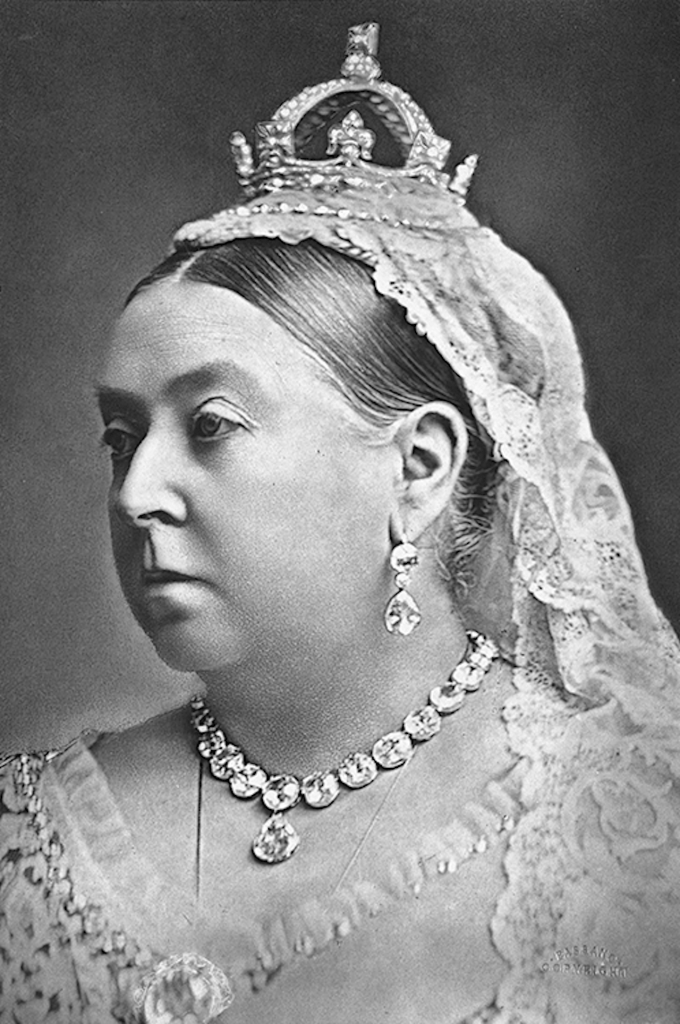
Image: Queen Victoria – National Portrait Gallery, London
Ella Wheeler Wilcox’s “The Queen’s Last Ride”
As the subtitle to the elegy reveals, the poet composed her poem “The Queen’s Last Ride” on the day of Queen Victoria’s funeral on February 2, 1901. The poem retains it special status and a tribute to the queen, whose reign influenced an era.
Introduction and Text of “The Queen’s Last Ride”
With its colorful imagery and a strict formal tone, Ella Wheeler Wilcox’s elegy “The Queen’s Last Ride” reveals the serious nature of the occasion.
The poem furthermore presents clearly the results of the speaker’s having mused on the themes of mortality, a royal legacy, and spiritual transcendence from the physical level of being to the astral level of being.
The Queen’s Last Ride
(Written on the day of Queen Victoria’s funeral)
The Queen is taking a drive to-day,
They have hung with purple the carriage-way,
They have dressed with purple the royal track
Where the Queen goes forth and never comes back.
Let no man labour as she goes by
On her last appearance to mortal eye:
With heads uncovered let all men wait
For the Queen to pass, in her regal state.
Army and Navy shall lead the way
For that wonderful coach of the Queen’s to-day.
Kings and Princes and Lords of the land
Shall ride behind her, a humble band;
And over the city and over the world
Shall the Flags of all Nations be half-mast-furled,
For the silent lady of royal birth
Who is riding away from the Courts of earth,
Riding away from the world’s unrest
To a mystical goal, on a secret quest.
Though in royal splendour she drives through town,
Her robes are simple, she wears no crown:
And yet she wears one, for, widowed no more,
She is crowned with the love that has gone before,
And crowned with the love she has left behind
In the hidden depths of each mourner’s mind.
Bow low your heads—lift your hearts on high—
The Queen in silence is driving by!
Reading of “The Queen’s Last Ride”
Commentary on “The Queen’s Last Ride”
On the same day as Queen Victoria’s funeral on February 2, 1901,Ella Wheeler Wilcox composed her most famous and likely most ambitious poem “The Queen’s Last Ride.” The poem is an elegy for the queen’s funeral procession, commingling sentiments of reverence as well as spirituality.
Stanza 1: A Metaphoric Drive
They have hung with purple the carriage-way,
They have dressed with purple the royal track
Where the Queen goes forth and never comes back.
The first stanza introduces the poem’s main metaphor: the queen’s funeral procession is portrayed as a “drive,” a term which lightens the formal nature of a royal, state funeral, while it grants the occasion an intimate, personal tone.
The repetition of “purple” in “They have hung with purple the carriage-way” and “They have dressed with purple the royal track” implies the color’s two-fold importance as a symbol of royalty and also as a symbol of spirituality [1].
In Victorian England, the color of purple was used to symbolize royal dignity [2]; that hue was often in evidence in ceremonies to signal authority but also to show reverence.
The color’s distinction in this poem emphasizes the grave and serious nature of the occasion; it utterly transforms the physical, earthly path of the procession into a symbolic “royal track” that leads to an eternal destination. The implication corresponds to the poem’s spiritual undertones.
The phrase “Where the Queen goes forth and never comes back” heralds the theme of finality, signaling that death remains an inevitable departure. The word “never” rings in a stark closure, which contrasts mightily with the gentleness suggested by use of the term “drive”; thus a balance of tenderness and inevitability is accomplished.
The speaker’s employment of the present tense—”The Queen is taking a drive to-day”—creates a feel of immediacy, connecting the poem to the historical moment of February 2, 1901, when the queen’s funeral procession actually took place [3].
This time-stamped anchoring invites readers to join and observe the event as it is occurring; this invitation encourages a shared sense of mourning. The stanza’s meter and rime scheme (AABB) parallels the orderly movement of the funeral procession, as it emphasizes the ceremonial tone.
Furthermore, the actions stated by “They have hung” and “They have dressed” suggest a shared effort. It is thus implied that the nation—or even the world—is, in fact, participating in arranging this sacred path.
That shared agency sets the stage for the poem’s broader exploration of shared grief and reverence; such common sharing places the queen’s act of leaving her physical encasement (death) as a special moment of world-wide importance.
The imagery of the “carriage-way” and “royal track” further reveals the Victorian fascination with ceremonial processions [4] as well as other public events.
Funerals of high-ranking official were very carefully orchestrated events; they were intended to mirror the social order of the community [5]. Wilcox’s speaker’s use of language clearly communicates the Victorian cultural customs.
Such subtle linguistic performance is responsible for transforming the physical route of funeral procession into a metaphorical, even metaphysical, journey from the earthly to the spiritual level of being.
Finally, this stanza sets forth the poem’s somber tone while firmly grounding it in the cultural and historical state of Queen Victoria’s unusually long occupation of the throne, which ran through six decades (63 years and 7 months, from June 20, 1837, to her death on January 22, 1901) and left an enduring influence on British identity.
Stanza 2: Setting Laboring Duties Aside
Let no man labour as she goes by
On her last appearance to mortal eye:
With heads uncovered let all men wait
For the Queen to pass, in her regal state.
The second stanza moves from description to command: it calls for the ceasing of labor and the displaying of respect. No one should be giving attention to anything else as the queen passes by for the last time.
This command demonstrates the Victorian era’s stress on decorum, especially during moments of national mourning. The laying aside of work was a common practice during royal funerals. The cessation of labor and other everyday duties was for demonstrating a community pause for the purpose of honoring the deceased.
The speaker’s command to stand with “heads uncovered” calls forth a traditional gesture of respect. This custom became deeply ensconced in British customs of removing any head gear in the presence of royalty or during solemn occasions.
This act of removing headgear also carries a democratic undertone, which suggests that all men, regardless of class, remain united in moments of homage.
The phrase “last appearance to mortal eye” deepens the poem’s musing on mortality; such musing frames death as a leaving off of human sense awareness.
The word “mortal” emphasizes the Queen’s humanness, an act that strips away her royal status to concentrate on her shared vulnerability with all other member of humanity.
This universal gesture is representative of Wilcoxian poetry in general, which often explores themes of human connection and spiritual continuity. The stanza’s imperative tone—”Let no man labour” and “let all men wait”—creates a sense of common obligation, inviting readers to join in the ritual of mourning.
The regular rime and meter continue to parallel the orderly nature of the procession, while the repetition of “let” reinforces the speaker’s authority in guiding the reader’s response.
The second stanza also subtly critiques the busyness of modern life, a growing concern in Victorian literary arts. By calling for a pause in labor, the speaker elevates the queen’s passing above the everyday concerns of life, placing it as a moment of profound importance.
The phrase “her regal state” reinforces Victoria’s continued majesty, even in death, while the act of waiting suggests a open space between life and death, where the living honor those who have left their physical encasements.
This stanza thus serves as both a call to action and as a musing on the cultural practices that guided Victorian responses to death, particularly for a queen whose reign set the boundaries of an era.
Stanza 3: A World-Wide Tribute
Army and Navy shall lead the way
For that wonderful coach of the Queen’s to-day.
Kings and Princes and Lords of the land
Shall ride behind her, a humble band;
And over the city and over the world
Shall the Flags of all Nations be half-mast-furled,
For the silent lady of royal birth
Who is riding away from the Courts of earth,
Riding away from the world’s unrest
To a mystical goal, on a secret quest.
The third stanza expands the poem’s reach to a world-wide scale; it depicts a grand procession led by the “Army and Navy,” followed by “Kings and Princes and Lords of the land.”
This imagery accurately portrays the historical reality of Queen Victoria’s funeral, which was a carefully orchestrated event, attended by foreign dignitaries, including other European royalty, and further punctuated with military honors.
Victoria’s rôle as the “grandmother (or godmother) of Europe” [6], with family ties to many royal houses, transformed her funeral as a diplomatic as well as a ceremonial occasion.
The speaker’s introduction of “Kings and Princes” emphasizes the international extent of her influence, while at the same time portraying the Queen as a unifying figure whose impact had been felt beyond national borders.
The image of “Flags of all Nations” at half-mast further emphasizes the international impact of Victoria’s death. The half-mast flag, a world-wide symbol of mourning, reveals the widespread grief that accompanied the end of her reign, which correlated with the height of British imperial power.
The speaker’s claim of “all Nations” suggests the joint act of homage, which reinforces the queen’s rôle as a symbol of stability in an era of rapid expansion of colonies and often uncertain international alliances.
The stanza’s language, with its expansive scope and formal diction, parallels the grandeur of the funeral itself, which was formal display of imperial power as well as national unity.
The latter half of the stanza introduces a spiritual element, as it describes the queen as a “silent lady of royal birth” who is “riding away from the Courts of earth” to a “mystical goal, on a secret quest.”
This move from earthly to astral realms corresponds to the Victorian interest in spirituality and the afterlife, a theme that can be observed in tWilcox’ oeuvre as well.
The word “silent” invokes both the solemn nature of the funeral and the ineffable nature of death, while “mystical goal” and “secret quest” suggest a transcendental purpose beyond human understanding.
These phrases subtly suffuse the queen’s final journey with an element of divine mystery, which places her death as a possible passage to a higher plane of existence. The stanza thus melds the specifics of history with universal themes, which reflects both the public exhibition of the funeral and the private, spiritual implications for immortality.
Stanza 4: Emphasizing Simplicity
Though in royal splendour she drives through town,
Her robes are simple, she wears no crown:
And yet she wears one, for, widowed no more,
She is crowned with the love that has gone before,
And crowned with the love she has left behind
In the hidden depths of each mourner’s mind.
The fourth stanza juxtaposes the queen’s “royal splendour” with her simplicity, noting that “Her robes are simple, she wears no crown.” (Note the use of the British spelling “splendour.”)
This contrast furthermore demonstrates the historical portrayal of Victoria in her later years, especially after the death of her husband (consort) Prince Albert of Saxe-Coburg and Gotha in 1861, at which time she adopted a subdued public image; she often publicly appeared n simple black attire [7].
The speaker’s stress on simplicity humanizes the queen and signals that she remained humble. Humility was a Victorian ideal, especially in the facing of death. However, the speaker reimagines the crown by portraying it as a metaphorical one, “crowned with the love that has gone before” and “crowned with the love she has left behind.”
This two-fold crowning advances Victoria’s legacy well beyond any material wealth and speeds it on to an enduring emotional and spiritual force.
The reference to “love that has gone before” likely alludes to Prince Albert, whose death profoundly influenced Victoria’s life as all as her reign. The “love she has left behind” reaches to the mourners, who remain carrying love in the “hidden depths of [their] mind.”
This phrase suggests a personal, introspective connection to the queen, emphasizing her rôle as a beloved figure, whose influence continues in shared memory. The imagery of a crown of love elevates the traditional symbol of royalty to a universal emblem of affection and loyalty, which emphasizes the poem’s theme of legacy.
The stanza’s language, with its emphasis on simplicity and emotional depth, reveals the poet’s skill in combining the personal and the public.
The regular rime scheme continues to provide a sense of order, which parallels the structured and controlled nature of the funeral procession, while the shift to metaphorical imagery introduces a more introspective tone.
By focusing on the queen’s emotional legacy, the speaker emphasizes the human dimension of her passing, inviting readers to reflect on their own bond with the monarch.
Final Couplet 5: A Silent Farewell
Bow low your heads—lift your hearts on high—
The Queen in silence is driving by!
The final couplet serves as a touching conclusion, urging readers to bow their heads as in prayer but also to take the occasion into their hearts with great feeling. This duality speaks to the poem’s balance of grief and hope, a distinctive feature of all successful elegiac poetry.
The act of bowing heads signifies humility, respect, and mourning, while lifting hearts suggests a transcendence of earthly, physical plane sorrow, joining with the spiritual undercurrents introduced earlier.
The phrase “The Queen in silence is driving by” reinforces the solemn nature of the moment, with “silence” symbolizing both the reverence of the mourners and the ineffable nature of death. The repetition of “driving” ties back to the first stanza, creating a cyclical structure that simulates the the motion of the procession’s journey.
The stanza’s commanding tone engages readers directly, inviting them to join in the shared act of mourning. This call to action reveals the Victorian practice of community grieving, where public displays of sorrow reinforced social continuity.
The upward gesture of lifting hearts also corresponds to the Christian tenet of resurrection and eternal life, which was cardinal to Victorian commemoration culture.
By concluding with this hopeful note, the speaker transforms the queen’s death into a moment of spiritual upliftment, an act which strongly suggests that her legacy will endure beyond the physical level of being.
Wilcox’s Mastery
Ella Wheeler Wilcox’s “The Queen’s Last Ride” remains a masterful elegy that explores the interaction between public presentation and private grief.
As both a historical, literary artifact and a timeless musing on death, “The Queen’s Last Ride” exemplifies Wilcox’s ability to blend individual emotional depth with public formal elegance, offering a fitting tribute to a queen whose reign influenced the culture and customs of an era.
Sources
[1] Editors. “Exploring Purple Symbolism: From Royalty to Spirituality.” The Symbolism Hub. 2025.
[2] Greg Gillespie. “What Does Purple Mean in the Victorian Era?” Vintage Printable Art. June 23, 2023.
[3] Curators. “Funeral procession of Queen Victoria, February 1901.” Todays History. February 1, 2019.
[4] Herman du Toit, editor. Pageants and Processions: Images and Idiom as Spectacle. Cambridge Scholars Publishing. 2009. pdf.
[5] Curators. “The History of Funeral Processions.” Sunset. April 1, 2024.
[6] Editors. “The ‘Godmother of Europe’: Queen Victoria’s Family Ties across the Continent.” Accessed May 31, 2025.
[7] Liam Doyle. “Royal Heartbreak: Why Did Queen Victoria Wear Black?” Express. September 17, 2020.
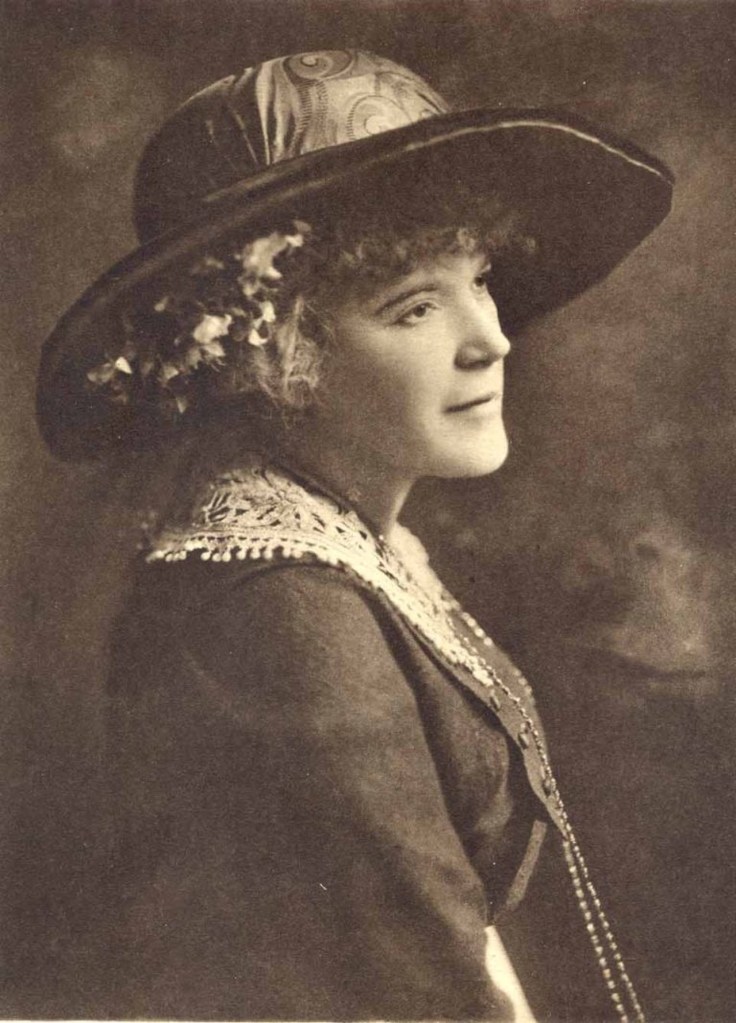
Image: Ella Wheeler Wilcox
🕉
You are welcome to join me on the following social media:
TruthSocial, Locals, Gettr, X, Bluesky, Facebook, Pinterest
🕉
Share
 Linda's Literary Home