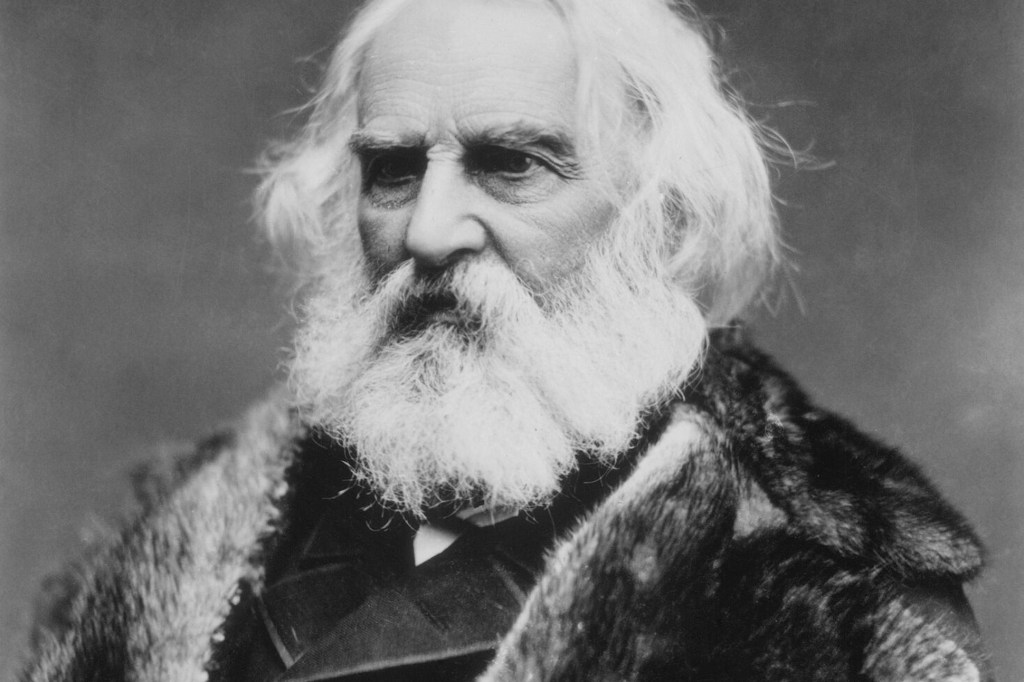
Image: Henry Wadsworth Longfellow
Henry Wadsworth Longfellow’s “Christmas Bells”
Henry Wadsworth Longfellow’s” Christmas Bells” is a widely anthologized poem that celebrates the winter holiday. It features a phrase associated famously with the Christmas season in its chant, “Of peace on earth / Good-will to men.”
Introduction and Text of “Christmas Bells”
Henry Wadsworth Longfellow’s “Christmas Bells” is remarkable not only for its tribute to Christmas but also for its commentary regarding the American Civil War, which was in progress at the time the poet composed this poem on Christmas Day 1864. This poem was published in 1865, and by 1872, it was set to music, becoming a world famous Christmas carol, covered by many singers, including Frank Sinatra.
The poem plays out in seven cinquains, each with the riming scheme, AABBC. It repeats the phrase, “peace on earth, good-will to men,” which has become a widely chanted invocation for world peace.
Christmas Bells
I heard the bells on Christmas Day
Their old, familiar carols play,
And wild and sweet
The words repeat
Of peace on earth, good-will to men!
And thought how, as the day had come,
The belfries of all Christendom
Had rolled along
The unbroken song
Of peace on earth, good-will to men!
Till ringing, singing on its way,
The world revolved from night to day,
A voice, a chime,
A chant sublime
Of peace on earth, good-will to men!
Then from each black, accursed mouth
The cannon thundered in the South,
And with the sound
The carols drowned
Of peace on earth, good-will to men!
It was as if an earthquake rent
The hearth-stones of a continent,
And made forlorn
The households born
Of peace on earth, good-will to men!
And in despair I bowed my head;
“There is no peace on earth,” I said;
“For hate is strong,
And mocks the song
Of peace on earth, good-will to men!”
Then pealed the bells more loud and deep:
“God is not dead, nor doth He sleep;
The Wrong shall fail,
The Right prevail,
With peace on earth, good-will to men.”
Reading with musical accompaniment:
Commentary on “Christmas Bells”
Since its original publication in 1865, the concluding year of the American Civil War, Henry Wadsworth Longfellow’s” Christmas Bells” has enjoyed widespread distribution and attention.
The poem’s refrain, “Of peace on earth / Good-will to men,” has served as an appeal for a common goal, uplifting the minds and hearts of all people the world over. And while the poem’s association with the Christmas holiday is obvious, the sentiment for peace and world-wide goodwill remain regnant throughout the year.
First Cinquain: Ringing in Christmas
I heard the bells on Christmas Day
Their old, familiar carols play,
And wild and sweet
The words repeat
Of peace on earth, good-will to men!
The speaker reports that upon hearing the church bells pealing and the singing of carols in celebration of Christ’s birth, he is reminded of the purpose of Christmas celebration of peace and harmony among the world’s citizens. He avers that the words and sentiment are very well-known to him.
He also reports that those words hold a special place in his heart. The speaker’s tribute thus reveals the nature of the season that had become and still remain one of the most important celebrations of the year, especially in Western culture.
The line—”Of peace on earth, good-will to men!”—becomes the refrain in this poem that may also serve as a hymn. The refrain allows the poem to function as a chant. It has been invoked many times in many places for that purpose since its composition in 1863.
Those important words have also been employed to remind a warring world of the true goal human endeavor, that peace and harmony are ever more desirable than war and chaos.
Second Cinquain: A Reminder of Peace
And thought how, as the day had come,
The belfries of all Christendom
Had rolled along
The unbroken song
Of peace on earth, good-will to men!
Hearing the bells and the caroling also reminds the speaker of the “unbroken song” of Christ’s birth that is celebrated in all places where Christians and others of a spiritual nature acknowledge and love Jesus Christ.
Again, the speaker repeats that all important idea, “Of peace on earth, good-will to men!” The chanted line remains an important feature of this poem for its ability to alter even the speaker’s mood as he continues to describe his reaction to hearing the bells.
For the speaker, the continuation of the celebration of the birth of Jesus Christ as the savior of humankind has informed his remembrance, even as life has progressed and often descended into the chaos that all of humankind would prefer to avoid.
He is writing during the time of war, and thus he desires to achieve peace, but that desire may be contrasted with outward events that hem him round. As he writes his tribute, motivated by the words of sacredness from the carols, he is reminded of calmness and the nature of life as he would have it.
Third Cinquain: Heavenly Sounds
Till ringing, singing on its way,
The world revolved from night to day,
A voice, a chime,
A chant sublime
Of peace on earth, good-will to men!
The sounding of the bells and voices singing Christmas carols continues throughout the day as the day turns into night. The speaker describes the sounds he hears as voices and chimes. He finds those sounds to be heavenly; they remind him of all things sublime. And the chant he has fashioned again closes the cinquain.
The simple chanting of an uncomplicated but seemingly unattainable state of earthly tranquility provides the atmosphere in which a mind may rest, if only for a moment. The necessity of that rest becomes paramount during times of holy day recognition, and the celebration of the birth of Christ offers “Christendom” that opportunity for solemn meditation on the soul.
The speaker throughout his tribute remains intensely focused on the refrain that is chanted, and the peace and goodwill that he is asserting then become part of a prayer.
As he asserts that the words of the carols remind him of sacredness, he yearns to bring about that very situation through concentration on the peace and harmony that such chanting is not only describing but also demanding.
Fourth Cinquain: A Moment of Bleak Melancholy
Then from each black, accursed mouth
The cannon thundered in the South,
And with the sound
The carols drowned
Of peace on earth, good-will to men!
While the speaker is enjoying of the beautiful peeling of the bells and the singing of carols, he enjoyment is suddenly interrupted by a loud, explosive reminder that war is raging.
Symbolizing the war, cannons are loudly reminding the speaker of the unfortunate events that are being played out, especially in the southern part of his country. Those likely metaphoric sounds have intruded into the speaker’s consciousness at a time when he is musing on beautiful qualities that should exist, specially at this time of year.
The loud cannons that “thunder” become a dark cloud, covering the beauty of the carols that proclaim earthly peace and the lovely fellow feeling that should exist among all citizens.
This interlude of remembrance of war contrasts greatly with the opening emphasis on beauty, tranquility, along with peace and goodwill. The stark image of a cannon’s “black, accursed mouth” startles the mind that has heretofore been soothed by the reminders of celebration of spirituality through peace and goodwill.
Fifth Cinquain: Peace Broken by War
It was as if an earthquake rent
The hearth-stones of a continent,
And made forlorn
The households born
Of peace on earth, good-will to men!
Continuing the contrasting stark interlude of war that has pushed its way into the speaker’s awareness, this stanza then likens the war to a different calamity. Thus the narrative moves from the cannons of war to the natural phenomenon of an earthquake that breaks up the very ground beneath the feet of the citizens.
The households seem to be suddenly stripped of the serenity that should be aglow with the peace and harmony for each family. This interlude of melancholy and pain, however, still contains the seeds of hope as the cinquain concludes again with the refrain for peace.
The speaker is aware that too many families have been affected by the war as husbands, wives, sons, daughters, brothers, and sisters have gone off to war to defend what they consider their homeland. This “earthquake” of war has caused a melancholy atmosphere to fall over the citizenry, but the speaker still continues to chant his prayer of yearning for peace and goodwill.
Sixth Cinquain: No Peace—Just Despair and Hatred
And in despair I bowed my head;
“There is no peace on earth,” I said;
“For hate is strong,
And mocks the song
Of peace on earth, good-will to men!”
Into the third stanza also comes the painful interlude of melancholy, which continues to serve as a reminder that this poem is being composed during a time of war. The speaker looks down, bowing his head, feeling desperate for better times.
He bemoans the fact that currently peace does not reign over the land. His country is engaged in a bloody battle for its soul; it is being pulled apart by differences that reflect strong hatred on both sides.
Political differences have spoiled the peace that should be spreading over the landscape and into the hearts and minds of the citizenry, instead of the suffering and chaos that war and hatred are bringing.
Because there is such strong hatred in the world, the song of peace is mocked by the brutality of war, which contrasts so violently with the notion of peace and harmony. Sadly then, the speaker is experiencing a moment of hopelessness that there is no truth in chanting about peace, love, and goodwill.
The contrast between his earlier feeling regarding peace and harmony reflected by his repeated refrain and this painful realization that peace is lacking must have been excruciating for the speaker as he passes through that dark moment brought on by the reality of war raging in his country.
That the speaker is forced to concede, “There is no peace on earth,” remains a painful reminder of the chaos that hatred brings into the lives all people. The very hope that peace can be achieved on earth becomes difficult to maintain in the midst of all the pain and suffering caused by the destruction of weapons and brute force against citizens.
Seventh Cinquain: The Return to Faith and Joy
Then pealed the bells more loud and deep:
“God is not dead, nor doth He sleep;
The Wrong shall fail,
The Right prevail,
With peace on earth, good-will to men.”
Just as suddenly as the melancholy had momentarily overtaken him, the speaker’s mind fortunately returns to its faith that all will be well. The bells’ tone now seems to become even deeper and louder, causing the speaker’s musings to be uplifted.
His heart and mind become filled with the notion that the wrong of the world will be defeated by the right, which will win. The speaker assures himself that God is in control, and that God never abandons His children. The sound of the bells continues to peal in the speaker’s consciousness as they deliver his mood from sadness to hope and faith again.
The speaker then is able to assert with strongest faith, “God is not dead.” He also asserts with assurance, “nor doth He sleep.” The speaker’s faith thus returns him to the knowledge that right will overcome wrong because God is still controlling all events.
The speaker can thus continue emphasizing the sentiment of his controlling refrain. He can again with renewed faith place that emphasis on that refrain that had brightened all the preceding stanzas of his discourse. He can chant again his invocation for peace and goodwill for all his earthly brethren.
Thus, because of the return of his faith in his deep heart’s core, he can proclaim the repeated truth that God still fills the world’s faithful “With peace on earth, good-will to men.”
🕉
You are welcome to join me on the following social media:
TruthSocial, Locals, Gettr, X, Bluesky, Facebook, Pinterest
🕉
Share
 Linda's Literary Home