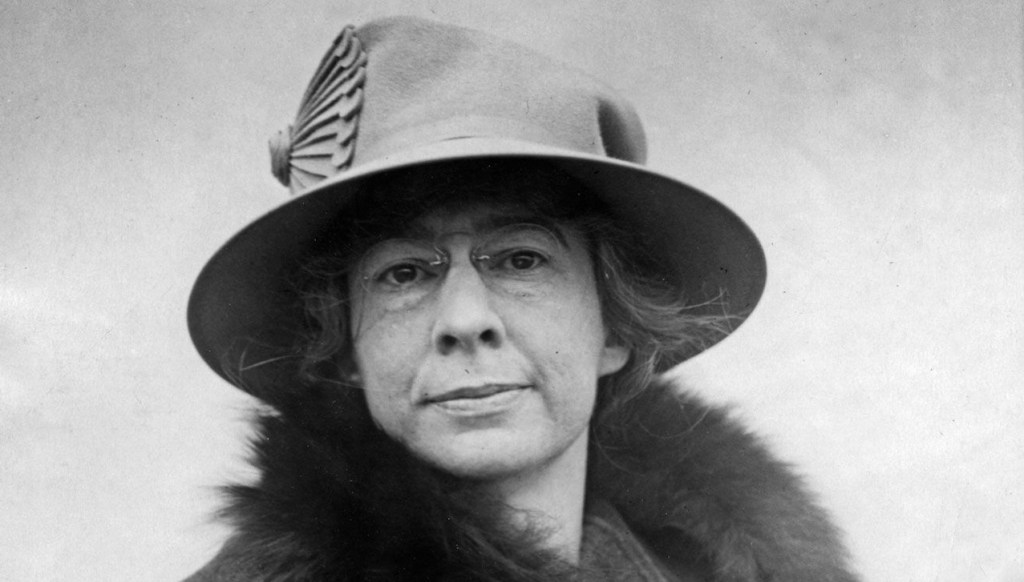
Image: Sara Teasdale Britannica
Sara Teasdale’s “Barter”
Sara Teasdale’s “Barter” is a lyrical musing on the importance and value of beauty, stressing the indispensability of giving oneself up completely to any moment of loveliness that happens to appear before one’s consciousness.
Introduction and Text of “Barter”
Sara Teasdale’s “Barter” was first published in 1917 in her collection titled simply Love Songs. It is likely the poet’s most anthologized poem, for it remains one of her most crystallized expressions on loveliness, self-surrender, and sublimity.
In “Barter,” the poet has created a speaker who professes the belief that beauty is all encompassing in all of its aspects including its presence in nature, or in love between individuals, or in the soul’s quiet musings. To purchase such a rare commodity, one must be willing to pay any price.
Barter
Life has loveliness to sell,
All beautiful and splendid things,
Blue waves whitened on a cliff,
Soaring fire that sways and sings,
And children’s faces looking up
Holding wonder like a cup.
Life has loveliness to sell,
Music like a curve of gold,
Scent of pine trees in the rain,
Eyes that love you, arms that hold,
And for your spirit’s still delight,
Holy thoughts that star the night.
Spend all you have for loveliness,
Buy it and never count the cost;
For one white singing hour of peace
Count many a year of strife well lost,
And for a breath of ecstasy
Give all you have been, or could be.
Commentary on “Barter”
The title “Barter”offers the first hint that the controlling metaphor of the poem will be that of commerce in the marketplace. The speaker then moves from description of worldly things of beauty to exhortation in demanding the audience’s complete surrender in order to acquire that beauty.
First Stanza: What Life Possesses
Life has loveliness to sell,
All beautiful and splendid things,
Blue waves whitened on a cliff,
Soaring fire that sways and sings,
And children’s faces looking up
Holding wonder like a cup.
In the opening line, the speaker establishes the controlling metaphor for the poem: life is similar to a marketplace where its products are myriad forms of beauty. The speaker thus is personifying “Life” as a vendor, who is selling “loveliness.”
The speaker then begins a catalogue of examples of the things that are lovely, that is, they are “[a]ll beautiful and splendid things” such as ocean waves that whiten as they beat up against “a cliff,” fire that soars, sways, and sings, and the faces of little children as they look up in wonderment. The structure of the stanza features a quatrain with the rime scheme ABCB, and the final two lines are a rimed couplet. This structure is repeated in the remaining two stanzas.
Second Stanza: Things of Beauty
Life has loveliness to sell,
Music like a curve of gold,
Scent of pine trees in the rain,
Eyes that love you, arms that hold,
And for your spirit’s still delight,
Holy thoughts that star the night.
Opening the second stanza, the speaker repeats the line “Life has loveliness to sell,” creating a chant-like rhythm and continuing the commerce metaphor. Then again following the same structure, the speaker offers another catalogue of the items for sale that are beautiful.
The four senses of hearing, smell, sight, and touch are represented. For hearing, there is music with its “curve of gold,” suggesting both melody and shape, along with value and warmth; this auditory image melds aesthetic and moral value: music soothes and inspires while gold glitters and is long lasting.
Representing the olfactory image, the “[s]cent of pine trees in the rain” brings to mind a pungent oder, wherein rain further enhances the scent by drawing out the resinous sharpness of the trees.
The sense of sight finds its ocular image in the “[e]yes that love you,” and the tactile image in the “arms that hold.” The human element brings to the poem an aura of intimacy and love, as these two images engage the emotion involved in the human acts of affection and protection.
The final couplet moves from the physical to the spiritual level of existence. The spirit (soul) also is afforded the quality of beauty in this marketplace. “Holy thoughts” offer pleasure to the soul as the stars offer loveliness to the night time sky.
Third Stanza: The Vital Importance of Experiencing Beauty
Spend all you have for loveliness,
Buy it and never count the cost;
For one white singing hour of peace
Count many a year of strife well lost,
And for a breath of ecstasy
Give all you have been, or could be.
In the final stanza, the speaker moves from announcement and description to a direct command. Replacing the incantatory “Life has loveliness to sell” is the command to spend all that you possess in order to purchase this commodity called “loveliness.” Further commanding, the speaker insists that her listeners continue to purchase and give no thought as to how much is the price.
Conjoining color, sound, and time, the speaker commands her listeners to find it prudent to have lost “many a year of strife” for acquiring the amazing experience of “one white singing hour of peace.”
In the final couplet, the speaker presses forth her most intense commanding statement: for even a moment of the highest bliss, give up yourself entirely, including all you have been and all you could ever be. For this speaker the importance of experiencing even a brief moment of joyful beauty is worth all one can sacrifice.
Such a suggestion implies that the speaker believes that most beauty is lost through the human acts of non-observation and non-involvement with the things of this world that are indeed lovely if one looks with seeing eyes and an open loving heart.
🕉
You are welcome to join me on the following social media:
TruthSocial, Locals, Gettr, X, Bluesky, Facebook, Pinterest
🕉
Share

Full Image: Sara Teasdale Britannica

