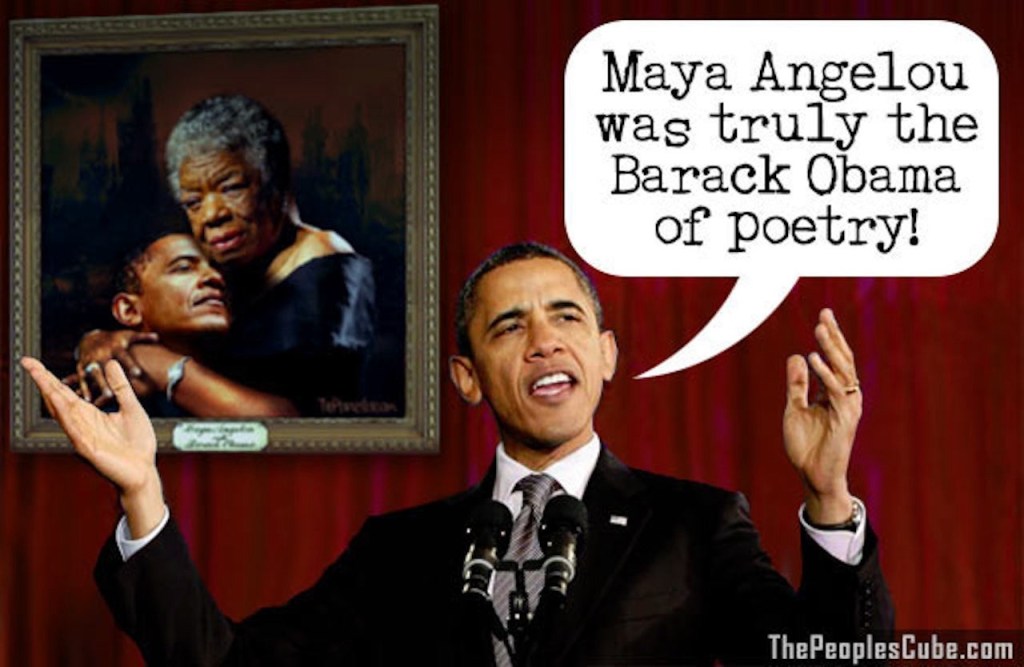
Image: Two Sacred Cows
Dr. Maya Angelou: Sacred Cow of Po-Biz
The late Maya Angelou was a poetaster, who also dabbled in the writing of essays, songs, and plays. She made her way from sex-worker to professor to world-wide, belovèd po-biz star on little writing talent. She possessed abundant quantities of the gift of gab and the skill to schmooze.
Wearing Many Hats
Critic Helen Razer [1] has said of Maya Angelou’s verse scribblings: “I won’t effectively urge you to critically read her poems, which are almost uniformly shit.” Razer still offered a certain level of praise for Angelou’s social activism.
Maya Angelou’s status as a sacred cow——i.e., one who is undeservedly immune to criticism——prevents most criticism, even the mildest form, from being leveled against this po-biz personality. Such critics often pay the price for criticizing these sacred cows.
Other more generous commentators have dubbed the former “madam” [2] a “renaissance woman” [3] for all of her so-called accomplishments such as poet(aster), essayist, songwriter, playwright, editor, actor, dancer, director, historian, and professor.
Included in Dr. Maya Angelou’s long list of professions is, indeed, the one considered the oldest profession; she worked as both a prostitute and a madam.
In her 1974 memoir, Gather Together in My Name, the former sex worker details her stint in that field of endeavor.
Angelou was also not shy about weighing in on politics: she was a “communist sympathizer” [4] and strong supporter of Cuba’s murdering dictator Fidel Castro.
Joining such luminaries as Louis Farrakhan and the Nation of Islam and the activists seeking release from prison the cop-killer Mumia Abu-Jamal, she supported many radical causes in the name of civil rights.
As Dr. Maya Angelou’s sycophants seek to elevate her as a renaissance women, the more clear-eyed critics realize she was little more than a “jack of all trades, master of none.”
The late poetaster dabbled in the writing of essays, songs, and plays in addition to verse.
After dipping into numerous professions of editor, dancer, director, actor, she was nominated for an Emmy award for her performance in Alex Haley’s Roots.
And she clawed her way from the degrading world of prostitution to become a world-wide, belovèd star, on little talent other than the gift of gab and the penchant for schmooze.
The Bogus Professor
When Dr. Maya Angelou was not traveling and delivering speeches, she occupied the Reynolds Professor of American Studies at Wake Forest University, where she “taught” beginning in 1981.
Hardly qualifying as a “professor,” Angelou taught only one course per semester, and students have reported that she occupied no office on campus.
According to John Meroney’s “The Real Maya Angelou” [5],”The office listed for her in the Wake Forest telephone directory is a storage closet in a building far from the main part of campus.”
Before the site finally eliminated her from its inclusion, her rating on “Rate My Professors” boasted a measly 2.6 on a 5-pont scale.”
One student had commented about the good Dr.’s teaching ability:
Arrogant, spiteful, rude, boring – and possessing a thoroughly mediocre intellect. The only thing that humanizes her is the suspicion that her incessant bullying stems from an awareness of just what a fraud she is. [6]
Star-struck Margaret Feinberg writes a glowing memory of an Angelou class, yet at the same time reveals the poverty of Angelou’s teaching style [7]; the phony professor spent the first three weeks of a semester having the students learn one anothers’ names!
Angelou was awarded numerous honorary doctorates, and she took full advantage of them, even calling herself “Dr.” Maya Angelou, an unearned title. According to Mark Oppenheimer, writer and podcast host,
. . . throughout academia, it is agreed that an honorary doctorate does not entitle one to call oneself “Dr.” The media generally agrees, and a good thing too. [8]
Marguerite Ann Johnson aka “Dr. Maya Angelou” did not earn a doctoral degree. Actually, she never even earned a bachelors or masters degree, having never attended college at all.
Of course, Ms Angelou has the last laugh on her critics regarding her lack of academic acumen: although she occupied no academic office space, she now boasts a residence hall standing in her name: Maya Angelou Hall! [9]
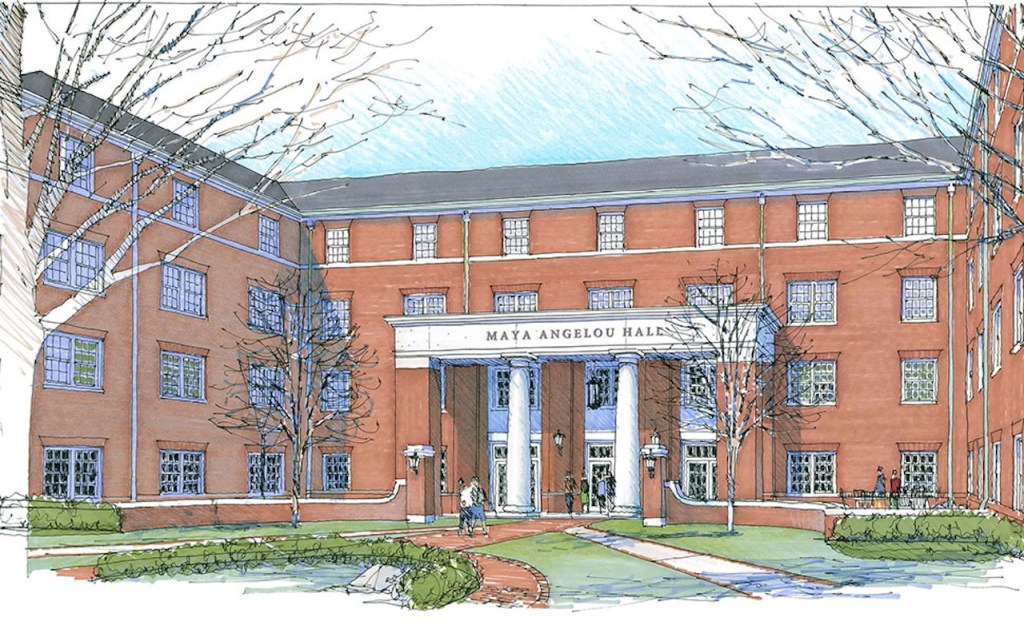
Image: Maya Angelou Hall – Wake Forest News
Since 2002, The “Maya Angelou Center for Health Equity” [10] has been studying the “racial and ethnic disparities in health care and health outcomes.”
Also in Angelou’s name was created the “Maya Angelou Presidential Chair” at Wake Forest, currently occupied [11] by race-baiter extremist Melissa Harris-Perry [12].
Sadly, Harris-Perry’s ranting is what currently passes for education in many of today’s universities [13], but on the bright side, note that MSNBC did have the good sense to fire her from her news anchor position.
Other Gigs
Dr. Maya Angelou teamed up with Target and the Poetry Foundation to create a project that introduces children and adults to poetry. The project is called “Dream in Color.”
Few individuals have exploited the color of their skin to the degree that the former Marguerite-Johnson-turned-Maya-Angelou did.
However, it is likely that Angelou’s best gig, the one formidably suited for her level of talent, was her stint with Hallmark Greeting cards [14].
Two samples of the drivel she created for Hallmark: “The wise woman wishes to be no one’s enemy, the wise woman refuses to be anyone’s victim” and “Life is a glorious banquet, a limitless and delicious buffet.”
A Childhood Trauma
Maya Angelou was born Marguerite Ann Johnson [15] in St. Louis on April 4, 1928. At age seven, she was raped by her mother’s boyfriend.
She confided this information only to her brother, but later she learned that one of her uncles had killed the man who raped her.
She claims melodramatically that fearing that her words had killed a man, she refused to speak and did not utter a word until she reached age thirteen.
She periodically lived with her mother and grandmother, who introduced her to literature.
Leaving high school for a short period, she became a cable car conductor in San Francisco. She returned to high school, and then she gave birth to a son a few weeks after graduation.
Although her life was difficult, she never gave up on her interests in the arts, dancing, and writing.
Marguerite Johnson Becomes Maya Angelou
After marrying Tosh Angelos, a Greek sailor, she got a job as a nightclub singer. She changed her name from Marguerite to Maya and altered the Angelos to Angelou and became “Maya Angelou” (pronounced “angelō” not “angeloo.”)
Angelou toured Europe with a production company, studied dance with Martha Graham, and released an album titled Calypso Lady in 1957.
Her interest in writing became strong, and she moved to New York, where she joined a Harlem writing group. She continued acting in off Broadway plays.
Years Abroad
In 1960, Maya Angelou met and married South African civil rights activist Vusumzi Make; the couple relocated to Cairo, Egypt, where Angelou worked as editor of the English language weekly paper The Arab Observer.
After this marriage dissolved, Angelou and her son moved to Ghana, where she worked as a music instructor at the University of Ghana; she also served as an editor at The African Review, while writing for The Ghanaian Times.
Returning to America
After Angelou returned to America in 1964, she began her writing career in earnest, producing I Know Why the Caged Bird Sings, her first autobiography, which was published in 1970.
This first autobiography gave Angelou national recognition. In all, Angelou penned seven autobiographies.
Angelou also wrote a book of essays titled, Letter to my Daughter, despite the fact that she had no daughters. Angelou’s play Georgia, Georgia was nominated for a Pulitzer Prize in 1972.
Presidential Appointments
President Gerald Ford appointed Maya Angelou to serve on the American Revolution Bicentennial Commission.
For President Jimmy Carter, she served on the Presidential Commission for the International Year of the Woman.
At President Bill Clinton’s inauguration, she read her poem, “On the Pulse of the Morning.”
Most Noted Poetic Attempt: “Phenomenal Woman”
One of Angelou’s most famous pieces is “Phenomenal Woman.” This piece is quite accessible, as are all of her poems.
Angelou’s mystique is in her ability to perform many tasks and perform them well enough to make many people believe she is in fact a phenomenal woman, instead of simply an accomplished borderline grifter.
A Self-Invention: Famous for Being Famous
Angelou has explained that she decided to invent herself because she did not like the inventions that others had invented for her.
She was six feet tall, making her physically imposing. Angelou’s main talent was indeed in making a silk purse out of a sow’s ear——no small feat.
Despite her lack of true talent in any of her chosen fields of dabbling, she managed to gain recognition in many of them.
As some accomplishment-free yet widely celebrated folks like the Kardashians and Zsa Zsa Gabor are famous for being famous, Maya Angelou was noted for being noted.
Angelou did have the ability to make people notice her, but even more sweet for her was her ability to make herself seem accomplished when, in fact, her talent was mediocre at best.
Exposing a Sacred Cow
As a sacred cow of po-biz, Dr. Maya Angelou still benefits from an undeserved status.
Most scholars and critics shy away from pointing out the obvious about Ms. Angelou——that her talent as a writer, especially a poet, was meager at best, totally lacking at worst.
However, there are those brave commentators who ask the question, “Is it time yet to talk honestly about Maya Angelou?,” and then proceed to make that attempt.
Thus, the editor and co-founder at American Thinker Thomas Lifson [16] has begun the honest talk with the following:
There is an important phenomenon in cultural life that the hard left has exploited for many decades.
Most people cannot really tell what good poetry, or painting, or serious theatre (or artsy film, for that matter) is, but they fear looking stupid if they fail to appreciate what others say is good.
So, an “artist” in these semi-esoteric fields who is helped along by a claque of politically sympathetic cheerleaders in academia or journalism can become “widely acclaimed” and, if he or she plays the part well (as Angelou did), even “beloved.”
Still, the fact that Marguerite Johnson could transform her life in such a gigantic, flamboyant manner into the highly successful “Dr. Maya Angelou” on such little poetic talent speaks volumes for the grit and tenacity the woman possessed.
That feat may be something to be begrudgingly admired, even if not emulated.
Sources
[1] Helen Razer. “”The Awfully Good Activism and Terribly Bad Poetry of Maya Angelou.” Daily Review. August 15, 2016.
[2] Mikaela Lefrak. “8 Things You Might Not Have Known About Maya Angelou.” Boston.com. May 28, 2014.
[3] Editors. “Renaissance Woman Maya Angelou.” PBS. September 7, 2013.
[4] Mo Brooks. “‘Communist Sympathizer’ Maya Angelou Doesn’t Deserve Post Office Honor.” Al.com. Update: March 7, 2019. Original: March 2, 2016.
[5] John Meroney. “The Real Maya Angelou,” The American Spectator. March 1993. Via The Unz Review.
[6] Contributor. “Maya Angelou’s Ratings on ‘RateMyProfessor.com’.” reddit. Accessed May 4, 2023.
[7] Margaret Feinberg. “How Maya Angelou’s Class Changed My Life.” Margaret. May 4, 2023.
[8] Mark Oppenheimer. “Why Do People Call Ms. Maya Angelou ‘Dr. Maya Angelou’?” The New Republic. May 29, 2014.
[9] Curators. “New Residence Hall Named for Maya Angelou.” Wake Forest News. November 18, 2016.
[10] Curators. “Maya Angelou Center for Health Equity.” Wake Forests University School of Medicine. Accessed May 4, 2023.
[11] Melissa Harris-Perry. “Professor.” Melissa Harris-Perry’s Official Website. Accessed May 4, 2023.
[12] Tom S. Elliott. “Montage: Ten Reasons MSNBC Should Have Fired Harris-Perry before Now.” National Review. February 29, 2016.
[13] Warren Treadgold. “The Sad State of Higher Education.” Minding the Campus, Inc. July 26, 2018.
[14] Jeannie Williams. “Maya Angelou Pens Her Sentitiments for Hallmark.” USA Today. January 10, 2002.
[15] Kelly A. Spring. “Maya Angelou.” National Women’s History Museum. Updated December 2021 by Mariana Brandman.
[16] Thomas Lifson. “Is it Time yet to Talk Honestly about Maya Angelou? ” American Thinker. May 30, 2014.
🕉
You are welcome to join me on the following social media:
TruthSocial, Locals, Gettr, X, Bluesky, Facebook, Pinterest
🕉
Share
 Linda's Literary Home