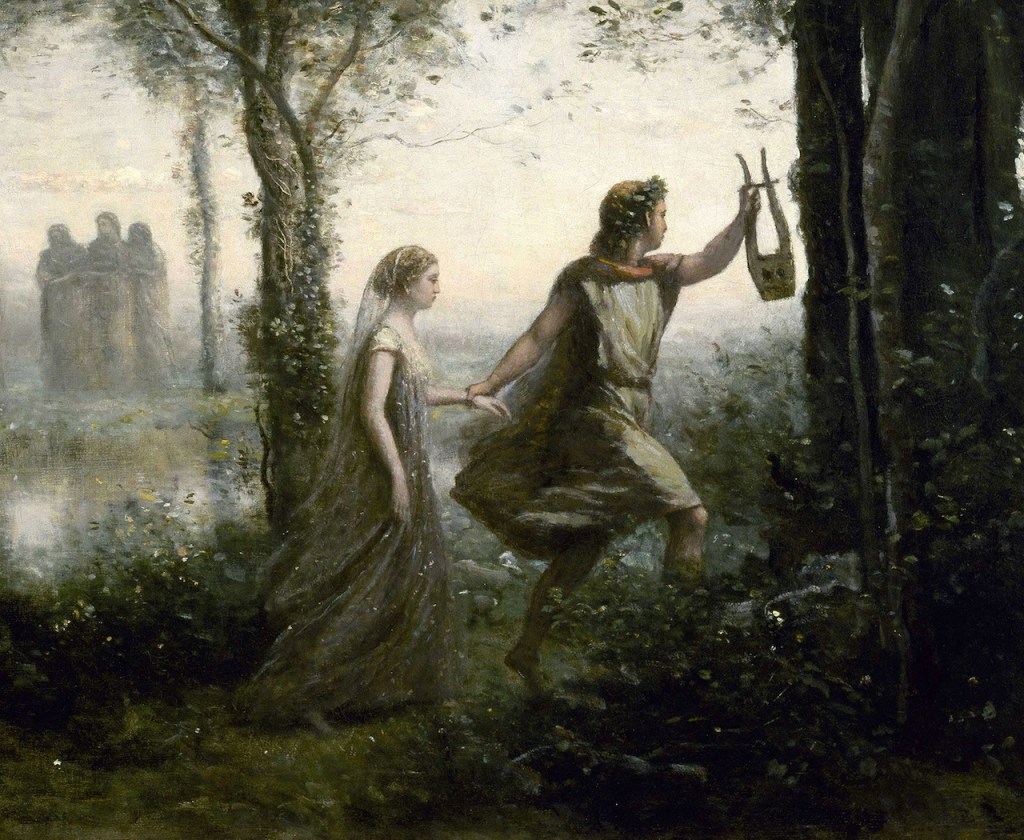
Image: Orpheus Leading Eurydice from the Underworld
Misreading the Orpheus and Eurydice Myth: Feminist Ideology and the Corruption of Mythic Meaning
Misunderstanding myth is a widespread phenomenon: the very definition of the term “myth” is trivialized in modern parlance, as anything from an error to a lie is often called a myth. The term myth refers to stories with universal, spiritual appeal to the heart, mind, and soul of humankind.
The current motivation to “correct” the past has become one of the more persistent urges in contemporary literary studies. This tendency is visible in the modern attempts to rewrite classical myth, from which ancient figures are called forth, not to unveil perennial truth but to recite the slogans of contemporary feminist ideology.
The myth of Orpheus and Eurydice has suffered significantly from this modernizing impulse in the hands of Margaret Atwood and Carol Ann Duffy. The myth’s spiritual drama—the soul’s yearning for transcendence and the unfortunate failure of faith—has been “corrected” by turning it into a patriarchal battle between man and woman.
Atwood and Duffy
In Atwood’s “Eurydice,” from Interlunar (1984), and Duffy’s “Eurydice,” from The World’s Wife (1999), Eurydice has become a cynical voice for liberation, mocking Orpheus as the stereotype of the egotistical male artist. Duffy’s Eurydice calls the musician/poet “Big O” and accuses him of valuing his own legend above his loved one’s life.
Both Atwood and Duffy applaud Eurydice for slipping through her husband’s grasp as he looks back, disobeying his only command. This understandable failure of Orpheus, which is tragic, is converted into emancipation of his spouse by the simple wave of the feminist wand, levied against the patriarchy.
Yet this politically inspired moral conversion relies upon an act of historical and spiritual blindness. The myth of Orpheus is grounded in the sacred lore, explicating the imagination of antiquity, not to the ideological preoccupations of the current modern social climate.
In its original telling, preserved most completely in Virgil’s Georgics and Ovid’s Metamorphoses, the mythic narrative of Orpheus and Eurydice is not about the sexes but about the soul.
Orpheus remains the quintessential musician/poet; his music/lyrics seeks to restore harmony between life and death as well as between the physical body and the soul. His foray into the Underworld represents the artist’s very vocation: to recover the lost beauty of the world through creative song.
Disobeying a Spiritual Command
The spiritual command not to glance back symbolizes the command of faith: trust in that which cannot be seen with the human eye. His failure as he looks back is not an claim to dominance but the revelation of human weakness facing the enigma of divine perfection. Eurydice’s vanishing does not symbolize an act of resistance; it reveals the soul’s return to the mystery, from which it had only briefly materialized.
The readings of Atwood and Duffy convert the mythic dimension from human emotional truth into the psychology of victimhood. Their Orpheus is not a mystic but a narcissist; their Eurydice is no symbol of the soul but a sarcastic wife in a contemporary petty quarrel. By revising the myth’s value, they turn the story into social allegory and thereby trivialize what they intend to redeem.
They remake the Underworld into a metaphor for patriarchy, and the danger associated with divine disobedience transforms into a parable of female self-assertion. The result remains not only tone-deaf but spiritually hollow. They have thus allowed their gesture of contemporary moralism to masquerade as mythic revision.
Readers can easily understand the appeal for such ministrations. Contemporary literary culture has come to measures significance by the degree of subversion it can produce. To “provide Eurydice a voice” is to score a moral victory for the supposedly oppressed silences of women in the past.
Yet mythic silence is not oppression; it is reverence. Eurydice’s quietness is the silence of mythic spiritual mystery, not the muteness of oppressive victimhood. To convert sacred stillness to irony is to replace contemplation with complaint.
The ancient poets comprehended well the aspects of life and creativity that their modern revisers ignore. Myth does not express itself with grievance language; instead it speaks in the language of the soul. As Orpheus sings, he does not merely effuse emotion; he reorders cosmic energy.
Orpheus’ songs are capable of charming the stones and the trees, not because they answer grievances, but because they call forth balance and harmony between the human and the divine—as does all art, rightly framed.
A Universal Tragedy
The tragedy of Orpheus’ looking back remains universal, not personal. Every human heart and mind, aspiring to attain perfection—self-realization—is required to face the same frailty of faith. Because of this universal mandate, Orpheus’ failure is our own failure: in our fallen state, we cannot help but glance back to what we love, even as love commands us to trust the unseen.
By the empty social moralizing of the myth and sifting it through modern political ideology, poets including Atwood and Duffy abandon the myth’s sacred resonance to the insipid, spiritually dry idiom of politics. They mischaracterize the myth’s silent universality as erasure and mistake its reverence for oppression.
The irony becomes blatantly clear that their “liberated” Eurydice is not free; she remains bound within the suffocating psychology of the age. Her fake, modern voice, though loud with wit, cannot move beyond self-assertion. She may have been granted parole from Hades, but she now finds herself imprisoned in ideology.
The Myth’s Endurance
Thankfully, what endures, however, is not the Atwoodian-Duffian parody of the myth but the myth itself. The songs of Orpheus continue to waft across the centuries because they sing to the immutable condition of the human soul, which longs for what it has lost and suffers as it fails to secure it.
The modern motivation to correct such myths by turning them into moral parables cannot extinguish the ancient fire of their importance. Such trivialization does remind us how some thinkers, influenced by the contemporary postmodernism of radical feminist ideology, only dimly glimpse that light.
Works Cited
Margaret Atwood. “Eurydice.” Interlunar. Oxford University Press, 1984.
Carol Ann Duffy. “Eurydice.” The World’s Wife. Picador, 1999.
Ovid. Metamorphoses. Translated by A. D. Melville. Oxford University Press, 1986.
Virgil. Georgics. Translated by Peter Fallon. Oxford University Press, 2006.
🕉
You are welcome to join me on the following social media:
TruthSocial, Locals, Gettr, X, Bluesky, Facebook, Pinterest
🕉
Share
 Linda's Literary Home