Image: POSTMODERNISM
Poetry and Politics
under the Influence of Postmodernism
Although many dissemblers in both fields of poetry and politics have tainted those fields through pretense and duplicity, a good measure of skepticism, the one valuable tenet of postmodernism, remains a useful asset in genuine literature and authentic statesmanship.
The Basics of Postmodernism
In general, the tenets of postmodernism [1] work against most traditions in Western civilization, including but not limited to tight structure in works of art, received moral tenets, family values and structure, legal imperatives, and attitudes toward subjects such as patriotism, beauty, love, truth, and religion.
This oppositional stance includes viewing the world through a lens of skepticism, and while too often the works produced by those heavily invested in subterfuge seem to be using a rather fogged lens, nevertheless, skepticism has its place in human activity.
The issue regarding whether “truth” exists has suffered greatly within the confines of the postmodernist mind-set, resulting in the notion that “Postmodernist truth [2] is hence that there is no truth.”
A result of this pernicious idea that there is no truth—that all truth is relative—is demonstrated in the following narrative, regarding Oprah Winfrey’s receiving a life-time achievement award at the 75th Golden Globe Awards:
[Winfrey is speaking]: “I want to say that I value the press more than ever before as we try to navigate these complicated times, which brings me to this: What I know for sure is that speaking your truth is the most powerful tool we all have…For too long, women have not been heard or believed if they dared to speak their truth to the power of those men, but their time is up. Their time is up!” [emphasis added]
Winfrey did not say that women were speaking the truth, because in the postmodern world, there is no absolute truth, only narrative. Only “your truth” or “my truth.” As Ben Shapiro recently tweeted, “There is no such thing as ‘your truth.’ There is the truth and your opinion.” [3]
The very claim that “there is no truth” negates itself, as poet and essayist David Solway has explained:
Ironically, the governing canon such postmodern revisionists espouse, namely, the relativity of all truth claims, applies to everything, apparently, but their own absolute insights and pronouncements about the relativity of truth claims. All facts are fictive except their own. [4]
Apparently, even those postmodernists who concocted and spread that notion have remained humble enough not to add the caveat, “except for this statement,” likely already seeing the absurdity of the claim or perhaps remaining blind to its implication.
Postmodern Poetry
Nevertheless, the idea of relativism has taken hold and has wrought havoc in many fields of endeavor, including poetry, which has become a vague shadow of itself, as Anis Shivani’s scatter-shot review [5] of Paul Hoover’s Postmodern American Poetry: A Norton Anthology demonstrates.
Examples of the folly, dreck, and gloom that postmodernist poets have inflicted upon contemporary literary canon can be seen in the works of Robert Bly, Adrienne Rich,Charles Bernstein, Barbara Guest,Charles Simic, and many others.
Often the works of art produced through the fog of nihilism result in disjoined imagery which never coalesces around meaning. Many postmodernist poets have succumbed to the notion that they can spew anything forth in broken lines and have it accepted as “poetry.” Often even without a system of thought which the basic skepticism of postmodernism should supply, these postmods have perpetrated a fraud upon the reading public.
If a poet does not attempt to write something that makes sense even to herself, she should not expect her works to be admired by others. Unfortunately, too many so-called poets have allowed themselves to be lured by that method. Yet others have simply accepted revisionist versions of history and fallen for the idea of victimhood, categorized by the politics of identity.
A Notable Exception
Although Allen Ginsberg’s poem “Howl” stands at the beginning of the postmodernist era in America, the piece has stood the test of time as holding value for literary studies.
Ginsberg’s poem, whose style is loosely based on that of Walt Whitman’s Leaves of Grass, provides a view of American life that informs that portion of society that would never consider taking the trips of a Ginsberg or a Kerouac.
Regardless of whether one agrees with or appreciates a work of art or not, that art’s message can be useful. Even if a work displays nonsense or spews nihilism, immorality, or naïveté, art consumers are entitled to experience such a piece and should be allowed to determine their own thoughts and feelings about the work.
While poetry’s main function is not for reporting facts and information, poems do include facts as they focus mainly on expressing human experience of emotion and feeling. Despite Ginsberg’s focus on debauchery and degradation, his poem’s reportage of certain facts can remain useful in comprehending the milieu in which Ginsberg and his ilk operated.
The Curse of Censorship
If poets are cowed by the possibility that misreadings of their poems may arise and thus they allow that possibility to influence what they write, they are permitting themselves to be censured and censored. No form of censorship should be condoned—even those poets, whose works are not admirable such as Bly, Glück, and Rich, must be permitted a hearing. Honest, heartfelt claptrap is better than timorous, duplicitous flattery.
However, readers should always vehemently speak out against senseless blather, filled with nihilistic whining and blaming others for perceived victimhood. Further response to such unsatisfying texts is preferable to attempting to cancel what one does not admire or censor that with which one does not agree. Regarding censorship, John Stuart Mill in his essay, “On Liberty,” has averred,
the peculiar evil of silencing the expression of an opinion is, that it is robbing the human race; posterity as well as the existing generation; those who dis- sent from the opinion, still more than those who hold it. If the opinion is right, they are deprived of the opportunity of exchanging error for truth: if wrong, they lose, what is almost as great a benefit, the clearer perception and livelier impression of truth, produced by its collision with error. [6]
Capitalizing on this same line of thinking, Justice Louis Brandeis composed the Counterspeech Doctrine [7] in which he declared, “If there be time to expose through discussion, the falsehoods and fallacies, to avert the evil by the processes of education, the remedy to be applied is more speech, not enforced silence” [7].
Image: Squiggly Lines Statement Postmodern
Postmodern Politics
Under the vacuous influence of postmodern thought, poetry has become devalued and under-appreciated, and the same emptiness and misdirection can be detected in the arena of politics. The once respected status of statesmanship, which originally intended to represent only temporary service [8] to the nation through elected government posts, has too often degenerated into a career of influence-peddling.
This degradation of statesmanship has its greatest example in the Biden family, as nationally acclaimed Professor Jonathan Turley [9] and the research of esteemed journalist Miranda Devine [10] so thoroughly demonstrate. Victor Davis Hanson offers a useful overview and introduction to the issue of political postmodernism:
All presidents have, at one time or another, fudged on the truth. Most politicians pad their résumés and airbrush away their sins. But what is new about political lying is the present notion that lies are not necessarily lies anymore — a reflection of the relativism that infects our entire culture.
Postmodernism (the cultural fad “after modernism”) went well beyond questioning norms and rules. It attacked the very idea of having any rules at all. Postmodernist relativists claimed that things like “truth” were mere fictions to preserve elite privilege. Unfortunately, bad ideas like that have a habit of poisoning an entire society — and now they have. [11]
The postmodern mind-set, touting relativism often surrenders to abject hypocrisy. Within the political arena [12], certain issues must be revisited from time to time as the society changes—for example, the institution of slavery, women’s suffrage, and same-sex experience. Care should be taken not to judge unfairly the good just because it is not perfect.
Perfection in an imperfect world remains a fantasy—something most school children learn, or used to learn, by the end of grade school. In their expectation and pursuit of the “perfect,” many postmods have indulged in the melancholy of nihilism [13], seeking to abolish certain societal strictures. Their wishlists for proper behavior are too often based only on personal preference.
Such illogical thought leads only to more melancholy and ultimately to the chaos of anarchy through which no organized society can exist. Politicians who engage in the extreme tenets of relativism do so in order to pander to influence groups for the purpose of securing votes, not of serving their constituents’ actual needs.
The poet and essayist David Solway has observed and written extensively about the threats of relativism and how those threats undermine the values attained and held within the Judeo-Christian ethic, vital to the continued strength of Western civilization. Individual rights including free speech, freedom of religion, freedom of peaceable assembly, guaranteed by the US Constitution and Declaration of Independence hold little to no sway under the auspices of relativism.
Furthermore, turned on their heads as they are thought of as “sub-cultural attitudes or culture-specific assumptions” are such issues as gender equality, traditional matrimony, habeas corpus, and even the basic rule of law. Relativism assumes that the forces that govern a civilized society do not necessarily apply to all people. Thus, David Solway concludes,
It is this relativistic sentiment that informed President Obama’s Cairo speech. Alluding to the muddy concept of the “will of the people,” Obama deposed that “Each nation gives life to this principle in its own way, grounded in the traditions of its own people.” Barack Obama is America’s first postmodern president.
Postmodern Presidencies: Obama’s Lie of the Year / Biden’s First Lie of His Presidency
President Barack Obama’s tentative relationship with truth also has marked him as “America’s first postmodern president.” His most widely spread prevarication was one of his earliest: “if you like your health plan, you can keep it”—deemed by the left-leaning PolitiFact, “Lie of the Year” [14].
Additionally, Matt Margolis, political commentator for PJMedia, has documented the “29 scandals” [15] of the preposterously touted “scandal-free” Obama administration. Regarding the postmodernism of the current Oval Office occupier, Joe Biden, Julio M. Shilling, political scientist and director of the CubanAmerican Voice, writes that the Biden presidency is being administered more like a “regime” than a “government.”
That the press behaves as an arm of the Democratic Party feeds into this evaluation, as does the fact the private businesses and government have become aligned as in fascist regimes. Thus, Shilling explains,
A regime includes a government but additionally brings with it a set of institutions, laws, rituals, belief systems and a power structure. To merely identify the Biden Administration as simply a government would be flawed. This is a postmodern presidency. [16]
Further discussion regarding the postmodern presidency of the current administration is offered by the Cornell Review’s Joe Silverstein [17]. Silverstein addresses the first lie told by Joe Biden, as the former VP began his campaign for the presidency—his original reason for running for president.
In Biden’s announcement that he would be seeking the nomination for president, the former vice president repeated the vile already debunked claim circulating about his predecessor: “good people on both sides” became the fake rallying cry for Biden and his ilk. Opposition media had spread the lie that President Trump had praised the neo-nazis and white supremacists who clashed with the protesters at the removal of Robert E. Lee’s statue in Charlottesville—now labeled the “Charlottesville Hoax” [18].
When President Donald Trump said there were “good people on both sides,” he was referring to the protestors’ two sides: those who wanted the statue down and those who did not. He was not referring to the extremists white nationalists and neo-nazis who tried to take advantage of the protest to seek publicity. And in that same speech, Trump made that distinction perfectly clear.
Silverstein also points out the prevarication by Biden that his administration “didn’t have the vaccine,” until after he took office. Yet, Biden had already been vaccinated while Trump was still president.
Silverstein explains that academic postmodernism has declaimed on the “no objective reality” notion and that flaw has influenced culture. He avers that the claim that facts can come from bias has led some professors to assert that “math is racist.” Because of such anomalies, Silverstein chides Republican politicos for not engaging and giving an airing to Biden’s claim that “we choose truth over facts” as Biden campaigned in Iowa. Silverstein avers,
By dismissing Biden’s comment as a mere gaffe, they missed an important opportunity to highlight Biden’s allegiance to the ideological far Left. His remarks represented more than a mere verbal slip-up: they demonstrated Biden’s commitment to an ideology hellbent on destroying America.
An Unsavory Collision: Politics and Poetry
Even Joe Biden’s choice of poet to perform at his inaugural ceremony put on display one of the most current fads in postmodern poetry, as the very young spoken-word (Hip-Hop) artist, Amanda Gorman, celebrated her president with a text that can be described only as a word salad, filled with bland, even meaningless platitudes.
True to the sycophantic postmodernist flair for uncritical criticism, Maya King and Nolan D. McCaskill offer their disingenuous appraisal of Gorman and her pedestrian piece in their article on Politico, “The political roots of Amanda Gorman’s genius” [19].
A Caveat
The basic original tenet of informed skepticism can result in useful works. However, because too much of postmodern thought has resulted in fake and fraudulent works, readers must be continually vigilant while experiencing contemporary poetry. Separating the genuine from the disingenuous is necessary to avoid falling prey to literary charlatans. The same vigilance is necessary in vetting politicians who are committed to relativistic truth telling that too often equals blatant lying.
One has to wonder how certain lies can continue with such strength as the “Charlottesville Hoax” proffered by Biden, as he threw his hat in ring to run for president, because what President Trump actually said can so easily be found on the internet. Did Biden not know that Trump said, “I’m not talking about the neo-Nazis and white nationalists because they should be condemned totally.”
Whether Biden knew or not, his deplorable prevarication equals dereliction of duty: if he knew, he blatantly lied; if he did not know, he should have, and that lapse in knowledge places part of the blame on his advisors.
Currently, America now awaits the likely dangerous results arising from the debacle [20] of the American military withdrawal from Afghanistan. As political pundit, Tom Borelli, has averred, “President Biden’s promise that the Taliban will not take over Afghanistan will go down as a huge lie.” With the remaining years of the Biden occupancy of the Oval Office, it is quite likely that many more examples of postmodern political dreck will fill media pages and spotlights.
Relief from Postmodern Denial of Truth
In order to alleviate the disservice done to the culture by a movement based on denying reality and truth, readers, thinkers, citizens from all walks of life, races, and ethnic groups should take it upon themselves to become and remain as informed as possible.
Citizens must engage with ideas by reading and listening to texts from widely different sources, and must do so carefully and closely so they can make the appropriate connections that lead to accurate meaning.
Readers need to look up words, learn the meanings of symbols, and determine whether a text, speech, lecture, or any discourse is primarily literal, figurative, or satiric. Most of all individuals must retain some skepticism, which remains the best and virtually the only positive tenet of the otherwise vile, culture-destroying movement known as postmodernism.
Sources
[1] Editors. “Postmodernism.” Britannica. Accessed August 30, 2021.
[2] Editors. “Postmodernist Truth.” Changing Minds. Accessed August 30, 2021.
[3] Darrow. “The Demise of Truth and Morality.” Darrow Miller and Friends. May 31, 2018.
[4] David Solway. “The Origins of Postmodernitis.” PJMedia. May 25, 2011.
[5] Anis Shivani. “Where Stands Postmodern American Poetry: Is Paul Hoover’s Anthology the Final Word?” HuffPost. June 23, 2016.
[6] John Stuart Mill. “On Liberty.” EE-T Project Portal. Accessed August 31, 2021. PDF file.
[7] David L. Hudson, Jr. “Counterspeech Doctrine.” The First Amendment Encyclopedia. Middle Tennessee State University. Updated December 2017. Originally published 2009.
[8] Chuck Pinkney. “Founders Never Meant Politics to be a Career.” Daily Star August 14, 2012.
[9] Jonathan Turley. “New Emails Raise New Allegations of Influence Peddling By Hunter Biden And Direct Knowledge Of President Biden.” Jonathan Turley. July 2, 2021.
[10] Miranda Devine. The Biden Family Scheme Unravels. The New York Post. April 10, 2022.
[11] Victor Davis Hanson. “The Poison of Postmodern Lying.” National Review. January 30, 2014
[12] Paul Austin Murphy. “Postmodernism Is Leftism.” American Thinker. April 8, 2017.
[13] Ron Rolheiser. “Post-Modern Nihilism.” Ron Rolheiser, OM. February 27, 2000.
[14] Angie Drobnic Holan. “Lie of the Year.” PolitiFact. December 12, 2013.
[15] Paul Bedard. “Obama’s 29 Scandals and the Media’s Campaign to Hide Them.” Washington Examiner. April 16, 2018.
[16] Julio M. Shilling. “A Postmodern Regime.” Am: El American. January 2, 2021.
[17] Joe Silverstein. “Joe Biden’s Presidency Is Built on Lies and Deceit.” The Cornell Review. February 17, 2021.
[18] Steve Cortes. “Trump Didn’t Call Neo-Nazis ‘Fine People.’ Here’s Proof.” RealClearPolitics. March 3, 2019.
[19] Maya King and Nolan D. McCaskill. “The Political Roots of Amanda Gorman’s Genius.” Politico. January 23, 2021.
[20] Tom Borelli. “Biden Lied About Taliban Not Taking Over Afghanistan.” Deneen Borelli: Reigniting Liberty. August 16, 2021.
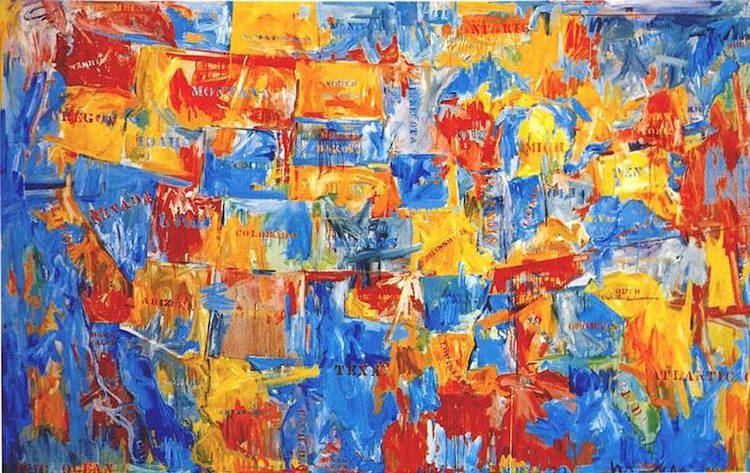
Image: Postmodern Art: US Map
🕉
You are welcome to join me on the following social media:
TruthSocial, Locals, Gettr, X, Bluesky, Facebook, Pinterest
🕉
Share
 Linda's Literary Home