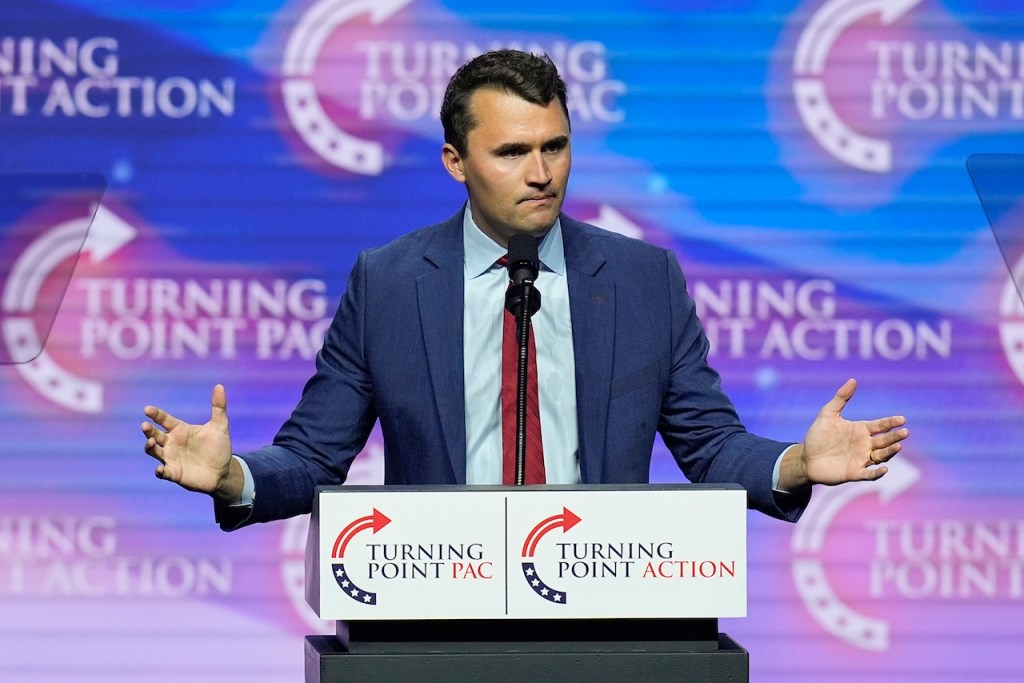
Image: Charlie Kirk
The Charlie Kirk Effect
The late Charles James Kirk, Charlie Kirk, is most noted as the founder of the organization Turning Point USA, created to assist young voters in understanding the values and policies that make life in America prosperous, safe, and spiritually satisfying.
The Growth of a Movement
Born Charles James Kirk on October 14, 1993, to Robert and Kathryn Kirk in Arlington Heights, Illinois, Charlie Kirk graduated from Wheeling High School in 2012; for one semester, he attended Harper College a community college in Palatine, Illinois [1]. As a junior in high school he applied to West Point and was rejected.
While still in high school at age 18, Kirk and a group of friends began laying the foundation for what later became Turning Point USA (TPUSA) [2]. His main reason for dropping out of college was to use his time and effort in growing Turning Point, whose purpose was the supply the education for young people that felt was lacking.
His semester at Harper College, as well as his observation of the lack of informed young voters, convinced him that in general college did more harm than good in passing on to the coming generation the accurate history and values of America [3].
Kirk’s grassroots organization grew rapidly into a national phenomenon, and by 2025, TPUSA had multiplied into chapters numbering in the thousands, including chapters in universities, high schools, and even online.
“Prove Me Wrong”
Shortly after launching Turning Point USA, Charlie Kirk started holding sessions he labeled “Prove Me Wrong” on college campuses [4]. He would invite those students in the crowd who opposed his views to come forward to the microphone to debate issues. These sessions became widely popular, with views on Youtube and TikTok numbering in the billions.
Some of the public universities across the United States, where Kirk spoke and held his “Prove Me Wrong” sessions include Arizona State University (2018), the University of California–Berkeley (2019), and Ohio State University (2019), and many others.
At each session, Kirk first delivered his statement on a hot-button political or cultural issue, including free speech, immigration, abortion, or taxation. He then invited those students in the crowd who disagreed with his positions to come forward, speak into a microphone, and “prove him wrong.”
The verbal duels were recorded and made publicly available through YouTube, TikTok, and other media platforms, becoming widely popular, numbering in the billions by the mid-2020s.
Kirk’s goal was to persuade these young voters; he employed a civil tone, never demeaning them or talking down to them as he relied on verifiable facts and logical analyses to support his claims.
Through he own experience, Kirk became aware that the college/university environment fosters Marxist ideology, which is antithetical to the American way life that values freedom, individuality, and actual diversity of thought.
His “Prove Me Wrong” debates offered a forum for respectful exchange of ideas, something the average college classroom has long abandoned in favor of indoctrinating students on what to think rather than how to think. These sessions always attracted large number of students, most of them Kirk supporters, but many of them detractors, to whom Kirk most directly spoke.
Kirk’s engagement with his opposition always remained civil, respectful, and he even expressed admiration for his challengers for their courage and for their attempts to engage and think critically.
Political analysts have credited Kirk’s “Prove Me Wrong” sessions as playing a key role in assisting in the increasing interest of young people in the political process. These sessions along with other activities of Turning Point, as well as, Kirk’s charismatic performance and personality have had a great uplifting influence on the whole of society both old and young.
Kirk held the conviction that persuasion with facts and logic was more influential than partisan oneupmanship. His engagement with students was often the first opportunity they had been given to think and express their views.
Political Stance
Charlie Kirk’s politics centered on three basic issues: free speech, limited government, and free markets. Thus he advocated for deregulation. Furthermore, he supported school-choice initiatives, pro-life/pro-family commitment, and a strong approach to national defense.
Along with Andrew Breitbart, he believed that politics was downstream form culture. Culturally, Kirk argued against the tenets of what has become known as “woke” orthodoxy.
Kirk’s ultimate strategic purpose was to help win elections, which he believed meant winning the hearts, minds, and habits of the younger generation. Thus he directed his message primarily to young people, especially those who are experiencing the aridity of the college camps.
He also emphasized life-affirming activities such as career choice, marriage and family life, and civic duty. The topics he chose to address could often be associated with his core values.
Religious Faith
Charlie Kirk’s Christian faith was the driving force both for his life and his political activism. He believed in the importance of the role of faith in any strategy for cultural renewal.
He personally maintained a daily routine that not only bolstered his faith but kept his mind centered in spirituality. Daily, he read from the Holy Bible, prayed, examined his inner motives [5]. He also maintained a “Sabbath practice,” which meant observing a day of quiet meditation without worldly engagements such as news reports.
Kirk was raised in a Christian family and as a adult became more intensely dedicated to his faith. He remained aware that his faith enhanced his ability to engage publicly and to lead his organization.
Charlie Kirk did not argue for a state sponsored religion. He well understood that the state is prohibited from establishing a religion in order that individuals could practice and worship their religion as they wished.
Kirk’s rhetoric often expressed political struggles in theological terms. Moral questions about family, gender, and identity were not merely policy items but spiritual battles: he believed that cultural trends were demonstrating spiritual decay and that spirituality need to be revived.
His ideas resonated with conservative Christians who believed that secular elites had diminished the influence of faith in public institutions. His ideas and unique voice made him a prominent presence in American politics.
While some critics have denigrated his stance with the label “Christian nationalist,” he described his purpose in civic, not religious terms. His knew that teaching religion by example not rhetoric was more important and effective for today’s youth [6].
Kirk’s religious faith also shaped his alliances and media platforms. He partnered with Christian media (e.g., Salem Media) and evangelical leaders who amplified his message. His faith remained the central focus for his personal identity and his political strategy.
Death and Legacy
The “Charlie Kirk Effect” is felt in his enduring influence as co-founder and CEO of Turning Point USA (TPUSA) and on mobilizing and educating young conservatives.
After his assassination on September 10, 2025, at Utah Valley University during the launch of his “American Comeback Tour,” the name and influence of Charlie Kirk spread far and wide, as it had never been before. This heinous act was immediately recognized as an event that elevated the once spiritual and political activist to the status of a martyr (7).
Although there is a presence of his organization on at least 3500 campuses, reports have claimed that requests for new chapters all over the world are numbering about 120,000, growing every day.
Charlie Kirk’s work focused on promoting fiscal responsibility, free markets, limited government, and faith-based values among high school and college students. By the time of his death at age 31, TPUSA’s annual revenue had grown to nearly $85 million in 2024, fueled by major donors and events like the 2025 Student Action Summit, which drew 5,000 attendees in Tampa, and the Young Women’s Leadership Summit, which hosted over 3,000 participants in Texas.
As mentioned earlier, Kirk’s approach emphasized grassroots activism, including the establishment of student chapters for leadership training and on-campus debates in his signature “Prove Me Wrong” style.
These efforts reached millions through social media—he attracted 2.8 million followers on X—and initiatives like the “You’re Being Brainwashed” tour, which visited 25 campuses in 2024 to boost Gen Z voter turnout for Donald Trump’s presidential campaign.
As a close Trump ally, Kirk attended the 2025 inauguration, played golf with the president days before, and served as a personal aide to Donald Trump, Jr. during the 2016 election. Kirk’s media presence extended to hosting The Charlie Kirk Show podcast and a weekday talk show on Trinity Broadcasting Network that began in February 2025.
Kirk’s educational vision went beyond activism. He launched Turning Point Academy in 2025 to counter “woke ideology” by creating Christian schools rooted in biblical principles, with the first brick-and-mortar site at Dream City Christian in Phoenix.
Through Turning Point Faith, Kirk partnered with evangelical leaders for tours framing elections as spiritual battles. These programs trained young leaders, with TPUSA alumni entering roles in conservative politics and media.
The assassination—a targeted shooting by 22-year-old Tyler Robinson from a rooftop 125 meters away—drew widespread condemnation as a “political assassination” from Utah Governor Spencer Cox and President Trump, who announced a posthumous Presidential Medal of Freedom for Kirk.
The event, attended by about 3,000 people, prompted campus closures and a manhunt that ended with Robinson’s arrest. In its aftermath, TPUSA reported over 32,000 inquiries for new campus chapters within 48 hours, followed by 18,000 more requests after widow Erika Kirk’s address, signaling a surge in engagement.
Erika Kirk was unanimously elected CEO and Chair of the Board on September 18, 2025, fulfilling Charlie’s expressed wishes and vowing to expand TPUSA tenfold. The tour continues, with the next stop at Colorado State University on September 18.
Arizona Senate President Warren Petersen also proposed renaming Loop 202 the “Charlie Kirk Memorial Loop 202” to honor his Arizona roots.
Charlie Kirk Effect
The “Charlie Kirk Effect” is present in this institutional momentum: a network of chapters, donor support, and media infrastructure that equips young conservatives with tools for civic and political involvement.
Kirk’s books, such as Time for a Turning Point (2016), and his emphasis on family (8), faith, and patriotism continue to inspire. Globally, TPUSA’s model has influenced groups in the UK and beyond.
Charlie Kirk’s legacy will be measured by the sustained growth of these efforts and the leaders they produce, ensuring his mission endures.
Sources
[1] Joe Summerlad. “Charlie Kirk’s Family.” Independent. September 12, 2025.
[2] Turning Point USA. “Our Founder.” TPUSA. Accessed September 20, 2025.
[3] Eleanor Stratton. “Who was Charlie Kirk? A Look at the Turning Point USA Founder and Conservative Activist.” US Constituition.Net. Accessed September 19, 2025.
[4] Adriana Gomez Licon and Bill Barrow. “How Charlie Kirk Shaped a Generation of Young People into a Conservative Force.” AP News. September 2025.
[5] Brigham Tomco. “What Charlie Kirk Told Me about His Faith and Legacy.” Deseret News. September 10, 2025.
[6] Salem Media Group. “The Charlie Kirk Show — Salem Media Statement on the Assassination of Charlie Kirk.” Salem Media. September 10, 2025.
[7] Mark Creech. “Charlie Kirk: A Martyr for Faith and Freedom.” The Christian Post. September 15, 2025.
[8] Kathryn Jean Lopez. “Charlie Kirk: A Joyful Warrior for Life.” National Review. September 2025.
🕉
You are welcome to join me on the following social media:
TruthSocial, Locals, Gettr, X, Bluesky, Facebook, Pinterest
🕉
Share
 Linda's Literary Home