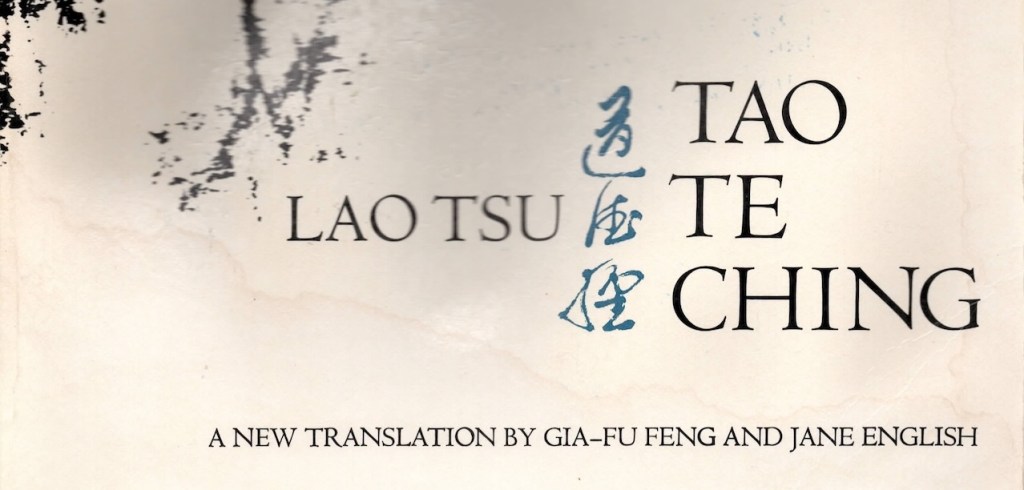
Image a: Book Cover – Feng/English Translation
Ursula K. Le Guin’s Tao Te Ching
Addressing a portion of the errors that have been foisted on the literary world by Ursula K. Le Guin’s faulty “translation” of the sacred text Lao Tsu’s Tao Te Ching, this essay seeks to redirect the narrative driving that spiritual classic.
Introduction: Translation vs Rendition/Version
This essay contrasts a translation of Lao Tsu’s Tao Te Ching by Gia-Fu Feng and Jane English to a rendering by Ursula K. Le Guin. Feng actually translated the text from the original Chinese, while Le Guin simply rewrote and reinterpreted from genuine translations of the text, including the Feng/English translation. In order words, Le Guin pulled a stunt akin to poetaster Robert Bly’s notion of translation.
To be fair to Le Guin, however, it must be noted that she does not claim to have “translated” Lao Tsu’s work; she merely wrote her own interpretations and reactions based on the translations of others. She refers to the effort as a “rendering” or a “version”—not a translation.
In her study and revising of the sacred text, Le Guin appears to be working out her own path of spirituality, which means that the work should have remained private and never been released on the public. Poets and writers who become widely famous—as have Le Guin and Robert Bly—often become so enamored with their own output that they seem to think that anything they write must be worthy of widespread distribution—not to mention the possibility of added revenue from sales.
The personal rendering of sacred texts may become hazardous, when the poet does not truly understand the spirit that originally motivated the work. The result in T. S. Eliot’s “romantic misunderstanding” becomes all too evident. Unfortunately, reviewers, publishers, and promoters have labeled Le Guin’s work a translation, and such labeling is grossly misleading. In her section on Sources, Le Guin lists several translations of the work that she studied; among them are translations by Paul Caru, Arthur Waley, Robert G. Hendricks, and several others.
She also mentions Gia-Fu Feng and Jane English with the comment: “First published in 1972. I have the Vintage edition of 1989. Arising from a sympathetic and informed understanding, this is literarily the most satisfying and recent translation, I have found terse, clear, and simple.”
It is this last one with which I am concerned in this essay. And because Le Guin has called the Feng/English the “most satisfying,” I wonder why she would have even taken it upon herself to engage with a text that others would mistakenly reckon to be a new translation.
And the unfortunate consequence is that those relying on the Le Guin “translation” of the Tao Te Ching as a reference for supporting their arguments will find that their claims do not age well. The inaccuracies foisted on the literary world by faulty translations cheapens the very engagement that literary scholars love and work hard to keep genuine. It is with the purpose of correction that I offer this essay.
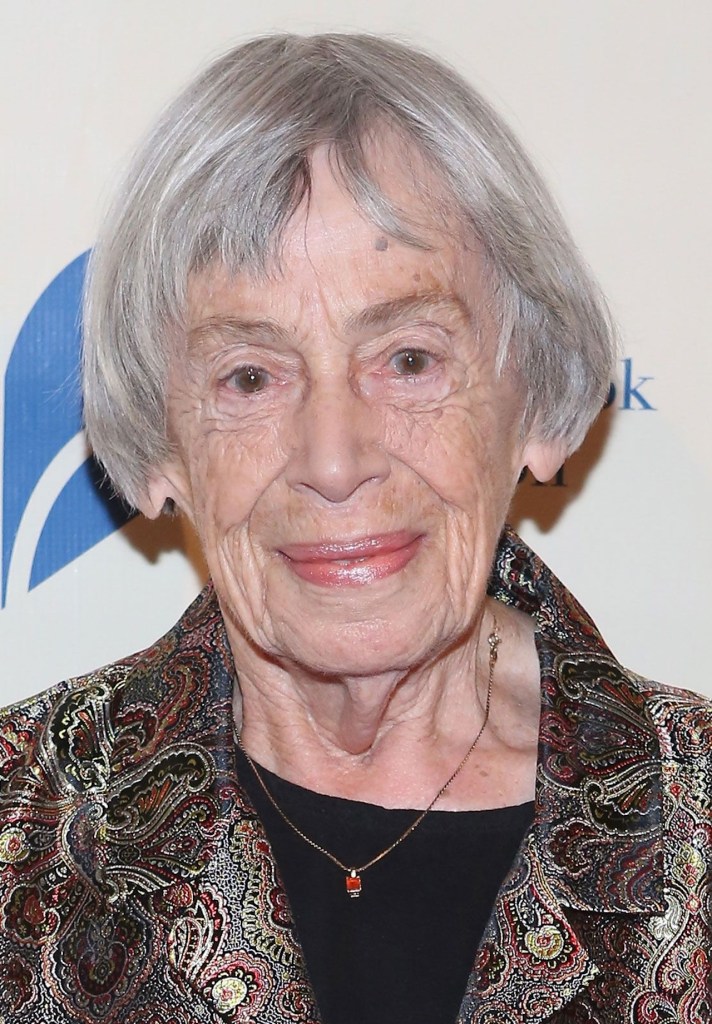
Image b: Ursula K. Le Guin
Where Le Guin Goes Astray: A Textual Analysis
Note: While the original text of Tao Te Ching is comprised of 81 chapters and Le Guin’s content focuses on all 81, I have excised a mere dozen or so of them for this essay. I plan to engage a larger study to include all of the chapters in future.
What follows is not a general complaint about poetic freedom, but a critique of specific departures from Lao Tsu’s meaning—departures that, when repeated throughout the work, amount to a systematic softening and psychologizing of Taoist metaphysics. In each case, I cite the Feng/English translation alongside Le Guin’s rendering and explain why the former preserves Lao Tsu’s intent while the latter obscures or distorts it.
1. Chapter 1: Ontology Reduced to Epistemology
Feng/English:
“The Tao that can be told
is not the eternal Tao.
The name that can be named
is not the eternal Name.”
Here Lao Tsu asserts the ontological priority of the Tao over language and conceptualization. Telling and naming are functions of the human mind, and the human mind cannot conceive of the Ultimate Reality, the Tao, or God. Only the soul can perceive, unite with, and therefore understand the Tao (Ultimate Reality, Divine Belovéd, Divine Mother, or God).
Note that the term “Tao” is capitalized in the Feng/English work, while Le Guin lowercases it. Le Guin’s lower-casing possibly results from the mistaken notion that Eastern religions, especially Buddhism, which was heavily influenced by Taoism, is an atheistic (Godless) religion.
Le Guin:
“The tao that can be told
is not the eternal Tao.
The name that can be named
is not the eternal name.”
While the wording remains the same, except for lowercasing, Le Guin’s framing elsewhere in her text interprets the passage primarily as a comment on human linguistic limitation, rather than as a declaration about the structure of reality itself. Taoist philosophy as well as most Eastern religious philosophy is entirely judgment/evaluation free: these texts describe reality; they do not judge/evaluate the pairs of opposites. Western interpretation of Eastern texts across the board go astray by adding judgment/evaluation.
2. Chapter 2: Mutual Arising vs. Moral Psychology
Feng/English:
“When people see some things as beautiful,
other things become ugly.”
This expresses the Taoist principle of mutual arising (相生). It engages the basic principle of maya delusion that exists through the pairs of opposites: beautiful vs ugly, good vs evil, up vs down, etc.
Le Guin:
“Everybody on earth
knowing that beauty is beautiful
makes ugliness.”
Le Guin’s phrasing shifts structural polarity (pairs of opposites) into psychological causation. Instead of merely expressing the fact that the pairs of opposites exist in relation to each other, this shift adds the notion that the human mind causes the contrast, and that notion is simply false, because those contrasts exist without the human mind interpreting them. Le Guin’s phrasing implies that if only we did not deem something beautiful, we would not then see ugliness. The error of that implication should be self-evident.
3. Chapter 11: Emptiness as Enabling Force
Feng/English:
“We shape clay into a pot,
but it is the emptiness inside
that holds whatever we want.”
Le Guin:
“…the emptiness inside
that makes it useful.”
Potentiality becomes utility—again the hint of judgment mars the usefulness of this rendering. While the Feng/English simply states a fact, the Le Guin adds the human value judgment of usefulness.
4. Chapter 17: Wu Wei and Governance
Feng/English:
“When the Master governs,
the people are hardly aware that he exists.”
Le Guin:
“The best rulers
are those the people don’t notice.”
Governance becomes political minimalism rather than cosmic alignment.
5. Chapter 22: Ontological Paradox Flattened
Feng/English:
“Yield and overcome;
Bend and be straight.”
Le Guin:
“Yielding is completion.
Bending is becoming straight.”
Paradox is psychologized.
6. Chapter 25: Cosmogony Softened
Feng/English:
“There was something formless and perfect
before the universe was born.”
Le Guin:
“There is something
unformed yet complete
that existed before heaven and earth.”
Metaphysical priority is rendered poetic.
7. Chapter 32: The Uncarved Block and Cosmic Authority
Feng/English:
“The Tao is forever nameless.
Though the uncarved block is small,
no one in the world dare claim it.
If kings and lords could harness it,
the ten thousand things would naturally obey.
Heaven and earth would unite…”
Le Guin:
“The way is forever nameless.
Though the uncarved block is small,
no one in the world dares make it a servant…”
Metaphysical taboo becomes ethical restraint.
8. Chapter 37: Wu Wei as Koan
Feng/English:
“The Tao never does anything,
yet through it all things are done.”
Le Guin:
“The Tao does nothing,
yet nothing is left undone.”
Causality becomes aphorism.
9. Chapter 42: Violence as Ontological Failure
Feng/English:
“The violent perish by their own violence.
This is the root of my teaching.”
Le Guin:
“What others teach, I teach also:
the violent die a violent death.
This will be the root of my teaching.”
Cosmic law becomes moral maxim.
10. Chapter 48: Subtraction vs. Self-Improvement
Feng/English:
“In the pursuit of learning, every day something is acquired.
In the pursuit of Tao, every day something is dropped.”
Le Guin:
“Learning adds.
The Way subtracts.”
Radical existential negation becomes slogan.
11. Chapter 57: Governance and Natural Order
Feng/English:
“The more prohibitions you have,
the less virtuous people will be.”
Le Guin:
“The more laws you make,
the more criminals there will be.”
Taoist naturalism is reframed as modern political critique.
12. Chapter 74: Human vs Divine Justice
Feng/English:
If men are not afraid to die,
It is of no avail to threaten them with death.
If men live in constant fear of dying,
And if breaking the law means that a man will be killed,
Who will dare to break the law?
There is always an official executioner.
If you try to take his place,
It is like trying to be a master carpenter and cutting wood.
If you try to cut wood like a master carpenter,
you will only hurt your hand.
The Feng/English version accurately captures the chapter’s critique of harsh governance and the death penalty. It directly addresses rulers who rely on threats of execution to control the people, pointing out the futility when people lose their fear of death (often due to oppressive conditions).
The “official executioner” refers to the natural order or Tao itself—the impartial force that metes out consequences. Attempting to usurp this role through arbitrary human killings is presumptuous and self-destructive, like an amateur wielding a master carpenter’s tools. This rendering stays close to the original Chinese text’s structure and intent, emphasizing non-interference and the dangers of overreaching authority.
Le Guin:
When normal, decent people don’t fear death,
how can you use death to frighten them?
Even when they have a normal fear of death,
who of us dare take and kill the one who doesn’t?
When people are normal and decent and death-fearing,
there’s always an executioner.
To take the place of that executioner
is to take the place of the great carpenter.
People who cut the great carpenter’s wood
seldom get off with their hands unhurt.
Le Guin’s version introduces interpretive additions that distort the original meaning. Phrases like “normal, decent people” and repeated emphasis on “normal” behavior inject a moralistic, humanistic judgment absent from the Chinese text, which speaks generally of “the people” without qualifiers of decency or normality. This shifts the focus from a political warning against tyrannical rule to a psychological or ethical observation about consistent human behavior.
The hypothetical “who of us dare take and kill the one who doesn’t?” implies no one would dare execute even the fearless, softening the critique of capital punishment and missing the irony in the original’s rhetorical question about lawbreakers (“who would dare?”).
While poetic, these liberties dilute the chapter’s core Taoist message: rulers should not play executioner, as death is the province of the Tao (“great carpenter” or divine master who “hews” life), and human interference invites harm. The Feng/English stays truer to this anti-authoritarian essence without the added layers.
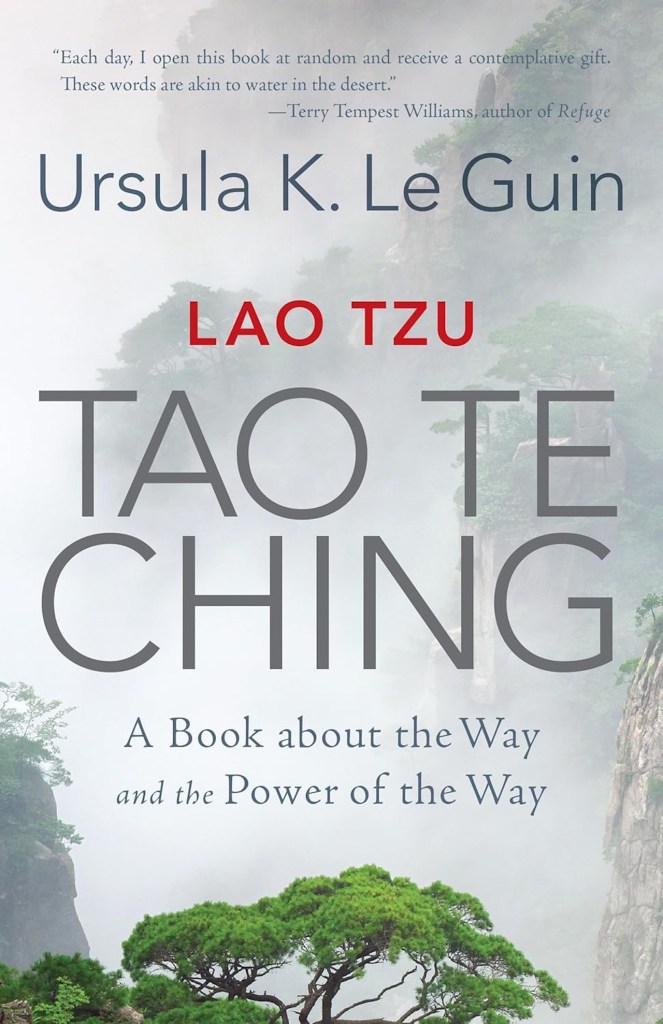
Image c: Le Guin’s Book Cover
Why Accuracy Matters
Le Guin’s Tao Te Ching is a graceful literary artifact. It is often insightful, occasionally beautiful, and sometimes moving. But it is not Lao Tsu—which she spells “Lao Tzu.” By filtering Taoism through modern psychology, ethical sentiment, and literary minimalism, Le Guin consistently narrows a cosmological text into a personal one. Feng and English, by contrast, preserve the exotic, impersonality, and metaphysical rigor of the original.
This distinction matters. Sacred texts are not raw material for aesthetic rearrangement without consequence. When a “version” is mistaken for a translation, the philosophical lineage is compromised, and later arguments built upon it rest on unstable ground. It is precisely to prevent such erosion that this essay insists on correction—not to diminish Le Guin’s literary talent, but to restore Lao Tsu’s voice where it has been inadvertently overwritten.
The Damage Done by Overwriting
Le Guin’s Tao Te Ching is often defended on the grounds that it is not a translation at all, but a “version,” a “rendering,” a personal engagement with the text. That defense, however, does not mitigate the damage done when such a rendering is repeatedly received and cited as Lao Tsu. The harm lies not in poetic interpretation per se, but in philosophical overwriting—the replacement of a coherent metaphysical system with a modern ethical sensibility that only partially overlaps with it.
Because Lao Tsu views human perceptual reality as a yin/yang play of dualities within a wholeness of Being, he does not present good and bad as moral preferences or psychological dispositions. They are structural features of manifested reality. Likewise, Lao Tsu distinguishes between a true, creative form of power—one aligned with the Tao—and a false, destructive form, arising from coercion, force, and egocentric assertion. This distinction is not ethical window dressing; it is central to Taoist ontology.
In the Feng/English translation, this structure remains intact. Power is impersonal, prior, and generative; its counterfeit is self-assertive and ultimately self-defeating. Violence fails not because it is morally frowned upon, but because it violates the grain of reality itself.
Le Guin, however, repeatedly recasts this ontological distinction in affective and evaluative language. Where Lao Tsu speaks of alignment and misalignment with the Tao, Le Guin substitutes terms such as “mysterious,” “great,” and “true” for what might be called real power, and “care” as its preferred human expression. Opposed to this is not ontological distortion, but what reads as a lesser, egocentric abuse of power—a psychological or ethical failing rather than a metaphysical one. This shift is subtle, but its consequences are profound.
Taoist power is not something one chooses to wield kindly; it is something that operates whether one believes in it or not. By recasting power as a matter of care versus abuse, Le Guin relocates Taoism from the realm of cosmology into that of moral psychology. The Tao becomes something one believes in, rather than something one must align with.
This same kind of misunderstanding is observable in Christianity, when religionists insist that one must believe in Jesus as God, instead of as a son (child) of God, who was aligned with God in ways that the bulk of humanity has forgotten, the fall of Adam and Eve being the mythological depiction of that fall. Jesus took on some of the karma of erring humanity, but individual karma still applies to each human being born of woman into this world of maya.
The impact of inaccuracies results in the damage done by overwriting. The text is no longer strong enough. Its impersonality is softened; its rigor is humanized; its metaphysical claims are domesticated into ethical preferences. What remains is graceful, humane, and accessible—but it is no longer Lao Tsu’s Tao Te Ching.
When such a version is mistaken for a translation, the consequences extend beyond literary taste. Scholars, students, and readers build arguments upon it, unaware that the philosophical ground has shifted beneath their feet. Over time, the Tao itself is subtly redefined—not by debate or refutation, but by replacement.
It is precisely to prevent such erosion that this essay insists on correction. Not to deny Ursula K. Le Guin her considerable literary gifts, but to insist that a sacred philosophical text must be allowed to remain what it is, even when it resists modern sensibilities. Lao Tsu does not need to be improved, clarified, or made more caring. He needs to be heard.
🕉
You are welcome to join me on the following social media:
TruthSocial, Locals, Gettr, X, Bluesky, Facebook, Pinterest
🕉
Share
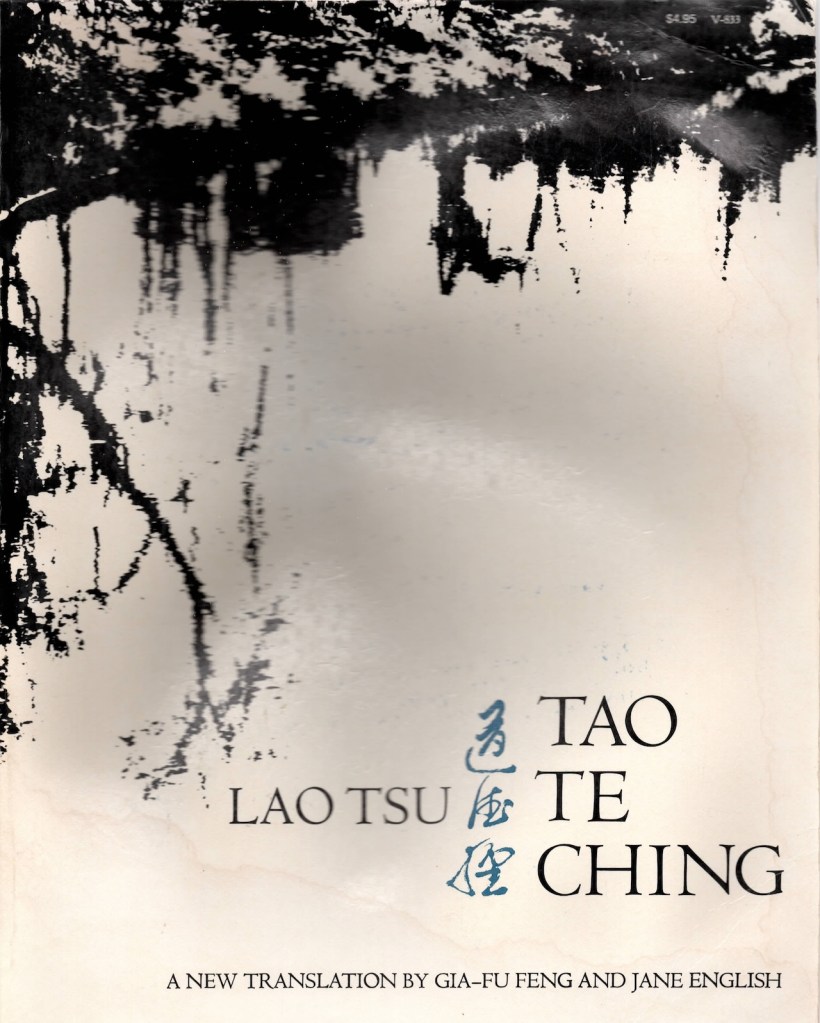
Full Image: Book Cover Feng/English Translation
 Linda's Literary Home