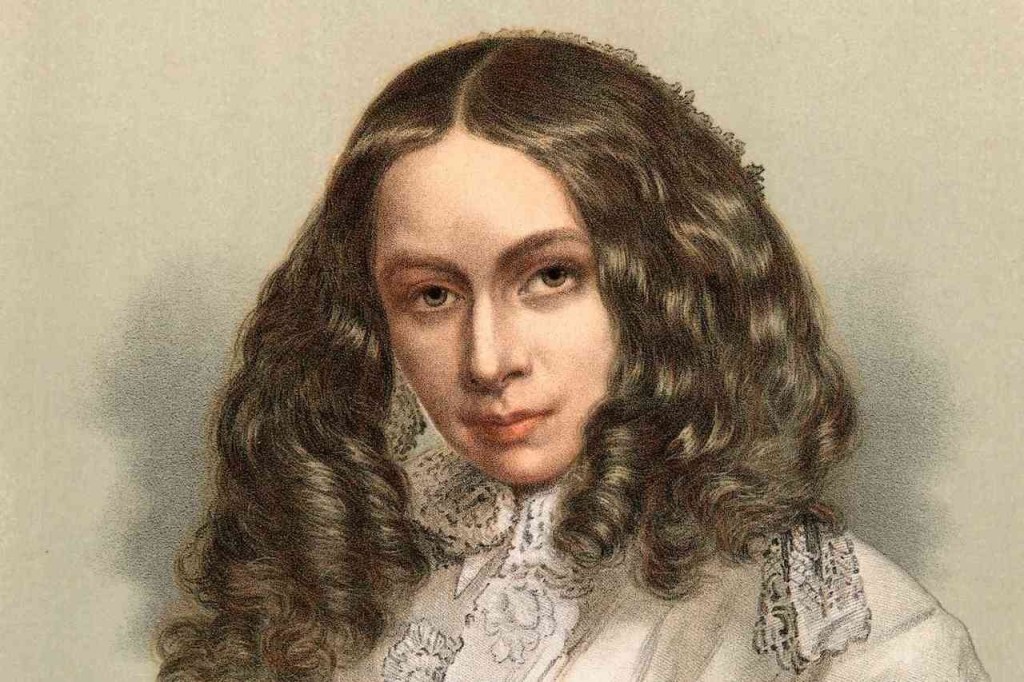
Image: Elizabeth Barrett Browning – Getty Images
Sonnet 3 “Unlike are we, unlike, O princely Heart!”
The speaker in Elizabeth Barrett Browning’s sonnet 3 muses on how unlikely it seems that a plain individual such as herself would begin a relationship with a person who has attracted royalty.
Introduction and Text of Sonnet 3 “Unlike are we, unlike, O princely Heart!”
The speaker of Elizabeth Barrett Browning’s sonnet 3 from Sonnets from the Portuguese contemplates the differences between her belovèd and her humble self. She continues her study of unlikely love employing the use of the Petrarchan sonnet form for the sequence.
The speaker thus is dramatizing her musings as they focus on her relationship with her belovèd partner. She explores her many doubts and self-deprecation seeming to be looking for a reason to change her mind about what seems to be an impossible liaison.
Sonnet 3 “Unlike are we, unlike, O princely Heart!”
Unlike are we, unlike, O princely Heart!
Unlike our uses and our destinies.
Our ministering two angels look surprise
On one another, as they strike athwart
Their wings in passing. Thou, bethink thee, art
A guest for queens to social pageantries,
With gages from a hundred brighter eyes
Than tears even can make mine, to play thy part
Of chief musician. What hast thou to do
With looking from the lattice-lights at me,
A poor, tired, wandering singer, singing through
The dark, and leaning up a cypress tree?
The chrism is on thine head,—on mine, the dew,—
And Death must dig the level where these agree.
Commentary on Sonnet 3: “Unlike are we, unlike, O princely Heart!”
The speaker in sonnet 3 is musing on how unlikely it seems that an unknown simple individual such as herself could attract and begin a relationship with a person who has attracted the attention and respect of royalty.
First Quatrain: Contemplating Differences
Unlike are we, unlike, O princely Heart!
Unlike our uses and our destinies.
Our ministering two angels look surprise
On one another, as they strike athwart
The speaker begins with an excited utterance. The humble speaker and her newly formed romantic partner perform very different roles in life; thus, they would naturally be on the road to very different “destinies,” one would assume, as the speaker seems to do. The speaker then paints a fantastic image wherein a pair of angels look with surprise, “On one another, as they strike athwart / / Their wings in passing.”
This unusual pair of lovers possesses very different guardian angels, and those angels find themselves taken aback that such a couple with very differing stations in life should come together. Even more remarkable is that they seem to begin to flourish as they engaging in their new relationship. The angels’ wings begin fluttering, as they questioningly peer upon the unlikely couple.
Second Quatrain: A Guest of Royalty
Their wings in passing. Thou, bethink thee, art
A guest for queens to social pageantries,
With gages from a hundred brighter eyes
Than tears even can make mine, to play thy part
The speaker reports that her new belovèd has often been the guest of royalty at their social events—something this speaker could never have accomplished. The speaker is only a shy and retiring individual; she thus offers the contrast between her own social station and skills to that of one who has shined so brightly as to attract the acceptance into the company of kings and queens.
The speaker assumes that the folks he surely meets at the spectacular affairs of royalty no doubt look at him with “a hundred brighter eyes” than her own. Even her tears cannot be enough to render her eyes as bright as what he must experience at such high level social affairs.
First Tercet: Her Lowly Self
Of chief musician. What hast thou to do
With looking from the lattice-lights at me,
A poor, tired, wandering singer, singing through
The speaker then contends that unlike her lowly self, her new found love has played the role of “chief musician” at those gatherings of royalty. She, therefore, must question the notion that he would even bother to give her a second thought, after encountering the glamor and glitz of upper class events.
The speaker then puts the question to her romantic partner in order to become informed as to why one such as he would be “looking from the lattice-lights” at one such as herself.
The speaker wants to know why one who can so easily attract and associate with royalty can at the same time seem to be like a commoner, as he “lean[s] up a cypress tree,” while peering up at her through her shaded-window.
She seems to harbor a suspicion that her new relationship might be based on some frivolous curiosity instead of genuine interest and affection. Thus, she continues to muse and examines all aspects of this new liaison, until she feels comfortable in allowing herself to enjoy the relationship.
Second Tercet: A Precious Oil
The dark, and leaning up a cypress tree?
The chrism is on thine head,—on mine, the dew,—
And Death must dig the level where these agree.
Finally, the speaker declaims that her loved one sustains “chrism” on his head, but she possesses only “dew.” The precious oil coming together with only plain dew boggles her mind; thus, she evokes the image, “Death must dig the level where these agree.”
On the earthly plane and in a definitely class based society, the speaker cannot reconcile the differences between herself and her beloved. She therefore suggests that she will just allow “Death” to establish the meaning and purpose of this seemingly bizarre, but happy, occurrence.
🕉
You are welcome to join me on the following social media:
TruthSocial, Locals, Gettr, X, Bluesky, Facebook, Pinterest
🕉
Share
 Linda's Literary Home