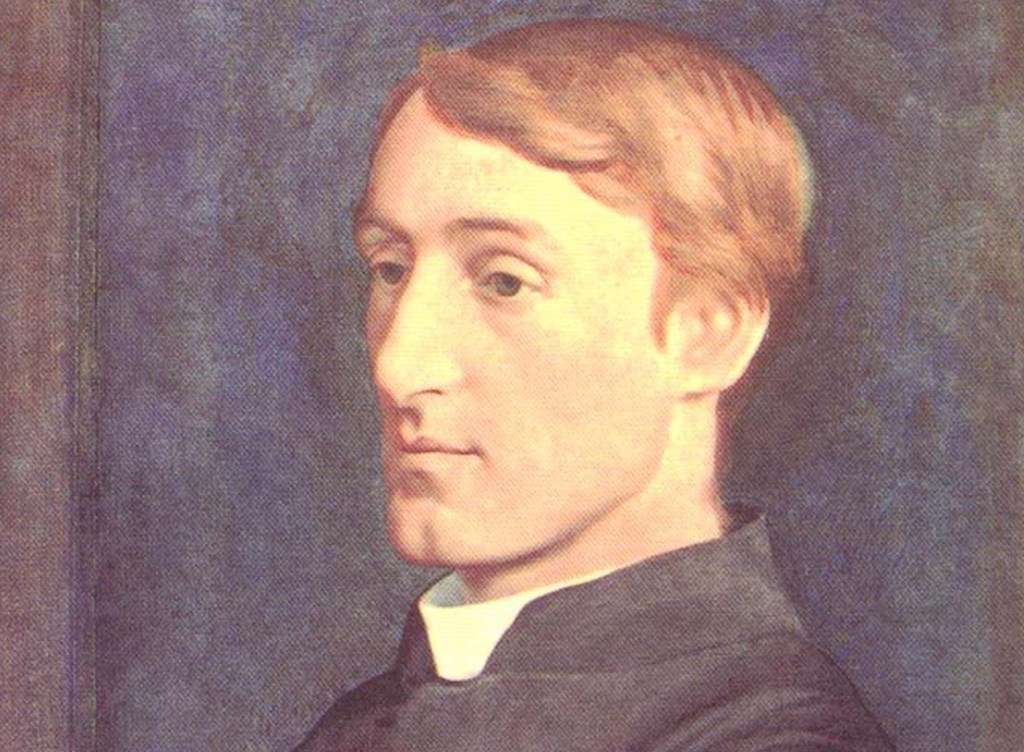
Gerard Manley Hopkins’ “My own heart let me more have pity on; let”
The speaker in this sonnet examines his inward struggle, through which he has learned mercy toward the self (soul) while undergoing heavy, sustained spiritual pressure. My personal issue with this pressure assures me that Father Hopkins well understood its vicissitudes as well as its rewards.
Introduction and Text of “My own heart let me more have pity on; let”
In this final terrible sonnet, the speaker turns inward to speak directly to his own heart; he does so with urgency but restraint. The sonnet foregrounds his own personal moral and spiritual reckoning. In that accounting, he has found that self-pity is not indulgence but instead it is simply charity rightly ordered and affirmed.
The poetic language pushes as well as it knots itself into compression. It portrays the pressure exerted on a mind that has been tormented to the point of exhaustion. Thus, now that exhausted mind must seek a genuine place to rest.
Readers may note that Father Hopkins has separated both the octave and the sestet into two quatrains in the octave and two tercets in the sestet. This kind of separation adds to the dramatic effect that each stanza represents.
The sonnet could be interpreted as consisting of four movements; however, for consistency of preserving the Petrarchan model, I have kept them grouped in my commentary as simply octave and sestet.
My own heart let me more have pity on; let
My own heart let me more have pity on; let
Me live to my sad self hereafter kind,
Charitable; not live this tormented mind
With this tormented mind tormenting yet.
I cast for comfort I can no more get
By groping round my comfortless, than blind
Eyes in their dark can day or thirst can find
Thirst’s all-in-all in all a world of wet.
Soul, self; come, poor Jackself, I do advise
You, jaded, lét be; call off thoughts awhile
Elsewhere; leave comfort root-room; let joy size
At God knows when to God knows what; whose smile
‘S not wrung, see you; unforeseen times rather—as skies
Betweenpie mountains—lights a lovely mile.
Reading
Commentary on “My own heart let me more have pity on; let”
The sonnet dramatizes four movements, as mentioned above, from self-laceration to self-mercy, which has led to the discovery of hope—not by force of harsh discipline but by soft, divinely inspired release.
Octave: “My own heart let me more have pity on; let”
My own heart let me more have pity on; let
Me live to my sad self hereafter kind,
Charitable; not live this tormented mind
With this tormented mind tormenting yet.
I cast for comfort I can no more get
By groping round my comfortless, than blind
Eyes in their dark can day or thirst can find
Thirst’s all-in-all in all a world of wet.
The speaker begins the octave by offering a plea that is, however, also a command. He is directly addressing his own heart as both somewhat metaphorically as both judge and defendant. The line “Let me more have pity on” signals a deliberate act of will: pity must be allowed to exist and work its power, not merely be passively felt.
The speaker then labels his accustomed cruelty toward himself: he has become a “tormented mind” that compounds his suffering by continually rehearsing it. The repetition of “tormented” mimics the cycle he is condemning; his has become a mind that had kept turning upon itself without pause to rest.
Charity here does not engage merely for sentimental purposes; it remains a necessary, ethical discipline, employing the discipline to refuse to continually inflict self-harm, even under the guise of rigor.
The second quatrain moves quite quickly but assertively, and then it intensifies the uselessness of the same old, ordinary search for simple, quiet comfort. Casting “for comfort” metaphorically creates the two leisure activities of fishing and gambling. Both of these activities involve chance, and uncertainty often hands over nothing to the player after plunging much effort into them.
The “blind/Eyes” image sharpens the deadlock: Blind eyes cannot see daylight simply by groping, while thirst cannot be slaked by being dunked in water that is not fit to drink. Again, the poet has been performing his duty of giving back to the reader his own experience. And the mark of a great poet is that he does so completely in a natural, believable voice, as Father Hopkins does here.
The paradox of “thirst’s all-in-all in all a world of wet” completely and earnestly captures spiritual barrenness as it spirits about in a world of abundance, where remedies for maladies surround the suffering soul yet remain remote and unreachable.
The octave thus has closed every false door. The activities of exerting much effort, of analyzing each sorrow’s parts, and then groping toward some restless search have only deepened the dryness of the issue. The speaker’s understanding and honesty now clear the way for a genuine rejoinder that does not hang on mastery or grasping.
The minds and hearts of all humanity remain in search of such genuineness, especially as it contemplates it own mortality. The winds of change may threaten the material world, but the astral and causal levels of being hold promises that humanity keeps deep in its bosom.
Sestet: “Soul, self; come, poor Jackself, I do advise”
Soul, self; come, poor Jackself, I do advise
You, jaded, lét be; call off thoughts awhile
Elsewhere; leave comfort root-room; let joy size
At God knows when to God knows what; whose smile
‘S not wrung, see you; unforeseen times rather—as skies
Betweenpie mountains—lights a lovely mile.
The speaker in the sestet now is able to turn advice into consolation, as he discovers joy; and this joy was not seized by groping fingers but granted by steady grace, which arrived without exertion and through patience.
In the sestet, the direct address broadens as the “Soul, self” bring together the divided mind/heart into a single event. The affectionate diminutive “Jackself” calms the weather of judgment, while weariness is acknowledged but without contempt.
The advice remains as simple as it is radical—“let be.” Thought itself must be allowed to rest “awhile,” not disappeared but its temperature lowered. The speaker suggests a turning “elsewhere,” away from the former obsessive peer into inwardness, leaving “comfort root-room.” Comfort cannot be bludgeoned at the root, an joy must be afforded a place to increase.
The speaker then suspends time as well as outcome, when he asserts “At God knows when to God knows what.” This line refuses acts that schedule or measure. It finds that hope exists only under divine discretion. The smile then appears quite naturally because it is “not wrung”; it is not forced by circumstances , neither is it caught up by the will. Instead, this divine joy may come like a flash in “unforeseen times,” and the speaker compares that flash colorfully to the sudden light that appears between mountains.
This image then significantly gives honor to the obstruction without dragging in the issue of despair: the mountains still remain mountains, but between them, a mile or so has been wonderfully lighted. The sonnet concludes with a vista—limited, lovely, and sufficient. Mercy toward the self has become the condition for perceiving the divine light, for experiencing joy, and it is patience that remains the means by which that blessed condition endures.
🕉
You are welcome to join me on the following social media:
TruthSocial, Locals, Gettr, X, Bluesky, Facebook, Pinterest
🕉
Share
 Linda's Literary Home