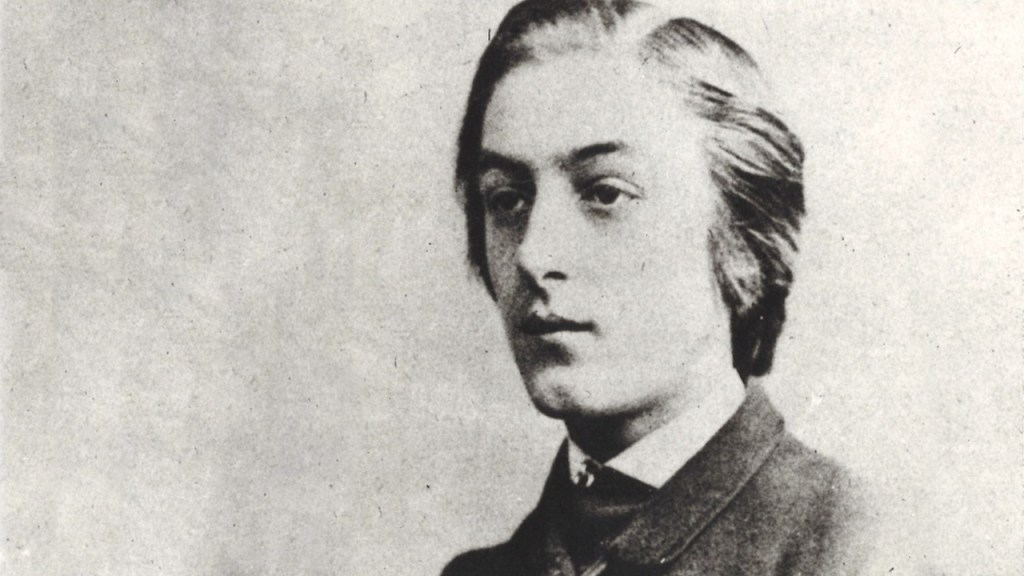
Gerard Manley Hopkins’ “Patience, hard thing! the hard thing but to pray”
This sonnet is counted as one of Father Hopkins’ six “terrible sonnets.”
Introduction and Text of “Patience, hard thing! the hard thing but to pray”
The speaker in Father Hopkins’ “Patience, hard thing! the hard thing but to pray” explores searchingly the nature of spiritual endurance. He is focusing on patience not as a soft virtue but as a challenging and difficult discipline, which oftentimes scars the pride, while exhausting the will.
But those actions still reflect and align with divine will and action. As he usually does, this speaker reveals the hard discipline of God remains always for the betterment of humankind. As human beings, we all search for—or at least wish for—our own betterment.
As a Jesuit priest, Father Hopkins made it his mission to seek divine guidance, and unlike us non-priestly poets, he focused primarily on religious and spiritual issues that affected him deeply.
Patience, hard thing! the hard thing but to pray
Patience, hard thing! the hard thing but to pray,
But bid for, Patience is! Patience who asks
Wants war, wants wounds; weary his times, his tasks;
To do without, take tosses, and obey.
Rare patience roots in these, and, these away,
Nowhere. Natural heart’s ivy, Patience masks
Our ruins of wrecked past purpose. There she basks
Purple eyes and seas of liquid leaves all day.
We hear our hearts grate on themselves: it kills
To bruise them dearer. Yet the rebellious wills
Of us we do bid God bend to him even so.
And where is he who more and more distils
Delicious kindness? – He is patient. Patience fills
His crisp combs, and that comes those ways we know.
Reading
Commentary on “Patience, hard thing! the hard thing but to pray”
As human beings, we learn early that patience is an important personal quality, but the speaker in this sonnet is revealing his inner turmoil as an argument against which he confronts resistance even as he refuses to decry the virtue that seems to be resisting him. He treats the virtue of patience in a realistic manner—not with sentimentality. He asserts that patience is both vitally necessary as well as deeply painful.
The humanity of his cries shows us that as we strive and struggle, all of humanity has done so. Father Hopkins lived in the 19th century—two centuries earlier than our own, and yet his struggles are our struggles.
Octave: “Patience, hard thing! the hard thing but to pray”
The speaker begins the octave with an effusive cry—no calm reflection here! He invokes “patience” immediately and pairs it with prayer; they are both difficult things to approach and accomplish. We often cry for what we seem to lack, even in the 21st century.
He knows that genuine prayer requires patience, and it is a kind of patience that the heart and mind naturally resist in a fallen world. The sharpness of his complaint is emphasized through repetition.
He then seems to create a stunning paradox in that patience is difficult, but it is also “bid for.” The speaker easily confesses that patience is not only endured, but it is sought and asked for, even though that asking heralds conflict.
Personified as a female figure who is doing the asking, Patience paradoxically “wants war, wants wounds,” and those qualities expose that there is a cost in acquiring her. She commands that one live a life without ease, which includes doing without things one might need for comfort, receiving blows that stun and hurt, all the while remaining obedient. Dame Patience then requires obedience under pressure with the willingness to accept pain, trials, and tribulations that seem arbitrary instead of well-deserved.
The speaker asserts that that kind of patience remains rare, even fragile. It takes hold only under these catastrophic conditions; for if they are removed them, there is not patience within existence. This insistence blows up the notion that patience can be a decorative virtue experienced in comfort; instead, patience makes it appearance only in deprivation, instability, and any other calamity.
Still through all this mayhem, the speaker refuses to qualify her as infertile. Through a striking shift in tone and assurance, patience then transforms into “Natural heart’s ivy” —a living being, covering “our ruins of wrecked past purpose.” We chafe under ruined purposes as we try to build a better world even in current times.
With that ivy image, the speaker is acknowledging that failure and collapse within the self, which include all past intentions are broken and defeated. Patience, however, does not convert them; she merely masks them by covering all that damage with new growth.
The final lines of the octave seems to complicate the struggle. Patience is basking in colorful accoutrements, yet luxuriant color and fluidity suggest abundance, as well as beauty, even though it is a beauty that grows over wreckage.
The speaker thus remains well aware that such patience beautifies what has been lost without denying the loss itself. The octave leaves the speaker’s fragility suspended between intense pain and strange fertility—between war and ivy.
Sestet: “We hear our hearts grate on themselves: it kills”
In the sestet, the speaker turns inward with even greater urgency. He hears that “our hearts grate on themselves”; this image is harsh and mechanical, suggesting inner resistance. And patience can be understood as not only difficult, but it is also possibly lethal, in that “it kills / To bruise them dearer.”
That claim is intimating that the heart continues to hang onto its own wounds because it would rather retain the familiar pain than to face the adversity made possible by surrender.
Especially within the confines of such thinking, the speaker has to surrender to an subtle prayer: “the rebellious wills / Of us we do bid God bend to him.” Even as the will resists God, it, at the same time, must supplicate to God to transcend its resistance. An exotic tension unfolds the divided mind/soul as it prays. It remains faithful but still defiant.
The main focus that has infused itself throughout the entire sonnet comes into sharp relief in the form of the question “where is the goodness that justifies all of this misery and suffering?” A question to haunts our current civilization as surely as it did two centuries ago!
The speaker responds not with an argumentative abstract notion, but with a person. “He is patient.” God’s kindness can come only slowly, similar to a liquid being “distilled,” drop by drop, rather than being poured out all at once. As science has shown us certain processes, poetry shows us the metaphorical value of understanding those processes.
Patience is not merely a virtue that human beings must learn; it is the basic method of God’s own divine action. The final image of “crisp combs” brings to mind honey made by bees that labor furiously as they produce such sweetness.
Patience “fills” them (all of creation’s creatures), and from that fullness comes kindness in “those ways we know,” as it ascends to human experience through evolutionary time rather than temporal spectacle.
In the sestet, the speaker comes close to showing how to defend one’s heart and mind in the struggle that humanity is engaged in. He does not provide direct relief from pain or a way to guard against rebellion.
But instead, the speaker suggests that the answer can only be understood in terms of what is human and what is divine; thus, human patience can be seen to resemble divine patience. The pain and suffering experiences by human beings can be converted into the divine stuff that produces sweetness, i.e., kindness.
The process, of course, is meditation and prayer, along with deep thought and service to humankind and the world at large, in whatever form that service must take—even writing poems, thus, can serve a divine purpose.
We struggle today as humanity has struggled in the past. From poets such as Father Hopkins, we can glean the depth of our sorrow but also we can be comforted that there is a light at the end of the tunnel of sad darkness, and we can determine that we will progress toward that light.
🕉
You are welcome to join me on the following social media:
TruthSocial, Locals, Gettr, X, Bluesky, Facebook, Pinterest
🕉
Share
 Linda's Literary Home