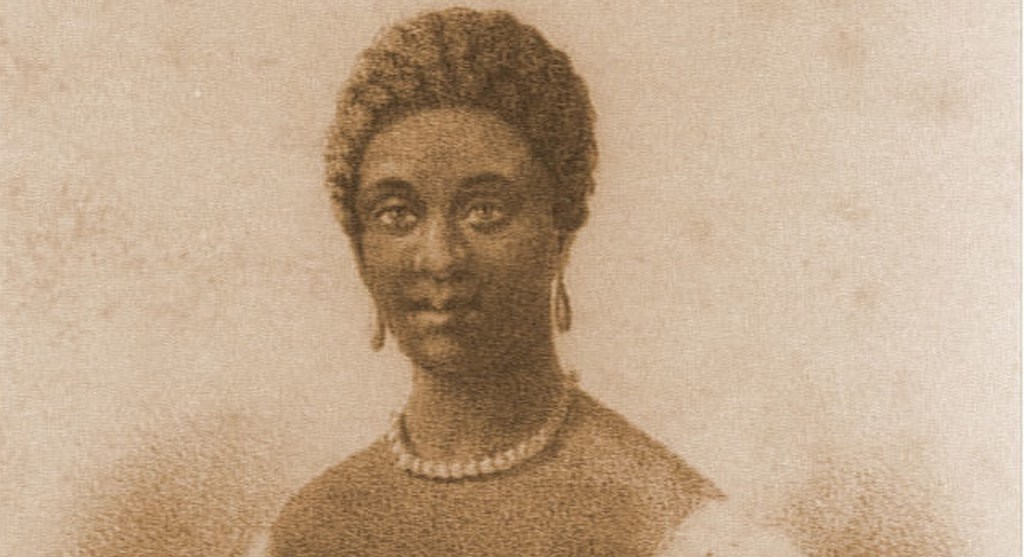
Image: Phillis Wheatley
Life Sketch of Phillis Wheatley
Phillis Wheatley’s talent was questioned but then authenticated during her lifetime, and she is now hailed by all but the most cynical as one of America’s finest poetic voices.
Two Versions of a Publication History
Although Phillis Wheatley’s talent was at first questioned [1], her authenticity was finally established during her lifetime. Today, she is widely recognized by all, except the most cynical [2], as one of America’s finest poetic voices.
Phillis Wheatley’s first and only collection of published poetry was titled Poems on Various Subjects, Religious and Moral; it was published in England.
There are two versions of the history of this book’s publication [3]: one is that the Countess Selina of Huntington invited Phillis to London and found a publisher for the poet; the other is that Phillis suffered from asthma, and so the Wheatley family took her to England to recuperate, and while there, they sought publication of her work.
Either way, the book was published and Wheatley’s career was established. The Wheatley family’s insight played a major role in helping a slave rise above the hardships of that vile institution.
The Value of One Poem
In May 1968, one poem written by Phillis Wheatley brought $68,500 at Christie’s auction [4], Rockefeller Center in New York. It had been estimated to bring between $18,000 and $25,000.
The poem is titled “Ocean”; its seventy lines were written on three pages that had yellowed with time. It is thought to be the only copy.
Ocean
Now muse divine, thy heav’nly aid impart,
The feast of Genius, and the play of Art.
From high Parnassus’ radiant top repair,
Celestial Nine! propitious to my pray’r.
In vain my Eyes explore the wat’ry reign,
By you unaided with the flowing strain.
When first old Chaos of tyrannic soul
Wav’d his dread Sceptre o’er the boundless whole,
Confusion reign’d till the divine Command
On floating azure fix’d the Solid Land,
Till first he call’d the latent seeds of light,
And gave dominion o’er eternal Night.
From deepest glooms he rais’d this ample Ball,
And round its walls he bade its surges roll;
With instant haste the new made seas complyd,
And the globe rolls impervious to the Tide;
Yet when the mighty Sire of Ocean frownd
“His awful trident shook the solid Ground.”
The King of Tempests thunders o’er the plain,
And scorns the azure monarch of the main,
He sweeps the surface, makes the billows rore,
And furious, lash the loud resounding shore.
His pinion’d race his dread commands obey,
Syb’s, Eurus, Boreas, drive the foaming sea!
See the whole stormy progeny descend!
And waves on waves devolving without End,
But cease Eolus, all thy winds restrain,
And let us view the wonders of the main
Where the proud Courser paws the blue abode,
Impetuous bounds, and mocks the driver’s rod.
There, too, the Heifer fair as that which bore
Divine Europa to the Cretan shore.
With guileless mein the gentle Creature strays.
Quaffs the pure stream, and crops ambrosial Grass.
Again with recent wonder I survey
The finny sov’reign bask in hideous play.
(So fancy sees) he makes a tempest rise
And intercept the azure vaulted skies.
Such is his sport:—but if his anger glow
What kindling vengeance boils the deep below!
Twas but e’er now an Eagle young and gay
Pursu’d his passage thro’ the aierial way.
He aim’d his piece, would C[ale]f’s hand do more ?
Yes, him he brought to pluto’s dreary shore.
Slow breathed his last, the painful minutes move
With lingring pace his rashness to reprove;
Perhaps his father’s Just commands he bore
To fix dominion on some distant shore.
Ah! me unblest he cries. Oh! had I staid
Or swift my Father’s mandate had obey’d.
But ah! too late.—Old Ocean heard his cries.
He stroakes his hoary tresses and replies:
What mean these plaints so near our wat’ry throne,
And what the Cause of this distressful moan?
Confess. Iscarius, let thy words be true
Not let me find a faithless Bird in you.
His voice struck terror thro’ the whole domain.
Aw’d by his frowns the royal youth began,
Saw you not. Sire, a tall and Gallant ship
Which proudly skims the surface of the deep?
With pompous form from Boston’s port she came.
She flies, and London her resounding name.
O’er the rough surge the dauntless Chief prevails
For partial Aura fills his swelling sails.
His fatal musket shortens thus my day
And thus the victor takes my life away.
Faint with his wound Iscarius said no more.
His Spirit sought Oblivion’s sable shore.
This Neptune saw, and with a hollow groan
Resum’d the azure honours of his Throne.
Coming to America
Phillis Wheatley was born in Senegal/Gambia, Africa, in 1753. At age seven, she was brought to America and sold to John and Susannah Wheatley of Boston. She soon became a family member instead of a slave. The Wheatleys taught Phillis to read, and she was soon reading classic literature in Greek and Latin, as well as English.
But her talent did not stop with reading, because she began to write poetry, influenced by the Bible and the English poets, particularly John Milton, Alexander Pope, and Thomas Gray. Her poetry reflected the classical forms and content which she closely studied [5].
Phillis wrote her first poem at age thirteen, “On Messrs. Hussey and Coffin,” which was published in 1767 in the Newport Mercury [6]. But she gained wide recognition as a poet with “On the Death of the Reverend Mr. George Whitefield,” which appeared only three years later. Chiefly, because of this poem, Phillis’ first book was later published. It is thought that she had a second book of poems, but the manuscript seems to have disappeared.
In 1778, Phillis married John Peters, a failed businessman. They had three children, all of whom died in childhood. Phillis’ final years were spent in extreme poverty, despite her work as a seamstress. She continued to write poetry and tried in vain to publish her second book of poetry. She died at age 31 in Boston.
The Poet’s Authenticity Questioned
As one might surmise, there was, indeed, a controversy over the authenticity of Phillis’ writing. That a young black slave girl could write like a John Milton was not a fact easily digested back in Colonial America, when slaves were considered something less than human.
Even Thomas Jefferson [7] showed disdain for Phillis’ writing; in his Notes on the State of Virginia, he remarked, “Religion indeed has produced a Phyllis Whately [sic] but it could not produce a poet. The compositions published under her name are below the dignity of criticism.”
Yet Jefferson goes ahead and offers criticism in his next remark, “The heroes of the Dunciad are to her, as Hercules to the author of that poem.”
Unlike Jefferson, George Washington [8].proved to be a fan; in 1776, she wrote a poem and a letter to Washington, who praised her efforts and invited her to visit. I wonder how seriously we can take Jefferson’s criticism, when he so badly misspelled her name; one wonders if he might be speaking of someone else.
Important American Poet
Readers can sample Phillis’ poetry online; her book of poems, Poems on Various Subjects, Religious and Moral, is offered in its entirety, including the front material that shows how strong the controversy over her talent was [9]. After suffering the ambivalence of the Colonial mind-set during her lifetime, today Phillis Wheatley is hailed as one of the most important early American poets.
Sources
[1] Joel Gladd. “Phillis Wheatley, Thomas Jefferson, and the Debate over Poetic Genius.” CWI. Accessed August 25, 2023.
[2] R. Lynn Matson. “Phillis Wheatley—Soul Sister?” Phylon (1960-), vol. 33, no. 3, 1972, pp. 222–30. JSTOR.
[3] Sondra A. O’Neale. “Phillis Wheatley.” Poetry Foundation. Accessed August 25, 2023.
[4] Paul P. Reuben. “Phillis Wheatley.” Perspectives in American Literature. Accessed August 25, 2023.
[5] Sydney Vaile. “Phillis Wheatley’s Poetic Use of Classical Form and Content in Revolutionary America, 1767–1784.” Researchgate. April 2015.
[6] Debra Michals. “Phillis Wheatley.” National Women’s History Museum. 2015.
[7] Thomas Jefferson. “Notes on the State of Virginia: Queries 14 and 18.” Teaching American History. Accessed August 25, 2023.
[8] George Washington. “George Washington to Phillis Wheatley, February 28, 1776.” Library of Congress. Accessed August 25, 2023.
[9] Phillis Wheatley. Poems on Various Subjects, Religious and Moral. Gutenberg Project. Accessed August 25, 2023.
Commentaries on Phillis Wheatley Poems
- Phillis Wheatley’s “On Imagination” Phillis Wheatley’s classically influenced poem, “On Imagination,” explores the powerful force of human imagination. Wheatley demonstrates her remarkable talent for use of mythological allusion and the classical forms in which she was trained and in which she excelled.
- Phillis Wheatley’s “An Hymn to the Morning” Phillis Wheatley was influenced by Greek and Roman classical literature, as well as by early 18th century British poets, who were also influenced by that same literature.
- Phillis Wheatley’s “On Virtue” The speaker in Phillis Wheatley’s “On Virtue” is describing the characteristics of that quality, as she supplicates to the heavenly realms to enrich and enliven her creative ability to produce useful, genuine, and delightful poems.
- Phillis Wheatley’s “A Hymn to the Evening” The speaker in Phillis Wheatley’s “A Hymn to the Evening” offers her spiritually motivated song/prayer as a tribute to evening, the part of the day when nightly slumber is arriving in all its glory.
🕉
You are welcome to join me on the following social media:
TruthSocial, Locals, Gettr, X, Bluesky, Facebook, Pinterest
🕉
Share
 Linda's Literary Home