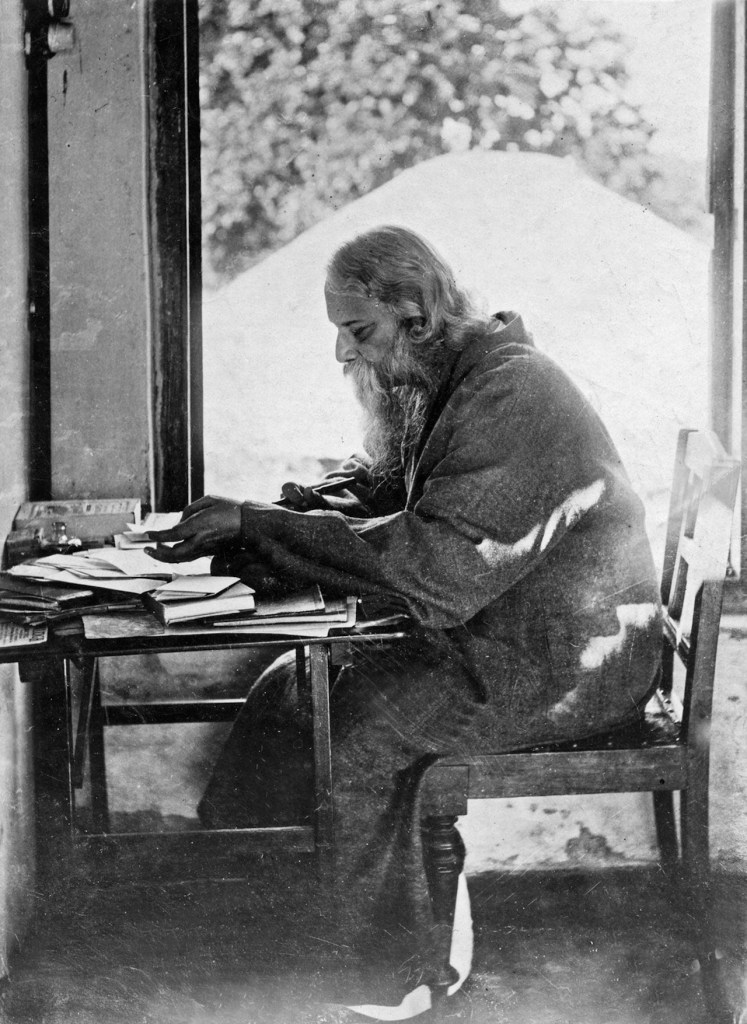
Image: Rabindranath Tagore – Britannica
Rabindranath Tagore’s “The Last Bargain”
Rabindranath Tagore’s “The Last Bargain” focuses on what seems to be an quandary: how is it that a child’s offering of “nothing” to a seeker becomes the “last bargain” as well as the best bargain?
Introduction and Text of “The Last Bargain”
The human mind/hear/soul engages in the spiritual search in order to gain freedom and bliss. Much sorrow and pain afflict those who focus solely on the material level of existence.
As the speaker in Rabindranath Tagore’s “The Last Bargain” searches for a job, he is, in fact, demonstrating the difference between focusing on the material level of being and focusing on the spiritual level.
The Last Bargain
“Come and hire me,” I cried, while in the morning I was walking on the stone-paved road.
Sword in hand, the King came in his chariot.
He held my hand and said, “I will hire you with my power.”
But his power counted for nought, and he went away in his chariot.
In the heat of the midday the houses stood with shut doors.
I wandered along the crooked lane.
An old man came out with his bag of gold.
He pondered and said, “I will hire you with my money.”
He weighed his coins one by one, but I turned away.
It was evening. The garden hedge was all aflower.
The fair maid came out and said, “I will hire you with a smile.”
Her smile paled and melted into tears, and she went back alone into the dark.
The sun glistened on the sand, and the sea waves broke waywardly.
A child sat playing with shells.
He raised his head and seemed to know me, and said, “I hire you with nothing.”
From thenceforward that bargain struck in child’s play made me a free man.
Commentary on “The Last Bargain”
Rabindranath Tagore’s “The Last Bargain” presents an enigma: how can it be that a child offering nothing can be the bargain that makes a “free man” of the seeker?
First Movement: Seeking Employment
“Come and hire me,” I cried, while in the morning I was walking on the stone-paved road.
Sword in hand, the King came in his chariot.
He held my hand and said, “I will hire you with my power.”
But his power counted for nought, and he went away in his chariot.
The opening movement taking place in the morning finds the speaker apparently seeking employment; thus he announces, “Come and hire me.” A king then comes on the scene, offering the individual employment through his “power.”
However, the job seeker determines that the king’s power held very little value. The king then moves away in his “chariot.” Then the speaker continues to search. Now, the reader is likely to suspect that this speaker is not seeking a job on the material, planet Earth, physical sense.
Second Movement: Continuing the Search
In the heat of the midday the houses stood with shut doors.
I wandered along the crooked lane.
An old man came out with his bag of gold.
He pondered and said, “I will hire you with my money.”
He weighed his coins one by one, but I turned away.
The speaker keeps up his search, and the time now is “midday.” He takes notice that the doors to all of the houses are closed. All of a sudden, an old man comes on the scene; he is carrying a “bag of gold.” The old man then inform the seeker that he will offer him a job “with [his] money.”
The old man counts out his coins piece by piece, which demonstrates his attachment to money—a physical level necessity and reality. However, that display of physical attachment annoys this spiritual seeker, who then turns away in disgust.
The speaker remains unimpressed by the power of a king, and he is not favorable to an old man’s “gold.” The reader can now be assured that the speaker is not seeking an earthly job and thus not seeking worldly goods; instead, he is searching for the spiritual love that comes only from God. Worldly wealth and power hold no importance for him.
Third Movement: Experiencing a Change
It was evening. The garden hedge was all aflower.
The fair maid came out and said, “I will hire you with a smile.”
Her smile paled and melted into tears, and she went back alone into the dark.
However, the seeker continues on well into evening, when he sees, a “garden hedge [ ] all aflower.” Then he encounters a “fair maid” who says, “I will hire you with a smile.” But he inevitably experiences the transformation that comes to the aged human being as the smile “paled and melted into tears.” Thus rejected, the maiden “went back alone into the dark.”
Fourth Movement: The Best Bargain
The sun glistened on the sand, and the sea waves broke waywardly.
A child sat playing with shells.
He raised his head and seemed to know me, and said, “I hire you with nothing.”
From thenceforward that bargain struck in child’s play made me a free man.
In the final movement, the speaker, as he is walking along the ocean’s shore, watching the turbulent waves, and meeting a child who is playing on the shore, is afforded his final bargain: the child affirms, “I hire you with nothing.” This final bargain thus results in a situation that ultimately becomes the best bargain.
The best bargain is the one that liberates the seeker from searching for satisfaction from earthly things. He, then instead, may focus his attention on his own soul, where the real “job” of seeking freedom, liberation, and bliss exist.
It is the quiet Spirit—the seeming nothingness contrasting with materiality, the space transcending time and matter—that turns out to be the genuine, true employer. Working for the Celestial, Divine Employer (God) affords the laborer the true freedom, soul realization, and bliss—none of which can achieved by earthly power, gold, and physical affection.
🕉
You are welcome to join me on the following social media:
TruthSocial, Locals, Gettr, X, Bluesky, Facebook, Pinterest
🕉
Share
 Linda's Literary Home