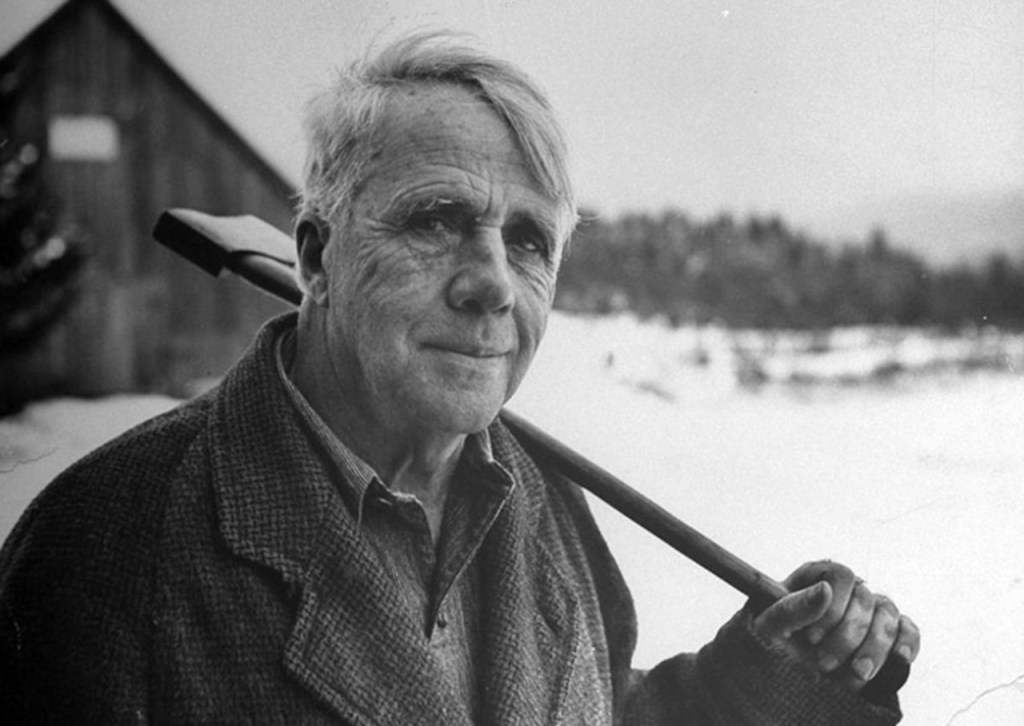
Robert Frost’s “Bereft”
Robert Frost’s poem, “Bereft,” displays one the most amazing metaphors to be encountered in poetry: “Leaves got up in a coil and hissed / Blindly struck at my knee and missed.” Like “The Road Not Taken,” however, this poem offers up a tricky feature.
Introduction with Text of “Bereft”
Robert Frost masterfully guides his metaphor to render his poem “Bereft” a significant American poem. Despite the sadness and seriousness of the poem’s subject, readers will delight in the masterful use of the marvelous metaphor displayed within it.
The speaker in this poem is living alone and he is sorrowful. He says he has “no one left but God.” The odd rime-scheme of the poem—AAAAABBACCDDDEDE— bestows a mesmerizing effect, perfectly complementing the haunting grief of the subject.
The important metaphor—”Leaves got up in a coil and hissed, / Blindly struck at my knee and missed”—remains one of the best in the English language. The visual imagery of this metaphor is stark and startling, yet clear and powerful.
Sometimes the concept and function of metaphor is difficult for beginning poetry students and readers to grasp, and the leaves as snake metaphor should be in every teacher’s toolkit for explaining the concept and function of metaphor to students.
Serving as a clarifying example, that metaphor is one of the most useful and beneficial to help novices read and understand poetry. Robert Frost, in this poem, demonstrates his strongest poetic powers. And he also adds a little trick that has become part of his modus operandi.
Bereft
Where had I heard this wind before
Change like this to a deeper roar?
What would it take my standing there for,
Holding open a restive door,
Looking down hill to a frothy shore?
Summer was past and the day was past.
Sombre clouds in the west were massed.
Out on the porch’s sagging floor,
Leaves got up in a coil and hissed,
Blindly struck at my knee and missed.
Something sinister in the tone
Told me my secret must be known:
Word I was in the house alone
Somehow must have gotten abroad,
Word I was in my life alone,
Word I had no one left but God.
Reading
Commentary on “Bereft”
The speaker in Robert Frost’s “Bereft” expresses his melancholy aloneness. He is in his life as well as in his house alone. His haunting description of nature around him bespeak shis utter sorrow, and a mysterious aura seems to hang on his every image.
First Movement: A Man Alone in His Life
Where had I heard this wind before
Change like this to a deeper roar?
What would it take my standing there for,
Holding open a restive door,
Looking down hill to a frothy shore?
In the first two lines, the poem commences with a question as the speaker asks about having heard a similar sound in the wind prior to this moment. The wind had intensified to a “deeper roar.” The speaker, who is a man alone in his life, is sharply cognizant of sounds; it is human nature that when one is alone, one seems to hear every little sound.
Then the speaker poses another question. He wonders what the wind might be thinking of him just standing idly holding the door open, as he stares down at the shore of a body of water, perhaps a lake. The lake’s waters have been whipped up into a spume that is landing on the bank.
He continues musing on what such a roaring wind would think of his just standing there quietly holding open his door with the wind shoving itself against it. He continues to give a blank stare down to the lake that looks like a tornado or hurricane is swirling it up in to billows with a roaring wind. Somehow it feels to him that the wind must be judging him in his odd movements.
Second Movement: Funereal Clouds
Summer was past and the day was past.
Sombre clouds in the west were massed.
Then in a riming couplet, the speaker observes that summer is over, and the end of the day begins to represent more than the actual season and day. Those endings take on the function of a symbol as the speaker paints metaphorically his own age: his youth is already gone and old age has taken him. He intuits that the funereal clouds are heralding his own demise.
Third Movement: Sagging Life
Out on the porch’s sagging floor,
Leaves got up in a coil and hissed,
Blindly struck at my knee and missed.
The speaker steps out onto the porch that is sagging, and here is where that magnificent metaphor makes its appearance:
Leaves got up in a coil and hissed,
Blindly struck at my knee and missed.
The speaker metaphorically likens the leaves to a snake without even employing the word “snake.” He allows the leaves to make an image of a snake as he dramatizes their action. The wind whips the leaves up into a coil, and they aim for the speaker’s knee, but before they could strike, the wind lets them drop.
Fourth Movement: Alone Only with God
Something sinister in the tone
Told me my secret must be known:
Word I was in the house alone
Somehow must have gotten abroad,
Word I was in my life alone,
Word I had no one left but God.
The entire scene is sober, as are the clouds that were accumulating in the west. The speaker describes the scene as “sinister”: The wind’s deep roar, the sagging porch, the leaves acting snakelike—all calculate as something “sinister” to the speaker.
The speaker then guesses that the dark and sinister scene has been effected because word had gotten out that he is alone—he is in this big house alone. Somehow the secret had gotten out, and now all of nature is conspiring to remind him of his aloneness. But even more important than the fact that he is living in his house alone is the fact that he is living “in [his] life alone.”
The appalling secret that he has “no left but God” is prompting the weather and even the supposedly insensate nature to act in a disturbing manner just because they have the power to do so. And nature along with the weather possesses that power because it is so easy to disturb and intimidate a bereaved individual who is alone in his life. The speaker’s circumstance as a bereaved individual appears to move all of nature to collude against his peace of mind.
Nevertheless, readers will recall that the speaker has said he has God in his life—even if he had phrased it quite negatively. Still, if all one has in one’s life is God, that life will, in fact, remain full.
As usual, Robert Frost has created a very tricky poem. All the sadness, loneliness, natural wizardry, and lamentation amount to very little when the realization of having God in his life is noted and affirmed.
🕉
You are welcome to join me on the following social media:
TruthSocial, Locals, Gettr, X, Bluesky, Facebook, Pinterest
🕉
Share
 Linda's Literary Home