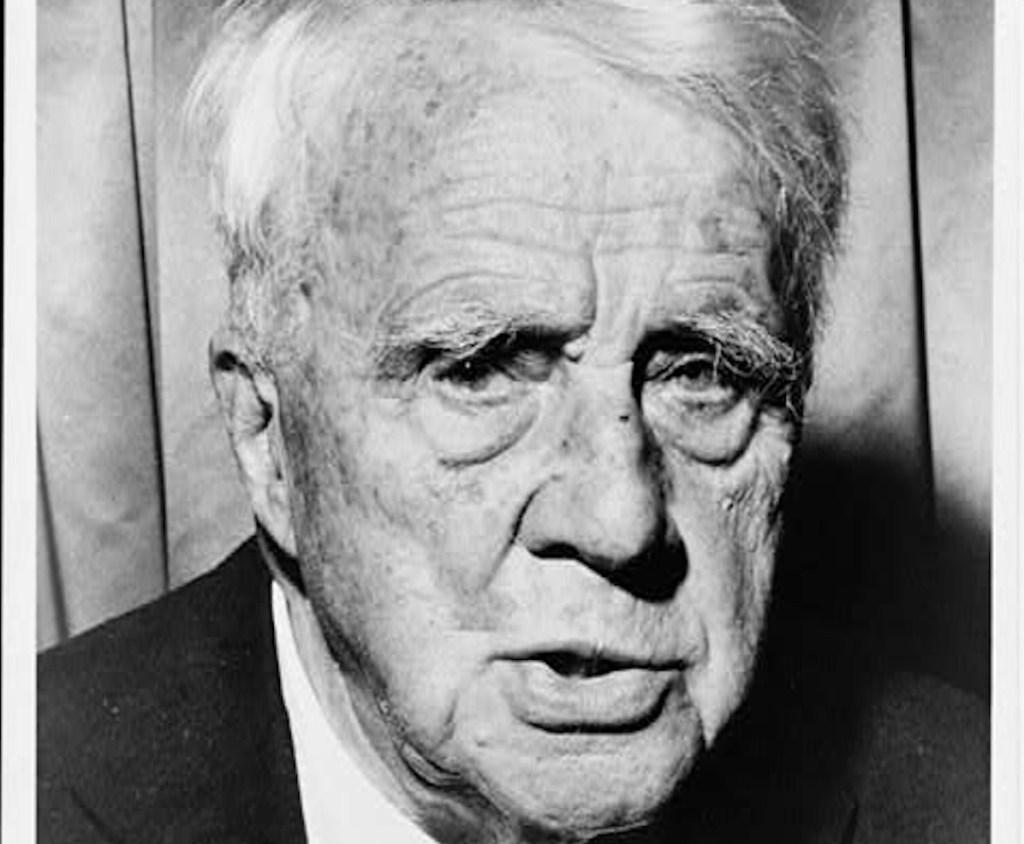
Image: Robert Frost – Library of Congress
Robert Frost’s “Stopping by Woods on a Snowy Evening”
Robert Frost’s “Stopping by Woods on a Snowy Evening” seems simple, but its repeated phrase, “And miles to go before I sleep,” offers room for speculation. Many of Frost’s poems present a tricky element, as he quipped about “The Road Not Taken” being “very tricky.”
Introduction with Text of “Stopping by Woods on a Snowy Evening”
The beloved American poet, Robert Frost, wrote many “tricky poems.” Frost has even quipped that his “The Road Not Taken” is a “very tricky poem.” One might wonder if he also thought that many of his other poems are tricky. Chiefly because of the final repeated line, his “Stopping by Woods on a Snowy Evening” may also be considered a highly tricky poem.
The main event of the poem remains uncomplicated: a man has paused his trek home and sits by a woodland viewing the scene as the snow is piling up in the woods. And the man’s thoughts as he continues to view the scene and what he expresses as he watches may suggest many questions regarding his thoughts and musings.
The speaker’s audience then must remain curious about the speaker’s reasons for stopping to muse: was it only to watch the snow filling up the woods? Why does he think his stopping is “queer”—a qualification he projected onto his horse? Why does he care if the owner of the woods would see him?
The questions raised are only suggested in the speaker’s report but never answered. Although the poem is very simple and uncomplicated without even the use of a literary device such as metaphor, it encourages much speculation.
Then too, a further puzzlement might be: what seemed to cause him to return to his ordinary consciousness from his trance-like musing on the loveliness of snow piling up in the woods?
Although critics who have interpreted the notion of suicide from the last repeated line can offer nothing concrete for such a bizarre reading, still that repetition may suggest something other than its literal claim. Readers are, of course, free to speculate about the difference in meanings of the repeated line, but at the same time they can still enjoy the simple beauty of the poem.
Stopping by Woods on a Snowy Evening
Whose woods these are I think I know.
His house is in the village though;
He will not see me stopping here
To watch his woods fill up with snow.
My little horse must think it queer
To stop without a farmhouse near
Between the woods and frozen lake
The darkest evening of the year.
He gives his harness bells a shake
To ask if there is some mistake.
The only other sound’s the sweep
Of easy wind and downy flake.
The woods are lovely, dark and deep,
But I have promises to keep,
And miles to go before I sleep,
And miles to go before I sleep.
Reading
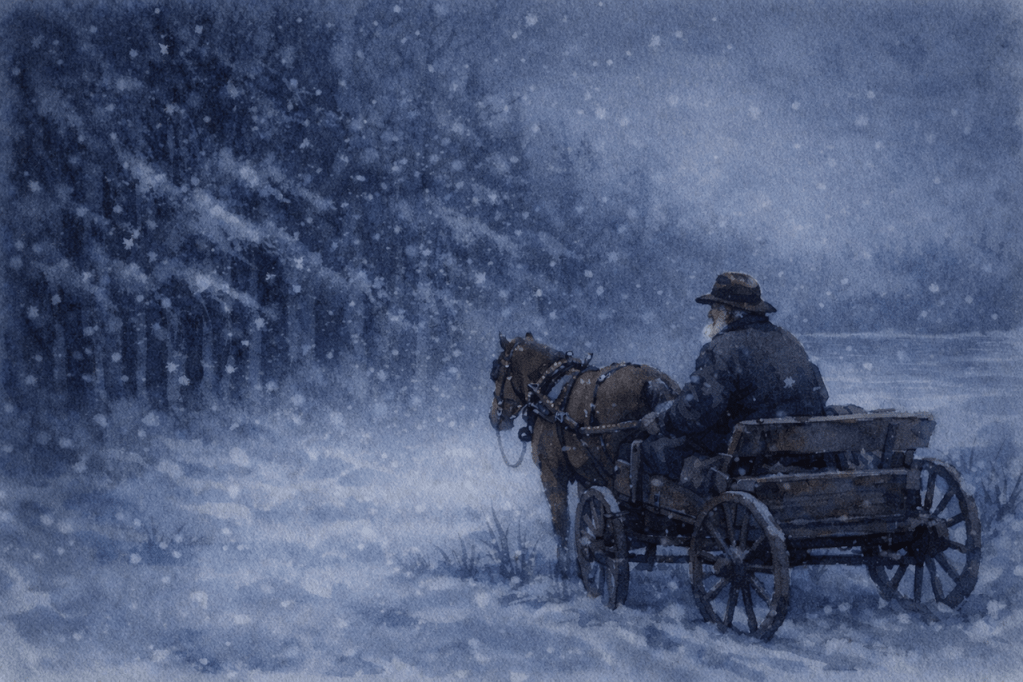
Image: “Musing on a Snowy Evening” – Created by ChatGPT – Titled by Linda Sue Grimes
Commentary on “Stopping by Woods on a Snowy Evening”
One of his tricky poems, Robert Frost’s “Stopping by Woods on a Snowy Evening” seems simple, but the repetition of its nuanced phrase, “And miles to go before I sleep,” offers room for interpretation.
Stanza 1: The Reason for Stopping
Whose woods these are I think I know.
His house is in the village though;
He will not see me stopping here
To watch his woods fill up with snow.
Robert Frost’s simple poem, “Stopping by Woods on a Snowy Evening,” offers an uncomplicated scene wherein a man who was riding a horse pauses his ride by the roadside near a wooded area to observe as the snow is falling and piling up in the woods.
The poem is executed without extensive figurative language and literary devices such as metaphor and metonymy. However, the speaker’s claims do herald questions as noted in the introduction.
One is likely to wonder if the speaker would not have stopped if he thought the owner of the land would see him. Because the speaker mentions that fact, the listener cannot help but wonder why.
Stanza 2: The Horse Thinks What the Man Thinks
My little horse must think it queer
To stop without a farmhouse near
Between the woods and frozen lake
The darkest evening of the year.
The speaker then reports what he thinks his horse thinks: he claims that his horse must be thinking it an odd thing to be stopping before reaching home, and equally strange that the man would want to stop beside a woodland and lake while it is becoming dark outside.
The speaker suggests that the time of year is around December 22, the shortest day of the year and the beginning of winter in the Northern Hemisphere. That is the reason it is “the darkest evening of the year.”
It is obvious that it is the speaker himself who thinks his behavior is odd, stopping in the cold, dark winter weather to watch snow falling in a woods. That he projects his thoughts onto his “little horse” is, of course, merely a ruse that dramatizes his own actions.
Stanza 3: Soft Breezes and Flaky Snow
He gives his harness bells a shake
To ask if there is some mistake.
The only other sound’s the sweep
Of easy wind and downy flake.
In stanza 3, the speaker reveals that he thinks the horse has deemed this stopping as odd because the horse is shaking his head and rattling his harness. The speaker continues to speculate about what the horse thinks; this time he suggests that his horse thinks he made a “mistake.” Such speculation about the cogitation of a horse actually becomes rather comical.
It has become quite clear that all of the thoughts the speaker has speculated about what the horse thinks is simply what the speaker himself is thinking. He seems to want to suggest that this stopping to watch snow filling up a woods is somehow unseemly or at least “queer”—in the original definition of the term.
The speaker then notices that other than the rattling of the horse’s harness it is utterly quiet with the only sound he hears being the wind gently blowing as the snowflakes whirl around and into the woodland.
Stanza 4: Many Miles to Keep Promises
The woods are lovely, dark and deep,
But I have promises to keep,
And miles to go before I sleep,
And miles to go before I sleep.
In stanza 4, the speaker paints the only pictorial details about what he is viewing, as he reports that the woodland is “lovely, dark and deep.” The bulk of the poem simply offers speculation about who might have seen him and what his little horse may be thinking.
Finally, the speaker ends his musing by claiming that he has made promises, and he must keep them. He must still be a fairly great distance from his residence as he claims that he has miles yet to travel before he can “sleep.” Those final three lines, actually, state the reason that the speaker must cease his musing on the beauty and quiet of the woodland and continue on with he journey back home.
But the claim that he “has miles to go before [he] sleep[s]” because it is repeated offers room for interpretation. Perhaps the second repetition has a different meaning from the first, or just perhaps that is the only way to end poem.
The Rime Scheme
It is quite likely that the final repetition has no further meaning from it first iteration. The rime scheme that the poet has crafted simply offers no way out of the poem except to repeat the line: AABA BBCB CCDC DDDD.
Notice that the poet has taken the last word in the third line of the first stanza—”here”—and rimed it with last word in the first—”queer,” second—”near,” and fourth—”year” lines in the second stanza.
He then repeats that scheme until the end of the poem. In theory, he could have continued down through the entire alphabet. With such a connected system of riming, there is no useful, harmonious way to end the poem, except the way he actually did.
Perhaps merely stopping is a option but not as graceful, and too, by the repetition in this particular poem, because of the subject matter, the repetition adds a nuance of meaning, promulgating the suggestion that the first part of the repetition has a different meaning form the second.
Repeated Line Open to Interpretation
By repeating the line, “And miles to go before I sleep,” the speaker has crafted an intriguing curiosity that cannot be mollified by the reader, scholar, critic, or commentarian. The poem offers no support for the idea that the speaker is suggesting he might be thinking about suicide. That interpretive speculation is overly melodramatic.
However, the speaker seems to awaken from a trance-like musing as he watches the snow piling up in the woods, and it does remain unclear what caused him to wake up from that dream-like musing. As laid out in the introduction, the piece does herald questions without providing any concrete answers.
Because these questions are not answered by the speaker of the poem, but also because Robert Frost called his poem, “The Road Not Taken,” “a tricky poem,” readers may possibly speculate that Frost held that his “Stopping by Woods on a Snowy Evening” was also a “very tricky poem.”
Ultimately, answers to those questions do not matter. The poem offers a serene scene of a man observing nature and then moving on. The meaningful beauty of the poem, one might argue, is in the lack of details and how a consummate poet can create a stunning, impressive piece of art based on such simplicity.
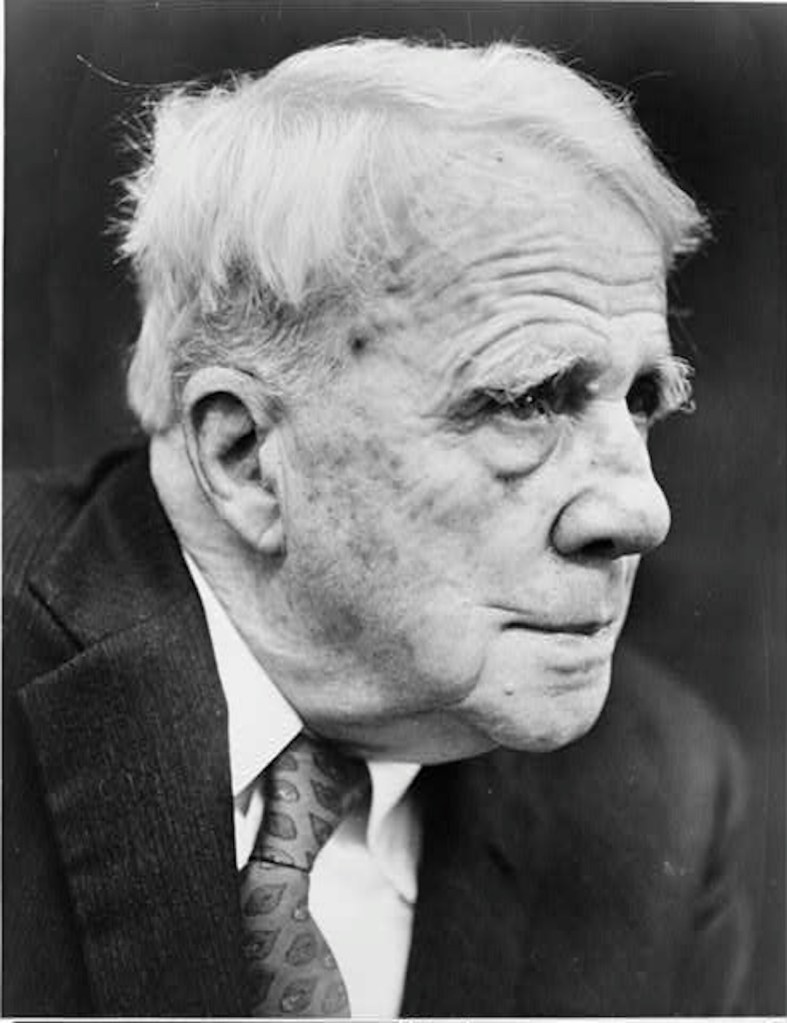
Image: Robert Frost – Library of Congress
🕉
You are welcome to join me on the following social media:
TruthSocial, Locals, Gettr, X, Bluesky, Facebook, Pinterest
🕉
Share
 Linda's Literary Home