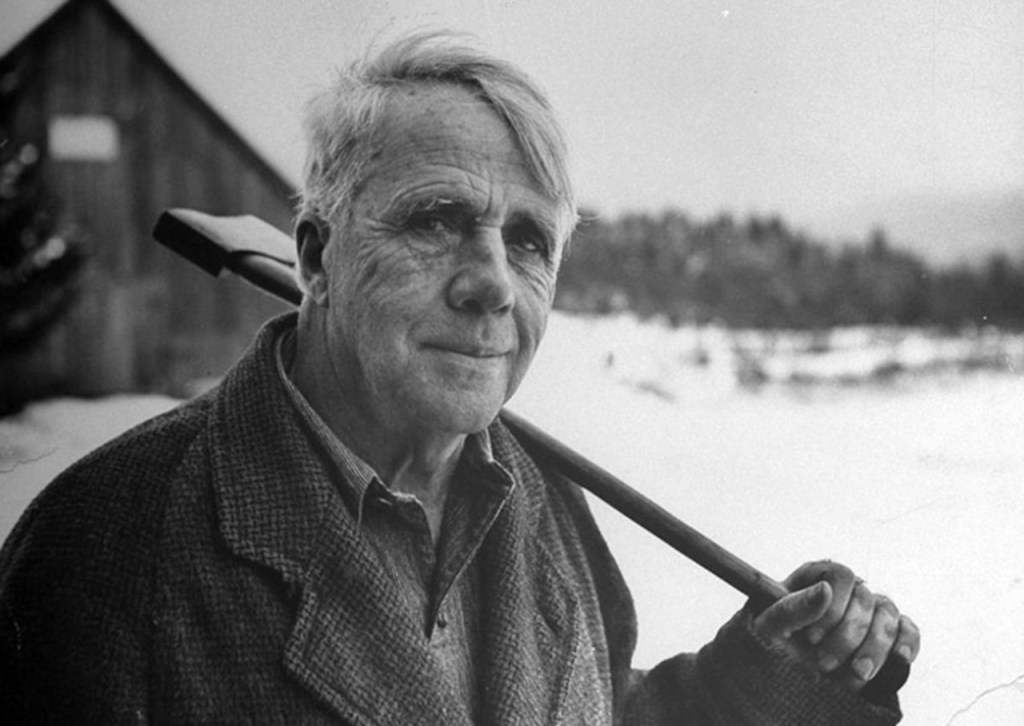
Image: Robert Frost in 1943
Robert Frost’s “The Road Not Taken”
Robert Frost’s “The Road Not Taken” is often misinterpreted; it does not encourage nonconformity. It dramatizes the difficulty of making choices and then living with the consequences.
Introduction with Text of “The Road Not Taken”
Robert Frost’s “The Road Not Taken” has been one of the most anthologized, analyzed, and quoted poems in American poetry. It has also remained one of the most misunderstood and thus misinterpreted poems in the English language.
Published in 1916 in Robert Frost’s poetry collection titled, Mountain Interval, the poem has since been interpreted primarily as piece that prompts non-conforming behavior, a philosophy of the efficacy of striking out on one’s own, instead of following the herd. Thus the poem is often quoted at commencement ceremonies. However, a close look at the poem reveals a different focus.
Instead of offering a moralizing piece of advice, the poem merely demonstrates how memory often glamorizes past choices despite the fact that the differences between the choices were not so great. It also shows how the mind tends to focus on the choice one had to abandon in favor of the one selected.
Edward Thomas and “The Road Not Taken”
Robert Frost lived in England from 1912 to 1914; he became fast friends with fellow poet Edward Thomas. Frost has explained that “The Road Not Taken” was prompted by Thomas, who would continue to fret over the path the couple could not take as they were out walking in the woods near their village.
The Road Not Taken
Two roads diverged in a yellow wood,
And sorry I could not travel both
And be one traveler, long I stood
And looked down one as far as I could
To where it bent in the undergrowth;
Then took the other, as just as fair,
And having perhaps the better claim,
Because it was grassy and wanted wear;
Though as for that the passing there
Had worn them really about the same,
And both that morning equally lay
In leaves no step had trodden black.
Oh, I kept the first for another day!
Yet knowing how way leads on to way,
I doubted if I should ever come back.
I shall be telling this with a sigh
Somewhere ages and ages hence:
Two roads diverged in a wood, and I—
I took the one less traveled by,
And that has made all the difference.
Robert Frost Reads “The Road Not Taken”
Commentary on “The Road Not Taken”
Robert Frost called “The Road Not Taken” “very tricky.” Some readers have not heeded his advice to be careful with this one. Thus, a misunderstanding brings this poem into places for which it is not suitable, such as graduation ceremonies, wherein the speaker has taken as his theme the efficacy of strong individualism as opposed to herd conformity.
First Stanza: The Decision and the Process of Deciding
Two roads diverged in a yellow wood,
And sorry I could not travel both
And be one traveler, long I stood
And looked down one as far as I could
To where it bent in the undergrowth;
In the first stanza, the speaker reveals that he has been out walking in the woods, and he approaches two diverging pathways; he stops and peers down each path as far as he can. He then avers that he would like to walk down each path, but he is sure he does not have enough time to experience both. He knows he must take one path and leave the other behind, and so he commences his decision making process.
Second Stanza: The Reluctant Choice
Then took the other, as just as fair,
And having perhaps the better claim,
Because it was grassy and wanted wear;
Though as for that the passing there
Had worn them really about the same,
After scrutinizing both pathways, he decides to start walking down the one that seems “less traveled.” He admits they were “really about the same.” They were, of course, not exactly the same, but in reality there was not much difference between them as far as he could tell from where he stood. Both paths had been “traveled,” but he fancies that he chooses the one because it was a little less traveled than the other.
Notice at this point how the actual choice in the poem seems to deviate from the title. The speaker takes the road less taken, not the one “not taken,” as the title seems to suggest. That fact was, no doubt, part of the trickiness that Frost mentioned as he discussed the genesis of this poem, calling it “very tricky.”
The title also lends to the moralizing interpretation. The path not taken is the one not taken by the speaker—both roads have been taken by others, but the speaker being just one individual could take only one.
Third Stanza: Really More Similar Than Different
And both that morning equally lay
In leaves no step had trodden black.
Oh, I kept the first for another day!
Yet knowing how way leads on to way,
I doubted if I should ever come back.
Because the decision making process can be complex and lengthy, the speaker continues to reveal his thinking about the two paths into the third stanza. But again he reports how the paths were really more similar than different.
Fourth Stanza: The Ambiguous Sigh
I shall be telling this with a sigh
Somewhere ages and ages hence:
Two roads diverged in a wood, and I—
I took the one less traveled by,
And that has made all the difference.
In the final stanza, the speaker projects how he will look back on his decision in the distant future. He surmises that he will remember taking a “less traveled” road, and that decision “has made all the difference.”
The problem with interpreting the poem as advice for individualism and non-conformity is that the speaker is only speculating about how his decision will affect his future. He cannot know for certain that his decision was a wise one, because he has not yet lived it.
Even though he predicts that he will think it was a positive choice when he says, it “made all the difference,” a phrase that usually indicates a good difference, in reality, he cannot know for sure.
The use of the word “sigh” is also ambiguous. A sigh can indicate relief or regret——two nearly opposite states of mind. Therefore, whether the sigh comports with a positive difference or negative cannot be known to the speaker at the time he is musing in the poem. He simply has not lived the experience yet.
“Tricky Poem”
Frost referred to this poem as a tricky poem, and he admonished readers “to be careful of that one.” He knew that human memory tends to gloss over past mistakes and glamorize the trivial. He also was aware that a quick, simplistic perusal of the poem could yield an erroneous understanding of it.
The poet also has stated that this poem reflects his friend Edward Thomas’ attitude while out walking in the woods near London, England. Thomas continued to wonder what he might be missing by not being able to walk both paths, thus the title’s emphasis on the road “not taken.”
“Road” as a Symbol for Life’s “Path”
In this commentary, readers may notice that I have used the term “path” instead of road in most the references to that entity in the poem. The poem begins by placing the speaker in a “yellow wood.” Thus, the speaker has encountered two different pathways through the wood because it more likely that a wood has paths (pathways) than roads. Paths are for walking; roads are for vehicle traffic.
Thus, I suggest that the speaker is employing the term “road” as a symbol of one’s pathway through life——not a a literal road in a wood. Even though the speaker had used the term “travel” in the opening lines, he later limits that mode of travel to foot travel when he says, “long I stood” and later, “In leaves no step had trodden black.” He “stood” because he had been walking. And “step had trodden black” refers to the condition of the leaves having been walked upon.
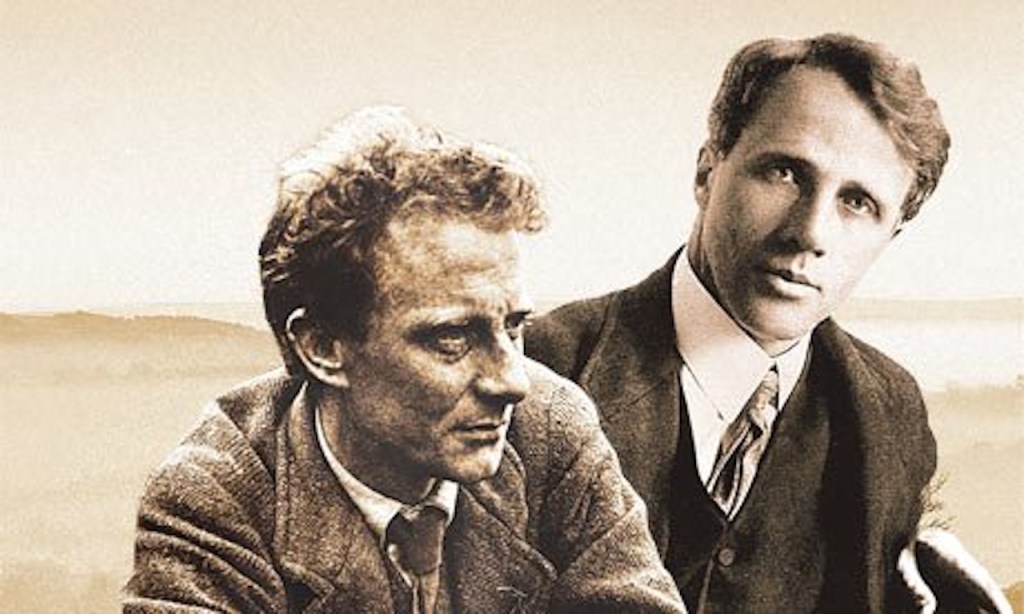
Image: Robert Frost and Edward Thomas
🕉
You are welcome to join me on the following social media:
TruthSocial, Locals, Gettr, X, Bluesky, Facebook, Pinterest
🕉
Share
 Linda's Literary Home