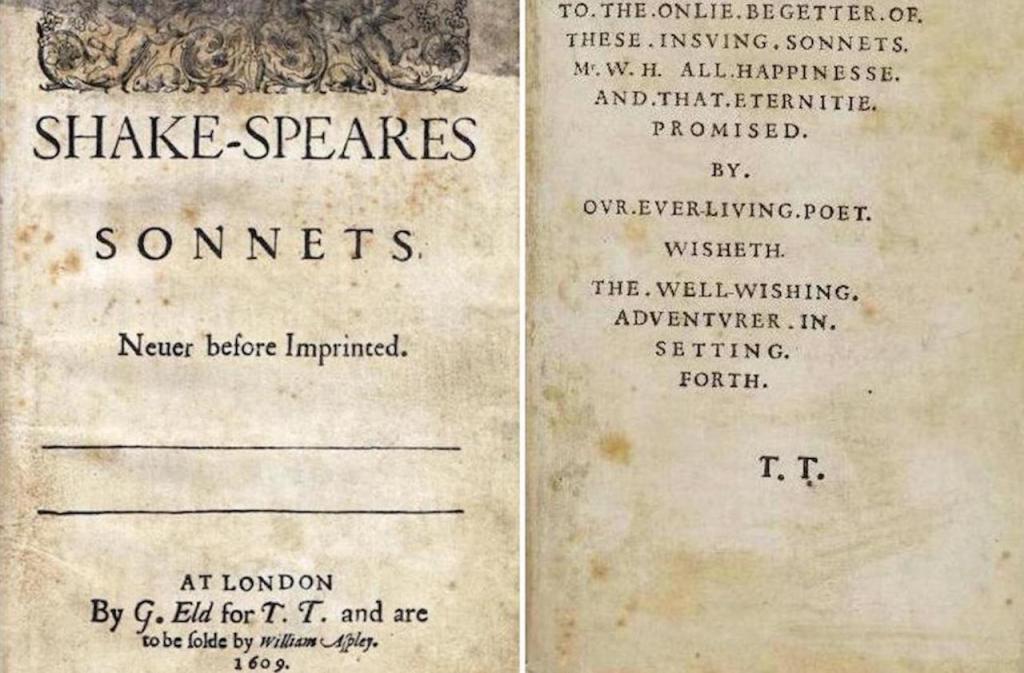
Image: Shake-speares Sonnets Hank Whittemore’s Shakespeare Blog
Shakespeare Sonnets: The Muse Sonnets 18—73
Shakespeare Sonnet 18 “Shall I compare thee to a summer’s day?”
Shakespeare sonnet 18 “Shall I Compare Thee to a Summer’s Day” is one of the bard’s most widely anthologized—and most widely misunderstood—sonnets. There is no person in this sonnet: the speaker is not comparing/contrasting the beauty of nature and the beauty of a paramour.
Introduction with Text of Sonnet 18 “Shall I compare thee to a summer’s day?”
The second thematic group within the classic Shakespeare 154-sonnet sequence is “The Muse Sonnets,” and that groups begins with sonnet 18 “Shall I compare thee to a summer’s day?”; the Shakespeare speaker shifts from persuading a young man to marry and produce pleasing offspring to addressing important issues vis-à-vis his writing ability.
In “The Muse Sonnets” (18-126), which comprise the majority of the classic 154-sonnet sequence, the speaker is addressing his muse, his own frailties, and often the poem itself in his attempt to guarantee that he always faces a profound issue with which to grapple in his creative writings.
Sonnet 18 “Shall I compare thee to a summer’s day?“ focuses on the speaker’s comparing the sonnet to a day in summer. This sonnet has been widely misunderstood to be comparing a paramour to a summer’s day; yet, there is no human being in this sonnet or in any of the others that comprise this thematic group.
This group of sonnets (18-126) has been widely mischaracterized as speaking to a young man and thus, in my opinion, wrongly titled as “The Fair Youth” sonnets. A close reading reveals that the speaker is not addressing any person in this group of sonnets.
Sonnet 18 “Shall I compare thee to a summer’s day” remains an example of the traditional English sonnet, also labeled Shakespearean or Elizabethan sonnet. This form includes three quatrains with the rime scheme ABAB CDCD EFEF and a couplet with the rime GG.
Sonnet 18 “Shall I compare thee to a summer’s day?”
Shall I compare thee to a summer’s day?
Thou art more lovely and more temperate:
Rough winds do shake the darling buds of May,
And summer’s lease hath all too short a date:
Sometime too hot the eye of heaven shines,
And often is his gold complexion dimm’d;
And every fair from fair sometime declines,
By chance, or nature’s changing course untrimm’d;
But thy eternal summer shall not fade,
Nor lose possession of that fair thou ow’st,
Nor shall death brag thou wander’st in his shade,
When in eternal lines to time thou grow’st;
So long as men can breathe, or eyes can see,
So long lives this, and this gives life to thee.
Original Text
Better Reading
Commentary on Sonnet 18: “Shall I compare thee to a summer’s day?”
Comparing his sonnet to a summer day, the speaker finds his own creation to possess advantages over that beautiful seasonal wonder. Please note that there is no person in this sonnet; yet it is often interpreted as a paean to a lover.
First Quatrain: A Sonnet Outlasts Summer
ShallI compare thee to a summer’s day?
Thou art more lovely and more temperate:
Rough winds do shake the darling buds of May,
And summer’s lease hath all too short a date:
This quatrain has the speaker musing on whether he should compare his sonnet to a day in summer. Then he begins the comparison which is in actuality a contrast. He contends that the sonnet is, in fact, “more lovely” and more even-tempered than one of those beautiful summer days.
The idea that his sonnet is more beautiful is, of course, just the speaker’s opinion, but he intends to prove that his opinion is accurate. Thus he claims that the early flowers of May are sometimes molested by “rough winds,” and with this fact alone, it can be demonstrated that a summer day is not always so “temperate.”
He then adds that summer simply does not remain long; the season comes and the quickly goes. His sonnet, however, may last eternally after it has been written. The sonnet’s beauty will remain mild, not shaking any buds with any empty, gusty winds.
The audience is likely aware that summer does not actually begin in May but in the middle of June. However, the speaker, by asserting that even in May the weather may be disagreeable, is suggesting that one can likely expect some equally bad weather to come along in summer proper.
Second Quatrain: No Fickle Weather in a Sonnet
Sometime too hot the eye of heaven shines,
And often is his gold complexion dimm’d;
And every fair from fair sometime declines,
By chance, or nature’s changing course untrimm’d;
The speaker now is bemoaning the heat of summer because sometimes it can simply become too hot; this “eye of heaven” can beam down uncomfortable weather conditions during the season of summer. Also, that same sun can become obscured by a cover of clouds. Thus a day in summer can become unpleasant in ways that the sonnet never will.
The sonnet will never be spoiled by too hot sunshine; it will never become obscured by a cloud cover. The sonnets will stand in loveliness in a permanent manner, even as a day in summer may become unpleasant through extreme sun activity and cloud maneuvers.
It should be noted that the speaker selected the most pleasant season with which to compare/contrast his sonnet. If he had selected to compare/contrast his poem to a winter day, he might be considered to proffered an unfair advantage to his argument.
The speaker confessed that natural creations diminish with time, including people. Some things decay “by chance” while other will be lessened with the transformative activities of nature.
The speaker has been comparing/contrasting the sonnet to the summer day, and already the summer day’s weights in negatively with rough winds shaking the early blossoms, the sun shining too hot while suffering sometimes being shaded with clouds. The speaker is making it clear that all of these natural diminishings cannot molest his sonnet.
Third Quatrain: Existence in Perpetuity
But thy eternal summer shall not fade,
Nor lose possession of that fair thou ow’st,
Nor shall death brag thou wander’st in his shade,
When in eternal lines to time thou grow’st;
In this stanza, the speaker lays out the advantages possessed by the sonnet over those of the day in summer. The summer day must end, while the sonnet may remain eternally. The sonnet is not subject to the same ravages of time that are imposed on a summer day.
The “summer” of a sonnet will never fade as that of the natural summer must, and the sonnet will continue to hold its unique beauty. The sonnet will never die as human beings must, as the sonnet will exist in the poet’s “eternal lines.”
The Couplet: Temperate throughout Eternity
So long as men can breathe, or eyes can see,
So long lives this, and this gives life to thee.
In the couplet, the speaker concludes his discussion with definite finality, summing up his argument with a flourish. As long as people exist and are capable of reading, the speaker’s sonnets will also continue to exist and retain their beauty.
Unlike a day in summer that will continue to demonstrate unfavorable temperatures and then come to an end, the speaker’s sonnet will continue to remain “temperate,” and it will retain its loveliness eternally.
Shakespeare Sonnet 19 “Devouring Time, blunt thou the lion’s paws”
In Shakespeare sonnet 19 “Devouring Time, blunt thou the lion’s paws,” the speaker is personifying and challenging Time to devastate his art as he does all living creatures as they age; then the speaker declares and affirms that Time cannot devastate or diminish his art.
Introduction with Text of Sonnet 19 “Devouring Time, blunt thou the lion’s paws”
In the thematic group “The Marriage Sonnets, 1–17” from the classic Shakespeare 154-sonnet sequence, the speaker is attempting to convince a young man that he should marry and produce offspring. Throughout the sequence, the speaker employs a number of colorful conceits to bolster his argument.
The speaker in sonnets 18-126 “The Muse Sonnets” is addressing the poet’s own talent and art, often directly addressing the very poem he is writing. Again, he employs a number of colorful and dramatic situations to explore his relationship with his art and his ability to create it.
And finally, in “The Dark Lady Sonnets, 127-154,” the speaker is exploring and dramatizing a relationship with a woman of ill repute. In sonnet 19, the speaker is again broaching the subject of his writing talent, as he had begun doing in sonnet 18, in which he addressed the poem itself. Sonnet 19 differs in that the speaker is addressing “Time.”
In sonnet 19, the speaker is personifying “Time” in order to challenge it to spoil his artistic efforts as the passage of time does to all living creatures as they age. The speaker, however, proclaims that Time cannot lay waste to his art.
Sonnet 19 “Devouring Time, blunt thou the lion’s paws”
Devouring Time, blunt thou the lion’s paws
And make the earth devour her own sweet brood;
Pluck the keen teeth from the fierce tiger’s jaws,
And burn the long-liv’d phoenix in her blood;
Make glad and sorry seasons as thou fleets,
And do whate’er thou wilt, swift-footed Time,
To the wide world and all her fading sweets;
But I forbid thee one most heinous crime:
O! carve not with thy hours my love’s fair brow,
Nor draw no lines there with thine antique pen;
Him in thy course untainted do allow
For beauty’s pattern to succeeding men.
Yet, do thy worst, old Time: despite thy wrong,
My love shall in my verse ever live young.
Original Text
Better Reading
Commentary on Sonnet 19 “Devouring Time, blunt thou the lion’s paws”
As this thematic group of sonnets continues to attest, this clever, creative speaker is enjoying his opportunity to challenge his adversaries—even devastatingly strong ones such as Time. His colorful drama plays out in order to offer a triumphant final claim.
First Quatrain: Battling with Time
Devouring Time, blunt thou the lion’s paws
And make the earth devour her own sweet brood;
Pluck the keen teeth from the fierce tiger’s jaws,
And burn the long-liv’d phoenix in her blood;
In the first quatrain, the speaker commences with his direct engagement with Time, in what turns out to be a battle of wills. He is upbraiding Time, challenging it to go ahead and makes “the lion’s paws” dull and unreliable with the aging process; also let sharp incisors of the tiger fail; even let the ever-reviving phoenix succumb to the ashes.
The images of these robust, magnificent creatures being overwhelmed by the ravages of time create a substantial background against which the speaker can aver his later declaration.
This clever speaker has even alluded to the mythical phoenix, the bird that is capable of reviving itself after setting itself ablaze; however, even the phoenix boasted a life-span of only five hundred years.
Second Quatrain: Forbidding Crime
Make glad and sorry seasons as thou fleets,
And do whate’er thou wilt, swift-footed Time,
To the wide world and all her fading sweets;
But I forbid thee one most heinous crime:
In the second quatrain, this clever speaker is challenging the personified Time to create joyous seasons and sad seasons as he hurries by. The speaker even encourages Time to continue on and do whatever he wishes to the whole world. The speaker insists that everything lovely will vanish with the passage of the seasons and years.
But the speaker admonishes Time not to afflict one special being. The insistent speaker declares vehemently that there exists one crime which is so horrendous that the speaker will not permit Time to commit.
Third Quatrain: A Time of Carving
O! carve not with thy hours my love’s fair brow,
Nor draw no lines there with thine antique pen;
Him in thy course untainted do allow
For beauty’s pattern to succeeding men.
In the third quatrain, the speaker unveils the “heinous crime” which he forbids Time to commit: he will not allow Time to cause his poetic creation to grow old and fade. The speaker personifies his sonnet by giving it a face with a “fair brow.”
After Time has employed his tools to “carve” lines into the forehead of an individual, the results are the wrinkles that all old people sport. The speaker demands of Time that he not etch those lines on the faces of his sonnets.
The clever, adroit speaker is employing the pun—”lines”—which refers to both old age wrinkles in a human face and strings of works with which sonnets are composed. The speaker forbids Time to try to impose upon his works—his “love”—the results of Time’s having written with his “antique pen.”
The speaker will not permit Time to overwrite upon his works with his old writing instrument, because this insistent speaker/poet wants his poems to remain fresh and youthful in order to allow succeeding generations to enjoy and appreciate them.
The speaker is creating beauty and storing it in his sonnets, where he knows Time will not be capable of dimming that beauty. His little drama is simply producing a fascinating dilemma which the speaker can easily repudiate because of his masterful skill in poetry creation.
The Couplet: Meeting the Challenge
Yet, do thy worst, old Time: despite thy wrong,
My love shall in my verse ever live young.
In the couplet, the speaker seems to be reversing his argument. He declares, addressing his adversary time, on the other hand, move ahead, “old Time,” do your strongest mischief to devastate my love—my God-given talent—and these sonnets of mine. And even though you strive your very hardest, “My love shall in my verse ever live young.”
This determined speaker’s love, which is his art, his talent for producing beauty in sonnets, is incorruptible by time. His talent will remain young, strong, and full of life eternally.
The speaker, thereby, has overcome the age old obstacle wherein beauty vanishes into rot and decay. At the very least, he has addressed that ancient issue so far as his God-given writing talent, skill, and abilities are concerned.
By crafting beautiful works of art, this creative, resourceful, and talented speaker will permit to be available for perusing a part of his mind and heart, and that viewing will remain throughout eternity or as long as humanity can see, hear, read, and listen.
Shakespeare Sonnet 20 “A woman’s face with Nature’s own hand painted”
In the Shakespearean sonnet 20 “A woman’s face with Nature’s own hand painted,” the speaker is again addressing his poem, likening it to a woman’s charms but finding it less fickle and more capable of consistently shielding love.
Introduction with Text of Sonnet 20“A woman’s face with Nature’s own hand painted”
The Shakespearean sonnet 20 “A woman’s face with Nature’s own hand painted” from the classic Shakespeare 154-sonnet sequence belongs to the group of sonnets that some Shakespeare scholars and critics have designated as the “Fair Youth” (or young man) theme. However, those scholars and critics have also conceded that their classifications are not ironclad.
And as readers experience these sonnets, they come to realize that there is, indeed, no young man nor any person at all in sonnets 18–126. Clearly, sonnets 1-17 can accurately be designated at the “The Marriage Sonnets,” in which the speaker is urging a young man to marry and produce offspring to ensure his legacy.
However, sonnets 18–126, as my commentaries humbly argue, do not portray the kind of relationship that some scholars have claimed for them; instead, they reveal a speaker contemplating and musing upon his own ability to create art—his poetry and plays. At times, he addresses his “muse,” the inspiration for the content of his art, and other times, he addresses his talent generally.
Still other times, he addresses the issue of periods of low inspiration—a phenomenon that all creative writers face periodically. And often, he speaks directly to his poems, as in the first sonnet of this thematic group, sonnet 18 “Shall I compare thee to a summer’s day?,” in which the “thee” in the first line and title refers to his sonnet.
In sonnet 20 “A woman’s face with Nature’s own hand painted,” the speaker is not addressing a person but again his sonnet, as he often does in this thematic group of sonnets 18-126. He is comparing the sonnet to the qualities of a woman, for whom he claims sonnets were first created. As in sonnet 18, he finds the sonnet’s qualities to be more genuine, less fickle, and to hold more love.
Sonnet 20 “A woman’s face with Nature’s own hand painted”
A woman’s face with Nature’s own hand painted
Hast thou, the master-mistress of my passion;
A woman’s gentle heart, but not acquainted
With shifting change, as is false women’s fashion:
An eye more bright than theirs, less false in rolling,
Gilding the object whereupon it gazeth;
A man in hue all hues in his controlling,
Which steals men’s eyes and women’s souls amazeth.
And for a woman wert thou first created;
Till Nature, as she wrought thee, fell a-doting,
And by addition me of thee defeated,
By adding one thing to my purpose nothing.
But since she prick’d thee out for women’s pleasure,
Mine be thy love, and thy love’s use their treasure.
Original Text
Better Reading
Commentary on Sonnet 20 “A woman’s face with Nature’s own hand painted”
In sonnet 20 “A woman’s face with Nature’s own hand painted,” the speaker is again addressing his poem, likening it to a woman’s charms, but finding it less fickle and more capable of consistently shielding love.
First Quatrain: Grace without Fickleness
A woman’s face with Nature’s own hand painted
Hast thou, the master-mistress of my passion;
A woman’s gentle heart, but not acquainted
With shifting change, as is false women’s fashion:
In the first quatrain, the speaker tells the sonnet that it has the grace of a woman’s countenance without the fickleness. The sonnet is the “master-mistress” of the poet’s “passion.” Thus the speaker likens the poem to a woman companion, but he finds the poem an even more satisfying companion because the poem’s face is naturally painted with nature and not cosmetics as a human woman often is.
Also, the sonnet will remain steadfast because it will retain its same thoughts, its same little drama, not changing with the seasons or with any fickle passion that may cross the adult human female mind. The speaker holds the sonnet to have more charm because of its temperate qualities, unlike those of women whose passions may run hot and cold from time to time.
Fortunately, the poem does possess through metaphoric personification a “woman’s gentle heart”—the positive, permanent qualities of the so-called gentler sex also are featured in the sonnet. That the poem will retain those qualities in their original beauty pleases the speaker.
Second Quatrain: Bright and Brighter
An eye more bright than theirs, less false in rolling,
Gilding the object whereupon it gazeth;
A man in hue all hues in his controlling,
Which steals men’s eyes and women’s souls amazeth.
In the second quatrain, the speaker continues to compare the attributes of the poem to those of a woman. He finds a woman to have bright eyes, but the poem’s eyes are even brighter and “less false in rolling.” And what the poem gazes upon becomes gilded: it saves for future generations the subject that is placed into it.
And like a painter who controls the colors that he uses with his brushes, the poem “steals men’s eyes and women’s souls” because of the poet’s amazing skill at capturing the momentous drama as it occurs.
As the speaker compliments the poem’s pleasant qualities, he is also by implication praising his own ability to create such pleasing, true works. The speaker remains confident in his ability to infuse his poems with truth, beauty, and other enduring features that future generations will visit and appreciate.
In their lack of fickleness, his poems and other works of art (such as his plays) will be able to present all thoughts, feelings, and issues in a clever, clear, but honest little drama.
Third Quatrain: Origin of the Sonnet
And for a woman wert thou first created;
Till Nature, as she wrought thee, fell a-doting,
And by addition me of thee defeated,
By adding one thing to my purpose nothing.
The speaker says that the poem was first created for a woman; he is, no doubt, alluding to Giacomo da Lentini, who is credited with the invention of the sonnet, and to Petrarch, who popularized the form. Each poet employed the form to idealize and thus idolize a woman. But then along comes this particular speaker by the grace of nature who realizes that such unreality causes the art form to fall; its “doting” became too fanciful to be useful.
The speaker with his new understanding of realism is defeating that outmoded purpose. The old way of mere idolization is not the present speaker’s purpose. This speaker/poet wants to make rime that truly represents the nature of the subject he chooses to immortalize. And he praises the sonnet as such a practical and useful vehicle.
The Couplet: To Make a Useful Form
But since she prick’d thee out for women’s pleasure,
Mine be thy love, and thy love’s use their treasure.
Still the speaker recognizes the feminine attraction to poetry and has no wish to change that fact. The speaker, however, will devote his talent, his skill, and his love of his art to make the sonnets a useful form that will hold love as “their treasure.”
The speaker is convinced that his art will serve as a repository for his important musings, featuring useful and pleasing qualities that afford humankind a solid foundation for growth and prosperity—especially in cultural issues. His complete confidence in his ability to create treasures of art prompts him to continue to strive and achieve.
Shakespeare Sonnet 21 “So is it not with me as with that Muse”
The theme of sonnet 21 “So is it not with me as with that Muse” from the thematic group “The Muse Sonnets” is similar to other sonnets that offer praise while portraying a realistic description of the belovèd, instead of the exaggerations that amount to untruths.
Introduction with Text of Sonnet 21 “So is it not with me as with that Muse”
In Shakespeare’s era as now, many people thought that poetry was something that was ethereal and dainty and that poets were interested only in sugar-coating ugliness or moving it out of daily affairs.
But the speaker in this group of sonnets—”The Muse Sonnets”—is writing to change that perception, by affirming that true love does not have to be compared only to beautiful flowers and gemstones and stars. This speaker wants to reveal beauty as it appears, not as something that has been cosmeticized and, therefore, falsified.
From the classic Shakespeare 154-sonnet sequence, Shakespeare sonnet 21 “So is it not with me as with that Muse” finds the speaker railing against a poetic tradition that he disdains because of its failure to describe truthfully, thus depriving true beauty of its rightful place in the cosmos.
Sonnet 21 “So is it not with me as with that Muse”
So is it not with me as with that Muse
Stirr’d by a painted beauty to his verse,
Who heaven itself for ornament doth use
And every fair with his fair doth rehearse,
Making a couplement of proud compare,
With sun and moon, with earth and sea’s rich gems,
With April’s first-born flowers, and all things rare
That heaven’s air in this huge rondure hems.
O! let me, true in love, but truly write,
And then believe me, my love is as fair
As any mother’s child, though not so bright
As those gold candles fix’d in heaven’s air:
Let them say more that like of hear-say well;
I will not praise that purpose not to sell.
Original Text
Better Reading
Commentary on Shakespeare Sonnet 21 “So is it not with me as with that Muse”
Sonnet 21 resembles other sonnets of praise that portray a realistic description of the belovèd target, instead of the exaggerations that amount to falsehoods. This speaker consistently contends that he is interested only in the genuine and the truthful.
First Quatrain: False Beauty
So is it not with me as with that Muse
Stirr’d by a painted beauty to his verse,
Who heaven itself for ornament doth use
And every fair with his fair doth rehearse
In the first quatrain of Shakespeare sonnet 21 “So is it not with me as with that Muse,” the speaker says that he will not be like the poet who, while motivated by false beauty, paints artificial beauty upon his belovèd. Interestingly, the speaker is not referring to a person but instead to his sonnets.
The speaker has no intention of painting a false face or façade of beauty upon his poems by comparing his subject matter to heaven. He also will not assert or claim that fake loveliness may ever equal true loveliness. He demonstrates his inner strength garnered through only positive, accurate qualities and descriptions.
This speaker desires to further his reputation by functioning as a plain speaking sonneteer; his art is too important to him to exaggerate and run the risk of being misunderstood.
He has no interest in employing the use of imaginary claims for the true and the beautiful merely to enhance his poetry. This honest, clever speaker wishes to have his poetry represent truth itself, not a version of truth. He strives for the original, not the stock images that had come to dominate poetry.
Second Quatrain: Painted Beauty
Making a couplement of proud compare,
With sun and moon, with earth and sea’s rich gems,
With April’s first-born flowers, and all things rare
That heaven’s air in this huge rondure hems.
Continuing his list of ways that other poets have painted beauty on the faces of their poems, he asserts that he will not compare his sonnets’ subjects to the “sun and moon” or gemstones or the first rush of beauty of April’s blooms.
While other poets pick out many of the most beautiful things on the earth to enhance their poems, he opposes such exaggeration as falsehood. He will not engage in such counterfeit speaking.
By filtering out the aspects and qualities of existence that do not comport with a mainstream shallow notion of the good, the true, and the beautiful, artists lose their grasp on reality and end up launching high-flown rhetoric that never seems to land anywhere, never has the ability to engage the intellect or to inspire the heart.
This speaker is interested in soul qualities, which are genuine, inherently beautiful, and eternal. And this deep-thinking speaker has become aware that sometimes those true aspects do not shine out from the surface of things.
Third Quatrain: From the Heart
O! let me, true in love, but truly write,
And then believe me, my love is as fair
As any mother’s child, though not so bright
As those gold candles fix’d in heaven’s air:
In the third quatrain, the speaker asserts that his heart is interested in truth. This speaker desires to feature only what is actually real, not exaggeration and artificiality. This genuine artist/speaker desires that his writing portray and dramatize only true beauty in order for his readers to accept what he says as truth.
He knows that readers can see through such exaggeration and that they do not appreciate being lied to, nor do the types of readers, whom this speaker seeks out, fancy condescension and flattery.
The speaker asserts that his love, that is, his poetry—remember, there are no persons in this sequence of sonnets, 18–126, the largest section of the 154 sonnet sequence—may not be as bright as stars; nevertheless, his poetry is like his children and is as glorious to him as “any mother’s child.”
Thus, while his poem will exude reality, it will not aspire to the same glow that one sees in the stars in the sky. Those heavenly bright “gold candles” will have no competitor in this genuine artist.
The Couplet: No Interest in False Exaggeration
Let them say more that like of hear-say well;
I will not praise that purpose not to sell.
The speaker allows that others may exaggerate—”[l]et them say more”—those who are not interested in direct or plain speaking, those who are interested only in “hear-say.”This speaker has no intention of praising that which does not deserve praise.
And he is not interested in selling his verse widely to an undiscriminating audience. This speaker continues to assert his belief in the genuine, the true, the beautiful, and the lovely—all that speak directly to the heart and mind of discriminating audiences.
He has no interest in acquiring a gathering of eyeballs that are easily distracted by shallowness, fakery, and condescension. He and his muse must remain above the vulgar, the mundane, and the ordinary by keeping their minds and hearts on the straight path to blessèdness.
Shakespeare Sonnet 22 “My glass shall not persuade me I am old”
The speaker in sonnet 22 “My glass shall not persuade me I am old” asserts that despite his death, his talent for creating poems will cause them to retain his love, inspiring future generations. Confidently, he asserts that his little dramas will continue to inspire all those who encounter them.
Introduction with Text of Sonnet 22 “My glass shall not persuade me I am old”
From the classic Shakespeare 154-sonnet sequence, this sonnet 22 “My glass shall not persuade me I am old” belongs to “The Muse Sonnets” thematic subsequence, wherein the Shakespeare writer has his speaker question and examine his abilities for composing sonnets; this group comprises the largest section in the 154 poem sequence.
As has been shown before, the first thematic section includes the first 17 sonnets. The second thematic section includes 18-126—109 sonnets. The final section, the “Dark Lady” theme includes 127-154 or 28 sonnets.
It remains completely appropriate that a writer such as the one experienced in the Shakespeare canon would be absorbed in his own writing process, as this thematic subsequence of 109 sonnets attests. Therefore, it is unsurprising that he demonstrates more interest with more sonnets in his composing muse than in the themes of the other two subsequence—”The Marriage Sonnets” and “The Dark Lady Sonnets.”
Thus the speaker in sonnet 22 “My glass shall not persuade me I am old” is asserting that despite the aging and eventual death of his phis divinely inspired sonnets will inspire future generations.
Sonnet 22 “My glass shall not persuade me I am old”
My glass shall not persuade me I am old
So long as youth and thou are of one date;
But when in thee time’s furrows I behold,
Then look I death my days should expiate.
For all that beauty that doth cover thee
Is but the seemly raiment of my heart,
Which in thy breast doth live, as thine in me:
How can I then, be elder than thou art?
O! therefore, love, be of thyself so wary
As I, not for myself, but for thee will;
Bearing thy heart, which I will keep so chary
As tender nurse her babe from faring ill.
Presume not on thy heart when mine is slain;
Thou gav’st me thine, not to give back again.
Original Text
Better Reading
Commentary on Sonnet 22 “My glass shall not persuade me I am old”
The speaker in sonnet 22 “My glass shall not persuade me I am old” asserts that despite his physical aging and death, his talent for creating poems will eternally retain his love, inspiring future generations.
Although such musings may seem hubristic at first blush to readers, commentarians, and critics of literature five centuries later, such a self-evaluation seems to be right on target, as contemporary readers still marvel at the Shakespearean accomplishments.
First Quatrain: Maintaining His Inner Youth
My glass shall not persuade me I am old
So long as youth and thou are of one date;
But when in thee time’s furrows I behold,
Then look I death my days should expiate.
In the first quatrain, the speaker broaches the issue of aging. He asserts that when he looks into his mirror, he will not believe that he is old as long as youth itself and his writing talent/poems have not aged. Of course, youth itself will not have aged, and it makes sense that his poems will not age because of the cosmic subject matter he is engaging.
The speaker’s sonnets will sit eternally on the page ever speaking in the speaker’s voice. However, if the speaker finds that his poems are aging with “time’s furrows,” he shall expect his own life will atone for his own death.
His life can accomplish such atonement only through his creative writing, his poetry—his sonnets but likely his plays also. His focus will remain on his desired goal of ever improving and polishing his talent in producing pleasing retainers for his enlightened thinking.
Second Quatrain: Beauty from the Heart
For all that beauty that doth cover thee
Is but the seemly raiment of my heart,
Which in thy breast doth live, as thine in me:
How can I then, be elder than thou art?
The speaker asserts that the beauty that decorates his poems is the same as the beauty that grows in the speaker’s heart. The same beauty and life that live in the poetry’s heart also live in the speaker’s heart; they are one and the same, so one cannot be older than the other.
The speaker, even though he will eventually appear in the mirror to reflect a withered brow and graying hair, will still retain his youth because of his ability to understand the ageless soul nature of his own being and that of his poetic artistry.
That his poetry will retain a vibrancy and relevancy remains foremost to this speaker, as he contemplates, muses upon, and then creates each little drama. His creative force will keep him inline on his true path to self-awareness and will keep him progressing to his next level of achievement.
This speaker’s unflagging ability to remain focused on his goal will continue to spark his creative juices which will continue to flow in the proper direction—ever upward. His ability to foresee such eventualities is astonishing yet it rests there on the page for the world of readers to experience.
Third Quatrain: Addressing Love
O! therefore, love, be of thyself so wary
As I, not for myself, but for thee will;
Bearing thy heart, which I will keep so chary
As tender nurse her babe from faring ill.
In the third quatrain, the speaker addresses “love,” personifying his belovèd writing and asking it to guard itself against the danger of sinking into mediocrity because he will also take this same precaution. He will guard his talent the same way a “tender nurse [protects] her babe from faring ill.”
This speaker, therefore, can make such seemingly obvious promises because he and his works are one, just as he and his heart’s love are one and the same. The drama the speaker creates brings out into the light of day the thoughts and feelings that usually run beneath the surface like an underground river.
The unity, with which this speaker offers his creations, keeps his ideas and feelings in check; his emotions are not ever allowed to spew forth mere squishy, nauseating effusions. He eschews all forms of falsehoods, especially those presented in tinsel and decoration.
Amateurish fraudsters and poetasters are blinded by their own emotions to the point that they lose the mental capacity to limit and contain their fly-by-night word salads. This speaker retains evermore strengthening abilities to marshal courage and fortitude as well as sweetness and compassion.
The Couplet: Addressing His Sonnet
Presume not on thy heart when mine is slain;
Thou gav’st me thine, not to give back again.
In the couplet, the speaker addresses his sonnet and asks it not to think merely because this speaker/poet will die that it will also die. He received his gift from his Divine Creator and that gift became his writing talent, which he has retained for all eternity.
Therefore, the speaker’s physical death cannot result in his spiritual death, and he is leaving his love easily received by future generations in his sonnets and other writings. That this speaker is prescient in grasping the importance of his ability to transcend time remains one of his most endearing qualities.
As readers five centuries after he wrote delve into the deep-thinking mind of this poet through his sonnet creations, they understand the unity of soul awareness, and they even get a glimpse of the unifying nature of art.
This supremely talented artist will always be one of the great arbiters of culture, and his works will remain a blessing upon the citizens who take the time and put forth the effort to appreciate them.
Shakespeare Sonnet 23 “As an unperfect actor on the stage”
The speaker in sonnet 23 “As an unperfect actor on the stage” reveals that human failures have caused his lack of skill in professing love; thus he hopes his writing skill will properly portray his heart.
Introduction with Text of Sonnet 23 “As an unperfect actor on the stage”
From the classic Shakespeare 154-sonnet sequence, the second thematic group—“The Muse Sonnets”—continues with the speaker musing on his various attitudes regarding his writing.
He also cogitates on a multitudes of uses to which he can put his writing, but his primary focus remains the pursuit of beauty and truth, as he maintains the importance of love in human experience.
He wishes above all that his writings remain pure and unsullied. Thus the speaker in sonnet 23 “As an unperfect actor on the stage” has a strong wish to dramatize the love that resides within his being. He, therefore, admonishes his readers to acquire the skill required for reading poetry with understanding and appreciation.
This poet/speaker places great importance on his art, for he remains certain that only his art is capable of expressing clearly and convincingly his true feelings. Because his physical tongue too often becomes paralyzed in attempting to express deep, strong emotion, he must rely on the word writ across the page to express that affection.
Sonnet 23 “As an unperfect actor on the stage”
As an unperfect actor on the stage
Who with his fear is put beside his part,
Or some fierce thing replete with too much rage,
Whose strength’s abundance weakens his own heart;
So I, for fear of trust, forget to say
The perfect ceremony of love’s rite,
And in mine own love’s strength seem to decay,
O’ercharg’d with burden of mine own love’s might.
O! let my books be then the eloquence
And dumb presagers of my speaking breast,
Who plead for love, and look for recompense,
More than that tongue that more hath more express’d.
O! learn to read what silent love hath writ:
To hear with eyes belongs to love’s fine wit.
Original Text
Better Reading
Commentary on Sonnet 23 “As an unperfect actor on the stage”
The speaker is employing a theatre metaphor to explore his feelings and to offer advice to future generations regarding their sensibilities relative to fine art appreciation. As a mastercraftsman, this speaker possesses the ability to to assist in such an endeavor.
First Quatrain: An Actor with Stage Fright
As an unperfect actor on the stage
Who with his fear is put beside his part,
Or some fierce thing replete with too much rage,
Whose strength’s abundance weakens his own heart;
In the first quatrain, the speaker asserts that he is like a fearful actor on a stage who has difficulty with his lines because of stage fright, but he also resembles “some fierce thing” that is weakened because of rage.
He, as an actor in his own drama, is portraying the timidity and emotion that prevent him from expressing the love that he feels. It is quite fitting that a playwright and theatre worker would use the metaphoric device of “actor” to portray his feelings.
That the Shakespeare canon is most noted for the plays contained therein, it remains consistent that the speaker of the sonnets would often show a flare for the theatric, employing the stage, actors, and other theatre related terms in those sonnets, in which he is the main actor on his own created stage.
Second Quatrain: Fear Limits Ability to Move
So I, for fear of trust, forget to say
The perfect ceremony of love’s rite,
And in mine own love’s strength seem to decay,
O’ercharg’d with burden of mine own love’s might.
The speaker then asserts that for “fear of trust” he is unable to speak the necessary words for the “ceremony of love’s rite.” He claims that the intensity of his love seems “to decay” under its own strength. The reader will easily recognize the speaker’s predicament.
When emotion is strong, it sometimes limits logical responses. Fear especially restricts the ability to act as one needs. The speaker frames his claim, noting that his strong love overcomes that love’s own power.
The desire to eliminate fear and frenzied emotion from one’s heart and mind is recognized as a major part of the human condition. The many medicinal remedies such as tranquilizers attest to that recognition.
So do methods for producing calmness such as yoga and other physical and mental exercises. The human mind remains abuzz with activity, which is quite natural and even useful and necessary, but an over-abundance of stimulation along with lack of relaxation brings on the opposite of natural progress.
Third Quatrain: Begging for the Muse to Intercede
O! let my books be then the eloquence
And dumb presagers of my speaking breast,
Who plead for love, and look for recompense,
More than that tongue that more hath more express’d.
The speaker’s humility in alleging that he has an inability to speak eloquently leads him to remark that the ability of the written word to speak may seem silent even as they reveal what is in his heart. He is emphasizing the fact that in his deep heart his emotion weighs far more significantly than that which may be expressed by his tongue.
Readers have already observed that “The Muse Sonnets” demonstrate the poet’s vital talent in composing poems; thus it remains not unusual for this speaker to address his talent asking it to assist him in overcoming his human flaws as he attempts to express his emotion.
Looking to one’s own God-given gifts must remain a part of each individual’s striving for equanimity and even on to perfection. This speaker has long recognized that profound thinking is key to bringing him in touch with his inner world.
The Couplet: Begging Readers to Learn to Read
O! learn to read what silent love hath writ:
To hear with eyes belongs to love’s fine wit.
In the couplet, the speaker addresses his future readers, admonishing them to educate their senses in order to discern what great poetry and other fine literature can offer. He emphasizes his belief that love offers the best path to understanding.
His use of the concept of synesthesia in the phrase, “To hear with eyes,” produces the paradoxical nudge that engages his readers to learn to understand and to appreciate that fine qualities lead to the ability to live life on a higher plane, where pure joy replaces the profane and vulgar sense pleasures.
By reading the speaker’s words, which portray a silent eloquence, the reader can enjoy his fine portrayals of love. The speaker desires so much to express the love that is in his heart.
Thus the speaker’s command to readers that they become skillful in reading poetry once again dramatizes the importance that this speaker places on his art and his certainty that his art will express his feelings, even if his physical tongue is overcome by his strong emotion.
Shakespeare Sonnet 24 “Mine eye hath play’d the painter and hath stell’d”
The speaker in sonnet 24 “Mine eye hath play’d the painter and hath stell’d” compares the art of poetry to the art of painting, revealing the importance of heartfelt love, not mere ornamentation, in the creation of art.
Introduction with Text of Sonnet 24 “Mine eye hath play’d the painter and hath stell’d”
The speaker in Shakespeare sonnet 24 “Mine eye hath play’d the painter and hath stell’d”from the classic Shakespeare 154-sonnet sequence loves his art deeply; therefore, he not only employs it to express his emotions, but he also employs it to feel those emotions even more strongly.
This speaker appreciates his talent, which rewards him with a keen understanding of his own heart. He disdains artists whose works remain superficial, speaking only about that which they can see and hear with the physical senses.
This highly talented speaker lives a spiritual life, exploring not only the heart and mind, but also the soul. It is, after all, the soul that offers the artist the greatest insights. This sonneteer urges poets, painters, and other artists to live more deeply, more intensely seeking the inner life, in order to express more than decorated beauty.
Art sometimes is employed for merely decorative purposes, but works that become classics are always more consequential than those pieces used for superficial, cosmetic enhancement.
Interestingly, graffiti artists even make searching attempts to elevate their art into more than just paint sprayed out across public entities. They not only want to attract attention for themselves, but they also want to be known for some ideal that they hold dear or even some characteristic that they feel best represents them. In that regard, those graffiti taggers have much in common with the Shakespeare bard, who cherished ideals above mere ornamentation.
Sonnet 24 “Mine eye hath play’d the painter and hath stell’d”
Mine eye hath play’d the painter and hath stell’d
Thy beauty’s form in table of my heart;
My body is the frame wherein ’tis held,
And perspective it is best painter’s art.
For through the painter must you see his skill,
To find where your true image pictur’d lies,
Which in my bosom’s shop is hanging still,
That hath his windows glazed with thine eyes.
Now see what good turns eyes for eyes have done:
Mine eyes have drawn thy shape, and thine for me
Are windows to my breast, where-through the sun
Delights to peep, to gaze therein on thee;
Yet eyes this cunning want to grace their art,
They draw but what they see, know not the heart.
Original Text
Better Reading
Commentary on “Mine eye hath play’d the painter and hath stell’d”
The conjoining of the two art forms, painting and poetry, offers a whole new world of expression. The speaker in sonnet 24 “Mine eye hath play’d the painter and hath stell’d” compares the art of poetry to the art of painting, revealing the importance of heartfelt love in the creation of art.
First Quatrain: The Poetic Form
Mine eye hath play’d the painter and hath stell’d
Thy beauty’s form in table of my heart;
My body is the frame wherein ’tis held,
And perspective it is best painter’s art.
In the first quatrain, addressing the sonnet itself, the speaker is informing his poem that like a painter he has captured the poem’s beautiful form and now keeps it locked in his heart. With that image placed in the central location of the heart, his body functions as a picture “frame” to hold that form.
The speaker further makes the claim that “perspective it is best painter’s art.” This point of view reveals that the best artist has a deeply felt “perspective” or attitude toward his subject and that “perspective” or attitude is the force that propels his creativity.
Interestingly, the term “perspective” is also a technical term for the field of art; and while it is more often though of in terms of artists who paint, the same definition holds for any art form. Any artist must work from some type of perspective.
Second Quatrain: Skill and Comprehension
For through the painter must you see his skill,
To find where your true image pictur’d lies,
Which in my bosom’s shop is hanging still,
That hath his windows glazed with thine eyes.
Also continuing his comparison of the poet to the painter, the speaker insists that the viewer for, reader of, or audience to the artist can comprehend the artist’s creations only by taking note of “his skill.” This speaker is inviting criticism of his art, and he portrays confidence that his skill can win over any audience.
This talented speaker not only knows that he has talent, but he also loves his talent and is grateful to the Divine Creator for granting him that gift. The speaker explains his position by insisting that his exalted purpose is to find the true, the good, and the beautiful by intuiting the very image that results from those sacred qualities.
In order to accomplish that feat and complete the discovery, the artist must realize that the creations are in the artist’s heart—at least the artist, whose eyes are cast lovingly upon his own works, as the speaker/poet insists his are.
Third Quatrain: Love of Art
Now see what good turns eyes for eyes have done:
Mine eyes have drawn thy shape, and thine for me
Are windows to my breast, where-through the sun
Delights to peep, to gaze therein on thee;
The speaker then reveals that the artist’s eyes can perceive marvelous creations when they are lovingly cast upon his works. His works look back at him and reflect the love the artist feels for his creations.
Those works perform for the creative artist and do each other “good turns” because each is brightened by that love, as if beautiful images come dancing from the very sunbeams that brighten the day. Those dancing images come to the intuitive eye of the artist and allow that artist to “gaze” upon them as he becomes amazed and inspired to create his best, truest art.
The Couplet: Art of the Profound
Yet eyes this cunning want to grace their art,
They draw but what they see, know not the heart.
This speaker demonstrates that he is interested in art that expresses more than mere superficialities. He complains that too many intelligent poets, painters, and artists of all stripes merely offer decorated products that do little more than show off egotistically motivated urges.
This creative speaker lives and breathes on a more spiritual level; thus he continues to insist on filling his own poetry with spiritual truths, truths that live in the deep heart, not merely on the surface.
This speaker urges poets to write from a depth of being, not simply parrot surface findings. He also urges painters to concentrate on more substantial fare than only to “draw what they see.” He is deeply in love with his art, and therefore he not only uses it to express his emotions, but he also uses it to feel them more abundantly and intensely.
The talented speaker lives deep inside of his talent, and his talent rewards him with a keen understanding of his own heart. He aspires to a life greater than the sum of its part, and his reliance on art for elevation becomes more and more the vehicle for that upward artistic evolution.
Shakespeare Sonnets 25 “Let those who are in favour with their stars”
The speaker in sonnet 25 “Let those who are in favour with their stars” claims that only unconditional love is worth cherishing because love continues to give joy and gladness. Again, the speaker is honoring his talent because the love he speaks of is not limited to that of another human being.
Introduction and Text of Sonnet 25 “Let those who are in favour with their stars”
Many of the poems in the subsequence—”The Muse Sonnets” 18–126—from the classic Shakespeare 154-sonnet sequence address the poem directly, or speak about the happiness and enrichment the speaker derives from being able to compose such poems.
This speaker sincerely loves and cherishes his amazing talent, and he considers his achievement more important than the approval of any other human being. Once again, the speaker is honoring his talent because the love he speaks of is not limited.
The speaker in sonnet 25 “Let those who are in favour with their stars” is asserting that only unconditional love is worthy of one’s attention because fame and status are nothing but fleeting favors, while love will continue to give joy and gladness, along with the sustenance each human heart craves.
Sonnet 25 “Let those who are in favour with their stars”
Let those who are in favour with their stars
Of public honour and proud titles boast,
Whilst I, whom fortune of such triumph bars,
Unlook’d for joy in that I honour most.
Great princes’ favourites their fair leaves spread
But as the marigold at the sun’s eye,
And in themselves their pride lies buried,
For at a frown they in their glory die.
The painful warrior famoused for fight,
After a thousand victories once foil’d,
Is from the book of honour razed quite,
And all the rest forgot for which he toil’d:
Then happy I, that love and am belov’d,
Where I may not remove nor be remov’d.
Original Text
Better Reading
Commentary on Sonnet 25 “Let those who are in favour with their stars”
The speaker in sonnet 25 “Let those who are in favour with their stars” is exploring the nature of unconditional love, admonishing his true self of the flighty nature of fame and status in the eyes of humanity. He cherishes the true and the permanent, and he has become aware that his talent remains the font from which flows much joy, gladness, and contentment.
First Quatrain: High Regard Personally
Let those who are in favour with their stars
Of public honour and proud titles boast,
Whilst I, whom fortune of such triumph bars,
Unlook’d for joy in that I honour most.
In the first quatrain, the speaker states that those famously honored by the public may “boast” of their accomplishments, while he, who has attained no such exalted status, will remain inconspicuous as he continues to enjoy that which he personally holds in high regard.
At this point, readers will understand that they are not yet made privy to what the speaker treasures above name and fame, and they may suspect that they must wait until the couplet to find out what it is.
One might argue that the speaker is also “boasting” as he makes his own humble situation sound more attractive than those famous ones who garner public attention. They have their “proud titles” while he delights in what he implies is something more substantial.
This versatile artist/speaker, even as he seems to elevate his own status, has the remarkable ability to make his claims so substantial that they transpire to truthfulness, and that truth erases the possibility of mere hubris. This speaker, unlike poetasters and other charlatans, can express his abilities without sounding like an exaggerating buffoon.
Second Quatrain: Humility Wins
Great princes’ favourites their fair leaves spread
But as the marigold at the sun’s eye,
And in themselves their pride lies buried,
For at a frown they in their glory die.
Even favored celebrities rewarded and regaled by royalty hold a position no higher than a simple flower such as the marigold, which has the attention of the sun, but without that attention, the flower shrivels up and dies.
And when the fame wears off and the “princes” no longer look favorably upon those famed individuals, their “glory” simply dies, as the glory and beauty of the marigold does.
The true poet who captures the experiences of genuine relationships and colorfully and faithfully dramatizes them in his little poems will always find an audience to cherish the insights of the genuine for accurately giving them back their experiences.
Only dullard, doltish minds will continue to follow the poetasters and fakes; only those who are divorced from their own reality will glom onto that which will eventually dry up and blow away.
Third Quatrain: Twin Fickle Partners—Fame and Favor
The painful warrior famoused for fight,
After a thousand victories once foil’d,
Is from the book of honour razed quite,
And all the rest forgot for which he toil’d:
The third quatrain finds the speaker offering yet a further description of those twin fickle partners—fame and favor. Even battle-scarred formerly winning warriors continue to be afforded high regard only if they keep on winning. If a loss comes to these hero-warriors, they lose their accolades and are “from the book of honour” deleted.
The poor warrior’s “thousand victories” then are not enough to keep him in high regard, so he has toiled in vain in this speaker’s opinion. The speaker wants the reader/listener to see that trying to elevate one’s self by deeds that win the attention of others is a vain activity.
The fact that widespread favorable attention remains an illusion is a fundamental principle that every artist of any stripe—poet, playwright, photographer, painter, sculptor—needs to take to heart. Fooling the public has never been more than a fool’s errand, even if at first that fooling seems to be taking hold. Only the true, the genuine, and the real have any hopes of becoming classics in their fields.
The Couplet: Vain Strivings
Then happy I, that love and am belov’d,
Where I may not remove nor be remov’d.
The speaker implies that the great warriors, politicians, and others who rely on the good will of authorities and the public can have their vain strivings. For him, he is happy because of love: he is made happy by being able to love and to be loved. He honors unconditional love, which “may not remove or be remov’d.”
And the place where this speaker’s unconditional love finds its ground and movement is in his art. His poems receive his love and reflect it back permanently and without condition.
This speaker’s art remains his primary focus, as he continues to muse, to analyze, and to consider the world and all the players who enter and exit the stage of life. His focus is less a philosophy than a way of life.
He practices his art faithfully, and as some of his sonnets also attest, when he fails to live up to his own notion of what devotion means, he suffers mightily until he has corrected that failure. Such dedication can arise out of and progress only through unconditional love.
Shakespeare Sonnet 26 “Lord of my love, to whom in vassalage”
The speaker in sonnet 26 “Lord of my love, to whom in vassalage” acknowledges his duty to write poems. His talent is his Lord because it is God-given, and he promises to perform his duty without becoming boastful.
Introduction and Text of Sonnet 26 “Lord of my love, to whom in vassalage”
The speaker in sonnet 26 “Lord of my love, to whom in vassalage” from the classic Shakespeare 154-sonnet sequence is recognizing the importance of his artist ability as he assumes his duty to write poems. He accepts the burden that his singular talent places upon him, and he assures his muse that he will continue to accept and perform his duty without becoming a braggart.
This speaker realizes that his talent is divinely inspired, and it remains a precious gift that he must practice, in order to keep it new and viable. The speaker considers his muse an envoy from the Divine Creator. He takes his mission very seriously as he promises to respect and honor his Creator.
Artists, even those of the atheist persuasion, intuit the divine essence that prompts their ability to perform their particular art form. Even without realizing the divinity of such a force, the artist is motivated and constrained to perform to the best of his ability.
That some poets become poetasters simply demonstrates that they have listened too closely to their own selfish motives rather than delving deep into the true Self for the light and spirit that moves each soul.
Sonnet 26 “Lord of my love, to whom in vassalage”
Lord of my love, to whom in vassalage
Thy merit hath my duty strongly knit,
To thee I send this written ambassage,
To witness duty, not to show my wit:
Duty so great, which wit so poor as mine
May make seem bare, in wanting words to show it,
But that I hope some good conceit of thine
In thy soul’s thought, all naked, will bestow it;
Till whatsoever star that guides my moving
Points on me graciously with fair aspect,
And puts apparel on my tatter’d loving,
To show me worthy of thy sweet respect:
Then may I dare to boast how I do love thee;
Till then not show my head where thou mayst prove me.
Original Text
Better Reading
Commentary on Sonnet 26 “Lord of my love, to whom in vassalage”
The speaker in sonnet 26 “Lord of my love, to whom in vassalage” explores his duty as it relates to his ability to express through poetry; thus he acknowledges his duty to compose poems. He has become aware that his talent is his “Lord,” and he promises to execute his dutiful writing tasks without becoming boastful.
First Quatrain: Addressing His Talent and Skill
Lord of my love, to whom in vassalage
Thy merit hath my duty strongly knit,
To thee I send this written ambassage,
To witness duty, not to show my wit:
The reader has surely observed in earlier sonnets that the speaker at times addresses his poems, and at other times he addresses his ability to write those poems. In sonnet 26 “Lord of my love, to whom in vassalage,” it is the latter: the speaker is addressing his talent as “Lord of my love.”
The first quatrain opens with the speaker telling his God-given talent that he is offering this poem to confirm his willing acceptance of the duty that his writing talent has placed upon him. This speaker is not writing these quaint little verses merely to show off his intelligence, thereby puffing up his own ego.
Instead of mere ego grandstanding, this devoted speaker is writing because he recognizes his true calling, which acts, in effect, as a duty that his significant talent demands from him. He appears to abide by the Biblical injunction, “For unto whomsoever much is given, of him shall be much required” (KJV, Luke 12:48).
Second Quatrain: No Special Intelligence
Duty so great, which wit so poor as mine
May make seem bare, in wanting words to show it,
But that I hope some good conceit of thine
In thy soul’s thought, all naked, will bestow it;
The speaker admits humbly that he has no special intelligence; as a matter of fact, he claims his “wit” is “poor.” And compared to the great duty imposed upon him by his talent in creating verse, his wit seems “bare.” But the speaker invokes the presence of this spiritual gift in hopes that its “good conceit” will inspire him to create despite his lacking “words to show it.”
The speaker refers to “thy soul’s thought” as being “all naked” which indicates that the very heart of the living presence that bestows his talent is not dressed up with material colors and textures but, instead, is pure because it is unadorned.
The speaker’s humble invocation resembles a prayer as he supplicates for guidance in using his talent for pure purposes. Also, as the reader has seen before, the speaker professes that his talent and his love are identical.
Therefore, that he addresses his God-given talent as “Lord of my love” becomes even more understandable as it remains formed out of the inner strife and searching that lead to keen attention to all things physical as well as spiritual.
Third Quatrain: Remaining Humble
Till whatsoever star that guides my moving
Points on me graciously with fair aspect,
And puts apparel on my tatter’d loving,
To show me worthy of thy sweet respect:
After calling for divine direction, the speaker then submits that he will need such guidance until he can safely maneuver without it or until the force that moves him along can also afford him the quality of respect that he deserves.
The speaker strives to remain utterly humble, never taking credit alone for his creations. Instead of his own hand, he credits his “star” with clothing his deep but imperfect love. And he realizes that this bestowal will eventually render him “worthy” to receive the “respect” he hopes to enjoy.
Even though the speaker acknowledges that he has this writing talent, he can never feel that he alone is the creator. As he quietly and surreptitiously avers that his talent comes from the Divine Spirit or God, he never overtly names God, but does name God’s divine agents such as the stars.
The ability to cognize the divine essence in creation remains one of the mainstays of artistic talent; otherwise, the creations of the artist fail to present beauty and truth, and instead, their monstrosities reveal the inner turmoil of selfishness and often become mere exaggerations in didacticism.
The Couplet: Divine Grace and Guidance
Then may I dare to boast how I do love thee;
Till then not show my head where thou mayst prove me.
After the speaker has been the beneficiary of God’s grace and guidance and through the divine maneuvering of the stars, if he can show himself “worthy of [God’s] sweet respect,” then he may boast to the world of his love of Spirit that has invested in him a special talent.
But until such a time as the speaker can display perfectly his divine gift, he will not “show [his] head.” For so doing, he would open himself to divine retribution, if he were wrong.
The speaker remains humble despite the weight of his profound understanding. Although he knows his talent is considerably abundant, he has no desire to flaunt his ability merely for selfish aggrandizement.
As he remains humble, his poetic output will remain on a steady path that will lead him to his goal of complete realization, and even though he will never know how widespread his works might have traveled, he can be assured that in composing those works, he has always performed to the best of his ability.
Shakespeare Sonnet 27 “Weary with toil, I haste me to my bed”
Sonnet 27 “Weary with toil, I haste me to my bed” presents a little drama that exemplifies the depth of the speaker’s dedication to his art—though exhausted from a hard day’s physical labor, as he tries to fall sleep, his mind is wide-awake thinking about and planning the details of his next poem.
Introduction with Text of Sonnet 27 “Weary with toil, I haste me to my bed”
In sonnet 27 “Weary with toil, I haste me to my bed” from the thematic group “The Muse Sonnets” in the classic Shakespeare 154-sonnet sequence, the speaker creates a little drama to show the depth of his dedication to writing his sonnets. During the day, he works, goes on journeys, and toils at his writing labors.
And then at nighttime, when it is time to rest his tired physical encasement (body), the speaker discovers that he continues to envision the next poem. His mind has become so used to working on poems that he can almost accomplish the task in his sleep—or at least, in the moments before he actually drops off to sleep.
Sonnet 27 “Weary with toil, I haste me to my bed”
Weary with toil, I haste me to my bed
The dear repose for limbs with travel tired;
But then begins a journey in my head
To work my mind, when body’s work’s expir’d:
For then my thoughts—from far where I abide—
Intend a zealous pilgrimage to thee,
And keep my drooping eyelids open wide,
Looking on darkness which the blind do see:
Save that my soul’s imaginary sight
Presents thy shadow to my sightless view,
Which, like a jewel hung in ghastly night,
Makes black night beauteous and her old face new.
Lo! thus, by day my limbs, by night my mind,
For thee, and for myself no quiet find.
Original Text
Better Reading
Commentary on Sonnet 27 “Weary with toil, I haste me to my bed”
In Muse sonnet 27, the speaker discovers that even when he is exhausted from a hard day’s work, his mind continues to plan and plot the outlines of his next poem. The speaker has become addicted to writing sonnets; he likely envisions a huge collection of these fascinating little dramas, which he looks forward to completing.
First Quatrain: Now I Lay Me Down to Sleep
Weary with toil, I haste me to my bed
The dear repose for limbs with travel tired;
But then begins a journey in my head
To work my mind, when body’s work’s expir’d:
In the first quatrain, the speaker reports that after becoming very tired from much work, he hurries to bed to get some much-needed rest for his weary body, but then his mind becomes very active. He has become tired from not only work, but also from travel, which in the 16th century was quite arduous.
But getting himself to bed merely causes him to go on another journey, “a journey in [his] head.” Although he is trying to rest his body after his physical labor and travel are finished, he seems to have to continue his labors mentally.
This struggle with insomnia caused by a busy mind has not only affected poets and other creative types but also because of that struggle, a multi-billion dollar industry has arisen offering pills of every shape, color, and size that continues to be peddled by the pharmaceutical establishment claiming to assist the sleep deprived in falling asleep.
This sixteenth century insomniac chooses to blame his failure to fall asleep on the promptings of his voracious art. It will be noted that this clever speaker can turn any adversity to his advantage, as he explores the issues of his life to gather material for his poetry and theatrical dramas.
Second Quatrain: Wondering Thoughts
For then my thoughts—from far where I abide—
Intend a zealous pilgrimage to thee,
And keep my drooping eyelids open wide,
Looking on darkness which the blind do see:
The speaker then addresses some entity, saying that his mind has begun a “zealous pilgrimage to thee.” At this point, the reader realizes that the addressee could be anyone or anything.
So the question becomes, just whom is the speaker addressing? Who is this person or thing that has captured the thoughts of the speaker, so that he is unable to rest his weary body, because of his busy mind?
The addressee appears to remain far away from the speaker, as he claims, “from far where I abide.” Although the speaker is tired and his eyelids are now “drooping,” his thoughts of the dear addressee cause him to remain unable to fall asleep.
Thus the speaker, though lying wide awake in bed in his totally dark room, keeps his eyes wide open, viewing only what “the blind do see,” as he begins to contemplate and muse on his next sonnet. His addiction to creating his sonnets always leads him to that act, and now he is dramatizing how that act even invades his nighttime rest.
Third Quatrain: The Next Poem
Save that my soul’s imaginary sight
Presents thy shadow to my sightless view,
Which, like a jewel hung in ghastly night,
Makes black night beauteous and her old face new.
In the third quatrain, the nature of the addressee becomes clear: the speaker is again addressing his poetry, and probably more specifically, his next poem. His physical eyes see only the blackness of night, but his inner eye sees the filmy outline of the next creation that has already begun to burn its image within that inner eye.
He colorfully and accurately labels that vision, the “soul’s imaginary sight.” It is his soul that sees the perfect image of his next poem, and that vision “like a jewel” lights the darkness of his physical eyes. Those physical eyes act as a slate upon whose blackness the “beauteous” image with a new face is then fashioned out of the old one.
This speaker’s audience has witnessed his adoration and devotion to his art many times before in this particular thematic group of sonnets (18-126), and in this one that devotion is once again dramatized. The speaker refers to his next poem’s presence as a “shadow” which seems to become a positive image when seen against his “sightless view.”
His devotion to composing continues in his mind, even after he is physically exhausted and is lying down to rest. His busy, ever-seeking mind will not allow him to abandon its creative search.
The Couplet: The Laboring Mind
Lo! thus, by day my limbs, by night my mind,
For thee, and for myself no quiet find.
The couplet confirms that the speaker is all consumed in his love and devotion to his art: in the day time, he performs physical labor, writing and revising, traveling, toiling as he must to meet life’s duties and responsibilities.
But in the night time, even after a full day of physical labor, the speaker’s mind continues to labor in his devotion. His talent is demanding, and because he has acquired the habit of living for his art, his mind naturally looks always for the shadow of the next poem.
Anyone who has become accustomed to performing some belovèd act can identify with the speaker’s predicament in this sonnet. Although some exaggeration is surely involved, each bout with sleeplessness ingrains the speaker’s dedication ever more securely on his journey of sonnet creation.
It, therefore, is likely that such dedication is never voluntary abandoned and whose eventual abandonment may be described as Emily Dickinson’s speaker so colorfully did when she declared, “Because I could not stop for death – / He kindly stopped for me.” While the little sleep may continue to elude the speaker, he can be certain that the big sleep will not.
Shakespeare Sonnet 28 “How can I then return in happy plight”
The speaker in Shakespeare sonnet 28 “How can I then return in happy plight” is suffering from low inspiration and complaining that day and night seem to be conspiring to keep him from fulfilling his belovèd writing duties. He is emphasizing that his mind is constantly focused on his issue.
Introduction with Text of Sonnet 28 “How can I then return in happy plight”
In sonnet 28 from the thematic group “The Muse Sonnets” in the classic Shakespeare 154-sonnet sequence, the speaker is now addressing his muse. He is becoming tired and weary, and his creativity appears to have stagnated: he is suffering from low inspiration. The speaker then complains that both day and night some strange force seems to be engaged in preventing him from producing his belovèd sonnet.
Because the speaker takes his duties and responsibilities very seriously, especially those duties related to his writing talent, he now seeks answers from the muse, who seems to be allowing his writing to remain blocked—a situation against which this speaker will continue to remonstrate as he progresses through this sequence.
Sonnet 28 “How can I then return in happy plight”
How can I then return in happy plight
That am debarr’d the benefit of rest?
When day’s oppression is not eas’d by night,
But day by night, and night by day oppress’d,
And each, though enemies to either’s reign,
Do in consent shake hands to torture me,
The one by toil, the other to complain
How far I toil, still further off from thee.
I tell the day, to please him thou art bright
And dost him grace when clouds do blot the heaven:
So flatter I the swart-complexion’d night;
When sparkling stars twire not thou gild’st the even.
But day doth daily draw my sorrows longer,
And night doth nightly make grief’s strength seem stronger.
Original Text
Better Reading
Commentary on Sonnet 28 “How can I then return in happy plight”
As the speaker continues to suffer the writer’s malady of low inspiration, he complains and bemoans his temporary impediment both day and night as it seems all the world is conspiring against him to keep him from fulfilling his beloved writing duties.
First Quatrain: Questioning His Muse
How can I then return in happy plight
That am debarr’d the benefit of rest?
When day’s oppression is not eas’d by night,
But day by night, and night by day oppress’d
In the first quatrain, the speaker questions his muse, wondering how he can ever be happy again. He cannot refresh himself, because he cannot sleep. His beloved muse seems to have abandoned him. During the day, he is oppressed, and then during the night he still remains oppressed.
He is unable to write during the day, and then at night he worries about not being able to write. This speaker usually remains so confident in his abilities, but as all creative individuals do, he is suffering a period of inspirational dryness.
Nothing seems to work to call forth joy and creativity from his heart and mind. He will not settle for writing trivialities. And this dedicated speaker/poet knows well that he could still pound out drivel, but he remains dedicated to revealing only the best in his heart and mind, and he knows his little dramas must always demonstrate the high quality of art that he demands of himself.
Second Quatrain: Keeping Separate Kingdoms
And each, though enemies to either’s reign,
Do in consent shake hands to torture me,
The one by toil, the other to complain
How far I toil, still further off from thee.
Day and night keep separate kingdoms and seem to have little to do with each other, but now during the writer’s time of dryness and emptiness, it seems that day and night both conspire to keep him in a state of “torture.”
The speaker toils by day—tries his best to overcome his block, and then by night he also toils by complaining how much he toiled during the day; yet all of this toiling does not bring the speaker closer to enjoying and fulfilling his beloved accomplishments—his talent, and his creation of poetry. He remains, “still further off from thee.”
Notice that the speaker uses the term “further” rather than “farther.” The speaker employs the term “further” to indicate that he is not referring to distance in physical miles.
Such a word choice is one of the many indicators that this thematic group “The Muse Sonnets” does not contain any references to people, let alone a “fair youth.” “Farther” would indicate distance from a person, but “further” indicates a distance only in the speaker’s mind/heart/soul.
The speaker is not traveling on a journey which is separating him from another person. He is merely cut off temporarily from his God-given talent, represented by his muse, by a period of low inspiration which resembles spiritual dryness.
It seems that both night and day are conspiring to keep him weary and inhibit his creative juices from flowing: each succeeding day adds an additional or “further” veil of separation from his adored duty to write his sonnets.
Readers will be quick to notice that even when this speaker is complaining about something as mundane as writer’s block, he is still creating high quality little dramas. His masterful command of language and skill in creating scenarios remains intact even as he wends his way through periods of dryness. He does, in fact, make lemonade from the lemons that he is often handed.
Third Quatrain: Coaxing Daylight
I tell the day, to please him thou art bright
And dost him grace when clouds do blot the heaven:
So flatter I the swart-complexion’d night;
When sparkling stars twire not thou gild’st the even.
The speaker tries to coax day to let him create by telling day that his poet creations are also “bright” and can actually brighten up day’s domain when there are clouds blocking the sun. And the speaker then “flatter[s]” the god of night by telling the “swart-complexion’d” one that his poetry can light up the heavens when the stars are not visible.
The speaker uses the term “twire” which means twinkle but also in the Shakespearean time period meant “to sing.” His poems, he avers, can sing for the stars, if night time will only relent and let him rest. The speaker’s clever thinking never fails him as he never fails to persevere. His relentless pursuit of his goal keeps him ever steadfast on his journey of creativity.
The Couplet: Cajoling the Gods
But day doth daily draw my sorrows longer,
And night doth nightly make grief’s strength seem stronger.
But no matter how intensely the speaker cajoles the gods of day and night, day seems to make his life ever more sorrowful, and night makes his grief even heavier. During the day, he remains focused on his negative situation which makes his “sorrow” grow; then after nighttime covers the landscape, those sorrows grow from the simple melancholy that darkness brings both literally and symbolically.
By repeating significant terms, such as “”day doth daily” and “night doth nightly,” the speaker places emphasis on his claim that both day and night find him in dire straits. His challenge of employing terms in their varied forms alerts the reader that this speaker has thought deeply about his issues, has worked diligently to address them, and ultimately he has succeeded in his venture.
Shakespeare Sonnet 29 “When in disgrace with fortune and men’s eyes”
This super-human talented speaker, being quite human, sometimes suffers feelings of defeat, but when he thinks about his poetry, he realizes how fortunate he is to have such a talent and to be able to create the little dramas that grace his life and the lives of those who read his works.
Introduction with Text of Sonnet 29 “When in disgrace with fortune and men’s eyes”
The speaker in the classic Shakespeare 154-sonnet sequence always remains down to earth and never boasts about his considerable talents for poetry creating. At times, the talented scribbler, however, finds himself dismayed by his lot and especially about what others may think of him.
It is during those melancholy periods that the speaker garners much satisfaction from his ability to create lovely sonnets. Thus he comes to acknowledge how fortunate he is to possess such a prepossessing talent.
In Muse sonnet 29 “When in disgrace with fortune and men’s eyes,” the speaker explores the contrast between the dark moods that sometimes afflict him. When he places his mind on the negative aspects of critical and financial burdens, he becomes a victim of that darkness of mood. But then after he removes his mind from that darkness, a special light flips on, and he becomes cognizant that his own position in life is better than that of “kings.”
Sonnet 29 “When in disgrace with fortune and men’s eyes”
When in disgrace with fortune and men’s eyes
I all alone beweep my outcast state,
And trouble deaf heaven with my bootless cries,
And look upon myself, and curse my fate,
Wishing me like to one more rich in hope,
Featur’d like him, like him with friends possess’d,
Desiring this man’s art, and that man’s scope,
With what I most enjoy contented least;
Yet in these thoughts myself almost despising,
Haply I think on thee,—and then my state,
Like to the lark at break of day arising
From sullen earth, sings hymns at heaven’s gate;
For thy sweet love remember’d such wealth brings
That then I scorn to change my state with kings.
Original Text
Better Reading
Commentary on Sonnet 29 “When in disgrace with fortune and men’s eyes”
The speaker is affirming his considerable talent, offering something of a benediction for having been afforded the ability to create his works of art. And although he may suffer outward defeat among society’s critics, he knows he can retain mental equanimity because of his creative abilities.
First Quatrain: Sometimes He Experiences Difficulties
When in disgrace with fortune and men’s eyes
I all alone beweep my outcast state,
And trouble deaf heaven with my bootless cries,
And look upon myself, and curse my fate
In the first quatrain of Shakespeare sonnet 29 “When in disgrace with fortune and men’s eyes,” the speaker admits that there are times in his life when things are not going well, times when he thinks he is being disparaged and disgraced by others.
He admits to feelings of despair at such times and that he even cries like an outcast victim, while whining and cursing his low estate. It does him no good, but he, at times, continues to complain and bother “heaven” with his worthless petitions.
The form that this speaker uses in this sonnet is the “when/then” construction, in which the “when clause” indicates a situation followed by another happening, or “when this happens, then that happens.” This construction is one of the speaker’s favorites, for it allows him to create drama through cause and effect.
Because narratives both long and short hinge on the “what happens next” phenomenon, the when/then construction offers that flavor to any piece that depends on movement through time and space.
This sonnet construction thus offers the speaker the opportunity to place before the reader/listener a prevailing situation and then speculate or even cause to eventuate the later outcome.
Second Quatrain: Sometimes He Feels Cursed and Hopeless
Wishing me like to one more rich in hope,
Featur’d like him, like him with friends possess’d,
Desiring this man’s art, and that man’s scope,
With what I most enjoy contented least
The second quatrain continues the “when” clause but further describes the speaker’s discontent. When he finds himself feeling cursed and outcast, he might wish he were like some other man, particularly like those who appear to have more “hope” than he does.
But he adds that he might also prefer to be as handsome as some other men, or have better, friendlier friends. He continues to make such contrasts by claiming that he might also wish he could create like some other creative men and also possess the same level of understanding that others possess.
All of this wasted envy of others, however, causes the speaker to disdain the very things he loves most; he finds himself less content with all things he loves because of his negative attitude.
He realizes that he has become negligent and oblivious, even failing to find joy in the things in his life that usually make him happy, all because of his falling into unhealthy, bitter views of his own situation. He has failed to sustain the gratitude he needs to remain productive, creative, and observant of life-sustaining qualities.
Third Quatrain: Poetry Rescues His Vagrant Thoughts
Yet in these thoughts myself almost despising,
Haply I think on thee,—and then my state,
Like to the lark at break of day arising
From sullen earth, sings hymns at heaven’s gate
When the speaker is feeling cursed and outcast by others and wishing he were more like those who are more acceptable, and these thoughts are making him “almost” hate himself, he then asserts that he has a life-line that brings him back from all of his dark moods that have hindered his perceptions.
And that life-line is his poetry. He simply remembers the profound influence that his poetry has on his life—and suddenly his state of mind becomes transformed. That transformation causes his mood to brighten, and he suddenly receives a visitation by the beautiful image of a “lark” soaring into the sky at daybreak.
The bird has suddenly risen from the “sullen earth” and now is singing at the door of heaven. The speaker has quite appropriately likened his feeling to the bird that is known for its singing.
In this group of sonnets, the speaker consistently celebrates his art, his creation of poems in terms of songs—so appropriate because the term “sonnet” translates as “little song” from the Italian “sonetto.”
The Couplet: Art Lifts His Spirits
For thy sweet love remember’d such wealth brings
That then I scorn to change my state with kings.
The speaker has invested so much love and affection in his own art that it can be only that art that lifts his spirits when he becomes depressed with worldly activity. The speaker’s ability to craft polished sonnets lifts him from the doldrums, and it heralds his realization that he is better off than royalty because of that art.
After the speaker finally remembers his cherished poetry, he realizes that he is in a better position than that of royalty. His considerable talent elevates his mind and heart to a status of importance that he would not trade for any kingdom.
He becomes elated with all that lives within his own abilities. In sonnet 29 “When in disgrace with fortune and men’s eyes,” the speaker moves from a sorrowfully depressed state of negativity to one of joy and profound positivity.
After confessing that sometimes finds himself in moods that are so dark that he whines and cries and bemoans his lot and then contrasting despairingly his lot with others, he then simply withdraws his mind from those trivialities, places it upon his own talent, his muse, and his creative works, and suddenly his dark mood is erased and brightened and begins to soar to heavenly realms like a song-bird rising from the mud ball of earth.
Shakespeare Sonnet 30 “When to the sessions of sweet silent thought”
Shakespeare sonnet 30 “When to the sessions of sweet silent thought” is one of “The Muse Sonnets,” mistakenly thought to be addressed to a young man; however, no person is ever addressed in this group. The “dear friend” in the couplet does not refer to a person but to the speaker’s talent.
Introduction with Text of Sonnet 30 “When to the sessions of sweet silent thought”
In sonnet 30 “When to the sessions of sweet silent thought” from the thematic group, “The Muse Sonnets,” in the classic Shakespeare 154-sonnet sequence, the speaker is dramatizing the simple idea that despite all of the sorrow and lack he has experienced in his life, the one thing he can count on to restore “all losses” and end his sorrow is his dear friend, his ability to write poems.
Sonnet 30 “When to the sessions of sweet silent thought” belongs to the thematic group that is mistakenly thought to be addressed to a young man and has been mislabeled “The Fair Youth Sonnets.” However, no young man appears in any of the sonnets in this group. No other person at all appears in anyt of sonnets in this group.
The speaker muses only on his poems and his ability to compose them; thus subsequence “The Muse Sonnets” offers a more accurate label for this thematic group. The “dear friend” he is addressing in this sonnet is his talent, his ability to write sonnets. That ability is truly the speaker’s best and dearest friend, as he makes clear repeatedly in this thematic group.
Sonnet 30 “When to the sessions of sweet silent thought”
When to the sessions of sweet silent thought
I summon up remembrance of things past,
I sigh the lack of many a thing I sought,
And with old woes new wail my dear times’ waste:
Then can I drown an eye, unus’d to flow,
For precious friends hid in death’s dateless night,
And weep afresh love’s long since cancell’d woe,
And moan the expense of many a vanish’d sight:
Then can I grieve at grievances foregone,
And heavily from woe to woe tell o’er
The sad account of fore-bemoaned moan,
Which I new pay as if not paid before.
But if the while I think on thee, dear friend,
All losses are restor’d and sorrows end.
Original Text
Better Reading
Commentary on Sonnet 30 “When to the sessions of sweet silent thought”
Indulging the “when-then” construction again, the speaker is addressing his talent—his ability to write soul inspiring poems—claiming that often it is only this talent in producing his creative writing that can lift his spirits after he has suffered dark moods from enduring the world’s indignities.
First Quatrain: When-Then
When to the sessions of sweet silent thought
I summon up remembrance of things past,
I sigh the lack of many a thing I sought,
And with old woes new wail my dear times’ waste
Shakespeare sonnet 30 “When to the sessions of sweet silent thought” plays out within the “when-then” structure as many of the sonnets do. The speaker asserts that “when” one event occurs, “then” a second event will follow.
In this sonnet’s first stanza, the speaker’s when-clause dramatizes his thinking back to his earlier life. A rough paraphrase might read, “when I think of things that happened in the past as I muse in times of lovely silence . . . . “
This colorfully described occasion of “sessions of sweet silent thought” refers to the times during which he is musing on writing a poem. When such a musing session happens to lead him to thoughts of sadness and loss, he “sigh[s]” at what he was unable to accomplish or at what he was unable to attain, and he bemoans his wasted time in certain pursuits.
Again, the reader will have noted that the when-then structure seems to be a favorite of this poet for placing dramatic words in the mouths of his speakers. A fascinating study might result from concentration on the several sonnets that employ the when-then construction.
Because any dramatic narrative short or long depends on the phenomenon—”what happens next?”—the when-then construction offers the mini-stage for that phenomenon to play out.
As soon as readers/listeners are confronted with a “when” clause, they know that they are being set up for the “then” part, which answers the question “what happens next?” concocted in the “when” clause.
Second Quatrain: Sad Memories
Then can I drown an eye, unus’d to flow,
For precious friends hid in death’s dateless night,
And weep afresh love’s long since cancell’d woe,
And moan the expense of many a vanish’d sight
Such sad memories cause the speaker to cry a flood of tears, and he goes on to remember friends who have died, and old lost loves who made him sorrowful, but long since he had forgotten. Still, these memories, when they attend the speaker during a session “of sweet silent thought,” lay heavy on his heart, and he suffers anew as if the sorrow had just begun.
Even though the speaker had overcome the sorrow, and his tears were “unus’d to flow,” the memories can become so vivid that they overtake his composure, and his tears rush freely down cheeks that had long remained dry and stalwart against pain.
As mentioned earlier, there are no people in this thematic group of sonnets; the mere mention of “precious friends hid in death’s dateless night” remains just a mention. The speaker is not addressing those people. He is not even emphasizing their existence; his mention of them actually emphasizes their absence.
Thus the statement that there are no persons in any of this thematic group remains accurate—perhaps with the proviso that with the exception of mere mentions offered to emphasize other phenomena, for example, in this sonnet’s case, the absence of those “friends.”
Third Quatrain: Heavy Grief
Then can I grieve at grievances foregone,
And heavily from woe to woe tell o’er
The sad account of fore-bemoaned moan,
Which I new pay as if not paid before.
The speaker’s past grief becomes so heavy that he has the ability to take account of it as if the grief were newly minted. He has the ability to shape in it a poem to narrate again his sorrowful report. He can retell the sad story to make it so real that others can experience it in his poems.
The speaker possesses great confidence in his knowledge of his own heart and his ability to create art out of the material of his grief. This talented speaker’s memories provide the material, and his mind and genius for writing allow him to capture his emotion in sturdy strings of language.
The Couplet: Removing Pain
But if the while I think on thee, dear friend,
All losses are restor’d and sorrows end.
Despite the fact that the speaker’s sorrows are deep and wield his strength to tears, and the lack he has suffered makes him doubt some of his past choices, all he has to do to recover is remember that his God-given gift of poetic genius is enough to remove all pain and sorrow. The speaker thinks of his ability to compose as a “dear friend.”
The speaker’s reliance on his God-given talent remains a strong feature in this set of sonnets. He repeatedly demonstrates that he knows he is a great poet; he is aware of his considerable gifts in dreaming up scenarios and then capturing and stationing just the right word in just the right place to allow those precious thoughts and images to dance and sing in his little songs.
Shakespeare Sonnet 31 “Thy bosom is endeared with all hearts”
In Shakespeare sonnet 31 “Thy bosom is endeared with all hearts,” the speaker is dramatizing the importance and function of his poetry: through his creative writing talent, his friends and lovers whom he thought dead remain alive in his poem.
Introduction with Text of Sonnet 31 “Thy bosom is endeared with all hearts”
The notion of keeping loved ones alive is an old one. Many folks believe that they keep them alive only in their memory or in relics that belonged to beloved ones who have passed on.
The poetic conceit of keeping ones love alive in poetry is also an old one. Poets have long argued that the poem is not merely a piece of discourse, but it is a place where abstract qualities can become concrete realities. Emotions can be personified and walk and talk as a man or a woman. The limit to such dramatic creation is only the sky and the poet’s ability to fashion those dramas.
This speaker happens to be one of those rare poets who has been gifted with the mental and spiritual power to create the kind of poetry in which he can keep his loved ones alive and continue to enjoy communing with them as long as he lives.
In sonnet 31 from the thematic subsequence “The Muse Sonnets” in the classic Shakespeare 154-sonnet sequence, the speaker-poet is dramatizing this important function of his poetry. He is able to place his friends and lovers in his poems and thereby keep them alive.
As the reader has discovered before in this sonnet sequence, the speaker is once again touting the power and magic that his ability to compose brilliantly and successfully to bring his loves into his life.
Sonnet 31 “Thy bosom is endeared with all hearts”
Thy bosom is endeared with all hearts
Which I by lacking have supposed dead;
And there reigns Love, and all Love’s loving parts,
And all those friends which I thought buried.
How many a holy and obsequious tear
Hath dear religious love stol’n from mine eye,
As interest of the dead, which now appear
But things remov’d that hidden in thee lie!
Thou art the grave where buried love doth live,
Hung with the trophies of my lovers gone,
Who all their parts of me to thee did give,
That due of many now is thine alone:
Their images I lov’d I view in thee,
And thou—all they—hast all the all of me.
Original Text
Better Reading
Commentary on Sonnet 31:“Thy bosom is endeared with all hearts”
Dramatizing through the age-old notion of keeping friends and lovers alive in poetry, the speaker-poet is engaging his talent to make his memories vibrant and sturdy regarding loved ones who have passed on. Again, the speaker places emphasis on the act of creating, not the actual people for whom he is creating.
First Quatrain: Addressing His Poems
Thy bosom is endeared with all hearts
Which I by lacking have supposed dead;
And there reigns Love, and all Love’s loving parts,
And all those friends which I thought buried.
In the first quatrain, the speaker is addressing his art, his poetry, telling the poem that it holds all of the former loves of his life, and even though he has thought them gone, they indeed continue to live on in his poems.
All of his friends whom he has cherished continue to live because they continue to remain vibrant in his poems through the love he possesses for them. In his poems, he can create a special place where his dear ones will exist forever.
He has found charm in his own ability to create his little dramas. And his sonnet sequence shines forth from the poet’s ability to remain focused and dedicated to creating insightful art.
Second Quatrain: Tears over False Notions
How many a holy and obsequious tear
Hath dear religious love stol’n from mine eye,
As interest of the dead, which now appear
But things remov’d that hidden in thee lie!
The speaker has shed many tears because of the false notion that his dear ones had disappeared. He is now emphasizing the importance of the tears by labeling them “holy and obsequious.”
The speaker had cried, out of duty as much as out of sorrow, because the dead seem to call forth passion and intensity from hearts. But the speaker now realizes that the passion and intensity are only “hidden in thee,” that is, they are quietly immortalized in his poetry.
The speaker as a poet with ability to create will never find a limit to his talent, and that talent could not be better employed than in developing a permanent locus where he can return repeatedly to enjoy the company of those beloved souls. He also is projecting into the future at a time when after his own demise, other souls may have the advantage of his experience.
Third Quatrain: A Metaphorical Grave
Thou art the grave where buried love doth live,
Hung with the trophies of my lovers gone,
Who all their parts of me to thee did give,
That due of many now is thine alone:
Their images I lov’d I view in thee,
And thou—all they—hast all the all of me.
The speaker is metaphorically comparing his poetry to a grave, “where buried love doth live.” However, ironically, instead of simply reclining forever in the cold ground that seemingly buried love instead “doth live.”
The speaker’s talent has the magical ability to keep his love alive in his poetry. He cherishes this function of his talent. He once again is showing how his blessed talent for composing sonnets has the power to give life to his most precious attributes.
Everything the speaker has gained from his lovers he continues to retain by capturing it all in his poems. The poems are like a shelf that holds “the trophies of [his] lovers gone.”
And now, what he once owned of his former lovers belongs solely to the poems. The speaker’s ability to create pieces of art enhances his life, and instead of bragging about his talent, he demonstrates his joy and passion by creating places that display the loves of his life.
The Couplet: Repository of Love
Their images I lov’d I view in thee,
And thou—all they—hast all the all of me.
The couplet completes the thought and makes it even more abundantly clear: the speaker’s poems contain images of his lovers, and he can see them clearly anytime he chooses. He has given his whole heart, mind, and soul to this art as he creates his poems to serve as the repository of his love.
This speaker makes his intentions clear that he remains dedicated to truth, beauty, and love. He insists in drama after drama that his interests keep his art informed and his own heart and mind on a steady beat of a lively rhythm of life.
Shakespeare Sonnet 32 “If thou survive my well-contented day”
In sonnet 32 “If thou survive my well-contented day,” the speaker waxes humbler than usual about his poems, even as he colorfully personifies a sonnet, giving it the ability to read. He is musing on the future of his body of work, speculating about its ability to remain relevant in a changing world.
Introduction with Text of Sonnet 32 “If thou survive my well-contented day”
Shakespeare sonnet 32 “If thou survive my well-contented day” from the thematic group, “The Muse Sonnets,” in the classic Shakespeare 154-sonnet sequence, personifies the sonnet, giving it the delicious power to read and understand the differences between form and content.
The speaker is speculating that if some better poet comes along and outperforms the speaker with his poetic prowess, the addressee, the personified sonnet, should read the poem for the speaker’s love and read the other poets for their skill. This injunction placed on his addressee guarantees that his sonnets retain a high purpose: the repository of his love.
This speaker remains adamant that his works hold only the qualities of love, truth, and beauty. While he hopes his works will be read by the following generations, he is more interested in making his works as true to his feelings and thinking as possible. By addressing a personified sonnet and giving it the ability to read, he grounds himself in his own generation as he projects a possible failure into the future.
Sonnet 32 “If thou survive my well-contented day”
If thou survive my well-contented day
When that churl Death my bones with dust shall cover,
And shalt by fortune once more re-survey
These poor rude lines of thy deceased lover,
Compare them with the bettering of the time,
And though they be outstripp’d by every pen,
Reserve them for my love, not for their rime,
Exceeded by the height of happier men.
O! then vouchsafe me but this loving thought:
‘Had my friend’s Muse grown with this growing age,
A dearer birth than this his love had brought,
To march in ranks of better equipage:
But since he died, and poets better prove,
Theirs for their style I’ll read, his for his love.’
Original Text
Better Reading
Commentary on Sonnet 32 “If thou survive my well-contented day”
In Shakespeare sonnet 32, the speaker seems to project a more humble position than usual about his poems as he addresses his loved one, a personified sonnet.
First Quatrain: Hypothetically Speaking
If thou survive my well-contented day
When that churl Death my bones with dust shall cover,
And shalt by fortune once more re-survey
These poor rude lines of thy deceased lover
The first two quatrains of Shakespeare sonnet 32 “If thou survive my well-contented day” are structured with if/then clauses: the first quatrain presents a hypothetical and the second presents what should follow. The “if” hypothetical is if his beloved sonnet should outlive him, and the “then” is that the personified sonnet should re-read his poems a certain way.
The speaker begins by referring to the day he dies as “my well-contented day” indicating that he will be accepting of his demise. Still the poet/speaker calls death a “churl” and colorfully describes his post-death lot as his bones being dust covered. The speaker refers to his poems as, “[t]hese poor rude lines,” and throughout the sonnet, seems to disparage his poetry.
Second Quatrain: Special Comparison/Contrast
Compare them with the bettering of the time,
And though they be outstripp’d by every pen,
Reserve them for my love, not for their rime,
Exceeded by the height of happier men.
If the speaker’s belovèd sonnet should outlive him and also if the poem happens to re-read his poem, he wants it to compare them to the poems of others, but if they are not as well crafted as others, it should, “[r]eserve them for [his] love, not for their rime.”
The speaker asks the personified sonnet to remember that his poems contain his heart and soul, so each personified poem should consider that fact above its technical skill. Such skill as this speaker’s might be bested by “happier men.” But his personal love for his talent, writing ability, and the sonnets is retained in, “[t]hese rude lines of thy deceased lover.”
The speaker’s love for his sonnets, indeed all of his varied canon, is declared in virtually every piece of composition. He can even be seen fretting about his periods of writer’s block because of his obsession to write.
Such periods become monumental areas for discovery, however, because this speaker retains his great love for his ability, and he knows he will pull out of whatever doldrums that are bound to visit him for time to time.
Third Quatrain: Repetition of Love
O! then vouchsafe me but this loving thought:
‘Had my friend’s Muse grown with this growing age,
A dearer birth than this his love had brought,
To march in ranks of better equipage:
Then the speaker tells the lover-sonnet what to think, which takes up the rest of the poem, and instead of referring to the sonnet as a “lover,” he employs the term “friend.” But what he tells his lover/friend is essentially a repetition.
The speaker wants the sonnet to have the opinion that if its poet/friend/lover had lived longer and his Muse had grown, his love poems could have been better and strong enough to compete “in ranks of better equipage.”
The speaker is focusing on a premature death for himself. He believes that if he can live long enough, his talent will only grow stronger, but if he dies too soon, that talent will have remained at the same level he retains at the time he is now writing.
If he makes his sonnet/reader aware of certain inevitable facts, he is sure that when the sonnet reads his works in future, it will take into consideration the fact that if the speaker had lived longer, he would have improved in his ability to create his little dramas.
The Couplet: No Room for Improvement in Skill
But since he died, and poets better prove,
Theirs for their style I’ll read, his for his love.’
However, because the poet/friend died, and now there are far better poets, the personified sonnet will read the better poets for their prowess, but he admonished the sonnet to read its friend’s poems “for his love.”
Truthfully, this poem’s skill may appear to denigrate his poems but in actuality, it once again lifts them to an extremely high position, as the poet covers himself lest, in fact, a better poet should come along after his departure from the earthly art scene.
The poem reveals not only the poet’s skill that he so cherishes, but it also unveils a definite prescience that his art will never have to face worry over being out-performed; his stature is safe, and he is sure of it.
He expects such to happen because of his genius in creating new, useful, entertaining, and enlightening scenarios filled with not only colorful language but also with language that holds profundities of which most artists remain incapable.
Waxing Humble in the Face of Great Talent
As the earlier explication of this group of sonnets has emphasized, most of these poems remain dedicated to a celebration of the poet’s poetic talent, and often the speaker actually addresses the poem itself, as this one also does.
The uniqueness of this sonnet is the personification of the sonnet itself. He creates in the personified sonnet the ability to read, in order to admonish the poem to read his sonnets with a certain purpose.
If the speaker is somehow outdone by the talent of stronger poets in the future, then the sonnet should read his poems only for the love they contain and then read other poets for their skill.
By creating such a unique situation, the sonneteer is virtually guaranteeing that he will never be “outstripp’d by [any] pen.” This speaker likes to cover his talent against any eventuality with his many layers of metaphoric and often metaphysical prowess.
Shakespeare Sonnet 33 “Full many a glorious morning have I seen“
Shakespeare sonnet 33 “Full many a glorious morning have I seen“ offers an extended metaphor, dramatizing the phenomenon of clouds hiding the sun. The sun represents the speaker’s muse; the clouds are lulls in inspiration.
Introduction with Text of Sonnet 33 “Full many a glorious morning I have seen”
Sonnet 33 “Full many a glorious morning I have seen” from the classic Shakespeare 154-sonnet sequence extends a metaphor of the sun and clouds, dramatizing the natural phenomenon of clouds as they hide the sun.
It follows then that the sun represents the metaphoric equivalence of the speaker’s writing talent or muse, while the clouds stand for the periodic spells of dryness causing lulls in the writer’s inspiration.
Writers refer to this period of dryness, this period in which they suffer the inability to create, as writer’s block. Yes, even the great poet of the “Shakespeare” brand did suffer such an indignity.
The way this writer meets the challenge of writing should give hope to all who struggle to spread words across a page and remind writers to use that flaw, to delve deep into it, for the Shakespeare writer managed to pen some of his best sonnets dramatizing that fact of a writer’s life.
Sonnet 33 “Full many a glorious morning have I seen”
Full many a glorious morning have I seen
Flatter the mountain-tops with sovereign eye,
Kissing with golden face the meadows green,
Gilding pale streams with heavenly alchemy;
Anon permit the basest clouds to ride
With ugly rack on his celestial face,
And from the forlorn world his visage hide,
Stealing unseen to west with this disgrace:
Even so my sun one early morn did shine,
With all-triumphant splendour on my brow;
But, out! alack! he was but one hour mine,
The region cloud hath mask’d him from me now.
Yet him for this my love no whit disdaineth;
Suns of the world may stain when heaven’s sun staineth.
Original Text
Better Reading
Commentary on Sonnet 33 “Full many a glorious morning have I seen”
The extended metaphor of sonnet 33 dramatizes clouds hiding the sun, with the sun representing the speaker’s writing talent or muse and the clouds representing the lulls in inspiration.
First Quatrain: The Sun
Full many a glorious morning have I seen
Flatter the mountain-tops with sovereign eye,
Kissing with golden face the meadows green,
Gilding pale streams with heavenly alchemy
In the first quatrain of sonnet 33, the speaker reports having seen the sun’s rays on a “glorious morning” when they “[f]latter the mountain-tops with sovereign eye.” The morning is made glorious by the golden-rich light of the life-giving star.
The speaker has also watched as the sun “kiss[es] with golden face the meadows green.” The kiss of the sun literally turns the meadows green, and on “pale streams,” the speaker has observed the sunlight “gilding [the streams] with heavenly alchemy.” The sun’s rays seem to magically transform the water of a common brook into a celestial vision.
Such innovative terms as “heaven alchemy” reveal the creative thinking of the writer. Even as he offers complaints, his mind remains engaged in extraordinary thinking. Instead of giving in to melancholy, he keeps observing, rearranging, revisioning, and finally recreating ideas to turn them into golden metaphors.
Second Quatrain: Rays That Hide
Anon permit the basest clouds to ride
With ugly rack on his celestial face,
And from the forlorn world his visage hide,
Stealing unseen to west with this disgrace:
However, as soon as the speaker has seen the wondrous marvels that the sun performs on earthly things, that same heroic orb allows “the basest clouds” to hide the glorious rays.
The sun allows those ugly clouds to keep its beautiful face hidden as it continues its movement across the day from east to west. The speaker adamantly compares the clouds negatively with the sun and even deems the fact that the sun permits itself to be hidden by such an “ugly rack” to be a “disgrace.”
Of course, clouds do not always function in a disgraceful, ugly manner—only when they have the audacity to obliterate the marvel that is the sun. The importance of sunlight on the earth renders the clouds a nuisance as they brazenly march across the face of the big star. Any diminishment of the sunlight that has been deemed the contributor to a “glorious morning” can easily be condemned when garnered for dramatic effect.
Third Quatrain: A Brief Glimpse of Glory
Even so my sun one early morn did shine,
With all-triumphant splendour on my brow;
But, out! alack! he was but one hour mine,
The region cloud hath mask’d him from me now.
In the third quatrain, the speaker asserts that one morning quite early the sun was shining all-gloriously on his very “brow,” and the first thing you know, another cloud came along and “mask’d” the wonderful rays from his face. The speaker was allowed the glory of the sun on his face “but one hour.”
The speaker is dramatizing the wondrous feeling of the sun on his face, but then along comes another cloud to interfere with that sunbath. The short period of time of only an hour was not enough time.
Remembering that the sun is the metaphor for his writing muse, the reader will realize that the speaker is saying that a burst of inspiration for writing was his for only an hour, and writers need much more time for musing on, contemplating, and then composing their creations.
The Couplet: A Pun for Sun
Yet him for this my love no whit disdaineth;
Suns of the world may stain when heaven’s sun staineth.
The speaker finally vows that despite its so easily giving in to hiding behind clouds, he loves the bright star no less and avers, “Suns of the world may stain when heaven’s sun staineth.” The speaker is punning “suns” for “sons.” Sons of the earth “stain” with ink on a page, if they are possessed of the talent with which the speaker is so abundantly possessed.
Therefore, those with talent enough are like the sun; even as they suffer low periods of inspiration, they continue to be as inspired as the sun does continue to shine despite the clouds. Regardless of whether the sun’s rays are visible to those on earth, the sun continues to influence all living creatures and all phenomena such as mountain-tops, meadows, and streams.
The Sun as Metaphor
Sonnet 33 “Full many a glorious morning have I seen” is highly metaphorical; it is, in fact, an extended metaphor. The sun is metaphorically compared to the artist’s talent or muse. Clouds dramatize the periods of dryness of inspiration to compose.
The poet then is able to realize that in spite of the lulls, his talent, like the sun, remains always with him and is always motivating him to keep that being in him, recognized as the artist, and the artist’s love alive and well functioning.
This speaker demonstrates the learning process included in his musing. He will begin with a conundrum, often including a complaint; he will then offer observations along with explanations that he finally puts together, forming a valid conclusion.
This thinking process follows his natural ability to see creatively, and his writing skill then allows him to select marvelous images, metaphors, and endearing terms with which he fashions his little songs, his little dramas.
Shakespeare Sonnet 34 “Why didst thou promise such a beauteous day”
Shakespeare sonnet 34 “Why didst thou promise such a beauteous day” dramatizes its subject, extending a metaphor of weather with sun and clouds and with the troughs and crests that appear in the always evolving tumult of the speaker’s creative writing adventure.
Introduction with Text of Sonnet 34 “Why didst thou promise such a beauteous day”
In Shakespeare sonnet 34 “Why didst thou promise such a beauteous day” from the classic Shakespeare 154-sonnet sequence, the speaker again employs the metaphor of weather to elaborate his concerns with the bumpy roads that his writing process sometimes has to travel.
As the speaker dramatizes his writing experience, he extends that weather metaphor of sun and clouds that provide the ups and downs, the crests and troughs, that both favor and then disrupt the ever evolving tumult of the speaker’s writing journey.
Sonnet 34 “Why didst thou promise such a beauteous day”
Why didst thou promise such a beauteous day
And make me travel forth without my cloak,
To let base clouds o’ertake me in my way,
Hiding thy bravery in their rotten smoke?
’Tis not enough that through the cloud thou break,
To dry the rain on my storm-beaten face,
For no man well of such a salve can speak
That heals the wound and cures not the disgrace:
Nor can thy shame give physic to my grief;
Though thou repent, yet I have still the loss:
The offender’s sorrow lends but weak relief
To him that bears the strong offence’s cross.
Ah! but those tears are pearl which thy love sheds,
And they are rich and ransom all ill deeds.
Original Text
Better Reading
Commentary on Shakespeare Sonnet 34 “Why didst thou promise such a beauteous day”
Sonnet 34 “Why didst thou promise such a beauteous day” dramatizes its subject, extending a metaphor of weather with sun and clouds with the troughs and crests that appear in the always evolving tumult of the speaker’s writing creative writing journey.
First Quatrain: Dramatizing a Complaint
Why didst thou promise such a beauteous day
And make me travel forth without my cloak,
To let base clouds o’ertake me in my way,
Hiding thy bravery in their rotten smoke?
The first quatrain of Sonnet 34 finds the speaker addressing some person or something, inquiring with the rather blunt question that seems to imply some grievance: For what reason did you make me think the day would be lovely, only to be disappointed that I failed to bring my coat?
The speaker then continues with the issue: you allowed the clouds to accumulate around me, while covering their insolence in their black fury. He did not wear his outerwear clothing, because he thought the weather would turn out to be pleasant and sunny.
However, contrary to the speaker’s anticipation of a nice day, the clouds gathered and turned his fair weather prediction into a false guess. Their “rotten smoke” of the bank of clouds gave the speaker a drenched face and set of clothing, and he was not happy about this moist outcome.
Second Quatrain: Forgiving the Sun’s Behavior
’Tis not enough that through the cloud thou break,
To dry the rain on my storm-beaten face,
For no man well of such a salve can speak
That heals the wound and cures not the disgrace:
The speaker next opens up that he now is required to address the sun: I am not yet satisfied that the sun eventually came and dried my wet condition. The sun has finally cut between the clouds, and the warm orb is now relieving the wet speaker’s “storm-beaten face.”
However, the speaker does not immediately forgive the sun’s behavior, because although the star is now drying off the speaker’s face, the speaker is still smarting as he considers himself injured by the earlier drenching: the “salve” is healing the “wound” but “cures not the disgrace.”
The clever speaker has been put out by the rain. And worse it is that he had thought the weather would remain clear. He is mightily offended that the sun had permitted him to remain unprepared by failing to take his cloak along with him.
Third Quatrain: The Sun’s Confession
Nor can thy shame give physic to my grief;
Though thou repent, yet I have still the loss:
The offender’s sorrow lends but weak relief
To him that bears the strong offence’s cross.
The speaker now ribs the sun again, as he suggests that in spite of the fact that the offending sun has confessed wrongdoing and attempted to give the speaker recompense, still, he has been done wrong, and he thinks the sun’s attempt to make amends remains too little, too late. It never aids the victim that the offender may confess sorrow over a misdeed; the victim continues to suffer because of the offender’s negligent actions.
The Couplet: Shining Forth
Ah! but those tears are pearl which thy love sheds,
And they are rich and ransom all ill deeds.
However,in the couplet, the speaker capitulates, taking back his abrasive upbraid because he now realizes that the daystar as well as all the weather’s behavior has resulted in “tears” of “pearl.”
Rain affords richness to the land, assisting with the earth’s fertility. The sun’s involvement in the entire creative process “ransom[s] all ill deeds”—or does indeed make amends.
Again, a Weather Metaphor
Noticeably,the speaker once more employs the extended metaphor of weather using the sun and clouds to create a little drama, featuring and constantly evoking the activity involved in the speaker’s talent as a writer.
The speaker had thought when he first set out to create his poem that his muse was with him and shining on him with intensity. Thus, he traveled forth into the writing process with a cheerful composure. But he had failed to realize that his muse would soon stop shining and allow the darkening clouds of doubt and frustration to gather, as he attempted to compose.
However, the speaker’s creative juices begin to flow again, but he still was not amused that his muse would feign to abandon him so easily; therefore, he scolds the muse and protests that has been aggrieved by her.
But then, the speaker finally admits that all’s well that ends well, and even the muse’s capricious moments are capable of eventually composting the plowed garden of the speaker’s inspiration.
Shakespeare Sonnet 35 “No more be griev’d at that which thou hast done”
In sonnet 35 “No more be griev’d at that which thou hast done,” the speaker is addressing his episode of writer’s dryness which includes the failure of his muse to inspire him, but he realizes that along with the positive, always comes the negative, and this thought sets him on a tranquil path.
Introduction with Text of Sonnet 35 “No more be griev’d at that which thou hast done”
The speaker in sonnet 35 “No more be griev’d at that which thou hast done” from the classic Shakespeare 154-sonnet sequence remains a fairly optimistic fellow. He seldom sinks into melancholy likely because of his confidence in his remarkable ability to compose despite periods of dryness brought on by periods of low inspiration.
In this sonnet, the speaker is addressing that low inspirational episode and blaming it colorfully on mere failure of his muse to inspire him, but he realizes that he is bound to have bad days as well as good ones.
As the speaker continues to battle his periods of dryness, he realizes that his battle remains an internal war, for he is only battling his own inadequacies. He does remain ever hopeful for he has realized that even his dry spells can serve him in creating colorful writing topics that result in fulfilling little dramas.
Sonnet 35 “No more be griev’d at that which thou hast done”
No more be griev’d at that which thou hast done
Roses have thorns, and silver fountains mud;
Clouds and eclipses stain both moon and sun,
And loathsome canker lives in sweetest bud.
All men make faults, and even I in this,
Authorising thy trespass with compare,
Myself corrupting, salving thy amiss,
Excusing thy sins more than thy sins are;
For to thy sensual fault I bring in sense,—
Thy adverse party is thy advocate,—
And ‘gainst myself a lawful plea commence:
Such civil war is in my love and hate,
That I an accessary needs must be
To that sweet thief which sourly robs from me.
Original Text
Better Reading
Commentary on Sonnet 35 “No more be griev’d at that which thou hast done”
The speaker must weigh the pros and cons of having off days when nothing seems to work the way he would have it. As he remains hopeful even cheerful, he continues to employ colorful images to perform for him, assuring him a tranquil process.
First Quatrain: Chiding His Muse
N0 more be griev’d at that which thou hast done
Roses have thorns, and silver fountains mud;
Clouds and eclipses stain both moon and sun,
And loathsome canker lives in sweetest bud.
In the first stanza, the speaker is directly addressing his lazy muse, telling her not to worry about failing to inspire him. Then he reasons that, “Roses have thorns, and silver fountains mud.” Along with the beauty of the rose come the sharp, ugly thorns that protect it. Also, lovely flowing fountains contain their not-so-lovely features.
The speaker remains aware that this world will always turn upon the interactions of duality; the eternal pairs of opposites keep creation on its evolutionary march. The speaker avers that the beauty of the “moon and sun” is often blotted out by “[c]louds and eclipses.”
And even the most adored flower may provide a home to a worm. Therefore, he reasons that although his muse has let him down on occasion, it goes with the territory that his talent should possess some dullness along with brilliance.
Second Quatrain: We All Make Mistakes
All men make faults, and even I in this,
Authorising thy trespass with compare,
Myself corrupting, salving thy amiss,
Excusing thy sins more than thy sins are
The speaker claims that everyone makes mistakes, and everyone is guilty of failures from time to time. He is admitting that even he is at fault for chastising his muse. He admits to “[a]uthorising [the muse’s] trespass with compare.”
By comparing the muse’s failure with her success, the confident speaker has legitimized the failure more than was needed. And therefore, he has continued to blame himself ultimately more than he should have.
In blaming himself, the speaker has actually been “[e]xcusing [the muse’s] sins more than [the muse’s] sins are,” yet paradoxically exaggerating their worth more than they deserve. He knows that as he chastises his muse, he is in reality chastising himself, and he admits that he is prone to overstating his case.
As the speaker continues to brainstorm under the guise of critiquing his behavior and the behavior of the muse, he is cleverly creating what he claims he is unable to create. To write creatively and poetically while creating a viable discourse is to be doing the opposite of what one does if one is afflicted with writer’s dryness.
If the muse has abandoned him, yet he composes a brilliant sonnet dramatizing the abandonment, he is essentially rendering his complaint null and void. Such is the clever sleight-of-hand of which this speaker is capable!
Third Quatrain: Reasoning Oneself out of Difficulty
For to thy sensual fault I bring in sense,—
Thy adverse party is thy advocate,—
And ‘gainst myself a lawful plea commence:
Such civil war is in my love and hate,
That I an accessary needs must be
To that sweet thief which sourly robs from me.
In the third quatrain, the speaker continues to reason himself out of his difficulty. He avers that his muse has committed a “sensual fault,” and the speaker will “bring in sense” or reason to correct it.
The muse has given in to laziness perhaps, but even overzealousness could qualify as a “sensual fault” as well. Whatever the fault is, it has prevented the speaker’s talent from creating at the top of his ability, which he feels is a stain on his poetry and ultimately his reputation.
The adversity that the muse’s flaw has brought against the speaker has caused him to experience thoughts about himself that are not constructive. The speaker admits, “[s]uch civil war is in my love and hate”: his moods are filled with such tremendous highs and lows.
First he loves, then he hates, and the muse shrinks from such violent emotions, favoring calm recollection. As William Wordsworth averred two centuries later, “Poetry is the spontaneous overflow of powerful feelings: it takes its origin from emotion recollected in tranquillity.”
The Couplet: Emotional Tug-of-War
That I an accessary needs must be
To that sweet thief which sourly robs from me.
The couplet sums up the emotional tug-of-war the speaker is having with his muse. His internal “civil war” converts his muse into a “sweet thief” that robs him of his own better judgment. Losing his equanimity, the speaker returns to the backdrop that has plunged him into his combative behavior toward his muse.
If he continues to whine about the behavior of his muse, he will continue to berate himself for experiences of the blame and shame that accompany those thoughts. Although William Wordsworth was writing two centuries after the Shakespeare writer, the universality of the tenet of recollecting “powerful feelings” “in tranquillity” remains untethered to a time frame.
The Shakespeare writer creating his complaining speaker was as much aware of that tranquillity tenant as Wordsworth will be. Universal ideas remain in the cosmos ready to unfold in the mind that is ready to open to them. Thus even though the speaker in this poem seems to conclude on the negative side, his equilibrium allowing him to call the “thief” “sweet” demonstrates the tranquillity with which he has accepted his lot.
Shakespeare Sonnet 36 “Let me confess that we two must be twain“
The speaker of Shakespeare sonnet 36 “Let me confess that we two must be twain” is again addressing his poem, dramatizing the unique duality of unity and separation, as the artist experiences those two phenomena.
Introduction and Text of Sonnet 36 “Let me confess that we two must be twain”
There is a natural, fundamental unity binding the three components of creation: the creator, the act of creating, and the resulting created entity. For artists, those trinities for poetry, painting, and music can be designated thusly: poet, making, poem; painter, painting, painting; musician, composing, score.
A generalized art trinity is thus: artist, creating, art. Each component of the Trinity of Art may be compartmentalized in order to be analyzed and studied. The speaker in the Shakespeare 154-sonnet sequence, particularly in the thematic grouping labeled “The Muse Sonnets,” compartmentalizes that art trinity to examine each component in order to create his little dramas.
For example, he often separates himself as the poet from the poem in order to subtly praise the sonnet. Other times, he performs this act simply to revel in the reunification process that results in the creation of an especially belovèd and exceptional poem.
Within this paradigm also exists the phenomenon of duality vs unity. Any two aspects of creation may be understood to work together or to work against each other. The poet, therefore, can experience duality as he separates himself from his poem for some specific reason.
As he engages the process of separation, the act of creation becomes silent because it is understood. Duality becomes the focus in order to analyze and study the nature of the relationship between the artist and his art, without engaging the complex issue of the process of creating.
Thus, the third scenario, in which this speaker performs this disunifying act, is simply to speak to his sonnet, even as it is in the process of being created. In sonnet 36, the speaker is dramatizing the dual nature of unity and separation, as he expresses his own unique view regarding those two phenomena that he has gained through experience.
Sonnet 36 “Let me confess that we two must be twain”
Let me confess that we two must be twain
Although our undivided loves are one:
So shall those blots that do with me remain,
Without thy help, by me be borne alone.
In our two loves there is but one respect,
Though in our lives a separable spite,
Which, though it alter not love’s sole effect,
Yet doth it steal sweet hours from love’s delight.
I may not evermore acknowledge thee,
Lest my bewailed guilt should do thee shame,
Nor thou with public kindness honour me,
Unless thou take that honour from thy name:
But do not so; I love thee in such sort
As thou being mine, mine is thy good report.
Original Text
Better Reading
Commentary on Shakespeare Sonnet 36 “Let me confess that we two must be twain”
The speaker of sonnet 36 again addresses his poem, dramatizing the unique duality of unity and separation, as the artist experiences those two phenomena.
First Quatrain: Addressing the Poem
Let me confess that we two must be twain
Although our undivided loves are one:
So shall those blots that do with me remain,
Without thy help, by me be borne alone.
In the first quatrain of Sonnet 36, the speaker/poet, addressing his poem, confirms that although he and his poem are essentially individual beings, they share a common goal, “our undivided loves are one.”
And though both the speaker/poet and the poem are united in their quests, the speaker admits that any error that occurs in his poem-inspired art is his alone and does not belong to his poem.
Such a confession reminds the reader of the artist who thanks his assistants by giving them much credit for the ultimate production of the art but still claims that if there is anything wrong the art, it is the artist’s flaw and not the assistants.
Second Quatrain: The Drama of Unity
In our two loves there is but one respect,
Though in our lives a separable spite,
Which, though it alter not love’s sole effect,
Yet doth it steal sweet hours from love’s delight.
The second quatrain again dramatizes the closeness and unity of the poet and the poem. Despite the fact that they covet a common goal, their individual beings remain an obstacle with which the artist must ever contend.
The poet and the poem may never completely merge, but they may share the same “sweet hours” that they acquire “from love’s delight.” The poet, during his creative hours, may sometimes be deceived into believing that the poem will always complement his creative nature, even as the dark times return repeatedly to emphasize their separation.
Third Quatrain: No Honor in Blaming Others
I may not evermore acknowledge thee,
Lest my bewailed guilt should do thee shame,
Nor thou with public kindness honour me,
Unless thou take that honour from thy name:
The speaker says that perhaps he will not credit his poem for his poetry, because his failure, if he fails, would then attach to the poem, and the speaker/poet avers that there is no honor in blaming anyone but himself for his failures.
And the speaker then opines that the poem will not announce its relationship to his work, unless it does so in its own name. The speaker is, obviously, citing a situation that is impossible, but he, nevertheless, avers that his own inspiration in the form of an imaginative poem can do no other than agree.
The Couplet: Poem Need not Fret
But do not so; I love thee in such sort
As thou being mine, mine is thy good report.
Finally, the speaker tells the poem not to be concerned. The poem need not do anything other than inspire the speaker/poet. The speaker/poet will continue to honor and love the poem because as he asserted in the beginning, they are, in fact, one and indivisible in matters of the heart, and whatever the speaker accomplishes, so does the poem: “mine is thy good report.”
Questionable Repetition of Couplet in Sonnets 36 and 96
Shakespeare sonnet 36, in which the speaker also addresses the sonnet directly, has the identical couplet of this sonnet 96. The couplet works well with either sonnet because in both cases the speaker is affirming his identity as the poem’s creator.
In both sonnets, the fact that they will go forth and engage readers in a way that reflects on the poet is asserted. However, even though, or perhaps because, the couplet works with both sonnets, the possibility of a publishing error exists. It is difficult to see how that would occur, but it cannot be ruled out.
Shakespeare Sonnet 37 “As a decrepit father takes delight”
In sonnet 37 “As a decrepit father takes delight,” the speaker is addressing his poem. He is exploring the ways in which his art, particularly his poetry creation, enriches his life. His sonnets enhance his joy in life and afford him pride of accomplishment, somewhat as a child would do.
Introduction and Text of Sonnet 37 “As a decrepit father takes delight”
The speaker in sonnet 37 “As a decrepit father takes delight” from the classic Shakespeare 154-sonnet sequence is framing his discussion as a father to a child. As he addresses his poem, he is revealing that he feels for his poetic creations as he would for his offspring.
The poem, because it reflects so much of its writer’s qualities, may be thought of as the offspring of its writer. The speaker finds his comfort and joy in his poems. He possesses through his art a pride of accomplishment.
The speaker may feel even more pride in a poem that he has created, knowing that he alone is responsible for its worth. As God has given humans the ability to procreate, the Blessèd Divine has also given them the power an talent to create. Creating art is a significant way that the human mind can reflect itself in colorful and useful productions.
Sonnet 37 “As a decrepit father takes delight”
As a decrepit father takes delight
To see his active child do deeds of youth,
So I, made lame by Fortune’s dearest spite,
Take all my comfort of thy worth and truth;
For whether beauty, birth, or wealth, or wit,
Or any of these all, or all, or more,
Entitled in thy parts do crowned sit,
I make my love engrafted to this store:
So then I am not lame, poor, nor despis’d,
Whilst that this shadow doth such substance give
That I in thy abundance am suffic’d,
And by a part of all thy glory live.
Look what is best, that best I wish in thee:
This wish I have; then ten times happy me!
Original Text
Better Reading
Commentary on Sonnet 37 “As a decrepit father takes delight”
Addressing his sonnet as a father would a son, the speaker is dramatizing multifaceted ways by which his life is enhanced through his written creations. He is expressing his appreciation and love for his little dramas.
First Quatrain: An Aged Father
As a decrepit father takes delight
To see his active child do deeds of youth,
So I, made lame by Fortune’s dearest spite,
Take all my comfort of thy worth and truth;
In the first quatrain, the speaker compares his lot in life to an aged father who can take comfort primarily in his son’s life. The son’s achievements and ability continue to please the aged parent as the offspring’s life proceeds from youth and young adulthood.
Regardless of how “lame” the speaker’s future might become, he will always have his works of art to remind him of his brilliant talent. As he has done often before, the speaker is again addressing his poem; his sonnet is like his son because the speaker’s creativity gives the poetry life.
So the speaker—because of his ability to create poetry—can say to his poem: “I // Take all my comfort of thy worth and truth.” The speaker has often vowed that his creations will reflect truth; thus, they will remain a valuable asset for his life.
Second Quatrain: Creating from Fine Qualities
For whether beauty, birth, or wealth, or wit,
Or any of these all, or all, or more,
Entitled in thy parts do crowned sit,
I make my love engrafted to this store:
The speaker then asserts that regardless of whether the positive qualities of “beauty, birth, or wealth, or wit” actually garner accolades from others, he knows that he creates his art from these positive qualities.
His determination to remain genuine motivates his best efforts; thus, he knows he can trust his works to reflect the interests that he will continue to engage, even as he advances in the natural aging process.
The speaker strives to create beauty in his poetry, and he remains convinced that his talent is equal to the effort. He avers that he knows his own mind and heart, and whether his creations are held up like royalty or not, he has attached his love to his works. He can take comfort that he has produced to the best of his ability, despite what others may think of his efforts.
Third Quatrain: Great Talent
So then I am not lame, poor, nor despis’d,
Whilst that this shadow doth such substance give
That I in thy abundance am suffic’d,
And by a part of all thy glory live.
Because of his great talent, the speaker can remain assured that he is not “lame, poor, nor despis’d.” In the “shadow” of his creations, he has learned that he can continue to live abundantly. The speaker is “suffic’d” by the glory of is works, but he claims only a part of that glory, giving much credit to the mystery that is talent.
The speaker is aware that any braggadocio would tarnish the truth of his expression. He knows that humility must remain part of his mindset, in order to continue to create what is truthful, fair, and honest.
The speaker has allowed this sonnet’s message and portrayal to harken back to his plea to the young man to marry and have children who would glorify the young man’s old age. The speaker in this group of poems shows how his poetry saves him from decrepitude, and he demonstrates how his love and essence are reflected in his poetic creations.
The Couplet: Writing Poetry Enhanced Happiness
Look what is best, that best I wish in thee:
This wish I have; then ten times happy me!
The speaker recounts that he is ten times as happy as he would be without his talent in writing poetry. He thus invites the poem to look at what is best and realize that all of the speaker’s wishes rest with the poem.
Because the speaker is lucky enough to entertain such a wish, he is, in fact, blessed with many levels of happiness. While the speaker has not personified the sonnet, he still makes clear that he looks upon his little dramas as holding the place of offspring.
His sonnets spring off from his deep-thinking mind, are tempered spiritually by his abundant heart, and are set down by his skillful hand—thus, are his poems not only the result of the physical level being as a literal child would be, by they also are the product of all three levels of being—physical, mental, and spiritual. His own dedication to truth continues to lead him to produce his best works.
Shakespeare Sonnet 38 “How can my Muse want subject to invent”
In sonnet 38 “How can my Muse want subject to invent,” the speaker is delineating a fine distinction between his talent and his “Muse” and essentially manages to create a useful tenth muse, not to add to the original nine Muses in “The Theogony” but to work to preserve his own poetic legacy.
Introduction and Text of Sonnet 38 “How can my Muse want subject to invent”
As the speaker in sonnet 38 “How can my Muse want subject to invent” from the classic Shakespeare 154-sonnet sequence creates a fine distinction between his talent and his “Muse,” he is simply elaborating the notion that his own special muse/talent renders his works uniquely outstanding.
This uniqueness, he believes, will be reflected in the ability of his works to profess a freshness as time passes by. The clever speaker is, thereby, claiming a special type of genuineness that remains unique in its own special manner.
Unlike those earlier bards who called on the nine muses for inspiration, his special talent bolstered by audacious confidence will create his own “tenth muse” that will assist his creations in outshining those reliant on the other nine muses.
Sonnet 38 “How can my Muse want subject to invent”
How can my Muse want subject to invent
While thou dost breathe, that pour’st into my verse
Thine own sweet argument, too excellent
For every vulgar paper to rehearse?
O! give thyself the thanks, if aught in me
Worthy perusal stand against thy sight;
For who’s so dumb that cannot write to thee,
When thou thyself dost give invention light?
Be thou the tenth Muse, ten times more in worth
Than those old nine which rimers* invocate;
And he that calls on thee, let him bring forth
Eternal numbers to outlive long date.
If my slight Muse do please these curious days,
The pain be mine, but thine shall be the praise.
Original Text
Better Reading
Commentary on Sonnet 38: “How can my Muse want subject to invent”
In sonnet 38 “How can my Muse want subject to invent,” the speaker is dramatizing a fictional distinction between his talent and his “Muse,” with a confidence so potent that it will create a tenth muse.
First Quatrain: Question to the Muse
How can my Muse want subject to invent
While thou dost breathe, that pour’st into my verse
Thine own sweet argument, too excellent
For every vulgar paper to rehearse?
The speaker opens Sonnet 38 by addressing his talent, asking how his muse could lack something worthy to write about as long as the speaker possesses such strong and capable talent. The speaker avers that his talent resembles living waters that “pour[] into [his] verse / [their] own sweet argument.”
This speaker’s own talent informs his verse with such sweetness and high quality that it remains unequalled by any of those lesser talents who currently spread their wares in search of an audience. While he seems to be boasting, he is, in fact, merely elucidating the verity that his poems yield a high quality, not like lesser works with which inferior poems must struggle.
Second Quatrain: Advising His Talent
O! give thyself the thanks, if aught in me
Worthy perusal stand against thy sight;
For who ’s so dumb that cannot write to thee,
When thou thyself dost give invention light?
The speaker then advises his talent (which, of course, also co-exists with the speaker’s very soul) to give credit to itself, if the speaker has anything worthy to say. This speaker reckons that when talent is present, anyone would be capable of writing: when the muse/talent is present in sufficient quality and ability, anyone except the very depraved in intelligence may put pen to paper with some level of success.
Because this speaker’s strong talent sheds such a vigorous light of creation, he, therefore, cannot fail to produce worthy art that he is sure will endure down through the ages. He has become well aware of his considerable ability, using it to fulfill his goal of producing meaningful, profound works.
He does not makes such audacious statement merely to boast; he is merely reporting factual matters as they exist. The speaker has a nightly talent, he knows it, and therefore he has no issues with describing and even praising it as is necessary for the drama.
Third Quatrain: Earlier Invocation
Be thou the tenth Muse, ten times more in worth
Than those old nine which rimers invocate;
And he that calls on thee, let him bring forth
Eternal numbers to outlive long date.
Many earlier poets have invoked the muses when beginning a poem. Homer began The Iliad with “Sing, O goddess, the anger of Achilles son of Peleus,” and The Odyssey with “Tell me, O muse, of that ingenious hero.” Edmund Spenser begins The Faere Queene with “Lo I the man, whose Muse whilome did maske.”
But then the speaker calls on his writing capabilities to stand in place of the “tenth Muse.” And he, therefore, commands his talent to be that “tenth Muse,” adding that his Tenth Muse will then be ten times more valuable than the muses the poets of old had invoked.
This poet does far more than merely create rimes; he knows himself to be a genuine poet. This speaker remains confident that the poet who relies upon his own God-given talent will create works far superior to those craftsmen who in earlier time relied upon a group of nine Muses for their inspiration and guidance.
The speaker/poet remains steadily sure of his own talent and that its strength and ability will stand his works in good stead as the years pass. He recognizes that he is up to the task of poetry creation that will remain universal even as it creates his own personal dramas.
The Couplet: Humble and Creative
If my slight Muse do please these curious days,
The pain be mine, but thine shall be the praise.
The speaker then becomes ever more humble by asserting that if his “slight Muse” can create poetry that is pleasant for his own enigmatic times, he himself may incur the pain of the arduous labor, but his talent/soul will receive “the praise.”
This humble speaker, at last, acknowledges that his mind and ability apart from his poetic talent are small and must put forth great effort, but his talent is able to shine through his mental dullness to hoist his creations to greatness.
The speaker has essentially created a tenth muse to add to the original nine. And while as a mere human being and a man, he would appreciate “praise,” he is more determined that his works are lauded, for they will outlive him.
Shakespeare Sonnet 39 “O! how thy worth with manners may I sing”
In sonnet 39 “O! how thy worth with manners may I sing,” the speaker is dramatizing a division between himself and his poem, in order to think lovingly about the value of the poem without slipping into solipsism.
Introduction and Text of Sonnet 39 “O! how thy worth with manners may I sing”
In Shakespeare Sonnet 39 from the classic Shakespeare 154-sonnet sequence, the speaker is dramatizing a fancied division or separation between himself and his poem. He is creating this distance so that he can acknowledge the value of his creation without slipping into ugly solipsism.
The speaker knows that his poems are exceptionally well written and that they deserve to be recognized as great art. But he does not want to toot his own horn and praise his poems. Thus he creates a momentary space in which he can attest to the quality of his work.
Sonnet 39 “O! how thy worth with manners may I sing”
O! How thy worth with manners may I sing
When thou art all the better part of me?
What can mine own praise to mine own self bring?
And what is ’t but mine own when I praise thee?
Even for this let us divided live, And our dear love lose name of single one,
That by this separation I may give
That due to thee, which thou deserv’st alone.
O absence! what a torment wouldst thou prove,
Were it not thy sour leisure gave sweet leave
To entertain the time with thoughts of love,
Which time and thoughts so sweetly doth deceive,
And that thou teachest how to make one twain,
By praising him here who doth hence remain.
Original Text
Better Reading
Commentary on Sonnet 39 “O! how thy worth with manners may I sing”
Sonnet 39 “O! how thy worth with manners may I sing” finds the speaker dramatizing a complete separation between himself and his poem, in order to think lovingly about the value of the poem without slipping into solipsism.
First Quatrain: How to Approach His Poem’s Worth
O! How thy worth with manners may I sing
When thou art all the better part of me?
What can mine own praise to mine own self bring?
And what is ’t but mine own when I praise thee?
In the first quatrain of Shakespeare sonnet 39 “O! how thy worth with manners may I sing,” the speaker questions the poem, asking how he (the speaker) can portray the value of the poem; he compliments the work calling it “the better part of me.” Thus if he dares boast about the poem’s worth, he will simply be praising himself because the poem comes from his “better part,” which is his invaluable and unique talent.
The next two lines seem to simply reiterate the same question. He continues to wonder if he would sound like a pathetic braggart, if he praises his own written compositions. He is setting his drama through rhetorical questioning that he will likely vouchsafe the answers as the drama proceeds.
His ultimate concoction functions similarly to a paradox which upon further appropriate refection always becomes abundantly apparent despite at first blush seeming riddled with contradiction.
Second Quatrain: Distinguishing Self and Creation
Even for this let us divided live, And our dear love lose name of single one,
That by this separation I may give
That due to thee, which thou deserv’st alone.
The speaker then drives a wedge between himself and his creation, claiming that if there is at least a slight separation between the creator and his creation, the speaker can then give all the credit to the creation without seeming to be praising himself.
As a poet, this speaker wishes to acknowledge the value of his works, but he knows that any hint of praise for his own creation would seem improper. This speaker’s love for his own work will not allow him to permit even a slight appearance of self-aggrandizement.
Those who have observed the solipsistic qualities in certain artists know the disgust that such displays of braggadocio generates. The postmodernists of the late twentieth century raised this kind of art like a proud flag and thereby diminished the prestige of the arts, especially poetry.
This speaker remains prescient in his knowledge that such a condition arising for the arts would be a disaster, causing public scorn and ultimate dismissal, which has all but come about for the art of poetry.
(Please note: For further information about how this postmodernist ethos works, please see my article “Poetry and Politics under the Influence of Postmodernism.”)
Third Quatrain: A Drama of Separation
O absence! what a torment wouldst thou prove,
Were it not thy sour leisure gave sweet leave
To entertain the time with thoughts of love,
Which time and thoughts so sweetly doth deceive,
In the third quatrain, the speaker becomes quite dramatic as he addresses the separation of himself from his work: “O absence! what a torment wouldst thou prove.” If his absence from his unity with his poetry were factual, it would actually “torment” the speaker, but the “sour leisure” or temporary hiatus from the true unity merely affords the speaker a respite to contemplate the true love that ties him as artist to his art.
So the supposed separation between artist and his creation is deceptive, yet the interval between the idea of unity and disunity provides a period for sweet thoughts of the love that binds them.
The Couplet: The Respite of Absence
And that thou teachest how to make one twain,
By praising him here who doth hence remain.
Not only does the “absence” provide that respite, but it also “teachest how to make one twain.” The speaker is free to think lovingly of his art for the brief time that they are separate because during that interval only the poem remains. The speaker has taken himself out of the equation, if only for a brief moment, and if only in theory.
Shakespeare Sonnet 40: “Take all my loves, my love, yea, take them all”
Shakespeare sonnet 40 “Take all my loves, my love, yea, take them all” continues the hiatus from unity taken by the speaker that he declared in sonnet 39, but instead of praising the poem, he appears to be chiding it.
Introduction and Text of Sonnet 40 “Take all my loves, my love,yea, take them all”
In sonnet 40 “Take all my loves, my love, yea, take them all” from the classic Shakespeare 154-sonnet sequence, the speaker becomes ultra crafty, cleverly playing on the word “love,” as he again feigns an imaginary distance from his creations. This speaker loves his poems and his ability to craft them more than life itself.
The creative craftsman has proven his love and his appreciation for his ability to write poetry in nearly every sonnet up to this point. And, spoiler alert! he will continue to demonstrate his love and loyalty to his writing vocation, even beyond this current sequence—”The Muse Sonnets” 18-126—that focuses directly on that topic.
The speaker’s ability to complain and yet create loveliness with language has become part of the mystique that belongs to the Shakespeare writer. His amazing talent serves him well as he pushes himself to continue his poetic works. In this poem as he addresses his sonnet as “my love,” he demonstrates his deep affection for each poem that he has thus far fashioned.
Sonnet 40 “Take all my loves, my love,yea, take them all”
Take all my loves, my love, yea, take them all
What hast thou then more than thou hadst before?
No love, my love, that thou mayst true love call;
All mine was thine before thou hadst this more.
Then, if for my love thou my love receivest, I cannot blame thee for my love thou usest;
But yet be blam’d, if thou thyself deceivest
By wilful taste of what thyself refusest.
I do forgive thy robbery, gentle thief,
Although thou steal thee all my poverty; And yet, love knows it is a greater grief
To bear love’s wrong than hate’s known injury.
Lascivious grace, in whom all ill well shows,
Kill me with spites; yet we must not be foes.
Original Text
Better Reading
Commentary on Sonnet 40: “Take all my loves, my love, yea, take them all”
While the speaker often praises his poems, at times for a blistering little drama, he must appear to complain and even rail against them. Sonnet 40 “Take all my loves, my love, yea, take them all” finds the speaker remaining somewhat distanced from his poetic unity that he had declared in sonnet 39 “O! how thy worth with manners may I sing,” as he again seems to be scolding his works.
First Quatrain: Art Can Take All
Take all my loves, my love, yea, take them all
What hast thou then more than thou hadst before?
No love, my love, that thou mayst true love call;
All mine was thine before thou hadst this more.
The speaker begins by commanding “[his] love” to go ahead and relieve him of all that he loves. His poetry takes much energy, time, and dedication, so he affirms that he is giving in and letting his art take all that he is, all that he loves.
It has already become apparent that this speaker’s greatest love is the art itself, as he has affirmed repeatedly. But now the speaker remonstrates that even if his art succeeds in taking all of the speaker’s loves, it will not have more than it already has.
This claim stands perfectly in line with the fact that his poetry already has all of his love—a unity which he can divide and separate at will, simply for the sake of dramatic creation. The speaker plays on the word “love,” repeating it many times with slightly different meanings: “No love, my love, that thou mayst true love call.”
The first love refers to the ordinary abstract referent, while the second directly addresses his art, thereby somewhat personifying the poem, and the third refers back similarly to the first abstract referent, except instead of mere “love,” the speaker emphasizes it by calling it “true love.”
His clever word plays offer color and variety to his dramas. He employs them often and is likely very amused by his own shenanigans in language. Not only does this speaker/poet entertain an audience of other people, but he also entertains himself with his masterful language skill.
Second Quatrain: Playing on Love
Then, if for my love thou my love receivest, I cannot blame thee for my love thou usest;
But yet be blam’d, if thou thyself deceivest
By wilful taste of what thyself refusest.
In the second quatrain, the speaker continues playing on the word “love” as he addresses his poem. He muses that even if his work takes all of his love, because of his love, the poem will assuredly be blamed if it deceives itself by taking his loves when the speaker will need his loves to enrich the poem.
The poem can deplete itself only by depleting the speaker. The speaker whimsically personifies his art in order to upbraid it for usurping all of the speaker’s energy, time, and, of course, “love.”
The word play may, at time, give readers a feeling of a whirlwind in the mind, keeping the ever so slightly varied meanings straight while at the same time assigning each meaning to a specific period of time.
Without mentioning time, the speaker has engaged that feature to speak in quantities of wish, desire, and proper affection, never diluted with anything less than genuine feeling.
Third Quatrain: Robbed of Poverty
I do forgive thy robbery, gentle thief,
Although thou steal thee all my poverty;
And yet, love knows it is a greater grief
To bear love’s wrong than hate’s known injury.
The personification continues as the poem becomes a “gentle thief,” who has robbed the speaker of his “poverty.” However, unlike a real robber who robs wealth, this “gentle thief” removes poverty from the speaker.
The speaker has determined that an upside-down theory can get him over the finish line as he rounds the bend to his couplet. Word play can work indefinitely as long as it genuinely communicates. Paradoxically, the speaker asserts, “love knows it is a greater grief / To bear love’s wrong than hate’s known injury.”
This paradox plays out in time simply on top of the theft of poverty that provides the speaker with the entanglement that only his feigned lost love can possibly rectify. The speaker continues to reassure his poems that they will always communicate, despite the clever tricks he will employ and exploit.
The Couplet: The Nature of Affection
Lascivious grace, in whom all ill well shows,
Kill me with spites; yet we must not be foes.
By averring that “[l]ascivious grace” would be responsible for “kill[ing]” the speaker “with spites,” the speaker repudiates the nature of affection that could divide the speaker from his art perpetually.
The crafty speaker then seals the unification to which he has returned by demanding, “we must not be foes.” This demand is, of course, greatly understated.
The speaker, however, is permitted to reinvent his argument as he likes in future to achieve whatever variety he may need. He knows he cannot repeat his arguments with exactitude; he must continue to make his works new, even as he rehashes old tricks.
All those word plays and language tricks must still coalesce to make dramas that clearly communicate the speaker’s central theme of love, beauty, and truth—which always meld into the unity for which the speaker lives and writes.
Shakespeare Sonnet 41 “Those pretty wrongs that liberty commits”
In sonnet 41 “Those pretty wrongs that liberty commits,” the speaker is addressing his poem, dramatizing the differences between true poetic qualities and poetic license to create. He also declares his unity with his art, as he makes a promise to his future readers to remain genuine and honest.
Introduction and Text of Sonnet 41“Those pretty wrongs that liberty commits”
The speaker in sonnet 41 “Those pretty wrongs that liberty commits” from the classic Shakespeare 154-sonnet sequence, does an about face regarding his unity with his poetic creations. As he dramatizes the nature of genuine poetic qualities, he contrasts them with the mere laying on of decoration.
Because the speaker’s only interest is in the genuine stuff of poetry, he now reasserts his unity with his poetry. He has made it clear that his only duty is to produce genuine art. This speaker thus assures his readers that he would never afford himself mere poetic license, which would result only in fabrication and even folly.
This talented speaker is making a promise to this audience that he will pursue only genuine feelings as he creates his little dramas. Because he remains so connected and dedicated to creating the best art possible, he can assure his audience of his authentic intensions.
He despises anything fake, plastic, or concocted—the kind of poetry produced by poetasters. This speaker has taken stock of his own abilities and has vowed to himself to remain focused and never to descend into the attitudes of the libertines, who litter the literary landscape with their dreck and drivel.
Sonnet 41 “Those pretty wrongs that liberty commits”
Those pretty wrongs that liberty commits
When I am sometimes absent from thy heart,
Thy beauty and thy years full well befits,
For still temptation follows where thou art.
Gentle thou art, and therefore to be won,
Beauteous thou art, therefore to be assail’d;
And when a woman woos, what woman’s son
Will sourly leave her till she have prevail’d?
Ay me! but yet thou mightst my seat forbear,
And chide thy beauty and thy straying youth,
Who lead thee in their riot even there
Where thou art forc’d to break a twofold truth;—
Hers, by thy beauty tempting her to thee,
Thine, by thy beauty being false to me.
Original Text
Better Reading
Commentary on Shakespeare Sonnet 41 “Those pretty wrongs that liberty commits”
The speaker in sonnet 41 “Those pretty wrongs that liberty commits” is directly addressing his poem, dramatizing the differences between genuine poetic qualities and those that merely masquerade as poetic qualities. He is also declaring his unity with his art.
First Quatrain: The Loveliness of Intent
Those pretty wrongs that liberty commits
When I am sometimes absent from thy heart,
Thy beauty and thy years full well befits,
For still temptation follows where thou art.
Sonnet 41 “Those pretty wrongs that liberty commits” finds this clever speaker conversing with his sonnet again, as he reports the phenomenon that sometimes when the poet is not practicing his art, his thoughts commit “pretty wrongs.” The musing speaker does not clearly specify the wrongs, but the point is that even when he is “absent from [the poem’s] heart,” its loveliness of intent follows him.
Most poets and artists find themselves from time to time asserting that they are always looking for something that will contribute to their next creation. Practicing aestheticism tempts the artist to anything the artist may deem beautiful. This speaker hints that he is not a beginning poet but has for many years been allured by art’s aesthetic temptations.
Such temptations, nevertheless, must be tempered by reason and deep thinking. This speaker thus asserts that he will continue to treasure profundity over the superficiality of decorative art. He is determined to keep his art genuine, reflecting true human feelings and not the plastic, bombastic fake emotions that mar amateurish attempts to create poems.
Second Quatrain: Most Attractive Qualities
Gentle thou art, and therefore to be won,
Beauteous thou art, therefore to be assail’d;
And when a woman woos, what woman’s son
Will sourly leave her till she have prevail’d?
The speaker then reveals the qualities that most attract him—gentleness and beauty. He insists that any mother’s son would do the same. The gentle and beautiful slope of art wins the artist’s heart. It is as natural as night following day. If the speaker tried to resist such temptation, it would cause him to feel bitter. His life would sour until he returned again to his Spirit-driven attractions and practiced his in-born talent.
This talented speaker can prevail only in following his intuition that leads him always back to his love of creating his poems. Natural talent must be nurtured and cannot be hurried. The fruit of natural talent will always be obvious to the audience/viewers of the particular art, whether it be poems, plays, songs, or other artistic endeavors.
This speaker’s goal is to appeal only to those who are capable of appreciating genuine art; he cares little for sycophants and other sheep-like followers. Even as he seeks a genuine audience, he remains more dedicated to genuine art than to wide-spread publicity.
Third Quatrain: Poem over Poet
Ay me! but yet thou mightst my seat forbear,
And chide thy beauty and thy straying youth,
Who lead thee in their riot even there
Where thou art forc’d to break a twofold truth;—
The speaker then addresses the notion that the poem might garner more attention than the poet. The beauty and the “straying youth” of the poem might seem to “chide” the speaker or even the poem itself; thus, such a chiding would count as one of the “pretty wrongs that liberty commits.”
The speaker thus insists that the poem is forced to tell the truth, even as it appears to “break a twofold truth.” He then asserts that whoever would “lead thee in their riot even there” is the one who would cause the muse to break with truth, but the twofold truth is delayed until the couplet.
The speaker continues to hold to the notion that the poet should never become more interesting or more important to readers than his works. If that happens, it likely means that the poet’s life has become that of a libertine, and not a life of discipline. The libertine would thus produce superficial art, hoping to reach as wide an audience as possible. The disciplined artist would produce quality art, even if his appeal remains limited.
The Couplet: The Poem’s Proper Condition
Hers, by thy beauty tempting her to thee,
Thine, by thy beauty being false to me.
If the muse breaks truth with the poem, her beauty would tempt the speaker to address the necessary correction to bring the poem back to its proper condition, and if the beauty is merely superficial, the poem would not only be untruthful to itself, but it would also prove false to the speaker.
The speaker has on every occasion convinced the reader that he could never allow such an atrocity; therefore, the unity of poet and poem is recaptured. He knows that he and his poem must remain united, but at times, he must appear to make an important distinction between his goals and society’s superficial goals.
Decoration merely for the sake of decoration must be eschewed at all costs. This speaker knows that only genuine, natural beauty can enhance and therefore deepen his dramas. He is essentially making a vow, composing a contract with his readers that he will remain so connected to his poems that he would never allow himself to falter in pursuing the genuine, the beautiful, and the true.
Shakespeare Sonnet 42 “That thou hast her, it is not all my grief”
The speaker in sonnet 42 “That thou hast her, it is not all my grief” is contemplating the unified nature of art and artist, as he addresses his talent, personifying it as a lover who has tried to pursue his mistress, the poem. His conclusion offers him the comfort he continues to seek.
Introduction and Text of Sonnet 42 “That thou hast her, it is not all my grief”
The writer of the Shakespeare sonnets continues to concoct clever little dramas to examine his own talent in “The Muse Sonnets” thematic group from the classic Shakespeare 154-sonnet sequence. His exploration of art and artist has revealed that he has a nimble mind that can create many different angles to explore his thought processes. Some of the questions that the speaker is attempting to answer for himself include the following:
- Can an artist be separated from his art?
- What is the difference between the artist, the act of creating the art, and the final, created product?
- Does the artist have total control over his creations?
- How might the creation exercise control over the artist?
Sonnets 30-42 have been exploring, even agonizing, over the conundrum of the relationship between the artist and the art work. In sonnet 42 “That thou hast her, it is not all my grief,” the speaker continues to contemplate the unified nature of art and artist, or poem and poet. Also once again, this speaker is musing on and addressing his talent. He cleverly personifies that talent as a lover who has attempted to capture the heart of his mistress, the sonnet.
Sonnet 42 “That thou hast her, it is not all my grief”
That thou hast her, it is not all my grief
And yet it may be said I lov’d her dearly;
That she hath thee, is of my wailing chief,
A loss in love that touches me more nearly.
Loving offenders, thus I will excuse ye:
Thou dost love her, because thou know’st I love her;
And for my sake even so doth she abuse me,
Suffering my friend for my sake to approve her.
If I lose thee, my loss is my love’s gain,
And losing her, my friend hath found that loss;
Both find each other, and I lose both twain,
And both for my sake lay on me this cross:
But here’s the joy; my friend and I are one;
Sweet flattery! then she loves but me alone.
Original Text
Better Reading
Commentary on Sonnet 42 “That thou hast her, it is not all my grief”
Contemplating the unified nature of art and artist, the speaker is addressing his talent, personifying it as a lover who has strived to pursue his mistress, the poem.
First Quatrain: A Lover’s Triangle
That thou hast her, it is not all my grief
And yet it may be said I lov’d her dearly;
That she hath thee, is of my wailing chief,
A loss in love that touches me more nearly.
In the first quatrain, the speaker uses his ingenuity to set up a scenario of a love triangle. The speaker addresses what seems to be a third party, who has stolen, or tried to steal, the speaker’s mistress.
Addressing the would-be thief, the speaker says in effect “the fact that you may have taken her from me may be sad but that is not all from which I will suffer.” However, the speaker makes it abundantly clear that even if the would-be lover-thief has, indeed, stolen the mistress, the speaker is not devastated by it.
Even though the speaker had deep affection for her, he is more upset that the mistress might return the affection of the intrusive lover, that is, be taken by him. If she is willing to take the third party of the triangle, the speaker is more affected.
Likely, creating such a scenario as a lovers’ triangle gives the speaker a deeper appreciation of his art and affords him more satisfaction than his efforts put forth trying to dig himself out of the dark hole of inspirational dryness. The colorful little dramas that he is able to create continue to mount as he associates his talent with possible situations, even likely events he has actually experienced in the past.
Second Quatrain: The Drama of Creation
Loving offenders, thus I will excuse ye:
Thou dost love her, because thou know’st I love her;
And for my sake even so doth she abuse me,
Suffering my friend for my sake to approve her.
The speaker then addresses the would-be intrusive lover and the supposed mistress, calling them “Loving offenders” but saying he “excuses” them. And he explains why he is being so magnanimous: he knows that the intrusive lover loves his mistress, only because the speaker loves her. And the mistress’ affection for the intrusive lover is the result of her wishing to keep favor with the speaker.
Such a situation demonstrates that the speaker is not referring to a literal unfaithful mistress and would-be adulterer. The personified concepts stand metaphorically for poem (mistress) and talent, or art and process (would-be stealer of the mistress’s heart).
In such a case of created unfaithfulness, the speaker can rest assured that his creation will not, in fact, ever fail him; his sonnets will always remain faithful despite his playful bouts of pretending that they could ever be otherwise.
This clever speaker has learned to remain balanced through an artist’s flair of harmonious pretense vs reality. His ability to pursue what is real cannot throw him off balance despite his hyperbolic claims and assertions.
Third Quatrain: Speculation and the Nature of Loss
If I lose thee, my loss is my love’s gain,
And losing her, my friend hath found that loss;
Both find each other, and I lose both twain,
And both for my sake lay on me this cross:
The speaker then speculates about the nature of loss, and he decides that if he loses that particular poem, he still wins because he has the ability to create others. If the speaker loses the ability to create others, he would lose both that poem and any future poems he might create. And that loss would, indeed, result in his having a “cross” to bear. This inventive speaker remains assured that he cannot lose anything that relates to his art creation.
He has experienced his periods of inspirational lack and conquered them brilliantly; thus, his confidence allows him to remain evenminded, even as he concocts notions of loss, pain, and sorrow. His ability to create remains as strong as ever, even during those times that he must struggle to convince his own mind that that strength still remains ascendant.
The Couplet: The Declaration of Unity
But here’s the joy; my friend and I are one;
Sweet flattery! then she loves but me alone.
The speaker then declaims a triumphant announcement: we remain one unity, my talent and I cannot be separated. Once again, the musing speaker reaches the conclusion that he is eternally united with his talent. So because there is no separation between himself and his ability to create poems, he cannot lose either the poem or his talent.
The unity that the speaker from time to time feigns to lose remains with him always, and he can be both aware and unaware of the presence of that unity, as he sees fit, or for whatever purpose is required for the next colorful, meaningful, and profound little drama.
Shakespeare Sonnet 43 “When most I wink, then do mine eyes best see”
Shakespeare Sonnet 43 “When most I wink, then do mine eyes best see” finds the speaker musing on the transformative powers of his poetic muse. She can turn night into day, while ordinary vision fails to inspire.
Introduction and Text of Sonnet 43 “When most I wink, then do mine eyes best see”
In the Shakespearean sonnet 43 from the classic Shakespeare 154-sonnet sequence, the creative speaker asserts that his dreaming vision which includes his poetic muse is always brighter than daylight.
Even though he sees ordinary objects in daylight, they cannot hearten him as does his muse in dreams or darkness. The speaker’s muse who leads him to his poetry creation remains the brightest star in his life. A nighttime of bright muse is worth much more any daytime of ordinary light.
Sonnet 43 “When most I wink, then do mine eyes best see”
When most I wink, then do mine eyes best see
For all the day they view things unrespected;
But when I sleep, in dreams they look on thee,
And darkly bright, are bright in dark directed.
Then thou, whose shadow shadows doth make bright,
How would thy shadow’s form form happy show
To the clear day with thy much clearer light,
When to unseeing eyes thy shade shines so!
How would, I say, mine eyes be blessed made
By looking on thee in the living day,
When in dead night thy fair imperfect shade
Through heavy sleep on sightless eyes doth stay!
All days are nights to see till I see thee,
And nights bright days when dreams do show thee me.
Original Text
Better Reading
Commentary on Sonnet 43 “When most I wink, then do mine eyes best see”
In sonnet 43 “When most I wink, then do mine eyes best see,” the speaker is musing on the transformative powers of his poetic muse. She can turn night into day, while ordinary vision fails to inspire.
First Quatrain: Seeing While Sleeping
When most I wink, then do mine eyes best see
For all the day they view things unrespected;
But when I sleep, in dreams they look on thee,
And darkly bright, are bright in dark directed.
The speaker in Shakespeare Sonnet 43 “When most I wink, then do mine eyes best see,” claims that he sees best when he “sleeps,” or visits the astral, mental world because it is then that he experiences his belovèd—the poetry muse. The dark behind the closed eyes of sleep, whether day or night dreaming, reveal to the speaker all the love and beauty he desires.
The speaker then muses on his belovèd with a concentration directed toward fashioning his thoughts and feelings into a sonnet. The darkness is figuratively lit up with the brilliance of creativity. He sees many objects during the day that are ordinary to which he seldom gives a second glance.
Second Quatrain: Bright Shadow
Then thou, whose shadow shadows doth make bright, How would thy shadow’s form form happy show
To the clear day with thy much clearer light,
When to unseeing eyes thy shade shines so!
Even the shadow of the speaker’s muse is bright, filled with light that makes a “happy show.” The speaker plays with incremental repetition here in such lines as “whose shadow shadows doth make bright” and “How would thy shadow’s form form happy show.”
And the speaker also uses the alliteration of sibilant sounds: “to unseeing eyes thy shade shines so!” The skillful speaker is practicing his skill with words as he celebrates and praises his poetic muse.
Again, this talented poet/speaker insists that even the darkness or the shadow of his muse is “clearer” than the ordinary light of day. This speaker’s mental world is brighter and more amazing to him than the physical world he perceives with his physical eyes.
Third Quatrain: A Question of Rhetorical Importance
How would, I say, mine eyes be blessed made
By looking on thee in the living day,
When in dead night thy fair imperfect shade
Through heavy sleep on sightless eyes doth stay!
The third quatrain is an exclamatory rhetorical question: how could I fancy seeing you in the ordinary light of day when the shadow of your presence lights my sleep, and unlike the flitting glances of daylight vision your “imperfect shade” remains with me in my mental world!?
The rhetorical question answers itself by asserting that the speaker’s mental vision is superior to his physical vision because it is permanent when the speaker deems it so.
The Couplet: Reversing Day and Night
All days are nights to see till I see thee,
And nights bright days when dreams do show thee me.
Day and night reverse themselves in the musings of the speaker. If he does not encounter his muse in ordinary light, then it might as well be night for him. But when the speaker’s muse appears to him, even if it is night, even if he is merely dreaming, then nighttime transforms into a “bright day[].”
Polyptotonic Repetition
Shakespeare Sonnet 43 “When most I wink, then do mine eyes best see” employs the rhetorical device known as polyptoton in classical rhetoric. This type of repetition places emphasis on a word or thought as it adds texture and specificity to the line or phrase.
The repeated term appears often but not always in a slightly altered form, for example, “darkly” and “dark,” “shadow” and “shadows.” In sonnet 43, the following lines employ polyptoton:
Line 4: “And DARKLY bright, are bright in DARK directed.”
Line 5: “Then thou, whose SHADOW SHADOWS doth make bright”
Line 6: “How would thy shadow’s FORM FORM happy show”
Line 7: “To the CLEAR day with thy much CLEARER light”
Line 13: “All days are nights to SEEtill I SEE thee”
One might imagine that he poet in this piece had decided to practice the use of this device, but if so, his practice because of his skill resulted in a rich texture of verse.
His voice sounds as natural as if he had been speaking right off the top of his head. Ultimately, that skill remains the reason that this speaker can be so assured of the value of his creations. He was a true bard and he knew it.
Shakespeare Sonnet 44 “If the dull substance of my flesh were thought”
In sonnet 44 “If the dull substance of my flesh were thought,” the ever-profound, thinking speaker is contemplating the meaning of space and distance from his muse, as he dramatizes the differences between flesh and thought.
Introduction and Text of Sonnet 44 “If the dull substance of my flesh were thought”
The astute speaker in sonnet 44 “If the dull substance of my flesh were thought” from the classic Shakespeare 154-sonnet sequence is exploring the notion of thought as it relates to the influence of his muse and his physical body’s ability for motion. The speaker knows that the muse, being an ethereal entity, is capable of great speed. The muse is essentially a creature of thought—as well as an element of the soul.
As soon as this thought creature escapes him and flies off to God-knows-where, the speaker feels abandoned, left to the influence of his physical and mental encasements—body and mind.
Although the speaker would like to have the same ability to speed off physically as he chases his muse, he realizes that his slow periods of “moan[ing]” result in his creations. Thus, another problem period of low inspiration is solved through a useful, fertile drama, featuring speed and accuracy.
Sonnet 44 “If the dull substance of my flesh were thought”
If the dull substance of my flesh were thought
Injurious distance should not stop my way;
For then, despite of space, I would be brought,
From limits far remote, where thou dost stay.
No matter then although my foot did stand
Upon the furthest earth remov’d from thee;
For nimble thought can jump both sea and land,
As soon as think the place where he would be.
But, ah! thought kills me that I am not thought,
To leap large lengths of miles when thou art gone,
But that, so much of earth and water wrought,
I must attend time’s leisure with my moan;
Receiving nought by elements so slow
But heavy tears, badges of either’s woe.
Original Text
Better Reading
Commentary on Sonnet 44 “If the dull substance of my flesh were thought”
The speaker is musing on the meaning of space and distance from his muse as he dramatizes the differences between flesh and thought—or more generally the differences between the material and spiritual levels of being.
First Quatrain: Body and Thought
If the dull substance of my flesh were thought
Injurious distance should not stop my way;
For then, despite of space, I would be brought,
From limits far remote, where thou dost stay.
The speaker begins by contemplating a scenario in which his body could take on the attributes of a thought. Because thought can move from one place to another in an instant, if the speaker himself were “thought” instead of “flesh,” he could flit through space as effortlessly as a thought can flit through the mind from one idea to the next.
If the speaker could move so expeditiously, then distance would not be “injurious.” Nothing could stop the speaker from moving from one place to the next, and thus he could follow his muse as easily as he follows one idea to another.
Or the speaker could actually move himself as far as he chose, as it continued to follow the fleeting muse. Such an ability makes a marvelous target for contemplation; therefore, he surely feels that he on to something colorful to enliven a little drama in fourteen lines.
Second Quatrain: Muse Flying Off
No matter then although my foot did stand
Upon the furthest earth remov’d from thee;
For nimble thought can jump both sea and land,
As soon as think the place where he would be.
The second quatrain reiterates the fact that thought is both rapid and nimble, with the wonderfully agile ability to speed and jump even between “sea and land.” If the muse flies off beyond his reach, in thought the speaker can fly off to follow his belovèd muse.
The speaker can follow his belovèd muse in thought, despite the fact that that muse may have removed itself to some distant place. The speaker is astounded by the velocity of thought. He wishes that his body could achieve such speed.
The speaker then comes to the realization that the effectiveness such creative power lends through thought remains a miracle. He then detects a contradictory notion, but instead of pursuing it immediately, lets it wait as he places that resolution into the third quatrain.
Third Quatrain: Bestowing a Moan on Time
But, ah! thought kills me that I am not thought,
To leap large lengths of miles when thou art gone,
But that, so much of earth and water wrought,
I must attend time’s leisure with my moan;
In the third quatrain, the speaker seeks to sooth his frustrated mood brought on by the necessity for reliance of physics. Through colorful exaggeration he contends that although it “kills [him] that [he is] not thought,” he can realize that despite his physical composition of “earth and water,” he is required to pay attention to the way time progresses, and he can do so with his painful “moan.”
While bestowing a moan on “time’s leisure” may seem a pale duty compared to the fairy-like abilities of flitting from planet to planet, the speaker knows that his liabilities work to his advantage: if he, in fact, had such speed in body, he would lack the motivation to create the products that result from his “attend[ing]” to “time’s leisure.”
So as the speaker “moan[s],” he creates, and his creativity is vastly more important to him than remaining in grasping distance of his muse, as is evident from the many sonnets devoted to exploring every nuance of his talent.
The Couplet: The Admixture of Earthly Elements
Receiving nought by elements so slow
But heavy tears, badges of either’s woe.
Because the speaker’s body is made up of earthly elements, water and earth, his mind is governed by those same elements. On the one hand, the speaker is exasperated to be slowed down to what seems like a turtle’s pace; yet, on the other hand, it is his own mind that is capable of realizing the nature of the speed of thought.
The speaker’s “heavy tears” are converted to a “badge of [] woe,” and he gladly shares that badge like a badge of honor with his own creative mind. He has composed his sonnet through the moans and groans that accompany his complaints. That nature does not conform to his wishes, thus, assists in offering a level of inspiration that total perfection could never do.
Shakespeare Sonnet 45 “The other two, slight air and purging fire”
As the speaker of sonnet 45 “The other two, slight air and purging fire” contemplates the status of his creativity, he is musing on the admixture of the four elements of earth, water, fire, and air and how the lighter qualities of air and fire play on his moods and attitudes.
Introduction and Text of Sonnet 45 “The other two, slight air and purging fire”
In sonnet 45 “The other two, slight air and purging fire” from the classic Shakespeare 154-sonnet sequence, the speaker is contemplating the nature and status of his creativity. As he muses on that nature, he focuses on how the elements of air and fire contribute to his moods and attitudes.
This speaker understands that his body is composed of the four elements of earth, water, fire, and air. He considers the earth and water elements the grosser, or heavier, ones that when mused upon lead to sorrow. The lighter elements of fire and air lead to happier thoughts and creativity.
Paramahansa Yogananda, “The Father of Yoga in the West,” has explained the science of the elemental states and how they affect the human encasements:
The Cosmic Vibration, or Aum, structures all physical creation, including man’s physical body, through the manifestation of five tattvas (elements): earth, water, fire, air, and ether (q.v.). These are structural forces, intelligent and vibratory in nature.
The Shakespeare writer possessed at least a rudimentary understanding of this science, and that knowledge becomes apparent in his sonnets on certain occasions as he broaches subjects similar to the one he is addressing in sonnet 45.
Sonnet 45 “The other two, slight air and purging fire”
The other two, slight air and purging fire,
Are both with thee, wherever I abide;
The first my thought, the other my desire,
These present-absent with swift motion slide.
For when these quicker elements are gone In tender embassy of love to thee,
My life, being made of four, with two alone
Sinks down to death, oppress’d with melancholy;
Until life’s composition be recur’d
By those swift messengers return’d from thee, Who even but now come back again, assur’d
Of thy fair health, recounting it to me:
This told, I joy; but then no longer glad,
I send them back again, and straight grow sad.
Original Text
Better Reading
Commentary on Sonnet 45 “The other two, slight air and purging fire”
Sonnet 45 “The other two, slight air and purging fire” focuses on how the lighter qualities of air and fire play on the speaker’s moods and attitudes, as he muses on the state of his creativity.
First Quatrain: Bodily Elements
The other two, slight air and purging fire,
Are both with thee, wherever I abide;
The first my thought, the other my desire,
These present-absent with swift motion slide.
The speaker of sonnet 45 is aware that his body and mind are influenced by the physical body’s composition of earth, water, fire, and air. In sonnet 44 “If the dull substance of my flesh were thought,” the speaker had mused on the possibility of rapid movement if his body were merely made of thought but concluded that the gross elements of earth and water unavoidably and necessarily confine his nature.
As the speaker begins sonnet 45, he refers to “[t]he other two” elements, air and fire. He asserts that his creativity is made of these elements; they “are both with thee.” The speaker’s thought resembles air, and his desire resembles fire, and both elements become metaphors for the nature of creativity.
Those two elements of air and fire possess the power of “swift motion.” They contain and facilitate his thought processes that allow him to create. It is possible that he is not fully aware that a 5th element—ether—belongs to this group. However, he likely thinks correctly of that element in terms of the soul or spirit.
Second Quatrain: The Despondence of Materiality
For when these quicker elements are gone
In tender embassy of love to thee,
My life, being made of four, with two alone
Sinks down to death, oppress’d with melancholy;
The speaker dramatizes his situation by averring that at the same time his mind flees out of the “quicker elements” and concentrates solely on the bodily elements, he “[s]inks down to death, oppress’d with melancholy.” The speaker then becomes despondent thinking only on material existence. Without the fleet foot of the astral level of existence where creativity abides, he anticipates only oppression and melancholy.
The things of the physical world remain pleasant enough at times, but for the soul—and even for the mind—they become oppressive, and the mind must from time to time be relieved with reassuring rest from the heaviness of the physical status.
Third Quatrain: The Essential Being
Until life’s composition be recur’d
By those swift messengers return’d from thee,
Who even but now come back again, assur’d
Of thy fair health, recounting it to me:
The speaker appreciates that the unity of all the elements—the slow gross ones as well as the swift lighter ones—connects his essential being to the “fair health” of his creativity. Without the admixture of all four elements, the speaker knows that “life’s composition” would not exist.
While the speaker’s moods may be affected by the complexity of the swings in dominance that play among those elements, his ability to catch artistic poses from them must ebb and flow. The speaker’s contemplations reassure him that his art will continue to mature while the play of the elements continues in “recounting [the nature of reality] to [him].”
The Couplet: Vacillation Between Joy and Sorrow
This told, I joy; but then no longer glad,
I send them back again, and straight grow sad.
Still, even with this admission that all is well and good and ultimately accepted as reality, the speaker knows he will continue to vacillate between joy and sorrow. The speaker knows that his mind is a playground wherein he moves as on a giant swing: from joy to sorrow, sending his mind through the fleet elements and back again through the gross elements, he grows from joy and then again “straight grow[s] sad.”
The clever speaker is merely demonstrating his mature attitude that he has earned through much lived experience that sometimes things go well and happiness in the offing and other times things do not go so well and thus some sadness can be expected. That he possesses the wherewithal to create a meaningful, profound little drama with that simple knowledge likely keeps his mood in check and his creative juices flowing.
Shakespeare Sonnet 46 “Mine eye and heart are at a mortal war”
In the Shakespeare sonnet 46 “Mine eye and heart are at a mortal war,” the always perceptive speaker is exploring, examining, and then dramatically revealing the inherent conflict between the two human sensibilities: the aesthetic sense or “eye” and the pure feeling or “heart.”
Introduction and Text of Sonnet 46 “Mine eye and heart are at a mortal war”
The speaker in Shakespeare sonnet 46 “Mine eye and heart are at a mortal war” from the classic Shakespeare 154-sonnet sequence is examining the nature of the conflict that rages between the two important sensibilities that direct his capability in composing his poems and other creative works. Each poem includes an outer or visual part and an inner or metaphysical part: the outward part is guided by the “eye.” The inner part is presided over by the “heart.”
The speaker employs two metaphors to describe this raging battle: first, he places the eye and heart on a battlefield; then, he transfers them to a courtroom. As the speaker dramatizes the two battles, he eventually demonstrates how balance and harmony may prevail even after engaging in a vicious, contentious struggle.
Sonnet 46 “Mine eye and heart are at a mortal war”
Mine eye and heart are at a mortal war
How to divide the conquest of thy sight;
Mine eye my heart thy picture’s sight would bar,
My heart mine eye the freedom of that right.
My heart doth plead that thou in him dost lie,—
A closet never pierc’d with crystal eyes,—
But the defendant doth that plea deny,
And says in him thy fair appearance lies.
To ’cide this title is impannelled
A quest of thoughts, all tenants to the heart;
And by their verdict is determined
The clear eye’s moiety and the dear heart’s part:
As thus; mine eye’s due is thy outward part,
And my heart’s right thine inward love of heart.
Original Text
Better Reading
Commentary on Sonnet 46 “Mine eye and heart are at a mortal war”
In sonnet 46 “Mine eye and heart are at a mortal war” from the thematic group “The Muse Sonnets,” the speaker is exploring and dramatizing the conflict between two sensibilities inherent in the two physical organs of the bodily encasement: “eye” and “heart.”
First Quatrain: Combating Heart and Eye
Mine eye and heart are at a mortal war
How to divide the conquest of thy sight;
Mine eye my heart thy picture’s sight would bar,
My heart mine eye the freedom of that right.
In Shakespeare sonnet 46 “Mine eye and heart are at a mortal war,” the speaker is dramatizing a struggle between his heart and eye engaged in a furious fight. The speaker’s heart and eye are battling as the age old conundrum of reason vs feeling: the ability of the speaker as a poet for aesthetic creation represents his reasoning or mind power, metaphorically expressed as “eye.”
The speaker’s power of emotion is represented metaphorically by “heart.” He claims that each would not approve of what the other declares; therefore, they are locked in a “mortal war.” The speaker demonstrates his awareness of the inner struggle that he must abide as he lives a poet’s life engaged in poetry creation.
This determined speaker will go to any length to understand as well as express what presses upon his heart and crosses his field of vision. This speaker is so clever that he is able to make beautiful, profound sonnets even as he complains about writer’s block. Out of abject nothingness, this speaker’s talent retains the marvelous ability to create something grand and glorious.
Second Quatrain: The Heart’s Demand
My heart doth plead that thou in him dost lie,—
A closet never pierc’d with crystal eyes,—
But the defendant doth that plea deny,
And says in him thy fair appearance lies.
The fight carries on with the speaker reporting that the heart is demanding that the poem belongs inside him. The heart asserts that it shields his feelings—covering them and keeping them out of sight.
If the eye is incapable of seeing into the temple of the heart, the heart then will believe that it will remain in first place regarding the creation of the poem. That heart avows that it need not permit the eye to intrude into its activities.
The speaker then transforms his metaphor from the battlefield to the courtroom as he maneuvers into a legal metaphor. He calls the eye the “defendant,” and this defendant is arguing that he is responsible for the poem having a “fair appearance.” The defendant “eye” claims that the heart is perjuring himself in the complaints.
Third Quatrain: Engaging Thought
To ’cide this title is impannelled
A quest of thoughts, all tenants to the heart;
And by their verdict is determined
The clear eye’s moiety and the dear heart’s part:
In order to determine the outcome of this battle turned court case, the speaker engages a group of “thoughts.” However, these “thoughts” are anything but haphazard. Instead, all the thoughts are actually “tenants to the heart.” Thus, it will become arguable whether those “tenants” will remain fair and objective.
However, it is not objectivity that this speaker pursues; his treasure will be balance and harmony. He speaks truly that this “quest of thought” will render the proper verdict; thus, he will remain satisfied that they will decide correctly how each part—”eye” or “heart”—will play out in his poetry creation.
The colorful employment of the notion of tenants and courtroom battle elucidated with great specificity and accuracy the relationship between vision and feeling plays out well in the real world. Only metaphoric reality can blend into life’s burdens to fashion the quality of poetry this speaker requires of himself. He can employ his many tools of learning and experience in clever, creative, and accurate dramas that keep both eye and heart in check and in balance.
The Couplet: Balance and Harmony
As thus; mine eye’s due is thy outward part,
And my heart’s right thine inward love of heart.
The couplet demonstrates that the speaker has balanced and harmonized the rôles of heart and eye in his poetry creation. He determines that the eye will be responsible for the outward appearance of the sonnet, including all the poetic devices such as rhythm, rime, imagery, and metaphor, and while employing those devices, the eye will shape the form of the sonnet.
The heart will guide and guard the subject matter and content of the sonnet. The heart will perform this task while adhering to constraints offered by the eye, lest the poem become maudlin or melancholy, or perhaps even solipsistic. The speaker has repeatedly and often unveiled his own true purpose for poetry creation: to express his love. He creates each little drama out of his love for his art and for his subject matter.
The speaker continues to report on each little conflict that arises in his journey toward the perfect sonnet. Each drama becomes a contributing chapter in the story of his art and the unveiling of his resplendent talent. His adoration for poetry creation remains at the heart of all of his efforts.
Shakespeare Sonnet 47 “Betwixt mine eye and heart a league is took“
Sonnet 47 “Betwixt mine eye and heart a league is took” dramatizes the unity of eye and heart, resulting in a fusion, satisfying as it enhances the sensibilities of the artist. Artistic enhancement remains his coveted goal as he presses on in his creative endeavors to become a profound sonneteer.
Introduction and Text of Sonnet 47 “Betwixt mine eye and heart a league is took”
In Shakespeare sonnet 47 “Betwixt mine eye and heart a league is took” from the classic Shakespeare 154-sonnet sequence, the speaker is dramatizing the unity that exists between the “heart” and “eye” of the artist. He has struggled to understand the nature of this union, and he now realizes to the fullest its vital importance for his art. This union constitutes a quality that satisfies the balance and harmony of the artist.
That union also enhances and deepens the perceptions and sensibilities of the creative artist. The deepening of the ability to perceive and then feel furthers the ability of the artist in his rôle as a craftsman. That artist is, thus, creatively innovative, and he is also able to organize and sculpt his art in the best possible ways.
The speaker, as a man of high adventure and much prior physical prowess in all manner of physical contests, has the ability to grasp relationships between events of being and states of being. The ability to understand origins and their resulting eventualities offers the artist the capabilities required to wield hand and eye coordination.
This marvelous talent is certainly necessary for the artist whose medium is the canvas and paint, but it is equally necessary for the poet to possess such strengths, and this poet is well endowed with those necessary qualities that all artists must possess in order to produce lasting and profound works.
Sonnet 47 “Betwixt mine eye and heart a league is took”
Betwixt mine eye and heart a league is took
And each doth good turns now unto the other:
When that mine eye is famish’d for a look,
Or heart in love with sighs himself doth smother,
With my love’s picture then my eye doth feast,
And to the painted banquet bids my heart;
Another time mine eye is my heart’s guest,
And in his thoughts of love doth share a part:
So, either by thy picture or my love,
Thyself away art present still with me;
For thou not further than my thoughts canst move,
And I am still with them and they with thee;
Or, if they sleep, thy picture in my sight
Awakes my heart to heart’s and eye’s delight.
Original Text
Better Reading
Commentary on Sonnet 47 “Betwixt mine eye and heart a league is took”
The speaker is exploring the nature of coordination of eye and heart. He appreciates and therefore seeks a unity that will consistently enhance his ability to create.
First Quatrain: Separation and Unity
Betwixt mine eye and heart a league is took
And each doth good turns now unto the other:
When that mine eye is famish’d for a look,
Or heart in love with sighs himself doth smother,
In sonnet 46 “Mine eye and heart are at a mortal war,” the speaker began by complaining that his “eye” and his “heart” were struggling against each other. But he had found their unity by the end of the sonnet, and now in sonnet 47, he continues to dramatize the happy advantage of the unity of eye and heart.
Because the speaker’s feeling and vision are now cooperating, they are each doing what assists each of them in their continued endeavors. Sometimes the speaker desires to look at his creations, and sometimes he desires merely to feel. The speaker now begins his thought in the first quatrain but then waits for the second quatrain to put on the finishing touches of that thought.
Second Quatrain: The Fruits of Labor
With my love’s picture then my eye doth feast,
And to the painted banquet bids my heart;
Another time mine eye is my heart’s guest,
And in his thoughts of love doth share a part:
As the speaker engages in seeing with his eye or feeling with his heart, his sensibilities no longer clash but invite each other to enjoy the fruits of each other’s labor. Sometimes the speaker’s “eye” becomes “famish’d,” and he needs to look at his creations, and at other times, his “heart” just continues to sigh with melancholy.
At such times, the speaker needs simply to bask in the fullness of his love and emotion. And for this speaker only true fullness will suffice; he will continue to question and cajole for answers from his silent muse until he has vouchsafed a satisfactory response, one that convinces him that he knows that he knows.
The speaker’s eye is nourished by images of love, and then to the created, well-crafted collection of images, his eye invites his heart. And at other times, his vision is invited by his emotion, as both eye and heart impart love to each other. The speaker’s dual nature brings invitations to two separate banquets—one for the eye, the other for the heart.
The eye may seem to lavish beauty from mere image observation, while the heart must feel what the eye’s mind interprets. The speaker is seeking confirmation that his eye remains accurate; thus, his heart will appropriate only the true essence of emotion. He insists that the unity be genuine and not some phantom he allows himself to imagine.
Third Quatrain: Blissful Unit
So, either by thy picture or my love,
Thyself away art present still with me;
For thou not further than my thoughts canst move,
And I am still with them and they with thee;
The blissful unity between “eye” and “heart” results in his love being artistically captured, an act which thus preserves for the speaker the finished “picture” featuring his love. The speaker’s creations remain with him, and even if his muse roves far from him, his inspirational urges cannot range farther than his thoughts.
It is through the speaker’s heartfelt emotion that he remains with the poems, and additionally, they remain with him. He is, therefore, never without his love, his muse, his inspiration. Through the speaker’s eye and heart working in tandem, his creations capture all that is vital to him. The unity of those creations provides him a home from where he never need stray.
The speaker’s artistic wholesomeness provides material for his physical and mental, and even spiritual, vitality. He remains ever vigilant that that vitality continue to provide the lifeline that his talent begins. Once begun, the sonnet must venture on to become and remain its own vital substance, and this clever speaker knows well that he must seek beyond his mere mental apparatus to retain the tools that will fashion his fullness of spirit.
The Couplet: The Heart’s Awakening
Or, if they sleep, thy picture in my sight
Awakes my heart to heart’s and eye’s delight.
Even if the speaker’s physical eye and heart “sleep” or take a hiatus from creativity, he still possesses the image of the muse that continues to feed his fancy or which wakes up both his heart and eye to all the delightful experiences that he intuits. The speaker’s vigilance will allow him to watch for the very states of mind and heart that keep both eye and heart in a unified state.
This clever and awakened speaker is capable of speaking from an elevated platform, from which he can oversee his workshop of ideas, limits as well as unbounded forms, upon which he will rely but also upon which he will remain dependent.
Despite any dependency upon physical beings such as his own senses and his vital heart, this speaker knows he can float eternally on the bosom of creative silence through which he has learned to live and breath his sonnets, and through which he can stretch and bend his mental faculties in all directions.
Shakespeare Sonnet 48 “How careful was I when I took my way”
In Shakespeare sonnet 48 “How careful was I when I took my way,” the speaker explores the nature of sham artists and the effects of fraud on an audience. He implies that the lack of interest in the genuine will lead to disdain for his own art, and he foreshadows the rise of an era lacking interest in and disdaining truth.
Introduction and Text of Sonnet 48 “How careful was I when I took my way”
Sonnet 48 “How careful was I when I took my way” from the classic Shakespeare 154-sonnet sequence finds the speaker exploring the nature of those would-be artists who possess little talent but are filled with bombast and braggadocio. As a dedicated artist and poet, this speaker has taken a vow to dedicate his art to love, beauty, and truth, his favorite triad of valuable qualities.
This deep-thinking speaker knows that artists must possess genuine emotion and profound thought in order to create. He has no interest in superficiality that might try to pass as art. He muses on the nature of art that will endure throughout the centuries.
Sonnet 48 “How careful was I when I took my way”
How careful was I when I took my way
Each trifle under truest bars to thrust,
That to my use it might unused stay
From hands of falsehood, in sure wards of trust!
But thou, to whom my jewels trifles are,
Most worthy comfort, now my greatest grief,
Thou, best of dearest and mine only care,
Art left the prey of every vulgar thief.
Thee have I not lock’d up in any chest,
Save where thou art not, though I feel thou art,
Within the gentle closure of my breast,
From whence at pleasure thou mayst come and part;
And even thence thou wilt be stol’n, I fear,
For truth proves thievish for a prize so dear.
Original Text
Better Reading
Commentary on Sonnet 48 “How careful was I when I took my way”
The speaker in sonnet 48 “How careful was I when I took my way” is musing on the nature of those uninspired artists who engage in lackadaisical thinking and whose lack of the heart-felt genuine in art creation may culminate in disdain for his own deliberate, dedicated works.
Interestingly, the speaker was quite prescient in his prediction; the postmodernist age, faintly commencing after World War I and settling in heavily during the 1960s, has produced the “hands of falsehood” and the “vulgar thief” foretold so clearly in this sonnet.
First Quatrain: Taking Great Care in His Art
How careful was I when I took my way
Each trifle under truest bars to thrust,
That to my use it might unused stay
From hands of falsehood, in sure wards of trust!
The first quatrain finds the speaker asserting that he has always taken great care as he makes his way through the extensive treasure house of literary devices such as metaphors, similes, images, and other poetic tools offered the poet/artist in the literary world.
He has long determined that he will focus only on the most profound issues of human life, and he will employ the choicest words to create the best works of which he is capable.
This speaker/poet adds that he has remained in the habit of seeking truth thus keeping his art from falling into the “hands of falsehood.” He has always worked to make sure that his readers are able to trust his art implicitly. He would not let his creations deteriorate into poetastry, even if many other artists follow that route.
Just as a significant number of contemporary postmodernists [1] have sullied the art of poetry and caused its virtual disappearance from wide-spread readership and appreciation, that same ilk also worked their “hands of falsehood” back centuries ago.
That time period was during the 16th century, in which the Shakespeare writer [2] was crafting his plays and sonnets. The speaker is commenting, often simultaneously, on both lesser talented artists as well as lesser perceptive consumers of art.
Second Quatrain: But the Vulgar Reader
But thou, to whom my jewels trifles are,
Most worthy comfort, now my greatest grief,
Thou, best of dearest and mine only care,
Art left the prey of every vulgar thief.
In the second quatrain, the speaker addresses the issue of callow and superficial readers who remain incapable of comprehending the authenticity of this speaker’s poetry; he wishes to alert and inform those who think his gems are mere “trifles.”
However, this speaker does remain aware that there will always be those individuals who despise the genuine in favor of the mediocre and even disreputable. To this dedicated artist, such an unworthy attitude is his “greatest grief.”
This speaker is revealing that the aficionado of counterfeit art who has merely a superficial interest and understanding is like a vulture who preys on art as a “vulgar thief.” This speaker cares first and foremost about truth in his art, but he knows that not every supposed poetry lover is dedicated to seeking and understanding truth with the same level of awareness that he is.
This speaker’s profound, clever art remains his “most worthy comfort” and his “best of dearest and [his] only care.” He lives with the presence of mind that the “vulgar thief” will be dismissed in time. He remains a forward-thinking artist of great ability, and he knows that he can create great art; thus he does anticipate and hope that he will have great readers.
Third Quatrain: No Concern with Profanity and Poetasters
Thee have I not lock’d up in any chest,
Save where thou art not, though I feel thou art,
Within the gentle closure of my breast,
From whence at pleasure thou mayst come and part;
The speaker will not overly concern himself with the profane attitudes of lesser talent. He remains well aware that he will always be faced with those who enjoy degrading and diminishing the genuine, being themselves base and fraudulent. However, the speaker will not allow that ilk to divert him.
This speaker knows that his most important feelings are kept in “the gentle closure of [his] breast.” False lovers “come and part,” but this speaker will not be hampered by the fickle, the pusillanimous, and others who lack his commitment.
The Shakespearean dedication to art prevails in each of his well-crafted sonnets. The poet’s profound thinking, as well as his mature, God-given talent, continue to inform each piece.
This poet’s collection of sonnets bestows on the literary world the highest calibre of artistic endeavor. Because of many factors, these sonnets remain a first class example of Cleanth Brooks’ “well wrought urn” [3].
The Couplet: The Mine-Field of Delusion
And even thence thou wilt be stol’n, I fear,
For truth proves thievish for a prize so dear.
The couplet allows the speaker to summarize his exploration through the mine-field of false artists and false art lovers. He demonstrates his dismay at those who would deceive, dissemble, and unfairly denigrate. He reveals his faith that truth will prevail and will prove to be stronger and more resilient than falsehoods.
As this speaker explores his inner world of talents and gifts, he describes those kinds of fraudulent artists who may become quickly famous and then are quickly forgotten. The speaker knows that genuine artists work from genuine emotion.
Yet ,those genuine artists also wish to have their works appreciated by their contemporaries and also for many centuries hence. The speaker has mused on the nature of his art, so that he may continue to produce genuine works.
The speaker also reveals his hope that his works will be perceived to be well-crafted and that they concentrate on important subjects; he strives to remain confident that he has produced his best works. In order to contrast his own commitment to the genuine to those he considers to be merely “vulgar thieves,” he has attempted to describe those that he finds lacking his devotion, those whom he disdains.
Sources
[1] Linda Sue Grimes. “Poetry and Politics under the Influence of Postmodernism.” Linda’s Literary Home. Accessed November 24, 2025.
[2] – – -. “The ‘Shakespeare’ Writer.” Linda’s Literary Home. Accessed November 24, 2025.
[3] Cleanth Brooks. The Well Wrought Urn: Studies in the Structure ofPoetry. Original Publication: New York: Harcourt Brace, 1947. Print. Via Internet Archive. Accessed March 3, 2024.
Shakespeare Sonnet 49 “Against that time, if ever that time come”
Exploring possible future losses through abandonment by his muse, the poet/speaker admonishes that procurer of inspiration that he will do whatever it takes to secure his heart and mind against any possible future loss of poetic motivation.
Introduction and Text of Sonnet 49 “Against that time, if ever that time come”
Sonnet 49 “Against that time, if ever that time come,” from the classic Shakespeare 154-sonnet sequence, begins to play out with the structure of the phrase, “Against that time”; he means he will guard against the time when certain events may occur. The first and second quatrains reveal the events, while the third along with the couplet reveal what the poet intends to do about the results of those events.
The speaker is addressing his muse in sonnet 49 “Against that time, if ever that time come,” and he is aware and somewhat fearful that at any time, and especially likely in future, his muse might abandon him. Thus, he fears losing inspiration for creating his little dramas.
But this perceptive speaker always remains observant and is capable of detecting any change in circumstances, and he, therefore, lets his muse know that he is equal to the task of carrying on without the muse’s promptings. His confidence may be tested, but his insistence surely gives him comfort as he progresses through his duty to his work.
Shakespeare Sonnet 49 “Against that time, if ever that time come”
Against that time, if ever that time come
When I shall see thee frown on my defects,
When as thy love hath cast his utmost sum,
Call’d to that audit by advis’d respects;
Against that time when thou shalt strangely pass,
And scarcely greet me with that sun, thine eye,
When love, converted from the thing it was,
Shall reasons find of settled gravity;
Against that time do I ensconce me here
Within the knowledge of mine own desert,
And this my hand against myself uprear,
To guard the lawful reasons on thy part:
To leave poor me thou hast the strength of laws,
Since why to love I can allege no cause.
Original Text
Better Reading
Commentary on Sonnet 49 “Against that time, if ever that time come”
As this talented speaker addresses his muse, he convinces his own will that he is dedicated to securing his inspiration despite any hiatus taken in future by his muse.
First Quatrain: Hesitation before Prediction
Against that time, if ever that time come
When I shall see thee frown on my defects,
When as thy love hath cast his utmost sum,
Call’d to that audit by advis’d respects;
In the first quatrain, the speaker begins his claim that he is shoring against a future time when something may occur; he hesitates by adding an “if” clause because he does not want to predict that such losses will definitely occur. He is covering himself, as he muses on the possibility that if certain unpleasant events occur, he will be prepared, and, of course, if they do not occur, he has lost nothing by being prepared.
But if that undesirable time comes to pass, it will be that his muse looks on him with a “frown” instead of the smile to which the poet/speaker has grown accustomed. When or if the muse is summoned by fate to behave in those uncertain and unwelcome ways and the muse is no longer bestowing on him the affection—and attention—he desires, the speaker will remain awake to the notion that he has been abandoned.
Second Quatrain: Hypothetically, Without Inspiration
Against that time when thou shalt strangely pass,
And scarcely greet me with that sun, thine eye,
When love, converted from the thing it was,
Shall reasons find of settled gravity;
Again repeating that phrase—”Against that time,” which is becoming a chant-like mantra, the speaker suggests that that future accursed time would reveal itself if the muse would seem to be passing the speaker by without even a nod for greeting, as the poet makes every attempt to continue composing his creations, his sonnets.
Instead of the bright clarity that he usually envisions as he composes, he would feel a heavy darkness ascend upon his mind and heart, obstructing his vision for creativity. The former love that the muse had been bestowing would have changed utterly into a thing that he could scarcely recognize, no longer offering him the inspiration and guidance that he has formerly so easily enjoyed.
The speaker is still deeply musing, cogitating over possibilities as he goes on verbalizing hypothetically, and also he is holding in abeyance his plan to overcome the possible negativity that might be in store with the loss of his muse’s affection.
This speaker feels that timing in thought and deed as they relate to art is vitally important; he knows that if he accepts some first notion without due diligence of cogitating, he might be accepting a path that leads down to perdition or even just coagulated confusion. Thus, he has the foresight to infuse just the right phrase to place his conclusions in the proper time frame.
Third Quatrain: Intention Combating Dryness
Against that time do I ensconce me here
Within the knowledge of mine own desert,
And this my hand against myself uprear,
To guard the lawful reasons on thy part:
The third quatrain reveals the speaker’s intention to remain “ensconc[ed]” in what he knows so well within his own mind, heart, and soul. Even if his own inner environment may remain dry and barren, this high thinking speaker is confident that his own soul remains superior to all the laws or reasons that anything outside himself could perpetrate upon him, including the subtle separateness from his own muse.
The speaker does not delude himself that it is anyone other than his own self who perpetrates this rift between his soul and his muse. His ability to create this tension while questioning it and then ultimately solving the problem that the split causes is just another piece of evidence that this speaker will always remain the consummate craftsman.
The Couplet: The Poet Keeps the Upper Hand
To leave poor me thou hast the strength of laws,
Since why to love I can allege no cause.
The poet/speaker acknowledges that the muse has “the strength of laws” to leave him poor,” that is, without the inspiration to continue his craft, but the poet/speaker still has the upper hand because he has not designated reasons or causes for his love. The speaker understands that remaining causeless, he (including his talent and poetic affinity) cannot be contained nor denied.
The Shakespeare Struggle of Muse vs Soul
In several earlier sonnets, the speaker has been exploring the delicate divergence of his muse from his soul, and in this one, he has continued with a slight variation on that theme. One might successfully argue that the entire sequence of sonnets (“The Muse Sonnets” 18–126) addresses the issue of the classic struggle between mind and soul, or more colorfully between muse and soul.
The speaker’s purpose remains foremost to create colorful, yet profound, pieces of sonnet drama. He has no set notion about how many sonnets he will need, but he does intuit that the number must be substantial. With such a goal in mind, he knows he will always need a specific theme and subject for each sonnet.
With the composition of plays, that issue takes care of itself through characters, conflicts, and even historical events that provide a background from some of this writer’s dramas, but with poems, characters do not fret and strut upon a stage in the same sense as they do in plays.
Therefore, the speaker himself becomes the main character, who explores, examines, muses on, and then judges his own being. By splitting his character into muse, soul, heart, mind, and even physical encasement (body), he makes for himself a veritable treasure trove of characters to employ to keep his sonnets colorful and profound.
Shakespeare Sonnet 50 “How heavy do I journey on the way”
In sonnet 50 “How heavy do I journey on the way,” the grieving speaker laments the battle between body and soul—the dualism that even his art cannot surmount in times of trials and tribulation, descending into woe.
Introduction and Text of Sonnet 50 “How heavy do I journey on the way”
In sonnet 50″How heavy do I journey on the way” from the classic Shakespeare 154-sonnet sequence, the speaker is bemoaning the struggle between body and soul, in which every human being must engage. Even the artist’s creations cannot alleviate the suffering that dualism causes. The trials and tribulations that result on the physical, material plane of being will continue to engender woe in many a circumstance.
The speaker speculates as he attempts to look ahead to the end of his current incarnation. He tries to console himself, but the beast of burden becomes strong, and he remains in a blue funk as he allows himself the luxury of mourning his state of being. Physical pain can cause utter depression, and mental pain then must become the spur to gouge out that pain through creative endeavors.
This speaker is usually able to overcome all sorrow as he contemplates his unique talent, but there are times when nothing avails to drive away the facts of biology and it relationship to metaphysics. Mental equanimity is always in danger when such times descend upon one. It is then that soul power and peace alone can dislodge the pain and suffering from physical and mental sorrows.
Sonnet 50 “How heavy do I journey on the way”
How heavy do I journey on the way
When what I seek, my weary travel’s end,
Doth teach that ease and that repose to say,
‘Thus far the miles are measur’d from thy friend!’
The beast that bears me, tired with my woe,
Plods dully on, to bear that weight in me,
As if by some instinct the wretch did know
His rider lov’d not speed, being made from thee:
The bloody spur cannot provoke him on
That sometimes anger thrusts into his hide,
Which heavily he answers with a groan
More sharp to me than spurring to his side;
For that same groan doth put this in my mind:
My grief lies onward, and my joy behind.
Original Text
Better Reading
Commentary on Sonnet 50 “How heavy do I journey on the way”
The speaker in sonnet 50 “How heavy do I journey on the way” is grieving, as he bemoans having been caught in the battle between body and soul—the painful results of dualism that, it seems, even his art cannot assuage in such times of tribulation and woe.
First Quatrain: Addressing the Soul
How heavy do I journey on the way
When what I seek, my weary travel’s end,
Doth teach that ease and that repose to say,
‘Thus far the miles are measur’d from thy friend!’
The speaker is addressing his own soul through his creativity. He reports that as he travels through his life the burden of merely living causes him great consternation. The speaker speculates about what might meet him at the end of his life’s journey. He fears that instead of “repose” and “ease,” he might experience nothing but a giant nihilistic nothingness.
However, the speaker knows he must continue the journey, regardless of how far from his vaunted expectations the miles may lead him. All of the speaker’s activities have become life habits, which he speculates that he will perceive to have receded as he ages into decrepitude. He labels the journey “heavy” because peering into the future brings doubt and worry.
Second Quatrain: A Metaphoric Animal
The beast that bears me, tired with my woe,
Plods dully on, to bear that weight in me,
As if by some instinct the wretch did know
His rider lov’d not speed, being made from thee:
The speaker then metaphorically likens his physical body to a draft animal, “the beast that bears me.” The body “plods dully on,” afflicted by the burdensome weight of his talent. The “wretch” or his animal-like body seems to intuit that the soul is not interested in speed, but in celestial food gathered in part through the act of creativity.
Yet the body and soul contrast even as they attempt to work together. The artist/poet must still acknowledge that his body, or animal, carries that burden that results from the soul’s duty to itself.
While the body becomes “tired with [ ] woe,” the soul spurs it on, and the individual who is the result of this composite of soul and body must balance the weight of each: the physical weight that weakens and ages and the spiritual weight (more accurately “presence”) that does neither. The speaker/poet realizes that he is “made from thee,” as he addresses the soul, or the creator of his art.
Third Quatrain: Angry off Balance
The bloody spur cannot provoke him on
That sometimes anger thrusts into his hide,
Which heavily he answers with a groan
More sharp to me than spurring to his side;
In the third quatrain, the speaker recognizes his emotional self that becomes angry when he finds himself thrown off balance in his attempt to appease body and soul. The “bloody spur” that attempts to prod the body may cause a “groan,” but it is impotent in spurring on the soul. The speaker suffers more mentally than physically when his talent is under attack from worries and woes.
This speaker lives more by mental power than physical prowess, despite all of the physical encounters he has experienced. The battle with sonnet composition remains as great as any fighting he may have had with physical enemies. He has educated himself through his experience as well as through books and learning, and intuitively, he knows there is a vast difference of degree but not kind between physical and soul power.
The Couplet: Physical vs Spiritual Reality
For that same groan doth put this in my mind:
My grief lies onward, and my joy behind.
The “groan” that transpires from the soul’s spurring on the body motivates the speaker/poet to think that his past has been more joyful than his future. The speaker falls into the blue funk of distorted reality, when too much identification with physical reality overtakes the ultimate authenticity of spiritual reality.
Ending on such a bitter note simply means that there is, in fact, no end, but that this sonnet will require correction in further piece. Therefore, this sonnet becomes the origin of a sub-sequence, which remains a natural occurrence in any sonnet sequence. As the poet continues the sequence, he always finds that one sonnet will not allow the completion of some thoughts which must then stretch out over two or more pieces.
Shakespeare Sonnet 51 “Thus can my love excuse the slow offense”
As in sonnet 50 “Thus can my love excuse the slow offence,” this speaker continues the use of the horse metaphor, as he explores the contrast between body and soul. He demonstrates the power and agility of the mental faculty over the physical.
Introduction and Text of Sonnet 51 “Thus can my love excuse the slow offence”
In sonnet 51 “Thus can my love excuse the slow offence”from the thematic group “The Muse Sonnets” in the classic Shakespeare 154-sonnet sequence, the speaker is continuing his exploration of the relationship between his physical encasement and his spiritual essence.
And once again, as a talented craftsman, he is colorfully employing the use of the animal metaphor. The animal body of physicality moves slowly and with great effort and much time, while the mind can flit hither and yon easily and quickly.
Sonnet 51 “Thus can my love excuse the slow offence”
Thus can my love excuse the slow offence
Of my dull bearer when from thee I speed:
From where thou art why should I haste me thence?
Till I return, of posting is no need.
O! what excuse will my poor beast then find,
When swift extremity can seem but slow?
Then should I spur, though mounted on the wind,
In winged speed no motion shall I know:
Then can no horse with my desire keep pace;
Therefore desire, of perfect’st love being made,
Shall neigh—no dull flesh—in his fiery race;
But love, for love, thus shall excuse my jade,—
‘Since from thee going he went wilful-slow,
Towards thee I ’ll run, and give him leave to go.’
Original Text
Better Reading
Commentary on Sonnet 51 “Thus can my love excuse the slow offence”
The clever speaker in sonnet 51 “Thus can my love excuse the slow offence” continues to compare metaphorically the abilities of a horse to a human body, in his exploration of the contrasts that play out between a human being’s physical encasement and soul.
First Quatrain: A Continuing Thought
Thus can my love excuse the slow offence
Of my dull bearer when from thee I speed:
From where thou art why should I haste me thence?
Till I return, of posting is no need.
That sonnet 51 “Thus can my love excuse the slow offence” continues the idea which was originally broached in sonnet 50 is implicit in the coordinating adverb “thus” which begins the opening clause, “Thus can my love excuse the slow offence.” Again, the speaker is constructing a sub-sequence in which he will lay out his message over the span of two or more sonnets.
The “slow offence” is inherent in the nature of the physical encasement as opposed to the mental or spiritual encasements or bodies. As thought can silently but swiftly move far distances, a physical entity takes great effort and time.
The speaker’s body is metaphorically likened to a beast of burden, that is, a horse that carries a rider. The body is a “dull bearer.” When the speaker tries to “speed” from his muse, his body is an impediment that only the mind and/or soul can transcend.
The speaker then asks the listening muse why he should even try to depart from the muse’s company, and then he remarks that sending a letter is not necessary. Sometimes this speaker likes to insert a measure of levity into his commentary.
Of course, sending a letter to the muse is ridiculous, but he also extends a rather paradoxical suggestion in the term “letter” because his field of endeavor is letters, that is, literary. Any letter he would send the muse would simply be anything he writes, any sonnet, play, or other poem. Thus he can claim a double-barreled suggestion that works on multiple levels.
Second Quatrain: Allusion to Pegasus
O! what excuse will my poor beast then find,
When swift extremity can seem but slow?
Then should I spur, though mounted on the wind,
In winged speed no motion shall I know:
In the second quatrain, the speaker alludes to Pegasus, the wingèd-horse symbol of poetry, to ask the muse what he might offer as an excuse to allow pardon for his slowness. Although he thinks he may be moving swiftly, he knows that swiftness is but a relative quality.
Against a Pegasus, his own slow-moving carcass would seem to drag about. And then too there is the fact that even the swiftness of thought will seem slow as the speaker’s mind is moving away from his muse.
Riding the wingèd horse encounters no motion, though the speaker seems to ride the wind. Despite airy, high-flown thoughts, he makes no headway as he deigns to flee his muse.
The speaker’s insistence on reality extends to his mental states, which must align if mythological characters are to assist his argument. He knows that his muse remains fully aware of all states of being, and his own awareness continues to increase and open.
If a human body should move as quickly as the mind, then he would never be without inspiration, but he must rely on his mind, and he has come to realize that mental states can become mere tricks of other sensations, as the eye may play a trick as easily as the ear.
Third Quatrain: Slow Body vs Swift Mind
Then can no horse with my desire keep pace;
Therefore desire, of perfect’st love being made,
Shall neigh—no dull flesh—in his fiery race;
But love, for love, thus shall excuse my jade,—
Again in the third quatrain employing colorfully his horse metaphor, the speaker avers, “no horse with my desire [can] keep pace.” His slow body cannot match his swift mind, even if the desire is ensconced as “perfect’st love.”
Even though the “dull flesh” like a horse “[s]hall neigh” through a “fiery race,” the speaker’s love, that is, the love that is from the soul, “shall excuse my jade.” Though the speaker becomes world-weary or jaded, his pure soul will transcend that dismal state.
The speaker has, thus, demonstrated the difference between the physical and spiritual levels of being. He approaches the spiritual through the mind, which he knows to move much faster than the body.
And he knows that only with soul power can the mind speed to any desired and useful plane. The speaker has again split his conscience into the hopeful and the jaded, and again he will have to take steps to reunite those splits.
The Couplet: Living in Soul
‘Since from thee going he went wilful-slow,
Towards thee I ’ll run, and give him leave to go.’
The speaker declares that from the body’s reckoning of slow and stubborn movement from his muse, he will choose to traverse the field swiftly home toward his muse. Thus this speaker will allow the body to sink into silent tranquility, and he will live in his soul. In the tranquility of the soul resides the muse, and this speaker’s duty is to his muse.
This speaker/poet is happiest when he is thinking of love—the highest point of his thematic triumvirate of truth, beauty, and love; he is most content when he is creating his sonnet worlds that hold his love, precious letters from his soul. The impediment of the beast of burden, his horse-like body, cannot hold sway over his immortal soul.
Shakespeare Sonnet 52 “So am I as the rich, whose blessed key”
In sonnet 52 “So am I as the rich, whose blessed key,” the speaker observes that pleasure is best enjoyed infrequently, as he likens his enjoyment of his own creations to traditionally rare occasions.
Introduction and Text of Sonnet 52 “So am I as the rich, whose blessed key”
In sonnet 52 “So am I as the rich, whose blessed key” from “The Muse Sonnets” in the classic Shakespeare 154-sonnet sequence, the speaker is making a quaint observation. He has noted that pleasure is best enjoyed infrequently. The speaker cites traditionally celebrated occasions as an example of such infrequent enjoyment.
If pageantry were held daily, its force for pleasure would wear thin. Thus, the speaker is reporting that he visits his own creations only on rare occasions. His constant indulgence in such enjoyment would also wear thin the pleasure he takes from visiting his creations only on occasion.
This speaker continues to find new ways to demonstrate his unique talent for discovering fascinating conceits from which he can dramatize and showcase his creative abilities. Just as he did in the thematic group, “The Marriage Sonnets,” this clever speaker continues to perform brilliantly varied acts of drama as he explores the nature of his talent.
The main difference between the two thematic groups is that in “The Muse Sonnets” the speaker essentially has only one audience member and that is his own self (soul), which takes various forms, including his muse, his mind, and even the poem itself, which he will often address.
In “The Marriage Sonnets,” the speaker was performing for at least two individuals: himself and the young man, whom he continues to cajole into matrimony. But he also kept an eye on the future generations who might read his poems; thus, he was constantly in the process of creating rich and truthful pieces that would delight and edify those readers who would come after his own generation.
Sonnet 52 “So am I as the rich, whose blessed key”
So am I as the rich, whose blessed key
Can bring him to his sweet up-locked treasure,
The which he will not every hour survey,
For blunting the fine point of seldom pleasure.
Therefore are feasts so solemn and so rare,
Since, seldom coming, in that long year set,
Like stones of worth they thinly placed are,
Or captain jewels in the carconet.
So is the time that keeps you as my chest,
Or as the wardrobe which the robe doth hide,
To make some special instant special blest
By new unfolding his imprison’d pride.
Blessed are you, whose worthiness gives scope,
Being had, to triumph; being lack’d, to hope.
Original Text
Better Reading
Commentary on Sonnet 52 “So am I as the rich, whose blessed key”
In sonnet 52 “So am I as the rich, whose blessed key,” the speaker is musing on the fact that pleasure is best enjoyed infrequently; he then likens his enjoyment of visiting the products of his own creative writing to enjoying traditionally rare occasions.
First Quatrain: Rich in Treasure
So am I as the rich, whose blessed key
Can bring him to his sweet up-locked treasure,
The which he will not every hour survey,
For blunting the fine point of seldom pleasure.
The speaker, in the first quatrain of sonnet 52 “So am I as the rich, whose blessed key,” is likening his circumstances to that of a rich man who can afford to keep “up-locked treasure.” And as the rich man would not “every hour survey” his possessions, the speaker likes to gaze on his creative works only sparingly, lest he lose interest in them.
The speaker possesses a “blessed key” that opens for him the locked treasure of his soul. That blessed key is his talent, his ability to compose, and his poetic creations are the treasure. He has discovered that he disdains “blunting the fine point” of his pleasure by overindulgence. This speaker possesses a keen sense of enjoyment and a sharp artistic sensibility, both of which he has discovered require constant care and modulation.
Second Quatrain: Forbearance in Pleasure
Therefore are feasts so solemn and so rare,
Since, seldom coming, in that long year set,
Like stones of worth they thinly placed are,
Or captain jewels in the carconet.
In the second quatrain, the speaker again dramatizes the act of forbearance in the enjoyment of pleasure: large dinner gatherings occur only a few times a year, for example, Easter and Christmas gatherings, or certain state events that require celebrations—all remain both rare and seldom by tradition.
Celebrations remain “solemn” and “seldom,” just as the emphatic jewels decorating a necklace or tiara are “thinly placed.” (The term “carconet” meaning necklace or setting for gem stones in contemporary English is spelled “carcanet.”)
The speaker is celebrating and emphasizing the fact that pleasure is best when mildly and infrequently indulged. It is a human predilection to desire overindulgence in those things, people, and events found favorable. Yet this speaker has discerned that intemperance ultimately devalues the delight found in their enjoyment. This speaker’s goal remains to enhance pleasure, not dull it.
Third Quatrain: Superior Zest
So is the time that keeps you as my chest,
Or as the wardrobe which the robe doth hide,
To make some special instant special blest
By new unfolding his imprison’d pride.
Because only occasional enjoyment provides superior zest, the speaker keeps his poetic creations locked away and infrequently takes them out for purview. The speaker likens his ceremony to the wardrobe that keeps the robe hidden from view, when the owner takes the dress out only on special occasions.
The speaker avers that through his schema of only rarely indulging in his pleasures he is promoting his wish to make something “special” even more special. When the talented speaker takes his poem out to review it, it is as if it is a “new unfolding.” He experiences the pride of accomplishment that is “imprison’d” in the work, while if he overindulged he would blunt the very pleasure he had created.
The Couplet: The Blessings of Talent
Blessed are you, whose worthiness gives scope,
Being had, to triumph; being lack’d, to hope.
In the couplet, the speaker is addressing his sonnet: your divine presence affords the ability to experience both victory and hope because of the rare value that has been worked into your very bering. The speaker is blessed with a rare talent, and he knows he must temper his appreciation in order to retain the pleasure he experiences from that talent.
Through that rare talent, his pleasure finds “scope” for “worthiness.” That the speaker possesses the poem and all it holds leads him “to triumph,” and between the times of enjoyment, or “being lacked,” he retains the virtue of “hope.”
Thus, lack becomes a virtue itself but it is a simple lack of intention. He, with complete clarity, limits his indulgences because he has learned the value of restraint. And he knows that the same principle applies not only to his talent but to all human events.
Through his writing talent and his keen observation, the speaker has learned to temper his senses in such as way as to enhance the very talent that has spurred him on to enlightenment, entertainment, and eventual success.
Shakespeare Sonnet 53 “What is your substance, whereof are you made”
In Shakespeare Sonnet 53 “What is your substance, whereof are you made,” the speaker explores the nature of the Divine, as he has examined the nature of his own soul and its relationship to his poetic ability.
Introduction and Text of Sonnet 53 “What is your substance, whereof are you made”
This exceptionally talented speaker has been examining his own talent related to his poetry creations. He is well aware that his ability to compose sonnets far exceeds that of many who have written before him and who are at that time publishing. The speaker, however, prefers to concentrate on eternal verities. Thus, he muses on the nature of God and God’s relationship to the speaker’s own soul.
This speaker’s concentration has been so focused that it has led him to understand the dual nature of the material level of being. And more importantly, that concentration has led him to at least the early stages of meditation, wherein the soul begins to become aware of it own nature.
Thus in sonnet 53 “What is your substance, whereof are you made,” this speaker demonstrates that he is becoming ever more aware that the Divine Creator has created all of creation and has inserted a spark of that divine nature into each of His creations.
Sonnet 53 “What is your substance, whereof are you made”
What is your substance, whereof are you made,
That millions of strange shadows on you tend?
Since every one hath, every one, one shade,
And you but one, can every shadow lend.
Describe Adonis, and the counterfeit
Is poorly imitated after you;
On Helen’s cheek all art of beauty set,
And you in Grecian tires are painted new:
Speak of the spring, and foison of the year,
The one doth shadow of your beauty show,
The other as your bounty doth appear;
And you in every blessed shape we know.
In all external grace you have some part,
But you like none, none you, for constant heart.
Original Text
Better Reading
Commentary on Sonnet 53 “What is your substance, whereof are you made”
In 53 “What is your substance, whereof are you made,” the speaker is exploring the nature of the Divine, as he examines the nature of his own soul and its relationship to his ability for creating original art.
First Quatrain: Substance of Being
What is your substance, whereof are you made,
That millions of strange shadows on you tend?
Since every one hath, every one, one shade,
And you but one, can every shadow lend.
The opening quatrain of sonnet 53 “What is your substance, whereof are you made” finds the speaker posing a question regarding the material out of which spirit is composed. As this very talented speaker begins to address his Belovèd Divine Creator, he is seeking answers from the Divine Reality about the composition and as well as the purpose of Its being.
The phrase “millions of strange shadows” refers to the many created things that take their existence and that flow from the substance of the First Cause, Divine Reality, or God. The speaker is thus attempting to elucidate the nature of the Divine Reality. This speaker knows well that that Reality exists as the creator and the storehouse for his special talent for creating and organizing his poetry.
In his copious collection of sonnets, this extraordinarily talented speaker has long since discovered his soul nature. He has come to comprehend his soul’s relationship with his talent for poetry creation. Thus this speaker has come to understand the unity that exists between that gift of talent and the Ultimate Creative Force.
The speaker then avers: “Since every one hath, every one, one shade, / And you but one, can every shadow lend.” The Divine Reality is one entity, but creatures emanating from the Creative Force exist as many. God, or the First Cause, exists as only one “substance”—one being. Yet, His creatures remain similar to His shadows. It remains a conundrum to puzzle the small human mind that One Being can, indeed, possess a multitude of shadows.
Second Quatrain: The Use of Myth
Describe Adonis, and the counterfeit
Is poorly imitated after you;
On Helen’s cheek all art of beauty set,
And you in Grecian tires are painted new:
The speaker, as a poet, is wont to allude to mythological pieces by which to examine his own art. Thus he remarks: “Describe Adonis, and the counterfeit / Is poorly imitated after you.”
The speaker is contending that even the loveliest of manmade creations pales in contrast to the Ultimate Creative Force, Which originally brought them into existence. Divinity remains thus planted squarely on “Helen’s cheek.” The First Cause can be considered to be newly attired after the fashion of the Greeks. The speaker is exemplifying beauty as it has existed down through the ages.
The speaker is contending that the wholesomeness and loveliness of all manmade objects are merely reflections of the works of the Divine Artist’s talent. The Divine Artist has eternally extended his talent to his created beings.
Third Quatrain: Beauty Divine
Speak of the spring, and foison of the year,
The one doth shadow of your beauty show,
The other as your bounty doth appear;
And you in every blessed shape we know.
Further samplings of divinely inspired beauty exist in nature in the seasonal activity of spring with its new-born green, fall’s multi-colored leaves, winter’s snowy blankets, summer’s pleasurable temperatures. All these effusions are alluring to the human senses. The speaker then remarks: “Speak of the spring and foison of the year, / The one doth shadow of your beauty show.”
The speaker then asserts that the Creator remains in everything He has created: “The other as your bounty doth appear; / And you in every blessed shape we know.” The First Cause, or Ultimate Force, contains not only omniscience but also omnipresence as well as omnipotence.
The Couplet: The Part and the Whole
In all external grace you have some part,
But you like none, none you, for constant heart.
No created part of the Whole can ever claim to be the Whole. However, every part possesses features that become evident to the senses, despite the fact that the senses can never completely detect that Whole.
The Ultimate Reality has never condescended to make Itself comprehensible to the senses. The awareness of the First Cause, Divine Reality, or God can only be attained by the soul, which is itself a spark of the flame that is the Divine Belovèd First Cause.
Shakespeare Sonnet 54 “O! how much more doth beauty beauteous seem”
In sonnet 54 “O! how much more doth beauty beauteous seem,” the speaker is averring that the beautiful are only beautiful as long as they are ensconced in soul truth. His claim is, therefore, reminiscent of the old adage, “beauty is only skin deep.”
Introduction and Text of Sonnet 54 “O! how much more doth beauty beauteous seem”
The speaker in sonnet 54 “O! how much more doth beauty beauteous seem”from the classic Shakespeare 154-sonnet sequence is comparing outer beauty with inner beauty, employing the symbol of two types of roses. As a sonneteer, this writer has continued to live up to his vow to approach his work with sincerity, honesty, and unalloyed truthfulness.
This speaker has no interest in the mere baubles and tinsel of outward physical encasement for show. This speaker/poet has chosen the goal of creating works that remain vibrantly filled with truth throughout eternity or until the last poetry reader has vanished form the Earth.
Sonnet 54 “O! how much more doth beauty beauteous seem”
O! how much more doth beauty beauteous seem
By that sweet ornament which truth doth give.
The rose looks fair, but fairer we it deem
For that sweet odour, which doth in it live.
The canker blooms have full as deep a dye
As the perfumed tincture of the roses,
Hang on such thorns, and play as wantonly
When summer’s breath their masked buds discloses:
But, for their virtue only is their show,
They live unwoo’d, and unrespected fade;
Die to themselves. Sweet roses do not so;
Of their sweet deaths are sweetest odours made:
And so of you, beauteous and lovely youth,
When that shall vade, my verse distills your truth.
Original Text
Better Reading
Commentaryon Sonnet 54 “O! how much more doth beauty beauteous seem”
Sonnet 54 “O! how much more doth beauty beauteous seem” reveals a speaker who continues to find beauty in the truth of the soul. That he follows the wisdom of the old adage, “beauty is only skin deep,” becomes evident as he creates his little dramas dedicated to love, beauty, and truth.
First Quatrain: Inner Beauty
O! how much more doth beauty beauteous seem
By that sweet ornament which truth doth give.
The rose looks fair, but fairer we it deem
For that sweet odour, which doth in it live.
The first quatrain of sonnet 54 features the speaker proclaiming that beauty is only genuine when loveliness is contained inwardly, as well as outwardly; only both levels of beauty can truly demonstrate the admirable quality called “beautiful.” The speaker continues by exemplifying his claim as he suggests that human feeling regarding a rose is replete with the philosophical stance, on which he is now elaborating.
The speaker explains that even as a rose’s appearance is pleasant to the eye, its sweet smell enhances that outward beauty. The rose’s odor delights the human nostrils because its petals of beauty are infused with that delightful fragrance. The fragrance symbolizes the inner beauty of the rose while the shape and color of the petals represent the outward beauty.
Second Quatrain: Cultivation and Cankers
The canker blooms have full as deep a dye
As the perfumed tincture of the roses,
Hang on such thorns, and play as wantonly
When summer’s breath their masked buds discloses:
The cultivated roses contrast with “canker blooms.” The latter remain the wild-dog roses that grow naturally and are not cultivated to produce pleasantries. The cultivated roses possess “the perfumed tincture,” while the canker blooms do not. The latter may look pleasant, but they lack the inner beauty, symbolized by fragrance.
Just as the canker bloom is naturally shielded by its thorns, so is the cultivated rose. Also “summer’s breath” is said to play over both roses. Yet only the cultivated rose performs service for humanity while the canker rose goes unobserved.
Third Quatrain: Outward Beauty Goes Wanting
But, for their virtue only is their show,
They live unwoo’d, and unrespected fade;
Die to themselves. Sweet roses do not so;
Of their sweet deaths are sweetest odours made:
The canker rose possesses only outward loveliness. Because that rose does not yield a corresponding lovely fragrance, it remains undesired. Outward beauty alone, again, is found wanting, even in roses. Lack of inner beauty causes the canker rose to remain undesired for human enjoyment.
Thus the canker blooms expire “to themselves,” while the sweet blooms continue to be searched out for they posses both inner and outer beauty. The rose with inner as well as outer beauty can be transformed into sweet smelling perfume after the rose itself dies: “Of their sweet deaths are sweetest odours made.”
The Couplet: Soul Qualities
And so of you, beauteous and lovely youth,
When that shall vade, my verse distills your truth.
The couplet unveils the speaker’s comparison that he has been constructing throughout the three quatrains: soul qualities are the eternal qualities that remain most important vs the outward garb of physical encasement beauty: after the freshness and loveliness of youth have vanished from all things on the material level, the essence of that beauty will remain in the speaker’s poems. He has “distilled” that beauty, placed it in the container of his 14-line sonnet, thus retaining it for all time, as long as people can read.
The speaker is thus contending that the muse will remain everlastingly young because she functions as an instrument of the eternal soul. The muse will remain beautiful throughout eternity for that same reason; the muse, representing both the writer’s talent and his soul qualities, is of the eternally youthful and beautiful inner being.
Despite the natural aging process of the aging poet’s physical encasement, the muse will be able to retain her vitality; she will remain “beauteous and lovely.” Even as the poet ages, he makes a solemn vow to his own muse/soul that he will “distill your truth” in verse.
This speaker/poet will never break his vow of remaining dedicated and mindful; he will never become satisfied by creating outwardly beautiful sonnets; he will instead fill his works with eternal truth as he constructs his poems and bases them on all things transcendental.
Shakespeare Sonnet 55 “Not marble, nor the gilded monuments”
In sonnet 55, the prescient speaker is praising his own ability to immortalize his subjects, as he addresses the sonnet itself in order to praise it. He reveals his prescience in the knowledge of the future importance of his creations for future generations of readers and thinkers.
Introduction and Text of Sonnet 55 “Not marble, nor the gilded monuments”
In sonnet 55 “Not marble, nor the gilded monuments” from the classic Shakespeare 154-sonnet sequence, the speaker is lovingly addressing his sonnet. This speaker often addresses his muse or his own talent. Often he obsesses over the writing process, especially during times of dryness that result in writer’s block.
However, this clever speaker always has the resourcefulness to overcome any blocking by simply addressing the issue. He waxes especially dramatic as he addresses his belovèd poem.
This speaker always has a multifaceted purpose for each dramatic act. He knows his poems are praiseworthy; thus he sets out to offer them the highest praise he can muster.
The crafty speaker thus insists on allowing his poems to become aware that they are eternal because they are replete with truth, beauty, and love—the speaker’s favorite triad of qualities. He believes that these outstanding, praiseworthy sonnets will outlast even the strongest building materials because they are born of inner truth which is based on soul reality.
Sonnet 55 “Not marble, nor the gilded monuments”
Not marble, nor the gilded monuments
Of princes, shall outlive this powerful rime;
But you shall shine more bright in these contents
Than unswept stone, besmear’d with sluttish time.
When wasteful war shall statues overturn,
And broils root out the work of masonry,
Nor Mars his sword nor war’s quick fire shall burn
The living record of your memory.
‘Gainst death and all-oblivious enmity
Shall you pace forth; your praise shall still find room
Even in the eyes of all posterity
That wear this world out to the ending doom.
So, till the judgement that yourself arise,
You live in this, and dwell in lovers’ eyes.
Original Text
Better Reading
Commentary on Sonnet 55 “Not marble, nor the gilded monuments”
The speaker builds his strong argument around his bold opening statement, praising his poem, while addressing the sonnet directly in order to both praise it and to laud his own ability to immortalize his splendid subjects without sounding boastful.
First Quatrain: The Power of Poetry
Not marble, nor the gilded monuments
Of princes, shall outlive this powerful rime;
But you shall shine more bright in these contents
Than unswept stone, besmear’d with sluttish time.
The speaker of Shakespeare sonnet 55 is proclaiming that his poem will remain more powerful than “marble” and “gilded monuments.” No prince has advantage over a poet when ringing out truth is concerned. Despite being built of sturdy, hard materials, the statues erected to “princes” will not be able to rival the staying-power of this poet’s compositions. The poet/speaker believes strongly in his own sonnets.
This speaker is certain that his poetic creations will last longer than the stone statues which become “besmear’d with sluttish time.” A stone or marble monument merely becomes some obscene gesture, as it is contrasted with the written monumental creations of the poet.
These written tributes to beauty and truth will remain throughout eternity. This speaker understands that truth remains inspired by the soul; thus it will remain far longer than any physical material.
Second Quatrain: A Living Record
When wasteful war shall statues overturn,
And broils root out the work of masonry,
Nor Mars his sword nor war’s quick fire shall burn
The living record of your memory.
The second quatrain finds the speaker asserting that nothing can obliterate the written document that memorializes the subject of his sonnet. The memory of the poem remains constant and everlasting. As “wasteful war” might “overturn” “statues” and “broils root out the work of masonry,” still a poem remains ethereal.
A poem once written and recorded will maintain itself as a permanent artifact submitted into the record of memory. “The living record” continues to include much more than just paper and ink. “The living record” will always include the power of thought, which has been born in each human thinking, mind.
A seer/poet who is true to his own vision will create living recorded documents in his poems, and each poem will remind his fellows that truth is inborn. Truth is beautiful; it is also eternal and cannot be ambushed, even as brutish wars that are fought destroy the landscape, they cannot touch the living record of truth contained in poetry.
Third Quatrain: Truth and Beauty
‘Gainst death and all-oblivious enmity
Shall you pace forth; your praise shall still find room
Even in the eyes of all posterity
That wear this world out to the ending doom.
The poem that contains beauty and truth will remain throughout eternity. Such a poetic piece of art will remain, “‘Gainst death.” No enemy will be able to gain success against that soul-inspired truth. This clever, creative speaker is always revealing his dedication to the permanent over the temporary, the real vs the fake, and truth over falsehood.
The speaker then asserts that the lauded poem will find a place in the hearts and minds of humanity down through the generations that will exist until the world finally vanishes. As always, this talented speaker has complete confidence that his poetic creations will continue to enjoy lasting fame, as they circulate far and wide across the landscape and down through the centuries.
Future generations of readers, who are the “eyes of all posterity,” will be appreciating, reading, studying, and commenting on these works. The speaker possesses an ever deepening faith in his own talent. This confident speaker remains certain that future readers will continue to remain fans of his works as long as those works are in circulation.
The Couplet: This Speaker’s Prescience
So, till the judgement that yourself arise,
You live in this, and dwell in lovers’ eyes.
Finally, the speaker tops his assertions by insisting that the beauty and truth dramatized in his poems will become part of the culture of future generations. The speaker’s future readers will not only appreciate his works but those works will become part and parcel of the culture.
This speaker is prescient in the knowledge that his creative works will enjoy many allusions, and quotations will abound that point to the truth and beauty of his tireless efforts. His prescience has been gloriously validated even up to five centuries after his prediction.
Shakespeare Sonnet 56 “Sweet love, renew thy force; be it not said”
Love at the spiritual level of being is the most important subject for this speaker of the sonnets. The “little songs” do consistently sing of it. This craftsman is less interested in ordinary love than in mystical love, which transcends the physical and mental levels of being.
Introduction and Text of Sonnet 56 “Sweet love, renew thy force; be it not said”
In sonnet 56 “Sweet love, renew thy force; be it not said” from the classic Shakespeare 154-sonnet sequence, the speaker is describing the love that the true devotee of the Divine Reality experiences. He is addressing love itself, but interestingly without personifying that valuable quality.
In this section of the sonnet sequence (“The Muse Sonnets” 18-126), the speaker variously addresses his talent, his muse, his poem, and in sonnet 56 “Sweet love, renew thy force; be it not said,” he is addressing the very subject of the poem, as continues his description.
This speaker has declared that he is interested only in creating art that expresses beauty and truth. Thus, he believes and often suggests that love is the most beautiful and most truthful of all subjects.
Sonnet 56 “Sweet love, renew thy force; be it not said”
Sweet love, renew thy force; be it not said
Thy edge should blunter be than appetite,
Which but to-day by feeding is allay’d,
To-morrow sharpen’d in his former might:
So, love, be thou; although to-day thou fill
Thy hungry eyes, even till they wink with fulness,
To-morrow see again, and do not kill
The spirit of love with a perpetual dulness.
Let this sad interim like the ocean be
Which parts the shore, where two contracted new
Come daily to the banks, that, when they see
Return of love, more bless’d may be the view;
Or call it winter, which, being full of care,
Makes summer’s welcome thrice more wish’d, more rare.
Original Text
Better Reading
Commentary on Sonnet 56 “Sweet love, renew thy force; be it not said”
This deeply engaged speaker is addressing the subject of love, placing that virtue center stage in his little drama, fitted into his “little song.” The pinnacle of his trinity of major subjects and delights is love, with the other two qualities truth and beauty featuring strongly in his chest of poetic tools.
First Quatrain: The Transcendental State of Love
Sweet love, renew thy force; be it not said
Thy edge should blunter be than appetite,
Which but to-day by feeding is allay’d,
To-morrow sharpen’d in his former might:
The speaker addresses his favorite subject, his concept of divine love. He avers that this special love has the remarkable ability to replenish itself. Sweet love or soul love exists in an eternal, transcendental state, not like ordinary physical appetite/hunger, that although fed, will return again and again.
Sweet love, however, exists as a perpetual force. It is ever renewed on the ethereal plane. Sweet love emanates from the Divine Creator (God) and resides in the soul, as a spark of that Divinity. It possesses an “edge” that is never “blunter than appetite.” The speaker is dramatizing this special soul love as he delineates its elongated perpetuity.
Second Quatrain: Mystical Intoxication
So, love, be thou; although to-day thou fill
Thy hungry eyes, even till they wink with fulness,
To-morrow see again, and do not kill
The spirit of love with a perpetual dulness.
In the second quatrain, continuing to address “love,” the speaker asserts that this special level of love fulfills the yearning for love as no physical level ever can do. True, mystical, soul love remains alive, fresh, ever-new; thus that special love can never become tainted or dull. Without personifying the character of love, the speaker describes the substance of love as concretely as any physical level of being could ever appear.
One may become overfull of drink or food, but of this soul love, the hunger or desire remains although the lover is satiated. This specialized level of “love” is the same as that described by Emily Dickinson’s speaker as a “liquor never brewed.”
The lover may drink his/her fill of this love and still remain in a state of joyful awareness, never becoming a victim of the hang-over, as the ordinary drunk may, but always remaining divinely tipsy.
The nature of divine intoxication delivered through the mystical implements of the abstract qualities renders that state capable of remaining one of an ever renewing blissful experience—an experience that remains permanent even as it changes from one joyful form to another.
Third Quatrain: The Satisfying Permanence of Soul Love
Let this sad interim like the ocean be
Which parts the shore, where two contracted new
Come daily to the banks, that, when they see
Return of love, more bless’d may be the view;
With ordinary romantic love, the lovers part and experience emptiness during the “sad interim.” The lovers may feel that they are separated by space as wide as the ocean. And when the lovers once again appear in each other’s sight, they think they are “more blest” and feel the “[r]eturn of love.”
But with soul love, the love remains and fills not only the lovers’ eyes and ears and other senses but affords a self-alertness that allows the lover to remain ever wrapped in the arms of the Belovèd. No ocean can separate this pair. They remain on the “banks” of this permanent Ocean of Love.
The Couplet: Love of Summer, Care of Winter
Or call it winter, which, being full of care,
Makes summer’s welcome thrice more wish’d, more rare.
On the ordinary physical level of being where “winter” will bring its chill to even the warmest romantic relationship, the lovers will find themselves “full of care.” But soul love beckons with a perpetual “summer’s welcome,” even though it is rarer than the vestiges of ordinary love. The lovers will yearn three-times more strongly for this level of soul love, even before they are aware of that yearning.
The speaker has been reminding himself of his inner life, where his trinity of art—truth, beauty, and love—reside perpetually. As he muses on love with the possibility of losing its glow, he is able to compare love to other qualities. A metaphorical comparison to an annual season allows him to contemplate the strength of the quality of love.
As he makes his comparisons, he becomes capable of distinguishing levels of awareness, levels of desires, and levels of artist necessity. He has already determined the importance of genuine art and dedicated his attention to his trinities of arts and interests.
Remaining for him, however, is the actual creation of that art, and he, therefore, continues to muse on what each quality—love, truth, beauty, genuineness—will continue to deliver to his creations.
Shakespeare Sonnet 57 “Being your slave what should I do but tend“
The speaker in Shakespeare sonnet 57 “Being your slave what should I do but tend” is dramatizing his relationship with his muse to whom he deems himself a slave. He emphasizes the importance of his muse as he reveals his dedication to his own special talent.
Introduction and Text of Sonnet 57 “Being your slave what should I do but tend”
In sonnet 57 from the classic Shakespeare 154-sonnet sequence, the speaker dabbles in a paradox: while he deems himself a slave to his muse, at the same time, he declares a soul freedom that the very music-slavery affords him. This speaker is tracing his cleverness back to the same source of his abundant, profound talent.
He is exploring his ability from all sides. He is especially interested in elucidating his own dedication in the sonnet. By allowing that he is, in fact, a captured slave of the muse, the speaker is at the same time demonstrating his independence from all kinds of snobbery, puffery, and buffoonish solipsism.
This speaker’s poetic toolkit remains a treasure trove of thoughts, feelings, and literary scenarios with which a poet with a perfect-pitch talent can continue to craft colorful, meaningful, and deeply personal yet universal masterpieces in poetry. His goal of remaining true to love, beauty, and truth always shines before him, guiding him to the best word to put in the best place.
He speaks with power and precision—even when engaging in tongue-in-cheek hyperbole—because he eschews all manner of fakery and mere decoration. His metaphors must perform a vital function in the communication process or else he will allow them to fall away, and he makes the same kinds of decisions regarding all manner of literary devices.
Sonnet 57 “Being your slave, what should I do but tend”
Being your slave, what should I do but tend
Upon the hours and times of your desire?
I have no precious time at all to spend,
Nor services to do, till you require.
Nor dare I chide the world-without-end hour,
Whilst I, my sovereign, watch the clock for you,
Nor think the bitterness of absence sour
When you have bid your servant once adieu;
Nor dare I question with my jealous thought
Where you may be, or your affairs suppose,
But, like a sad slave, stay and think of nought,
Save, where you are how happy you make those.
So true a fool is love that in your will,
Though you do anything, he thinks no ill.
Original Text
Better Reading
Commentary on Sonnet 57 “Being your slave, what should I do but tend”
Because his muse is vitally important to him,this speaker can often be seen weighing that importance and exploring the nature of the relationship. Remaining a slave to this spiritual essence allows him to emphasize his dedication to his own talent.
First Quatrain: Addressing His Muse
Being your slave, what should I do but tend
Upon the hours and times of your desire?
I have no precious time at all to spend,
Nor services to do, till you require.
The speaker begins the first quatrain by addressing his master muse, declaring that he is, in fact, a “slave” to his music talent. This speaker cannot do anything without permission from the muse. He has committed himself to waiting to perform whatever the muse wishes at whatever times the muse is ready for his service.
The speaker declares that he possesses no time at all that is dedicated solely to himself. He is so indebted to his music talent that he does not even possess a shred of time. This dedicated speaker also has nothing to do, no services to perform, until the muse bids him act. His dedication is complete; he has nearly obliterated any self or self-value in favor of this higher power which he allows to possess him.
Second Quatrain: Refusing to Complain
Nor dare I chide the world-without-end hour,
Whilst I, my sovereign, watch the clock for you,
Nor think the bitterness of absence sour
When you have bid your servant once adieu;
Despite his absolute obeisance to his master muse, this speaker refuses to complain. He has learned to move comfortably in chains, so to speak. Unlike the ordinary slave who quietly performs his service while plotting revenge and escape, this speaker refuses even to “chide” anyone regarding his slavery.
This speaker does not sulk in bitterness while the muse is away. He does not dare moan and whine when Master Muse “bid[s her] servant once adieu.” He willingly accepts his servitude.
As the speaker concentrates on and reports all the negative things he does not do, he is implying their opposite: that he is ever willing to retain this servile station, accepting with utter sweetness any condition which the muse sees fit to lay upon him. He will smile through all absences and still be smiling and bowing upon the master muse’s return.
Third Quatrain: No Jealousy
Nor dare I question with my jealous thought
Where you may be, or your affairs suppose,
But, like a sad slave, stay and think of nought,
Save, where you are how happy you make those.
The speaker does not badger his muse with jealous demanding of the whereabouts of the muse, as lovers would likely do to each other. This speaker has dignity and independence, even while deep inside the muse’s constraints.
This confident speaker continues to behave as an independent human force, not as “a sad slave.” He never bothers to blight his heart and mind with an imagination gone wild featuring his muse traipsing off and lavishing her time on others.
The obverse of what the speaker does not do holds especial sway here. The speaker has closely examined and colorfully portrayed many times in many sonnets the strength of his own God-given talent.
The power this speaker possesses and the confidence he displays result from his own self-awareness. He can be content even when his most important possession, his muse, his poetic talent, takes hiatus, as that creative entity is wont to do from time to time.
The Couplet: Muse as Spiritual Reality
So true a fool is love that in your will,
Though you do anything, he thinks no ill.
Of course, the muse manifests herself as the spiritual reality of the speaker’s intense love, his strong soul love that informs his art. The speaker realizes that his own worth allows him to “think[ ] no ill” even while his muse seems to be off frolicking elsewhere. This speaker understands and appreciates that his love is absolutely not a fool but the best kind of genius that will serve him perpetually.
The speaker may also be understood to be speaking somewhat tongue-in-cheek, and likely he is painting his attitude as he knows it should be. He knows he does not really aspire to such gilded perfection, but by insisting a situation is so, he will be able to achieve that perfection as he works toward it.
His hyperbolic slavery allows him to speak freely, and his eloquence allows him to create new identities and new attitudes that will continue to serve him well in his capacity as a genuine artist.
Shakespeare Sonnet 58 “That god forbid, that made me first your slave”
The speaker in sonnet 58 “That god forbid, that made me first your slave”addresses his muse; this time he is examining the course of waiting for the pleasure of the muse to assist him in his creativity. The speaker sounds miffed with his muse, as might be expected of one anticipating the arrival of inspiration.
Introduction and Text of Sonnet 58 “That god forbid, that made me first your slave”
As he often does, he speaker in sonnet 58 “That god forbid, that made me first your slave”from the classic Shakespeare 154-sonnet sequence is addressing his muse. He is performing this task in his sonnets in order to create his little dramas. In this sonnet, he is examining and somewhat lamenting the process of waiting on the pleasure of the muse to inspire his creativity.
The speaker would pray that the muse offer him her services at times that are more convenient for him. However, this talented, gifted speaker, who always remains aware that the muse will continue to remain free-wheeling and unable to pin to an exact schedule, demonstrates that his impatience can be conquered despite his strong urges to create his art on his own terms and on his own time.
Sonnet 58 “That god forbid, that made me first your slave”
That god forbid that made me first your slave
I should in thought control your times of pleasure,
Or at your hand the account of hours to crave,
Being your vassal, bound to stay your leisure!
O! let me suffer, being at your beck,
The imprison’d absence of your liberty;
And patience, tame to sufferance, bide each check,
Without accusing you of injury.
Be where you list, your charter is so strong
That you yourself may privilege your time
To what you will; to you it doth belong
Yourself to pardon of self-doing crime.
I am to wait, though waiting so be hell,
Not blame your pleasure, be it ill or well.
Original Text
Better Reading
Commentary on Sonnet 58 “That god forbid, that made me first your slave”
The speaker in sonnet 58 “That god forbid, that made me first your slave” addresses his muse, as he is examining his feelings about waiting and anticipating the moment when that muse finally decides to inform his creativity.
First Quatrain: Sarcasm Can Be Useful
That god forbid that made me first your slave
I should in thought control your times of pleasure,
Or at your hand the account of hours to crave,
Being your vassal, bound to stay your leisure!
In sonnet 58 “That god forbid, that made me first your slave,” employing a somewhat sarcastic tone, the speaker accosts his muse with the notion that far be it from him (the poet/speaker) to try to control the muse.
He asserts that he will remain, by God’s grace, a slave of the muse, a position he does not disdain; yet, he nevertheless will remain in his cogitation mode awaiting the muse’s performance of accommodation to provide him nourishment of thought and inspiration more in line with his own schedule.
This talented speaker does know that he is merely a “vassal” of the muse, and his own “account of hours” will never move the muse to act. He might even make things worse by his craving, which will probably be “bound to stay [the muse’s] leisure.” The speaker’s speculation will drive his drama until he can feel that burst of energetic inspiration that he knows he needs and will thus willingly follow.
Second Quatrain: Exaggeration and Melodrama
O! let me suffer, being at your beck,
The imprison’d absence of your liberty;
And patience, tame to sufferance, bide each check,
Without accusing you of injury.
Since there is no cure, the speaker goes on to exaggerate his lot, melodramatically asserting, “O! let me suffer, being at your beck.” He will always remain at the beck and call of the muse, so he exclaims that he will go ahead and suffer it.
He is “imprison’d” by the free will of the muse. He seems to remain acquiescent to the way things are, and at the same time, he complains about the way things are. Such tension assists him in his plight to continue his mission of drama creation but also annoys him that he even needs such tension.
The speaker knows that he must possess and exhibit “patience.” He knows that he is required to “tame” his suffering heart. Each time the muse plays coy, he must “bide each check” and not become disconcerted by the muse’s seeming fickleness.
His purely human reaction, however, will continue to provide the material needed for creating his colorful dramas, but if he complains too much, he will undermine his own argument. He finds that he is always in need of balance, and he must seek harmony along with balance just to keep his head above water, lest he drown in melancholy, and melancholy would prolong the bouts of dryness that he has come to suffer.
Third Quatrain: The Soul Force of the Muse
Be where you list, your charter is so strong
That you yourself may privilege your time
To what you will; to you it doth belong
Yourself to pardon of self-doing crime.
Whatever the muse does must be accepted because its force is soul force, and the human mind cannot understand or control such force or even begin to comprehend its relationship to time.
Only the muse can “privilege [the muse’s time] / To what [the muse] will.” Again, the speaker struggles with the issue of balance and harmony of thought and feeling. Complaining must then reveal the issue, not cloud it.
So while the speaker can complain, he can also create his poems based on the supposed frustrating schedule of the creative force, and he chides the muse with exaggerated blame, even referring to the muse’s behavior as a “crime.”
But this always wise speaker insists that the crime belongs only to the muse; he may suffer it, but he does not have to accept blame for it. Again, he knows he has to remain vigilant that he not offer too strong his many insults that he cleverly hurls at his belovèd muse, even as he is so often tempted to do.
The Couplet: Final Acceptance
I am to wait, though waiting so be hell,
Not blame your pleasure, be it ill or well.
The couplet might be roughly paraphrased thus: “I know I’ll have to be patient though remaining patient is hellishly painful; it is not for me to sling blame at you who will have your way despite my bootless cries!” And by the time it took to reach that awareness and strength to make such a statement, the speaker has cooled down a bit.
He still strenuously hates the cruel waiting on the criminally-terminal schedule; however, “though waiting” seems like hell to him, this pragmatic speaker will not ultimately blame the muse but accept her pleasure whether it suit him “ill or well.”
It may seem that the speaker is trying to win both sides of the argument, and, in fact, he is. But he has that prerogative. After all, it is his own muse, his own mind/heart/soul, with which he is arguing. Thus, the sole purpose of splitting into a dichotomy is for creating the stage on which he can joust, equivocate, and finally surrender to the beauty and truth that he so desperately seeks.
Shakespeare Sonnet 59 “If there be nothing new, but that which is”
The speaker in Shakespeare sonnet 59 “If there be nothing new, but that which is” delves into the notion that there is no such thing as originality. What any artist or poet creates has already been done—how does this possibility affect the artist/poet? Does it stifle or liberate?
Introduction and Text of Sonnet 59 “If there be nothing new, but that which is”
In sonnet 59 from the thematic group, “The Muse Sonnets,” in the classic Shakespeare 154-sonnet sequence, the speaker is exploring the nature of creativity vis-à-vis originality. What implications follow from the premise that there is no such thing as originality?
Why should an artist even bother, if he cannot, in fact, truly create anything new? This speaker’s mind has truly taken a turn for the bizarre. He is, of course, roaming into territory from which he can return only with speculations. Clearly, his own pride is at stake here.
No doubt this speaker has long thought himself creating original works. And it is likely that someone has pointed out to him that originality is impossible according to biblical lore. Instead of dismissing such a notion, however, the speaker muses on it and creates one of his colorful, little sonnet-dramas.
What does he have to lose? If there is truly no originality in creation, at least his poems are new to him. The speaker still possesses the delicious knowledge that his little dramas are well-crafted and likely to please appreciative reading audiences many years hence.
Sonnet 59 “If there be nothing new, but that which is”
If there be nothing new, but that which is
Hath been before, how are our brains beguil’d,
Which, labouring for invention, bear amiss
The second burden of a former child!
O! that record could with a backward look,
Even of five hundred courses of the sun,
Show me your image in some antique book,
Since mind at first in character was done!
That I might see what the old world could say
To this composed wonder of your frame;
Whe’r we are mended, or whe’r better they,
Or whether revolution be the same.
O! sure I am, the wits of former days
To subjects worse have given admiring praise.
Original Text
Better Reading
Commentary on Sonnet 59 “If there be nothing new, but that which is”
The speaker in this sonnet is contemplating the idea true originality may not exist. What artists create is already in existence—how does this fact affect the artist? Or does the very claim itself simply result from a paradox?
First Quatrain: Nothing New
If there be nothing new, but that which is
Hath been before, how are our brains beguil’d,
Which, labouring for invention, bear amiss
The second burden of a former child!
In sonnet 59, the claim, “there is no new thing under the sun” (Ecclesiastes 1:9), finds expression in the speaker’s assertion, “If there be nothing new, but that which is / Hath been before,” and he says if this assertion is true, how odd it is that we become enthralled after bringing forth a re-creation.
It seems odd at first that a creative artist would consider himself creative, if, in fact, he were merely creating what he, or someone else, earlier had already created. Is that not the very definition of copyright infringement or plagiarism? While ideas can be plagiarized, they cannot be copyrighted.
One cannot copyright an idea, only the form in which the idea is displayed or revealed. This speaker’s concern is, in fact, somewhat trivial. As long as he is not directly or indirectly influenced by an already written text before him, he is not subject to his notion that “beguil’d” brains are merely giving birth a second time to a “former child.”
The issue of form vs content becomes a sticky one when applied to plagiarism. While ideas cannot be copyrighted, they are often so tightly bound up in the form in which they have appeared that a copied text—which does reveal plagiarism— can be revealing that the thief who stole the text is also stealing an idea.
Second Quatrain: Sonnet Doppelgänger
O! that record could with a backward look,
Even of five hundred courses of the sun,
Show me your image in some antique book,
Since mind at first in character was done!
The speaker yearns to look back in some “antique book” and see the corresponding sonnet that came before his own. He wonders what the earlier version would be like, what people thought and said about the older version.
Because “mind at first in character was done,” he has to wonder how many returns of that sun, under which there is nothing new, perhaps “five hundred courses” or even more, might have elapsed since the similar artist created a similar verse, which now renders his own a mere “second burthen.”
The speaker has obviously taken the notion to a seemingly logical but factually absurd conclusion. The fact that nothing new exists does not mean that if he writes a sonnet in 1590, there already exists an exact sonnet that was written around 1090. The clever speaker, alas, likes to play around with notions—whether they correspond to reality or whether they tilt reality to a new vision.
Third Quatrain: The Evolving Sonnet Form
That I might see what the old world could say
To this composed wonder of your frame;
Whe’r we are mended, or whe’r better they,
Or whether revolution be the same.
The concerned speaker muses on what “the old world could say” about the sonnet form, “wonder of your frame.” He wonders if his generation has improved on the form or if they were actually better at it long ago. Or there is also, of course, the possibility that the former and the latter are equal in stature.
The artist cannot help but wonder about the technical advances that he observes. He may be tempted to think his own modern methods are surely superior. However, the speaker knows that he has no way of judging them, because written records are deleted from the cosmos after several hundred centuries have passed.
The speaker has now brought his ideas back to an area of possibility as he addresses the issue of the form itself and not its exact duplicate. Whether the sonnet form itself has improved offers a useful and logical issue for contemplation.
The Couplet: The Literary Wit
O! sure I am, the wits of former days
To subjects worse have given admiring praise.
In the couplet, the speaker quips that his attempt to match wits with earlier forms of his art is not as impractical as one might first think. The clever speaker asserts that worse subjects have been admired, even praised. This speaker then finds solace in all of his musings, even if he cannot make absolute conclusions.
The speaker’s muse remains intact, even if he cannot claim absolute originality in his creations. The speaker can remain fairly assured that the notion of no two things in the cosmos being exactly alike is playing in his favor.
Thus, the speaker has brought the conundrum to an end by asserting another widely bandied about paradox. One would have to wonder about the disconnect between the idea that nothing is ever original and no two things are ever exactly alike.
Instead of clearly elucidating both concepts, however, he merely shrugs his shoulders and avers that people have admired such ideas despite their inability to prove them right or wrong. As a poet, he is merely creating his little dramas, not concocting some scientific study filled with equations and numbers. Letters suit him just fine.
Shakespeare Sonnet 60 “Like as the waves make towards the pebbled shore”
In Shakespeare sonnet 60, the speaker is once again examining the ravages of time on all created entities and his refusal to accept those ravages as a final destruction. The speaker’s poetry lends an element of timelessness and depth to the natural progression of time’s deteriorating effect.
Introduction and Text of Sonnet 60 “Like as the waves make towards the pebbled shore”
This clever sonneteer has many times addressed the issue of the passage of time and how it leads to degeneration and decay of both mind and body. In sonnet 60 “Like as the waves make towards the pebbled shore” from the classic Shakespeare 154-sonnet sequence, the speaker is once again insisting that his sonnets and other literary creations will essentially bestow immortality on his subjects.
By encasing the things he loves in the amber of the sonnet, the speaker is essentially obviating the inherent progression imposed by the natural forces that lead all created things, including human bodies, to ugliness, decay, and death.
Sonnet 60 “Like as the waves make towards the pebbled shore”
Like as the waves make towards the pebbled shore,
So do our minutes hasten to their end;
Each changing place with that which goes before,
In sequent toil all forwards do contend.
Nativity, once in the main of light,
Crawls to maturity, wherewith being crowned,
Crooked eclipses ‘gainst his glory fight,
And Time that gave doth now his gift confound.
Time doth transfix the flourish set on youth
And delves the parallels in beauty’s brow,
Feeds on the rarities of nature’s truth,
And nothing stands but for his scythe to mow:
And yet to times in hope, my verse shall stand
Praising thy worth, despite his cruel hand.
Original Text
Better Reading
Commentary on Sonnet 60 “Like as the waves make towards the pebbled shore”
Shakespeare sonnet 60 “Like as the waves make towards the pebbled shore” finds the speaker musing on the ravages of time. He remains reluctant to accept those ravages, and through the creation of his poetry, he constructs a defense against total annihilation.
First Quatrain: Time Like Ocean Waves
Like as the waves make towards the pebbled shore,
So do our minutes hasten to their end;
Each changing place with that which goes before,
In sequent toil all forwards do contend.
The first quatrain finds the speaker likening each individual human being’s time to the waves of the ocean, which continuously roar and roll onto the land fronting the waters. He asserts that, as the waves behave, so do the periods of time that human beings possess as they quickly reach the finality of their days. Rather than simply moving in a leisurely pace, those waves and therefore time speed on rapidly, that is, they “hasten.”
This observation demonstrates that this speaker is not a young man but rather he is a mature individual, who is seasoned in life and who has existed on this earth at a time period commensurate with the ability to know that human life on the physical plane quickly comes to an end.
This mature, experienced speaker further has noticed that the “minutes” flow rapidly as do the waves of the ocean, and as everything moves forward, it is replacing that which precedes it, for example, each minute is replaced by another minute the same way that each continuing wave is replaced by another wave as it moves to the ocean’s shore.
Second Quatrain: Desire for Maturity
Nativity, once in the main of light,
Crawls to maturity, wherewith being crowned,
Crooked eclipses ‘gainst his glory fight,
And Time that gave doth now his gift confound.
After being born into this world, each young human being feels that life moves slowly from youth to adulthood; virtually all youthful folks yearn to be more mature as they are growing and maturing, slowly but surely.
Those youthful individuals may possess the notion that they are and will remain invincible, but then they find that they must face situations that tell them they may not remain as strong and sturdy as they have thought themselves to be. Trials and tribulations soon begin to accrue, and they speak again to the nature of human invincibility.
Youthful folks invariably come face to face with adversity in spite of their possession of an abundance of talents and abilities; they must battle against the newly acquired fact that they are actually growing old, and that their bodies are transforming from their glowing youthfulness to an aging maturity that seeks more from their efforts than mere romantic foolishness.
The same element of “Time” that they were handed upon their birth then appears to be confusing to them as they become addled and befuddled. Life’s precious gift then transforms into a heavy burden which must be dealt with in order to attain knowledge of the true purpose for living.
Third Quatrain: A Mournful Complaint
Time doth transfix the flourish set on youth
And delves the parallels in beauty’s brow,
Feeds on the rarities of nature’s truth,
And nothing stands but for his scythe to mow:
The speaker continues his mournful complaint as he asserts that “Time” converts youth by carving those telling lines in the forehead and around the eyes, those facial wrinkles which serve as a symbol for growing old. The surety of nature seems to be usurped by the passage of time without regard to how “rare” the individual’s special gift or loveliness might have been.
Individuals are born with unique physical assets and mental talents, but it matters not at all what those physical/mental assets/gifts/talents are, for everything within the purview of the mayic force will face decay and death. Colorfully and dramatically, the speaker likens time’s cutting down youth to a mower whacking down weeds with a scythe.
The speaker stresses this fact that life is fleeting as he dramatizes and portrays the process through repeated metaphoric employment. The speaker understands that human beings experience this phenomenon uniquely but very intensely, and he exploits the issue dramatizing it without mercy.
The Couplet: Softer and Gentler
And yet to times in hope, my verse shall stand
Praising thy worth, despite his cruel hand.
The final lines serve to soften some of the speaker’s earlier intensity. What was blood and guts now becomes a soft gentle exercise in breathing: Even though the punishing hand of time may continue in full force against all that is created, his poems will remain filled with those same things, offering them immortal praise.
This speaker’s confidence in his ability to bestow immortality on anything he puts into his sonnets remains in place and, if possible, stronger than ever. Time may mow down things, but in his poems they will live as freshly as the day they were born/created.
Although the speaker and even his poems will take on advanced age, his visage will change, but his cache of poems will remain as young and vibrant as ever. What he wishes to preserve, he will place in these beautiful containers (sonnets) that will preserve his vision, his attitude, and his profound thought processes.
Thus the speaker’s vibrant dramas will remain communicative as long as anyone is left alive and able to experience them. The people, places, and things that he preserves in his dramatic pieces will remain as fresh as the day they came into being.
Shakespeare Sonnet 61 “Is it thy will, thy image should keep open”
In sonnet 61 “Is it thy will, thy image should keep open,” the speaker has found that his muse is playing coy once again, and he finds it difficult to sleep, wondering where the muse is, as he poses three questions only he can answer.
Introduction and Text of Sonnet 61 “Is it thy will, thy image should keep open”
In sonnet 61 from the classic Shakespeare 154-sonnet sequence, the speaker wishes to blame his lackadaisical attitude on the muse. He seems to wish he could control the muse in ways that ultimately he knows are not possible or even desirable.
As the speaker muses on his relationship with the inspiring muse, he eventually comes around to the mundane fact that he alone is responsible for his actions. The speaker knows he must take up the pen and forge ahead, with or without the supposed inspiration of the imagined muse.
Sonnet 61 “Is it thy will, thy image should keep open”
Is it thy will, thy image should keep open
My heavy eyelids to the weary night?
Dost thou desire my slumbers should be broken,
While shadows like to thee do mock my sight?
Is it thy spirit that thou send’st from thee
So far from home into my deeds to pry,
To find out shames and idle hours in me,
The scope and tenor of thy jealousy?
O, no! thy love, though much, is not so great:
It is my love that keeps mine eye awake:
Mine own true love that doth my rest defeat,
To play the watchman ever for thy sake:
For thee watch I, whilst thou dost wake elsewhere,
From me far off, with others all too near.
Original Text
Better Reading
Commentary on Sonnet 61 “Is it thy will, thy image should keep open”
As he experiences difficulty falling asleep, the speaker in sonnet 61 “Is it thy will, thy image should keep open” is finding that his muse is playing coy once again, and he wonders where she is, as he poses three questions only he can answer.
First Quatrain: Questioning the Muse
Is it thy will, thy image should keep open
My heavy eyelids to the weary night?
Dost thou desire my slumbers should be broken,
While shadows like to thee do mock my sight?
Shakespeare sonnet 61 sonnet 61 “Is it thy will, thy image should keep open” finds the speaker commencing with an opening yes/no question, asking if it is the wish of his muse to keep him from sleeping. The speaker is attempting to ascertain if it is the muse’s desire that even though he is exhausted, he should lie awake envisioning her, instead of drifting off to much-needed sleep.
The speaker is refusing to take all the fatigue on himself, assigning it to the “weary night.” His own mental awareness streams out into the environment as he attempts to brush the muse image from his brain. He is examining his melancholy in order to determine the cause, as he explores the images that are likely sustaining his ambiguity.
The speaker then poses his second question that resembles the first; he now wonders if the muse wants to break his sleep and offer only hints that fail to complete his own fledging thoughts. He feels that his muse is even mocking his efforts, and he must confront the effrontery of such action.
Although this query bears a strong resemblance to the first, the second question contains a darker estimation of the muse. Instead of simply being an image, it turns into a bunch of “shadows,” and instead of simply being kept awake by the shadows, those shadows “mock [his] sight.”
Second Quatrain: Insulting the Muse
Is it thy spirit that thou send’st from thee
So far from home into my deeds to pry,
To find out shames and idle hours in me,
The scope and tenor of thy jealousy?
The third question professes scathing implications. The speaker queries his muse, whom he seems to insult by accusing her of being “far from home” when he knows intuitively that she is always within his own genuine self, even if she sends her spirit to look into his “shames and idle hours.”
The question implies that the speaker is feeling guilty vis-à-vis his own lax attitude toward his work. Nevertheless, it is much easier and also face-saving to lay the blame for his own lackadaisical attitude on the muse’s absence.
In this way, the speaker is asserting to the muse that if she would remain with him and stop this constant fleeing, he would always be able to create. Thus he lays the blame for his faltering at the feet of his muse. It is her absence that is the problem. He then furthers his criticism by calling that absence the result of the muse’s jealousy.
Third Quatrain: Accepting Responsibility
O, no! thy love, though much, is not so great:
It is my love that keeps mine eye awake:
Mine own true love that doth my rest defeat,
To play the watchman ever for thy sake:
The speaker then answers his earlier queries, as he recognizes that the liability is all his alone. He cannot permit himself to be influenced by a muse that he can reject at will; he can receive only a certain amount of inspiration from his muse because “[the muse’s] love, though much, is not so great” as his own.
The speaker then concedes that he is the only one who is responsible for his own inspiration: “It is my love that keeps mine eye awake.” He says, “Mine own true love that doth my rest defeat.” The speaker accepts his own culpability in his lackadaisical behavior.
The Couplet: Reason and Accountability
For thee watch I, whilst thou dost wake elsewhere,
From me far off, with others all too near.
The couplet finally has the speaker again divulging that he has become too dependent on a fake image of the muse, as if she were capable of “wak[ing] elsewhere” and “with others all too near.”
By stating flatly his own absurd image, the speaker is now giving it an airing that will permit him to overcome his lame excuses and embrace his desired accountability for his own behavior.
Shakespeare Sonnet 62 “Sin of self-love possesseth all mine eye”
The speaker in sonnet 62 “Sin of self-love possesseth all mine eye” takes a critical look at his obsession with his own self but then concludes that that love is really for his soul, a spark of the Divine.
Introduction and Text of Sonnet 62 “Sin of self-love possesseth all mine eye”
The Shakespeare speaker employs the thematic group “The Muse Sonnets” (18-126) to examine, explore, analyze, praise, and, from time to time, even to complain about his own predilection for creating art.
He finds himself in an amazing yet precarious position as a poet, a sonneteer, and of course, also as a playwright. Thus, in order to perfect his art, he studies his own mind and heart assiduously and then produces these little dramas that stage his findings.
Sonnet 62 from the classic Shakespeare 154-sonnet sequence is considered one of the “young man” poems that scholars have thematically identified. However, it is quite obvious that there is no person, no young man, in this poem. The only subject in this sonnet is the speaker himself.
This poem further supports the claim that this section of the sonnets has been misidentified: the sonnets do not address or immortalize any young man; they are all about the speaker, his muse, his talent, and his own self-confidence.
Sonnet 62 “Sin of self-love possesseth all mine eye”
Sin of self-love possesseth all mine eye
And all my soul, and all my every part;
And for this sin there is no remedy,
It is so grounded inward in my heart.
Methinks no face so gracious is as mine,
No shape so true, no truth of such account;
And for myself mine own worth do define,
As I all other in all worths surmount.
But when my glass shows me myself indeed
Beated and chopp’d with tanned antiquity,
Mine own self-love quite contrary I read;
Self so self-loving were iniquity.
‘Tis thee, myself, that for myself I praise,
Painting my age with beauty of thy days.
Original Text
Better Reading
Commentary on Sonnet 62 “Sin of self-love possesseth all mine eye”
The speaker in sonnet 62 “Sin of self-love possesseth all mine eye”—taking a critical look at his obsession with his own self but then concluding that that love is really for his soul, a spark of the Divine—desires to face his physical condition and understand its relationship to his mental and spiritual encasements.
First Quatrain: Admission of Guilt
Sin of self-love possesseth all mine eye
And all my soul, and all my every part;
And for this sin there is no remedy,
It is so grounded inward in my heart.
In the opening quatrain, the speaker admits that he is guilty of the “[sin] of self-love.” That sin has power over every part of him, all of his senses, his heart, and his very soul, and he feels helpless to alter the situation because “[i]t is so grounded inward in my heart.”
Such a love, however, should be directed only toward the Divine Creator, and the speaker seems to be condemning his self-love as he begins his confession. While this speaker is consumed with the issue of his ability to compose literary works, he often must face his physical condition and understand its relationship to his mental and spiritual encasements.
The speaker realizes that each of the three body forms—physical, mental, and spiritual—must become and remain in harmony in order for true creativity to thrive. His desire for establishing the immortality of his art influences his constant study and push to attain the best possible knowledge that leads to bliss in life as well as art.
Second Quatrain: More Interested in Self than in Others
Methinks no face so gracious is as mine,
No shape so true, no truth of such account;
And for myself mine own worth do define,
As I all other in all worths surmount.
The speaker of this poem might remind the reader of the TV sitcom character Murphy Brown, who once said, “I am the most interesting person I know.” In the second quatrain, the speaker admits as much: he believes that no fellow human being has a countenance any more “gracious” as his own; no other human body has any more worth and stature as his; he has the ability to take account of the qualities of others as he evaluates his own self-worth.
The speaker is, therefore, more obsessed with himself even than Ms Brown was. He is worth more than all other people. He finds his appearance more “gracious.” His own ideas about truth are superior to others. He confesses a total absorption in his own self-interests.
Third Quatrain: True Self Is the Soul
But when my glass shows me myself indeed
Beated and chopp’d with tanned antiquity,
Mine own self-love quite contrary I read;
Self so self-loving were iniquity.
When the speaker looks into his mirror and sees that he looks haggard and aging, it seems that his love for such an appearance defies all logic: “Self so self-loving were iniquity.” Nevertheless, the speaker realizes that that is only his physical self; his true self is his soul, and he recognizes through intuition the permanence of the soul’s youth and beauty.
The Couplet: Only the Soul Gives Praise
‘Tis thee, myself, that for myself I praise,
Painting my age with beauty of thy days.
The speaker’s obsession with the physical level of existence leads him to a deep understanding of the nature of life as a fading proposition. He is enjoined to overcome the dissonance that such knowledge engenders in the hearts and minds of each human sufferer.
Thus it is the speaker’s soul that gives praise, not his physical encasement, which operates only as an instrument for “[p]ainting [his] age with beauty of [the soul’s] days.” Therefore, the speaker’s sin is transmuted into a virtue because he is simply confessing love for his own soul, which is truly only love for the Divine Reality, Over-Soul, or God.
Shakespeare Sonnet 63 “Against my love shall be as I am now”
The speaker of sonnet 63 “Against my love shall be as I am now” broaches one of his obsessions—aging. Though all things physical will age, grow frail, and vanish, his love will remain in his lines of poetry.
Introduction and Text of Sonnet 63 “Against my love shall be as I am now”
In sonnet 63 “Against my love shall be as I am now” from the classic Shakespeare 154-sonnet sequence, the speaker is once again concerned about loss through the aging process. He seems to discern, however, that it is only the physical encasement that ages and eventually results in loss.
The speaker then demonstrates his relief and gratitude for his ability to compose sonnets that will outlive his body. He is becoming ever more confident that a certain kind of immortality can be attained through his art. Even if this speaker remains unaware of the immortality of the soul, he can find peace and contentment knowing this art will outlive him.
Sonnet 63 “Against my love shall be as I am now”
Against my love shall be, as I am now
With Time’s injurious hand crush’d and o’erworn;
When hours have drain’d his blood and fill’d his brow
With lines and wrinkles; when his youthful morn
Hath travell’d on to age’s steepy night;
And all those beauties whereof now he ’s king
Are vanishing or vanish’d out of sight,
Stealing away the treasure of his spring;
For such a time do I now fortify
Against confounding age’s cruel knife,
That he shall never cut from memory
My sweet love’s beauty, though my lover’s life:
His beauty shall in these black lines be seen,
And they shall live, and he in them still green.
Original Text
Better Reading
Commentary on Sonnet 63 “Against my love shall be as I am now”
The speaker of sonnet 63 “Against my love shall be as I am now” is addressing one of the issues, over which is often obsesses—the aging process. Though all things physical will age, grow frail, and vanish, the spiritual quality that is his love will remain in his lines of poetry.
First Quatrain: Remaining Ageless
Against my love shall be, as I am now
With Time’s injurious hand crush’d and o’erworn;
When hours have drain’d his blood and fill’d his brow
With lines and wrinkles; when his youthful morn
In the first quatrain, the speaker declares that because of his deep soul love, he will remain ageless—not through his physical body but through his soul’s exceptional talent in creating undying art. As the talented speaker has many times before, he is now demonstrating the permanence of the soul over the evanescence of the body, which grows old, withers, and then dies.
The speaker then dramatizes the characteristics of old age: “Time’s injurious hand” will “crush” and wear out his body, and “hours” will drain his blood and fill “his brow / With lines and wrinkles.” He continues the drama in the second quatrain.
Second Quatrain: Keeping Undying Love
Hath travell’d on to age’s steepy night;
And all those beauties whereof now he ’s king
Are vanishing or vanish’d out of sight,
Stealing away the treasure of his spring;
After his youth has flown by and he finds himself engaged in the ravages of aging, the speaker, whose beauty had shown so brightly in his earlier years, must contend with his own mortality. He comes to realize that as those qualities have disappeared, they will have vanished like “the treasure of his spring.”
The speaker then delves deeply into portraying the phenomena of growing old, as he emphasizes the destruction that aging brings, in order to compare and contrast the value of his always youthful ability to encase his everlasting, undying love in his sonnets.
The speaker is again celebrating his ability to make art. By writing his poems, he keeps his love alive. His sonnets will not come under the ravages of time, nor will they ever be demolished or deemed outworn.
Third Quatrain: Making Hay While the Sun Shines
For such a time do I now fortify
Against confounding age’s cruel knife,
That he shall never cut from memory
My sweet love’s beauty, though my lover’s life:
The speaker then declares that he is “fortify[ing]” himself “[a]gainst confounding age’s cruel knife.” In his sonnets, he will engage his love as his flood subject, leaving a record of his love. And even though the physical subjects that populate the speaker’s poems may die, the record of his love for them will not.
Again, the reader will note there is no actual person in this poem. The mention of “my lover’s life” refers to the speaker himself. The speaker is the lover, and he as lover will die, but his “sweet love’s beauty” will not, because of his talent and ability to portray that love in poems.
The Couplet: Captured Beauty in “Black Lines”
His beauty shall in these black lines be seen,
And they shall live, and he in them still green.
The beauty of the speaker’s love will live on because it is captured in “these black lines.” That beauty will continue to be seen and “shall live.” Also, the speaker’s own soul’s essence will remain “still green” as his love and its beauty continue to exist in a deathless form.
The speaker has learned to appreciate immortality as a virtue of the soul (spiritual encasement) but not of the body (physical encasement.) Yet he seems to keep his grasp on earthly definitions by insisting that he can preserve his love and longing in his poems. For this speaker, certain affections will remain green with spring because he can dramatize them in his poetic creations.
Shakespeare Sonnet 64 “When I have seen by Time’s fell hand defac’d”
Sonnets 64 “When I have seen by Time’s fell hand defac’d”and 65 “Since brass, nor stone, nor earth, nor boundless sea” may be considered together. In sonnet 64, the speaker reports that he fears losing his love but is convinced that it must happen, while he presents a possible remedy in sonnet 65.
Introduction and Text of Sonnet 64 “When I have seen by Time’s fell hand defac’d”
This sonnet should be paired with the following sonnet 65 because in 64 the speaker presents his fear and in 65 he shows how it is mitigated. In sonnet 64, the speaker appears to remain levelheaded and earthbound, although he is reporting that he entertains great fears of losing his love. Even though the speaker is certain that this even must occur, he also seems to be implying that a remedy for the situation does exist. Or does he?
As readers have observed before, this clever speaker is always striving for the best narrative voice full of images with which to display his current musing. Despite the bend or curve of his thought at the moment, he remains dedicated to fashioning his argument with the best dramatic force. Thus, he will often come across as mysterious as he never wants to reveal what should best be held in check until the perfect time for it to be revealed.
Sonnet 64“When I have seen by Time’s fell hand defac’d”
When I have seen by Time’s fell hand defac’d
The rich-proud cost of outworn buried age;
When sometime lofty towers I see down-raz’d,
And brass eternal slave to mortal rage;
When I have seen the hungry ocean gain
Advantage on the kingdom of the shore,
And the firm soil win of the watery main,
Increasing store with loss, and loss with store;
When I have seen such interchange of state,
Or state itself confounded to decay;
Ruin hath taught me thus to ruminate—
That Time will come and take my love away.
This thought is as a death, which cannot choose
But weep to have that which it fears to lose.
Original Text
Better Reading
Commentary on Sonnet 64 “When I have seen by Time’s fell hand defac’d”
In sonnet 64, the speaker remains earthbound, reporting that he fears losing his love but is convinced that it must happen. But does he also later imply a remedy?
First Quatrain: The Theme of Decay and Loss
When I have seen by Time’s fell hand defac’d
The rich-proud cost of outworn buried age;
When sometime lofty towers I see down-raz’d,
And brass eternal slave to mortal rage;
Beginning with the first quatrain, the speaker asserts four adverbial “when” clauses, two in the first quatrain, each dramatizing the theme of decay and loss. The speaker avers that he has seen “outworn buried age[s]” devastated by the hand of Time.
The mature speaker has seen “lofty towers” taken down and “brass eternal slave to mortal rage.” Through war and civil havoc, the speaker has observed the destruction that comes to all things in the mortal world.
This well-traveled and keenly-observant speaker can report his vast experience in order to summon the logic behind all of his claims. He remains well acquainted with the world of delusion with its pairs of opposites: its building up and its tearing down, its profundity and its shallowness—all worth exploring with a sharp eye and brain that is capable of turning such physical realities into art that can represent the mystical.
Second Quatrain: The Struggle of Opposite Natures
When I have seen the hungry ocean gain
Advantage on the kingdom of the shore,
And the firm soil win of the watery main,
Increasing store with loss, and loss with store;
The speaker then pivots to the natural events of the sea that range upon the shore, as he continues with the third “when” clause. The speaker has experienced observing the waxing and waning of the waves as they beat upon the shore and bring about the erosion of the sand; however, the land always returns the onslaught, fighting back and regaining control from the waves.
The waves bring their force upon the land, and the land again offers its force unto the waves in an everlasting struggle of opposite natures. Of course, all of the natural creation is composed of sets of opposites, or its existence would be impossible.
The artist’s ability to observe always serves him well, but the artist also needs the ability to maneuver what he observes in order to shape and frame the raw observed material into the imagery that will confirm his claims.
The expository nature of a creative piece must always work in tandem with the impressionistic nature or else no sense can be made of the work. This loss of integration of mind and heart caused untold damage to the postmodern art world, as artists lost their ability to connect thoughts and things.
Third Quatrain: Learning from Ruin
When I have seen such interchange of state,
Or state itself confounded to decay;
Ruin hath taught me thus to ruminate—
That Time will come and take my love away.
The final “when” clause discloses that the speaker has seen nations go down to decay. The speaker then reveals that when he has taken all of this decay and devastation into account, he has learned from all of this “ruin” “to ruminate” and conclude, “Time will come and take my love away.”
From all of his observation and experience of watching things be spoiled, destroyed, wrecked, and broken, the speaker has been able to draw a certain conclusion about how the physical world operates.
From the young child who thinks his world will yield to his joys eternally to the old man who has seen perpetual destruction, the mind of man comes to realize the evanescence of all physical existence.
The speaker while feeling intensely the devastation of such destruction, nevertheless, remains capable of molding those thoughts, feelings, and things into beauty, the one quality that his art will always return to him untold pleasure and comfort.
The Couplet: Logical Conclusion
This thought is as a death, which cannot choose
But weep to have that which it fears to lose.
In the couplet, the speaker is remarking that like death, pain of loss remains a human burden upon the mind and heart. The speaker has discerned that if one cannot escape “death” and loss, then one has no choice but to be driven to the dread of losing what he has.
The sonnet leaves the reader with an empty feeling, which is unlike most of the other sonnets. The speaker habitually poses problems but almost always solves them. This sonnet leaves the reader with a loss that is not restored until the next sonnet.
Shakespeare Sonnet 65 “Since brass, nor stone, nor earth, nor boundless sea”
While sonnet 64 “When I have seen by Time’s fell hand defac’d” lamented the decay of the physical/material world, sonnet 65 “Since brass, nor stone, nor earth, nor boundless sea” provides the remedy that mitigates the ravages of that decay.
Introduction and Text of Sonnet 65 “Since brass, nor stone, nor earth, nor boundless sea”
One of the many strategic structures that are employed in the classic Shakespeare 154-sonnet sequence is allowing his speaker to posit a question, often seemingly a rhetorical question, and then offering a likely answer. Sonnet 64 allows the speaker to reveal the problem of time ravaging the entities in life for which human beings hold affection.
Following in the sonnet 65, the speaker offers the answer to the question, solving that universal problem. For this speaker, any answer to any question may not be able to move far beyond the goals of his sonnet sequence: the muse, his talent, and his “black ink” that he employs to stretch across the page with his erudite, dramatic sonnets.
Once again, this brilliant speaker reveals his versatility in crafting scenes in which he is able to perform his mastercraftsmanship. He retains the search for fresh imagery, luminous colors, and dulcet tones. He often provides imagery that appeals to the five senses. Readers, therefore, cannot do otherwise than experience each dramatic work with a complete set of emotional responses.
Sonnet 65 “Since brass, nor stone, nor earth, nor boundless sea”
Since brass, nor stone, nor earth, nor boundless sea
But sad mortality o’ersways their power,
How with this rage shall beauty hold a plea,
Whose action is no stronger than a flower?
O! how shall summer’s honey breath hold out
Against the wrackful siege of battering days,
When rocks impregnable are not so stout,
Nor gates of steel so strong, but Time decays?
O fearful meditation! where, alack,
Shall Time’s best jewel from Time’s chest lie hid?
Or what strong hand can hold his swift foot back?
Or who his spoil of beauty can forbid?
O! none, unless this miracle have might,
That in black ink my love may still shine bright.
Original Text
Better Reading
Commentary on Sonnet 65 “Since brass, nor stone, nor earth, nor boundless sea”
Sonnet 64 “When I have seen by Time’s fell hand defac’d” lamented the decay of the physical/material world, and sonnet 65 “Since brass, nor stone, nor earth, nor boundless sea” supplies the cure, mitigating the destruction of that physical degradation.
Thus, this sonnet sequence continues to put forward the speaker on his path to complete awareness. He employs as his tools the qualities of beauty, truth, and love with him as he contemplates and masterfully directs his own purpose in life.
First Quatrain: The Strong Cosmos
Since brass, nor stone, nor earth, nor boundless sea
But sad mortality o’ersways their power,
How with this rage shall beauty hold a plea,
Whose action is no stronger than a flower?
The speaker of Shakespeare sonnet 65 begins by cataloguing a few of the sturdy physical attributes of the cosmos, such as brass, stone, and earth, along with the mighty ocean. But he bemoans their demise, which always remains in the offing. He acknowledges but decries the fact that those entities that appear to be so sturdy and lasting are all cut down by the forces of “mortality.”
By first focusing on the ways of nature, he can then speak to that nature with a human response, seeking to rise above those ravages which nature foists upon natural objects, including the human frame.
Then the speaker asks how beauty can conquer the damaging effects of time, as beauty appears to be a quality that is as frail as any flower. Thus the question ultimately asks, How might beauty overcome the damage brought about by the aging process and Time, as beauty offers no opposing force?
Beauty’s force remains less than that of a flower, which also shows beauty but no power to struggle. The speaker has noticed the lack of struggle in the flower; he is habituated to human struggling and contemplates that lack in the lower evolved members on the evolutionary scale.
Second Quatrain: Symbolic Summer
O! how shall summer’s honey breath hold out
Against the wrackful siege of battering days,
When rocks impregnable are not so stout,
Nor gates of steel so strong, but Time decays?
The speaker continues his questioning about the brief duration of summer and how that bright, warm season becomes wrecked through “battering.” Summer becomes a symbol for all the bright and glorious things of the planet—things which give pleasure. Still it remains a fact that the summer season endures for only four months—a very brief period of time by human reckoning.
Even rocks that appear to be strong even “impregnable,” in actuality, “are not so stout.” Even “gates of steel” are not strong enough to compete with ruinous Time, who oversees the destruction of all matter. The speaker’s imagery hold natural as well as human-made items to show that all things remain under the influence of duality—the pairs of opposites.
Third Quatrain: Commanding a Response
O fearful meditation! where, alack,
Shall Time’s best jewel from Time’s chest lie hid?
Or what strong hand can hold his swift foot back?
Or who his spoil of beauty can forbid?
The speaker offers an exclamation, asking his muse, and with special emphasis demands to understand where Time is hiding his “best jewel.” Where does Time retain the items that he truly wishes to keep? The speaker wonders if there is some “strong hand” that is able to slow the rapid pace of destruction and decay. The speaker’s questions remains not simply rhetorical, because those inquiries imply intensely that a proper solution to the thorny problem must exist.
The speaker then tosses out an additional inquiry regarding the possible existence of some power that can slow down or stop the waste of “beauty.” By pressing forth these questions, this speaker is implying that he is aware of how to complete the performance that will retard Time’s swift escaping foot and mollify Time’s spoilage of beauty. He is gently offering a hint at answers that allow him to stay humble yet profound, as he puts forward his revealing questions with their equally revealing answers.
The Couplet: The Force of Creative Writing
O! none, unless this miracle have might,
That in black ink my love may still shine bright.
The speaker appears to be confessing that nothing can prevent Time from deconstructing love and beauty; thus, he exclaims, “O! none,” but immediately draws back from this claim by asserting, “unless this miracle have might.” So, what “miracle” might that be?
Naturally, he is referring to the power and force of his creative works—his sonnets and plays. With his “black ink,” he will keep on dramatizing and immortalizing his love, and that love will continue to “shine bright,” undeterred by Time’s ravaging demolition.
Thus, the speaker is offering the notion that a certain kind of immortality can be acquired through his poetry. Because of such an vital task, the speaker will continue to soldier on, craving his dramas and his poems that not only put on display his valuable supply of learning but that also will continue to retain that knowledge and learning framed in beautiful, truthful, and enduring language.
To the speaker, his art is his life, and his life is his art. Those two sacred possessions influence him to keep on striving to create his best creative works. As he keeps on creating, he keeps on growing even more brilliant, even more poised, and even more spiritual as he travels his path to the reality of transcendence.
Shakespeare Sonnet 66 “Tir’d with all these, for restful death I cry”
In sonnet 66 “Tir’d with all these, for restful death I cry,” the speaker exaggerates his state of mind, claiming to wish for death as a means of delivery from the negativity existing on the earthly plane. His talent reveals a mind that at times can be quite prescient as well as keenly astute.
Introduction and Text of Sonnet 66 “Tir’d with all these, for restful death I cry”
The clever speaker in Shakespeare sonnet 66 “Tir’d with all these, for restful death I cry” from the classic Shakespeare 154-sonnet sequence offers a wish that turns out to be quite an exaggeration in service of a main point.
As the speaker offers a lucid and valid condemnation of some of the insane thoughts and movements that lead to mediocrity and actual devaluation of honored traditions, he dramatizes again his own talent for creating little dramas in his sonnets. The speaker’s desire to leave all Weltschmerz behind is, however, alleviated by the very act of writing about that world sorrow.
Sonnet 66 “Tir’d with all these, for restful death I cry”
Tir’d with all these, for restful death I cry
As to behold desert a beggar born,
And needy nothing trimm’d in jollity,
And purest faith unhappily forsworn,
And gilded honour shamefully misplac’d,
And maiden virtue rudely strumpeted,
And right perfection wrongfully disgraced,
And strength by limping sway disabled,
And art made tongue-tied by authority,
And folly—doctor-like—controlling skill,
And simple truth miscall’d simplicity,
And captive good attending captain ill:
Tir’d with all these, from these would I be gone,
Save that, to die, I leave my love alone.
Original Text
Better Reading
Commentary on Sonnet 66 “Tir’d with all these, for restful death I cry”
In sonnet 66 “Tir’d with all these, for restful death I cry,” the speaker is exaggerating his growing weariness with all the negativity that exists on the earthly plane—so much so that he wishes for “restful death” —which, however, holds a negative aspect.
First Quatrain: A Brash Claim
Tir’d with all these, for restful death I cry
As to behold desert a beggar born,
And needy nothing trimm’d in jollity,
And purest faith unhappily forsworn,
In the first quatrain of sonnet 66, the speaker announces his brash claim that he “cries” for “restful death.” He makes that cry because he has become fatigued from facing earthly trials and tribulations that are present in various and sundry issues of life in general.
The speaker employs the remaining lines of the poem to catalogue those issues that he has become tired of, and he also wishes to show why these things and issues weigh so heavy on his heart and mind.
First, the speaker complains that people who appear deserving of a good life are often born into and saddled with abject poverty. Having observed this situation and attempted to understand the implications arising therefrom, the speaker has been rendered tired and weary.
The speaker then announces the next installment from his catalogue which contrasts with the initial offering: those who appear less deserving are many times surrounded with the good things of life, as those with a better claim go without.
The speaker next complains that those who live in faith are often dragged down by circumstances, despite their continued righteousness. The speaker dramatically emphasizes the contrasts that he has observed which exist on the physical plane, unveiling his disapproval of one while increasing the worth of its opposite.
Second Quatrain: Catalogue of Grievances
And gilded honour shamefully misplac’d,
And maiden virtue rudely strumpeted,
And right perfection wrongfully disgraced,
And strength by limping sway disabled,
In the second quatrain, the speaker continues his list-catalogue of grievances: honor is mislaid; virtue is cheapened and prostituted; perfection fails to reach its goal; strength remains “disabled” as it goes “limping sway.”
The speaker is reporting generalities that remain accurate for all generations down through history. There is ever a contemporary besmirching of honor that the speaker deems as shameful.
Third Quatrain: Galled by Weltschmerz
And art made tongue-tied by authority,
And folly—doctor-like—controlling skill,
And simple truth miscall’d simplicity,
And captive good attending captain ill:
The speaker pressed on with his list of observations of things that gall him to Weltschmerz: art is prostituted by disingenuous movements; folly is perpetuated by “doctor-like” robotic clowns; “simple truth” is rendered simplistic by being falsely labeled “simplicity”; good is dispossessed by bad.
Contemporary examples of “art made tongue-tied by authority” are the movements in modernist and postmodernist art that misappropriate the stage once valiantly held by craftsmanship and the search for truth, replacing former excellence and genuine achievement with self-serving mumbo jumbo.
The speaker in sonnet 66 seems to have been especially prescient in this matter. Five centuries after this poet was writing sees the honor of the Nobel Prize in Literature degraded by being bestowed on Bob Dylan, a plagiarist, whose claim to fame is not even genuine literature but pop(ular) music.
Thus is the influence of postmodernism; other examples of postmodernist gibberish posing as art include the folly of Robert Bly, the drivel of Charles Bernstein, and the gloom-filled posturing of Adrienne Rich.
The Couplet: Weary of Hypocrisy
Tir’d with all these, from these would I be gone,
Save that, to die, I leave my love alone.
The speaker again repeats that he is weary of all the hypocrisy that results from disingenuity and duplicity. He again shares the thought that he would prefer to die and be rid of this world of woe and lies—except for one very significant reason: he would not relish leaving behind his love.
This speaker’s most valued possession remains the divinely inspired gift of his brilliant talent. He employs this exalted talent to exalt his “love.” In the final analysis, this creative and deep-thinking speaker has simply exaggerated his desire for death in order to serve to highlight his little drama displaying worldly contrasts.
Shakespeare Sonnet 67 “Ah! wherefore with infection should he live”
The speaker in Shakespeare sonnet 67 addresses the issue of inferior talent that seems to thrive alongside its superior, an irksome situation for the genuine poet. The sonnet features four rhetorical questions, each answered in the drama created by the genuinely talented poet.
Introduction and Text of Sonnet 67 “Ah! wherefore with infection should he live”
The speaker in Shakespeare sonnet 67 “Ah! wherefore with infection should he live” addresses the Cosmic Presence, the Divine Belovèd, or God. He wants to underscore the incongruity of such a perfect talent as his existing in such a flawed world.
This creative and talented speaker may seem somewhat arrogant, yet he knows that his talent comes from the Perfect Eternal. The difference between arrogance and truth may sometimes seem to be in the eye of the beholder, but the outcome will justify the one on the side of genuine truth.
Genuine poets in every age have decried the presence of their inferiors. While true poets delight in those of equal or superior talent, they cringe at the poetasters who offer only a “shadow” art.
In four rhetorical questions, the speaker offers a spate of lucid criticism that describes vividly the annoyance rendered by the presence of the inferior spewings of literary charlatans and poetasters.
Sonnet 67 “Ah! wherefore with infection should he live”
Ah! wherefore with infection should he live
And with his presence grace impiety,
That sin by him advantage should achieve,
And lace itself with his society?
Why should false painting imitate his cheek,
And steel dead seeming of his living hue?
Why should poor beauty indirectly seek
Roses of shadow, since his rose is true?
Why should he live, now Nature bankrupt is,
Beggar’d of blood to blush through lively veins?
For she hath no exchequer now but his,
And, proud of many, lives upon his gains.
O! him she stores, to show what wealth she had
In days long since, before these last so bad.
Original Text
Better Reading
Commentary on Sonnet 67 “Ah! wherefore with infection should he live”
The speaker in sonnet 67 “Ah! wherefore with infection should he live” bases his little drama on four rhetorical questions, as he explores the curiosity of the inferior, the phony, and the merely mediocre.
First Quatrain: Why Are Poetasters Permitted a Voice?
Ah! wherefore with infection should he live
And with his presence grace impiety,
That sin by him advantage should achieve,
And lace itself with his society?
The speaker poses his initial question: why should it be that this perfect being exist in a flawed, degenerate world? The presence of this talent “grace[s] impiety,” and when “sin” associates itself with that talent, it gains “advantage.” The speaker likely feels that such co-existence causes imbalance and disharmony in a world of material depravity backed by spiritual strivings.
Within this question, the reader can infer a range of possible reasons that poetasters are permitted by the Vast Cosmic Artist. Without the contrast of skillful vs clumsy, good art would not be visible or appreciated. Also, the competitive spirit winnows out the wheat from the shaft. Still, the question remains until gloriously fulfilled by the Creator Himself.
Second Quatrain: Reckoning with the Dualities
Why should false painting imitate his cheek,
And steel dead seeming of his living hue?
Why should poor beauty indirectly seek
Roses of shadow, since his rose is true?
The speaker then asks, why are those with less talent able to copy from him? Why should lesser poets be able to emulate his style, when he alone has the authentic style? Although the speaker is annoyed that lesser lights are able to spark a flicker because of him, his question still reveals the drama that ensues from the dualities.
On the earth plane of existence, the dualities are always a fact to be reckoned with. Despite knowing intuitively the answers to his questions, the speaker asserts the human inclination and desire to know and understand completely all that the human heart and mind encounters on its earthly journey.
Third Quatrain: The Result of Dead Parroting
Why should he live, now Nature bankrupt is,
Beggar’d of blood to blush through lively veins?
For she hath no exchequer now but his,
And, proud of many, lives upon his gains.
The speaker then asks the question, why should this speaker even bother to care that others cause cataclysm with their dead parroting? The speaker understands well that the poetasters and fakers will ever remain with us, spewing out their doggerel and dreck.
But the irksomeness of their plodding continues to annoy, distract, and even belittle at times. And even as this talented speaker remains justifiably pleased and proud of his own creations and the talent that has helped him create them, he sculpts his criticism with an eye on the fact that he is actually injured by these charlatans and poetasters.
The Couplet: True Art Will Always Conquer Bad Art
O! him she stores, to show what wealth she had
In days long since, before these last so bad.
In the couplet, the speaker offers his answer: Nature depends on the true poet, the one of talent, and as long as the genuinely talented offer an abundance of their creations, nature can encompass the non-talented as well.
Nature will always be able to point to the true poet to “show what wealth she had.” Even though art may degenerate through the activity of poetasters, true art will always be available as long as the true poet creates.
While the speaker undoubtedly believes he understands the necessity for both good and bad poets, he wants to make it abundantly clear that those of lesser talent who usually tend to be those of arrogant, loud, haughty demeanor, will always remain an annoyance as well as a point of contrast to the genuine, truth-filled poet.
Shakespeare Sonnet 68 “Thus is his cheek the map of days outworn”
Sonnet 68 “Thus is his cheek the map of days outworn” is a companion piece to sonnet 67 “Ah! wherefore with infection should he live,” continuing the theme of authentic art vs. the artificial.
Introduction and Text of Sonnet 68 “Thus is his cheek the map of days outworn”
In sonnet 68 “Thus is his cheek the map of days outworn” from the classic Shakespeare 154-sonnet sequence, the speaker is once again chastising those poetasters who merely imitate older established artists. The imitations lack the honesty and genuine search for truth and beauty that the originals possessed.
In the preceding sonnet 67 “Ah! wherefore with infection should he live,” the speaker had also broached the subject of good art vs bad, but he concluded that nature can possess both, and the good and true will outshine and outlive the mediocre.
Because this speaker knows himself to be a genuine talent, he is capable of offering criticism of the works of others. And he is not shy in letting his listeners and readers know what he deems legitimate and what he deems unworthy of honor and praise.
Sonnet 68 “Thus is his cheek the map of days outworn”
Thus is his cheek the map of days outworn
When beauty liv’d and died as flowers do now,
Before these bastard signs of fair were born,
Or durst inhabit on a living brow;
Before the golden tresses of the dead,
The right of sepulchres, were shorn away,
To live a second life on second head;
Ere beauty’s dead fleece made another gay:
In him those holy antique hours are seen,
Without all ornament, itself and true,
Making no summer of another’s green,
Robbing no old to dress his beauty new;
And him as for a map doth Nature store,
To show false Art what beauty was of yore.
Original Text
Better Reading
Commentary on Sonnet 68 “Thus is his cheek the map of days outworn”
Sonnet 68 “Thus is his cheek the map of days outworn” is a companion piece to sonnet 67, continuing the theme of authentic art vs the artificial.
First Quatrain: Nature Proffering True Art
Thus is his cheek the map of days outworn
When beauty liv’d and died as flowers do now,
Before these bastard signs of fair were born,
Or durst inhabit on a living brow;
The speaker begins sonnet 68, linking it to sonnet 67 “Ah! wherefore with infection should he live,” with the conjunctive adverb “thus.” Because Nature will always be able to proffer true art through true artists, therefore “is his cheek the map of days outworn.” On the aging face of the true artist will “beauty” live and die, despite the phony upstarts who merely copycat and therefore denigrate art with their pettiness and shallowness.
The speaker is metaphorically using face to mean the face of art, not the face of the human artist. He is not concerned with human appearance here as he was in the “marriage sonnets.”
The speaker, instead, is concerned only with the genuine art of bona fide artists. Earlier art provided a “beauty” that “liv’d and died as flowers do now.” That was before “these bastard signs of fair were born” who now dare to copy past masters yet remain poetasters.
Second Quatrain: The Abomination of Poetasters
Before the golden tresses of the dead,
The right of sepulchres, were shorn away,
To live a second life on second head;
Ere beauty’s dead fleece made another gay:
The shallowness of copycat poetasters is an abomination just as are grave robbers who steal hair from the dead to fashion into wigs. The “second life” of that hair that well suited its original owner becomes an unnatural prop, not an outgrowth of beauty.
The speaker implies that such art is unnatural, unoriginal and therefore lacks the attributes of natural beauty and truth, which he much disdains as counterfeit. By comparing metaphorically such artists to grave robbers, the speaker makes it known that he values the older works that have stood the test of time. Better such art remain sepulchered than brought out by shining hucksters whose bogusness denigrates the art.
Third Quatrain: Valid Artists
In him those holy antique hours are seen,
Without all ornament, itself and true,
Making no summer of another’s green,
Robbing no old to dress his beauty new;
The speaker then turns to the valid artist whose “holy antique hours are seen.” That artist’s creations are genuine, without employing ornamental, meaningless devices. Such genuine creators do not steal the “green” from another artist’s “summer”; instead they provide their own color. They have no need to purloin the clothing from the old in an attempt to refashion a new “beauty.”
The legitimate artist does not rely on decorations; his metaphors and images are “true.” He does not reply on the work of others. The genuine artist has no need to “rob” or copy from older artists to enhance his own work.
The Couplet: The Stockpiles of Nature
And him as for a map doth Nature store,
To show false Art what beauty was of yore.
It is the work of that indisputable artist that Nature stockpiles using his true creations as a “map” “[t]o show false Art what beauty was of yore.” No matter how much the contemporary poetasters “rob” from the artists of yesteryear, only Nature will recognize the authentic, genuine, heart-felt works of the morally and spiritually inspired artist.
Shakespeare Sonnet 69 “Those parts of thee that the world’s eye doth view”
In Shakespeare sonnet 69 “Those parts of thee that the world’s eye doth view,” the speaker is elucidating and dramatizing the difference between the inner and outer qualities that constitute the human personality, with implications for the healing nature of art.
Introduction and Text of Sonnet 69 “Those parts of thee that the world’s eye doth view”
The speaker in Sonnet 69 from the classic Shakespeare 154-sonnet sequence is expressing his interest in the differences between the mind’s ability to distinguish truth on the physical and spiritual levels.
While the physical level may show outward beauty that the mind may perceive, the spiritual level possesses the true eternal nature of beauty, which, according to sages, avatars, and other spiritual adepts, only the soul understands.
This deep-thinking speaker suggests that while each human being possesses an outer and inner level of being, those who aspire to access the inner qualities of the heart and mind live and think profoundly and thus acquire the ability to create true art. This indefatigable speaker is ever focused on creating art, and thus he continues to explore and elucidate all aspects of art from creation to criticism.
Sonnet 69 “Those parts of thee that the world’s eye doth view”
Those parts of thee that the world’s eye doth view
Want nothing that the thought of hearts can mend;
All tongues—the voice of souls—give thee that due,
Uttering bare truth, even so as foes commend.
Thy outward thus with outward praise is crown’d;
But those same tongues, that give thee so thine own,
In other accents do this praise confound
By seeing farther than the eye hath shown.
They look into the beauty of thy mind,
And that, in guess, they measure by thy deeds;
Then,—churls,—their thoughts, although their eyes were kind,
To thy fair flower add the rank smell of weeds:
But why thy odour matcheth not thy show,
The soil is this, that thou dost common grow.
Original Text
Better Reading
Commentary on Sonnet 69 “Those parts of thee that the world’s eye doth view”
The speaker is focusing on and dramatizing the difference between inner and outer qualities of the human personality. As always, he is elucidating these qualities with implications for the healing nature of art and for his own ability to create.
First Quatrain: Inner vs Outer Personality
Those parts of thee that the world’s eye doth view
Want nothing that the thought of hearts can mend;
All tongues—the voice of souls—give thee that due,
Uttering bare truth, even so as foes commend.
In the first quatrain of sonnet 69 “Those parts of thee that the world’s eye doth view,” the speaker determines that the inner person may not be the same as the outer physical appearance. The “heart” can “mend” any deficiency that exists in the beauty and grace of the physical body. The “voice of souls” uplifts the person who might be rebuked by “foes.”
Critics who may be “[u]ttering bare truth” are more important than those who seek to mollify it. The heart represents love, while the “voice of souls” represents wisdom. Although neither is detectible by outward senses, both do contend and accomplish without fanfare.
The speaker is confronting issues that remain part of his wheelhouse for the generation of themes and subjects on which he will continue to focus. He is thus encouraging his creative process to remain steadily aware of the nature of healing that comes from within the artist’s own heart and soul.
The physical makeup of a sonnet may be personified and thus reflect a similar growth pattern that an individual human being might possess. This talented speaker is capable of intuiting the inner dwelling of power that resides in the heart and soul; therefore, he is able to create his dramas featuring the profound knowledge about which he is cognizant.
Second Quatrain: Outward Praise Nothing Special
Thy outward thus with outward praise is crown’d;
But those same tongues, that give thee so thine own,
In other accents do this praise confound
By seeing farther than the eye hath shown.
After the outward façade of any piece of art is awarded undeserved accolades, nothing of substance is gained by either the artist or the audience. Outward beauty degenerates with time, but inner beauty can grow and become even more beautiful over time.
All the wagging “tongues” cannot add or detract from inner soul beauty. This speaker has always been more interested and intrigued by the spiritual (inner) level of being. He is appalled at the degeneration of the physical level.
The physical eye is capable of detecting only the outward, mutable appearance, but the heart and soul are more significant than the physical eye because they are capable of “seeing farther than the eye.” This speaker believes that the human personality blossoms through creativity.
The nature of the blossoming of the human personality depends upon individual levels of awareness. For example, a child will be only minimally cognizant of his potential for growth and change. An adult, however, will have gone through various stages of growth and change.
The adult then will have become aware that there is more to each individual’s maturing nature than at first may be observed with the physical eye. This speaker always remains more interested in the unseen than the seen, for he knows that scientifically the permanent is spiritual energy rather than visible matter.
Third Quatrain: Unworthy Praise
They look into the beauty of thy mind,
And that, in guess, they measure by thy deeds;
Then,—churls,—their thoughts, although their eyes were kind,
To thy fair flower add the rank smell of weeds:
The heart and soul are capable of observing and concentrating on inner, mental loveliness, and thus capable of estimating the value of actions. The unreliable adulation of popular criticism based on outward appearance is unworthy and offers no truth. And churlish critics can even distort what they see outwardly and “[t]o [a] fair flower add the rank smell of weeds.”
This speaker realizes that mere opinion, even while sounding reasonable, and logic can be dead wrong; thus, opinion based on the outward garb of art may focus on elements that add nothing substantial to the success of the art. Superficial critics may turn a lovely flower into a stinking weed with their false notions.
Lacking the ability to see into the heart and soul of a poem or any piece of art, the surface-searching critic remains hide-bound and mentally ossified by the outward, the façade, and the decoration instead of the inner qualities that render art meaningful and profound.
The Couplet: Comprehending Truth
But why thy odour matcheth not thy show,
The soil is this, that thou dost common grow.
Those who fail to grasp the spiritual level of the human personality, especially in the artist, do not “matcheth” or understand the level of truth revealed in the creative works of spiritual artists. Instead of offering true growth, the superficial viewers negate all art to dirt.
Those surface thinking charlatans engage in a level of blather (See “Robert Bly’s ‘The Cat in the Kitchen’ and ‘Driving to Town Late to Mail a Letter’”) from which an erroneous common denominator blights the understanding of human personality. That misconception arising from that blighted thinking keeps the mind bound to the physical level filled with the pain and limitation of the temporary.
According to the saints and sages of all philosophical traditions, only at the soul level can consciousness reach infinity. The human personality is capable of reaching that level but remains rigid and intolerant as it continues to engage in virtually exclusive reliance on the physical senses.
This speaker has engaged his high level thinking power and is able to intuit that his spiritual energy far outpaces his physical power; thus, he can write and describe the landscape from the metaphorical mountaintop instead of inside the figurative cave.
Shakespeare Sonnet 70 “That thou art blam’d shall not be thy defect”
In sonnet 70 “That thou art blam’d shall not be thy defect,” the speaker is addressing his own persona, that is, his artist soul, lightening his heart by assuaging the pangs it might be feeling from unfair criticism.
Introduction and Text of Sonnet 70 “That thou art blam’d shall not be thy defect”
Every artist or poet must face criticism, and because criticism consists basically of the opinion of the critic, it is always likely that some critic will give a negative review of the piece of art. Unfair critics will always be with us, just as charlatans and poetasters will be.
In sonnet 70 “That thou art blam’d shall not be thy defect” from the classic Shakespeare 154-sonnet sequence, this speaker is admonishing his own creative self that it is the best work that is most likely to receive the harshest criticism.
While such a notion might seem to be mere rationalization because poor work can also be harshly criticized, this speaker has proven repeatedly that he is a genuine artist and that he creates only the “sweetest” works possible. Thus, readers and listeners of this speaker are more likely to remain open to his opinions and will be able to grasp his take on every eventuality with an open mind.
Sonnet 70 “That thou art blam’d shall not be thy defect”
That thou art blam’d shall not be thy defect
For slander’s mark was ever yet the fair;
The ornament of beauty is suspect,
A crow that flies in heaven’s sweetest air.
So thou be good, slander doth but approve
Thy worth the greater, being woo’d of time;
For canker vice the sweetest buds doth love,
And thou present’st a pure unstained prime.
Thou hast pass’d by the ambush of young days,
Either not assail’d, or victor being charg’d;
Yet this thy praise cannot be so thy praise,
To tie up envy evermore enlarg’d:
If some suspect of ill mask’d not thy show,
Then thou alone kingdoms of hearts shouldst owe.
Original Text
Better Reading
Commentary on Sonnet 70 “That thou art blam’d shall not be thy defect”
In order to mitigate the pangs felt from unfair criticism, the speaker is addressing his artist soul, formulating and offering sage advice.
First Quatrain: Addressing the Artist Inside
That thou art blam’d shall not be thy defect
For slander’s mark was ever yet the fair;
The ornament of beauty is suspect,
A crow that flies in heaven’s sweetest air.
In the first quatrain of sonnet 70 “That thou art blam’d shall not be thy defect,” the speaker addresses his own artist self, assuring himself that the blame he may incur does not indicate that he, or is work, is therefore defective. Those who slander always choose what is best because there is no point in running down what is already unworthy of praise.
Such an attitude may be considered a rationalization, but this speaker, as his followers have discovered, is secure in his own self-awareness regarding his art. This speaker knows genuine criticism from mere slander. Whenever a beautiful object appears in nature, its opposite appears to tarnish it. Such is the nature of duality on the earth plane of existence.
Second Quatrain: Vowing to Continue Good Work
So thou be good, slander doth but approve
Thy worth the greater, being woo’d of time;
For canker vice the sweetest buds doth love,
And thou present’st a pure unstained prime.
The speaker then advises his soul persona to “be good,” or to continue producing good works and worthy art because negative criticism is simply a sign that his art is genuine, certainly more worthy than the negative critique The speaker is again implying that scandalous criticism by comparison will only showcase the genuineness of the true artist’s creations.
The worm that seeks out “buds” to suckle seeks “the sweetest,” and the speaker’s art is “pure unstained prime.” It is then a simple matter of logic that such a rare purified art should become a target of unscrupulous critics who endeavor to disparage genuine art. Those same bilge spouting blatherers will then find favor in works of a definite inferior quality.
Third Quatrain: No Longer a Beginner
Thou hast pass’d by the ambush of young days,
Either not assail’d, or victor being charg’d;
Yet this thy praise cannot be so thy praise,
To tie up envy evermore enlarg’d:
The speaker then reminds his artist soul that he is no longer a youth starting out in his chosen art field. This speaker is a mature artist, not an adolescent who can be jerked around by fits and starts of high-flown poetic nonsense.
The praise this speaker/poet receives is for the skill that he possesses; he crafts his sonnets using his best materials and techniques. This speaker does not engage in his art “[t]o tie up envy” but to produce the best that can be spoken about the spiritual realm of being as it pertains to the material.
The skill that this artist possesses has come to him through his maturity, and he remains cognizant that the achievement of age is to be praised even if that praise will likely never be heaped upon art that transcends common mores and low levels of understanding. This speaker’s devotion to the genuine over the fake remains intact despite the cold, hard stares of doubting critics.
The Couplet: Recognizing True Worth
If some suspect of ill mask’d not thy show,
Then thou alone kingdoms of hearts shouldst owe.
If unscrupulous shysters did not try to disparage this artist’s creations, he would have to take on the total responsibility of spreading his creations to all those who will, indeed, love his works. While positive criticism works to publicize even the most egregious art, negative or scandalous false criticism can also help publicize even the best art.
This talented, deep-thinking speaker retains his confidence that his art is genuine and that true art lovers will be able to recognize its worth. Thus as the naysayers ply their trade, he can remain confident that they are only helping to spread his vision, despite their obvious destructive intensions. He knows that ultimately he must leave his reputation and all that attends it to the functioning of karma.
Shakespeare Sonnet 71 “No longer mourn for me when I am dead”
The speaker in sonnet 71 “No longer mourn for me when I am dead” muses on the permanence of his works to which he remains wholeheartedly dedicated.
Introduction and Text of Sonnet 71 “No longer mourn for me when I am dead”
At first reading, “Muse Sonnet” 71 “No longer mourn for me when I am dead” from the classic Shakespeare 154-sonnet sequence may seem to be a departure from the theme of writing and the muse. However, it becomes clear that the request for readers and listeners not to sorrow over the death of the writer is made simply to allow that audience to concentrate on the art, not the artist.
This speaker does not want his life to be scrutinized nor his death deeply mourned because such scrutiny and mourning would detract from focusing clearly and intently on the sonnets. This speaker repeatedly demonstrates that his love for creating his art remains bolstered by his strong talent. His pleasure and pride in his work constitute the main focus of his life. He knows his strength, and he plays to it wholeheartedly.
Sonnet 71 “No longer mourn for me when I am dead”
No longer mourn for me when I am dead
Than you shall hear the surly sullen bell
Give warning to the world that I am fled
From this vile world, with vilest worms to dwell:
Nay, if you read this line, remember not
The hand that writ it; for I love you so,
That I in your sweet thoughts would be forgot,
If thinking on me then should make you woe.
O! if,—I say, you look upon this verse,
When I perhaps compounded am with clay,
Do not so much as my poor name rehearse,
But let your love even with my life decay;
Lest the wise world should look into your moan,
And mock you with me after I am gone.
Original Text
Better Reading
Commentary on Sonnet 71 “No longer mourn for me when I am dead”
In this sonnet from the thematic group “The Muse Sonnets,” the speaker is admonishing his readers and listeners to keep their period of mourning short after he has died. He wants his little dramatic creations to take center stage and not be upstaged by his biography or personality.
First Quatrain: Addressing Future Readers
No longer mourn for me when I am dead
Than you shall hear the surly sullen bell
Give warning to the world that I am fled
From this vile world, with vilest worms to dwell:
The first quatrain of sonnet 71 finds the speaker addressing his future readers and listeners. He then requests a favor from those individuals, asking them to shorten all periods of mourning for him after he has left this life. Their mourning period should endure only as long as is required a “surly sullen bell” to cease its ringing. That “warning” bell at some unknown point in the future will report the speaker’s death to the world.
That death ring will announce to the village that the speaker has left his body, and that body will now go “with vilest worms to dwell.” The speaker releases his contempt for the world in this sonnet by calling it, “this vile world.”
That “world” includes all the nasty critics, creepy poetasters, and despicable charlatans whom the speaker has chastised abundantly in his earlier sonnets. But even as the world is filled with villainous people, the speaker’s physical encasement will be submitted to an even worse fate as it enters the domain of the “vilest worms.”
Oddly, however, the speaker then states that his body will be living among the worms, as he says, “with vilest worms to dwell”; this state of events remains in contrast to the usual notion of a body being eaten up by the worms.
Second Quatrain: Asking a Favor
Nay, if you read this line, remember not
The hand that writ it; for I love you so,
That I in your sweet thoughts would be forgot,
If thinking on me then should make you woe.
In the second quatrain, the speaker continues to ask his future readers and listeners for a favor. He strangely requests his audience not even “remember” the speaker/writer who wrote those lines.
The speaker states that he loves his future readers/listeners so much that he would never want to cause them pain. Such pain seems to be pressing the speaker even as he writes. Just the thought of causing others such sorrow shakes his equanimity.
Assuaging any future grief and sorrow of loved ones becomes the speaker’s goal. He always strives to reduce sadness, melancholy, and sorrow from his life. He has taken as his goal to create art that is filled with love.
This speaker has shown repeatedly that he knows he is blessed with a unique talent. He wants that talent put to use only for positive purposes, such as sharing beauty, love, and truth.
Third Quatrain: Dramatizing a Request
O! if,—I say, you look upon this verse,
When I perhaps compounded am with clay,
Do not so much as my poor name rehearse,
But let your love even with my life decay;
The speaker now is dramatizing an additional request of his future readers and listeners. As readers experience the speaker’s sonnet, the speaker commands them not to utter the speaker’s name, but “let your love even with my life decay.” The speaker desires that his readers, listeners, fans concentrate only on his polished sonnets and not grieve over the speaker’s death.
This speaker’s notion of not using the name of the poet likely accounts for the poet’s use of a nom de plume. By using the poet’s pen name, the reader will not be engaging the writer’s true identity. If the reader were to pronounce the real name of the writer, it would then become more difficult for that reader to forget who wrote the piece.
The speaker is attempting to instruct the reader/listener to eliminate all emotion and thought of the speaker that would unnecessarily burden the reader. The speaker wants all the readers’ attention placed on his verse not his personality.
The Couplet: Odd Requests
Lest the wise world should look into your moan,
And mock you with me after I am gone.
In the couplet, the speaker manages to insert a further reason for his odd requests. Openly mourning the speaker might bring mockery on his readers, he fears. Again, the speaker shows compassion for his readers. But ultimately, his goal is to focus on his creations. He wants nothing to blur the vision of those who would concentrate upon his art.
This speaker has shown repeatedly how important his talent for writing is to him and how very urgently he wants his beautiful creations to shine before the world’s eye. By insisting that the readers and listeners in his audience remain steadfastly concentrated on the works and not on their composer, the speaker again emphasizes that he deems his creations more important than their creator.
Irony of Situation
The irony that has developed from the subject of sonnet 71 “No longer mourn for me when I am dead” is strong. Although the speaker is asking that his biography remain of minimal interest, the opposite has occurred. The biography of the “Shakespeare” writer has taken center stage, as barrels of ink have been spilled addressing the issue of the “real” writer of the Shakespeare works.
The mere fact the sonneteer employed a nom de plume has made it impossible that his future audience would simply focus on his works and not on his life. It is likely that as much text has been researched and written about the Shakespeare writer’s true identity as has been done about his works.
It is also quite likely that Edward de Vere, the 17th Earl of Oxford had an inkling of that controversy he was creating as he was composing the “Shakespeare” sonnets, and it likely added to the mystic that he surely suspected would surround his dramatic creations. He must have entertained such a thought with a knowing smile.
Shakespeare Sonnet 72 “O! lest the world should task you to recite”
In sonnet 72 “O! lest the world should task you to recite,” the speaker addresses his poem again, creating a drama about his death and advising the poem not to advertise the speaker’s merit after he has departed, because he wants the emphasis to remain upon his works not his biography.
Introduction and Text of Sonnet 72 “O! lest the world should task you to recite”
There exists growing awareness of the controversy regarding the real writer of the Shakespearean works, both plays and sonnets. This controversy exists primarily in the world of literature, but thinkers in other fields of endeavor are also becoming aware of its nature and impact.
Many scholars and critics are convinced that Edward de Vere is the writer who actually composed the works attributed to “William Shakespeare.” Thus the name “William Shakespeare” is, in fact, merely the pen name of the 17th Earl of Oxford.
This sonnet 72 offers further support for the assertion that de Vere was using the nom de plume, “William Shakespeare.” Its theme demonstrates the desire of the sonnet’s speaker to have his works speak for themselves and not be influenced by the poet’s name.
Sonnet 72 “O! lest the world should task you to recite”
O! lest the world should task you to recite
What merit lived in me, that you should love
After my death,—dear love, forget me quite,
For you in me can nothing worthy prove;
Unless you would devise some virtuous lie,
To do more for me than mine own desert,
And hang more praise upon deceased I
Than niggard truth would willingly impart:
O! lest your true love may seem false in this,
That you for love speak well of me untrue,
My name be buried where my body is,
And live no more to shame nor me nor you.
For I am sham’d by that which I bring forth,
And so should you, to love things nothing worth.
Original Text
Better Reading
Commentary on Sonnet 72 “O! lest the world should task you to recite”
The speaker is once again addressing his poem, creating a drama about his death and advising the poem not to advertise the speaker’s merit after he has departed from earthly life.
First Quatrain: Distinguishing Self from Poem
O! Lest the world should task you to recite
What merit lived in me, that you should love
After my death,—dear love, forget me quite,
For you in me can nothing worthy prove;
In Shakespeare sonnet 72 “O! lest the world should task you to recite,” the speaker establishes a distinction between himself and his poems. He does not sanction the notion that his poetry will be a reflection of his own personal merit. He understands that as a flawed human being the art that results from his talent is greater than his idiosyncrasies.
The speaker realizes that after the death of an artist, that artist’s stock often rises considerably, and he does not want that to happen to him. He wants his art to shine for itself, not because of some imagined superior state of the poet.
This particular desire expressed by this speaker reveals his dedication to his art and not to his own reputation. He continues to create his little dramas for the sake of the art itself and for edification of those who can appreciate it.
He knows that those looking merely for biographical information about him, as a celebrated name, would miss the significance of his art. His plea in this sonnet thus becomes a kind of prayer from deliverance from that state of events.
Second Quatrain: No Fawning over Personality
Unless you would devise some virtuous lie,
To do more for me than mine own desert,
And hang more praise upon deceased I
Than niggard truth would willingly impart:
The concocting of “some virtuous lie” would serve only to elevate the poet above his poetic productions. He knows that his poems deserve great adulation for they reflect “[his] own desert.”
But to fawn over his personality and lavish “more praise” upon him after his death denigrates the truth that he has always aspired to dramatize and promote.
The speaker is forming his request to essentially command, “don’t fawn over me when I’m dead, unless you want to diminish my poetry.” As his readers have repeatedly experienced, this speaker is playing with language structure to produce original discourses.
This speaker is, therefore, loath to have his creations upstaged by an emphasis on his personal life or personality. Such a desire remains a motivation for writers to engage noms de plume, stage names, or pen names.
Third Quatrain: Emphasis on Works not Poet
O! lest your true love may seem false in this,
That you for love speak well of me untrue,
My name be buried where my body is,
And live no more to shame nor me nor you.
The speaker then provides further reasoning for keeping the emphasis on his works and not himself. The “true love” that he has consistently dramatized in his poem would appear “false in this.”
This speaker feels that his life remains quite humble and unassuming, and in order to elevate his virtue, lies, or at best exaggerations, would have to be slipped into his eulogy.
This talented speaker, therefore, requests that “[his] name be buried with [his body].” His flawed human personality will, after his death and burial, no longer be present to “shame” his muse, his talent, or even other people.
This insightful speaker insists that only his poetry be allowed to shine, without his flawed biography to co-opt it.
The Couplet: His Shames Do Not Write His Verse
For I am sham’d by that which I bring forth,
And so should you, to love things nothing worth.
The speaker admits that he has committed shames in his life, and if much is made of him after his death, his poetry will suffer in value. This speaker wishes to bury his personality so that his works can speak for themselves without critics and scholars attempting to account for the events with biography. In the early 20th century, a school of critical thought called the New Criticism took this very tactic as its foundation.
New critics such as Allan Tate, Robert Penn Warren, John Crowe Ransom, and Cleanth Brooks believed that, “The reader does not need outside sources, such as the author’s biography, to fully understand a text.” Edward de Vere would have agreed because as an aristocrat he would not have benefited by being linked to the lowly craft of writing sonnets and stage plays.
Shakespeare Sonnet 73 “That time of year thou mayst in me behold”
The speaker in sonnet 73 “That time of year thou mayst in me behold” is employing three different metaphors—a tree, a day, and a fire—to describe the effect that a temporary lack of inspiration exerts on the speaker’s ability to create his little dramas.
Introduction and Text of Sonnet 73 “That time of year thou mayst in me behold”
This much anthologized sonnet 73 “That time of year thou mayst in me behold” from the classic Shakespeare 154-sonnet sequence is often interpreted only as a speaker describing the aging process of his body.
But this complex sonnet actually works on two levels: one describes the body’s aging while the other once again bemoans that low period of a writer’s dilemma when inspiration may be running thin.
This sonnet does, in fact, appear in the series of sonnets dedicated to the speaker’s muse, his talent, his poems. It is not likely that he would simply abandon that theme to focus solely on the mundane subject of an aging physical body.
This speaker is far too clever and too strongly dedicated to writing unique poems to fall so low as to create a drama simply about a physical function. Thus, the speaker once again creates a unique view of how it feels to experience the worse curse of any writer—lack of inspiring motivation to create.
Sonnet 73 “That time of year thou mayst in me behold”
That time of year thou mayst in me behold
When yellow leaves, or none, or few, do hang
Upon those boughs which shake against the cold,
Bare ruined choirs, where late the sweet birds sang.
In me thou see’st the twilight of such day
As after sunset fadeth in the west;
Which by and by black night doth take away,
Death’s second self, that seals up all in rest.
In me thou see’st the glowing of such fire,
That on the ashes of his youth doth lie,
As the deathbed whereon it must expire,
Consumed with that which it was nourished by.
This thou perceiv’st, which makes thy love more strong,
To love that well which thou must leave ere long.
Original Text
Better Reading
Commentary on Sonnet 73 “That time of year thou mayst in me behold”
As a dreaded waning of inspirational motivation overtakes the speaker’s ability to create his little dramas, he must use all of his resources to stave off that invader which makes him perceive himself and his creations as a tree moving into autumn—its best, productive days in the past spring and summer seasons.
First Quatrain: Addressing the Sonnet
That time of year thou mayst in me behold
When yellow leaves, or none, or few, do hang
Upon those boughs which shake against the cold,
Bare ruined choirs, where late the sweet birds sang.
In the first quatrain of Shakespeare sonnet 73 “That time of year thou mayst in me behold,” the speaker is addressing his belovèd sonnet, remarking that it may see that the strength of his talent is shaking again through another period of low inspirational motivation.
The speaker compares his stagnated talent to a tree in autumn losing its leaves: “yellow leaves, or none, or few, do hang.” The tree in summer stood tall as its leaves began to unfurl and deepen into summer leaves of sturdy green.
Now as a dull lethargy falls onto the poet’s shoulders, his pages (“leaves”) have turned yellow with lack of ink. Personifying his compositions, the speaker’s poems’ literary hair has thinned against the on-set of that dreaded curse for writers, and the few strands they still possess are turning gray through disuse. The gray hair that once was brown/black is likened to yellow leaves that once were green.
And like the tree’s branches trembling in the cold breezes of winter coming on, the speaker’s penchant for verse seems to shiver in the cold weather brought on by his lack of poetic inspiration. The speaker’s poetry is becoming “[b]are ruin’d choirs,” though it used to be filled with beautiful expression akin to the songs of “sweet birds.”
Second Quatrain: Loss of Inspiration—Like a Tree and a Day
In me thou see’st the twilight of such day
As after sunset fadeth in the west;
Which by and by black night doth take away,
Death’s second self, that seals up all in rest.
After comparing this recent onset of writer’s low energy to a tree in late autumn, the speaker then compares it to a day. His ebbing inspiration has caused him to feel that he is in the “twilight of [that] day,” the time when the sun “fadeth in the west.”
When the speaker’s full inspiration and full flowing creativity is in progress, he feels that the time of day is noon, when the sun is highest and the ability to see is keenest. The low-energy ability to continue his creations causes him to feel that he is experiencing that part of the day that is becoming dark.
The speaker expresses metaphorically the approaching of night time for the day as the time when soon everything sleeps. The day gives way to “black night.” And black night brings on “Death’s second self,” or sleep.
While the speaker does not wish to sleep, because he wishes to be able to write his poems, he knows that it is likely that he will have to sleep in order to gain some strength to fight the lack of inspiration that is occurring.
Third Quatrain: Low-Burning Energy—Like a Fire
In me thou see’st the glowing of such fire,
That on the ashes of his youth doth lie,
As the deathbed whereon it must expire,
Consumed with that which it was nourished by.
In the third quatrain, the speaker again introduces a new metaphor: this time he compares his ebbing motivation to compose to a fire that “on the ashes of his youth doth lie.” The times when he was freely and productively composing represents youth that once burned brightly.
However, during these times of low-burning energy, it seems that his flame may be dwindling, and that the very things that fed his youthful, vibrant flame are being consumed by the low-burning fire of inspirational insufficiency.
The Couplet: Faith in the Muse
This thou perceiv’st, which makes thy love more strong,
To love that well which thou must leave ere long.
Nevertheless, the speaker knows that his belovèd muse that accompanies his talent is still affording him love and that love is becoming even stronger as he continues to battle the fatigue brought on by this dreaded curse of writers.
The speaker credits his fine talent, his inspiring muse, and his strong ability to compose with the capability of continuing. By personifying those creative entities, the speaker can thus perceive that his love is well protected and growing even stronger—despite the fact that it may in future seem to burn low again.
🕉
You are welcome to join me on the following social media:
TruthSocial, Locals, Gettr, X, Bluesky, Facebook, Pinterest
🕉
Share
 Linda's Literary Home