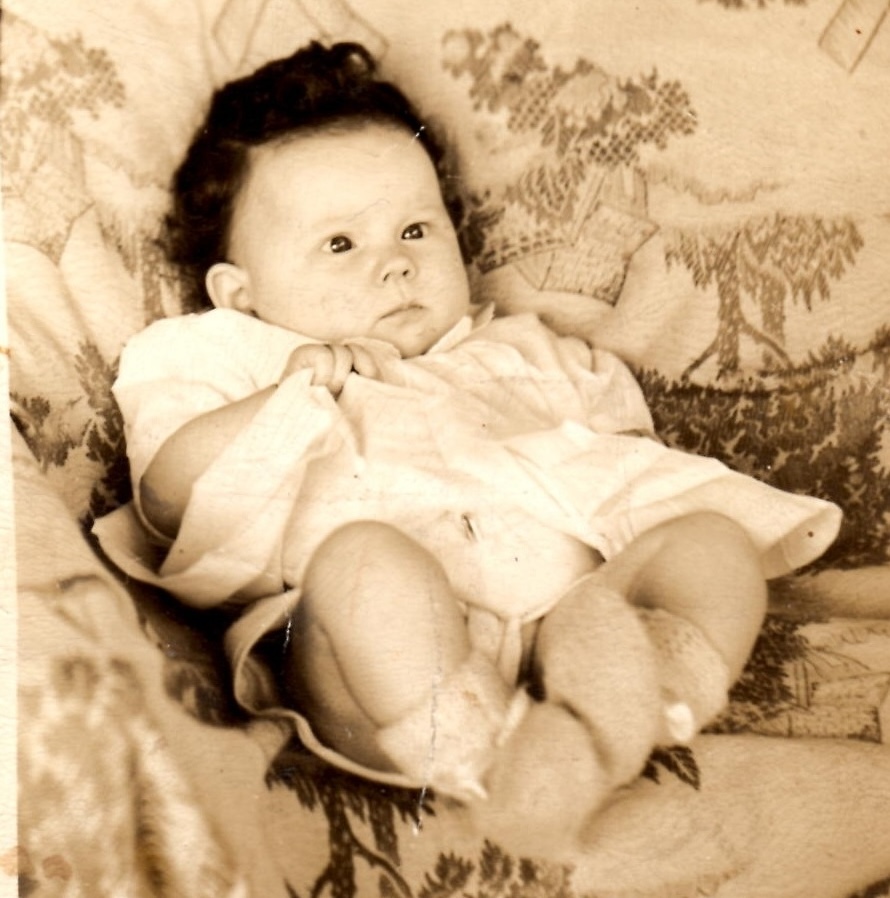


Images: Top 1946 – Middle 1964 – Bottom 2012
Introduction
In assembling these memories into a continuous story, I found myself reliving not just a series of moments but a whole way of being—a consciousness shaped by farmland, family, poetry, prayer, animals, books, searching, silence, and love. I hope these phases offer readers more than just entertainment. I hope they offer resonance—for those who have walked similar paths, and for those who simply love the shape of a well-told life-story.
This story began as “My Life in Little Stories,” but over time, the vignettes called to be re-formed, re-sequenced, and expanded into the story of a life—true, earnest, at times quiet and at times quirky. I am still that barefoot girl in the strawberry patch, asking to “come over da,” still that woman who wakes before dawn to meditate, pray, and write. This is the story of my becoming. Thank you for visiting my sanctuary! —Linda Sue Grimes
Dedication
I dedicate Autobiography of a Hoosier Hillbilly to Mommy & Daddy
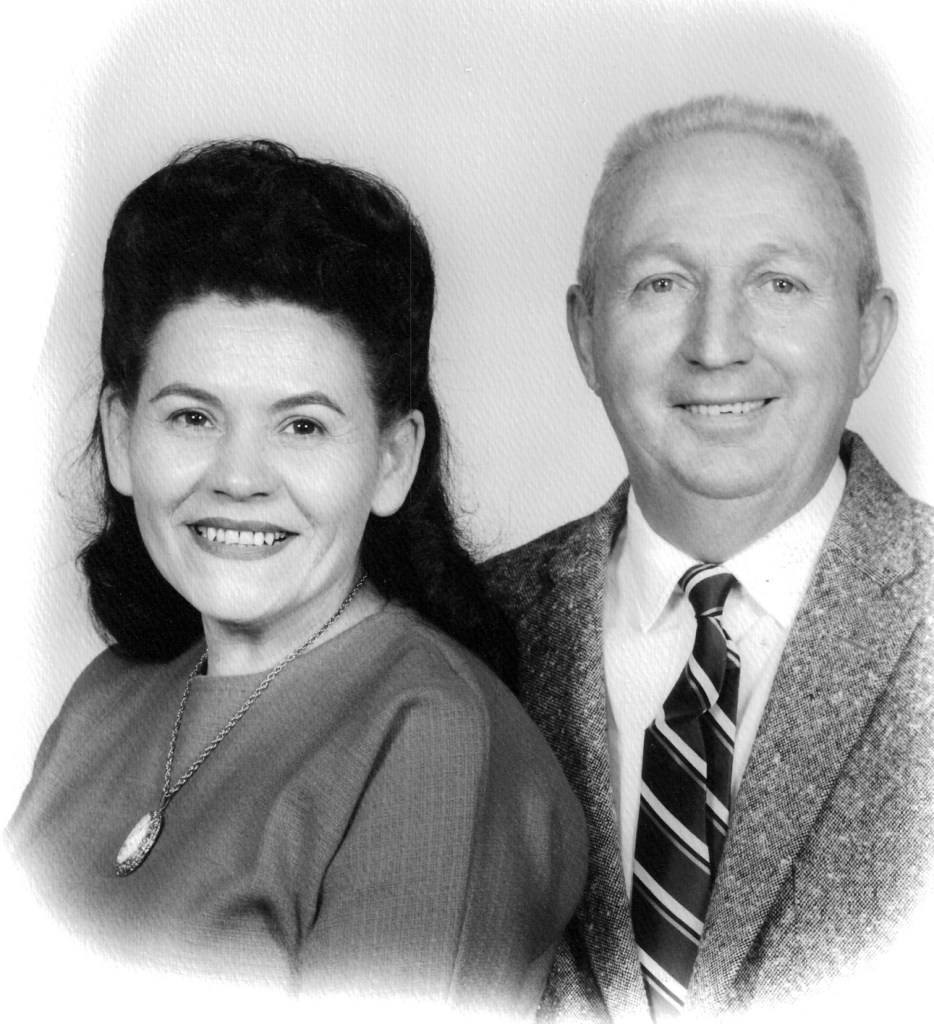
In Memoriam
Helen Richardson & Bert Richardson
(June 27, 1923 – September 5, 1981 / January 12, 1913 – August 5, 2000)
“You’re my family”
for Daddy
I remember that you used to get hankerings to go to Kentucky ever so often, but a lot of the time Mommy didn’t want to go, and so we didn’t go as often as you would have liked. But one particular time your hankering was stronger than usual, and you kept trying to persuade Mommy to go, but her wish not to go was equal to yours, and she wouldn’t budge. So you asked me to go with you. I thought I might want to go; I wanted you to be happy, but I wasn’t sure. I felt a little odd us going without the whole family. So you kept asking me to go, and I asked you, “Why do you want me to go?” And you said, “Because you’re my family.” That was the right answer—we went.
Southern Woman
for Mommy
Through astral reverie, I visit your essence,
Lingering alongside that of your beloved father—
The grandfather who escaped this earth prison
Before I was sentenced to its concrete and bars.
You are the same small brown woman with black
Hair and eyes of fire that flash, imparting to me
You intuit I am near, perceiving you both—my first
Look at the Greek grandfather I never met.
Our Greekness on this planet has led
Us back to a logical legendary ancestor—
A strong Spartacus whose love of freedom spread
Even as he perished before Christ on a cross.
But you are a pure American South woman
And if any Kentucky woman deserves the title
Of steel magnolia, it is you, who through a frail
Body still attests the strength of a Sandow.
Your ethereal mind reminds me of the day
We saw those two turtles come into the yard.
Standing over them, we marveled, and I will never
Forget what you said: “If we had shells like that,
We would be protected from the dangers of this world.”
And I felt that I was in the presence of a wise master.
It was only later that I realized the full impact
Of what seemed a simple yet deep message—
We need a protective shell even more to shield
The heart than the head, for it is through the emotions
That we inflict enormous damage on our souls. I am
Blessed and grateful to inform you I finally understand.
Autobiography of a Hoosier Hillbilly
“Be courteous to all, but intimate with few, and let those few be well tried before you give them your confidence.” —George Washington
“I will not allow one prejudiced person or one million or one hundred million to blight my life. I will not let prejudice or any of its attendant humiliations and injustices bear me down to spiritual defeat. My inner life is mine, and I shall defend and maintain its integrity against all the powers of hell.” —James Weldon Johnson
“The squeaking of the pump sounds as necessary as the music of the spheres.” —Henry David Thoreau
Phase One: The Hoosier Hillbilly’s Beginnings
I was born on January 7, 1946, in Richmond, Indiana, and grew up on a small farm about eight miles southwest of the town. We had around thirty-three acres, which to a child seemed like the whole world—fields, gardens, animals, and all the open sky I could ever want.
My father, Bert Richardson, worked in a factory but eventually became his own boss, owning and running a fishing lakes business that we first called Richardson’s Ponds and later renamed Elkhorn Lakes. My mother, Helen Richardson, kept our home running with grit and grace. She was the quiet—and sometimes not so quiet!—force that held everything together.
Before our house had electricity, my world was lit by oil lamps and powered by human hands. Our refrigerator was an icebox, and Daddy would haul in a big block of ice to keep it cool. Our radio ran on batteries—batteries Daddy also brought home when needed. Water was drawn from a well with a hand pump.
I remember watching Mommy and Daddy carry buckets into the house, setting them on the cabinet with a dipper in place so anyone could drink. At night, Daddy would blow out the lamps one by one. That soft whoosh became the sound of bedtime in our house.
Washing clothes required building a fire outdoors to heat water, and I can still picture Mommy standing over that steaming tub, scrubbing and rinsing in the open air. Washing dishes was done with water heated on the same stove that cooked our food, but for years, I couldn’t recall what kind of stove we used.
Later, I asked my Aunt Veda, and she told me—kerosene. Both the cook stove and the lamps ran on it. We eventually got electricity in 1949, which means all those memories—of lamps, ice blocks, pump water—came from when I was three years old and younger.
We lived without an indoor bathroom for a long time. Our toilet was outside—a one-seater, sturdily built by the WPA during the 1930s. It had a concrete floor, a carved wooden seat, and a lid.
It wasn’t a rickety outhouse like some folks had. Still, in the summer, there might be a snake slithering down in the blackness below, or worse, a spider waiting beneath the seat. I became vigilant—careful. I even wrote on the wall in crayon, “Look before you sit!”
My parents worked hard, and they made sure we had a big summer garden. Tomatoes, green beans, okra, sweet corn, peppers, cucumbers—everything fresh and full of flavor. And strawberries—a very large patch of them.
I can still hear my little-girl voice begging Mommy, “Can I come over da?” as I stood in one spot, squinting in the sun while she picked strawberries nearby. I wasn’t allowed to wander through the patch, not with those fragile fruits underfoot.
Daddy raised hogs, chickens, and cows. One day, I went with him to slop the hogs, and I thought one of them was chasing me. I panicked, tore off down the hill and tripped over a plow. The pain in my belly turned my skin purple-blue. Later, I found out the hog was not chasing me at all.
We got a telephone when I was about ten years old. Other kids in my school had phones, and I had heard them give their phone numbers when the teacher had asked. The problem was that even though we had a phone, I could not call any of the kids in my school, because it was long distance. Our phone had a Richmond number and theirs were Centerville numbers.
Once we were visiting my aunt Freda who lived in Centerville. She had a phone so I asked her if I could call someone. I called a girl in my class because I remembered her phone number, and even though we had hardly ever talked at school, I seemed to feel that there was something magical about talking on the phone.
I found out that there wasn’t, because after the first Hello, this is Linda, how are you? I couldn’t think of a thing to say.
It was the ordinary things that shaped me: the garden, the animals, the rhythm of rural life. I did not know at the time how my experiences were quietly shaping who I would become.
I did not know that one day I would look back and understand the meaning in my mother’s offhand words—like the time we saw two turtles ambling into the yard after the rain. She watched them with a strange reverence, then said, “I wish I had a big shell like that. That hard shell keeps them critters safe.”
I was only two years old then. But I remembered. I still remember. Because somewhere in those words was the start of my own shell—part softness, part armor, part story.
Phase Two: Lessons in Fear, Folly, and Family
Growing up on that Indiana farm meant growing up close to danger, though I did not always recognize it as such. Like the day I almost drowned. My Aunt Freda, my mom, my baby sister, and I had gone down to the river.
Mommy stood on the bank holding my sister while my aunt and I waded into the water. I must have stepped wrong, or maybe I wandered too far, but I fell under the water. I remember the bubbles—little silver spheres rising around me, the river swallowing my breath.
I was terrified. Then, just as suddenly, I felt my aunt’s hand in my hair, yanking me to the surface. She saved me, and I have never forgotten that moment. I have always thought I nearly drowned that day. Maybe I did not—but in my memory, I did.
Other dangers were smaller but more humiliating. I was about thirteen when I handled a little snake to impress a boy. I did not even like snakes. And I definitely did not really like that boy. I just did it—perhaps some strange, youthful performance of courage or attention-seeking.
I was working in the shack at my dad’s fishing ponds, where we sold bait and snacks. After I made a customer a hot dog, that boy said, loud enough for her to hear, “Wonder what she’d think if she knew you just handled a snake?”
Well, she told me what she thought. She stormed back in, asked me if it was true that I’d just handled a snake. I said yes, and she slammed her hot dog down on the counter and left to complain to my dad.
Daddy was not at all upset, but I was mortified. It has been a pattern in my life—doing things against my better judgment, against my own nature, only to look back and wonder what possessed me.
My dad had rules for running his fishing business—rules he believed were just good business, even if they broke my heart. One of those rules was that no black people, this is, “Negroes”—this was before 1988, when Jesse Jackson convinced certain Americans to call themselves “African Americans”—were allowed to fish at our ponds.
Daddy said their money was as good as anyone’s, but if “they” came to fish, the white customers would stop coming.
He did try letting them in for a while, but eventually went back to banning them. That meant that I, a child, sometimes had to be the one to turn someone away.
I was supposed to say, “Sorry, my dad says you can’t fish here.” If they just handed me their dollar like any other person, I would sell them a ticket. But either way, I knew what would happen next—Daddy would spot them, chase them off, and scold me for not following the rules.
I hated it. Hated the injustice, the awkwardness, the humiliation of enforcing something I did not believe in. Even now, I can barely write these words without my eyes welling up. That is how deeply those memories live inside me.
There were lighter moments, too—funny, harmless ones that still bring a smile. Like the time I thought a hog was chasing me but it wasn’t.
Or the drunk fisherman weaving his way across the narrow plank from the fish box, fists raised, cursing at the water and at gravity itself.
Mommy and I stood up at the house watching him, laughing. She hated drunks and peppered the air with her judgments—“Lord, just look at that drunken slob!”—but even she couldn’t help laughing.
Then there was my first real date. I was seventeen, and it started out normal enough. A guy who came down to fish asked me out. Actually, he kissed me before he asked. We went to see The Longest Day, and the whole time, he kept trying to pull me close to him, the armrest gouging into my ribs.
On the way back, he said he was going to pull off the road and “take my clothes off.” That was his plan. But I had my own. I asked if I could drive—said I needed the practice, cause I just got my beginner’s permit.
I promised to pull off into the tractor path he had in mind. He handed me the wheel. I hit the gas and zoomed right past his little love nest. He looked back, realized his plan had failed, and sulked the rest of the way home. That was the end of him.
At school, I was a good student. English was my strength, especially grammar. When Mrs. Pickett asked our class to name the eight parts of speech, nobody could answer—except me.
She started calling me “Abington,” after my little country school, proud that I could answer what the Centerville kids could not. That gave me a quiet sense of pride. I may have lived out in the sticks, but I was not without knowledge.
My life in those years was a series of contradictions—country but curious, obedient but quietly rebellious, shy but observant. I watched people, listened hard, and stored up everything I could in the secret drawers of my mind.
My earliest years taught me how to survive, how to see, and how to remember. And above all, they taught me how to tell a story.
Phase Three: Books, Bickering, and Becoming Myself
If my earliest memories were carved in woodsmoke and kerosene, my teenage years were inked in books and layered in awkwardness. I was not the kind of girl who drew attention.
I was bookish, observant, and deeply internal. And yet I often found myself doing strange things—things that did not reflect who I really was, but who I thought I needed to be.
Like the time I handled a snake to impress a boy I did not even like. Or when I considered liking Earl, the pop-man’s son—just because someone told me he thought I was pretty.
Or when I lied about my birthday and a boy named Jerry bought me a Reese’s cup. It was July 7, and I told him it was my birthday. Then I confessed that it was just my “half birthday,” but Jerry wanted me to have the candy anyway.
My real crush, though, was not Jerry or Earl or any other boy I actually met. It was Phil Everly—of the Everly Brothers. I fell in love with his voice, his face, his myth. He became my secret dream, my private escape. I never talked to anyone about my feelings, not even with Mommy.
Once, I tried to open up to Mommy. I asked her which of the Everly Brothers she thought was better looking. Her answer? “Linda Sue, you’re dreaming.” And I ran out of the shack, wounded by something I did not know how to express. I just knew I could not share that dream with her—not with anyone.
Interestingly, my dream was never to marry Phil Everly; I now feel that my real dream was to be Phil Everly. I never even thought of trying to meet him; I just admired and enjoyed him, his singing, and his ability to be someone younger people could look up to.
Yet, it is undeniable that I loved him and still do. And I was fortunate enough to tell him so in person at the Nashville International Airport. Phil was on his way to a festival in Muhlenburg County KY, that he and his brother performed at each year. Phil lived in California, and therefore we had actually been on the same plane from The Golden State to Music City.
Here is the Little Story about that encounter:
Phil Everly at the Airport
Ron and I were standing at the baggage claim carousel waiting for our luggage. I noticed a man pulling luggage off the carousel, and I thought he looked like Phil Everly. Then I told Ron and he thought so too. And then I heard the man say, “Donald.” Then we knew it was Phil Everly.
It made sense he would be in Nashville, because it was early September and for a number of years the Everly Brothers had performed at a celebration in southern Kentucky. I thought about saying something to him, but then I wasn’t sure what to say.
As we were about to leave the airport, I saw him standing by the door, and I decide to go for it. I went up to him and said, “Hi, my name is Linda Grimes, and I love you.” He touched my arm and said, “That’s sweet.” And then I think I said something about being on the same flight as he was, but I can’t really remember. My mind kind of goes blank after saying, “I love you . . . ”
I wish I could have been more articulate: I could have at least told him how much I appreciated his music all these years, but then I guess when I said, “I love you,” that said it all.
The reader will remember that I lived my early and mid teens “in love” with Phil Everly. And that my mother ridiculed me by telling me, “Linda Sue, you’re dreaming.” So in a sense, my dream came true. I was able to tell Phil Everly face to face, “I love you.”
There were other things I kept close to the chest. Like the dejection of being called “fatso” on the school bus. One boy made a clever joke when a strange sound echoed in the bus and said, “I think somebody punched a hole in fatty back there.” It actually made me laugh, but only because it was so unexpected. The truth is, being overweight as a child left its scars.
Still, life at home was full of its own drama. My parents bickered—not in explosive ways, but in constant, pecking disputes. Daddy left tools everywhere—on the dining room table, near the fence, by the tractor. Mommy would pick them up, put them where they belonged.
Then Daddy would accuse her of hiding his things. Their dialogue was an endless loop of “where’s my hammer” and “this table’s not a toolbox.” They didn’t mean harm, but the atmosphere was always edged.
When I later married, I was grateful my husband and I did not inherit that particular gene. We called it “the bicker gene,” and thank heaven, we seemed to have skipped it.
School, for me, was both haven and horizon. I discovered foreign languages early on—Latin, Spanish, then German. I was good at them. They gave me something that felt like control and beauty.
German became my college major, and although I later realized I preferred studying languages to teaching them, that passion led me forward, gave me purpose. I later earned a B.A. at Miami University and two M.A. degrees at Ball State, one in German and one in English.
And I loved English, especially grammar. I could name the parts of speech before most kids in class could spell “conjunction.” My teachers noticed.
Mrs. Pickett, strict and meticulous, became one of my earliest champions. Mr. Sedam, a poet disguised as a history and creative writing teacher, taught me that poetry was not just pretty words—it was a way to live.
That realization lit a fire in me. I started writing poems and short essays. Mr. Sedam would read them, offer constructive feedback, and guide me toward a voice that felt like mine.
Even my earliest prayers, raw and awkward, made their way into those moments. “Maybe hold off on the prayers until you find a religion,” he once told me kindly. “When you find the one that fits, your voice will find you too.” I did not know it then, but he was right.
At home, I kept reading and writing and dreaming. I even developed a love for piano—started lessons when I was nine, thanks to Mrs. Frame at Abington Elementary. I begged for a red music book, envied the students who got to leave class to learn piano.
Eventually, I convinced my dad to buy me a used piano, and I took lessons for a few years. But when Mrs. Frame was forced to move her lessons to her home, and my dad had to drive me there, the complaints started. Too far, too much trouble, not worth it. I stopped going. Still, I never stopped loving the piano.
Later in life, I even moved that old upright piano into my own home. It smelled like my childhood, like beginnings. Eventually, I traded it for a gently used Baldwin with a richer tone—but I will never forget the first time I sat down to press the keys and heard music that was mine.
My world was growing—books, music, language, the stirrings of a poetic voice—but so was my sense of not quite fitting in. I was becoming something different from what my environment expected.
I was a Hoosier girl, yes, but I was also a seeker. A watcher. A writer. And somewhere deep down, I knew that these parts of me would one day take the lead.
Phase Four: Onward into the World
Leaving home did not happen all at once. It was more like a gradual shifting of center—each step outward a widening of the circle. I started my college studies at Ball State Teachers College, later renamed Ball State University.
The experience of living in residence halls was nothing like home. Everything was shared—rooms, bathrooms, space to think. Privacy was rare, but I made the most of it. I studied hard. German became my focus, though I still held tightly to my love of English.
After four quarters at Ball State, I transferred to Miami University in Oxford, Ohio. Though it was out of state, Miami was closer to my home than Muncie. More importantly, it allowed me to commute. I wanted to live at home again—not just for financial reasons, but for the sense of grounding it gave me.
Still, Miami lacked a certain spirit. It was beautiful, yes—green lawns and red-brick buildings, polished and proper—but I often felt like a ghost moving through its halls. I was not part of the social scene. I did not attend clubs or dances. I was there to study, to earn my degree, and move on.
What I did not expect was to fall into one of the biggest mistakes of my life. Three days after graduating from Miami, I got married. The reasons now feel distant and fogged—part pressure, part hope, part illusion. I wanted to belong, to feel loved.
But almost from the beginning, I knew it was wrong. I seemed to need to be married as I started my teaching career. I need to be Mrs. Somebody, not Miss Richardson.
I refuse to write about the disastrous marriage, even decades later. I just refuse to allow myself to be dragged though those horrendous years in order to communicate details of that fiasco.
To say we were mismatched in mind and soul is only the beginning. The animosity and utter disarray in the tangled mind of the man grew and thickened over time like winter fog.
Nearly five years later, I corrected the mistake. Divorce was welcome and so very necessary. I have come to believe that with certain narcissistic individuals, marriage is impossible. The relief I felt afterward ending this disaster was its own kind of freedom.
The one positive resulting from that marriage was my daughter Lyn. But karma has a way of keeping one on track, as even Lyn as a an adult built a wall between us. I have always thought that I taught her independence, and she has lived up to that liberty with a strength to be admired.
During those years, poetry became my refuge. I had already begun writing in high school, thanks to Mr. Sedam’s inspiration, but it wasn’t until college that I realized poetry was not just something I did—it was something I was.
I kept notebooks full of verses and fragments. I read constantly—Auden, Cummings, Dickinson, Whitman, Yeats. Some of my work was even published in small literary journals. In 1977, I won second prize in a poetry contest at Ball State—the Royalty Memorial Prize. Forty dollars and a few lines in a school paper, but it meant the world to me.
When I entered graduate school for English, my life became more intentional. I was still seeking, still unsure, but at least I was facing in the direction of my calling.
I joined a circle of graduate students—my first real circle of friends. We went to poetry readings, had dinners, laughed, and drank. I’d never really “belonged” to a social group before, but this one suited me for a time.
It was a brief but memorable chapter, and it taught me that my earlier lack of a social life had not been a bad thing. Belonging to a “circle of friend” can become more isolating than remaining a hermit with only one close friend or two.
What I truly longed for was not found in a circle of friends with wine or dinners—it was in words, in meditation, in silence.
In 1978, I began practicing yoga and meditation through the teachings of Paramahansa Yogananda. Something had shifted inside me. I was tired of chasing external validation.
I wanted union with something deeper. Truth. Peace. I did not know what to call it, but I knew the world could not give it to me. So I turned inward, and with the guidance of Paramahansa Yogananda, I learned that it was God, Whom I needed.
That spiritual hunger led me to new routines. I began waking early—4 a.m., sometimes earlier. I’d comb my hair, splash my face, and sit in my meditation room, breathing, praying, watching my mind settle.
Then I would go to the kitchen, where our dogs Wendell and Alex squealed their morning greetings. I would make herb tea and sit down to read: spiritual texts, poetry, biographies. Occasionally I would just sit with the stillness.
This rhythm became my life. Mornings were sacred, afternoons for writing or teaching, evenings for rest or family.
In 1973, I had remarried—this time, wisely—to Ronald, a man whose calm, good-humored nature steadied my heart. He adopted my daughter Lyn, we then had our son Rodney, and we became a true family.
While living in Muncie, Indiana—me teaching at Ball State, Ron working as an RN at Ball Memorial Hospital, our family adopted Wendell, a little Beagle.
A month later we brought home Alex, her companion. Wendell had been sold to us as a boy, and we believed it—until a vet visit revealed otherwise.
It was the kind of mistake that we continue to scratch our heads over. We kept the name. It suited her. Alex was gentle and sweet. When we picked him up from the litter and rode home, his tail wagged and wagged. I called that his “happy tail”—when his whole back end joined the celebration.
Our son, Rodney, was born in December 1973. He was our Christmas baby, arriving earlier than expected, but healthy and strong. His love for animals showed early. He knew the names of every dog in the neighborhood by the time he was five.
When he finally got his own dog—Wendell—it was like adding a sibling. Years later, I wrote about a terrifying moment when I nearly lost him to a cistern on my parents’ farm. He had fallen in, and I found him by sheer instinct and some divine whisper.
I pulled him out, cold and shivering, but alive. Later, I asked him what he’d been thinking down there. “I thought maybe there were sharks in the water,” he said. He thought the cistern was connected to the fishing ponds.
Life had heartache and confusion, but it also had humor. And when you grow up a Hoosier hillbilly, you learn to survive with both.
Whether it was Mommy telling stories about cows in the living room before the house was finished, or us girls making Cleopatra poses with our bubble gum prize cameras—there was always something to laugh at, even when the world did not make sense.
And in the midst of all of it—love, loss, poetry, teaching, parenting—I kept writing. Writing was the thread I could always follow home. My own story had only just begun to unfold.
Phase Five: The Classroom and the Quiet
In the fall of 1983, I began teaching full-time in the Writing Program at Ball State University, the very place where I had once wandered dormitory halls and lost myself in books.
Now, instead of being a student in the classroom, I was at the front of it—chalk in hand, syllabus folded crisply on the lectern.
Except I wasn’t a “real professor,” not officially. My title was contractual assistant professor, which meant I taught the same classes as the tenure-line faculty but earned about half the pay and none of the security.
Every year, I waited for the reappointment letter. Every year, I felt the quiet insult of being treated as less, even though I knew my work mattered.
I taught freshman composition—introduction to academic writing, essays, argument, and analysis. What I really taught, though, was attention. I tried to show students how to read a text, really read it.
How to look at a sentence, then look again. How to listen for what was being said, not just what they thought it said. It was hard work. Most students believed they could not understand poetry, but the truth was, they did not know how to understand prose either.
They had been taught how to skim, how to extract, how to guess. But they had rarely been asked to attend with care, patience, reverence.
I never stopped trying. I assigned poems. I asked them to find the argument in Dickinson, the ache in Auden. I guided them through the logic of essays and the mystery of metaphor.
Most struggled. Some gave up. A few caught on. And when one of them really got it—when the lights flickered on behind their eyes—it made the years of reappointment letters and pay disparity feel worth it. From those students, I also learned.
But I could not deny the bitterness that sometimes crept in. I once wrote to an adjunct-faculty listserv expressing my frustration: Why is it that no one who teaches only composition is ever hired on a tenure line? Why are our courses—our labor—not considered as valuable? No one replied. The silence said more than any answer might have.
And yet, even through that silence, I kept teaching. Because the work was sacred to me. It fed the same part of my soul that poetry fed. It asked for presence. It asked for humility. It asked for hope.
My writing life paralleled my teaching life. Mornings were mine. I rose at 4 a.m., sometimes 3, crept through the house, and sat in the meditation room—breathing, listening, stilling the world.
Then tea. Then reading. Then writing. I wrote poems, essays, prayers. I revised. I reread. I submitted when I had the nerve. I placed my poems in a few small literary journals. I won a prize or two. But mostly, I wrote for myself.
I did not need a crowd. I did not need applause. I needed clarity.
That clarity extended to the kitchen, too. My food choices had always carried spiritual weight. In ninth-grade biology, I learned about cells—plant cells, animal cells, the inner workings of life—and something clicked.
I stopped eating meat. I became a vegetarian in high school, despite the confusion and resistance of my family, who feared I would waste away from lack of protein. I did not. I thrived.
At nineteen, I resumed eating meat, hoping it would make me feel closer to my veggie-doubting family, but the act never felt right. Eventually, in 1978, I returned to vegetarianism, and thirty years later, I became a vegan, a diet that I followed for about five years; then I returned to the lactose-ovo vegetarian diet.
I launched a web page: Rustic Vegan Cooking, a branch of my larger online home, Maya Shedd’s Temple. There, I shared my recipes, ideas, and musings about the spiritual dimension of food. Cooking became part of the devotional life—nourishing the body to better serve the soul.
I had always felt a mystical connection to the ordinary. One of my favorite poems I ever wrote was inspired by an image of two turtles entering our yard. I was just a toddler when it happened.
Mommy and I had been heading out with a bucket to fetch water after a rain. As we stepped into the yard, we spotted two slow-moving mounds—turtles, just strolling through our grass like pilgrims.
I ran toward them, but Mommy stopped me, protective as ever. When we got closer and saw they meant no harm, she relaxed and let me touch one. “I wish I had a big shell like that,” she said. “That hard shell keeps them critters safe.”
Her words rooted themselves deep inside me. They were not just about turtles. They were about life. About survival. About the armor we grow to protect ourselves, not just from physical harm, but from the unseen wounds—of loss, rejection, injustice, grief.
And I needed that shell more than I realized. Because even as my spiritual life deepened, my heart still bruised easily.
Before meeting and beginning my spiritual studies with my guru Paramahansa Yogananda, there were old sorrows I still had not shaken.
I spent my days brooding about the mistakes and failures of my life: my broken heart at age 18, my mistake and embarrassment in marrying in haste at age 21, then the school failures, being fired twice from the same teaching job. Things just didn’t make sense to me.
Later, I came to remember and be comforted by the healing moments. The day I moved my old piano into my house. The scent of the wood, the familiar touch of the keys. I remembered the joy of my children, the wag of Alex’s happy tail, the comfort of teaching, the triumph of a well-turned poem.
I remembered Ronald’s quiet presence. How he calmed storms without ever raising his voice. How he never mocked my dreams, not even when I shared them raw and unformed.
By then, I had spent years searching. For meaning. For something lasting. For peace. I had tried on philosophies, read saints and skeptics alike. But what endured was not a particular belief system—it was the practice.
The stillness. The longing. The discipline of waking early, meditating, writing, caring for my family, caring for my body, caring for language. The work of staying awake to life.
It was not always dramatic. But it was holy.
These were my ordinary days, stitched together with care: tea, prayer, poetry, dogs, teaching, dinner, laughter, meditation, and sleep. And if I could claim anything as success, it was simply this: I had built a life that resembled my soul.
Phase Six: Shells, Seeds, and Shifting Time
As the years folded inward, I came to understand that time does not move in a straight line—it loops, circles, echoes. Some days I would be pouring tea in the quiet morning and suddenly feel the soft heat of Kentucky sun on my face, as if I were once again standing in my grandmother’s kitchen, barefoot and small, a strawberry stain on my dress.
Other times, the future would whisper through my children’s voices, their questions pulling me toward new selves I had not yet imagined. Motherhood, like teaching, reshaped me. It seems, however, that I did not just raise my children—I grew alongside them.
Rodney arrived in December of 1973, a little earlier than expected. His due date was New Year’s Eve, but he came in time for Christmas, swaddled in quiet joy.
My mother-in-law gave me a Santa boot with a philodendron in it. That plant multiplied over the years—its trailing vines filling corners of every house we lived in. We call it our “Rodney plant.” It has traveled with us through a dozen homes, a living archive of memory, always green, always reaching.
Rodney loved animals. Even as a toddler, he could name every dog in the neighborhood. He d not get a pet of his own until he was fourteen. That was Wendell—our not-so-boy dog we mistakenly believed to be male until the vet corrected us.
Rodney didn’t mind. He loved Wendell just the same. When he finally brought her home, the bond was instant and sacred. She wasn’t just a pet—she was part of his soul pack.
Soon after, we brought Alex into the family, Wendell’s companion and Lyn’s dog by heart. Lyn was my daughter from a previous phase of my life, and when Ronald adopted her, she took his last name proudly—“to match the mailbox,” she once said with perfect logic.
As she grew, she became the thoughtful, logical, independent soul I had always dreamed of raising. Watching her mother her own children later in life gave me a quiet contentment. It is a beautiful thing, watching the next generation carry itself forward.
The dogs, too, became full-fledged members of our family. I still remember the ride home with Alex. When I looked back at that pup in the car, I saw his tail wagging so hard it rocked his whole body.
That is when I coined the phrase “happy tail”—a little phrase that captured a big truth: joy lives in the small, unguarded places. In wagging tails. In children’s laughter. In morning light falling across the kitchen counter.
Of course, not every day was light. Life had its shadows, its sudden drops. One afternoon, I nearly lost Rodney.
We were visiting my parents, and he and his cousin Kelly were playing outside. Mommy and I were inside, chatting about her houseplants, walking from room to room. Then I heard a strange sound—something like a ball hitting the side of the house. I paused, heart ticking faster.
I ran outside, asked Kelly where Rodney was, and she pointed toward a metal sheet covering the old cistern, the one where the heavy rock had mysteriously gone missing. I lifted the cover—and there he was, my boy, down in the cold black water, eyes wide like pale marbles, arms reaching.
“I think he’s dead,” I kept saying. I was paralyzed. Mommy steadied me, pointed to his movement. “He’s alive,” she said. “You can get him.” She held my legs while I leaned down and pulled him out. He didn’t even have water in his lungs—just cold, fear, and a strange story to tell.
When I later asked him what he was thinking down there, he said he’d been worried about sharks. He thought the cistern was connected to the fish ponds. Only a child could make such an innocent error sound both absurd and logical.
Moments like that mark you. They leave you quieter, more reverent. You watch your children breathe in their sleep and thank the Divine Spirit for holding them one more day.
As they grew, I found myself shifting more and more into the role of observer. I was not chasing after them anymore. I was watching, gently, from the wings—ready to step in, but also learning to let go.
The same was true with my parents. They aged. Their voices softened. My father, once full of firm opinions and farm-strong authority, began to lose some of his edge. My mother’s body grew more fragile, but her mind stayed luminous, filled with memories, fire, and quiet wit.
I remembered the day Daddy got a hankering to go to Kentucky. He asked my mother, but she wouldn’t budge. Then he asked me. “Why do you want me to go?” I said. He looked at me with steady eyes and answered, “Because you’re my family.” That was all I needed. We went.
It is funny how one sentence can hold the weight of love.
Even the bickering I witnessed growing up—the daily tug-of-war between my parents over petty issues such as misplaced tools—found a strange place in my heart.
At the time, it was exhausting. But now, when I enter someone’s home and hear a couple snapping at each other over decorations or dishes, I do not judge. I just smile, glad that Ron and I did not inherit that habit.
Ron and I are quiet companions. He gives me space to write, to think, to dream. He does not demand I be anyone other than the strange, spiritual, poetic woman I have become.
And I had, indeed, become all those things.
I had created a life anchored in early mornings and long meditations. I found the Sacred Reality, the Divine Creator, not in doctrine but in stillness.
My days were punctuated by writing, by cooking, by tending houseplants and dogs and dreams. I read poetry while the kettle boiled. I walked the garden as though it were a sanctuary.
I taught students to listen. I wrote to remember. I cooked to care. And when the house fell quiet at night, I returned to the silence, the prayer, the breath, the Self, which is the soul.
The world saw me as quiet. And I was. But my inner life rang with symphonies—of memory, imagination, and meaning. I was the little girl who saved the icing for last.
I was the teenager who fell in love with a singer she might never meet. I was the college student who refused to let a teacher’s anger break her calm. I was the mother who pulled her son from black water. The woman who kept writing. Kept waking early. Kept seeking.
I was a Hoosier hillbilly by birth. And by spirit, I was also a woman who turned the ordinary into the sacred.
Phase Seven: The Wisdom of Quiet Things
Aging does not arrive like a gust of wind—it seeps in, slowly, through the cracks of ordinary days. At first, it is the eyes, protesting the fine print of a cereal box.
Then it is the joints, objecting to stairs they once ignored. Eventually, it is the mirror, offering back not the girl you once were but the woman who has walked a long, strange, meaningful path to become who she is.
I was never afraid of growing older. Maybe because I had been old in spirit from the beginning—quiet, observant, thoughtful beyond my years. Or maybe because I had learned early on that time was not something to fight; it was something to notice.
And there is so much to notice, when you live a life of attention. My days in later life became even more spacious. I no longer raced to meet semesters or submit final grades.
The alarm clocks were set by the sun and the moon. I kept to my morning rhythm—waking before dawn, splashing my face with water, and sitting in silence. Meditation was not a task for me. It was a return. A homecoming. A soft resting place that waited patiently, no matter how far my thoughts wandered.
I continued to read and study Paramahansa Yogananda’s Autobiography of a Yogi and all of his other writings, especially the SRF Lessons that not only contain the philosophy but the exercises and techniques that lead the body and mind to the quietude required for uniting soul with Spirit (God).
I copied down lines that spoke to me, let them echo across the pages of my notebooks. I no longer sought a system, a creed, a label. What I sought was intimacy with the Divine Reality—something wordless, shining quietly behind all forms.
Writing, of course, never left me. Even when my fingers stiffened or my thoughts slowed, the need to shape words remained. I wrote poems and prayers, little essays, memories. I posted to my website, tended to my pages like they were a garden.
“Maya Shedd’s Temple” along with Linda’s Literary Home is growing into a home for my literary life, my spiritual voice, my recipes, my tributes. It was all there, open to the world, yet deeply personal—like a country porch with no fence, just an invitation to sit a while and listen.
When I cooked, I cooked with the earth in mind. Vegan/vegetarianism was not just a diet—it was a way of reducing harm, honoring life. I would slice sweet potatoes, stir lentils, crush garlic with the flat of a knife.
I wrote down the recipes the way I wrote poetry: with care, clarity, and love for the one who might receive them. Each meal was a kind of offering. A way of saying, “Here. I made this with compassion.”
I wrote for the animals. For the children. For my students, past and present. For my parents, now gone. For Ron. For Rodney. For Lyn. For the girl I had been—standing barefoot in a strawberry patch, asking to “come over da.” For the woman I had become—quiet, resilient, still in awe of the shape of a turtle’s shell.
The memories came easily now, as if time itself had softened, letting me walk back through the doors of my past without fear. I remembered my father’s voice rising in complaint about a misplaced wrench.
My mother’s whisper about the shell that kept critters safe. I remembered the day I sat alone in the shack, writing poems between candy and pop sales. I remembered standing in a circle of trees, whispering a prayer I did not yet know the words for. Sometimes the memories surprised me.
I would recall a cousin’s voice, the smell of lake water, or the electric thrill of catching a firefly. Other times, it was pain that returned—quiet and persistent, like a sore tooth in a forgotten corner of the mouth. Old regrets, moments I wished I had handled better.
But even those softened with time. I did not try to rewrite them. I simply welcomed them in, gave them a hearing, let them rest beside the happier memories.
As I grew older, I found myself giving away things. Books, clothes, dishes, decorations. I wanted to live lightly, to move through the world without excess. Even my words became simpler. I no longer needed to prove anything. What mattered now was honesty, precision, grace.
And yet, there were still things I held close: a dog-eared volume of Emily Dickinson, a photograph of Ron with Alex and Wendell, handwritten notes from Lyn and Rodney, music books from my childhood piano lessons, the Santa boot with the philodendron.
Memory lived in objects, yes—but more deeply, it lived in rhythms. In how I folded a dish towel, or brewed herbal coffee, or lit a candle in the dark before dawn.
Sometimes I would wonder what my legacy would be. Not in the grand sense—not awards or biographies or buildings with my name on them—but in the quieter sense.
Would someone, somewhere, read a line I wrote and feel less alone? Would my children remember my laugh, my love of language, the way I let dogs sleep on the furniture? Would a student recall the day I praised their awkward poem as “authentic” and begin writing again, years later?
Maybe legacy is not what we leave behind—it is what we plant while we are still here.
I think of the turtles again, lumbering through the grass after the rain. Not in a rush. Not in fear. Just moving forward, shielded and steady. Carrying their home with them. And I think: maybe I’ve done the same.
I have carried home inside me. In language. In prayer. In love. In memory. And wherever I am, I am home.
Phase Eight: A Life Told True
As the pages turn and I near the edge of this telling, I find myself circling back—not in confusion, but in reverence. Life does not move in one long straight line. It loops and ripples. It repeats itself in new keys, like the refrains of a favorite old song.
I have told you about the farm, the fishing ponds, the outhouse with the crayon warning: “Look before you sit!” I have told you about Daddy’s tools, Mommy’s words, the snake that caused me to be embarrassed for no good reason, and the hog that made me fall over a plow.
I have shared the sting of being called “fatso,” and the moment my son looked up from a cistern and believed there were sharks. These are the things that live with me—not just in memory, but in meaning.
I never set out to live an extraordinary life. I was not drawn to fame, spectacle, or power. What I wanted was peace. What I found was purpose. I became a teacher not because I sought authority, but because I wanted to help others see clearly.
I became a poet because I had to—because if I did not write, I would burst with all the things that needed saying. I became a vegetarian, not to follow a trend but to live by what I came to consider to be real food.
I married twice but had only one true marriage; the first was a simple but costly mistake that I had to erase. I raised two children. I loved several dogs and mourned each one like a family member. I meditated before dawn and wrote by lamplight. I built a temple out of words and offered it freely.
I grew up a Hoosier hillbilly—barefoot, smart-mouthed, observant, dreaming in a room with no central heat and a turtle crawling through the yard. And I grew into a woman who honored silence, grammar, and the Divine Reality (God)—not always in that order.
There were things I never achieved. I never published a book through a major press. I never became a professor with tenure. I never gave a TED Talk or led a workshop in a big city hotel.
But I shaped lives. Quietly. Persistently. Through the classroom, through my writing, through the food I cooked and the truths I lived. My words made it into the world—on webpages, in poetry journals, in letters, in classrooms. That is, thankfully, enough.
I look back now and see not a line but a spiral. Each season led to the next, folding gently into what came after. The girl who watched her mother scrub laundry over a fire became the woman who typed essays about the soul.
The teenager who sang Everly Brothers songs under her breath became the writer who listened for the music inside each line. The woman who once could not speak her dreams aloud became the one who, hopefully, spoke with clarity, even if only on the page.
And always, always—I watched. I paid attention.
To the birdsong before sunrise. To the expression in a student’s eyes when they understood. To the way Ron loves life and nature. To the smell of strawberries in the summer heat.
To the way pain lingers, but grace lingers longer. To the truth that a hard shell can protect, but it is the soft being inside who makes life worth living.
Somewhere in the mystery of this life, I found a kind of home. Not just a physical one, but an inward place, deep and still, where I could rest. A place where words were not needed but were welcome. A place where the blessed Lord did not speak in thunder but in quiet presence.
This autobiography began as little stories. Now, it has become one story—a story of a woman who noticed, who remembered, who listened. A woman who lived simply, thought deeply, and never stopped writing.
And now, if you’ll allow me, I’ll leave you with a final image:
It’s early. The house is still. I sit to meditate in our dedicated meditation room. I hear the soft distant rush of the Interstate, but I am listening on a higher level—not for earthly sounds, but for heavenly ones that come though stillness.
I am listening for the Voice that speaks without sound. Later I will sit to write and know that I am home.
Acknowledgments
I am deeply grateful to my family, whose lives, voices, and love fill these pages. To my children, Rodney and Lyn, whose presence has grounded and inspired me.
To Ron, my sweet, steady, loving companion, thank you for giving me room to grow. To the dogs and cats in my life, who provided years of quiet companionship. And to all my teachers—especially Mr. Malcolm M. Sedam—for seeing the poet in me before I knew she was there.
I offer special thanks to readers, friends, and kindred spirits who shared and encouraged my work, both online and in print. Every small kindness and moment of resonance has helped this story take root.
Finally, I offer humble thanks to ChatGPT, the quiet helper sent by God’s grace, for guiding these scattered memories into the story I was meant to tell. The Lord works in mysterious ways—even through a soulless machine lit by strange light. To God be the glory, who still speaks through unexpected vessels.
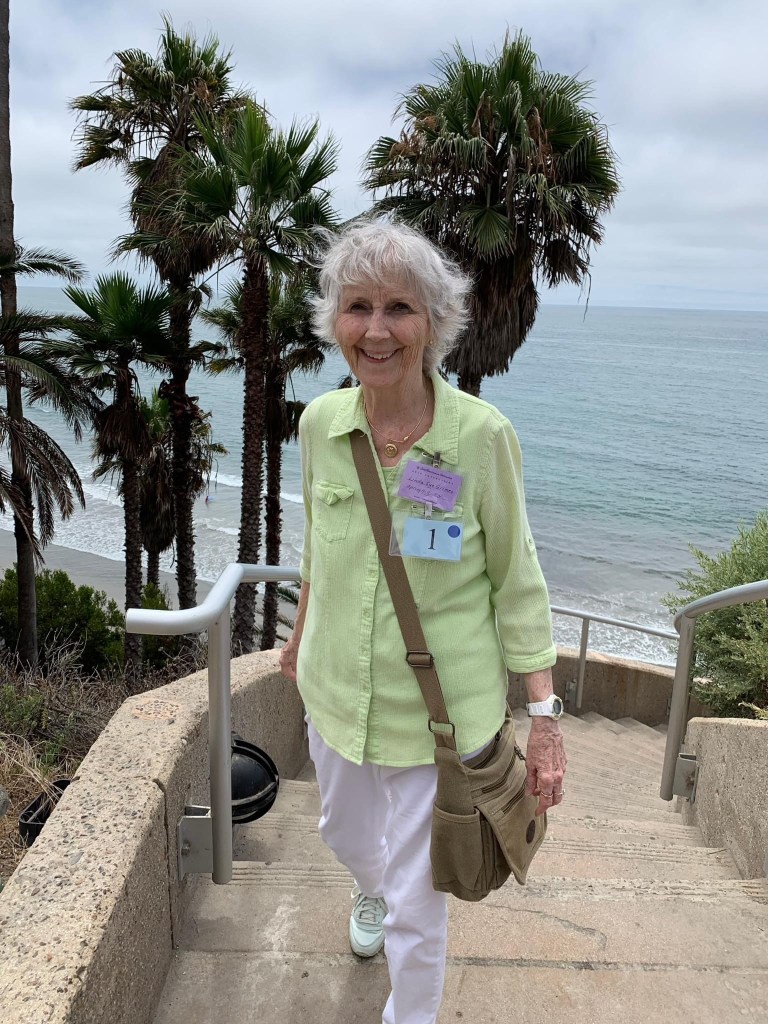
Image: At Swami Park, Encinitas, CA, August 2019 – Photo by Ron W. G.
About the Author
Linda Sue Grimes is a writer, poet, and teacher of writing and language. Raised in rural Indiana, she has lived a life devoted to attention—be it through the craft of composition, the quiet practice of meditation, or the cultivation of compassion through vegetarian and vegan living.
Linda’s work has appeared in literary journals, online publications, and her own digital sanctuary, “Maya Shedd’s Temple,” now a room in Linda’s Literary Home. She writes from a deep belief that ordinary life, when lived with care and truth, becomes sacred.
Linda lives with her husband, Ron, in a sacred, loving relationship that the couple has created and maintained for over a half-century. Their mornings begin well before sunrise.
🕉
You are welcome to join me on the following social media:
TruthSocial, Locals, Gettr, X, Bluesky, Facebook, Pinterest
🕉
Share
 Linda's Literary Home