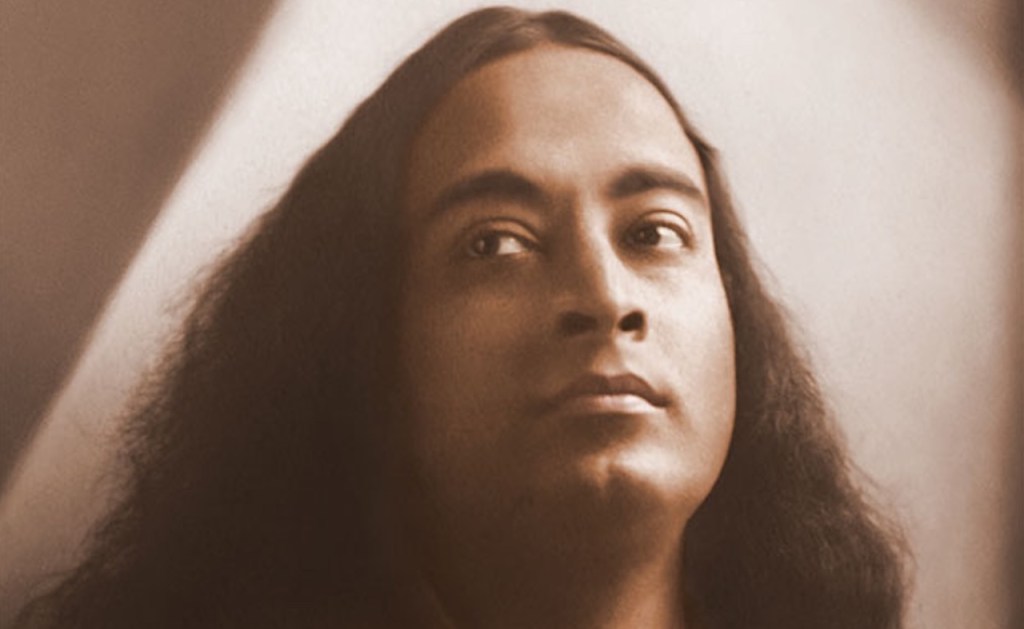
Image: Paramahansa Yogananda’s Song of the Soul
Commentaries on Paramahansa Yogananda’s Songs of the Soul
Each time my father, mother, friends
Do loudly claim they did me tend,
I wake from sleep to sweetly hear
That Thou alone didst help me here.
—from “One Friend”
for Ron Grimes, my soulmate
with whom I travel the spiritual path
About These Commentaries
This collection of personal commentaries is a companion to the book of spiritual poems, Songs of the Soul, written by Paramahansa Yogananda, the “Father of Yoga in the West.”
While these commentaries offer elucidation of each poem, they cannot offer the beauty and majesty experienced by reading the poems themselves.
I have included only an excerpt from each poem preceding each commentary. I, therefore, humbly suggest that you acquire a copy of the great guru’s poems to experience them for yourself, along with my commentaries.
Paramahansa Yogananda’s Songs of the Soul is available at the Self-Realization Fellowship bookstore, Amazon, Barnes & Noble, and other online outlets, as well as in bookstores everywhere.
These commentaries are my personal responses to the poems in Paramahansa Yogananda’s Songs of the Soul. If they assist any reader in understanding the poetic language on a deeper level, then that is a bonus, for my only purpose is to offer my own personal, humble reading.
Another version of these commentaries resides on HubPages. The first installment is located at Paramahansa Yogananda’s “Consecration.”
Brief Publishing History of Songs of the Soul
The first version of Paramahansa Yogananda’s Songs of the Soul appeared in 1923. He continued to revise the poems during the 1920s and 1930s, and the definitive revision that was authorized by the great guru was published in 1983, featuring many restored lines that had been excised from the first publication of the text.
The 1923 version of the collection of poems appears online at Internet Archive. For my commentaries, I rely on the printed text of the 1983 version; the current printing year for that version is 2014. The 1983 printing offers the final approved versions of these poems.
Special Purpose of the Poems in Songs of the Soul
The poems in Songs of the Soul come to the world not as mere literary pieces that elucidate and share common human experiences as most ordinary successful poems do, but these mystical poems also serve as inspirational guidance to enhance the study of the yoga techniques disseminated by the great guru, Paramahansa Yogananda.
He came to the West, specifically to Boston, Massachusetts, in the United States of America, to share his deep knowledge of yoga through techniques that lead the mind to conscious awareness of God, a phenomenon that he called “self-realization.”
The great guru published a series of lessons that contain the essence of his teaching as well as practical techniques of Kriya Yoga.
His organization, Self-Realization Fellowship, has continued to publish collections of his talks in both print and audio format that he gave nationwide during the 1920s, 1930s, 1940s, and 1950s.
In addition to Songs of the Soul, the great guru/poet offers mystical poetic expressions in two other publications, Whispers from Eternity and Metaphysical Meditations, both of which serve in the same capacity that Songs of the Soul does, to assist the spiritual aspirant on the journey along the spiritual path.
The official website for Paramahansa Yogananda’s Self-Realization Fellowship offers further information about the Lessons and Kriya Yoga.
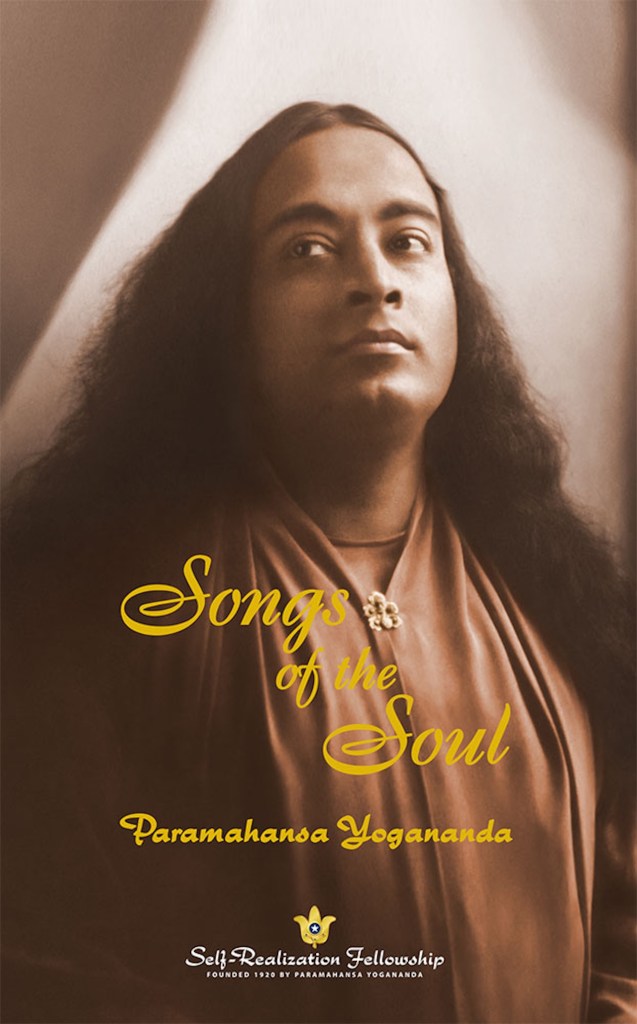
Image: Book Cover – Songs of the Soul
Commentaries
This section features the commentaries, one for each of the 101 poems in Songs of the Soul. Each commentary is preceded by a brief introduction and excerpt from the poem.
1. “Consecration”
In the opening poem, titled “Consecration,” the speaker humbly offers his works to his Creator. He offers the love from his soul to the One Who gives him his life and his creative ability, as he dedicates his poems to the Divine Reality or God.
Introduction and Excerpt from “Consecration”
Paramahansa Yogananda, the great guru/poet and founder of Self-Realization Fellowship, known as the “Father of Yoga in the West,” dedicates his book of mystical poems, Songs of the Soul, to his earthly father and consecrates it by offering it to his Heavenly Father (God—the Divine Creator). In dedicating his collection to his earthly father, the great guru writes,
Dedicated
to my earthly father,
who has helped me in all my spiritual
work in India and America
The first poem appearing in the great yogi-poet’s book of spiritual poems is an American (innovative) sonnet, featuring two sestets and a couplet with the rime scheme AABBCC DDEFGGHH.
The first sestet is composed of three rimed couplets; the second sestet features two rimed couplets and one unrimed couplet that occupies the middle of the sestet.
This innovative form of the sonnet is perfectly fitted to the subject matter and purpose of the Indian yogi, who has come to America to minister to the waiting souls, yearning for the benefits of the ancient yogic techniques in which the great guru will instruct them.
The ancient Hindu yogic concepts offer assistance to Westerners in understanding their own spiritual traditions, including the dominant Christianity of which many are already devotees.
Excerpt from “Consecration”
At Thy feet I come to shower
All my full heart’s rhyming* flower:
Of Thy breath born,
By Thy love grown,
Through my lonely seeking found,
By hands Thou gavest plucked and bound . . .
*The spelling, “rhyme,” was introduced into English by Dr. Samuel Johnson through an etymological error. As most editors require the Johnson-altered spelling of this poetic device, the text of Songs of the Soul also adheres to that requirement featuring the spelling, “rhyming.” However, when I employ that term in my commentaries, I use the original spelling, “rime.”
Commentary
These spiritual poems begin with their consecration, a special dedication that offers them not only to the world but to God, the Ultimate Reality and Cosmic Father, Mother, Friend, Creator of all that is created.
First Sestet: Dedication of Poetic Effort
The speaker proclaims that he has come to allow his power of poetry to fall at the feet of his Divine Belovèd Creator. He then avers that the poems as well as the poet himself are from God Himself.
The Divine Belovèd has breathed life into the poems that have grown out of the speaker’s love for the Divine. The speaker has suffered great loneliness in his life before uniting with his Divine Belovèd.
The spiritually striving speaker, however, has earnestly searched for and worked to strengthen his ability to unite with the Divine Creator, and he has been successful in attaining that great blessing.
The speaker/devotee is now offering that success to his Divine Friend because he knows that God is the ultimate reason for his capabilities to accomplish all of his worthwhile goals. As he feels, works, and creates as a devotee, he gives all to God, without Whom nothing that is would ever be.
Second Sestet: Poems for the Divine
In the second sestet, the speaker asserts that he has composed these poems for the Belovèd Creator. The collection of inspirational poetic works placed in these pages contains the essence of the guru-poet’s life and accomplishments made possible by the Supreme Spirit.
The writer asserts that from his life he has chosen the most pertinent events and experiences which will illuminate and inform the purpose of these poems.
The speaker is metaphorically spreading wide the petals of his soul-flowers to allow “their humble perfume” to waft generously.
He is offering these works not merely as personal effusions of shared experience for the purpose of entertainment or self-expression but for the upliftment and soul guidance of others, especially for his own devoted followers.
His intended audience remains the followers of his teachings, for he knows they will continue to require his guidance as they advance on their spiritual paths.
The Couplet: Humbly Returning a Gift
The speaker then with prayer-folded hands addresses the Divine directly, averring that he is in reality only returning to his Divine Belovèd that which already belongs to that Belovèd. He knows that as a writer he is only the instrument that the Great Poet has used to create these poems.
As the humble writer, he takes no credit for his works but gives it all to the Prime Creator. This humble poet/speaker then gives a stern command to his Heavenly Father, “Receive!”
As a spark of the Divine Father himself, this mystically advanced speaker/poet discerns that he has the familial right to command his Great Father Poet to accept the gift that the devotee has created through the assistance of the Divine Poet.
2. “The Garden of the New Year”
In “The Garden of the New Year,” the speaker celebrates the prospect of looking forward with enthusiastic preparation to live “life ideally!”
Introduction and Excerpt from “The Garden of the New Year”
The ancient tradition of creating New Year’s resolutions has situated itself in much of Western culture, as well as Eastern culture. As a matter of fact, world culture participates in this subtle ritual either directly or indirectly.
This tradition demonstrates that hope is ever present in the human heart. Humanity is always searching for a better way, a better life that offers prosperity, peace, and solace.
Although every human heart craves those comforts, each culture has fashioned its own way of achieving them. And by extension, each individual mind and heart follows its own way through life’s vicissitudes.
The second poem is titled “The Garden of the New Year.” This poem dramatizes the theme of welcoming the New Year, using the metaphor of the garden where the devotee is instructed to pull out “weeds of old worries” and plant “only seeds of joys and achievements.”
The pulling out of weeds from the garden of life is a perfect metaphor for the concept of a New Year’s resolution. We make those resolutions for improvement and to improve we often find that we must eliminate certain behaviors in order to instill better ones.
The poem features five unrimed versagraphs*, of which the final two are excerpted.
Excerpt from “The Garden of the New Year”
. . . The New Year whispers:
“Awaken your habit-dulled spirit
To zestful new effort.
Rest not till th’ eternal freedom is won
And ever-pursuing karma outwitted!”
With joy-enlivened, unendingly united mind
Let us all dance forward, hand in hand,
To reach the Halcyon Home
Whence we shall wander no more . . .
*The term, “versagraph,” is a conflation of “verse paragraph,” the traditional unit of lines for free verse poetry. I coined the term for use in my poem commentaries.
Commentary
This poem is celebrating living life “ideally,” through changing behavior that has limited that ability in the past.
First Versagraph: Out with the Old and in with the New
The speaker is addressing his listeners/readers as he asserts that the old year has left us, while the New Year is arriving.
The old year did spread its “sorrow and laughter,” yet the New Year holds promises of brighter encouragement and hope. The New Year’s “song-voice” offers grace to the senses, while commanding, “Refashion life ideally!”
This notion is universally played out as many people fashion New Year’s resolutions, hoping to improve their lives in the coming year.
Because most people are always seeking to improve their situations, they determine how to do so and resolve that they will follow a new path that will lead to a better place.
Second Versagraph: Abandoning the Weed to Plant New Seeds
In the second versagraph, the speaker employs the garden metaphor to liken the old problematic ways to weeds that must be plucked out so that the new ways can be planted and grow.
The speaker instructs the metaphoric gardener to pull out the weeds of “old worries” and in their place plant “seeds of joys and achievements.”
Instead of allowing the weeds of doubt and wrong actions to continue growing, the spiritual gardener must plant seeds of “good actions and thoughts, all noble desires.”
Third Versagraph: The Garden Metaphor
Continuing the garden metaphor, the speaker advises the spiritual aspirant to “sow in the fresh soil of each new day / Those valiant seeds.” After having sown those worthy seeds, the spiritual gardener must “water and tend them.”
The perfect metaphor for one’s life is the garden with its life-giving entities as well as its weeds. As one tends a garden, one must tend one’s life as well to make them both the best environment for life to thrive.
By careful attention to the worthy, good seeds of attitudes and habits, the devotee’s life will become “fragrant / With rare flowering qualities.”
Fourth Versagraph: New Year as Spiritual Guide
The speaker then personifies the New Year as a spiritual guide who gives sage advice through whispers, admonishing the devotees to employ real effort to wake up their sleeping spirit that has become “habit-dulled.”
This new spiritual guide advises the spiritual aspirant to continue struggling until their “eternal freedom” is gained.
The spiritual searchers must work, revise their lives, and continue their study until they have “outwitted” karma, the result of cause and effect that has kept them earth-bound and restless for aeons.
The beckoning New Year always promises a new chance to change old ways. But the seekers must do their part. They must cling to their spiritual path, and as soon as they veer off, they must return again and again until they have reached their goal.
Fifth Versagraph: A Benediction of Encouragement
The speaker then offers a benediction of encouragement, giving the uplifting nudge to all those spiritual aspirants who wish to improve their lives, especially their ability to follow their spiritual paths.
The speaker invites all devotees to “dance forward” together “With joy-enlivened, unendingly united mind.” The speaker reminds his listeners that their goal is to unite their souls with their Divine Beloved Who awaits them in their “Halcyon Home.”
And once they achieve that Union, they will need no long venture out into the uncertainty and dangers as they exist on the physical plane.
The New Year always holds the promise, but the spiritual aspirant must do the heavy lifting to achieve the lofty goal of self-realization.
3. “My Soul Is Marching On”
This amazing poem, “My Soul Is Marching On,” offers a refrain which devotees can chant and feel uplifted in times of lagging interest and seeming spiritual dryness.
Introduction and Excerpt from “My Soul Is Marching On”
The poem, “My Soul Is Marching On,” offers five stanzas, each with the refrain, “But still my soul is marching on!” The poem demonstrates the soul’s power in contrast with the weaker powers of entities from nature.
For example, as strong as the light of the sun may be, it vanishes at night, and will eventually be extinguished altogether in the long, long run of aeons of time.
Unlike those seemingly forceful, yet ultimately, much weaker physical, natural creatures, the soul of each individual human being remains a strong, vital, eternal, immortal force that will keep marching on throughout all time—throughout all of Eternity.
Devotees who have chosen the path toward self-realization may sometimes feel discouraged as they tread the path, feeling that they do not seem to be making any progress.
But Paramahansa Yogananda’s poetic power comes to rescue them, giving in his poem a marvelous repeated line that the devotee can keep in mind and repeat when those pesky times of discouragement float across the mind.
Included here are the epigram and first two stanza of the poem, “My Soul Is Marching On.”
Excerpt from “My Soul Is Marching On”
Never be discouraged by this motion picture of life. Salvation is for all. Just remember that no matter what happens to you, still your soul is marching on. No matter where you go, your wandering footsteps will lead you back to God. There is no other way to go.
The shining stars are sunk in darkness deep,
The weary sun is dead at night,
The moon’s soft smile doth fade anon;
But still my soul is marching on!
The grinding wheel of time hath crushed
Full many a life of moon and star,
And many a brightly smiling morn;
But still my soul is marching on! . . .
Commentary
Before beginning his encouraging drama of renewal, Paramahansa Yogananda offers an epigram that prefaces the poem by stating forthrightly its intended purpose. In case the reader may fail to grasp the drama of the poetic performance, the epigram will leave no one in doubt.
The Epigram: A Balm to the Marching Soul
The great guru avers that there is no other reality but the soul’s forward march. Despite all circumstance to the contrary, the soul will, in fact, continue its march.
The devotee simply has to come to realize that fact that all “wandering footsteps” return to their home in the Divine. The guru then states unequivocally, “There is no other way to go.”
This amazing, inspiring statement culminates in the refrain that allows the devotee to take into mind a chant for upliftment anytime, anywhere it is needed.
First Stanza: The Soul Marches on in Darkness
The speaker begins by asserting that the bright bodies of the stars, sun, and moon are often hidden. The stars seem to sink into the black backdrop of the sky, or even remain hidden by day, as if never to be seen again, yet other times, they are completely invisible.
The largest dominant star of all—the sun—also seems to completely vanish from the sight of world-weary inhabitants of planet Earth. The sun seems to be “weary” as it has crossed the diurnal sky and then sinks out of sight.
The moon whose glow remains less bright compared to the sun, nevertheless, also fades out of sight. All of these bright orbs of such tremendous magnitude glow and fade, for they are mere physical beings.
The speaker then adds his marvelous, encouraging claim that becomes his refrain—”But still my soul is marching on!” The speaker will continue repeating this vital assertion as he dramatizes his poem to encourage and uplift devotees whose spirits may from time-to-time lag.
This refrain will then ring in their souls and urge them to keep marching because their souls are already continuing that march.
Second Stanza: Nothing Physical Can Halt the Spiritual
The speaker then reports that time has already smashed moons and stars and obliterated them from existence. Many cycles of creation and recreation have come and gone from the annals of eternity.
That eventuality remains the nature of physical creation: it emerges from the depths of the body of the Divine Creator and then later is taken back into that Divine Body, disappearing as if they had never been.
But regardless of what happens on the physical level, the soul remains an existing Entity throughout Eternity. The soul of each individual continues its journey. It makes no difference on which planet it may appear; it may continue from planet to planet, if necessary, as it marches back to its Creator.
The soul will continue to “stand unshaken amidst the crash of breaking worlds” because that is the nature of the indestructible soul, the life energy that informs each human being.
That soul will continue its march to the Divine, despite all cosmic activity. Nothing can prevent the soul’s forward march, nothing can stop the marching soul, and nothing can hinder that march. The refrain shall again and again ring in the mind of the devotee who has begun this march to self-realization.
Third Stanza: The Evanescence of Nature
The speaker then reports on other natural phenomena. Marvelous, beautiful flowers have offered their colorful blooms to the eyes of humankind, but then they invariably fade and shrivel up to nothingness. The evanescence of beauty remains a conundrum for the mind of humankind.
Like the beauty yielding flowers, the gigantic trees offer their “bounty” for only a while, and then they too sink into nothingness. The naturally appearing entities that feed the human mind as well as the human body all mysteriously come under “time’s scythe,” appearing and disappearing again and again.
But the soul again remains in contrast to these wonderful natural entities. The soul continues its eternal march, unlike the outer physical realities of flowers and trees. The human soul will continue its march, as will the invisible souls of those seemingly vanishing nature’s living beings.
The refrain must take hold in the mind of the devotee, who in times of lagging interest and self-doubt will chant its truth and become re-invigorated.
Fourth Stanza: As Physical Life Fades, The Soul Continues Unabated
All of the great emissaries sent by the Divine Creator continue to speed by. Vast swaths of time also speed by as creation seems to remain on a collision course with ultimate disaster.
The human being must remain in a perpetually vigilant state of mind just to remain alive in this dangerous and pestilent-filled world. Even human against human remains a continued concern as “man’s inhumanity to man” prevails in very age in every nation of planet Earth.
But the speaker is not only referring to the small planet at a short period of time; he is speaking cosmically of the entire history of all Creation.
He is averring that being born a human being at any time in history brings that individual soul into the same arena of struggle. As each human being lets fling his arrows in battle, the individual finds that all of his “arrows” have been used up. He finds his life ebbing away.
But again, while the physical body remains the battle ground of trials and tribulations, the soul is unaffected. It will continue on its path back to its Divine Haven, where it will no longer need those arrows. The devotee will continue to chant this truth again and again to spark his march to greater heights.
Fifth Stanza: The Refrain Must Remain
The speaker has observed that his fight with nature has been a fierce one. Failures have blocked his way. He has experienced the ravages of death’s destruction. He has had to face obstructions blocking “his path.”
All of nature has conspired to “block [his] path.” Nature has always been a challenging force, but the human being who has determined to overcome the ravages of nature will find that his “fight” is stronger than that of nature, despite the fact that nature remains a “jealous” power.
The soul continues to march to its home in God, where it will never again have to face the fading of beautiful light, the vanishing of colorful flowers, the failures that obstruct and slow one’s pace.
The soul will continue to march, to study, to practice, to meditate, and to pray until it at last experiences success, until it as last finds itself totally awake in the arms of the Blessed Divine Over-Soul, from which it has come.
The devotee will continue to hear that amazingly uplifting line and continue to know that his/her “soul is marching on!”
4. “When Will He Come?”
How to stay motivated in pursuing the spiritual path remains a challenge. This poem, “When Will He Come?,” dramatizes the key to meeting this spiritual challenge.
Introduction and Excerpt from “When Will He Come?”
Perhaps today is not going well, and you feel indifferent about your work and your progress. You might begin to think about how you have not been giving enough time and effort to your spiritual progress.
You might then begin to feel deeply depressed and begin to judge your motives harshly. And finally, you decide that you do not deserve to reach your spiritual goals because of your laxity.
You realize that days have gone by, and you have taken care of every detail of your life, but you have neglected your soul. You have veered off your spiritual path and are dallying in the ditch of delusion.
Of course, you know what the problem is and you know how to solve it, so you turn back to your spiritual studies.
You pick a spiritual poem to uplift your thinking. Likely there is no better poem than the one that answers your immediate question as you wonder when the Lord will finally appear to you.
This poem contains the exact message that you need right now: “Even if you are the sinner of sinners, / Still, if you never stop calling Him deeply / In the temple of unceasing love, / Then He will come.”
The poem uplifts you because it simply reminds you to get out of that ditch and back on the road to your goal. You have thought you could not continue, and you have become convinced that Spirit will never come to you, but this inspired spiritual poet’s metaphors dramatically tweak your thoughts back to your goal.
Excerpt from “When Will He Come?”
When every heart’s desire pales
Before the brilliancy of the ever-leaping flames of God-love,
Then He will come.
When, in expectation of His coming,
You are ever ready
To fearlessly, grieflessly, joyously
Burn the faggots of all desires
In the fireplace of life,
That you may protect
Him from your freezing inner indifference,
Then He will come . . .
Commentary
These seven stanzas work to uplift the devotee’s lagging mood and urge it on to greater effort on the path to soul-realization.
First Stanza: The All-Consuming Flame of Spirit
Humanity finds itself needing and wanting a myriad of things of this world. Those things are both tangible or material and intangible or spiritual.
Even in those who are not spiritually inclined, the mind still craves nourishment such as is offered through studying and learning. The impulse to read widely comes from a hungry mind that wishes to know more about the world we live in.
Along the way, however, as these human hearts and minds continue to gather the things of this world, they may suddenly realize that none of those things has the power to make them truly and lastingly happy or can even offer a modicum of permanent comfort and joy.
It is at this point most folks are introduced to the value of a spiritual life: that only the Divine Belovèd can offer everything that the physical, material world cannot.
All of the accumulated earthly desires will eventually lead only dullness and suffering. However, in the first stanza of this poem, devotees are reminded that Spirit’s love is great like “ever-leaping flames.” Such “brilliancy” they must realize will cause every desire of the human heart to pale in comparison.
And all they have to do is keep their attention and concentration on their spiritual routine on the path. A devotee may wonder how s/he could have ever given in to doubt, and yet s/he has read only the opening stanza.
Second Stanza: A Temporary Spacing
The second stanza continues to remind devotees of their own role in finding Spirit, in getting this blessing to come to them: those little pale desires amount to a “freezing inner indifference” that all devotees must burn “fearlessly, grieflessly, joyously” in the “fireplace of life.”
Of course, devotees already know this is true, but they sometimes do temporarily forget. Thus, the purpose of these uplifting, spiritually forward-thrusting poems can be fulfilled as devotees continues to live in their message and be guided by their wisdom.
Daily life becomes routine, and as the initial enthusiasm over beginning a spiritual path wanes, the devotee may find herself in this period of spiritual dryness.
Devotees are urged to continue by reading and rereading their spiritual works and most importantly to continue with their spiritual routines including meditation and prayer.
The speaker of this poem continues to cast the contrast between “desire” and the marvelous achievement to be possessed after quieting desire that continues to eat away at one’s soul.
Third Stanza: Constancy Assures His Ultimate Arrival
Stanza three continues to remind devotees: When Spirit is certain of the devotee’s utmost attention, when the Divine Belovèd knows that the devotee will ever keep her/his mind focused on soul, when nothing else can claim the steadfast heart of the devotee who gives total devotion to his/her spiritual life, “Then He will come.”
It does seem somewhat puzzling that the human heart and mind do not seem to learn that half-heartedly doing anything, whether physically or spiritually oriented, is bound to lead to failure.
If one is studying to become a lawyer, half-hearted attention to one’s studies will not result in success, and obviously that fact is operative in every endeavor.
The same applies to the spiritual path: one must remain on the path with attention focused on the goal in order to succeed.
Fourth Stanza: Ignoring the Hopeless for the Hopeful
But even though devotees may mentally take in these ideas, seekers may still feel easily oppressed by life, may still become moody and feel powerless, and thus may wonder if they can really change enough so that Spirit will come to them and remain permanently.
The demand is quite simple, yet often not so easy to accomplish. But devotees have been assured by the great guru that they can accomplish their spiritual goal, if they continue to love God, stick to the path, and serve willingly in any capacity for which they have an aptitude.
Fifth Stanza: Concentrating the Mind on the Goal
But the mind is stubborn and will fight against the devotee’s best effort, telling him/her that it does not matter how much hope the individual entertains, the devotee will remain weak and therefore undeserving of Spirit. Paramahansa Yogananda insists that
if the devotee switches his thoughts from failure to success and believes strongly that the Lord is on His way to the devotee, then the Divine will, in fact, appear to the striving devotee.
Yes, a great solace is remembering the power of the soul. Greater than the body that changes daily and the mind that flits every which way is the soul that is ever united with Spirit already.
All each individual has to do is get out of that ditch and continue on down his/her path and refuse to listen to the opposition, i.e., the Devil or Satan, that would keep the devotee’s mind earthbound committed to the rounds of karma and reincarnation.
Sixth Stanza: When Nothing Else Can Claim the Mind and Heart
Then, the great leader instructs that wandering mind: “When He shall be sure nothing else can claim you, / Then He will come.”
Again and again, the guru continues to remind the wandering mind and soul of his followers to keep focused on the goal, and do not let trivia block you from your Divine Beloved.
When the Divine Goal is all that remains in the concentrated mind of the devotee, that devotee can be assured of success. But each individual must remember the Creator expects the devotee to be mindful that nothing else must claim his/her attention.
The devotee must put his/her whole heart and mind into the studies and devotions to reap the benefits.
Seventh Stanza: The Sinner Becomes the Seeker
The great guru then assures his devotee that even the greatest of sinners can gain heaven, simply by abandoning his/her indifferent ways and by continuing to rely upon the Divine Reality. The sinner must not think of himself as a sinner but as one who is a seeker of the Divine Creator.
The former sinner must keep calling on the Divine Beloved, taking the beloved name again and again, chanting love for the Only Reality.
And after diving into this inspired song of the soul written just for the devotees by this great Spirit-illumined poet, they are prepared to enter again that “temple of unceasing love” where they will be ready to greet Him when He comes.
Poetic Encouragement
The sentiment and guidance of the poems in Songs of the Soul are there for the devotee.
Regardless of how downtrodden each individual may feel, whether tormented by trials and tribulations, tested by karmic factors, no matter how fearful, if the practicing devotee remains steadfastly on the path, and if the devotee keeps hope alive in his/her heart, the Divine Belovèd is sure to come into one’s life.
The reassurance that calming the dogs of desire can be of helpful assistance as one travels that path to spirit is offered repeatedly in these poems.
They help one return again and again to the traits that one needs for soul-realization, which includes the coming of the Divine into one’s consciousness.
The great guru is not instructing his devoted followers to ignore their material duties. He states often that one must take care of the body and mind as well as the soul and must perform those duties that involve family.
The devotee who shirks familial responsibilities is also likely to shirk his/her spiritual duties.
The key is to find balance, to perform one’s material duties with full attention and then as soon as those duties are completed to return the mind to the spiritual goal.
These poems shine a light on how to live in this world and yet not become so attached to the things of this world that such attachment interferes with spiritual goals.
5. “Vanishing Bubbles”
Worldly things are like bubbles in the sea; they mysteriously appear, prance around for a brief moment, and then are gone.
This speaker dramatizes the bubbles’ brief sojourn but also reveals the solution for the minds and hearts left grieving for those natural phenomena that have vanished like those bubbles.
Introduction and Excerpt from “Vanishing Bubbles”
“Vanishing Bubbles” features five variously rimed stanzas. The irregularity of the rime-scheme correlates perfectly with the theme of coming and going, appearing and disappearing, existing and then vanishing. Also, the frequent employment of slant-rime and near-time support that main theme as well.
The poem’s theme dramatizes the evanescence of worldly objects under the spell of maya, and the speaker expresses a desire to understand where these things come from and where they go after they seem to disappear.
This age-old conundrum of life remains a pervasive feature of every human mind—born into a fascinating yet dangerous world, seeking to understand, survive, and enjoy.
Excerpt from Vanishing Bubbles
Many unknown bubbles float and flow,
Many ripples dance by me
And melt away in the sea.
I yearn to know, ah, whence they come and whither go—
The rain drops and dies,
My thoughts play wild and vanish quick,
The red clouds melt into the skies;
I stake my purse, I’ll slave all life, their motive still to seek . . .
Commentary
The things of this world are like bubbles in the ocean—appearing and then disappearing as if they had never been.
First Stanza: Coming and Going in the Mayic Drama
In the first stanza, the speaker states that many things come and go, and he would like to know both where they come from and to where they vanish.
The speaker metaphorically compares these worldly objects to “bubbles,” indicating that their existence is tenuous, ephemeral, and that they are in reality only temporary appearances on the screen of life.
The bubbles remain “unknown,” for they seem to appear as if by magic. The observer cannot determine how, where, or why they so magically appear.
The speaker continues to describe the bubbles as things that, “dance with me / And melt away into the sea.” The waves of the sea that cause little watery bubbles to bounce around the swimmer serve as a useful metaphor for all the worldly things that are passing through a fragile existence on their way to who knows where.
By extension, the observer may also think of every physical object in existence as a magical production because the observer/thinker cannot think his way to the origin of all those bubble-like things.
Even each human life may be compared to a vanishing bubble; from the time of birth to the moment of death, the exact locus of the human soul cannot be understood with the human brain.
Thus all of human existence along with the things that humans experience, including the grandest scale items such as mountains, stars, universes, may be metaphorically expressed as vanishing bubbles.
Second Stanza: The Evanescence of Natural Phenomena
The speaker then reports that rain drops appear and die away as quickly as they approached, noting again another natural phenomenon that comes quickly and leaves just as quickly.
But then the speaker adds that his thoughts also come and go with great speed. As if with the rain, the speaker’s thoughts arrive and then flee.
The nature of thought adds to the mystery of all things; while there are physical, seemingly concrete items one perceived as reality, there is also the subtle, abstract realm where thoughts, feelings, ideas, and notions of all kinds appear and disappear and seem to possess an equal portion of reality.
Again, making his observation as concrete as possible, the speaker then reports that “red clouds” seem to dissolve into the skyey surrounding; the rain vanishes and the cloud vanishes, leaving the speaker to desire ever so strongly to know the why and wherefore of such actions.
As the human mind takes in the drama of its physical surroundings, it not only observes the actions but begins to wonder about the nature of those things, where they come from, where they are going, and for what purpose.
And as wishes, desires, and feelings intrude upon the mind, the speaker becomes even more determined to understand the drama which he is observing.
Most human beings, especially those with a contemplative penchant, at some point in their lives feel that they would give all their hard-earned wealth just to understand some of the mysteries that continue to play in their lives.
The human heart and mind especially yearn to understand why suffering and pain must play such a large part in the drama of life.
And the “vanishing bubble” metaphor yields a deep metaphoric meaning for those hearts and minds that have suffered great loss in life.
But just as the mind cannot answer to what it loses, it cannot answer from what it has gained. Winning and losing become part of the same phenomenon tossed by the sea of life with all of the vanishing bubbles.
Just so, the speaker thus vows to “stake [his] purse” and “slave all [of his] life” to find out why these things behave as they do.
The difference between this dramatic speaker and the average human observer is the intensity with which the former craves such knowledge.
This speaker would give all his wealth, and in addition, he will work—even “slave”—all his life to know the secrets behind all of these mysterious bubbles.
Third Stanza: The Intense Desire to Know
The speaker then notes that even some of his friends have vanished, but he asserts that he knows he still has their love. He, thus, is imparting the knowledge that the unseen is the part of creation that does not vanish.
The physical bodies of his friends must undergo the vanishing act, but their love does not, because love is entrenched in the immortality of the soul.
As the speaker broaches the spiritual concepts, including love, he begins to point to the reality of existence where things do not behave as vanishing bubbles.
He supports that great claim that love is immortal, and although his friends have, as bubbles do, appeared and then disappeared behind that seemingly impenetrable screen, that love that he harbored for them and they for him cannot disappear and cannot behave bubble-like.
The speaker then avers that his “dearest thoughts” also can never be lost. He then points out that the “night’s surest stars” that were “seen just above” have all “fled.”
Objects as huge and bright as stars come and go, but his own thoughts and love do not. He has thus reported that it is the concrete things that seem to come and go, while the abstract is capable of remaining.
Fourth Stanza: All Matter of Sense-Appealing Nature
In the fourth stanza, the speaker offers to the eye and ear a list of nature’s creatures, such as lilies, linnets, other blooming flowers with sweet aromas, and bees that are “honey-mad.”
These lovely features of nature once appeared on the scene under shady trees, but now only empty fields are left on the scene. As the little wavelets and rain and the stars appeared and then vanished, so did these other phenomena.
The speaker chooses those natural features that life offers in order to report beauty. Flowers along with their scent appeal to both eye and nose.
It is, of course, the senses that are piqued by those natural features, and the human mind, like the “honey-mad” bee becomes attached to the things of the world.
By pointing out the fact that all life’s phenomena appear and then disappear, the speaker, at the same time, is pointing out that it is the spiritual aspect of life that remains eternally.
While the scent of the flower along with their beauty will grace the vision and sense of smell briefly, love and beautiful thoughts may grace the mind and soul eternally for they are the features that retain the ability to remain.
Fifth Stanza: Evanescent Images of Entertainment
The speaker again refers to the evanescent images of “bubbles, lilies, friends, dramatic thoughts.” He then reports that they play “their parts” while they “entertain.”
The speaker then dramatically proclaims that after they vanish, they exist only “behind the cosmic screen.” They do not cease to exist, however; they merely change “their displayed coats.”
Instead of the physical world’s mayic drama of sight and sound, these once worldly presences become “quiet” for they are “concealed.”
But the important, uplifting thought that accompanies the spiritual reality of all phenomena is that they do not truly vanish; they “remain.”
The scientific law of the conservation of energy, as well as the spiritual law of immortality, proclaim their eternal existence.
Again, the speaker has demonstrated that nothing that exists ever, in fact, ceased to exist. The vanishing of things is just the delusion of maya.
Thus because of the great desire to retain all those beautiful features of life, the human mind becomes attracted to and attached to only the acts that lead to true understanding beyond the reach of maya.
6. “The Screen of Life”
“The Screen of Life” dramatizes the mayic dance of life with all its many activities and myriad natural objects that continually come and go.
Introduction and Excerpt from “The Screen of Life”
The poem, “The Screen of Life,”features five versagraphs. The drama emphasizes the vital importance of understanding the delusive nature of the natural world and realizing the reality of the life behind the “screen.”
This colorful poem dramatizes the dance of maya that stirs life with all its many activities and myriad natural objects that so mysteriously continue to appear and then vanish.
Excerpt from “The Screen of Life”
When dawn breaks the spell of darkness
And roses bloom;
When little pleasures all dance round you,
And fickle festivity sings
Of babes newborn (in future sure to die);
When fortune laughs
And praise weaves garlands
And glory makes the crown;
When on all sides men shout your praises
And thousands follow —
You see His hands showering blessings . . .
Commentary
Featuring the interplay of many activities and the objects of nature, this drama plays out like a mayic dance.
First Versagraph: Beauty in the Light of Day
The speaker catalogues items and events that occur after “dawn breaks the spell of darkness.” In the light of day, the individual observes beauty when “roses bloom.”
People experience “little pleasures” that “dance . . . around [them].” The speaker remarks that “fickle festivity sings / Of babes newborn.”
The celebratory atmosphere is “fickle” because that newborn is “sure to die,” even if the death may occur far “in future.” But individuals will go on experiencing praise from others and “fortune” will “laugh.”
This teeming life full of gifts comes to the devotees from the Divine, Who quietly operates the cosmic projector that throws all the images upon the screen of life, and those who look will “see His hands showering blessings.”
Second Versagraph: The Essence of Joy Remains
Even in seasons when life seems to lie dormant, when the rose is without its beautiful blossoms and lush green leaves, even in the midst of snow, the essence of “budding joy” exists “in every twig.”
While joy exists in the activity of experiencing the dawn, it also exists “in waiting” for that “streak of dawn in the dark.” Each pair of opposites contains within it equal joy before the Lord.
Third Versagraph: The Necessity of Opposition
The speaker then examines the nature and the need for the pairs of opposite in the physical world of maya. Without “persecution,” one would not be able to realize the joy of praise.
Without having to go through a period of expectancy, the achievement of a goal would be less joyous. It is the “uncertain darkness” that causes “each little flame of joy” to “burn[ ] brighter.”
While it is human nature to disdain one state and exalt another, the ability to transcend human nature requires a new way of understanding the purpose of unwelcome things and acts.
Fourth Versagraph: Demonstrations of Delusion
Above all, it is important to understand and realize that the images projected upon this screen of earth life demonstrate delusion not “true Life”: “Behind the unreal motion pictures of things seen / Unfolds the real drama.”
Using the metaphor of the motion picture, the speaker reveals that the sense-experienced existence consists of mere “shadows” “lined with light.”
But instead of sinking into melancholy with the news that sense experience is delusion, the speaker helps his listeners understand that “Sorrows bulge with joy. / Failures are potent with determination for success, / Cruelties urge the instinct to be kind.” The bad is not meant to cause harm but to encourage and motivate for the good.
Fifth Versagraph: Awakening in Solitude
The speaker reveals that when the human mind is occupied with the things of this world, especially those that are deemed pleasant and desirable, these things “hide [the Divine Beloved’s] presence.”
But when those things “all are gone,” and the devotee’s mind observes “solitude,” and there is no one left “shaking hands with you,” then “[the Divine] comes to take your hand.” The Blessèd Reality comes after all else has abandoned one.
7. ”Shadows”
Although a “shadow” takes on the form that is standing between it and a light source, it has no reality of its own; it is only the illusion of a form, an airy nothingness, making it a perfect metaphor for the delusion of Maya, variously called “Satan” and the “Devil” in the West.
Introduction and Excerpt from “Shadows”
According to Paramahansa Yogananda, the power of delusion is very strong. A human being is a soul who has a body and a mind, but the power of delusion makes humans think that they are just minds and bodies, and many people tend to think that perhaps the soul is a religious fiction, concocted for the clergy to gain control over the behavior of their minions.
The deluded mind coupled with the solid body convinces humankind that its main reality exists in them. But according to spiritual leaders and teachers, humanity is deluded by maya, the principle of relativity, inversion, contrast, duality, or oppositional states. Maya’s nameis “Satan” in the Old Testament and is referred to as the “Devil” in Christianity.
Jesus Christ colorfully described the mayic devil: “He was a murderer from the beginning, and abode not in the truth, because there is no truth in him. When he speaketh a lie, he speaketh of his own, for he is a liar and the father of it” (King James Version, John 8:44).
Paramahansa Yogananda explains that maya is a Sanskrit word meaning “the measurer,” a magical power in creation which divides and manipulates the Unity of God into limitations and divisions. The great guru says, “Maya is Nature herself—the phenomenal worlds, ever in transitional flux as antithesis to Divine Immutability.”
The great yogi/poet further defines the mayic force by explaining that the purpose of maya is to attempt to divert humankind from Spirit to matter, from Reality to unreality. The great guru further explains,
Maya is the veil of transitoriness of Nature, the ceaseless becoming of creation; the veil that each man must lift in order to see behind it the Creator, the changeless Immutable, eternal Reality.
Paramahansa Yogananda has instructed his devotee-students regarding the workings of the mayic concept of delusion. He often employs useful metaphoric comparisons filled with colorful images.
Excerpt from “Shadows”
Beds of flowers, or vales of tears;
Dewdrops on buds of roses,
Or miser souls, as dry as desert sands;
The little running joys of childhood,
Or the stampede of wild passions;
The ebbing and rising of laughter,
O the haunting melancholy of sorrow . . .
These, all these, but shadows are . . .
(Please note: This poem appears in Paramahansa Yogananda’s Songs of the Soul, published by Self-Realization Fellowship, Los Angeles, CA, 1983 and 2014 printings. A slightly different version of this commentary appears in my publication titled, Commentaries on Paramahansa Yogananda’s Songs of the Soul.)
Commentary on “Shadows”
Jesus Christ described the devil as a murderer and a liar because there is no truth in him. The character/force, called “Satan” in the Old Testament and the “devil” in Christianity, is labeled Maya in Hinduism and yogic philosophy.
First Movement: Maya Similar to Shadows
Beds of flowers, or vales of tears;
Dewdrops on buds of roses,
Or miser souls, as dry as desert sands;
The little running joys of childhood,
Or the stampede of wild passions;
The ebbing and rising of laughter,
O the haunting melancholy of sorrow
A beautiful and revealing example of Paramahansa Yogananda’s dramas featuring maya can be found in this poem. The poem’s first fifteen lines offer a catalogue of pairs of opposites: “bed of flowers,” the first image encountered, is a positive one that readers can visualize as colorful beauty and possibly fragrant smells wafting from the flowers, while “vale of tears” denotes a negative tone of sadness and sorrow.
Then the two images, “Dewdrops on buds of roses, / Or miser souls, as dry as desert sands,” offer again two oppositional pairs, the beauty and life of rosebuds with dew on them contrasts with the aridity of selfishness.
Two further images, “little running joys of childhood, / Or the stampede of wild passions,” contrast innocence with violent emotions. Additionally, the “ebbing and rising of laughter, / Or the haunting melancholy of sorrow” contrast happiness and sadness.
Second Movement: Desire is Will-o-the Wisp
There is an important, interesting break in this pattern with the following lines:
The will-o-the wisp of our desire,
Leading only from mire to mire;
The octopus grip of self-complacency
And the time-beaten habits
While human desire sometimes leads humankind astray from “mire to mire,” human beings may also suffer from their own self-inflicted inertia that prevents them from changing their error-strewn path as their self-complacency and habits hold them in an octopus-like grip.
Both of these pairs are negative. One could speculate about why the poet let these negatives remain without countering them with positives as he did in the other catalogued pairs.
While those two negatives may seem to imbalance the poem, they serve the useful purpose of offering the strong hint that the extremely attractive power of maya causes humanity to mistakenly feel that the world has more negative than good qualities.
Third Movement: Shadows Only for Entertainment and Education
The next two pairs, however, return to the positive/negative pattern: a newborn infant’s first cry vs the death rattle and excellent health of the body vs degenerating diseases.
Then the final six lines aver that all of these experiences of the senses, mind, and emotion are nothing more than “shadows.” They are merely the forces of maya—seen by humanity on the cosmic mental screen.
But instead of allowing human hearts and minds to take from all this that the unreality of maya amounts to airy nothingness, the great spiritual leader enlightens all who encounter his marvelous teachings, to the fact that those shadows contain many shades from dark to light, and those “shadows” are not meant to hurt and discourage the children of the Divine Creator but to serve as a prompt, in order to entertain, educate, and enlighten them.
8. “One That’s Everywhere”
The speaker in “One That’s Everywhere” reveals that Divine Omnipresence strives to reveal Itself through all creatures, even the inanimate.
Introduction and Excerpt from “One That’s Everywhere”
The great spiritual leader, Paramahansa Yogananda, composed many amazing, divinity-inspired poems that inspire and uplift all who are blessed to hear them. One need not be a follower of the great guru’s teachings to understand, appreciate, and benefit from these beautiful, spiritually blessed compositions.
The great guru’s Metaphysical Meditations and Whispers from Eternity are also filled with pieces that guide and inspire as they accompany the devotee on the path to self-realization through the meditation techniques created and offered by the great guru.
This poem features two variously rimed stanzas. The speaker celebrates all natural creatures, including language-blessed humankind. The great guru’s poem reveals that Divine Omnipresence strives to reveal Itself through all creatures, even the so-called inanimate.
All of nature asserts itself from a divine origin. However, because the other creatures remain without language and a definite manner for clear communication, they do not reach the level of capabilities that the human being does.
The complex brain of each human individual that retains the ability to create such a complex and clear system of communication bespeaks the special creation that the human being has undergone through evolution.
Excerpt from “One That’s Everywhere”
The wind plays,
The tree sighs,
The sun smiles,
The river moves.
Feigning dread, the sky is blushing red
At the sun-god’s gentle tread . . .
Commentary
The speaker in this poem is colorfully revealing that Divine Omnipresence strives to reveal Itself through all creatures, even the inanimate.
First Stanza: Varied Creations of Nature
In the first stanza, the speaker begins with deliberation by cataloguing a short list of nature’s entities all coupled with their own special activity: wind playing, tree sighing, sun smiling, and river moving. These varied creations of nature offer the human individual a vast field for thought and wondrous amazement about the natural environment.
This speaker interprets the activities in playful and colorful ways. For example, instead of observing mundanely that the wind blows, his cheerful, creative mind interprets, “the wind plays.” Similarly, instead of merely averring that the sun shines, he offers the unique perspective that “the sun smiles.” The association of “sun” and “smiles” is now quite a widespread phenomenon.
To remark about the largest natural feature of humankind’s field of vision, the speaker offers an expansive line: “Feigning dread, the sky is blushing red / At the sun-god’s gentle tread.” The beauty of the sky becomes intense and palpable through this marvelous interpretation of events.
The triple rime, dread-red-thread, multiplies the phenomenal effect of sun’s rays as they paint the sky. The speaker then dramatizes the daily occurrence of planet Earth transforming from dark to light: “Earth changes robes / Of black and starlit night / For dazzling golden light.”
Second Stanza: Expressing Individuality
Referring to Mother Nature as “Dame Nature,” the speaker reports that this metaphoric lady of nature enjoys decking herself out in fabulous colors that humanity observes as the “changing seasons.”
The speaker then proclaims that “the murmuring brook” attempts to convey “hidden thought” that an unseen, inner spirit brings to the flowing water. This deeply-inspired, observant speaker then reveals, “The birds aspire to sing / Of things unknown that swell within.”
These linguistically mute creatures of nature all are motivated by the unseen, unheard, omnipresent Divinity, about which they strive to articulate in their own unique manner. But it is humankind, who “first speaks in language true.”
While the other natural creatures, also made in the image of the Divine, strive to express their own individuality as they sing of their inner spirit, only the human creature has been blessed with the ability to create and employ a fully formed system of communication.
Only the human being is capable of expressing the Divine in a conscious way. Human individuals are able to speak loudly and clearly and “with meaning new.” All natural creatures, however, are inspired by the divine, but their expression of the great spirit remains only partial.
It is a great blessing, therefore, to reach the status of being born in human form, for in that blessed form the human being is allowed to “fully declare / Of One that’s everywhere,” or state that God, the great Creator, exists in all of creation.
9. “Where I Am”
The great yogi/poet, founder of Self-Realization Fellowship, dramatizes the spiritual journey in his poems. They uplift the mind and direct it toward the Divine Reality or God. This poem offers that same upliftment with the answer to a common question regarding the Divine Reality.
Introduction and Excerpt from “Where I Am”
In “Where I Am,” the Speaker of the poem is the Blessèd, Divine Creator or God. And in this poem, God tells His listener exactly where He is. God is in the soul of each individual because each human being is a unique expression, or spark, or the Divine Creator. One need not acquire union with the Divine Belovèd, but one does have to learn to realize that fact.
Excerpt from “Where I Am”
Not the lordly domes on high
With tall heads daring clouds and sky,
Nor shining alabaster floors,
Nor the rich organ’s awesome roar,
Nor rainbow windows’ beauty quaint —
Colossal chronicle told in paint —
Nor pure-dressed children of the choir,
Nor well-planned sermon,
Nor loud-tongued prayer
Can call Me There . . .
Commentary
As in the other poems in this collection, in “Where I Am,” the great yogi/poet is dramatizing the spiritual journey. Those poems uplift the mind and direct it toward the Divine Reality or God.
First Movement: Not Drawn by Ornate Beauty
The poem opens with the Divine Belovèd describing the ornate beauties of a cathedral that will not necessarily draw His presence. Despite the ornate beauty and grandeur of this cathedral, the Speaker says He will not come there drawn by this material beauty alone.
Then after listing a catalogue of other items that make clear He is describing a majestic church, the Speaker says He will not be summoned by polished sermons and high-toned pleas.
Second Movement: Beautiful but Physical Buildings too Small
The Divine Belovèd reports that He will not enter a “richly carven door” through with only vanity and pride have entered. He will, however, come unseen and unrealized. The fancy features that offer only outward allure remain too small for “My large, large body.”
The Belovèd Lord cannot be tempted by physical beauty alone. All the marble and polished altars in the world cannot bring the Divine Presence if the soul is not tuned to His essence.
Third Movement: Only Attracted by the Soul
The celestial Speaker shows a clear preference for the simplicity of nature: “On grassy altar small — / There I have My nook.” Even ruined temples and a “little place unseen” are preferable if “A humble magnet call” of the devotee’s soul attracts Him.
The final versagraph reveals the place where God always wants to “rest and lean”: in the heart of the true seeker who is “A sacred heart / Tear-washed and true.” Such a heart draws “Me with its rue.”
The Speaker tells us that He takes no bribes—strength, wealth, beautiful, expensive cathedrals, and well-rehearsed ceremonies cannot lure God, unless they are accompanied by the deep desire for truth.
Examining One’s Life
The great ancient Greek philosopher/teacher Socrates said that the unexamined life is not worth living. The nineteenth century American poet/essayist/thinker Henry David Thoreau went to Walden Pond so he could live deliberately.
Both men of deep thought are telling us that this life has meaning and purpose. They believed that living a proper life means more than going through the motions of a daily grind without stopping to muse about the meaning that grind has for each of us.
The result of this idea—of examining our lives with deliberation—leads one to a path of spirituality. Spirituality motivates the human being to seek not only physical needs but also the needs of the mind and of the soul. Our spirituality compels us to commit to a life that allows us to flourish as we seek to understand all the mysteries that life places before us.
The question regarding the location of “God” finds the human mind’s lack of imagination a culprit in its failure to offer a satisfying answer. The great guru Paramahansa Yogananda’s direct yet simple answer to that question offers all of humankind a balm.
Guiding the Imagination Challenged of the World
Unlike the great worldly thinkers of the planet, however, the great guru is able to dramatize God’s location for the stumbling eyeless of the world. His vision far exceeds that of such philosophers as Socrates or Thoreau because as an avatar he possesses true wisdom, being united with God in soul.
In Paramahansa Yogananda’s poem, “Where I Am,” God tells us where He is: in the “sacred heart / Tear-washed and true,” and “the distant broken heart / Doth draw Me, e’en to heathen lands: / And My help in silence I impart.”
10. “In Stillness Dark”
The speaker in this poem is dramatizing the results of calming the body and mind and thus allowing the spiritual eye to come into full view on the screen of the mind, the same location experienced in dreams.
Introduction and Excerpt from “In Stillness Dark”
The poem, “In Stillness Dark,” features two stanzas; the first consists of ten lines of scatter rime, AABCDDEFGG, while the second stanza offers thirteen lines of cluster rimes, AAABBBBCCDEED. This style of rime scheme is exactly appropriate for the poem’s theme, deep meditation.
Beginning yoga meditators find their efforts come in fits and starts until they have mastered the yogic techniques that lead to the necessary stillness required for precise vision. The speaker is creating a little drama that features the journey of devotees as they practice the yogic methods, leading to peace, quiet, and stillness for the ultimate viewing of the vitally important Kutastha Chaitanya, or spiritual eye.
The spiritual eye or Kutastha Chaitanya appears in the three sacred hues of gold, blue, and white. A ring of gold circles a field of blue, at the center of which pulsates a white pentagonal star. The spiritual eye, or eye of God, appears to the deeply mediating devotee. That devotee then is able to have wonderful, divine experiences:
After the devotee is able at will to see his astral eye of light and intuition with either closed or open eyes, and to hold it steady indefinitely, he will eventually attain the power to look through it into Eternity; and through the starry gateway he will sail into Omnipresence. —from “Penetrating the Spiritual Eye” online at The Royal Path of Kriya Yoga
As the speaker in this poem avers, “Apollo droops in dread / To see that luster overspread / The boundless reach of the inner sky.” The spiritual eye puts all lesser light to shame with its brilliance.
Excerpt from “In Stillness Dark”
Hark!
In stillness dark —
When noisy dreams have slept,
The house has gone to rest
And busy life
Doth cease its strife —
The soul in pity soft doth kiss
The truant flesh, to soothe,
And speaks with mind-transcending grace
In soundless voice of peace . . .
Commentary
The speaker in “In Stillness Dark” describes the marvelous outcome that results from calming the body and mind, thus allowing the spiritual eye to become visible on the screen of the mind.
First Stanza: Communion with the Soul
The speaker begins by commanding the meditating devotee to listen carefully to his admonitions. He is instructing the devotee to be aware of what he is going to tell about the magic of becoming still at night in preparation for deep communion with the Divine.
The enlightened speaker is explaining that as the metaphorical house of the soul, the body, goes to sleep to rest, busy dreams also become quiet. As “house” metaphorically represents the body, and at the same time, it literally represents a soul’s residence.
Thus, when “busy life” calms down at night it “cease[s] its strife.” After home life has settled down for the night and the body becomes calm, the devotee may quiet the mind in preparation for the profundity of silent communion with the soul.
During that quiet time, the soul becomes aware of itself; the peace of the soul automatically causes the “truant flesh” to be “soothe[d].” The soul “speaks with mind-transcending grace,” and the “soundless voice” of the soul offers rest and peace to the body.
As the body becomes still, its muscles, heart, and lungs become quiet. Instead of the noisy, busyness with which the physical processes keep the mind stirred, the absence of that motion allows the beauty and sanctity of the soul to shine forth. This process leads to the ability to meditate in order to meet that coveted goal of God-union, or self-realization. The self is the soul, and to realize the soul is humankind’s greatest duty.
Second Stanza: Watching with Care
The speaker commands the meditating devotee to peer through the “walls of sleep.” While “peep[ing]” through those “transient fissures,” the devotee must take care not to “droop” and not to “stare,” but to simply to carefully watch.
The devotee must remain relaxed, not falling asleep nor straining as s/he watches for the “light of the spiritual eye, seen in deep meditation.” The speaker poetically refers to that spiritual eye as “the sacred glare,” which is “ablaze and clear.” The light, because it seems to appear on the screen of the mind in the forehead, does so “in blissful golden glee” as it “flash[es] past [the meditating devotee].”
The light of the spiritual eye puts “Apollo” to shame with its brilliance: “Ashamed, Apollo droops in dread.” The “luster overspread” is not that of the physical cosmos; thus, it is not the sun in the physical sky, but instead exists in the “boundless reach of the inner sky.”
The speaker dramatizes the act of achieving the magnificent result of deep meditation that leads to communion with the Divine. Through calming the physical body and the mind, the devotee allows the energy from the muscles to move to the spine and brain where true union with Divinity is achieved.
The ultimate goal of self-realization or God-union achieved by meditation remains ineffable. God cannot be described as one describes physical objects such as trees, rivers, tables, or curtains, or other human bodies. One might think of the difference in terms of body and mind. We can see a human body; we cannot see a human mind. But the importance of the mind is without doubt.
The mind creates beyond the physicality of all things seen and experienced. Because of the ineffability of the nature of God, soul, and even such familiar terms as love, beauty, and joy, the poet who wishes to explore that nature must do so with metaphoric likenesses. Only a God-realized individual can perform that poetic act with surety and direct purpose.
11. “Silence”
The poem, “Silence,” dramatizes the importance and power of silence in allowing the meditating devotee to connect with his/her inner Divine Glory.
Introduction and Excerpt from “Silence”
The poem, “Silence,” features four tightly crafted stanzas. The author has appended the following note to the lines, “They hear its call / Who noise enthrall”:
I.e., those who practice yoga techniques of meditation, which enable the mind to disconnect itself from sensory distractions, thus freeing it to experiences perceptions of the Indwelling Glory.
This note reveals the poem’s theme, while offering another wondrous name for the Nameless, Whom many simply call God. Paramahansa Yogananda’s finely crafted poem, “Silence,” features a drama of the vitality and power that silence brings, as it allows the meditating devotee to unite with the blessed Divinity within, residing as the soul.
Excerpt from “Silence”
The earth, the planets, play
In and through the sun-born rays
In majesty profound.
Umpire Time
In silence sublime
Doth watch
This cosmic match . . .
Commentary
The speaker in “Silence” is revealing the nature, power, and rôle of silence in the devotee’s struggle for self-realization or God-union.
First Stanza: Beyond Earth Awareness
The speaker begins by taking the reader’s attention beyond earth-bound awareness, remarking that the earth and other planets all participate in a drama bathed by the sun, and that drama, which proceeds like a game, is “[i]n majesty profound.” “Time” plays a rôle similar to an “umpire,” watching “in silence sublime” as the “cosmic match” proceeds.
When creating dramatic scenes from ineffable phenomena, speakers and writers must employ metaphoric likenesses from nature, including personification of abstract concepts such as “time.” Allowing “time” to perform the function of an umpire adds colorful depth as well as understanding of relationships in the ineffable dramatic presentation.
Second Stanza: The Name Unpronounceable
The speaker then explains that the creator of this heavenly match between the sun and the planets performs according to “His will.” The name of this Creator, Who is “The Author of the wondrous game,” cannot be correctly and completely pronounced. Although His children invent names for their Creator, they are unable to invent one name that can encompass all that such an Author must be.
There is simply no name that can be completely useful in labeling the entire cosmos and all of its inhabitants and entities. The pantheistic claim that God is everything makes an accurate statement, but it remains impossible to think about, and thus name, everything all at once.
All names for such an entity are deficient, and therefore unable to be spoken, except in fragments. The concept that the Divine cannot be known by the mind but can be realized by the soul eliminates the deficiency of humankind’s remaining unable to speak authoritatively the name of its Creator.
This wondrous “Author,” however, directs “without a noise.” And humankind can be thankful that as He works, He does so as He takes no notice or retribution against humankind’s ungratefulness, and instead forgives all “Unkindness” rendered by His unrealized children.
The human mind is given to judging, evaluating, and denigrating without sufficient evidence, but the Ultimate Judge holds no grudges for humankind’s errors. The Ultimate Judge simply hands down His rulings made with perfect knowledge and continues on.
Third Stanza: Muted Method of Correction
Despite the seeming obscurity of the Author of this game of life, every created child of the Author-God hears with the ear of conscience even though that conscience does not speak loudly.
Human beings are capable of perceiving that they have transgressed divine laws by the consequences they suffer thereafter; for example, when one overeats, one suffers an uncomfortable stomach, and breaking any law, divine or human, has unpleasant consequences from which the transgressor should learn to change behavior.
Through an indirect and somewhat muted method of correction, the Divine Father allows His children the freedom of will to make their mistakes and then learn from those errors.
Without such freedom, the human mind and heart would be little more than automatons. Instead, those minds and hearts are directed through silent instruction and guidance that remain infallible yet malleable as afforded by individual karma.
Similar to the laws of physics, moral law remains more obvious and compelling because it is infused in the design of nature. A very young child may likely not know beforehand that throwing an object up into the air will result in its immediate return to the ground.
But after the child has experienced the act of tossing an object into the air and finding that it does not remain there but returns to its downward position, s/he will have learned about the nature of gravity and should thereafter behave accordingly.
Thus, it is with the relationships between individuals, where the “Golden Rule” should hold sway, for its obvious glad results for all involved.
Fourth Stanza: Taming the Tiger Heart
In the final stanza, the speaker brings together metaphorically the various transgressions of human behavior that can be overcome through the “powerful silence of unspoken words.”
As noted, the Divine does not speak directly as a parent would directly instruct a child through language, but by meditating and “disconnecting” one’s attention “from sensory distractions,” the devotee who seeks to transform his life, to “tame” his “tiger” body, and “maim” his “failure’s talons,” may do so by freeing his attention from “sensory distractions.”
By contacting the inner silence, the human mind and heart learn to connect with the profound and infallible guidance that permeates every created being. As the heart seeks freedom to feel and the mind seeks freedom to express thoughts, the individual becomes more and more aware of the deep wisdom gained through stillness and silence.
Freedom from physical traumas and mental tortures is necessary for living a balanced and harmonious life. Freedom from all trials and tribulations including doubt, fear, and anxiety becomes necessary for walking the spiritual path that leads to the goal of ultimate soul freedom. After that soul freedom is achieved, the devotee can perceive that unspoken name as that “Indwelling Glory.” The Unnamable emerges as the true reality.
12. “The Noble New”
The theme of “The Noble New” is individualism; the speaker is urging the devotee not to be dragged down by a herd-mentality in journeying toward self-realization.
Introduction and Excerpt from “The Noble New”
The speaker of “The Noble New” extends eight loving commands to devotees in an octet that consists of eight movements in two quatrains.
The first quatrain features two riming couplets, and second quatrain has the traditional rime scheme of an Elizabethan sonnet, ABAB. The great guru praised the United States of America as a land of opportunity and freedom. He admired the business acumen and technological spirit of America.
While loving his native land of India dearly with its emphasis on spirituality, Paramahansa Yogananda always made it clear that the spiritual East and the industrious West were both necessary for advancement on the path to self-realization or God-union. The great spiritual leader praised individuality and always cautioned against blindly following the majority which leads the seeker down the path of stagnation.
Excerpt from “The Noble New”
Sing songs that none have sung,
Think thoughts that ne’er in brain have rung,
Walk in paths that none have trod,
Weep tears as none have shed for God . . .
Commentary
New ways of thinking and behaving do not belong only to the radical, antiestablishment element of society. The spiritual aspirant should also remain an individual, engaged in his/her own critical thinking in order to remain an original thinker, who can accomplish new feats for the world and for God.
First Movement: Unique Songs
The speaker first instructs the devotee to sing his own unique songs to the Divine. Most people are content to listen to worldly music and learn to sing only the songs that others sing.
While in the very beginning, this kind of imitation can help develop the singer’s skill, after the devotee becomes mature in his craft and his belief system, he no longer needs the guide of imitation.
Instead of singing to fellow human beings, the devotee sings only to the Divine, and these songs grow out of the unique relationship the individual has with his Divine Belovèd.
Second Movement: New Pathways of Thought
So much of humankind’s endeavors are mere repetition of what others have accomplished and so many of the thoughts that each person entertains are simply a version of what others have thought for centuries.
Most citizens of Western Civilization have relegated religion and the spiritual life to one day a week, coupled with a few holidays each year. But the devotee who craves more of the Divine than what fits into that small framework must make every effort to think of Divinity all of the time, or in the beginning as much as possible.
Thinking those thoughts to which the speaker refers means thinking about the Divine Belovèd all the time and very intensely at certain times—during meditation, prayer, and chanting.
Third Movement: A Road Truly Less Traveled
Again, the speaker commands the devotee regarding the path; in today’s common parlance, it might be expressed, “to walk the walk.”
The path to the Divine remains sparsely populated; it may be that no one in a devotee’s family will accompany him/her on the journey. But this guru-speaker lovingly commands the devotee to walk that path anyway.
Fourth Movement: Even Tears Are Expand the Search
Because so few fellow human beings are seeking the Divine—alas! even the seemingly devout and the ostensibly religious—few will cry for the Divine as the true devotee will.
The speaker’s command lets the devotee know that the Divine appreciates those tears that the devotee weeps.
Fifth Movement: Keeping Others in One’s Purview
The speaker instructs the devotee to offer a loving word or smile of peace to those whom others ignore. Sincere charity is never wasted. And sometimes all one can give is that smile or word of kindness because it is never helpful to try to proselytize one’s religious leanings.
However, as the devotee moves closer to the goal of self-awareness, s/he naturally feels a charity for others. That devotee wishes that everyone could feel the peace and blessedness of that exalted state.
Sixth Movement: True Individuality
The devotee must assert his possession of the Divine, despite the fact that so many of his fellows dispute the very existence of the Deity. The atheism and agnosticism of the world may strike the devotee as sad blemishes on the culture. But the sincere devotee must remain steadfast in proclaiming his stance.
While the devotee must not try to push his beliefs on others, he also must not allow himself to be disheartened by the stumbling, halting masses who will always continue to ridicule what they fail to understand.
Seventh Movement: Love with Intensity
The speaker then commands the devotee to love the Lord’s created beings as one loves that Creator with the intensity that most people never feel.
As often as one hears that God is love, the notion is never repeated too often. Learning to love the Divine may be difficult in the beginning because one has become accustomed to loving only that which one can perceive with the senses.
But offering love to everyone, to every created being, prepares the heart for accepting and giving to the Creator the love that must be given in order to receive.
Eighth Movement: The Struggle for Divine Freedom
If the devotee will sing, think, walk, weep, give, claim, love, and brave all for the Divine, then s/he can “brave / The battle of life with strength unchained.”
In so doing, the devotee will be able to soldier on through his/her worldly existence undaunted and with perfect freedom and realize the Divine Belovèd at last.
13. “Wake, Wake, My Sleeping Hunger, Wake!”
The speaker in this poem is creating a little drama, exploring the nature of spiritual hunger.
Introduction and Excerpt from “Wake, Wake, My Sleeping Hunger, Wake!”
The great spiritual leader and founder of Self-Realization Fellowship, Paramahansa Yogananda, brought to the West his marvelous techniques of yoga and became known as “The Father of Yoga in the West.” These techniques parallel the spiritual teachings of Jesus Christ, leading devotees to their home in the Divine Creator. In addition to the Lessons featuring the yogic techniques, the great guru published further spiritual works to inspire, uplift, and urge the devotees on as they move along the spiritual path toward realization of their souls which leads to God-awareness.
“Wake, Wake, My Sleeping Hunger, Wake!” dramatizes the theme of humanity’s intense craving for that mysterious “something more,” especially after reaching some worldly goal, such as attaining the perfect job, meeting the perfect mate, achieving a certain level competence in any field of endeavor. The speaker of this dramatic poem metaphorically likens that strange craving to “hunger” and “thirst.”
Only the physical body is motivated by needs for food and liquid to replenish its cells, but the soul also moves the human being to find nourishment for its maintenance and advancement. The speaker in Paramahansa Yogananda’s “Wake, Wake, My Sleeping Hunger, Wake!” creates a little drama, exploring the nature of spiritual hunger.
The refrain becomes, “Wake, wake, my sleeping Hunger, wake!”; it then caps each stanza of this amazing call to awareness. The repetition of this marvelous thought will play chant-like in the devotee’s consciousness as s/he moves through the day’s responsibilities and duties.
Excerpt from “Wake, Wake, My Sleeping Hunger, Wake!”
When tables large — of earth and moon and meteors,
Of brooks and rills, of shining ether ore —
Are laid with wondrous One Nectar,
Stolen from nature’s nooks by lares,
Do thou thy sullen sleep forsake:
Wake, wake my sleeping Hunger, wake! . . .
Commentary
“Wake, Wake, My Sleeping Hunger, Wake!” creates a little drama exploring the nature of spiritual hunger, offering the chant-like refrain that assists the devotee in keeping his/her mind on the goal.
First Stanza: A Hunger That Bewilders
The speaker is addressing his own bewildering hunger, commanding it to rouse itself. There exists for every soul a veritable banquet of things to feast upon with the eye and ear. The “tables” are huge and resemble a sumptuous meal spread out for honored guests. But instead of mere food, these tables contain the universe of “earth and moon and meteors,” and “brooks and rills,” along with “shining ether ore.” These things all signify a “wondrous One Nectar,” indicating that not only the eye and ear may be greeted but also the sense of taste is included.
This fabulous ambrosial liquid offered for imbibing has figuratively been “stolen from nature’s nooks” by the gods of domesticity. The speaker implies that his attention has been suffering “sullen sleep,” instead of observing all of these magnificent God-given gifts that should inspire and motivate him. Thus, he commands his lagging mood, to “Wake, wake, my sleeping Hunger, wake!” This command becomes the important chant or refrain completing each stanza.
Second Stanza: Begging for Spiritual Crumbs
The speaker then reveals that his soul has traveled the cosmos “through diverse paths of aeons,” and he has been a beggar, crying for crumbs. Now he finds himself exhausted by this journey, as he is within reach of his goal. He castigates his inertia, mocking his tear- besmeared cheeks, informing his lazy attitude to acknowledge that the sweetness of his goal is as near as a lovely beverage upon taking a drink comes close to the lips.
The speaker is able to quench his long-suffering thirst, but only if he will “partake!” Thus, the speaker repeats his refrain, “Wake, wake, my sleeping Hunger, wake!” His thirst and his hunger conflate into a craving that has bedeviled him for many incarnations. Now the speaker is whipping his effort to summon the discipline required to realize that he must wake up and experience the all-satisfying “manna” of his own soul.
Third Stanza: Soul Hunger
The speaker then reports that although he had consumed “all fare,” still he was unable to satisfy that “unquenched Hunger.” Even satiated with food, he remained “starved” and continued to search for the nourishment that would finally gratify his craving. Now, he realizes that he must awake to his soul.
Each human being strives for many goals to complete his/her life, and as each goal is reached a certain level of happiness is attained by that accomplishment. But after some point in life—determined by one’s individual karma—accomplishing worldly goals begins to satisfy less and less, until one realizes that despite all of the reached goals, despite all the financial comfort, despite maintaining a beautiful relationship with one’s soulmate—there is still something missing. That “something” is soul-awareness or God—without a deep relationship with one’s Creator, the shiny things of this world lose their luster. This speaker is metaphorically likening that desire to “hunger” and “thirst”—two states that all beings with physical bodies understand only too well.
Fourth Stanza: Awake and Realize
Again, during all that time and many experiences that the speaker sought relief, he could not find it anywhere, but “[t]he Nectar sought for seeks thee now.” The speaker’s search has finally led him to the place where he is being sought after by the only Power with the ability to satisfy his hunger and thirst, and all he has to do is wake up and realize it.
Fifth Stanza: Reawakening to One’s Own Success
The speaker then reminds his craving that it has worked so hard to quell its trammels; it has shed tears desiring to understand life’s mysteries, and it has prayed for nothing less than truth. And the hard work has succeeded, but now the seeker must surrender the search and simply enjoy the wakefulness he has achieved. His spiritual thirst has been quenched; the “eternal ache” is now at an end.
The devotee who spiritually labors for many years to unite his soul with the Divine may need a final nudge in recognizing his own success; therefore, the speaker commands his metaphorical hunger to recognize the food before it, the figurative food and drink that quenches all hunger and thirst.
14. “Freedom”
The speaker in the poem, “Freedom,” declares his spiritual freedom, insisting that his soul is free regardless of the status or condition of his physical body or mind.
Introduction and Excerpt from “Freedom”
Paramahansa Yogananda’s “Freedom” consists of three versagraphs, each featuring some form of the refrain, “I am free, ever free.” The refrain becomes a chant, which through concentrated repetition, transforms into an affirmation. The speaker in this poem is declaring and thus claiming his spiritual freedom.
This speaker contends that his soul is free regardless of the status or condition of his physical or mental body. The great yogi, Paramahansa Yogananda, penned his mystical poems to inspire and uplift his striving devotees who are sincerely seeking the soul freedom that this poem describes.
Excerpt from “Freedom”
Brave cords, bind me hand and foot;
Yet lo, I am free, ever free.
Disease, ply your tortures;
Still I am free, ever free.
Health, try your lures;
But see, I am tree, ever free.
Death, destroy if you will
My body-prison; caged or uncaged,
I am free, ever free . . .
Commentary
The speaker in “Freedom” is proclaiming his soul freedom. He is insisting that his soul remains ever free regardless of the trials and tribulations that may afflict his physical body. He is also free from the mental trammels and tortures that prey on the mind, including highs and lows involving moods.
First Versagraph: Transcending the Ordinary Mind-Set
The speaker commands the would-be freedom usurpers to “bind me hand and foot.” He even calls them “Brave cords.” The mind-set immediately reveals the soul of one who has transcended the emotions of the physical and mental levels of being. The mind of the ordinary human individual would not be able to think of his captors as “brave,” but this speaker realizes that his own power is such that anyone or anything that has the temerity to try his strength must be brave indeed.
The speaker then begins the important refrain, “Yet lo, I am free, ever free.” Even if his hands and feet are tied securely, he knows that his soul cannot be tied; thus, because his soul is eternally free, he retains his liberty also.
The speaker then addresses “Disease,” commanding it to “ply [its] tortures.” Despite the ravages of illness, the speaker can again repeat, “Still I am free, ever free.” After the opposite of “Disease,” that is, “Health” has been one’s fortune, the human may become overconfident; thus, the speaker commands, “Health, try your lures.” But again the speaker will not be lured to a false satisfaction, because he is “free, ever free.” Whether he is in the body, or the body is “caged or uncaged,” the speaker affirms his soul liberty, “I am free, ever free.”
This confident speaker identities with his life force or soul. He knows he is fundamentally a soul that merely possesses a body and a mind. The power of both body and mind remains subordinate to the permanent, eternal power of the all-conquering soul. The speaker remains ensconced in the knowledge of his immortality, knowing that because he is the omnipresent, omniscient soul, death cannot touch him. And if he has no fear of death, then he has no reason to fear anything life can throw at him.
Second Versagraph: A Journey’s Overview
The speaker then offers a brief overview of the journey that has led him to this great freedom. His soul has been “[f]orged in the furnace of incarnations.” Like metal, his soul has been hammered, heated, and formed into its present shape. This brave speaker’s soul has withstood and broken the “long chains of earthly desires” that have attempted to fasten that soul to those desires. He has “escaped from life to life.”
The speaker then colorfully likens his journey to traveling “[t]hrough the portal of the rainbow,” and by fastening his soul to light, he was able to “enter[ ] heaven’s free skies.” And now he can affirm and chant repeatedly, “Now I am free, ever free.” He can move freely under any circumstance because he has broken the restricting bonds that would keep him under siege in the physical and mental encasements. His soul awareness has taught his body and mind to become freedom itself.
Third Versagraph: The Award of Freedom
The speaker then declares that nothing can take his freedom if he insists on retaining it, and nothing can free him if he insists on remaining bound. The speaker is the great agent that awards himself with freedom; thus, “Knowing that naught exists to bind me, / I know I am free, ever free.” Because nothing can make him believe he is anything less than free, the speaker can describe with clarity his status as a free individual.
The demands of the body cannot lure him into thinking they are more important than they are. He knows his body requires certain physical conditions just to exist, but he has no need to stress over a mere material, scientific fact. He knows that his mind is the observer of every change that occurs before his senses, but he will not allow his senses to control him, because he has no need to identify with those changes.
He remains dedicated only to soul awareness. He will cherish stillness, quietness, and envision only the beauty of peaceful endeavors, even as he meets the challenges of living on the physical and mental planes of existence. His refrain will remain, “I am free, ever free.” He has become and will remain the thought that he continues to entertain.
15. “After This”
The speaker of Paramahansa Yogananda’s “After This” reveals that an advanced yogi’s relationship with his devotees is eternal and unchanging—the great avatar continues to guide and guard the practicing spiritual aspirants until those devotees reach their goal of God-realization.
Introduction and Excerpt from “After This”
The highly spiritually advanced speaker in Paramahansa Yogananda’s “After This” reveals the fascinating characteristics of an advanced soul that has become aware of its unity with Spirit. Such a soul has the marvelous ability to teach others the methods through which they will be able to achieve such a feat. The speaker intimates that such is the only desire that a highly advanced, God-united individual possesses. The self-realized master wishes only to be of service to those who remain unaware of the qualities of self-realization.
The great guru’s speaker makes its clear that no matter what form his being may take as directed by the Divine Belovèd, the guru will remain glad do so because he remains in control of his own actions; he retains free will and the ability to assert it in any way necessary. Such an exalted soul is never the victim of any other person or force. The freedom of such a soul is exact and final.
The great guru wants to instruct all of humanity to realize that they possess that same eternal soul freedom. The speaker in the great guru’s “After This” reveals that as an advanced yogi, he will always guide and guard his devotees, even after his own soul has left its physical encasement. He speaks for the benefit of all of his devotees, who aspire to achieve his spiritual stature.
Excerpt from “After This”
After the prison-petals of earth-life fade,
And the soul-scent slips
Into the mighty cosmic wind of Spirit,
No more would I love a flower-cage life —
Unless to mingle the dewdrop tears of other prisoned souls with mine,
And show them the way that I my freedom won . . .
Commentary
Assuring his devotees that he will always guide and guard them because the relationship between guru and chela (devotee) is eternal, the speaker in this poem is offering this dramatic rendering for the benefit of all of his devotees, who are seeking their own soul liberation.
First Movement: Only to Help Others
In the poem, “After This,” the great guru’s speaker is reminding his devotees that even after the guru’s soul departs from its physical encasement, that great soul will still possess the one and only wish retained by a self-realized being: to assist others by passing on the knowledge and techniques that have led him to his goal of self-realization or union with God.
Such a soul that has become aware of its own self and its union with the Creator has no further desire or need to reincarnate. He will be glad do so, however, in order to demonstrate his empathy with those who are still imprisoned by the lack of self-knowledge and in order to assist them in reaching their own soul freedom.
Second Movement: Liberation is Power
The great spiritual leader’s speaker then dramatizes the many activities that occur on the earth level of being, stating that he would be content to regress to the evolutionary stage of “roses and daffodils” because he knows it is his own “free will” that allows him to undergo such experience. Students of the teachings of Paramahansa Yogananda have learned that their souls reincarnate in an evolutionary upward progression from the mineral to the saint. As a human being, the soul has the opportunity to understand its condition and aid in its own upward evolution. The great yogi, then, poetically avers that he would not mind having his soul live in the plant kingdom, if he had the ability to choose that existence.
The soul who has gained self-realization, or union with the Divine Creator, has that awe-inspiring ability. The great guru then remarks that if he were forced to remain bound to physical bodies “forever,” he would not fancy that. Not only would he not like to remain shackled to the physical reality of sunlight, he would not want to be forced to exist, “[e]ven in a golden heavenly cage.” The emphasis is on the ability to exercise completely his own free will. As a self-realized soul, this yogi is experiencing the ultimate freedom, which he would not trade for the best of earthly circumstances.
Third Movement: A Soul Retaining Bliss
Because the speaker possesses the ability to exert his own free will, he can willingly undergo any physical transformation without losing that ability. This great advanced one can truthfully assert that he has the ability to incarnate in any flower at any time.
The special speaker is also capable of “wear[ing] the blackness of the night”: he can withstand any negative situation that comes to him. He is willing to live as the most “famous man” or as the least known man. All circumstances are all the same to him. This great soul can retain its own bliss, no matter what God instructs him to be or do.
Fourth Movement: Unaffected by Duality
As a free soul nurtured eternally by bliss, this great yogi will be content to remain “the tiniest cosmic spark,” “the clouds,” “the babble of the brook,” or “the voice of the nightingale.” It simply matters not where his soul may be sent; he will retain his consciousness of ever-new bliss. The speaker in this poem is assuring his devotees of the magnificent power that soul freedom bestows on the self-realized mind and heart. That one can easily be content to undergo any of the oppositional states that exist on earth is mind-boggling to the unrealized.
No unrealized being would ever be content to fling their bodies “[a]gainst the rocks of world strife,” but that is exactly what the self-realized being is more than willing to do, if he himself has the choice to do so. Taking on dangerous or unpleasant experiences can be tolerated only for a just and higher purpose, and it is only the realized soul that retains an appetite for such adversity.
Fifth Movement: Loving with the Love of God
As the great yogi’s speaker continues his drama, he metaphorically transforms his being into many entities. Thus, the great advanced soul offers a catalogue of individual activities through which he will become united with all of humanity: a “log of laughter” will allow him to maneuver to “shores of bliss.” He will “sing through the voices of all,” and he will “preach through all temples and prayers.”
This great one will love all of humanity because he retains God’s love in his own heart and soul. All hearts have the potential to become like the heart of the great yogi. All souls will be his soul, and all smiles, his own smile. His capacity to engender his own stature in others will demonstrate the unity of God and God’s creation. The speaker in this poem is guaranteeing guidance and protection for each of his devotees throughout eternity.
16. “Fountain of Smiles”
Admonishing against dull, ego-inflated grins, the speaker in Paramahansa Yogananda’s “Fountain of Smiles” offers a lesson on the efficacy of colorful, friendly smiles. Smiles are more than grinning teeth and laughing eyes, for they offer inspiration to those who receive them.
Introduction and Excerpt from “Fountain of Smiles”
After receiving an invitation to speak at the International Congress of Religious Liberals in Boston, Massachusetts, the great spiritual leader, Paramahansa Yogananda, who had just recently become a member of the ancient swami order in India, arrived in the United States September 19, 1920. His lecture was so well received that he remained in America, traveling and speaking about the marvelous teachings of Kriya Yoga. He experienced the wonderful period of individual freedom and a healthy economy under the Calvin Coolidge presidency during the 1920s. But then during the 1930s, a devastating economic depression raged.
Because of the failed economic policies of the Hoover administration and the following years under Franklin Delano Roosevelt’s damaging policies, the country sank into a depression that engulfed the American people. Smiles were hard to come by during the administrations of FDR. Economists have now realized that the disastrous policies of the FDR administration prolonged the Great Depression by at least seven years.
The great guru founder of Self-Realization Fellowship, a transplanted Indian-American, knew how to smile despite the dire hard times, and he went about the land showering those smiles along with his yoga techniques for attaining a wealth far beyond the paltry baubles of earth. Thus, in contrast to the sour frowns of economic poverty that so many Americans faced, the great guru coined the phrase, “Smile Millionaire.”
Even if one cannot be a financial millionaire, one can always become and remain a “smile millionaire.” Paramahansa Yogananda’s “Fountain of Smiles” offers a complete lesson on becoming and remaining a “smile millionaire.” Such a lesson remains indispensable anytime anywhere.
The speaker in “Fountain of Smiles” elucidates the joy and inspiration that the simple gesture of a smile can bring; however, he begins his lesson on smiles by warning against flashing certain kinds of smiles, such as those motivated by sarcasm and disdain. He continues by admonishing against “bandit smiles” that steal from the heart its deep truth. He colorfully labels other negative smiles that are to be avoided: “serpent smiles,” “volcanic smiles,” “pitying smiles”—all of which taint the mind and heart with negative vibrations. He also warns against raucous “contorting” laughter that disfigures the countenance while revealing “an emptiness” of the soul.
Thus, the speaker eliminates the negative types of deceitful smiles that inflect more pain and sorrow on the populace. Instead, he then admonishes his audience to spread only joy and happiness through one’s smiles. He creates a number of varied metaphors to describe the types of smiles that can be employed. For example, as a “fountain of joy,” a smile can spray forth in all directions, serving to quench the thirst for happiness and cheerfulness, especially in those who are suffering in sorrow and melancholy. He demonstrates that true, sincere, friendly smiles can help uplift the minds and hearts of all those receive them.
Excerpt from “Fountain of Smiles”
Bestow not sarcastic smiles
Born from the dark womb of hate.
Welcome not bandit smiles
Which rob thy trueness.
Wear not serpent smiles
Which hide their venom
Behind a sting of laughter.
Banish volcanic smiles
Of subterranean wrath.
Bedim not that mirror of soul — thy face —
With shades of pitying smiles.
Let no witless, noisy, muscle‐contorting laughs,
Like rowdies, echo an emptiness of thy soul.
A fountain of joy
Must gush from the soil of thy mind
To spread in all directions
Fine sprays of smiles,
Like vital veins
Running through laugh‐thirsty hearts.
Let the lake of thy smiles break its embankment
And spread to territories of Infinitude.
Let thy smiles
Rush through lonely stars
To brighten their twinkles . . .
Commentary
Paramahansa Yogananda’s “Fountain of Smiles” offers a valuable lesson in the art of smiling, beginning with a list of unfavorable smiles and then demonstrating through colorful metaphors that types of smiles that inspire and brighten even the darkest moods.
First Stanza: Unproductive Smiles
The first stanza of “Fountain of Smiles” by Paramahansa Yogananda addresses the kinds of smiles that are not useful and pleasant. The importance of this lesson in smiles is emphasized by the use of the gentle but emphatic command. The great yogi is not only enumerating the negative smile scenarios, but he is also commanding his listeners not to engage in those gloom-ridden smiles.
For example, in the first line, “Bestow not sarcastic smiles,” he is commanding his listener not to smile at someone with scorn and derision in one’s heart, because such smiles come from hatred, a dark place in the mind. Smiles that are motivated by hate damage the bearer as much as they do the recipient.
Second Stanza: Turn Sarcasm into Joy
Instead of from sarcasm, smiles should gush forth from a “fountain of joy.” Hating people is hardly conducive to joy. The mind must become a fountain that sprays forth these joy-filled smiles. The “fine sprays of smiles” can then “spread in all directions.”
Shifting the metaphor to a lake, the speaker commands the smiler to allow the big body of smiles to break forth and overflow its banks and flood all the land in all directions with magnanimous smiles.
Sincere smiles have the ability to float up to the stars and render the light of the stars to shine even brighter. Not only does the speaker “imagine” such a smile, but he also commands his listeners to smile such sincere, honest from-the-heart smiles. He is commanding his audience to smile so that their smile influences even the stars. The power of the smile thus resides in the attitude of the smiler.
Third Stanza: Inundated with Laughter
The proper smile can transform itself into “laughter” that can spread and water the arid places in “dry minds.” Those “dry minds” spread gloom and disfunction throughout the landscape. They fail to see the stars while watching intently what is happening in the gutters. Instead of sharing the beauty of the world, they engage in folly, demagoguery, and obfuscation and remain dedicated only to their own selfishness.
The speaker then commands his listeners to spread smiles like “the dawn.” Dawn engulfs everyone; it spreads the sunlight on everyone. It causes the darkness to vanish. The speaker commands his audience to spread smiles to everyone to eliminate the mental gloom with which so many are afflicted. People like to see others smile at them; thus, the speaker is encouraging his audience to smile at others and to make sure that those smiles are joyous soulful smiles.
The speaker insists that everyone is capable of finding their Source of Joy, if they look within. He then commands his listeners to spread their smiles in every place that is dark, and those smiles will brighten even a cloud-covered day. He goes on to make the inspiring claim that one can make one’s smile so life-filled that they may, “resurrect life / In the walking dead”—those dry minds that he mentioned earlier.
The speaker reports that one can even smile “for the dead,” for in death they have gained a “grim peace” that nevertheless bears witness to “victory” over pain. And for the living, smiles can demolish entrenched pain and sorrow. They can serve to “water” thirsty “desert-souls” as well as make glad “oasis-hearts.” He furthermore claims that smiles swish through any mind one encounters anywhere, and thus they can break through all barriers to happiness.
Fourth Stanza: God Laughing Through the Soul
The fourth stanza features the powerful metaphor of the “Prince of Smiles”:
When God laughs through the soul,
And the soul beams through the heart,
And the heart smiles through the eyes,
Then the Prince of Smiles
Is enthroned beneath the canopy
Of thy celestial brow.
Protect thy Prince of Smiles in the castle of sincerity.
Let no rebel hypocrisy lurk to destroy it.
Spread the gospel of “Smile!”
Purify all homes with thy healthy smiles.
Smiles spread from the Divine Reality and move through the soul, from the soul to the heart, from the heart to the eyes, if each human being will but allow it. The great guru’s speaker is imploring all listeners to spread these healing smiles everywhere. It is so important, so necessary to help lift humankind from its egotistical stupor.
Fifth Stanza: Becoming and Remaining a “Smile Millionaire”
Finally, the speaker commands his listeners to “Let loose the wildfire of thy smiles.” This wildfire will “blaze the thickets of melancholia.” Shifting to a perfume metaphor, he commands the listener to open up his bottle of fragrant smiles “to waft in all directions.”
It does no good to focus one’s smiles only on those one already loves. Others must be included in one’s good will; there are so many other folks who need such smiles. Then shifting to the wine-spirit metaphor, he commands his listeners to, “[i]ntoxicate all with the wine of thy smiles.”
The speaker then commands his listeners to accept the sincere smiles of others and “from the Mine of all true mirth,” which is the Divine Belovèd. In all directions “north, south, east, west, where’er thou goest,” everyone needs to cooperate in spreading sincere smiles.
The speaker concludes by calling his listener, “Thou smile millionaire,” and telling him to spread his “golden smiles” everywhere he goes. He must freely give those beautiful smiles to everyone he meets. A “smile millionaire” can afford to lavish his happiness on others because the smile millionaire is the true millionaire, invested in spreading happiness and joy with the simple gesture of a smile.
Sources
- Editors. “SRF Centennial: 100 Years of Self-Realization Fellowship – 1920-2020.” Self-Realization Fellowship Official Web Site. Accessed February 7, 2021.
- Thomas Sowell. “FDR’s Policies Prolonged Great Depression.” Rapid City Journal. November 3, 2010. EXCERPT: Far from pulling the country out of the Great Depression by following Keynesian policies, FDR created policies that prolonged the depression until it was more than twice as long as any other depression in American history.
- Editors. “FDR’s New Deal Prolonged the Great Depression.” Washington Examiner. October 29, 2008. EXCERPT: A groundbreaking study by UCLA economists Harold Cole and Lee Ohanian demonstrates that President Franklin D. Roosevelt’s excessively pro-labor, anti-competitive New Deal actually prolonged for seven long years the severe economic pain immortalized in John Steinbeck’s Grapes of Wrath.
17. “The Human Mind”
The speaker in “The Human Mind” possesses the wisdom to choose pleasant, uplifting thoughts, while leaving the disagreeable and depressing ones behind. Pursuing the spiritual path demands attitude readjustments to help the aspirant focus on the positive while transcending the negative.
Introduction and Excerpt of “The Human Mind”
Paramahansa Yogananda’s “The Human Mind” dramatizes the mental struggle that engages every spiritual aspirant who seeks soul-realization. The speaker in this poem speaks from the position of one who has gained the essential wisdom that imparts to him the marvelous ability always to prefer and choose pleasant, uplifting thoughts, as he leaves the “vile-born, unkind” ones behind.
In five variously rimed quatrains, the poem describes a metaphorical journey that the mind takes on it path to bliss consciousness. Although moods and other negative attitudes can blight the spiritual journey, the power of each human being’s mind can offer the metaphorical, metaphysical path the leads away from all negativity and toward the goal of God-realization.
The speaker’s observations demonstrate that each human mind along with its physical encasement has the ability to exercise its will to achieve all spiritual goals. The speaker is revealing the strength and variable abilities of the human mind that make it a vital tool for living the life of a spiritual aspirant.
Excerpt from “The Human Mind”
I love to roam alone, unseen,
In cities of the human mind.
I prize the streets untrod by crooked thoughts —
Vile-born, unkind.
Incognito I wish to wander —
To living lanes my thoughts surrender —
With simple wish to know and learn
Each straight and righteous path and danger-turn . . .
Commentary
The speaker in “The Human Mind” is capable of transcending the crooked and the narrow and therefore sustains the ability to inform others who wish to learn the nature of plain living and high thinking.
First Quatrain: Metaphorical Cities of the Mind
Metaphorically, the speaker is referring to cities of the mind and asserts his pleasure at wandering through those places. This metaphor indicates that the mind is a private place, where the individual is able to retire and reflect without interference from the outside world. The mind is also a place, where each individual human being is able to create his own original thoughts, whether they be for entertainment purposes, educational endeavors, or for ultimate enlightenment.
The mind’s unique quality of privacy guarantees this benefit to all living beings, and each human being upon conception comes equipped with this most remarkable tool. The speaker avers that he is especially fond of treading the streets where “crooked thoughts” do not abide. Such crooked thoughts are merely “vile-born, unkind” intrusions on life. The speaker avoids the unholy places where evil lurks, choosing instead the soul-stimulating places that remind him of uplifting and inspiring deeds.
Second Quatrain: Following the Pathways of Good
The speaker reminds the reader/devotee that within one’s own mind, one is always “incognito.” And the speaker desires to wander there undetected by others, as he allows his thoughts to stroll down “living lanes.” The speaker wishes to discover “[e]ach straight and righteous path and danger-turn.” As he follows the paths of good, he wants to be able to detect where the evil exists, so he can avoid it.
Third Quatrain: Soul-Rousing Urges
The speaker then reveals that he wishes to ramble down the many lanes that present themselves like mazes with some thoughts that are dark and others that remain bright. Also at the same time, the speaker will give “love to all” while injuring no one. He will bring only useful, soul-rousing urges to the lanes down which he travels.
The speaker wishes to retain his cheerful attitude as he continues to think deeply about life’s problems, joys, and situations. He makes clear the fact that choice is involved in his venture. He is always choosing what he considers to be the better path, the brighter path, the path that leads to success and happiness.
Fourth Quatrain: Straightening the Crooked
This wise speaker desires to take the “selfish, twisted thought[s]” he might encounter and transform them into better, more useful, more encouraging thoughts; thus, he will
continue to pursue a wider territory through which to roam. He wishes to inform his listener/devotees that “soul’s wisdom” always enhances the journey and attitude of the mind, while evil thoughts and actions diminish the individual who continues to entertain them.
Fifth Quatrain: Transcending Evil
Finally, the speaker yearns to rise above those cities and then soar as if in a balloon, so that he may be able to see the entire panorama of both the narrow and wide alleys and roads that stretch themselves through the mind.
In such soaring, the speaker will transcend all of the negativity that bad moods can bring and that bind him to earthly endeavors. The speaker demonstrates the desirability of escaping the mental plane and transcending to the spiritual level where the heaven of bliss abides.
18. “Paupack’s Peak”
As Paramahansa Yogananda’s speaker in “Paupack’s Peak” describes a journey through a forest, he reveals the heart of beauty and how that beauty signals the presence of the Divine Creator.
Introduction and Excerpt from “Paupack’s Peak”
The poem, “Paupack’s Peak,” demonstrates the power and grace with which the great poet and spiritual leader has imbued his poem-epistles to the Divine. The great poet reveals the heart and soul of majestic beauty as he describes a journey that he undertook through a forest on Paupack’s Peak.
Excerpt from “Paupack’s Peak”
O Paupack’s Peak,
‘Mid rustic scenes and trees
I found thee; and did seek
In thee the Hidden Beauty
The palace I approached by woodsy road;
Where on both sides there stood
Thy columned trees, with leafy swords outstretched
To render bowered welcome . . .
Commentary
The speaker of Paramahansa Yogananda’s poem seeks, observes, and captures the heart and soul of beauty, while demonstrating the efficacy of silence, as he describes a journey through a forest on Paupack’s Peak.
First Stanza: Seeking Hidden Beauty
Addressing the peak, the speaker declares that after becoming aware of this glorious place, he sought its “[h]idden Beauty” as well as its outward physical beauty. The speaker, as an accomplished mystic, takes his listeners/readers to the soul depths of spiritual realization that he expertly mines from the natural beauty of forest and peak, lake and leaf, shade and sun. Finding beauty without, this mystic speaker is able to hie home within to soul awareness where the individual soul meets its Divine Origin and Creator.
All of the poems in this collection perform the vital service of demonstrating that the beauty of the natural world offers one of the most palpable signs of the Creator’s presence in His creation. Other such signs include the feelings and thoughts of the human heart and mind that lead to peace, love, balance, and harmony. The devotee seeking to contact his own inner awareness of Divinity finds not only wholesome entertainment in these inspirational poems but also a new way of experiencing his own environment, a method for changing negative attitudes, and a feeling of clarity of vision and comprehension of all things sacred.
Second Stanza: Addressing the Divine Reality
The speaker, in addition to addressing the peak, is addressing the Divine Belovèd as well. He demonstrates that every atom of creation bares the Maker’s mark. The speaker shows his full awareness of the omnipresent nature of the Creator, in statements that reveal the Creator’s presence in the “woodsy road” that leads to “[t]hy palace.” He also presents a view of “[t]hy columned trees” that decorate the forest.
This speaker exhibits a reverence for the Divine, and thus he bestows that same reverence upon the peak and the forest which he is describing so lovingly. The leaves of the trees resemble swords as they stretch forth, and they welcome the nature-loving visitor to their domain. The Blessèd Creator is welcoming a devotee, as the forest is welcoming a nature lover.
Third Stanza: Unveiling Secrets of the Scene
The beauty arouses in the speaker the motivation to unveil further secrets of the peak’s beauty. He anticipates the glories he will find, as he reveals his temptation to study closely the secrets held in such a resplendent scene. The speaker refers to his hope to unveil those mysteries as “unconscious”; he had entertained such hopes even before he had arrived on the scene to enjoy its beauty.
The loveliness of the forest has now caused his latent hopes to reveal themselves, and the speaker, as he learns more about the forest, will learn more about his own mind and heart in regards to such sublime beauty. The exquisite beauty of nature retains the marvelous power to herald to the fore the deeply held spiritual longing secreted in each human soul.
Fourth Stanza: Facing Beauty
The speaker intimates that he is propelled rapidly “through secret hilly ways” to places that strike him as wondrous in their luscious beauty as well as exotic in their grace. He thus finds himself standing and facing the scene that holds indescribable splendor, “[w]here liquid silver spray” adorns the “breast of caves.”
The water cascading down the faces of the caves moves and coruscates with the sun’s rays. The glistening water decorates the stones and logs, as it encircles them, making them appear to be wearing lovely “necklaces” that have the amazing ability to spin and swirl.
Fifth Stanza: Motivated by Beauty
Roused by astounding beauty, the speaker moves quickly through a “veil of trees,” and then he is suddenly gazing upon “Thy peaceful Paupack.” At this point, the amazed speaker also encounters a lake, which he describes as “tears close-gathered” which resemble a “mirror still.” This sight quenches his spiritual thirst as clear, cool water would quench the palate.
Sixth Stanza: Transcending to Heaven
Into the speaker’s sight sail “two canoes” that coming gliding like “peaceful swans.” The watercrafts are exiting the “snow-white mist.” They resemble “mystic barks” carrying “singing angels,” as they sail “across the sky.” In the speaker’s mind’s eye, the lake and the canoers transcend to the heavens on wings of sheer joy and expectation.
Seventh Stanza: What Wealth Cannot Afford
The speaker then continues his hike, taking himself up a pathway where “velvet moss / And sunshine-checkered leafy cushion” offer a “silken form” that the tree leaves have furnished “for all to tread.” He then interjects a rhetorical question: could even the richest man afford such luxury as the gracious Lord has offered here?
Of course, no man could ever create a scene so full of natural elements such as acre after acre of a huge lake, countless white and pink rhododendrons that every summer return to adorn the “woodland darkness.” Humankind has the limited ability to plant flowers and fashion gardens but not on such a grand scale that naturally appears without a human hand.
Eighth Stanza: Stillness in a Silent Temple
The speaker then passes through another clump of trees, walking “a garland path,” finding his footsteps had become noisy. Thus, the speaker commands his feet to be still, while “in sweetest reverence” he bows “to the Spirit in this temple of silence.”
Ninth Stanza: Engrossed in Prayer
As the speaker stands engrossed in prayer, his natural meditative state takes him deep within where his soul communes personally and peacefully with the Divine Reality that is “within, without.” The speaker intuits that “leaves and stones, my body, sky and earth and light” are all one in the One.
The devout speaker thus avers that no matter where he looks, he sees the “Peeping Eye” of the Divine Creator drawn to his consciousness by his own soul. As beautiful and pleasurable as the physical body of nature is, the Creator of all this beauty mightily exceeds that beauty, as the devotee contacts that Creator within the depths of his own soul.
19. “Thy Call”
In Paramahansa Yogananda’s “Thy Call,” the speaker is dramatizing the inner sanctuary which he can summon even in the midst of the day’s din of activity by merely focusing on the presence of his Creator. As he describes his own experience, he teaches others how to emulate his abilities.
Introduction and Excerpt from “Thy Call”
Paramahansa Yogananda’s poem, “Thy Call,” consists of five stanzas, each composed of two beautifully riming couplets. The poem focuses on the summoning of the Divine Voice to the devotee’s consciousness after the negative effect of worldly endeavors has crept into the devotee’s mind and begun to attract too much attention.
In this poem, the speaker demonstrates from his spiritual oasis that after he begins to think about the Divine Belovèd calling him, he can be rescued from the hustle and bustle of everyday activity.
As devotees move through their days, they experience the trammels of the world. Earning enough money to just keep body and soul together remains a daunting task, even for the spiritual aspirant. For the devotee whose goal is strengthening his soul awareness, carrying the meditative state of calmness into the hustle and bustle of daily life remains a challenge.
The speaker of Paramahansa Yogananda’s mystical poetry offers those devotees new ways of meeting those material-world induced challenges, rendering it possible to look at the things on the material plane with fresh eyes—with eyes that see the Divine Belovèd dwelling in creation.
Excerpt from “Thy Call”
When lost I roam
I hear Thy call to Home —
In whistling breeze
Or rustling leaves of trees.
When drunk in folly
I wander gaily
By the sandy shore,
Who wakes me with a sudden roar? . . .
Commentary
The call of the Divine Belovèd can herald the devotee to a spiritual oasis within. This poem creates a drama of that healing call, as the speaker describes his own experience in colorful, mystical language.
First Stanza: Turning off Earthly Noises
In the first stanza, the speaker declares that after he finds himself lost in worldly pursuits and becomes entangled in the joys and sorrows that ordinary life presents, he can turn off those earthly noises from his mind as soon as he hears the Divine calling him “Home.”
Interestingly, the speaker does not have to hear heavenly bells or angelic whispers; instead, he hears the Belovèd Creator calling him through the wind swishing through tree leaves. Just an ordinary sound is enough to divert his consciousness from the physical to the spiritual.
The speaker can realize the Divine Inner Essence because he has become aware that the Great Creator of the cosmos remains a force within creation. Not only does the Great Spirit exist outside of creation, but that Divinity also exists inside of that creation. The Great Divine Creator of all exists in each thing, act, and thought that has been created.
Just the mere knowledge of this phenomenon can help the seeker of truth uplift his/her consciousness to assuage the pain and suffering inherent in living in a physical body with a mind that experiences nothing but change. The mere awareness that each individual human being is a soul that possesses a body and a mind gives a substantial measure of comfort while meeting the challenges and confronting the dangers that are inherent in creation.
Second Stanza: A Change of Strategy
The speaker then changes his strategy for his little drama in the second stanza; instead of stating directly that it is the Divine who calls him, he forms his claim into a rhetorical question. The speaker reveals that it is indeed the “folly” of earthly pleasures that may cause him to behave as though intoxicated.
This inspired speaker may find himself ambling on the beach of the ocean. Then he hears the ocean roar and is reminded of the great cosmic sound of AUM—also spelled OM—which steals his awareness away from the earthly bustle of nerve-wracking trammels; that “sudden roar” of the natural phenomenon, the ocean, has called to him from its created essence.
By employing a rhetorical question, the speaker emphasizes his claim that it is, indeed, his Heavenly Father, who is causing the speaker to wake up from his dream of earth, to wake up from the delusion that he is primarily a physical body that can be damaged and a mind that can suffer from all manner of accident and ill-fate. The speaker’s question, as all rhetorical questions do, functions not to pose a question at all—but to offer a fortified emphasis on his statement.
Third Stanza: Inevitable Negativity of Earth Life
In the third stanza, the speaker demonstrates the negativity that inevitably results from earth life. The good times of joyful play on the oceans’ beaches give way to “clouds” that “steal” his “precious joy.” Again, this accomplished speaker employs a rhetorical question: after life has turned into a difficult affair, who is the one who removes the negativity to reveal the love of the Divine?
Instead of merely stating that it is the Divine Friend who calls him, he dramatically poses the rhetorical question that contains its obvious answer. The speaker knows that by allowing his reader to answer the question the answer will remain more forceful and more memorable.
Fourth Stanza: Trapped in Worldly Experience
Once again, the speaker in this stanza reveals that events at times appear to be quite dark, and he, as well as other folks, will experience the discomfort of being trapped by worldly events and earthly phenomena. As that darkness appears, the speaker queries: who points out and lights the way I should go through all this earthly darkness with the brilliance of ever-remaining brightness?
The Divine continues to guide and guard devotees as they live their lives. The Blessèd Creative Force remains ever ready to turn the devotee’s consciousness to peace and fulfillment faster than the speed of light. Thus, the employment of “moonlit” along with a personified smile transforms the simple scene of moonlight on the landscape into an uplifting gesture from a loving Divine Father, who has given that very moonlight to the devotee. By living in the faith that it is the Divine Reality smiling at one through the moon, the devotee’s heart remains inspired and much pain and suffering can be erased.
Fifth Stanza: Peace Reminding Entities
The speaker then avers that the sun, the stars, and even the “river’s ever murm’ring air” all remind him of the peace, tranquility, and utter bliss that the Cosmic Creator brings as the devotee hears that “call.” The simplicity of merely assigning Divine bliss to every mundane sound is enough to rescue the soul. Through the experience described by a self-realized saint, the devotee learns to look at the world through different eyes. That basic attitude adjustment can transform sorrow into healing hope; it can turn catastrophe into mere signs pointing to better days.
Descriptions of the physical universe by the advanced yogi, who sees the Sacred Reality in everything, teaches devotees and all sincere truth seekers how to see that world through the lens of beauty, truth, and love. Instead of remaining shackled to the fabricated ugliness and hatred offered by a faithless simulacrum foisted upon the world by mindless, mean-spirited, selfish poseurs, the devotee has the choice of looking up at the stars instead of down at the gutters.
20. “For Thee and Thine”
In Paramahansa Yogananda’s poem, “For Thee and Thine,” the speaker dramatizes his spiritual journey, which includes the enjoyment of all wholesome earthly things.
Introduction and Excerpt from “For Thee and Thine”
Paramahansa Yogananda’s “For Thee and Thine” consists of four stanzas, each with its own rime scheme: ABBA AABCCB AABBCCB AABCCB. Stanzas two and four have the same rime scheme. The rime scheme emphasizes the variety of things that earthly creation offers.
The theme of this poem dramatizes the unity between the individual soul and the Cosmic Creator, the Divine Reality. As the speaker dramatizes his journey to enlightenment or self-realization, he establishes the pleasant nature of wholesome worldly enjoyments.
Excerpt from “For Thee and Thine”
I love to seek what’s mine.
I think. I act,
I work with tact
To gain what’s mine.
I pass by the river
Aflow in joyous quiver,
To soothe this mind of mine.
I smell the flowers
To cheer the hours —
I love to have what’s mine . . .
Commentary
Paramahansa Yogananda has described creation as “God’s lila,” or “divine play or drama.” The creation operates through pairs of opposites such as night/day, activity/rest, strength/weakness, up/down, high/low, hot/cold, health/illness, happy/sad, and many, many others. The interplay of those opposites keeps the wheels of creation turning. While the duality of the pairs of opposites offers many alluring traps that confound and hinder soul progress, that same creation also features many healthy offerings. The speaker is demonstrating the spiritual way of acknowledging and enjoying the wholesome aspects of creation.
First Stanza: Loving the Path
In the first stanza, the speaker declares that he is enamored with his spiritual journey. He loves to be on the path that leads to the Divine. The speaker claims the Divine for his own. Although he is still seeking, he knows that the Blessèd Reality is already his. He goes about his duty of gaining what is his by using calm, measured behaviors in his actions of thinking, acting, and working.
With four simple sentences the speaker has demonstrated the simplicity of his path. He moves and acts in uncomplicated ways to reach his sacred goal. He is not passive, and yet he is also not flamboyant or boastful that he is privileged to have joined a sacred path that leads to the Ultimate Reality. His example assists devotees in their own striving to remain humble and direct as they also journey on the spiritual path.
Second Stanza: Glorifying His Days
The speaker then continues to reveal his actions that enliven and glorify his days. He goes to the river, which to his calm and directed mind appears to flow with joy. He is able to sense the joy that is exuded in the ordinary movement of a river. This ordinary, even mundane, occurrence “soothes” his mind. His spiritual journey deepens his senses, making him aware of the God-joy that the Divine has infused in all of His Creation or lila.
The speaker then declares that he enjoys the fragrance of flowers, and the scent of those God-given gifts enlivens in him cheerfulness as he passes his time. He can thus remark that the joy of the river’s “quiver” and the smell of the flowers belong to him. The Divine has given him the ability to be aware of the heavenly attributes of those earthly entities, and he takes full advantage of them on his spiritual journey.
Third Stanza: Enjoying the Physical While Following the Spiritual
The speaker continues to show that he is able to enjoy the physical plane of being, even as he pursues his spiritual path. He metaphorically likens the sun to a drink that is warm and soothing, and he declares that as he drinks that sunshine, that golden beverage warms his physical encasement, giving him a sense of comfort and ease of being.
Continuing the beverage metaphor, the speaker then imbibes the air that is flowing fresh about him him. Connecting his breath with his prayer and meditation, he declares that he raises a prayer to the Divine Belovèd as he continues to comb the physical world for everything that belongs to him and to those he loves. As a child of God, he knows he possesses all that the Deity-Father possesses, and he is free to enjoy all that Father-God has given.
Fourth Stanza: Converting Sorrow to Joy
The fourth stanza proclaims that the early days of sorrow of having been born into a world of duality through the forces of karma have been converted into days and hours of joy. In the past as he sought only those gifts for himself and his kin alone, he had lived in delusion.
After having traveled the spiritual path, enjoying only the wholesome, healthy gifts from the Heavenly Father, and then praying and meditating, the speaker has arrived at his goal: through his enlightenment, he knows that all along he has been living for “Thee and Thine.” The “me and mine” mentality has been converted into the cosmic awareness that keeping the mind on the Divine allows one to see creation through the lens of beauty that the Ultimate Reality has infused into all creation.
21. “‘Tis All Unknown”
The speaker in Paramahansa Yogananda’s “‘Tis All Unknown” metaphorically likens the dawning of day and the unfolding of rosebud petals to the beauty of the opening of human consciousness.
Introduction and Excerpt from “‘Tis All Unknown”
The speaker in Paramahansa Yogananda’s “‘Tis All Unknown” is creating a little drama that takes for it theme the metaphorical comparison of the opening of a rosebud and the dawning of the day to the awakening consciousness of the human mind as it becomes aware of the Divine Reality. That awakening features spiritual beauty as the rose holds physical beauty upon its opening from bud to blossom.
The day’s dawning causes the darkness of night to vanish, which compares to the soul awakening to the light of Blessèd Divinity from the spiritual darkness of mayic ignorance that exists and engulfs the individual before s/he awakens in spirit through the attainment of self-realization which unites the soul with the Divine Reality.
The employment of beauty taken from the physical environment helps the striving spiritual aspirant to become aware of and to be settled into the idea that the Divine Reality can be sensed throughout Creation. The Blessèd Creator-Father has instilled not only his wisdom in the atoms of the universe but also His gentle beauty that has become symbolized by flowers, sunrises, and sunsets.
As a rose opens revealing its beauty to the eye and the nose through its fragrance, and as each day opens with the sunlight drenching the landscape revealing the beauty of trees, grass, hills, rivers, and other earthly features, the mind opening to the beauty that is deep-down in all things physical and then becoming aware of its own Divinity holds a special sacred beauty made all the more exceptional for its earlier quality of having been unknown.
Excerpt from “’Tis All Unknown”
Each rosebud dawning day,
In hourly opening petal-rays,
Doth fair display
Its hidden beauty.
The petal-hours, unfolding smile,
My drooping, lagging heart beguile.
Day spreads its petals all
Of novel hopes and joys withal.
“Today” is here.
Commentary
The beauty of the opening of human consciousness is likened metaphorically to the beauty of the petals of a rose opening and the day dawning—two major symbols of beauty.
First Stanza: Opening of Day
In the first stanza, the speaker avers that each day opens like a rosebud; the rays of the sun each hour grow stronger as the petals of the rose open to reveal the full-blossomed flower. The beauty of the landscape that had been hidden by night or the absence of sunlight now comes into view, just as the rosebud had hidden the beauty of the opened rose.
The “unfolding smile” of the opening rosebud heartens the speaker, whose mood had revealed a “drooping, lagging heart.” The petals of sunlight “spread[ ]” and new hope is engendered in the speaker. “Joys” are brought forth in the mysterious beauty of the opening day. And finally, the speaker exclaims, “Today” has arrived.
Moods that beguile the individual hide the beauty of the environment. Thus, the drooping spirit remains the prey of even more difficult moods. But as the individual’s attention is pointed to mysterious phenomena, especially phenomena featuring beauty that brightens the senses, the heart may be uplifted.
It is during the periods of upliftment that the soul may become inspired to manifest its presence. As the presence of beauty uplifts the mind and heart, the individual’s ego opens to possibilities that had heretofore remained unknown. Wallowing in the mud of delusion, the heart and mind allow the ego to overshadow the soul, but through refocusing the attention through beauty, the consciousness can open unto the deep spirit in all creation.
Second Stanza: Rosebud Opening with the Day
The second stanza finds the speaker spying a literal rosebud in the light of the sun and remarking that as the day moves on the rosebud will open, even if the day seems “lazy” and “gloom[y].” The speaker admonishes the lethargic day by commanding it to, “Forsake thy sleep / “O lazy day!”
He commands that lazy day to be open unto the many possibilities that have been afforded it, merely by the fact that it exists. The speaker then commands the day to open up as completely as the rosebud would have already done. He commands it to open, “To chase my gathered gloom away!”
The speaker is also likening his own consciousness to that of the opening rose and the dawning day. He is figuratively commanding his own consciousness to open fully to the divinely driven abilities it possesses.
Third Stanza: Rosebud and Day Open Fully
In the final stanza, the speaker is reporting that the day has fully opened as the rosebud has. The day now seems to be smiling and the smile is complete and pleasant, but then the speaker offers a wise observation. Even though the rosebud and the day both open and spread their beauty regularly, their purpose remains mysterious to the human observer.
The speaker declares that this seemingly ordinary event that one can observe every day remains a mysterious occurrence: who knows why the rose exists? who knows why day follows night? That day follows night may be a commonly observed phenomenon to the human mind, but until that mind has achieved the ability to open its consciousness, all phenomena will remain unknown.
The speaker has likened that opening of the mental consciousness to the opening of the rose and the opening of the day that banishes darkness that night had brought.
22. “Protecting Thorns”
The speaker in “Protecting Thorns” is dramatizing the contrast between the attainment of beauty and the struggle for possession.
Introduction and Excerpt from “Protecting Thorns”
Nature offers the spiritual aspirant many avenues for inspiration and also the opportunity to make comparisons/contrasts between natural phenomena and soul qualities. The great spiritual leader, Paramahansa Yogananda, was a great observer of the natural world. His love and appreciation of all created things brought out in him the ability to report his deep observations as well as portray them in little dramas that inspire and uplift.
The great yogi’s poem, “Protecting Thorns,” consists of two rimed stanzas, each with seven lines, thus comprising an American or Innovative sonnet. Its rime scheme is ABABBCC in the first stanza and AABBCDC in the second stanza. The division into two rimed stanzas with variant rime schemes differentiates this sonnet from the English and Italian styles; its innovative differences account for its falling into the American sonnet category.
The speaker in this poem is portraying and dramatizing the beauty of the rose. The title, “Protecting Thorns,” introduces the theme of struggle for beauty in terms of possession.
Excerpt from “Protecting Thorns”
The charm of the blushing rose
Hides its stinging thorns beneath.
Without some wounds from those,
Thou canst not snatch her wealth
E’en with stealth:
The rose that sprang from earthly sod,
Unplucked, with thorns unstained with blood.
In her defense the barbs do sting,
To keep thee out with thorny ring;
But perfumed petals’ beguiling show
Thy drowsing soul doth wake and draw.
If thou dost love the beauty alone,
Why would’st thou rush
To bleed from prickly thorns? . . .
Commentary
The speaker in “Protecting Thorns” creates a drama, focusing on the theme of beauty and possession.
First Stanza: Colorful Beauty
In the first stanza, the speaker reports the natural phenomenon that even though the beauty of the rose comes streaming from its “blushing,” therefore colorful, petals, also projecting from that lovely form come “stinging thorns.” The thorns remain “beneath” or hidden by the leaves like a snake waiting in the weeds ready to strike an intruder. The speaker then remarks that anyone who tries to “snatch” a rose from its stem will suffer “wounds.”
The rose protects its “wealth,” which is its beauty retained by its colorful petals, and even those who are very careful and act surreptitiously may be caught by those prickly protecting protrusions. The speaker then avers that the rose was given birth by the sod of the earth.
If left “unplucked,” that flower will remain a whole beautiful entity, and its thorns will not become bloodied from protecting those beautiful petals. But the greedy, uncaring human being who rushes to steal the beauty of the rose will suffer, as those thorns tear through flesh, performing their dutiful function to keep the rose from being torn asunder.
The speaker is offering advice that if one is intent of taking the beauty of the rose as found in its petals, one must be willing to take some pain, perhaps even willing to lose some blood. This insightful speaker is demonstrating the mayic nature of all things: that along with the positive there is always a negative to provide a balance.
Even a natural object as simple as a flower dramatizes the duality or nature of opposites. The human mind and heart may always prefer the positive and make the true and beautiful their goal, but as long as they exist in the world of maya, they must remain aware that creation exists in pairs of opposites.
Second Stanza: The Duty of Thorns
The speaker then explains that the true purpose of the thorns is to perform the duty of providing the “defense” mechanism for the rose against all acts of enemies that would do it harm, such as plucking its flower, its lovely, colorful petals. Every living creature has some defense mechanism. The thorn’s only purview of duty and purpose is to “sting” an intruder as a bee would use its defense mechanism of stinging to protect itself.
The rose, as do all flowers and living plants, desires to continue living until it lives out its natural allotted time span. All living creations upon the earth are infused with the desire to live and therefore possess this laudable goal of self-defense for self-protection; thus, the “thorny ring” will perform its intended function even to the point of becoming blood-tinged.
The speaker asserts the rose’s beauty as he avers that its loveliness and marvelous fragrance are intended to draw soul awareness in the human being’s observance. Instead of picking the flower, the human observer would be better served if s/he is reminded of God’s gift of beauty.
The speaker then avers that loving the “beauty” of the rose is perfectly fine and, in fact, it should be the ethereal beauty of the rose that one favors, not possession of its corporeal form. One is reminded that the physical encasement remains the temporary body of each being, and the spiritual level of being remains the most essential level because it is the permanent aspect of the Divine.
23. “Blood of the Rose”
The speaker in the great guru’s “The Blood of the Rose” is revealing his connection to the soul of the rose, won through his remorse after picking the flower.
Introduction and Excerpt from “Blood of the Rose”
In the secular world, a poem’s main function is to represent aesthetically the experience of human emotion; the poems in this collection, Paramahansa Yogananda’s Songs of the Soul, function beyond that level of ordinary, secular poems. For the spiritual aspirant, these poems do offer representations of such human experiences, but they also serve to portray the life and attitude of the spiritual aspirant at the most elevated levels of achievement.
The advanced avatar—one who has achieved the goal of self-realization or God-realization—is able to offer insights into worldly phenomena that assist the striving spiritual aspirant on his/her own path to enlightenment. Paramahansa Yogananda’s “Blood of the Rose” is dramatizing the speaker’s remorse after picking a rose. In his little drama, the speaker expresses sorrow because he knows his act has caused the rose to die sooner than it might have normally done.
This speaker’s elucidation of his sorrowful expression demonstrates great empathy and the ability to detect the pain of other living beings. The soul of the speaker has identified with the life force (soul) of the rose and is capable of experiencing what the picked rose is experiencing. That ability comes with advancement in yoga practice to those who have become God-realized.
Can a Rose Feel Pain?
If readers are at first baffled by the claim that after being plucked from its stem, the rose “quivered” and the speaker could detect pain in the rose’s behavior, they need merely hear what scientists have discovered about the ability of plants to experience pain. According to Sieeka Kahn, reporting in the Science Times,
For years, scientists are baffled by the question of whether plants can feel pain or not. A team of scientists from Tel Aviv University may have the answer to that question, as they discovered that some plants can emit a high-frequency distress sound when in environmental stress.
Ordinary unrealized human consciousness on planet Earth at its current level of evolutionary progress will continue to remain unaware of those plant reactions. Human sensitivity has limits for each sense; for example, a dog whistle can be heard by a dog but not by a human, who hears a narrower range of decibels than a dog. The human sense of smell is also more limited than a dog’s. And one need only observe the number of human individuals wearing corrective lenses to detect the limit of human eyesight.
Such information should be used only to encourage the devotee on the spiritual path, not to cause depression and panic that plants can feel pain. The next scientific question might be, “is human and plant pain really the same?” Perhaps plant pain is merely reaction and not the same sensation that human experience. Nevertheless, ultimately the lesson for the greater part of humanity is that plants as well as animals are living beings that are sentiently conscious on certain levels, and all sentient beings deserve respect. That awareness of consciousness is what drives the yogi in this poem to the final awareness that he elucidates.
Excerpt from “Blood of the Rose”
I tore the rose,
I bled its slender stem;
Its petals quivered
And I shivered;
Yet I dared to rob it of its smell! . . .
Commentary
The speaker in “Blood of the Rose” has experienced great sorrow and remorse after plucking a rose from its stem. He is dramatizing his feeling of self-condemnation and vows to love the rose for its soul power more than its physical beauty.
First Stanza: After Picking a Rose
In the first stanza, the speaker reports that he picked a rose from its stem, which seems to be an ordinary act. Most people have picked flowers simply because they are beautiful, and they wish to take that beauty with them and keep it, even knowing that a picked flower’s beauty remains quite brief. This speaker, however, is one whose consciousness is very keen, very highly developed. He, therefore, can perceive the feelings of the rose; he is able to sense that the rose’s “petals quivered.”
The rose sent out the signal that having its “slender stem” torn caused it pain. The speaker, realizing what he had done by causing the rose to suffer, immediately feels regret for having caused that pain; yet despite the fact that he now deems his act regrettable, additionally, he then “dared to rob it of its smell!”
Bringing the rose to his nostrils, the speaker deeply inhaled its delightful fragrance. However, he then experienced a further pang of remorse for having enjoyed the olfactory sense pleasure at the expense of the now fading and dying rose.
Then the speaker describes himself as a condemned man, though “self-condemned” and “stained with rose’s blood.” He claims that his “hands are soiled,” and thus he stood in silence contemplating the situation, determining what he has learned from this ordinary, and seemingly innocent act.
The speaker’s sense of regret does not simply pass unidentified and unnoticed. He uses his brief encounter to demonstrate the depth of soul awareness of which human beings are capable. if they have trained their mind and heart to connect through the soul instead of through the mere physical and mental senses.
Second Stanza: An Upliftment of Consciousness
The speaker then reports that his love for the rose is more important than the physical reality of the rose as a flower. Even though he had picked the rose for its beauty and enjoyed it for its fragrance, he had thought his act was merely for sense gratification. After thinking deeply about the rose and its “wealth,” the speaker comes to realize that an act when done for merely physical gratification is, indeed, a wanton act.
But after understanding that the speaker loves the rose for its spirit not merely for its physical beauty, he determines that henceforth he will never again “desecrate” or “lose” that love, whether he picks the rose or merely admires it on the stem. The speaker realizes his connection with the soul of the rose, and the soul connection is always superior to any physical connection.
Sources
- •Sieeka Khan. “A Group of Scientists Suggest that Plants Feel Pain.” The Science Times. December 18, 2019.
- •Editors. “Paramahansa Yogananda’s ‘The Soul‘.” The Royal Path of Kriya Yoga. Accessed January 11, 2021.
24. “Undying Beauty”
The speaker is dramatizing the life and death of a rose, revealing that the rose’s soul of beauty outlives its physical vehicle. According to the great guru, Paramahansa Yogananda, it is a scientific as well as spiritual truth that the soul of every living entity exists eternally.
Introduction and Excerpt from “Undying Beauty”
Paramahansa Yogananda’s “Undying Beauty” features twenty-six lines with a variable and graceful rime scheme. The poem’s theme portrays the beauty of the rose and reveals the nature of the soul of the rose as eternal, just as the soul of the human being is everliving.
The theme plays out in four dramatic movements, each unfolding as a rosebud unfolds in its evolution of diurnal reality. Every flower will play its special rôle in the drama of life, offering beauty and fragrance to uplift the spiritually minded. Little wonder that flowers remain a vital addition to any spiritual celebration or sacred ceremony!
As the speaker dramatizes the life and death of a rose, he ultimately arrives at the encouraging and uplifting thought that the rose’s soul of beauty outlives its physical encasement. The same scientific, spiritual truth applies to the physical vehicle of all created beings.
Each living entity, whether belonging to the human race, the animal kingdom, or the plant kingdom, is in actuality a soul that possesses a body or physical encasement. Death means that the soul leaves the encasement, and depending upon the entity’s karma, will reincarnate on Earth or exist some other level of being.
Excerpt from “Undying Beauty”
They did their best
And they are blest —
The sap, the shoots,
The little leaves and roots;
The benign breath,
The touch of light —
All worked in amity . . .
Commentary
Celebrating the life cycle of the rose, the speaker is dramatizing the flower’s soul power that despite the death of its body, the soul continues to exist eternally.
First Movement: The Body of the Rose
The speaker begins by celebrating the function of the physical parts of the rose that have kept its physical body alive and growing; he avers that the sap, shoots, leaves, petals, and roots of the flower all functioned perfectly to maintain the flower as it performed its duty of providing beauty to a material world.
Interestingly, the poet has changed the term “blessed” to “blest,” thereby doubling the riming power from a mere sound rime to include a sight rime. The double rime strengthens the emphasis of the idea of the Divine Creator and Sustainer of all, working through these vital parts of the plant.
The speaker then offers a tribute to the wind and sunshine; these natural phenomena worked together to assist in the development of the entity that was the rose with its spiritual quality of beauty. He then commands his audience to look closely at the rose’s “splendor / Its undying grandeur.”
Of course, the rose’s body will die, but the speaker is inviting his listeners to look for the Divine Reality in the rose’s beauty, not just the physical reality of the rose plant. Through that “splendor” and “grandeur” the observer will detect the “Infinite Face” of the Divine Belovèd Reality.
Second Movement: The Divine Face in the Rose
The speaker then points out that that “Face” of the Divine Reality Creator is offering Itself through the little rose’s physical encasement. He admonishes and consoles the devotee that the “falling petals,” which indicate the dying of the body of the rose, does not spell death for the soul of the rose, merely for the physical encasement. And the speaker also consoles with the idea that once the soul of the rose leaves its bodily garment (cf. “The Tattered Garment”). “its duty ends.”
The release from the physical body of the rose resembles the human being’s release from its physical encasement. Death need not be viewed with such deep, tremendous sorrow when one knows that it merely provides the closing of one stage of life so that another stage of life may began. The duties of the physical world end and the duties of the astral world begin—even for the rose.
Third Movement: Triumph of the Soul
The soul of the rose then travels to its “Immortal” home with its Blessèd Creator. The dried sap and falling leaves merely indicate the beginning of a new era for the rose’s soul. As the rose’s physical body sheds its petals, it looks sorrowful and weak, just as an aged human being near death and failing in health may appear, but what happens to the physical encasement while it looks direful to the physical eyes is a mighty triumph for the soul.
Death is instead of a thief of life a deliverer sent by the Divine Creator to usher in a new era for the soul, leaving a worn-out physical encasement. The rose has completed its duty and therefore must move on. Without the knowledge that its soul essence does not die, the human observer mourns the loss of the rose’s beautiful physical encasement, but understanding that the soul of the rose is still intact changes the nature of the loss to one of simple observation of natural evolution.
Fourth Movement: Soul Beauty
The rose and all living beings have the same experience in common: the soul of each entity merely leaves the body and moves on to its next evolutionary experience. Though the living organism naturally wars against death, the soul conquers death because it does not die—no calamity can kill the soul.
Even though the physical body of the rose passes into chemical decay, its beauty will remain everlastingly in the atmosphere on the spiritual level of existence. The physical body never actually achieves that quality of beauty; only the soul can permeate the physical with beauty, as the soul remains and functions without becoming visible to the physical eyes.
Flesh, bone, skin, petals, stems, leaves, chemistry, molecules, and atoms—all abide on the physical plane of being, where affected by mayic duality, they all change. The soul made of pure spirit does not change. Against physical change, permanence is a spiritually vital soul quality. Beauty, love, truth are all soul qualities, which death cannot touch because of their very soul nature.
25. “Make Us Thyself”
The speaker in Paramahansa Yogananda’s “Make Us Thyself” is dramatizing his earthly sojourn as a dream, querying the Divine Belovèd about the nature of reality and dreams, while supplicating for the succor of understanding for all created beings.
Introduction and Excerpt from “Make Us Thyself”
Because of his great empathy with humanity, which comes through his spiritual adeptness, Paramahansa Yogananda’s speaker in “Make Us Thyself” first queries his Creator Father about the dream nature of the world and then demands from the Divine Belovèd that He “Make us Thyself!”
The speaker is supplicating to the Creator for elevation of the minds and hearts of His suffering children. This speaker, demonstrating great empathy with humanity, pleads with the Divine Parent to assist those suffering children. He suggests to the Father that if He is dreaming, He should allow his children to know that they are also dreaming that same dream. His hope is to soften the heart of the Invisible Creator in order to soften the difficult earthly experiences His children are continuing to endure.
The speaker is addressing the Divine Reality intimately as child would address a parent. He is claiming his status as a child of God, and through this supplication, demonstrating to all striving devotees that they are also children of the Divine Creator. He thereby is implying that all devotees should do as he is doing and pray deeply and earnestly to the Divine Spirit, for the wisdom and the ability to connect with the Soul-Perfection that leads to self-realization, the state of God-union, for which every created being yearns.
Excerpt from “Make Us Thyself”
That forced silence on my last day will be a mystery
sleep; my beautiful and nightmare dreams of
earthly being will bid farewell — for a time, at least.
On the downy bed of blissful oblivions, a short rest;
then I shall awake, on a new star, perchance, or
in a new earthly setting — another dream of another life.
Maybe I shall be deluded still, thinking I am awake
while yet I dream . . .
Commentary
The speaker dramatizes his earthly journey as a dream, supplicating to the Blessèd Creator to lighten the burden of pain and sorrow that forgetfulness of that dream has wrought in the lives of all God’s children.
First Stanza: Entering the Mystery Sleep
The speaker states that on the day he leaves his present incarnation he will enter a “mystery sleep,” and saying good-bye to the dreams and nightmares of earthly life, he will wander away, perhaps for a short time or perhaps for many eons. The speaker then will rest a while in “blissful oblivion” and then find himself born again on some distant star or perhaps return to the same earth that will be new to him.
The speaker knows that only his karma will dictate his next evolutionary stage. The speaker will perhaps think he is awake, while, in fact, he may still be dreaming again, depending on his spiritual development at the time of his passing and rebirth.
As the speaker muses on the possibilities that lie ahead for him, he is implying that all human beings are essentially in the same boat as he is: they find themselves existing on a precarious planet, having been born and destined to die, and between those events, they will wonder why they are here, why anything is here, why there is a creation, who created it, how it was created, and where it all is destined.
Second Stanza: The Nature of Reality and Dramas
Addressing the Creator-Father-Mother, the speaker demands answers to questions regarding the nature of reality and dreams. The speaker wants to know if this continuing cycle of dream-state and wake-state will end only when he awakens in the Divine.
This particular speaker, however, knows the answer to this question is yes, but then he asks a more pertinent question, why. The speaker wants God to tell him why as Creator, He has “monopolized in [Him]self the only wakefulness.” Furthermore, this speaker wants to know why God has hidden the secret key to this wakefulness.
The cheekiness of this speaker may sound like blasphemy, but, in fact, it denotes an intimate relationship with the Deity—one that few spiritual leaders and theological pundits have allowed themselves to feel.
This speaker, instead of merely musing on God and offering half-hearted prayers, demands answers from God, and thus demonstrates that he knows he is God’s child, and he is demanding his status as a prince would demand of his father the king.
Third Stanza: Bold Inquiry
Continuing his bold inquiry, the speaker asks the Lord why He wants us to “dream this cosmos.” The speaker speculates that perhaps God is also dreaming and then humankind becomes a dreamer within a dream, more specifically, “we are waking and dreaming within Thy dream.” The speaker then asks if it is only when God awakes that we awake, and wonders, “Will all trees, all bodies, all bodiless souls then become Thyself?”
The speaker does not remain in the realm of generalities; he focuses in on very specific particulars, knowing that no one can receive an answer to a question that he never bothered to ask. He is demonstrating the Judeo-Christian dicta: “Ask, and it shall be given you; seek, and ye shall find; knock, and it shall be opened unto you” (KJV of the Holy Bible, Matthew 7:7-8).
Fourth Stanza: The Curious Nature of Dreams
The speaker continues to muse on the curious nature of all the dream things in this world—”minds, mountains, souls, sky, stars,” and he avers that the Creator has “transformed” His dreaming mind into all these things. But the speaker reminds the Lord that while all this is merely a dream to the Dream-Creator, to His children, it is “an awesome dream-struggle and death.”
Thus, the speaker is implying that the Creator should condescend to offer succor to his suffering progeny. The speaker uses his best logic to demonstrate to his Father-Mother-God that allowing his children to struggle wildly in this dream and die without understanding is not a good thing. God is all powerful; He can do anything He wishes. The speaker hopes to convince the All-Powerful Force to use His unique abilities to help suffering, deluded humankind.
Fifth Stanza: From Questions to Demands
The speaker finally asks the Creator why He does not just wake up and allow us to melt into His “fearless, blessed Being.” And from that point on, the speaker continues to make demands of the Lord, no longer questioning but demanding of His Divine Belovèd that He “[u]nite our fading life with Thine imperishable Life.”
Continuing, the speaker demands that the Deity, “[b]lend our flickering stale happiness into Thine enduring ever-new Blessedness.” In his final demand, the speaker shows an innocent boldness, “Make us fearless, by letting us know that we are waking and dreaming in Thee.” The speaker wants His Creator to show all of his faltering brothers and sisters that they are “all-protected” in the “ever-blissful Self” that is the Divine.
26. “Thy Divine Gypsy”
The speaker in this poem about a divine journey insists that he will follow an uncharted path to the Divine, enjoying all of the creation, which reminds him of his Belovèd Creator.
Introduction and Excerpt from “Thy Divine Gypsy”
Paramahansa Yogananda’s poem, “Thy Divine Gypsy,” features a speaker who dramatizes the spiritual journey of an ardent worshiper of the Divine Reality, who sees the Creator everywhere. The speaker in this poem is asserting his desire to faithfully follow his own uncharted path to the Divine Belovèd.
As he moves through creation, this speaker will enjoy all wholesome aspects of that creation. Most important for this speaker is that creation at every step and moment keeps his mind focused on the Divine Creator, without whom all the beauty he will experience could never have been created.
Excerpt from the 3rd stanza of “Thy Divine Gypsy”
. . . I will eat the food that chance will bring;
I will drink from the crystal sparkling spring;
I will doff my cap and off will go.
Like a wayward brook of long ago,
I will roll o’er the green
And scatter the joy of all my heart
To birds, leaves, winds, hills — then depart
To stranger and stranger lands, from East to West. . .
Commentary
The speaker in this poem is traveling a path to soul-union with the Over-Soul, or Divine Reality, or God. He is insisting dramatically that he will continue through this uncharted territory to his Divine Goal, enjoying all the healthful, wholesome aspects of that creation that remind him of his Belovèd Creator.
First Stanza: Roving and Roaming Through the Landscape
The speaker metaphorically likens himself to a rover and asserts that he plans to “roam, roam, and roam.” He will create and sing songs that no one else has yet composed and performed. This speaker is not like the Robert Frost character that merely hints at choosing a road “less traveled by;” this determined, spiritually strong speaker insists that he will definitely travel that unexplored road.
This devoted and certain speaker will “sing to the sky,” “sing to the winds,” and he will “sing to [his] red clouds.” This determined and sincere traveler/speaker will acknowledge and commune with all of the Creator’s creations as he roams, and he will be the “King of the lands through which [he] roam[s].”
This spiritually inspired speaker is demonstrating the unique path followed by true spiritual seekers. They take charge of their own lives as a reigning monarch would do with his own kingdom, but instead of governing other people/subjects, the spiritual traveler governs only himself. This speaker’s sojourn on earth will compare metaphorically to the travels of fabled roaming people who pitched their tents in varied locations, enjoying the fruits of each location.
Second Stanza: No Ordinary Roamer
This joyful speaker will be even more unconventional than an ordinary roamer: instead of living in a tent, he will employ “the shady trees” for his tent during the daytime, when the sun is hot overheard. And by night, this itinerant will engage “the stars” to be his “candles.” The moon will serve as his lamp that will “light [his] silver, skyey camp.” He is no ordinary rover; he is a “divine roamer.”
This metaphorical journey will include enjoyment of the natural elements such as trees, sunlight, moonlight, all the stars and the sky itself. He will pay attention to God’s creation with a special love that comes from the search for the Divine Bliss. As the speaker travels, he will keep in his heart and mind the reason and goal for such journey, and that goal will sweeten every experience he meets along the path.
Third Stanza: Letting His Divine Creator Care for Him
This blissful speaker will not worry about finding food; he will be satisfied with whatever his Creator provides him. He will take his liquid sustenance at the “crystal sparkling spring.” The speaker will “doff his cap” and move on. He will “scatter the joy” of his bursting heart to “birds, leaves, winds, hills.”
Then again, this divine roaming speaker will be off for sights unseen and places hitherto unknown. He anticipates visiting and enjoying “stranger and stranger lands, from East to West.” The speaker then repeats his divine refrain: “Oh! I will be a gypsy— / Roam, roam, and roam.”
Fourth Stanza: A Soul Traveling the Cosmos
The speaker finally avers that he will “roam and roam—through aeons roam.” It becomes clear that the speaker is referring to his soul, not just his physical and mental encasements. This yogic traveler is suggesting that the physical level of being is nothing but a dream. As the time approaches for this wandering soul to rest, he will “dream of Thee whom I love best.” And by dreaming of the Creator, he will, in fact, “wake from many lifetimes’ dreams fore’er.” Once the traveling, roaming narrator unites his soul with its Creator, “Thou and I, as one, shall wander everywhere.” After the speaker has contacted his own Divine Belovèd, his Creator, the two will become one and journey forth as one “Divine Gypsy.”
The metaphorical travels can only refer to the movements of the soul. The speaker elucidates the many wonders that the soul will enjoy—all of the beautiful creations that the Divine Belovèd Creator has issued to His creation. The speaker as an adventurous child of God is staking his claim to his share of inspiration that God has infused into the lives of each created soul that is a spark of Divinity—each wandering, searching, life-experiencing soul may be understood to the a “Divine Gypsy.”
27. “Thou and I Are One”
The speaker is addressing the Divine Essence, offering a catalogue of all the ways the seemingly separate entities, in fact, make up a single unity.
Introduction and Excerpt from “Thou and I Are One”
Paramahansa Yogananda’s “Thou and I Are One” offers a dramatic elucidation of the unity of the individual human soul and the Over-Soul. As Ralph Waldo Emerson understood, “that Unity, that Over-soul, within which every man’s particular being is contained and made one with all other,” is none other than that “Cosmic Life,” or God, described so lovingly and beautifully in these spiritual, poetic offerings from the “Father of Yoga in the West.”
Excerpt from “Thou and I Are One”
Thy Cosmic Life and I are one.
Thou art the Spirit, and I am all nature;
We are one.
Thou art the Ocean, and I am the wave;
We are one.
Thou are the Ocean, and I am the drop;
We are one.
Thou art the Flame, and I am the spark;
We are one.
Thou art the Flower, and I am the fragrance.
We are one.
Thou are the Song, and I am the music;
We are one . . .
Commentary
Addressing the Divine Reality or God, the “Cosmic Life,” the speaker is elucidating a catalogue of the many ways the seemingly separate entities are, in reality, united as one.
First Movement: Glowing with Cosmic Life
The divinely inspired speaker avers that the “Cosmic Life” is the same life that glows in the speaker. The speaker then goes through each element/sense and notes how this heavenly claim works.
As liquid, the speaker is united with Divine Liquid. Using the ocean as the metaphor, the speaker claims two qualities to symbolize the fact that each human being is made of mostly liquid, that is, water. So the speaker asserts that the ocean and the speaker are one because the Divine is the ocean and the speaker is the “wave.” Also the speaker is a “drop” of water from the ocean while the Divine is the entire ocean.
The speaker is only the “fragrance” of the flower. The Divine Essence is the entire flower. This poem, however, conflates the elements with the senses. The elements are earth, water, fire, air, and ether. There are also five senses: seeing, smelling, tasting, touching, and hearing—listed in the order that they cease during the process of dying—that is, the soul leaving the body.
Thus the speaker becomes only the fragrance, the sense of smell, of the entire flower, which represents the earth element. The Divine is the entire “Song,” while the speaker represents merely the music accompanying the song.
Second Movement: I and My Father Are One
The second movement focuses on relationships. Relationships are so important to earthly creatures. Sometimes they live and die because of them. So the speaker avers that the Divine Essence is the father, and he is merely the child. Radical feminism notwithstanding, the father has been the epitome of the clan/tribe for many centuries in all earth cultures.
Thus the speaker begins with the “Father,” then proceeds to the “Mother”—the speaker is the “child” of the “Father” and the “son” of the “Mother.” The point is that the speaker is united with the top dog of the clan, whether one wishes to identify it as male or female. Can earthlings ever achieve equanimity regarding the details of body consciousness?
The speaker then avers, “Thou art my Friend, and I am Thy friend.” So simple— “Friend” and “friend.” No gender issues, no hierarchy! Just upper case and lower case letters. Thankfully, the speaker is also united as, “Belovèd” with lover.” Again, no societal male, female, king, subject baggage to interfere. Thus the speaker avers that he is united as belovèd with “Lover”—removing the sexual connotation from the term, “lover.”
The speaker then claims that the Master and servant are one. Note that this does not imply that the servant is mistreated in order to enrich the Master; the spiritual level of existence is open to everyone. The master is the whole; the servant is the part. Both socialist and capitalist can groove with this arrangement, if they realize the nature of description vs prescription.
Then concluding this movement, the speaker avers that he is the disciple and “Thou art my Guru.” “Guru” is the “dispeller of darkness.” The disciple is the poor fool who still does not know how to unite with spirit, but who is under the instruction of one who has. There are no earthly delusions here, just Guru and disciple, or chela if you prefer the Hindu term.
Third Movement: The Laughter and the Smile Are One
The speaker then moves into the ethereal realm, where the spiritual have their home. The speaker labels God, that is, the Divine Creator, as the “Laughter” while the speaker is merely the “smile.” The speaker is the “atom” while the Divine Creator is the “Light.”
The speaker is merely a “thought,” while the Divine Creator is “Consciousness.” The speaker is merely “strength,” while the Divine Creator is “Eternal Power.” Recognizing oneself in relationship to the Divine Creator creates a path for uniting oneself with that Creator. The world’s five great religions all were founded by those who recognized that relationship.
Fourth Movement: The Soul and Peace
Who on God’s green earth does not prize peace, joy, wisdom, and love? Even atheists can approve of peace, joy, wisdom, and love, even though they may likely bristle at any religious or spiritual method for attaining those qualities. The speaker, however, makes the bold claim that each of these qualities and he are one. Thus, the speaker is claiming that the Divine Belovèd is all of these qualities, and not sexual gratification, not ego inflation, not a catalogue of trivial facts, not financial wizardry—not anything that makes an individual look good in the eyes of others.
Others are not looking at others; they are looking at themselves! Only the spiritual matters! While a handful of political activists are touting the notion that only “Black lives matter,” and others are supporting the notion that, “All lives matter,” the Divine Creator is trying to make them all see that only their relationship with their Divine Belovèd matters. Why?
Fifth Movement: United Through a Divine Creator
Because all human beings are related to their Divine Creator for their entire, eternal existence. If they think their entire existence is “four score and ten years,” or less because they have family members who died before they reached 70, they need to rethink the issue! Upon the earth at this present time there are people who are in their 80s or 90s or 100s! What if one lives way past that?
What if every one of one’s relatives, friends, or acquaintances is dead? Are they then related to anyone? Such thoughts can buffet one about without an Anchor. But for this inspired speaker/guru and the many who follow his line of thought, “Thou and I will be one evermore,” offers the solution to the issue of existence and non-existence.
The sacred unity that exists between the Creator and creation remains the most expansive, the most powerful idea for comprehending the nature of reality. Each human mind and heart desires material and spiritual comfort while enduring the vicissitudes of earth life; that comfort can be attained by realizing one’s eternal unity with the Divine Creator.
Sources
- Ralph Waldo Emerson. “The Over-Soul.” Ralph Waldo Emerson (1803 – 1882). Accessed February 22, 2021.
- Editors. “Elements.” The Royal Path of Yoga. Accessed February 22, 2021.
- Linda Sue Grimes. “Brief Sketches of the Five Major World Religions.” Linda’s Literary Home. Updated: November 20, 2025.
- Heather Mac Donald. “The Danger of the ‘Black Lives Matter’ Movement.” Imprinis. April 2016.
- Blog posts for the movement, ALL LIVES MATTER. Accessed February 22, 2021.
28. “I Was Made for Thee”
Paramahansa Yogananda’s poem portrays the attitude of the spiritual aspirant who understands the spiritual goal of realizing the divine nature within each human being.
Introduction and Excerpt from “I Was Made for Thee”
The speaker of the poem, “I Was Made for Thee,” declares the spiritual truth as he addresses the Divine Belovèd: “I was made for Thee alone.” From that awareness, this devotee/speaker demonstrates what it is like to be aware that his existence was actually called into being for the purpose of understanding that very fact.
If then the speaker knows he was made for the Divine, how does that fact affect his behavior? Because he has been created only for the Divine, what will he do? How will he spend his time?
Excerpt from “I Was Made for Thee”
I was made for Thee alone. I was made for dropping flowers of devotion gently at Thy feet on the altar of the morning.
My hands were made to serve Thee willingly; to remain folded in adoration, waiting for Thy coming; and when Thou comest, to bathe Thy feet with my tears.
My voice was made to sing Thy glory . . .
Commentary
The spiritual aspirant who relishes the important goal of uniting the divine nature within himself with the Creator is portrayed in this poem.
First Movement: A Sole Cosmic Purpose
In the first stanza, the speaker announces that because he was made for Spirit alone, he will meditate deeply offering his attention and love to Spirit, and he will do this every morning.
The speaker says, “on the altar / of the morning,” indicating that he considers morning his temple. In addition to signaling time, “morning” represents a holy place that calls the devotee to begin his day drenched in the devotion and awareness of Divinity.
Second Movement: The Purpose of Each Physical Attribute
The second movement begins a catalogue or list of the speaker’s physical attributes and declares the purpose for their creation: “My hands were made to serve Thee willingly; to / remain folded in adoration, waiting for Thy coming; and when Thou comest, to bathe Thy / feet with my tears.”
When the speaker begins his daily work, because he realizes that his hands were made for working for the Divine, he will do his work “willingly.” That willing attitude guarantees that the work will be done well, not just to get by and get finished so he can move on to other things. The speaker will actually work to accomplish his tasks with the integrity and the honesty that produce the best outcome for himself, his family, his neighbors, and his belovèd Lord.
And after the speaker accomplishes his work duties, he will return to the peace of meditation with hands “folded in adoration.” Because the speaker is doing everything possible to remain in contact with the Divine, he stays alert and energized, ready to work again when the time is again right for work.
Third Movement: Singing in Divine Adoration
The speaker then declares, “My voice was made to sing Thy glory.” Because the speaker believes that his voice was made to sing the glory of Divinity, then that understanding guarantees that he will speak only truth. And the speaker will sing and chant his love and adoration for his Belovèd Creator.
Fourth Movement: Seeking the Divine Everywhere
Because his feet are made to seek temples, the speaker will go only to wholesome places. The devoted speaker will seek out places where devotees have worshiped and continue to worship the Divine Belovèd.
Fifth Movement: Searching Out Only Beauty
About his eyes, the speaker claims: “My eyes were made a chalice to hold Thy burning / love and the wisdom falling from Thy nature’s / hands.” Because the speaker has perceived intuitively that his eyes were made for the glory of the Divine, he will observe only the useful things from Nature, “wisdom falling from Thy nature’s hands.”
Sixth Movement: Listening for the Divine Footsteps
About his ears, the speaker declares: “My ears were made to catch the music of Thy / footsteps echoing through the halls of space, and / to hear Thy divine melodies flowing through all / heart-tracts of devotion.”
The speaker’s ears will listen for the Divine’s “footsteps echoing through the halls of space,” and he will listen to “divine melodies,” and hearing these messages from that Sacred source will keep him balanced and in harmony with his inner and outer being.
Seventh Movement: Living to Praise
About his lips, the speaker asserts: “My lips were made to breathe forth Thy praises and / Thine intoxicating inspirations.” The speaker’s lips will speak to praise the Great Spirit and tell others about the “intoxicating inspirations” he receives from the Divine.
This speaker will not bother with idle chatter that distracts from divine perception but will ever send forth inspirational words that uplift and point the way for others who are seeking the divine path of Self-Realization.
NOTE: Shift from the Concrete to the Abstract
While the opening seven movements focus on the physical level of each human being, the final three movements focus on the abstract realities of love, heart, and soul.
Eighth Movement: The Purpose of Love
The speaker’s love was created to search for love of the Divine “hidden in the forest of my desires.”
Desires that spring from the physical and mental, i.e., sense-awareness, are like a forest in which one can get lost, but knowing the true purpose for his love makes this speaker aware that his love is like an “incandescent / searchlight.”
Ninth Movement: Communing through the Heart
The speaker’s heart beats not primarily to pump blood to keep him living, as the secular world’s limited knowledge contends, but that heart was created to open its door to Divinity in conversation and communion.
This speaker understands that the spiritual plane of being is the only true reality; thus all human physicality and sense-awareness stem from the soul—not the other way around.
Tenth Movement: In Concert with True Nature
The speaker’s soul was created to function as a messenger, to let other souls know their true purpose, so they too can live an exalted, dare one say, double life, or more accurately, a complete life.
According to this speaker’s world view, if human beings understand their true nature, it stands to reason, that they will act in concert with that true nature.
If the human being’s true nature is a spark of the Divine Flame, and the only purpose of living the life of a human is to become aware of that nature, it also stands to reason that each person will behave in concert with that reality: more devoutly, more divinely, even as they eat, sleep, work, breed, and die on the physical plane.
29. “Tattered Garment”
In Paramahansa Yogananda’s “Tattered Garment,” the speaker creates a little drama that compares the human body’s relationship to clothing to the soul’s relationship to the body (physical encasement.)
Introduction and Excerpt from “Tattered Garment”
In Paramahansa Yogananda’s poem, “Tattered Garment,” the speaker likens the physical human body to clothing that the soul simply sheds at death, but this poem also reveals that the soul is like gold, a precious metal, which has been hidden by dust. The physical body is also referred to as dust in the Judeo-Christian scripture: “. . . for dust thou art, and unto dust shalt thou return” (KJV Genesis 3:19).
The speaker tells his listeners not to be overly concerned about their own physical encasement after their soul has left it. He wants his ashes to be scattered to the wind, “Oh, blow my tattered garment’s dust away!” The speaker is demonstrating the relative importance of the physical level existence to the spiritual level. The soul is the ever-existing entity and therefore of much greater importance than the temporary physical body or physical level of existence.
Excerpt from “Tattered Garment”
Sing thou no plaintive lay
When my earthly raiment dies,
Nor let ashes tell thy tears where it lies;
Oh, blow my tattered garment’s dust away! . . .
Commentary
By likening the physical body to a piece of clothing that becomes useless with tatters and is then discarded, the speaker is demonstrating the importance of the soul that simply wears that physical body for a time before removing it. Knowledge of that important relationship between physical body and soul serves to encourage spiritual aspirants in their effort to pursue soul-awareness.
First Stanza: The Body Dies — the Soul Does Not
The speaker is both comforting and instructing his devotees about the important reality: even though the body changes and dies, the soul does not change or die but goes on in splendor, and those who practice diligently the yoga techniques will be able to experience that splendor just as their guru has done.
The speaker, therefore, admonishes his listeners about the futility of mourning the death of the body. He asks them not to sing sorrowful songs after his physical body has been abandoned by his soul. The speaker asks that his ashes not be memorialized, because they simply constituted that “raiment” that is no more important than a “tattered garment” covering the physical frame.
Second Stanza: Gold Beneath the Dust
The second stanza refers to the soul as “Gold” which is seen only after it has been “clean-washed” of the dust or physical body. The speaker thus reminds his devotees that they do not become soul-aware just because their souls have left their physical encasements. The devotee must have been preparing for the ability to become soul-aware.
After the devotee has united his consciousness with his soul, he will become aware of the brightness and soul-wisdom that the soul contains. Because the soul is the spark of God in the physical encasement, it retains the same omniscient, omnipresent characteristics that are always ascribed to the Divine Creator.
The devotee washes clean the dust of the body through use of the yoga techniques given by the God-realized guru. Again, like a tattered garment covering the body, the dust of the physical body covers the soul until it can be washed clean.
Regardless of the level of soul awareness experienced by the devotee, the soul will not die when the body dies. The soul which is all wisdom will glow wherever its karmic path takes it. No earthly dross can diminish the soul’s energy, light, and being.
Nevertheless, many devotees mistakenly believe that after death, they will become soul aware. The guru reminds them often that they must become soul-aware while the soul remains in the physical encasement, otherwise they will simply continue to reincarnate until they do attain that ultimate liberation.
Paramahansa Yogananda explains the concepts of reincarnation and karma:
Reincarnation: The doctrine that human beings, compelled by the law of evolution, incarnate repeatedly in progressively higher lives — retarded by wrong actions and desires, and advanced by spiritual endeavors — until Self-realization and God-union are attained. Having thus transcended the limitations and imperfections of mortal consciousness, the soul is forever freed from compulsory reincarnation. “Him that overcometh will I make a pillar in the temple of my God, and he shall go no more out” (Revelation 3:12).
Karma: Effects of past actions, from this or previous lifetimes; from the Sanskrit kri, to do. The equilibrating law of karma, as expounded in the Hindu scriptures, is that of action and reaction, cause and effect, sowing and reaping. In the course of natural righteousness, each man by his thoughts and actions becomes the molder of his destiny. Whatever energies he himself, wisely or unwisely, has set in motion must return to him as their starting point, like a circle inexorably completing itself. An understanding of karma as the law of justice serves to free the human mind from resentment against God and man. A man’s karma follows him from incarnation to incarnation until fulfilled or spiritually transcended.
Third Stanza: A Luminous Being
In the final stanza, the speaker continues the description of the soul as a luminous being: “it waits with luring luster.” The golden soul of light will guide the striving devotee to his/her heavenly “Goal” or God. Death is not the termination of human consciousness, because each human being is chiefly a soul that possesses a physical body. And though the body withers away and dies, the soul does not. The soul simply leaves the physical encasement at physical death and will then be directed according to its karma.
The speaker has explained the soul’s leaving the body in terms of the physical body changing its clothing. As the body ages and wears out, it resembles a “tattered garment,” and at death as the soul leaves that “tattered garment” behind, the highly evolved consciousness is shown that luminous “path, with lightning glimmer” that leads it from the darkness of the physical world to its Goal in God, the Divine Belovèd.
30. “What Use?”
Through a series of rhetorical questions, the speaker dramatizes and emphasizes the connate use of each human faculty: eyes, hands, feet, ears, reason, will, feeling, and love.
Introduction and Excerpt from “What Use?”
Paramahansa Yogananda’s “What Use?” examines the use of four concrete, physical human faculties, including the eyes, hands, feet, and ears in the first movement. The speaker then focuses on the human abstract faculties of reason, will, feeling, and love in the second movement.
This marvelous offering directs devotees’ attention to their physical faculties in order to instruct striving spiritual aspirants on how to best put those faculties to work for the betterment of their condition.
While humanity is predisposed to think that the use of vision (eyes) is primarily for assisting in maneuvering through the environment, the instructive suggestion from the spiritual leader is that the devotees think of their eyes as instruments that assist in keeping the attention directed to the goal of spiritual striving—God (or self-realization).
The speaker then directs that same attention to those other physical human instruments: hands, feet, and ears. But the human being comes equipped with a mind as well as a body; thus, the speaker addresses the attention directed usage of human reason, will, feeling, and love.
Spiritual leaders, gurus, saints, avatars of all stripes and religions continually remind their followers that they must keep the mind always turning toward the goal of their striving—God. The same practice holds for any secular striving. The musician will spend long hours perfecting his skill in his chosen area of musical interest.
Even when not practicing, the musical aspirant will find that his mind continues to wander through the fields of music. The same goes for any endeavor. Sports’ enthusiasts not only practice long hours but also continually plot and strategize in how to best improve skills, which means that their minds area also focused one-pointedly on their goal.
Thus, it is hardly a novel idea that spiritual aspirants would be directed by their spiritual leaders to keep their minds on their goal of God-realization. These practical as well as spiritual poems of Paramahansa Yogananda serve this important cause—assisting the devotee in seeing God in every corner of creation.
This poem remains especially useful as it focuses on the physical instruments with which every human being is intimately acquainted; though they may not have thought of using those instruments to help them seek God, now they can consider how that use may be employed.
Excerpt from “What Use?”
Why did You give me eyes
If I cannot see You everywhere?
What use my hands
If they do not touch Your feet
Treading silently in the heart of all cosmic motions?
What use my feet
If they exert not to seek Your temple in every place?
What use my ears
If they do not with ecstatic attention
Hear the echo of Your voice in the soundless sermons of the scriptures? . . .
Commentary
The speaker is dramatizing the spiritual use of each human sense and motion faculty: eyes, hands, feet, and ears. He then dramatizes the use of the human mental instruments of reason, will, feeling, and love.
First Movement: The Purpose of Eyes, Hands, Feet, Ears
The speaker, addressing his Belovèd Creator, asks why the Creator should have given his child eyes, if that child cannot see his Originator “everywhere.” The devotee then wonders why he should have been fitted with hands, if they were not intended to touch the feet of the Belovèd Creator. After all, those “feet” are not ordinary feet, but those that are “[t]reading silently in the heart of all cosmic motions[.]”
The spiritual journey has transformed this speaker’s thought process. He no long holds that eyes and feet are meant solely to participate in secular endeavors. And even though those endeavors remain necessary in the world of the devotee’s movement, the spiritual aspirant has come to realize that those physical faculties possess a higher purpose.
Thus, these rhetorical questions are not flippant as from the doubter who derisively asks questions in jest. Instead, this questioner has the utmost faith that he was given certain human faculties because the Divine Creator does preside omnipresent and omnipotently everywhere.
This speaker knows that the very purpose of his existence is to become and remain locked in an eternal embrace with his Maker. The speaker continues in this meditative mood, musing on the true and best “use” of certain of his faculties: his feet were made “to seek Your temple in every place.” His ears were made to listen to the “soundless sermons of the scriptures.”
The usual, physical functioning of human eyes, hands, feet, and ears is simply an outward, incidental one to the sincere devotee on a spiritual path. While that physical function is necessary and useful, it remains secondary to the function of employing that physicality to search out and worship God.
Second Movement: The Purpose of Reason, Will, Feeling, and Love
While the first movement addresses the physical, concrete attributes of eyes, hands, feet, and ears, the second movement focuses on the abstract attributes of reason, will, feeling, and love.
Again, the speaker uses rhetorical questions to emphasize the genuine purpose or “use” of these attributes. The speaker implies that his reason would be less than useful if it did not guide him away from the influence of maya and to his true abode in the arms of his Creator.
The speaker’s will would remain less than purposeful even if he attained every material wish and still failed to find the ultimate liberation from the senses promised by all scripture.
The speaker’s feeling would be less than purposeful if he could not sense the Divine Belovèd as the essence within creation. His feeling serves him only when he can thrill to “the electronic forget-me-nots / Glistening in the garden of time and space.”
And finally, the speaker offers the ultimate question: what use would his love be, if he could not feel that love of the Divine “slumber[ing] in ignorance” in those who have not yet been fortunate enough to become aware that the Divine is blessing them, as well as in “those prophetic ones that are awake in Thee.”
As all rhetorical questions do, this series functions to emphasize the obvious answer: the proper use of all of human faculties is to assist in finding and uniting the individual soul with the Divine Reality—the Creator-Father of all.
31. “Flower Offering”
Paramahansa Yogananda’s speaker of “Flower Offering” is demonstrating the power of making a humble offering at the feet of the Divine Creator.
Introduction and Excerpt from “Flower Offering”
In Paramahansa Yogananda’s “Flower Offering” the humble speaker is offering his worshipful thoughts that he calls flowers to his Divine Creator.
This speaker is a devoted worshipper who is demonstrating his understanding that he is eternally united with the Belovèd Creator, despite his level of attainment at any stage of his worship.
This speaker reveals the expansive nature of the Divine Creator by metaphorically comparing the Divine Reality to the expanding lotus flower as it opens.
Excerpt from “Flower Offering”
A goblet of my folly-blood
Is humbly set beneath Thy petaled feet,
O, Lotus Sweet!
I’ve stood with brimming cup of tears,
Seeking Thine angry thirst to quench . . .
Commentary
The speaker of “Flower Offering” demonstrates his own humility as he shows the power of making a humble offering at the feet of the Divine Creator.
First Movement: Worshipful Devotion
The speaker is a devotee (chela) offering worshipful devotion to his Divine Creator. The humble speaker offers himself humbly at the feet of the Divine, referring to himself as “a goblet of my folly-blood.”
To the devout chela, worshiping at the feet of the Divine is a privilege and a comfort. While stationed “beneath [Those] petaled feet,” the devotee calls his Lord “Lotus Sweet.”
The lotus flower symbolizes grandeur rising from humility. The Great Creator as a lotus creates in his offspring the same qualities. The devotee assumes the humble qualities, however, without acknowledging that such qualities herald a grand stature.
The child and Child-Creator are one. Thus, in the reality of this metaphor the worshiper and the Worshiped are both divine flowers.
Second Movement: The Metaphor of Cup and Flower
The speaker reveals that he has come to the Divine with his eyes filled with “tears,” continuing the metaphor of cup and flower. The “cup of tears” from the goblet body of the devotee is a sincere offering to the Divine.
The speaker tells his Divine Beloved that with his tears he has sought to slake the “angry thirst” of the Divine.
God is a jealous God, who hungers and thirsts for his children to love Him. The Creator Divine does not command them to love; He only nudges them, tempts them, lures them with various and sundry methods.
Even when bad things happen in the child’s life, the Divine is behind it, prodding and praying that the child will turn to his/ her only real hope, the Divine Source.
Third Movement: Worshipful Offerings
The speaker then catalogues the offerings that he has brought to the Divine to accompany his worship: he has brought many colored flowers with many fragrances.
The chela/devotee has brought deep devotion from his “heart of hearts.” He has brought his constant longing and ever evolving worship to lay at the feet of the Divine.
All of these offerings are consecrated by the devotee’s ever burning desire to please, to make peace with, and unite with his Divine Belovèd Creator. The goal of the devotee’s “heart of hearts” has ever been that unity.
Fourth Movement: A Silent Song in the Heart
The speaker then avers that within him, deep within that “heart of hearts,” he carries a “silent song.” That song gathers all the other offerings into itself to form the bouquet of beauty, devotion, and love that the speaker cultivates for the Divine.
The song is silent to all but the Divine. The Divine Creator of all vibration can hear that song that broadcasts from the true devotee’s heart. The speaker brings that song to the Divine to humbly worship at the Lotus Feet.
Fifth Movement: Continuing to Send Out His Silent Song
At first, it may seem that the Divine Belovèd does not respond to the devotee’s worship. His sincere heart song seems to go unnoticed. But the true devotee does not give up. The sincere worshiper goes on broadcasting that “silent song,” knowing that the Divine Ear hears it, knowing through faith, that the Divine will answer back with a special song in due time.
The speaker does not know when the Divine will answer—just that in His own good time, He will. Thus, the speaker vows to go on crying and praying to his Belovèd. Even if the speaker has to leave off sleep, as a true devotee, he will continue to bring his flowers of love and “lay [them] there,” at the feet of the Divine Belovèd.
Alternate Closing Movement: Simply Wishing to Worship
Paramahansa Yogananda offered an alternate closing movement to this poem. It essentially restates the sentiment of the final movement in, perhaps, clearer terms. The speaker avers that he is not asking the Divine for anything; he simply wishes to worship.
The humble speaker will simply and quietly offer his silent song filled with the beauty of devotion and the fragrance of flowers to the Divine. The speaker will continue on with his worship, expecting nothing in return, for he knows that the Divine has already endowed him with everything he will ever need.
32. “The Ever New”
Each day offers the opportunity for new experiences. The nature of creation has established such a changing world that the “ever new” is always in the offering. No one has to strive for newness; one simply has to be open to it.
Introduction and Excerpt from “The Ever New”
This speaker of “The Ever New” makes a startling claim—every day, every moment can be filled with a new experience.
Humanity has come to expect pretty much the same old grind, and each individual continues to grind away because duties and responsibilities dictate that work must be done. But the speaker in this audacious poem has the audacity to proclaim that something new is always in the offing.
Excerpt from “The Ever New”
Newer joys adorn the day;
Brighter burn, through livelong night,
The stars with purer light;
Wiser thoughts do brace my voice,
Unused words await my choice —
With heart of the new I’ll sing my lay . . .
Commentary
With new experiences always confronting each human mind and heart, the idea of the “ever new” may become a truism, until one realizes that one always has the choice to embrace either a positive or negative attitude toward each experience.
First Movement: A Startling Claim
The speaker begins by claiming that “[n]ewer joys” will be part of that day. The stars that lit the night during which humanity slept will “brighter burn.” Those stars will burn with “purer light.”
People will speak and their voices will emit “wiser thoughts.” They will say things they never thought they could utter. Their song will be resplendent “with heart of the new.”
Humanity is already in the process of doing all this—partially to some extent. No day is exactly the same as the one before or after, even as it seems to be so in that certain tasks must be repeated day after day. The idea of always having to face some new experience or event should actually frighten the mind that realizes the efficacy of habit and repetition. Still humanity does continue to desire variety and newness.
Second Movement: Racing Thoughts
Thoughts race through the human brain at all times, even in sleep, at which time they are sifted through the subconsciousness. Unfortunately, much of humanity does not realize that those thoughts are racing to their Origin.
Even a thought of lust and murder posts guidelines that lead to the Divine Creator. Lust and murder result in such utter misery that the only way out of them is to return to the Creator with whatever method one happens to comprehend.
What makes human beings understand that their inborn depravities keep them from uniting with and even understanding that they are depraved? Their own experience. As the Divine Voice in Autobiography of a Yogi averred: “Pain a prod to remembrance.” After one has experienced a certain level of intolerable pain, one will automatically seek relief from that pain.
Religions are given and inspired by the Creator to lead suffering humanity out of its painful situations. However, the fact that there are five major religions and hundreds of subbranches makes one wonder why are there so many religions and not just one, since the purpose of each religion is the same: to yoke each soul back to the Over-Soul.
Many religions exist for the same reason that many languages exist—there are approximately 6,500 languages in the world. And the purpose of all languages is same: to communicate.
Many religions and many languages exist simply because the planet is very large and populated with many different peoples, and humanity is so varied that it would be myopic to expect this varied bunch of humans to come up with one major religion—just as myopic to expect one language, which no one ever does.
Yet many will dismiss religion because there are five major ones with varying misunderstandings representing the only acquaintance they have with religion.
Third Movement: No Two Things Alike
Each day is different. All human beings “chant their songs”—each different because no two thoughts are the same. No two things in the entire creation are the same. The human mind categorizes, compares/contrasts the things but ultimately learns that nothing repeats itself in Creation.
The guilty human beings who repeat criminal, perverse actions think otherwise, but they are only justifying their own perversions. Justifying perversions is not the purpose of the ability to think; that ability should direct each human being to lose those perversions. Unfortunately, so many are not even aware that they are continuing and sanctioning perversions. Thus, the drama plays on! Yet, the newness of the Great One spirits on! Humanity eventually learns to seek its Sacred path.
Fourth Movement: Drunk with Joy
Humans love to begin new friendships. The speaker metaphorically refers to such, calling it the “bubbling joy / Of a little boy.” And then he likens such friendship to an intoxicating beverage. But the Divine “steal[s]” such intoxication and will fill them with his own “ageless cup of heart.”
Drunk with desire for unity, the human tries many human hearts until s/he finds that no such heart exists. Only the Divine Heart is capable of assuaging the misery that each human mind and heart is born to experience.
Fifth Movement: Songs Are Myriad
Notice that the speaker has mentioned again and again “his lay”—or song. Songs are myriad in their subject matter. Songs focus on heartbreak, hate, love, passion, death, rain, sunshine, ghosts, flowers, noise, animals, people, children, and many other subjects.: anything the human mind has focused on can be found in a “song.”
But this lay features a focus that remains spiritual, as it focuses only on the divine: “The voices same do choir their praise / In temple, church, and fane.” Even in such spiritually, religiously devoted “lays,” one might encounter sadness.
Thus, the speaker vows, “My fountain springs afresh today — / With tears ne’er shed before will flow my lay.” His song will transcend all the sadness that permeates other songs. The day is new; his song will be new.
New year’s resolutions are meant to change such situations. The year will be new; each human heart and mind will be new. Each individual will focus on what makes him/her different and better than the year before.
Sixth Movement: Embracing Differences
However, all individual human beings will remain in the same body that they were in the day before, but their behavior, their activities will be different, if they decide to make them different. If they decide that they will take a different path.
They will make the conscious choice not to continue engaging in bad habits, such as smoking cigarettes, eating junk food, castigating others for not believing as they believe. They will make the decision to embrace differences; perhaps they will embrace the old adage of agreeing to disagree, or to disagree but not to be disagreeable.
Seventh Movement: New Day, New Opportunity
The last movement of this marvelously instructive poem features a call to see each new day as an opportunity to do only what should be done to live a fresh better life: “The bell will ring a new Sunday.”
Each devotee will be “bathèd in Thy beaming ray.” And each devotee will thus, “with newer thoughts,” sing a different song, a better song, a beautiful song that leads to Divine Love.
33. “City Drum”
The speaker in Paramahansa Yogananda’s “City Drum” is dramatizing the glory of simply waking up in the morning to the sounds of a city as it begins an ordinary yet miraculous day.
Introduction and Excerpt from “City Drum”
The rime scheme in Paramahansa Yogananda’s “City Drum” offers the poem a quaint rhythmic gait as it opens the atmosphere imparted to the observant spectator of the rousing of the city in the morning. The poem consists of four stanzas; the first, second, and fourth each have four rimed lines, while the third has five rimed couplets.
The rime scheme does not remain consistent throughout but varies to enhance the varied subject as it progresses. The first stanza’s rime scheme is ABCB, and the second stanza’s rime scheme is ABCC, while the fourth stanza consists of two couplets, as in the third stanza.
This offset rhythm and rime scheme perfectly expresses the varied activities of the city waking up, beginning its myriad forms of labor and events—all that make up a marvelous commingling of human activity, involving strong feelings of struggle for hope as well as survival.
Excerpt from “City Drum”
‘Tis morn. I hear
In rolling wheels the song
Of a marching world
So strong.
I love to be roused
From a silent sleep
By the early hum
Of the active city drum . . .
Commentary
In a perfectly cadenced rhythm coupled with a marvelously varied rime scheme, the speaker in Paramahansa Yogananda’s “City Drum” reports his feelings of awe at the sounds of a city coming to life in the morning.
First Stanza: A Busy World in the Morning
The opening line declares that it is morning—just a simple statement announcing the time of day, and then the speaker asserts that to his ears has come the great sound of many vehicles moving to their various places of employment for the day’s work.
The speaker is listening to the many cars and trucks of working people who are on the move, starting their day. And the speaker avers that that great “marching world” of work is stout and hardy.
The following lines come to mind from the great Walt Whitman, wherein with his sprawling catalogues he demonstrates his love for the opening of an ordinary workday:
I hear America singing, the varied carols I hear,
Those of mechanics, each one singing his as it should be blithe and strong,
The carpenter singing his as he measures his plank or beam,
The mason singing his as he makes ready for work, or leaves off work.
The speaker in Paramahansa Yogananda’s poem also hears music in the ordinary opening of the day, expressing the sound of “rolling wheels” as a song, and the great poet Walt Whitman offers that same mindset as he describes the scenes he cherishes.
Second Stanza: The Simple Act of Waking Up
In the second stanza, the speaker reports his affection for the simple act of waking up to the sounds of the city. He finds it refreshing to be awaked from a deep sleep by that sound of the city beginning its day. He finds the sound so beautiful that it reminds him of the sound of a musical instrument, a drum.
The colorful description of a city’s rousing itself awake infuses what may seem to be merely a hum-drum experience with new interest and appeal. Seen through the eyes of this speaker, the miracle of each day’s renewal can be experienced in the simple act of waking up, listening to ordinary sounds of God’s children moving about and going to work or school or anywhere else toward which they may be moving.
Third Stanza: Celebrating Ordinary People
The five couplets of the third stanza portray as “heroes” all the people who choose to face the morning’s potential trepidations with courage and “a dauntless smile.” Again, the speaker’s assessment of all the strangers he does not even know reminds the reader of Walt Whitman’s many catalogues that celebrate ordinary people as they meet their day in work and in play.
The speaker claims that this beautiful, musical drum beat is greeting all those ordinary laborers, caregivers, students, shoppers, professionals of all stripes as “heroes.” They soldier on heroically in the face possible dangers as they overcome worries and other trials and tribulations.
The same “drum” beat of “rolling wheels” that rouses the speaker has likewise roused those other citizens to get out and go about their duties. The workers, whether they are businessman, teacher, nurse, or laborer will hear the same beat of the drum.
And they do it smiling, and thus they bring about a well-functioning “happy camp” where the peace of silent accomplishment moves the nation in the direction of prosperity. The dutiful multitude of citizens provides the world with an energy that blesses everyone; the simple act of beginning a new day transforms itself into an amazing miracle to be cherished and enjoyed.
Fourth Stanza: Celebrating the Efficacy of Sound
The speaker then summarizes and reemphasizes the efficacy of sound. The “city drum” that is a “noisy hum” daily, early, and consistently trumpets its “true and strong” announcement that, “The world is marching on.”
The speaker in Paramahansa Yogananda’s “City Drum” has gently dramatized the glory of simply awakening to the morning sounds of a city as it begins its ordinary yet miraculous day.
The speaker has gently, lovingly, and convincingly demonstrated that even the most common, ordinary event one could image, the waking up of people in the morning and going to work, remains nothing less than a miracle.
Such a gift to the heart and mind of humanity is priceless—to see everything and every event that surrounds one as a miracle. Such an attitude vanquishes pain, sorrow, stress, and the simple weight of being.
34. “Scenes Within”
After observing the Rocky Mountain area near Denver, Colorado, the great guru Paramahansa Yogananda employs the wondrous mountain scenery as a metaphor to examine and describe the inner beauty that he finds within the hearts, minds, and souls of his fellow human beings.
Introduction and Excerpt from “Scenes Within”
John Denver, noted singer-songwriter hailing from Roswell, New Mexico, became so enamored of the Colorado Rocky Mountains that he made his home in Aspen, Colorado, for most of his adult life; in 1973, his top-10 hit, “Rocky Mountain High” took its place as a Colorado state song, alongside A.J. Fynn’s “Where the Columbines Grow,” which was adopted in 1915.
My family and I lived in the Denver area from November 1979 to April 1983, while my husband served in the U.S. Army at Fitzsimons Army Medical Center. I can attest to the fact that the mountainous area is beautiful, fascinating, and speaks to one’s soul on a high level.
Paramahansa Yogananda, however, had observed that area several decades before John Denver and I did, and because Paramahansa Yoganandaji is a great Avatar of God, he can reveal nooks and crannies that spark the brain to high thinking, high feeling, high living, as he metaphorically compares the beauty and majesty of the mountain area to the inner landscapes of “human souls.”
Excerpt from “Scenes Within”
“Paramahansaji wrote these verses while riding in a car through the countryside near Denver, Colorado.” —note attached to poem
Many a wondrous scenic face
Denver’s horizon grand doth grace.
Yet when I think of the rarer beauties
That lie in human souls,
Rapture calls.
Eagerly I look;
Delving deep in valleys of human minds —
In all their sacred nooks.
Colossal mounts of nobility
I find, adorned with every goodly quality . . .
Commentary
The speaker describes the beauty of the souls he has encountered on his travels across the United States of America. He metaphorically likens that inner soul beauty to the majestic grandeur of the physical landscape.
First Stanza: A Greater Beauty
The speaker locates himself in the Denver, Colorado, area. He finds the place “grand” with many “scenic face[s].” But then remarks that “human souls” call his attention to a greater beauty.
The speaker has thus signaled that a comparison will follow: while the poem is titled, “Scenes Within,” the speaker also reveals some scenes without.
Second Stanza: Abundant Nobility
The speaker has perused the minds of many individuals and found nobility in abundance. He has delved “deep in the valleys of human minds.” He finds the good and emphasizes it. As the speaker describes the inner scenes, he employs descriptions that pertain to the actual, physical landscape through which he has traveled.
The deep valleys of the physical landscape, thus, have a parallel in the minds of the people he encounters. The “nooks” that exist in mountainous crags also find similar metaphorical structures in the minds of individuals.
Third Stanza: Metaphoric Flowers
Instead of employing the simile, a weaker form of comparison, the speaker continues to metaphorically describes what he sees. For example, “Marigolds, roses, pure white flowers” loom raucously before the readers’ sight, but they are “budding thoughts” whose “perfume” is wafting to spark the attention of the observer. Thoughts are not merely “like” flowers, they become the flowers themselves and therefore make a stronger impression on the reader’s vision.
The speaker takes each beauty and molds it into the qualities of the soul that he has detected in the human beings whom he has come to serve, to lead, to bless, and to elevate. While the “expanse of blue amity” signals compassion, it also reveals “thrills of endless beauty.”
Beauty of soul and beauty of landscape coalesce, as the physical reality represents its spiritual counterpart. Furthermore, this compassionate, caring speaker has encountered many examples of “soul freshness” in “constant kind looks,” and thus he knows that, “founts of matchless love” exist in the hearts and souls of humankind.
Fourth Stanza: The Understanding of Pure Souls
This perceptive speaker, however, also remains aware that not all of the people he meets accept him: “one warms me, and another freezes.” That sad fact remains in existence simply because of the vast variety of levels of understanding that exists among the populace.
Recognizing an Avatar is not possible for those of painfully limited experience and mental capacity. That Jesus Christ’s status as an avatar was not recognized by the authorities of the Roman Empire resulting in the crucifixion Christ. It remains a common theme for all times that in the “land of souls / Blow various breezes.”
But the “pure souls,” the ones who are capable of understanding, the ones who have evolutionarily advanced enough to comprehend the sacred message that this speaker has come to deliver, “breathe living air” in him, and to them his “doors are open wide and free.”
Recognizing that there are various levels of understanding among the populace is not a negative criticism or judgment against those minds; instead, that recognition merely offers a description of reality. Because all souls are eternal, every one will eventually return to its state of perfection; thus, all souls in reality remain essentially equal and are certainly all loved equally by the Creator.
Fifth Stanza: The Magic Behind Closed Eyes
The speaker then reports that he observes the physical landscape around him with open eyes. But then something magical transpires when he closes his eyes. With closed eyes, he can view the “world of souls.”
In a thought experiment one can imagine there is the landscape where one lives, and there are the people who inhabit it. Suppose that with open eyes one views the landscape and with closed eyes the individual views the souls of the people who live there: It is easy to say that in the physical landscape one saw this mountain, that river, this city, that ocean, this garbage dump, that railroad track, and on and on.
But after one closes his/her eyes, does one imagine that all those souls equal one to one the quality of their landscape? The speaker notes that “cities loom, with passions all” with “liquid mazes of desires.” Many people living in any area have conflicting desires and passions.
Sri Yukteswar has averred: “Human conduct is ever unreliable until man is anchored in the Divine.” Those desires lead to that conduct, leading to those “deceiving mires.” Why? Because of lack of faith: “Ego’s dark, titanic chasms, / Where faith has never shone.”
Likely many of today’s citizens worldwide have not been introduced to the efficacy of faith. To them, faith is tantamount to fairy tales. Their god is “science”— but a science that has not been vetted, not been realized in the “scientific method,” and certainly not substantiated.
Such folks are willing to accept the doctrine of an Usama bin Laden because they think the Christian, whom they also misunderstand, is as guilty of mayhem as is the Islamic extremist, who believes that killing is the way to achieving his Ecstasy. A little lesson in history would clarify this issue.
Thus, ego remains ascendent replacing soul qualities. The speaker then avers that ego hide “dark, titanic chasms” where faith can never exist. Instead of moving with faith, the ego is motivated by selfishness and greed. If any endeavor does not result in money, compliments, scores, or other physical gratification, it remains worthless or even nonexistent to those living in delusion.
Sixth Stanza: The Real America, the Living India
This speaker can aver that in the minds of humanity he finds the “real America” along with the “living India.” He perceives reality and perfectly reports it. Although individuals love to visit the Himalayas, the Rockies, the ocean on the coasts of America, it is the minds and souls of the Americans that matter.
The real America and the real India live in the souls, the hearts, and minds of the natives of their countries. So as various and “diverse” as humanity thinks itself to be, “There lies here but One Reality.”
Seventh Stanza: Traveling Through Minds
This speaker then reveals that his travels through the minds of the people have revealed to him the ultimate truth that the Cosmic Vibration manifests itself in the scenery of the location of each area—whether one focuses on the physical landscape or the inner landscape of the human mind.
All are equal in their value, their beauty, their yearning to experience eternal bliss on the Ultimate Level of Existence. The speaker expresses his desire to plant new visions of the beautiful, the eternal, and the true in the minds, hearts, and souls of all who are desirous of accepting his suggestions.
Note: The Denver Meditation Group of Self-Realization Fellowship offers a marvelous Web site documentary of Paramahansa Yogananda’s visits to the Denver area.
Sources
- John Denver. “Rocky Mountain High.” John Denver News. Accessed February 24, 2021.
- A.J. Fynn. “Where the Columbines Grow.” State Symbols USA. Accessed February 24, 2021.
- Editor. Cool History of Fitzsimons Army Medical Center. Travel, Spooks, History and a Little Weirdness. August 21, 2015.
- Denver Meditation Group. “Swami Yogananda in Colorado.” Self-Realization Fellowship. Accessed February 24, 2021.
35. “Variety”
The speaker in Paramahansa Yogananda’s “Variety” muses on the vast number of people and things in creation and the fact that there are never two individual persons or things that are exactly the same.
Introduction and Excerpt from “Variety”
Emily Dickinson once quipped that the things of this world hold so very strongly. That truth is epitomized by the many things that do exist on this material level of being. The “variety” of creation has never been exhausted by the mind of humankind. And the continued interest in those things remains because of the mayic delusion that those things hold happiness for the human heart.
The speaker in Paramahansa Yogananda’s “Variety” pays homage to all those created things, while at the same time removing the delusive element from each one. Each human heart and mind is cautioned to enjoy the wholesome things while refusing to become attached to them. Attachment belongs to the spirit level of being where true “variety” remains an eternal quality, not bound by earthly events or substances and not detected by the five delusive senses.
Excerpt from “Variety”
I sought for twins
But could not find;
I search my mind.
No twins I’ve seen.
They seem alike —
Man and man, beast and brute —
Yet no faces two are like;
Ne’er the same song sang the lute . . .
Commentary
The speaker in Paramahansa Yogananda’s “Variety” is contemplating and musing on the qualities of the vast number of people and things in creation. He reveals and emphasizes the amazing phenomenon that there are never two individuals—whether human, animal, plant, or inanimate object—that are exactly the same. Variety and diversity rule the created sphere.
First Movement: Looking for Twins
The speaker asserts that he has looked for two things in nature that are the same, but he has not been able to find any two things that are exactly alike. He cogitates on the matter, searching his own mind, but comes to the conclusion, “No twins I’ve seen.” Although “they seem alike,” whether it be two men or two animals, no two faces are exactly the same.
Metaphorically asserting that the lute has never played the same song, the speaker is likening each human being and each individual created being to the vibration of a song. He then addresses the Divine Presence, acknowledging that Eternity’s diversity is limitless, and he pays homage to that Great Spirit Creator that has made all things.
Second Movement: Honoring Uniqueness and Variety
The speaker says that he holds each “new form and name” in honor and bows to them all. “Variety complete” exists throughout creation, fashioned into myriad patterns. The speaker then muses on what it would be like to experience existence as each of the many creations that the Blessèd Creator has caused to come into existence. He surmises it would be similar to “donning robes of newer kinds,” if he could grasp the mind of each being.
The speaker then catalogues what he would do if he could assume the identities of others: He would smile or go about in sadness, or simply be charming. He also might “march with martial songs.” Or he would eliminate sorrow, if he could take on the “powerful prophet mind.”
The speaker thus honors all created forms by contemplating their existence through divining what it would be like to be each of those forms. In a sense, he puts his mind into those chosen forms in order to experience their consciousness.
Third Movement: Keeping the Best of Each
The speaker would plumb the depth of each heart and attempt to understand the noble thoughts of noble minds, keeping the best part of each to round out his own personality. From “brain-born nixes” to “marauding pixies,” he would find friendship in every “elfin thought.”
The inspired speaker asserts that his “spirit clings / To the new in things.” He knows he could never “taste the same nectar,” even as he quaffed from the same “immortals’ jar.” His awareness of the uniqueness of each creation leads him to a deeper understanding of both nature and nature’s God.
The speaker wishes to honor all creation by acknowledging not only the variety but also the diversity of things. All things have common bonds, common roots having been created by the same Creative Force; yet that Force has never repeated Itself in Its creations. The speaker’s heart and mind become emboldened to realize his own uniqueness, as he genuinely honors the uniqueness in all of his fellow beings.
Fourth Movement: A Humble Prayer
Offering a humble prayer to the blessèd eternal Spirit, this deeply inspired speaker again acknowledges the “endless variety” that the Divine Omniscient Belovèd has created and continues to create and maintain. And yet although the devoted speaker appreciates that variety, he asks that his soul not be changed even as he changes his fleshly garments.
He asks to remain “the humble same” regardless of what his name is in his many incarnations. The worshipful speaker then asks to be able to “watch myself / In changeless mirror of my Self,” the individual soul seeing itself in the Over-Soul. He then states an eternal verity that though our “dress will change,” we will never change.
The great guru, Paramahansa Yogananda, often likened the relationship between the soul and the physical encasement to the relationship between the physical body and the soul. Just as the body changes clothing, the soul changes bodies between incarnations. The concepts of karma and reincarnation offer explanations for the soul’s journey from one physical encasement to another.
Humankind, which is made up of many individuals, retains the commonality that each human being is unique in both physical body and soul. The soul remains the force that drives each individual human being’s existence whether on the physical, earthly plane or the spiritual level of being.
The mundane notions of variety, diversity, likeness, difference, sameness, similarity, or some other same-vs-different qualities are operative only on the physical, earthly level of being. Soul qualities transcend those mundane ideas because soul qualities exist in permanence, stillness, and thoughts that never conflict with other thoughts or beings.
Physical qualities offer much space for conflict over differences, but the soul that knows itself knows through intuition that it is unique and that its fellows are unique, leaving no room or reason for conflict. That knowledge leads to the ability to appreciate the beauty and efficacy of having “variety” on the physical level of being.
36. “On Coming to the New-Old Land—America”
The great guru/poet, Paramahansa Yogananda, was born on January 5, 1893, in Gorakhpur, India. He arrived in America in September 1920 and founded his organization, Self-Realization Fellowship in 1925.
Introduction and Excerpt from “On Coming to the New-Old Land—America”
Paramahansa Yogananda, for over a century in America considered “The Father of Yoga in the West,” first arrived in the United States in 1920 to speak in Boston at a meeting of the International Congress of Religious Liberals. His speech was so well received that he quickly gathered a following of spiritually minded Americans, who became deeply interested in the ancient science and art of yoga. By 1925, his organization, Self-Realization Fellowship, was thriving with the purpose of disseminating his teachings of yoga and keeping them exactly as he taught them.
In Paramahansa Yogananda’s poem, “On Coming to the New-Old Land—America,” the spiritual leader creates a speaker who gives his readers a glimpse of the thoughts and feelings he experienced in making the arduous journey to the United States.
The poem consists of three stanzas with varied rime schemes; the third stanza displays in four riming couplets. The first stanza has five lines, the second seven lines, and the third eight lines; the growing number of lines in each stanza corresponds to the filling of the great guru’s heart and soul with the events his poem’s speaker is experiencing.
Excerpt from “On Coming to the New-Old Land—America”
Sleeping memories,
Of friends once more to be,
Did greet me — sailing o’er the sea —
Sensing my coming,
The Pilgrim Land to adore.
The distant sleeping shore
Lay in the twinkling night
Dem through the vanished light . . .
Commentary
The great guru/poet Paramahansa Yogananda is creating his little drama, recalling his journey from India to America. He lets his followers know the importance of his friendship with the folks had yet to meet. He had been afforded glimpses of many of those future friends in visions during his mediations, and his little drama reveals to them the importance of memories stored in the superconsciousness—memories acquired in past lives.
First Stanza: Meeting Old Friends Anew
In the first stanza, the great guru’s speaker implies that he will be seeing again people he has known before in prior incarnations; he, therefore, is reawakening images of people whom he had known in past lives. This hint points to one of the tenets of the philosophy he will be teaching—reincarnation.
The speaker is already in transit across the ocean as the poem begins, “sailing o’er the sea.” The great guru, destined to become a great spiritual leader of Americans, is sailing on the ship called The City of Sparta, which was the first passenger ship to sail to the United States after the end of World War I.
The great guru’s speaker senses that he will love America, knowing that he already has friends there. He is already beginning “to adore” “[t]he Pilgrim Land.” He will be an additional “pilgrim” to the land already filled with pilgrims. His allusion to the historic founding of America demonstrates the understanding and knowledge open to the mind of a perceptive, deeply advanced yoga practitioner.
Second Stanza: Anticipation of the New Land
The second stanza dramatizes the great guru/poet’s anticipation of the new land to which he is bound. His profound affection for his new land grows as he experiences visions of the “distant sleeping shore.” This visionary speaker can intuit that this new land is well-lit even during the night time but it is revealed in hushed tones to his inner sight.
The speaker senses a strong breeze from the ocean and begins to have unusual thoughts about his new home. The thoughts are ringing in the brain. However, this speaker is able to tame those thoughts with hope and work them into a tapestry of sweetness and delightful anticipation.
Third Stanza: A Sudden Dip into Gloom
Then suddenly, like a black bird of “gloom,” a frightening thought appears in the great perceptive speaker’s mind and seems to want to overtake his soul and strength, but that bird, as quickly as it came, quickly vanishes when he sees visions of those “phantom friends.”
The speaker knows as he first meets those who will become his fast friends that they are there to cheer his arrival, to welcome him with open arms, and that knowledge puts an end to his moment of fear. His revelation of his brief moment of trepidation demonstrates that even an advanced avatar can experience the mundane terrors of life if only briefly.
One remembers Jesus Christ’s brief moment on the cross in which he uttered, “My God, my God, why has thou forsaken me?” (KJV Matthew 27:46). As long as an avatar’s soul remains attached to a physical encasement, physical trammels may intrude. But the avatar’s highly evolved abilities still remain and will serve him well as time moves on.
In this special poem, Paramahansa Yogananda, a modern yogi and great spiritual leader, shows his human side as well as his divine ability to intuit that he is going to meet friends he has known before. He fashions his experience to demonstrate to his new friends and devotees how memories can appear out of the distant past and also to reassure them that he knows them well now because he knew them in distant past reincarnations. He employs his experiences to inform his teachings, making them even more helpful and distinctive.
37. “Yogoda Dream Hermitage – A Dream Dropped from Heaven”
Paramahansa Yogananda describes his experience upon receiving a gift of the grounds of his Encinitas Hermitage and Meditation Gardens from his belovèd disciple, Mr. James J. Lynn, whose monastic name is Rajarsi Janakananda.
Introduction and Excerpt from “Yogoda Dream Hermitage – A Dream Dropped from Heaven”
This poem not only describes the beautiful hermitage in which the “Father of Yoga in the West” composed many of his important mystical masterpieces, but the poem also offers a tribute to the generosity of his belovèd devotee, Rajarsi Janakananda.
Known in the business world as Mr. James J. Lynn, this devoted disciple of the teachings of the great spiritual leader Paramahansa Yogananda was later referred to by his spiritual name, Rajarsi Janakananda, which Paramahansa Yogananda bestowed upon him, celebrating the former businessman’s great achievement and advancement in the practice of Kriya Yoga.
The poem, “Yogoda Dream Hermitage — A Dream Dropped from Heaven,” features three versagraphs in the beautiful styling that Guruji enshrines in all of his poetry and prose.
Excerpt from “Yogoda Dream Hermitage – A Dream Dropped from Heaven”
A vision of yore — of incarnations before —
Of a dream-bud retreat
Grew in the garden of my soul.
For ages ’twas caressed,
By sun-warm breeze of His blessings blessed,
Until in this life,
Away from all strife,
Beyond noises’ reach,
On Encinitas’ mountain-beach
That dream-bud blossomed true.
A dream of silent rest
Dropped down from Heaven’s breast,
Through magic tough of one, most blessed of mine!
Beloved Saint Lynn* divine . . .
*Mr. James J. Lynn was an exalted disciple of Paramahansaji, who later received from his guru the monastic title and name, Rajarsi Janakananda.
Commentary
The beautiful expanse of land along the Pacific coast in Encinitas, California, known as the Self-Realization Fellowship Hermitage and Meditation Gardens, was bestowed upon the great guru by his advanced, belovèd yoga disciple, Mr. James J. Lynn.
First Versagraph: A Gift from a Grateful Disciple
In the opening versagraph, the great guru begins his tribute to the special meditation gardens and ashram that he received from his disciple, Mr. James J. Lynn (Rajarsi Janakananda). The speaker of the poem states that having experienced the vision of his future hermitage was like having that beautiful place “gr[o]w in the garden of [his] soul.”
The speaker then describes the beauty of the setting of his cherished hermitage, which is located in Encinitas, California, on a cliff overlooking the Pacific Ocean. The speaker also allows his listeners to experience with him that along with the majesty of the location, the true importance rests in the solitude the place would afford the guru, the monks and nuns who would live there, and then all of the future devotees who would visit and be inspired by the great guru’s living presence.
This exalted spiritual leader’s “dream-bud blossomed true,” and after having seen that very same ashram in his dreams and meditation-induced visions, he finally realized that dream-vision, after his “Beloved Saint Lynn divine” presented the great guru with the gift of the hermitage. (Paramahansa Yogananda also lovingly referred to his advanced yoga disciple as “Saint Lynn.”)
Second Versagraph: Blueprint from the Ether
The great guru/poet avers that the blueprint for the extraordinary hermitage and meditation gardens had existed mystically in the ether throughout eternity, and then “it came wafting — enchanting, entrancing — / Down the arches of the ancient years.” After Paramahansa Yogananda had arrived in America from India, he began a search for a perfect location for the building and grounds that would match his vision.
The great guru searched the long expanse of “the golden California coast,” looking for his dream in reality, until finally through the grace of “Divine Mother’s whispered call” and the generosity of his devoted disciple, he had to search no more. The exceptional bounty the guru received was indeed spectacular: “With decks of rocks and caves, and many a lacy tree — Jutting out to sea, / Anchored forever / By sands of silver.”
Third Versagraph: A Place to Work
Just as Paramahansa Yogananda had searched for the Divine Mother Herself, he searched for the promise of the ashram, a comfortable home in which he could continue his work to assist others in their spiritual search. After exploring the possibilities of the California coast, the great guru looked even farther around the area of Lake Elsinore, which is north and inland from the Encinitas location that finally became the realization of his sacred vision. The following elucidation of the guru’s search for a location for his coastal hermitage appears following the poem in Songs of the Soul:
Prompted by the inner vision that he would someday have an ashram near the sea, Paramahansaji had in earlier years searched near Lake Elsinore for the right place to build a hermitage. However, the Encinitas bluff overlooking the sea had remained his favorite place of mediation, and it was for this reason that Rajarsi chose this spot for construction of Paramahansaji’s “dream heritage.”
After the great spiritual leader had been led to the Encinitas location, he realized that location as the same spot he had visualized many times, even though the actual building had not yet been constructed. While Paramahansa Yogananda was away from California, traveling on his historic journey through Europe and back to his native India, his devotee Rajarsi Janakananda, the former Mr. Lynn, acquired the property on which the guru and a group of his disciples had enjoyed meditation outings and picnics.
With the construction of the hermitage, the guru recognized the building as the one he had seen many times in his meditations. The experience of receiving this important location with its comfortable hermitage, which assisted with his spiritual work, became yet another example of the glorious giving that “Dame Divinity” provided for the guru and his work.
In his meditations, the great spiritual leader experienced “bless-showers raining” from the Mother Divine “by enrapturing Encinitas’ elysian shore.” Today, the spiritually drenched site continues to summon the Elysian Fields for those who visit, whether they be Paramahansa Yogananda’s devotees or devotees/believers of other faith traditions.
38. “Invisible Mother”
Paramahansa Yogananda’s “Invisible Mother” offers a unique description of God in His aspect as the Mother of creation. The speaker also reveals his closeness with that aspect as he demands a personal visitation from the Mother.
Introduction and Excerpt from “Invisible Mother”
Paramahansa Yogananda’s poem, “Invisible Mother,”consists of four versagraphs. The first two versagraphs are octaves, the third is a sestet, and the final versagraph is a dectet.
Eleven-year-old Mukunda Lal Ghosh lost his mother to illness at that tender age; this loss deeply moved the young boy to seek God as Divine Mother. His closeness and dependence on his mother left a deep hole in his heart that could be filled only by God in the divine aspect of Divine Mother.
As the great guru has explained, each individual experiences God in a unique and personal way.
His experience led him to God as the universal mother. He also explains that God is also our father as well as our mother. But depending upon the personal leanings of each individual, the experience of seeking God-realization may be to envision God—the Ineffable—as father, mother, friend, or some other form that represents God for that individual.
The speaker is pouring out his heartfelt desire which remains the desire of each individual soul that finds itself trapped in a human physical encasement. He craves soul freedom and to be united with the Divine Creator in order to achieve the ultimate goal of freedom.
This highly advanced yogic speaker uplifts the hearts and minds of all human beings by offering hope for that blessed state of being: unification with the Divine Belovèd Creator, who is metaphorically called Father by some and Mother or Friend by others.
Excerpt from “Invisible Mother”
O Thou Mother of all,
Be Thou consciously receptive to my prayers.
all that I know I know through Thee;
And Thou knowest all I know,
So Thou knowest my prayers.
Knowing Thee, feeling Thee constantly,
I know Thou art I, I am Thou.
My little wavelet of me has vanished in Thee
Thou alone didst exist
Before Thy maya waves appeared;
And Thou alone dost exist now, and ever shall —
Naught is, that is not Thee.
Formless, impersonal Thou art;
The Unseen, omnipresent.
But I want to know Thee also, and forever,
As personal . . .
Commentary
The speaker is directly addressing God as the Divine Mother; thus, he is describing the invisible mother, while supplicating for a personal visitation from her.
First Versagraph: Invocation to Divine Mother
In the first versagraph, the speaker invokes the Divine Mother to listen to his prayer. He lovingly avers that he is addressing the universal mother, who is the nurturer of all her children. The speaker grants that everything he has and is comes through the instrumentality of God, whom he is addressing here as the Divine Mother.
The speaker focuses particularly on his ability to know through the Mother. He says that all of his own knowledge has come to him because the beautiful mother has given him that knowledge.
Divine Mother then remains aware of his every supplication, as well as how he feels about any aspect of life. He then avers that he and his Divine Mother are one, already united in perpetuity. The speaker engages a useful metaphor that he often invokes to demonstrate the relationship between God and His children: God is the ocean and each child is a wave. Thus, he reckons that he is only a “little wavelet” on the bosom of the ocean of Divinity.
Second Versagraph: A Creation Drama
The speaker then dramatizes the creation as he reports that only the invisible mother existed prior to creating the cosmos. He states colorfully that the mother exists before she created “maya waves”—those delusive phenomena that keep humanity bound to the physical plane.
But this speaker reminds himself and his listeners that only the cosmic mother truly exists; she is the only reality because she alone does exist—not only now but also forever.
The speaker asserts that nothing exists that is apart from the Divine. He further reveals that the Divine is “formless” and “impersonal.” This wise speaker then describes other qualities that attach to the Divine Mother as “the Unseen” and “omnipresent.” But he also wants to experience the Divine as “personal.”
Third Versagraph: The Efficacy of Strong Devotion
In the third versagraph, the speaker reveals that his strong devotion allows him to glimpse the Divine variously as the Hindu or the Christian prophet. He explains that individuals will be able to envision the great spiritual avatars with whom they most identify. The accomplished speaker has acknowledged that the Divine is invisible, as the title of the poem indicates.
Thus, he divulges how such a contradiction is not a contradiction at all, for the Divine Mother, while being formless and invisible, is manifested within the forms she has created.
The Divine Creator exists both within creation and outside of creation—that is the very definition of the term omnipresent. The omnipresent Divine resides in all creation, which means that Essence resides in the hearts of the created children.
The speaker then colorfully describes the invisible mother as “[h]idden with the temple of [his] love.” The temple of his love is primarily his heart, but also on a grander scale that temple is the soul. And each human child contains in his soul the essence of the Divine Mother.
The strength of the essence depends upon the soul evolutionary advancement of the individual. This speaker’s advancement has elevated him high on the evolutionary scale; thus, he possesses the ability to see the Divine Mother, Krishna, and Christ—a feat won through deep, intense meditation, spurred by his deep, ardent love of the Divine Reality.
Fourth Versagraph: Unity of Creator and Creation
In the fourth and final versagraph, the speaker further dramatizes the unity of God with His creation, employing again the ocean/wave metaphor. He avers that the great invisible mother has “frozen” her ineffable essence “into the sea of cosmic finitude.”
But just as the mother has created that physical ocean, she can appear in a physical form to the devotee whose desire to see her is exceptionally strong.
Thus, the speaker is commanding his Divine Mother to appear before him. Because a spark of God is in everything in creation, the reality is that God is both visible and invisible; therefore, it is both prudent and wise to demand and expect God, in the devotee’s favorite form, to appear before him/her.
This accomplished, highly advanced yogi/saint, who has readied his heart and mind for contact with that Infinitude, can see and understand that unity that always exists between the Divine Mother and Her child, or God and His creation. His metaphor of the ocean and the wave may be invoked again to demonstrate that unified relationship.
The speaker exposes what is secreted in the heart of every creature of God’s creation: the desire for conscious unity with that Creator. Each individual carries the seed of that desire for that unity because that unity already exists and needs only to be “realized.”
This advanced yogic speaker is capable of such worship, and his example allows others to follow and eventually achieve that same capability.
39. “One Friend”
This eight-line poem gives the human heart and mind a balm for living in the knowledge that each individual is eternally blessed to have an omniscient, omnipresent true Friend, who is also the Creator of all creation.
Introduction and Excerpt from “One Friend”
This short poem gives back to the individual the hope that one might have lost in childhood and early adulthood. The poem refers to God, the Creator, by one of His many aspects, that of Friend.
Excerpt from “One Friend”
Many clouds do race to hide Thee —
Of friends and wealth and fame —
And yet through mist of tears I see
Appear Thy Golden Name . . .
Commentary
This inspiring poem affords the human heart great hope, as it points to the Eternal Friend, the “One Friend.”
First Movement: The Metaphorical Clouds
The speaker begins with a statement about “clouds.” But those clouds are not the literal clouds up in the sky; they are the many people and things each human being has to encounter and contend with just to stay alive. We may think of this situation in terms of looking back, knowing that as a youngster, we all had a family that often nurtured us yet perhaps often failed us.
We love our families, but we feel that, at times, they may not be deserving of our love, but we do our best. Most of us leave our birth family on its own road and find other roads to travel. Likely not knowing precisely where we are going, we just know we have to go, and so we do.
Those racing clouds will still race on, but we are in a different race away from theirs. We will find our own “friends and wealth and fame”; we are confident enough to strike out on our own. If we were not one of those brave souls, the mayic tints of society would be less hued and then what?
The world of maya would continue on without any one of the earth’s citizens. The old taint of the mayic delusion remains for anyone born because we are born for a reason: to seek the knowledge that we are souls, not merely physical bodies, not merely minds. The illusion is strong, but pain and suffering become so real that we must seek a way to eliminate all that sorrow. Our lives continue down unknown paths until we can discern a specific path that leads out of the forest of trial and tribulations. For some folks, merely learning that we are souls gives a measure of comfort for the journey.
Second Movement: To Know the Lord
On our journey, things may not have gone as well as we have hoped. But we, being the clever ones that we are, did not sever ties. Who would ever sever ties with their original family? That only happens in novels, short stories, movies, and other forms of fiction, right?
But it does not matter. Our new family and new friends are not really the bunch that can satisfy us either. We still have this little yearning in our heart. We want something, we can’t find it, what is it anyway?
Ah, yes, as the late George Harrison averred, “My Sweet Lord—I really want to know You.” But who are You? Where are You? We have asked the question, so the answer appears as a “Golden Name.” Now what will we do? What happens when our most urgent question is answered? It depends on our level of spiritual attainment and mystic attunement.
Third Movement: True Friends
We have heard them: father, mother, sister, brother. They will never let us forget that we belong to them: “you have been away too long.” “I wish we lived closer.” “Why are you disavowing the very family that loves you, protects you, nurtures you?” But we know the truth. They did not protect us when we needed it most. They did not nurture us in the ultimate, meaningful way.
They were only walking their own path, not recognizing that we were all individuals, who had to walk very different paths. Loud as they may be, we know we must seal our ears to them even as we do not ignore them. We must listen to the “One Friend.” Only the One Friend can lead us to where we need to go.
The loving but frustrating relationship we have with the people around us does offer one important boon to our development: it spurs us on to greater understanding. So often we find ourselves enveloped in confusion from which we think we cannot extricate ourselves, and quite often that bondage involves family, friends, and acquaintances.
Most of us do not live cloistered lives, even in the best of times. But eventually we find that we are, indeed, alone in the most important aspects of our lives. We have to make decisions for our lives that no one else can make for us, and no matter how impactful others might have been in our lives, ultimately there is only one friend to which we can turn for necessary, efficacious solace.
Fourth Movement: The Supreme Force
Finally, the speaker of this poem is awake, hearing the sweet voice of the only one who can offer that solace for those living on this mud ball hurtling through space at an ungodly rate of speed. Actually, it is quite Godly because only God, the real, true friend is causing the mud to hurtle!
We will finally heal because we finally realize, “That Thou alone didst help me here.” We can then awake from our fitful sleep to rest in the knowledge of being loved and cared for by our “One Friend.”
A Slightly Difference Voice
I have written this piece in a slightly different voice from the one I employ in most other poem commentaries. Instead of the rather staid academic persona I usually allow to speak my commentaries, in this offering, I am calling upon an impressionistic, personalized voice that is reacting more than merely commenting.
The main purpose for writing this commentary remains similar to that of other poem commentaries: to offer discourse that both supplies explicatory meaning and allows the reader a view of the poem from poetry expertise. But because this particular poem has heralded personal dips into memory, the impressionistic voice has naturally arisen to assist in communicating the message of this poem.
40. “Two Black Eyes”
The phrase “two black eyes” operates both as an image and also as a symbol of eternal, spiritual love in Paramahansa Yogananda’s poems about his belovèd mother.
Introduction and Excerpt from “Two Black Eyes”
In Paramahansa Yogananda’s spiritual classic, Autobiography of a Yogi, the great guru avers: “I loved Mother as my dearest friend on earth. Her solacing black eyes had been my refuge in the trifling tragedies of childhood.” But at the tender age of eleven years, the little boy, known then as Mukunda Lal Ghosh, lost those two black solacing eyes when his mother unexpectedly died.
The young Mukunda deeply loved his father, his three brothers, and four sisters, but the loss of his mother was a crushing blow; he asserts, “Years passed before any reconciliation entered my heart. Storming the very gates of heaven, my cries at last summoned the Divine Mother.”
That poignant image of “two black eyes” becomes a symbol for loving protection, and the importance of that image for the yogi/poet is displayed repeatedly throughout his written works, especially throughout his creative writing, but also from time to time, he invokes that image in his philosophical writings.
Excerpt from “Two Black Eyes”
When my brother or my teacher
Stormed at me,
In the haven of my mother’s two black eyes
I found my retreat.
She died —
And I cried —
And I sought those lost two eyes everywhere.
I searched in the stars,
Until, bedimmed by my tears,
They twinkled black eyes everywhere.
Commentary
The symbolic importance of “two black eyes” in the literary works of Paramahansa Yogananda cannot be overstated. They became his guiding force while he was still a child, and that force motivated him to seek the Ultimate Reality, the Mother of the Cosmos, and in so doing, he became the great guru capable of leading others to finding their own equivalent for which that symbol stands.
It remains no less remarkable that Paramahansaji himself possessed two black eyes, giving the same comfort to his devotees that his mother’s eyes gave to him.
First Movement: A Storm-Tossed World
Paramahansa Yogananda’s poem, “Two Black Eyes,” begins with a storm-tossed world which, nevertheless, offered a safe harbor of security and comfort for the speaker’s young soul. After disagreements with his siblings or teachers, the young lad could withdraw into the welcoming arms of his mother, whose eyes became for him a symbol of unconditional love and safety.
The mother’s loving strength and kindness healed the lad of the worldly wounds inflicted by others. This mother became the young boy’s “haven” and “retreat” from the sharp edges that the world inflicts upon its inhabitants.
Second Movement: A Devastating Event
For any young child who depends so strongly upon a mother’s guidance and protection, the sudden death of that mother would be a devastating event. The speaker proclaims, “I cried.” But then he began immediately “storming the gates of heaven,” searching for the solace that was now so cruelly ripped out of his life.
The young lad literally looked to the heavens “in the stars,” for those two black eyes that had nurtured him in his time of distress. Through his tears, he seemed to see “black eyes everywhere” twinkling in those stars.
But alas! they were not those black eyes that he had lost to cruel death. The youth had to keep searching. His little broken heart would not allow him to cease his search for those two shelters.
Third Movement: Mothering Black Eyes
The speaker reports that although many other sets of black eyes attempted to “mother” him, he could not be satisfied with them. Those generous eyes of others were not the eyes of his mother who had stolen his heart.
The speaker’s love for his mother prompted him to reject the affection of others; he intuitively understood the difference between his love for his mother’s “two black eyes” and the affection offered by relatives and friends who would try to stand in her stead.
Fourth Movement: Storming the Gates of Heaven
Because the speaker could find no solace in the eyes of any other human being, he continues his search for the “two black eyes” that could offer him what the needed. Thus after he had searched and stormed the gates of heaven, the young lad finally contacts his “Divine Mother.”
In attracting his Divine Mother, he intuits that he has also discovered his shelter of the original mother-love that guided him and guarded him in his turbulent childhood.
The Divine Mother offers not only that long-lost love of those “lost two black eyes” but also the Divine Love that every soul is seeking, as She reveals to the searching young Mukunda:
It is I who have watched over thee, life after life, in the tenderness of many mothers! See in My gaze the two black eyes, the lost beautiful eyes, thou seekest! (Autobiography of a Yogi, “My Mother’s Death and the Mystic Amulet”)
In the shelter of unity with the Creator Divine (Divine Mother), the speaker finds his permanent haven, his everlasting retreat from the trammels of the chaotic world.
41. “My Cosmic Mother’s Face”
At age eleven, Paramahansa Yogananda grieved the loss of his mother, but his spiritual nature impelled his search for and ultimate success in realizing his Divine Mother.
Introduction and Excerpt from “My Cosmic Mother’s Face”
The speaker of Paramahansa Yogananda’s “My Cosmic Mother’s Face” is celebrating his devotion to the Divine Mother aspect of God, or the Over-Soul.
Suffering the loss of his mother at age eleven, Mukunda Lal Ghosh, later known as Paramahansa Yogananda, was motivated to search for the greatest love of all mothers—that of the Divine Mother.
Excerpt from “My Cosmic Mother’s Face”
Fairy dream faces, like fresh flowers,
May bloom in the vase of my gaze for my soul to see;
But the Face that vanished behind space
Cannot be replaced by any of these . . .
Commentary
The speaker of “My Cosmic Mother’s Face” offers his drama featuring his search for the Divine Mother, or the Cosmic Mother aspect of God.
First Stanza: Ephemeral Visions
The speaker reveals that in meditation he has glimpsed the ephemeral visions of “fairy dream faces” that resemble blossoms in the “vase of [his] gaze” which is visible to his soul.
Even though the speaker is able to visualize these beautiful phantoms, he knows that they do not represent the “Face that vanished behind space.” As his earthly mother’s face vanished from his physical sight, his Divine Mother’s face has also been absent from his sight.
Second-Fourth Stanzas: A Catalogue of Faces
In the next triad of stanzas, the speaker then catalogues the various faces that exist throughout the cosmos including those that are peculiar to the earth. Some faces express “transcendent beauty” and “exquisite charm,” but none can compete with the Face of the Divine Mother.
Some faces feature the “fires of lust” and represent the type of face “a child cannot trust.” But even the faces of true beauty “are dim beside” that of the Cosmic Mother.
Some faces are revealed in various flowers—violet, lily, lotus, rose—and even in the stars, moon, and sun. But as lovely and luminous as these faces are, they do not appeal to the speaker as much as that of the “One Face” of the Belovèd Mother.
Fifth-Sixth Stanzas: Streams in Dreams
The speaker then reveals that he has sought the face of the Divine Mother “through aeons unnumbered.” He metaphorically likens his glimpses throughout his search to “streamlets of [his] dreams.”
And now those streams have all merged with the Cosmic Mother’s “silver ocean-face.” As all rivers and streams ultimately reach and merge with the ocean, the speaker’s dream streams have reached and merged with the oceanic face of the Cosmic Mother.
Seventh-Tenth Stanza: The Face of Light
The speaker emphasizes the importance of the Cosmic Mother’s face for him: without her face, he has no light. While the activity of the cosmos carries on, the Mother’s face exists for him throughout eternity. For him the smile of the Divine Mother is reality bolstered by “selfless prayer.”
The speaker’s mind and heart are like a “calm lake” on which glistens the face of his Belovèd Mother. He senses in the “deep crystal pool” of his heart the face of his Comic Belovèd Mother forever reflecting the love and security that he had always craved.
Eleventh-Thirteenth Stanzas: Divine Glow
The lights of the physical plane dim in comparison to the glow of the Mother Divine. All the lights from “auroras,” “hives of atoms,” “world of flame,” and “Dumb stones and speaking minds” meld into one form that is perfect and eternal, “To form Thy one face and to spell Thy one name.”
In a glory filled finale of triumph, the speaker announces: “My vision, withdrawn from viewing pulsating centuries, / Throws its countless eyes within to search eternity; / And all I seek, O Cosmic Mother, all I crave forever, / Is the light of one face – the face of Thee!” The speaker avers his complete unity with the light of the Cosmic Mother’s face, flashing forever on his inner, spiritual eye.
42. “Breathe in Me”
In Paramahansa Yogananda’s “Breathe in Me,” the speaker is addressing the Divine Reality, as he seeks the ability to increase his love for his Creator.
Introduction and Excerpt from “Breathe in Me”
Paramahansa Yogananda’s” Breathe in Me” consists of two unrimed versagraphs, the first featuring twelve lines, and the second nine. Also, in the second versagraph, a six-line refrain emphasizes an important contingency regarding the speaker’s supplication to the Divine.
Excerpt from “Breathe in Me”
Breathe in me the way to love You,
That I may learn to faultlessly love You.
Pour me the wisdom-wine
By which I become intoxicated with You.
Whisper in my ears of silence
The way to be with You always . . .
Commentary
In Paramahansa Yogananda’s “Breathe in Me,” the speaker is addressing the Divine Reality, seeking the ability to increase his love for his Creator.
First Versagraph: Re-establishing His Unity with the Divine
In the first versagraph, the speaker asks the Divine Belovèd to make him realize the Divine as his own breath. The Blessèd Creator, Who fashions his children out of the same essence as Himself, does actually “breathe,” circulate blood, work, and play in the bodies of His children. As the speaker beseeches his Creator, he is asking for the ability to remember his already close relationship with the Lord.
The speaker wants to re-establish his awareness of that close relationship so that he may “faultlessly love [the Divine Creator].” He wishes to “learn” to love his Maker without any taint of forgetfulness or selfishness that existence in the flesh has engendered in him.
The speaker then employs the metaphor of intoxication: “Pour me the wisdom-wine / By which I become intoxicated with You.” Being “drunk” with thoughts of the Divine brings a euphoric state that is without the negative side effects of imbibing liquid intoxicants.
Metaphorically imbibing the spiritual liquor brings the perfect bliss that all humans seek. Next, the speaker asks the Belovèd Divine to “[w]hisper in my ears of silence,” imploring that those whispers be guidance for his “wandering senses.”
The devoted speaker is asking that his scattered thoughts and feelings be brought back to the Divine, to “[the Maker’s] sanctuary within.” The speaker then implores the Creator to “call the marauding mind and counsel it”; he asks again to be guided back “to [his Maker’s] home.”
The speaker knows he has been in that home before because he asks to learn “how to retrace” his steps back to the heavenly abode. Finally, the speaker requests, “With Your silent eyes, just look at me” because he understands that once he catches a glimpse of the Belovèd, he will intuitively know “where to find [Him].”
Second Versagraph: Locating the Divine in His Many Forms
The second versagraph transitions into a chant-song: “You may hide behind the ocean, / You may hide behind delusion, / You may hide behind life.” The speaker is showing in his repetition that the nature of Maya delusion is to hide evidence of the Blessèd One from the speaker’s sense awareness.
It appears that the Divine Belovèd continues to hide everywhere, inside all created forms, progressing from the lowest level of consciousness of gemstones to the highest level of consciousness in the minds and bodies of human beings.
The speaker is seeking to locate the Divine in the many forms that hide His reality, as he continues his refrain: “You may hide behind dualities, / You may hide behind theological conundrums, / You may hide behind unanswered prayers.”
Divinity even hides behind ideas such as the pairs of dual opposites, the enigmas of religious study, and for humankind the most frustrating of all is that the Creator hides behind seemingly “unanswered prayers.”
The speaker then reveals the key to his own prayer’s being answered: that the Lord “cannot hide behind [the devotee’s] love.” The speaker will find the Blessèd One “in the mirroring light of [his] love” for the Divine; in that love “[the Creator] is revealed.”
43. “The Splinters of Thy Love”
The speaker in Paramahansa Yogananda’s “The Splinters of Thy Love” is metaphorically comparing God’s sparks of love that exist in all human hearts to small strips of wood lying about ready to be collected into one strong mass.
Introduction and Excerpt from “The Splinters of Thy Love”
Paramahansa Yogananda’s short 13-line poem, an American Near-Sonnet, “The Splinters of Thy Love,” metaphorically compares the sparks of love scattered throughout humanity to small strips of wood lying “strewn in many a heart.”
The speaker of the poem is thus asserting that these “little fragments” have descended from the higher consciousness that is one with the Divine Reality.
Excerpt from “The Splinters of Thy Love”
The splinters of Thy love
Lie strewn in many a heart.
These little fragments of Thy love
Descended from far above,
I find spread here and there; and charmed, I start
To seize all and with care collect . . .
Commentary
The term “splinters” functions as a metaphor, likening the various individual bits of affection that exist among the mass of humanity, reminding readers that all of God’s children retain a spark of the Divine Creator.
First Movement: Metaphorically Splintered
The speaker is addressing the Divine Reality of Love. He metaphorically avers that God’s love has been splintered, and those little strips of wood now lie throughout humanity in the hearts of each Divinely created child.
The speaker is alluding to the fact that each child of the Divine Belovèd is basically and essentially a spark of the Divine. Each soul is nothing but a piece of God’s divine essence.
The speaker employs the metaphor of wood being splintered into its smaller pieces because such pieces are used to start fires more easily than large logs. Thus, the speaker wishes metaphorically to ignite a divine fire with those splinters of love that rest in the hearts of children of the Divine Belovèd.
Second Movement: Fragments from Above
The speaker then proclaims that those “little fragments” have come from “above.” “Above” is traditional direction of the spirit that it is above the created things of the earth. The speaker reports that he has observed these little splinters of love in the hearts of those people he has encountered.
The speaker is implying that those in whom he has observed those bits of love may likely not even be aware of their possession. Therefore, the speaker begins to “collect” those splinters together for he has been “charmed” to see those glimmers of love in each individual. He is gently collecting the splinter, handling them with “care.”
Third Movement: The Panorama of Divine Love
The speaker then asserts that he is sure that he has seen “Thy whole unbroken love” that seems to be spread hither and yon. Each spark of the Divine taken together by a seeing individual totals the entire panorama of God’s love.
The speaker has gathered those splinters metaphorically together, and because he is able to see God’s existence and love in each individual, he is capable of intuiting the Divine Reality Itself.
Fourth Movement: Strong Devotion
The speaker finally asserts that because of his strong devotion, he can meld into one “varied collection” all the pieces of love that exist in various forms such as “friendly” and “parental.”
Because love exists in many ways as it spreads out over the field of humanity, as observed and understood through devotion and deep affection, that love may be realized as the love of God.
The speaker claims that he collects those splinters of love in order to “match it” to that of the Divine Reality. It is, of course, already existing as such, but the speaker’s ability to intuit those collected splinters of bits and sparks of God allows him to metaphorically split and then recollect them for his drama.
Special Features
The special nature of this poem with its unique metaphor calls for the following additional issues to be addressed.
Unique Rime Scheme
The poem has a unique rime scheme: ABAABCCDDEFFE. The rime scheme alone demonstrates a unique view of language, art, and consciousness.
These poems composed by Paramahansa Yogananda, the “Father of Yoga in the West,” are not ordinary poems; they are informed and inspired by the superconscious state of mind, in which the great guru is ensconced.
The other-worldly nature of this poem, as well as the other poems it accompanies in Songs of the Soul, exemplify a writer who is more than an ordinary poet, whose extraordinary poems reveal the relationship of the soul to the Over-Soul or Divine Creator.
Union of Divine and Individual
This poem insists that each individual human heart contains a part of the Divine. All the “splinters” of the Divine are spread over the globe in the hearts of each human being, whom God has created in His image, as the Christian faith professes.
The first two lines release the metaphor that likens God’s love to the tiny pieces of wood that “lie strewn” in hearts throughout the world. Then the next two lines reveal that these tiny pieces come from the Divine.
The Speaker Collects the Splinters
The speaker of the poem reveals that he gathers those “splinters” that he finds “spread here and there.” He is a guru to all those individuals whom he finds life after life, in order to lead them back to Superconscious Awareness.
The guru is charmed by his devotees; he collects them “with care,” and he is reminded that he has seen the whole of God’s love collected into one being from the many tiny pieces of love he feels from the hearts of the many individual devotees.
The Guru Defines the Divine Belovèd
As a guru, one who leads those in darkness back into light, the speaker asserts that he has seen the Creator’s “whole unbroken love that’s everywhere.” Therefore, he has the strong will and the intense devotion with which he can “weld [his] varied collection / Of tiny bits” of love.
And after the guru has fused all of those “splinters,” he makes a complete tree, and his collection “matches” that of the Creator. He has merely connected all of the hearts into one vast tree of love. That tree of love is the Divine Belovèd.
44. “What Is Love?”
The speaker is offering a dramatic definition of the term, “love,” which demonstrates love’s importance for success and advancement along the spiritual path.
Introduction and Excerpt from “What Is Love?”
The term, love, is all encompassing, much broader than simply a feeling or an emotion. Love is a spiritual, substantive presence; it is the basic foundation on which all other human endeavors must build, if they are to result in success. The speaker is thus dramatizing forcefully and colorfully a definition of “love,” while putting on display its vital significance for following and advancing on the spiritual path.
Excerpt from “What Is Love?”
Love is the scent with the lotus born.
It is the silent choirs of petals
Singing the winter’s harmony of uniform beauty.
Love is the song of the soul, singing to God.
It is the balanced rhythmic dance of plants — sun and moon lit
In at the skyey hall festooned with fleecy clouds —
Around the sovereign Silent Will.
It is the thirst of the rose to drink the sun rays
And blush red with life.
’Tis the promptings of the mother earth
To feed her mild to the tender, thirsty roots,
And to nurse all life.
It is the urge of the sun
To see all things alive . . .
Commentary
The definition offered in this poem demonstrates the all-encompassing nature of love. Love is far more than a mere emotion, and this dramatization of its qualities makes clear its importance for a life lived, following the spiritual path.
First Movement: Harmony and Beauty
The speaker is asserting that love may be likened to a healthy flower whose scent is pleasant and alluring. Love may also be compared to the many colorful and beautifully shaped “petals” that unfold after the “harmony” of a winter’s song has composed the “choirs” of beauty.
The speaker asserts, “Love is the song of the soul, singing to God.” This assertion elucidates the subject matter revealed in the title of this collection of poems, Songs of the Soul. The speaker is strongly suggesting that music comes from God and that the music of the human heart is for God, especially as the human singer aims his attention toward the Divine Belovèd Creator.
Beautiful, spiritual songs of the Divine possess a heavenly rhythm that plays out in the “dance of planets.” The sun and the moon remain sterling and brilliant by the “Silent Will,” which decorates the sky with “fleecy clouds.” Love is like a rose, thirsty as it drinks in “the sun rays” and then glows with a red blush pregnant “with life” shining forth from its metaphorical cheek.
Love can also be comprehended as “the mother earth” nourishing her young; with her milk (rain) that she bestows to feed and moisten “the tender, thirsty roots.” That same earth mother also “nurses all life.” Love especially parallels the sun whose “urge” is directed to sustaining life in “all things.”
Second Movement: Parental Love
Unheardas well as unseen, the sustaining love of Divine Mother changes into the “protecting father-form.” The Graceful Mother is capable of “feed[ing ]” all “mouths / With milk of mother’s tenderness.”
Those young mouths play a motivating role in compelling all human mothers and fathers to act as emissaries from the Divine Mother and Heavenly Father in nourishing and nurturing them.
The importance of parental love cannot be overstated. As the innocent babe requires much attention and care, s/he is eliciting from his parents the depth of their heart’s core. For the infant to grow and to flourish, that love must flow unceasingly.
That love is called “unconditional” because the parent is urged by deep motivations to give without thought of anything in return or how the youngster eventually turns out. Good or naughty, he will always have the love of his parents.
Third Movement: Beyond Narrow Walls
The speaker claims that the broad concept of love includes the wellbeing of the whole “family rose of petal-beings.” The individual who is capable of offering love will then be able to function beyond the narrow walls and halls of his original human family, and he will be able to go on to a wider social network of “national” and “international sympathy,” and even beyond those earthbound classifications.
Love will move the individual on “to the limitless Cosmic Home,” and that home is the place for which all human beings entertain cravings. After the individual human heart is able to enclose all other beings in his own family to the wider family of the cosmos, the individual will be able to achieve the ultimate goal of truly grasping, “what love is,” and thus remain capable of living all stations included in such knowledge.
Fourth Movement: Love’s Evolution
The speaker dramatizes love as “evolution’s ameliorative call.” Evolution, as a scientific concept, is widely misunderstood; it is the process of improvement, not simply the adaptation of physical characteristics. The opposite of “evolution” is “devolution,” which the mind and heart of each human being strives to eschew.
Improvement means progressing toward the goal of “self-realization,” or God-union. Love, as a human emotion rightly employed, can assist and guide the mistake-ridden being to the correct path that leads to that self-awareness. The “far-strayed sons” can then “return to perfection’s home” through the unerring guidance of love.
The “beauty-robed ones” following the path of divine love “worship the great Beauty,” that is, the Blessèd Divine Creator. The speaker avers clearly that, “love” is the “call of God”—and that merciful, alluring call arrives through “silent intelligences” and “starbursts of feelings.” The aspiring devotee is unmistakably guided through silent guideposts as well as by enhanced emotional events that burst forth in tranquil surrender.
Fifth Movement: Perfection’s Pathway
In the final movement, the speaker is voicing a marvelous statement: the entire creation, including each human being, is in the process of moving toward that “Heaven” to which “Love” is calling. The speaker, with this claim, is alluding to a definition of humanity once voiced by Sri Yukteswar.
Paramahansa Yogananda’s great guru explained that only two classes of people inhabit the earth plane. One class is seeking God, and the other is not. Sri Yukteswar averred that that distinction resulted in duality of wisdom vs ignorance.
The individuals who are “rushing by the straight path of action right” make up the first class—the wise who are seeking God, and those “wondering laboriously on error’s path” are included in the second class—the ignorant who are not seeking God.
But the ultimate beauty, as well as salvation, for the two classes is that, “All [will] reach” that “Heaven” eventually. It will simply take more time to reach that coveted goal for those who remain ignorant.
45. “A Milk-White Sail”
Consisting of only six lines, this marvelously descriptive verse features a speaker who is finding himself approaching a difficulty, when suddenly he discovers he can move swiftly past the problem.
Introduction and Excerpt from “A Milk-White Sail”
This speaker in Paramahansa Yogananda’s “A Milk-White Sail” engages the metaphor of sailing a small vessel through a turbulent ocean storm.
In only six lines, the speaker creates a little drama featuring the individual soul discovering that it can maneuver its vessel to a safe location on the shore where it can find safety from the turbulence of storms out in the vast ocean.
The speaker claims that despite the danger of such storms, he can quickly overcome them, and he can escape the ravages of such turbulence with his ability to swiftly flee those rough gales.
Excerpt from “A Milk-White Sail”
A milk-white, tiny sail
Skims fast across my sea; I wail,
The threatening storms to see . . .
Commentary
After perceiving an oncoming difficulty, the speaker suddenly discovers his ability to move swiftly past the problem.
First Movement: Storms Threaten the Bark of Life
The speaker creates his little drama by metaphorically likening his life to sailing aboard a “bark” with a “milk-white, tiny sail.” As any longtime sailor would have observed from time to time, a storm will kick up threatening the vessel in which he rides.
Life’s trials and tribulations may at times appear to be similar to turbulent storms with dark clouds, heavy rains, and damaging gusts of winds. When such a turbulent event comes into one’s life, one cannot know the outcome.
Weather storms have swooped by leaving untold amounts of damage, just as life’s events such as illness, accidents, and death of loved ones have from time to time overtaken the individual with pain, sorrow, and sometime loss of hope for the future.
Second Movement: Acting and Reacting to Danger
Because the individual aboard this metaphorical “bark” knows that untold damage may be swooping into this life, he cries out in pain, that is, he “wail[s]” upon becoming aware of the approaching onslaught of “threatening storms.”
Each human mind comes equipped with the ability to act and react to any eventuality, but unless that mind is divinely developed, it cannot know the precise damage he might have to endure.
Thus, even before the individual is able to take any assessment of the devastation, he will begin to suffer even the slightest hint that the pain may be on its way. Each human being of a certain age and experience can identify with the notion that an individual will react with sorrow to those possible oncoming devastations.
But this speaker, while living on the Earth plane with its abundance of uncertainty, has gathered his abundant faith and thereby understands something that each human being seeks to know.
Third Movement: Racing from Every Storm
Thus, the speaker can by strong faith and utter divine assurance claim that his boat of life will race out of every storm and find its safety on the shore of Divine Love and Security.
This speaker can see with soul clarity that his life is sailing in divine waters and his little bark has the facility and the ability to take him to safety from any danger he may encounter.
Fourth Movement: The Shore of Safety
The speaker capitalizes the location known is “the Shore” because this shore is metaphorically serving as the Ultimate Goal. Not only is the speaker safe from the ocean’s literal storms, he is safe in the arms of his Divine Belovèd or God.
The Ultimate Reality swoops down its blessed arms to engulf the speaker, who has arrived at the ultimate goal, who has united his soul with the Over-Soul, who has gained self-realization thereby achieving the ability to know all, see all, and be all.
This divine assurance remains the safety of the “Shore” where the little soul escapes the barrage of trials and tribulations that threaten his happiness and very existence.
Once the speaker has arrived at this long-desired Shore, the “roar” of the ‘tempest[ ]” is “angry” no longer. The calmness of a bright, summer day will keep the blessed soul “safe” from all harm, and afford that soul the bliss he has long sought.
This speaker demonstrates that he has found the safety of that Shore, and he intimates that his fellows may do the same with love, faith, and sincere effort in rowing that boat of life to the safety of shore of all-quenching Bliss.
46. “The Little Eternity”
Paramahansa Yogananda’s poem, “The Little Eternity,” reveals the problematic human condition while supplying the solution that assuages the terror of that condition.
Introduction and Excerpt from “The Little Eternity”
Playing out in three ever increasingly longer stanzas, “The Little Eternity” offers a marvelous comparison of the finite and small human body to the cosmos in which that body is forced to move and thrive.
Seeking the Creator through His creation can become a confusion-filled, never-ending battle for the human mind and heart—until that mind can realize its unity with its Creator and know that “behind the wings of Thy blessings, / My soul can be safe in Thy keeping.”
Excerpt from “The Little Eternity”
As a dream melts deep
Into the silent well of sleep,
So may this earthly dreaming
Dissolve in the depth of Thy being . . .
Commentary
The speaker in “The Little Eternity,” addresses the problem that is of the puzzling nature of the human condition, as he also offers the solution to that problem.
First Stanza: A Metaphoric Melting
In the first stanza of “The Little Eternity,” the speaker is addressing the Divine, as he likens the process of a sleeper’s consciousness progressing into the stillness of deep sleep to the act of unifying one’s soul with the Over-Soul, or God.
The speaker then prays that that experience come to all devotees. The goal sought by the spiritual aspirant is exactly to “dissolve in the depth of [God’s] being.” The speaker then describes precisely the human condition of having to reincarnate into a human body time after time before transcending that necessity.
The speaker deems that repetition “useless, hazardous traveling”: a monotonous journey of dreams, nightmares, birth after birth, and “repeated deaths.” The soul desires to know its true self; thus, it becomes very boring for it to suffer through dreams and nightmares as it undergoes the trauma of repeated cycles of birth and death and rebirth.
The speaker therefore declaims that those bothersome bouts of repeated reincarnations can be circumvented as soon as the seeker unifies with that Over-Soul, that bastion of perfect protection, that safe haven that blessed realization bestows.
Second Stanza: The Demolition of Delusion
In twelve glorious lines, the speaker demolishes the notion that “the universe” of material reality exists as anything other than “a tiny slimy egg of thought.” What seems “so big” to the tiny human brain as taken in through the eyes is only a fantasy that is “beaten with the egg-beater of fancy, / Frothed up into the fluffy cosmic dream.”
The human mind is deluded by the ostensible reality of the material level of being, “With sextillion worlds glimmering, / With Milky Way bubbles shimmering.” On the contrary, however, this huge mass is nothing more than “a single little thought.”
What seems to be a “giant cosmic lot” simply “throbs and lives” in the mind of the beholder, even though this “vast cosmic dream” that is “squeezed into tiniest nothingness” can also “be eternally expanded, tier upon tier, / Into an ever-growing, endless sphere.” Even if the expanding universe doubles, triples, or quadruples its size, it is still the same delusion of the human mind.
Third Stanza: Illusive Reality
The human body is part of the universe, being composed of the same elements of which the universe is composed; thus, the universe and the “little, finite frame” of the individual human being “both recede or reside / In my thought’s ebb and tide.”
Whether the speaker thinks about the whole universe or his own small body, his thought depends upon the illusion of their reality.
The important fact that the speaker is conveying to the devotee is that the soul of the devotee is a spark of the Divine, “the colossal cosmic God” because God “lives in my little self’s sod.” The body itself may be perishable sod, but the human soul lives “in His palace of eternity.” And “He lives in me.” Also, “He dreams in me.”
Finally, the Divine awakes in the devotee, who had been asleep to His presence. The Divine seems to be dead in the devotee who “sleep[s] in delusion.” But ultimately, through meditation, soulful study, useful service, and a cheerful attitude, the devotee realizes, “[God] is reborn in my wisdom-womb’s seclusion.” The soul is the “little eternity,” which abides in the devotee’s “measureless amity.”
that “in some higher age,” humankind will ride in a “better boat” and discover that the ends of the sky also reside in each one of them. After he finds the “borderland” of the sky, he knows he will find it in himself.
Fifth Movement: Angels in the Spine and Brain
The speaker concludes with a metaphysical boundary—the “distant heavens.” Of course, that distance is merely a delusional reality, because again, even those distant heavens exist in the speaker.
The speaker addresses a “secret One” and seven angels. The secret One is God and the seven angels are the six chakras of the spine—coccyx, sacral, lumbar, dorsal, cervical, medulla oblongata, and the seventh is the spiritual eye in the forehead.
These angels exist in the speaker and every child of God. After devotees have earned the power to find themselves in those angels, they will see all of the angels as well as the “secret One.”
It is with that sacred Union that all children of the Sacred Reality will be able to chant with the speaker that all creation exists in them. And they will understand the eternal truth that “[i]n my sphere You all I see, / In me, in me, in me!”
47. “The Tattered Dress”
The metaphor of a dress works to describe the relationship of the physical body to the soul. Thus, dying is simply changing one old tattered dress for a fresh new one.
Introduction and Excerpt from “The Tattered Dress”
Many times in his writings the great yogi/poet Paramahansa Yogananda has likened death to the act of changing clothing. The soul’s leaving the body is like the body shedding a ragged old coat or dress and putting on a brand new one.
In Paramahansa Yogananda’s nine-line poem, “The Tattered Dress,” the speaker refers metaphorically to the physical body as a garment of clothing, a “dress.” The old worn body is like a dress that is ragged and torn; thus, it is a “tattered dress.”
But the main thrust of this brief poem is the act that removes the ragged clothing and replaces it with a fine new radiant gown that reflects the beauty of the Divine’s highest elements: that act is the act of dying.
Instead of mundanely saying something like when you die, your soul simply exchanges its physical body for a new astral body of light, the speaker has created a little drama in which he watches as Spirit with magic hands quickly pulls the soul from its tattered dress and places it into a “soul-sheen habiliment” or a “newly given robe”—a new dress that reflects the light of heaven.
Excerpt from “The Tattered Dress”
I see Thy magic Hands of death
Snatch away in stealth
And change the tattered dress —. . .
Commentary
A clothing metaphor is employed to describe the relationship between the physical encasement and the metaphysical soul. After death, the soul engages in the process of exchanging one old tattered dress for a fresh new one.
First Movement: Personifying Death
The speaker begins his little profound drama by reporting what he has seen: he personifies death, giving death “magic hands” and those hands act to pull the tattered garment off of the individual.
Death does this “in stealth” as only the most advanced yogi would be able to see that a soul is withdrawing from the physical body. Ordinary human consciousness remains incapable of detecting this momentous occurrence.
Second Movement: The Over-Importance of the Physical Encasement
The speaker refers to the body as the “tattered dress,” which the unenlightened individual, that is, the soul-unrealized individual, is wont to desire to retain. People are so fond of the body that they hug to it, giving it more importance than it deserves.
Those blinded by the physical world become so attached to only what they see that they see only the unreal, and remain blind to the spiritual reality. Those on the spiritual path, however, crave a change of mind-set, allowing transcendence from the physical.
The blind cannot experience the “soul-sheen” garment of the astral world. Ordinary consciousness functions blindly in the realm of the reality of the higher consciousness. Ordinary consciousness requires retraining to be able to sense higher states of being.
Third Movement: A Boost for the Next Karmic Journey
But despite that blind attachment to the physical encasement, all souls are given a new robe, a new body in which to play out their karma. Each soul is eternal and never ending. The physical body “dies” but the soul does not.
On the astral level, the soul inhabits a glowing body of light, “That shines with th’ empyrean beauties” of God’s creation. The astral level of being allows the soul a respite, a chance to leave old worries behind before continuing the journey to the Divine Goal.
Thus, at death, the soul simply leaves the worn-out physical body behind, inhabits an astral body for a time, then returns to Earth—or to whatever location his karma requires—in a new fresh body, a new dress, to continue its journey back to the Divine Reality.
Of course, the karma of the soul remains to be worked out the next life, but possessing a fresh body, a brand-new dress to wear, and a refreshed mind serves as a boost for the continuing trek to heaven.
48. “Luther Burbank”
This tribute to the great horticulturist, Luther Burbank, demonstrates that the great Eastern yogi and the great Western scientist have much in common in their pursuit of truth.
Introduction and Excerpt from “Luther Burbank”
Paramahansa Yogananda’s tribute to the famed horticulturist, Luther Burbank, dramatizes the exquisite relationship between the two unique representatives of Eastern and Western culture: the great yogi/spiritual leader from the East and the foremost scientist from the West.
The poem features eleven stanzas of varying lengths in scattered rime.
Excerpt from “Luther Burbank”
Beatific Burbank!
The great reformer Luther, thou art,
Of living plants and flowers of every mood —
The tender ones, the stubborn-growing ones,
Or cactus rude . . .
Commentary
The great Eastern yogi meets the great Western scientist, and they discover that they have much in common because of the love and pursuit of truth.
First Movement: Scientist as Reformer
The speaker begins by directly invoking the name of the one to whom he is offering the tribute; he indicates that Luther Burbank’s foremost quality is his saintliness. By referring to Burbank as “Beatific Burbank!” in a soulful exclamation, the speaker establishes the profundity of spirit that will guide the homage.
The speaker then reveals the nature of Burbank’s grand work; he has been a “great reformer”—not of people, as the yogi has been, but of “living plants and flowers.” The speaker discloses the truth that plants, like people, are conscious beings; they behave according to “moods,” and they are variously “tender ones,” and “stubborn-growing ones,” as exemplified by the thorny “cactus rude.”
Second Movement: Celebrating Experimentation
The speaker celebrates the experiment that led to the “spineless cactus,” a product the great horticulturist was successful in developing through his deep understanding of the consciousness of the cactus. Yogananda discusses the science behind this experiment in his Autobiography of a Yogi, his important book that he dedicated to Luther Burbank, calling him an “American Saint.”
Before Burbank’s science intervened, the walnut tree took much longer to mature and produce nuts. Through the great scientist’s work, he was able to shorten that time by half and soften the shells in the process.
The speaker compares the horticulturist to a “God-grown mental lotus-flower.” Burbank’s knowledge has disseminated “its supreme ways” and has mightily served humanity.
Third Movement: The Unity of Science and Love
The speaker avers that the scientist’s understanding and science-through-love allowed him to understand the work of the guru without explanation: “We had one goal, one task, one law: / By knowledge to break / The walls of dogma dark.”
The two great minds were able to comprehend each other’s profound spirituality and goal of service. They found that their minds were like divers in a great sea of truth. They both eschewed “dread isms and dogmas.” They had no use for “all man-made false enigmas.” The speaker playfully refers to the two unique souls as “outcasts”: “We ‘outcasts’ know but one bright / Truth-made path of light.”
Fourth Movement: Creating with the Creator
The speaker then lavishes praise on the accomplishments of the outstanding scientist who has “broken the dogma of ages.” The work of Burbank “show[s] the world of wonder” and that “the Creator’s child [is] a creator” also. And the esteemed American Saint demonstrated his God-given creativity by “creating new fruits, new plants.”
Fifth Movement: Botanical Magic
The speaker concludes by extending a compliment to the town where Burbank lived and worked his botanical magic: “O Santa Rosa, thou art blessed / To have blown the perfume of this great flower / That all people of the earth enjoy its shower / Of scent so sweet.”
The speaker avers that Burbank has the talent and skill to correct any “imperfect plant” that Nature makes. And then he again addresses Burbank’s hometown in a final tribute to the master plant man: “Santa Rosa, thy Luther-flower the ages shall not fade; / In soil of memories shall it live, e’er fresh, / Through endless decades.”
49. “Friendship”
The speaker in Paramahansa Yogananda’s poem, “Friendship,” explores and dramatizes the unique bond that exists between friends and reveals its rôle in serving soul progress.
Introduction and Excerpt from “Friendship”
Paramahansa Yogananda’s poem, “Friendship,” features nine movements of varying lengths. It sprawls across the page in a Whitmanesque manner, which is so befitting the subject of the discourse.
The speaker in this poem offers an uplifting dramatization focusing on the unique relationship that exists between friends. His drama reveals also how friendship serves a special rôle in bringing about soul progress.
Excerpt from “Friendship”
Is friendship the weaving of the red strings of two hearts?
Is it the blending of two minds into a spacious one‐mind?
Is it the spouting of love founts together
To strengthen the rush of love on droughty souls?
Is it the one rose grown ‘twixt twin mind‐branchlets
Of one compassionate stem?
Is it the one thinking in two bodies? . . .
Commentary
The speaker in Paramahansa Yogananda’s poem, “Friendship,” explores and dramatizes the unique bond that exists between true friends and reveals its rôle in serving each individual’s soul progress.
First Movement: What Is Friendship?
The speaker begins by posing five rhetorical questions in the opening movement—each question heralds an answer in the affirmative. Thus, he is, in fact, stating that friendship is the “weaving of the red strings of two hearts.” Friendship is also a “melding of two minds.”
The love between two friends pours forth like water from fountains, and that friendship resembles a rose growing between two “mind-branchlets.” Best of all, the speaker avers that friendships is “the one thinking in two bodies.” And that one is the Divine Reality, the Creator of humankind and all of the cosmos.
Second Movement: Rhetorical Possibilities
Continuing with the rhetorical questions that dramatically state a definition of friendship, the speaker contends that friendship resembles two strong stallions, “Pulling the chariot of life together / To that one Goal.” The speaker uses the entire stanza to dramatize the chariot metaphor.
Third Movement: As the Deluded Mind Engages
The speaker then offers some unpleasant possibilities regarding the nature of friendship, ones that deluded humankind often engages instead of the noble ones. Sometimes so-called friendship exists between two people wherein one merely takes advantage of the other. Other times, people not of good will unite and blindly follow a warped ideology and both end up “falling at last into pits of disillusionment.”
Fourth Movement: Difference and Harmony
The speaker now offers his descriptions of what friendship really is—it “is noble, fruitful, holy.” And although the two “march in difference,” they yet do so “in harmony.” They are able to agree and disagree, while “improving diversely.”
The idealism portrayed in each movement of this poem remains a goal of perfection made specific through the various images such a pulling a chariot, marching together though different, as the individuals involved continue to grow better in different ways according to their own style and path.
Fifth Movement: True Friendship
In true friendship, one does not seek his comfort at the cost of the other. Each looks out for the other, and “in that garden of selflessness, / Fragrant friendship perfectly flowers.” Continuing the garden metaphor, the speaker asserts, “[f]or friendship is a hybrid, born of two souls.”
No two people can think and act as an undifferentiated unit, but each member of the friendship circle can offer assistance, respect, and love that flows from an unselfish character. Just as selfishness blights any relationship, it utterly destroys any hope of friendship between or among individuals. The speaker is describing the class of friendship that exists between two already like-minded individuals.
Sixth Movement: Hidden Influence of Friendship
Continuing his positive assertions, the speaker avers that friendship comes from a place that is hidden and inexplicable, but it is also the fountain of true feelings. And just as gardens need both rain and sunshine to thrive, friendships grow in both likeness and difference.
However, familiarity and lust kill friendship, as do crass narcissism and egotism, while friendship will shoot up “tall and sturdy” as the friends learn to recognize their unity on the three levels of being: physical, mental, and spiritual.
The obverse of friendship is, in fact, familiarity; too often it is familiarity that causes one individual to attempt to influence the other in negative ways because of the mere ego boosting qualities of familiarity. Lust of any stripe means to death of any relationship, while passion for a true, spiritual purpose may enhance and vitalize a friendship.
Seventh Movement: Anathemas to Friendship
The speaker then catalogues the qualities that are anathema to friendship: “[d]emands, deception, sordid sense of possession / Courtesy’s lack, narrow self-love, suspicion / Thoughtless, sharp-pointed, piercing words.” All of these things are “cankers” that destroy friendship.
Each true friend will recognize and avoid such friendship killing qualities as deceiving guile, lack of courtesy, or nasty words, often uttered with hatred and disgust for the purpose of boosting the ego.
If a potential friend engages in such behavior, s/he is revealing the fact that s/he cannot successfully befriend the spiritual aspirant. The God-union seeking individual cannot waste his/her precious time and energy engaging with such a friendship-killing reprobate.
Eight Movement: The Flowering of Friendship
The speaker then returns to the pleasant aspect of friendship and again likens it to a “flowering, heaven-born plant!” The growth of friendship takes place at the soul level “in the soil of measureless love.” While the two friends are seeking their own “soul progress,” they can make even faster progress together. Each friend will water and nurture the growth of the other.
Ninth Movement: The Friend of All Friends
Through the friendship of human beings, the blessed Lord comes as on an altar whereon the flowers of the friendship are offered to that “Friend of all friends.” Although each friend will experience his/her relationship with the Ultimate Friend in different ways, the journey together to that sacred union will have been a blessing to both friends, who have remained loyal to their path and to each other.
50. “My Kinsmen”
The speaker in Paramahansa Yogananda’s “My Kinsmen” declares his unity with all of creation, celebrating the progression of stages through which he has evolved.
Introduction and Excerpt from “My Kinsmen”
Divinity lives as soul in all creation, evolving upward from the ocean sand to gemstones and precious metals then to plants, animals, and finally to humankind. This hierarchy of evolution is celebrated in Paramahansa Yogananda’s “My Kinsmen.”
The advanced soul is capable of remembering all of its prior incarnations from stones to humanity, and that memory expresses itself in the love that the advanced yogi feels universally for all.
Excerpt from “My Kinsmen”
In spacious hall of trance
Aglow with million dazzling lights,
Tapestried with snowy cloud,
I spied my kinsmen all — the lowly, proud.
The banquet great with music swelled
The drum of Aum in measure fell.
The guests in many ways arrayed.
Some plain, some gorgeous dress displayed . . .
Commentary
Recognizing and celebrating his unity with all created beings, the speaker in this poem is dramatizing each progressive stage of his evolution upward from gemstones to homo sapiens.
Stanza 1: A Grand Banquet
The speaker metaphorically paints the scene of a grand banquet attended by all of his relatives and friends from his past lives. The advanced yogi literally experiences this gathering “in spacious hall of trance,” which is a colorful rendering of the act of deep meditation.
Interestingly, as readers experience this poem, they come to realize that those “kinsmen” include not only human beings, but relatives that the speaker has been acquainted with from the mineral kingdom through the plant kingdom then animal kingdom and on to homo sapiens.
This speaker’s awareness of evolution rivals Charles Darwin’s in both intensity and scope. As a human scientist, Darwin was simply working on the physical level of being and with the level of advancement that Western science of his day had to offer.
The speaker in this poem is an omniscient seer. His science is “omni-science” not the limited science of an earth-bound materialist, in whose purview exist only things that can be perceived by the senses.
Stanza 2: A Great Sound
The speaker avers that the great sound of “Aum” fills the banquet hall, as music would be a traditional part of any celebration. The speaker observes that all of the guests are colorfully dressed, “in many ways arrayed, / Some plain, some gorgeous dress displayed.”
The speaker’s metaphor of a banquet hall allows the devotee to observe along with the speaker the vastness of a cosmos conflated to a manageable scenario. Because the subject broached here remains an ineffable one, which cannot be literally expressed in words, the speaker must engage metaphoric similarities in order to give his readers/listeners a sense of what he is experiencing.
Stanza 3: A Cosmic Reality
The speaker reports that the “various tables large” are, in fact, the “earth and moon and sun and stars.” By placing the banquet hall in space, the speaker suggests the ineffable nature of his experience. Those planets are, therefore, merely metaphorical representations of the experience in high consciousness that the speaker is undergoing.
The vastness of the subject again has taken on a manageable scope for consideration by the limited human mind. Only those with the vision of mysticism can create for listeners/readers the beyond-words descriptions that impart valuable information.
This exalted state of awareness is not limited to vast minds as exemplified by this speaker, but every human mind has the capability of seeing and understanding just as this speaker does, after the mind has become soul-realized—knowing that a human being is much more than a mind and a physical body.
Stanza 4: The Evolution of the Soul
In the fourth stanza, the speaker begins to report the physical appearance of some of the “guests” along with his memory from the time when he lived among them. The speaker begins with his experience as sand along the ocean, when he “drank of ocean’s life.” He remembers that incarnation, in which he “brawled / For a sip of sea, with kinsmen sands.”
The evolution of the soul on its way to becoming the human being is said to begin in the mineral kingdom: sand, rocks, gemstones, etc. One can only marvel at the expansive mind that has the ability to remember his existence as a grain of sand or rock or diamond!
Stanza 5: Remembering Past Incarnations
The speaker then recalls his incarnation as “a tiny baby tree,” a frustrating time for him because he wanted so much to be able to “run with winds so free.” The guests who remind him of this incarnation are “those old dame rocks / Who held me on their stony laps.” He is recalling his former mothers.
The fascinating tidbit of information here is that even as rocks, we had mothers, and no doubt, fathers, sisters, brothers, and other relatives. The scope for imaginative thinking and creating stories about such a world is truly breathtaking!
Stanza 6: The Utter Logic of the Cosmos
The speaker then observes the “rose and lily buds aglow” and is reminded that he once “adorned a kingly breast — / Lost life; returned to mother dust.” As a flower, the speaker once decorated the costume of a king, before losing that life, and having that vegetable-body return to the dust of the earth.
Not only does the human physical encasement succumb to the “dust to dust” scenario, but logically all physical encasements from rocks to roses undergo the same transformations. The utter logic of a cosmos so ordered bends the knees of those who pay attention.
Stanza 7: The Promise of the Return of Memory
The speaker is reporting his memory from the time that he “smiled in diamonds, gleaming bright.” The speaker also remembers that his “blood in [the ruby’s red breast] once flowed so clear.” Again, the speaker shows that the advanced spiritual seeker is able to remember his past incarnations from every stage of his evolution.
The promise of the return of memory remains one of the most fascinating concepts in the world of spiritual culture. As the human being progresses from infancy to old age, the variation and especially the fading of the memory function weighs heavily on the heart and mind.
The promise of such a return that one will not only be able to remember one’s childhood but also will recall that one existed as a gemstone and then a bird can no less than astound the devotee who has taken to the path leading to soul-realization.
Stanza 8: The Souls of Inanimates
The souls of diamonds and rubies, in this yogi’s exalted state of awareness, remember with smiles and tears as they “meet their long-lost friend at last.” A fascinating scene must surely arise at the contemplation of one’s friends during the evolutionary stage of the gemstone. However, the same curious state propounds itself at any stage, especially those earlier than the human.
Then again, once the human stage is reached, how many times one has existed in the homo sapiens form comes into play, and to find out how many millions of times one has been a human being would surely lay heavy in the heart and perhaps fluster the mind.
Stanza 9: Recognition of Souls from the Past
The speaker encounters souls that he once knew when they are gold and silver; and they are dressed respectively in “yellow gown” and “white robe.” As they smile on him “maternal smiles,” the speaker avers that these souls were also former mothers.
This speaker is enthralled to be meeting his former mothers. That familial relationship has been the most important to this speaker, and therefore throughout eternity, he will encounter relationships that speak the mothering tongue.
Each soul will find the same situation true for it. If the father relationship has been the most important relationship for many incarnations, it will be that relationship that one will be most attracted to.
Stanza 10: Former Mothers
The speaker then encounters another former mother that nurtured him when he was “a tiny bird.” With “leafy fingers, arms outspread,” the speaker’s tree home/mother “caressed him” and “fed [him] with ambrosial fruit.”
The speaker has now progressed into the animal kingdom, and again he is encountering another mother figure. As he continues to progress evolutionarily, he will continue to encounter mothers—a sure sign that Divine Mother is guiding and guarding him throughout his move up the evolutionary scale.
Stanza 11: A Catalogue of Creatures
In the eleventh stanza, the speaker offers a catalogue of creatures: lark, cuckoo, pheasant, deer, lamb, lion, shark, and other “monsters of the sea”—all greeted him “in love and peace.”
In his progression through the animal kingdom, the speaker has lived as many animal forms. He catalogues a list of them and emphasizes the necessary qualities of “love and peace,” which aid in the progress up the evolution ladder.
Stanza 12: Existing Throughout Eternity
To capstone his encounter, the speaker avers that he has existed throughout eternity, from the beginning of creation, “when first the atoms and stardust sprang” from the mind of God. As each spiritual tradition came into being, he partook of each: “When Vedas, Bible, Koran sang, / I joined each choir.” And now the chants, hymns, and songs of those faiths, “still echo in [his] soul in accents strong.”
As the speaker moved into the human stage of existence, he became a spiritual being from the beginning. As a human being, he does not emphasize sense pleasure, but only the strong desire to fly past the homo sapiens state and into that of an avatar, one divinely and eternally united with his Creator. He has observed the many religious paths in order that he may speed toward his goal of Unity with his Divine Belovèd Creator.
51. “I Am He”
This poem is based on Swami Shankara’s chant, “No Birth, No Death,” which is often employed in the meditation services of Self-Realization Fellowship.
Introduction and Excerpt from “I Am He”
Paramahansa Yogananda’s poem, “I Am He,” proffers the beautiful description of the human soul, an entity that is ever free, never fettered, always without the illusions, trials and tribulations, and changes that the physical body and mind must endure, according to the yogic teachings of Paramahansa Yogananda, “the Father of Yoga in the West.”
This poem is based on the chant of Swami Shankara, who reorganized the swami order in India and whom Paramahansa Yogananda in Autobiography of a Yogi describes as “a rare blend of saint, scholar, and man of action.”
Excerpt from “I Am He”
No birth, no death, no caste have I;
Father, mother, have I none:
I am He, I am He, — blessed Spirit, I am He!
Mind, nor intellect, nor ego, feeling;
Sky, nor earth, nor metals am I:
I am He, I am He, — blessed Spirit, I am He! . . .
Commentary
Swami Shankara’s “No Birth, No Death” is often chanted by SRF devotees during their meditation services.
First Movement: Ever Living
Yogic teachings inform us that every soul of every human being is ever living, and therefore does not experience the events of birth and death. As unselfrealized individuals do experience these events, they do so because of the delusion that they are untethered from the Divine Creator.
After each individual is able to realize completely that s/he is the soul and not the mind and body, that individual can say, “I am He.” At that time, each individual can also realize that along with lacking the experiences of birth and death, s/he also has “no caste,” and no mother or father. The ever-liberated soul requires nothing from the limiting qualities found on the physical level of being.
Second Movement: Only the Soul
Those individuals beginning the study of yogic teachings may easily comprehend the thought that their fundamental being is not the physical encasement; however, it is more difficult to understand that they are also not the mind.
The physical body is defined closely by and linked to sense awareness. The mind, on the other hand, seems to be as invisible as the soul is, that is, not detectable by the senses. The mind, thus, cannot be seen, heard, tasted, touched, or smelled.
However, the mind is as subject to delusion as is the physical encasement. In yogic meditation, the neophyte soon discovers it is even more difficult to control the mind than it is to control the physical body. After the individual has somewhat seized control of the physical body, the mental body still remains free to scurry off hither and yon in every direction as one attempts to concentrate for meditation.
Therefore, beginning meditators must so impress upon their consciousness the liberating fact that each human being is not the mind; nor is the individual the intellect, the ego, or the feeling. The physical encasement that seems to be such a concrete reality, of course, remains an impediment; however, the mind also remains an impediment even though it is a non-concrete reality.
Thinking cannot vanquish the borderline between reality and unreality. Only through transcendence of the physical and mental can the physical body and mental encasement become united with of the Ultimate Creative Reality. That evolutionary process can be greatly enhanced by the act of chanting the truth that the genuine nature of the soul remains eternally in conscious existence.
Third Movement: Soul United with Over-Soul
This poem includes lines that reveal scientific truths: “No prana, or its vital currents five, / Nor the quintuple sheaths of wisdom traits and body-stuff.” A footnote explains and defines the term, prana:
Prana is the intelligent life energy that pervades and sustains the human body through the specialized function of five currents. The ‘quintuple sheathes’ are the five koshas or subtle coverings that separate the soul in delusion from Spirit.
The chant makes clear the truth that each soul is a spark of its Divine Creator and therefore remains a finer substance than such elements as fire, air, or ether. The soul, which is freedom itself, need not be concerned with the concept of liberation. The soul is eternally free of all bondage; it need not concern itself with any of the boundaries that hem round the human mind and body.
52. “To the Aurora Borealis”
The speaker in “To the Aurora Borealis” compares the awe-inspiring northern lights to the inner vision experienced in divine perfect union of soul and Divinity.
Introduction and Excerpt from “To the Aurora Borealis”
Paramahansa Yogananda’s poem, “To the Aurora Borealis,” celebrates the great yogi’s experience in viewing that celestial phenomenon. The poem features six versagraphs of varying lengths.
Paramahansa Yogananda’s speaker in his marvelously descriptive poem, “To the Aurora Borealis,” is likening the beauty of the awe-inspiring northern lights to that to the inner vision experienced in divine perfect union of soul and Divinity.
Excerpt from “To the Aurora Borealis”
From the heart of the northern horizon,
A dim, palpitating fountain of flame
Spread flickeringly
Through the dark stray clouds and the Milky way,
And across the space o’erhead.
Softly glowing, liquid fleecy lights
Rose, quivered, and flooded the southern land.
Aurora lit the sky,
And played with shadows within the deeps of the limpid lake —
Fluttered scintillating, transparent lights
O’er the stars and the sky o’erhead;
And shone on the rippleless lake beneath —
Then floated like dream waves of light
In my mental sea . . .
Commentary
The great light experienced by deeply meditating yogis is often compared to various physically occurring lights that appear in the cosmos.
First Versagraph: Phenomenal Light
An epigraph locates the poem’s experience at “Forest Lake, Minneapolis, Minnesota.” The speaker then begins immediately to describe the phenomenal light that is coming into his vision. On the northern horizon, he sees “a dim, palpitating fountain of flame,” which is flickering as it spreads “through the dark stray clouds and the Milky Way.”
The speaker continues to report the nature of the lights: they glow “softly,” and they look “liquid” as well as “fleecy.” The light seems to “flood[ ] the southern land.” Illuminating the sky, the lights of the Aurora “played with shadows within the deeps of the limpid lake.”
At this point, the speaker begins to draw a comparison between the physical lights of the Aurora to his own inner vision. As the lights played in the heaven among the stars, they seemed to shine “on the rippleless lake beneath.” They “floated like dream waves of light / In my mental sea.”
The “mental sea” metaphorically describes the speaker’s consciousness which has flown Godward. An advanced yogi’s samadhi may at times be triggered by an especially moving or beautiful experience.
Second Versagraph: The Light of Samadhi
The speaker reports his inner experience wherein “stilled thoughts, like stars, would glimmer / Through dim mental clouds.” As the lights of the Aurora had burst through the physical clouds, the light of samadhi now breaks through the mundane thoughts that were crowding the speaker’s mind.
Addressing the Aurora directly, the speaker likens quite plainly the light of the Aurora to the light on the screen of his inner vision: “O Aurora! / Spreader of light and joy o’er cloudy hearts, / Reminder, thou, of bursting, glowing light within my forehead!”
Third Versagraph: Ever-Burning
Again, dramatizing the heavenly display of Aurora, the speaker paints the event for the reader/listener: “Spouting ethereal mystic flames, / Which joyfully bounded and vanished in the eternal Ray. / Ever-burning radium, thou, Aurora!” The speaker heralds the luminescent element “radium” as “ever-burning.”
Fourth Versagraph: Inner Vision
Again returning to his inner vision, the speaker says, “My inner fountain of strange colors / Flooded my mental sky.” These “strange colors” light the dark corner of the speaker’s brain and the “opaque darkness / Behind which the Light of all lights hides.” The presence of God remains hidden within until the individual is capable of attuning his consciousness with that inner light.
The light of the outer reality consisting of “every-changing, rolling, molten light / “Coax[es]” the stars, trees, water, earth, and matter, all / To melt their grossness / And become the Cosmic Light.”
Fifth Versagraph: Samadhi, Nirvana, Salvation
In this expansive versagraph, the speaker shows the efficacy of attaining the skill of experiencing the mystical state known as samadhi to the Hindus, Nirvana to the Buddhists, and Salvation to the Christians.
The speaker conveys that the ability to reach samadhi is the one that gives “hope.” In the dark atmosphere engulfing life on earth, “My little soul will breathe with the Eternal Breath.” Thus, the speaker can be assured of not only the hope of life everlasting but that eternal life itself which conquers every human being’s most significant fear—the fear of death.
He avers, “No more shall I clasp but a little clod.” No longer bound only by physical body awareness, he becomes like the great northern spectacle that he is beholding, “For I am the life, / And my body is the universe.” He can become as small as the atom and still remain as large as the entire cosmos. Thus, he can assert, “I am the Life that shattered its confines of littleness / To become the infinite bigness of all things.”
Sixth Versagraph: An Experience in Cosmic Awareness
United with the Divine, he can speak as Jesus did, “I am the most subtle — the subtlest of forces is gross enough to hide me — / Yet everything speaks of me.” As God does, the speaker can “peep through the twinkling light of the darkness.”
And this speaker can “paint and wipe away / The pictures on the canvas of the sky.” And finally, he can “play hide and seek with the sky, stars, clouds, and waters, / As the mystic light of the aurora.” For such an exalted personage, the experience of seeing the Aurora Borealis becomes an experience in cosmic awareness.
53. “Samadhi”
Paramahansa Yogananda’s poem, “Samadhi,” describes the state of consciousness, to which the great guru’s teachings lead those who follow those teachings.
Introduction and Excerpt from “Samadhi”
Paramahansa Yogananda has left more than one version of his poem, “Samadhi.” The two versions most familiar to devotees may be found in the Autobiography of a Yogi and Songs of the Soul.
The version in Songs of the Soul features 76 lines, while the version in the autobiography contains 53 lines. The great guru recommended that devotees memorize the poem; therefore, it is likely that he shortened it and simplified some of the imagery in order to facilitate the memorization process. For example, the first movement of the longer version in Songs of the Soul features the following lines:
Departed, these false shadows on the screen of duality.
Waves of laughter, scyllas of sarcasm, whirlpools of melancholy,
Melting in the vast sea of bliss.
Bestilled is the storm of maya
By the magic wand of intuition deep.
The guru simplified those lines in the version provided in Autobiography of a Yogi to the following lines:
Perished these false shadows on the screen of duality.
The storm of maya stilled
By magic wand of intuition deep.
This astute simplification includes the elimination of an allusion to the mythological character, “Scylla,” which likely would have to be researched by the devotee in order to understand the allusion’s significance. “Bestilled is the storm of maya” becomes “The storm of maya stilled.” He also leaves out unneeded articles like “the.” And he has continued this simplification process throughout the shorter version, making it clearer and thus easier for the devotee to memorize.
For this commentary, I have relied on the version found in the Autobiography of a Yogi. The ultimate description and meaning of the poem remain untouched by the great guru’s skillful simplification process; thus, the commentary will hold true for either version that a reader might encounter.
Excerpt from “Samadhi”
Vanished the veils of light and shade,
Lifted every vapor of sorrow,
Sailed away all dawns of fleeting joy,
Gone the dim sensory mirage.
Love, hate, health, disease, life, death:
Perished these false shadows on the screen of duality.
The storm of maya stilled
By magic wand of intuition deep.
Present, past, future, no more for me,
But ever-present, all-flowing I, I, everywhere . . .
Commentary
Paramahansa Yogananda’s poem, “Samadhi,” describes the state of consciousness, which is the goal of those study the great guru’s teachings.
First Movement: The Veil of Maya
The great guru often compares metaphorically fallen humankind’s delusion to wearing a veil. The pairs of opposites that keep the world enmeshed in that delusion are responsible for hanging that veil over the eyes of every unselfrealized being. Upon attaining the cherished goal of “samadhi,” or union with the Creator, that veil is “lifted.”
With the lifting of that veil, sorrows vanish and all the delusive images gathered by the senses are understood for what they are. Compared to lucid comprehension of true reality those sensory impressions all equal a “dim . . . mirage.”
After the “storm of maya” is quieted, all of the pairs of opposites, including “Love/hate, health/disease, and life/death,” fall away like “false shadows.” The attainment of this state of being is brought about by the profound intuition of the soul, which seems like some “magic” quality when compared to physical, material level phenomena.
Second Movement: All Time and All Things
Not only are the supposedly concrete features of ordinary life stilled, but the notion of time and its divisions into “present, past, future” no longer exist for the enlightened. Only the eternal now, the “ever-present” exists. The ego-bound “I” then can feel itself in every speck of creation, “everywhere / Planets, stars, stardust, earth.”
From where creation bursts forth to all earthly things like “every blade of grass, myself, mankind,” the new soul inducted into samadhi experiences the same omnipresence and omnipotence that belong to the Divine Belovèd.
That blessed state reveals to the enlightened one all thoughts of all people who have ever existed. It is as if the newly inducted devotee has “swallowed” and then transformed everything in his path into a “vast ocean of blood of [his] own one Being.”
Third Movement: Joy
The great guru always reminds his devotees of the rôle played by the emotion of joy in the journey to and especially including the attainment of this magnificent goal of samadhi. In this poem he calls that joy, “smoldering joy.”
That joy that had been only slightly perceived in meditation now becomes almost overwhelming as it “blind[s]” the devotees “tearful eyes,” and as it “bursts into immortal flames of bliss.” This joy that has become bliss then gobbles up those “tears,” as well as the devotee’s “frame.” Everything about the devotee melts into this sacred bliss.
The guru then announces the great truth: “Thou art I, I am Thou.” He then elucidates the great truth that in this state the “Knower,” the “Known,” and the process of “Knowing” all become “One.”
In this tranquil state, thrill upon thrill is experienced as one realizes his/her “eternally living, ever new peace.” The imagination can never become capable of experiencing such bliss as is acquired in the act of attaining this “magic” state of “samadhi bliss.”
With further elucidation, the great guru describes this state of being as not an unconscious place brought on by stultification of the mind as during hypnosis. Instead, this state enhances and extends the realm of the mind.
The mind through its own agent moves outside of its “mortal frame.” It is capable of extending itself to the “farthest boundary of eternity.” The individual is like an ocean of cosmic consciousness that can observe itself, the “little ego,” as it seems to be “floating in Me.”
Fourth Movement: The Ocean of Mirth
This fascinating description then reveals that the devotee can hear the sound of atoms that seem to whisper as earthly features such a mountains and seas transform into “vapors of nebulae.” The blessed sound of “om” behaves like a breeze that blows open the veils that have hidden the reality of their essence to the fallen eyesight of humankind.
The very electrons that make up the ocean waters are detected by the samadhi entranced soul. Finally, the “cosmic drum” brings about the melting of the “grosser lights” as they disappear into “eternal rays / Of all-pervading bliss.”
As devotees experience all of these sights and sounds with their astral senses, they come to realize at last that their beings are, in fact, nothing other than joy. They realize that they originate from joy and that they melt into that sacred joy again. The mind like a great ocean absorbs all of “creation’s waves.” The four veils of “solid, liquid, vapor, and light” are all lifted from the eyes of those experiencing this blessed state.
The speaker then reveals that the little ego, called “I,” now enters the “Great Myself.” All of those shadows that blighted the life of the earthly dweller under delusion are gone. They were merely the shadows of “mortal memory.” The screen of consciousness or “mental sky” of the devotee is now “spotless” on all sides. The devotee is fully aware that s/he is united with the eternal; s/he and Eternity are hence forth “one united ray.”
The final two lines of the poem also feature a metaphor often employed by the great guru to compare God and creation: God is the ocean and creation is the wave. The wave remains a part of the ocean, even as it retains an individual form. It is the goal of the human being to become united with the Creator as the wave unites with the ocean; thus, in samadhi, the devotee is a “tiny bubble of laughter,” who has “become the Sea of Mirth Itself.”
54. “In Me”
The unity of all natural phenomena exists for the self-realized individual, who can then chant that all is “in me.”
Introduction and Excerpt from “In Me”
Everything in creation is connected, irrevocably through its Creator. Although Maya, or delusion, makes it seem that people, trees, rivers, mountains, oceans, and the sky are all separate entities, they are separated only as part of the mayic scheme.
The speaker in Paramahansa Yogananda’s “In Me” is celebrating his kinship and connectivity with all created beings. His ultimate purpose is to demonstrate his union with the Creator of all those creatures in natural phenomena.
Excerpt from “In Me”
Hello, Yonder Tree!
Thou dost breathe in me, in me;
O fast-footed River!
Thy shining, meandering quiver
Declares itself
Through myself;
Thou dost shine through me, in me . . .
Commentary
The speaker is celebrating his unity with all of creation.
First Movement: Worshiping Unity
In the opening movement, the speaker points out and greets, “yonder tree!” and declares that the tree breathes in him. He knows himself and the tree to have a common ancestor, and he senses that as he breathes the same air in which the tree takes its being, his relationship with the tree is unity instead of seeming separateness.
The speaker then makes the same claim regarding the river. Even though a tree and a river seem so different in their mayic forms and functions, still they remain connected through their Creator and thus are connected to the speaker.
The river may be “fast-footed” while the tree remains rooted in the soil, thus rendering them seemingly very different in form and function. But the speaker unites them through himself. Both natural forms exist in the speaker, just as they exist in their Creator.
Second Movement: Where the Soul Resides
The speaker then moves on to an even larger, vaster phenomenon, the Himalayan Mountain range. He describes the mountains as coupled with “snowy sovereign white regalia.” Keeping with the royalty metaphor, he states that the “throne” of those mountains resides in him.
The home of the mountains, the locus that emanates from the Father Creator exists in the speaker, for he is aware of his larger self that exists everywhere. Because the speaker had united his soul with the Over-Soul Creator, he can feel all things in himself just as the Creator does.
Third Movement: The Oceanic Awareness
As the speaker gathers all phenomena in his purview, his discourse become closer and more aligned with the Blessed Lord Creator Himself. By the third movement, the speaker is not only speaking for himself, but he is also giving his listener a glimpse of Creation from the eye of its Creator.
Thus, as the speaker addresses the nature of the ocean, he can aver that to him that vast expanse which seems to exist in “boundless stretches” is, in reality, quite “small.” Instead of a huge expanse of water, to him it is but a “tiny drop upon a ball.”
In order for such a huge expanse of water to be a mere drop and exist inside some entity that entity would have to be of tremendous size, unimaginable to the human mind. Such an entity can only be the original Creator, the Divine Really, or God.
Fourth Movement: Growing Vastness of Earthly Creations
The speaker had begun his discourse with the smaller features of nature—the tree, the river—then he moved to a larger earthly feature, the vast Himalayas, then he addressed the largest feature on earth, the ocean.
Now the speaker addresses the phenomenon that holds the place of the vastest area known to earth inhabitants—the sky. In the environment of earth creatures, the sky as it surrounds that “ball” on which they exist remains the entity most vast in nature.
Not only does the eye report that vastness, but also in the imagination the sky seems to exist without an end. The eye and all the technological visual enhancement tools cannot detect the end of the sky.
This speaker now metaphorically transforms the nature of the sky to that of the ocean. He predicts that “in some higher age,” humankind will ride in a “better boat” and discover that the ends of the sky also reside in each one of them. After he finds the “borderland” of the sky, he knows he will find it in himself.
Fifth Movement: Angels in the Spine and Brain
The speaker concludes with a metaphysical boundary—the “distant heavens.” Of course, that distance is merely a delusional reality, because again, even those distant heavens exist in the speaker.
The speaker addresses a “secret One” and seven angels. The secret One is God and the seven angels are the six chakras of the spine—coccyx, sacral, lumbar, dorsal, cervical, medulla oblongata, and the seventh is the spiritual eye in the forehead.
These angels exist in the speaker and every child of God. After devotees have earned the power to find themselves in those angels, they will see all of the angels as well as the “secret One.”
It is with that sacred Union that all children of the Sacred Reality will be able to chant with the speaker that all creation exists in them. And they will understand the eternal truth that “[i]n my sphere You all I see, / In me, in me, in me!”
55. “Too Near”
According to yogic teachings, the Blessèd Creator has become many souls that reside in many hearts and minds. Each heart’s highest duty is to realize its own divine nature.
Introduction and Excerpt from “Too Near”
Paramahansa Yogananda’s poem, “Too Near,” declares the spiritual truth that each individual soul is a spark of the Divine Creator. The individual does not have to acquire that status, but understanding that state of being is necessary in order to realize and become aware of that unity.
Each individual needs only to expand his/her consciousness in order to realize the already divine nature of the soul.
The speaker offers a dramatic approach to the Divine, beginning with the inspiring nature setting that offers the mind and heart the comforting environment in which to worship to realize, “In me Thou art.” The corresponding Christian expression is, “I and my Father are one.”
Excerpt from “Too Near”
I stood in silence to worship Thee
In Thy temple grand —
With blue etheric dome,
Lighted by the spangling stars,
Shining with the lustrous moon,
Tapestried with golden clouds —
Where reigns no dogma loud . . .
Commentary
Paramahansa Yogananda teaches that God has become many souls and resides in many hearts and minds. Each individual’s highest duty is to realize his/her own divine nature.
First Movement: Worshiping Under the Sky
The speaker is addressing the Divine Belovèd, his Creator, or God. He describes his environment, revealing that he was standing in the Lord’s temple, that is, under the open sky with its “blue etheric dome.” The sky was lit by myriad, shining stars, the moon shone “lustrous,” and “golden clouds” offered a “tapestried” effect.
The speaker labels this setting the Divine Reality’s “temple grand.” Thus, this natural setting becomes and affords the speaker an amazingly beautiful church, where he stands and worships the Blissful Spirit.
This natural church, “temple grand,” is very different from a human-made building; this church offers no loud sermons featuring church dogma that often separates humanity into creeds and sects of various religious traditions.
Second Movement: The Begging Prayer
The speaker’s heart’s desire is to invite the Belovèd Lord to come to him. But after he had “prayed and cried,” he reports that the Lord did not appear to him. The speaker then affirms that he will cease his waiting for the Lord. He will no longer cry and pray that the Lord come to him.
At first, these words seem sullen and surprising: how can the speaker simply give up calling on the Lord to come to him? Should he not cry and pray even more intensely? But the speaker has called his prayer “feeble,” and now avers that he will no longer remain in waiting to hear the “[f]ootsteps” of the Divine.
Third Movement: Going Within
In the final couplet, the speaker reveals his reason for no longer offering those feeble prayers and waiting to hear the footsteps of his Divine Belovèd. Those “footsteps” can never be heard outwardly on the physical plane, because they exist only in the soul of the individual.
The Belovèd Creator has situated His essence in each individual soul; thus, the speaker can aver that, “In me Thou art.” In fact, the Lord is not only near the speaker at all times, he remains “too near.”
The Lord exists eternally inside each of His created children, too near to be thought of as separate, too near to be considered a consciousness that must be attained. Because the Divine Creator exists “too near,” His divine presence must only be realized.
Spiritual devotees never need to pray and cry that the Divine come to them, because each devotee already possesses that coveted Reality. All they need to do is set their consciousness on the path that leads to the realization of that great, comforting truth, “I and my Father are one” (John 10:30 King James Version).
56. “Divine Love Sorrows”
The epigraphic inscription accompanying “Divine Love Sorrows” states, “The music of Fritz Kreisler’s ‘Liebesleid’ inspired Paramahansaji to write these words for it.”
Introduction and Excerpt from “Divine Love Sorrows”
Paramahansa Yogananda’s “Divine Love Sorrows” features three movement stanzas of unrimed verse. The speaker is addressing the Divine Reality and expressing his sorrow at being separated from his Divine Creator.
Excerpt from “Divine Love Sorrows”
I have been roaming, forsaken by Thee.
Who hast seen me groping,
Hardly ever answering.
I shall be roaming, roaming,
Bursting all boundaries of heart,
Ever more moving toward Thee,
To Thy vast unthrobbing heart . . .
Commentary
Inspired by Fritz Kreisler’s melody in “Liebesleid,” the great guru composed a lyric for the classical artist’s work.
First Movement: Not Deterred by Silence
The speaker asserts that he has been searching diligently for his Divine Friend, and he declares that he is aware that his Lord has “seen [him] groping,” and yet the Divine has remained silent, not responding to the pleas of his child.
But the speaker insists that the silence will not deter him; he will continue “roaming, roaming,” until he is capable of “[b]ursting all boundaries of heart,” and until he reaches the quiet heart of the Divine.
Second Movement: Commanding the Divine
The speaker commands his Divine Friend, “Come Thou to me, O Lord!” Then after repeating his command, “Oh, come at last to me,” he explains that he has waited “Centuries and Centuries // Through endless incarnations.”
For all this time, the speaker has called on the name of his Blessed Creator to come to him. The speaker colorfully likens his seeking to “Searching by the streamlets / Of all my silvery dreams,” implying that he has shed many tears in his yearning for Divine Union.
Third Movement: Safe in Sacred Knowledge
Even though the speaker intuits that he has longed for God-union throughout countless periods of time, he demonstrates that he has never lost his faith that one day the Lord would come to him and “steal the flowers of my heart.”
The speaker has continued to offer his heart’s devotion-flowers because the speaker’s faith has remained strong, and he has never doubted that he could attract the Divine Thief, who one day would sneak upon him and take that devotion that rightly has always belonged to the Blessed Lord.
The speaker demonstrates his literary prowess by creating the colorful metaphor, likening the Divine Beloved to a thief stealing the flowers of the devotee’s heart. The metaphor also works as an allusion to the use of flowers in devotional services where graceful blossoms are presented as a token of the devotee’s devotion and faith in his/her guru/saint.
The speaker carries on, revealing that as he has continued to mourn and to search for his Divine Beloved, he “sadly sang [his] song to [the Blessed Divine].” The devotional chant that focuses the devotee’s mind on the Divine Beloved is also part of the devotional process and strengthens the devotee’s faith that “[his] love would reach [the Ultimate Reality].”
The speaker again reiterates, “Though many lives I had to wait / On mountain crags of high devotions / I sadly sang my song, my song, my song.” Again, the speaker/singer/poet drives home the importance of constancy, of never giving up, of continuing to sing and chant until the Divine Singer comes to blend His melodies with those of the devotee.
57. “My Mother’s Eyes”
Paramahansa Yogananda’s phrase, “two black eyes,” became a symbol of love, prompted by the memory of his earthly mother’s eyes as she cared for him, soothing his childhood sorrows.
Introduction and Excerpt from “My Mother’s Eyes”
The great guru composed a series of poems that focus on the aspect of God as the Divine Mother. In the “Invisible Mother,” the speaker offers a prayer as well as a poem to express the unity of all creation under a God, whose many aspects allow all devotees to understand and approach the Deity on their own terms.
In “Two Black Eyes,” the phrase “two black eyes” operates first as an image and then as a symbol of eternal, spiritual love that the great guru felt for his beloved biological mother. The speaker of “My Cosmic Mother’s Face” offers his drama featuring his search for the Divine Mother, or the Cosmic Mother aspect of God.
In “My Mother’s Eyes,” the speaker is dramatizing his frantic search to find those two lost black eyes that he loved so much.
Excerpt from “My Mother’s Eyes”
Whence came that black-eyed light
Flickering in my life a moment?
Whither did it flit away?
The twilight of many incarnations
Had glowed in those eyes;
Many lights of love dreams
Have met in the bower of those two eyes.
And then, , but a soulless altar —
The lifeless eyes
Remained before me . . .
Commentary
The phrase “two black eyes” functions both as an image and then as a symbol of the eternal, spiritual love in Paramahansa Yogananda’s poems about his beloved mother.
First Movement: Image and Symbol
The speaker begins with that all-important image: “Whence came the black-eyed light, / Flickering in my life a moment?” He alludes to earlier incarnations wherein he had experienced the love that flowed from similar black-eyed mothers. The speaker roams beyond the physical plane, transcends to the cosmic level where the Divine Mother abides.
Second Movement: Divine Mother Expressing as an Earthly Mother
Addressing his Divine Mother, the speaker asks from where did She come to become the guiding force that he found in those “two eyes” of his earthly mother. In times of distress as he was growing up and experiencing the trials and tribulations of the world, he could find comfort and direction as his mother gave him affection and deep love.
As he experienced the comfort from gazing into those comforting eyes, the speaker’s love for his mother grew and he became dependent on her love and affection.
Third Movement: The Search Begins
Adopting a seafaring metaphor, the speaker asserts that his “life-boat” lost it direction after he became motherless. Death had come like an earthquake into his young life and had stolen his harbor of safety. The speaker then reports that he began to search the heavens for the comfort that those two black eyes had afforded him.
The little drama features the speaker sailing directionless on the uncharted “sky-sea.” He looked to the stars searching for those two comforting eyes. He detected in those stars many twinkling black eyes, but they were not the eyes that he sought.
Fourth Movement: Accepting no Substitute
After the death of his beloved mother, many other mothers attempted to comfort the grieving young boy. His “orphan life” that plagued his mind, however, could not be assuaged by the affection offered him by others. His “motherless sorrow” continued to motivate him to search for the permanent love that will never leave one abandoned.
The earthly mother by her very nature is only temporary, and the pain of the child losing her/his mother can be devastating. Where can one go? What can one do to quell the pain of such loss?
Fifth Movement: Love of the All-Pervading Mother
The speaker can finally report that after searching “in all the lands of the unknown,” he finally found “the all-pervading Divine Mother’s / Countless black eyes.” Not only does he find his lost mother, but he finds the Mother Who will never leave him.
The eyes of the Divine Mother now let him know that he is fiercely loved by an Eternal Entity that is everywhere in “space and heart,” in “earth-cores, in stars,”—and all those eyes remain “staring at me / From everywhere.”
Sixth Movement: The Search and Its Goal
The speaker can now announce that after “seeking and seeking” that dead earthly mother, he “found the Deathless Mother.” He had lost an earthly mother but gained his “Cosmic Mother.” After he found the Divine Mother, he found that love again in that permanent, omnipresent, omniscient, Cosmic Mother.
However, now that he has her attention, the speaker puts the question to Her: why did you take away my beloved, earthly mother? He creates a colorful metaphor in which to place his piercing question, as he accuses the Cosmic Mother of tearing away “the dazzling diamond of my mother’s love / From the ring of my heart?” The seventh movement features the extended reply from the speaker’s Divine Mother.
Seventh Movement: Divine Mother Explains
To answer that cheeky question from the speaker, a “cloud voice” breaks through the “firmament within” to inform him of Her reason for taking his earthly mother from him when he was so young:
The Divine Mother had suckled the devotee throughout eternity in the “breasts of many mothers.” Those two black eyes that he adored so much were none other than the Divine Mother Herself.
But the speaker had become too attached to those earthly eyes; his “wisdom and cosmic love” had become entangled in the “jungle of those two eyes.” Thus, the Cosmic Mother “set afire” the darkness that was engulfing him. The earthly mother’s physical encasement, according to Hindu custom, would have been cremated; thus, the fire reference.
The Divine Mother continues explaining that She had to free the speaker from his attachment to his earthly mother so he would seek the Permanent Mother, in Whom he would find again those two earthly eyes. All the black eyes of all mothers on the earth are mere “shadows only of My eyes.”
The Cosmic Mother, therefore, “broke the finite” form of the earthly mother so the speaker might gaze upon the Divine Mother. Thus, the speaker finally could understand that “every soulful woman” represents the Divine Mother. At last, the speaker could behold the “Infinite Cosmic Form” of his earthly mother’s love that had been symbolized by the phrase “two black eyes.”
58. “Thou in Me”
Paramahansa Yogananda’s “Thou in Me” celebrates the union of the individual soul with Divinity or the Over-Soul, as Ralph Waldo Emerson called it.
Introduction and Excerpt from “Thou in Me”
The poem consists of four unrimed stanzas. The first and second stanzas each contain four lines. The third stanza contains three lines, and the fourth stanza has six lines.
The speaker is celebrating the unity that exists between the Divine Reality (God) and the individual human soul. Ralph Waldo Emerson, the great American transcendentalist philosopher, employed the term “Over-Soul” to refer to the Ultimate Reality or God.
Excerpt from “Thou in Me”
When I smile,
Thou dost smile through me;
When I cry,
In me Thou dost weep . . .
Commentary
As his speaker often does, in this poem he is celebrating his unity with his Maker, Whom he directly addresses.
First Stanza: The Smile of the Divine
In the opening stanza of Paramahansa Yogananda’s “Thou in Me,” the speaker recognizes that his own smiles are essentially the smile of the Divine; therefore, the Divine also does “weep” as the individual cries. The speaker is dramatizing the unity between his own soul and the Ultimate Intelligence.
If the soul is a reflection of a Supreme Spirit, which is made in the image of God, then it logically follows that everything the individual soul does is irrevocably tied to what the Supreme Spirit does. This concept in no way implies that the speaker thinks he is God; he correctly recognizes that God has become himself, and he therefore exists as a part of God.
Second Stanza: Welcome Everywhere
The speaker then avers that during his waking hours, the Divine “greet[s]” him. The speaker’s awareness of his closeness with his Creator makes him feel welcome everywhere he goes. He cannot escape the warm feelings that accompany him as he goes about his work throughout the day.
As the speaker walks, he is aware that the Lord is also walking by his side. This great Comfort walks not only as a close friend but also as infallible guide. The speaker cannot make a misstep with such Blessed Assurance keeping him steady on his path.
Third Stanza: Made in the Image
In the third stanza, the speaker reiterates his earlier claims that the Lord both smiles and weeps through him, and that the Lord does “wake and walk, like me.” The speaker alludes again to the scriptural claim that man is made in the Divine image: “My likeness, Thou.”
If man is made in the image of the Divine, then the Divine is also the image of man. The speaker takes his claim as his own guiding star, and it makes him strong and sure and allows him to perform his worldly tasks with heavenly perfection.
Fourth Stanza: Ever Awake
In the fourth stanza, the speaker celebrates the superiority of his Creator, recognizing that even though he is made in the Creator’s image, he is ever aware that the Creator’s power dwarfs his own worldly powers. Thus, while the speaker may dream, the Lord is ever awake.
And though the speaker may stumble in humanly imperfection, the Lord is ever perfect and “sure.” But again, the speaker asserts the beautiful realization that the Lord is, in fact, the speaker’s very life, even after the death of the physical frame.
59. “The Great Lightland”
The speaker in Yogananda’s “The Great Lightland” is giving listeners a glimpse of what he sees and then demonstrates gratitude for his attainment.
Introduction and Excerpt from “The Great Lightland”
The speaker in Paramahansa Yogananda’s “The Great Lightland” offers his audience a foretaste of Omnipresence. As the speaker describes the Ineffable in terms of the physical plane of being, he reveals that such a description must be performed through metaphor.
In order to describe the superconscious level of being, the speaker must still employ the terms of the earthly plane. The speaker, therefore, must describe his experience in terms of light; thus, he calls that the location of that experience the great “Lightland.” The higher plane of consciousness built of light remains more readily recognized as “light” than the gross thickness of the physical world would ordinarily allow.
Excerpt from “The Great Lightland”
I have been roaming in Endlessness
In the fire-mist of the great Lightland.
In that Luminosity
I read the meaning of all mysteries
Scribbled on the scrolls of time . . .
Commentary
The advanced yogi/speaker in Yogananda’s “The Great Lightland” employs terminology relating to the phenomenon of light to reveal the sacred experience he knows through superconsciousness.
First Movement: A Human Desire
The speaker reports that he has “been roaming in Endlessness.” He further describes this thing called “Endlessness” by saying it is the “fire-mist of the great Lightland.”
The human mind with its endless desires wishes to exist throughout eternity. And while the physical encasement is doomed to end along with that mind, each soul will remain in existence and does possess the delicious quality of endlessness which the mind craves.
Second Movement: Receiving All Answers
The speaker then reports that on that level of consciousness with that high level of “Luminosity,” he is able to “read the meaning of all mysteries.” All things become known to the soul that unites with the Over-Soul.
The speaker metaphorically locates that “meaning of all mysteries” on “the scrolls of time.” Through his union with the Divine, the speaker is able to receive answers to all the questions that puzzle every earth dweller.
The speaker then avers that despite his roaming in “Endlessness” in the Land of Light, he still retains his consciousness of his earth life. However, he is only half interested in earth-life because the beauty and allure of the land of higher level of consciousness is so much more charming and satisfying.
Third Movement: Dipping into Calmness
Even as the speaker enjoys the “dream of earth-life,” he still “sip[s] the joys / From the cup of delicious meditations.”
The speaker has achieved the ability to travel to the “great lightland” by virtue of having meditated long and deep, yet even in his half-awake earth state, he continues to dip into the calmness and joy of meditation.
Fourth Movement: Moved to Prayer
The speaker then naturally moves from his description of his adventures in the “Great Lightland” to a prayer to the “Blessedness.” This highly advanced speaker’s connection with this Blessedness, while unbroken, may become tenuous on the earth level, so he asks the Divine to “[w]alk with me in my kingdom / Of royal happiness.”
The speaker also asks the Divine Blessedness to “keep me from the dream-nightmare of trialsome life.” Life on earth is, of course, full of trials and tribulations, some so severe as to be likened to nightmares. Though the earth-life itself is a dream, its horrors may be metaphorically compared to nightmares.
The speaker beseeches the Divine to be with him always as he remains half-awake on the earth plane. But this speaker demonstrates his fortunate blessing that he is capable of realizing his unity with the higher plane of consciousness.
60. “Thy Homecoming”
This poem is the result of a vision that the great guru/poet experienced, as he explains in the epigram that opens the poem.
Introduction and Excerpt from “Thy Homecoming”
The Whitmanesque form of this poem will be immediately apparent to readers. It spills across the page in robust, long sentences that burst the bounds of the ordinary poetic line. And such a form befits magnificently the subject of this poem: the uniting of the individual soul with the Over-Soul, or Divine Reality.
The speaker’s metaphoric locus could only be the Milky Way, far beyond the little Earth but still part of humankind’s astronomical awareness. His brilliant descriptions bring much needed light to the imagination as it attempts to envision such a place in the galaxy.
Excerpt from “Thy Homecoming”
Thy mansion of the heavens is lit by perennial auroral displays of mystic lights.
Stellar systems arch across the trackless highways of eternity that lead to Thy secret home.
Comet-peacocks spread their plumes of rays and dance in wild delight in Thy garden of many moons.
The planetary dance glides in stately rhythm, awaiting Thy homecoming.
I sit on a little patch of the Milky Way and behold the glory of Thy kingdom spread round me — endlessly, everywhere . . .
Commentary
It is very challenging to imagine soul awareness beyond the physical encasement. Those five senses hem us round, keeping us earthbound, but still we so often must wonder what the experience of omnipresence must be. This poem offers us a marvelous clue to that sacred experience.
First Movement: The Epigram
The purpose of epigrams is to set the stage for what is to come. While most literary works necessarily begin in medias res, there are occasions when the subject needs a bit of introduction. And the momentous occasion of this subject definitely falls into that category, requiring that stage setting.
The speaker explains that this poem will focus on a vision that he experienced while undergoing “an ecstatic state of God-realization.” He envisioned himself “sitting on a little patch of the Milky Way, beholding the vast universe . . . .” God then becomes “manifest” to the speaker’s consciousness, and during the celebration of this “Homecoming,” the speaker becomes aware that all inanimate things were also celebrating “in the mansion of light.”
Second Movement: A Mystical Vision
The speaker begins to describe what he has seen in his God-united vision. He employs the metaphor of the “mansion” as the sacred and embellished residence of the Divine Awareness. The “heavens” compose this mansion wherein their multi-colored lights that possess a mystic nature.
Instead of mere roads or lanes as the Earth dweller experiences, the star pathways are “trackless highways of eternity.” These systems of stars conduct the speaker’s destination to the Divine Belovèd’s “secret home.”
The speaker then colorfully metaphorizes the many rays of light that dance and seem to look like “comet-peacocks.” They spread their multi-colored feathers as they move about rhythmically in the “garden of many moons.”
Third Movement: Anticipating an Arrival
These planetary entities of the stellar system continue to dance because they are anticipating the arrival of the Divine for His “homecoming.” The rhythm mimics the act of rhythm achieved in Earthly dramas enacted by governmental bodies. Yet instead of the choppy effect waded through by state musical bands, these dances seem to simply glide along in smooth, adorning fashion.
The speaker now announces that he is situated “on a little patch of the Milky Way.” And it is from this position that he can testify that the sight he sees is a glory magnificent. The Lord’s “kingdom” opens out around the speaker, and it extends “endlessly, everywhere.”
The speaker then likens the heavenly action to “fireworks.” Stars shoot and seem to be hurled through the sky. The “devoted forces” that throw these masses of light are dazzling and provide the speaker with feelings that he is enjoying a massive festivity in the heavenly realm. The sky-show delights and amazes the viewer of these wondrous light festivals. The star-show remains magical, continually moving through the aid of “unseen bands.”
Then the speaker utters an amazing description: “Meteorites skip, glow, swoon, and fall to earth — mad with Thy joy.” Remembering that he had claimed that all inanimate things seemed to be celebrating the Lord’s homecoming, the reader will find this fascinating image one of incredible importance, especially the claim that those meteorites are experiencing a madness filled with the joy of the Divine.
Fourth Movement: A Joy-Filled Prospect
The speaker then affirms that all people and all things including the very atoms themselves become joy-filled at the prospect of the arrival of the “uncrowned King of the Universes.” While this “king” remains “uncrowned,” his kingdom spreads out throughout infinity, throughout eternity because the speaker has averred that not only does one “universe” exit, but also there exist many “Universes” over which this King reigns.
The speaker’s ability to continue reporting Earth events demonstrates the omnipresence he has contacted in his mystical vision. He thus can report that the very Earth “trees drop flowers” to honor the Divine. Also, the sky becomes a massive incense burner as it sends to the Divine its “fire-mist incense.”
The forces of heaven metaphorically transform into “candlesticks” that wield the stars to light up “Thy temple.” The abundance of light will spark in the reader’s memory the scientific fact that all creation is made of light and that the only difference between substances is the rate of vibration of those bodies of light.
The speaker now broaches the subject of the seeming absence of the Divine Reality from His creation. He simply hid Himself ever so quietly and secretly inside the matter that He created. And His “subjects”—a nod the continued royalty metaphor—have long failed to detect him only because of their “ignorance.” They have simply ignored Divinity, as they have become enmeshed in matter-bound creation.
Because of this ignorance, this failure to seek the Light, the Lord’s mansion has become dark. Without knowledge of the presence of the Divine, God’s children remain in darkness. Those children have allowed the mansion of the Divine Reality to remain without Him. They have ignored the spiritual for the physical, and thus darkness is the result.
Fifth Movement: Turning Out Darkness
However, the speaker now reports that the darkness is in the process of being turned out of the Lord’s mansion. Radiant light is beginning to pour into the home hitherto containing rooms that had become “gloom-drenched.” The report that the Lord is on His way to appear at His homecoming sparks the dissolution of the darkness and gloom that matter-only minds have allowed to dominate.
The lights of heaven are beginning to spark, as the gates of darkness begin to open. Huge, fiery “bonfires” filled with “nebulous mists” all are reporting the fabulous news of the arrival of the Divine. His home is being readied by the scouring off of aeons of matter-smeared mud from the chambers of the hearts and minds of his subjects who are, in fact, His children.
The welcome mat is being fastidiously arranged for this royal homecoming. The speaker reports that even the sun and moon stand like steady “sentinels” as they anticipate the arrival of the Divine.
Sixth Movement: Light That Remains Forever
Without the uncrowned King, life has been drab, dark, and dreary. The kingdom has remained “a lonesome wilderness of matter,” as the darkness has seared off the inclusive heart-soothing brilliance that the metaphoric sunlight of Perfect Reality yields forth.
The speaker thus finds himself in a jovial mood: he runs wild as he dances on the physical plane. But he also is capable of finding himself “skimming over the Milky Way.” His joy uplifts his soul and affords it the delicious ability to move throughout the Cosmic Expanse.
As the speaker moves with this all-pervading joy, he urges all beings of creation—”everything, every atom, every speck of consciousness”—to open their minds and hearts to the Divine Light that is now arriving and pouring its beams over and into Creation.
Once that dull darkness has been overcome, and the bright light of the Divine has been allowed to permeate the hearts and minds of His heretofore ignorant children, that darkness will be banished forever. The speaker avers that this arrival—this extraordinary “homecoming”—comes with the majestic power of “driving darkness forevermore from Thy cosmic kingdom.”
61. “The Cup of Eternity”
The omniscient speaker metaphorically compares a thirsty traveler to a spiritual seeker on the path to soul-realization.
Introduction and Excerpt from “The Cup of Eternity”
Paramahansa Yogananda’s poem, “The Cup of Eternity” consists of seven quatrains; each quatrain consists of two rimed, often slant-rimed, couplets. The speaker is dramatizing the spiritual longing, metaphorically describes as “thirst,” which can be quenched only by God-realization through gaining awareness of the soul within the physical and mental encasements.
Excerpt from “The Cup of Eternity” – Sixth Quatrain
. . . The deathly thirst so fleshly born
Shall parch his soul, oh, ne’er again!
The cup he’ll drink, but not the bane,
To quench his thirst and bliss attain* . . .
*Note appended to poem: At first the cup of true bliss seems to possess “contents scant’” (the quietude of meditation seems a barren substitute for material interests). But by the exercise of true discrimination and right choice of pleasures, man begins to experience the illimitable nature of divine joy and to discover the infinite treasures within the “little orb” of the spiritual eye (the “single eye” referred to by Christ), the true “cup of eternity.”
Commentary
The omniscient speaker is metaphorically likening a thirsty traveler to a spiritual seeker on the path to God-union, also referred to as self-realization or soul-realization, for after the human being has become self- or soul-realized, s/he becomes aware of her real nature as united with God, or the Over-Soul.
First Quatrain: Spiritual Dryness
In the first quatrain, the reader meets the traveler who is spiritually dry; this traveler is tired and thirsty, but not merely physically weary from “thirst” but mentally, emotionally, and spiritually yearning for some elixir to quench his/her “mortal thirst.” The traveler’s heart is heavy from worries s/he cannot express in language.
This kind of longing is very difficult to name; many individuals suffer for decades before they become aware that what they are really seeking is peaceful union with the Divine Belovèd—not merely bodily comfort nor mental engagement with sense gratification and entertainment.
Second Quatrain: Silently Doing Nothing
The thirsty traveler “spies a cup” and speeds to take a drink but then stops because there seems to be so little in the cup. As the beginning spiritual aspirant first embarks on the journey of meditation, s/he finds little to interest him/her. S/he seems merely to be sitting silently doing nothing.
So she is apt to give up before she finds her goal. At first, meditation may seem just the lack of activity as the mind and body attempt to become quiet. But with devoted application of meditative yogic principles, the quieting of the body and mind allows the soul to become apparent.
Paramahansa Yogananda has often employed the following analogy to explain why in ordinary consciousness, unrealized individuals are not aware of their own soul: When a body of water is agitated, the reflection of the moon on such water is distorted, but after the water becomes still and the wavelets are settled, a clear image of the moon’s reflection may be seen.
Third Quatrain: The Thirst Continues
The thirsty traveler then again starts to drink and a vagrant thought intrudes on him that he might, in fact, simply increase his thirst. However, because he continues to try again, he finds encouraging inner “counsel deep” that spurs him on. Instead of giving in to doubts, he is heartened to persist in meditation.
Paramahansa Yogananda has averred that the first sign of success in yogic practice is a deep feeling of peace. Because each individual’s experiences depend upon individual karma, experiences will differ from one individual to another. But everyone can identify with the concept of peace and calmness that begin to assist the meditating yogi who remains steadfastly on the path to his/her goal of realization.
Fourth Quatrain: The Vital Necessity of Meditation
While the act of meditation may seem like a futile act to the uninitiated and perhaps even to beginning practitioners, those who persevere, becoming experienced in meditation, realize the usefulness of the yogic practice. Those who lack the awareness of their own immortality continue to deem “the cup” dry, while those who have persevered find out the glorious value of their effort. They become “soulful” and realize that they are not merely “mortal” beings.
What at first seemed like an empty, dry, worthless endeavor will become the most important endeavor in one’s life. Finding relief from all physical, mental, and spiritual pain and anguish from living in a world that must be maintained through the dualities of pain/joy, sickness/health, dark/light, and all the other pairs of opposites becomes the main goal of one’s life.
“Deliver us from evil” becomes the war cry of the devotee seeking refuge in the arms of the Great Deliverer. And such a devotee finds constant upliftment from suffering, even despite any setbacks s/he may face.
Fifth Quatrain: Consciousness Absorbed in God-Awareness
Because the spiritual aspirant/traveler has realized the valuable contents of his own soul, he can now become aware of the profound meditative act leading to the “ambrosial drink” that he will wish to quaff again and again.
The spiritual traveler’s consciousness will be absorbed in God, and s/he will spend eternity satiated with soul-awareness. She will know her soul is immortal and eternal, and she will praise the Creator for the blessing.
Sixth Quatrain: Where Death Cannot Go
Death will no longer touch the soul-realized; the spiritual seeker who has arrived at her destination will never again suffer a “parched” soul. That blessed, Divine-realized soul will continue to drink the ambrosia of God-realization and not suffer worldly tragedies in the same way as before.
With her spiritual thirst quenched, the self-realized soul will enjoy bliss eternally. Her soul will celebrate its own self as the eternal cup remains never empty of that “ambrosial drink.”
Seventh Quatrain: Assisting Others to Find That Cup
After the spiritual aspirant has reached his/her goal of self-realization, there is only one desire left for that individual: to encourage others to find their own souls. Therefore, the self-realized individual will be guided to minister to others, persuading them to find their own “cup” of bliss.
Because of the intense joy felt by the aspirant who has succeeded, the God-realized soul will then thirst only for others to experience that joy; thus, that realized soul will implore them to drink from the cup of soul-realization, so they may attain their own bliss. The self-realized one knows that there is no other place to find such bliss.
The duty of the self-realized individual is not to coerce or deceive others but merely to impart experience that has helped that individual to become self-realized. The truly God-realized individual has nothing more to gain, and, therefore, has no reason to attempt to take from others, nothing of material value nor for egotistical self-aggrandizement. The self-realized individual therefore ministers only to those who are ready for such ministrations.
Finding the “cup of eternity” is the desire of all suffering humanity, but each individual has to be ready to recognize that desire and then recognize the cure being offered. That recognition comes after each individual’s karma indicates that the individual is ready and open. After the individual has become ready for instruction, a God-realized leader appears and offers graciously that “cup of eternity” to the thirsty seeker.
62. “At the Fountain of Song”
The devotee in Paramahansa Yogananda’s “At the Fountain of Song” dramatizes his search for self-realization, elucidating the nature of light and sound.
Introduction and Excerpt from “At the Fountain of Song”
Paramahansa Yogananda’s “At the Fountain of Song” plays out in eight stanzas of varying lengths. The rime schemes enhance the meaning of each stanza’s drama. The poem metaphorically compares the practice of yoga to searching in the earth for a wellspring.
However, instead of water, this special wellspring exudes music. The word, “song,” in this poem compares metaphorically the Cosmic Aum sound, heard in deep meditation, to a unit of musical rendering.
Spoken by a yogi/devotee who practices the techniques of Kriya yoga that lead the practitioner to God-realization, or self-realization, this poem focuses on the awakening of the spinal centers that exude sound, as well as light, to the meditating devotee.
Excerpt from “At the Fountain of Song”
Dig, dig, yet deeper dig
In the stony earth for fount of song;
Dig, dig, yet deeper dig
In soil of muse’s heart along.
Some sparkle is seen.
Some bubble is heard;
‘Tis then unseen —
The bubble is dead . . .
Commentary
The devotee in Paramahansa Yogananda’s “At the Fountain of Song” is dramatizing his search for self-realization.
First Stanza: Command to Meditate Deeper
In the first quatrain-stanza, the devotee commands himself to meditate deeper and deeper in “[t]he stony earth,” with earth referring to the coccygeal chakra in the spine. Again, the speaker/devotee commands himself to continue his yoga practice, so he will move along the path quickly to liberation.
The speaker is creating a metaphor of his body as the earth, into which earth-dwellers must “dig” to procure the life-giving substance of water. The spiritual seeker is digging into his soul as he meditates to find the spiritual life-giving substance of spirit.
Second Stanza: A Glimpse of the Sought-After Substance
In the second stanza, also a quatrain, the devotee receives just a glimpse of the fountain; it is only a bubble that bursts quickly and then is gone. As the seeker after water would likely get a glimpse of the substance as he digs, the yoga seeker may also detect a “sparkle” now and then.
Beginning yoga practitioners experience exhilaration with their routine but find it difficult to hold that experience, and then they must make a decision to continue or to give up. The work to find water must continue until a gush is found, just as the yogic seeker must continue to seek until he has experienced the union his soul seeks.
Third Stanza: Continuing Awareness
If the devotee continues to “dig,” he will begin to experience awareness of the next chakra—the water, or sacral, chakra. In this quatrain, the speaker/devotee again commands himself to dig deeper to make the bubble return.
The devotee has again received just a glimpse, and he encourages himself to continue practicing so that the “bubble-song again [will] grow.” As the seeker continues his meditation practice, he finds is consciousness moving up the spine, chakra by chakra.
Fourth Stanza: Seeing and Hearing
The devotee exclaims that he now hears the sound of the water chakra; he metaphorically “see[s] its bubble-body bright.” But he cannot touch it, meaning he cannot completely grasp control of the feeling of bliss to which he has ventured very close.
Now he commands his own soul to “Bleed, O my soul, do amply bleed / To dig yet deeper—dig!” The speaker/devotee is spurring himself on to deeper meditation, so he can unite his soul fully with Spirit.
Fifth Stanza: Consuming Peace and Beauty
Hearing again the “mystic song,” the devotee becomes consumed with the peace and beauty of the feeling it offers. The “violin tones” continue in unending satisfaction to the devotee. The many songs make the listener feel that they will soon be exhausted, but they are not; they continue without pause.
The speaker grows ever more determined to continue his journey up the spine. Thus, he continues to command himself to dig ever deeper in the spiritual realm until he can bring forth that fountain in its entirety.
Sixth Stanza: Satisfying the Spiritual Thirst
The devotee dramatizes his experience by metaphorically comparing it to drinking a satisfying beverage: “I drink its bubble voice.” As the devotee imbibes, his throat becomes greedy for more and more of the soothing elixir. He wishes “to drink and drink always.”
The speaker knows that this is the kind of beverage that he can drink endlessly without physical satiation. Only the soul can expand without boundary. Thus, he can command himself to drink without ceasing.
Seventh Stanza: Moving Up to the Fire
After experiencing the “water” chakra through the “mystic song,” the devotee’s consciousness moves up the spine again to the “fire,” lumbar, chakra: “The sphere’s aflame,” because “[w]ith flaming thirst [he] came.”
The devotee then spurs himself on again to “yet deeper dig.” Even though he feels that he can practice no longer, he is determined to continue. The growing awareness inflames the devotee’s desire to know more, to experience more of the deep beauty and peace of the spiritual body.
Eighth Stanza: The Object of Digging
The devotee continues to dig deeper in his meditation, even though he surmised that he had experienced all the bliss he could find. But then the speaker/devotee pleasantly experiences the “undrunk, untouched” fountain.
Through the speaker/devotee’s faithful and determined effort and practice, the object of all of his “digging” has come into view. The overflowing fountain of song inundates the devotee with its refreshing waters. He has successfully unearthed his goal and is free to bask in the bliss of its waters.
63. “Pikes Peak”
Paramahansa Yogananda’s “Pikes Peak” dramatizes the yogi’s trip by car up the mountain, while it metaphorically portrays the spiritual journey of the meditating devotee.
Introduction and Excerpt from “Pikes Peak”
Paramahansa Yogananda’s poem “Pikes Peak” dramatizes the majesty of the mountain while inspiring awe that the true nature of the human soul can be united with the Creator of all that beauty.
As all of the mystical poems featured in this volume do, this poem demonstrates how a devotee can sense and appreciate the Divine Reality by merely observing with deep seeing eyes the profound beauty the Creator has instilled in His creation.
Paramahansa Yogananda’s “Pikes Peaks” offers a fascinating dramatization of the great yogi’s trip up Pikes Peak by car. In the poem, the speaker metaphorically likens the physical automobile ascendance up the mountain to the spiritual journey of the meditating devotee, who takes his consciousness up the spine to the brain.
This poem offers the striving devotee a way of thinking about God as Creator. A mountain remains an important symbol for humanity. People wish to explore and climb mountains simply because they are there. But spiritually striving seekers ask more profound questions than merely, “why climb a mountain?
Spiritual seekers ask questions such as, why are mountains there? Why am I here? What can I do to understand the nature of reality? As yogic avatars reveal answers to these profound questions, they often do so by directing the devotee to created phenomena that have already been awe-inspiring.
The awe that the spiritual aspirant experiences in the face of physical things will then engender in the inquisitive mind the desire to unite with the Divine Reality That created those physical phenomena. It is the nature of awe that spurs the human mind and heart to garner all resources to funnel love into the ego to transform selfishness into godliness.
(Please note: This poem was composed during Paramahansa Yogananda’s first trip to Colorado in August of 1924. The Denver Meditation Group of Self-Realization Fellowship offers a marvelous Web site documentary of Paramahansa Yogananda’s visits to the Denver area.)
Excerpt from “Pikes Peak”
Ne’er did I expect to roam
On wheels four
Where thousand clouds do soar —
The dangerous, darksome path
With tricky winding “W” curves that climbed
And glided secretly
Full fourteen thousand feet above the sea —
The home of dark-hued clouds, so gamesome free,
That watched with heavy binding vapor-shroud
To cast ‘round stranger’s steps
That dared to tread in stealth
Their realm of scenic wealth
And I did swoon
To spy, by light of miser moon,
The deep, deep hollow hall of space below —
Dimly adorned with weirdsome light, aglow
On pictures of twinkling, sleeping cities;
Shadowy trees, leaves inert in resting breeze;
And tall soldier-stones, and valleys,
Bright in silhouette . . .
Commentary
Anyone who has taken this same trip up Pikes Peak can identify with the sentiment engendered by the colorful, accurate descriptive imagery offered in his spiritual travel poem.
First Movement: A Unique Experience by Car
The poem begins with the speaker asserting his surprise that he is making such a singular journey by car up the side of a mountain. Those individuals who have traveled by car up Pikes Peak will realize that this poem is giving them back that experience. The clouds will be part of the memory for anyone who has taken this same journey. As the speaker has exclaimed, the experiences are surprising and unexpected.
Second Movement: A Spiritual Journey
As the speaker continues, he metaphorically likens the trip up Pikes Peak to a spiritual journey. The speaker spends the whole night at the top of Pikes Peak. He emphasizes his amazement that the moon reveals how “hollow” and “deep” the landscape below seems to appear.
At sunrise, the speaker observes that as the moonlight is replaced with dawn, the entire creation comes awake from its nightly sleep. As the speaker continues to describe the physical landscape, he also begins to make a subtle comparison between the physical and spiritual realms of existence.
His description makes clear the desirability of transcending the physical realm of existence and entering into the mystical, spiritual realm which is more real because it is permanent and not subject to constant change.
As he addresses the sun, the speaker offers an exclamatory elucidation of the symbolic nature of the sun. As all created beings observe the sun, they become aware that it is not only the physical orb that they are detecting but also—and much more importantly— the “Unseen Wonder.”
The symbol of the sun with its piercing light functions to remind all earthly creatures that they themselves possess an inner glow—or spark—of the Divine Creator. As wonderful as the mountain beauty is and as breathtaking as the sky, the moon, the stars, the clouds, the “twinkling cities,” and “shadowy trees” are, the real wonder rests with the “Unseen Wonder,” the One Who creates and sustains all of these physical wonders.
Third Movement: Transcending into Breathlessness
Across the physical sun that renders all creatures visible and all beautiful earthly objects from trees to glowing rivers, the meditating devotee transcends into the “breathless state,” where he is no longer merely observing God’s creation but is, in fact, one with the Creator because the “roar and din of the tipsy sense” has quieted.
In the final stanza, the yogi/speaker communes with nature, as he poses questions to “the winds.” He chases after the “rainbow.” He implores the “pure white clouds” to tell him if they see what he has glimpsed. The speaker has detected the special essence that is God—the very Spirit that has created all of nature.
The mystically inclined speaker is, in fact, communing with that nature God, Whom he has just “spied.” He then emphasizes the Divine Beauty that remains inherent in all that has been created by the Divine Belovèd, and he accomplished this rhetorical feat with a set of multiple rimes: “Him whom I’d just spied / Whose One Face to see I’d tried / . . . And in joy I cried aloud, ‘See Him hide / Beneath the beauty tide!’”
This quintet of rimes drives home the revelation that God only seems to be hiding within His creation because the advanced devotee whose heart is bursting with devotion and love for the Divine can see with his inner eye what is “[b]eneath the beauty tide.”
This poem gives each reader an adventure of crawling up a mountain by car, of viewing the panorama from the mountain top, and the added bonus of being made aware of the unity between the individual soul and “Unseen Wonder.
64. “Om”
The speaker is dramatizing the experience of listening to the Om sound. As he moves his consciousness up the spine from the coccyx to the Christ center, he reveals the sounds involved in creating the sound of the Om.
Introduction and Excerpt from “Om”
Paramahansa Yogananda has explained in detail how the human consciousness can regain its divine stature as a soul-aware child of the Divine Creator. He has explained that the spine is the locus in the human body in which the meditating devotee makes progress by moving the consciousness from the base of the spine (coccyx) to the spiritual eye, located between the eyebrows, often referred to in yogic texts as the Kutastha Chaitanya.
The great guru has analyzed, elucidated, explained, and demonstrated this journey up the spine in many of his writings, including the SRF Lessons. In this poem, he has in a colorful drama, declaimed on that metaphorical, metaphysical journey.
Excerpt from “Om”
Whence, oh, this soundless roar doth come,
When drowseth matter’s dreary drum?
The booming Om* on bliss’ shore breaks;
All heaven, all earth, all body shakes . . .
(Publisher’s note: *An alternate transliteration of Aum, the threefold energy of creation, preservation, and destruction. Cosmic Intelligent Vibration.)
Commentary
This poem features a marvelously colorful drama declaiming on the soul’s journey up the spine from its earthly situation to its heavenly destination.
First Movement: A Poetic, Rhetorical Question
A poetic, rhetorical question begins this dramatization of the experience of listening to the Om sound. The speaker uses this question technique merely to emphasize the etheric nature of that sacred sound, that the sound is not of the earth but of the heavens or ethereal realms.
The speaker includes in the question the time during which the Om sound occurs—after the earthly sounds have been quieted. He colorfully describes that event as the “dreary drum” of matter drowsing. It is during this time of cessation of movement on the material level that the spirit becomes ascendent in human awareness.
Again, colorfully, the speaker likens the Om sound to the oceanic waves that break upon the shore, but these shores are shores of “bliss.” Then he proclaims that as the human awareness takes in that blissful sound everything, all creation, takes on an equally blissful patina, dramatically shaking in spiritual delight.
Second Movement: Leaving the Physical for the Astral
As one remains in deep contact with the Om sound, identification with the physical body is removed. The vibrating waves that uphold creation become still and silent as the heart becomes quiet and the lungs cease to function.
Listening to the Om sound as it quiets the internal organs in the human body instills a vibrant health to the body. Much needed rest is given the heart and lungs, as the soul becomes dominant because it has become aware that it is united with the Divine Vibration.
Third Movement: Quieting the Physical
Metaphorically likening the body to a house, the speaker describes that house as being soothed, as in the state of falling asleep in a soft, dark, comfortable room. However, the light of the spiritual eye can be observed in the forehead, and dreams that are created from subconscious memories are stilled.
As all this occurs, it is then that the Om sound appears, making itself known to the awareness of the meditating yogi. In the stillness and quietness of all physical body functioning, the Om sound can be heard and experienced.
Fourth Movement: Beginning the Journey Up the Spine: Coccyx, Sacral
The fourth movement begins by naming the sounds of Om as heard in the spine, beginning at the coccyx region. The speaker calls this Om, “Baby Om,” and he reveals that as Baby Om, that sacred sound resembles the sound of a “bumblebee.” This chakra is elementally the earth center.
The speaker then moves up the spine to the sacral region, whose Baby Om sound becomes the sound of the flute, “Krishna’s flute.” And the element involved with the sacred chakra is water; thus, the speaker colorfully says that is where one meets the “watery God.”
Fifth Movement: Continuing to Ascend: Lumbar and Dorsal
Continuing up the spinal set of chakras, the speaker now lands in the lumbar area, whose sound resembles a “harp,” and whose element is “fire.” Thus, the speaker in this spinal region experiences God singing as fire.
Next, the speaker ascends to the dorsal chakra, whose element is air, and whose sound resembles a bell. The speaker dramatically likens that prana or energy to the “soul resounding” as that “wondrous bell.”
Sixth Movement: Moving on Up: Cervical and Medulla-Spiritual Eye
Continuing the “upward climb,” the speaker now reveals that the human body can be metaphorically likened to an upturned tree. The speaker is climbing the “living tree.” He now experiences the cervical chakra, whose sound is like rumblings of the restless ocean and whose element is ether.
Finally, the speaker ascends to the medullary and spiritual eye centers which combine by polarity to express the “Christ center.” He colorfully expresses experiencing that center as joining the “Christmas Symphony.” At this point, the Baby Om has matured to full adulthood. All of the sounds of the buzz, flute, harp, bell, and ocean roar combine to produce the full-fledged Om sound.
Seventh Movement: Celebrating the Omnipresent Sound
The final movement of the poem finds the speaker celebrating the marvelous, sacred nature of the amazing sound of the Om. He calls it a “soundless roar” because we must remember that these sounds are not physical, earthbound, sense detected sounds. They are, in fact, the “music of the spheres.”
These sounds, particularly as they combine to result in the blessed Om, bring about “light” over “dark.” And from the “mist of nature’s tears,” the Om announces that all creation is upheld by this divine sound. Like the Divine Creator Himself, this sacred Om continues to be “resounding everywhere” to the soul who has united its awareness with that sacred sound.
65. “The Royal Way”
Many of Paramahansa Yogananda’s poems offer introductory glimpses into the science of yoga, on which his teachings are based; “The Royal Way” dramatizes one such glimpse.
Introduction and Excerpt from “The Royal Way”
The poem, “The Royal Way,” finds the great yogi and spiritual leader speaking from the viewpoint of an unselfrealized seeker. The speaker is lamenting that he has often become confused because in this world of delusion it is difficult to know what is true and what is just some outward appearing good that will cause one to “blunder” down one’s path.
This speaker is exemplifying the thinking of confused humanity that is often amazed, confounded, and even dazzled by world contradictions resulting from pairs of opposites operating on the material level of being.
The sad fact also prevails that many confused human minds are not even aware of their reliance on false information; having been led astray for many decades, most folks continue to rely on the same sense awareness that has promised happiness but then brought great sadness and even tragedy in its wake. A wise person once opined that doing the same thing and expecting a different result is the very definition of insanity; thus, it is apparent that much insanity prevails day after day.
Excerpt from the Third Stanza of “The Royal Way”
. . . A subway path of ruby red,
Which far beneath lies hid,
For keen ones’ eager eyes to spy;
It leads straight on their feet
Where all paths do meet.* . . .
*Excerpt from Note appended to poem: The “royal way” refers to the subtle cerebrospinal axis of man with it seven centers of spiritual force. On this path “all paths do meet,” for the consciousness of all seekers ultimately follows this way of ascension to attain divine illumination . . .
Commentary
“The Royal Way” dramatizes a glimpse into the science of yoga. The path to divine illumination moves through the spine where the spiritual force moves through seven centers of awareness.
First Stanza: Travelers on a Spiritual Pathway
In the first stanza, the speaker asserts that those who sojourn on this earth are like “travelers” on an “ever-trodden path” where some continue in “joyous haste” and others go forth in a “slothful sorrow’s state.” Just as these other travelers are walking their various paths, the speaker is also traveling down one of the earthly paths, as he walks wondering about the nature of life, sometimes experiencing “truth” and sometimes “blunder[ing]” into untruth.
Representing unselfrealized humanity, the speaker joins the others; he sees the working of the pairs of opposites that causes the mayic delusion. The important difference between most of blundering humanity and the speaker is that this speaker knows the confusion, recognizes it for what it is, and is able to describe the puzzle.
Second Stanza: Delusional Pairs of Opposites
The pairs of opposites are exemplified again in the second stanza: left vs right, front vs behind. The speaker then declaims that the worldly way is filled with “diverse ways,” and the many choices that confront mankind cause confusion and ultimately delusion.
The individual feels that just maneuvering through life is like trying to navigate “baffling mazes.” Life is a “conundrum,” and the “bewildered” human mind is accosted at every turn by things and events that offer only troubles and more confusion.
There seems to be no end to the many ways that the human mind and heart can become overwhelmed with information and decisions. Many decisions offer directions that must be followed often sometime in the future, and one seems to be walking in a fog without a compass or guide.
Third Stanza: Intuition of Something Better
Despite all the confusion, pain, and suffering of humanity, intuition tells each individual that surely there must be something better than this, some way of thinking and behaving that will assuage the tribulations that one meets at every turn. This speaker has heard about one such way; it is called “a royal way.”
At this point in the last six lines, the speaker offers a brief introductory glimpse at that sure path that leads to peace. Every human mind seeks comfort and wishes to behave properly. Although far too many adjust their own misdirected thinking to allow them to think they are behaving properly, that kind of misdirection can lead only in the wrong direction.
Right behavior and right thinking remain open to all, and each mind and heart that discovers his/her true path discovers a way to feel oriented in the correct direction, the one that leads to truth, beauty, and happiness.
Glimpses into the Science of Yoga
The poems of Paramahansa Yogananda function on many levels; they do more than ordinary poems that seek primarily to entertain by elucidating the drama of the emotional experiences of humanity. These poems do offer emotion, but they also include thought and ways to engage one’s deepest intuition, which remains the most important tool in the science of yoga.
The great guru’s poems offer introductory glimpses into the science of yoga, on which his teachings are based. While he seeks to delight his readers with his poetic dramas, he always has a higher purpose as well: to assure people that they are loved and cared for by a loving and nurturing Divinity, and most of all that humanity has the ability to realize personally that Divine Belovèd through right yoga meditation.
The marvelous techniques that this poet/seer has given to the world further elucidates his poetry, as well as offering the important method for improving the physical, mental, and spiritual power of each individual human being. The yoga techniques keep the mind and heart glowing with energy, while the poetry deepens the soul’s awareness of itself.
66. “Nature’s Nature”
Paramahansa Yogananda’s “Nature’s Nature” is one of those poems that portray the bliss of samadhi so tangibly that the devotee cannot help but pine for attainment of that state.
Introduction and Excerpt from “Nature’s Nature”
Paramahansa Yogananda’s “Nature’s Nature” features ten cluster-and scatter-rimed stanzas.
The note accompanying this poem, which explicates the first four lines of the second stanza, reveals the poem’s explicit purpose: “Reference to the interiorization of the mind during deep yoga meditation, in which the attention is disconnected from sensory distraction and focused on the Spirit within.”
Excerpt from “Nature’s Nature”: The Final Stanza
. . . Away, away
With all the lightsome lays!
Oh, now will I portray
In humble way,
And try to lisp, if only in half-truths,
Of wordless charms of Thee Unseen,
To whom Dame Nature owes her nature and her sheen.
Commentary
The state of consciousness, or Divine Awareness, known as samadhi in yogic parlance, remains the goal of all who choose the yogic path. The great guru’s poem, “Nature’s Nature,” portrays the bliss of samadhi.
First Stanza: The Desireless State
As the meditating yogi/speaker ascends into the samadhic state of consciousness, he has no desire to contend with any physical or mental phenomena; therefore, he bids the “muses” that empower the mind and the “songs of the finch” that delight the ear to flee.
The glory of such earthly delights cannot compare to the bliss of the soul in union with the Divine, transcending all physical and mental consciousness.
In ordinary consciousness, sense awareness “sit[s] above / Her Maker,” but in deep meditation with consciousness raised above sense consciousness, the meditating yogi then gathers the rewards of his efforts.
Second Stanza: Closing All Doors of Attention
The speaker announces that he is closing the doors of his attention to all earthly things that he may “pore / Upon the things behind, ahead, / In the darkness round me spread.” Behind the closed “eyelid doors,” the speaker will see marvels with which earthly physical and mental awareness cannot compete.
Third Stanza: The Call of the Divine
The speaker clarifies that he will journey in places that the uninitiated misunderstand to be “darkness drear.” However, this speaker will continue “in the path” that all are truly seeking because he knows that the call of the Divine to Bliss is a “magnet call.”
Fourth Stanza – Seventh Stanza: A Pristine Heaven
In stanzas four through seven, the speaker repeats a refrain to drive home the point that the bliss he is seeking is not here in the physical/mental world. Even the mythological characters such as Apollo and Diana cannot intrude into the territory where the meditating yogi finds his peace and bliss.
In this transcendent place beyond all secular avenues, nothing can hurt the yogi nor interfere with his elevated state of consciousness: nothing can “[e]’er make me full of fear,” “Not Nature’s murderous mutiny, / Nor man’s exploding destiny / Can touch me here.” Nothing can enter this pristine heaven: “Through mind’s strong iron bars, / Not gods or goblins, men or nature, / Without my pass dare enter.”
Eighth Stanza: Soul-Burning Darkness
The speaker then describes how his soul is cutting through the darkness and finding “The darkness burns / With a million tongues.” The ineffable nature of the samadhic experience forces the poet into metaphors which can allure but never fully compare the knowledge to anything experienced through sense awareness, on which language always relies.
Ninth Stanza: The Seen Emerges from the Unseen
The speaker reveals that it makes him “smile serene” as he comprehends “wisdom’s brilliant blaze.” He realizes that the origin of Nature is the “Hidden Home Unseen.”
The “seen” arises from the “Unseen.” This soul-perceived milieu is the “factory whence all forms or fairies start, / The bards, colossal minds, and hearts, / The gods and all, / And all, and all!”
Tenth Stanza: All Sense Impressions Must Cease
Finally, the speaker bids all surface songs and poetry from sense knowledge cease their singing, while he “portray[s] / In humble way, / And try to lisp, if only in half truths,” something about the “wordless charms of Thee Unseen, / To whom Dame Nature owes her nature and her sheen.”
The speaker will use all of his powers of language and perception to simulate his experiences in samadhi for his readers, listeners, and devotees, who are struggling on the path to self-realization. This devoted speaker feels that if he can reveal the nature of the bliss he experiences, he will encourage those seekers to strive with ever more zeal in order to reach those blessed shores upon which the yogi enjoys that sea of Bliss.
67. “At ‘Sul Monte’”
After his visit to the estate of opera singer, Amelia Galli-Curci, and her husband, Homer Samuels, Paramahansa Yogananda composed this poem as tribute to the Divine beauty.
Introduction and Excerpt from “At ‘Sul Monte’”
The speaker of “At ‘Sul Monte’” reports the enjoyment of a visit to a beautifully manicured property. But his special focus remains on the Lord’s presence in the beauty of the trees as well as in the talent of the opera singer. He adds the soul-reassuring reminder that keeping God in everything brings even more pleasure to the devotee.
Excerpt from “At ‘Sul Monte’”
Paramahansaji dedicated this poem to Amelita Galli-Curci and her husband, Homer Samuels, after a visit to “Sul Monte,” their home in the Catskills.
They say that He’s remote, unseen,
Austere, beyond our vision keen;
Yet, passing through the tunnels of leaves
And seeing the hilltop green —
A grassy orchid-vase,
Adorned with little doll-sized temple,
Artistic, grand, yet simple;
Hanging, it seemed from the big skyey roof
High amidst the clouds; aloof
From din and uproars loud
Of aimless rushing crowd —
I asked myself:
Who made this? Who made that?
And found my answers
From His servitors,
Oh, everywhere, oh everywhere! . . .
Commentary
After visiting the estate of opera singer, Amelia Galli-Curci, and her husband, Homer Samuels, the great guru composed this poem as tribute to the Divine beauty that the couple had cultivated on their Catskills home.
First Movement: First Impressions
The speaker begins by reporting that many folks who speak of the Creator often imply that He is far away and invisible. Sense-bound individuals remain unaware that there exists a plane of being where the senses cannot penetrate, a level of consciousness, on which the one awakened to that consciousness can quite tangibly perceive the Creator in all of His glory.
The imagination may be a powerful tool, but it does not unite the individual soul with its Creator, even though it may attempt to envision such a scene. But the false notion that God is far can also be corrected by the heart-influencing, soul-stirring beauty that often is encountered on this terrestrial sphere.
The speaker then contrasts the notion that God is “unseen” as he begins his description of earthly beauty, hinting strongly that such a Creator not only exists but remains permeated throughout every inch of that creation.
After observing the many features of beauty that are offered the eye at the estate known as “Sul Monte,” the speaker reports that he queried his own muse about the Creator of all this majesty. He had observed “tunnels of leaves,” “the hilltop green,” “a grassy orchid-vase,” which was decorated with “a little doll-sized temple.”
The speaker finds the accoutrements to be “simple” as well as “artistic” and “grand.” They hung as if suspended from the sky among crowds of clouds, high above the furious noise of busy life below. He wonders then and asks about the Creator of all this: “Who” made this and that? And his answers were forthcoming “[f]rom His servitors,” who averred that the Creator of all this exists, “Oh, everywhere, oh everywhere!”
Second Movement: The Very Trees Bespeak His Presence
A self-realized master is capable of experiencing the Creator in His creation. And this speaker demonstrates that ability as he describes in majestic terms the scene he is viewing. The trees that he beholds seem to be dancing to a delightful rhythm as they send forth their “painted screens of varying light and shade.” They have become “charming scenic players,” and to this speaker they whisper the very name of their Creator as they “speak of Him.” These simple trees yield forth a light that entertains the viewers and then vanishes.
The leaves move in “motley” colored rows as they dance with the breeze or with the stronger winds that come with thunder. Trees that resemble soldiers in turbans yield forth their “serious, majestic, grim” presence; they appear from a great distance and shine forth “from “colossal mountain-castles.”
All of the players boldly send forth the declaration that God is near. And they admonish the viewers to wake up and experience the nearness of the Divine Creator. And just as they appear in the sunlight, they will disappear at night fall, which the speaker colorfully calls “nightly curtain-fall.”
Third Movement: Hearing a Mystic Note
The speaker, after experiencing the God-reminding beauty upon entering the estate, moves on and finds himself “strolling” along the “flower-fringed lawn.” Suddenly, he catches the notes of song that comes wafting into his field of hearing. The voice that he characterizes as a “fairy voice” prompts him to wonder if it is coming from a nightingale.
The speaker then answers his question in the negative, realizing that the voice is, indeed, a human soprano with a gifted ability to sound divinely beautiful with its “coloratura,” or high ranging vocal spills of florid decorations such as runs and trills.
The speaker stops to listen carefully and becomes captivated by the beautiful voice. He reports that just as he thought she had reached her highest note, she seemed to fly even higher. At that point, he realizes that such a “mystic note” was being remotely sent to her from her soul in contact with the Divine Singer.
Again, the speaker is able to intuit the Divine Creator in His creation: this time in the talent of an opera singer. Such connection renders the listening experience even more pleasurable for the one whose ability engages itself to intuit the Creator in His creation in all sense experiences.
Fourth Movement: God Speaking in Nature
The speaker continues to listen to the music wafting from Homer and Amelita. He colorfully characterizes the very breeze as “listening” and that it “drank long” that music that was so sweet.
The song was “soul-solacing,” which would prompt even the birds to come listen. Those creatures of God would then bathe in the peace of God at the “God-altar pure.” The scenic paintings of Nature have been made softer by what “man’s beauty-touches” are able to contribute.
Humankind’s ability to transform natural features comes directly from humankind’s Creator, and thus again the speaker attributes the final result to the Divine Reality, Who remains the sole benefactor of all talent, beauty, and truth that humankind can experience.
Fifth Movement: Remembering the Divine Creator
The speaker then addresses the owners—Homer and Amelita—of the estate, whose beauty has reminded him of his Belovèd Divine. He assures them that God will continue to speak to them eternally, and he concludes with a gentle admonition that they in turn remember that the Divine Belovèd is encouraging them to remember Him, “ever, ever.”
The speaker’s enjoyment of the visit with friends has become sweeter because of his marvelous ability to bring the Divine Essence into the visit, not only in the beauty of the estate but in the relationship between the great guru and his friends.
68. “The Toiler’s Lay”
The speaker in “The Toiler’s Lay”expresses a sentiment that is universally common to humanity laboring in this material world to keep body and soul together.
Introduction and Excerpt from “The Toiler’s Lay”
Paramahansa Yogananda’s “The Toiler’s Lay” dramatizes the longing that arises as the human body and mind grow tired and weary of the continual grind of struggle and strife; often, one wishes that one could just run away from all of the cares and bothers.
Excerpt from “The Toiler’s Lay”
From school of life,
From bossy duty’s binding day,
From hours of dollar-strife
I wish I were a runaway!
From harrying worry-hound
I’ll flee one day,
From crowds and restless throngs around
I wish I were a runaway! . . .
Commentary
The common, universal theme of labor infuses this poem with its powerful topic.
First Stanza: Life on Earth is a School
Yogic teachings often liken the human experience of earthly existence to “school,” from which one must complete lessons in order to graduate to a higher existence. The speaker acknowledges that life’s ordinary school and ordinary labor thereafter exert the force of tiresomeness that make one want to be “a runaway.”
Each day is filled with duties one must perform just to get through the day: eating, tidying one’s home, caring for family members exemplify some of those activities that are required and therefore must be considered “duties.”
And of course, one of the most profoundly important duties is the earning of money to support the upkeep of the body and the home and the family. The speaker acknowledges that much of one’s labor is “dollar-strife.” Regardless of the nature of the moneymaking employment, the performance of all jobs and professions requires specific amounts of physical and mental toil.
Second Stanza: The Longing to be Free
The speaker proclaims that one day he will free himself from these “harrying worry-hound[s]”; he will, in fact, leave those “crowds and restless throngs.” Again, the speaker repeats what becomes his refrain in the poem, “I wish I were a runaway!”
The speaker seems to be quite certain that he will one day be able to enjoy a different kind of being from the ordinary noisy, tiresome existence of daily toil. The reader commiserates and feels a sense of adventure in following the declarations of this confident speaker who wants to run away from it all.
Third Stanza: As Complaints Pile Up
The speaker then becomes very specific in his complaint with the material level of existence: he is tired even of having to eat food, and particularly tired of being tempted by delicacies.
The speaker engages the food itself calling it “greedy”; the food is greedy and manages to make itself be consumed by the tempted human being, who cannot help it that his body requires the nutrients in food, and whose consciousness tells him that the allure of the food motivates him to consume it.
Even though he knows he needs the nutrition, the speaker intuitively understands that his soul is not dependent on the physical food, and thus, in fact, he is longing to be that runaway to the place where even his body will not be tempted by physical food. Thus again, he engages the refrain, “I wish I were a runaway!”
Fourth Stanza: Banal Physical Features
The speaker again becomes very specific in naming the physical features of his environment with which he has become bored; instead of the “homely chairs and banal couch,” he would prefer to recline on a “grassy bed.” The romantic that ever exists in the human heart always finds nature more congenial than man-made utensils.
The speaker’s “heart’s desire” urges him to prefer the couch be the grass, instead of man-made contraption that he encounters daily. Thus, again he wishes to be “a runaway!”
Fifth Stanza: Craving the Natural
The romantic strain continues in the fifth stanza, which swells, doubling its lines from the four of the other stanzas to eight lines. The speaker proclaims that “someday” he will drink from his hands, scooping the waters from a natural stream. He will eat the fresh fruits that he can pluck with his fingers.
Instead of using a man-made cup, the speaker will use his God-created hands, and instead of using the man-made forks, he will employ his God-created fingers. And instead of the homely, man-made chairs and couches, he will sit “[a]ll snug beneath the shady trees.”
Instead of listening to man-made music, he will be “[e]nlivened by songs of birds and bumblebees” all the while being “fanned by mothering air,” instead of the man-made apparatuses that move the air to cool homes in summer.
Sixth Stanza: Home in Omnipresence
Still predicting his future “new-made day,” the speaker portends that one day he will “bathe [his] weary mind” in the joy that that new day will herald. No more “dishwashing, cups and saucers”—for he will be “a runaway,” and he will experience an unalloyed joy of freedom from the things of this world.
Of course, this speaker’s prediction is not that he will experience a utopian physical Garden of Eden; he is referring to his home in Omnipresence, where he will finally be liberated from the physical and united in the spiritual with the Divine, from which he will never want to be “a runaway.”
69. “Mohawk Trail”
Even a God-realized guru/saint can become bored by too much confinement in a city setting, and the non-realized can learn how to enjoy nature from the guru’s experience.
Introduction and Excerpt from “Mohawk Trail”
Paramahansa Yogananda’s “Mohawk Trail” dramatizes an outing that the exalted guru experienced on a drive down the Mohawk Trail to the Massachusetts town of North Adams, named for the great American patriot, Samuel Adams, a signatory of the Declaration of Independence.
The poem features a joy of living that instructs the ordinary, world-worn reader in learning to observe the environment in ways that offer the ability to see with the heart as well as with the mind.
Excerpt from “Mohawk Trail”
Welcomed by a fresh and smiling day
Ushered by trees benign that overlay
Shading our bodies from the jealous sun;
With wheels of rubber pressing the asphalt road,
And softly humming motor-noise we rode
The Mohawk Trail where Adam lies.* . . .
*North Adams (Massachusetts), a town at the end of the Mohawk Trail. In a play on this name, Paramahansaji alludes indirectly to the beautiful countryside, like the Eden enjoyed by the primal Adam.
Commentary
Becoming bored by the hustle and bustle of city life can weigh on the nerves of even a God-realized saint, and the non-realized can learn how to enjoy nature even more from that saint’s experience.
First Stanza: A Day Filled with Sunshine
The speaker reports that the day was filled with sunshine which made him feel “welcomed.” The day was also “fresh” for this mind that is always blissful. The road they are traveling is tree-lined, and the speaker is grateful that the shade of the trees offers relief from the “jealous sun.”
The speaker then refers to the car’s tires “pressing asphalt road.” The light swishing of the tires on the road combine with a “softly humming motor-noise,” completing the immediate environment in which the speaker luxuriates.
The speaker alludes to “Adam” of the Garden of Eden as he plays on the name of the town. The setting is so beautiful that it reminds the speaker of the mythical, paradisiacal garden.
Second Stanza: Refreshing the Mind in Nature
The speaker compares this ride to other “joyful rides” that had remained, nonetheless, unremarkable, and caused the senses to become “dulled” with “sameness.” During this ride, his mind is alert, “full and bright and good.”
In his great anticipation, the speaker experiences “a strange unknown, unthought, new thrill” that seemed to sweep through his body and mind. He has the ability to recognize every small change of his body and his consciousness.
The speaker finds himself racing with the wind, and his happiness motivates him to smile abundantly and offer those smiles to everyone: he “scattered smiles / That played with sunshine, spread for miles.” The speaker’s experience of this new, lush landscape conjoins the perfect sun and shade and the soft sounds—all unite to create nearly blissful earthly experience.
Third Stanza: Re-invigorating Body, Mind, and Soul
The great guru reveals that the joy of his soul is fully active. He “extravagantly” spends some of that joy-currency to “purchase Nature’s e’re new gaudy scenes.” Compared to the joy of the soul, the joys of earth are always somewhat trivial, but they can nevertheless be enjoyed and appreciated even by the most advanced yogi.
The speaker is observing the moving loveliness of the landscape as it is “shown by hasty, racing peddler windshield screen.” He metaphorically compares the car’s windshield to a peddler who is selling his wares—in this case, offering the observer all the beautiful scenes, past which the car travels.
The great yogi/speaker reveals that even one highly advanced in yogic awareness can feel “too long hemmed in city’s narrow walls.” On this particular outing, his “spirit” feels “once more . . . free,” and “all nature sent a joyous call.”
The speaker’s body, mind, and soul are invigorated by “waving leaves of trees, the babbling rill, / Impatient wind, the smiling sky, and patient hill.” The contrasting scenes and natural objects have united to provide the yogi with a nearly blissful earthly experience.
70. “Whispers”
The speaker is dramatizing the journey of the soul as it evolves from plant life to human life. Each stage of evolution allows the soul to express itself in greater portion.
Introduction and Excerpt from “Whispers”
In Paramahansa Yogananda’s “Whispers,” the speaker focuses on the soul’s ability to express its love for its maker, from the leaves that merely “sigh” to the human being who can interpret the “whispers” of their Creator.
Excerpt from “Whispers”
The leaves do sigh;
They cannot speak
Of the One on high.
The birds do sing;
They cannot say
What in their bosom springs . . .
Commentary
Soul evolution moves on a mystical level through which each human being, each created thing moves and takes varying stages of awareness.
First Movement: Sighing Leaves
The speaker avers that the leaves on the trees and on all other plants are incapable of verbalizing with a physical voice the praises of their Maker. But those leaves must be content merely to “sigh”; and even that sigh is aided by the breezes that cause them to rustle about. The leaves “cannot speak”; thus, they remain mum about “the One on high.”
To the leaves, it seems the Lord is self-evident. Because they must remain silent, their prayers are undetected by humanity. But the speaker shows gentle compassion with that lower form of life by giving them poetically and metaphorically through personification the human ability to sigh.
The nature of a “sigh,” however, has important implications for this poem. As in Robert Frost’s poem, “The Road Not Taken,” the ambiguous nature of the sigh reveals much. People sigh on two very different occasions: to express regret or to express relief. But the question arises for this poem, what would the nature of the “sigh” be if it is “leaves” doing the sighing?
Of course, leaves could in certain contexts be expressing relief, for example, if they were spared being devastated by a storm, a poet might infer from the rustling of leaves in the gently, sunshine-filled breezes that the leaves are offering a sigh of relief.
Unlike the ambiguous sigh in the Frost poem or the storm-weathered sigh of the grateful leaves, it is likely that the nature of these leaves’ sigh is one of regret. These leaves are unable to fully express their love and gratitude for their divine Creator; thus, their sigh would not be one of relief but likely one of regret.
Second Movement: Singing Birds
While birds are somewhat higher on the evolutionary scale than leaves, they can, in fact, make a vocal offering to their Maker because they can “sing.” But the birds still do not have the ability to fully express in unequivocal terms, “what in their bosom springs.”
The birds are still instinct driven; the blessed Creator guides and guards them, but He does so very strictly because He chose not to give them the level of free will that He reserved for his higher beings. As the leaves must be content with “sighing,” the birds must be content with “singing.”
Third Movement: Howling Beasts
Now the speaker moves on up the evolutionary scale to mammals or “the beasts.” But the beasts have something in common with the “leaves” and “birds”; they too “never can say nigh / What in their feelings lies.” The beasts must be content to “howl / with muffled soul.” By averring that the beasts have souls, the speaker is averring that all of God’s sentient beings have souls, including the leaves and the birds.
It is the soul that moves upward through the evolutionary scale from life to life, gaining wisdom through karmic direction that allows it to form more complex, thinking-powered brains during gestation, until it reaches the human level, from which it can consciously unite back with its Maker.
Fourth Movement: Singing, Speaking Crying Human Being
Because the speaker is fortunate enough to be a human being, the Maker’s highest evolutionary, earthly creation, he does have the ability to “sing” as the birds do, and also “say” what he feels for his Creator. This human speaker does not have to be content to “sigh” as the “leaves” do, but he can speak his heart and soul. Nor does he have to contend with a “muffled soul” as “the beasts” must.
And since the speaker has this marvelous capability, he vows to use that God-given power to “pour out whispers Thine — all and each — / That to hearts do softly reach.” Because this speaker is a God-united yogi, he will listen to the whispers from the Divine and share those Divine secrets with all who do not yet hear them.
71. “Listen to My Soul Song”
In Paramahansa Yogananda’s “Listen to my Soul Song,” the great yogi offers a perfect blend of three poetry forms: song, chant, and prayer.
Introduction and Excerpt from “Listen to My Soul Song”
Paramahansa Yogananda composed a short chant based on the penultimate stanza of this poem and titled it, “Come, Listen to my Soul Song.” He also features in his Cosmic Chants a chant titled “At Thy Feet,” which also employs the line, “Listen to my soul song.”
The poem, “Listen to My Soul Song,” demonstrates that the theme of this piece works beautifully as three poetic forms—song, chant, and prayer.
Excerpt from “Listen to My Soul Song”
Come! Listen to my soul‐song!
The darkness burst,
And Thy descending shafts of light
Pierced the clouds of gloom
To listen to my soul song . . .
Commentary
The human ability to sing remains a marvelous gift that the Creator has bestowed upon his children. That they would use that gift to help them celebrate and worship their Creator then becomes wonderful use of that precious gift.
First Stanza: Invocation to the Divine Singer
Uniquely, the first stanza is a single line that evokes the presence of the Divine, inviting, nay commanding, that the Great One attend to the singing soul of the devotee, who is pouring out his body, mind, and soul to his Creator.
Second Stanza: Celebrating the Presence
The devotee now begins to elucidate the presence of his Belovèd Creator, reporting and celebrating that presence that he has invoked. Metaphorically, the chanting devotee likens the approach of the Divine to “shafts of light” that “pierced the heart of gloom.”
And thus, the devotee is mindful of the Divine’s attendance. The refrain that maintains the quality of the chant is repeated in the final line of each stanza: the Lord appears to the devotee, “To listen to my soul song.”
Third Stanza: Chanting Through Intuition
The devotee reveals that even though the Blessèd Lord remains “hidden” “behind the screen of my eye,” the chanting celebrant intuits that the Divine is right there, “To listen to my soul song.”
Fourth Stanza: Emotional Commands
The devotee in a dramatic outburst of emotion commands his Divine Belovèd to rend all means of separation, “the veils,” the blue sky, “all lights,” to come to him. The chanting worshiper demands with his chant that his Creator “come to me as Thou art,” in order “To listen to my soul song.”
Fifth Stanza: Demanding Divine Presence
The devotee continues his emotional outburst of commands, demanding the Divine break through all barriers, even the devotee’s senses, mind, heart, feelings, silence, and soul. The chanter wants nothing to present itself as separation from his Belovèd, whom he commands again and again, “To listen to my soul song.”
Sixth Stanza: The Lord’s Omnipresence
In the sixth stanza, the devotee sweetly reminds the Lord of the many little notices he takes of the Divine presence in the physical world: he feels Him in the breeze, he senses the love of the Divine in the warmth of the sun, he sees the Lord’s face in “colorful scenery.” And this devotee sees God dancing “in the waves.” He knows that God is dancing over his own thoughts as the Blessèd One eternally continues, “To listen to my soul song.”
Seventh Stanza: The Command to Listen
The emotional effusion overtakes the devotee again and repeats his earlier demands—again portraying the fusion of poetry, chant, and prayer—to “burst the heart, burst the sky, burst the soul! / Come listen to my soul song!” And again, the devotee dramatizes God’s presence, “Hovering over the clouds, / Lingering over the lea.” He realizes that the Divine has come to him, “To listen to my soul song.”
Eighth Stanza: The Paradox of the Visible and Invisible
Paradoxically, the hidden God is both visible and invisible, “[b]eneath the gloaming / Of dim devotion of eyes unseeing.” Yet, despite the physical senses’ reportage or lack thereof, the Lord is ever with the devotee, “To listen to my soul song.”
72. “Life’s Dream”
Paramahansa Yogananda’s poem, “Life’s Dream,” celebrates Mount Washington as a spiritual oasis in the middle of the large city of Los Angeles.
Introduction and Excerpt from “Life’s Dream”
At the top of Mount Washington in the city of Los Angeles sits the Mother Center of Self-Realization Fellowship, which is also the international headquarters of the organization. The epigraph preceding Paramahansa Yogananda’s “Life’s Dream” offers a useful historical perspective on this poem of tribute:
Dedicated to the Self-Realization Fellowship Headquarters on Mount Washington in Los Angeles, California, established by Paramahansa Yogananda in October 1925.
At the end of the poem, the following note offers an additional bit of helpful information:
Readers of Paramahansaji’s Autobiography of a Yogi may recall that long before he came to America, he had had visions of Mt. Washington: at his Guru’s hermitage in Serampore, and later, on a trip with Sri Yukteswar, in Kashmir.
This poem reveals the great guru’s search for a home headquarters for his fledgling organization and serves as a memorial tribute to his first spiritual home in America that now serves as the main spiritual home for the devotees who study the teachings of this “Father of Yoga in the West.”
Excerpt from “Life’s Dream”
The summery East
And the wintry West,
They say;
But Mount Washington
(Named rightly after that pioneer
Of freedom’s great career),
Thou dost stand, a snowless guardian Himalaya
Of the Angel Land,* in perpetual green regalia . . .
*Los Angeles. Its full name was originally Ciudad de Los Angeles, “City of the Angels.”
Commentary
This poem offers a moving tribute to the great Guru’s spiritual home atop Mount Washington in the city of angels, a home that serves as a spiritual oasis for all of his current and future devotees.
First Stanza: Blasting Stereotypes
Alluding to the oppositional differences between “East” and “West,” Paramahansa Yogananda reports that “they” say that the East is warm and the West is cold. He then offers Mount Washington in the city of Angels as a contradiction to that assessment. Unlike the snow-capped Himalayas, Mount Washington stands “snowless” “in perpetual green regalia.”
The great guru offers a wonderful allusion to George Washington, first president and “father of America,” after whom Mount Washington is named: “Named rightly after that pioneer / Of freedom’s great career.”
With one simple stanza of truth, the great guru/poet invalidates the bitter, useless stereotypes that keep religions and peoples apart. The spiritual home he founded in the West becomes the Mother Center of his organization in the middle of a large metropolis where the weather is always relatively warm.
Second Stanza: A Garden Atop Mount Washington
On this Western perpetually warm and “green” location, the great guru planted trees and plants from other warm places of the world: “camphor trees” from Japan, along with, “Palm and date; and well-remembered spicy bay leaf tree of Hind stand close.”
Atop Mount Washington, the visitor enjoys “endless scenic beauties — / Of ocean, canyon, setting sun, moon-studded sky, / And nightly twinkling cities — / To declare Thine ever-changing beauty.” He addresses the Divine Beloved as he celebrates the qualities of this location.
Third Stanza: Where Life Is Taught
Directly addressing the mount itself, the great spiritual leader declares that it will become the place from which his teachings will be disseminated. It will become “a school of life” as it houses the monks and nuns who will learn and grow to become self-realized. This school of life, this Mother Center, will be the “priceless starry jewel” in the crown of the mount.
This wondrous school and home will “draw lost travelers from East and West, / To find their Goal, their own One Place of rest.” The devotees who study the teachings of Paramahansa Yogananda through Self-Realization Fellowship continue to fulfill the guru’s prophecy as they are drawn to visit their spiritual home on Mount Washington in holy pilgrimage.
Fourth Stanza: Dramatizing the Unity of Teachings
In the final stanza, the great guru dramatizes the unity of his teachings, which draw together all peoples of all cultures and religions, as he binds together the destinies of both America, which is “earthly freedom’s paradise,” and India, which is “spiritual freedom’s paradise.”
The guru/poet celebrates the unity of church, temple, and mosque, proclaiming, “Here long divorced matter-laws / Shall wed again in peace the Spirit-laws.” He proclaims, “This is the land of solace / Where my life’s dream in truth reappears.”
73. “Thy Secret Throne”
In “Thy Secret Throne,” Paramahansa Yogananda’s speaker focuses on the playfulness of the Lord, Who seems to be hiding somewhere—within or without the vast cosmos. To the unrealized eyes of the vast majority of individuals that hiding causes great consternation, doubt, and fear.
Introduction and Excerpt from “Thy Secret Throne”
This playful poem is displayed in twelve riming couplets: there are five couplets in the first stanza and seven couplets in the second stanza. The speaker is playfully accusing the Divine King Father of maintaining a secret hiding place from where He seems to taunt His children/subjects as He eludes them.
The speaker, however, also asserts that this Divine Belovèd cannot remain hidden forever from all of His children. Those who desire the Divine Presence with a loving and searching and demanding heart will find that Belovèd “with deeper mind.”
Excerpt from “Thy Secret Throne”
Behind the screen
Of all things seen,
How dost Thou hide —
Elude the tide
Of marching human eyes,
That ’round Thee rushing hies? . . .
Commentary
In “Thy Secret Throne,” Paramahansa Yogananda’s speaker is showing the playfulness of the Lord, Who only seems to be hiding somewhere deep in His created cosmos.
First Stanza: Dramatizing the Hiding Place of God
The speaker in Paramahansa Yogananda’s “Thy Secret Throne” dramatizes the hiding place of the Lord, Who seems to be reigning as a silent king somewhere deep within His land of cosmic creation. But the Divine also resides in “all things seen.” The Divine Essence secrets Itself “behind the screen” of every particle of creation. The speaker directly addresses the Belovèd, “How dost Thou hide . . .?” He remarks that the Lord is evasive as He escapes the sight of “marching human eyes.”
Even as these individuals look for the Divine Presence, that Presence escapes them in their constant motion. The speaker then offers encouragement to all those who seek, assuring them that it will “not be long” until they are able to contact the Object of their desire. With “eyes and grace” bestowed upon them by the Creator Himself, they will be able to discover the “hiding place” of the Divine Belovèd.
Second Stanza: The Miracles of Science
The speaker then testifies to the miracles of scientific study that have led to the remarkable capabilities of splitting atoms: “Sage science splits / Each atom knit.” But the speaker makes a rather startling statement as he mentions the overlooked purpose for splitting that tiny atom; instead of releasing the power of the atom for destructive purposes, the speaker reminds mankind that the original urge to learn through science is “to find apace / Thy hiding place.”
All discovery, research, and learning have provided knowledge that has been employed by mankind for both good and ill, but the only true reason for any search for knowledge is to discover the Creator behind the creation. The speaker then cleverly poses the question: “Is heart of atom, electron, / Thy secret throne?”
Before answering the question, which at first might appear merely rhetorical, the speaker adds that, in fact, the scientist delves deep into phenomena to “find Thine art and lore” of all creative things and events that are hidden from the naked eye and ear.
The speaker then offers a clue to finding the answer to his question: he confirms that the home of the Divine seems to remain “far, remote” from human grasp. He avers that God is not to be found in His created things.
The scientist cannot find God in the depths of the atom or even within the electrons or other particles of the atom. Looking for God within His creation will always result in failure. Finding the hiding place of God will require that the seeker search with “deeper mind.”
Kingdom of God Within
With the phrase “deeper mind,” the speaker alerts the listener/reader to the fact that the “kingdom of God” is within each human being, and that kingdom is not an entity to be found outside of the human soul somewhere in the cosmos or in any of the island universes that orbit within that physical cosmos.
All true religions maintain that it is not the physical body nor the mind but only the soul of each human being that has the capacity to realize the Ultimate Reality or God. Jesus Christ averred this fact regarding this issue:
And when he was demanded of the Pharisees, when the kingdom of God should come, he answered them and said, The kingdom of God cometh not with observation: Neither shall they say, Lo here! or, lo there! for, behold, the kingdom of God is within you. (Luke 17:20-21 King James Version) (my emphasis added)
The speaker in Paramahansa Yogananda’s “Thy Secret Throne,” as always, is making startling statements that may seem fanciful at first, but just a little thought, or experience with the yoga techniques of this great guru, brings those claims alive with possibility: the goal of uniting with Absolute Truth becomes much more than a quaint notion.
74. “Thy Cruel Silence”
In Paramahansa Yogananda’s “Thy Cruel Silence,” the speaker insists that even if his prayer is met with eternal silence, he will continue to pray and weep unceasingly throughout eternity for the belovèd Divine Reality.
Introduction and Excerpt from “Thy Cruel Silence”
In Paramahansa Yogananda’s “Thy Cruel Silence,” the speaker is assuring the Divine Beloved Lord of his sincere, intense devotion. The speaker will never cease his prayers to the Belovèd until they are most gloriously answered. He will continue to pursue his goal of divine union until he has reached it.
The great guru and spiritual leader Paramahansa Yogananda maintains that devotees should talk with the Heavenly Father, “in the language of their heart.” The great guru asserts that the Divine Mother is close, personal, and very familiar to the individual soul, and the individual does not have to fear offending that Creator.
The children of the Divine Creator can speak to that Divine Parent as they are, not as they hope to be, which, of course, is an impossibility. Thus, the great guru’s speaker in “Thy Cruel Silence” may appear to blaspheme to those who think one must always flatter the Ultimate Divine and praise That Being even if one does not feel that praise.
The great spiritual leader Paramahansa Yogananda insists that only open truth with the Divine will lead one to the Eternal Presence. The Divine Belovèd does not need or want our flattery and phony praise; the Divine Belovèd seeks only the highest good for each child, and that good begins with truth.
The speaker in “Thy Cruel Silence” affirms his desire to make his Divine Belovèd speak to him, and he thus speaks truth to power when he tells the Divine Friend that the Latter’s continued silence is cruel and causes the devotee great pain. Such honesty opens the heart of the Blessèd Creator.
Excerpt from “Thy Cruel Silence”
I prayed to Thee
But Thou wert mute.
At Thy door I knocked;
Thou answered not.
I gave my tears
To soft’n Thy heart;
In cruel silence
Didst Thou watch . . .
Commentary
The speaker is showing his deep love and devotion to his Eternal Creator, while affirming that he will continue to supplicate to the Creator, even if he must do so eternally.
First Movement: Continued Silence
The speaker informs his Divine Creator that he has prayed and yet the Divine remained “mute.” Instead of enjoying a response, the speaker continues to receive only “cruel silence” from his Divine Belovèd. In addition to praying and offering the Divine his heartfelt words, the speaker also metaphorically “knocked” “[a]t Thy door.” Yet the Divine continued to avoid him.
The great ones tell their followers that God is close, closer than any human relative, and his children need not wish for Him; all they have to do is realize that Eternal Lord’s presence with the soul. Each soul is a spark of the Divine Fire, a wavelet of the Divine Ocean, a drop of the Eternal Sky—any metaphor that works is the metaphor each individual must embrace on his/her spiritual journey.
Second Movement: Weeping for Union
After much prayer and knocking at the door of the heart of his Divine Friend, the speaker allows himself to weep openly with flowing tears that he thinks will “soft’n Thy heart.” The speaker hopes some pity from the Belovèd might assure a response. But again, Divinity “in cruel silence” simply watches while his sad child mourns.
The great guru has made it clear that to experience unity with the Divine requires patience and much effort. Becoming calm and steady, after countless incarnations of restless searching, striving, and living for sense pleasures have instilled in the individual a jittery nature, can be a painstaking engagement. But the encouraging words that each soul is already united with the Soul can erase many of those jiggery incarnations, and that fact helps the meditating devotee relax and begin the healing process.
Third Movement: Affirming Dedication
Finally, the speaker affirms that it does not matter how long the Divine Belovèd remains silent, the speaker will continue to pray and weep throughout eternity if necessary. The speaker avers that he now knows the way to “earn / Attention Thine.” The speaker has become aware that whether the Divine Reality speaks or remains silent, the two are already united. The speaker’s own “cruel silence” will meld with that of the Divine’s continued silence, as the speaker continues to pray “unceasingly.”
Knowing the way to “earn” that Divine attention also helps the devotee relax which facilitates the meditation process. That knowing gives the devotee the confidence that the seemingly permanent silence of the Divine Belovèd will at some point be lifted, and the devotee will then know with finality that s/he has reached the goal of self-realization or God-union.
Fourth Movement: An Eternity of Prayer and Meditation
If after an eternity of prayer and weeping for his Divine Creator, that Divine Friend does finally speak and “wish me peace,” the speaker will continue the unifying acts of prayer and weeping for his Divine Belovèd that keep them together. Even if “cruel silence” remains and the devotee’s soul is caught perennially inside that depth, he knows that giving the silence to the Ultimate Reality will allow him to realize eternally the unity his soul already experiences with the Divine Over-Soul. Such logic seems paradoxical, yet it is infallible, according the teachings of every major religion.
A devotee may wonder what comes next, after God-union has been attained. Or more likely, the devotee may fret that God-union may never be attained or that it may take many more incarnations. Again, the scriptural instruction of all great religions offers the healing for such painful pondering: embracing tight to the bosom that knowledge of one’s already-united status as a child to the Great Spirit. And after one has achieved that divine state, one need not fret what to do, for the soul will be guided directly and infallibly by that Divine Over-Soul.
75. “Eternity”
The speaker desires to grasp the Cosmic Hand that crafts all things and guides all events. He desires no less than unity with his Divine Creator.
Introduction and Excerpt from “Eternity”
The speaker of Paramahansa Yogananda’s “Eternity” craves knowledge about the origin of life on earth, and he poses the question to his Belovèd Creator if ever the day will come that he will attain that knowledge.
Excerpt from “Eternity”
Oh, will that day arrive
When I shall ceaselessly ask – yea, drive
Eternal questions into Thine ear,
O Eternity! and have solution
How weak weeds grow and stand unbent,
Unshaken ‘neath the trampling current . . .
Commentary
The speaker entertains the strong wish to grasp the Cosmic Hand that crafts all things and guides all events. He desires no less than unity with his Divine Creator. He begins by expressing his wondering if that day will come that he can, in fact, know what his Creator knows.
First Movement: Wondering if the Day of Knowing Will Come
Addressing the Divine Reality, the speaker queries as he wonders if he will ever attain the understanding about his environment that he wishes to possess. He admits to God that he has been “ceaselessly” putting into his Creator’s ear these “eternal questions.”
The speaker wishes to know if he will ever be able to stop that questioning. And there is only one solution to his stopping; he would have to receive the answers he seeks. He is determined to have such answers, and from his insistence, readers/listeners become aware that this speaker will never be satisfied until he gets them.
This speaker is addressing “God” in His aspect as “Eternity.” The speaker thus implies that he will remain a striving devotee forever if such striving remains necessary. As God is “eternal,” the speaker knows that the Divine is also all powerful and all knowledgeable. Thus, the speaker can be certain of answers at some time in his eternal existence as a child of Omnipresence.
Second Movement: Things, Events, and What They Mean
The speaker then begins a catalogue of things/events that he wishes to understand more fully. The first two items of the catalogue offer two contrasting events that puzzle the mind: how can “weak weeds” remain vibrant when assaulted by a “trampling current,” even though storms may demolish “titanic things.”
The speaker has observed such devastation, learned about catastrophes throughout history. He employs the natural phenomena to imply all devastating, even human, ignominious activities, for example, he has seen petty dictators such as Adolf Hitler and Benito Mussolini rise and destroy the lives of far better man.
The speaker wonders how storms may “uproot” trees while allowing those spindly weeds to remain in place. That same storm will cause the ocean to roar and become a dangerous weapon against humankind.
Third Movement: The Nature of All Those Firsts
The speaker then runs through a second catalogue featuring the appearance of “firsts” as they appear on the earth. He wonders how the “first spark” was lit and began to “blink[ ].” He asks about the “first tree,” the “first goldfish,” the “first bluebird,” a creature that is “so free.”
The speaker then moves into the human kingdom, wondering how the “first crooning baby” came to “visit” in this amazing house of never-ceasing wonders. He begs to understand the origin of all of these things that have “made their grand entry” into this “wonder-house.” And he states that they are here only “to visit”; he implies that their nature is ephemeral as they come merely to “visit” and not remain.
Fourth Movement: Strong Desire to Grasp the Cosmic Hand
The speaker then asserts that he sees that all those varied things come on the earth. But all he can observe is their “growth,” that is, their changing nature. The human being cannot see or know the actual formation of anything created—only that everything changes. The human mind knows nothing but change; it cannot comprehend purpose or begin anything itself; it can only observe and record change.
The speaker has watched all this changing from the contrasting weeds to uprooted trees in a storm, to all those “firsts” including the arrival of the baby human being. Everything appears for just a short “visit.” Everything appearing whether on land or on sea appears and then after a brief sojourn into life disappears again.
The speaker then concludes his drama of the vanishing bubbles of life to offer his heartfelt cravings to his Divine Creator. He wants to “seize” the Hand that fashions all those creatures on earth and throughout the cosmos. Addressing God as “O Eternity!,” the speaker insists that the Blessèd Lord open to him the knowledge of the “secret works on land and sea.”
The speaker is asking for no less than unity with the Creator, for only by uniting his soul with that Over-Soul could the speaker ever seize that Hand and know what the Brain guiding that Hand knows. The speaker then wishes to seize the All-Knowing, All-Powerful One, Who can reveal all things including reason and purpose to the speaker’s heart, mind, and soul.
76. “The Hart of Heaven”
Inspired by Francis Thompson’s “The Hound of Heaven,” this poem dramatizes the search for God-realization as a hunter chasing a Deer.
Introduction and Excerpt from “The Hart of Heaven”
In Paramahansa Yogananda’s “The Hart of Heaven,” the speaker creates his drama employing the controlling metaphor of God as a Deer, fleeing from the hunter. The devotee then is portrayed as the hunter who seeks the animal, determined to fell it, capture its carcass, and possess it.
The poem was inspired by “The Hound of Heaven,” written by Francis Thompson. In Thompson’s poem, however, the “hound” or the one doing the chasing is God. Thus, in Paramahansa Yogananda’s “The Hart of Heaven,” the situation is reversed.
About Thompson’s poem, John Francis Xavier O’Conor, S.J, has remarked:
The name is strange. It startles one at first. It is so bold, so new, so fearless. It does not attract, rather the reverse. But when one reads the poem this strangeness disappears. The meaning is understood. As the hound follows the hare, never ceasing in its running, ever drawing nearer in the chase, with unhurrying and imperturbed pace, so does God follow the fleeing soul by His Divine grace. And though in sin or in human love, away from God it seeks to hide itself, Divine grace follows after, unwearyingly follows ever after, till the soul feels its pressure forcing it to turn to Him alone in that never ending pursuit.
Thus, also the strange metaphor of God as an animal that a man would shoot, dress out, cook, and eat might at first seem quite inappropriate and wildly bizarre, but like the poem that inspired it, the strangeness of “The Hart of Heaven” disappears and the “meaning is understood” as the reader progresses through it.
Excerpt from “The Hart of Heaven”
Like a wild, cruel hunter,
Sure of my prey,
I chased the Heavenly Hart
Through forests of dark desires,
Mazes of my passing pleasures.
Down corridors of ignorance
I raced for Him — the Hart of Heaven . . .
Commentary
This poem employs the colorful metaphor of the search for God-realization as a hunter chasing a Deer.
First Movement: The Human Condition
The speaker likens himself to a “cruel hunter,” who is chasing a Deer—”Heavenly Hart”—through the forest. Only this “forest” is the human mind filled with “dark desires,” “passing pleasures,” and “ignorance.”
The hunter hurries after the Deer, but the animal flees farther from the hunter. It is motivated by fear of the hunt, who is “equipped with” his weapons that are like “spears” of “selfishness.”
Thus, the speaker has dramatized the human condition: humankind chases after Ultimate Bliss while ignorantly filled with desires for earthly pleasures. But the “Hart of Heaven” sensing those unholy desires races even farther from the seeker, interpreting those earthly desires as dangerous impediments to be feared.
Second Movement: The Continued Chase
As the Deer continues to speed away from the hunter, the heavenly Hart seems to communicate to the hunter through the echoing earth. The Hart informs the chasing hunter that He is faster than the hunter’s feet. The vain passion-filled greed of the hunter has pushed at the Hart. Then the Deer tells the hunter that no one who frightens Him away with his bombast can ever hope to capture Him.
The speaker then asserts that in his continued hunt of the Deer he “flew on the planes of heavenly prayer,” but because of his restlessness his just crashed the plane to earth. Again, the Deer flees from the speaker/hunter, and again the heavenly Hart informs the hunter He is faster than the “noisy plane of prayer” that is filled with “loud-tongued hollow words.” Again, this empty activity merely frightens the heavenly Hart and motivates Him to race from the sight of the hunter.
Third Movement: Making Progress
The speaker/hunter now announces that he forsakes his “spears,” his “hunting dogs,” and even his plane. Quietly, he concentrates on his prey, and all of a sudden, he sees the Deer “grazing peacefully.” Quickly, the hunter/speaker takes aim and shoots, but his hand was unsteady so he misses, and the Deer goes prancing off again. The echoing earth then again informs the hunter that he needs “devotion” to gain the Deer’s attention, and without devotion the hunter remains “a poor, poor marksman!”
The hunter/speaker continues to shoot but the Hart again easily evades him, as He echoes back to the hunter the information that He is far “beyond the range of mental dart.” The Hart remains beyond the mind which can never capture the precious treasure.
Fourth Movement: The Successful Capture
The speaker/hunter, who now is desperate to capture the heaven Hart, announces that he abandons this ineffective chase. He finds himself then being “led by intuition” and “curious wondering.” He finds a “secret lair of love” within himself. He “stroll[s]” within this new-found haven of love instead of running widely and then experiences his heart’s desire: the “Hart of Heaven” comes into his sight “willingly.”
The speaker/hunter had finally captured the coveted “Hart.” The speaker, who now has transformed from hunter to devotee, then continues to shoot his “concentration-dart[s].” But he was now shooting eagerly and steadily with devotion.
A few of his shots even missed their mark, but the Heavenly Hart remained, no longer fleeing in fear from the darkness that had frightened Him away. The hunter/devotee had now relinquished his inner turmoil, adopted a quiet heart, which allowed the Deer to enter and remain.
The Hart of Heaven admonishes the devotee that only deep inner stillness and pure love can capture Him and keep him; after the devotee had attained those qualities, the Hart Itself will supply the assistance needed for the devotee be able to receive the coveted Divine Blessing.
77. “The Grand Canyon of the Colorado”
The great guru reminds devotees that the Divine is present in wonderful, natural formations that attract visitors from all over the world.
Introduction and Excerpt from “The Grand Canyon of the Colorado”
As a note attached to this poem explains, in 1882, the majesty of the natural formations in the Grand Canyon reminded Clarence Dutton, an American Geological surveyor, of Indian temples; thus, he named them after the Hindu Deities. Paramahansa Yogananda later would dramatize the spiritual connection between natural and human-constructed temples to emphasize the unity of the Divine Creator.
Excerpt from “The Grand Canyon of the Colorado”
Who reigns in this canyon,
Deep and grand with measureless space —
The sun or moon! . . .
These shrines, though different, yet in unison
Do welcome all to see the One;
E’en as the temples of Shiva and Rama
In silence worship the one Brahma.* . . .
*Three towering peaks (about 8,000 ft.) so named in 1882 by Clarence Dutton of the U.S Geological Survey because of their resemblance to Hindu temples.
Commentary
The speaker in Paramahansa Yogananda’s “The Grand Canyon of the Colorado“ reminds devotees that the Divine Creator is eternally present in the beautiful, natural formations that attract visitors from all over the world.
First Stanza: Is Sun or Moon King of the Canyon?
The speaker begins his dramatic reportage about the amazing canyon by asking whether it is the sun or moon that “reigns in the canyon.” He then playfully suggests that the two orbs “jealously vie / To drive away with swiftness / The demon of darkness.”
The speaker adds that not only do the sun and then the moon try to drive out the darkness, but they also seek to illuminate the many colors that are painted on the canyon walls. The “glory” of the canyon reminds the speaker immediately of places of worship; thus, he refers to them as “crowded temple-peaks” that are both young and old.
Second Stanza: Temples of Rocks
The speaker refers to the rock formations as “shrines,” claiming that they are “different, yet in unison,” they call everyone to worship just as the Indian temples call devotees to come to pray, meditate, and bow before “the One.”
Third Stanza: The Blessed Creator Permeates His Creations
Again, the speaker asks, “Who reigns here?” And, of course, the answer is God, the One—Who always reigns everywhere. The speaker avers that because of the differing sensibilities and values of “wide aesthetic needs,” worshipful signs appear on the earth through “different shapes and names / To inspire.”
Nevertheless, when the soul is aroused by the strong “Spirit of Vastness,” the devotee understands intuitively that God is that vast spirit, and worship comes as naturally as the rock formations that glorify the Grand Canyon.
The Lord’s Handiwork
The spiritual reminders offered in the names of the Deities allow the visitors to the canyon to experience the call of wonder and depth of soul that they sense in silent worship. As the devotees remember that all of this splendor was created by the same Creator, that every river and mountain, every forest and plain is His handiwork, they experience the awakened fervor of heart and soul. The great guru continually redirects the devotees’ attention, so that they may learn to see God everywhere.
(Please note: The Denver Meditation Group of Self-Realization Fellowship offers a marvelous Web site documentary of Paramahansa Yogananda’s visits to the Denver area.)
78. “The Harvest”
In Paramahansa Yogananda’s poem, “The Harvest,” the speaker metaphorically compares the beauty of the autumn sky with the inner beauty of the spiritual sky.
Introduction and Excerpt from “The Harvest”
The speaker in “The Harvest” is observing the autumn sky and is reminded of the Divine Creator. Beautifully and methodically, the speaker likens metaphorically that Creator to a farmer who plows his fields and also to a painter who creates beauty on canvas with his paint brushes.
The speaker remarks about how the Great Creator of all nature remains hidden while still displaying His seasonal beauty. The speaker then compares the outward physical beauty of nature to the inner beauty of the mystical sky within the human soul.
The meditating devotee placing his/her mind upon the mystical sky of the soul then finds a depth of appreciation that what exists on the physical level is mirrored on the spiritual level, allowing a measure of comfort that the Eternal is near and dear at all times.
Heralding the season of gratitude and rebirth, the speaker achieves a spiritual attitude through observation of ordinary earthly things, instructing his listeners in the art of seeking beauty in the interior of the heart, mind, and soul.
Excerpt from “The Harvest”
Drawn by joy sublime,
I watch each harvest time,
When furrowed sky glows red with ripe sunbeams;
But never have I found Thy ploughing teams . . .
Commentary
Metaphorically, the speaker is comparing the beauty of the autumn sky to the inner beauty of the spiritual sky within each soul, where each devotee directs his attention during mediation.
First Movement: The Great Farmer
In the opening three lines, the speaker seems to be referring to the physical surroundings of the autumnal harvest, including the configuration and colors of the sky. However, the speaker then says he has never been able to see the “ploughing teams,” and suddenly the reader then realizes that the speaker is, in fact, addressing the Great Farmer or God, Whose mystical teams have secretly plowed the heavens.
The speaker is referring to the cloud formations that display themselves against the backdrop of the sky. The speaker then asserts that despite the outward beauty of the autumn sky, the One, Who is responsible for providing it, remains out of sight. The “furrowed sky” is metaphorically a plowed field, and instead of ripe corn or wheat, it “glows red with ripe sunbeams.”
Second Movement: The Great Painter
Then the speaker offers other contrasting natural objects: the beauty of the colorful bird, the oriole, can be experienced, but the Creator/Painter of those colors still remains hidden. The speaker has thus far likened God to a farmer and then to a painter. As a farmer, He has plowed the sky, and as painter the Blessèd Creator has colored the birds with an array of alluring hues.
By metaphorically referring to God as farmer, painter, creator, and many other human positions, the speaker brings the mystical, ephemeral, ineffable Being into the realm of human understanding. While a human farmer can plant a field in corn, only the Ineffable Creator can provide the seed and the process of growth, including the soil, the sunshine, and the rain, which will contribute to the ultimate harvest of ripe produce.
Third Movement: Master of Time
The speaker returns his attention to the heavens observing that the North Star keeps perfect time, referring to the North Star as keeping a perfect schedule as do the “sun and seasons,” but still the Master of it all seems not to be present. Even though this “Master” keeps a tight rein on the sun and the seasons, He still fails to show himself to his children. The Blessed Divine Belovèd’s outward features detected by the senses give us joy and make us ponder their beauty, but the One who provides that beauty remains hidden, shy as a little child.
The challenge of living a spiritual life remains because of the seeming invisibility of God. Although it is the Divine One who provides all the materials His children need to live, He seems to remain hidden behind a veil of mystery. We would like for the Omnipotent One to appear to us more directly than through the examples of His natural objects and natural processes, but He appears to have other plans.
Fourth Movement: The Harvest and Gratitude
Late autumn, the season most closely associated with the harvest, finds human beings enjoying the fruits of their labor as they observe the beginning of the holiday season that culminates in Christmas and the glorious birth of Lord Jesus Christ.
It seems that the pumpkin has become a big, bright symbol for the beginning of the autumn season, as neighbors decorate their front porches with haystacks and those large sturdy fruits that later will be turned into pies.
The Great Farmer/Painter has performed His skillful craftsmanship throughout the year, and as the temperature cools, hearts and souls become aware of their gifts and are motivated to offer gratitude. In addition to the physical beauty that the harvest season offers, it also brings a palpable spiritual beauty ushered in by gratitude and awareness of the constant spiritual journey.
Thus, despite the mystery of a supposedly invisible Creator, the faithful find that the fruits of their labor and the magic that spiritual beauty brings actually usher in a period of humility and gratitude. It is that gratitude that permeates the special season of the “harvest.”
While the laborers have worked and now enjoy their harvest, they are reminded of the One, Who has provided all the materials with which they have worked. It is not only the physical harvest of pumpkins, vegetables, and hay that makes the harvest special, but it is also the faith that the Invisible Provider is guiding and guarding each devotee, infallibly and eternally—even though invisibly—through ties of love.
79. “Leave Thy Vow of Silence”
In Paramahansa Yogananda’s “Leave Thy Vow of Silence,” the ardent speaker lovingly but somewhat forlornly supplicates to his Creator to remove the veil of separation between Himself and the devotee.
Introduction and Excerpt from “Leave Thy Vow of Silence”
The poem, “Leave Thy Vow of Silence,” consists of two verse paragraphs, each revealing a speaker who strongly prays that the Divine Creator will reveal His presence in the speaker’s life. The speaker compares natural phenomena to the nature of its Creator. This devotee perceives that creation simply reflects the characteristics of its Maker, a logical proposition bathed in informed faith.
Excerpt from “Leave Thy Vow of Silence”
Blossoms come and seasons change
They all speak of Thee.
The moon slightly shows Thy smile;
The sun holds Thy lamp of life.
In the arteries of leaves
I see Thy blood flowing . . .
Commentary
In Paramahansa Yogananda’s “Leave Thy Vow of Silence,” the ardent speaker lovingly but somewhat forlornly supplicates to his Creator to remove the veil of separation between Himself and the devotee.
First Versagraph: The Creator in Creation
The first verse paragraph (or versagraph) describes the nature of the beloved Lord, Whom the speaker so urgently seeks. In the first two lines, the speaker likens the Lord to nature, as he reports that blooming flowers as well as changing seasons all represent their Maker, as if they were speaking about the Lord.
Then the speaker demonstrates how, along with the flowers of spring, other natural features reflect the Lord: the moon reflects His smile, the sun affords life to earthly creatures as the Lord’s “lamp of life.”
The speaker continues his metaphor of nature to God comparison, as he compares the sap moving through the “arteries of leaves” to the life blood that belongs to the Divine Creator of all.
This speaker can detect aspects of the Divine Creator in all things that he perceives with the senses. The last four lines of the first versagraph are dramatizing the personal urgency the speaker feels, as he avers that his own thoughts are, in fact, the beating heart of the Belovèd.
This speaker-devotee is so in love with the Divine Reality that he has become aware that this Blessed Being exists in his every thought. And at this point, the speaker demands that the Lord appear to him instead coming to the devotee indirectly through nature. This speaker is no longer satisfied in experiencing the Lord through nature or even through his own thoughts.
Knowing the Blessed Creator vicariously through His creation is no longer tolerable, so the speaker gives the Blessed Reality an order to appear before him. The speaker wants his Creator to sleep no longer in His phenomena but to shed the veil that separates the devotee from his Maker.
Second Versagraph: The Desire for Unity
In the second versagraph, the speaker laments his craving, telling the Lord that he has cried a sea of tears, waiting for the Lord to appear, and in the final four lines, the speaker inquires demurely of the Divine Belovèd, asking when the Lord will “talk to me.” And when will the Lord leave his “vow of Silence.”
But then immediately again, the speaker hurls another command: “Wake! Wake! From Thy sleep— / Speak to me now, O Lord.”
The intensity of the speaker’s love for and attention to the Ultimate Reality is extremely high. He sees the Lord in all of nature from the sun to the threads of leaves; he realizes that his every thought is impregnated with the essence of God.
The speaker talks to his Creator directly, not only questioning Him, not only praising Him, but actually demanding of Him what is his birthright, that Loving Father God forsake His vow of silence and speak directly to His devotee.
This devotee’s behavior surely represents the kind in which Divinity finds favor—one who not only follows His rules, but one who demands His love and has the courage to demand it directly to the Lord, Himself.
80. “Mystery”
The ardent speaker in Paramahansa Yogananda’s “Mystery” metaphorically renders the puzzling cosmos as “inky cloud,” “staring sky,” and “rough sea,” as he poses pertinent questions about his surroundings, in order to find out how to break the bonds that keep life a universal mystery.
Introduction and Excerpt from “Mystery”
Paramahansa Yogananda’s speaker yearns to find answers to his questions regarding his existence on this material, earthly plane. This speaker represents all minds that are hungry for answers to the deep questions over which philosophers have struggled for eons: Who am I? Why am I here? Where did I come from? Where do I go after death? No drama can ever answer those questions in six stanzas, but such a drama can offer a clue as to where such an inquiring mind might start its research.
Excerpt from “Mystery”
Burst, inky cloud, do burst;
Fling open thy fathomless gloom!
In thy dark chamber must
A million mysteries loom.
Heartless, staring sky!
Make quick reply
To aching query of my straining eye;
Show what thou hidest, and why . . .
Commentary
Metaphorically comparing the mysterious cosmos to “inky cloud,” “staring sky,” and “rough sea,” this mentally curious speaker continues to question that great mystery in order to pursue his goal of complete and final understanding.
First Stanza: Commanding the Cloud
The speaker commands a dark cloud to “burst” and dissipate the gloom that its dark mystery has wrought. This metaphorical cloud represents the great mystery that is the universe into which each human being is born. The speaker further commands the “inky cloud” to open its gloom wide to make it understandable.
This speaker represents all of the striving thinkers who are seeking to unlock the secrets of the universe that baffle all human minds. This speaker will further demonstrate his passionate desire to find answers to questions about the human condition that most people ignore while seeking sense gratification.
By identifying his surroundings as a great mystery, the speaker sets the stage for the many probing questions that might assist the thinking individual in searching for ultimate answers. While most of humanity’s individuals are engaged in the battle for the simple act of continuing to live, they find themselves bound to a body of senses that often deceive them about their own surroundings.
Those deceptive senses remain the culprits, telling those minds that all things simply equal a mystery, and too many continue to live only by the delusional information provided by those unreliable senses.
Fortunately for humanity, many thinkers like the one in this poem have glimpsed perceptions that tell them that there is more to life than meets the eye and other senses. And those glimpses result in the questions that lead the curious mind to pose further vital questions leading to a serious search for ultimate answers.
Second Stanza: Commanding the Sky
The speaker is addressing the sky—calling it “heartless” and “staring.” He commands the sky to answer his “aching query.” This searching speaker is “straining” his eye to see what the sky is hiding. Furthermore, this speaker seeks to understand why the sky is hiding its secrets.
This speaker is not content to simply look at the blue vault and wonder what might lie beyond its vastness; he demands answers to his questions, and he wants them now. The sky, as did the cloud in the opening stanza, functions as a metaphor for all physical phenomena—the society of humankind, planets, stars, the world, the universe, the cosmos—all of creation with its many “mysteries.”
Any one feature of the created universe may serve to represent the entirety. But the “sky” or even a cloud appropriately represent the whole entity, working as a universal feature. As the human eye peers upward, it can detect no end to the sky. One thus suspects that whatever is beyond the sky will remain a mystery to the limited human senses.
Listening to the music of the spheres, the human ear finds itself in the same conundrum as the eye, wondering what music might be playing beyond those spheres. As the mystery continues, so must the inquiry.
Third Stanza: Prancing Thoughts
The speaker declares that the many thoughts that enter his brain seem to mock him as they go “dancing by.” Those prancing thoughts seem to know things that he can only wonder about, and he aches “to know their lot.” The speaker finds that his own thoughts seem to pulsate even as he becomes aware that there are so many things he does not know.
His lack of knowledge seems to mock his efforts. He knows he does not know so many things, but whatever is hiding that knowledge seems suspiciously capable of keeping those answers locked behind that great mastery. But the speaker will continue to knock at the door of the mystery until it opens.
Fourth Stanza: A Sea of Troubles
The speaker describes how alone and without direction he feels, having been thrown here where he must constantly battle what seems to be a sea of troubles. The speaker’s metaphor shifts to an ocean on which he drifts “rudderless” and “stranded on shoals.” He feels as if he were in a boat over which he has no control.
Again, the speaker offers a useful metaphor of the “sea” on which he must contend as he moves through his life. Readers can easily identify with the notion of their life moving seemingly in an uncontrollable vehicle. Thus, continued questioning and seeking become the only active responses to such a lot.
Fifth Stanza: Motivation to Understand
The speaker then proclaims his intentions, arising from his strong desire to understand his lot, to do everything necessary to alleviate his burden of unknowing. That “inky cloud” that mystified him has motivated him to “burst the clouds.” That “heartless, staring sky” he will “rip” “in twain.” And that rough sea, he will “clear the shoals.” Further, in his determination to understand, he will “break [his] heart” and “with questions crush [his] brain.”
This determined speaker will “ask and pray” and “beg or steal” to find those “friends long stolen away.” This ardent speaker craves the knowledge of what happens to loved ones who have died. By identifying the question of what happens after death, the speaker has chosen the most baffling and most heart-rending of conundrums that the mystifying universe places before humankind’s mental processes.
Sixth Stanza: Like an Actor on a Stage
The speaker concludes by likening the life of the human being to an actor on a stage. The day may be “wondrous” and even “glorious,” but so many of the actors who have not sensed the “Unseen Hand” remain “actors . . . anon” and “know not why they play.” This speaker has determined that he will not remain such an actor but will “ask and pray” until he receives an answer.
81. “Oceanic Presence”
The speaker is creating a drama of adventure, using the ocean as a metaphor for the Divine Belovèd.
Introduction and Excerpt from “Oceanic Presence”
The speaker first creates a drama of sailing away from the Divine Presence on the “river of desire.” This speaker is the human soul dramatizing the situation in which all of God’s children find themselves. No matter what the speaker does in his little drama, he encounters the Divine Belovèd.
The speaker is suggesting that humankind is constantly concocting ways to avoid seeking the presence of the Divine Reality. Seeking God requires strict concentration in the posture of complete stillness. It is a difficult position for the fidgety, undisciplined human mind and body to accomplish.
Thus the speaker has created a little drama that may uplift even the most restless heart and mind: no matter where the little boat of the restless mind tries to take one, the soul is always at rest on the bosom of the Oceanic Presence of the Blessèd Creator.
Excerpt of “Oceanic Presence”
As I sailed away from You on the river of desire,
Suddenly I found myself launched on Your oceanic presence.
Though I ran away from You through the fog of incarnations,
I arrived at the threshold of Your all-pervading temple . . .
Commentary
The speaker is dramatizing his upliftment of mind and heart as he discovers the presence of the Divine Belovèd extends everywhere.
First Movement: The River of Desire
The speaker begins his dramatic journey by describing in sailing terms that he “sailed away” from the Divine Belovèd on the “river of desire.” But instead of remaining on the tiny river, he finds himself suddenly confronted with the boundless presence of the Lord, and it is vast like the ocean. The immeasurable, vastness of the Omnipresent Creator now “launche[s]” the speaker on His ocean.
The next couplet offers an expression that interprets the first couplet: during his many incarnations down through the centuries, he has been attempting to escape his Divine Belovèd. Those foggy periods of time, however, only led him to find out the Lord’s house of worship extends everywhere, for His is an “all-pervading temple.”
Second Movement: Relationship with the Divine Reality
The speaker now offers another set of images to communicate his relationship with the Divine Reality. The speaker has found that his thoughts have been flying off in all directions. But the “net of [the Lord’s] omnipresence” kept him in bounds.
Still, his many thoughts carried the speaker like “wings of swiftest electrons” into “the bowels of eternity.” But as the speaker continued to dive, all he found was the Blessèd One. The omnipresence of the Creator kept the speaker in tow despite all of his attempting to flee on wings of desires.
Third Movement: Continuing His Journey
The speaker continues his little, dramatic journey, as he “zoom[s]” upward “into eternity’s heart.” But try as he might to flee that Oceanic Presence, as he roamed farther and farther, he still found that the Divine Reality “stood always ahead of me.”
The speaker has discovered that he is unable to flee from Omnipresence, yet he made further attempts, as he “plunged” eastward and westward “in eternity’s chasms.” He then finds that he has fallen in the lap of the Divine. He then employs the “dynamite of [his] will,” exploding “the airship” of his very soul, including all of his “thoughts” and his “love.”
The speaker’s thoughts, feelings, his very soul, and his love all seemed to explode into “countless dust specks of fading life.” These specks “float[ed] everywhere.” They move into “all things.” The speaker then finds that he is sleeping in the bosom of the Lord.
Fourth Movement: Confession of Confusion
The speaker now confesses his confusion. He simply thought he was hiding from his Creator, the Divine Reality, but he had only been keeping his eyes closed to the Reality of the Ever-Living Over-Soul. He now admits that in the eyes of the ever-watchful Lord, the speaker exists eternally: “ever-present am I.”
The speaker breaks into prayer asking the Divine Belovèd to keep the speaker’s eye open so that he may “behold” the Divine everywhere. He knows that the Divine remains looking at him “from all sides, everywhere.”
The speaker finally realizes that he cannot hide from the omnipresent, omniscient One. Even when the speaker thinks he is trying to hide from his Creator, he knows that he can never accomplish that act because “Wherever I am, there are You.” The speaker will always remain a tiny soul surrounded by the Ocean of Omnipresence; thus, he will throughout eternity be blessed with this “Oceanic Presence.”
82. “Flight!”
The epigram appended to this poem states that it is, “An experience in samadhi.”
Introduction and Excerpt from “Flight!”
The experience described in this poem remains necessarily ineffable, for quite literally, no words can ever describe the experience of samadhi, which is the Sanskrit term for God-union, soul-realization or self-realization. The term is akin to the Buddhist concept of nirvana and the Christian concept of salvation.
Thus, it stands to reason that each experience for each individual would be different, unique, and therefore indescribable. But great spiritual souls, who have experienced God-union have always found it in their hearts to describe to the best of their abilities that blessed, exalted state of being.
Those great souls offer their testimony that others might realize that they too possess this ability. In this testimonial creation of discourse, there is no ego attempting to write the best description or capture the largest following. Those great spiritual leaders have always known that all fallen individuals will find and follow the leader whose explanations and descriptions most appeal and call to them.
Excerpt from “Flight!”
I closed my eyes and saw the skies
Of dim opalescent infinity spread round me.
The grey sky-chariot of the dawn of awakening,
Displaying searchlight eyes,
Came and took me away . . .
Commentary
As the epigram notes, this poem dramatizes the sacred experience that all spiritual aspirants are seeking, “an experience in samadhi.”
First Movement: Closed Eyes Looking on Eternity
The speaker begins his description by stating that he “closed his eyes.” This action would likely be expected by any reader familiar with the concept of samadhi. But the following claim that after the speaker closes his eyes he sees “the skies” may startle. Then the speaker qualifies those “skies” by describing them as “of dim opalescent infinity” that was “spread round[him].”
At this point only two lines into the experience in samadhi, the reader is taken out of ordinary consciousness and reminded that one of the great features of God-union includes the nature of “infinity.” How does one then interpret the nature of those skies that appear to be spreading around the speaker casting a bluish hue and spreading out in all directions without end? The reader can only close his own eyes and try to imagine that view. Not impossible to do, but still one must remember that each experience in samadhi is unique.
The speaker then concludes the first movement of this experience by claiming to be taken up into a “grey sky-chariot” which is like the “dawn of awakening.” This chariot that “came and took [him] away” features the manifestation of “searchlight eyes.” Such seemingly bizarre features must be held in abeyance as the reader understands that his/her own experience of samadhi will surely display in a number of out-of-the-ordinary occurrences.
Second Movement: Zooming Through Space
The speaker now reports that after finding himself carried away by this heavenly chariot, he is “zoom[ing] through space.” The notion of zooming through space is not a difficult one to envision. In the science-fiction literary genre, such zooming has become common place. However, the speeding through space is usually confined to some super-powered rocket or airplane.
The speaker here is describing the activity only of his own soul. His consciousness, in order words, is doing this zooming, and that is, of course, and will remain the ineffable. It will remain somewhat foreign to each mind until that mind can experience it for him/herself. A bit like the taste of an orange, one cannot describe it so that others will know exactly how an orange tastes; they must actually eat the orange themselves to know that exact taste of the orange.
The speaker asserts that his consciousness then plows through the “ether of mystery.” The Divine Reality is nothing, if not mysterious to all of us who are merely seeking God-union. All individuals know about certain qualities of that Divine Reality, but to experience them directly erases the “mystery” that always remains.
Continuing his zooming through space, the speaker says that he “passed through age-hidden spiral nebulae.” As he does this he seems to be moving without a designated plan, as his soul is capable of flying off in all directions: “Left, right, north, south, above and below.” He then asserts that his continued motion through this uncharted territory seemed to present nowhere to “land.”
Third Movement: Heavenly Distractions
The speaker reports the odd move of “tailspins of distractions.” This claim throws a definite oddity into the description. What could possibly present a “distraction” to the soul hurtling through the space of infinity? Or would everything comparatively seem a distraction? Again, the individual must assign such a claim to the wait-and-see category, and move on.
Despite the “distractions,” the speaker then “sp[ins] through limitlessness,” a quality that one would likely readily assume for the state of samadhi. One of the earth dwellers’ constant spiritual complaints is that of the limited state of the soul caged in a physical body, hemmed in by a restless mind—the two bodies that constantly serve to limit the soul. In the state of samadhi awareness, one would definitely expect to feel “limitless.”
The speaker then reports that he is “whirl[ing] through an eternal furnace of lights.” Again, while one cannot imagine the feeling of such “whirling,” one would expect to be presented with a multitude of “lights.” The scientific knowledge that everything on the material plane is, in fact, composed of light is enough to spark the imagination to the presence of light as one experiences soul-realization.
Fourth Movement: Melting into Light
The speaker now finds himself melding with the supernal light that he is experiencing. He finds that his “plane” or the chariot in which he was scooped up is melting into “that transmuting flame.”
The speaker is shedding the last vestiges of physicality, especially as he discovers his “body” has “melted” “bit by bit” in a fire that does not burn but merely purifies.
Fifth Movement: The Light of Bliss
Finally, the speaker realizes that “bit by bit” his very thoughts are melting. No longer is he held by any limiting force, and he even becomes free from limiting thoughts.
Most importantly, the speaker now finds that his feelings have become “pure liquid light.” The notion that one’s feelings can become “liquid light” serves as a magnificent image on which to focus one’s attention.
As each aspiring soul works to attain this blessed state of being, known as samadhi, concentrating on descriptions of that state by those great souls who have undergone them serves to speed the soul along it path to the day when it too can offer an ineffable description of that state of Bliss.
83. “In the Land of Dreams”
The speaker in the poem, “In the Land of Dreams,” describes not only the ordinary night dreams of mortals but also expands his description to the importance of dreams that foreshadow Divine Self-Knowledge.
Introduction and Excerpt from “In the Land of Dreams”
As the speaker in Paramahansa Yogananda’s “In the Land of Dreams” defines and describes the nature of “dreams,” he compares ordinary earth-life existence to those nightly dreams, and after he awakens in Divine Reality, he knows he is joy itself and can then leave all ordinary dreams forever.
Excerpt from “In the Land of Dreams”
Each night, as my spirit roams
In spheres of slumber vast,
I become a hermit, renouncing
My title, body‐form, possessions, creeds
Breaking the self‐erected prison walls
Of flesh and earthly limitations . . .
Commentary
The speaker is describing the nature of dreams that converge into a samadhi-like state where the physical level of being no longer hampers the soul’s bliss.
First Stanza: The Colorful Dream Experience
The speaker colorfully describes this special dreamer’s experience while sleeping and dreaming: he forgets the body along with its daytime possessions such as titles or creeds. The dreamer may glide among the heavens unfettered by earthbound chains and enclosures. The dreamer is “no longer caged in a brittle, dingy clod.” The dreamer is not aware that he must breathe to remain alive; he is unencumbered by the trivialities of daily earthly living such as “social standing,” and he is not bound by any earthly duties.
The dreamer becomes capable of bursting the limitations of having been created in physical form from the dust of the earth. The “dingy clod” is only the physical encasement and cannot hamper the eternal soul that inhabits that clod. The human being is not a body that possesses a soul; it is a soul that possesses a body. That distinction becomes vital for the soul-traveler on this earth plane, for knowing, at least intellectually, about the human being’s composition remains a basic starting point for beginning the journey.
Second Stanza: Special Dreams
The speaker continues to catalogue the numerous qualities that may be expressed while in the waking consciousness: while dreaming this special dream, the dreamer is not aware of his nationality, religion, or whether he is “Occidental” or “Oriental.” His race is irrelevant while experiencing this dream state. Instead of being bound by all the earthly constraints, in “dreamland,” space converts to “limitless acres.”
The soul reclaims its “freedom.” The spirit’s only “religion” is “freedom.” The soul, as spirit, ventures about like a “gypsy.” It gathers “joy from everywhere.” In this dreamland, no one has conferred upon the dreamer a despotic title to rule him. Only the “Myself” rules “myself.” The slave may become a god in dreamland, where “the sleeping mortal” becomes “the awakened deathless Lord!”
When attempting to speculate about a perfect existence, the human mind may begin by asking what it truly desires: how would it like to live? what experiences would it prefer to undergo? how would it prefer to feel? what does it prefer to think about? All of these questions lead to the ultimate fact that each human being desires eternal, conscious bliss.
This thought leads to the ultimate awareness that the desire for eternal, conscious bliss cannot be achieved on the earthly level. But saints, sages, and seers of all religions have promised that the most basic human desires are attainable; thus, the thinking human mind is delivered to the awareness that its basic desire can be achieved only on the spiritual level. The phenomenon of dreaming serves as a useful aid to attaining the basic understanding that leads to the path to Ultimate Reality.
Third Stanza: The God in Myself
In “dreamland,” the immortal soul knows itself as an “an unseen, unheard god.” He drinks and breathes “gladness.” He glides with “wingèd glory.” Throughout the space of dreamland, the dreamer is “free from haunting fears.” No accident will crush his skull. There is nothing in this beautiful land to hurt him in any way. He cannot be drowned. No poison gas can suffocate him. He cannot be destroyed by fire. Even his haunting memories cannot touch him, because he is no longer occupying “a fragile body-dream.”
In this dreamland samadhi, his consciousness is spread throughout “infinite space.” This dreamer is “all things.” The speaker then asks, “How, then, could aught / Dare injure me?” While he is united with the “big Myself,” he cannot be negatively touched in any way. The reality of the Over-Soul has encapsulated the under-soul, rendering pain, suffering, and even death impossible.
The speaker/seer continues to offer iterations that the permanent state of bliss has offered to the soul that has perfected itself by uniting itself with the Great Over-Soul. The very basic human desire for eternal, conscious bliss becomes within striking distance of the soul on the spiritual path.
Fourth Stanza: The Joy Long Sought
The nature of the dream makes it a private endeavor. It is “unknown to others, but known to Myself.” During all that the dreamer does, such as waking, walking, dreaming, eating, drinking, he is always enveloped in pure “Joy.” The dreamer himself remains pure “Joy.” The speaker had long sought joy, only to finally discover that he himself had always been the “Joy I sought.”
Everyone is seeking that joy. While in the waking, ordinary consciousness, each human being seems “so little.” The body and mind while under the delusion of maya seems “so finite.” Yet when one wakens to the “dreamland” of Ultimate Reality, one becomes the boundless, infinite Essence.
The speaker concludes his final destination on his dream journey, “When I dreamt in my sleepy wakefulness.” He has discovered that he is “boundless big am I, awake / In my sleepless wakefulness!” This special dream has become the land beyond ordinary dreams where the soul finds itself ensconced in the joy of bliss consciousness.
The soul experiences a tranquil existence, unlike the earthly chaos it endured while suffering in the cage of a flesh and blood earthly body. The mind delivers its tranquil letters of peace, love, and bliss to the immortal soul, which lives eternally in the dreamland with the Divine Love of the Belovèd Creator.
84. “At the Roots of Eternity”
The speaker dramatizes the contrast between diurnal observation of the Lord’s creation and nocturnal one-pointed concentration on the Lord Himself.
Introduction and Excerpt from “At the Roots of Eternity”
In Paramahansa Yogananda’s “At the Roots of Eternity,” the speaker metaphorically likens the Blessed Divine Reality to a tree, whose roots are hidden sources of a blissful nectar, which affords free-flowing Bliss to those who capture it. The speaker also is dramatizing the contrast between daytime observation of the Divine Creator’s creation and nighttime’s state of meditation and union with the Divine Reality.
The created forms such as clouds, seas, and planets, the Divine has given to His children to serve as examples of the power, beauty, and majesty of that creation. But uniting with that Divine Reality Itself brings the consciousness to Bliss, not merely the mindful enthrallment offered by creation. The Creator remains always more alluring than His Creation.
Excerpt of “At the Roots of Eternity”
With sailing clouds and plunging breeze,
With singing leaves and youthful storms, capricious seas,
With bounding plants-balls — all these —
Absorbed, I wildly play,
Forgetful of Thee; but not alway . . .
Commentary
Creation—in the forms of clouds, seas, and planets—offers God’s children all the examples of the power, beauty, and majesty of that creation; then, uniting the mind and soul with that Divine Reality Itself brings the consciousness to Bliss.
First Movement: Daytime Distractions of Beauty
The speaker begins by listing a wide-ranging group of natural occurrences that distract him by their beauty. He admits to becoming “absorbed” by these creations. In his absorption, he gives much thought to these creations. As most people love to do, he watches the clouds as they go sailing about the sky.
He takes note of the “plunging breeze.” We all from time to time become enamored of the gentle wind that cools on a hot day, or as those gentle breezes delicately move flowers to dance to their rhythms.
The speaker observes that leaves seem to sing in the breeze as they gently undulate to the force of the gentle wind or as they sail from the trees in autumn and land with a soft plop on the grass. The speaker also has become absorbed in observing “youthful storms,” and it is likely that he is referring to the stormy passion of youthful humanity as well as the storms of weather.
The speaker also finds himself engulfed by thoughts of the “capricious seas,” and he would especially be affected by the ocean as he travels by ship over the wide waters of the earth. He is also confronted with the presence of planets, including the sun, the stars he can observe at night, the moon, and especially the mud ball of earth on which he finds himself hurtling through space.
All of these entities take up space in the mind of the speaker, and he is addressing his Divine Beloved, confessing that the Divine’s creation, represented in this list of natural occurrences, do, in fact, absorb his attention, as he deeply considers their existence. In his mind, as he “wildly play[s]” with all of these creations, he briefly forgets his Divine Beloved.
The speaker has listed the many distractions created by his Beloved Creator, as he muses on the state of his consciousness; thus, as he addresses his Divine Creator, he freely admits taking his mind off of his Beloved Goal as he “wildly plays” with those entities. But then he adds, “but not alway.”
Second Movement: Nighttime One-Pointed Concentration
In the second movement of his confession, the speaker sites the time of day when he closes his mind to all of those amazing, miraculous creations. “At close of day” he finds himself in one-pointed concentration on his Divine Belovèd.
After having been absorbed in the beauty and majesty of the Creator’s varied creations during the day, at nighttime he becomes even more absorbed in the reality of the spiritual bliss of union with his Belovèd Divine Creator.
The speaker now dramatizes the Divine Reality through the metaphor of a tree; thus, the speaker then employs his “eager hands” to gather his Bliss from this tree of free-flowing, all thirst-quenching “nectar-loot.” Addressing his Heavenly Creator as “O Eternity,” he reports that he is tapping into the “hidden roots,” whence flows this soul-satisfying liquid Bliss.
85. “The Spell”
The speaker metaphorically likens falling asleep to coming under the clutches of a “spell.”
Introduction and Excerpt from “The Spell”
Paramahansa Yogananda’s “The Spell” creates a little drama featuring nighttime as nectar brewed by the sun, and that nectar is a potion that casts the spell of sleep over the tired individual, alleviating his/her thirst for rest. The fascinating little piece includes a brief prayer that invokes the Blessèd One to allow this spell to provide this fatigued physical body of “little fleshly cell[s]” with the rest it needs to refresh itself.
Excerpt of “The Spell”
Ah, this old, old nectar of night,
Brewed below by sun-god bright —
Let every little fleshly cell
That’s tired and thirsty drink it well; . . .
Commentary
The speaker metaphorically likens falling asleep to falling under the power of a “spell.”
First Movement: The Sun-God Is Brewing the Nectar of Night
The speaker describes night as “old, old nectar,” but he is also referring to the subject of his discourse which is “sleep.” He creates a fascinating drama of night being “brewed” by the “sun-god” whose is located “below.” Of course, while the sun is shining visible upon one hemisphere of the earth, the other one is experiencing night.
The adverb “below,” however, does not refer to location; it refers to disposition. The sun-god’s location is a mental concept here and is more congruent as a period of time than as a place. Thus, in dramatically active terms, the sun-god as he appears to the hemisphere of earth on which he is shining is metaphorically brewing the nectar that is night.
Second Movement: A Prayer for Rest
The speaker then prays that every living cell of the physical encasement allow itself to drink deep of this nighttime nectar which brings about the “soothing spell of sleep.” It is sleep that refreshes the body after it becomes tired. When that body becomes tired, it also grows thirsty for the state of sleep that it has come to know as the cure for that fatigue.
The speaker accuses the heart and brain of “infect[ing]” those “little fleshly cell[s]” with the aches have been accumulating during the daytime activities and that result in the state of tiredness that then thirsts for rest and relaxation. It aches to come under this “spell of sleep” that the nectar of nighttime will afford it.
Third Movement: Falling Asleep
The speaker then dramatizes the act of falling asleep. Sleep is this “spell” that quickly marches into his consciousness, seeming to fall over him and warm him as it takes him out of ordinary, daytime consciousness. The state of sleep is thus metaphorically likened to having one come under a spell that alters that consciousness.
This “spell” is not comparable to that cast for selfish purposes by another person—it is common in the culture that casting spells is the purview of witches, wizards, and feminine sex-appeal—this spell results in the refreshment of the one over whom it is cast.
Fourth Movement: Erasing Thought from the Mind
The speaker continues his thought from the previous movement. The spell that is being cast over him has caused him to feel warm, and now he finds that it is loosening the myriad thoughts that have kept his mind busy.
This spell is now removing, or more colorfully “rob[bing],” those thought from the mind of the tired body that is now falling asleep. Thus, the speaker willingly allows his consciousness to become a “prisoner” because being a prisoner of such a comforting force provides a “charm” that the tired body desperately needs.
86. “A Mirror New”
The speaker in Paramahansa Yogananda’s “A Mirror New” reveals the importance of introspection. Learning about ourselves and our motivation can assist in discovering the appropriate methods that we need to follow to improve our lives.
Introduction and Excerpt from “A Mirror New”
Paramahansa Yogananda’s “A Mirror New” offers a delightful little drama that metaphorically compares Kriya Yoga to a mirror, which can serve as a useful tool in the devotee’s spiritual arsenal.
Excerpt from “A Mirror New”
I bring to you
A mirror new —
A glass of introspection clear,
That illusion shows, and sooty fear
That spots thy mind . . .
Commentary
Looking inward and studying his motives, the devotee learns to understand why he is prone to certain behaviors and moods.
First Stanza: A New Method
The guru/speaker of this poem announces that he has brought to his devotees, and those who may in future become his devotees, a new method for reaching the goal of self-realization or union of the soul with the Divine. This new mirror is a looking-“glass of introspection clear.” When one looks into this mirror, one will see how “illusion” has caused the separation from the Divine, and that illusion is coupled with “sooty fear.”
This metaphorical mirror, similar to literal mirrors, reflects exactly; it has no ability to alter the devotee’s thoughts, for its purpose is to help the devotee correct his/her mental facility. It is helpful to understand the nature of one’s distorted thoughts, in order to reorder them. A major reason for one’s lack of spiritual awareness is that illusion “spots [the] mind.”
The mind of the beginning yogi is clouded with the debris of long living in the world of oppositional states: life-death, good-bad, weak-strong, up-down, and all the many pairs of opposites that comprise and drive the physical and even mental levels of being.
Second Stanza: Reflecting the Inner Being
In addition to reflecting the sooty spots in the mind, however, this “new” mirror is capable of reflecting the “Inner You.” While a physical looking-glass reflects the physical body, this “new” mirror is able to strip away the “veil,” that is, the “flesh,” allowing the individual to see for perhaps the first time the inner issues that have been guiding and misguiding the individual to behave in ways that are contradictory to useful, wholesome living.
This view “never doth appear,” because it is hidden deep within the flesh of the physical encasement. Of the three bodies possessed by each human being, only the physical outer body can be reflected in an ordinary, or old, mirror. But this new mirror “would loyal show” the “Inner You” or soul. That many individuals are not even aware that the soul exists demonstrates that soul awareness in humanity is rare.
The mental body is also not seen by a literal mirror, and as the devotee journeys on the path to the soul, the mental body can perform as a helpful partner, or it can impede progress as a treacherous devil, if it fails to remove those sooty, fear inducing spots. Like unawareness of the soul, the average individual is not even aware of the tangible existence of the mental body belonging to each human beings in physical encasement.
Third Stanza: Washing Away Daily Trials and Tribulations
In the final stanza, the guru/speaker entreats the devotees to employ this new mirror of meditation techniques he has given. This new mirror becomes then “thy mirror-friend” not the treacherous foe that stifles and keeps the devotee’s attention earthbound. All of the activities that interfere on the spiritual path must be limited and placed second in one’s spiritual routine. The meditation aspirant becomes more and more aware of his/her true self.
The devotee is encouraged to wrap him/herself in the Divine each night before “the sorcerer Sleep doth call.” The guru/speaker offers the devotee motivation to “make use to see thyself withal.” By refreshing the body and mind through employment of this “mirror new,” the devotee can “clear away / Dust of that day.” The spiritual adventurer learns day by day to trust his/her inner strength and determination to succeed on the path to self-realization.
Each day brings new demands in the world so full of other people, things, activities that invade the devotee’s mind and heart. Each night, with the “mirror new,” offers the devotee the opportunity to wash away the daily cares and tribulations, offers the solitude to renew his/her strength and determination to reach the Ultimate Goal.
87. “Evasion”
The six couplets in Paramahansa Yogananda’s “Evasion” testify to the difficulty of capturing the Divine.
Introduction and Excerpt from “Evasion”
In Paramahansa Yogananda’s “Evasion,” all but two of the couplets rime. The second and third couplets break the rime pattern and emphasize the separation from the Divine, which breaks the heart of the devotee.
Excerpt from “Evasion”
Whene’er I almost see Thee,
Thou dost vanish suddenly.
When Thou art nearly trapped in me,
I look, and find Thee gone . . .
Commentary
The great guru always makes it clear that reaching the Divine Goal is not easy. Much intensity and striving are involved, but also, he always shows how worthwhile is the spiritual struggle.
First Couplet: Continuing to Lament and Strive
In the first couplet, the speaker/devotee addresses the Divine, lamenting that every time he thinks he is about to “see Thee,” the Blessèd One just quickly disappears. This sudden loss causes consternation for the devotee. However, because the devotee continues to lament, he also continues to strive. He does not give up, but instead he redoubles his efforts again and again.
Second Couplet: Trapping the Divine Belovèd
The speaker then metaphorically refers to capturing the Divine, or realizing God through his own soul, as trapping that Blessèd Presence. And yet again as in the opening of his report, as soon as he thinks he has “trapped” the Great Spirit, “I look, and find Thee gone.” The little rabbit-God has avoided the trap again. The goal moves farther from the devotee’s sight, it seems. The devotee’s heart is breaking from his near misses.
Third Couplet: Evading the Trap
There are even times when the devotee is sure he has attained the Divine Goal, and yet again like the little rabbit-God evading the trap, the Divine does “e’er escape.” The second non-riming couplet reveals the devotee’s even stronger sorrow for losing the grasp on his goal, because this time he thought he had actually “seized Thee.” Having such a strong thought thwarted causes great pain.
Fourth Couplet: Intense Longing
The speaker in sheer exhaustion and exasperation poses a question to his Divine Belovèd: “How long this hide-and-seek and play?” The striving devotee is getting really perplexed and talks to God as if He were a fellow human being. Such God-intimacy reveals the devotee’s intense longing as well as the perfect faith that God can be known and perceived even more directly than a human friend ever could be.
The speaker then admits that his efforts in the world make him tired: “I’m weary with the toil of the day.” The worldly striving just to keep body and soul together are enough to make an individual weary. However, this determined devotee adds the further effort to reach his spiritual goal of finding God. And when God does not seem to be cooperating, the devotee feels even more “weary.”
Fifth Couplet: Playing Hide and Seek with God
The devotee reaches a turning point in the fifth couplet. Even though he has to contend with a situation not to his liking, he determines that he will continue. The demanding devotee will continue to “brook this game—evasion Thine.” He will put up with God’s playing hide and seek with him and enjoy even the “tiny flash of time” that he perceives occasionally.
Sixth Couplet: Freedom Worth Renewed Effort
And finally, the speaker’s determination is again emphasized because he knows that, “in the end,” the devotee will see the face of the Heavenly Father. And when the devotee has reached his spiritual goal, even if, at first, it is in fits and starts, his joy will double and his mind will be free. And that freedom will have been well worth all the effort and the failures that the devotee has had to endure.
88. “Methought I Heard a Voice”
In this simple observation of nature, the speaker in Paramahansa Yogananda’s “Methought I Heard a Voice” demonstrates his awareness of the divinity suffused throughout the scene.
Introduction and Excerpt from “Methought I Heard a Voice”
A stroll through nature allows the speaker of Paramahansa Yogananda’s “Methought I Heard a Voice” to demonstrate the mental muscle of a yogic seer, whose keen auditory capabilities and power of sight allow him to perceive the Divine in natural phenomena.
Seers, prophets, saints, and sages of all religions have testified that God is everything, God is everywhere, and God exists in every inch and cell of His creation. This pantheistic view comforts the heart and mind of an erring humanity that so often behaves in such Godless ways.
The poetry of the great guru from the East, Paramahansa Yogananda, places the Divine Reality or God at the center of each and every poem. The great spiritual leader has the ability to show that God is present in everything the poet sees, hears, and in all things that come before his musing mind and heart.
It is easiest to intuit the nature of God in nature, over which He broods like a mother bird. Paramahansa Yogananda offers brief glimpses of that brooding in imagery that appeals to the five senses, as well as to the sixth sense. The great guru helps his devotees understand that the Divine Consciousness of the omnipresent Spirit exists in all.
Excerpt from “Methought I Heard a Voice”
While singing by the rill
My voice did softly thrill
With echoes of my thought
By fancies brought . . .
Commentary
That God is suffused throughout His creation and exists, therefore, not only outside of nature but inside of nature is a comforting thought to all suffering humanity.
First Stanza: Voice Reflecting Thoughts
After pausing from a trek through a beautiful landscape, the speaker reports that he was “singing by the rill,” where his voice took on a quality that he describes as a soft thrill. His voice reacted to his thoughts, which were seemingly encased in a dreamy, happy fantasy.
The speaker’s opening stanza reveals a state of mind that is at once captivated by his outward surroundings in nature and influenced by an inner joy that cannot help but escape as it affects his singing voice. The result of the speaker’s voice “softly thrill[ing]” contributes to the speaker’s upliftment as his emphasis on the Divine creates in him a blissful repose.
Second Stanza: Hearing a Voice!
The speaker continues his jaunt, describing his walk as “wander[ing] in my play.” He considers himself to be in the act of playing, as an innocent child would do. He alights in a “faerie field,” where he “stop[s] to muse” and “rejoice.” It is at this juncture of place and time that he feels as if he “heard a Voice!”
The profundity of his hearing this “Voice” is communicated by the capitalization of the “v” and the exclamation mark ending the sentence. The speaker is emphatically implying that he knows it is God’s voice—the voice of the Divine becomes audible to this joyful, innocent, aware speaker.
Third Stanza: Flowers of a Mystical Nature
The speaker then reports on the beauty of the flowers that were growing in that field. Not only did they possess “wondrous hues,” they were “perfumed” with a fragrance that seemed to warm and lighten the heart, and they “did yield / Delicious joys undreamed.”
These flowers possess a mystical nature because the speaker’s inner vision is capable of seeing their inner nature as well as their outer beauty. This speaker’s vision can penetrate to the divine essence that these flowers embody.
Fourth Stanza: Blissful Observance of Nature
The beauty of the flowers parallels the beauty of the soul. Their outward luster, which is covered with a “thin bright veiling,” corresponds to the soul’s “blossom-scented feelings.” The speaker’s soul awareness allows him to see deeply into the mystery of creation. He understands the relationship between his own soul and the souls of flowers, trees, and all other divinely created phenomena.
In the speaker’s moment of utter blissful observance of nature, coupled with the earlier “Voice!” that he heard, he experiences “a fitful flash,” which he calls “Some Glistening Presence.” Earlier, he heard the Divine voice, and now he sees the Divine’s glowing being.
Fifth Stanza: State of Grace
Finally, the speaker reports that in this state of grace, he stood upon his “tiptoe”—and simply went on “listening, watching.” He poured out his heart in prayer and again continued, “listening, watching.”
89. “I am Here”
The speaker in Paramahansa Yogananda’s “I am Here” dramatizes his search for his Divine Belovèd, colorfully attempting to find the Divine Creator first in His Creations.
Introduction and Excerpt from “I am Here”
Because the Creator of all Creation does not remain and perform solely through a simple physical body, as a human being does, That Divine Presence can only be experienced through soul awareness. The speaker in “I am Here” creates a little drama of his search that begins with a childlike attempt to “find” the Ultimate Reality, the Creator of All Things and Existence, in that Creator’s creations—first the ocean, then a tree, then the sky.
The speaker’s surprising growth into the unity that he craved implies that his soul grew through and despite the pain and anguish he suffered as his soul search led him through the valley of darkness.
Excerpt of “I am Here”
Alone I roamed by the ocean’s shore,
And watched
The wrestling waves in brawling roar —
Alive with Thine own restless life,
Thine angry mood in ripply quiver —
Until Thy wrathful vastness made me shiver
And turn away from nature’s heated strife . . .
Commentary
Childlike, the speaker searches for the Divine One in his Creations, but after many failed attempts learns a valuable lesson about his Blessèd Creator.
First Movement: On the Seashore
The devotee-speaker first finds himself by the sea where he is observing the violent crash of waves against the land. He is speaking to his Divine Belovèd, and he associates the “angry mood” of the sea with the Divine’s “own restless life.” He colorfully describes the wave activity as “wrestling waves in brawling roar”—anyone who has stood by the ocean as this devotee is doing will identify that accurate description.
The speaker then reports that he stood looking at the rapid, noise-filled water action as long as he could, and then suddenly all that “wrathful vastness” caused him to “shiver.” Thus, he turns from the “nature’s heated strife” to an entity with less movement and noise.
Second Movement: Observing a Tree
The speaker has turned away from the shiver-inducing, violent roaring ocean to a “kindly, spreading sentinel tree.” The tree’s “friendly” waving arms seem to give comfort to the speaker. He thus is offered empathy and a place to rest his mind to gain equanimity.
Again, the speaker colorfully describes this divinely created entity that has a “gentler look sublime.” It seems to comfort him with tender rimes from a lullaby. The “swaying leaves” of the tree sing to the speaker, sending him a gentle message from the Divine Belovèd.
Third Movement: Observing the Sky
The speaker now turns to the sky—the “mystic sky.” With all the impatience and eagerness of a child, he tries to tug at the heartstring of the Divine; the childlike devotee wishes to engage the Divine Father to lift him from this “valley dim.” But alas, he determines that his search is in vain as he seeks the “body” of the Divine Reality.
The speaker then colorfully describes the body of the Divine as “cloud-robed, foam sprayed, and leaf-garlanded”—all of the natural features through which he had been seeking the Lord. But he must admit that he is learning that the Divine Creator is “too rare” for physical eyes to see or physical hears to hear. However, the speaker also has learned that the Blessèd Creator is “always near.”
The speaker understands and reports that the Blessèd One is simply playing “hide-and-seek” with his children. As the devotee-speaker has “almost touched” the Divine One, He seems to pull back. Yet the searching devotee continues to seek Him through all obstacles, though they be “the maddening fold / Of ignorance dark.”
Fourth Movement: Halting the Search
The speaker then asserts that he finally stops his search though he remained in “dim despair.” Though he had searched everywhere for the “Royal Sly Eluder,” who it seems exists “everywhere” and “seeming nowhere.” The Divine Belovèd seemed to remain “lost in unplumbed space.” And the face of the Divine cannot be viewed by His children, nor can He be touched by any physical means.
As the speaker quickly ended his search, he attempted to run away from the Divine. And yet he still found no response from the “wrathful sea,” or from the “friendly tree,” neither from the “limitless blue sky.” In the valleys and in the mountains, all remained in silence, or “cruel silence” as the speaker as earlier called it.
Again like a child, hurt by the absence of his mother, in pain “within the depths of me,” as he emphasizes those “depths,” the speaker hides himself and “sulk[s]” as he is “no longer seeking” his Divine Friend.
Fifth Movement: Reaching the Goal
Then to the speaker’s utter amazement, his hopeless state of mind is plucked away from him. The “all-black band” which has kept him blinded to his Belovèd Divine Friend is lifted and his energy returns. He is “no longer weary,” but instead, finds himself full of “strength.”
The speaker then finds himself standing and observing those physical creations again, but now instead of exuding negative qualities, they show only positive ones: the sea is “laughing” instead of giving off “wrathful roars.” The whole world now becomes a “gay, glad”—one, whose doors remain “mystically opened.”
Between himself and his Divine Creator, he finds only “mists of dreams.” He senses the infallible presence of “Someone” standing beside him. And although this Presence remains unseen, the Presence “whisper[s] to [him], cool and clear: / ‘Hello, playmate! I am here!’”
90. “My Prisoner”
The speaker in “My Prisoner” begins with a prison metaphor that transforms into a cloister, wherein the devotee/speaker will retain his Divine Captive.
Introduction and Excerpt from “My Prisoner”
In Paramahansa Yogananda’s “My Prisoner,” the speaker addresses the Divine Beloved, reminding Him that the Lord has been hiding from the devotee/speaker for many years. Divine Beloved, or God, has remained undetectable to the speaker because the speaker’s mind has been disturbed by “restless thoughts.” The speaker now understands that he must still his mind and banish the restlessness that hides the Divine Presence.
The great guru’s poem employs the clever use of a prison metaphor to liken the procedure of engaging the spiritual search for Divine Unity to that of worldly law enforcement searching out and capturing a law-breaking perpetrator. There is a well-placed irony in the fact that both the searching/capturing agent and the Divine Perpetrator are, indeed, following Divine laws exactly—not breaking them as perpetrators do under man’s law.
Thus, the law/prison metaphor works perfectly in creating the drama of the search for God that each soul must engage in order to fulfill its purpose for being. That the metaphor converts to the place where all inmates go voluntarily to seek God puts the finishing beauty of the search in grand perspective.
Excerpt from “My Prisoner”
Long didst Thou hide
Beneath the static of my restless thoughts;
Long didst Thou flee
In the chambers of eerie ether.
At last I hunted Thee down
In quiet desert-dunes
Of my desirelessness.
Fastened with strong cords of devotion,
Thou art my Prisoner . . .
Commentary
The speaker is employing a prison metaphor and the capture of a law-breaker to colorfully describe the spiritual seeking of a devotee.
Stanza 1: Hiding and Fleeing
In the opening stanza, the speaker avers that the Lord has been escaping the speaker’s notice as if He were running away from the speaker and hiding. The Lord’s presence, clouded by the restless thoughts of the devotee, seems to vanish like smoke into invisibility.
Engaging the prison metaphor, the speaker is suggesting that the Divine Beloved has been fleeing from the devotee as a lawbreaking perpetrator would flee law enforcement. Of course, the major difference is that all this fleeing, hiding, and searching is done on the ineffable, mystic, spiritual level of being, which resembles “chambers of eerie ether.”
Stanza 2: Relinquishing Desires
Finally, the speaker is able to detect the presence of the Divine Beloved. The speaker is at last able to still his mind and to relinquish the desires that interfere with God perception. The “quiet desert-dunes” represent the blank slate of the calm, still mind that ultimately allows God contact.
The “desert-dunes” represent the quiet spaces that result when the devotee is able to quiet the mind and allow himself to experience the state of desirelessness. The state of quiet desirelessness is necessary to allow the presence of the Divine Beloved to appear on the screen of the devotee’s soul.
Stanza 3: The Lord as Prisoner
Upon realizing his first contact with the Beloved, the speaker uses “strong cords of devotion” to hold Him, Who now becomes the speaker’s “Prisoner.” The speaker will imprison the Beloved in his heart and soul in order to eternally enjoy the Bliss of His presence.
It is through love, affection, devotion, and rapt attention that the devotee is made capable of capturing the presence of the Beloved Divine. And also through those qualities that become the “strong cords” with which the devotee secures that Presence, that devotee is made capable of retaining the awareness of his unity with his Blessed Creator.
Stanza 4: Divine Perpetrator in Custody
The Divine Perpetrator who has eluded the speaker is now secure in the speaker’s custody, and the speaker/devotee intends to retain that custody by locking the Divine Prisoner “[i]n the cell of silence, / Secure behind bars of my closed eyes.”
The speaker’s act of meditation is metaphorically likened to securing a prisoner. The devotee avows to attend eternally to his Divine Inmate, keeping him secure in the bosom of his heart, in the bower of his mind, and in the sanctuary of his soul—all likened simply as the prison in which the devotee will keep his Prisoner locked.
Stanza 5: The Prison Metaphor
The speaker continues the prison metaphor, addressing the Lord as “Beloved Captive,” and assuring Him that he will keep him not only in his dreams, but also he will “hide [the Beloved Captive] / In a bower of caresses.”
Having captured his Divine Perpetrator, the devotee continues in his determination not to allow his Prisoner to escape him ever again. The devotee’s love and attention will serve as those strong cords that keep his Prisoner locked in the Unity that the devotee has long sought.
Stanza 6: From Prison to Monastery
The speaker then addresses the Divine as “Precious Prisoner,” softening the prison metaphor as he asserts that he will “enshrine [the Lord] / On the altar of my secret songs.” The speaker has transformed the prison metaphor into a monastic setting, where the monastic will encounter spiritual reminders as well as an altar with sacred chants.
As the prison is now transforming into a monastery, the long search for the fleeing perpetrator now allows the devotee to realize a more mystical place where all the “inmates” devote their lives to seeking God-Realization.
Divine “secret songs” will fill the chambers of the devotee’s monastic soul, chants dedicated to the Blessed One will also serve as one of those strong cords that will keep the Divine Prisoner locked in the heart and soul of the devotee.
Stanza 7: In the Cloister of the Soul
Continuing the transformed metaphor, the speaker addresses the Lord as “Infinite Personage,” Whom the speaker will “cloister” “behind strong walls of [his] undying love.” The Perpetrator, Whom the speaker had to seek throughout much time and space, has become the Beloved, Whom the speaker will keep in the prison/cloister of his heart and soul.
The delightful transformation from “prison” to “monastery” places the devotee’s engagement exactly where he can continue to meditate, serve, worship, and honor the Divine Indweller. The devotee’s soul is finally revealed as the true “prison” in which the Divine Beloved will be welcome to reside eternally, locked in the secure embrace of the devotee’s “undying love.”
91. “I Am Lonely No More”
The speaker in Paramahansa Yogananda’s “I Am Lonely No More” celebrates his freedom from the human malady of loneliness.
Introduction and Excerpt from “I Am Lonely No More”
Paramahansa Yogananda’s speaker in “I Am Lonely No More” no longer senses himself as a solitary being adrift on a sea of danger but instead realizes that his beloved Divine Self accompanies him everywhere he goes because the Divine Beloved Creator exists everywhere the speaker may travel.
Excerpt from “I Am Lonely No More”
I am not lonely in the chamber of solitude,
For Thou art always there.
I am lonely amidst an uproarious crowd,
In which the silence slips away
Like a startled, fast footed, large eyed deer . . .
Commentary
Release from the human malady of feeling alone and abandoned in a wilderness of danger is cause for celebration and humble appreciation.
First Movement: Celebrating Freedom
The speaker expresses and celebrates his freedom by stating that he is not lonely even when he is alone in any location and experiencing “solitude.” His awareness of the Divine as an integral part of his own self allows him to be conscious that the Lord is always with him.
The speaker then insists that while he is in a large noisy crowd of people, he finds that he can, in fact, be lonely because the presence of the Divine Reality, so palpable in silence, is hard to realize in a noisy, boisterous group of people. Colorfully, the speaker says that in such a place, the silence of the Divine “slips away / Like a startled, fast-footed large-eyed deer.”
Second Movement: Loneliness Before Experiencing Realization
Before the speaker had realized the nature of his oneness with the Divine, the speaker was plagued by thoughts that seemed to declare him to be an isolated individual, resulting in the negative state of loneliness. In this desperate state, he lamented and feared that as he had come on earth from some “unknown,” thus he would have to leave and again enter that same nefarious “unknown.”
Third Movement: Learning to Make God One’s Own
Since finding that he has been eternally united with the Divine, the speaker asserts that he has discovered that he and the Divine are always united. Regardless of where the speaker may travel, whether in lonely places where no one else can be found, or whether he finds himself in places filled with other people, he is now always aware that he has a Divine Friend Who accompanies him.
The knowledge of this reality of his Higher Self secures for him permanent relief from the dull human heartache that causes the sense-bound mind to think it is alone and isolated.
Fourth Movement: God’s Infinite Drama
The speaker has become aware of the invisible ties that bind him all round: front and back, in life and in death.
The speaker now understands that his life is not just one chance occurrence that holds no meaning while offering only a miserable display of unanswerable questions; he now comprehends that his life is part of a cosmic divine plan wherein he can play his part in God’s infinite drama.
Fifth Movement: The Result of Meditation and Spiritual Effort
The speaker, through meditation and spiritual effort, has come to understand and realize that he comes from the Divine, he lives in the Divine, and he will “dive” into the Divine after he leaves his physical body. Referring to the Divine as “my Known-One,” he confirms his divine knowledge.
Sixth Movement: Divine Unity Banishes Loneliness
So simply and so beautifully, the speaker avers that before he had met the “big Self,” he was, in fact, afflicted with loneliness; however, now the affliction of loneliness assaults him no longer.
The speaker has realized his eternal unity with the only Entity that can banish all loneliness, the Entity that instills every great thought and comfortable feeling that human hearts and minds crave. In the Bliss of Unity, the speaker can say he remains, “lonely no more.”
92. “Some Treasure of My Own”
The speaker in Paramahansa Yogananda’s “Some Treasure of My Own” elucidates his understanding regarding the importance of loving the Giver more than the gifts.
Introduction and Excerpt from “Some Treasure of My Own”
Paramahansa Yogananda’s “Some Treasure of My Own” features a speaker who addresses the Divine Belovèd with the purpose of assuring himself and the Blessèd Lord that he understands what he must do in order to return the love that has been divinely given him.
Excerpt from “Some Treasure of My Own”
Whatever I sought to give You
I found was Yours.
So took away the flowers from the altar,
And snuffed out the candles in the temple,
For I would offer You some treasure of my own . . .
Commentary
The speaker is exploring the procedure involved in giving a gift to One, Who, not only already possesses everything but has also given the speaker everything he seems to possess.
First Stanza: To Find the Unique Gift
The speaker reveals that he is unable to give the Divine Beloved anything. He avers that the usual offerings of flowers and burning candles are not sufficient, because these things already belong to the Lord.
The speaker intuits that giving the Giver those things which He has given is a futile act. Thus, the speaker removes the flower offerings and the burning candles and determines that he will find something that is uniquely his own to offer to the Beloved,” [f]or I would offer You some treasure of my own.”
Second Stanza: Searching the Heart
The speaker searches his heart and discovers “rare perennial plants,” and these metaphorical plants demonstrate their “craving for [the Divine Beloved].” The speaker realizes that as plants turn to the sunlight, his desire, his “craving,” causes him to turn to the Lord.
Thus, the act of desire for the Lord is the only possible gift that the speaker can bestow upon the Giver of all gifts. With elation, he cries, “You are mine — what joy! / And ‘tis my free choice to love You as mine.”
Third Stanza: Seeming Contradictions Explained
The speaker then explains the nuance of difference that arises from a seeming contradiction: Doesn’t love also come from the Lord? So how is returning His love to him really a personally unique treasure from the devotee?
Once God gives the devotee that gift of love, it no longer belongs to Him. The speaker avers that now that he has that love that has become his own, he “want[s] to love” God. So ultimately, it is the desire and the willingness to love and turn to God that is the gift that the devotee can bestow upon the Lord.
Fourth Stanza: Command vs Willingness
The speaker continues to elucidate the difference between loving God by command and loving God through the willingness of heart. He thus avers that the love from the Divine Beloved is not accompanied by the “command to love [Him] only.”
The speaker knows that he could have continued his life just loving God’s gifts, or he could even worship those gifts only, or he was also free to “become saturated with the desires / Of a material life.”
Along with the love, the Infinite Father has given each devotee free will to choose—to love Him or ignore Him. The Divine Creator does not choose for his children whether they will love him or not. He simply gives the love and the ability to love; then He waits to see if it will be returned.
Fifth Stanza: God Craving
The speaker thus concludes that he will give the Divine Beloved only those “flowers of love / From those undying plants of [his] soul-craving.”
The speaker’s cravings for God have been “[b]looming amidst the garden of incarnations”; for many returning incarnations, the speaker has sought the Divine Creator, and now he finally understands how to reach the Divine Beloved. He, henceforth, will lay the flowers of his devotion “in the temple of Your heart; / For these alone are mine.”
Sixth Stanza: Preferring the Giver to the Gifts
Thus, most importantly, the speaker has determined to love God “[o]f my own accord.” He chooses willingly to love God; he is not forced to love God, for nothing and no one, not even God, can exert such force.
The speaker chooses to “prefer You to Your gifts.” By employing his own ability to exert free will, the speaker can thus give God what is uniquely his. And he knows that God must accept this gift, “the love I freely give, / Sole treasure of my own.”
93. “They Are Thine”
The speaker in Paramahansa Yogananda’s “They Are Thine” dramatizes the unity that exists throughout creation, which eternally remains in possession of the Divine Creator.
Introduction and Excerpt from “They Are Thine”
The speaker in Paramahansa Yogananda’s “They Are Thine” is recognizing the fact that all creation belongs to the Creator, Who created the entire cosmic universe, as well as all things and all sentient creatures within it. The poem addresses the Divine Belovèd as in prayer. But like most prayer, it is not supplication for some favor; it merely asserts a truth about the speaker, his soul, Creation, and the Divine Creator, Who governs them all.
Excerpt of “They Are Thine”
I have nothing to offer Thee,
For all things are Thine . . .
Commentary
The speaker is demonstrating the power of humbleness in seeking divine realization.
First Movement: A Humble Offering
The speaker begins with the simple statement that he has nothing to offer the Great Spirit, who has created all things and who exists throughout all eternity. One such as himself, a small part of humanity, would naturally become humble in awareness of the vastness of the One, Who flings the stars, fashions the planets, causes the earth to put forth it fecundity, and then creates the physical body to encase the soul.
Thus, the speaker avers that he cannot give the One, Who has everything, anything, for the simple reason that the Great Creator already possesses everything. The logic of such a simple remark enlivens this prayer with a forceful power that stimulates the mind of each devotee to calm awareness.
Second Movement: Prayer to Deepen Divine Knowledge
The purpose of prayer is often to deepen in the devotee knowledge that he may already have but which seems to be allowed to weaken as life becomes crowded with its many duties, trials, and tribulations. But this speaker asserts his full understanding that he has nothing to offer the Blessèd Lord, and therefore he does not desire to waste time moaning and wishing the situation were different.
The speaker knows that offerings to the Lord, such as ritual or ceremonial flowers, fruit, or even the devotee’s appreciation and tears of longing are merely useful tools for the devotee but cannot add one iota to the storehouse of possessions already contained in the Blessèd Divine’s Creation. The speaker thus avers that nothing belongs to him, and he repeats his claim for emphasis.
Third Movement: Giving Out of Deep Love and Gratitude
The speaker, who is a devotee deeply loving and appreciating his Divine Creator, is compelled to yield unto his Belovèd Father-Creator all that he is: from his ability to speak to his very life, he bestows these possessions unto his Lord. Although he knows the Lord already possesses all of those things, his heart just simply bursts to give all he can to the One, Who has given him those things in the first place.
The speaker thus places all of his own possessions at the feet of the Divine, knowing that it is through such surrender that he becomes one with his Divine Goal. The placement of his gifts at the “feet” of the Divine symbolizes the humbleness through which the speaker functions. It is also through a humble nature that he perceives the immanent power that rests within his body, mind, and soul.
Fourth Movement: All Gifts Belong to the Divine Creator
The speaker in the final line, therefore, makes that important claim that all that he is and has already belong to the Divine Belovèd. All of this speaker’s possessions, all of his abilities from walking to talking to eating to sleeping to thinking to meditating and praying—all belong to the Divine Creator, Who has created all of humankind and bestowed on all of His children all of the gifts they possess and enjoy.
94. “When I Cast All Dreams Away”
The great guru, Paramahansa Yogananda, often likens the unreal nature of the material world to “dreams”; the speaker in “When I Cast All Dreams Away” dramatizes his awakening to true Bliss.
Introduction and Excerpt from “When I Cast All Dreams Away”
Paramahansa Yogananda’s “When I Cast All Dreams Away” dramatizes the incompleteness and ultimate failure of all earthly pleasures to give true joy to the soul.
The first eleven lines catalogue the activities and things from which the speaker tried to wring joy. The final seven lines conclude simply that from them no true peace or happiness is to be obtained; however, they also aver that that happiness is possible.
Excerpt from “When I Cast All Dreams Away”
. . . Only nightmares of incompleteness,
Ever receding will-o’-the wisps of promised happiness,
Haunted and hastened my heart.
But when I cast all dreams away,
I found the deep sanctuary of peace,
And my soul sang: “God alone! God alone!”
Commentary
The speaker in this poem is dramatizing his awakening to true Bliss; the great guru, Paramahansa Yogananda, often likens the unreal nature of the material world to “dreams.”
First Movement: Sampling Many Innocent Pleasures
The speaker reports that he has sampled all innocent or “sane pleasure[s]”; he has been enthralled by the exquisite “beauty of sextillion stars.” The speaker has attempted to extinguish all sadness and for a time “basked in the glory blaze.” He is establishing a timeline, one that begins with his attempting to pursue and find happiness in the common features of the natural world, or those things that all humankind experiences through sense awareness.
It is mostly through sense awareness that the human mind and heart experience the world at large, especially in the beginning of their young lives. Reliance on mental ability and random or even planned thoughts too often betrays those who are habituated to live on the surface. Skating along the superficial avenues of life, unfortunately, becomes the only activity widely recognized by a blind-leading-the-blind inhabitants of the material world.
Second Movement: The Comfort of Friends and Family
The speaker has enjoyed and felt comforted by all of his friends and family who have loved him and whom he has loved. He has understood that all love is important. The speaker also knows that all love, whether it is offered by the mother, father, siblings, or friends, comes from One Source.
This speaker has, therefore, metaphorically stirred these loves together as one would lemon juice, sugar, and water to make a comforting drink. Continuing with the drink preparation metaphor, the speaker asserts that he attempted to “squeeze” scriptural lore to wring out bits of peace for which he so thirsted. He also sought that peace and solace through poetry, as is the wont of most poets who engage in that art.
It is common and understandable that the human mind and heart will seek for its comfort in those things that are most closely associated with their own lives; thus, love and comfort from family and friends are expected. And as the individual ages and takes part in society and its culture, s/he experiences the joy and contentment offered by certain types of employment, entertainment, and hobbies.
The down-side to attachment to people and engagements is that attachment leads to disappointment because no person or engagement can ever be permanent on the physical/material level of being: there is this interloper called death that sees to it that you and your object of attachment will be parted sooner or later. Despite humankind’s penchant for variety, down deep it yearns for permanence that cannot be afforded one on this mud ball of a planet.
Third Movement: The Search for Ultimate Happiness
As the speaker’s life progressed, his hunger and thirst for bliss motivated him still to continue the search for the ultimate happiness; thus, he continued his search by taking beautiful nuggets of philosophical thought. The human mind becomes greedy for a philosophy or a religion that will afford it direction, guidance, inspiration, along with the promise of ultimate enlightenment.
The speaker continues, stating that he lifted innocent pleasures from every wholesome quarter; again, he looks for satisfaction in the simple pleasures that life offers. The speaker continued his search in activities such as reading, smiling, working, planning, and still as he ached for that all-quenching something-else that seemed to elude him, he had to keep searching for his goal of perfection.
Fourth Movement: The Emptiness of Physical Satisfaction
The speaker then abruptly halts his report of his search and states directly that nothing worked. He found absolutely nothing to fill that hole in his heart, that emptiness of mind that kept him aware that he is missing something important. The speaker realizes that he is finding bad dreams filled with “incompleteness.” All of those lovely things offered by creation, the beauty of stars, the love of friends and family, the gemstones of philosophy, the poems he was able to fashion “from the winepress of Nature,” all the sweet, innocent joys amount to very little in the long run.
Those items all just fade out over and over again with promises that turned to dust and blew away with the wind. The promise of happiness was stifled as all these natural phenomena failed him one by one. They all promised happiness but they all failed to keep that promise. All those broken promises rummaged through his heart and mind like ghosts. Then with a heart troubled by the fantasies of happiness, the speaker finds himself at his lowest point. With his blood racing, he comes to the conclusion of his search.
Fifth Movement: Awaking from the Dream
Finally, when the speaker refocuses his mind, he gazes no longer upon the ghosts and “dream/nightmares” of this material world; he places his attention on the Creator of all of the earthly gifts and realizes that it was the Creator, for Whom he had long pined, not the paltry gifts that kept him busy for so long. The speaker finally realizes that his bliss lies with “God alone!” He then discards all those dreams, all of those ghosts of unreality, “[a]nd [his] soul sang: ‘God alone!’”
Interestingly, this attitude does not mean that speaker then refused to look at beautiful natural things like flowers, sunsets, and the like and enjoy the love of family and friends—quite the opposite, only his attitude changed. Earlier he had thought those things would provide the ultimate happiness and peace he craved.
But then after the speaker became aware that only the Divine Beloved can provide those states of being from the soul to the heart and mind, could he actually enjoy the natural phenomena and familial love with even greater and lasting joy. He could take even more pleasure from natural things, knowing that his own soul is a spark of the Divine, and the Divine has created all those features of nature, expressions of love explicitly for the enjoyment of His children.
95. “My Native Land”
While demonstrating the nature of a true patriot, the speaker in Paramahansa Yogananda’s “My Native Land” offers a loving tribute to India, the country of his birth.
Introduction and Excerpt from “My Native Land”
The speaker in Paramahansa Yogananda’s “My Native Land” demonstrates the qualities that allow all true patriots to love their own countries while also honoring and respecting the love that others retain for their own native lands.
This speaker reveals that his own native India will always remain in his heart, holding the first place of love. His first allegiance will always remain to his native land. This attitude does not separate him from other nations; quite the opposite, his love for his own nation allows him to honor, love, and respect other countries whose citizens feel toward their nations as he does his. Thus, he respects the patriotism of all world citizens and the love they hold for their own birth nations.
Excerpt from “My Native Land”
The friendly sky,
Inviting shade of banyan tree,
The holy Ganges flowing by —
How can I forget thee! . . .
Commentary
The speaker of “My Native Land” demonstrates the nature of one who loves his own country of birth, while also loving and respecting all nations, all peoples, and ways of life.
First Stanza: Beloved Natural Attractions
The speaker addresses his native land, portraying its natural features: a strong sun that makes it ever so sweet that the “banyan tree” offers comforting shade, and the river deemed sacred to devotees, the “holy Ganges flowing by.” His attitude demonstrates the advantageousness of positivity because other less evolved souls might see these natural features very differently.
The speaker avers that he could never forget his native land, as he stresses three of its noted and beloved features. As he addresses directly the land of his birth, the speaker is expressing his expanded feelings of sacredness and his gratitude for the blessings his home country has bestowed upon him.
Second Stanza: Positive Attitude
In the second stanza, the speaker proclaims his affection for the “waving corn,” which makes the “fields so bright.” To the speaker, those fields are a physical symbol of the land that gave him birth. Those fields are superior to those grown by “deathless gods” in mythological accounts.
The speaker shows his positive attitude that renders him capable of maintaining a mindset that allows his heart to keep within it a stillness coupled with a sacred purpose. He will be able to influence all those who come within his sphere with his aura of blessedness.
Third Stanza: A Strong Legacy of Love
In the third stanza, the speaker dramatizes the reason for his deep love for his country: it was in his own native land that he learned that he was a unique soul, a spark of the Divine. He learned to love God in the land where he was born. This love of the Divine places a permanent glow about his native nation for which he is eternally grateful.
With such a strong legacy of love and devotion to his Divine Creator, the speaker may go forth to all corners of the globe, and he will still find within his own soul the courage to remain full of hope as he spreads love, tenderness, and affection to all who come within his scope.
Fourth Stanza: Affection for Natural Features
The speaker then pronounces his affection for the “breeze,” “the moon,” the “hills and seas” as they appear from his native India. Love of one’s nation shines through in the natural features that exist there, and this glow attaches itself to those things of nature, making them even more alluring to the heart of the native. And even though the patriot may wander, his memory will still harken back to and be inspired by that glow.
The words of this speaker in tribute to his birth country that also raised him up to be a man of God are strong and clear; they possess the power to change hearts and minds. The misguided minds who have chosen to denigrate their own native lands will remain in darkness and despair until they too can realize gratitude for what they have been offered. The example being set by this speaker can move those dark minds toward the light where happiness, calmness, and joy reside.
Fifth Stanza: Love for God
In these two rimed couplets, the speaker now dramatizes the love that is most important to him: the love of God. He demonstrates his gratitude that India taught him to love “the sky, the stars, and God” above all. As he offers homage, he offers it first to “India,” and he does so by laying his devotion at India’s feet, an ancient Indian tradition, followed by devotee to master.
The speaker has been fortunate enough to have realized his need for and eternal dependence on his Divine Creator. Because he knows without any doubt the value of that bond, he will remain eternally grateful that he learned that valuable lesson, and having learned it early in his own birth country will remain a sacred blessing that will bind him to that land in a sacred trust.
Sixth Stanza: Keeping the Native Land First, While Loving Other Lands
In the final stanza, the speaker shows that he has learned through his great love and respect for his native country that he can love and respect all nations: he can “love all lands alike.” He bows to India for the great lessons in love, patriotism, and altruism that she has taught him.
For this speaker, India will always remain in his heart, occupying the first seat of love. His first allegiance will always be to his native land, and far from separating him from other nations, that love, which keeps India first in his heart, is what allows him to respect and love other countries. He expects other individuals to love and respect their own native lands as he does his, and thus he can love and respect others and their own special forms of patriotism.
96. “My India”
The poem, “My India,” features Paramahansa Yogananda’s moving tribute to his native country.
Introduction and Excerpt from “My India”
Paramahansa Yogananda traveled from his native India to the United States of America in 1920 to attend the International Congress of Religious Liberals held in Boston.
The great spiritual leader’s clarity in imparting the ancient yoga techniques gained him an immediate following, and the great guru remained in America—with occasional ventures outside his adoptive homeland. By 1925, he had founded the organization, Self-Realization Fellowship, which preserves for purity and disseminates his teachings.
The following is the final stanza from the great guru’s marvelous tribute to his native India:
Excerpt from “My India”
. . .
Better than Heaven or Arcadia
I love Thee, O my India!
And thy love I shall give
To every brother nation that lives.
God made the earth;
Man made confining countries
And their fancy-frozen boundaries.
But with newfound boundless love
I behold the borderland of my India
Expanding into the world.
Hail, mother of religions, lotus, scenic beauty, and sages!
Thy wide doors are open,
Welcoming God’s true sons through all ages.
Where Ganges, woods, Himalayan caves, and men dream God –
I am hallowed; my body touched that sod.
Commentary
In “My Native Land,” Guruji demonstrates the love of a true patriot for his birth nation. In “My India,” he continues his tribute, while making clear that his first allegiance is to God. Still, he loves his native India for all that she has afforded him, especially his spiritual nature that had led him to soul-awareness.
First Stanza: Seeks no Future Comfortable Birth
Opening his tribute, the great guru says that if he must put on mortal garb once more, that is, if he must be born on this earth again, he does not seek to limit the Divine with any wish to be born comfortably.
This speaker does not pray that the land in which he is reborn is a happy place, “where the musk of happiness blows.” He does not ask to be shielded from “darkness and fears.” He will not wish to return only to “a land of prosperity.”
As a God- realized soul, Paramahansa Yogananda prefers to return to any place where souls need him most, and they would need him most in places that are downtrodden, whether materially, mentally, or spiritually.
Second Stanza: Despite Pestilences
Even if the conditions in India were such that “dread famine may prowl and tear [his] flesh,” he “would love to be again / In [his] Hindustan.” The guru refers to his native land by its religious name.
The speaker goes on to dramatize other possible pestilences that could be waiting to ravage the human body: “a million thieves of disease”; “clouds of fate / May shower scalding drop of searing sorrow,” but despite all these calamities, he would still “love to reappear” in India.
Third Stanza: Love for Native Land
The great guru now asks if his feelings thus far expressed reflect “blind sentiment,” but then he avers, “Ah, no! I love India, / For there I learned first to love God and all things beautiful.” He explains that some teachers impart information only about the physical (material) level of existence, which is merely a “fickle dewdrop”—our lives are like drops of dew “sliding down the lotus leaf of time.”
And “stubborn hopes are built / Around the gilded, brittle body bubble.” But in India, he learned about “the deathless beauty in the dewdrop and the bubble.” The great souls of India taught the speaker to find the Self, buried beneath “the ash heaps / Of incarnations of ignorance.”
Through intuition, he knows he has appeared on earth in many incarnations, “garbed sometimes as an Oriental, / Sometimes as an Occidental.” His soul has traveled far and wide and finally discovered itself in India.
Fourth Stanza: To Dream Immortality
Despite the many catastrophes that might be visited upon India, the great guru would gladly “sleep on her ashes and dream immortality.” He reports that India has suffered greatly from the “guns of science and matter,” but never has her soul been conquered.
The great “soldier saints” have bravely and effectively battled and won against “the bandits of hate, prejudice, and patriotic selfishness.” The guru says, “The Western brothers” through technological advances “have conquered my land.”
But instead of turning, material weapons upon those Western brothers, “India now invades with love / To conquer their souls.” The great guru is alluding, in part, to Mahatma Gandhi’s peaceful revolution against Britain, which resulted in India’s gaining its independence from that Western nation in 1948.
Fifth Stanza: Inclusive Love for Brother Nations
The speaker asserts that he loves India better than Heaven or Arcadia. And he pledges to give that love to every brother nation that lives. He avers that the Divine created the earth, but humankind created “confining countries / And their fancy-frozen boundaries.”
The great spiritual leader, however, now finds that because of his boundless love, he sees “the borderland of [his] India / Expanding into the world.” Finally, he addresses his native nation calling her “mother of religions” as well as mother of “lotus, scenic beauty, and sages!”
The speaker proclaims that India now holds open her doors to all true truth-seeking souls. His final lines have become well known, oft quoted as a perfect summary of his tribute: “Where Ganges, woods, Himalayan caves, and men dream God / I am hallowed; my body touched that sod.”
Through Paramahansa Yogananda and his teachings, India has expanded her most important qualities of spirituality and love of God-union to all nations.
97. “God! God! God!”
Paramahansa Yogananda’s “God! God! God!” dramatizes the speaker’s one-pointed concentration on the Divine from waking through daily activities to sleeping.
Introduction and Excerpt from “God! God! God!”
The speaker in Paramahansa Yogananda’s “God! God! God!” is dramatizing the glorious nature of his one-pointed concentration on the Divine from waking in the morning, then throughout his daily activities, until he falls asleep at night, during which he is still conscious of being united with his Divine Belovèd.
The final movement of the great guru’s poem catalogues all of the day’s endeavors, haloing them in that one-pointed concentration, which is “unheard by any” but is nevertheless a central focus in the life and mind of the devotee.
Excerpt from “God! God! God!”
From the depth of slumber,
As I ascend the spiral stairway of wakefulness,
I whisper:
God! God! God!
Thou art the food, and when I break my fast
Of nightly separation from Thee,
I taste Thee and mentally say:
God! God! God!
Commentary
The chanting of the name of the Divine Belovèd—”God! God! God!”—becomes the ever-living expression that animates the speaker’s one-pointed concentration on the Divine from the time he wakes in the morning until he goes to sleep at night.
First Movement: As I Wake Each Morning
The speaker determines that the first thing he will acknowledge as he wakes every morning will be his Divine Belovèd; he “will whisper: / God! God! God!” The speaker compares metaphorically the process of waking up to walking up a stairway arranged spirally. The speaker will not declaim his Belovèd’s name loudly upon awakening but will take that name with a quiet “whisper.” The speaker will begin his day with calmness, after his consciousness has risen from a deep sleep.
Second Movement: Breaking My Fast
The devotee then avers that the Divine is the very food he will consume at breakfast time. To end his period of sleep which has separated him from Divine awareness/consciousness, he will take his meal, realizing that he is tasting the Divine Essence in that food that has so lovingly been provided the devotee. And as he enjoys the food given by the Belovèd, he will “mentally say: God! God! God!” Again, just a simple, quiet acknowledgment keeps his thoughts ever trained on the Belovèd Lord, his Creator Father.
Third Movement: Keeping My Mind Focused
The speaker then determines that he will keep his thought on his Divine Belovèd even as he engages in the days activities. He will engage in his daily duties of struggle but keep an inner call and that silent cry will be, “God! God! God!” He will keep his mind ever focused intensely on the Great Divine Being.
Fourth Movement: Tossed by Life’s Trials and Tribulations
The speaker acknowledges that his daily duties will at times be filled with difficulties; he metaphorically dramatizes them as “boisterous storms” that “shriek” and “worries” that like hungry wolves “howl.” But instead of allowing those tribulations to crowd his mind, he will snuff out those intrusive noises by “loudly chanting: / God! God! God!
Ordinarily, just a quiet whisper, mental chant, or silent war-cry will suffice to bring the calm the speaker seeks, but when “storms of trials” and “worries howl” for attention, he will have to chant aloud to bring about their retreat.
Fifth Movement: As I Sleep and Dream
In the fifth movement, the speaker retires for the night, and his mind fills with “threads of memories.” He will not allow his mind to merely “weave[ ] dreams”; he will metaphorically turn those woven dreams into a “magic cloth” on which he will imprint the name of his ever-awake Divine Reality: “God! God! God!”
Sixth Movement: In Deepest Sleep
Because the speaker has disciplined his mind, he can enjoy a period of time when his sleep is very deep—a relaxing sleep that even when he dreams has experiences a peace that “calls, Joy! Joy! Joy!” and that joy will yield the same chant of one-pointed concentration that the devotee has practiced daily: that joy will “come[ ] singing evermore: / God! God! God!”
Seventh Movement: In All of Life’s Activities
The speaker’s soul essence has the ability to hum continuously with the mere thought or name of his Divine Creator, even as the speaker engages in all activities during the day or during the night in sleep. Through the discipline of yoga, his mind has been trained to focus one-pointedly on his Divine Belovèd at all times.
This marvelous ability that keeps the speaker united with God provides the speaker with everything he needs on all levels of his being—physical, mental, and spiritual. And this speaker can be assured that this blissful state will never leave him, because he has worked and strived to attain this blessèd union. In his mind and heart as well as in his soul, he continues to chant uninterruptedly, “God! God! God!”
98. “God’s Boatman”
The eternal relationship between the guru (dispeller of darkness) and his devotees (followers) is dramatized in Paramahansa Yogananda’s reassuring poem, “God’s Boatman.”
Introduction and Excerpt from “God’s Boatman”
Paramahansa Yogananda’s “God’s Boatman” offers devotees on the spiritual path the comforting knowledge that the guru will always remain their spiritual leader, throughout eternity, and the guru will not abandon them to delusion and despair. The poem reveals the empathy that a God-realized saint has for the suffering human beings in this world.
The relationship between a God-realized saint (a guru) is eternal. The guru will guide and guard his devotee throughout their existence, so long as the devotee remains without that desired state of consciousness known as samadhi or “self-realization,” or union with the Divine Causal Reality. This poem dramatizes the guru’s promise to continue and maintain his protection of his devotees throughout eternity.
Excerpt from “God’s Boatman”
I want to ply my boat, many times,
Across the gulf-after-death,
And return to earth’s shores
From my home in heaven.
I want to load my boat
With those waiting, thirsty ones
Who are left behind,
And carry them by the opal pool
Of iridescent joy
Where my Father distributes
His all-desire-quenching liquid peace . . .
Commentary
“God’s Boatman” offers reassurance that the devotee who faithfully follows his/her spiritual path will be guarded and guided by the guru or spiritual leader of that paths.
First Movement: Willing to Return Many Times
The speaker of Paramahansa Yogananda’s poem, “God’s Boatman,” is a God-united saint, i.e., a self-realized soul. In this poem the speaker declares that he desires to and will, in fact, return to earth as many times as is necessary to retrieve those souls who have not yet regained that coveted state of Superconsciousness that the guru has achieved.
The God-realized guru metaphorically likens the space continuum between God-realization and earth-consciousness to an ocean across which he will metaphorically travel by boat “from [his] home in heaven” to the “earth’s shores,” where his stranded fellows remain in delusion.
Second Movement: A Boat Load of Souls
The speaker avers that he will “load [his] boat / With those waiting, thirsty ones / Who are left behind.” He will literally teach his yogic techniques to those who are open to them, to those who are suffering from the despair and misery that living in a physical body with mentally agitated awareness causes.
The guru/speaker will figuratively transport his devotees across the great watery divide to the “opal pool / Of iridescent joy / Where [his] Father distributes / His all-desire-quenching liquid peace.” He will teach them to concentrate their efforts and make their minds one-pointed and clear through meditation until they are able to shed the trials and tribulations of this world and enter the haven of bliss, where the Ultimate Reality will truly embrace and bless them.
Third Movement: Willing to Suffer Many Inconveniences
The speaker insists that he “will come again and again!” The unselfishness of the God-united saint is beyond comprehension by those unrealized minds and hearts, whose very existence seems to dictate the necessity of remaining self-centered and self-focused as they identify with their flesh, race, country, sex, and their families and possessions.
Furthermore, this beloved guru admits that he will suffer myriad inconveniences for his fellows; even if his feet have to bleed as he searches for them, he will come for them. He will come for them, “If need be, a trillion times — / So long as [he knows] / One stray brother is left behind.” Who, without self-realization, can even fathom the acts of taking on the physical body with its bothers “a trillion times” just for sake of others?
Fourth Movement: Desires Only God-Realization
Turning to the beloved Divine Creator, the speaker assures the Blessèd Lord God that he desires God-realization, and he wants that realization not only for himself but also to be able to “give [that realization] to all.” The speaker/guru supplicates to the Lord to be liberated from body delusion so that he may show others that they too can do as he has done, that they too can achieve the blessed state of superconscious awareness.
The speaker reiterates his plea to the Lord; he desires this ultimate liberation from the slavery of the physical encasement not only for himself but also in order to help deliver others from misery to the same God-bliss the speaker enjoys. He seeks that exalted state because it will give him the power to assist his fellow sufferers. This desire remains his ultimate unselfishness: that just as Jesus did, this unselfish speaker desires above all else to demonstrate the efficacy of the spiritual, yogic path, which leads to eternal happiness because it leads to the Ultimate Reality.
99. “When I Am Only a Dream”
The speaker in Paramahansa Yogananda’s “When I Am Only a Dream” assures his devoted followers that he will continue to protect and lead them, as they follow the spiritual path.
Introduction and Excerpt from “When I Am Only a Dream”
In the early 1950s in the United States of America, when the great guru (spiritual leader) Paramahansa Yogananda was nearing the end of his earthly incarnation, he prepared his close followers—the monks and nuns of Self-Realization Fellowship—for life without his physical presence. He understood that many of them would feel disheartened and would miss his loving guidance, but he counseled them with comforting words and invaluable instructions for continuing his organization, as well as for directing their own lives.
Guruji’s poem, “When I Am Only a Dream,” is part of the enduring legacy that the great guru knew he was leaving behind with his organization, as well as a representation of the advice and solace he offered, and continues to offer, to all of his followers.
Excerpt from “When I Am Only a Dream”
I come to tell you all of Him,
And the way to encase Him in your bosom,
And of the discipline that brings His grace.
Those of you who have asked me
To guide you to my Beloved’s presence —
I warn you though my silently talking mind,
Or speak to you through a gentle significant glance,
Or whisper to you through my love,
Or loudly dissuade you when you stray away from Him
Commentary
Similar in theme to “God’s Boatman,” Paramahansa Yogananda’s “When I Am Only a Dream” offers all devoted disciples the reassurance and comfort that the guru is always guarding and guiding them.
First Movement: Unique Purpose
The guru avers that his only reason for coming to them was to inform them about the nature of the Divine Belovèd and how they, like the guru himself, are capable of realizing that Divine Presence. Guruji then reminds them that achieving Divine Realization requires “the discipline that brings His grace.” The guru comes to the disciple to deliver discipline. The word “disciple” indicates one who is following a certain “discipline.” And Paramahansa Yogananda’s spiritual discipline offers the way to Divine Realization, that is, union of the individual soul with the Supreme Soul.
Guruji shows that only those who “have asked” for the discipline can receive it, but once they ask, then he is compelled to offer his discipline; therefore, for those who have asked him “to guide [them] to my Beloved’s presence,” he will do so, as he has done by warning them when they made mistakes.
Other ways in which the guru has used his disciplinary methods were in offering gentle glances, whispers of love, or even persuading them to abandon ways that would lead them in the opposite direction from their goal. So those who were privileged to have lived and served in the ashram at the time of Guruji’s incarnation were able, at times, to receive his loving guidance directly—no wonder they might feel bereft at his permanent physical parting from them!
Second Movement: The Guidance Continues
However, after the guru’s soul departs from its physical encasement, that is, “when [he] [is] only a memory, or a mental image” in the minds of the disciples, they will not be able to rely on his constant urgings in the same physical way. He admits that after he leaves his earthly shell, his disciples will no longer be able to summon him from his home in “unplumbed space.”
But the guru has promised to guide the disciple always even when the two are not on the same plane of existence. The guru’s advanced consciousness affords him the ability to continue to direct and to guide the discipline of the disciple, who follows his teachings with loving care. Thus, Guruji avers, “I will smile in your mind when you are right, / And when you are wrong I will weep through my eyes.”
The great spiritual leader will also appeal to each devotee through the devotee’s conscience. He will assist the devotee’s reasoning, employing their own ability to reason, and he will continue to offer love through the love of the devotee. Such promises are ironclad, and all the disciple has to do is to continue with attention and reverence to study the methods and practice the meditation techniques that the guru has freely given.
Third Movement: Advice from the Belovèd Guru
Guruji then becomes very specific in his directions for activities after he has gone; he tells his followers to read his book of prayer/poems, Whispers from Eternity. Through this book of metaphysical, mystical writings, the guru will talk to the disciple “eternally.”
Then he becomes ethereal again, promising to walk beside each devotee while guiding them with “invisible arms.” The disciple will find such comfort from these lines, knowing that the guru is, in fact, a guardian angel, who guides and protects each one of them even from the heavenly realm.
Such reassurance is beyond the power of the tongue to describe; it is a commanding exercise in faith that the guru gives the disciple who must remain in this material world. The absolute confidence that spiritual strength is much stronger than physical, or even mental, strength offers peace that comes from no other source.
Fourth Movement: The Magnificent Promise
The great guru finally reasserts the magnificent promise that underscores his very reason for serving; he affirms that after the disciple has succeeded in uniting his/her own soul with the Divine—that is, has at last achieved self-realization—”You will know me again more tangibly than you knew me on this earth plane.”
Even from the place that seems unreal as in a dream, the guru will be able to guide the disciple to the remembrance that they both are but dreams. And when the disciples realize their own dream state, they will, just as the guru has done, awaken and find themselves embraced by the Divine.
100. “The Dying Youth’s Divine Reply”
The speaker of this poem is a young man who knows that his soul is leaving its physical encasement. He is offering his words of comfort to those he is leaving behind.
Introduction and Excerpt of “The Dying Youth’s Divine Reply”
Paramahansa Yogananda’s “The Dying Youth’s Divine Reply” is the next to last poem in the book. This poem is also the longest piece appearing his collection titled Songs of the Soul. The poem’s subject is of great and grave importance because the issue of dying holds such a prominent place in the thoughts of humankind.
Excerpt from “The Dying Youth’s Divine Reply”
In his laughter he had often heard
The echo of God’s merriment.
This laughing youth of many charms
Lay dying in a hamlet,
They the bias of illness was unable to wither his smiles.
The doleful doctors can and said, “But da day,
But a day we give you to life.”
The dear ones of his family cried aloud:
“Leave us not, poor you of your hearts!
Our souls are bursting with pity for thee, for they plight”
Paraphrase of “The Dying Youth’s Divine Reply”
The following is a prose rendering or paraphrase of “The Dying Youth’s Divine Reply.” The paraphrase can assist readers in gaining insight into the poem as it helps in comprehending the commentary about the divinely inspired poem:
A charismatic youth lay on his death-bed in his family’s home. Illness, however, had no power to diminish the lad’s smiles. Physicians had given him perhaps one day to live. Understandably, the youth’s family became inconsolable with grief. Despite the horrible news, the lad continued to be the happy youth he had always been. He expounds the reasons for his joy to his family. Fear had been expelled from the boy’s soul. The boy had been preparing himself for his soul to be liberated into the Divine Infinite. He had made strong his will and overcome the forces that would render in him doubt and pain. The young man had entered into a kingdom of Peace. The lad was even joyous to be leaving behind this “mortal prison,” wherein the physical encasement is wont to be attacked in all manner of uncertain and unwelcome ways. He perceived Death to be a liberating savior, who would guide him from this mud ball of a planet. The lad begged his affectionate family to celebrate with him that he would be merely transcending this planet and moving into freedom. He then again catalogued all the dangers, trials, and tribulation that one living in a physical encasement might encounter.
The youth asserted strongly that he would be liberated and would experience sadness for the loved ones he would leave behind in the “mortal prison.” He opined that they are, indeed, the ones for whom tears are required, not the one who would be journeying to the beautiful, delightful astral world, where fire cannot burn, water cannot drown, and gas cannot choke. The youth continues his rejoicing that he will be liberated into the Infinite Divine, where music is sweeter, and thus he will be singing eternally. The boy also celebrates that fact that now it is less than a day’s time that he is required to remain confined in this problematic physical encasement. The youth knows that he heading toward bliss that exists in a place that is far superior to this world where death and destruction reign. The youth then gently reproves his affectionate family once more, as he reminds them that he will be capable of preparing a place for them after they finally must travel out from the cursed finite to the Blissful Infinite. The youth mightily attempts to assist his beloved family to comprehend what he knows, that he is only in route to remain eternally with his “Only Belovèd.” The youth knows that same Belovèd belongs to his loving family.
Commentary
The dying youth in Paramahansa Yogananda’s “The Dying Youth’s Divine Reply” has the marvelous ability to understand and know that his dying simply means that his soul will then inhabit the beautiful astral world, and therefore, he admonishes his mourners not to mourn.
First Movement: Divine Understanding
In the opening stanza, readers learn that the doctors have said the young man has but one day to live. But the readers are also made aware that the young man has been close to God: “In his laughter he had often heard / The echo of God’s merriment.”
The young man’s family grieves at such news and begs the young man not to leave them. But the young man, who has seen visions of the astral world, is not disheartened by the news of his coming demise, quite the contrary. The youth answers,
The smiles of the youth grew brighter,
And he joyously spoke, in a voice that sang:
“Ah, just a day; yea, but a day
Between me and my long-lost Beloved.”
The youth’s happiness motivates his joyous voice to sing his delight because he has faith that he will be entering into a level of being that he deems will draw him closer to God.
Second Movement: Unity with Divine Nature
The poem continues for six more stanzas, the longest poem in Songs of the Soul. The youth continues to paint scenes of his expectations after his soul has left its body. He reports that his light has become one with the great light of his Creator. He further contends that that very light continues to shine out onto all the “splendors of eternity”—asserting his omnipresence as well as his immortality.
With such an awareness, the lad no longer has to contend with fears; thus, all fears have slipped into oblivion, as that great soul light has “spread of the dark nooks of [his soul].” He continues to describe what he knows will be his experience, in order to assuage the sorrow of his loved ones whom he must leave.
The lad then declares that all of his faculties are awaiting “Delightful Death,” which he calls “the divine messenger.” After Death has performed its function of lifting the “latch of finitude,” his soul and all souls are then able to enter into the “kingdom of Infinity.”
Third Movement: Rejoicing in the Divine Transformation
The dying youth then catalogues all the ways that living in a human body is anathema to the soul: in that dangerous encasement, it is “lashed with worries,” “pounded by accidents, failures,” and “thrown into the dungeon of uncertain, unsafe living.” He makes it clear that leaving such a precarious situation brings nothing but gladness. The dying—the souls leaving those physical encasements—feel joy at escaping that “broken cage of brittle bones.”
The dying know that they will be able to throw that physical body of flesh and trouble into the fires of immortality. They well set free the “Bird of Paradise.” That free bird can then sail high through the “skies of Blissful Omnipresence.” The boy then startles by reporting his pure glee at awaiting the death angel; the hours seem to have slowed down as he waits for that sweet release.
The lad asks his beloved family to “rejoice in my joy.” He then repeats the list of trials and tribulations that the still living family will have to suffer and he will not—no broken bones, no accidents, no more fears of anything. He will not have to worry about “unpaid bills,” and worry over caring for possessions will no longer play a part in “gnawing at [his soul].”
The noise of the senses will be quieted, and he will remain “beyond their reach.” He will be exploring the reaches of Infinity with his Divine Belovèd. He begs his loved ones not to pray that he will be back in the prison house of incarnation. He will prefer his new “Home of blessed freedom.”
Fourth Movement: Divine Liberation
Again, the dying youth is the one who comforts his mourners: He reports that although he will be free and loving that freedom, he will look sadly on their lot, still remaining behind the bars of physical encasement and “mortal life.” They will remain “locked up” in the miserable life from which he has blissfully escaped. Thus, he bids them not to weep for him:
Don’t cry for me,
Ye who are left on this desolate shore,
Still to mourn and deplore;
It is I who pity you.
The doctors had given the boy a day to live and now the lad notes that he has less than one day to remain in his body prison. He contends that there is no sound sweeter than the music he is hearing now that he knows he will be leaving this prison for ultimate freedom. He now calls death a “dazzling chariot” that is coming to carry him to his home in Omnipresence, which he calls the “Kingdom of Deathlessness.”
In his “palace of Bliss-Dreams,” the boy will be happier than he has every been on the material, physical level of existence. He again admonishes his folks, who are crying “dark tears,” that it is he who also weeps for them. They must remain bound to the exploits of the pairs of opposites that control the prison called life.
The dying youth then tells them that he will be lighting the way for them when it is time for them to leave their prison-house of suffering. He states that he will “light candles of wisdom” to assist them on their way. And he will welcome them to the miraculous better world where they will all be together with their Divine Belovèd.
101. “When I Take the Vow of Silence”
The speaker is a highly advanced soul, a great yogi-guru, who is helping his immediate devotees adjust to life without his physical presence, as his impending departure from his physical encasement is imminent.
Introduction and Excerpt from “When I Take the Vow of Silence”
The great guru’s “tak[ing] the vow of silence” refers to his leaving his physical body, an act called mahasamadhi for spiritually advanced yogis. He describes the beauty that he will be experiencing, in order to both temper the sadness the devotees will feel at his physical absence and also to remind them of what will be in store for them when they also “take [their] vow of silence.”
This great inspiring poem works its magic on devotees who have come many decades after the period of time specific to the composition of this work. It allows those future followers a glimpse of what their beloved guru is experiencing after following a lifetime of yogic meditation and prayer.
Excerpt from “When I Take the Vow of Silence”
When I take the vow of silence
To remain enlocked with my Beloved
In the arms of His everywhereness,
I shall be busy listening to His symphony
Of creation’s bliss songs, and beholding hidden wondrous visions.
Yet I shall not be oblivious of you all . . .
Commentary
Great gurus feel deep sympathy for all those souls who have yet to experience the Bliss of Omnipresence and Immortality that they as saints have experienced; therefore, they offer words of comfort that not only comfort but also guide and guard those spiritual seekers.
First Movement: No Dying for the Self-Realized
The great yogi lets his devotees know that after he “dies,” he will be with the Divine Belovèd, Whom all are seeking. The yogi will be hearing the beautiful sounds of the “symphony / [o]f creation’s bliss songs.” He will also be viewing magnificent “visions” at his new locus in the cosmos.
Yet at the same time, the great avatar will be able to remain aware of each devotee and that devotee’s progress to his/her own self-realization. The liberated guru will have taken on the same omnipresent forces of the Divine Mother and Blessèd Heavenly Father.
Second Movement: Omnipresence of the Liberated Body
The speaker then describes his new body as it will have merged in the Great Creator. From that exalted place, he will be able to see his followers as they stroll across the “fresh grass-blades,” which now he will cognize as part of his own body. United with the Divine Creative Essence, the great yogi will be able to remain aware of his devotees as he watches them with “mothering tenderness.”
That mothering love may be detected in every beautiful flower that blooms through the love that God and Guru afford their aspirants. Loving and following the guidance of the Blessèd Lord and the Divine Guide of the Guru will bring the devotees to the awareness of their spiritual presence, regardless of where each may temporarily reside, on the physical, astral, or causal plane.
Third Movement: Essence in All Beautiful Things
The speaker avers that his essence will remain in all beautiful things that the earth has to offer. The gentle breezes that refresh the devotee’s body will be like a “caress” from the great guru, if the devotee is capable of perceiving it.
The great yogi lets his devotees know that in those gentle breezes he will be caressing them specifically to “relieve [their] worries and fears.” With the warmth of the sun, the great liberated yogi will be able to “enwrap” each devotee who is experiencing “the chill of delusive loneliness.”
Gazing at the ocean, the devotee will be gazing directly at the guru. After his mahasamadhi, that great spiritual leader will remain in unity with the Divine Creator. The “silver rays” of the sky above the ocean will sing with the presence of that great yogi-soul.
Fourth Movement: Remembering God Is Remembering the Guru
The speaker then describes how he will communicate with his devotees: he will speak to them only “through [their] reason.” He will no longer “scold” them but will correct them “through [their] conscience.” He will “persuade only through [their] love” and through the fact they too possess a “heart’s longing to seek the Beloved only.”
The great yogi continues his catalogue of ways he will continue to communicate with his devotees: he will continue to “tempt” them to “enjoy the Beloved’s love alone.” The speaker then makes a startling yet wondrously apropos remark, telling them to forget him if they wish, but do not forget “my Beloved.” And when they continue to remember, adore, and worship the Divine Beloved, they will not be able to forget the great guru, who led them to the Blessèd Creator.
🕉
You are welcome to join me on the following social media:
TruthSocial, Locals, Gettr, X, Bluesky, Facebook, Pinterest
🕉
Share
 Linda's Literary Home