Linda's Literary Home

Tag: African American

  • Langston Hughes’ “Goodbye, Christ”

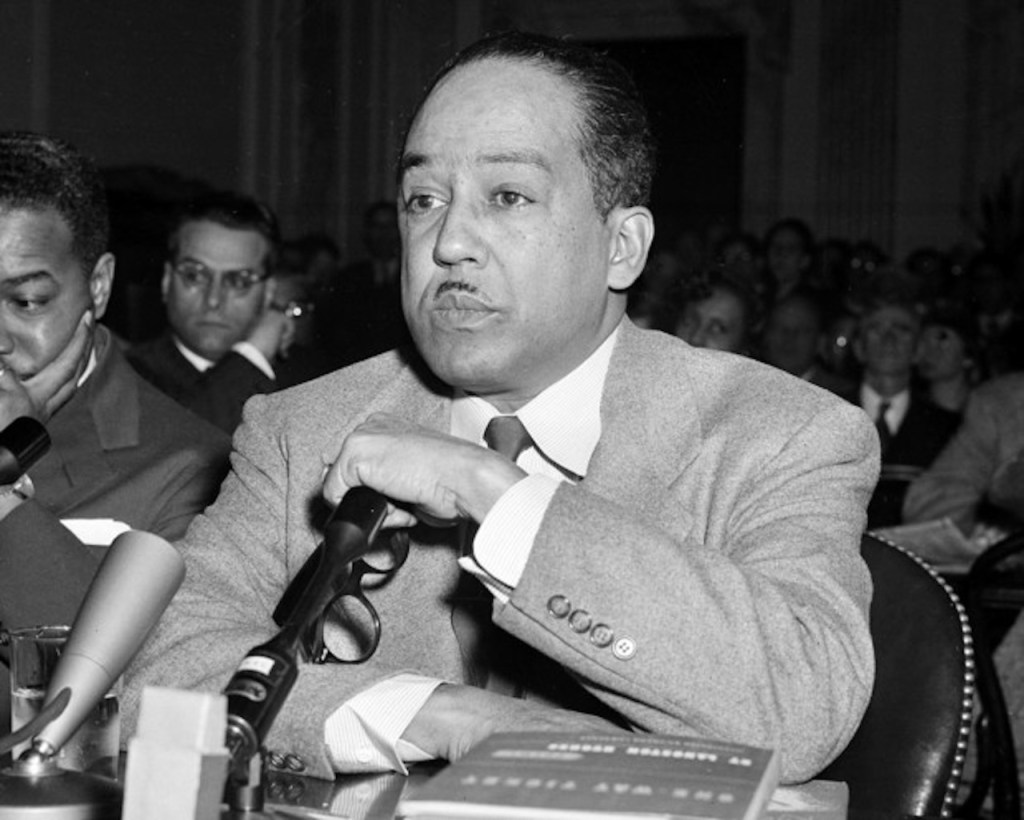
    Image:  Langston Hughes– Appearing before Joseph McCarthy’s Senate Permanent Subcommittee on Investigations – March 24, 1953

    Note on Term Usage:  Before the late 1980s in the United States, the terms “Negro,” “colored,” and “black” were accepted widely in American English parlance.   While the term “Negro” had started to lose it popularity in the 1960s, it wasn’t until 1988 that the Reverend Jesse Jackson began insisting that Americans adopt the phrase “African American.”  The earlier more accurate terms were the custom at the time that Langston Hughes was writing.

    Langston Hughes’ “Goodbye, Christ”

    Langston Hughes wrote “Goodbye, Christ” in 1931. It was published in a statist publication called “The Negro Worker” in 1932, but Hughes later withdrew it from publication.

    Introduction with Text of “Goodbye, Christ”

    Nine years after the publication of Langston Hughes’ “Goodbye, Christ,” on January 1, 1941, the poet was scheduled to deliver a talk about Negro folk songs at the Pasadena Hotel. Members of Aimee Semple McPherson’s Temple of the Four Square Gospel picketed the hotel with a sound truck playing “God Bless America.”   

    Likely those members of the McPherson temple became aware of the poem because McPherson is mentioned in it. The protestors passed out copies of Hughes’ poem, “Goodbye, Christ,” even though they had not secured permission to copy and distribute it. 

    A few weeks later, The Saturday Evening Post, heretofore no friend to black writers, also mentioned in the poem, also printed the poem without permission. The poem had received little attention until these two events.  

    But Hughes had been criticized for his “revolutionary” writings and apparent sympathy for the Soviet form of government. On March 24, 1953, Hughes was called to testify before the Joseph McCarthy’s Senate Permanent Subcommittee on Investigations.

    Goodbye, Christ

    Listen, Christ,
    You did alright in your day, I reckon-
    But that day’s gone now.
    They ghosted you up a swell story, too,
    Called it Bible-
    But it’s dead now,
    The popes and the preachers’ve
    Made too much money from it.
    They’ve sold you to too many
    Kings, generals, robbers, and killers-
    Even to the Tzar and the Cossacks,
    Even to Rockefeller’s Church,
    Even to THE SATURDAY EVENING POST.
    You ain’t no good no more.
    They’ve pawned you
    Till you’ve done wore out.
    Goodbye,
    Christ Jesus Lord God Jehova,
    Beat it on away from here now.
    Make way for a new guy with no religion at all-
    A real guy named
    Marx Communist Lenin Peasant Stalin Worker ME-
    I said, ME!
    Go ahead on now,
    You’re getting in the way of things, Lord.
    And please take Saint Gandhi with you when you go,
    And Saint Pope Pius,
    And Saint Aimee McPherson,
    And big black Saint Becton
    Of the Consecrated Dime.
    And step on the gas, Christ!
    Move!
    Don’t be so slow about movin?
    The world is mine from now on-
    And nobody’s gonna sell ME
    To a king, or a general,
    Or a millionaire.

    Commentary on “Goodbye, Christ”

    Langston Hughes’ poem “Goodbye, Christ” is a dramatic monologue. The speaker is addressing Christ, telling him to leave because He is no longer wanted. The speaker is employing irony and sarcasm to express his distrust and disapproval of the many people, including the clergy, who have used religion only for financial gain.

    Serving God or Mammon 

    In the first verse paragraph (versagraph), the speaker explains to Christ that things are different now from the way they were back in Christ’s day; the speaker figures that back then Christ’s presence might have been appreciated, but now “[t]he popes and the preachers’ve / Made too much money from [your story].”  

    And that complaint is addressed in the poem that certain individuals and organizations have used the name of Christ to make money: “They’ve pawned you / Till you’ve done wore out.”  

    The speaker makes it clear that it is not only Christianity that has been desecrated, for he also includes Hinduism when he tells Christ “please take Saint Gandhi with you when you go.”  It is not only white people like McPherson, but also “big black Saint Becton,” a charlatan preacher Hughes mentions in his autobiography, The Big Sea

    Hughes is, in no way, repudiating Jesus Christ and true religion. He is, however, excoriating those whom he considers charlatans, who have profited only financially without highlighting the true meaning of Christ’s (or other religions’) teachings. 

    Langston Hughes on “Goodbye, Christ” 

    In editor Faith Berry’s Good Morning Revolution: Uncollected Writing of Langston Hughes, Berry brings together a large collection of writings for which Hughes did not seek wide publication.  Some of his early politically statist-leaning poems, which had appeared in obscure publications, managed to circulate, and Hughes was labeled a Communist, which he always denied in his speeches. 

    About “Goodbye, Christ,” Hughes has explained that he had withdrawn the poem from publication, but it had appeared without his permission and knowledge.  Hughes also insisted that he had never been a member of the Communist Party.  He went so far as to say he wished Christ would return to save humanity, which was in dire need of saving, as it could not save itself. 

    Earlier in his immaturity, Hughes had believed that the communist form of government would be more favorable to black people, but he became aware that his VIP treatment in Russia was a ruse, calculated to make people of color think that communism was friendlier to them than capitalism while ultimately hoodwinking them just as the Democratic Party did later on in the century.  (Also see Carol Swain’s “The Inconvenient Truth about the Democratic Party”)

    In his senate committee testimony on March 24, 1953, Hughes makes his political inclinations clear that he had never read any book on the theory of socialism and communism.  Also, he had not delved into the stances of the Republican and Democrat parties in the United States.

    Hughes claimed that his interest in politics was prompted solely by his emotion.  Only through his own emotions had he glanced at what politics might have to offer him in figuring out personal issues with society.  So in “Goodbye, Christ,” the following versagraph likely defines the poet’s attitude at its emotional depths:

    Goodbye,
    Christ Jesus Lord God Jehova,
    Beat it on away from here now.
    Make way for a new guy with no religion at all—
    -A real guy named
    Marx Communist Lenin Peasant Stalin Worker ME—
    I said, ME!

    Hughes spent a year in Russia and came back to America writing glowing reports of the wonderful equalities enjoyed by all Russians, which many critics wrongly interpreted to indicate that Hughes became a communist.   On January 1, 1941, Hughes wrote the following clear-eyed explanation that should once and for all put to rest the notion that his poem was meant to serve blasphemous purposes:

    “Goodbye, Christ” does not represent my personal viewpoint.  It was long ago withdrawn from circulation and has been reprinted recently without my knowledge or consent.  I would not now use such a technique of approach since I feel that a mere poem is quite unable to compete in the power to shock with the current horrors of war and oppression abroad in the greater part of the world.

    I have never been a member of the Communist party.  Furthermore, I have come to believe that no system of ethics, religion, morals, or government is of permanent value which does not first start with and change the human heart.  Mortal frailty, greed, and error know no boundary lines.  

    The explosives of war do not care whose hand fashions them.  Certainly, both Marxists and Christians can be cruel.  Would that Christ came back to save us all. We do not know how to save ourselves. (my emphasis added) —from  Good Morning Revolution: Uncollected Writing of Langston Hughes, page 149.

    The Importance of Understanding the Irony in “Goodbye, Christ”

    While it may be difficult for devout Christians, who love Christ and his teachings, to read such seemingly blasphemous writing, it is important to distinguish between the literal and the figurative:  Hughes’ “Goodbye, Christ” must be read through the lens of irony and sarcasm, and realized as a statement against the financial usurpation of religion, and not a repudiation of Christ and the great spiritual masters of all religions.

    It should be remembered that Hughes’ seemingly blasphemous poem simply creates a character who was speaking ironically, even sarcastically, in order to call out the actual despicable blasphemers who desecrate true religion with duplicity and chicanery.
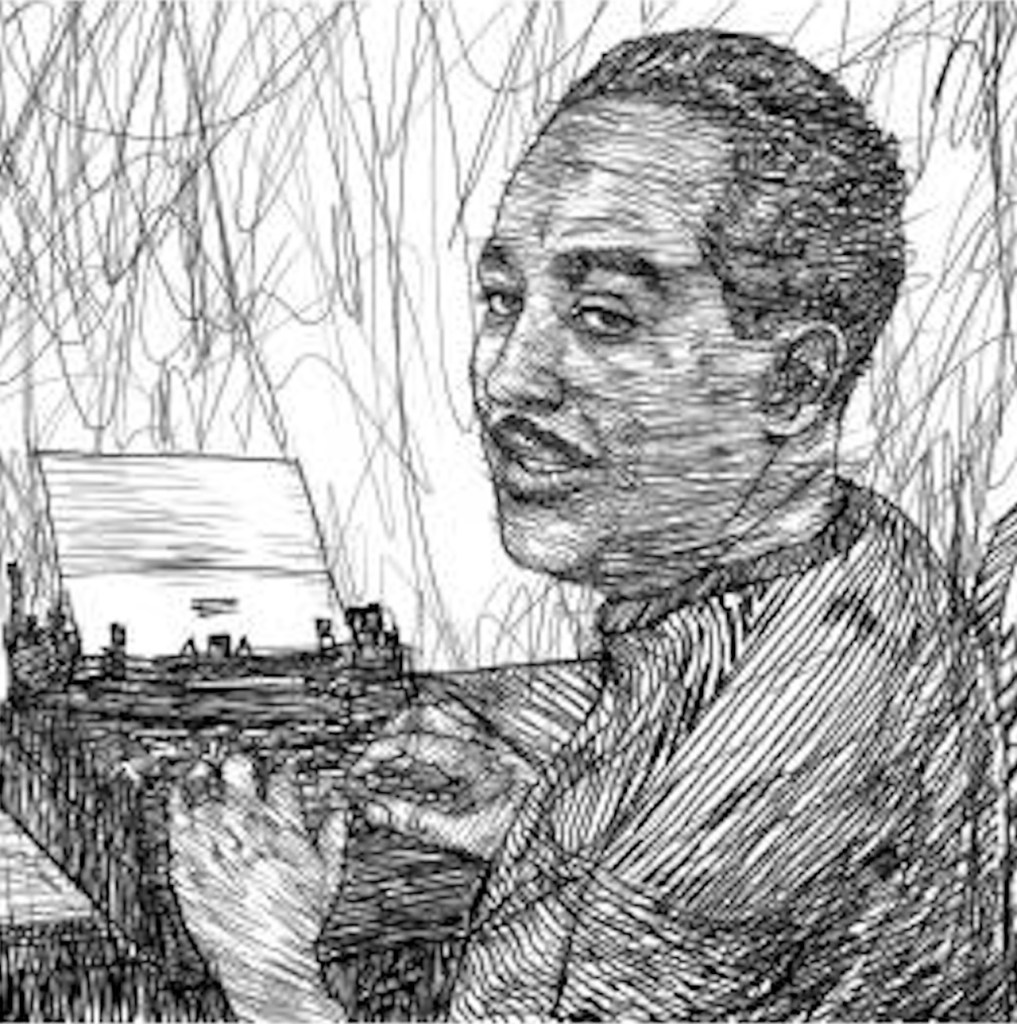
    Image:  Ink Drawing of Langston Hughes– Ink Portrait – Fabrizio Cassett
  • James Weldon Johnson

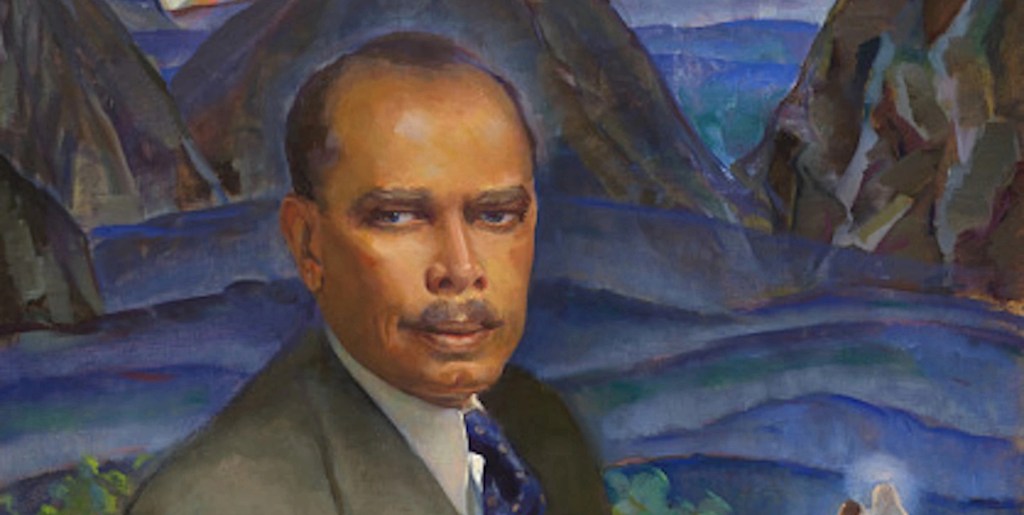
    Image:James Weldon Johnson – Portrait  by Laura Wheeler Waring

    Life Sketch of James Weldon Johnson

    A true “Renaissance man,” James Weldon Johnson wrote some the best spiritual poems and songs in the American literary canon.  He also held positions as attorney, diplomat, professor, and activist in a political party, fighting for the civil rights of black Americans.

    Note on Term Usage:  Before the late 1980s in the United States, the terms “Negro,” “colored,” and “black” were accepted widely in American English parlance.   While the term “Negro” had started to lose it popularity in the 1960s, it wasn’t until 1988 that the Reverend Jesse Jackson began insisting that Americans adopt the phrase “African American.”  The earlier more accurate terms were the custom at the time that James Weldon Johnson was writing.

    Early Life and Schooling

    James Weldon Johnson was born on June 17, 1871, in Jacksonville, Florida, [1] to James Johnson, of Virginia, who had held a position as headwaiter at a resort hotel, and Helen Louise Dillet, of the Bahamas, who had served as a teacher in Florida.  

    His parents raised James to be a strong, independent man.  The future poet became a free-thinker as his parents encouraged him to understand that he was capable of achieving all the success in life for which he sought to strive. 

    In 1894, after completing the bachelor’s degree at Atlanta University, he accepted a position as principal at the Edwin M. Stanton School.  His mother had taught at that school.  In his position as principal of Stanton, he made great improvements in the curriculum, adding grades 9 and 10.

    While serving at the Stanton school as principal, Johnson founded the newspaper, The Daily American.  The paper remained in publication for only a year, but it served as a lever for Johnson’s role as an activist, bringing him to the attention of Booker T. Washington and W.E.B. DuBois, two of the most influential activists of the civil rights movement.

    Johnson began the study of law in Thomas Ledwith’s law office in Jacksonville, Florida, in 1896 [2].  He passed the bar exam in 1898 and was admitted to the Florida bar.  He practiced law for several years and then decided to pursue other lines of work.

    From New York City to the Diplomatic Corp

    To engage a career in songwriting, in 1901 James and his brother Rosamond moved to New York City.  They became partners with Bob Cole and accepted a publishing contract which paid a $1200 monthly stipend.  That income amounted to a fortune in the early 20th century.  

    During the next half decade, the Johnson brothers wrote and produced a whopping 200 songs for both Broadway and for other formats.  Their substantial list of hits include titles such as  “Didn’t He Ramble,” “Under the Bamboo Tree,” and “The Old Flag Never Touched the Ground.”

    Along with Bob Cole, the Johnsons earned a outstanding reputation as a musical trio.   They became known affectionately as “Those Ebony Offenbachs.”  While they eschewed the artistry of the minstrel show stereotypes, they did agree to create simplified versions of black life of rustics for white audiences that seemed to relish such fare.  

    But their most important contribution includes a suite of six songs titled The Evolution of Ragtime, a documentary which has remained important for recording the black experience in contributing to music. Residing in New York also allowed Johnson the opportunity to attend Columbia University, where he engaged formally in the study literature and creative writing.  

    Johnson also began his civil rights activism in Republican Party politics.  While serving as the treasurer of New York’s Colored Republican Club, he wrote two songs for Theodore Roosevelt’s 1904 presidential campaign.  Roosevelt won that campaign, becoming the 26h president of the United States.

    The black national civil rights leadership divided into two factions: one remained traditional and was led by Booker T. Washington.  The other faction turned radical and was headed up by W.E.B. Du Bois.  Johnson chose to follow Washington and the traditionalists.  

    Washington’s leadership had offered the appropriate influence and had helped Roosevelt win the presidency.  Thus, Washington exerted his influence again to have Johnson appointed as the U.S. consulate to Venezuela.  

    Johnson’s stint in Venezuela afforded him time to create poetry. There he composed his magnificent, nearly perfect sonnet, “Mother Night,” during this time.  Also, during this three year period of service as consul on Venezuela, he was able to finish his novel, The Autobiography of an Ex-Coloured Man.  

    After Johnson’s service in Venezuela, he received a promotion that relocated him to Nicaragua. His job in Nicaragua became more demanding, allowing him less time for literary efforts.

    Back to New York and the Harlem Renaissance

    In 1900, Johnson composed the hymn “Lift Ev’ry Voice and Sing” for a school celebration of Abraham Lincoln’s birthday [3].  His brother Rosamond later added the melody to the lyric. In 1919, the National Association for Advancement of Colored People (NAACP) designated the song the “Negro National Hymn (Anthem).”

    In 1913, because of the inauguration of Woodrow Wilson, a Democrat, Johnson resigned his foreign service position and returned to the U.S.A.  In New York, Johnson began writing for New York’s prestigious black newspaper, the New York Age.  He wrote essays explaining and promoting the importance of the hard-work ethic and education.  

    Johnson’s traditionalism kept his position more in line with Booker T. Washington than with the radical militant W.E.B. Du Bois.  Despite those differences in ideologies, Johnson remained on good terms with both activists.

    In 1916, after Du Bois suggested the position to Johnson, he accepted the role as secretary in the NAACP.  In 1920, Johnson led the organization as president. Despite his many activist duties with the  NAACP, Johnson dedicated himself to writing full time. In 1917, he published his first collection of poems, Fifty Years and Other Poems.  That collection received great critical acclaim and established him as an important voice in the Harem Renaissance Movement.  

    Johnson continued writing and publishing; he also served as editor for numerous volumes of poetry, such as The Book of American Negro Poetry (1922), The Book of American Negro Spirituals (1925), and The Second Book of Negro Spirituals(1926).  

    In 1927, Johnson published his second book of poems God’s Trombones: Seven Negro Sermons in Verse [4]. Again, his collection received much praise from critics.  Dorothy Canfield Fisher, a best-selling author and activist for education reform, stated in a letter about Johnson’s style:

    . . . heart-shakingly beautiful and original, with the peculiar piercing tenderness and intimacy which seems to me special gifts of the Negro. It is a profound satisfaction to find those special qualities so exquisitely expressed.

    Back to Teaching

    After his retirement from the NAACP, Johnson continued writing.   He also served as professor  at New York University.  Johnson’s stellar reputation again preceded him; as he joined the NYU faculty, Deborah Shapiro testified:

    Dr. James Weldon Johnson was already a world-renowned poet, novelist, and educator when he arrived at the School of Education in 1934.  His faculty appointment was in the Department of Educational Sociology, yet Johnson’s influence did not end there.  As the first black professor at NYU, Johnson broke a crucial color barrier, inspiring further efforts toward racial equality both within and outside the boundaries of Washington Square.

    Death

    In 1938 at age 67, Johnson was killed in an automobile accident in Wiscasset, Maine, after a train crashed into the vehicle in which the poet was a passenger.  His funeral, held in Harlem, New York, was attended by over 2000 individuals.  

    Johnson’s creative power and activism rendered him a true “Renaissance man,” who lived a full life.  He penned some of the finest poetry and songs ever to appear on the American literary and music scenes. Johnson’s life creed bestows on the world an uplifting inspiration after which any individual might choose to chisel his life:

    I will not allow one prejudiced person or one million or one hundred million to blight my life. I will not let prejudice or any of its attendant humiliations and injustices bear me down to spiritual defeat. My inner life is mine, and I shall defend and maintain its integrity against all the powers of hell. [5]

    The poet’s body is interred in Green-Wood Cemetery in Brooklyn, New York [6]. In an unconventional final expression, his body has been arrayed in his favorite lounging cape, with his hands clutching a copy of his collection God’s Trombones.

    Sources

    [1] Editors. “James Weldon Johnson.”  Famous African Americans. Accessed January 27, 2023.

    [2] Malik Simba.  “Profile:  James Weldon Johnson (1871- 1938).”  Black Art Story.  Accessed January 27, 2023.

    [3] Editors. “The Story Behind the Black National Anthem.”  Black Excellence.  September 26, 2018.

    [4] Editors. “James Weldon Johnson.”  Poetry Foundation.  Accessed January 27, 2023.

    [5] Christine Weerts.  “How ‘Lift Every Voice And Sing’ Became A Song Of Hope For Generations.”  The Federalist.  February 12, 2021.

    [6] FindAGrave.  “James Weldon Johnson.”  Accessed January 27, 2023.

    Commentaries on Poems by James Weldon Johnson

    This room in my literary home holds links to poems written by James Weldon Johnson along with commentaries on the poems.  

    Poems with Commentaries

    1. Noah Built the Ark”
    2. “Go Down Death”
    3. “Sence You Went Away”
    4. “Fifty Years”
    5. “A Poet to His Baby Son”
    6. “Lift Every Voice and Sing”
    7. “Mother Night”
    8. “The Creation”
    9. “O Black and Unknown Bards”
    10. “My City”

    Full Image:James Weldon Johnson – Portrait  by Laura Wheeler Waring

  • Sterling A. Brown’s “Southern Cop”

    Image:  Sterling A. Brown  Academy of American Poets

    Sterling A. Brown’s “Southern Cop”

    This commentary on Sterling A. Brown’s “Southern Cop” offers an alternative reading to the sycophantic interpretation given by postmodernists who subscribe to the prevailing ideology of victimhood.  The curse of identity politics soft censors such stances; thus they remain rare.

    Introduction with Text of “Southern Cop”

    While the speaker in Sterling Brown’s “Southern Cop” seems to be exposing and rebuking racism, he actually engages in racism himself. This widely anthologized poem features the following scene: A rookie cop named Ty Kendricks has shot a man who was running out of an alley. 

    The poem does not report the reason that the man was running nor the reason that the police officer happened to be at the scene.  However, the report clearly states that the man’s reason for running was not because of any guilt on his part. It is useful to keep in mind that the caveat stating that one is innocent until proven guilty applies to all citizens—even those who are running.

    The speaker of the poem purports to represent the outraged citizenry, whose emotional reaction is so powerful that the speaker must turn to verbal irony in order to convey that outrage. The outraged speaker assumes that his audience is as offended as he is and thus will agree with his statements on all levels. 

    But the speaker also assumes that a racist audience will take him literally, even though brushing away the irony would demonstrate the utter bankruptcy of his intentionally ludicrous exhortations. The ideas that because Ty Kendricks was a rookie in the process of proving himself and that the citizenry should decorate him for shooting an innocent man cannot be taken literally.

    The ideas of proving manhood and decorating a cop for shooting an innocent man are clearly absurd. The ideas are absolutely preposterous, yet the speaker does not suggest the course of action society should take in dealing with Ty Kendricks, the rookie cop, who likely made a mistake, without consideration of the race of the victim. 

    What does this rookie cop deserve? Who is to decide? An angry, disorderly mob? The speaker’s emotion becomes magnified with each stanza from the first line of the first stanza that would appear not to be ironic at all but quite literal to the first line of the last stanza that is undoubtedly filled with irony. 

    About half-way through the poem the irony becomes obvious. And the speaker then sets center stage his ironic barbs in his effusion.

    Southern Cop

    Let us forgive Ty Kendricks.
    The place was Darktown. He was young.
    His nerves were jittery. The day was hot.
    The Negro ran out of the alley.
    And so Ty shot.

    Let us understand Ty Kendricks.
    The Negro must have been dangerous.
    Because he ran;
    And here was a rookie with a chance
    To prove himself a man.

    Let us condone Ty Kendricks
    If we cannot decorate.
    When he found what the Negro was running for,
    It was too late;
    And all we can say for the Negro is
    It was unfortunate.

    Let us pity Ty Kendricks.
    He has been through enough,
    Standing there, his big gun smoking,
    Rabbit-scared, alone,
    Having to hear the wenches wail
    And the dying Negro moan.

    Commentary on “Southern Cop”

    This irony-filled drama portrays a bundle of rage and racism. The attitude of the speaker weighs in at least as heavily as the actual event that the speaker is decrying.

    Stanza 1:  Forgiveness Is Good

    Let us forgive Ty Kendricks.
    The place was Darktown. He was young.
    His nerves were jittery. The day was hot.
    The Negro ran out of the alley.
    And so Ty shot

    The first stanza opens with the speaker seemingly quite controlled as he suggests that he and his milieu “forgive” the young cop named Ty Kendricks. The invocation of the Christian value of forgiveness offers no clue that the speaker would not, in fact, forgive this rookie cop. Of course, the biblical injunction demands that  trespassers be forgiven.

    However, in this particular scenario, what is the speaker suggesting be forgiven? He is urging forgiveness of Ty Kendricks the rookie cop who shot an man because he was running out of an alley.  The speaker does not reveal the reason that the man was running, nor what caused the cop to shoot; the speaker is simply asking that the rookie be forgiven. 

    Stanza 2:  Understanding Is Also a Good Thing

    Let us understand Ty Kendricks.
    The Negro must have been dangerous.
    Because he ran;
    And here was a rookie with a chance
    To prove himself a man.

    Next, the speaker asks that he and his listeners “understand” the rookie cop. Of course, they should try to understand both the perpetrators of crime and the enforcers of law. Otherwise, justice cannot prevail without understanding. 

    But then the speakers’s audience is apprised of what they are being commanded to forgive and to understand: the man was surely dangerous/guilty because he was running.  Not only that, the rookie Ty Kendricks now has the opportunity to show himself to be a man.

    Because running does not equal guilt, and the notion of proving manhood by shooting someone is ludicrous, it now becomes clear that the speaker is engaging in verbal irony to portray his true message.  This speaker does not, in fact, want his audience to forgive nor understand Ty Kendricks, the rookie cop.

    What does the speaker hope to accomplish with his use of irony? He intends to brand Ty Kendricks a racist and elicit sympathy for the man shot by this cop. Of course, the man who was shot deserves sympathy, but the speaker offers no evidence that Ty Kendricks was a racist cop.  

    That fact that Kendricks shot a man running out of an ally does not equal racism, despite the fact that the running man was black. All things being equal, Ty Kendricks would likely have shot any man of any race in this situation.

    Stanza 3:  Condoning the Killing of an Innocent Man

    Let us condone Ty Kendricks
    If we cannot decorate.
    When he found what the Negro was running for,
    It was too late;
    And all we can say for the Negro is
    It was unfortunate.

    Condoning this apparently despicable act of a rookie cop shooting an innocent victim becomes a near surreal request.  But because the speaker is engaging in irony, he does not intend his listeners to “condone” but instead to “condemn” the rookie cop.

    The cop’s reaction of shooting the running man became just another “unfortunate” event by the time the cop learned the reason for the running.  But what is the efficacy of forgiving, condoning, and decorating a cop for a bad shoot? 

    The ironic use of the terms means that the speaker is in reality suggesting that his listeners continue to hold a grudge and to condemn cops, even those who might have mistakenly shot someone. The intensity of this verbal irony may possibly encourage speculation that the speaker is even attempting to instigate rioting, burning buildings, and killing other cops.

    Stanza 4:  Pity for All Involved

    Let us pity Ty Kendricks.
    He has been through enough,
    Standing there, his big gun smoking,
    Rabbit-scared, alone,
    Having to hear the wenches wail
    And the dying Negro moan.

    Finally, the speaker appears to return to some semblance of humanity, asking that he and his listeners “pity” this poor rookie cop.  Of course, the cop deserves pity. Or more accurately, he deserves sympathy and support. Taking the life of a fellow human being causes emotional damage—even to the most well-adjusted veteran law enforcement officer.

    And taking a human life constitutes a serious, deeply spiritual offense against Creation and the Creator, even though that Creator has arranged Creation to require such an offense at times. Even man’s law allows for self-defense.

    But notice that the speaker is still in his own racist venue, as he applies his final acerbic barb of irony: he does not, in fact, want his audience to pity that rookie cop. Instead, he wants his readers to pity only the family of the deceased man: they stood there crying and moaning the loss of their loved one. 

    The speaker asks us to pity the rookie only because that rookie has to listen to that crying and moaning.  By stating ironically that the pity should apply to Ty Kendricks and contrasting his situation with that of the deceased man and his family, the speaker is implying that any loss suffered by the cop remains negligible.

    But suffering cannot be compared and contrasted especially in such a callous way. There is no way of calculating and weighing the suffering on either side: it’s a lose-lose situation.

    Ultimately, there is no pity for Kendricks from this speaker and his ilk—only a hollow attempt to portray the cop as a criminal, not simply a human being who has made a mistake.

    The Issue of Racism in the Poem

    A cursory reading of Sterling A. Brown’s “Southern Cop” may result in the assumption of the stereotypical view that cops shoot young black men because they are black.  An example of such a reading includes the following:

    Sterling A. Brown’s poem “Southern Cop” published in 1936 is an extremely powerful piece of poetry in American history because it cuts at the heart of racism in America. Unfortunately, many of the points Brown makes are still relevant today. In fact, this poem could have been written after any number of recent events, Ferguson perhaps being the most well known, and it would be as pertenant (sic) as ever. [1]

    The claim that this poem parallels the situation in “Ferguson” is patently false.  The shooting in the poem “Southern Cop” and the shooting in Ferguson have nothing in common.  In the “Ferguson” shooting, the race of the cop who shot and the race of the victim are known.  In “Southern Cop,” the race of the cop can only be assumed—and then only prejudicially.

    The “Hands up, don’t shoot!” claim, following the shooting of black teenager Michael Brown by white cop Darren Wilson in Ferguson, Missouri, in August 2014, has been debunked repeatedly; yet its basic impetus has refused to be abated [2] [3] [4] [5].   In fact, the only racism discoverable in the poem”Southern Cop” comes from the speaker, who identifies the victim as a “Negro” but does not ever mention the race of the cop who shot the “Negro.”  

    Because the stereotype of white racist cops, especially southern cops, is so ingrained in the culture, the speaker feels no need to identify the race of Ty Kendricks, who could as likely have been of any race. But because of the assumption that the cop is white, the speaker demonstrates his own racism by his utter contempt; he is deliberately attempting to pit the race of the shooting victim against the race of the shooter. 

    The speaker demonstrates sympathy only for the “Negro” while he attempts to promote hatred and contempt for the cop. 

    Sources

    [1]  WESSWIDEREK.  “Southern Cop.” ENGL 213: Modernist Lit & Culture.  November 14, 2016.

    [2]  Noah Rothman.  “‘Hands up, Don’t Shoot’: The Myth That Refuses to Fade.”  Hotair.  December 03, 2014.

    [3]  Andrew C. Mccarthy. “Progressive Mythography.”  National Review.  November 29, 2014.

    [4]  Nick Gass.  “‘Hands up, Don’t Shoot’ Ranked One of Biggest ‘Pinocchios’ of 2015.”  Politico.  December 14, 2015.

    [5]  William A. Jacobson.  “Reminder: “Hands up, Don’t Shoot” Is a Fabricated Narrative from the Michael Brown Case.”    LI: Legal Insurrection.  June 4, 2020.

    Note on Usage

    Before the late 1980s in the United States, the terms “Negro,” “colored,” and “black” were accepted widely in American English parlance. 

    While the term “Negro” had started to lose it popularity in the 1960s, it wasn’t until 1988 that the Reverend Jesse Jackson began insisting that Americans adopt the phrase “African American.”  The earlier more accurate terms were the custom at the time that Sterling A. Brown was writing.

    Suggestion for Students Writing Papers on Sterling A. Brown’s “Southern Cop” and Other Sensitive Issues

    The following advice applies to students attending most American colleges and universities.  Exceptions are Hillsdale College and a few others, where the First Amendment and other constitutional protections are still operative.

    The current prevailing societal emphasis on identity and the politics of racial victimhood insures that my critical stance in this commentary is deemed unacceptable and will be at least soft censored, if not completely canceled.

    So if you take such a stance in your classes, you are likely to be graded down or even censored—at best.  At worst, you may be labeled racist, even expelled.   

    Therefore, please consider your options when writing on sensitive subjects like this one.  Know your professors’ biases and use caution in crossing them.

    However, the best outcome is that you are in position to take legal action against those professors who violate your constitutional rights. With such endeavors, I wish you all the best success.