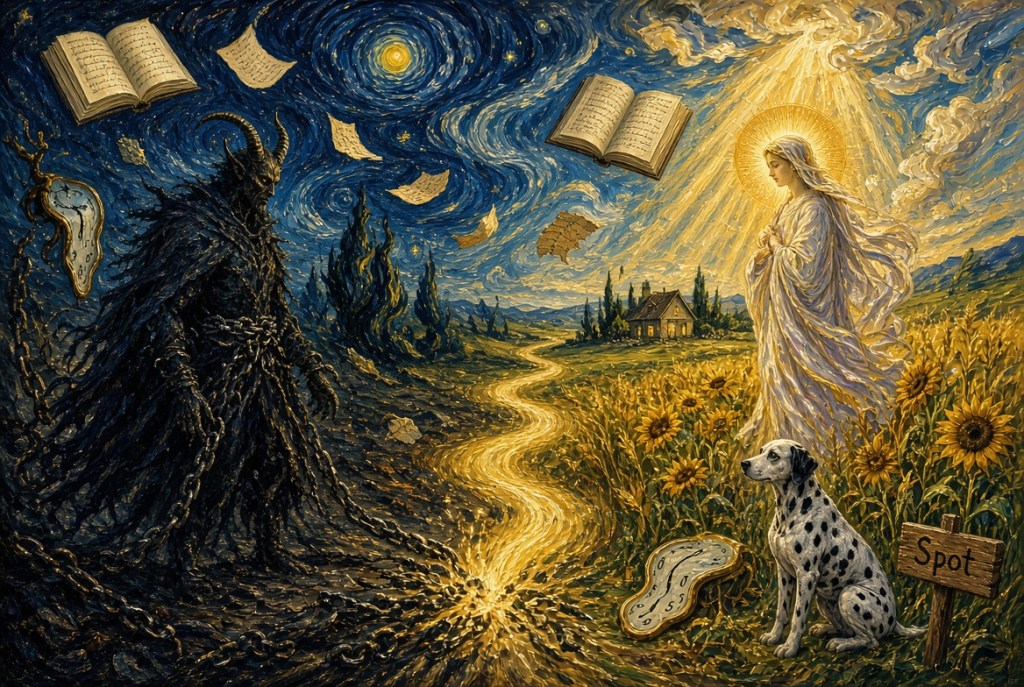
Seeking Retribution and Forgiveness
After acknowledging any commission of sin or wrong doing, a devotee on a spiritual path owes the Divine Belovèd—as well her human fellows—a new sense of fealty, a renewal of faith, and promise to go forth and sin no more.
The Price of Redemption
These poems give voice to two opposing views or selves—“Satan” and “Saint”—each staging a soliloquy over guilt, wrongdoing, and the price of redemption. The collection brings together 20 of my original free-verse poems, each inspired by a Vincent van Gogh painting.
Also included are one poem “Power of Color” inspired by a van Gogh quotation and an original, inspired by a stream-of-consciousness poem “Landscape & Me with Spot,” dedicated to Vincent van Gogh, Salvador Dali, and Spot, my childhood dog appearing in a photo that inspired the poem “Landscape & Me with Spot.”
I have also composed twenty-two original Shakespearean (English) sonnets, each replying to or simply owed to the original free-verse pieces; each sonnet follows the original free-verse poem.
Through this presentation, the voices confront the consequences of immoral desire, willing transgression, and mortal sin, then move on to the demanding transition from retribution toward redemption and forgiveness and ultimately on to peace, grace, a clear mind, and a quiet heart.
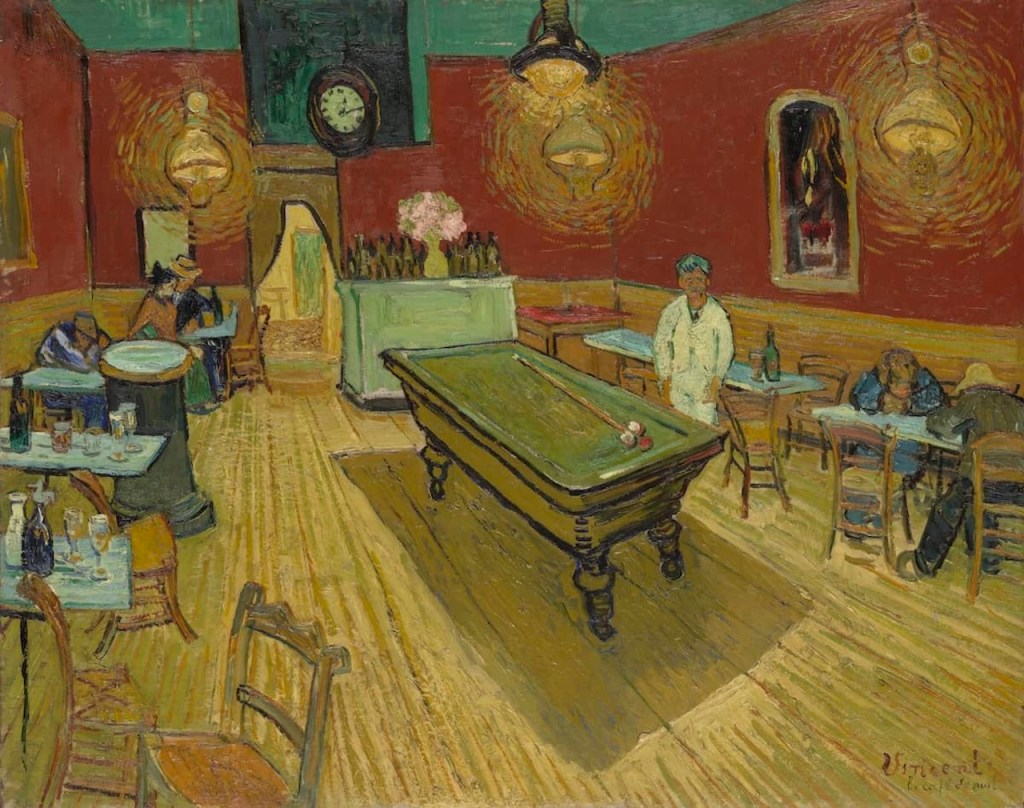
1. Vincent van Gogh’s Le Café de Nuit
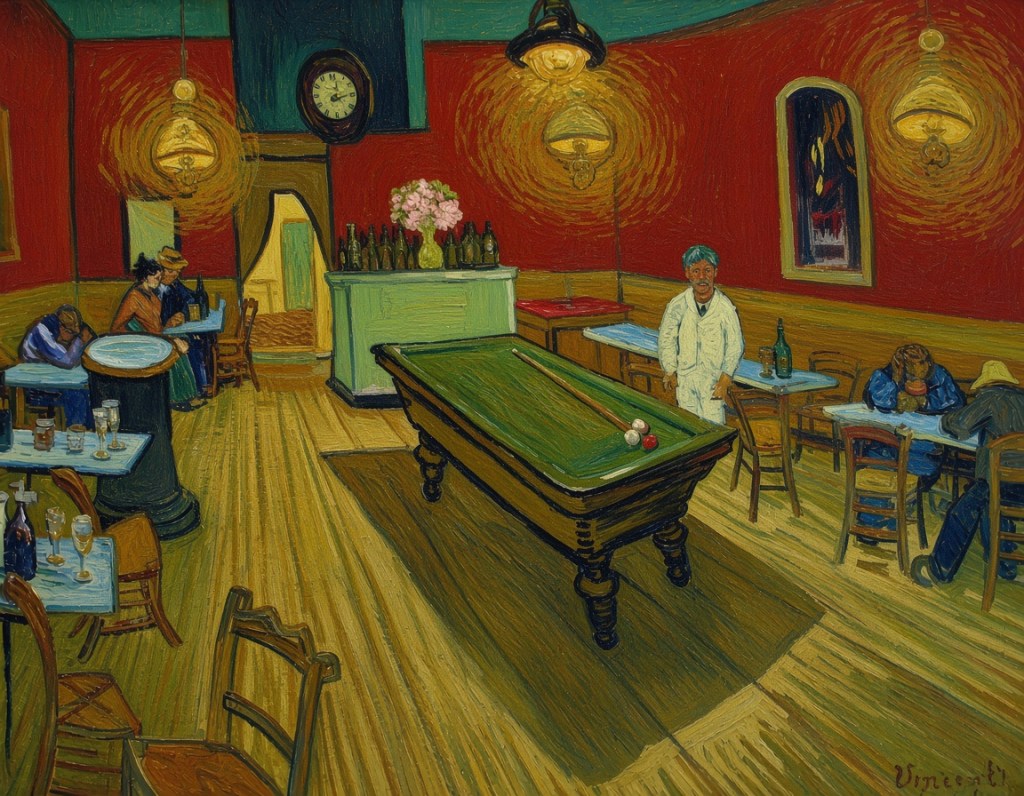
Satan: Quarter Past Midnight at Le Café de Nuit
Vincent’s tortured paint has drawn me
To a place I would never go,
Now that saintly solitude has become my solution.
But then of the six people in the cafe
Only a man and a woman back in the left corner
Sit together,
Sharing a bottle
& whispers, I guess.
Later, after they leave their empty glasses,
Will they stay together or shuffle down
The solemn streets alone?
A man slumps at the table nearest the couple,
No glass or bottle on his table.
A bottle, half a drink, & three empty glasses stand
On the table near the slumping man; a carafe, an empty
Bottle & two half-empty glasses on the next table
As I travel towards myself marking the abandoned tables.
A pool table casts an unlikely shadow over too much floor,
& a man has risen from his chair, stands by the pool table
Gazing at me through the troubled paint.
Shying away from his eye,
I mark behind him another table holds a half-full bottle
& a full glass, probably his bottle & glass.
The last two figures also slump, also without drinks. Sitting
Catty-cornered they seem to face each other, having
A less than intimate conversation. But then they, as well
As the first slumper, are perhaps sleeping, likely homeless men &
these tables their only warm bed.
I wonder if Vincent knew.
The Night Cafe—a place I could not go:
Those red walls & green ceiling & friendly lamps
Hanging down & the booze bottles
Standing brazen on a cabinet
Against the back wall; a curtained
Doorway suggests someone
Lives back there behind the cafe,
Unless, of course, I’m turned around
& that is the entrance.
In any case I would never go there (well, maybe
If you invited me, for a drink and some
intimate conversation)
Because—at this writing—
I know I have more in common with artists
Than I do with the saints.
Saint: Retribution of the Café
These lighted lamps haunt the room at midnight
Red walls seem to accuse this faithless heart
Of sin I drank and saw my vows take flight
Note the green-hued ceilings cover the art
Three empty glasses testify my guilt
Half-empty bottles mock the vow I swore
Sloven slumping men drupe, day-dream, and wilt
A symbol of my shocking creedless lore
O Belovèd, let retribution spurn
Let penalty burn hot as Vincent’s flame
Yet grant me glad grace for which I now yearn
And damn my sin wholly and my vile shame
Through Vincent’s tortured paint my sins confess—
Now I seek a new path my soul will bless
2. Vincent van Gogh’s Madame Roulin Rocking the Cradle
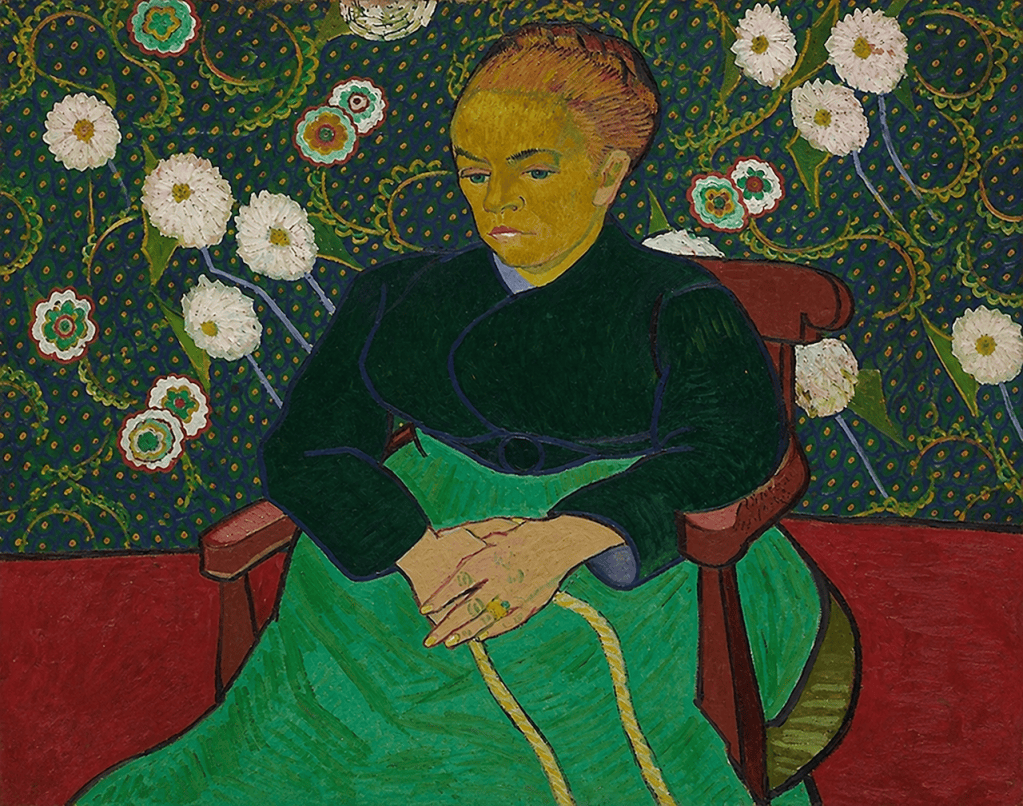
Satan: La Berceuse: Two Views
1
Madame Roulin’s pudgy body
fills up the chair. She’s a short-waisted
dump of a woman, her hair scraped back
tight away from her eyes, her eyes peer
two blanks downward, her mouth matches
the empty look of the eyes but adds
a sour touch with those pursed lips.
The happy flowers on the wallpapered
background contrast with her face.
Her cold countenance makes me shudder for
the pauvr’enfant in her care, she rocks
the cradle with a rope.
2
This is her moment to muse
about those early days
in the cafes, when the soldiers
and their women preened
and crowed, and the hookers
with their painted faces
stole tips from the waitresses
and then her man took her for a virgin
and after little Marie died, and after
he cried and went back to sea,
she settled down with a cradle
and a rope to keep house
for other people
and is well fed.
Saint: Retribution of the Berceuse
Bright flowers blow upon the papered wall
Madame Roulin rocks cradle to and fro
With downcast eyes that seem blind to flowers’ thrall
Pursed lips appear to show a hidden woe
Her rope swings strangely measuring her care
And holds the child whose dreams on her depend
Her deep grief has left her without a prayer
Wounded by time alone she must contend
Thus I who had strayed from the oath I swore
Now sway from the burden of love betrayed
I seek forgiveness though I fear the door
Has closed on the grace for which I have prayed—
I now must suffer for the wrong I’ve done
Sadly I learn that shame and grief are one
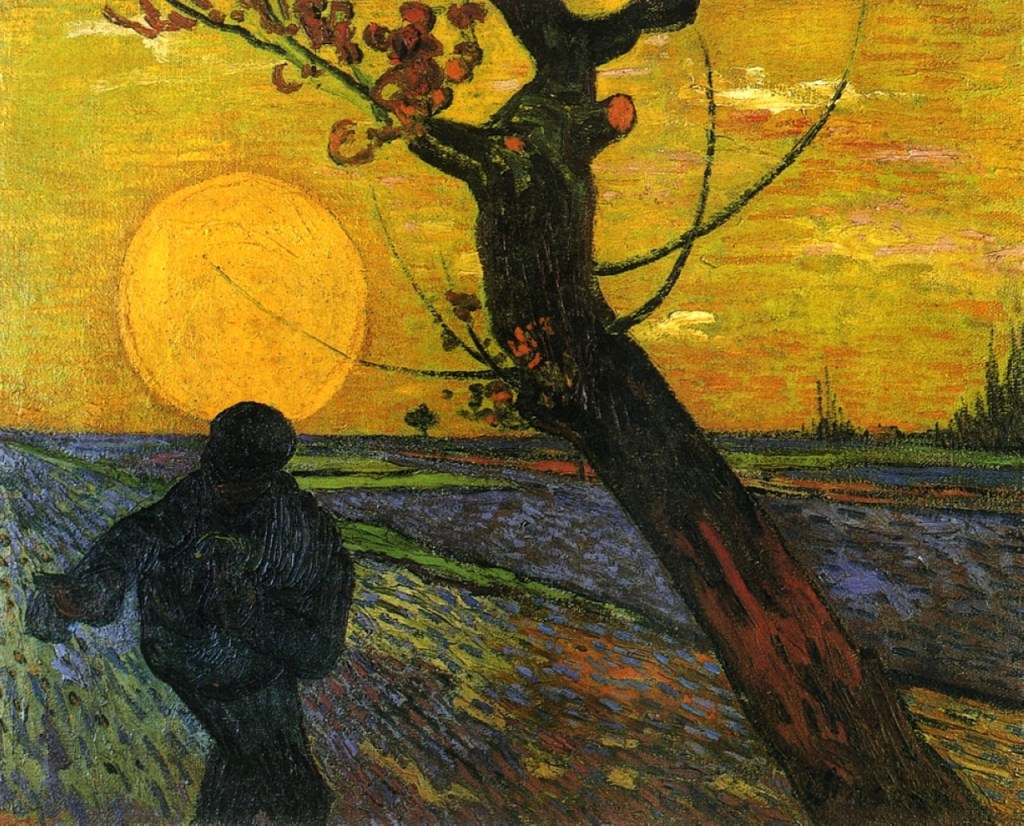
3. Vincent Van Gogh’s Sower with Setting Sun
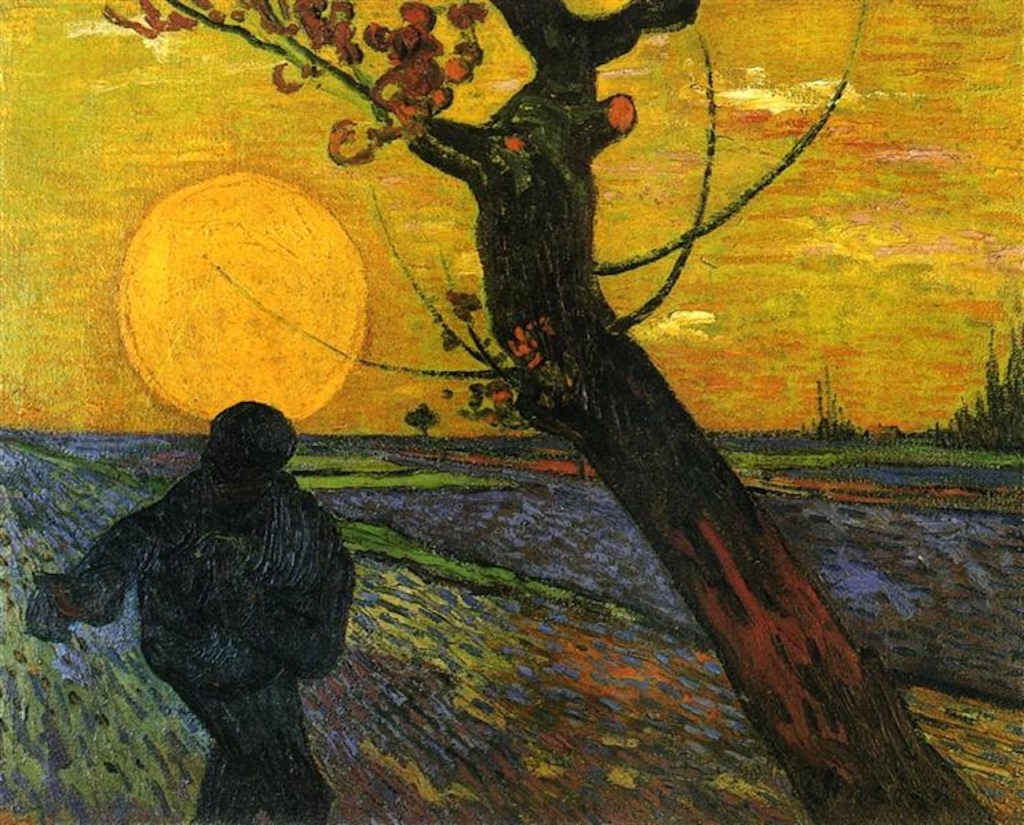
Satan: The Planter
How the sun rings
The top of his head
Like a giant solid halo.
The seed bag slung
Over his right shoulder.
How his face tilts down
As his sowing arm
Swings out, open hand
Letting loose the seeds
But where are the seeds?
You can’t distinguish them
From the other paint drops
In the field. and what about
Other parts of this field
That is so neatly sectioned off?
But it’s too hard to tell if
They are planted & if planted
What they are planted in.
But never mind,
Let’s have another beer
And concentrate on that sun,
That setting sun is important,
After all, vincent called it,
Sower with Setting Sun.
I chose to call my poem
“The Planter” but i too feel
That the sun is important.
The sun has painted the sky
A golden hue.
A naked tree looms
In front of the planter,
A dying tree.
His house sits back
Off to the left
Of the fields,
A long walk,
He is getting tired,
And as soon as the sun
Sinks behind that blue line,
He will have relieved himself
Of all his seeds
And head home to supper.
Saint: Retribution of the Planter
The golden sun haloing round his head
He plants—no guilt in hands that scatter seed
I trek across a split and barren spread
Reaping the burdensome crop of my deed
Behind a naked tree now dead and bare
A home sits far off in the fading light
I hid the dark dalliance I couldn’t share
My judgment comes sure as the coming night
Allow retribution make me whole
Restore trust and honest words to redeem
Forgive the rough sin that now takes its toll
Allow me a new sweeter way to dream
The planter casts his last seed to the ground
May I walk the path where true faith is found
4. Vincent van Gogh’s Flower Beds in Holland
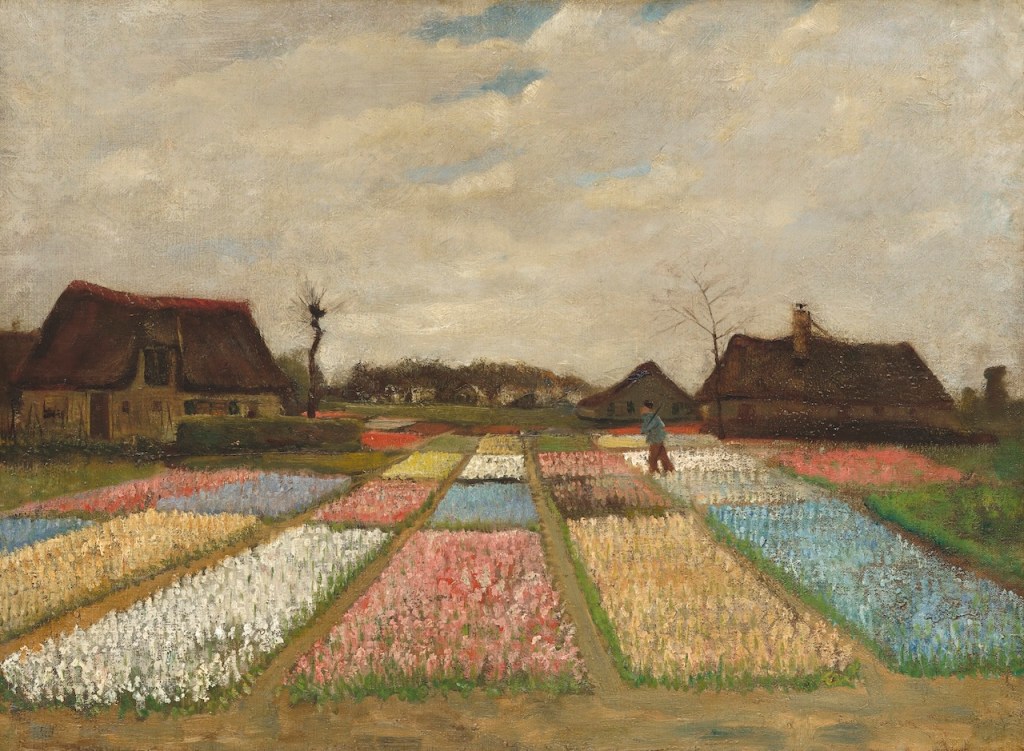
Satan: Flower Beds
Who is that man walking between the white tulips
Carrying a rifle? we will hunker down out of sight
Until he has passed. he will probably disappear beyond
That cottage in a moment and then we can pull up close
To the tulips and watch their lips cup the bees. you
Will say my lips are the color of the frosty pinks, and I
Will say your eyes match the dreamy blues. someday,
I tell you, I will have a dress like those golden-hues and
You will have a shirt as delicious as the peach-blush.
You tell me that your mother grows beautiful flowers,
But she has never been able to cultivate a healthy
African violet, so I say, let’s go back into the house
And I pick one out for her. you take her the plant.
And leave me contemplating the painting. years
Of contemplating and many poems later
I study the Flower Beds in Holland and wonder
About the African violet in your mother’s house.
Saint: Retribution of the Flower Beds
Our deed secreted beneath the tulips
Those stolen moments were not ours to keep
As hiding from an armed man, our view flips
We sowed dark seeds—they now trouble my sleep
Your mom’s African Violets remained spare
I gave you one of mine to give to her
Plants hang with our secrets if we may dare
To withstand the angst—guilty as we were
Years have passed—I study the painted blooms
Their varied hues scold my Janus-faced heart
I pray for pardon from a life that looms
I crave forgiveness for my faithless part
May justice win—may shame and sorrow die
Love—save our souls for truth can never lie
5. Vincent van Gogh’s View of Arles with Irises in the Foreground
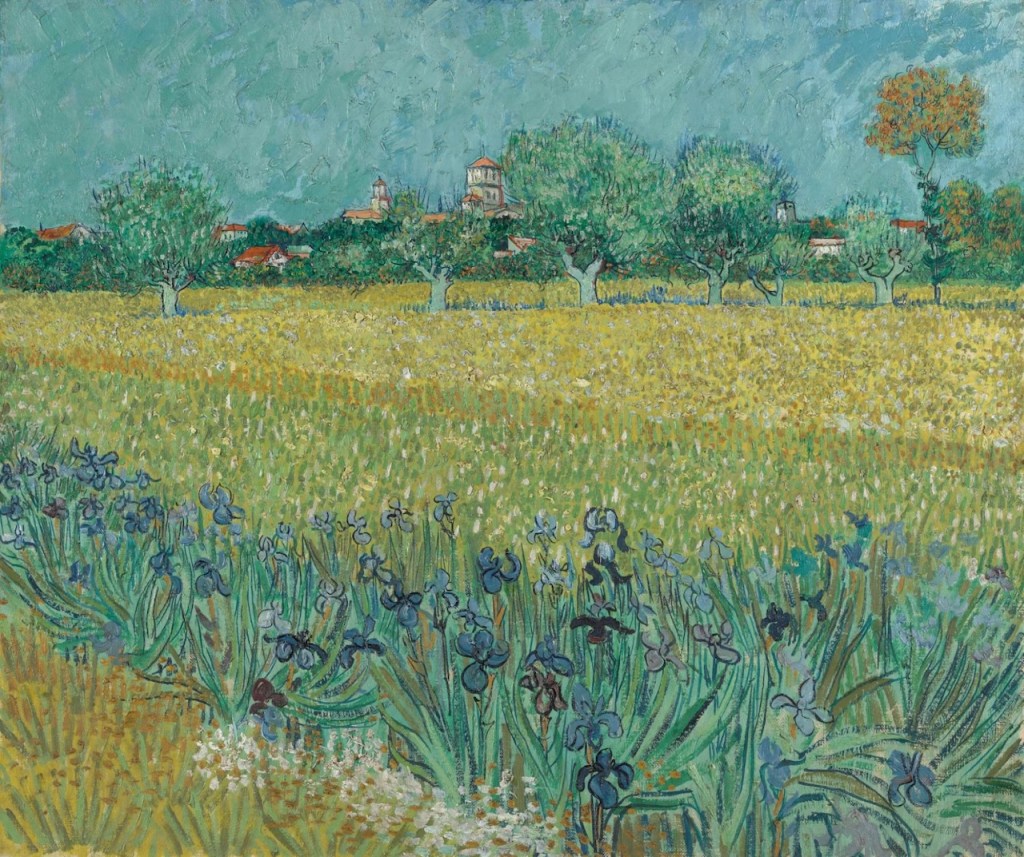
Satan: Vincent’s View of Arles with Irises in the Foreground
To see as you do, Vincent, would give a soul
a clearer heart: the trees that look like
upside-down men, plunged headfirst
into the earth to their waists,
their leaves like women’s hair blown
by the wind and the irises’ pouting lips
parting for the butterflies and the bees,
the red roofs under which the harlots of Arles
grind their tricks into dust,
and the church tower remanding all eyes
to look up at that troubled paint in the sky—
those tiny strokes.
your fingers, your brushes,
and your burden of beauty.
Saint: Retribution of the Irises
Vincent’s irises parting ’neath the sun
Reminds my heart of the shame it had sown
Beneath red roofs vile wicked deeds are done
I slipped my vows for pleasures not my own
Trees bowing low look like men stuck in earth
Wind-tossed leaves hark back to my loosened hair
My honor I shed for a moment’s mirth
I left truth to gasp on its own despair
Allow irises to exact what’s due
Allow their purple lips to scream my guilt
Allow Vincent’s dark sky bear witness too
Allow my grievous sin to grieve and wilt
Renew me that true love may take my part
Cleanse me with grace—let mercy heal my heart
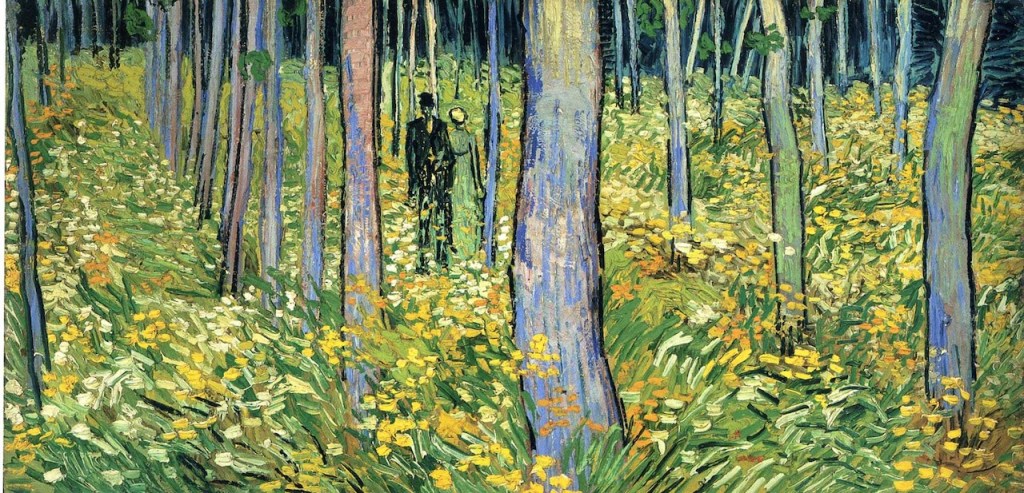
6. Vincent van Gogh’s Undergrowth with Two Figures
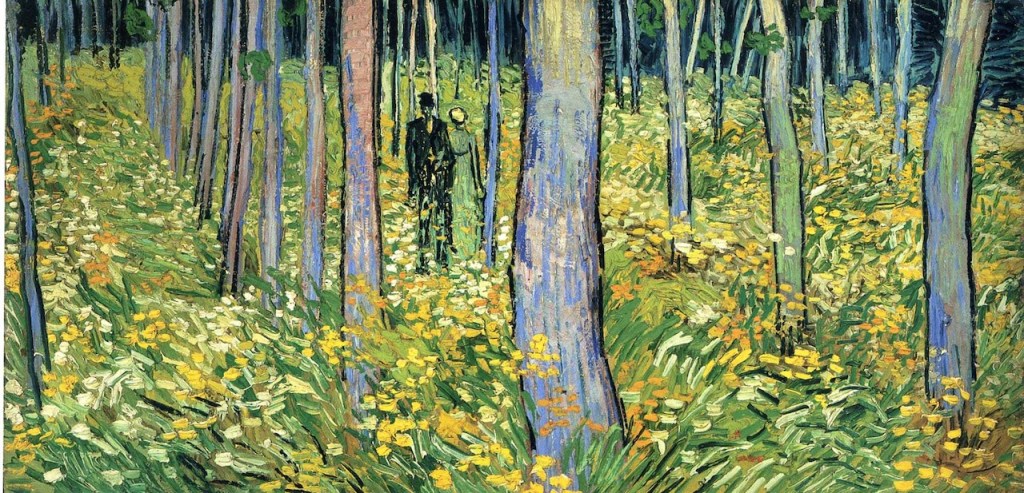
Satan: In the Undergrowth
We walked out that day
to get some air,
the conversation
had left me not knowing
if we were coming or going,
the trees are a comfort always.
even if you held my hand
you would not touch my heart
you could not say my name
your tongue forked my brain,
your eyes reflected the lush,
my yellow moon face
opened to you like the wildflowers
expectant, holding back nothing
offering up to you everything,
when you spoke, you seemed to address
the trees, you said they would build
a sturdy bed for you and your bride.
if i could hide here, i would not feel
the need to tell you that she will
crash as soon as she eyes you face to face,
as soon as she knows what i have learned
about your poisoned honey; she is sinking in kisses,
you are prickling beneath your smooth
lies popping like mushrooms.
Saint: Retribution of the Undergrowth
We walked among the shady trees that day
Our tangled sin spewed venom from the roots
I handed you my warm heart but away
You turned—your love to hand over to brutes
Honeyed words you served up with poison sweet
Your forked tongue poked and pierced my trusting mind
You spread crazed vows of lust beneath our feet
My innocence had long been left behind
Your bride will likely see what I have known
You keep a serpent coiled beneath your guise
Every seed of treachery you have sown
Will likely bear the bitter fruit of lies
I seek divine pardon for my vile crimes
What you seek reveals no reason no rimes
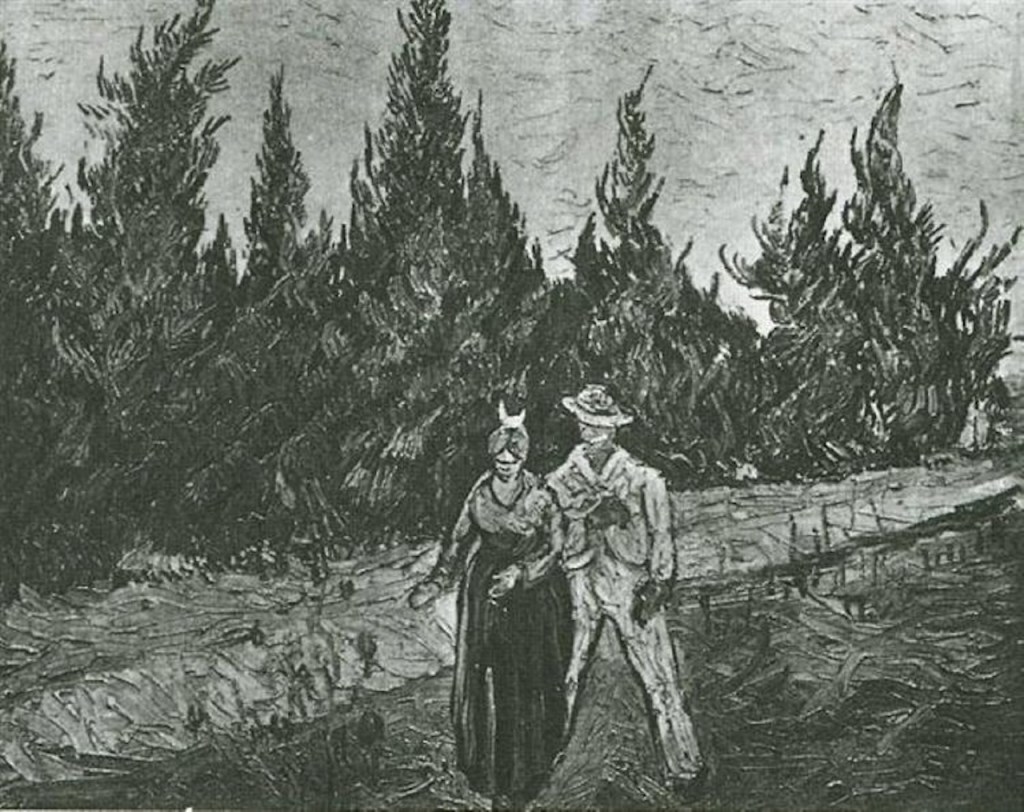
7. Vincent van Gogh’s Couples in the Voyer d’Argenson Park at Asnières
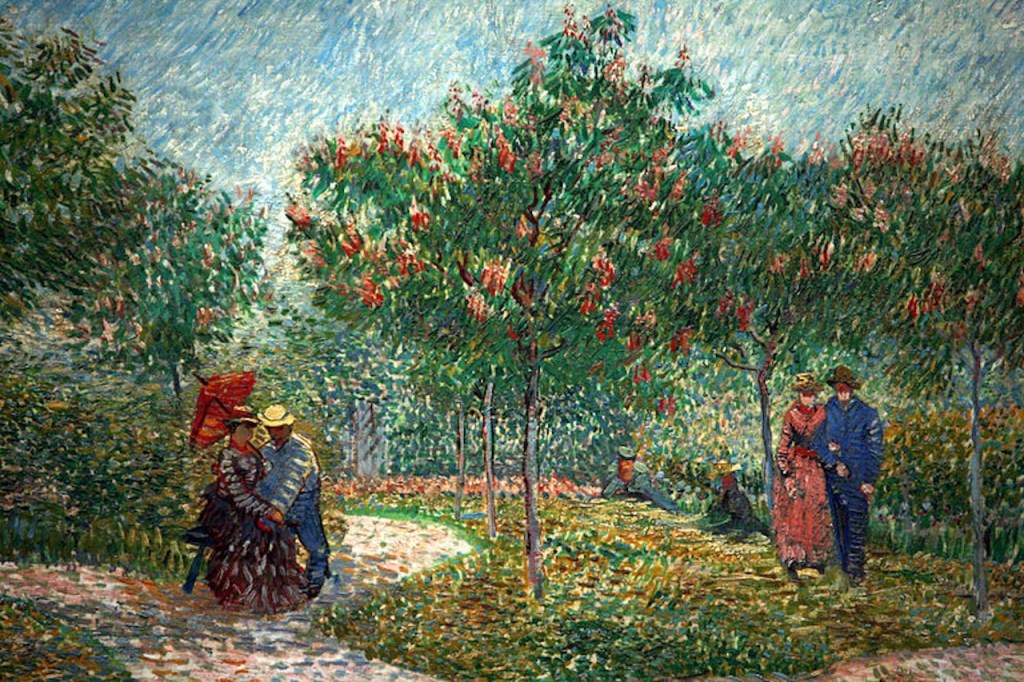
Satan: Couples in the Park
We walked out that day
to get some air,
the conversation
had left me not knowing
if we were coming or going,
the trees are a comfort always.
even if you held my hand
you would not touch my heart
you could not say my name
your tongue forked my brain,
your eyes reflected the lush,
my yellow moon face
opened to you like the wildflowers
expectant, holding back nothing
offering up to you everything,
when you spoke, you seemed to address
the trees, you said they would build
a sturdy bed for you and your bride.
if i could hide here, i would not feel
the need to tell you that she will
crash as soon as she eyes you face to face,
as soon as she knows what i have learned
about your poisoned honey; she is sinking in kisses,
you are prickling beneath your smooth
lies popping like mushrooms.
Saint: Retribution of the Couples
See—lovers leisurely stroll through the green
Their innocent posture stirs my veiled sin
How sweet the air gracing the summer scene
How dark the guilt that I have welcomed in
I sought some fancy glow obtained in vain
No well-kept park could hold this love of mine
My glances bounced and cried like injured rain
Stolen kissed turned rancid as dark brine
If retribution must take on my heart
If shame levies the price of my cruel deed
O grant me grace O Lord to do my part
And let forgiveness come with fitting speed
I know I deserve the gloom I now bear—
O but let Thy love make me earn Thy care
8. Owed to Vincent, Salvador, & Spot

Satan: Landscape & Me with Spot
a stream of consciousness runs
through the landscape
Dali has
pitchforked brain cells
little girl with dog in photo
off to my left, and Vincent in
Saint-Rémy
1889 look a long way off,
you look for yourself in the landscape you are not walking across the meadow
& you are not marked on any hill so I insist the clouds have gobbled you
those great Vincent-swirled cotton-tails that crawl
up the hills, over the blue paint stroked open legs not my legs
my legs are off to the left under the dress
of that little girl reaching out for her dog
trying to smile at the goddamned camera
the sun hurting her damaged little eyes the sun always hurting
her, sitting on grass always hurting her, the fat little arms, chubby little cheeks always hurting
that poor little girl is not in the landscape either
she is hiding inside the cottage
in the middle of the painting:
kissing your luscious lips kiss over, kissed-off she runs to Dali
drip
p
ing
t i m e .
.
.
Saint: Retribution of Vincent, Salvador, and Spot
A thought stream runs straight through the painted scene
Dalí forks the brain with his dreaming art
The little girl reaches for Spot her keen
Companion as the clouds unmake her heart
Saint-Rémy the year eighteen eighty-nine
Was far away. I search the hills for me
Those swirls of clouds swallow each lost design
The blue-stroked legs stretch where mine own should be
My legs fold on the left beneath my dress
Sun wounding eyes that cannot bear the light
I reach for my dear Spot in silent distress
Then hide inside the cottage out of sight
I kissed sweet lips then ran from dream’s resolve
With Spot and dripping time I may dissolve
9. Vincent van Gogh’s The Mulberry Tree in Autumn
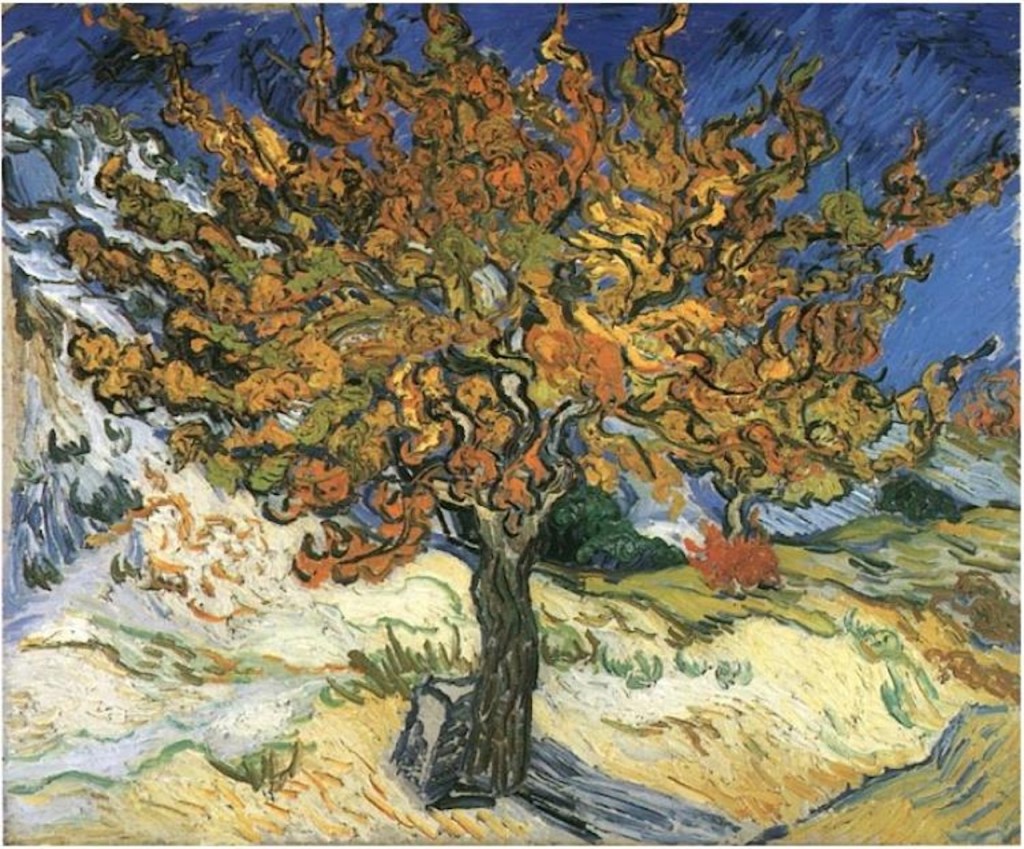
Satan: Picnic
The last summer holiday.
we get off school so we decide
to take peanut butter sandwiches
and raspberry tea
and go sit and talk and eat
under the mulberry tree
and study The Mulberry Tree.
you observe the painted tree
is deeper into fall than we.
I watch your mouth, your lips,
I know those lips —
leaves flare like fire —
how they taste and cushion my tongue.
the soft yellow grass, scraps of green,
green hangs on as long as it can —
how your tongue torches thigh.
‘here’s a bush, red like yours,’ you say,
and I blush. you eat so clean, and tear me off a piece.
your fingers touch my lips, my greedy tongue
licks the tips, and you draw them to your mouth
and lick where I licked. I pour tea, hot,
honey-sweet, raspberry. we sip, and mark the sky,
‘the black strokes are no mistake,’ you say,
‘Vincent was still perfecting
his technique, but he worried,’ and I say, ‘I think his
worries tortured his art, don’t you think so?’
and you say, ‘probably so.’ you ask me if my
worries torture my poems, but I need not reply . . .
for the phantasm has vanished
and I am caught again fondling my memory
of your lips and tongue,
my fingers stroking only a print.
Saint: Retribution of the Mulberry Tree
We lingered beneath the boughs in autumn
I hungered for the sweetness of your tongue
I knew the guilt that would shame the garden
I let vile lust break the vows I had rung
These scarlet leaves accuse me overhead
Their smoldering gives witness to my sin
I crave retribution but still I dread
The pain that comes from punishment within
O mulberry, thy root didst absorb lies
Thou canst testify to my sad ruin
Thy blazed leaves portray the guilt in my eyes
They bounce back the stigma my lust has brought
Winter will judge the degree of my crime
And sentence my heart to its deserved time
10. Vincent Van Gogh’s Wheatfield with a Reaper
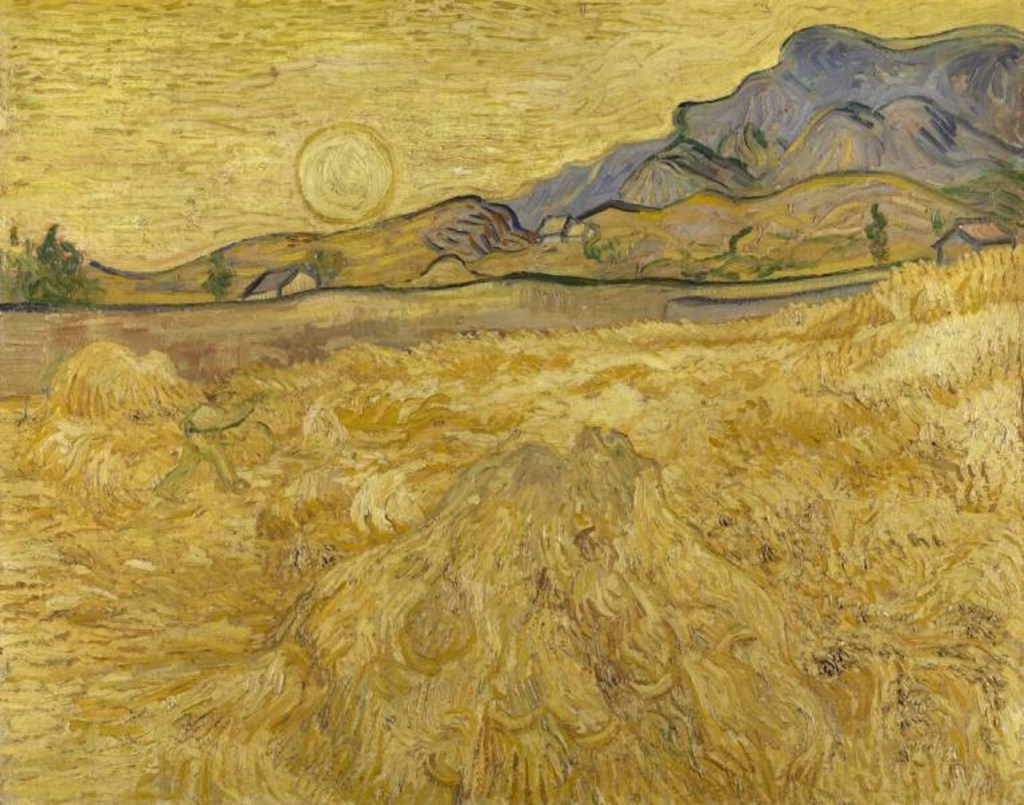
Satan: October Reaper
a study of brown, even the sun is
ringed with brown, the brown hills,
the brown wheat, and a brown reaper.
you run your finger over the mounds
and stiffen at the thought of a woman’s
breasts, you say, these look like a well-fed
woman’s breasts, and I think but do not say:
and the brown-ringed sun looks like a cum-stain
left on yellow sheets by a careless dripping
lover
and what else can I say? nothing to you. for if I did
you would not answer, so I hold forth to Vincent, who
tortured these worlds into existence, and I
torture myself with phantoms, and although
you won’t be with me, in this brown
October, I can see us walking those hills,
I can see the brown-ringed sun dripping
its chipped rays on our silence.
Saint: Retribution of the Reaper
Brown hills rolling under the silent taint
Golden wheat bowing slowly to the ground
A busy reaper moving through the paint
My own blue sorrow settles all around
Russet-haloed sun is staining the sky
Its dimming rays scattering on the plain
It was lust not love wanton flesh did try
To fill that careless hour—passed in vain
The reaper gathers what his sowings yield
His even steps move surely through the grain
Only my regrets spread across that field
The broken stalks will offer me no gain
May autumn take my sorrows as I pray
Pray that Divine forgive what I betray
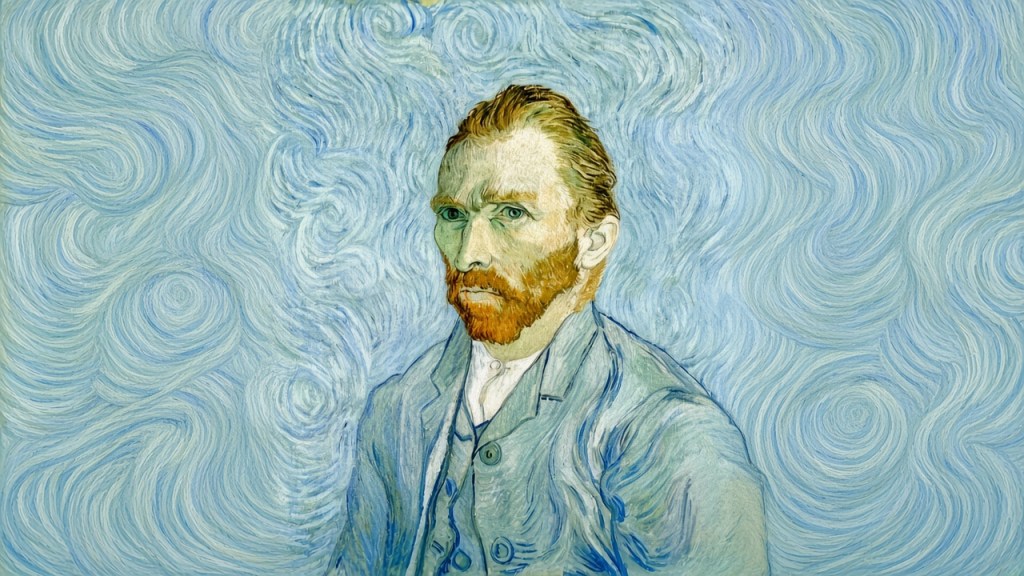
11. Vincent van Gogh’s Self-Portrait
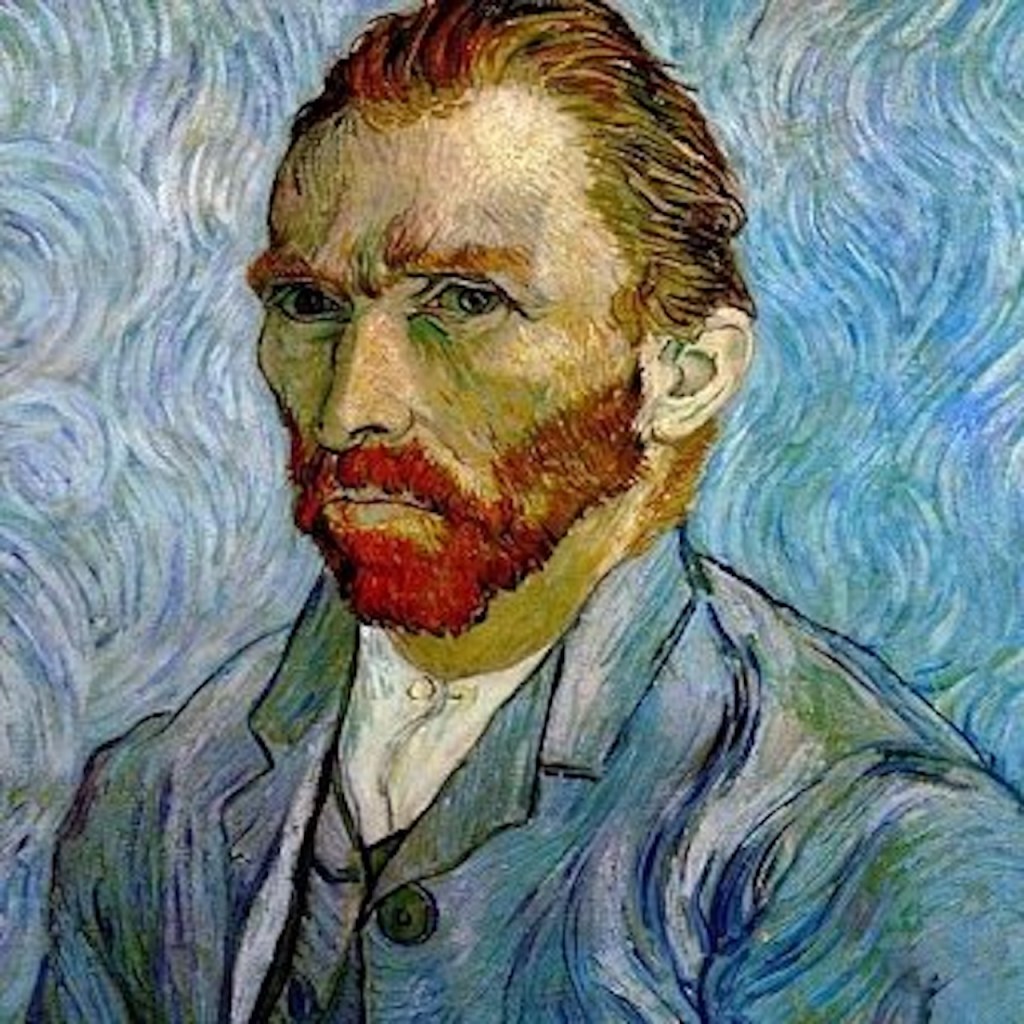
Satan: the wall and self -portrait
on the wall behind you
you have swirled the paint
into looking as if the air
around your head is agitated
your eyes look off in different
directions, ear still whole but
(which one did you cut off anyway?)
your knitted brow gives you your
desperate look and the green
shadows under and around your
right eye and smeared across your
left cheek promote your lizard quality
while the two reds of your beard hang
and drip making me expect to see the
drops on your coat that does little more
than enclose some of the swirling wall
behind you
if i look hard enough the swirls
swallow you, your self-assertion slight
as the hint of curiosity on the face
of a long practicing strumpet
Saint: Retribution of the Self-Portrait
I peer into the wreckage of that face
Restless swirls conspire to confuse the wall
Within tumult of feeling is a place
To foist the blame and answer for it all
Those eyes stare refusing to meet my own
That brow a knot of anguish green with shame
Two streaks of red hang from that beard alone
It seems the thick paint pronounces my name
I served up this flesh to a freak show fire
I must endure the damnation I earn
I kneel praying for the end of desire
I need the grace for which I now so yearn
No proffered hand can seal the bond of trust
No portrait can avenge the sin of lust
12. Vincent van Gogh’s Starry Night
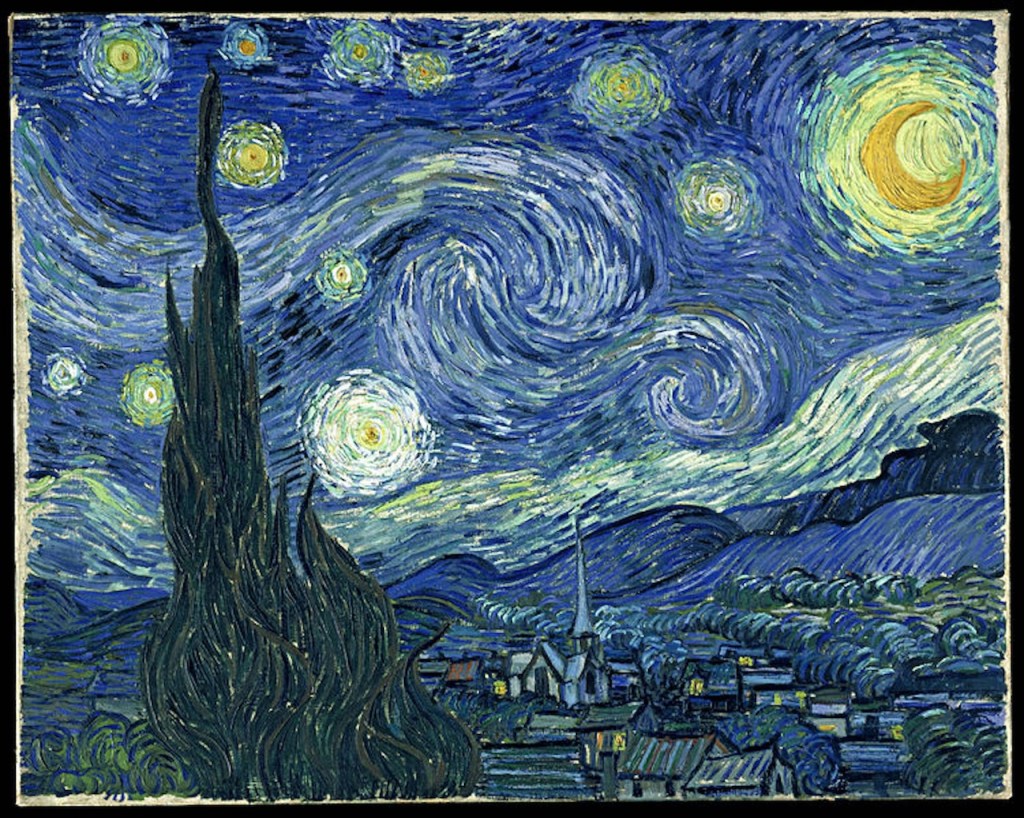
Satan: Starry Night on His T-Shirt
those big swirls through the sky startle—Vincent’s vision
must have been something much less than twenty /
twenty to have seen stars that big. church goers would
think some revelation at hand, the second coming perhaps
if the stars were that damn big. from his window his view of the
trees shaped the trees like sheep. and
the rolling hills like the hips of a well-nourished woman.
the lights are on in many of the houses. long loaves of bread being
pulled out of the oven, fresh bottles of Chablis,
and little François recounting to papa his exploits
with Marie, and papa laughing with a wide mouth
showing its contents, and maman’s brow forming its quiet frown, but
outside, a mourner on his way home carrying
his bundle will step inside the church and lip a little prayer trying to
pray his way back to love and hope and, perhaps,
the will to keep on. those bushes that loom up like a fire,
did you want us to see fire? the fire in the stars is not
enough, Vincent? you had to lap our lenses with a flaming bush?
eleven stars and a crescent moon, almost a horseshoe that moon, all
swirling in halos. Vincent, you have painted the wind that raises a
storm across the sky. and now his T-shirt bears your art, tempting me
to bare my heart to your stars.
Saint: Retribution of the Stars
Vincent’s stars whirl big on the night’s blue tint.
A cypress burns in tortured paint nearby.
I gazed upon the young man’s t-shirt print
And let my vain heart all reason deny.
Would that I had not trod that cursèd sphere
Nor let delusion tempt me to engage.
I permitted risk, drew peril too near.
I must now face the crime and pay the wage.
Would that I had never engaged such wrong!
I yielded where control should have triumphed—
No painted stars can sing sin into song!
No tortured art can render guilt exempt!
Soul now teaches heart what it needs to learn,
As I brook all future pain that I earn.
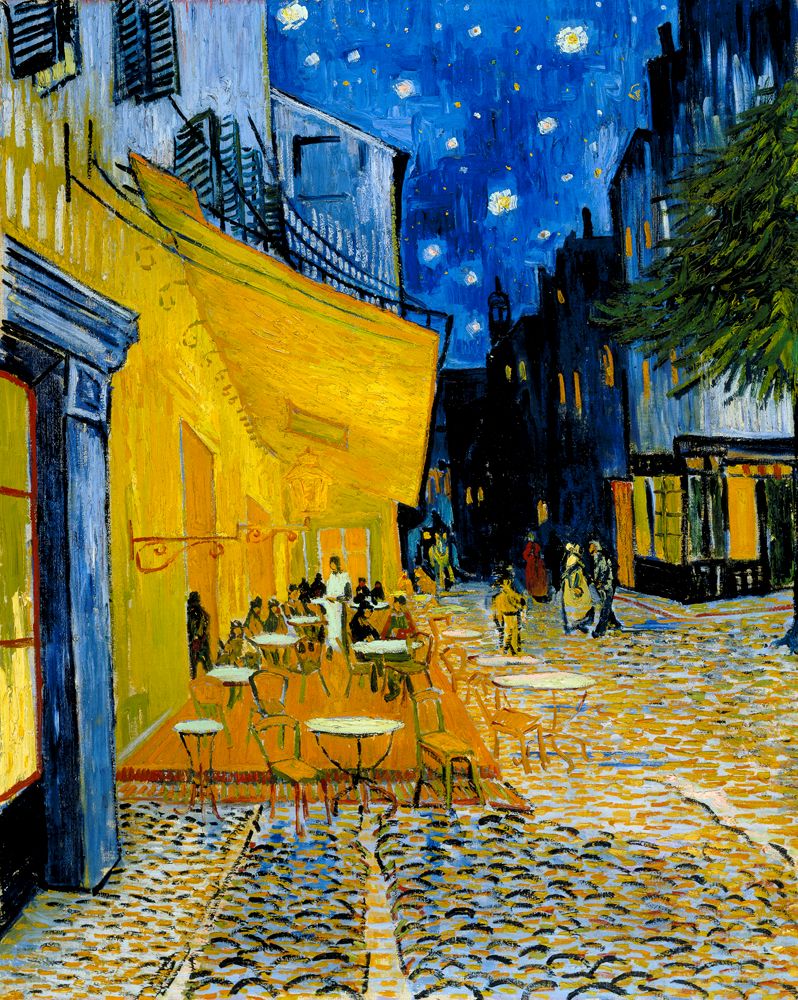
13. Vincent van Gogh’s Café Terrace at Night
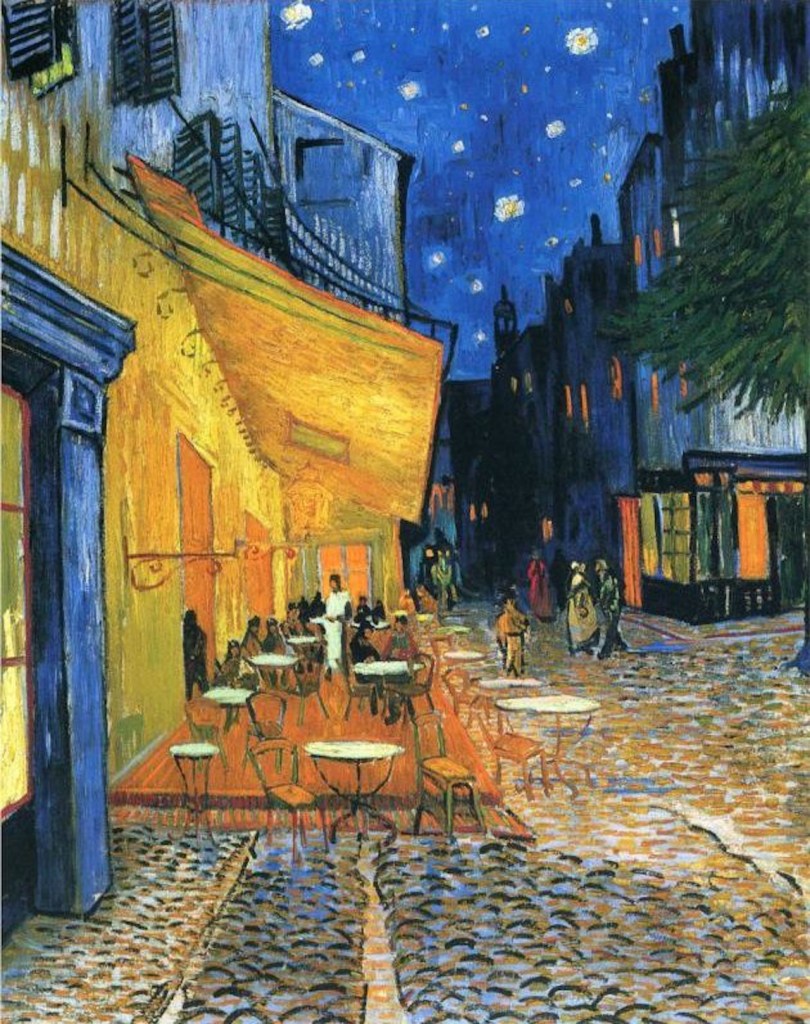
Satan: Our Table at the Café Terrace at Night
what if we decide to be public about it? nothing terribly
elaborate, just a cup of tea, just a rude little cafe
and we pick our table.
you point to one along the wall, and say you’d like
that one but it’s occupied, and so we drag another chair out
to one situated on the cobblestone, not so wobbly as it looks.
your face looks swollen, eyes tired, too much
late night studying, so many papers to write, I guess, I hardly
know what to say, but want to say you are still beautiful,
and the stars remind me of that big Starry Night T-shirt you
used to wear, and that you loved Vincent: Vincent, my new
home, where I invite you in and we talk and touch.
the people look old and foreign but they do not stare at us,
they glance and return to their own mates.
I wonder who lives in the apartment above the cafe.
I wonder where this cobblestone street leads to.
maybe we will explore this city together,
maybe we will have lunch tomorrow, here at this very same
roughly etched cafe, but you have not yet spoken, and
maybe you won’t,
maybe I should start. what should I say?
maybe I should say, have you seen this painting before? was it
ever silk-screened on a T-shirt like your Starry Night one? just
how many prints do you have now? How long do you think it
will take you to finish your masters? do you think you will come
back here to teach? and don’t you think
it feels almost sodden holding this print together?
and don’t you think it feels safely warm being close
enough to touch, even if we don’t?
Saint: Retribution of the Night Cafe
The thick painted stars accuse and avow
I drank and ate forbidden fruit that day
Only lust not love reigned and claimed its now
Sickening flames consumed without delay
The cobbled stones have kept no secret well
The yellow lamps burn bright above the street
Deep in my heart there rings a broken bell
That peels the hour that guilt and craving meet
I sensed the cost but chose the dark disgrace
His succulence like razor’s edge drew near
I now sense the harsh judgment I must face
I now must face the truth though filled with fear
I regret letting myself go so wrong
I shall now strive to sing a sacred song
14. Vincent van Gogh’s Sorrow
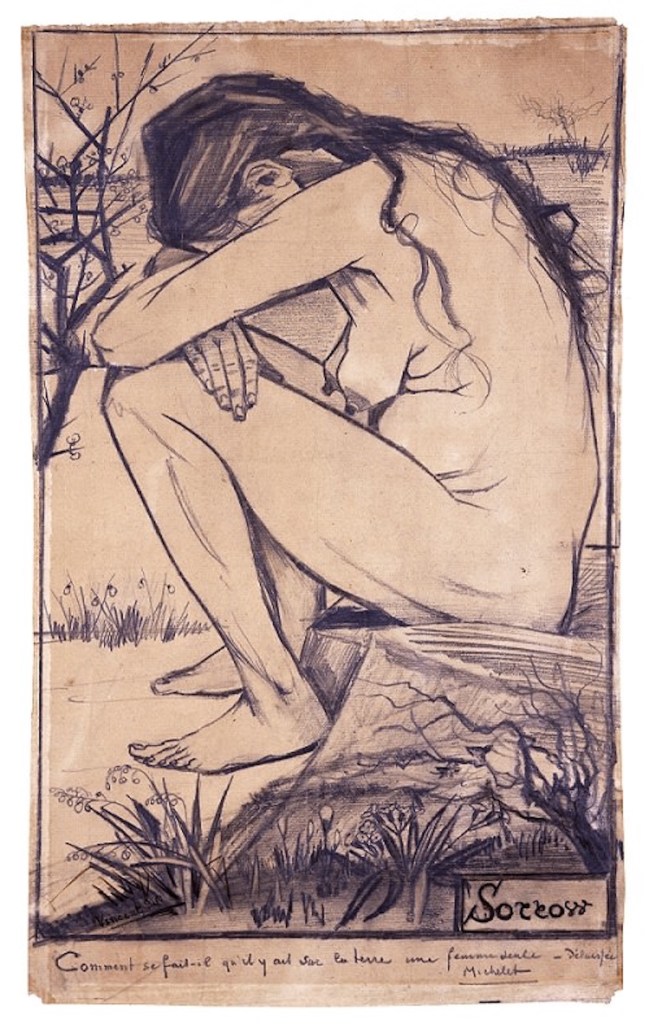
Satan: Naked, Sitting Bent Over
naked, sitting bent over
so her head rests on her arms
that fold over her knees, her stringy hair
straggling down her back, a bulging belly,
hanging breasts, weeping unlipped,
useless as flab,
cow-heavy with unseasoned love,
joy prostituted, future raped.
if we could see her face, would we see
swollen red eyes? or is it
too hard to move the heart again?
has the soul become a jaded stranger
digging through the dirt of this world
for just a glimpse of itself?
Saint: Retribution of the Naked Harlot
I sit stripped bare before the eyes of God
My flesh so foul for which my soul now cries
Forbidden pleasures quake in thoughts so odd
A lover’s faithless eyes were shedding lies
My sacred ways that I had come to trust
Gave way for some new pleasure that I took
It fed my hunger—made a god of lust
Veiling the sacred vows that I forsook
Now the lash of conscience whips needed sleep
And sorrow strips me naked filled with pain
The love I share I’m fortunate to keep
My heart will be washed clean in his pure rain
Harlot scars of guilt may render me numb
But mercy can be mine—shame overcome
15. Vincent van Gogh’s The Potato Eaters
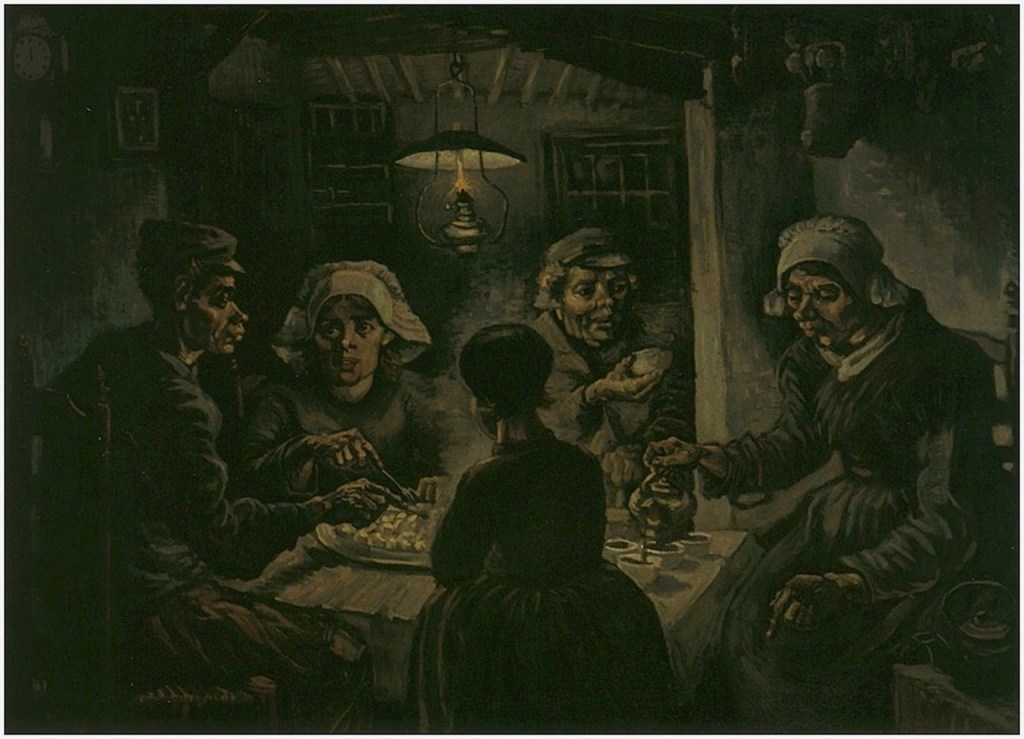
Satan: In Light of The Potato Eaters
“I have tried to emphasize that those people, eating their potatoes in the lamplight, have dug the earth with those same hands they put in the dish, and so it speaks of manual labor and of how they have honestly earned their food.” —Vincent van Gogh
Their drama is played out in wordless harmony
(like yours and mine, now that we talk no more).
Their meal is a symphony of simplicity.
Their dark, luxuriant mouths and noses make me
think of Africans, though these are Dutch peasants
(life is tinged with Africa, my own Greek blood fairly
sings of it).
This study hints at the grim blood Vincent would be
shedding with the bullet. This study of poor peasants
pouring their barley coffee, cutting their potatoes,
tasting silence in the dim room suffers me to know
that I will go on digging deep into dirt, hoarding
these words, stocking this tongue
till it tells some truth. Vincent let his blood many times
before the bullet—now I bleed & sweat bullets
at the brow, laboring to stretch ink
across blank pages, eating words like potatoes,
mining you for some treasure I sense I lost somewhere
in the dusk-tinted past—God knows how many times.
Saint: Retribution of the Potatoes
Kneeling in light falling upon the floor
Suff’ring sorrow harvested through my sin
My guilty heart had opened wide the door
Through which the lustful, greedy spook slipped in
As peasants bent over their modest fare
I search the soil for relief of my stain
But each potato holds the weight I share
Of shame I attempt to throw off in vain
O Love, demand the price this flesh has wrought
Make retribution scour my ev’ry bone
Allow me grace to right this ruin I brought
Allow me no more errors to condone
If I must bleed to earn a better way
Let blood run as I learn through night and day
16. Vincent van Gogh’s Quotation
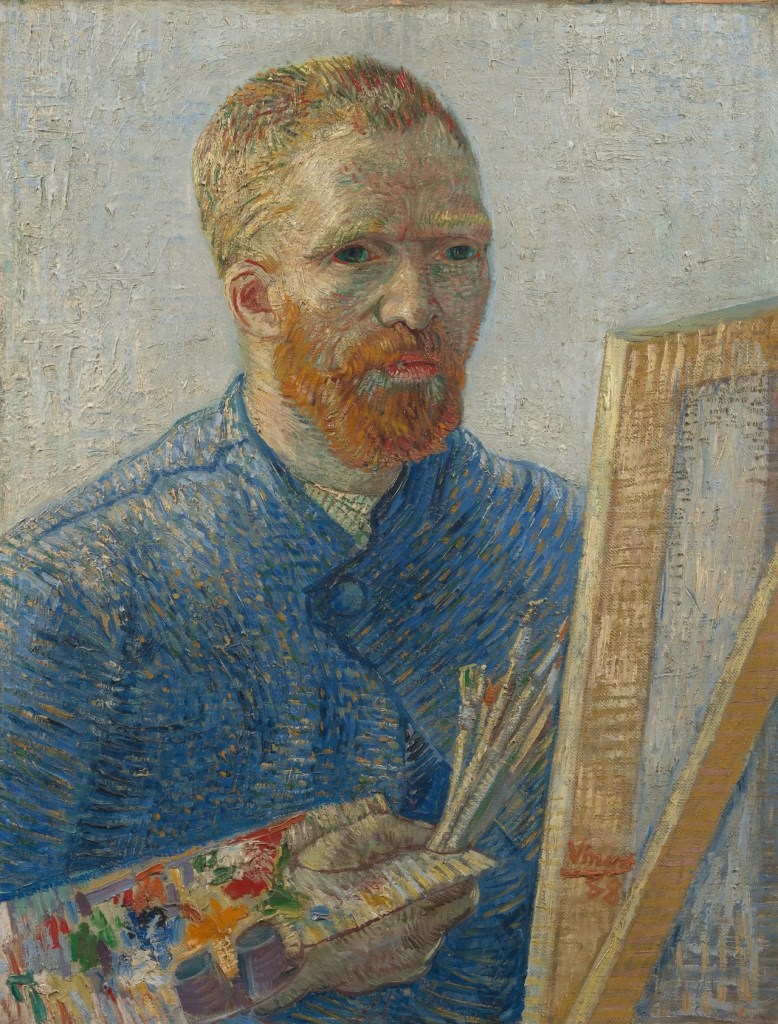
Satan: Power of Color
“While painting, I feel a power of color in me that I did not possess before.” —Vincent van Gogh
They talked in a fresh wash of sunshine.
She led him through her garden. Blushing
Tomatoes, cucumbers almost ready,
Bordered by marigolds. The Starry Night
Became a symbol for fondling poems
As they listened for the voice that calls
Lovers to touch. She leaned into that star-studded
Piece, touching the skin of paint with the tips
Of her fingers. Her tongue imagined the soft pressure
Of lips and she believed the wet lie his tongue was telling.
His germ took root in her soul: Sprouting green thoughts—
The red of a kiss—the gold of fingertips on skin—Gazing
Blue eyes. Writing poems, she feels the power of color
In her that she did not possess before the touching.
Saint: Retribution of the Colors
In her sun-bright garden, they that day stood—
Tomatoes burned red and bright with desire
Golden marigolds flashed out passion’s mood
Rooted deep in her lust that bloomed like fire
Stifling her tongue with whispers soft with lies
His blue gaze as deep as the painted sky
His seeds her lust did bind in tender ties
Now her verse flames with shame she can’t deny
Retribution scalds her heart guilty red
She seeks a brush to swish away the taint
Grace divine can snuff out the lust instead
No word of humankind can quash the feint
Though colors bright may stir beneath her skin—
Gold, blue, and white alone can clear the sin.
17. Vincent van Gogh’s The Lovers: The Poet’s Garden IV
Satan: Lovers in The Poet’s Garden, Arles 1888
He says, ‘now we are holding hands, no longer separated,’
She hesitates, ‘yes,’ and her palm moistens, a palm that
Was ice cold only a moment ago, she wants him, she’s
Sure of that, but she has a husband, God, what can she
Say to make this right? maybe she has no husband at all—
Maybe she is only 18 and still a virgin—no, decades
And children have filled her pages, but he is young,
Much younger than she is, and he is not a virgin,
‘I am staying at this address,’ he hands her the address,
‘She will not return for six weeks, we can meet there, alone,
If you like,’ ‘I like, I will meet you there,’ she is not shy,
His hat covers his head, and please notice that the faces
Are not distinguishable, let’s keep it that way for her family
And for her who will return to him in six weeks.
Saint: Retribution of the Poet’s Garden
In the poet’s garden that day stood they
Holding forth as though no ties bound her heart
Youthful eyes woke her readiness to stray
From sacred vows and from her oath depart
Her hand cool a moment before grew warm
She felt the urge vanquish the wage of sin
What justice waits for one who dares to harm
The sacred vows held deep beneath the skin?
He said his mate for six weeks would be gone
His scribbled their address a burning lure—
She chose his arms betraying hearth and home
Her flaming mind a vessel still impure
Let retribution clean that garden’s soil
Grant forgiveness for which her heart must toil
18. Vincent van Gogh’s Café Terrace at Night
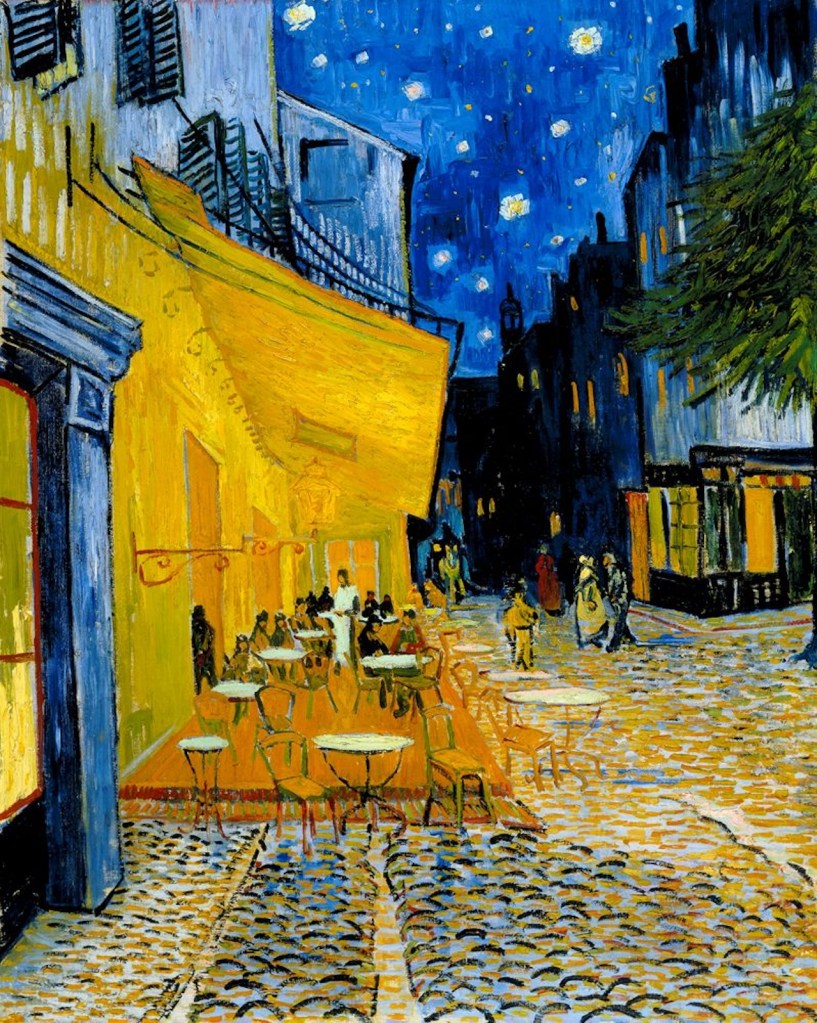
Satan: Rendezvous at Café Terrace at Night
yes, the particles are in bloom tonight,
but the wine will not
pop out in red on my face, I think,
because, I am already flushed
with the excitement of seeing you again.
I am sorry, I am speaking so fast,
I seem to think I have so much to say,
so much you must
want to hear, after all, here we are,
and it was you who finally
e-mailed me and said we must talk,
that you need to tell me all
these things that had backed up in your heart
and you were ready
to flood me with all those explanations,
and you hoped I would agree
to see you, you knew you have been
an ass again, maybe I would
not care any longer to hear,
because after all, I have e-mailed you
many times, and been met with
that cold silence, and I have e-mailed
you about needing closure,
and you wouldn’t give it so I took it,
and naturally, well, naturally you are unsure,
maybe I have stopped being the kind-hearted
soul you remember, and maybe I have just become
indifferent to anything you have to say,
but you would really like to explain, you think you can now, and you
hope I will agree to see you, we can finally be the kind of friends you
have wanted all along to be—
I sip my coffee, it is cold. that flood may never wash, I fear.
Saint: Retribution of the Night Café
Midnight stars over the terrace still burn
Shadows lengthen where hellish memory lies
I have sought closure but have faced in turn
Cold silence wherein warm affection dies
You now return seeking excuse for sin
Your heavy heart flooding with words abstruse
You expect from my kindness deep within
Forgiveness handed despite your abuse
In such a gas-lit night my heart demands
A closing for all the tears I have shed
I hold no burning vengeance—no commands
That lust and guilty passion rule instead
I sip this cup made bitter with the strain
Your flood of words can’t wash away the stain
19. Vincent van Gogh’s A Road in St-Rémy with Female Figure
Satan: That Day I Traveled A Road in St-Rémy
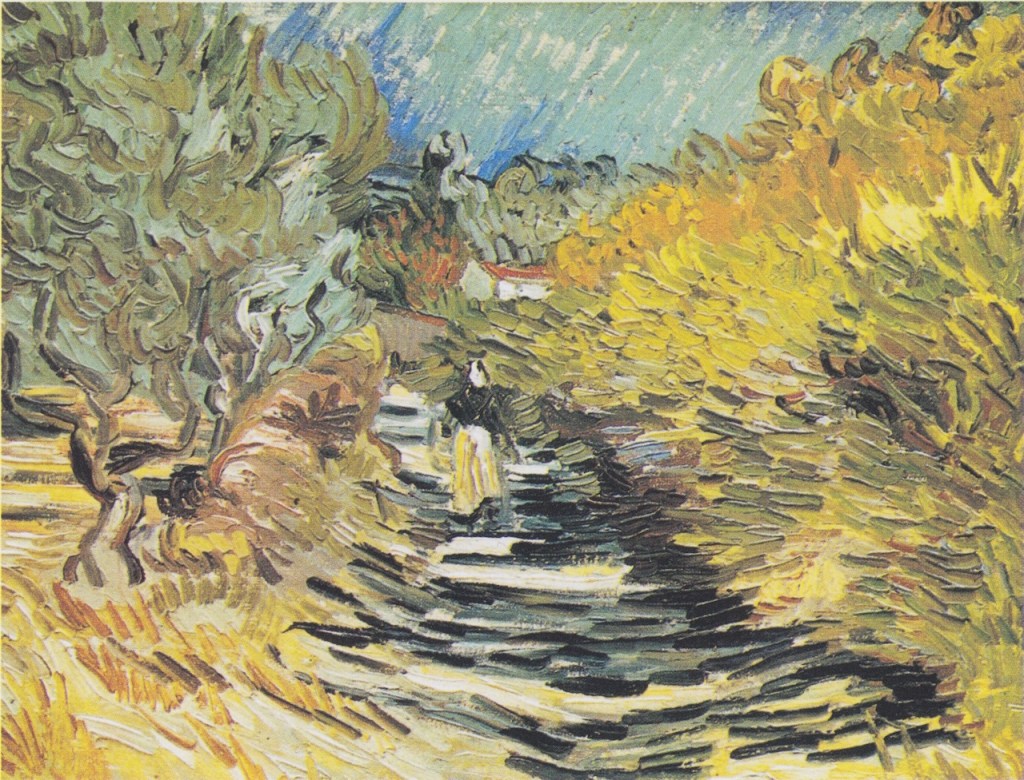
my first reaction is, God what a mess—
the skirted walker carrying her basket then forms herself
and I’m walking inside her skirt, beneath her bonnet.
I see my little house just a short way up the road,
and I see my shed and wagon, and think about
my sink and stove and that the children are grown
and my husband is safe in the love of the dogs
and nestled inside his studies
and you have moved on to God-knows what kinds
of greener pastures than these, but these are
my pastures and this is my own clotted road,
and the mess has cleared the chaos of my knotted heart,
and I walk on closer now to my home with its little
fireplace and its little bed, I’ll throw the rugs out to air
and make my little supper of bread and peas and barley
coffee and I will lip a little prayer for you tonight, but
I will not weep again. the red roof of my house
has spoken a flame and warmed my name
and all these things I own, and I know my soul will
pull all these things together and map out my path
through all these brush strokes.
Saint: Retribution of the Road
I stroll down the road musing on this game
I swapped sacred vows for fleeting desire
With each step I suffer the weight of shame
That brands my conscience with its Janus fire
No pardon did I seek—I chose to stray
No weighing the ruin waiting in the wake
I spurned the truth—sped from my oath away
I now must lug the wreckage I did make
Retribution must be born in my breast
I have well earned the sentence I must face
20. Vincent van Gogh’s The Langlois Bridge at Arles with Women Washing
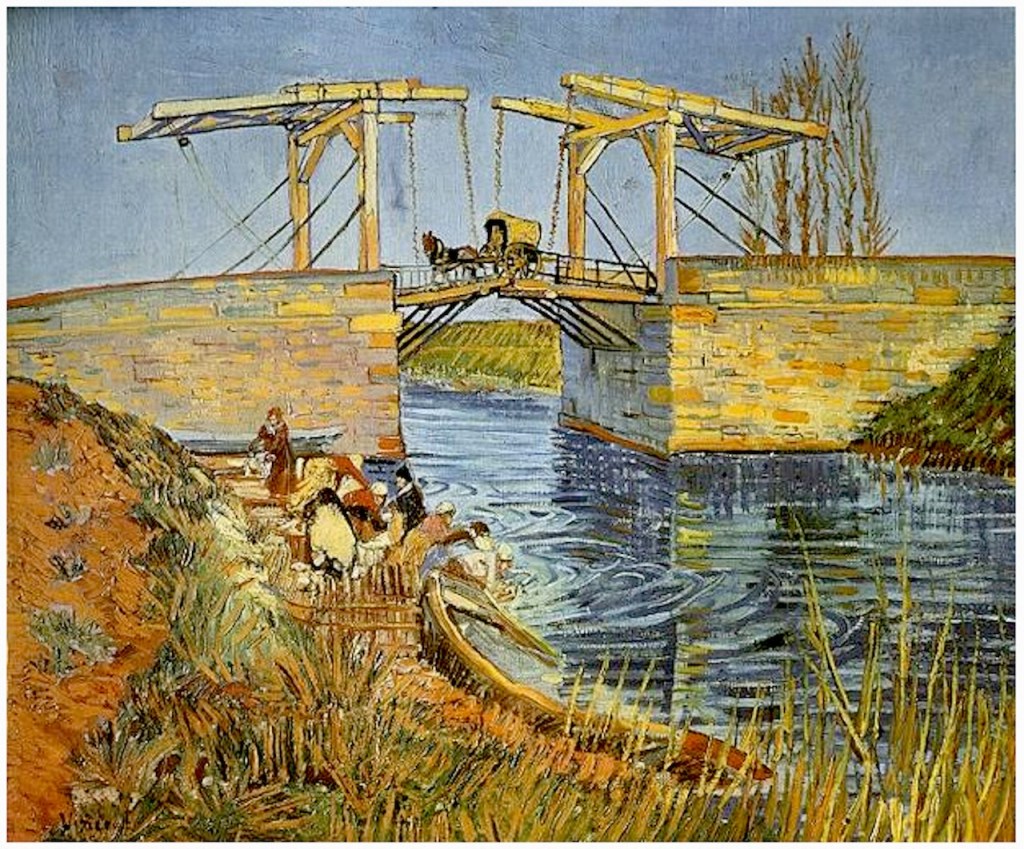
Satan: Bridge
The Langlois Bridge at Arles with Women Washing
reflects your genius with water.
the river’s tortured strokes reflect
brick abutments and swirls from the wash.
how you must have labored to feature
the intense character of the water,
and the women
moving, pushing the clothes into its blues,
scrubbing the dirt out with those strong arms,
shaking their heads and the underwear
of their husbands and their petticoats
they lift up to check for stains, all the while
jabbering about little Marie
and Marceau and his mistress.
at your easel you absorb the drama.
looking up from the tortured water,
you see a buggy approaching,
and the draw bridge lets down its planks
that come together, and the buggy eases out
across the meeting of the two halves,
and that’s where you capture horse,
buggy, rider crossing from right to left,
and still the women bend and wash,
bend and wash beside a half sunken boat.
Saint: Retribution of the Bridge
I traversed the bridge—from my vows did stray
Slipping my oath beneath the restless tide
His lips and arms had drawn my heart his way
As truth and honor hid beneath my pride
The women wash their husbands’ linen clean
They beat the stubborn stains from every thread
I watch their hands and sense that I had been
A heart whose faithless deeds were stained in red
The bridge testifies to my heinous sin—
Once two halves were joined but now torn apart
Harsh punishment O wash taint I’m stained in
Mend these broken chambers of this sad heart
O let the river flood these tears from me
O Lord grant me grace that will set me free
21. Vincent van Gogh’s Seascape at Saintes-Maries-de-la-Mer 1888
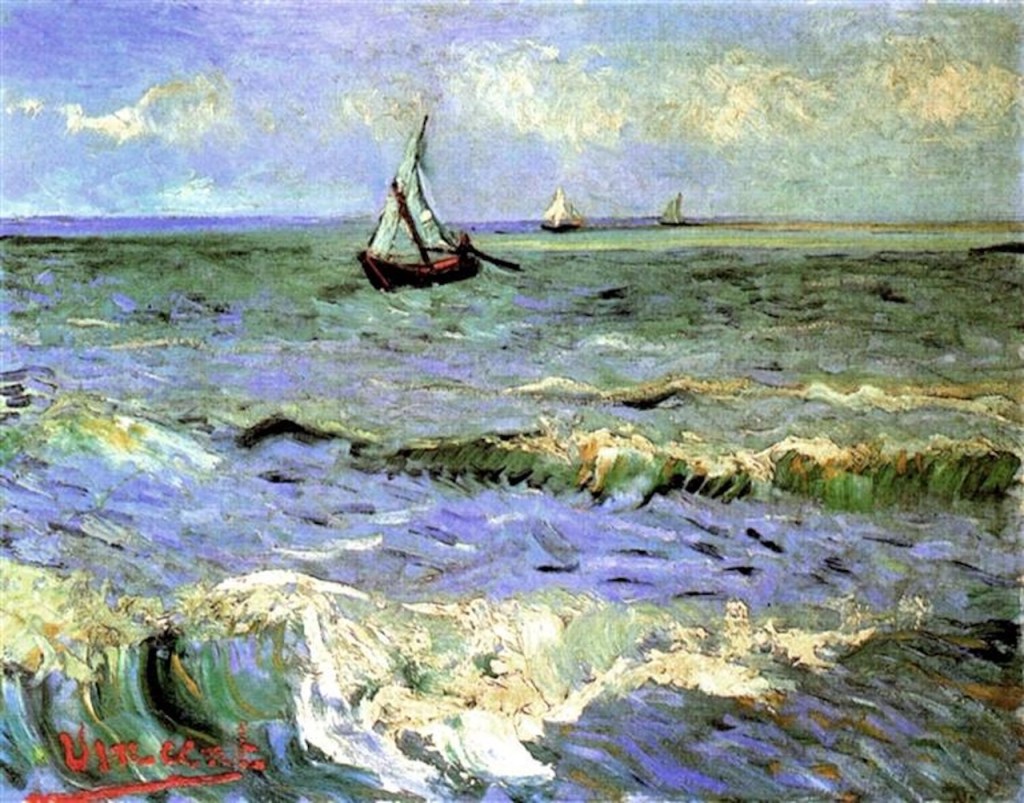
Satan: On the Mediterranean
getting sea legs
getting arms to stop quivering
nose to stop running
forgetting the Atlantic at Virginia Beach
that boasts all those condos
and the Pacific at Encinitas where
all those surfers iron the waves—
you have never seen those places,
and neither did Vincent,
who only once painted the Mediterranean,
his thick strokes churning the waves
while I let you churn my mind—
thoughts sloshing in all directions like that
mackerel colored sea that Vincent knew
to be so changeable—
and all those fishermen
putting out to sea.
Saint: Retribution of the Mediterranean
The sea revenges the vows I betrayed
Its mackerel waves reveal my faithless heart
Vincent’s restless strokes the waters have frayed
So my sin our cherished love did depart
I let his sweet-lipped youth possess my flesh
Gave in to lust what sacred love is owed
Waves of guilt now pry me from passion’s mesh
Conscience weights the heart with a heavy load
O sea I’ll pay the price my sins demand
Tempests O please scour the stain I have made
Bestow on me grace as I wobbling stand
Let love grow again where trust in ruins laid
I must suffer in sorrow for my sin
O let forgiveness and deep affection win
22. Vincent van Gogh’s Wheat Field under Threatening Skies with Crows)
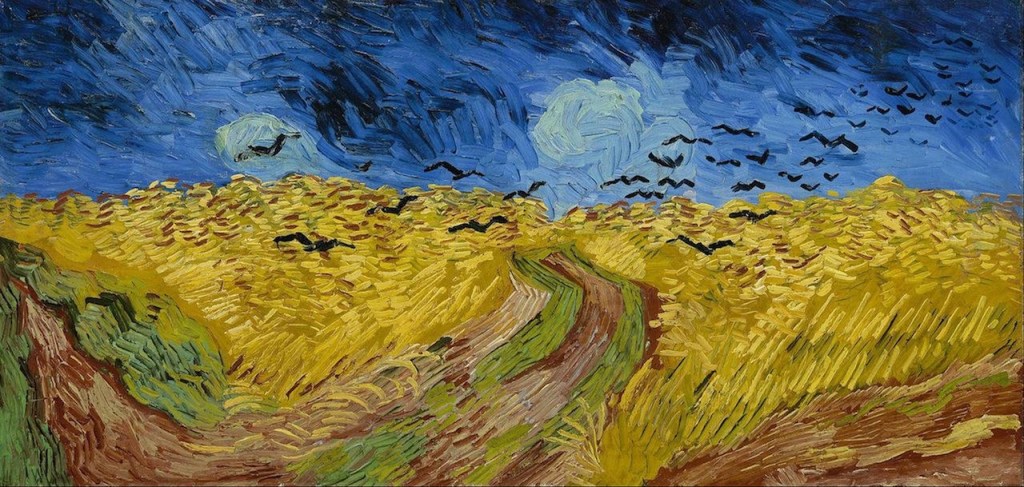
(thought to be Vincent van Gogh’s last painting)
Satan: Threatening Skies
“Having returned here, I have found myself feeling much sadder.
My life is being attacked at its very root, and the steps I am taking
are unsteady.” —Vincent van Gogh
Vincent did not speak the tongue of the living.
His second-hand tongue was thin-skinned.
But his threatening skies pound the air.
The crows are black waves washing over the wheat.
I will not fool myself thinking art soothes rough edges.
Peace is a horseshoe on the soul’s anvil.
The heart that has been burned
is a heart that knows heat—
like a wheat field blazing in the autumn sun.
My tongue leaves you with this:
I live in my mouth,
Vincent lived in his hands;
if you ever vouchsafe to me where you live,
I will dispatch you these poems.
Saint: Retribution of the Threatening Skies
Threatening skies do descend upon my soul
Black-wingèd crows hover over the wheat
I stand facing what I yearn—to be whole
I ride the storm where truth and sorrow meet
I did stray too far from love’s sacred torch
I warmed flesh where it had no right to burn
Now the fire of guilt guts my valued force
Yet bids me study lessons I must learn
Let God’s retribution pour as fall’s rain
Soaking the fields where faithless shadows sigh
Let God’s redemption cut through all this pain
As golden wheat grows ’neath a clear-blue sky—
You cannot comprehend what these poems claim
Thus, I hand you only your share of shame
finis