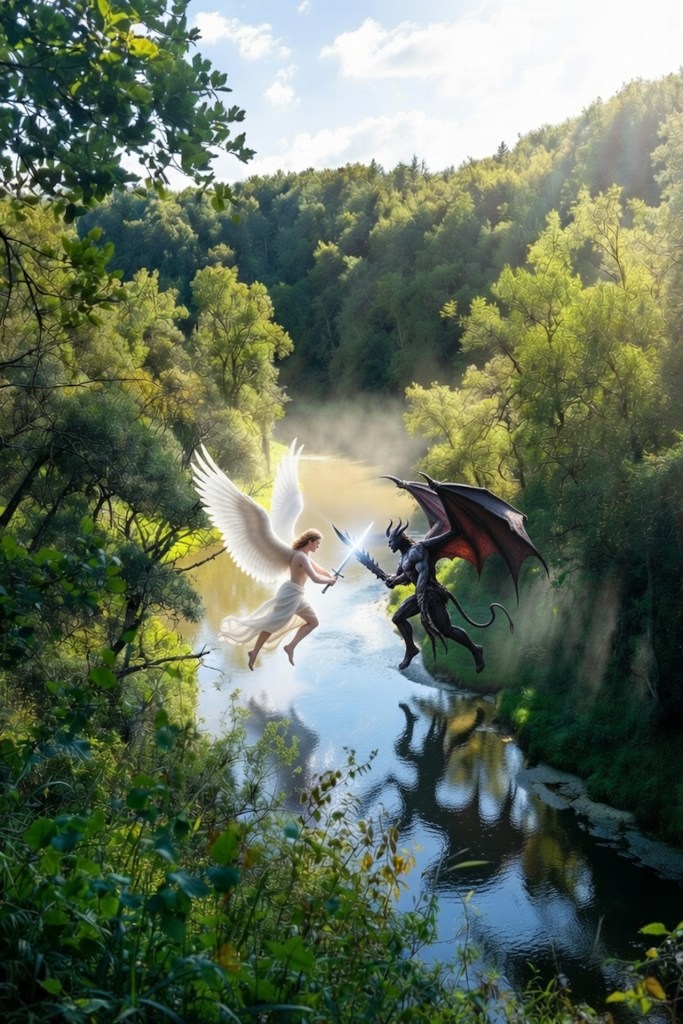
Image: Created by Grok
Original Song: “Twixt Good and Evil” and Prose Commentary
I chose the quotation from Isaiah because it demonstrates the omnipotence and omnipresence of the Almighty Creator. Some religionists, especially Christian, argue that God is all good and therefore could not have created evil. But such a claim limits God’s power and ability—an odd thing to do since they claim that God is omnipotent and omnipresent!
Twixt Good and Evil
“I form the light, and create darkness: I make peace, and create evil: I the Lord do all these things.” —Isaiah 45:7
Chorus
In the fight twixt good and evil
Good will always win;
For God created the devil
Just tempt us all to sin.
God doesn’t cause us to bear sorrow;
He tries to lead us to His light,
And His Word guides our tomorrow
If we learn to read It right.
First Verse
Good morning, Satan!
Are you doing OK?
What kinds of nasty
You going to throw at me today?
Will my daughter get cancer?
Will my son fall off his bike?
Will my husband crash his truck?
Will my dog lie down and die?
Second Verse
Good morning, Devil!
Are you doing just fine?
How will you try to tempt me
To cross that boundary line?
Will you make me think I’m sexy?
Will you make me want to flirt?
Will you take me to a place
I’d never go without your dirt?
Third Verse
Good morning, Lucifer!
How’s it going, Old Dude?
What you got in store for me today—
What kind of rude and crude?
Will you shine your light on sorrow?
Will you tempt me to believe
I’ll be so good tomorrow
That today I can misbehave?
Fourth Verse
Good morning, Maya!
Of all the things in the fold
Which one will grab my thoughts today
To divert me from my goal?
Will I seize upon another’s mote
Though there’s one in my own eye?
Will I hurt anyone whose handy?
Or will I just sit, sigh, and cry?
Chorus
In the fight twixt good and evil
Good will always win;
For God created the devil
Just tempt us all to sin.
God doesn’t cause us to bear sorrow;
He tries to lead us to His light,
And His Word guides our tomorrow
If we learn to read It right.
To listen to the recorded version, please visit “Twixt Good and Evil” on soundcloud.
Commentary on “Twixt Good and Evil”
Epigram: “I form the light, and create darkness: I make peace, and create evil: I the Lord do all these things.” —Isaiah 45:7
I chose this quotation from Isaiah because it demonstrates the omnipotence and omnipresence of the Almighty Creator. Some religionists, especially Christian, argue that God is all good and therefore could not have created evil.
But such a claim limits God’s power and ability and at the same time introduces a second force into being. Because there can be no second force, only God can be responsible for all that exists, including evil. In the Isaiah quotation, God is speaking and He clearly says, “I . . . create evil.”
At first, such a claim may seem paradoxical, but just because God creates evil does not make God evil: it makes Him all powerful, the very quality that Christians believe God to possess.
So with that fact established, the next question is why did/does God create/allow evil? And the answer is so that a physical creation can exist. Without pairs of opposites, there can be so creation: forces rub against forces; conflict pits good and evil against each other.
We cannot recognize a quality unless we have something to which we can compare or contrast it. Image that only good things had happened to you in your life. How would you know that only good things had happened if you had never experienced the less than good or the bad?
Humanity is faced with these forces in order to learn and to evolve. According to Paramahansa Yogananda and other great spiritual leaders, the only purpose of life is to unite the soul with the Over-Soul or God. In order to do that, each human being has to work out its karma, its issues that lead it to believe it is nothing more than a bag of bone and flesh.
Each human being must learn that he or she is essentially a soul that has a physical body. That soul is already perfect but because it lost its divine awareness by being born in a physical encasement, it has to relearn to be divine.
Now, why did God make such a plan, such an existence? Why not just let us keep our divine status and not have to go through incarnations that may take many millennia? Only God knows the answer to that question. Offering one possible explanation, Paramahansa Yogananda contends that creation is God’s lila or play, and He made for his own enjoyment.
Because that explanation may not satisfy, the following exchange between Sri Yukteswar, the guru of Paramahansa Yogananda, and a student suggests additional reasoning:
“Why did God ever join soul and body?” a class student asked one evening. “What was His purpose in setting into initial motion this evolutionary drama of creation?” Countless other men have posed such questions; philosophers have sought, in vain, fully to answer them.
“Leave a few mysteries to explore in Eternity,” Sri Yukteswar used to say with a smile. “How could man’s limited reasoning powers comprehend the inconceivable motives of the Uncreated Absolute? T
he rational faculty in man, tethered by the cause-effect principle of the phenomenal world, is baffled before the enigma of God, the Beginningless, the Uncaused. Nevertheless, though man’s reason cannot fathom the riddles of creation, every mystery will ultimately be solved for the devotee by God Himself.” (my emphasis added)
The opening quotation, therefore, establishes the spiritual nature of the song: a monotheistic worldview in which nothing—light or darkness, peace or evil—exists outside God’s sovereignty.
By invoking Isaiah 45:7, I preempt the simplistic dualism: evil is not an equal rival to God but a force that God Himself created to serve a divine purpose. This contention prepares the listener/reader to understand temptation and suffering not as evidence of God’s absence, but as part of a moral testing ground in which human choice matters.
Thus, although the singer/speaker has undergone all of these tests foisted by Satan, the Devil, Lucifer, and Maya—all of which are simply different names for the same force—she seems to be implying that she is transcending them because she realizes that God only created these forces to tempt his children.
She is also implying that she has learned to read God’s word correctly and now she understands that by not allowing that evil force to dominate her she will no longer suffer.
Chorus: “In the fight twixt good and evil”
In the fight twixt good and evil
Good will always win;
For God created the devil
Just tempt us all to sin.
God doesn’t cause us to bear sorrow;
He tries to lead us to His light,
And His Word guides our tomorrow
If we learn to read It right.
The chorus opens the song/poem with its theme, which focuses on the battle between good and evil in the world of humankind. It makes the explicit claim that “good will always win,” and then it explains that the devil is just a tempter—not a separate force— because God Himself “created the devil.”
That “God created the devil / Just to tempt us all to sin” reflects the exact message of the Isaiah quotation. God made the devil to introduce temptation in our lives, but God allows it, and He did not create temptation to make us suffer, at least, not eternally.
We know of God’s intention because God has offered a guide in written scripture, which all religions and spiritual faiths possess. But it is interpreting those pages of guidance that confounds us and keep us in darkness. God wants to lead us to light, and learning to interpret his Word correctly and effectively can lead us there.
First Verse: “Good morning, Satan!”
Good morning, Satan!
Are you doing OK?
What kinds of nasty
You going to throw at me today?
Will my daughter get cancer?
Will my son fall off his bike?
Will my husband crash his truck?
Will my dog lie down and die?
The singer/speaker addresses Satan directly, asking quite conversationally how he’s doing? Assuming that he is doing “OK.” Then she pitches a series of questions at him. These question involve “nasty” events that no one wants to experience: a daughter getting cancer, an son falling off his bike, a husband crashing his truck, a dog dying.
The answer to each of these questions is yes: Satan will throw all of these things at me eventually. And I personally have experienced every one of them. So addressing Satan in such a friendly way must be understood a high sarcasm.
Satan will always remain the adversary, but showing him that I can take him lightly lessens his power over me. Besides, I have already told you in the chorus that I know the score on these issues. Satan does not hold the power; God does.
Second Verse: “Good morning, Devil!”
Good morning, Devil!
Are you doing just fine?
How will you try to tempt me
To cross that boundary line?
Will you make me think I’m sexy?
Will you make me want to flirt?
Will you take me to a place
I’d never go without your dirt?
Addressing Devil with the same tone expressed when she addressed Satan, the singer/speaker assumes Devil is “doing just fine.” Again, with a series of questions: how are you going to temp the today? will you use sex and promiscuity to make me do things that otherwise I would deplore?
Because vanity and sex lead to so much mischief and depravity in the world, one would likely be a consummate prevaricator to deny having been caught up in such “dirt.” That’s all the personal confession and testimony I will offer for this one. But obviously, again, the from Devil, the answer is “Yep, I’ll get you, my Pretty, and you little dog, too!”
Third Verse: “Good morning, Lucifer!”
Good morning, Lucifer!
How’s it going, Old Dude?
What you got in store for me today—
What kind of rude and crude?
Will you shine your light on sorrow?
Will you tempt me to believe
I’ll be so good tomorrow
That today I can misbehave?
Addressing the devil/satan in his light-bearer form, Lucifer, the singer/speaker makes no assumption but simply asks how things are going for the “Old Dude. Then again wants to know that the Light-Bearer has “in store” for her.” She knows that whatever it is it will likely be “rude and crude.” She has learned about this being’s ways in earlier verses.
She wonders if Lucifer will put a spotlight on self-pity and thus allow her to engage in sorrowful feelings. Then abruptly, she shifts to wondering if he will encourage her think she will behave tomorrow so well that today she can engage in all manner of debauchery.
This verse captures the moral danger of self-bargaining and the illusion of future repentance as permission for present wrongdoing.
Fourth Verse:
Good morning, Maya!
Of all the things in the fold
Which one will grab my thoughts today
To divert me from my goal?
Will I seize upon another’s mote
Though there’s one in my own eye?
Will I hurt anyone whose handy?
Or will I just sit, sigh, and cry?
In this final verse, I address the evil one as Maya, which means delusion, and is the Hindu concept for Satan/Devil/Lucifer. Maya seems less judgmental and harsh than the Christians concepts, although the end result of “delusion” is the same as the end result of sin. It is delusion that causes us to “misbehave” and therefore “suffer.”
The satanic, evil, mayic force all steer the human being to engage in sense gratification, and such activities divert the person from seeking Divine Awareness, which is the goal of life, according to Paramahansa Yogananda.
When I reference the “mote” and the “beam,” I am, of course, echoing Christ’s teaching on judgment, offering that as the first possible wrong thing I might do today. Then again I continue questions as I wonder what the magic Satan/Maya will do today to “divert me from my goal.”
I might engage in activities that hurt people, or maybe I will just sit, think useless, thought, become maudlin and then “cry.” The negativity supports the wretched influences that has been on display in the entire song/poem.
Chorus: “In the fight twixt good and evil”
In the fight twixt good and evil
Good will always win;
For God created the devil
Just tempt us all to sin.
God doesn’t cause us to bear sorrow;
He tries to lead us to His light,
And His Word guides our tomorrow
If we learn to read It right.
What saves the whole mess from languishing in pool of sorrowful dreck is the chorus, which is repeated at the end. Despite the battle each human being has to face each day, eventually according to each person’s karma “good will always win.”
 Linda's Literary Home