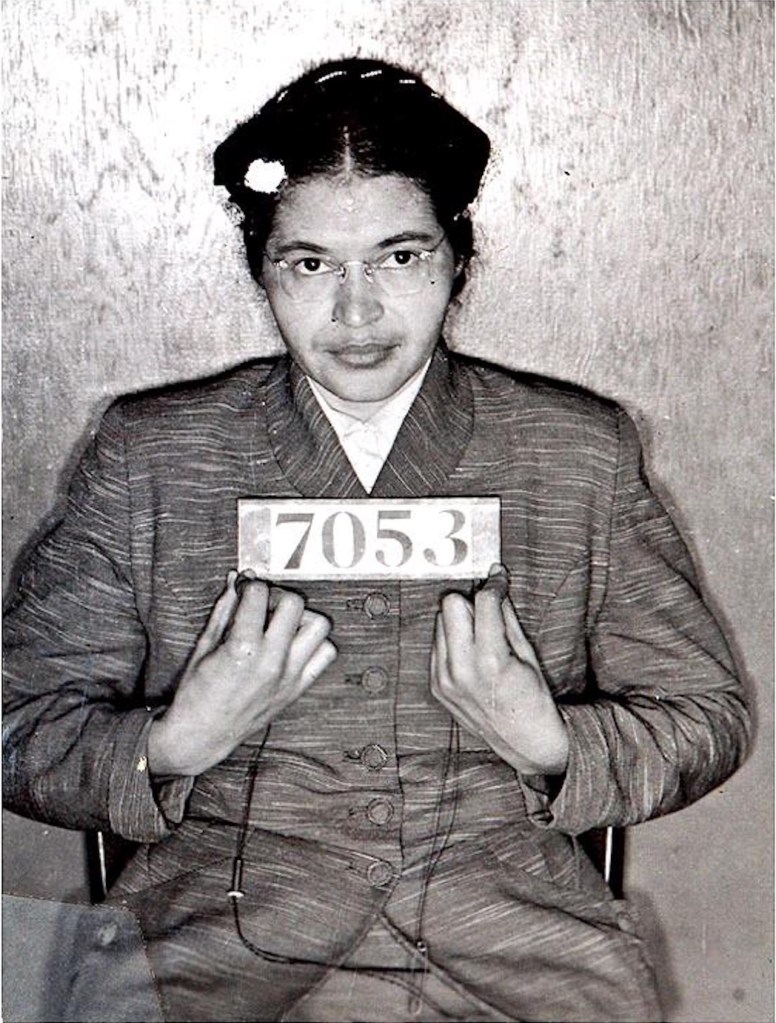
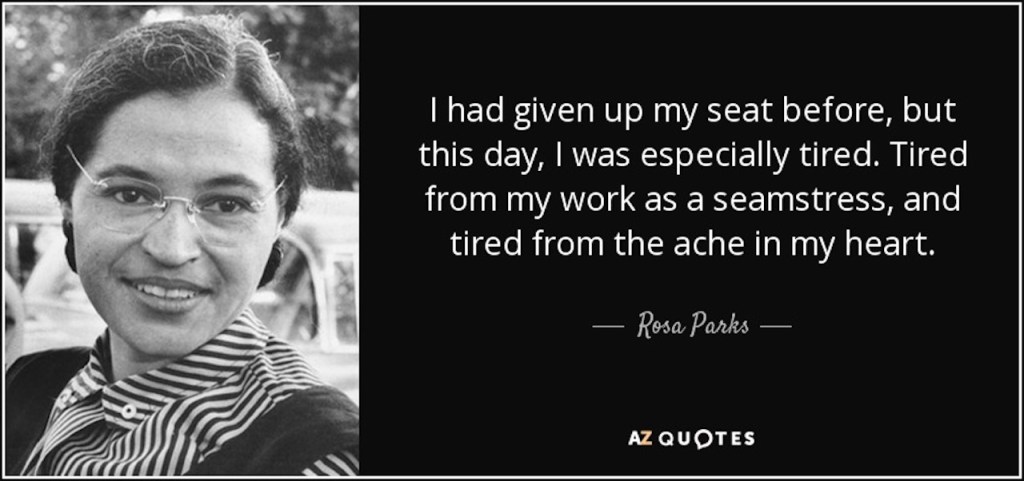
Former U. S. poet laureate, Rita Dove, offers a simple yet powerful tribute to one of America’s heroes, Rosa Parks, who through her act of defiance by simply continuing to occupy a bus seat, became known as the “Mother of the Modern-Day Civil Rights Movement.”
Introduction with Text of “Rosa”
An Alabama seamstress named Rosa Parks [1] became known the “Mother of the Modern-Day Civil Rights Movement.” It all started with a bus ride on December 1, 1955. Rosa had just completed her day’s work at a department store, she was tired, and she headed home.
After boarding a Montgomery city bus, as was her usual routine, she sat down in the front row section of seats in the black section of the bus. It is often misreported that she was asked to leave the front of the bus, but that is not accurate. She was following the laws of segregation and seated herself in the section allowed her race.
As the bus began to fill up, white passengers began seating themselves in the black section, which was, of course, within the law. A white man wanted Rosa’s seat, and so the bus driver commanded Rosa to leave her seat in the front row of the black section and move farther back.
Rosa refused. She was tired from her day’s work. And she was tired of the ridiculous Jim Crow/Black Codes that stifled the lives of black folks. Rosa was arrested for violating the Jim Crow/Black Codes laws. From that point on, the modern Civil Rights movement had begun.
Former poet laureate of the United States (1993-95), Rita Dove, has penned a powerful tribute to Rosa Parks. So simple, yet exquisitely profound, Dove’s elegy describes the quiet yet determined woman, whose uncomplicated act of resistance changed the country’s history in a way that led to a broader fulfillment of the Founding Father’s plan of freedom for all American citizens enshrined in the U. S. Constitution.
Rosa
How she sat there, the time right inside a place so wrong it was ready.
That trim name with its dream of a bench to rest on. Her sensible coat.
Doing nothing was the doing. The clean flame of her gaze carved by a camera flash.
How she stood up when they bent down to retrieve her purse. That courtesy.
Rita Dove explains the genesis of and reads “Rosa”:
In 60 words, this tribute to a genuine hero offers a heartfelt observation of courage and determination that changed a nation’s consciousness.
First Stanza: She Just Sat There
How she sat there, the time right inside a place so wrong it was ready.
The speaker is musing on the actions taken by the “Mother of the Modern-Day Civil Rights Movement” on that fateful day only decades ago—December 1, 1955. The speaker effuses on “how” Rosa “sat there” because that just-sitting-there remains the heart of Parks’ resistance: she just sat there in defiance of a humiliating, immorally legislated mandate that had kept her a second class citizen for most of her life.
Parks was tired from her day’s work, but she was even more tired of mandates that insulted her humanity on a daily basis. She was already sitting in the “colored” section at the back of the bus, and then a white patron wanted her seat.
She would have to move farther back or even stand to accommodate the injustice being leveled against her and her fellow black citizens. But on this day, she just “sat there.” Because of all that had gone on before in terms of the Jim Crow/Black Codes South, it was time to stand up and say “enough.” All the wrong that had been done to black citizens was now “ready” to be righted. Rosa stood up by just sitting there.
Second Stanza: A Sensible Woman
That trim name with its dream of a bench to rest on. Her sensible coat.
The speaker then muses on the simple name “Rosa,” who at the time just wanted a place to sit and rest from her labors. The plain, ordinary things in life should never be beyond the dreams of citizens who simply wish to exercise their civil rights, yet for Rosa and others of her skin tone, those rights had been abridged too long. Her dream was one worth purchasing with some jail time, and she her “trim name” was up to the task.
The speaker then makes the observation that Rosa was wearing a “sensible coat.” She was a sensible woman, an uncomplicated, intelligent, law-abiding woman, and now she needed to rest her weary body that had finished her day’s contribution to the work force.
Third Stanza: Doing Much by Doing Nothing
Doing nothing was the doing. The clean flame of her gaze carved by a camera flash.
The speaker then emphasizes the simplicity of Rosa’s action: she was doing a great service to humanity by “doing nothing.” By forcing the ludicrous law to take her to jail, she was showing how utterly bankrupt the laws had been.
The very description of what happened sounds utterly impossible: a woman arrested for failing to give up her seat on a bus and to a man— aren’t gentlemen supposed to give up their seats for ladies? In the Jim Crow South, however, black women were expected to give up their seats on the bus to both white men and women who demanded it.
With the law on their side, the authorities, including bus drivers, had for decades demanded compliance from both black men and women and had established the precedent that Rosa Parks, a black woman, would be jailed for non-compliance of that insane Jim Crow law.
The speaker of the poem has observed the calm demeanor of the photographs that began to appear in the news outlets of Rosa Parks as the cameras began to flash in her face.
The “clean flame of her gaze” burned through the lenses as they revealed her solemn yet determined demeanor as she was undergoing her ultimate humiliation at the hands of unjust legal maneuvering.
Fourth Stanza: An Act of Courtesy
How she stood up when they bent down to retrieve her purse. That courtesy.
The speaker then recalls how Rosa “stood up,” her purse falling to the floor and someone bending down to pick it up for her. That simple act of human kindness registers on the cosmos of time to show that people are simply people, face to face, and “courtesy” remains as natural as saying some simple greeting like “hello.”
After the elimination of the evil institution of slavery had been accomplished by the bloody Civil War of 1861-1865, a number of Civil Rights Acts had still not been efficacious in restoring full citizenship to America’s black population.
The Jim Crow/Black Codes South had continued to undermine the rights of its black citizens. The straightforward, uncomplicated act of defiance took place at a time when society was finally ready to right wrongs that it had lived with for a century.
Historical Significance of Dove’s Simple Tribute
Rosa Parks’ act of civil disobedience leading to her arrest led to the Montgomery Bus Boycott [2], which began after Jo Ann Robinson sent out 50,000 protest pamphlets, and E. D. Nixon, a labor leader called a meeting of black leaders.
At this meeting, those leaders formed an organization that they called the “Montgomery Improvement Association.” The MIA called for a bus boycott and began negotiation with the bus company to end the segregated sections on the buses.
Despite losing around 40,000 fares daily because of the boycott, the bus company stubbornly tried to keep its Jim Crow laws in effect. But then almost a year later, on November 13, 1956, the Supreme Court ruled those segregation laws unconstitutional, and the bus company finally reluctantly relented and complied.
The boycott resulted in the rise of the modern Civil Right Movement with Martin Luther King, Jr., who had been elected president of the Montgomery Improvement Association (MIA), as the charismatic and most effective leader.
The final result was the Civil Right Act of 1964 and the Voting Right Act of 1965, which guaranteed the American black population would finally be recognized as true citizens of their country.
Dove’s uncomplicated, straightforward, 60-word poem, very appropriately offers a clear glimpse at the uncomplicated act of defiance of the woman, who by just sitting there, helped roll out the most significant and efficacious civil rights acts the United States of America had ever experienced. Such a tribute remains a remarkable achievement by the accomplished poet, Rita Dove.
Sources
[1] Editors. “Biography.” The Rosa and Raymond Parks Institute for Self Development. Accessed October 13, 2026. [2] Curators. “Montgomery Bus Boycott.” U.S. Department of the Interior: National Park Service. Accessed October 13, 2026.
Video: Rita Dove, “On the Bus with Rosa Parks,” interview:
Debunking the Big Lie That Democrats and Republicans Switched Sides on Race
Republican failure to refute Democrats’ “big lie” that their parties switched sides on race has allowed that falsehood to spread. Republicans need to refute the Democrats’ lie to reclaim for their Party its history in fighting slavery and racism. The GOP has always been the party of Civil Rights.
The Big Lie and American Politics
The phrase “the big lie” [1] was popularized by Adolf Hitler [2] and his propaganda minister, Joseph Goebbels. The primary purpose of the big lie technique as employed by Hitler and the Nazis was to turn German citizens against the Jews.
The technique worked so well that the Holocaust, resulting in the deaths of upward of eleven million people, including at least six million Jews, became a stain on humanity and a historical reference point.
Unfortunately, American politics has never become immune to the diseased concept of the big lie.
Numerous fabrications have flourished and influenced in heinous ways the relationship between various identities groups that make up the United States of America.
Debunking a Pernicious Myth
One of the biggest of the big lies in American politics is that the two major political parties, Democratic and Republican, switched sides on the issue of race. In Dan O’Donnell’s “The Myth of the Republican-Democrat ‘Switch’,” the writer offers a useful introduction to the issue:
When faced with the sobering reality that Democrats supported slavery, started the Civil War when the abolitionist Republican Party won the Presidency, established the Ku Klux Klan to brutalize newly freed slaves and keep them from voting, opposed the Civil Rights Movement, modern-day liberals reflexively perpetuate the rather pernicious myth—that the racist southern Democrats of the 1950s and 1960s became Republicans, leading to the so-called “switch” of the parties. This is as ridiculous as it is easily debunked. [3]
Because the Republican Party was founded to abolish slavery and has always been the party of Civil Rights—including the struggle for women’s suffrage—in the U.S.A, the Democratic Party seized the issue, turning racism into a Republican problem by claiming that the parties switched sides of race.
The big lie of the parties switching sides on race, however, is not the only falsehood that litters the political landscape. Various factions have filled historical reportage with inaccurate claims that persist; for example, a 2015 Washington Post headline blares, “We used to count black Americans as 3/5 of a person” [4].
Political ideologues and agenda-driven academics often claim that in establishing the Constitution, the Founding Fathers thought that blacks were only three/fifths human because of the three-fifths compromise; however, the “Three/Fifths Compromise” focused on representation to congress not on the humanity of each person.
Even Condoleezza Rice [5], an educated, accomplished former secretary of state, fell for this lie: “In the original U.S. Constitution, I was only three-fifths of a person.” Such a misstatement by a sophisticated and knowledgeable person just shows how widespread and deep some errors have been carved into the culture.
Then there is the false assertion that “Nazis” are right wing. The term “Nazi” is short for National Socialist German Worker Party, translation from the German, “Nationalsozialistische Deutsche Arbeiterpartei.”
The political right has never endorsed “socialism.” Along with “fascism,” the term by definition includes statism or government control of the lives of citizens—the antithesis of the political right’s stance.
Confronting an Inconvenient Past
When confronted with the inconvenient history of their party regarding the issue of race, the American Democratic Party members and its sycophants insist that the Republican and Democratic Parties simply switched positions on race, after the Republicans had ushered in the Civil Rights Act of 1964. This ludicrous claim can easily be laid to rest with a few pertinent facts.
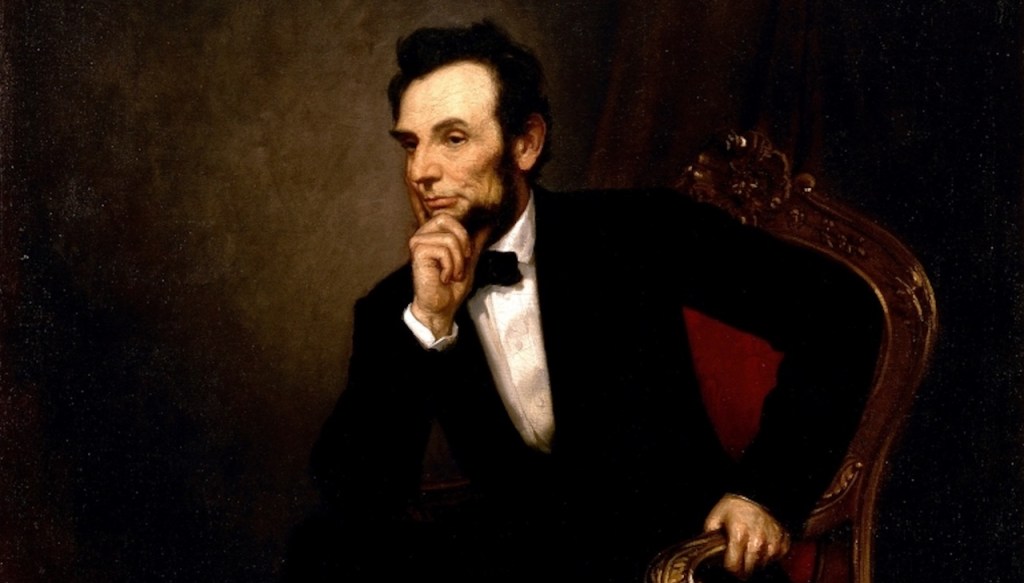
On January 1, 1863, Republican President Abraham Lincoln signed the Emancipation Proclamation, which stated “that all persons held as slaves are, and henceforward shall be free.”
The country had already been suffering two years of a bloody Civi War to end slavery. Democrats had been lobbying for and passing legislation such as the Jim Crow laws and Black Codes for over a century—all designed to keep the black population from enjoying the fruits of citizenship.
President Lyndon Johnson, a Democrat, signed the Civil Right Act of 1964 in to law; however, Johnson himself had labored tirelessly against earlier civil rights legislation.
By signing that bill, Johnson merely demonstrated that he had come to understand that the way for Democrats to acquire and maintain power in future was to pacify and humor blacks, instead of denigrating them and segregating them from whites as the Democrats had always done in the past.
Allegedly, Johnson had quipped, “I’ll have those ni**ers voting Democrat for the next 200 years.” That infamous statement clearly reveals where Johnson’s loyalties lay: with acquiring power for the Democratic Party and not for recognizing African Americans as citizens. Endeavoring to deconstruct Johnson’s racist position, David Emery at snopes.com labels the claim regarding Johnson’s remark “unproven” [6].
But then as he continues his biased analysis, Emery reveals other suggestions that make it clear that Johnson’s beliefs rendered him the consummate racist. For example, Emery offers the report, in which according to Doris Kearns Godwin, Johnson quipped,
These Negroes, they’re getting pretty uppity these days and that’s a problem for us since they’ve got something now they never had before, the political pull to back up their uppityness. Now we’ve got to do something about this, we’ve got to give them a little something, just enough to quiet them down, not enough to make a difference. (my emphasis)
After continued biased bloviating, David Emery admits, “Circling back to the quote with which we started, it wouldn’t have been entirely out of character for LBJ to have said something like, ‘I’ll have those ni**ers voting Democratic (sic) for 200 years’”; however, Emery doubts it, of course.
House and Senate Vote Tally for the Civil Rights Act 1964
The following is a breakdown of the voting tally in the House and Senate [7] for the Civil Rights Act of 1964 of members voting for the bill:
Democrats: House 153 out of 253 = approx. 60% Republicans: House 136 out of 178 = approx. 80% Democrats: Senate 46 out of 67 = 69% Republicans: Senate 27 out of 33 = 82%
While about 80% of the Republicans in the House of Representatives voted for the Civil Rights Act of 1964, only about 60% of the Democrats voted aye. Also while in the Senate, 82% percent of Republicans voted for the bill, only 69% of Democrats did.
Attempting to Rehabilitate by Geography
In order to try to rehabilitate the Democrats’ negative voting record on civil rights, Democrat apologists point out that when one accounts for geographical positioning [8] of the members of the house and senate, the voting tallies this way:
Southern Democrats: 1–20 (5%–95%) (Ralph Yarborough of Texas voted yea) Southern Republicans: 0–1 (0%–100%) (John Tower of Texas voted nay)
Northern Democrats: 45–1 (98%–2%) (Robert Byrd of West Virginia voted nay) Northern Republicans: 27–5 (84%–16%)
This set of votes shows that no southern senate Republicans voted for the act, but there was only one southern Republican in the senate at the time. And also no house Republican voted for the act, but again there were only ten southern Republicans in the house.
This low number of Republicans in the house and senate when converted to percentages skews the reality of the fact that the overall vote, which is the vote that counts, clearly outs the Democrats as opposers of the act. And the Democrats’ main reason for voting against the act was based on race, especially in the south.
However, all of the Republican senators, both north and south, who voted against the act, did so because they favored Senator Barry Goldwater’s position, who remained against the act, not because of racial animus but because of his belief that it was unconstitutional in usurping states’ rights, especially in the area of private business.
The Republican Party was founded, primarily in order to abolish slavery. Yet over a century later, modern-day Democrats such as former house member, Charlie Rangel, continue to spread the big lie that the Republican and Democratic parties simply “changed sides” in the 1960s on civil rights issues.
That excuse is widely exercised by Democrats when confronted with their own undeniably racist past [9]. However, the facts do not support but rather reveal that claim as a big lie.
Three Misrepresented Issues
The persistent inaccuracy that the two parties switched sides is partially based on three significant issues that have been misrepresented by Democrats and their sycophants in the mainstream media:
1.Barry Goldwater’s position regarding the Civil Right Act of 1964. Goldwater [10] did oppose that bill in its final form because he argued that it was unconstitutional, in that it usurped state and individual rights. Goldwater had helped found Arizona’s National Association for the Advancement of Colored People (NAACP), and he had voted for earlier versions of civil rights legislation.
Thus, Goldwater’s opposition was not similar to the Democrats’ opposition based on racism; Goldwater’s opposition was based on his interpretation of the Constitution.
2.The Southern Strategy. With this strategy [11], the Republican Party was attempting to demonstrate to southern Democrats that by continuing to vote for racist/socialist Democrats they were voting against their own economic interests.
What gave Democrats the opening to use this strategy against Republicans was that the Republicans utilized racist political bigots, who were, in fact, Democrats themselves, to help win votes for Republicans.
This strategy prompted the GOP opponents to misrepresent the Republican’s purpose and thus label it primarily racist, when it was, in fact, based on economic growth, not racism.
3. The American South turning to Red from Blue. This claim falls apart with the fact that the “Deep South”—Alabama, Mississippi, Georgia, South Carolina, and Louisiana—took 30 years to begin changing from Democrat to Republican.
It was only in the peripheral South—Florida, Texas, Tennessee, Virginia, North Carolina, and Arkansas—that many working-class transplants, relocating from the northern states as well as from other parts of the United States, understood that the Republican Party offered policies that promoted business, commerce, and entrepreneurial success.
Those transplants, after all, had relocated south to improve their financial status through their new jobs. Gerard Alexander explains in his review:
The myth that links the GOP with racism leads us to expect that the GOP should have advanced first and most strongly where and when the politics of white solidarity were most intense.
The GOP should have entrenched itself first among Deep South whites and only later in the Periphery. The GOP should have appealed at least as much, if not more, therefore, to the less educated, working-class whites who were not its natural voters elsewhere in the country but who were George Wallace’s base.[12]
If the myth of the switched sides were accurate, the Republican Party would have taken hold more strongly first among the traditional racists—that is, the older voters would have become Republicans before the younger ones and the transplants. But that did not happen, because the Republican Party attracted those who were “upwardly mobile” and “non-union.”
After the passage of the Civil Rights Act of 1964, racism in the country’s history had begun to wane as a social and political force. But the Democratic Party continued to foment unrest between the races in order to employ racism as an issue against their opponents in the Republican Party. That tactic is still in place.
After the election of 2020, under the Democratic administration of Joe Biden, the racial unrest began to escalate further with the ideas touted by proponents of Critical Race Theory [13] and the insistence that white supremacy [14] remains the country’s greatest threat.
Poverty Producing Policies
The main reason that the Democratic Party concocted the idea that the parties simply switched positions was to gain power. Reverend Wayne Perryman explains:
Many believed the Democrats had a change of heart and fell in love with blacks. To the contrary, history reveals the Democrats didn’t fall in love with black folks, they fell in love with the black vote knowing this would be their ticket into the White House.[15]
Economist Thomas Sowell [16] has also shed light on the subject: “some of the most devastating policies, in terms of their actual effects on black people, have come from liberal Democrats.”
Sowell emphasizes that the “minimum wage laws” everywhere they have been established have a “track record of increasing unemployment, especially among the young, the less skilled and minorities.”
According to historian Sam Jacobs [17], the 1960s Great Society and War on Poverty, the programs established by the Johnson administration, brought about conditions, which furthered the rise of poverty among black families.
By discouraging marriage, these policies have resulted in out-of-wedlock birthrates that have skyrocketed, “among all demographic groups in the U.S., but most notably African Americans.”
The U.S. out-of-wedlock birthrate in the 1960s hovered around 3% for whites and close to 8% for all Americans; that rate was around 25% for blacks. But, by the mid 1970s, those rates had increased to 10% for whites, 25% for all Americans, and over 50% for blacks.
Then by late 1980s, the birth-rate of unmarried black women had become greater than for married black women. In 2013, the out-of-wedlock birth rate for blacks had climbed to almost 75%.
The Census Bureau [18] maintains that poverty is closely associated with out-of-wedlock births. By instituting a system that keeps blacks at a disadvantage, the Democrats have a captive audience to which they pander for votes.
The Democratic Party stations itself as the protector of blacks and other minorities, not with policies that assist those demographics but with policies that keep them dependent on government.
Unfair Race Policies Unsystematized
Despite the revisionist history and unsupportable claims of the CRT and white supremacy advocates, there is no argument that can refute the fact that racism as an issue of public policy has been unsystematized since the passage of the civil rights acts of the 1960s. No more Jim Crow laws or Black Codes anywhere call for racial discrimination as they had done before the passage of those civil right laws.
Before the passage of those acts, not only did racist laws exist, they were enforced by legal authorities as well as the Ku Klux Klan, which, according the North Carolina historian Allen W. Trelease [19] in his book, White Terror: The Ku Klux Klan Conspiracy and Southern Reconstruction, “The Klan became in effect a terrorist arm of the Democratic Party.”
And Eric Foner [20], Columbia University historian, in his study, A Short History of Reconstruction, 1863–1877, has averred that the KKK was “a military force serving the interests of the Democratic Party.”
Still, statist historians such as Carole Emberton, an associate professor of history at the University at Buffalo, continue to employ the “party lines of the 1860s/1870s are not the party lines of today” [21] bromide attempting to separate the Democratic Party’s engagement from the Ku Klux Klan.
Yet in the same breath, Emberton admits, “that various ‘Klans’ that sprung up around the South acted as a ‘strong arm’ for many local Democratic politicians during Reconstruction.”
Democrats continue to employ the often debunked claim that racism is still a “systemic” problem. They offer this prevarication so they can insist that only the Democratic Party is willing to fight against that “systemic” blight on society.
But again and again, the Democratic Party’s policies have been used, as Lyndon Johnson used them, to placate blacks by making them think they are getting something that no political party even has the power to give: financial security and equality with guaranteed outcomes.
Political parties, when in power, can help the voting public only by instituting policies that encourage financial success and individual freedom. They cannot guarantee that success. They cannot legislate individual success through identity politics.
Strategy to Gain Power
The Democratic Party and its allies continue to employ the big lie that the two parties exchanged positions on race, in an attempt to gain power and to rehabilitate the party’s racist past.
Party members and its minions continue to tie most issues to race because that tactic seems to have worked for gaining power. But when voters look at the basic facts, that claim begins to lose its strength.
For example, citing the voter ID issue as a racist Republican strategy simply bolsters the evidence that Republicans are, in fact, not racist. A majority [22] of black citizens and voters are in favor of the voter ID laws.
However, the Democrats continue to rail against voter ID laws because they know that those laws would impede voter fraud—a demonstrably proven staple in the machine [23] to elect Democrats to government.
Democrats have been attempting to whitewash their racist past for decades; to do so, they often fabricate history. For example, as a candidate for the presidency in 2000, Al Gore falsely stated [24] to the NAACP that his father, Al Gore, Sr., had lost his senate seat because he voted for the Civil Rights Act of 1964.
But Gore, Sr., voted against that act [25], as he supported and joined in the filibuster against that act. Gore, Sr. then sponsored an amendment [26] that would take the teeth out of the enforcement power of that bill, just in case it passed.
Did Dixiecrats Become Republicans?
Democrats also point to the rise of the Dixiecrats that supposedly shows racist Democrats becoming Republicans. However, only two major politicians who had been Dixiecrats switched to the Republican Party.
Fewer than 1% [27] of the more than 1500 Democrats-turned-Dixiecrats left the Democratic Party for the Republican Party. They were prompted to switch party allegiance primarily for economic reasons rather than racial animus.
As the Democratic Party began moving toward socialism, many former Democrats experienced disdain for that socialist impact on business and entrepreneurship.
Senator Strom Thurmond traded in his party alliance with the Democrats to join the Republicans in 1964—not because he continued to support racism, but because he began repudiating it.
Frances Rice [28] explains: “Thurmond was never in the Ku Klux Klan and, after he became a Republican, Thurmond defended blacks against lynching and the discriminatory poll taxes imposed on blacks by Democrats.”
Governor Mills E. Godwin, Jr. of Virginia [29] abandoned the Democrats for the Republican Party in 1974. But again, like Thurmond, Godwin simply abandoned his racist past. Godwin also served as Virginia governor first while a Democrat and then as a Republican.
Hypocrisy about Racist Past
West Virginia’s Robert Byrd, a former Ku Klux Klan Exalted Cyclops and long serving Democratic senator, did renounce his earlier support for segregation and racism. However, Byrd voted against confirmation to the Supreme Court of Justice Thurgood Marshall [30], a Democrat and the first black to be appointed to the high Court.
Byrd also joined 47 of his fellow Democratic senators as he voted against Justice Clarence Thomas [31], a Republican. Neither a black Democrat nor a black Republican could pass muster with the former Klansman.
Senator Christopher Dodd [32] praised Byrd highly by stating that Byrd would have been “a great senator for any moment.” To this potentially inflammatory remark, the Democrats remained silent.
Then later after Senator Trent Lott spoke kind words of Senator Strom Thurmond, the Democrats with their usual hypocrisy lambasted Lott unmercifully. It made no difference that Thurmond had never served as a member of the Ku Klux Klan while Byrd had risen to the high position of Exalted Cyclops.
Regarding Democrat hypocrisy, John Feehery [33] has remarked: “. . . Democrats are super-sizing their hypocrisy to levels never seen. It is their embrace of nihilism that is pushing them to these extremes.”
Policies Harmful to All Citizens
Undoubtedly, the majority of the members of the Democratic Party are not racists today. Yet, it remains unconscionable that so many Democrats label Republicans racists and bigots in pursuit of political power against their opponents.
Democrats cannot legitimately deny the many studies that offer support to the argument proffered by Republicans that Democratic policies are detrimental not only to black citizens but to all citizens.
The current theoretical philosophy of Democratic Party consists of seizing through taxation the financial rewards from “the rich” and giving those rewards to “the poor.” In practice, this Robin Hood scam ultimately means taking from those who earn and redistributing it to friends and allies of the redistributors. Such a system cannot possibly succeed. It can only create victims whose ability to produce becomes atrophied by the false promises of pandering politicians.
Democrats continue to play the race card because they have become utter failures at convincing the majority of the electorate that their policies work. Citizens have become dissatisfied with the actual theft of their earnings, as they have watched as shabby, crime filled cities are, in fact, the result of Democrat policy fecklessness and fraud.
Rose and Milton Friedman Senior Fellow at the Hoover Institution Thomas Sowell has pointed out repeatedly that the policies of Democrats have prevented the black population from rising out of poverty.
Many of the poorest cities in the USA have been run by Democrats for decades. According to Investor’s Business Daily,
When Democrats are in control, cities tend to go soft on crime, reward cronies with public funds, establish hostile business environments, heavily tax the most productive citizens and set up fat pensions for their union friends. Simply put, theirs is a Blue State blueprint for disaster. [34]
Surely, it is time that African Americans, women, and minorities adopt a different mind-set and realize, as Rev. Perryman avers, that the Democratic Party is interested only in their vote, not in their welfare. And, in fact, there seems to be a shift coming in the voting preferences of blacks and Hispanics.
According to Darvio Morrow [35], CEO of the FCB radio network, Democrats for decades have relied on the theory that as the USA grows less white, its voters will become more firmly entrenched as a Democratic Party voting block.
However, Morrow explains, “The problem with this theory is that it relied on the premise that minorities were going to remain solid Democrats. And that premise is turning out to be false.”
American politics is a complex machine, and the force of big lies remains strong. Whether the republic can remain in tact will depend on refuting those lies and in their place establishing a culture of truth, in which facts dominate and falsehoods are rejected.
Despite their fervent support for the Marxist movement touting “Black Lives Matter,” today’s Democrats, including the former occupier of the Oval Office, Joe Biden, [36] continue to support the abortion provider known as Planned Parenthood.
Planned Parenthood is one of the greatest perpetrators of violence against African Americans in this country. It is founded on racism, perpetuates racism, and kills more than 850 African Americans every day. [37]
While blacks constitute roughly 13% of the USA population, they account for 36% of the abortions. Nearly 80% of all Planned Parenthood clinics are located near black neighborhoods [38]. Activists such as Candace Owens [39] and Kanye West [40] have labeled this set of circumstances genocide.
According to the educational website, blackgenocide.org, blacks are the only declining minority population in the USA, and “if the current trend continues, by 2038 the black vote will be insignificant.” Because abortion accounts for most deaths of black lives in the USA [41], those pandering for black votes might want to give that claim some serious thought.
Sources
[1] “Big Lie.” Merriam-Webster Dictionary.com. Accessed May 17, 2023.