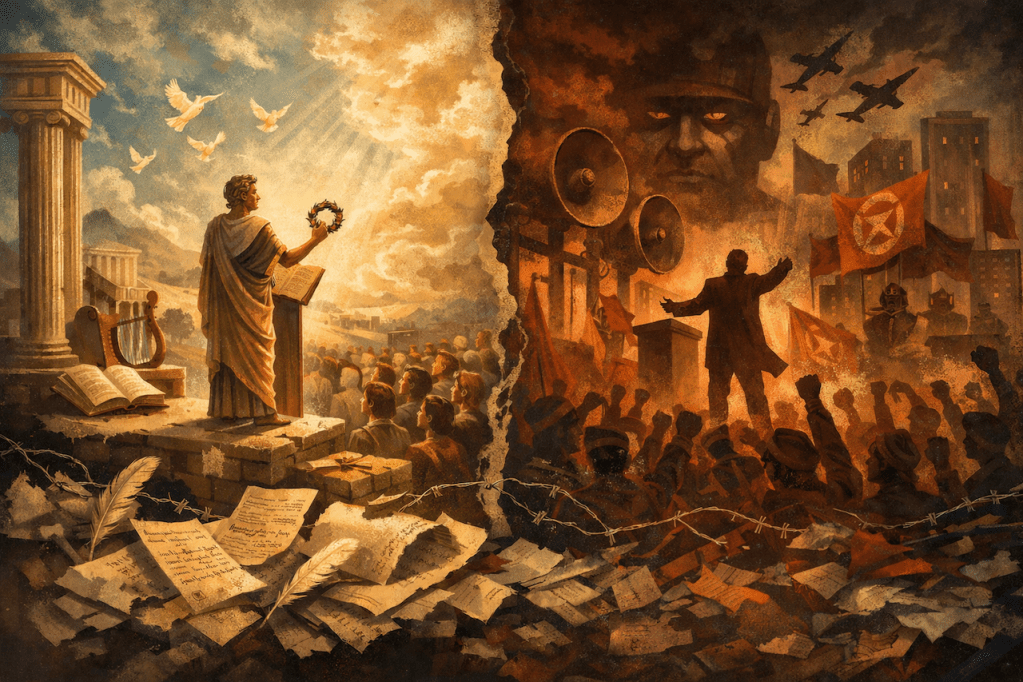
Image: Created by ChatGPT
The art of poetry, once central to cultural formation and moral imagination, has largely vanished from the public consciousness of the twenty-first century. Yet its techniques survive, not in poems, but in political speeches that seek to persuade, mobilize, and command allegiance. What once elevated the soul through truth now often manipulates the will through propaganda.
Historical Transcendence
Poetry historically functioned as a discourse for transcendent truth—or revealing shared characteristics and/or experience of the ineffable. That discourse was articulated through rhythm, rime, metaphor, image, and moral vision. Its purpose was not merely aesthetic but revelatory, offering insight into human nature and cosmic order.
In contrast, modern political rhetoric consistently borrows poetic devices while discarding poetry’s practical, etherial center. An important distinction between poetry and propaganda lies not in technique but in intent. Poetry aims to reveal truth through beauty of shared experience, while propaganda aims to impose belief through emotional coercion. This inversion inserts a profound cultural and political danger upon the culture.
The “cosmic voice” in poetry exemplifies the highest function of language as truth-telling. Poets such as Emily Dickinson and Rabindranath Tagore speak from a vantage point that transcends time, space, and merely personal, temporal interest by remaining true to their own felt experience. Their art invites contemplation rather than compliance.
Narrowing of Vision
By contrast, political persuasion narrows vision instead of expanding it. While employing supposedly elevated diction and often ridiculous, sweeping claims, it constricts thought to a prescribed moral frame. What appears poetic in form becomes propagandistic in function. It limits the world view to us vs them, even as it touts unreasonable and unrealistic visions of collectiveness and togetherness.
Aristotle distinguished rhetoric as the art of persuasion, separate from poetry, which he viewed as an reflected image of universal truth [1]. Modern politics collapses this distinction by weaponizing poetic techniques for rhetorical domination. The result is speech that sounds elevated but functions coercively.
The decline of poetry education has contributed to this confusion. Citizens no longer trained to discern metaphor, irony, and symbolic language become vulnerable to emotional manipulation. Without poetic literacy, propaganda passes for profundity.
Political speeches frequently invoke collective destiny, moral urgency, and historical inevitability. These elements mirror the cosmic voice but lack its grounding in transcendent truth. Instead of illuminating reality, they overwrite it.
The cosmic voice speaks from deep intuition aligned with self-evident moral law. Propaganda speaks from strategic calculation aligned with power. Though their cadences may resemble one another, their spiritual origins differ radically.
A Shared Humanity
Walt Whitman’s expansive voice celebrated the unity of the American soul without demanding ideological conformity. His poetry invited readers into shared humanity rather than partisan allegiance [2]. Modern political rhetoric reverses this impulse.
Totalitarian movements of the twentieth century demonstrated the lethal potential of propagandistic language. Adolf Hitler’s speeches, saturated with mythic imagery and rhythmic repetition, exemplify corrupted poetic form [3]. Beauty of language became an accomplice to brutality.
George Orwell warned that political language is designed “to make lies sound truthful and murder respectable” [4]. His insight underscores how poetic devices, stripped of ethical restraint, become tools of domination. Language ceases to clarify and begins to conceal.
The American founding generation understood the moral weight of language. The Federalist Papers, though persuasive, relied on reasoned argument rather than emotional spectacle [5]. Their restraint contrasts sharply with contemporary political performance.
Prioritizing Applause Lines
Modern speechwriters often prioritize applause lines over logical coherence. Repetition, chant-like phrasing, and simplified behavioral binaries replace substantive argument. These techniques mirror incantation more than deliberation.
Propaganda thrives where citizens abandon critical thinking for emotional identification. It offers belonging in exchange for obedience. Poetry, by contrast, invites solitude, reflection, and inner awakening. The cosmic voice requires humility before truth. Propaganda requires submission to narrative. One liberates the mind; the other enslaves it.
Media amplification intensifies this danger. Televised and digital platforms reward emotionally charged language over nuanced thought. Political speech increasingly resembles performance art devoid of contemplative depth. The poet speaks across centuries; the propagandist speaks to the moment. Poetry endures because it aligns with permanent truths. Propaganda expires when power shifts, leaving cultural debris.
Spiritual Realization over Persuasion
Paramahansa Yogananda’s poems and poetic prose exemplify language joined with spiritual realization rather than persuasion [6]. His words expand consciousness rather than direct behavior. Such writing resists political appropriation.
When political speech adopts cosmic imagery, it often falsifies transcendence. Appeals to “history,” “the people,” or “the future” replace genuine moral reasoning. Abstract collectives become moral/ethcial authorities. This substitution erodes individual conscience. Citizens are urged to surrender judgment to the supposed inevitability of political progress. Poetry affirms the inner reality of awareness; propaganda suppresses it.
The labeling of persuasive political language as “poetry” obscures its manipulative intent—especially when displayed in poems. Calling propaganda poetic grants it unearned authority and legitimacy.
Precision in language is therefore a civic necessity. Freedom depends on the ability to discern truth from emotional coercion. When citizens mistake propaganda for poetry, they become susceptible to ideological captivity. Liberty erodes quietly through linguistic corruption.
Absence of Classical Rhetoric and Poetry
Education in classical rhetoric and poetry once fortified citizens against demagoguery. Its absence leaves a vacuum filled by spectacle and slogan. Cultural amnesia thus becomes a political liability. The cosmic voice unites humanity by revealing shared being. Propaganda divides humanity by enforcing ideological boundaries. Poetry heals; propaganda fractures.
Political movements that rely on constant rhetorical escalation reveal their fragility. Truth does not require perpetual amplification. Only falsehood fears silence. The recovery of poetic literacy is therefore an act of resistance. Reading true poetry reawakens discernment and humility. It trains the ear to recognize authenticity.
Citizens must relearn to ask not how language makes them feel, but whether it aligns with reality. Emotional intensity is not evidence of truth. Poetry teaches this distinction; propaganda erases it.
The survival of the American republic depends on linguistic vigilance. Freedom requires citizens capable of resisting seductive falsehoods. Propaganda must be recognized, resisted, and rejected. True poetry remains a guidepost for this resistance. Its cosmic voice reminds humanity of higher order beyond power. In reclaiming poetry, citizens reclaim freedom.
Sources
[1] Aristotle. Poetics. Translated by S. H. Butcher. Project Gutenberg. Accessed January 9, 2026.
[2] Walt Whitman.Leaves of Grass. Project Gutenberg. Accessed January 9, 2026.
[3] Victor Klemperer. The Language of the Third Reich. Bloomsbury Academic. 2006. Internet Archive. Accessed January 9, 2026.
[4] George Orwell. “Politics and the English Language.” Horizon. 1946.
[5] Alexander Hamilton, James Madison, John Jay. The Federalist Papers. Project Gutenberg. Accessed January 9, 2026.
[6] Paramahansa Yogananda. Autobiography of a Yogi. Self-Realization Fellowship. Accessed January 9, 2026.
 Linda's Literary Home