Linda's Literary Home

Tag: Creator

  • Emily Dickinson’s “‘Why do I love’ You, Sir?”

    Image: Emily Dickinson - Amherst College - Daguerrotype of the poet at age 17, circa 1847 - likely the only authentic, extant likeness of the poet
    Image: Emily Dickinson – Amherst College – Daguerrotype of the poet at age 17, circa 1847 – likely the only authentic, extant likeness of the poet

    Emily Dickinson’s “‘Why do I love’ You, Sir?”

    The speaker of Emily Dickinson’s oddly punctuated poem “‘Why do I love’ You, Sir?” uses logic to demonstrate the reasoning that leads the created soul to experience love for its Creator.

    Introduction with Text of “‘Why do I love’ You, Sir?”

    This unusual Emily Dickinson poem begins with the following oddly punctuated first line: “Why do I love” You, Sir?

    Emily Dickinson’s Editors

    When analyzing the poems of Emily Dickinson’s, it is useful to remember that she did not work with an editor for the purpose of publishing.   Her poems were first edited after her death by Thomas Wentworth Higginson and Mabel Loomis Todd.

    But, unfortunately, their reworking often smoothed out Dickinson’s quirky use of language to the point of crushing the innovation and nuances that made her the unique poet that she was.  Therefore, Thomas H. Johnson restored her poems to the originals as found in the bundles (fascicles) of poems written in her own handwriting. 

    Thus the reader must be aware that Dickinson might have been persuaded to alter some of her quirks for publication, if she had been assured that her meaning would not be changed but instead made clearer by the changes.

    The odd punctuation of this poem, especially the first line, is an example of a Dickinsonian quirk which, no doubt, would have been altered by an editor after close consultation with the poet.  Indeed, it would be fascinating to hear Dickinson’s explanation for placing “Why do I love” in quotation marks, making it appear as a unit of thought that seems to address the second person “You.”

    No one can ever know for certain what significance that odd punctuation might have had for the poet, and it is likely that modern readers may simply dismiss the quotation marks as they begin the poem.

    The poem features four stanzas; the first two are innovative cinquains, the third is an innovative sestet, and the fourth is a Dickinsonian quatrain.  The poem dramatizes the theme of God’s love as mystery.  

    But it also makes it clear that the speaker is simplifying that emotion:  it is merely a natural sequence of events that the created soul will love its Creator.  The complication comes in giving thought to that sequence.  The speaker seems to desire to uncomplicate the issue once and for all.

    “Why do I love” You, Sir?

    “Why do I love” You, Sir?
    Because –
    The Wind does not require the Grass
    To answer – Wherefore when He pass
    She cannot keep Her place.

    Because He knows — and
    Do not You –
    And We know not –
    Enough for Us
    The Wisdom it be so –

    The Lightning – never asked an Eye
    Wherefore it shut — when He was by –
    Because He knows it cannot speak –
    And reasons not contained –
    – Of Talk –
    There be – preferred by Daintier Folk –

    The Sunrise – Sire – compelleth Me –
    Because He’s Sunrise – and I see –
    Therefore – Then –
    I love Thee –

    Commentary on “‘Why do I love’ You, Sir?”

    The speaker of Dickinson’s oddly punctuated poem uses logic to demonstrate the reasoning that leads the created soul to love for its Creator.

    First Stanza:   Unavoidable Love

    “Why do I love” You, Sir?
    Because –
    The Wind does not require the Grass
    To answer – Wherefore when He pass
    She cannot keep Her place.

    The speaker seems to be talking to the Divine Reality (God), calling Him “Sir,” and questioning Him as to why she loves Him. Then the speaker replies with her own answer, “Because — / The Wind does not require the Grass / To answer.”  However, in order to completely respond to this amazing mystery, the speaker finds it necessary to compare her feelings with phenomena of nature. 

    She thus decides to compare her love to the act of love the grass possesses.  The grass simply cannot prevent itself from undergoing its waving motion after the wind has blown through it. 

    The speaker’s love for her Heavenly Father Creator God is just simply natural.  There can be no questioning it.   Of course, she will continue to question and answer.  That’s just the way she rolls!

    Second Stanza:  The Wisdom of Love

    Because He knows — and
    Do not You –
    And We know not –
    Enough for Us
    The Wisdom it be so –

    In the second stanza, the speaker suggests that God as Father along with all she knows about anything, holds the “Wisdom” motivating the love in the soul of the created children for their Creator.   Nothing more is necessary, because everything is enfolded in that love and wisdom.

    Third Stanza:  “Why” Remains Irrelevant

    The Lightning – never asked an Eye
    Wherefore it shut — when He was by –
    Because He knows it cannot speak –
    And reasons not contained –
    – Of Talk –
    There be – preferred by Daintier Folk –

    In the third stanza, the speaker returns to describing phenomena of nature to explicate the “why”:  she reveals that that love eruption is akin to lightning striking the eye.  The eye will never stop to ask “why” it is acting as it does as it closes from the onslaught of  the light’s sudden brilliance.  Intimately coalescing occurrences do not motivate one to ask why.  They just are.  Or it is so obvious that no one has ever in history bothered to question it.   

    The speaker is nevertheless still aware that human minds crave reasons for things and events.   The human mind wants to discuss and declaim about the ineffable, even though the ineffable will never be “contained — / — Of Talk.”   The mind may be likened to “Daintier Folk,” who wish everything to be clarified in words, despite the fact that words often cannot perform that feat.

    By qualifying the mind and others who are not privy to such erudition as simply “daintier,” the speaker manages to suggest that there are those who are merely  incapable of seeing what is right before their eyes.  The employment of such a euphemism renders the speaker both kind and sympathetic and yet at the same time demonstrates her unique talent and deep mental perception.

    Fourth Stanza:  The Logic of Loving One’s Creator

    The Sunrise – Sire – compelleth Me –
    Because He’s Sunrise – and I see –
    Therefore – Then –
    I love Thee –

    The love for God, for this speaker, remains quite uncomplicated:  as the sun rises, her eyes perceive light.  As the Creator creates, the created loves.  To her mind, only the completely daft can question the logic of loving one’s Creator.

    But even without uttering any negativity regarding those who lack such natural understanding, the speaker has demonstrated her stance which remains replete with obvious implications.
  • S. Omar Barker’s “A Cowboy’s Christmas Prayer”

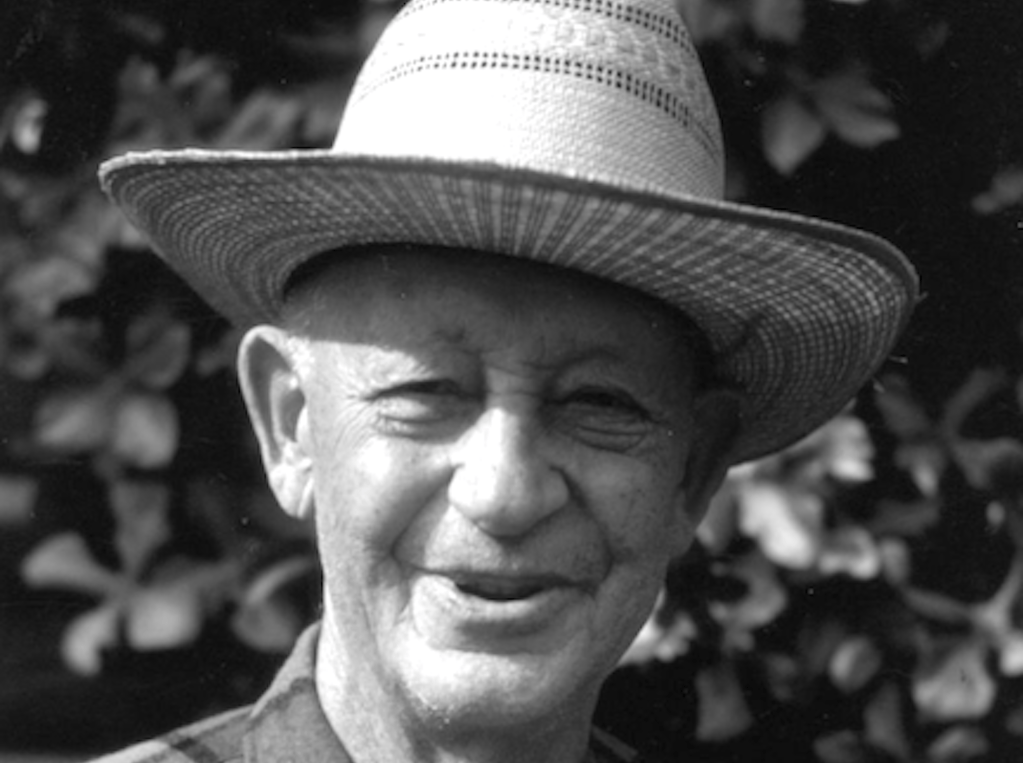
    Image:  S. Omar Barker – Texas Trail of Fame

    S. Omar Barker’s “A Cowboy’s Christmas Prayer”

    S. Omar Barker’s Christmas poem “A Cowboy’s Christmas Prayer” features a humble cowpoke, who is not accustomed to praying but is offering his heart-felt supplication at Christmas time.  As he prays, he reveals the qualities and issues of his life that are most important to him.

    Introduction with Text of “A Cowboy’s Christmas Prayer”

    This Christmas prayer/poem composed by cowboy poet, S. Omar Barker, allows a humble rider-of-the-range to express his deeply held wishes as he offers a supplication to the Lord for the good of all mankind.  The cowboy prayer is framed as a ballad-style narration emphasizing the simple, humble nature of the cowpoke.

    The ballad-influenced piece plays out in cowboy dialect and  in riming couplets.  Its stanza breaks are uneven with two single-line bridges that dissect the drama at important points to emphasize the shift in theme and tone.

    A Cowboy’s Christmas Prayer

    I ain’t much good at prayin’, and You may not know me, Lord —
    For I ain’t much seen in churches, where they preach Thy Holy Word.
    But you may have observed me out here on the lonely plains,
    A-lookin’ after cattle, feelin’ thankful when it rains.

    Admirin’ Thy great handiwork.

    The miracle of the grass,
    Aware of Thy kind Spirit, in the way it comes to pass
    That hired men on horseback and the livestock that we tend
    Can look up at the stars at night, and know we’ve got a Friend.

    So here’s ol’ Christmas comin’ on, remindin’ us again
    Of Him whose coming brought good will into the hearts of men.
    A cowboy ain’t a preacher, Lord, but if You’ll hear my prayer,
    I’ll ask as good as we have got for all men everywhere

    Don’t let no hearts be bitter, Lord.
    Don’t let no child be cold.
    Make easy the beds for them that’s sick and them that’s weak and old.
    Let kindness bless the trail we ride, no matter what we’re after,
    And sorter keep us on Your side, in tears as well as laughter.

    I’ve seen ol’ cows a-starvin’ — and it ain’t no happy sight;
    Please don’t leave no one hungry, Lord, on Thy Good Christmas Night —
    No man, no child, no woman, and no critter on four feet
    I’ll do my doggone best to help you find ’em chuck to eat.

    I’m just a sinful cowpoke, Lord — ain’t got no business prayin’
    But still I hope you’ll ketch a word or two, of what I’m sayin’:
    We speak of Merry Christmas, Lord—

    I reckon You’ll agree —

    There ain’t no Merry Christmas for nobody that ain’t free!
    So one thing more I ask You, Lord: just help us what You can
    To save some seeds of freedom for the future Sons of Man!

    Reading

    Commentary on “A Cowboy’s Christmas Prayer”

    S. Omar Barker’s “A Cowboy’s Christmas Prayer” dramatizes the prayer offered by a humble cowboy who is unaccustomed to praying and unacquainted with church services but who holds the blessings from the Creator very dear to his heart.  He expresses his gratitude for the simple life he lives and asks his Creator to bless others with kindness and prosperity.

    First Movement:  A Humble Prayer

    I ain’t much good at prayin’, and You may not know me, Lord —
    For I ain’t much seen in churches, where they preach Thy Holy Word.
    But you may have observed me out here on the lonely plains,
    A-lookin’ after cattle, feelin’ thankful when it rains.

    In the first quatrain, the supplicating cowboy begins by addressing the Lord, suggesting that the Lord may not even be acquainted with the cowboy; he then gives the reasons that he feels the Lord may not know him.  He has not attended church very often, and he knows that’s where they preach His “Holy Word.”

    However, the cowboy then suggests that perhaps the Creator has seen him out on the plains doing his work of watching “after cattle.”  The cowboy adds what he likely feels may be a useful introduction to the Lord Creator:  he has felt thankful for the rain that keeps life supported.

    Second Movement:  A Single-Line Bridge

    Admirin’ Thy great handiwork.

    The cowboy adds another positive feature in his heretofore somewhat tentative relationship with the Almighty: he has always admired the “great handiwork” that he often observes as he rides the range in the great outdoors.

    This line appears alone and emphasizes the important idea that the cowboy has always kept the Creator near to his heart by feeling enthralled by all of what He has created.  The cowboy is likely remembering the wide-open plains, the mountains, the trees, vegetation of the prairie, the night sky full of stars, and the cattle that he himself drives and protects. 

    This single line offers a useful bridge between the moments of prayer that supplicates, as it brings the Divine back into the cowboy’s consciousness.

    Third Movement:   Miracles in Creation

    The miracle of the grass,
    Aware of Thy kind Spirit, in the way it comes to pass
    That hired men on horseback and the livestock that we tend
    Can look up at the stars at night, and know we’ve got a Friend.

    The next quatrain offers a few specific examples of the great Lord’s “handiwork.”  The cowboy first mentions the grass, which he describes as a “miracle.”  He then avers that even as a simply cowpoke he feels the nature of the Lord is kindness.

    And through that “kind Spirit,” he reports that somehow the graceful occasion exists that those hired hands who work riding horseback and tending livestock are able to observe the sky full of “stars at night.”

    The cowboy makes it clear that such a sight fills his heart with gratitude that he and his fellow workers “got a Friend.”  His relationship with the Lord has blossomed even as he admits his tentative relationship with church and prayer.

    Fourth Movement:  Good Will

    So here’s ol’ Christmas comin’ on, remindin’ us again
    Of Him whose coming brought good will into the hearts of men.
    A cowboy ain’t a preacher, Lord, but if You’ll hear my prayer,
    I’ll ask as good as we have got for all men everywhere.

    Likely the coming of the season of Christmas has been the impetus for the cowboy to be offering this halting prayer.  So he now tells the Lord that the coming of Christmas has reminded him of Jesus the Christ, Who “brought good will” into men’s hearts.

    Even though he “ain’t a preacher,” the cowboy expresses the hope that the Lord will still hear his prayer.  He promises to supplicate for the “good” of everyone everywhere.  He wishes that all men may be as blessed as he his.  His gratitude keeps his own heart open to the Lord’s grace.

    Fifth Movement:  Prayer of a Simple Soul

    Don’t let no hearts be bitter, Lord.
    Don’t let no child be cold.
    Make easy the beds for them that’s sick and them that’s weak and old.
    Let kindness bless the trail we ride, no matter what we’re after,
    And sorter keep us on Your side, in tears as well as laughter.

    In the next cinquain, the speaker offers a catalogue of blessings that he wishes to ask of the Lord.  He asks that no bitterness reside in the hearts of men, as he asks that “no child be cold.”  

    He asks the Lord comfort those who are ill and make their convalescence go smoothly.  He also wish ease and comfort for those who are old and weak.  He asks kind-heartedness remain a feature of the “trail we ride.” He then asks the Creator to keep humanity on His side throughout good times as well as bad times.

    Sixth Movement:  Praying for Others’ Welfare

    I’ve seen ol’ cows a-starvin’ — and it ain’t no happy sight;
    Please don’t leave no one hungry, Lord, on Thy Good Christmas Night —
    No man, no child, no woman, and no critter on four feet
    I’ll do my doggone best to help you find ’em chuck to eat.

    Returning to the quatrain-form for the sixth movement, the speaker focuses on hunger; he has observed cows that are starving to death, and that sight weighs heavily on his heart and mind; thus, he begs the Lord to “leave no one hungry.” 

    This deprivation is so important to him that he asks that “no man, no child, no woman” be allowed to go hungry.  But he also wants the Lord to protect all animals from the fate of hunger.  He then promises to help the Lord in finding food for all who are hungry.

    Seventh Movement:  Self-Deprecation 

    I’m just a sinful cowpoke, Lord — ain’t got no business prayin’
    But still I hope you’ll ketch a word or two, of what I’m sayin’:
    We speak of Merry Christmas, Lord—

    In the next tercet, the cowboy again engages in self-deprecation, saying he is “just a sinful cowpoke” and he does not deserve to be “prayin’.”  Still, he expresses the hope that the Creator will hear at least “a word or two” of his prayer.  

    The cowboy/speaker then begins a thought which is so important that he offers merely the opening of it, allowing its conclusion to spread over another bridge and into the final tercet.  He begins by reporting that “[w]e speak of Merry Christmas, Lord—.”

    Eighth Movement:  Agreement with His Lord

    I reckon You’ll agree —

    The speaker then creates a second bridge between thoughts.  This time he inserts the important notion he thinks the Lord will agree with what he is about to propose. By beginning the thought in the conclusion of the seventh movement, allowing it to marinate through the eighth bridge movement, he has created a small mystery that emphasizes the utterly vital importance of his final thought.

    Ninth Movement:  Freedom Is Vital

    There ain’t no Merry Christmas for nobody that ain’t free!
    So one thing more I ask You, Lord: just help us what You can
    To save some seeds of freedom for the future Sons of Man!

    Finally, the cowboy issues his important claim before God and world that the most important possession that mankind must retain is “freedom.”  There can be no “Merry Christmas” unless humanity is free to enjoy it; no happiness can exists for any individual “that ain’t free!”

    Thus, the cowboy’s final supplication is that the Lord “save some seeds of freedom for the future Sons of Man!”  He asks his Creator to allow the love and hope of freedom to grow with mankind in all lands for all time.