The Reality of Human Differences
We live in a world where no two people are exactly alike. Human beings possess differing interests, ideas, and intentions, a fact that makes relationships inherently difficult. When you look at how distinct we all are on the inside, it is no wonder that it is so rare for any one human being to develop a peaceful and purposeful relationship with another.
The Root of the Difficulty
This struggle for human beings to get along is built right into the fabric of creation. As the unmanifested Spirit, God is pure Bliss, but to create the world, He utilized a cosmic deception called maya—the grand magical measurer [1]. Paramahansa Yogananda explains this cosmic setup [2]:
Spirit overspread and permeated Its creative desire with cosmic delusion, a grand magical measurer described in Hindu scriptures as maya (from the Sanskrit root ma, “to measure”). Delusion divides, measures out, the Undefined Infinite into finite forms and forces.
Delusion divides the Undefined Infinite into finite forms. Because of this division, we all navigate existence with avidya, or individual illusion, which makes us feel completely separate from everyone else. Trapped in individual egos, our human condition unfolds through a multiplicity of perspectives.
Most of our trouble comes from the fact that we look at life through our five senses and limited human minds, yet the senses are unreliable, catching only what happens on the changing, physical level.
When the Infinite is chopped up into billions of separate human beings—each shaped by unique experiences, temperaments, and aspirations—individual persons develop their own unique set of desires and motives. With so many different minds running around, it is a mathematical certainty that our intentions will eventually clash.
The Myth of Effortless Harmony
These divergences extend beyond mere preferences into our core intentions—the silent drivers of daily choices and long-term paths. Relationships, by their nature, require constant negotiation between these distinct inner worlds.
The family unit, often idealized as a sanctuary of unconditional unity, frequently illustrates this
challenge most acutely. Siblings raised in the same household may develop opposing worldviews, while parents and children encounter generational shifts in values that widen the gap between expectation and reality.
Similarly, the marital bond confronts the daily reality of two separate consciousnesses attempting to merge trajectories, and friendships dissolve when evolving intentions pull individuals in irreconcilable directions.
Because we are wrapped up in personal illusions, finding true harmony with another person is incredibly rare. To achieve a peaceful and purposeful relationship, two people must quiet their egos enough to see past their own selfishness.
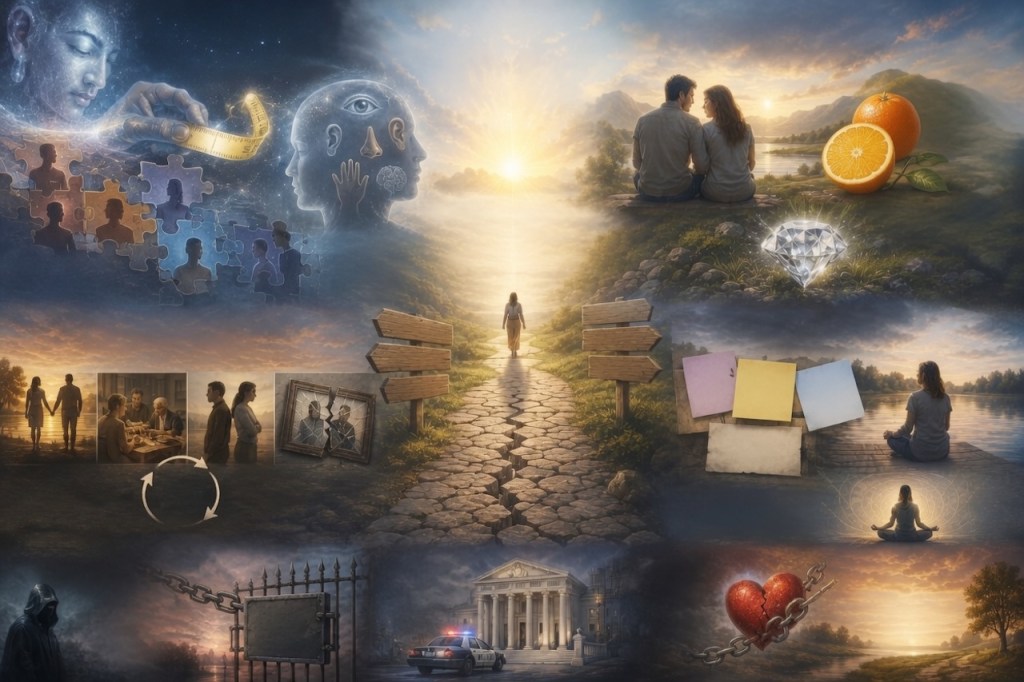
The inner world of another person—their hurts, thoughts, and true intentions—is entirely ineffable. It resembles the experience of tasting an orange: on the material plane, you can try to describe the taste to someone, but they will never truly know it until they taste it themselves. We can never perfectly climb inside someone else’s mind.
Dr. David Frawley notes that to find true harmony, we must look deeper [3]:
We can discover that Divine face and presence of consciousness everywhere, but for this to occur, we must first discover it within our own hearts and in the hearts of all beings. Most people have not found that presence within themselves yet, so they remain stuck in the outer shell of the ego. And where there is ego, there is friction.
Redefining Relationship Fractures
With human nature structured this way, we should not be shocked when things fall apart. Fractured family relationships, broken marriages, and ended friendships are natural phenomena in a dualistic universe.
In a material world defined by constant change and division, things come together and things fall apart. Just as creation itself goes through cycles of manifestation and dissolution [4], human relationships go through cycles too. When the underlying reasons that brought two people together expire, the relationship naturally dissolves.
Society loves to play the blame game, immediately searching for a villain when a relationship fails. Much suffering arises from the imposition of these unrealistic ideals—the belief that true love conquers all differences effortlessly, or that familial duty demands perpetual agreement. When reality falls short, individuals internalize failure or assign fault.
Assigning bitter blame is usually a mistake. It assumes that everyday human beings have the spiritual power to override the laws of maya at will. Until a person learns to completely quiet the body and the mind so the soul can take over, they will be pushed and pulled by their changing ideas and desires.
Broken marriages often reflect the honest recognition that continued union would stifle the authentic development of one or both partners; ended friendships signify the natural completion of a shared chapter rather than betrayal.
Removing Blame and Accepting Reality
If we want to have peace of mind, we must accept reality without holding onto resentment. I am Linda Sue Grimes, and as I have mentioned before, I have many aspects and nicknames—Sissy to my sister, Grammy to my grandkids, and Nubbies to my husband. Those roles are a part of my life, but they are not the eternal soul. Human relationships are temporary arrangements on the physical plane.
By recognizing relationships as dynamic interactions between distinct souls rather than proofs of personal merit, we cultivate compassion and remove blame. When a relationship ends, it is not always because someone is an evil person, but simply because the temporary alignment of their interests has come to a natural end. Accepting this truth softens the blow for postmodern minds constantly hurt by broken hearts.
When two people do manage to bridge that massive gap and create a beautiful bond, it stands as a genuine, transcendent blessing. Such connections require conscious cultivation: patience to listen beyond surface disagreement, humility to release the need for complete agreement, and wisdom to honor the other’s path even when it diverges.
This understanding aligns with broader spiritual insight. The difficulties of human connection invite the development of virtues—forgiveness, adaptability, and non-attachment—that facilitate progress on the spiritual path.
Ultimately, the human journey involves balancing the longing for connection with the reality of separateness. When intentions can harmonize sufficiently to allow mutual flourishing, something sacred occurs. When they cannot, releasing the bond with understanding preserves dignity and opens space for new possibilities.
An Important Caveat
However, a crucial distinction must be made: relinquishing blame and judgment of others does not mean we suffer fools and criminals. It must be acknowledged that evil does exist in this world of maya delusion, and evil individuals do try to victimize the innocent.
The understanding that human intentions diverge because of individual illusion is a philosophical tool for personal peace, not an excuse for passivity or a license for others to do harm.
Criminals must still be prosecuted to the full extent of the law. Society requires structure and protection from those whose delusions manifest as destructive violence or fraud. Furthermore, evil acts that may not be punishable by civil law still require banishment from one’s life.
Boundaries are essential; recognizing that an individual is acting out of ignorance or avidya does not mean you must allow them to remain a toxic presence in your domestic or social circle.
It is simply that crimes against us can be forgiven by us even if they are not forgiven by the legal system. The legal system must punish the act to preserve order on the material plane, but the individual victim can choose to release the burning resentment within their own heart.
Forgiveness is a spiritual function of the soul that frees the victim from the karmic tie of hatred, allowing them to move forward in quietude, even as the law takes its necessary course.
Sources
[1] Paramahansa Yogananda. “Maya.” Self-Realization Fellowship. Accessed June 22, 2026.
[2] Editors. “Law of Maya.” Paramahansa Yogananda: The Royal Path of Yoga. Accessed June 22, 2026.
[3] David Frawley. “Is Hinduism a Monotheistic Religion?” American Institute of Vedic Studies. August 27, 2014.
[4] Swami Sri Yukteswar. The Holy Science. Internet Archive. Originally published by Self-Realization Fellowship.