Linda's Literary Home

Tag: Divine Creator

  • Original Short Story: “The Thin Woman”

    Image:  The Big Pond 

    The Thin Woman

    Lenore’s most dreaded chore was picking up pop bottles. She had to tote a heavy pop crate while collecting the pop bottles from around the ponds. She trembled in fear while negotiating the sloping side of the pond because she could not swim . . .

    Lenore Ellen Thompson spent her childhood at end of a long dirt road, where her family owned and operated pay fishing lakes—Thompson’s Ponds, later renamed Heavenly Lakes. The fellows who came fishing would get mighty thirsty, so the Thompson’s sold soda pop and other snacks in their concession stand that they nicknamed “The Shanty.” 

    Back then in the late 1950s and early 1960s, the pop was sold in 12 ounce returnable bottles, but the fishers would not bring back their bottles to “The Shanty.” Instead they simply threw them on the ground around the ponds, and Lenore would have to go out and gather them up, so they could return them to the Pop Man, who came every Saturday to deliver fresh bottles of pop from his big pop truck.

    To gather up the pop bottles, Lenore would carry a pop crate that held about 20 or so bottles. She was always fearful when negotiating the sloping side of the ponds because she could not swim, and her inability to swim accounted for the reason that she feared picking up bottles on the sloping sides of the lakes. Sometimes she would pick them up around the level sides and just not bother with the sloping side.

    But when she did that, her father would tell her she was lazy for not finishing her task, so to avoid being upbraided by her father, she determined to finish her task regardless of her safety. After a weekend of fairly heavy business, the Monday, June 17, 1957, at approximately 9 a.m., Lenore was hauling the pop crate along the sloping side of the Big Pond, as the family referred to the bigger pond back then.  The other one was the Little Pond, naturally. 

    It had rained the night before and the ground was slippery with mud. There was only one person fishing in the lake, a very thin woman who was casting her line out and reeling in and casting out and reeling in, more as if she were practicing than fishing. As Lenore stepped down and reached out to retrieve a bottle from near the edge of the water, she slipped and went tumbling into the water.  The pop crate tumbled in after her hitting her on the leg. She panicked, she could not feel the bottom of the lake under her feet, so she panicked some more. 

    Suddenly, her lungs felt as though they were going to burst. All at once, she realized that she was breathing under water, and she was shocked! She wondered how she would tell her mom and dad that she could breathe under water.

    A Bizarre Thing Happened

    But then a most bizarre thing happened. She lunged up out of the water, hovered over it, and then looked around for what to do next.  She saw the woman, who was sitting in an odd position, cross-legged, on the hard ground, not moving, just staring off into space. It seemed that Lenore saw the woman open her brain and ask Lenore to enter it. 

    She did what the thin woman requested, and then after what must have been only seconds, Lenore realized that she no longer had the body of an eleven-year-old, but that of a woman who must have been in her thirties. Lenore got up and walked into a clump of trees up the sloping side of the pond. She sat down to decide what to do. She closed her eyes and began to pray.  

    Although she had never really prayed before, she couldn’t think of anything else to do, so she prayed for God or Someone or Something to tell her what to do. She knew she could not live as this woman—Lenore was still only eleven-years-old. What could she do? Lenore was guided to think hard about what she used to look like, and so she did that thinking for several minutes as hard as she could. Slowly, she could feel her body changing. She looked down at the hands; they were her hands. 

    The legs were her legs, and the arms her arms. She wondered if the face was her face, so she went down to the water’s edge and looked in and saw that, indeed, it was the face of eleven-year-old Lenore Ellen Thompson. 

    And she saw something that stunned her more than she had ever been stunned before: she saw her former body in the water.  She was starting to panic again—this time not because of not being able to swim, because she knew that if she fell into the water now, she would be able to swim.

    What if They Find the Body?

    Lenore tried to figure what she would do when people find that body. Everybody knows that she is not twins. She searched for a long tree branch and shoved the body deeper into the water.  Luckily, it finally disappeared so no one could see it from the bank, and she reasoned that because she was very much alive, no one would ever bother to look.  She sat for a few moments trying to calm herself and figure what to do next. 

    She had been gone for what seemed a long time, and she knew her mother would begin to worry if she didn’t get back to the house soon. Then it hit her that she had that woman’s clothes on. They were so tight that she could barely breathe. 

    The woman, whose body she now inhabited, had been a very thin woman, and Lenore was a rather chubby girl. And she realized that her mother would know that those clothes were not Lenore’s shorts and top.  She had to get into the house without her mother seeing her and get some of her own clothes.

    So she sneaked up the hillside and waited until her mother came outside. Fortunately, her mother came out and went to the garden to pull weeds.  Lenore ran as fast as she could, bounded into the house, changed her clothes, bundled up the thin woman’s clothes and then started to panic again. 

    What could she do with those clothes? Her mother would know that these were not hers. She looked out the window and saw that her mother had moved to the very far end of the garden, and thus could not see Lenore if she went outside. 

    Lenore thought at first that she could burn the clothes in a trash barrel drum that they were using to burn trash. But then she would have to account for the fire. The trash barrel was just a few yards away from their outdoor john, (they still had no indoor plumbing back then), and she got the idea to just toss them in the john, and that’s what she did. 

    It didn’t occur to her that anyone would look down into the excrement hard enough to recognize a pair of shorts and a blouse.  But later that night, her father started complaining about the fishermen using their private toilet. He said somebody had put some clothes down in it. That’s all though.  He and Lenore’s mother just thought that some fisherman had tossed those clothes down there. Luck was on Lenore’s side again.

    Who Was That Woman?

    Things settled down for Lenore Ellen Thompson over the next few days, months, years—at times, she wondered if that body would ever be discovered. But what bothered her most was, who was that woman who gave up her body for Lenore?  Every time Lenore would hear of a woman missing, she wondered if it were that thin woman until she’d find out some fact that made it impossible.

    For example, a woman in Eaton, Ohio, went missing, but they found her body later in Dayton in a hotel room, where she had committed suicide. Over the years, this fear finally faded. After earning her culinary certificate in Cooking Arts at the Culinary Institute in Rhode Island, Lenore married the chef Christopher Evanston.

    They worked together in vegetarian restaurants in Chicago, Miami, and finally Encinitas, where they settled down to raise their two sons, Eliot and William. In her early thirties, Lenore encountered the teachings of Vedanta from which she learned some astounding concepts which gave her great comfort—like reincarnation and karma and how each human being is responsible for his/her own salvation. 

    According to those teachings, if we have led a life that has caused us great pain, we can change it, and follow a pathway that leads us to happiness in the future. And the heart of these teaching is meditation, which calms the body and mind, allowing the soul to find itself.

    Discovering that each human body has a soul was a defining moment in the life of Lenore Ellen Thompson because she could now understand that it was her soul that left that body that day and entered the body of the thin woman.  Who was the thin woman? Lenore still did not know.

    But she thought that the woman was just an astral being used by the Divine Creator to allow Lenore to continue to live out her life. Also what the woman did for Lenore give her an experience base that would allow her to identify with the teachings of Vedanta—no one else in her family ever had such an experience base. 

    No one ever turned up missing who fit the thin woman’s description. And no one had bought a ticket to fish that morning that Lenore drowned while picking up pop bottles. No one saw the thin woman except Lenore.

    Strange Teachings

    Vedanta explains that vagrant souls exist and try to enter bodies of people who allow their minds to remain blank. At some point during Lenore’s death state, she became something like a vagrant soul. And the thin woman was waiting for Lenore to take over her body. Lenore comforted herself knowing that the thin woman invited her to do that; Lenore did not merely abscond with the woman’s physical encasement. 

    Lenore didn’t even know how she did it. It was as if forces were moving her and connecting her without much of her awareness. Lenore was guided to place her attention between her eyes and let the forces do the rest. Vedanta also explains that intense prayer can change the physical body. And at the time of her death and entry into that woman’s body, Lenore prayed with an intensity that she had never before or after experienced.

    The Thin Woman Revisits

    Despite her bizarre drowning death and rebirth, Lenore lived a fairly ordinary life. She was content in her marriage, motherhood, and loved working with her husband cooking in vegetarian restaurants.  Both sons entered monastic life in the ashrams of Paramahansa Yogananda, and Lenore whole-heartedly approved of her sons’ life choices.

    Lenore’s soul left its body with finality June 17, 2057, at 9:00 a.m.—exactly one hundred years after the bizarre drowning. Both sons were at her side as she slipped out of her physical encasement. Her belovèd husband had passed only days before. As she was entering the astral realm, Lenore was permitted a brief visitation with her belovèd husband and with several friends from her meditation group. 

    Then she saw a brilliant light that slowly formed itself into the image of the thin woman, who had offered Lenore her body that day by the Big Pond. The thin woman then welcomed Lenore’s soul to the astral world, where she continues on her journey back to the Infinite.
  • Phillis Wheatley’s “A Hymn to the Evening”

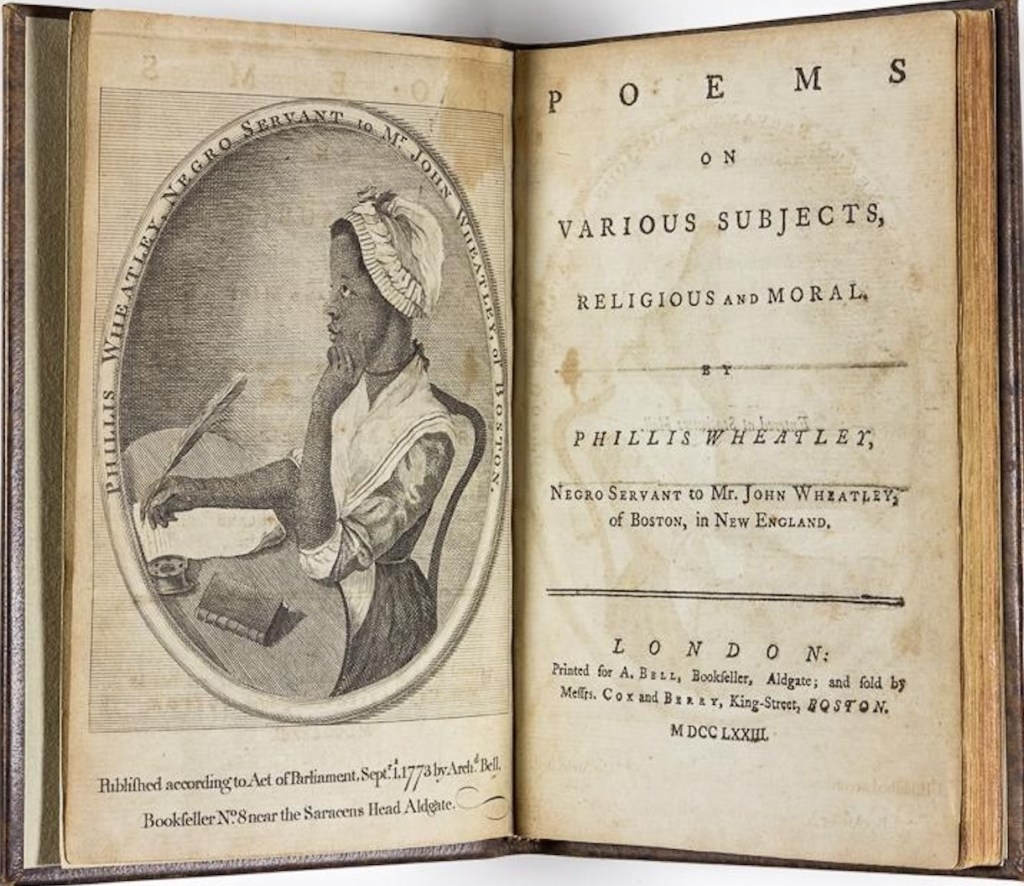
    Image: Phillis Wheatley:  Engraving, reproduced from her book, “Poems on Various Subjects, Religious and Moral.” London, 1773.  New York Public Library

    Phillis Wheatley’s “A Hymn to the Evening”

    The speaker in Phillis Wheatley’s “A Hymn to the Evening” offers her spiritually motivated song/prayer as a tribute  to evening, the part of the day when nightly slumber is arriving in all its glory.

    Introduction and Text of “A Hymn to the Evening”

    The speaker in Phillis Wheatley’s “A Hymn to the Evening” is delighting in the beauty surrounding her.  She is especially cognizant of how all events seem to be accruing for the purpose of making a beautiful day to close with a delightful, colorful evening. 

    The speaker finds the evening sky glorious as it yield the “deepest red” hue, as all other various colors are also displaying across the sky.  She also observes the scenery around her on earth; she takes measure of streams and especially the songs of birds.  She demonstrates her love and admiration for the creation that the Divine Creator has bestowed on all of His children.

    The poem consists of nine riming couplets, with the first couplet featuring an internal rime as well as an end rime.  The second couplet features the rare poetic device, similar to personification, of metaphorically comparing a gentle wind to a bird.  The couplet-formed verse lends to the high tone with which the poet has flavored her hymn.

    By labeling her poem a hymn, the poet has elevated its purpose from a simple tribute to a time of day, to a supplication for gratitude.  As she has observed much beauty about her and is thankful for the opportunity to engage that loveliness, she wishes that same gratitude for all of humankind.  

    The speaker is also offering her song as she is praying that the simple act of appreciating one’s environment may uplift and keep humankind on a virtuous path, on which avoidance of all that cause harm and corruption may be avoided.

    A Hymn to the Evening

    Soon as the sun forsook the eastern main
    The pealing thunder shook the heav’nly plain;
    Majestic grandeur! From the zephyr’s wing,
    Exhales the incense of the blooming spring.
    Soft purl the streams, the birds renew their notes,
    And through the air their mingled music floats.
    Through all the heav’ns what beauteous dies are spread!
    But the west glories in the deepest red:
    So may our breasts with ev’ry virtue glow,
    The living temples of our God below!
    Fill’d with the praise of him who gives the light,
    And draws the sable curtains of the night,
    Let placid slumbers sooth each weary mind,
    At morn to wake more heav’nly, more refin’d;
    So shall the labours of the day begin
    More pure, more guarded from the snares of sin.
    Night’s leaden sceptre seals my drowsy eyes,
    Then cease, my song, till fair Aurora rise.  

    Commentary on “A Hymn to the Evening”

    The speaker is inspired by the beauty of the day’s events that she has been observing both in the sky and on the land around her, as the end of the day is arriving.  She turns her simple awareness into a tribute and supplication for all humankind’s spiritual betterment.

    First Movement:  Opening of Day

    Soon as the sun forsook the eastern main
    The pealing thunder shook the heav’nly plain;
    Majestic grandeur! From the zephyr’s wing,
    Exhales the incense of the blooming spring.

    The speaker opens her tribute by describing how the day had begun with a thunder storm as soon as morning had ended.  She finds the event an example of “[m]ajestic grandeur.” On a soft gentle breeze, the fragrance of spring’s flowers came wafting.

    The inspired speaker then has the sun “forsaking” its domain in the east.  After having arisen, the big star does does not wait but keeps traveling across the sky, literally, forsaking all it leaves behind.  By beginning with the opening of the day, the speaker then gathers images throughout the day that accumulate to a marvelous evening at the close of that day.

    The speaker describes the thunder as “pealing” and that it colorfully caused to tremble the area around it. The thunder strikes the speaker as a grand event, one fitting to collect as evidence that a glorious evening may be in the offing.

    The first couplet includes an internal rime, as well as and end rime: “forsook – shook.”  Also, interestingly, the poet has employed avianification (akin to the device, “personification”) by metaphorically giving a gentle breeze a “wing,” a feature belonging to a bird.

    Second Movement:   The Colors of Beauty

    Soft purl the streams, the birds renew their notes,
    And through the air their mingled music floats.
    Through all the heav’ns what beauteous dies are spread!
    But the west glories in the deepest red:

    The speaker then notes that the streams are babbling gently and birds are continuing to offer their songs to the atmosphere.  The birds’ music seems to blend with other features of the landscape as their singular notes continue to waft on the breeze.  

    She has the stream purling, instead of merely babbling; this speaker is colorfully describing each natural object for the purpose of incorporating them into her collection of images, which she will offer to the day’s end.

    The speaker then remarks that through the sky swirl many various colors that she deems to be “beauteous,” as they stretch across the blue expanse.  However, she finds those hues that appear in “the west” to be the “deepest red,” and she implies that the oncoming sunset will cap the day in a marvelous and glorious procession.

    The speaker finds unusual as well as deeply spiritual ways of describing what she sees.   She is offering her words, her images, and her thoughts to her Divine Creator. Thus, she remains careful to choose each image and description with precision, for example, the west does not merely feature “deepest red,”  but it also “glories” in that color.  Making each word and each image work its magic demonstrates the poet’s skill and mastery of her art.

    Third Movement:  A Supplication for Gratitude

    So may our breasts with ev’ry virtue glow,
    The living temples of our God below!
    Fill’d with the praise of him who gives the light,
    And draws the sable curtains of the night,

    The speaker then turns to the hearts and minds of humanity, prayerfully supplicating for those hearts and minds to “glow,” filled with “ev’ry virtue.”  She hopes that the lives of all humankind become and remain “temples” on earth dedicated to the Belovèd Creator.  She includes all of humanity in her supplication as she effuses, “may our breasts” glow as living temples.

    The speaker wishes that all of humanity become full of praise for the Blessèd Creator of the cosmos; that Creator, Who had given “the light” also will close the “curtains of the night”: again the speaker has shown her marvelous skill by describing those “curtains” as “sable.”

    The speaker then prays that all of humanity may sleep peacefully and become refreshed so that the next day’s existence becomes “more heav’nly, more refin’d.”  She hopes and prays that each day will find humanity to be living more and more on a grand scale of plain living and high thinking.  As she includes herself in her prayer, she demonstrates her humility and deep inner awareness of the needs of all humankind.

    Fourth Movement:  Prayer for Virtuous Living

    Let placid slumbers sooth each weary mind,
    At morn to wake more heav’nly, more refin’d;
    So shall the labours of the day begin
    More pure, more guarded from the snares of sin.
    Night’s leaden sceptre seals my drowsy eyes,
    Then cease, my song, till fair Aurora rise.  

    After a night’s peaceful, invigorating rest of the body and mind, each child of the Divine Creator may begin his/her work, chastened and strengthened by the gratitude of finding a safe harbor in the Blessèd Lord.  

    The speaker prays that all be turned from “the snares of sin.”  Again, the speaker is demonstrating her ethical and moral strength as she wishes for all of humankind the same rectitude she desires for herself.

    The speaker then closes her song of praise for the Belovèd Creator’s beauty in creation by colorfully comparing the closing of her own sleepy eyes—her “drowsy eyes”—to being touched by a royal, magical wand.  

    She then bids her hymn end and allow her the sleep she now needs; thus, she prays for herself a soothing slumber until morning, when the Roman goddess, “Aurora,” brings in a new day with dawn.

  • Emily Dickinson’s “He touched me, so I live to know” 

    Image: Emily Dickinson – Amherst College – Daguerrotype of the poet at age 17, circa 1847 – likely the only authentic, extant likeness of the poet

    Emily Dickinson’s “He touched me, so I live to know” 

    Emily Dickinson’s “He touched me, so I live to know” dramatizes an experience in mystical union with the Divine Reality. Often interpreted and examined as madness, Dickinson’s mystical proclivities more easily and thoroughly explain her elliptical writings.

    Introduction with Text of “He touched me, so I live to know”

    Emily Dickinson’s many experiences in mystical union [1] with the Divine Spiritual Reality reveal that the poet was working from an extraordinary state of awareness.   Often interpreted and examined as madness or extreme idiosyncrasy, Dickinson’s mystical proclivities more easily and thoroughly explain her elliptical writings than total reliance on the physical and mental levels of being.

    While Dickinson must be perceived primarily as an accomplished poet and not an avatar of perfect knowledge, her mystical proclivities are difficult to deny.  For example, superficial observers of this poem are wont to report that the speaker is describing her happy experience of engaging in a physical tryst with a lover. 

    But the “lover” trope is often used by those who experience the mystical union with the Divine, for example, Saint Terese of Ávila’s ecstasy is metaphorically expressed as similar to “erotic intensity  [2].

    Instead of physical bodies uniting, however, the mystical experience is the uniting of the individual soul and the Divine Creator or God. Because the physical union offers intense pleasure, it makes a useful metaphor for the even more intense pleasure experienced during mystical union.  

    While understanding the union metaphorically is perfectly acceptable and logical, it is absurd to misunderstand and think those two very different experiences are identical.  It is helpful to remember that a metaphor is useful in that it likens two very different entities.

    The purpose of the physical, sexual union exists for procreation, that is, the continuation of the generations of humanity, while the mystical union remains the true goal of each human soul.  

    Paramahansa Yogananda and the avatars all of faiths have taught that the true purpose of life  [3] is to find and unite the individual soul with the Over-Soul, Divine Reality, or God.

    As the spiritual scientist, Sant Rajinder Singh Ji Maharaj, has elucidated [4], “It is important to recognize that this human existence has a purpose, that we are here to grow spiritually, to know God, and to merge back in God.”

    He touched me, so I live to know

    He touched me, so I live to know
    That such a day, permitted so,
    I groped upon his breast –
    It was a boundless place to me
    And silenced, as the awful sea
    Puts minor streams to rest.

    And now, I’m different from before,
    As if I breathed superior air –
    Or brushed a Royal Gown –
    My feet, too, that had wandered so –
    My Gypsy face – transfigured now –
    To tenderer Renown –

    Into this Port, if I might come,
    Rebecca, to Jerusalem,
    Would not so ravished turn –
    Nor Persian, baffled at her shrine
    Lift such a sign
    To her imperial Sun.

    Reading 

    Commentary on “He touched me, so I live to know”

    The speaker is describing the mystical experience that has transfigured her mind, her heart, even her entire life.   Likely, this poem was the poet’s first attempt to delve into that particular theme that had such a profound influence on her ability to compose poetry.

    First Stanza:  The Visitation

    He touched me, so I live to know
    That such a day, permitted so,
    I groped upon his breast –
    It was a boundless place to me
    And silenced, as the awful sea
    Puts minor streams to rest.

    The speaker begins by announcing that she has been visited by the Divine Reality.  Her union with the Mystical Creative Force caused her to feel that her living is now more intense and vital than it had ever been before this momentous realization.

    The speaker now is aware that such a soul-realizing event can actually happen to mere mortals.  The reality of His presence makes her feel that during this visitation she was “groping” upon an enormous entity.   Her consciousness has become unbounded by her heretofore mental and physicals encasements.

    Because God’s body remains inside and outside of creation, that Entity in human terms is a vast area of space and matter, and as the individual human soul unites with that Entity it experiences the enormity of that Form.

    The speaker then likens the experience to a “minor stream” such as a river that flows into the ocean.   Paramahansa Yogananda likens the little human body to a “bubble” and the God to the ocean, and in his chant he commands the Divine Reality:  “I am the bubble, make me the sea”  [5].

    The speaker in Dickinson’s “He touched me, so I live to know” is experiencing a time that God had made her the sea; she was a tiny bubble, and for a time, she experienced being the sea.

    Second Stanza:  The Transformation

    And now, I’m different from before,
    As if I breathed superior air –
    Or brushed a Royal Gown –
    My feet, too, that had wandered so –
    My Gypsy face – transfigured now –
    To tenderer Renown –

    After her mystical experience, the speaker now realizes that she is “different”; she has been transformed and feels that now even her breathing has been clarified and elevated.  She also likens her new awareness to touching a “Royal Gown.”  

    The speaker is describing an event that, in fact, cannot be translated into language; thus, she must metaphorically compare the ineffable to physical things and experiences that come closest to expressing her experience. 

    She then reports that her feet now seem more firmly planted, as before they had remained roaming in delusion.  Her face also has been transformed from a roaming, inquisitive face of to something kind, pleasant, and staid.

    Third Stanza:  The Reality of Permanence

    Into this Port, if I might come,
    Rebecca, to Jerusalem,
    Would not so ravished turn –
    Nor Persian, baffled at her shrine
    Lift such a sign
    To her imperial Sun.

    The speaker then contrasts her journey along with its destination to the biblical character, Rebekah, who traveled to the home of Isaac to become his wife, and to some nameless “Persian” whose prayerful pleadings remained somewhat superficial.

    Instead of such worldly experiences, this speaker insists that she has become aware of the permanence bestowed by this amazing event that has captured her. Her port, if she understands if correctly, leads to the immortality upon which she has long mused and upon which she strongly insists is a reality.  

    Her mystical experience has now confirmed for her that the Afterlife is real and that she has visited and now knows in her soul that the Creator of the Cosmos is directing and guarding her. 

    Sources

    [1] Virginia L. Paddock.  Madness as Metaphor: A Study of Mysticism in the Life and Art of Emily Dickinson. 1991. Ball State University. Ph.D. Dissertation. Cardinal Scholar.

    [2] Editors.  “The Ecstasy of Saint Teresa.” The Archive for Research in Archetypal Symbolism.  Accessed March 21, 2023.

    [3] Paramahansa Yogananda.  “The purpose of Life.”  Self-Realization Fellowship.  Accessed March 21, 2023.

    [4] Sant Rajinder Singh Ji Maharaj.  “What is the purpose of this life?.” Science of Spirituality.  Accessed March 21, 2023.

    [5]  Nuns of Self-Realization Fellowship.  Chanting: “I am the bubble, make me the sea.” YouTube.  Accessed March 21, 2023.

    🕉

    You are welcome to join me on the following social media:
    TruthSocial, Locals, Gettr, X, Bluesky, Facebook, Pinterest 

    🕉

    Share