Linda's Literary Home

Tag: Doggerel

  • Robert Bly’s “The Cat in the Kitchen” and “Driving to Town Late to Mail a Letter”

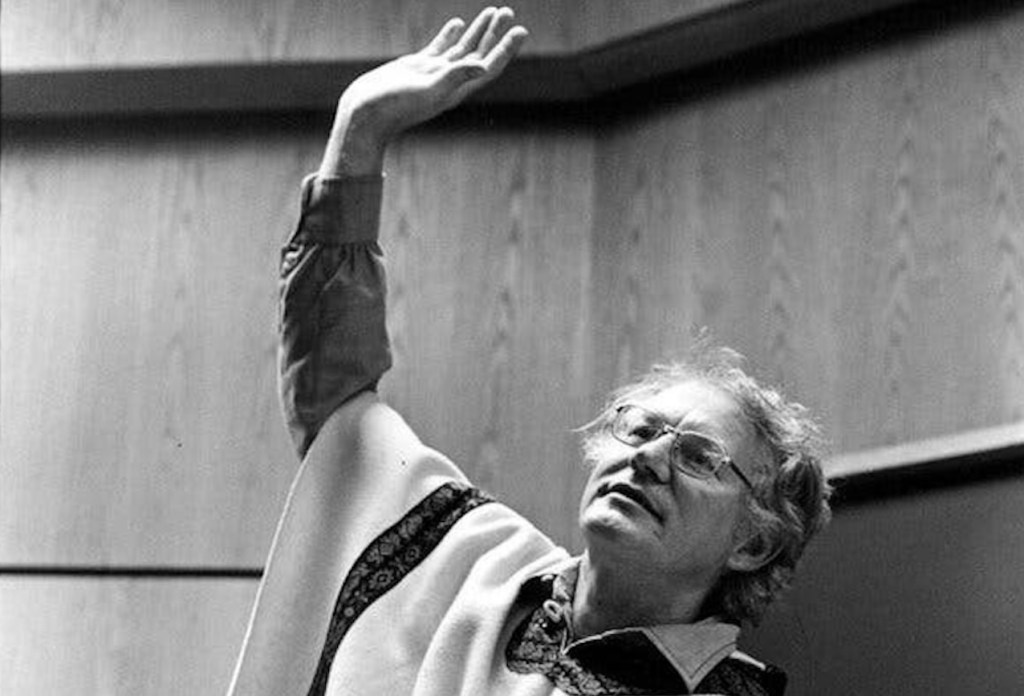
    Image:  Robert Bly – NYT– Robert Bly striking one of his melodramatic poses

    Robert Bly’s “The Cat in the Kitchen” and “Driving to Town Late to Mail a Letter”

    The following sample pieces of doggerel “The Cat in the Kitchen” and “Driving to Town Late to Mail a Letter” by Robert Bly exemplify the style of the poetaster and the types of subjects he addresses.

    Introduction with Text of “The Cat in the Kitchen”

    Two versions of this piece of Robert Bly doggerel are extant; one is titled “The Cat in the Kitchen,” and at the other one is titled “The Old Woman Frying Perch.”  They both suffer from the same nonsense:  the speaker seems to be spouting whatever enters his head without bothering to communicate a cogent thought.

    Bly’s 5-line piece “Driving to Town Late to Mail a Letter” consists of a fascinating conglomeration of images that results in a facile display of redundancy and an unfortunate missed opportunity.

    Robert Bly’s penchant for nonsense knows no bounds.  Most of his pieces of doggerel suffer from what seems to be an attempt to engage in stream-of-consciousness but without any actual consciousness.   The following summary/paraphrase of Bly’s “The Cat in the Kitchen” demonstrates the poverty of thought from which this poetaster suffers as he churns out his doggerel: 

    A man falling into a pond is like the night wind which is like an old woman in the kitchen cooking for her cat.

    About American readers, Bly once quipped that they “can’t tell when a man is counterfeiting and when he isn’t.”  What might such an evaluation of one’s audience say about the performer?  Is this a confession?  Bly’s many pieces of doggerel and his penchant for melodrama as he presents his works suggest that the man was a fake and he knew it.

    The Cat in the Kitchen

    Have you heard about the boy who walked by
    The black water? I won’t say much more.
    Let’s wait a few years. It wanted to be entered.
    Sometimes a man walks by a pond, and a hand
    Reaches out and pulls him in.

    There was no
    Intention, exactly. The pond was lonely, or needed
    Calcium, bones would do. What happened then?

    It was a little like the night wind, which is soft,
    And moves slowly, sighing like an old woman
    In her kitchen late at night, moving pans
    About, lighting a fire, making some food for the cat.

    Commentary on “Cat in the Kitchen”

    The two versions of this piece that are extant both suffer from the same nonsense:  the speaker seems to be spouting whatever enters his head without bothering to connect a cogent thought to his images.  Unfortunately, that description seems to be the modus operandi of poetaster Bly.

    The version titled “The Cat in the Kitchen” has three versagraphs, while the one titled “The Old Woman Frying Perch” boasts only two, as it sheds one line by combining lines six and seven from the Cat/Kitchen version.

    First Versagraph:  A Silly Question

    Have you heard about the boy who walked by
    The black water? I won’t say much more.
    Let’s wait a few years. It wanted to be entered.
    Sometimes a man walks by a pond, and a hand
    Reaches out and pulls him in.

    In Robert Bly’s “The Cat in the Kitchen,” the first versagraph begins with a question, asking the audience if they had heard about a boy walking by black water.  Then the speaker says he will not “say much more” when, in fact, he has only asked a question. If he is not going to say much more, he has ten more lines in which not to say it.  However, he then makes the odd demand of the audience that they wait a few years. 

    The speaker’s command implies that readers should stop reading the piece in the middle of the third line and begin waiting”a few years.” Why do they have to wait? How many years?   By the middle of the third line, this piece has taken its readers down several blind alleys. So next, the speaker, possibly after waiting a few years, begins to dramatize his thoughts: “It wanted to be entered.”  It surely refers to the black water which is surely the pond in the fourth line. 

    The time frame may, in fact, be years later because now the speaker offers the wobbly suggestion that there are times during which a man can get pulled into a pond by a hand as he walks by the body of water.  The reader cannot determine that the man is the boy from the first line; possibly, there have been any number of unidentified men whom the hand habitually stretches forth to grab.

    Second Versagraph:   Lonely Lake Needing Calcium

    There was no
    Intention, exactly. The pond was lonely, or needed
    Calcium, bones would do. What happened then?

    The second verse paragraph offers the reasoning behind a pond reaching out its hand and grabbing some man who is walking by.  The pond didn’t exactly intend to grab the man, but because it was “lonely” or “needed / Calcium,” it figured it would ingest the bones from the man. 

    Then the speaker poses a second question: “What happened then?” This question seems nonsensical because it is the speaker who is telling this tale.  But the reader might take this question as a rhetorical device that merely signals the speaker’s intention to answer the question that he anticipates has popped into the mind of his reader.

    Third Versagraph:  It Was Like What?

    It was a little like the night wind, which is soft,
    And moves slowly, sighing like an old woman
    In her kitchen late at night, moving pans
    About, lighting a fire, making some food for the cat.

    Now the speaker tells the reader what it was like.  There is a lack of clarity as to what the pronoun “it” refers.  But readers have no choice but take “it” to mean the phenomenon of the pond reaching out its hand, grabbing a man who was walking by, and pulling him into the water because it was “lonely, or needed / Calcium.” 

    Thus this situation resembles what? It resembles soft, night wind which resembles and old lady in her kitchen whipping up food for her cat.   Now you know what would cause a lonely, calcium-deficient pond to reach out and grab a man, pull him into its reaches, and consequently devour the man to get at his bones.

    Alternate Version: “The Old Woman Frying Perch”

    In a slightly different version of this work called “Old Woman Frying Perch,” Bly used the word “malice” instead of “intention.” And in the last line, instead of the rather flabby “making some food for the cat,” the old woman is “frying some perch for the cat.” 

    The Old Woman Frying Perch

    Have you heard about the boy who walked by
    The black water? I won’t say much more.
    Let’s wait a few years. It wanted to be entered.
    Sometimes a man walks by a pond, and a hand
    Reaches out and pulls him in. There was no
    Malice, exactly. The pond was lonely, or needed
    Calcium. Bones would do. What happened then?

    It was a little like the night wind, which is soft,
    And moves slowly, sighing like an old woman
    In her kitchen late at night, moving pans
    About, lighting a fire, frying some perch for the cat.

    For Donald Hall

    While the main problem of absurdity remains, this piece is superior to “The Cat in the Kitchen” because of two changes:  “malice” is more specific than “intention,” and “frying perch” is more specific than “making food.”

    However, the change in title alters the potential focus of each piece without any actual change of focus.  The tin ear of this poetaster has resulted in two pieces of doggerel, one just a pathetic as the other.   Robert Bly dedicates this piece to former poet laureate, Donald Hall—a private joke, possibly?

    Full Image:  Robert Bly striking his melodramatic pose

    Introduction with Text of “Driving to Town Late to Mail a Letter”

    Technically, this aggregate of lines that constitute Robert Bly’s “Driving to Town to Mail a Letter” could be considered a versanelle.   The style of poem known as a versanelle is a short narration that comments on human nature or behavior and may employ any of the usual poetic devices. I coined this term and several others to assist in my poem commentaries.

    Robert Bly’s “Driving to Town to Mail a Letter” does make a critical comment on human nature although quite by accident and likely not at all what the poet attempted to accomplish.   Human beings do love to waste time although they seldom like to brag about it or lie about it, as seems to be case with the speaker in this piece.

    Driving to Town Late to Mail a Letter

    It is a cold and snowy night. The main street is deserted.
    The only things moving are swirls of snow.
    As I lift the mailbox door, I feel its cold iron.
    There is a privacy I love in this snowy night.
    Driving around, I will waste more time.

    Commentary on “Driving to Town Late to Mail a Letter”

    This 5-line piece by doggerelist Robert Bly simply stacks untreated image upon image, resulting in a stagnant bureaucracy of redundant blather.  The poet missed a real opportunity to make this piece meaningful as well as beautiful.

    First Line:  Deserted Streets on a Cold and Snowy Night 

    It is a cold and snowy night. The main street is deserted.

    The first line consists of two sentences; the first sentence asserts, “It is a cold and snowy

    night.”   That sentence echoes the line, “It was a dark and stormy night, by Edward George Bulwer-Lytton, whose name became synonymous with atrocious writing for that line alone. 

    There is a contest named for him, “The Bulwer-Lytton Fiction Contest,” with the subtitle where WWW means “Wretched Writers Welcome.”  The second sentence proclaims the emptiness of main street. The title of the poem has already alerted the reader that the speaker is out late at night, and this line supports that claim that he is out and about so late that he is virtually the only one out. 

    This assertion also tells that reader that the town must be a very small town because large towns will almost always have some activity, no matter how late, no matter how cold. 

    Second Line:  Only the Swirling Snow

    The only things moving are swirls of snow.

    The second line reiterates the deserted image of the first line’s second sentence, claiming that the only movement about his was the swirling snow.  Of course, if the street were deserted, there would be no activity, or virtually no activity, so the speaker’s redundancy is rather flagrant. 

    The reader already knows there is snow from the first image of a cold and snowy night; therefore, the second line is a throwaway line.   The speaker is giving himself only five lines to convey his message, and he blows one on a line that merely repeats what he has already conveyed, instead of offering some fresh insight into his little jaunt into town.

    Third Line:  Cold Mailbox Door 

    As I lift the mailbox door, I feel its cold iron

    The third line is incredible in it facileness: the speaker imparts the information that he can feel the cold iron of the mailbox door as he lift it before depositing his letter. Such a line might be expected in a beginning poet’s workshop efforts. 

    The speaker had to have a line that shows he is mailing a letter, and he, no doubt, thinks this does it while adding the drama of “lift[ing] the mailbox door” and adding that he feels the coldness in the letter-box’s iron.  

    It’s a lame drama at best; from the information offered already both the cold iron and lifting the mailbox lid are already anticipated by the reader, meaning this line adds nothing to the scene.

    Fourth Line:  “There is a privacy I love in this snowy night”

    There is a privacy I love in this snowy night

    This line offers the real kernel of poetry for this conglomeration of lines. If the speaker had begun with this line, perhaps revising it to “I love the privacy of a snowy night,” and let the reader go with him to mail his letter, the experience could have been an inspiring one.

    The images of the cold, snowy night of privacy, the deserted main street, the swirls of snow, the mailbox door could all have been employed to highlight a meaningful experience.  Instead, the poetaster has missed his opportunity by employing insipid redundancy resulting in the flat, meaningless verse. 

    Fifth Line: Wasting Time Driving Around

    Driving around, I will waste more time

    The final line gives the flavor of James Wright’s “I have wasted my life” in his excellent poetic performance, “Lying In A Hammock At William Duffy’s Farm In Pine Island, Minnesota.”

    There is a major difference between Wright’s poem and Bly’s doggerel: Wright’s speaker is believable, genuine, authentic.   Bly’s empty verse is quite the opposite in every aspect, especially as Bly’s speaker proclaims he will ride around “wasting more time.” That claim is non-sense. Does he actually believe that mailing a letter is a waste of time?   If he does, he has not made it clear why he would think that. It just seems that he has forgotten what the poem is supposed to be about.

    Image: Robert Bly painting by Mark Horst

    On My Meeting with This Sacred Cow of Po-Biz 

    In Memoriam:  Robert Bly
    December 23, 1926 – November 21, 2021

    Requiescat in Pace.

    Poetaster Robert Bly, one of the greatest flim-flam artists that po-biz has ever foisted upon the literary world, has passed on to his reward.   Still, Bly remains one of the sacred cows of the contemporary literary world—so often praised that most critics, scholars, and commentarians shy away from pointing out the failings of this celebrated poetaster. 

    Ironically, among his hagiographies will remain criticism like the one by Suzanne Gordon, “‘Positive Patriarchy’ Is Still Domination: ‘Iron John’: Robert Bly’s devoted followers seem not to grasp what his message really means to women.”  

    While his recycled mythos, Iron John, surely earned him more financial rewards and much more recognition that his doggerel ever had, that twisted tome will also remain as testimony to the man’s warped thinking.    Ironic indeed that the man who thought of himself as a feminist turned out not to have had a feminist bone in his body.

    I met Robert Bly at Ball State University during a poetry workshop in the summer 1977.  He held private sessions to offer us budding poets criticism of our poetic efforts.  As I approached him, he planted a big kiss upon my lips before beginning the critique.  Shocked at the impertinence, nevertheless, I just figured that was his way and then flung the incident down the memory hole.

    The advice he offered regarding my poem was less than worthless.  For example, I had a line, “slow as sorghum on the lip of a jar.”    He called that vague and suggested that I somehow work my grandmother into the line, something like “my grandmother’s jar had a rim of sorghum.” (I was 31 years old at the time, but no doubt looked little more than 12).  

    That idiotic suggestion has colored my view of the man’s poetry, even more than his deceitful claims of “translations.”   At the same workshop, he had taught a group of us how to “translate” poems, which was little more than reworking other people’s actual translations. 

    Anyway, may he rest in peace.  He was persistent in his folly, and although William Blake infamously opined, “If a fool persists in his folly, he becomes wise,”  it remains doubtful that claim actually applies, especially in Bly’s case.

  • Al Gore’s “One thin September soon”

    Image:  Steven F. Hayward: Exposed! The global warming campaign enters its emperor’s-new-clothes phase.

    Al Gore’s “One thin September soon”

    Climate change alarmist Al Gore joked to his publisher that W. B. Yeats had penned the so-called poem “One thin September soon” in Gore’s latest book; sadly, the publisher seemed to fall for it, before Gore admitted to scribbling it.

    Introduction with Text of “One thin September soon”

    The former vice-president’s untitled piece appears in his book, Our Choice: A Plan to Solve the Climate Crisis, which purportedly offers the antidote to “global warming.”   Al Gore’s untitled verse is chopped up into seven three-line sets, which may charitably be labeled tercets. 

    In this farcical piece of doggerel, the AGW (anthropogenic global warming) fanatic has his speaker pontificate from the position of a shepherd, who is crying to the world about the impending doom that human mankind is bringing on the world through the use of fossil fuels. 

    Through his many pontifications and written tracts on the politically fabricated issue of global warming, the former failed presidential candidate shows that he fancies himself a kind of modern-day John-the-Baptist crying in the wilderness, which is growing hotter and drier year after year, despite the fact that there has been no “warming” since the mid-1990s [1].

    And now temperatures have actually started to cool [2], according to official NASA global temperature data.

    Never mind the inconvenient facts, Gore heralds his speaker to bark loudly about the concocted problem and to offer his saintly wisdom in his untitled “poem”—wonder when Gore will publish a collection of his poetry.  Likely, never.  It seems that the political gasbag has penned only one “poem” which barely qualifies as doggerel.

    One thin September soon

    One thin September soon
    A floating continent disappears
    In midnight sun

    Vapors rise as
    Fever settles on an acid sea
    Neptune’s bones dissolve

    Snow glides from the mountain
    Ice fathers floods for a season
    A hard rain comes quickly

    Then dirt is parched
    Kindling is placed in the forest
    For the lightning’s celebration

    Unknown creatures
    Take their leave, unmourned
    Horsemen ready their stirrups

    Passion seeks heroes and friends
    The bell of the city
    On the hill is rung

    The shepherd cries
    The hour of choosing has arrived
    Here are your tools


    Video:  Al Gore Reads “One thin September soon”  

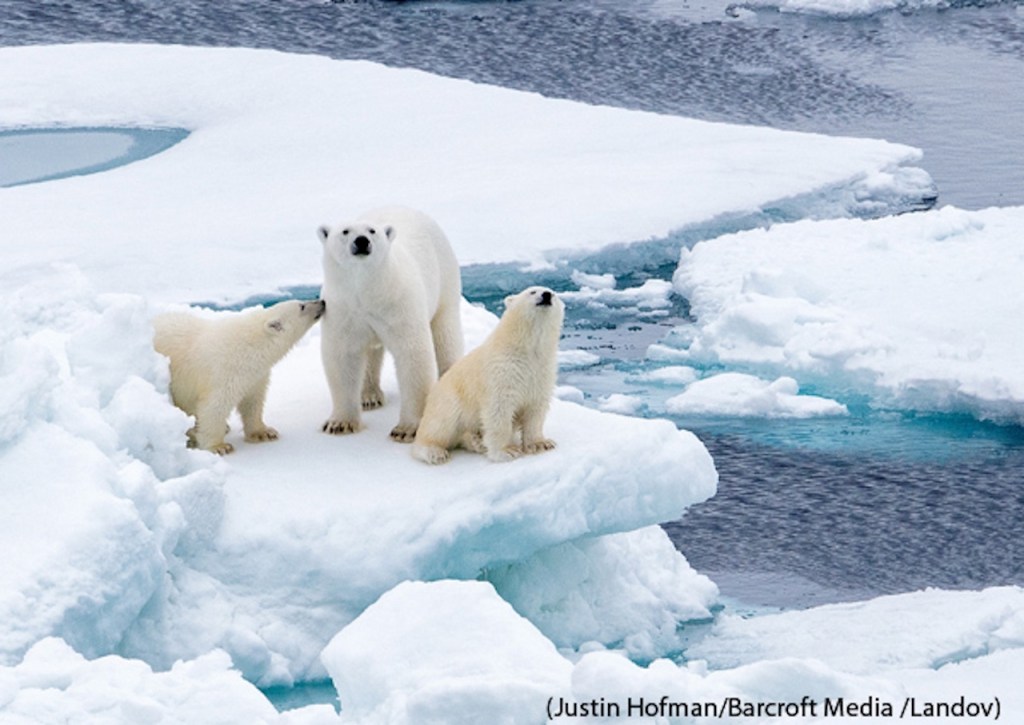
    Image:  Polar Bears on Ice Cap (Justin Hofman/Barcroft Media/Landov)

    Commentary on “One thin September soon”

    Supposedly well read in scientific literature, climate alarmist Al Gore gets the science of the Earth wrong as he has his speaker claim to be “crying in the wilderness” like some modern day John-the-Climate-Change-Baptist.

    First Tercet: Beginning with a Fantasy

    One thin September soon
    A floating continent disappears
    In midnight sun

    Gore’s speaker begins his piece by asserting that soon one of these Septembers—and it will be a “thin” September, not like the usual thick Septembers—the midnight sun will embrace the disappearance of a continent that floats.

    This first assertion presents several problems:

    1. it must be referring only to the continents at the Earth’s extreme north and south;
    2. floating continents [3]  exist only in fantasy [4],
    3. he has to be referring to Antarctica because the Arctic is not a continent at all;
    4. the midnight sun refers to a phenomenon that occurs in summer at each pole when the sun does not set.

    For the midnight sun reference, the speaker has to be referring to the non-continent Arctic because he names the month of September. There is midnight sun in the first three weeks of September at the North Pole but not at the South, whose summer is from December 22 to March 21.

    This confusion of poles gets the verse off to an inauspicious start. 

    On the one hand, the reader might remember that the composer of this pigswill is a man who is supposedly steeped in scientific studies in support of his global warming theory; yet, he engages a non-scientific fantasy and confuses the facts regarding activities at the Earth’s poles.

    On the other hand, if one considers Gore’s academic accomplishment in the study of science —”According to his Harvard transcript, he earned a D in natural science his sophomore year”—[5], his error-prone nonsense makes perfect sense.

    Second Tercet: The Conundrum of Postmodern Claptrap

    Vapors rise as
    Fever settles on an acid sea
    Neptune’s bones dissolve

    According to global warming proponents, ocean waters are becoming acidic because of the lethal effects that the warming is having on various sea creatures, including coral and urchins. Gore’s speaker refers to these sea creatures as Neptune’s bones that are dissolving.

    The absurd conflation of the bones of a mythological god and sea creatures bends the piece to the frowziness of postmodernism, where nothing matters because nothing makes sense anyway.  Yet this man of hard science wants to influence politicians and governments to make policies that will affect all citizens worldwide.

    Third Tercet: A Pile of Images

    Snow glides from the mountain
    Ice fathers floods for a season
    A hard rain comes quickly

    Because of the warming, snows begin to loosen and slide down mountains while melting ice gluts the ocean, and then the rains begin, those horrid rains! And they are “hard” [6] rains—recall that other noted poetaster/plagiarist Bob Dylan [7].

    The politician-cum-poetaster then makes those three claims of the melting that the earth is enduring: all obviously caused by the heat, all slapped together without punctuation or conjunction, possibly because everything is happening almost simultaneously. As the snow and ice suddenly become a hard rain, the reader might then suspect the prompt need of an ark.

    Fourth Tercet: As Lightning Celebrates

    Then dirt is parched
    Kindling is placed in the forest
    For the lightning’s celebration

    However, the next scene takes the reader to dry land where dirt is parched, and out of the blue, someone has placed small slips of wood in a forest where lightning can catch them to flame as it celebrates.

    The doggerelist does not reveal who placed that “[k]indling” in the forest so that lightning could set it aflame for its celebration. Why, one might wonder, would lightning be “celebrating” anyway? But by now the gentle reader has become aware that taking anything in this piece seriously is a fool’s errand.

    Fifth Tercet: Getting Ready for the Apocalypse

    Unknown creatures
    Take their leave, unmourned
    Horsemen ready their stirrups

    There are many species of animals on Antarctica, but Gore’s speaker chooses to claim that they are unknown as they “[t]ake their leave.”  It seems that such a situation would merit some drama, instead of the faint, euphemistic “take their leave.” 

    But then they are unmourned. He, no doubt, would at least have them be mourned, despite their being unknown.  Perhaps the most bizarre and useless line in the entire piece is, “Horsemen ready their stirrups.” There seems to be no reason for that line, for it connects to nothing. 

    And if the bizarre notion of an allusion to the “Four Horsemen of the Apocalypse” springs to mind, it will offer no resolution of any kind. The Book of Revelation has suffered many absurd interpretations, and if Gore’s speaker is attempting to add another, it results in the lamest of the lame.

    Sixth Tercet: A Gorean City on the Hill

    Passion seeks heroes and friends
    The bell of the city
    On the hill is rung

    The brave shepherd is passionately seeking others who will help him get his message out, that the earth is becoming a scorched, iceless dustbowl with the oceans rising. The speaker/shepherd now credits himself for ringing that all important bell in that all important place—that “city / On the hill.” The solipsism of this piece is nausea invoking.  

    Could the city on the hill be that same place to which President Ronald Reagan [8] referred?

    A troubled and afflicted mankind looks to us, pleading for us to keep our rendezvous with destiny; that we will uphold the principles of self-reliance, self-discipline, morality, and, above all, responsible liberty for every individual that we will become that shining city on a hill.

    It is likely that Gore’s speaker does, in fact, refer to that same place, but for very different reasons, for the policies thus far suggested to stop global warming would stifle the individualism and freedom of all world citizens, especially those in Third-World nations.

    Seventh Tercet: The Shepherd Handing Over the Tools

    The shepherd cries
    The hour of choosing has arrived
    Here are your tools

    In the final three-line set, Gore’s speaker reports that he, as this good crying shepherd, is telling his listeners that the time for action is at hand, and he has hereby come to hand to them all the tools they need.

    This self-important, junk-science spewing “shepherd” is offering in his new book the necessary “tools” that his sheep will need as they waddle with him down this fantastical path to an Earth-saving global temperature. Whatever that is?

    (Please note: On Amazon, Fredrick P. Wilson, in his comment, “Ugly, Economically Disastrous, Green Choices,” offers a useful review of Gore’s book, Our Choice: A Plan to Solve the Climate Crisis.)

    Sources

    [1]  Prof. Don J. Easterbrook. “Global Cooling is Here.” Global Research. November 2, 2008.

    [2] Aaron Brown.  “Did You Know the Greatest Two-Year Global Cooling Event Just Took Place?”  RealClear Markets.  April 24, 2018.

    [3]  Dr. Christopher S. Baird.  “What keeps the continents floating on a sea of molten rock?”  Science Questions with Surprising Answers.  July 18, 2013.

    [4]  TV-Tropes: The All Devouring Pop-Culture Wiki.  “Floating Continent.”  Accessed November 20, 2023.

    [5]  College Fix Staff.  “Al Gore, Climate ‘Expert’, Bombed Science in College.”  The College Fix.  April 30, 2012.

    [6]   Bob Dylan.  “A Hard Rain’s a-Gonna Fall.”  Genius.  Accessed November 20, 2023.

    [7]  Sean MichaelsBob Dylan is ‘a Plagiarist’, claims Joni Mitchell.”  The Guardian.  April 23, 2010.

    [8] Ronald Reagan.  “Shining City on a Hill” – 1988 State of the Union .

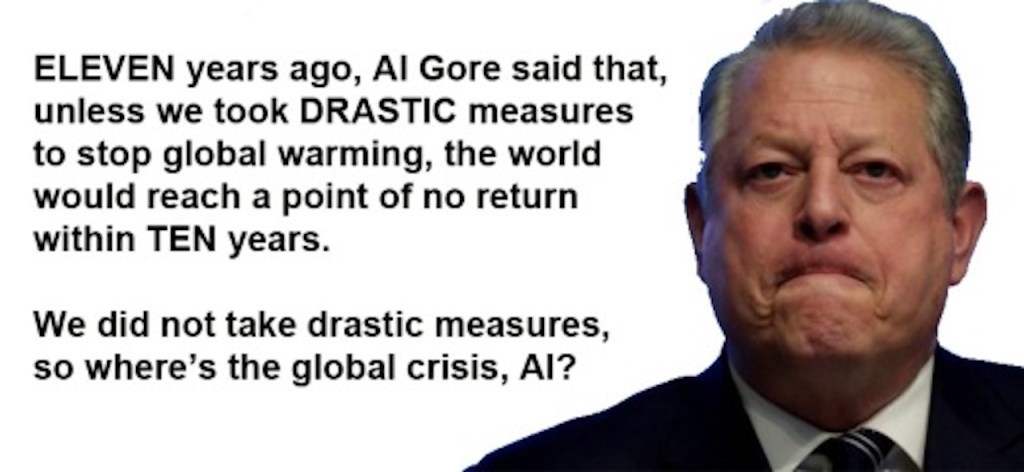
    Image:  Al Gore – PoliNation Blog – Science 

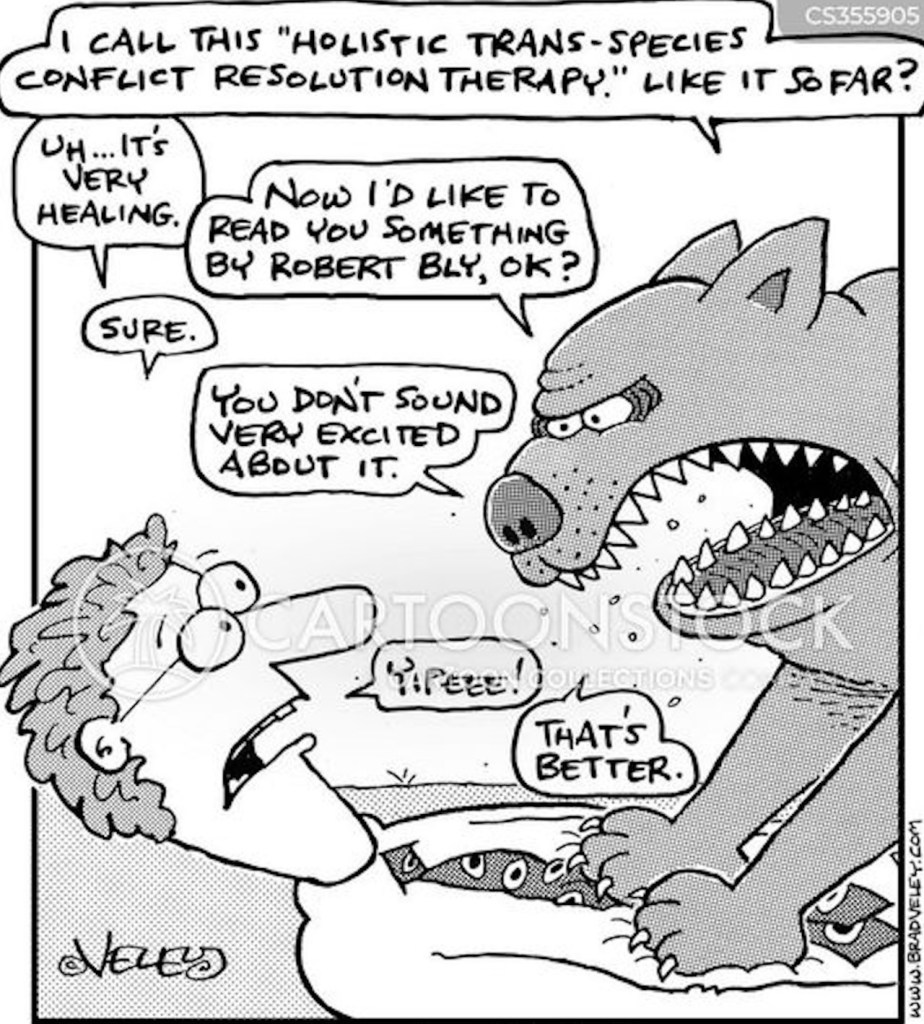
    Video:  Excellent Lampoon of Gore’s Doggerel   

  • Barack Obama’s “Underground”

    Image:  Bookcase Credibility

    Barack Obama’s “Underground”

    In addition to his piece titled “Pop,” Barack Obama also published in Occidental college’s literary magazine, Feast, the short piece titled “Underground,” featuring a fantasy in which fig-eating apes breathe underwater, while dancing and tumbling about.

    Introduction and Text of “Underground”

    At age 19, Barack Hussein Obama II published in Occidental college’s literary magazine, Feast, two “poems.”  A piece titled “Pop,” in which he explores the relationship between a young man and a father figure, and this short piece titled “Underground,” which reveals a fantasy world where fig-eating apes breathe underwater, while dancing and tumbling in rushing water.

    Just as Obama’s piece of doggerel “Pop” does not bode well for a potential writer of any stripe, the future U. S. President’s [1] poetic effort, “Underground,” offers further evidence that this hack scribbler will retain no place in letters, while the brilliance with which the former Oval Office Occupier handled the falling off of the presidential seal further demonstrates that his talent lay in areas of entertainment, not governance.. 

    The title, “Underground,” indicates a location under the land, and it could also be indicating metaphorically some event or transaction not open to public scrutiny or awareness: an example might be a secret network similar to the Underground Railroad. However, no such meaning can be gleaned from this mass of confused doggerel.

    Underground

    Under water grottos, caverns
    Filled with apes
    That eat figs.
    Stepping on the figs
    That the apes
    Eat, they crunch.
    The apes howl, bare
    Their fangs, dance,
    Tumble in the
    Rushing water,
    Musty, wet pelts

    Commentary on “Underground”

    This three-pronged failure demonstrates even more clearly than the effort titled “Pop” that this scribbler has no place in letters. It fails for three significant reasons: (1) misuse of grammar/diction, (2) awkward enjambment, and (3) lack of meaning.

    First Movement: Underground, Underwater?

    Under water grottos, caverns
    Filled with apes
    That eat figs.

    The first line—”Under water grottos, caverns”— indicates that the setting for the activity is not “underground,” but, in fact, it is underwater. While the preferred spelling for the plural of “grotto” is “grottoes,” such an amateurish error is minor compared to the repetition of the similar terms, grotto and cavern. 

    There is a difference in the denotative meanings of those two terms: grotto can be man-made and decorative while cavern is natural. Immediately, the bumbling speaker had befuddled the reader by employing those two terms, which because of their different meanings imply different connotations. Is the cave decorated by human beings or is it not? Is it a “grotto” or a “cavern”?  It cannot be both.

    Those underwater caves, which may or may not be decorated, are teeming with land-dwelling, mammals who naturally breathe air, yet here they are—living and thus obviously breathing under water. The piece then perhaps becomes a verse of surreal fantasy. In any case, the reader must, at this point, suspend belief in order to continue, learning about those animals—”apes” that eat figs. 

    This fact is nothing out of the ordinary, because apes do love fruit, but why the versifier chooses to employ “figs” must remain a mystery. No speculation can approach a satisfactory answer, and the context offers no clue.

    Second Movement: Figs Stepping on Figs

    Stepping on the figs
    That the apes
    Eat, they crunch.

    In this three-line assertion, the misplaced modifier jumbles the message—who steps on the figs? It would appear that the apes would be doing so because no one else with feet appears in the grotto. 

    Following an introductory gerund clause—in this case, “stepping on the figs”—the subject of the main clause must be the actor in the introductory clause. Thus, the subject of the introductory gerund clause, “they,” has to be the figs because it follows immediately the introductory gerund clause.

    Because it is absurd to think that even an amateur would be stating such an impossible occurrence—that the figs are stepping on themselves—the reader becomes aware of the grammatical error called misplaced modifier. As Jack Cashill [2] has pointed out, Obama has been consistent in misapplying grammatical constructions including but not limited to bringing his subjects and verbs into alignment.

    Furthermore, word choice in poems is vital, and the writer’s choices in this poem offer nothing but speculation to the reader.  That flaw hinders meaning.  There seems to be no clear reason for choosing figs over any other fruit.  And that the speaker claims that the figs “crunch” remains nonsensical. Figs are soft and pliable; even dried figs would not “crunch” if stepped on.  Thus, not only is the choice of figs questionable; it is also unfeasible.

    Third Movement: Maddened by Crunching Figs

    The apes howl, bare
    Their fangs, dance

    It now seems that the “crunch” sound inflames the apes so that they start to “howl” and “bare their fangs” as they “dance.” The only reason for the ape-dance is that someone stepped on figs and made them crunch or so one would guess. 

    Is the ape excitement motivated by anger or is it urged on to gladness by the crunching of their figs?  Such amateurish discourse demonstrates the lack of control in composing meaningful a piece that communicate clearly.  Ultimately, this kind of nonsense communicates nothing but does clearly reveal the lack of ability of the composer.

    Fourth Movement: Awkward Enjambment

    Tumble in the
    Rushing water,
    Musty, wet pelts
    Glistening in the blue.

    As mentioned in the commentary on “Pop,” often a sign of an amateur poet is a line ending with “the”: “Tumble in the / Rushing water.” The frivolous diversion of this awkward enjambment distracts from the list of activities engaged in by the apes after their figs were stepped on.  

    The reader will want to like the apes and want to know what they are doing and why they are doing it, but the confused grammar, lack of poetic control, and awkward phrasing demonstrates by the would-be poet obliterates any hope of a clear reading.

    The reader may summarize the activities of the apes by quoting four lines: the apes “howl, bare / Their fangs, dance, / Tumble in the / Rushing water.” They do all of these things while their “[m]usty, wet pelts / [are] Glistening in the blue.”

     It remains ambiguous as to what “blue” refers: it would seem to be the water, but the scant amount of light peeping into the underwater cave would allow only enough to render the water’s color to appear black. This confusion offers further evidence that this amateur poetaster had little control of his thoughts and his language arsenal. It becomes especially galling that the poet could not even realize the nature of light and how it operates to illuminate color.

    Ungrammatical, Awkward, Meaningless

    This piece of doggerel, “Underground,” fails for three significant reasons: (1) misuse of grammar/diction, (2) awkward enjambment, but most importantly, (3) lack of meaning.  

    The apes could be charming, even endearing with their figs and their musty pelts, but the reader concludes the visit with them, baffled by the awkward execution of the piece, having no idea what has just transpired in these lines. 

    Readers might wonder what they might have communicated in the hands of a genuine poet, instead of in the hands of immature hack whose lack of a literary sensibility has misused them. 

    Such confusion fostered by this poem offers further evidence that this poetaster had little control over his thoughts and the instruments in his poetry toolkit. Nay, it remains quite likely he possessed no poetry toolkit at all.

    Sources

    [1]  AP Archive.  “Presidential seal falls off podium as Obama speaks.”   YouTube. July 2015.

    [2] Jack Kerwick. Jack Cashill’s Deconstructing Obama. American Thinker. February 25, 2011.