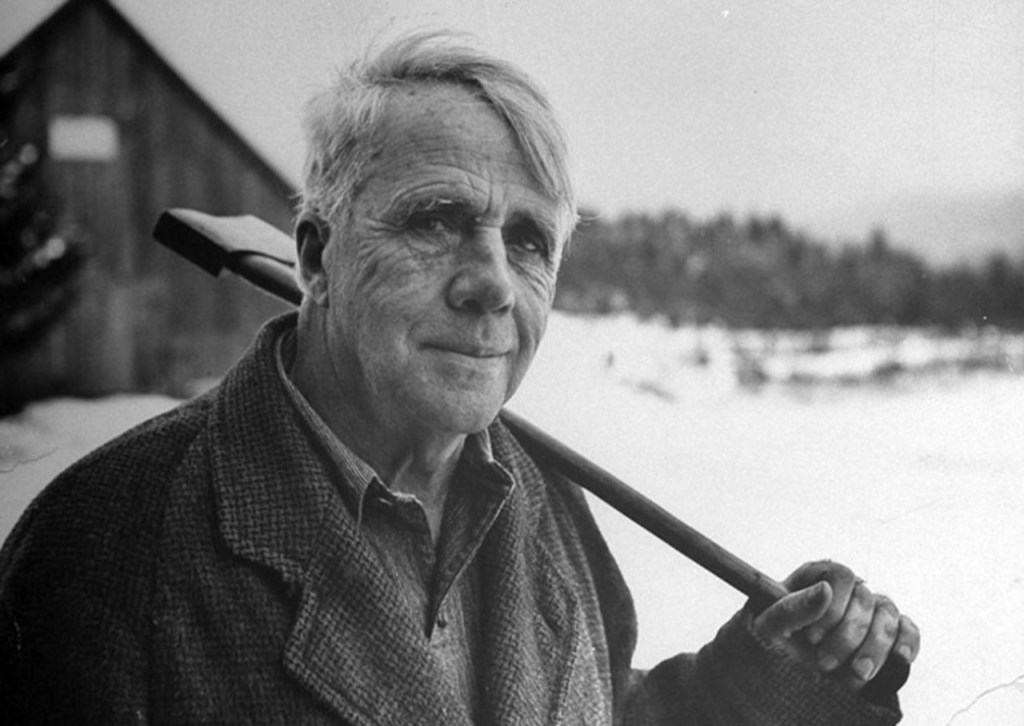
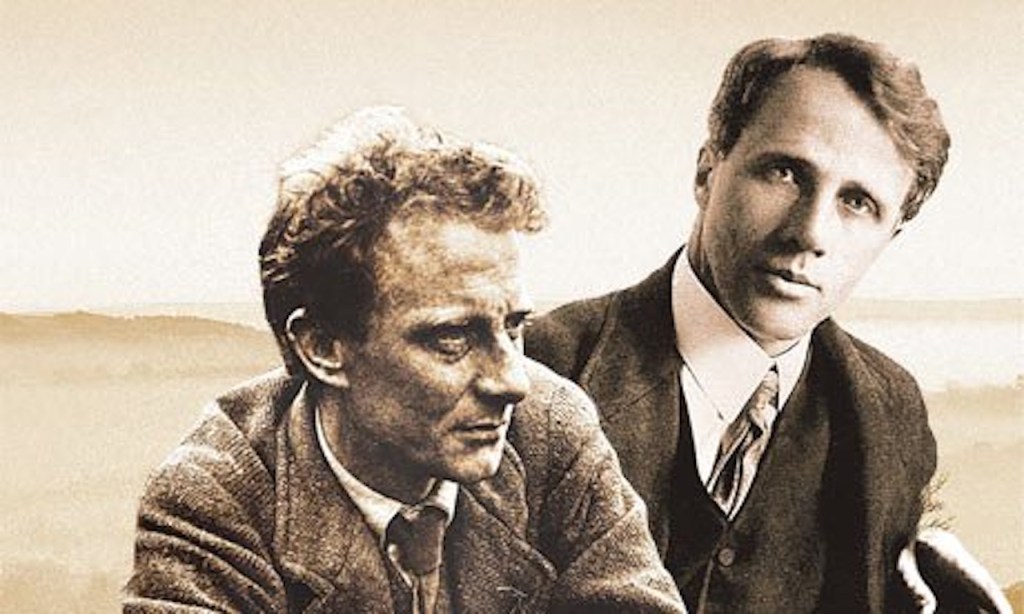
Image: Robert Frost in 1943. (Eric Schaal/The LIFE Picture Collection/Getty Images)
Robert Frost’s “To E. T.”
The speaker in Robert Frost poem, “To E. T.,” expresses his musings about his friendship with a fellow poet, who died serving as a soldier in World War I.
Introduction and Text of “To E. T.”
The initials E. T. are those of Edward Thomas, with whom Robert Frost had formed a close friendship while Frost resided in England. Thomas is likely responsible in no small part for assisting in the launching of Frost’s illustrious career as a poet.
In 1914, Frost published in first collection of poems, North of Boston, and Thomas wrote a glowing review of the book, after which the American audience began to pay serious attention to the works of Frost.
Robert Frost’s poem, “To E. T.,” plays out in five quatrains, each with rime scheme ABCB. In “E.T.,” the speaker’s main focus is on the nature of consciousness after war, especially after experiencing the death of friend who died serving in a war.
Frost had encouraged his friend, Thomas, to relocate to New England, but Thomas chose to serve in World War I, in which he died. That death left Frost with his curious musing about the nature of war consciousness.
To E.T.
I slumbered with your poems on my breast Spread open as I dropped them half-read through Like dove wings on a figure on a tomb To see, if in a dream they brought of you,
I might not have the chance I missed in life Through some delay, and call you to your face First soldier, and then poet, and then both, Who died a soldier-poet of your race.
I meant, you meant, that nothing should remain Unsaid between us, brother, and this remained— And one thing more that was not then to say: The Victory for what it lost and gained.
You went to meet the shell’s embrace of fire On Vimy Ridge; and when you fell that day The war seemed over more for you than me, But now for me than you—the other way.
How over, though, for even me who knew The foe thrust back unsafe beyond the Rhine, If I was not to speak of it to you And see you pleased once more with words of mine?
Commentary on Robert Frost’s “E. T.”
Robert Frost’s poem “E. T.” offers a moving tribute to Frost’s friend, Edward Thomas.
First Quatrain: Prompting a Dream
I slumbered with your poems on my breast Spread open as I dropped them half-read through Like dove wings on a figure on a tomb To see, if in a dream they brought of you,
The speaker opens his musing by revealing that he had attempted to prompt a dream of his friend by spreading the friend’s poems over his chest as he dropped off to sleep. The poems were spread over the speaker’s chest and resembled the wings of a dove that one sees on tombs. Because the dear friend of the speaker has died, the image works marvelously.
The speaker had revealed that he has only “half-read” through the poems before he dropped them across his body, and he admits that he has spread the poem there with the specific intention of provoking a dream of the friend.
Second Quatrain: What Remains Unspoken
I might not have the chance I missed in life Through some delay, and call you to your face First soldier, and then poet, and then both, Who died a soldier-poet of your race.
The speaker apparently would like to have told his friend that he considered the man both a poet and a soldier. The speaker places those two positions in the odd context of lineage.
He said he would tell to the friend’s face that he was indeed first a soldier, and then a poet. But then he adds “both,” as if to choose one over the other might somehow insult either the friend or either of the two positions.
The speaker then claims that the friend “died a soldier-poet of your race.” So he ends where he begins, in a sense, by placing soldier first in the phrase. By race, the speaker surely means nation. The friend about whom this poem was written is, of course, Edward Thomas, who died serving his country, England, in WWI.
Frost likely used the term “race” so loosely, in order to effect the rime with “face.” (This use of rime is always unseemly, and it happens too often, allowing meaning to take a back seat to rime.)
Third Quatrain: An Unfortunate Omission
I meant, you meant, that nothing should remain Unsaid between us, brother, and this remained— And one thing more that was not then to say: The Victory for what it lost and gained.
In the third quatrain, the speaker reveals that his relationship with the deceased was a close one. They both had intended that nothing between them would ever remain “unsaid.”
He calls his friend “brother” to demonstrate the closeness of their friendship. However, the speaker is sorry that he did not have the chance to say to his friend that he considered him a soldier-poet.
In addition to that unfortunate omission, the speaker realizes that they had not had the opportunity to say exactly what each would have considered “Victory.” The speaker remains somewhat vague about his notion of victory over what, as he just says, “Victory for what is lost and gained.”
The speaker senses that his friend felt that by serving in war, the friend had gained a victory, but the speaker likely wishes he could have discussed that with the friend in order to understand it better.
The speaker knows what he has lost; he has lost his friend, but now he is having difficulty in accepting that loss as a positive instead of negative event in his life, and also in the lives of both men.
Fourth Quatrain: Death and Questions
You went to meet the shell’s embrace of fire On Vimy Ridge; and when you fell that day The war seemed over more for you than me, But now for me than you—the other way.
It was at the Battle of Vimy Ridge that the Canadian Corps demonstrated it ability to fight successfully. Despite great losses, the Canadians came out victorious with the other Allied troops. In this battle, Edward Thomas died, and the speaker in this poem recognizes the fact.
The speaker dramatizes his friends death by metaphorically likening it to meeting an embrace, but this embrace is of “fire” from the shell that took the life of Thomas. When the speaker’s friend “fell that day,” the war was over for his friend, and the speaker says that at the time, it seemed to him that it over more for the dead friend than for himself.
But now it seems the opposite for the speaker. Now it seems that the war is over more the speaker than the friend, likely because the friend will now forever continue to be a casualty of war, which keeps him tied to that event.
Fifth Quatrain: Nature of the Consciousness of War
How over, though, for even me who knew The foe thrust back unsafe beyond the Rhine, If I was not to speak of it to you And see you pleased once more with words of mine?
The speaker continues musing on for whom the war is more over, and he poses a question, rhetorical in nature, wondering how the war can in fact be over more for either of them unless he is able to express that fact in words to his friend.
The speaker inserts into his question the fact that the Battle of Vimy (and the larger Battle of Arras) had sent the Germans packing “beyond the Rhine.” But the speaker remains in a state of quandary from not knowing how the friend would feel about the war effort and also continuing to wonder if the friend would be “pleased once more with words of mine.”
The speaker is obviously referring to the fellow poet-friend’s being pleased with the speaker’s poem. But the speaker also continues to wonder about the friend’s consciousness and how, if he were still living, he would reckon his values with the nature of war and how that reckoning would influence his poetry.
British poet, Edward Thomas, who was killed in the Battle of Arras during World War I, may be most famous for his friendship with American poet, Robert Frost, who penned his important poetic tribute—”To E. T.”— to his friend after the second lieutenant’s becoming a war casualty.
Early Life
Philip Edward Thomas was born in Lambeth, London on March 3, 1878, to Welch parents, Philip Henry Thomas and Mary Elizabeth Thomas. Edward was the oldest of the couple’s six sons [1]. His father entertained a strong interest in the life of the mind and political subjects; thus, he paid little attention to his six sons.
Edward and his father were very different in personality and disagreed on most areas of life; his father disdained Edward’s choice of a literary career. Thomas penned a poem that reveals the tenor of his relationship with his father. He titled the poem simply with his father’s initials [2]:
P.H.T.
I may come near loving you When you are dead And there is nothing to do And much to be said.
To repent that day will be Impossible For you and vain for me The truth to tell.
I shall be sorry for Your impotence: You can do and undo no more When you go hence,
Cannot even forgive The funeral. But not so long as you live Can I love you at all.
Thomas wrote the poem in February of 1916, but it was not published until 1949. Thomas father had remained adamant that his son take up civil service for his career, instead of writing.
Thomas was equally as adamant against that choice for his life’s work. The fact that the father and son had nothing of importance in common results in the animosity on display in Thomas poem addressing his father.
On Becoming a Writer
Edward Thomas attended Battersea Grammar and Saint Paul’s Schools in London; in 1898, he then entered Lincoln College at Oxford and majored in history, graduating in 1900. It was during this time that he determined to become a writer [3].
Thomas did take the civil service examination at his father’s behest. However, because of his intense interest in writing, instead of seeking a civil service position, he began writing essays about his many hikes.
Marriage
In 1899, Thomas married Helen Noble, daughter of James Ashcroft Noble. The couple had three children, Bronwen, Merfyn, and Myfanwy. Soon after the marriage, Thomas was awarded a scholarship to Lincoln College in Oxford, from where he graduated with a history degree.
Thomas became a reviewer for the Daily Chronicle, where he wrote reviews of nature books, literary criticism, and current poetry. Thomas’ earnings were meager at that time, and the family relocated five time in the span of ten years.
Suffering Depression
In 1896, through the influence and encouragement of James Ashcroft Noble, a successful literary journalist and who became Thomas’ father-in-law three years later, Thomas published his first book of essays titled The Woodland Life.
He had also enjoyed many holidays in Wales. With his literary friend, Richard Jefferies, Thomas had spent a great deal of time hiking and exploring the landscape in Wales, where he accumulated material for his nature writings.
Thomas wrote and published several significant biographies and critical studies, which include biographies of the important writers and critics such as Richard Jefferies (1909), Maurice Maeterlinck (1911), Algernon Charles Swinburne (1912), and Walter Pater (1913).
Despite his success in writing critical works, Thomas’ health suffered as he brooded over his financial situation and his lack of opportunity to engage in more creative writing efforts.
Because of his friendships with women writers such Eleanor Farjeon, along with his brooding melancholy, his marriage began to suffer. In 1913, he relocated his family to Steep Village, where he took up autobiographical writing and other writings of a more creative nature. He then produced his most famous works.
The move to Steep Village also had a healthful influence on Thomas. In Steep Village, Thomas began writing his more creative works, including Childhood, The Icknield Way (1913), The Happy-Go-Lucky Morgans (1913), and In Pursuit of Spring (1914). It was also during this period that Thomas met Robert Frost, and their fast friendship began.
Frost and Thomas, who both were at very early points in their writing careers, would take long walks through the countryside and attend the local writers meetings. About their friendship, Frost later quipped, “I never had, I never shall have another such year of friendship.”
In 1914, Edward Thomas helped launch Frost’s career by writing a glowing review of Frost’s first collection of poems, North of Boston. Frost encouraged Thomas to write poetry, and Thomas composed his blank-verse poem, “Up the Wind,” which Thomas published under the pen-name, “Edward Eastaway.”
Robert Frost’s poem, “The Road Not Taken,” was inspired by Thomas’ dissatisfaction with their path choices during their nature hikes. About the poem, Frost explained to Thomas: “No matter which road you take, you’ll always sigh, and wish you’d taken another.” Frost treasured his relationship with Thomas, writing that “Edward Thomas was the only brother I ever had.”
War and Death
Edward Thomas continued to write more poetry, but with the onset of World War I, the literary market took a down-turn. Thomas considered relocating his family to Frost’s New England. But at the same time he was also considering whether to become a soldier.
Frost encouraged him to move to New England, but Thomas chose to join the army. In a letter, dated August 30, 1914, to Walter de la Mare, Thomas wrote: “If the war goes on I believe I shall find myself a sort of Englishman, though neither poet or soldier” [4].
In 1915, Thomas signed up with the Artists’ Rifles, a regiment of the British Army Reserve [5]. As a Lance Corporal, Thomas became an instructor to fellow officers, which included Wilfred Owen, the poet most noted for his melancholy war verse.
Thomas took up training as an Officer Cadet with the Royal Garrison Artillery service in September 1916. Commissioned as a second lieutenant in November, he deployed to northern France. On April 9, 1917, Thomas was killed in the Battle of Vimy Ridge, the first of the larger Battle of Arras. He is buried in the Agny Military Cemetery.
Sources
[1] Editors. “Edward Thomas.” Academy of American Poets. Accessed October 12, 2026. [2] Edward Thomas. “P.H.T.” Special Collections and Archive. Accessed October 12, 2026. [3] William Green. “Biography of Edward Thomas.” Poem Analysis. Accessed October 12, 2026. [4] Katharine Lindsay. “Edward Thomas Biography.” University of Oxford. Accessed October 12, 2026. [5] Matthew Hollis. “Edward Thomas, Robert Frost, and the Road to War.” The Guardian. July 29, 2011.
Robert Frost’s “The Road Not Taken” is often misinterpreted; it does not encourage nonconformity. It dramatizes the difficulty of making choices and then living with the consequences.
Introduction with Text of “The Road Not Taken”
Robert Frost’s “The Road Not Taken” has been one of the most anthologized, analyzed, and quoted poems in American poetry. It has also remained one of the most misunderstood and thus misinterpreted poems in the English language.
Published in 1916 in Robert Frost’s poetry collection titled, Mountain Interval, the poem has since been interpreted primarily as piece that prompts non-conforming behavior, a philosophy of the efficacy of striking out on one’s own, instead of following the herd. Thus the poem is often quoted at commencement ceremonies. However, a close look at the poem reveals a different focus.
Instead of offering a moralizing piece of advice, the poem merely demonstrates how memory often glamorizes past choices despite the fact that the differences between the choices were not so great. It also shows how the mind tends to focus on the choice one had to abandon in favor of the one selected.
Edward Thomas and “The Road Not Taken”
Robert Frost lived in England from 1912 to 1914; he became fast friends with fellow poet Edward Thomas. Frost has explained that “The Road Not Taken” was prompted by Thomas, who would continue to fret over the path the couple could not take as they were out walking in the woods near their village.
The Road Not Taken
Two roads diverged in a yellow wood, And sorry I could not travel both And be one traveler, long I stood And looked down one as far as I could To where it bent in the undergrowth;
Then took the other, as just as fair, And having perhaps the better claim, Because it was grassy and wanted wear; Though as for that the passing there Had worn them really about the same,
And both that morning equally lay In leaves no step had trodden black. Oh, I kept the first for another day! Yet knowing how way leads on to way, I doubted if I should ever come back.
I shall be telling this with a sigh Somewhere ages and ages hence: Two roads diverged in a wood, and I— I took the one less traveled by, And that has made all the difference.
Robert Frost Reads “The Road Not Taken”
Commentary on “The Road Not Taken”
Robert Frost called “The Road Not Taken” “very tricky.” Some readers have not heeded his advice to be careful with this one. Thus, a misunderstanding brings this poem into places for which it is not suitable, such as graduation ceremonies, wherein the speaker has taken as his theme the efficacy of strong individualism as opposed to herd conformity.
First Stanza: The Decision and the Process of Deciding
Two roads diverged in a yellow wood, And sorry I could not travel both And be one traveler, long I stood And looked down one as far as I could To where it bent in the undergrowth;
In the first stanza, the speaker reveals that he has been out walking in the woods, and he approaches two diverging pathways; he stops and peers down each path as far as he can. He then avers that he would like to walk down each path, but he is sure he does not have enough time to experience both. He knows he must take one path and leave the other behind, and so he commences his decision making process.
Second Stanza: The Reluctant Choice
Then took the other, as just as fair, And having perhaps the better claim, Because it was grassy and wanted wear; Though as for that the passing there Had worn them really about the same,
After scrutinizing both pathways, he decides to start walking down the one that seems “less traveled.” He admits they were “really about the same.” They were, of course, not exactly the same, but in reality there was not much difference between them as far as he could tell from where he stood. Both paths had been “traveled,” but he fancies that he chooses the one because it was a little less traveled than the other.
Notice at this point how the actual choice in the poem seems to deviate from the title. The speaker takes the road less taken, not the one “not taken,” as the title seems to suggest. That fact was, no doubt, part of the trickiness that Frost mentioned as he discussed the genesis of this poem, calling it “very tricky.”
The title also lends to the moralizing interpretation. The path not taken is the one not taken by the speaker—both roads have been taken by others, but the speaker being just one individual could take only one.
Third Stanza: Really More Similar Than Different
And both that morning equally lay In leaves no step had trodden black. Oh, I kept the first for another day! Yet knowing how way leads on to way, I doubted if I should ever come back.
Because the decision making process can be complex and lengthy, the speaker continues to reveal his thinking about the two paths into the third stanza. But again he reports how the paths were really more similar than different.
Fourth Stanza: The Ambiguous Sigh
I shall be telling this with a sigh Somewhere ages and ages hence: Two roads diverged in a wood, and I— I took the one less traveled by, And that has made all the difference.
In the final stanza, the speaker projects how he will look back on his decision in the distant future. He surmises that he will remember taking a “less traveled” road, and that decision “has made all the difference.”
The problem with interpreting the poem as advice for individualism and non-conformity is that the speaker is only speculating about how his decision will affect his future. He cannot know for certain that his decision was a wise one, because he has not yet lived it.
Even though he predicts that he will think it was a positive choice when he says, it “made all the difference,” a phrase that usually indicates a good difference, in reality, he cannot know for sure.
The use of the word “sigh” is also ambiguous. A sigh can indicate relief or regret——two nearly opposite states of mind. Therefore, whether the sigh comports with a positive difference or negative cannot be known to the speaker at the time he is musing in the poem. He simply has not lived the experience yet.
“Tricky Poem”
Frost referred to this poem as a tricky poem, and he admonished readers “to be careful of that one.” He knew that human memory tends to gloss over past mistakes and glamorize the trivial. He also was aware that a quick, simplistic perusal of the poem could yield an erroneous understanding of it.
The poet also has stated that this poem reflects his friend Edward Thomas’ attitude while out walking in the woods near London, England. Thomas continued to wonder what he might be missing by not being able to walk both paths, thus the title’s emphasis on the road “not taken.”
“Road” as a Symbol for Life’s “Path”
In this commentary, readers may notice that I have used the term “path” instead of road in most the references to that entity in the poem. The poem begins by placing the speaker in a “yellow wood.” Thus, the speaker has encountered two different pathways through the wood because it more likely that a wood has paths (pathways) than roads. Paths are for walking; roads are for vehicle traffic.
Thus, I suggest that the speaker is employing the term “road” as a symbol of one’s pathway through life——not a a literal road in a wood. Even though the speaker had used the term “travel” in the opening lines, he later limits that mode of travel to foot travel when he says, “long I stood” and later, “In leaves no step had trodden black.” He “stood” because he had been walking. And “step had trodden black” refers to the condition of the leaves having been walked upon.
Taking his place among luminaries such as Dickinson and Whitman, Frost has remained one of the most widely anthologized American poets of all time. His poems are more complex than simple nature pieces; many are “tricky—very tricky,” as he once quipped about “The Road Not Taken.”
Robert Frost has earned his reputation as one of America’s most beloved poets. The poet holds the honor of being the first American poet to deliver his poems to the assembled celebrants at the 1961 inauguration of the 35th president of the United States of America, John F. Kennedy.
Early Life
Robert Frost’s father, William Prescott Frost, Jr., was a journalist, residing in San Fransisco, California, when Robert Lee Frost was born on March 26, 1874. Robert’s mother, Isabelle, was an immigrant from Scotland.
The young Frost spent the first eleven years of his childhood in San Fransisco. After his father died of tuberculosis, Robert’s mother relocated the family, including his sister, Jeanie, to Lawrence, Massachusetts, where they lived with Robert’s paternal grandparents.
In 1892, Robert graduated from Lawrence High School, where he and Elinor White, his future wife, served as co-valedictorians.
Robert then made his first attempt to attend college at Dartmouth College, but after only a few months, he left school and returned to Lawrence, where he began working a series of part-time jobs [1].
Marriage and Children
Elinor White, who had been Robert’s high school sweetheart, was attending St. Lawrence University when Robert proposed to her. She turned him down because she wanted to complete her college education before she married.
Robert then moved to Virginia, and then after he returned to Lawrence, again he proposed to Elinor, who had now completed her college education. The couple married on December 19, 1895. They produced six children.
Their son, Eliot, was born in 1896 but died in 1900 of cholera; their daughter, Lesley, lived from 1899 to 1983. Their son, Carol, born in in 1902 but committed suicide in 1940.
Their daughter, Irma, 1903 to 1967, battled schizophrenia for which she was confined in a mental hospital. Daughter, Marjorie, born 1905 died of puerperal fever after giving birth. Their sixth child, Elinor Bettina, who was born in 1907, died one day after her birth.
Only Lesley and Irma survived their father. Mrs. Frost suffered heart issues for most of her life. She was diagnosed with breast cancer in 1937 but the following year died of heart failure [2].
Farming and Writing
Robert then again attempted to attend college. In 1897, he enrolled in Harvard University, but because of health problems, he was forced to leave school again. He rejoined his wife in Lawrence. Their second child Lesley was born in 1899.
The family then relocated to a New Hampshire farm that Robert’s grandparents had procured for him. Robert’s farming phase thus began as he strove to farm the land while continuing his writing. The Frost’s farming endeavors continued to result in unsuccessful fits and starts. Frost became well adjusted to rustic life, despite his lack of success as a farmer.
On November 8, 1894, in The Independent, a New York newspaper, Frost’s first poem “My Butterfly” appeared in print. The next dozen years proved to be a difficult period in the poet’s personal life yet a fertile one for his writing. The poet’s writing life was launched in a impressive fashion, and the rural, rustic influence on his poems would set a tone and style for all of his works.
Nevertheless, despite the popularity of his individually published poems, such “The Tuft of Flowers” and “The Trial by Existence,” he could not secure a publisher for his collections of works [3].
Moving to England
In 1912, Frost sold the New Hampshire farm and relocated his family to England. Because of his failure to find a publisher in the US for his collections of poems, he decided to try his luck across the pond.
That moved turned out to be life-line for the young poet and his career. At age 38 in England, Frost found a publisher for his collection A Boy’s Will and soon after for his collection North of Boston.
In addition to securing publishers for his two books, the American poet became acquainted with Ezra Pound and Edward Thomas, two important contemporary poets. Pound and Thomas reviewed favorably Frost’s two book, and thus Frost’s career as a poet was launched.
Frost’s friendship with Edward Thomas became especially important, and Frost has revealed that the long walks taken by the two poet/friends had influenced his writing in a wonderfully constructive manner.
Frost has given credit to Thomas for one of his most famous poems, “The Road Not Taken,” which was influenced by Thomas’ attitude toward the fact of not being able to take two different paths on their long walks.
Returning to America
After World War 1 began in Europe, the Frosts moved back to the United States. Their brief stay in England had sparked useful results for the poet’s reputation, for even in his native country, he was becoming well known and loved.
American Publisher Henry Holt republished Frost’s earlier collections, and then published the poet’s third collection, Mountain Interval, which had been written while Frost was still living in England.
Frost began to experience the pleasing situation of having the same journals, such as The Atlantic, solicit his work, even though they had rejected those same works only a few years earlier.
In 1915, the Frosts purchased a farm, located in Franconia, New Hampshire. Their traveling days had come to and end, and Frost continued his writing career. Frost also taught intermittently at a number of colleges, including Dartmouth, University of Michigan, and especially Amherst College, where he served regularly from 1916 until 1938.
Amherst’s primary library is now the Robert Frost Library, in honor of the long-time educator and poet. Frost also spent most of his summers teaching English at Middlebury College in Vermont.
Frost never completed a university degree, but over his lifetime, he accumulated more than forty honorary degrees. Frost won the Pulitzer Prize four times for his books, New Hampshire, Collected Poems, A Further Range, and A Witness Tree.
Frost labeled himself a “lone wolf” in the world of poetry because he did not follow any current literary movements. His only motivation was to express the human condition in a world of duality.
Frost did not pretend to explain that condition; he sought solely to create his little dramas to reveal the nature of the emotional life in the mind and heart of a human being [4].
First American Inaugural Poet
Robert Frost had intended to star his occasional piece “Dedication” as a preface to the poem that the President-Elect John F. Kennedy had requested for his 1961 inauguration.
But the sun rendered Frost’s reading impossible, so he dropped “Dedication” but continued on to recite “The Gift Outright” from memory.
Introduction with Text of “Dedication”
On January 20, 1961, Robert Frost became the first American poet to deliver a poem at a presidential inauguration. He recited his poem “The Gift Outright” at the swearing in of John F. Kennedy as the 35th president of the United States of America. Frost had also written a new poem to preface his recitation of “The Gift Outright,” but he did not have time to commit his new piece to memory.
At the inauguration, Frost began to read the new piece, but he was unable to see clearly his copy of the poem because of the bright sunlight bouncing off the snow; he managed to stumble through the first 23 lines of the new poem [5]. But then he switched to reciting “The Gift Outright,” which he had by memory.
While Frost’s “Dedication” offers some useful and important historical features, it does reveal some of the fawning exaggeration that occasional poems [6] are often wont to suffer.
Dedication
Summoning artists to participate In the august occasions of the state Seems something artists ought to celebrate. Today is for my cause a day of days. And his be poetry’s old-fashioned praise Who was the first to think of such a thing. This verse that in acknowledgement I bring Goes back to the beginning of the end Of what had been for centuries the trend; A turning point in modern history. Colonial had been the thing to be As long as the great issue was to see What country’d be the one to dominate By character, by tongue, by native trait, The new world Christopher Columbus found. The French, the Spanish, and the Dutch were downed And counted out. Heroic deeds were done. Elizabeth the First and England won. Now came on a new order of the ages That in the Latin of our founding sages (Is it not written on the dollar bill We carry in our purse and pocket still?) God nodded his approval of as good So much those heroes knew and understood, I mean the great four, Washington, John Adams, Jefferson, and Madison So much they saw as consecrated seers They must have seen ahead what not appears, They would bring empires down about our ears And by the example of our Declaration Make everybody want to be a nation. And this is no aristocratic joke At the expense of negligible folk. We see how seriously the races swarm In their attempts at sovereignty and form. They are our wards we think to some extent For the time being and with their consent, To teach them how Democracy is meant. “New order of the ages” did they say? If it looks none too orderly today, ‘Tis a confusion it was ours to start So in it have to take courageous part. No one of honest feeling would approve A ruler who pretended not to love A turbulence he had the better of. Everyone knows the glory of the twain Who gave America the aeroplane To ride the whirlwind and the hurricane. Some poor fool has been saying in his heart Glory is out of date in life and art. Our venture in revolution and outlawry Has justified itself in freedom’s story Right down to now in glory upon glory. Come fresh from an election like the last, The greatest vote a people ever cast, So close yet sure to be abided by, It is no miracle our mood is high. Courage is in the air in bracing whiffs Better than all the stalemate an’s and ifs. There was the book of profile tales declaring For the emboldened politicians daring To break with followers when in the wrong, A healthy independence of the throng, A democratic form of right divine To rule first answerable to high design. There is a call to life a little sterner, And braver for the earner, learner, yearner. Less criticism of the field and court And more preoccupation with the sport. It makes the prophet in us all presage The glory of a next Augustan age Of a power leading from its strength and pride, Of young ambition eager to be tried, Firm in our free beliefs without dismay, In any game the nations want to play. A golden age of poetry and power Of which this noonday’s the beginning hour.
Commentary on “Dedication”
Robert Frost’s poem “The Gift Outright” remains the poem remembered for the inauguration of John F. Kennedy, and it also happens to be a much stronger poem than “Dedication.”
Frost once remarked [7] about his poem “The Gift Outright” that is was “a history of the United States in a dozen lines of blank verse.”
First Movement: Invocation to Artists
Summoning artists to participate In the august occasions of the state Seems something artists ought to celebrate. Today is for my cause a day of days. And his be poetry’s old-fashioned praise Who was the first to think of such a thing. This verse that in acknowledgement I bring Goes back to the beginning of the end Of what had been for centuries the trend; A turning point in modern history.
The speaker seems to be postponing his task of making this inauguration a grand and glorious event by remarking the efficacy and appropriateness of artists contributing to such an occasion. He likens his current effort to past glories of “poetry’s old-fashioned praise” of remarking that certain occasions are bound to point to historical trends.
The speaker’s claims remain rather vague and noncommittal but still leave open the possibility that things will become clearer and more specific as he continues to offer his gems of wisdom.
He claims that what he is doing, bringing verse to event, is as old as the beginning. But that beginning is then sparked by the “beginning of the end”; thus, the speaker is covering himself in case he may be proven wrong.
Second Movement: The Forming of a Nation
Colonial had been the thing to be As long as the great issue was to see What country’d be the one to dominate By character, by tongue, by native trait, The new world Christopher Columbus found. The French, the Spanish, and the Dutch were downed And counted out. Heroic deeds were done. Elizabeth the First and England won.
The speaker then draws an interesting picture of “colonial” America. He contends that the many nations that have found their progeny on the new shores were battling for dominance, putting forth the question: would France, Spain, or Holland take the lead in heading the American nation?
But then he answers the question by declaring England the winner, as “Elizabeth the First and England won.” Thus, the speaker provides answers to this question of whose characteristics, language, and traits would prevail: America would not adopt French or Spanish or Dutch as its native language; it would be English whose tongue the New World would speak.
Also, one can imagine the “native traits” including English style clothing, manners, and food. The other nations, while welcome, would take their place as an accompanying position.
Third Movement: Tribute to the Founding
Now came on a new order of the ages That in the Latin of our founding sages (Is it not written on the dollar bill We carry in our purse and pocket still?) God nodded his approval of as good So much those heroes knew and understood, I mean the great four, Washington, John Adams, Jefferson, and Madison So much they saw as consecrated seers They must have seen ahead what not appears, They would bring empires down about our ears And by the example of our Declaration Make everybody want to be a nation.
While this movement contains a number of historically accurate statements, it remains rather awkward in its structural execution. The parenthetical—”(Is it not written on the dollar bill / We carry in our purse and pocket still?)”— followed by the line,”God nodded his approval of as good” render their substance less impactful.
That “Latin of our founding sages” refers to “E Pluribus Unum,” (Out of the many, One) and loses it heft when placed as a parenthetical. Robert Frost was a somewhat religious agnostic. That he would claim that God was nodding approval of anything seems a bit out of character sparking a question of sincerity.
Because of Frost’s wholly secular take on the historical founding of a nation— despite the fact that one of the founding principles for founding this nation was religious—the questionable sincerity issue continues to present itself.
This issue is especially evident since the poem is an occasional poems specifically written to celebrate a politician in his ascendency to political office. The tribute to “Washington, / John Adams, Jefferson, and Madison,” whom the speaker designates “as consecrated seers” remains a wholly accurate statement.
And the final two lines appropriately celebrate the document the “Declaration of Independence” which along with the U. S. Constitution remain two of the most important texts ever to exist. The existence of those documents remains important both to the American nation and the world, making “everybody want to be a nation.”
Fourth Movement: Pursuing Life, Liberty, and Happiness
And this is no aristocratic joke At the expense of negligible folk. We see how seriously the races swarm In their attempts at sovereignty and form. They are our wards we think to some extent For the time being and with their consent, To teach them how Democracy is meant. “New order of the ages” did they say? If it looks none too orderly today, ‘Tis a confusion it was ours to start So in it have to take courageous part. No one of honest feeling would approve A ruler who pretended not to love A turbulence he had the better of.
The speaker then engages the issue of immigration to this newly formed nation. It makes perfect sense that folks from all over the world would desire to emigrate from totalitarian, freedom-squelching dictators in their own nations. And it remains quite sensible that they would want to relocate to this new land.
This new land from the beginning embraces freedom and individual responsibility while promising such in those documents delineating the basic human rights of “life, liberty, and the pursuit of happiness.”
The speaker denigrates the notion that only the aristocrats were appreciated and allowed to flourish in this new land. New immigrants may become our “ward,” but that status is only temporary and “with their consent.” In other words, new immigrants can become citizens of our new land of freedom because that new land represents the “[n]ew order of the ages.”
Fifth Movement: A Courageous Nation
Everyone knows the glory of the twain Who gave America the aeroplane To ride the whirlwind and the hurricane. Some poor fool has been saying in his heart Glory is out of date in life and art. Our venture in revolution and outlawry Has justified itself in freedom’s story Right down to now in glory upon glory. Come fresh from an election like the last, The greatest vote a people ever cast, So close yet sure to be abided by, It is no miracle our mood is high. Courage is in the air in bracing whiffs Better than all the stalemate an’s and ifs.
The speaker then focuses on the very specific event of the Wright Brothers (“the twain”) and their new invention “the aeroplane.” He then asserts that such feats have put the lie to the “poor fool” who thinks that there is no longer any “glory” in “life and art.” He insists that the American adventure story in “revolution and outlawry” has been gloriously vindicated and “justified [ ] in freedom’s story.”
The speaker then offers his take of how this recent election, whose result he is now celebrating, played out. He deems it the “greatest vote a people ever cast”—an obvious exaggeration. Yet, while the election was “close,” it will be “abided by.” The citizenry’s mood is “high,” and that fact is “no miracle.” He then asserts that such a situation arises out of the courage of the nation.
Sixth Movement: The Curse of the Inaugural Poem
There was the book of profile tales declaring For the emboldened politicians daring To break with followers when in the wrong, A healthy independence of the throng, A democratic form of right divine To rule first answerable to high design. There is a call to life a little sterner, And braver for the earner, learner, yearner. Less criticism of the field and court And more preoccupation with the sport. It makes the prophet in us all presage The glory of a next Augustan age Of a power leading from its strength and pride, Of young ambition eager to be tried, Firm in our free beliefs without dismay, In any game the nations want to play. A golden age of poetry and power Of which this noonday’s the beginning hour.
In the opening line of this final movement, the speaker alludes to John F. Kennedy’s book, Profiles in Courage—”book of profile tales.” Of course, the inaugural poet in his inaugural poem had to focus on the subject of this occasion, the new president of the United States, whom he is celebrating with his poem.
But then he becomes overly solicitous in his following remarks claiming that this president was a politician who can “break with followers when in the wrong.” The speaker furthers his fawning remarks by suggesting that this administration would be a “democratic form of right divine / To rule first answerable to high design.” This statement boarders on toadying flattery.
Then the puffery in the movement continues with the prediction of a “next Augustan age,” until the final unfortunate lines, “A golden age of poetry and power / Of which this noonday’s the beginning hour.”
Of course, hindsight now confirms that no “golden age” ever resulted for politics or poetry. And this president was assassinated before the completion of his first term in office.
While Frost’s “Dedication” offers some useful commentary, it still fails as a genuine poem. Even as an occasional poem in it final movement, it engages overzealously in exaggerated flattery.
One is reminded that fortunately, this piece did not see the light of day, as Frost was unable to read it as he intended. The poet was spared the drubbing he no doubt would have received had the sunlight not conspired to keep that piece in the dark.
Robert Frost’s “The Gift Outright”
Robert Frost’s “The Gift Outright” became the first inaugural poem, after President-Elect John F. Kennedy asked the famous poet to read at his swearing in ceremony—the first time a poet had read a poem at a presidential inauguration.
Introduction with Text of “The Gift Outright”
On January 20, 1961, John F. Kennedy was inaugurated the 35th president of the United States of America. For the inauguration ceremony, Kennedy had invited America’s most famous poet, Robert Frost, to write and read a poem. Frost rejected the notion of writing an occasional poem, and so Kennedy asked him to read “The Gift Outright.” Frost then agreed.
Kennedy then had one more favor to ask of the aging poet. He asked Frost the change the final line of the poem from “Such as she was, such as she would become” to “Such as she was, such as she will become.”
Kennedy felt that the revision reflected more optimism than Frost’s original. Frost did not like the idea, but he relented for the young president’s sake. Frost did, nevertheless, write a poem especially for the occasion titled “Dedication,” which he intended to read as a preface to “The Gift Outright.”
At the inauguration, Frost attempted to read his occasional poem, but because of the bright sunlight bouncing off the snow, his aging eyes could not see the poem well enough to read it. He then continued to recite “The Gift Outright.”
Regarding the changing of the final line: instead of merely reading the line with the revision Kennedy had requested, Frost stated,
Such as she was, such as she would become, has become, and I – and for this occasion let me change that to –what she will become. (my emphasis added)
Thus, the poet remained faithful to his own vision, while satisfying the presidential request. Robert Frost’s poem, “The Gift Outright,” offers a brief history of the USA, which has just elected and was in the process of inaugurating its 35th president.
The speaker of Frost’s poem, without becoming chauvinistically patriotic, manages to offer a positive view of the country’s struggle for existence, a struggle that can be deemed a gift that the Founding Fathers gave to themselves and the world.
To the question—“Well, Doctor, what have we got—a Republic or a Monarchy?”—regarding the product created by the Constitutional conveners during their meetings from May 25 to September 17, 1787, in Philadelphia, Founder Benjamin Franklin responded, “A Republic, if you can keep it” [8].
The US Constitution became a gift that has kept on giving in the best possible way. It replaced the old, weak Articles of Confederation and kept the nation in tact even during a bloody Civil War, nearly a century later.
The speaker in Frost’s poem offers a brief overview of the American struggle for existence, and he describes that struggle resulting in a Constitution as a gift the Founders gave themselves and to all the generations to follow.
The Gift Outright
The land was ours before we were the land’s. She was our land more than a hundred years Before we were her people. She was ours In Massachusetts, in Virginia, But we were England’s, still colonials, Possessing what we still were unpossessed by, Possessed by what we now no more possessed. Something we were withholding made us weak Until we found out that it was ourselves We were withholding from our land of living, And forthwith found salvation in surrender. Such as we were we gave ourselves outright (The deed of gift was many deeds of war) To the land vaguely realizing westward, But still unstoried, artless, unenhanced, Such as she was, such as she would become.
Robert Frost Reading “The Gift Outright”
At Inauguration
Commentary on “The Gift Outright”
Robert Frost’s inaugural poem offers a glimpse into the history of the country that has just elected its 35th president.
First Movement: The Nature of Possession
The land was ours before we were the land’s. She was our land more than a hundred years Before we were her people. She was ours In Massachusetts, in Virginia, But we were England’s, still colonials, Possessing what we still were unpossessed by, Possessed by what we now no more possessed.
The first movement begins by offering a brief reference to the history of the country over which the new government official would now preside. The speaker asserts that the men and women who had settled on the land, which they later called the United States of America, had begun their experiment in freedom living on the land which would later become their nation, and they would then become its citizens.
Instead of merely residing as a loosely held-together band of individuals, they would become a united citizenry with a name and government shared in common. The official birthdate of the United States of America is July 4, 1776; with the Declaration of Independence, the new country took its place among the nations of the world.
And the speaker correctly states that the land belonged to the people “more than a hundred years” before Americans became citizens of the country. He then mentions two important early colonies, Massachusetts and Virginia, which would become states (commonwealths) after the new land was no longer a possession of England.
Second Movement: The Gift of Law and Order
Something we were withholding made us weak Until we found out that it was ourselves We were withholding from our land of living, And forthwith found salvation in surrender.
During the period from 1776 to 1887, the country struggled to found a government that would work to protect individual freedom and at the same time provide a legal order that would make living in a free land possible. An important first step was the Articles of Confederation and Perpetual Union [9], the first constitution written in 1777, which was not ratified until 1781.
The Articles failed to provide enough structure for the growing nation, and by 1787, it was deemed that a new, stronger document was needed to keep the country functioning and united. Thus, the Constitutional Convention of 1787 [10] was convened to rewrite the Articles.
Instead of merely writing them, however, the Founding Fathers scrapped the old document and composed a new U.S. Constitution, which has remained the founding set of laws guiding America since it was finally ratified June 21, 1788 [11].
The speaker describes America’s early struggle for self governance as “something we were withholding,” and that struggle “made us weak.” But finally, we found “salvation in surrender,” that is, the Founding Fathers surrendered to a document that provided legitimate order but at the same time offered the greatest possible scope for individual freedom.
Third Movement: The Gift of Freedom
Such as we were we gave ourselves outright (The deed of gift was many deeds of war) To the land vaguely realizing westward, But still unstoried, artless, unenhanced, Such as she was, such as she would become.
The speaker describes the early turbulent history of his country as a time of “many deeds of war,” which would include the war [12] the early Americans had to fight against England—its mother country—to secure the independence that it had declared and demanded.
But the young nation wholeheartedly gave itself that “gift” of existence and freedom by continuing its struggle and continuing to grow by expanding “westward.” The people of this nation struggled on through many hardships “unstoried, artless, unenhanced” to become the great nation that now—at the time of the poet’s recitation—has elected its 35th president.
Sources
[1] Editors. “Robert Frost.” Poetry Foundation. Accessed March 26, 2023.