Linda's Literary Home

Tag: Feast

  • Barack Obama’s “Underground”

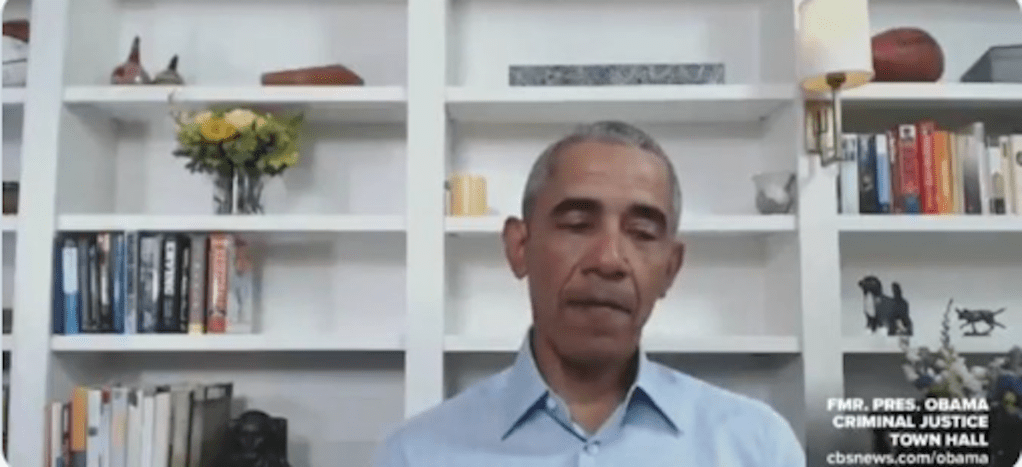
    Image:  Bookcase Credibility

    Barack Obama’s “Underground”

    In addition to his piece titled “Pop,” Barack Obama also published in Occidental college’s literary magazine, Feast, the short piece titled “Underground,” featuring a fantasy in which fig-eating apes breathe underwater, while dancing and tumbling about.

    Introduction and Text of “Underground”

    At age 19, Barack Hussein Obama II published in Occidental college’s literary magazine, Feast, two “poems.”  A piece titled “Pop,” in which he explores the relationship between a young man and a father figure, and this short piece titled “Underground,” which reveals a fantasy world where fig-eating apes breathe underwater, while dancing and tumbling in rushing water.

    Just as Obama’s piece of doggerel “Pop” does not bode well for a potential writer of any stripe, the future U. S. President’s [1] poetic effort, “Underground,” offers further evidence that this hack scribbler will retain no place in letters, while the brilliance with which the former Oval Office Occupier handled the falling off of the presidential seal further demonstrates that his talent lay in areas of entertainment, not governance.. 

    The title, “Underground,” indicates a location under the land, and it could also be indicating metaphorically some event or transaction not open to public scrutiny or awareness: an example might be a secret network similar to the Underground Railroad. However, no such meaning can be gleaned from this mass of confused doggerel.

    Underground

    Under water grottos, caverns
    Filled with apes
    That eat figs.
    Stepping on the figs
    That the apes
    Eat, they crunch.
    The apes howl, bare
    Their fangs, dance,
    Tumble in the
    Rushing water,
    Musty, wet pelts

    Commentary on “Underground”

    This three-pronged failure demonstrates even more clearly than the effort titled “Pop” that this scribbler has no place in letters. It fails for three significant reasons: (1) misuse of grammar/diction, (2) awkward enjambment, and (3) lack of meaning.

    First Movement: Underground, Underwater?

    Under water grottos, caverns
    Filled with apes
    That eat figs.

    The first line—”Under water grottos, caverns”— indicates that the setting for the activity is not “underground,” but, in fact, it is underwater. While the preferred spelling for the plural of “grotto” is “grottoes,” such an amateurish error is minor compared to the repetition of the similar terms, grotto and cavern. 

    There is a difference in the denotative meanings of those two terms: grotto can be man-made and decorative while cavern is natural. Immediately, the bumbling speaker had befuddled the reader by employing those two terms, which because of their different meanings imply different connotations. Is the cave decorated by human beings or is it not? Is it a “grotto” or a “cavern”?  It cannot be both.

    Those underwater caves, which may or may not be decorated, are teeming with land-dwelling, mammals who naturally breathe air, yet here they are—living and thus obviously breathing under water. The piece then perhaps becomes a verse of surreal fantasy. In any case, the reader must, at this point, suspend belief in order to continue, learning about those animals—”apes” that eat figs. 

    This fact is nothing out of the ordinary, because apes do love fruit, but why the versifier chooses to employ “figs” must remain a mystery. No speculation can approach a satisfactory answer, and the context offers no clue.

    Second Movement: Figs Stepping on Figs

    Stepping on the figs
    That the apes
    Eat, they crunch.

    In this three-line assertion, the misplaced modifier jumbles the message—who steps on the figs? It would appear that the apes would be doing so because no one else with feet appears in the grotto. 

    Following an introductory gerund clause—in this case, “stepping on the figs”—the subject of the main clause must be the actor in the introductory clause. Thus, the subject of the introductory gerund clause, “they,” has to be the figs because it follows immediately the introductory gerund clause.

    Because it is absurd to think that even an amateur would be stating such an impossible occurrence—that the figs are stepping on themselves—the reader becomes aware of the grammatical error called misplaced modifier. As Jack Cashill [2] has pointed out, Obama has been consistent in misapplying grammatical constructions including but not limited to bringing his subjects and verbs into alignment.

    Furthermore, word choice in poems is vital, and the writer’s choices in this poem offer nothing but speculation to the reader.  That flaw hinders meaning.  There seems to be no clear reason for choosing figs over any other fruit.  And that the speaker claims that the figs “crunch” remains nonsensical. Figs are soft and pliable; even dried figs would not “crunch” if stepped on.  Thus, not only is the choice of figs questionable; it is also unfeasible.

    Third Movement: Maddened by Crunching Figs

    The apes howl, bare
    Their fangs, dance

    It now seems that the “crunch” sound inflames the apes so that they start to “howl” and “bare their fangs” as they “dance.” The only reason for the ape-dance is that someone stepped on figs and made them crunch or so one would guess. 

    Is the ape excitement motivated by anger or is it urged on to gladness by the crunching of their figs?  Such amateurish discourse demonstrates the lack of control in composing meaningful a piece that communicate clearly.  Ultimately, this kind of nonsense communicates nothing but does clearly reveal the lack of ability of the composer.

    Fourth Movement: Awkward Enjambment

    Tumble in the
    Rushing water,
    Musty, wet pelts
    Glistening in the blue.

    As mentioned in the commentary on “Pop,” often a sign of an amateur poet is a line ending with “the”: “Tumble in the / Rushing water.” The frivolous diversion of this awkward enjambment distracts from the list of activities engaged in by the apes after their figs were stepped on.  

    The reader will want to like the apes and want to know what they are doing and why they are doing it, but the confused grammar, lack of poetic control, and awkward phrasing demonstrates by the would-be poet obliterates any hope of a clear reading.

    The reader may summarize the activities of the apes by quoting four lines: the apes “howl, bare / Their fangs, dance, / Tumble in the / Rushing water.” They do all of these things while their “[m]usty, wet pelts / [are] Glistening in the blue.”

     It remains ambiguous as to what “blue” refers: it would seem to be the water, but the scant amount of light peeping into the underwater cave would allow only enough to render the water’s color to appear black. This confusion offers further evidence that this amateur poetaster had little control of his thoughts and his language arsenal. It becomes especially galling that the poet could not even realize the nature of light and how it operates to illuminate color.

    Ungrammatical, Awkward, Meaningless

    This piece of doggerel, “Underground,” fails for three significant reasons: (1) misuse of grammar/diction, (2) awkward enjambment, but most importantly, (3) lack of meaning.  

    The apes could be charming, even endearing with their figs and their musty pelts, but the reader concludes the visit with them, baffled by the awkward execution of the piece, having no idea what has just transpired in these lines. 

    Readers might wonder what they might have communicated in the hands of a genuine poet, instead of in the hands of immature hack whose lack of a literary sensibility has misused them. 

    Such confusion fostered by this poem offers further evidence that this poetaster had little control over his thoughts and the instruments in his poetry toolkit. Nay, it remains quite likely he possessed no poetry toolkit at all.

    Sources

    [1]  AP Archive.  “Presidential seal falls off podium as Obama speaks.”   YouTube. July 2015.

    [2] Jack Kerwick. Jack Cashill’s Deconstructing Obama. American Thinker. February 25, 2011.


  • Barack Obama’s “Pop”

    Image: Obamas I, II, and Frank Marshall Davis  

    There is a price to be paid for criticizing Obama.” Jack Cashill

    Barack Obama’s “Pop”

    In Barack Obama’s “Pop,” the speaker is sketching what appears to be a father-figure—likely Frank Marshall Davis—and offering a glimpse into the relationship between the two.  Obama called his maternal grandfather “Gramps,”  rendering it unlikely that the father-figure in this poem is Stanley Dunham.

    Introduction with Text of “Pop”

    The spring 1981 issue of Feast, Occidental College’s literary magazine, published two poems, “Pop” and “Underground,” by erstwhile literary prodigy Barack Obama.  According to Jack Cashill, long-time researcher of Obama’s literary efforts, Obama’s writings [1] suffer from, “awkward sentence structure, inappropriate word choice, a weakness for clichés,” and “the continued failure to get verbs and nouns to agree.” 

    Obama’s poems suffer from similar language indignities but also include further issues relevant to poems, such a faulty line breaks, confusing mixed metaphors, and inappropriate use of surrealist images.

    Although readers can forgive a 19-year old for adolescent scribblings in non-sense, especially in poems published in a college lit mag, what they cannot do is discern that this particular adolescent was showing any potential to produce a future writer. 

    Likely, the future, and now former, occupier of the Oval Office could have become a capable interpretive reader, and it is possible that Barack Obama would have served more admirably as an actor [2] than writer or president.  

    Barack Obama possesses a unique charm that could have been employed in creative ways, if he had kept his focus on the humanities and entertainment fields instead of politics and government.  The Obama administration, tainted by incompetence and corruption [3], has altered the American political landscape more intensely than any other in American history.  

    For this misdirection, Barack Obama is less to blame than his handlers, beginning with political American terrorist Bill Ayers, continuing with political hacks David Axelrod and Valerie Jarrett. 

    His coterie of political advisors steered him in a direction that has enriched Obama and that coterie financially, instead of enriching society in a humanitarian field of endeavor.  The former president’s piece titled “Pop” consists of one 45-line versagraph [4]. The piece’s awkward, postmodern codswallop represents much of what is despicable and destructive in most postmodern art.

    Pop

    Sitting in his seat, a seat broad and broken
    In, sprinkled with ashes,
    Pop switches channels, takes another
    Shot of Seagrams, neat, and asks
    What to do with me, a green young man
    Who fails to consider the
    Flim and flam of the world, since
    Things have been easy for me;
    I stare hard at his face, a stare
    That deflects off his brow;
    I’m sure he’s unaware of his
    Dark, watery eyes, that
    Glance in different directions,
    And his slow, unwelcome twitches,
    Fail to pass.
    I listen, nod,
    Listen, open, till I cling to his pale,
    Beige T-shirt, yelling,
    Yelling in his ears, that hang
    With heavy lobes, but he’s still telling
    His joke, so I ask why
    He’s so unhappy, to which he replies…
    But I don’t care anymore, cause
    He took too damn long, and from
    Under my seat, I pull out the
    Mirror I’ve been saving; I’m laughing,
    Laughing loud, the blood rushing from his face
    To mine, as he grows small,
    A spot in my brain, something
    That may be squeezed out, like a
    Watermelon seed between
    Two fingers.
    Pop takes another shot, neat,
    Points out the same amber
    Stain on his shorts that I’ve got on mine, and
    Makes me smell his smell, coming
    From me; he switches channels, recites an old poem
    He wrote before his mother died,
    Stands, shouts, and asks
    For a hug, as I shink, my
    Arms barely reaching around
    His thick, oily neck, and his broad back; ‘cause
    I see my face, framed within
    Pop’s black-framed glasses
    And know he’s laughing too.

    Commentary on “Pop”

    The man addressed in Obama’s “Pop” is likely Frank Marshall Davis, long thought to be Obama’s biological father [5]. Barry called his Grandfather Dunham “Gramps” [6], not “Pop.”

    First Movement: Sheltered Young Man

    Sitting in his seat, a seat broad and broken
    In, sprinkled with ashes,
    Pop switches channels, takes another
    Shot of Seagrams, neat, and asks
    What to do with me, a green young man
    Who fails to consider the
    Flim and flam of the world, since
    Things have been easy for me;
    I stare hard at his face, a stare
    That deflects off his brow;
    I’m sure he’s unaware of his
    Dark, watery eyes, that
    Glance in different directions,
    And his slow, unwelcome twitches,
    Fail to pass.

    The speaker places his father-figure in his usual chair where the latter is watching television, enjoying his “Seagrams, neat.” The man, called Pop, begins accosting the young man by flinging at him a rhetorical question: “What to do with me?”  

    The speaker asserts that Pop thinks his young charge is just a “green young man / Who fails to consider the / Flim and flam of the world.” 

    Pop counsels the young man that the latter’s sheltered existence is responsible for the young man’s failure to recognize the “flim-flam” world. The speaker then stares at the old man, who exhibits a facial tick, while his eyes dart off “in different directions / And his slow, unwelcome twitches.”

    Frank Marshall Davis Is “Pop”

    While many reviewers of this poem have interpreted Pop to be Stanley Armour Dunham, the maternal grandfather who raised Obama, the former president’s hagiographer, David Maraniss, in his biography, Barack Obama: The Story, reveals that the poem “Pop” focuses on Frank Marshall Davis [7], not Stanley Armour Dunham.

    And the details of the poem all point to the truth of that revelation.  That Obama’s grandfather, who raised him, would be addressing such an issue with his young charge is untenable.   If the boy is incapable of considering the “flim-flam” of the world, whose fault would that be? It would be the person who raised the kid. 

    Obama’s relationship with Frank Marshall Davis, however, provides the appropriate station for such a topic of conversation. Davis took it upon himself to help the young Obama see the world through the lens of a black man in America. 

    Again, if “things have been easy for” the young Barry, it has been the grandfather who made them easy; thus, for the grandfather to be accosting the boy for that supposed flaw would be absurd.

    Obama’s grandfather introduced the boy to Davis for the purpose of providing Barry with the advice of an older man who had lived the life of a black man in America.  The Dunhams were heavily invested in identity politics as likely members of the Communist Party, as was card carrying member, Frank Marshall Davis [8]. 

    The grandfather was of the inclination that he could never guide a young black boy in certain areas but that Davis could. Whether that sensibility is accurate or not is the topic for another day, but the topic being discussed by the speaker of this poem precludes the poem’s addressing Obama’s white grandfather.

    Faulty Line Breaks

    Many of the bad line breaks [9] in the poem demonstrate the amateurish nature of the poetaster, who makes the rookie flaw of ending several lines with the definite article “the.” 

    About Obama’s use of line breaks, poet Ian McMillan sarcastically observes [10]: “Barack likes his line breaks, his enjambments: let’s end a line with ‘broken’ and start it with ‘in’ just because we can!”

    Second Movement: Surrealistic Encounter

    I listen, nod,
    Listen, open, till I cling to his pale,
    Beige T-shirt, yelling,
    Yelling in his ears, that hang
    With heavy lobes, but he’s still telling
    His joke, so I ask why
    He’s so unhappy, to which he replies…
    But I don’t care anymore, cause
    He took too damn long, and from
    Under my seat, I pull out the
    Mirror I’ve been saving; I’m laughing,
    Laughing loud, the blood rushing from his face
    To mine, as he grows small,
    A spot in my brain, something
    That may be squeezed out, like a
    Watermelon seed between
    Two fingers.

    The speaker then employs a surrealistic style as he continues to describe his encounter with Pop. 

    The speaker listens politely, nodding occasionally, as the old man declaims, but suddenly the speaker is “cling[ing] to the old man’s “[b]eige T-shirt, yelling / Yelling in his ears.” Those ears have “heavy lobes,” and the old man is “still telling / His joke.” But the speaker then asks Pop, “why / He’s so unhappy.”

    Pop starts to respond, but the speaker does not “care anymore, cause / He took too damn long.” The speaker then pulls out a mirror from under his seat. 

    The confusion here mounts because the speaker had just claimed he was clinging to Pop’s shirt and yelling in the old man’s ear, which would have taken the speaker out of his seat. This confusion adds to the surreal nature of the episode.

    After pulling out the mirror, the speaker asserts that he is “laughing, / Laughing loud.” What he does with the mirror is never made clear. But during his outbreak of laughter, Pop “grows small” shrinking to a “spot in [the speaker’s] brain.” 

    That tiny spot, however, “may be squeezed out, like a / Watermelon seed between / Two fingers.” This shrunken seed image of the speaker’s pop implies a level of disrespect that is quite breathtaking as it suggests that the speaker would like to eliminate Pop from his mind.

    Third Movement: Smelling the Stain

    Pop takes another shot, neat,
    Points out the same amber
    Stain on his shorts that I’ve got on mine, and
    Makes me smell his smell, coming
    From me; he switches channels, recites an old poem
    He wrote before his mother died,
    Stands, shouts, and asks
    For a hug, as I shink, my
    Arms barely reaching around
    His thick, oily neck, and his broad back; ‘cause
    I see my face, framed within
    Pop’s black-framed glasses
    And know he’s laughing too.

    The speaker observes that Pop “takes another shot, neat,” but he probably means that the old man took another sip; it is not likely that the father-figure is measuring out each swig with a shot glass. 

    With this swig, Pop “points out the same amber / Stain on his shorts that I’ve got on mine, and / Makes me smell his smell, coming / From me.” During the exchange, while clinging to Pop’s shirt, the speaker has stained Pop’s shorts.

    And Pop wants the speaker to realize his blame for the stain. At least, that’s one way to interpret the smelling the stain scene. 

    Others have inferred a sexual reference in the “smelling” scene, but that requires too much of a stretch, that is, a reading into the text what is not there and not implied.

    Pop then changes TV channels and “recites an old poem / He wrote before his mother died.” He then rises from his seat, “shouts, and asks / For a hug.” 

    The younger man realizes his smallness in comparison to the size of Pop: “my / Arms barely reaching around / His thick, oily neck, and his broad back.” But the speaker sees himself reflected in Pop’s “black-framed glasses.” And now Pop is “laughing too.”

    The reference to a poem written before Pop’s mother died also eliminates Grandfather Dunham as “Pop.” Dunham was only eight years old, when he discovered the body of his mother who had committed suicide. 

    The notion that an aged man would be quoting a poem that he wrote before he was eight years old is patently absurd. Plus there is no evidence that Grandfather Dunham ever wrote any poetry, while Frank is famously known as a poet, as well as his other endeavors in political activism and pornography.

    “Shink” Is Obviously a Typo and “Know” Is Likely “Now”

    Much has been made of the obvious typo in the line, “For a hug, as I shink, my.” The word is obviously “shrink.” Pop had shrunk to the size of a watermelon seed a few lines earlier, and now the speaker shrinks as he realizes how much smaller he is than Pop.

    It is quite possible that in the last line “know” is an additional typo, for the word “now” would be more appropriate. It would be nonsensical for the speaker to say he “knows” Pop is laughing when he is right there looking into his face. But it makes sense for him to report that during the hug Pop also begins to laugh.

    Interestingly, the editors of the New York Times quietly corrected the “shink” to “shrink” when they published the poems on May 18, 2008, in an article under the title, “The Poetry of Barack Obama [11]”. The editors did not correct the obvious error “know” for “now” in the last line.

    Sources

    [1]  Jack Kerwick. Jack Cashill’s Deconstructing Obama. American Thinker. February 25, 2011.

    [2]  Padmananada Rama. “Obama Heads To Hollywood; Conservative Group Mocks ‘Celebrity President’.” NPR. May 10, 2012.

    [3]  Hans A. von Spakovsky.  “Obama’s ‘Scandal-Free Administration’ Is a Myth.”  Heritage Foundation.  January 16, 2017.

    [4]  Linda Sue Grimes. “Literary Devices: Tools of the CommentarianLinda’s Literary Home. Accessed December 3, 2025.

    [5] Joel Gilbert. Dreams from My Real Father: A Story of Reds and Deception. Documentary. Trailer. July 24, 2012.

    [6]  Nancy Benac. “Obama’s Gramps: Gazing skyward on D-Day in England.” San Diego Union-Tribune. May 30, 2009.

    [7]  Cliff Kincaid. “The Red Diaper Baby in Obama’s Red Cover-Up.”  Renew America.  September 2, 2016.

    [8] Paul Kengor.  “What Obama’s Mentor Thought About General Motors.”  Forbes.  August 2012.

    [9] Eric McHenry. “Obama’s Oddest Critic.” Salon. July 17, 2012.

    [10]  Ian McMillan. “The Lyrical Democrat.” The Guardian. March 29, 2007.

    [11]  Editors.  “The Poetry of Barack Obama.” New York Times. May 18, 2008.