
Linda's Literary Home

Tag: folksong

  • Original Song:  “River Spirit” and Prose Commentary

    Image: “Whitewater River Songs – Album Cover” Photo by Ron W. G.

    Original Song:  “River Spirit” and Prose Commentary

    I wrote “River Spirit” circa 1980 then made a homemade recording of it around 20 around 2004.  In 2023, my husband Ron—whom I call “My Sweet Ron”—created the video featuring his own photos and videos selections along with the song.  

    Introduction to and Lyric of “River Spirit”

    The lyric of “River Spirit” plays out in four stanzas of tercets, with one couplet appearing as the second stanza.  It sports no traditional rime-scheme but does offer one set of perfect rime in “hand/sand” in the second and third lines.  Other slant—or more accurately ghost rimes—appear in “water/before” in the couplet.

    Ghost rimes also make an appearance with “bed/edge” and “changes/images.”  The time frame begins in spring, as the singer begins to report what she sees along the river after the cold hard season of winter has given way to the warmth of spring.

    The theme of the song is the mystery the singer feels at seeing that the landscape along the river has been radically transformed from what she had observed during the summer before this transforming winter had its sway.  The singer poses questions about how the trees got uprooted and the path along the river has shifted, as even the stones are taking on new patterns.

    The singer then announces what she had thought to be the agent of the transformations; however, she is ultimately revealing—in the title—that what she “guessed” back in the day, she now knows to be the work of the Divine Reality, the “River Spirit”—or God (see “Names for the Ineffable God”).

    (Please note:  Dr. Samuel Johnson introduced the form “rhyme” into English in the 18th century, mistakenly thinking that the term was a Greek derivative of “rythmos.”  Thus “rhyme” is an etymological error. For my explanation for using only the original form “rime,” please see “Rime vs Rhyme: Dr. Samuel Johnson’s Error.”)

    River Spirit

    Every spring along the Whitewater River
    I saw that some mysterious hand
    Had rearranged the rocks and sand.

    The path I followed the summer before
    Was slipping off into the water.
    I could not figure out whose force
    Could drive that water among the reeds
    & shift the river in its bed

    Whose muscles uprooted those trees?
    Whose fingers patterned those stones
    Along the edge?  

    I guessed only that the spring thaw
    Conjured up the changes
    In those sleeping river images.

    Commentary on “River Spirit”

    The time frame is spring, as the singer begins to muse on what she observes along the river after the cold, hard season of winter has given way to the warmth of spring.  Her earlier guess about that riverbank rearrangement has now become an article of faith, and she proclaims in the title the answer to her earlier inquiry.

    First Movement:  The Hand of Mystery

    Every spring along the Whitewater River
    I saw that some mysterious hand
    Had rearranged the rocks and sand.

    The singing narrator launches right into her story by making the claim that she observed a change in the pattern of stones and sand along the river’s edge, and she make this observation “every spring.”  She had thus a recollection of having experiences these changes many times.

    She colorfully attributes those rearrangements to “some mysterious hand.”  At this point, it may sound a bit odd that a river walker would think a hand had been involved in what went on along the riverbank in her absence.

    Second Movement:  River Features Shifting

    The path I followed the summer before
    Was slipping off into the water.

    After setting the stage for mystery and rearrangement of river features, the singer offers a very specific change.  She had walk along a path during the preceding summer, and now that path simply veered off into the river water.  Such a change would likely be quite jarring for the hiker, who would necessarily be obliged to alter her walking pattern.

    Third Movement:  Puzzling over the Changes 

    I could not figure out whose force
    Could drive that water among the reeds
    & shift the river in its bed

    The singer now inserts her puzzlement.  She becomes curious as to how such changes could have occurred.  She sees that the river has now shifted its course, plunging into the reeds along the bank.

    The mere fact of the river shifting “in its bed” seems Herculean in prospect.  The river is such a large body of moving water that the notion of it shifting surely requires a force that strikes the singer an unimaginable at this point.

    Fourth Movement:  Who Made Those Changes?

    Whose muscles uprooted those trees?
    Whose fingers patterned those stones
    Along the edge?  

    The singer then again adds more specificity to her inquiry.  She sees that trees have been “uprooted,” and she observes that the stones along the river’s edge have been rearranged in a different pattern from the summer before.

    Again, she colorfully attributes those “changes” to a seemingly human agency of “muscles” and “fingers.”  But behind those specific agents must lie some metaphysical force that at this point the singer cannot name, cannot even offer a guess about.

    Fifth Movement:  Guessing at the Conjuring

    I guessed only that the spring thaw
    Conjured up the changes
    In those sleeping river images.

    Now the singer offers what she thought to be an answer to her inquiry: Well, it was likely that not any hands, muscles, or fingers enforced all of these changes; it was simply the process of thawing out from the ice during the warming movements brought on by spring.

    Sure, that’s it: the spring movements of thawing influenced those inert river features to alter themselves into differing patterns from the summer before.  What else could it be?  But the singer is understating what she really believes now.  She “guessed” about the “spring thaw”—but that was then, this is now.

    Thus the singer through anthropomorphic images of hands, muscles, fingers has proclaimed that a humanlike power has, in fact, mades these changes.  Not an actual human being on its own however.  But some power that retains in its Being the image of the human form, power,  and ingenuity.

    Simply, the title of the lyric has already stated what the singer pretends to guess about as she unfurls the song:  God (as the “River Spirit”) has performed His magic on these “sleeping river images.” God has “conjured up” those alterations in those river images as they moved from a frozen, winter sleep to vital spring time awakening.

  • Original Song:  “I Wonder if You Ever Think of Me” and Commentary

    Image:  “Winter Melancholy” Irca & Jacky K.

    Original Song:  “I Wonder if You Ever Think of Me” and Commentary

    I wrote this song about 40 years ago, made a homemade studio recording of it about 20 years ago.  Recently, my husband Ron created a video using his own photos and videos selections featuring the song.  

    Introduction, the Lyric, and the Video

    The lyric of “I Wonder if You Ever Think of Me” displays in four cinquains and one single line, which concludes the lyric by repeating the chorus-like line, transforming the title from wondering to knowing.  The time frame runs from winter to the beginning of spring, with the singer signaling “snow” in the opening line and concluding with winter having turned to spring.

    The song follows a lost-love theme, which therefore relies on melancholic images such as “gray sky” in the opening cinquain, “bare branch” in the second, “wind is blowing cold” in the third, “empty house” in the final stanza.  Despite the theme of melancholy and the lost-love subject, the rendition maintains a rather fast paced rhythm, which allows room for interpretation regarding the depth of the sorrow that appears to be elucidated.

    I Wonder if You Ever Think of Me

    Now the snow is on the ground.
    I walk through the yard.
    Your footsteps I can’t find.
    Gray sky is pressing me down,
    And I wonder if you ever think of me.

    Light through my window comes late.
    I stand and I watch
    Bare branch against the sky.
    I take a walk down by the bridge,
    And I wonder if you ever think of me.

    Outside the wind is blowing cold.
    My heart beats fast
    To think you may be near.
    I walk back to my bed,
    And I wonder if you ever think of me.

    Night turns to day, winter to spring.
    I walk down the road,
    My dog my only friend.
    I walk back to the empty house,
    And I guess I know you never think of me.

    I guess I know you never think of me.

    Commentary on “I Wonder if You Ever Think of Me”

    What may at first blush seem to be a “lost-love” theme filled with sorrow and foreboding can be understood in actuality as quite the opposite—an affirmation of the efficacy of musing, ruminating, and clear-eyed observation.

    First Cinquain:  Beginning a Winter Tale 

    Now the snow is on the ground.
    I walk through the yard.
    Your footsteps I can’t find.
    Gray sky is pressing me down,
    And I wonder if you ever think of me.

    The singer begins to set the stage by revealing the season of the year in which she is making her musing.  “Snow” likely says, it is winter time.  A cold beginning foreshadows the mood of the piece as the singer wonders if the addressee ever thinks of her. Before revealing what she is wondering, she adds two details that set her glum mood. 

    The sky is gray and causing her mood to be low and likely sad, but more likely the detail responsible for her mood is that she cannot see the footprints of the addressee in the snow. That a natural phenomenon of the gray sky accompanying the lack of footprints of a likely lost loved one is wholly understandable.  Human emotion often tinges the nature of  things surrounding it.

    Second Cinquain: Bare Branch and Gray Sky Compound the Melancholy

    Light through my window comes late.
    I stand and I watch
    Bare branch against the sky.
    I take a walk down by the bridge,
    And I wonder if you ever think of me.

    The singer then reveals that she is looking out a window and the sun seems to have delayed its arrival that morning, as it is coming late.  She continues to stand at the window looking out at the winter branches on the trees; they are, of course, bare, having experienced the autumn season that preceded the current time frame.  The “bare branch” is set “against the sky,” revealing another detail of the melancholy which the singer is experiencing.  Bare branches are not considered to be as beautiful as branches full of leaves as in spring and summer.  

    It has already been revealed that the sky is “gray,” and thus the coupling a gray sky and bare branch work together the compound the melancholy mood of the singer.  The singer is then on the move; she walks down to the bridge.  She then repeats the chant-like refrain of wondering if the addressee thinks of her.  Likely the walk was intended to mitigate the melancholy of her wondering, but it has not helped thus she repeats her refrain.

    Third Cinquain:  A Fantastic Interlude

    Outside the wind is blowing cold.
    My heart beats fast
    To think you may be near.
    I walk back to my bed,
    And I wonder if you ever think of me.

    Instead of supplying any detail of the walk back to her house, the singer just suddenly places herself there as she notices that a cold wind is rustling “outside.”  The singer’s continued attempt to mitigate her painful wondering causes her mind to become jerked about, leaving out details that her listeners might want to have as they try to follow her narrative. 

    Again, the speaker adds an important detail that remains otherworldly; her heart begins to beat fast because the thought has arisen that, in fact, the addressee may actually “be near”—not just in her thought but in physical reality.  But instead of rushing to window to look to see if that nearness is likely, she simply “walk[s] back to [her] bed.”  Again, her refrain becomes dominant as she “wonder[s] if [the addressee] ever thinks of [her].”

    Fourth Cinquain:  Winter Bleeds into Spring

    Night turns to day, winter to spring.
    I walk down the road,
    My dog my only friend.
    I walk back to the empty house,
    And I guess I know you never think of me.

    Quite a bit of time has passed from the time frame of the first three cinquains; it is now spring.  But the singer conflates the changing of the season with nighttime turning to daytime.  Her mind is on the passage of time.  Time is supposed to possess a healing power.  Observing the changing of temporal phenomena may become part of the healing process.   

    But now the singer reveals that she is on the move again; this time she is simply taking a walk “down the road” and she is accompanied by her dog.  She confides that her dog is her “only friend.”  Thus her listener can be assured that she is still alone, still missing the addressee, even before she reveals that her house is still empty.  Again, the refrain of wondering if the addressee thinks of her becomes a final or near final expression.  She has continued to wonder as she wandered from winter to spring, as night becomes day, as she strolls about with or without her dog friend, and as she has continued to observe the things around her.

    Final Single Line:  The Return of Harmony and Balance

    I guess I know you never think of me.

    The final single line reveals that the singer has reached a conclusion.  She now knows that the addressee does not ever think of her.  She does not reveal explicitly how she knows that, but she has made it clear the she has cogitated on the issue for at least a whole season.  She began in winter time observing the absence of the addresses by the absence of footprints in the snow. She strolled through the yard, she strolled down the bridge, and she stood at her window watching as night turned to day and one season bled into another.

    The listener can then easily assume that as the singer did all of these things, she was musing, turning over in her mind details about the relationship with the addressee.  Thus with all of this musing and cogitation, she has reached the conclusive answer to the question, and it is no, the addressee never thinks of her. 

    The fast pace of the song reveals a certain mood of affirmation despite the melancholy that many of the images impart.  The singer has therefore not composed a dirge but a hymn to the importance of musing, cogitation, and observation.  The human heart may be persuaded to lighten if the mind of the observer remains focused on achieving balance and harmony. 

  • Original Song:  “These Letters” with Prose Commentary

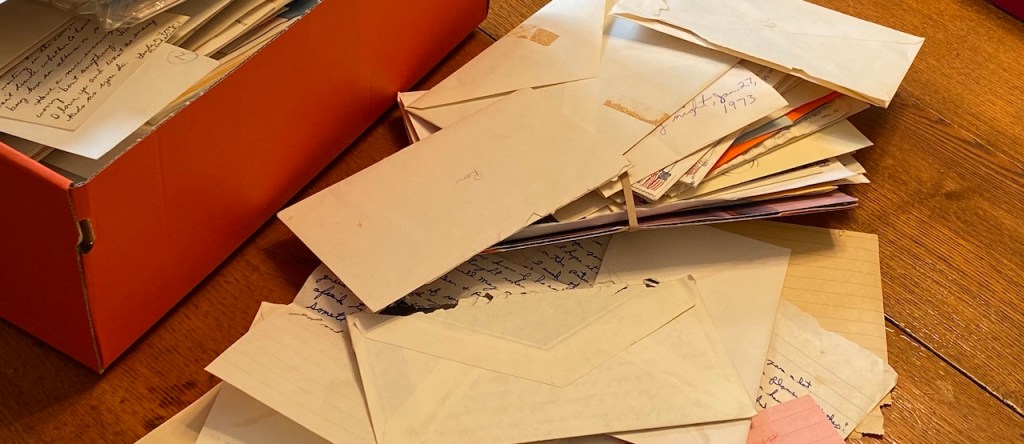
    Image:  Letters  – Photo by Ron W. G.

    Original Song:  “These Letters” with Prose Commentary

    My original song “These Letters” is a rather uncategorizable love song:  it does not exactly fit into the lost love category, nor does it fit into the romantic, idealism of most love songs.

    Introduction and Lyric of “These Letters”

    The singer and the individual addressed in the song have apparently had a friendly, loving relationship in the past—even likely lived together experiencing the life that the singer suggests with images in the song.  However, the addressee at the time of the song remains at some distance from the singer.   The fact that they have been exchanging letters reveals that a spacial distance exists between the two parties.

    The singer does not reveal the reason for the two being apart, but the fact that she hopes the addressee will return to her leaves open the question for the addressee’s departure and even whether the addressee will ever return.  The singer expresses the wish and hope that the addressee will return, and by that expression of that wish/hope, she is implying that the addressee many not ever return.

    Interestingly, the mention of being “far apart” is not clear that the singer is referring only to distance in miles, but it is obvious that a spacial distance exists because of the very title of the song.  The song cannot be considered a “lost love” song because the singer expresses her love for the distant individual and that she hopes the addressee will return to her.  Whether the two reunite remains a mystery because the theme of the song is simply that letters are not sufficient to maintain a close relationship.

    These Letters

    First Verse

    Here I sit with knitting needles
    Winter drawing near.
    Mind on fire with old desire
    Wishing you were here.
    So I’ll make this sweater
    To send to you
    With the love that’s in my heart
    And I’ll tell you that I long for you
    ‘Cause we’re so far apart.

    Second Verse

    The wine in the cellar gets better and better.
    I wish you could taste some with me.
    I try not to show
    The young plants as they grow
    How empty and sad I can be.
    The tomato vines hung so full this year
    I wish you had been here to see.
    I’ll send you some pictures and strawberry jam
    And my hopes that you’ll come back to me.

    Chorus

    These letters can’t take your place, my Love.
    I hope that you come back to me.
    No, these letters can’t take your place, my Love.
    I hope that you come back to me.

    Commentary on “These Letters”

    Because the title of the song is “These Letters,” the singer is placing great emphasis on that form of writing.  But she is letting the recipient of her letters know that she finds such correspondence insufficient to maintain their relationship.  While letters cannot take the place of the missing individual, she singer adds her hope their the addressee will return to their her and their life together.

    First Verse:   A Distant Relationship

    Here I sit with knitting needles
    Winter drawing near.
    Mind on fire with old desire
    Wishing you were here.
    So I’ll make this sweater
    To send to you
    With the love that’s in my heart
    And I’ll tell you that I long for you
    ‘Cause we’re so far apart.

    The singer begins by noting where she is and suggesting what she is doing:  she is sitting somewhere, likely in her home, with a pair of “knitting needles.”   She then alerts the addressee and her listeners to the fact that the winter season is coming soon.

    The fact that the coldest season is nearly upon her prompts her to reveal the reason for her sitting with knitting needles:  she is knitting a sweater for the individual, whom she is addressing in the song.  She then tells the individual that she is sending the sweater to him/her.  She adds the unexpected element that she will also be sending love the person.  

    Love resides in her heart for the person she is addressing, and she wishes they were not “so far apart.”  She reports that she will tell the individual that she “long[s] for [the individual]” because of the vast separation.

    Second Verse:  Hopes for Return

    The wine in the cellar gets better and better.
    I wish you could taste some with me.
    I try not to show
    The young plants as they grow
    How empty and sad I can be.
    The tomato vines hung so full this year
    I wish you had been here to see.
    I’ll send you some pictures and strawberry jam
    And my hopes that you’ll come back to me.

    The singer then reveals that she and the individual whom she is addressing have made wine together.  Their wine gets “better and better” as it rests in the cellar.   This set of imagery “wine” and “cellar” implies that the singer and the individual reside in the country, in a bucolic setting as opposed to city living, where cellars are not common, nor is wine-making.

    More evidence for the country living is that the singer next mentions the growing of the grapes for the wine, which likely represent other plants that the singer and her friend have formerly grown together.

    Now that she and the individual have distance between them, she singer is “empty and sad,” but as the cultivates the garden, she attempts to put on a happier face for the sake of the plants, as plants can be sensitive to the mood of their caretaker.

    She then tells her friend that the tomato harvest was especially good this year.  And again she expresses the wish that her friend had been there to experience those full-hanging tomato vines.  The singer then alerts her friend that she will send the individual pictures—likely images of those garden plants, particularly the tomatoes that grew so abundantly.  

    In addition to the pictures, she will send “strawberry jam”—another indication that the singer lives out in the country where she has the space to grow strawberries.  And again, this singer expresses “hopes”—this time, somewhat more than a mere “wish”—that the individual will return to the singer.

    Chorus:  What Letters Cannot Do

    These letters can’t take your place, my Love.
    I hope that you come back to me.
    No, these letters can’t take your place, my Love.
    I hope that you come back to me.

    The chorus which is offered only twice expresses the fact that the two individuals have been exchanging letters.   The singer makes her feelings known that letters are not sufficient to maintain the loving relationship that the two had earlier experienced.

    The chorus itself even repeats the fact that the letters are not enough.  The singer remains hopeful that the now distant former friend and likely housemate will return to her and their life together.

  • Original Song:  “Where You Are”  with Prose Commentary

    Image: Pacific Ocean – August 2015 – Self-Realization Fellowship Meditation Gardens – Encinitas CA – Photo by Ron W. G.

    Original Song:  “Where You Are”  with Prose Commentary

    This song Where You Are” is one of my original compositions. The video accompanying it was created by landscape artist/photographer Ron Grimes.

    Introduction and Text of “Where You Are”

    My original song “Where You Are”is based on a simple premise: the singer is addressing her Divine Belovèd (God), asserting to the Belovèd the desire to be where the Ultimate Loved One is.

    Each verse features rhetorical questions and musings upon the actual location of the Divine Creator.  Because the Creator/Father of all creation is both within creation and outside of creation, the answer to all of the rhetorical questions is, naturally, yes.

    Nevertheless, being where the Divine Belovèd is cannot be the same situation as being where a human friend or beloved is.   Because it seems that God is playing hide and seek with his children, the singer asserts that her soul “soul tugs at the veil hiding You from me.”

    Where You Are

    First Verse

    Are You standing on top of a mountain?
    Are You sitting beside the vast grave sea?
    How can I ever approach You?
    Will You ever just come to me?

    Second Verse

    Are You speaking to me through my loved ones?
    Are You quietly whispering through the silver stars?
    Are You waiting to hear what my songs will sing?
    Do You listen to the rapid beat of my heart?

    Third Verse  

    If I offer You all in my stillness—
    If I silently listen to the hum in my mind—
    If I patiently fast from all my senses—
    Will You break Your vow of silence and just come to me!

    Chorus 

    Where You are is where I long to be.
    I cannot understand where else I could seek.
    My soul tugs at the veil hiding You from me.
    Where You are is where I long to be.

    Video: Linda Sue Grimes performing “Where You Are”  

    SoundCloud:  Linda Sue Grimes performing “Where You Are” 

    Commentary on “Where You Are”

    After much questioning, contemplating, and ultimately meditating, the devotee will find that the soul will remove the veil hiding it from the Over-Soul—the soul’s Creator, the Divine Belovèd, or any of the preferred name for the Ineffable (God).

    First Verse:  “Are You standing on top of a mountain?”

    Are You standing on top of a mountain?
    Are You sitting beside the vast grave sea?
    How can I ever approach You?
    Will You ever just come to me?

    The singer opens with four rhetorical questions to the Divine Reality.  The first two questions reveal earthly locations that are considered sanctuaries of sacredness, holiness, or just ordinary vacation escapes:  mountain tops and sea sides. 

    The next two questions reveal that the devotee is still walking the sacred, devotional path to soul-realization (also known as self-realization or God-realization).  

    Before final liberation, the devotee experiences the separation from her Goal to be a heavy burden.  That burden causes her to wonder if she, in fact, will ever be able to unite with the Creator/Father.

    In her melancholy and sorrowful mourning because of the seeming distance, the devotee often wonders if the Lord will ever appear to her and make her know that she is His own child.   Will she ever be able to attain the Sacred Goal of self-realization and experience unity with her Belovèd Divine Creator?

    Second Verse:  “Are You speaking to me through my loved ones?”

    Are You speaking to me through my loved ones?
    Are You quietly whispering through the silver stars?
    Are You waiting to hear what my songs will sing?
    Do You listen to the rapid beat of my heart?

    In the second verse, the singer/devotee continues with rhetorical questions.  Intuiting the answer yet not knowing the fullness of each answer, she inquires of the Divine Belovèd if He is communicating with her through her family and friends.

    The singer likely is aware that God is speaking to her through everyone she knows and meets.  But without that last step in the process of enlightenment, she does not know exactly what is being said or exactly what all that conversation might ultimately mean to her.

    Thus, she also wonders if the One Who fashioned the “silver stars” may be signaling to her through those heavenly entities.  Again, she likely knows it to be a fact, but that separation continues to prompt questions.  

    The singer wonders if Divine Mother anticipates what she sings in her songs.  She wonders if her musical worship is reaching its intended Goal.

    The singer/devotee often becomes anxious with a rapid heart beat, knowing that that heart beat needs to become calm to achieve stillness.  She therefore wonders if the Creator Divine cares to listen to that rapid heart beat.  And she wonders if the Ultimate Physician will perform some medical heavenly magic to help her still her rapid heart.

    Third Verse:  “If I offer You all in my stillness”

    If I offer You all in my stillness—
    If I silently listen to the hum in my mind—
    If I patiently fast from all my senses—
    Will You break Your vow of silence and just come to me!

    The singer/devotee’s questioning becomes even more intense in the lyric of the final verse.    She has shown that she knows that she must still the rapid beat of her heart, but she also must still all of her senses as she offers her every atom to the Divine Essence.

    The devotee/singer shows awareness that she must listen the divine hum of the cosmic motor, the sacred AUM (Om) sound that upholds all of creation.  She knows that she must remove her attention from worldly things and events and place that attention upon the locus beyond the senses, where the soul resides.

    The singer/devotee remains certain that after she is able to accomplish all that is implied in her questions and musings, the Divine Belovèd Presence will, in fact, “break [that] vow of silence and [ ] come to [her].”

    Chorus:  “Where You are is where I long to be”

    Where You are is where I long to be.
    I cannot understand where else I could seek.
    My soul tugs at the veil hiding You from me.
    Where You are is where I long to be.

    The chorus, instead of offering mere rhetorical questions and musings, makes an affirmative statement:  the singer asserts that she wants to be where her Divine Beloved is.   She reveals her intuition that she cannot find love, peace, fulfillment on the physical, earthly plane.

    The singer/devotee insists that her soul is attempting to rend the cloth of separation from the Divine, as it “tugs at the veil” that keeps her from uniting with the Creator Belovèd. 

    The final line emphasizes as it repeats the important desire: “Where You are is where I long to be.”  The importance of the chorus is demonstrated by its repetition after every verse.