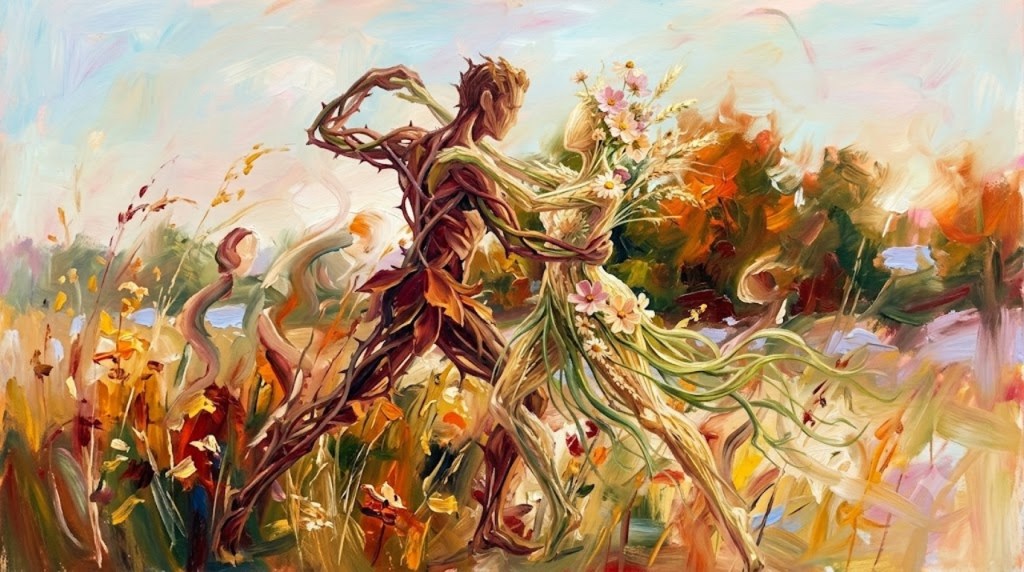
After the Spring Thaw
My summer mind
makes my thighs
and my tongue move
in ways all the talk
and friction
of last winter
could not pull off.
If you join me
in this heat,
we’ll find out
if we have the guts
to burn each other.
We’ll listen to the song
that the urge sings
as it rubs itself
hard against guilt.
We’ll hear the tale
that nature tells
to that place in the body
that beats itself to death
demanding for itself
body after body.
And if the heat
hangs hot enough
and we work and sweat
long enough that night,
we will come to
that place that runs
deep into the center
of the body on fire,
that place where knowledge
and love contradict each other.
A Prose Commentary on My Original Poem “After the Spring Thaw”
In my poem “After the Spring Thaw,” I have created a speaker who is reflecting on the awakening of desire after a season of emotional and physical dormancy. The seasonal movement from winter into summer becomes a controlling metaphor for the reemergence of instinct, passion, and longing, while the speaker contemplates the uneasy relationship between bodily appetite and the claims of conscience.
The poem does not celebrate desire uncritically, nor does it condemn it. Rather, it allows the natural world to mirror the forces that arise within the human person. Summer symbolizes vitality and release, but it also exposes the hidden tensions between impulse and moral awareness. My speaker remains attentive to both realities without allowing either one to dominate the musing.
The language throughout remains deliberately physical—thighs, tongue, heat, friction, sweat, body—yet each concrete image gestures beyond sensuality toward psychological and spiritual complexity. The body becomes the stage upon which conflicting truths encounter one another. My speaker does not resolve those conflicts but instead follows them toward their deepest implications.
Underlying the poem is my conviction that human desire is neither wholly trustworthy nor wholly corrupt. It belongs to the created order, yet it continually presses against the boundaries established by wisdom and self-knowledge.
Such an understanding has been profoundly shaped by the spiritual teachings of my blessèd Guru Paramahansa Yogananda, who consistently emphasized the necessity of bringing bodily impulses into harmony with divine consciousness.
First Stanza: Awakening after Winter
My summer mind
makes my thighs
and my tongue move
in ways all the talk
and friction
of last winter
could not pull off.
In the opening stanza, my speaker introduces the contrast between winter and summer as a metaphor for differing states of consciousness. The “summer mind” is not merely seasonal but psychological, suggesting an inward awakening that immediately manifests itself through the body. Thought itself becomes embodied as thighs and tongue begin moving in ways that winter had rendered impossible.
The reference to “talk / and friction / of last winter” implies that language, argument, or strained intimacy proved incapable of producing genuine transformation. Summer accomplishes effortlessly what conflict could not. The speaker suggests that desire often arises independently of reason, arriving with the force of nature rather than the conclusions of deliberate thought.
Second Stanza: Mutual Risk
If you join me
in this heat,
we’ll find out
if we have the guts
to burn each other.
Here, my speaker shifts from solitary reflection to direct address. The invitation is not merely erotic but existential, for entering “this heat” requires courage as well as attraction. Passion carries within itself the possibility of injury, and the image of burning evokes both pleasure and destruction.
The phrase “have the guts” deliberately emphasizes physicality while also invoking emotional resolve. The speaker recognizes that intimacy demands vulnerability. To approach another person honestly is always to risk mutual wounding, even when both participants willingly embrace the encounter.
Third Stanza: Desire against Conscience
We’ll listen to the song
that the urge sings
as it rubs itself
hard against guilt.
In this brief but concentrated stanza, my speaker personifies desire as a singer whose music emerges through friction with guilt. The imagery remains deliberately tactile, for the urge does not merely exist; it presses insistently against the moral awareness that resists its demands.
Rather than presenting guilt as an enemy or desire as a villain, the speaker allows both forces to remain active within the same experience. Their friction generates the poem’s emotional energy. The implication is that human beings rarely encounter desire in a morally neutral condition; appetite and conscience frequently arise together.
Fourth Stanza: Nature’s Ancient Story
We’ll hear the tale
that nature tells
to that place in the body
that beats itself to death
demanding for itself
body after body.
The fourth stanza broadens the musing from individual experience to the universal voice of nature. The speaker imagines nature continually telling its ancient story to the body’s deepest instinct for reproduction and possession. This tale is persuasive because it speaks directly to appetite rather than to reason.
The heart, or perhaps desire itself, “beats itself to death” in endless pursuit of one body after another. The hyperbole underscores the insatiable quality of physical longing when it becomes detached from higher purpose. My speaker suggests that instinct alone cannot satisfy itself because each fulfillment immediately gives rise to renewed craving.
For further clarification, the “one body after another,” alludes to reincarnation, not polyamory. Interestingly, both interpretations work in sussing out the meaning of the poem. But without the nod to reincarnation, the poem’s spirituality will go lacking.
Fifth Stanza: The Center of Contradiction
And if the heat
hangs hot enough
and we work and sweat
long enough that night,
we will come to
that place that runs
deep into the center
of the body on fire,
that place where knowledge
and love contradict each other.
In the concluding stanza, my speaker carries the imagery beyond physical exhaustion into a symbolic interior landscape. The lovers arrive not simply at bodily fulfillment but at “that place” lying deep within the human person. The repeated phrase marks the movement from external experience toward interior revelation.
The poem culminates in the assertion that “knowledge / and love contradict each other.” My speaker is not claiming that genuine love opposes truth, but rather that human passion often exposes painful contradictions between what one knows to be wise and what one longs to embrace.
The body becomes the arena in which these opposing claims reveal themselves most intensely. The speaker deliberately leaves that contradiction unresolved, recognizing that some of the deepest realities of human existence resist easy reconciliation.
An Afterthought
In “After the Spring Thaw,” I attempted to explore the mysterious reawakening of desire as both a natural force and a spiritual challenge. The seasonal imagery provides the framework through which the speaker examines the body’s vitality without ignoring the claims of conscience or higher understanding.
The poem ultimately suggests that physical passion reaches beyond itself toward questions that neither instinct nor intellect can answer alone. At its deepest center, desire reveals not only the body’s hunger but also the soul’s continuing struggle to reconcile knowledge, love, and the longing for wholeness.

