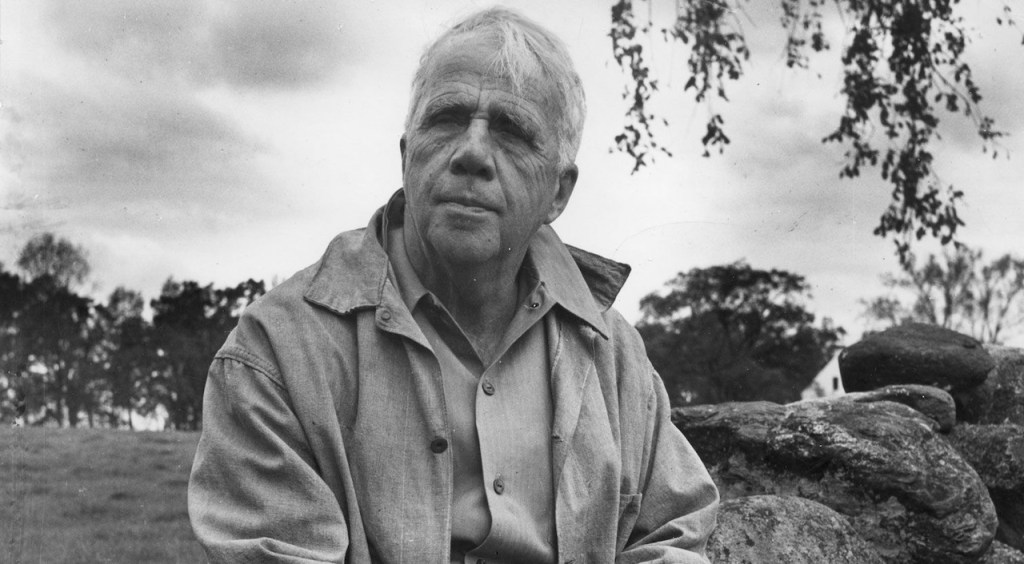
Robert Frost’s “War Thoughts at Home”
Robert Frost’s “War Thoughts at Home” is a collection of seven stanzas, which sounds more like a list of notes than a poem, as the title clearly reveals. It seems likely that Frost did not consider “War Thoughts at Home” to be a finished, polished poem. Clearly, it is a list of “thoughts” as the title states.
Introduction and Text of “War Thoughts at Home”
Robert Frost’s “War Thoughts at Home” consists of seven “notes,” with the rime scheme ABCCB in each.
A Sow’s Ear, not a Silk Purse
This piece seems to be most aware of itself as trying to be poetic. It is for this reason that critics and scholars should understand that it is not a poem at all, but merely a list of thoughts. And, in fact, Frost did not publish this piece as a poem. This “list of thoughts” was found among his archival materials, jotted down on a flyleaf of his book, North of Boston.
As a poem, this list is seriously flawed. Robert Frost would probably be embarrassed that people are fawning over it as an important Frostian find, or he might also get a belly laugh at the vacuity of contemporary people of letters.
It is merely a list that seems to wax profound trying to compare a bird fight to the war in France. But it is obviously not meant to be a finished poem; likely Frost’s trickster nature had him put the notes in rime, just to throw people off. Frost’s best works demonstrate how much better than this he was as a poet.
War Thoughts at Home
On the back side of the house
Where it wears no paint to the weather
And so shows most its age,
Suddenly blue jays rage
And flash in blue feather.
It is late in an afternoon
More grey with snow to fall
Than white with fallen snow
When it is blue jay and crow
Or no bird at all.
So someone heeds from within
This flurry of bird war,
And rising from her chair
A little bent over with care
Not to scatter on the floor
The sewing in her lap
Comes to the window to see.
At sight of her dim face
The birds all cease for a space
And cling close in a tree.
And one says to the rest
“We must just watch our chance
And escape one by one—
Though the fight is no more done
Than the war is in France.”
Than the war is in France!
She thinks of a winter camp
Where soldiers for France are made.
She draws down the window shade
And it glows with an early lamp.
On that old side of the house
The uneven sheds stretch back
Shed behind shed in train
Like cars that long have lain
Dead on a side track.
Commentary on “War Thoughts at Home”
Robert Frost, no doubt, would laugh heartily at contemporary scholars for mistaking this list of notes for a poem.
First Note: Blue Birds Fighting
On the back side of the house
Where it wears no paint to the weather
And so shows most its age,
Suddenly blue jays rage
And flash in blue feather.
The speaker describes a house, noting that the s “back side” seems to take the brunt of the bad weather; as a result of all this tumultuous weather, the paint has worn off, and this side of the house shows its age more than the other sides.
It is on this weather-beaten side of the house that a bunch of blue jays starts to rustle about. The speaker colorfully claims that the jays are flashing their blue feathers as they tussle all in a rage.
Second Note: Bleak Atmosphere
It is late in an afternoon
More grey with snow to fall
Than white with fallen snow
When it is blue jay and crow
Or no bird at all.
The speaker continues to describe a bleak atmosphere. The time is late afternoon, and it looks as if it will be snowing soon; there is a gray (British spelling “grey”) look to the scene, a time when there may be present a blue jay or a crow or more likely still, “no bird at all.”
Third Note: Weather-Beaten Woman
So someone heeds from within
This flurry of bird war,
And rising from her chair
A little bent over with care
Not to scatter on the floor
The speaker introduces a woman inside the house who has heard the birds’ racket, and she goes to the window. She is old and as weather-beaten as the house, “A little bent over with care.” She has been sewing so she gets up from her chair carefully placing her sewing aside so she won’t drop it on the floor.
The term “bird war” is employed, and for the first time the list begins to reveal the nature of its claim to be thoughts of war. The reader might feel that the house has already demonstrated a kind of war with the weather; then the birds reveal of kind of war. And now enters a human being who will add the “war thoughts.”
Fourth Note: Repetition
The sewing in her lap
Comes to the window to see.
At sight of her dim face
The birds all cease for a space
And cling close in a tree.
The third and fourth stanzas are connected by sharing the same sentence. The woman comes to the window to see the birds, but the birds stop warring for a bit and remain huddled in a tree. The reader is to infer that they see this woman’s face staring at them and they cease their “war.”
Fifth Note: WW I Prattles on
And one says to the rest
“We must just watch our chance
And escape one by one—
Though the fight is no more done
Than the war is in France.”
Then one bird begins to speak, asserting that they must remain alert so they can escape a fight, similar to the “war in France.” Frost is said to have “inscribed a new poem” into a copy of his published North of Boston in 1918. Thus, the war is World War I.
The bird says that they can escape this human if they lay low and leave one at a time, but he admits that the fight is not over yet, just as the fight in France is not over yet; however, the war in Europe did end by September of 1918.
Sixth Note: Who Says What?
Than the war is in France!
She thinks of a winter camp
Where soldiers for France are made.
She draws down the window shade
And it glows with an early lamp.
In the sixth stanza, the speaker repeats the line, “Than the war is in France!” But it is unclear whose words these are. The bird said that same line, but now the same line appears unattributed. Then the speaker is telling the reader what the woman is thinking: she is thinking of an undisclosed place where soldiers train before being sent to France. She calls it a “winter camp.”
Again, it is not clear. Where is the winter camp? Is it in the United States, which only entered the war a year earlier? Is it in France? There is nothing to clarify why this woman would know these things. Perhaps the reader is to assume that she has a relative who was sent to this war, but the reader cannot determine so. Then the woman draws the shade, which “glows with an early lamp.”
Seventh Note: Out the Back Window
On that old side of the house
The uneven sheds stretch back
Shed behind shed in train
Like cars that long have lain
Dead on a side track.
The seventh stanza simply gives a description of what one would see if one were looking out back from “that old side of the house.” This sounds strange because in the opening stanza, it seemed that the weather had been responsible for making the house look old, but now the speaker actually calls that side “that old side of the house.”
One has to wonder how one side might be any older than the other sides. And what one sees there is a line of old sheds that give the appearance of railroad cars that have “lain / Dead on a side track” for a long time.
Turning this list into a poem rides on the notion of turning a sow’s ear into a silk purse.
 Linda's Literary Home