Linda's Literary Home

Tag: Frank Marshall Davis

  • Langston Hughes’ “Cross”

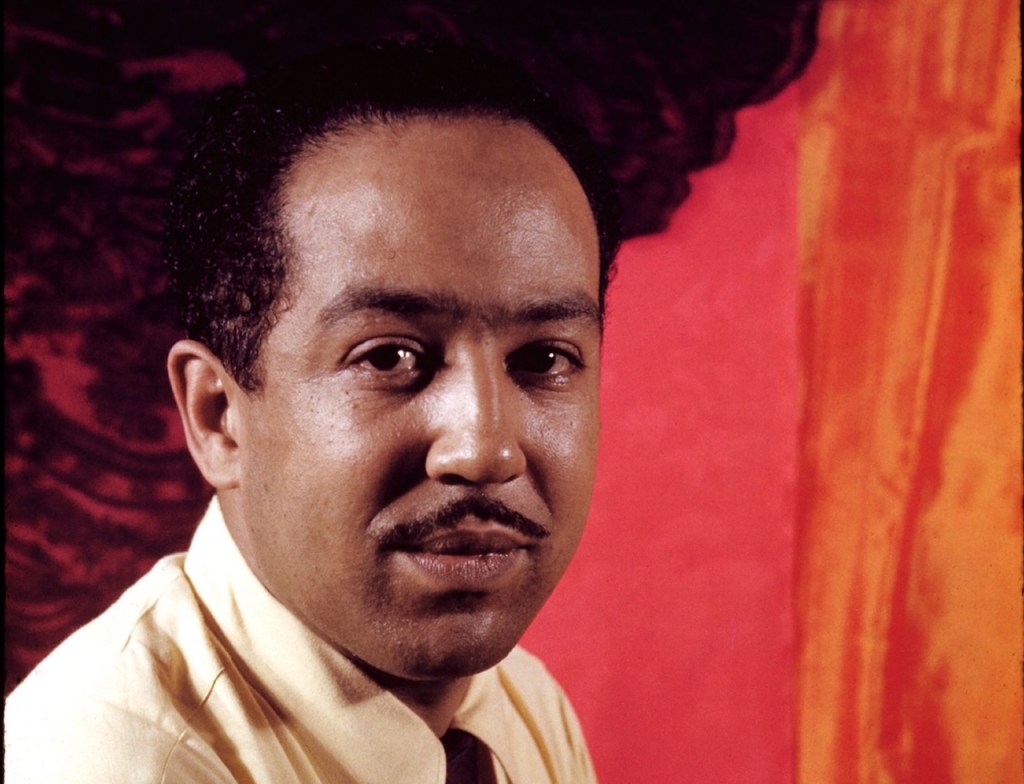
    Langston Hughes -  https://www.newyorker.com/magazine/2015/02/23/sojourner -  Photograph by Carl Van Vechten / Carl Van Vechten Trust / Beinecke Library, Yale - 1280
    Image: Langston Hughes – Photograph by Carl Van Vechten / Carl Van Vechten Trust / Beinecke Library, Yale – 1280

    Langston Hughes’ “Cross”

    The speaker in Langston Hughes’ “Cross” laments having been born to biracial parents, a white father and a black mother.  But the poem merely dramatizes stereotypes, and that reliance limits its achievement. This poem fails to exemplify the true achievement of this poet.

    Introduction with Text of “Cross”

    The speaker in Langston Hughes’ “Cross” is lamenting having been born to a mixed racial couple, a white father and a black mother.The title implies two meanings: he is the “cross” between two individuals, as are all human beings a cross between their parents.  But this speaker’s special situation of being a cross between two races causes him to suffer a burden, as in the idiom “cross to bear” [1].

    The poet, Langston Hughes, who penned this piece, was black and so were both of his parents:  about his parents, Hughes has remarked [2], “My father was a darker brown. My mother an olive-yellow.”

    Thus, he is not speaking from the experience of a mixed race individual but instead is relying on stereotypes as he explores the possible, and perhaps even, likely feelings of a biracial man.

    Cross

    My old man’s a white old man
    And my old mother’s black.
    If ever I cursed my white old man
    I take my curses back.

    If ever I cursed my black old mother
    And wished she were in hell,
    I’m sorry for that evil wish
    And now I wish her well

    My old man died in a fine big house.
    My ma died in a shack.
    I wonder where I’m going to die,
    Being neither white nor black? 

    Commentary on “Cross”

    One of Langston Hughes’ less successful pieces, his poem “Cross” does not dramatize the true feelings of a mixed race man.  The piece, instead, relies heavily on mere stereotypes, such as a rich white father and a poor black mother—rich father dying in a mansion, poor mother dying in a shack.  Supposedly, this situation leaves the biracial speaker wondering where he will die because he, incongruously, considers himself of neither race (of course, he is of both.)

    First Stanza:  Cursing the Father

    My old man’s a white old man
    And my old mother’s black.
    If ever I cursed my white old man
    I take my curses back.

    The speaker commences his lament by reporting that his father is white while his mother is black.  The speaker is thus an adult looking back over the events of his life as he remembers them, but it remains unclear how old the speaker may be at the time of his musing.  

    It may be assumed that he has seen enough of life to find that being a biracial individual can be a burdensome experience; thus, he is claiming he has had a heavy cross to bear during his lifetime.

    The speaker then admits that in the past he has spoken ill of his “white old man,” but now he has had a change of heart and wants to retract those inflammatory words.  The speaker offers no reason for his changing his mind about his father, but the poem moves along with a fine, rhythmic, well-rimed clip.

    While speculation about the motives or intentions [3] of a speaker in poem may remain unhelpful or even counterproductive, one can quietly assume that the speaker has just decided that forgiveness leaves the conscience more peaceful than hanging on to a grievance.  

    Because the poem relies only on stereotypes of what life is like for a mixed race individual, it is likely that the poet is just configuring his words to fill out his poem with possible riming sounds that move along in a pleasant meter.

    Second Stanza:  Cursing the Mother

    If ever I cursed my black old mother
    And wished she were in hell,
    I’m sorry for that evil wish
    And now I wish her well

    As the speaker has formerly “cursed” his father, he has also “cursed” his mother, even wished her to be condemned to “hell.”  But again as with his father, he now wants to retract those curses.  And with the old black mother, he now even “wishes her well.”

    The speaker did not wish his father well; he wished only to take back his curses that he has hurled at the old man.  Therefore, the speaker renders a least a tittle more affection for the mother.

    This situation is quite understandable:  the speaker was likely raised by the mother, thus in reality, he identifies more with his black racial makeup than his white.  Plus the very nature of motherhood more than fatherhood lends itself to more affection [4] by most children.

    Third Stanza:   Remaining in Confusion

    My old man died in a fine big house.
    My ma died in a shack.
    I wonder where I’m going to die,
    Being neither white nor black? 

    Somewhat vaguely, the speaker is suggesting that he was not raised by both parents, perhaps even by neither.  Stereotypically, he has his father, the “white old men,” die in a “fine big house.”  So he, at least, knows where his father lived, unless he is merely guessing, based on stereotype.

    Stereotype again intact, he has his “black old mother” dying “in a shack.”  Again, it remains unclear if the speaker was raised by the mother, even though that is likely.  If the speaker was raised by his mother, he would likely assume that he would die as she did.

    If the speaker had been raised by the father in a “fine big house,” again he would assume that he would die as his father did.  These assumptions suggest that the speaker has accomplished a life that is not quite as rich as his father’s but not quite as poor as his mother’s.  The speaker’s socio-economic status is ultimately irrelevant, however.  

    That the speaker sees himself as “neither white nor black” poses an important question, however:  why does he not think of himself as both white and black?  Biologically, he is, in fact, both white and black. What would that acceptance imply for the speaker’s confusion?

    Such speculation goes beyond the scope of this poem or any commentary about it; the poet, Langston Hughes, had no doubt been acquainted with individuals who expressed such mixed feelings.  

    Still, because Hughes was a master craftsman, who composed many fine, genuine pieces of writing, the poem clips along at an entertaining pace, even though it lacks the luster of a poem [5], such as Hughes’ “The Negro Speaks of Rivers,” which truly offers enlightenment of its subject.

    Facts and Feelings

    While each individual is entitled to his own feelings, opinions, and thoughts, he is not entitled to the facts surrounding and/or motivating those feelings, opinions, and thoughts. For example, if a black individual claims that he feels depressed, angry, or outraged because racism keeps him from attaining his goal of becoming a lawyer, we must believe his claim that he feels that way.

    However, we do not have to accept his reason for his feelings, because lawyers come in all races; there are two black justices currently serving on the U.S. Supreme Court.  So he is perfectly free to believe that racism is the cause of his feelings, but just because he believes it does not make it true. 

    The question then would arise, what is causing him to fail to understand that there must be other reasons—not racism—that he has failed to achieve his goal of entering the legal profession?  Similarly, the biracial fellow in “Cross” is entitled to feel that he is confused because he is not black or white.  But the fact of the matter is that he is both black and white.  

    So the next question for him might be, what are you doing to address your ongoing confusion from your black-and-whiteness?   One might argue that in all cases, stereotypical responses to issues actually prevent the ability to properly address those issues.  One cannot solve a problem that has been misidentified.

    Sources

    [1] Curators. “cross to bear.” Farlex Dictionary of Idioms. 2015.

    [2] Denise Low & T. F. Pecore Weso.  “Langston Hughes on His Racial and Ethnic Background.”  Kansas History.  2004.

    [3]  Nasrullah Mambrol.  “Intentional Fallacy.”   Literary Theory and Criticism.  March 17, 2016.

    [4]  Paramahansa Yogananda.  “Beauty and Joy, Grace and Refuge: Living in the Presence of the Mother Divine: Discover the Feminine Aspect of God.”  Self-Realization Fellowship Official Website.  Accessed October 31, 2023.

    [5]  Linda Sue Grimes.  “Langston Hughes’ ‘The Negro Speaks of Rivers’.”  Linda’s Literary Home.  February 11, 2026.

    The Cross of Barry Soetoro
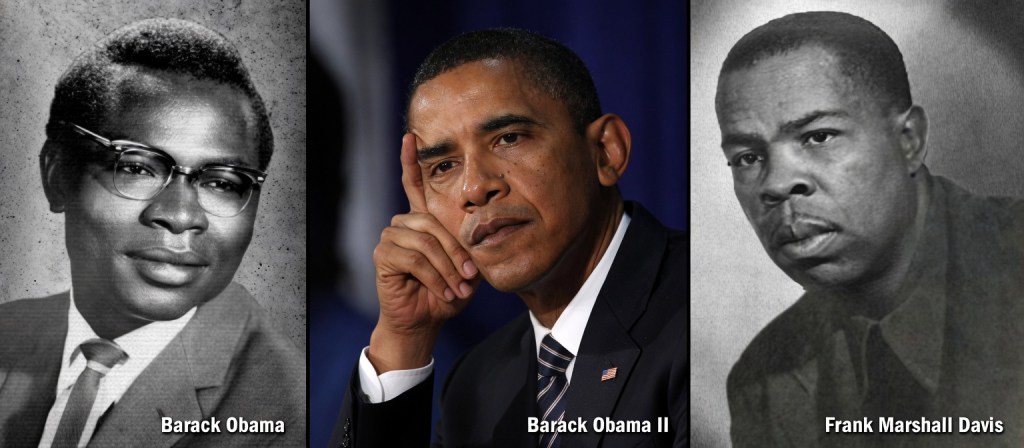
    Image: Obama I Obama II Davis – Alchetron.

    The poet Langston Hughes did not experience life as a biracial individual, because both of his parents were black.  Thus, the poet has created a character in his poem to attempt to make a statement about biracial individuals. 

    Hughes’ poem is not entirely successful in making that statement:  the poem depends only on a stereotype, the one that offers the notion that biracial individuals will remain confused because they cannot figure out with which race they should identify.

    Barack Obama, in his biographical, Bill Ayers-ghost-written Dreams from My Father, claims to have suffered the same confusion, but because he was raised by the white side of his family, he clearly absorbed the values of the white, communist ideological spectrum to which that family ascribed.  

    Obama’s attempt to identify as “black” came as he discovered the advantages of that now politically advantaged identity group.  Also, instead of sporting the name of his likely true biological father, Frank Marshall Davis, Obama achieves an even further boost at being a cosmopolitan, world citizen, with the ability to jokingly assert that he has a “funny name.”  

    In order to achieve that joking stance, Obama changed the name he had been using, “Barry Soetoro,” to “Barack Obama”—”Barry” just didn’t quite fit the joke of the “funny name.”

    The vagueness and hypocrisy of taking a stance with which one is not wholly familiar results in formless, vague imagery.  Therefore, in Hughes’ “Cross,” the speaker remains a vague, unformed figure.  And such a figure cannot convey a fully formed notion of what it is actually like to have lived life as a biracial individual. 

    The speaker’s goal in Langston Hughes’ “Cross” like that of “Barack Obama” is to air a grievance in hopes of achieving an unearned status, not to honestly inform.  As Obama remains a crepuscular figure on the horizon, Hughes’ poem remains a mere glance at a stereotype—not even close to what a poem needs to be to communicate its message.
  • Barack Obama’s “Pop”

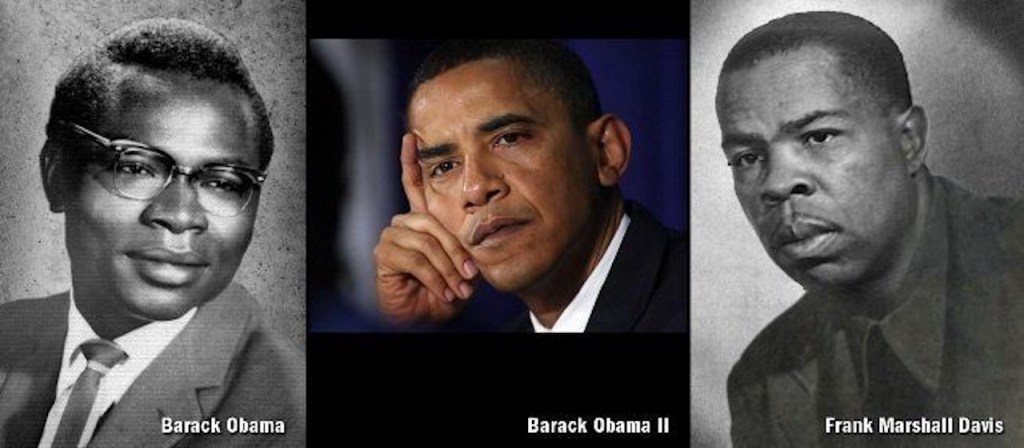
    Image: Obama I Obama II Davis - https://alchetron.com/Frank-Marshall-Davis
    Image: Obama I Obama II Davis – Alchetron

    There is a price to be paid for criticizing Obama.” Jack Cashill

    Barack Obama’s “Pop”

    In Barack Obama’s “Pop,” the speaker is sketching what appears to be a father-figure—likely Frank Marshall Davis—and offering a glimpse into the relationship between the two.  Obama called his maternal grandfather “Gramps,”  rendering it unlikely that the father-figure in this poem is Stanley Dunham.

    Introduction with Text of “Pop”

    The spring 1981 issue of Feast, Occidental College’s literary magazine, published two poems, “Pop” and “Underground,” by erstwhile literary prodigy Barack Obama.  According to Jack Cashill, long-time researcher of Obama’s literary efforts, Obama’s writings [1] suffer from, “awkward sentence structure, inappropriate word choice, a weakness for clichés,” and “the continued failure to get verbs and nouns to agree.” 

    Obama’s poems suffer from similar language indignities but also include further issues relevant to poems, such a faulty line breaks, confusing mixed metaphors, and inappropriate use of surrealist images.

    Although readers can forgive a 19-year old for adolescent scribblings in non-sense, especially in poems published in a college lit mag, what they cannot do is discern that this particular adolescent was showing any potential to produce a future writer. 

    Likely, the future, and now former, occupier of the Oval Office could have become a capable interpretive reader, and it is possible that Barack Obama would have served more admirably as an actor [2] than writer or president.  

    Barack Obama possesses a unique charm that could have been employed in creative ways, if he had kept his focus on the humanities and entertainment fields instead of politics and government.  The Obama administration, tainted by incompetence and corruption [3], has altered the American political landscape more intensely than any other in American history.  

    For this misdirection, Barack Obama is less to blame than his handlers, beginning with political American terrorist Bill Ayers, continuing with political hacks David Axelrod and Valerie Jarrett. 

    His coterie of political advisors steered him in a direction that has enriched Obama and that coterie financially, instead of enriching society in a humanitarian field of endeavor.  The former president’s piece titled “Pop” consists of one 45-line versagraph [4]. The piece’s awkward, postmodern codswallop represents much of what is despicable and destructive in most postmodern art.

    Pop

    Sitting in his seat, a seat broad and broken
    In, sprinkled with ashes,
    Pop switches channels, takes another
    Shot of Seagrams, neat, and asks
    What to do with me, a green young man
    Who fails to consider the
    Flim and flam of the world, since
    Things have been easy for me;
    I stare hard at his face, a stare
    That deflects off his brow;
    I’m sure he’s unaware of his
    Dark, watery eyes, that
    Glance in different directions,
    And his slow, unwelcome twitches,
    Fail to pass.
    I listen, nod,
    Listen, open, till I cling to his pale,
    Beige T-shirt, yelling,
    Yelling in his ears, that hang
    With heavy lobes, but he’s still telling
    His joke, so I ask why
    He’s so unhappy, to which he replies…
    But I don’t care anymore, cause
    He took too damn long, and from
    Under my seat, I pull out the
    Mirror I’ve been saving; I’m laughing,
    Laughing loud, the blood rushing from his face
    To mine, as he grows small,
    A spot in my brain, something
    That may be squeezed out, like a
    Watermelon seed between
    Two fingers.
    Pop takes another shot, neat,
    Points out the same amber
    Stain on his shorts that I’ve got on mine, and
    Makes me smell his smell, coming
    From me; he switches channels, recites an old poem
    He wrote before his mother died,
    Stands, shouts, and asks
    For a hug, as I shink, my
    Arms barely reaching around
    His thick, oily neck, and his broad back; ‘cause
    I see my face, framed within
    Pop’s black-framed glasses
    And know he’s laughing too.

    Commentary on “Pop”

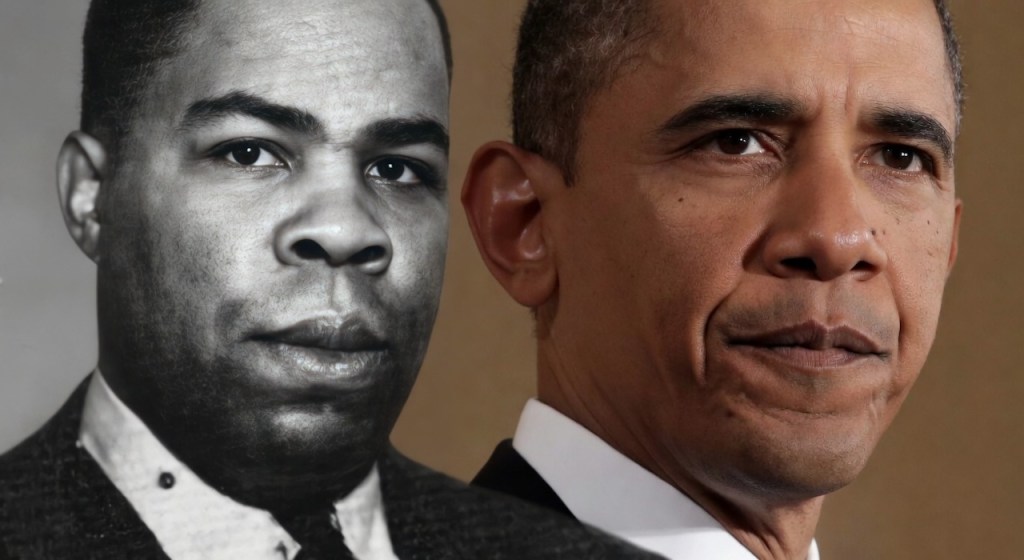
    The man addressed in Obama’s “Pop” is likely Frank Marshall Davis, long thought to be Obama’s biological father [5]. Barry called his Grandfather Dunham “Gramps” [6], not “Pop.”

    First Movement: Sheltered Young Man

    Sitting in his seat, a seat broad and broken
    In, sprinkled with ashes,
    Pop switches channels, takes another
    Shot of Seagrams, neat, and asks
    What to do with me, a green young man
    Who fails to consider the
    Flim and flam of the world, since
    Things have been easy for me;
    I stare hard at his face, a stare
    That deflects off his brow;
    I’m sure he’s unaware of his
    Dark, watery eyes, that
    Glance in different directions,
    And his slow, unwelcome twitches,
    Fail to pass.

    The speaker places his father-figure in his usual chair where the latter is watching television, enjoying his “Seagrams, neat.” The man, called Pop, begins accosting the young man by flinging at him a rhetorical question: “What to do with me?”  

    The speaker asserts that Pop thinks his young charge is just a “green young man / Who fails to consider the / Flim and flam of the world.” 

    Pop counsels the young man that the latter’s sheltered existence is responsible for the young man’s failure to recognize the “flim-flam” world. The speaker then stares at the old man, who exhibits a facial tick, while his eyes dart off “in different directions / And his slow, unwelcome twitches.”

    Frank Marshall Davis Is “Pop”

    While many reviewers of this poem have interpreted Pop to be Stanley Armour Dunham, the maternal grandfather who raised Obama, the former president’s hagiographer, David Maraniss, in his biography, Barack Obama: The Story, reveals that the poem “Pop” focuses on Frank Marshall Davis [7], not Stanley Armour Dunham.

    And the details of the poem all point to the truth of that revelation.  That Obama’s grandfather, who raised him, would be addressing such an issue with his young charge is untenable.   If the boy is incapable of considering the “flim-flam” of the world, whose fault would that be? It would be the person who raised the kid. 

    Obama’s relationship with Frank Marshall Davis, however, provides the appropriate station for such a topic of conversation. Davis took it upon himself to help the young Obama see the world through the lens of a black man in America. 

    Again, if “things have been easy for” the young Barry, it has been the grandfather who made them easy; thus, for the grandfather to be accosting the boy for that supposed flaw would be absurd.

    Obama’s grandfather introduced the boy to Davis for the purpose of providing Barry with the advice of an older man who had lived the life of a black man in America.  The Dunhams were heavily invested in identity politics as likely members of the Communist Party, as was card carrying member, Frank Marshall Davis [8]. 

    The grandfather was of the inclination that he could never guide a young black boy in certain areas but that Davis could. Whether that sensibility is accurate or not is the topic for another day, but the topic being discussed by the speaker of this poem precludes the poem’s addressing Obama’s white grandfather.

    Faulty Line Breaks

    Many of the bad line breaks [9] in the poem demonstrate the amateurish nature of the poetaster, who makes the rookie flaw of ending several lines with the definite article “the.” 

    About Obama’s use of line breaks, poet Ian McMillan sarcastically observes [10]: “Barack likes his line breaks, his enjambments: let’s end a line with ‘broken’ and start it with ‘in’ just because we can!”

    Second Movement: Surrealistic Encounter

    I listen, nod,
    Listen, open, till I cling to his pale,
    Beige T-shirt, yelling,
    Yelling in his ears, that hang
    With heavy lobes, but he’s still telling
    His joke, so I ask why
    He’s so unhappy, to which he replies…
    But I don’t care anymore, cause
    He took too damn long, and from
    Under my seat, I pull out the
    Mirror I’ve been saving; I’m laughing,
    Laughing loud, the blood rushing from his face
    To mine, as he grows small,
    A spot in my brain, something
    That may be squeezed out, like a
    Watermelon seed between
    Two fingers.

    The speaker then employs a surrealistic style as he continues to describe his encounter with Pop. 

    The speaker listens politely, nodding occasionally, as the old man declaims, but suddenly the speaker is “cling[ing] to the old man’s “[b]eige T-shirt, yelling / Yelling in his ears.” Those ears have “heavy lobes,” and the old man is “still telling / His joke.” But the speaker then asks Pop, “why / He’s so unhappy.”

    Pop starts to respond, but the speaker does not “care anymore, cause / He took too damn long.” The speaker then pulls out a mirror from under his seat. 

    The confusion here mounts because the speaker had just claimed he was clinging to Pop’s shirt and yelling in the old man’s ear, which would have taken the speaker out of his seat. This confusion adds to the surreal nature of the episode.

    After pulling out the mirror, the speaker asserts that he is “laughing, / Laughing loud.” What he does with the mirror is never made clear. But during his outbreak of laughter, Pop “grows small” shrinking to a “spot in [the speaker’s] brain.” 

    That tiny spot, however, “may be squeezed out, like a / Watermelon seed between / Two fingers.” This shrunken seed image of the speaker’s pop implies a level of disrespect that is quite breathtaking as it suggests that the speaker would like to eliminate Pop from his mind.

    Third Movement: Smelling the Stain

    Pop takes another shot, neat,
    Points out the same amber
    Stain on his shorts that I’ve got on mine, and
    Makes me smell his smell, coming
    From me; he switches channels, recites an old poem
    He wrote before his mother died,
    Stands, shouts, and asks
    For a hug, as I shink, my
    Arms barely reaching around
    His thick, oily neck, and his broad back; ‘cause
    I see my face, framed within
    Pop’s black-framed glasses
    And know he’s laughing too.

    The speaker observes that Pop “takes another shot, neat,” but he probably means that the old man took another sip; it is not likely that the father-figure is measuring out each swig with a shot glass. 

    With this swig, Pop “points out the same amber / Stain on his shorts that I’ve got on mine, and / Makes me smell his smell, coming / From me.” During the exchange, while clinging to Pop’s shirt, the speaker has stained Pop’s shorts.

    And Pop wants the speaker to realize his blame for the stain. At least, that’s one way to interpret the smelling the stain scene. 

    Others have inferred a sexual reference in the “smelling” scene, but that requires too much of a stretch, that is, a reading into the text what is not there and not implied.

    Pop then changes TV channels and “recites an old poem / He wrote before his mother died.” He then rises from his seat, “shouts, and asks / For a hug.” 

    The younger man realizes his smallness in comparison to the size of Pop: “my / Arms barely reaching around / His thick, oily neck, and his broad back.” But the speaker sees himself reflected in Pop’s “black-framed glasses.” And now Pop is “laughing too.”

    The reference to a poem written before Pop’s mother died also eliminates Grandfather Dunham as “Pop.” Dunham was only eight years old, when he discovered the body of his mother who had committed suicide. 

    The notion that an aged man would be quoting a poem that he wrote before he was eight years old is patently absurd. Plus there is no evidence that Grandfather Dunham ever wrote any poetry, while Frank is famously known as a poet, as well as his other endeavors in political activism and pornography.

    “Shink” Is Obviously a Typo and “Know” Is Likely “Now”

    Much has been made of the obvious typo in the line, “For a hug, as I shink, my.” The word is obviously “shrink.” Pop had shrunk to the size of a watermelon seed a few lines earlier, and now the speaker shrinks as he realizes how much smaller he is than Pop.

    It is quite possible that in the last line “know” is an additional typo, for the word “now” would be more appropriate. It would be nonsensical for the speaker to say he “knows” Pop is laughing when he is right there looking into his face. But it makes sense for him to report that during the hug Pop also begins to laugh.

    Interestingly, the editors of the New York Times quietly corrected the “shink” to “shrink” when they published the poems on May 18, 2008, in an article under the title, “The Poetry of Barack Obama [11]”. The editors did not correct the obvious error “know” for “now” in the last line.

    Sources

    [1]  Jack Kerwick. Jack Cashill’s Deconstructing Obama. American Thinker. February 25, 2011.

    [2]  Padmananada Rama. “Obama Heads To Hollywood; Conservative Group Mocks ‘Celebrity President’.” NPR. May 10, 2012.

    [3]  Hans A. von Spakovsky.  “Obama’s ‘Scandal-Free Administration’ Is a Myth.”  Heritage Foundation.  January 16, 2017.

    [4]  Linda Sue Grimes. “Poetic Devices: Tools for Poetry Commentary.” Linda’s Literary Home.  February 9, 2026.

    [5] Joel Gilbert. Dreams from My Real Father: A Story of Reds and Deception. Documentary. Trailer. July 24, 2012.

    [6]  Nancy Benac. “Obama’s Gramps: Gazing skyward on D-Day in England.” San Diego Union-Tribune. May 30, 2009.

    [7]  Cliff Kincaid. “The Red Diaper Baby in Obama’s Red Cover-Up.”  Renew America.  September 2, 2016.

    [8] Paul Kengor.  “What Obama’s Mentor Thought About General Motors.”  Forbes.  August 2012.

    [9] Eric McHenry. “Obama’s Oddest Critic.” Salon. July 17, 2012.

    [10]  Ian McMillan. “The Lyrical Democrat.” The Guardian. March 29, 2007.

    [11]  Editors.  “The Poetry of Barack Obama.” New York Times. May 18, 2008.

    Image: Frank Marshall Davis – Barack Obama II – PA Pundits International