I enjoy watching the cooking shows on TV, and as I watch, I constantly muse on how to convert their traditional uses of meat, eggs, milk, butter, and cheese to vegan versions. An example of this musing resulted in my “Vegan Meatloaf” that looks a lot like the meatloaf my mother used to make and tastes as yummy.
In addition to following a vegetarian diet, I also try to eat more alkalizing than acidifying foods. Most vegetables and fruits, some nuts, and pseudo grains are alkalizing; therefore, my recipes frequently call for sprouted grains to replace regular whole grains; however, I do use whole-wheat flour and unbleached organic flour occasionally, especially for biscuits and gravy.
I replace regular salt with sea salt, refined sugar with agave nectar, stevia, or raw sugar, depending on the recipe, and soy milk with coconut milk.
This kind of cooking requires experimentation, and these webpages, as well as my published cookbook, feature the recipes that I have tried and deemed successful—although I continue to think of my cooking as experimental because I hardly ever make a dish the same way twice.
And my dishes always have a rather ragged look about them that I call rustic. The pictures that accompany some of the recipes will show you exactly what I mean by “rustic.” They are tasty, however!
Thank you for taking this experimental culinary journey with me!
Ever since the 18th century, when Edward Jenner experimented with formulating a preventative for small pox, controversy has surrounded the use of vaccines. Vaccines have become a multi-billion dollar enterprise, and vaccine manufacturers now control most of the information about their product.
Edward Jenner’s Theory
In the closing years of the 18th century, a pharmacist named Edward Jenner began experimenting and seeking a preventative for the scourge of small pox, a dreadful disease that killed and maimed many of those who contracted it.
Jenner had heard of milkmaids who had contracted cowpox and then had become immune to small pox; thus, he formulated the theory [1] that has become the basis for vaccination: that small pox immunity could be effected by surviving the cowpox disease.
To test his theory, Jenner secured fluid from Sarah Nelmes, a milkmaid, who had survived cowpox; he injected the fluid into the arm of James Phipps, an eight-year-old boy, who had been healthy.
The boy then suffered cowpox and recuperated, and six weeks later, Jenner injected the boy with fluid taken from a small pox pustule. When the boy failed to suffer small pox, Jenner concluded that his theory had been proved correct.
The problem with this happy tale of science is that the boy, James Phipps, died of tuberculosis at the age of 20. Also, Jenner had injected his own son with his small pox vaccine, who exhibited a negative reaction and began showing signs of mental retardation.
Jenner’s son also died of tuberculosis at age 21. In the 19th century, it was discovered that the small pox vaccination was linked to tuberculosis (consumption). Dr. Alexander Wilder, editor of The New York Medical Times and professor of pathology, explained:
Vaccination is the infusion of contaminating element into the system, and after such contamination you can never be sure of regaining the former purity of the body. Consumption follows in the wake of vaccination as certainly as effect follows cause.
The science of vaccines even in the 21st century has remained unchanged since Jenner’s theory was promulgated in the late 18th century.
While most fields of science have progressed exponentially, for example, from the Earth-centered universe to the Sun-centered galaxy, the equivocal theory of Edward Jenner’s vaccinology has remained the “settled science,” despite the many great strides in understanding of vaccines that have been made in every century since Jenner’s first discovery.
These new discoveries offer an abundance of evidence for questioning the notion that Jenner was correct and that vaccines are, indeed, safe and effective.
Legally Protected Yet “Unavoidably Unsafe”
In the United States, the measles vaccine [2] was introduced in 1963, followed by the mumps vaccine in 1967, and then rubella in 1969. In the early seventies after the three shots were combined into a single MMR dose, schools began requiring that students be vaccinated to enter.
After these mass vaccination programs began, vaccine injuries and death began to skyrocket. During in the the 1970s and 1980s, vaccine-related injuries and death resulted in lawsuits against vaccine makers.
The drug manufacturers were paying out millions of dollars to the plaintiffs of these lawsuits, and they threatened to stop manufacturing vaccines. Health officials became alarmed even though they admit that vaccines can cause both injury and death.
The powerful health care industry lobbied congress and in 1986, the governing body passed the law that prevents vaccine makers from being sued for the injuries and death that result from their products.
In the 2010 court case, Bruesewitz v. Wyeth LLC [3], the Supreme Court guaranteed that vaccine manufacturers, despite the fact that their product is deemed “unavoidably unsafe,” will remain protected from legal action against them.
Instead of suing a vaccine maker, those injured by vaccines can seek compensation from a government program known as the Vaccine Court or the National Vaccine Injury Compensation Program (VICP) after reports to the Vaccine Adverse Event Reporting System (VAERS). According to the Health Resources & Services Administration (HRSA) [4],
Since 1988, over 26,046 petitions have been filed with the VICP. Over that 30-year time period, 22,132 petitions have been adjudicated, with 9,738 of those determined to be compensable, while 12,394 were dismissed. Total compensation paid over the life of the program is approximately $4.9 billion.
Parents with healthy, thriving children who changed into difficult, withdrawn, unhealthy children after a vaccine have begun to speak up and question the heretofore claimed safety and efficacy of those inoculations.
And now with the rushed manufacture of the newest vaccine for COVID-19, the question of vaccine efficacy and safety has taken the spotlight, and more citizens than ever before are faced with the vaccine question. The following issues lead to questioning the safety and efficacy of vaccines:
Controversy has always swirled around the issue of vaccines from the beginning [5].
Vaccines have never been tested in any meaningful way, that is, against a placebo; thus, there is no evidence for the claim that they are safe and effective. RFK,Jr. Lawsuit against HHS [6].
Manufacturers of vaccines cannot be sued [7] when their product causes an injury or death. Therefore, they have no incentive to improve or maintain the purity and safety of their product.
Vaccine ingredients [8] particularly aluminum and mercury have been proven to damage human health.
Rates of autism [9] have increased as the number of vaccines required for children have increased. Not only autism but a host of other illnesses afflict American children, rendering them the sickest in the world, suffering ADD, ADHD, asthma, and SIDS.
The case of Hannah Poling [10].
Dr. Frank DeStefano, former CDC Director of Immunization Safety, has admitted [11] that “vaccines might rarely trigger autism.” “I guess, that, that is a possibility. It’s hard to predict who those children might be, but certainly, individual cases can be studied to look at those possibilities.”
Vaccine Advocates Refuse to Debate
Robert F. Kennedy, Jr., and Alan Dershowitz participated in a debate [12], in which Kennedy presents a well-researched, in depth set of facts about the issue, as Dershowitz shows only how meagre is his own knowledge on the issue.
Dershowitz’s major point focuses only on a legal issue: if vaccines are safe and effective, then the Supreme Court would likely side with the branches of government in requiring all citizens to be vaccinated. But the law professor has nothing to offer to address the questionable claim that vaccines are, in fact, safe and effective. About the debate, Kennedy has said,
I want to thank Alan for participating in this debate. I’ve actually been trying to do a debate on this issue for 15 years. I’ve asked Peter Hotez, I’ve asked Paul Offit, and Ian Lipkin. I’ve asked all of the major leaders who are promoting vaccines to debate me and none of them have. And I think it’s really important for our democracy to be able to have spirited, civil discussions about important issues like this.
If pro-vaccine apologists, such as Drs. Paul Offit [13], Peter Hotez [14], and Ian Lipkin [15] remain so confident about their stance, it seems that they would gladly debate Kennedy in order to demonstrate their superior knowledge and to reassure the public that vaccines are safe and effective.
That the pro-vaccine apologists continue to refuse to debate the issue suggests a weakness that discredits their claims, making it vital that the public become aware of both sides of the issue.
This issue [16] remains controversial, even as new reports on the injuries and deaths from vaccines are being provided daily; yet many current mainstream media often make it difficult to acquire information when it counters the pharmaceutical claims for vaccine safety and efficacy.
The practice of social media platforms such as YouTube, Twitter (until recently converted to X), and Facebook of deleting and canceling alternative voices has become an obstacle to finding reliable resources for data. Despite the difficulty of remaining informed about the vaccine issue, the research is out there. One simply needs to do some digging to find it.
[15] Kent Heckenlively, JD. “The Case Against Ian Lipkin.” BolenReport: Science Based Analysis of the North American Health Care System. Accessed December 30, 2023.
In addition to the sources already cited, the following is a list of links to scientists, physicians, nurses, and activists who have offered analyses on this issue.
Many of these sources originally appeared on YouTube but were later censored and disappeared. Luckily, many of them now exist on rumble, the free speech competitor of YouTube.
The following resources relate specifically to COVID:
J. Roberts/Medical Veritas 5 (2008). “The dangerous impurities of vaccines.” EXCERPT: In 1998 and 1999 scientists representing the World Health Organization (WHO) met with the senior vaccine regulatory scientists of the USA and UK at the National Institutes of Health (NIH) in Washington D.C. to discuss the safety of the manufacturing methods employed to produce vaccines. No journalists were present but official transcripts were kept. What they record is that all the many experts that spoke expressed grave concern over the safety of the manufacturing process currently employed to make the licensed vaccines, such as MMR, flu, yellow fever, and polio. It was reported by leading experts that the vaccines could not be purified, were “primitive,” made on “crude materials,” and the manufacturers could not meet lowered government standards.
Alliance for Human Research Protection. “How the case against Andrew Wakefield was concocted.” EXCERPT: The case against Andrew Wakefield was funded by Murdoch; hatched by Brian Deer; launched in the Sunday Times; magnified by the BMJ.
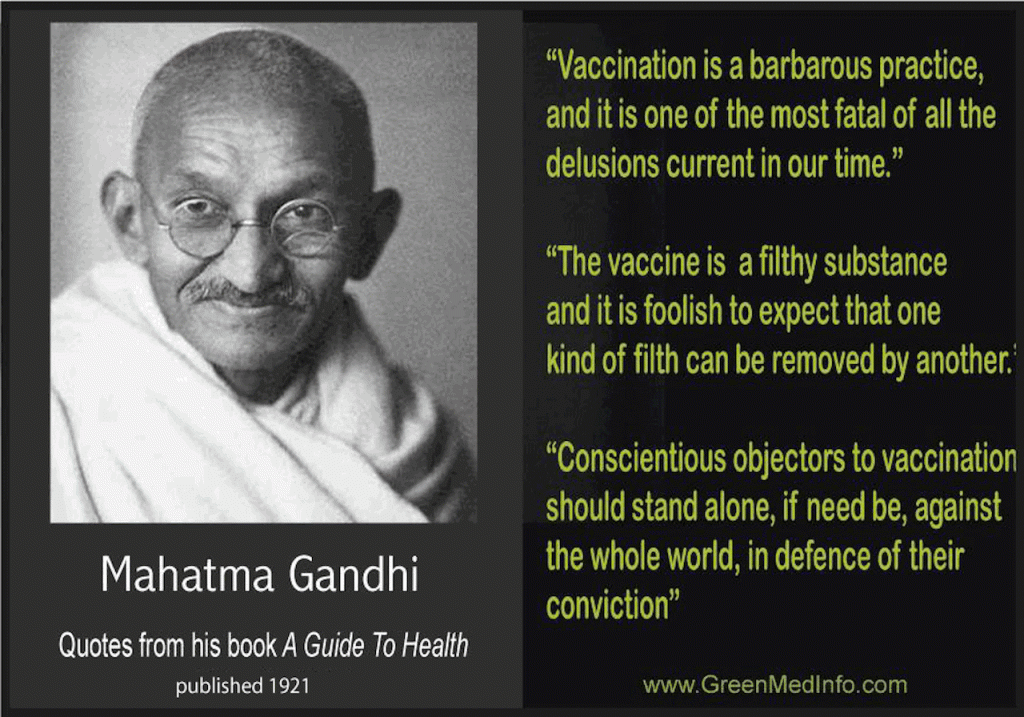
End All Disease. “Gandhi On Vaccines: ‘One Of The Most Fatal Delusions Of Our Time’.” EXCERPT: Almost one century ago, Gandhi published a book where he deconstructed the dangers and lack of effectiveness of vaccines and the agendas surrounding them. His voice rings true now more than ever.
Highwire. “Dr. McCullough Meets Dr. Geert Vanden Bossche.” EXCERPT: We covered how ill-advised mass vaccination with outdated mRNA vaccines continues to apply non-sterilizing ecological pressures on SARS-CoV-2 which work to: 1) prolong the pandemic 2) drive more mutations 3) increase transmissibility.
 Linda's Literary Home