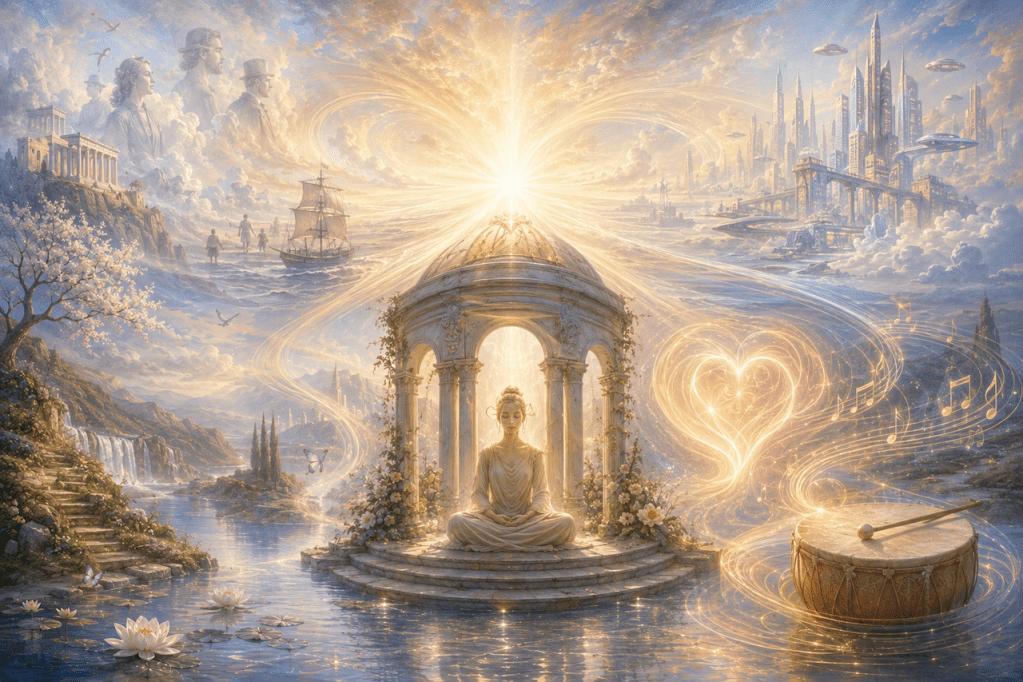
Mind is musing on the Eternal Now: Seamless width where past and future fold Into a single point of searing light No clock no calendar no fleeting hour Only unbroken being always present
Heart beats the drum with Its rhythm No yesterday no tomorrow only today Not bracing for what has not yet come Sounding its music in the present skin Vibrant adamant unyielding
Soul remains enshrined in Its temple A quiet realm where time cannot intrude Where every breath is neither first nor last But simply is complete unto itself Eternity has no length only depth
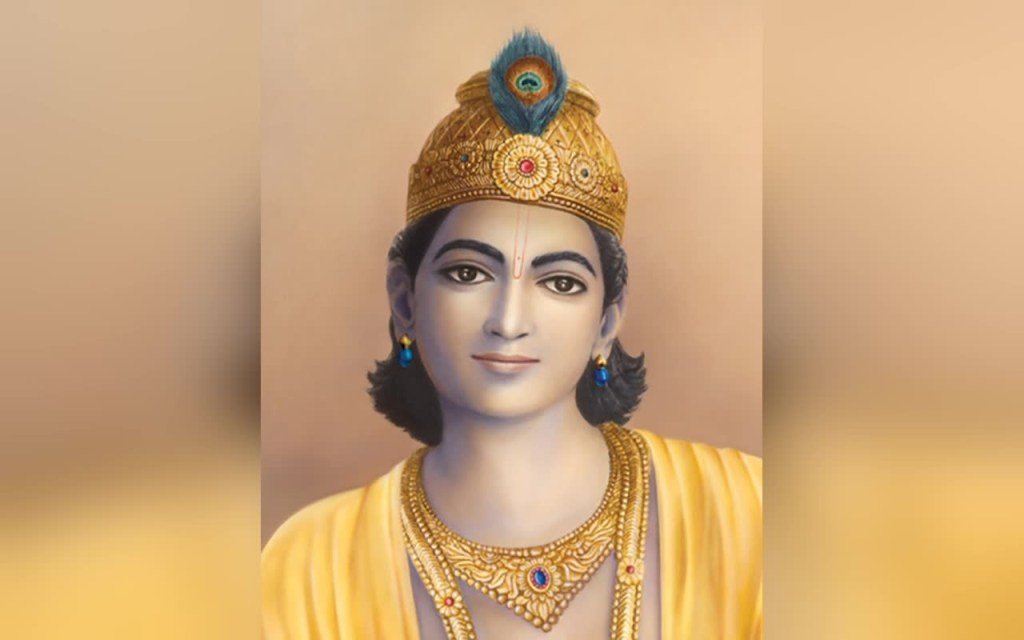
Paramahansa Yogananda’s “My Krishna Is Blue” reveals the chanter’s yearning for union with Krishna consciousness. He is envisioning a state beyond ordinary awareness, where the soul rises to the highest level of divine realization—self-realization.
Introduction and Text of “My Krishna Is Blue”
Paramahansa Yogananda’s “My Krishna Is Blue” is a devotional chant consisting of three movements. Through chant repetition and simplicity, the chanter dramatizes his profound love for Krishna and his longing to dwell perpetually in the Divine Presence.
The chant progresses from recognition to aspiration and finally to spiritual identification. The chanter first notices a correspondence between Krishna and the blue tamal tree, then expresses a desire to ascend to its highest branch, and finally longs to die where Krishna sat.
On the literal level, the chanter appears to be praising a tree associated with Krishna. On the mystical level, however, the imagery points beyond physical nature toward the soul’s desire to attain the exalted consciousness embodied by Krishna.
My Krishna Is Blue
My Krishna is blue; the tamal tree is blue. My Krishna is blue; The tamal tree is blue. So I do love thee, tamal tree! So I do love thee, my tamal tree!
And when I die, O Mother! Do put me high On a branch of the tamal tree, On a branch of the tamal tree.
Where Krishna sat, there I would die, Where Krishna sat, there I would die, On a branch of the tamal tree, On a branch of the tamal tree.
Commentary on “My Krishna Is Blue”
Paramahansa Yogananda’s “My Krishna Is Blue” reveals the soul’s devotion to the Divine Beloved. The chanter’s simple chant also expresses a profound spiritual aspiration toward God-union.
First Movement: “My Krishna is blue”
My Krishna is blue; the tamal tree is blue. My Krishna is blue; The tamal tree is blue. So I do love thee, tamal tree! So I do love thee, my tamal tree!
The chanter begins by establishing an identity between Krishna and the tamal tree. Both are described as blue, and that shared quality causes the chanter to regard the tree with affection and reverence.
The repetition carries the force of devotional musing rather than ordinary description. The chanter seems to be dwelling lovingly upon a spiritual correspondence that links the visible object with the Divine Reality symbolized by Krishna.
Because Krishna and the tamal tree share the same color, the tree becomes more than a botanical object. It functions as an emblem of Krishna consciousness and therefore deserves the chanter’s devotion.
The declaration—“So I do love thee, tamal tree!”—reveals that the chanter’s love for the tree derives from its association with Krishna. The affection is not directed toward matter but toward the divine presence reflected through matter.
The repeated address, “my tamal tree,” adds intimacy to the relationship. The chanter regards the tree as a sacred possession because it serves as a reminder of the beloved Lord.
Paramahansa Yogananda frequently emphasizes perceiving God’s presence throughout creation. Paramahansa Yogananda explains that divine consciousness may be perceived behind all forms, and the chanter’s vision reflects that spiritual perception.
On my literary website Linda’s Literary Home, I have discussed how poets often employ physical imagery to suggest metaphysical realities. The chanter similarly employs the visible tamal tree as a symbol pointing toward an invisible spiritual state.
The stanza therefore moves beyond literal description. Through the repeated equation of Krishna and the blue tamal tree, the chanter transforms a natural image into a symbol of divine consciousness.
Second Movement: “And when I die, O Mother!”
And when I die, O Mother! Do put me high On a branch of the tamal tree, On a branch of the tamal tree.
The second stanza shifts from recognition to aspiration. Having established the sacred significance of the tamal tree, the chanter now expresses a fervent desire regarding his own destiny.
The address to “Mother” adds emotional intensity, referring to the Divine Mother. The invocation conveys humility and dependence before a higher power. At first glance, the request appears unusual. The chanter asks to be placed “high” upon a branch of the tamal tree rather than buried or laid to rest in some conventional manner.
The word “high” becomes the stanza’s crucial term. The chanter does not merely seek proximity to the tree; he desires elevation within it. Such elevation suggests ascent rather than location. The imagery points toward a higher level of consciousness rather than a merely physical position.
The branch functions as a metaphorical rather than literal destination. To imagine a devotee sincerely wishing to have his body suspended in a tree would diminish the spiritual seriousness of the chant. Instead, the high branch symbolizes the summit of awareness. The chanter longs to rise to the highest attainable state of realization.
Paramahansa Yogananda repeatedly teaches that human consciousness may ascend from body-awareness to soul-awareness through spiritual discipline. The chanter’s longing for the highest branch harmonizes with that teaching of spiritual ascent.
On my literary website Linda’s Literary Home, I have often observed that poetry rarely states its deepest meanings directly. Through symbol and suggestion, poets allow intuition to perceive realities that ordinary language cannot adequately express. Thus the high branch becomes an image of supreme spiritual attainment. The chanter prays not for physical elevation but for the soul’s ascent into divine consciousness.
Third Movement: “Where Krishna sat, there I would die”
Where Krishna sat, there I would die, Where Krishna sat, there I would die, On a branch of the tamal tree, On a branch of the tamal tree.
The final stanza reveals the chanter’s ultimate desire. He wishes to die precisely where Krishna sat. The statement deepens the symbolic significance of the branch. It is not merely high; it is the place occupied by Krishna. If Krishna represents perfected divine consciousness, then the branch symbolizes the level of realization attained by that consciousness. The chanter longs to occupy the same spiritual station.
The repeated line intensifies the devotional yearning. The chanter does not seek worldly rewards, intellectual accomplishment, or heavenly pleasures. Instead, he desires complete identification with Krishna. The aspiration is one of union rather than admiration from a distance.
The word “die” also carries spiritual significance. Mystical literature frequently employs death as a symbol for the dissolution of ego-consciousness.The chanter therefore longs for the extinction of the limited self in the very state inhabited by Krishna. Such a death would not signify annihilation but fulfillment.
Paramahansa Yogananda teaches that the soul’s highest goal is realization of its unity with Spirit. The chanter’s desire to die where Krishna sat reflects precisely such a yearning for God-union. The repeated return to the tamal tree completes the chant’s symbolic design. What began as a blue tree associated with Krishna culminates as a metaphor for the highest spiritual center.
The chant’s simplicity is permeated with remarkable depth. Through the image of a blue tamal tree and its highest branch, the chanter dramatizes the soul’s longing to rise into Krishna consciousness and experience the liberating realization of divine union.
William Butler Yeats’ reputation stands him as one of the towering figures of twentieth-century poetry, a master whose lyrical skill and evocative imagery earned him the Nobel Prize in Literature in 1923.
William Butler Yeats: A World-Class Poet
Many of William Butler Yeats’ poems, including “The Second Coming” and “Sailing to Byzantium,” reveal a profound sensitivity to the human condition, blending Irish myth with modern innovation.
Yet, beneath his celebrated poetry lies a less triumphant endeavor: A Vision, a sprawling metaphysical treatise first published in 1925 and revised in 1937. In A Vision, Yeats attempts to create a comprehensive system—a poetic ethic—that would unify history, personality, and art under a single rubric.
Despite Yeats’ stature as a world-class poet, A Vision represents a resounding failure. Far from establishing a coherent ethic, the work emerges as a cacophony of misguided notions, revealing Yeats’ superficial and often erroneous grasp of the Eastern religious traditions he claimed to have deeply studied.
Yeatsean Audacity
Yeats’ ambition in A Vision may be understood as the epitome of audacity. Supposedly inspired by automatic writing sessions with his wife, Georgie Hyde-Lees, beginning in 1917, the poet believed he had received revelations from spiritual “instructors” that offered a key to understanding human creativity as well as history.
The result was a system based on a cyclical theory of history, symbolized by interlocking gyres—conical spirals that represent the rise and fall of civilizations over 2,000-year periods. (For a discussion regarding the error of the gyres, please see “William Butler Yeats’ ‘The Second Coming’.”)
Yeats divided human personalities into 28 phases of the moon, each corresponding to a specific type, and posited that art, history, and the soul were governed by these cosmic rhythms. His goal was not merely philosophical; he aimed to craft a poetic ethic, a lens through which his poetry could be both generated and then interpreted.
This ambition, however, was challenged by Yeats’ intellectual limitations. While his poetic genius thrived on intuition and ambiguity,the success of a work such as A Vision demanded precision and coherence—qualities it sorely lacks.
Scholars such as Richard Ellmann have noted that Yeats himself admitted to the work’s thinness and opacity, famously remarking in a letter to Ethel Mannin that he wrote it “to keep myself from going mad” [1]. The treatise’s reliance on occult sources, including theosophy and Rosicrucianism, already situates it on shaky ground, but its most glaring and distressing failure lies in Yeats’ mishandling of Eastern religious concepts, which he claimed as foundational influences.
An Eastern Mirage: Yeats’ “Romantic Misunderstanding”
T. S. Eliot labeled Western misunderstanding of Eastern philosophy and religious concepts “Romantic misunderstanding.” He could have been pointing directly to Yeats in this evaluation.
Yeats’ engagement with Eastern religion was not a passing fancy. He was introduced to Hindu philosophy through his association with the Theosophical Society and his friendship with figures such as Sri Mohini Chatterjee, an Indian philosopher whom Yeats met in 1885. Yeats’ fascination deepened with readings of the Upanishads and the Bhagavad Gita, texts he revisited throughout his life.
In A Vision, Yeats explicitly invokes these traditions, particularly in his concepts of reincarnation, the eternal self, and the interplay of the pairs of opposites—ideas he aligns with his gyres and lunar phases. Yet, a closer examination reveals that Yeats’ interpretations are not only idiosyncratic but fundamentally at odds with the traditions he sought to integrate.
Take, for instance, Yeats’ treatment of reincarnation. In Hindu and Buddhist frameworks, reincarnation (samsara) is a process governed by karma, the moral law of cause and effect, aimed at liberation (samadhi in Hinduism, nirvana in Buddhism, salvation in Christianity).
The Brihadaranyaka Upanishad, a key text Yeats references, describes the soul’s journey as a quest for union with Brahman, the universal consciousness or God (as that concept is understood in Western culture) [2].
Yeats, however, reimagines reincarnation as a mechanistic cycle tied to his gyres, devoid of moral progression or spiritual liberation. This watering down of the concept of reincarnation obliterates its deep, spiritual purpose in the lives of humanity.
His 28 phases of the moon assign fixed personality types—such as the “Hunchback” or the “Saint”—with no clear path to transcendence, reducing a dynamic process to a deterministic wheel.
Again, Yeats misunderstanding results in a fatal flaw that limits the Eastern concepts to mere thought experiments, not profound truths that guide individuals on spiritual paths to a definite goal.
Scholar Harold Bloom observes Yeats’ limited awareness of Eastern religious concepts by suggesting that the poet’s understanding of reincarnation amounts to little more than a parody; in Yeats system the soul is trapped rather than liberated [3].
Similarly, Yeats’ appropriation of the Bhagavad Gita’s concept of dharma (duty) is distorted beyond recognition. In the Gita, Krishna advises Arjuna to act according to his rôle as a warrior, emphasizing selfless action within a cosmic order [4]. Yeats, however, interprets dharma as a fatalistic submission to historical forces, as seen in his analysis of civilizations’ rise and fall.
His gyres suggest that human agency is illusory, a stark departure from the Gita’s call to active participation in one’s destiny. This misreading reflects not a deep study but a superficial cherry-picking of Eastern ideas to bolster his preconceived system.
A Cacophony of Contradictions
The intellectual incoherence of A Vision extends beyond its Eastern distortions to its internal structure. Yeats’ gyres, meant to symbolize the dialectical interplay of opposites (primary and antithetical tinctures, in his terminology), collapse under scrutiny.
He asserts that history oscillates between unity and multiplicity, yet his examples—such as the fall of Troy or the rise of Christianity—are cherry-picked and lack rigorous historical grounding. Scholar Northrop Frye critiques this approach, arguing that the poet’s historical cycles are poetic fictions masquerading as metaphysics, unsupported by evidence or logic [5].
The treatise’s reliance on vague assertions—for example the suggestion that the end of an age, which always receives the revelation of the character of the next age, is represented by the coming of one gyre to its place of greatest expansion [6]. Such bland unexplained statements further muddy the work’s claims.
Moreover, the 28 lunar phases, intended as a typology of human character, devolve into arbitrary categorization. Yeats assigns historical figures like Shelley (Phase 17) and Napoleon (Phase 20) to these phases, but the criteria are inconsistent and subjective.
The system’s complexity overwhelms its usefulness, leaving readers with a tangled, labyrinthine taxonomy rather than a meaningful ethic. As critic T.R. Henn has avered that the work is less a philosophy than a privately concocted mythology, a wobbly scaffolding for Yeats’ imagination that collapses under its own weight [7].
The Poetic Ethic That Never Materialized
Yeats’ stated intention in formulating his treatise was to establish a poetic ethic, a poetic framework that would elevate his art and serve as a guide those who consume his art. Yet, A Vision fails to come together as either a practical guide or a philosophical statement.
Unlike Dante’s Divine Comedy, which integrates a clear Christian cosmology into its poetry, or Rabindranath Tagore’s works that reveal the Eastern concepts as they are meant to be understood through a poetry that resonates with appropriate imagery as it reveals those concepts, A Vision remains detached from Yeats’ best poetry; its unhinged rhetoric is a like a raft let loose to the wind.
Poems such as “The Second Coming” draw loosely on its imagery—for example, the “widening gyre”—but their power lies in their ambiguity, not in the treatise’s labored explanations. Scholar Helen Vendler has suggested that Yeats’ great poems transcend A Vision, and that they succeed despite it, not because of it [8].
This disconnect underscores the work’s failure as an ethic. An ethic, poetic or otherwise, requires clarity and applicability—qualities A Vision sorely lacks. Its esoteric jargon and convoluted diagrams (the gyres, the wheel, the unicorn) alienate rather than enlighten, rendering it inaccessible.
Even the most devoted Yeatsean acolytes have struggled to reveal any logic or utility in the work. Yeats’ Eastern borrowings, far from lending depth, expose his misunderstanding of traditions that emphasize simplicity and direct experience over intellectual abstraction.
The Zen Buddhist principle of direct insight, for instance, stands in stark contrast to Yeats’ overwrought theorizing, highlighting the huge gulf between his system and the philosophies he seemingly admired.
A Poet’s Folly
William Butler Yeats’ legacy as a poet is unassailable; his poetry remains a testimony to his genius. Yet, A Vision reveals the limits of that genius when applied to systematic thought.
Sadly, intended as a poetic ethic, the work instead emerges as a cacophony of wrong-headed ideas, its Eastern influences warped by misinterpretation and its structure undone by contradiction.
Yeats’ deep study of Hindu and Buddhist concepts, so proudly proclaimed, proves shallow in execution, a veneer of exoticism atop a fundamentally Western occult framework.
The treatise stands not as a triumph but as a cautionary tale: even a world-class poet can falter when straying too far from his craft. In the end, A Vision is less a vision than a mirage—a grand but misguided attempt to impose order on a world that resists such human intervention on a grand scale.
Roughly in order of origin, the five major world religions are Hinduism, Buddhism, Judaism, Christianity, and Islam. Each major religion has many branches or denominations that focus on certain aspects of the main religion. This article features a brief overview of each of the five major religions.
Introduction: What Is the Purpose of Religion?
“If God after making the world puts Himself outside it, He is no longer God. If He separates Himself from the world or wants to separate Himself, He is not God. The world is not the world when it is separated from God. God must be in the world and the world in God.” —D. T. Suzuki
According to Paramahansa Yogananda [1], the purpose of all religions—as well as the purpose of life itself—is to reunite the individual soul with the Supreme Soul or God. The differences that seem to split religions from one another result from the use of different metaphors that portray concepts.
Also use of different names for the Supreme Deity causes confusion; for example, Allah, Divine Mother, Ultimate Reality, Supreme Intelligence, Emptiness, Absolute, and Over-Soul represent some of the terms used to name the Unnameable or the Ineffable [2].
A common misunderstanding of Hinduism emerges from the many Hindu names for God or the Supreme Soul. But instead of actually signifying different “gods,” the names merely signify different aspects of of the one God. Hinduism is monotheistic, just as Christianity and all other religions are.
All of the five major world religions—Hinduism, Buddhism, Judaism, Christianity, and Islam—have in common a basic faith, even though each religion describes the nature of their faith differently. They each have a prophet, or prophets, who interpret God’s ways, and scripture in which the interpretation resides.
Hinduism
Hinduism’s scripture is the Bhagavad-Gita, and major prophet is Krishna. However, Hinduism is probably the world’s oldest religion, [3] and, therefore, it also has other ancient scripture that was not written down for many centuries or perhaps millennia. These are called the Vedas.
In more recent history the important scripture that contains the explanation for existence and the guide back to God is the Bhagavad-Gita, whose central narrator is Bhagavan Krishna.
Buddhism
Buddhism’s scripture is the Dhammapada, and its major prophet is Siddhartha Gautama or the Buddha [4]. Buddhism began around 500 B.C. in India, when the prince Gautama abandoned his young wife and child and took up the life of an ascetic. It is said that he positioned himself under a banyan tree and determined to remain there until he had attained enlightenment.
Buddhism is very similar to Hinduism in that they both focus on meditation to achieve “enlightenment,” which is called “nirvana” in Buddhism and “samadhi” in Hinduism. Also both religions describe the nature of God, or the Absolute, pantheistically.
Judaism
Judaism’s major prophets are the Old Testament prophets, especially Moses [5]; thus, its scripture is the Old Testament or Torah consisting of the Five Books of Moses: Genesis, Exodus, Leviticus, Numbers, and Deuteronomy.
Because Judaism does not recognize the New Testament, it does not recognize the “old” testament as such, but simply as the Torah. The name “Judaism” originates from the fourth son of Jacob, who was the father of the tribe of “Judah.” The name “Judah” means gratitude in Hebrew.
It was the tribe of Judah that resided in Jerusalem during the reign of both David and Solomon. Later the Judaic kingdom included all of the southern tribes of Israel.
Thus, the religion of the Jews is called “Judaism.
Christianity
Christianity’s major prophet is Jesus Christ, whose major scripture is the Sermon on the Mount [6] which is part of the New Testament. Like most prophets, Christ appeared at a time of history when there was great turmoil and strife. Human kind had lost its knowledge of its divinity within the soul, and the Christ appeared to remind people that “the kingdom of God is with you.”
Islam
Islam’s prophet is Muhammad, and its scripture is the Quran (Koran). In addition to the Quran, the devout Muslim studies the Sunnah, which is an account of the prophet’s life and the activities and traditions he approved.
The prophet Muhammad was born April 20, 571, to a wealthy family of the tribe of Mecca. His father had died a few days before his son was born, and his mother died when he was six-years-old.
His grandfather, who was caring for the boy, then died when Muhammad turned nine, at which time he was cared for by an uncle. The world in which the young boy lived was a chaotic one, sometimes described a “barbaric.” It is said that Muhammad was a gentle boy, sensitive and compassionate in his dealings with others.
At the age of twenty-five he entered the caravan business owned by a wealthy widow, Khadija; their relationship grew from deep respect to admiration and love, and they married. Their union proved successful. Fifteen years later the man Muhammad transformed into the Prophet, but such a transformation did not happen overnight. According to Huston Smith [7],
There was a huge, barren rock on the outskirts of Mecca known as Mount Hira, torn by cleft and ravine, erupting unshadowed and flowerless from the desert sands. In this rock was a cave which Muhammad, in need of deep solitude, began to frequent. Peering into the mysteries of good and evil, unable to accept the crudeness, superstition, and fratricide that were accepted as normal, “this great fiery heart, seething, simmering like a great furnace of thoughts,” was reaching out for God.
Religious Distortion
All of the great religions have suffered distortion at the hands ignorant interpreters. In the name of Christianity large scale devastation was visited upon the world during in the Middle Ages during the Crusades [8], then later in the Spanish Inquisition [9] , and even in the colonial America during the Salem Witch Trials [10].
Hindu zealots have misappropriated and turned the Caste system into an oppressive ordering of society [11] that was not part of Hindu scripture. Many adherents to Buddhism in the West are attracted to that religion based on the misunderstanding that Buddhism is an atheistic religion.
Again, the misunderstanding results from failure to grasp the basic metaphors used to make sensible the Ineffable. And, of course, the extremist Islamists who distort the meaning of jihad [12] demonstrate the horror that can be fostered from erroneous understanding of the metaphor of scripture.
Much fantasy has grown out of the facts of religions, and much mayhem and destruction has been and continues to be carried out in the name of religion. But all of the great religions teach compassion and love, and even though certain misguided zealots try to conquer others immorally in so-called holy wars, they do not represent the vast majority of the devout who understand and practice their religions as they are meant to be practiced.
Sources
[1] Paramahansa Yogananda. The Science of Religion. Self-Realization Fellowship. 1953. Print. [2] Linda Sue Grimes. “Names for the Ineffable God.” Linda’s Literary Home. October 7, 2025.
[3] Joshua J. Mark. “Hinduism.” World History Encyclopedia. June 8, 2020.
According the renowned spiritual leader, Paramahansa Yogananda, when an individual develops an intense yearning for God, then God sends that individual tangible evidence of His love: “When you have convinced the Lord of your desire for Him, He will send someone — your guru — to teach you how to know Him.”
Also Yogananda has explained that when evil seems to be overcoming good in the world,
God sends a prophet (guru or spiritual leader) to help people turn back toward God. Muhammad, being a gentle, compassionate soul, developed his latent soul qualities and by intense meditation in the cave at Mount Mira touched God’s heart and God spoke to him, not only to satisfy the individual soul of Muhammad, but God also used Muhammad to inform those crude, superstitious, fratricidal brothers of a better way of life.
Unfortunately, just as Hindu zealots have misappropriated and turned the Caste system into an oppressive ordering of society, many Islamists have turned the teachings of Muhammad into the opposite of the prophet’s instructions for peace, and instead of leading to a “better way of life,” many ignorant followers of that faith have returned to “crude, superstitious, fratricidal” behavior.