Literary Studies: Elucidating Human Experience
Literary studies is the academic discipline devoted to the analysis, interpretation, evaluation, and contextualization of literature; it also includes the generalized act of commentary on literary works.
Literary studies examines written works—from poetry, fiction, and drama to essays and emerging digital forms—not simply as artistic objects but as cultural, historical, philosophical, linguistic, and aesthetic expressions. At its core, literary studies asks:
- What do texts mean?
- How do they work?
- Why do they matter?
The field draws from a range of approaches, including philology, historical scholarship, theory, philosophy, linguistics, theology, and cultural analysis. Each special focus from analysis to commentary engages its own experts who employ each of these fields in unique combinations of endeavor.
For example, the analyst may emphasize historical scholarship in explicating a poem, while the commentarian will dip into any number of those approaches in order to elucidate meaning from informed personal experience.
At the core of the literary field is human experience. From humankind’s first finding itself in world of pairs of opposites that operate sometimes for good and sometimes for ill, the mind of mankind has grappled with the very meaning of existence. Literature provides a written record of that grappling.
That record makes it so that humanity need not learn all over again and again everything required for living a well-seasoned and reasonably comfortable, prosperous life. Human beings can read about many more experiences than they can ever actually experience.
And while personal experience is always central to one’s psyche, it serves as a bedrock for understanding those contemporaries living in the immediate environment and those ancestors who lived in the past.
Literature and literary studies offer a treasure trove of material keeping the mind and heart balanced and harmonious as each human being travels a unique path to spiritual understanding and ultimate awakening to soul-reality—the final stage in understanding and uniting the soul with the Creator of creation (God).
Historical Development
1. Origins in Antiquity
The roots of literary studies reach back to ancient civilizations.
- Greece: Thinkers such as Plato and Aristotle explored poetry’s moral and aesthetic value, laying foundational concepts in mimesis, genre, and rhetoric.
- Rome: Critics such as Horace, Longinus, and Quintilian systematized literary technique and rhetorical education.
These early traditions treated literature as part of a wider program of moral, civic, and rhetorical training.
2. Medieval and Renaissance Scholarship
During the Middle Ages, literature was primarily studied through the lens of theology and classical rhetoric. With the Renaissance, renewed attention to classical texts and humanism broadened interpretation, emphasizing:
- textual editing
- authorial biography
- moral philosophy
- artistic imitation and originality
Figures such as Petrarch, Erasmus, and later Sir Philip Sidney were important for literary criticism as an intellectual discipline.
3. Philology and the Birth of Modern Literary Studies (18th–19th
Centuries)
The modern university model grew out of European philology—systematic study of languages, manuscripts, and textual origins. Key figures included:
- Friedrich August Wolf, who formalized classical philology
- Wilhelm Dilthey, who argued for the humanities as a distinct form of knowledge
- The Grimm brothers, whose linguistic scholarship shaped historical study of culture
In Britain and the United States, literary study emerged gradually as its own discipline, often housed in departments of English language and rhetoric.
4. The Rise of Criticism and Theory (20th Century)
The 20th century saw a dramatic diversification of methodologies, often called literary theory. Important movements and contributors include:
- New Criticism (T. S. Eliot, Cleanth Brooks, I. A. Richards): close reading, textual autonomy
- Structuralism (Saussure, Lévi-Strauss, Barthes): systems, language, signs
- Post-structuralism (Derrida, Foucault, De Man): instability of meaning, discourse, power
- Psychoanalytic criticism (Freud, Jung, Lacan)
- Marxist criticism (Marx, Lukács, Althusser, Williams)
- Feminist and gender studies (Woolf, Gilbert & Gubar, Butler)
- Postcolonial studies (Said, Spivak, Bhabha)
- Reader-response theories (Iser, Fish)
This pluralism made literary studies one of the most interdisciplinary fields in the humanities.
5. Literary Studies in the 21st Century
The field continues to evolve with:
- digital humanities (text mining, digital archives, computational analysis)
- environmental humanities (ecocriticism)
- narrative medicine
- world literature studies
- renewed interest in classical rhetoric and formal aesthetics
Today, literary studies includes both traditional close reading and technologically advanced methodologies.
Internal Tensions and Contemporary Challenges in Literary Studies
Despite its intellectual richness and adaptability, literary studies has faced sustained internal tensions and external pressures, particularly since the late twentieth century. Acknowledging these challenges is essential for an honest account of the discipline’s current condition.
1. Debates over Theory and Method
One of the most persistent internal debates concerns the role and dominance of literary theory. While theory expanded the field’s conceptual reach and interdisciplinary influence, critics have argued that its institutionalization sometimes displaced close reading, historical knowledge, and aesthetic judgment.
This tension has produced ongoing disagreements between theoretically driven approaches and those advocating a return to formal analysis, philology, rhetoric, or historically grounded criticism. The result has been both fragmentation and productive pluralism.
2. Institutional Pressures and Decline
Literary studies has also experienced institutional contraction, particularly in Anglophone universities. Declining enrollments, reduced funding, and departmental closures have forced the field to defend its place within increasingly market-driven educational systems.
These pressures have reshaped curricula, hiring priorities, and research agendas, often privileging demonstrable “impact” over long-term scholarly depth.
3. Economic Justification of the Humanities
A related challenge is the growing demand to justify literary studies in economic or utilitarian terms. Arguments emphasizing transferable skills—critical thinking, communication, adaptability—have helped defend the discipline, but they risk narrowing its intellectual and cultural aims.
Many scholars contend that literature’s value cannot be fully captured by metrics of employability, insisting instead on its role in ethical reflection, cultural memory, and imaginative freedom.
4. Public Relevance and Authority
Literary studies has also confronted questions about its public authority. As cultural commentary has migrated to digital platforms and popular media, academic criticism has sometimes appeared insular or inaccessible.
In response, there has been renewed interest in public humanities, essayistic criticism, and teaching-oriented scholarship that reconnects academic work with broader audiences.
5. Renewal through Self-Critique
These tensions have not merely weakened the discipline; they have also prompted self-examination and renewal. Contemporary literary studies increasingly combines theoretical sophistication with historical depth, formal attentiveness, and ethical seriousness. The field’s willingness to critique its own assumptions remains one of its defining strengths.
By recognizing these internal debates and structural challenges, literary studies presents itself not as a settled or complacent discipline, but as one engaged in ongoing reflection about its methods, purposes, and responsibilities in a changing cultural and institutional landscape.
Purpose of Literary Studies
- Interpretation and Meaning
The primary purpose of literary studies is to interpret texts richly and responsibly, explaining how literature creates meaning through form, language, imagery, voice, and structure.
2. Preservation of Cultural Heritage
Through editing, archiving, and historical scholarship, literary studies preserves important works and makes them accessible to future generations.
3. Critical and Ethical Inquiry
Literature is a testing ground for human experience. Studying literature helps individuals:
- examine moral and philosophical questions
- understand diverse viewpoints
- confront social issues
- explore the imagination’s power
4. Training in Analytical and Communicative Skills
Literary discipline develops skills essential across professions:
- close attention to detail
- critical thinking
- persuasive writing
- interpretive reasoning
- cultural literacy
5. Exploration of Aesthetics
Literary studies also seeks to understand the pleasures and structures of artistry—why poetry moves us, how narrative creates suspense, how style functions, and what beauty means in language.
Importance of Literary Studies
- Cultural Understanding and Memory
Literature is a record of humanity’s inner life. Studying it helps societies remember, reflect, and interpret their history, values, and aspirations.
2. Empathy and Human Connection
Reading literature strengthens the capacity to imagine the lives of others, fostering empathy and reducing cultural isolation.
3. Intellectual Freedom
Literary analysis encourages questioning, debate, and openness to multiple interpretations—essential qualities for democratic societies.
4. Preservation of Language
Through the study of style, genre, and linguistic change, literary studies enriches and preserves the expressive possibilities of language itself.
5. Influence Across Disciplines
The methods employed in literary studies inform philosophy, history, sociology, psychology, political theory, theology, and even medicine and law.
Place in Society
1. Education
Literary studies is central to curricula from primary schools to graduate programs. It cultivates literacy, imagination, ethical reflection, and intellectual maturity.
2. Cultural Institutions
Libraries, publishing houses, museums, and arts organizations rely on literary scholars for:
- editing and curating texts
- creating anthologies
- interpreting archives
- preserving rare works
3. Public Discourse
Literary critics influence cultural conversations through essays, reviews, public scholarship, and commentaries.
4. Media and the Arts
Film, theater, screenwriting, advertising, and media studies use literary analysis to shape storytelling, symbolism, and audience impact.
5. Humanities and Civic Life
As part of the broader humanities, literary studies sustains thoughtful civic engagement by nurturing critical reflection, historical awareness, and nuanced communication.
Cornerstone of the Humanities
Literary studies is a cornerstone of the humanities, offering tools to understand texts not only as artistic creations but as expressions of human thought, feeling, and cultural identity. Its long history—from ancient rhetoric to digital humanities—shows a discipline continuously reinventing itself to meet new forms of storytelling and new intellectual challenges.
By cultivating interpretation, empathy, cultural memory, and critical reasoning, literary studies plays a vital role in shaping educated citizens and sustaining a thoughtful, imaginative, and spiritually enlightened society.
🕉️
My Personal Engagement with Literary Studies
From my earliest love of music to my first unpleasant encounter with literary studies as a high school sophomore, it may seem rather odd that I did ever so engage.
Music: My First Love
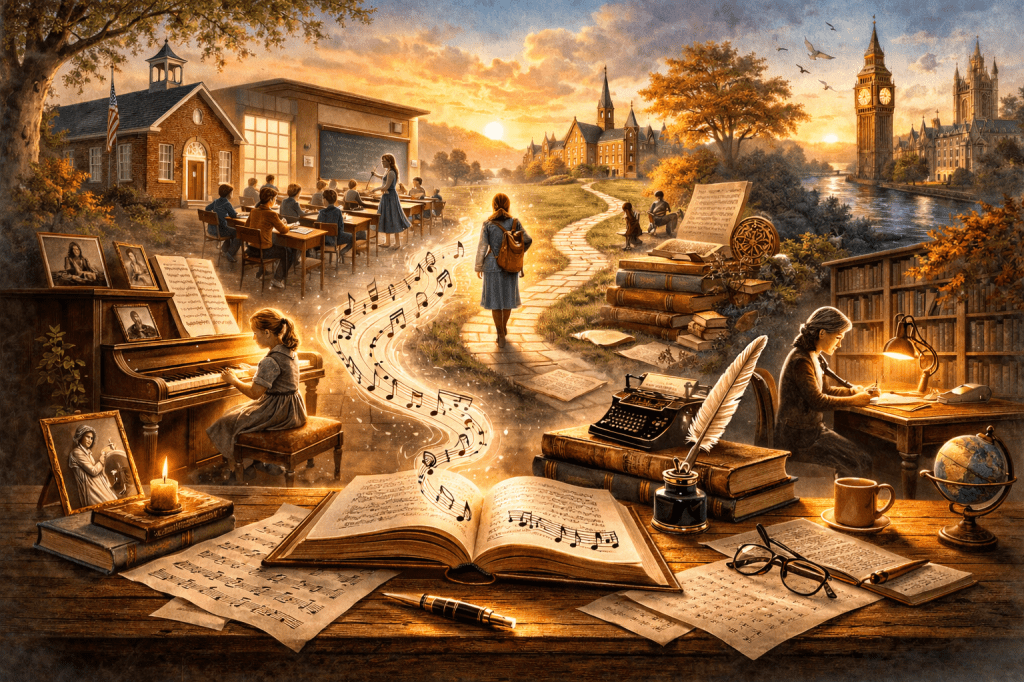
It is true that my first love was music. I especially loved piano. As I was but a toddler, I watched and listened with awe as my Aunt Winnie played the piano during visits to my paternal grandparents home in Kentucky. Winnie was in her teens and played beautifully only by ear. So I fell in love with the piano, later thrilling to the TV performances of Liberace.
I also persuaded my parents to let me take piano lessons at our little four-room school house in Abington, Indiana, when I was in about the third grade around age 9. The music teacher, Mrs. Frame, came once a week and gave lessons to students, who were permitted the leave the classroom for about a half hour for the lessons.
Unfortunately, the school board decided after about three years into my lessons to ban Mrs. Frame from using out little school to give her lessons; she then continued them at her home. But we had to then travel to her home, and my dad was often too busy to take me to my lessons.
To relieve my dad of that chore, I stopped the lessons fairly soon after Mrs. Frame’s banishment. I have often wished I could have continued the lessons beyond the three years. But I have continued to keep a piano in my home and to play it from time to time.
Literature in High School
During my sophomore year in high school, Mrs. Edna Pickett was my English teacher. The first semester we studied grammar, and I was a straight A student in grammar.
On the first day’s meeting in Mrs. Pickett’s class, she asked the class to name the 8 parts of speech. No one offered to do it, so I raised my hand a spouted them off for her; she was impressed, and she remained impressed with my ability to handle English grammar.
Then second semester arrived. And instead of my beloved grammar, the focus was on general literature. We would read stories and poems in the literature text book—a big thick thing that I had no love for—and then discuss them.
Oddly, I had no yardstick for measuring the height, depth, and width of those works. It seemed that we were supposed to fathom something in the stories that I could not seem to fathom. The study seemed terribly vague and unwieldy, not like grammar, which had real answers and followed logical patterns.
To make matters worse, Mrs. Pickett required us to write book reports. If we did not write a book report, we could not get a A, regardless of our accumulated number.
I thought that book report requirement was unfair, and I refused to write one. True to her word, Mrs. Pickett marked me down to a B, even though my grad average was in the high 90s as usual, which under normal circumstances would have given me my usual A.
I’m not sure how I managed to get A’s on the literature tests, but somehow I did. And Mrs. Pickett said when she assigned the B that she was sad about it, also. That B really stung, and from then on, I went ahead and read books and reported on them.
After sophomore English came junior English which was focused on American literature, in addition to the grammar, of course. By then I had fallen in love the poetry and began to appreciate literature more. So my American literature focus caused me no real consternation.
However, I did not take British literature with Mrs. Pickett in my senior year; that year a course in creative writing was offered and it fulfilled the requirement for academic curricula specialty, so I enrolled in creative writing instead of senior English. I have often regretted not taking both the Brit lit and the creative writing. I could have done so because I had two study hall periods that year.
Curiously, it is also the oddity that I ended up taking British/Irish literature as the main concentration for my PhD studies, writing my dissertation of William Butler Yeats’ focus on Eastern philosophy and religion.
PhD in British Literature
So the next part of this story ends on a reversal that could not have been predicted. And it has some twists and turns. As I enjoyed grammar in early high school, I also enjoyed and was good at foreign language, beginning with Latin. The study of Latin even enhanced my aptitude for English grammar.
I took Latin my freshman year, then I took Spanish my sophomore year; my junior year I took Latin II and Spanish II and then took French my senior year (Mrs. Pickett taught the French class, and it was the first year French had been offered. She even spent the summer at the Sorbonne in Paris boning up on her French stills.)
So my interest become completely ensconced in foreign language, and I knew that in college I would major in foreign language—likely Spanish. But then my creative writing teacher, Mr. Malcolm Sedam, who was working on a masters degree in history, let me know that he needed to translate some works from German. He was writing his thesis on Johannes Erwin Eugen Rommel, known as The Desert Fox, a German Generalfeldmarschall during World War II.
I had begun to study German, Italian, and Brazilian Portuguese on my own. And I had been apprized of the similarities between German and English, and I decided that in college I would likely major in German.
So I made an attempt to translate some the text that Mr. Sedam needed. Of course, that was a total bust; I had only a smattering of German, not nearly enough to translate such material.
Nevertheless, I went ahead and began my German major at Ball State Teachers College which I entered summer quarter 1964. I had to wait until fall quarter to take my first course in German however.
I thoroughly enjoyed studying German at Ball State, transferred to Miami University after studying four quarters at BSU, graduated with a major in German from Miami in April 1967. I then taught German at Brookville, Indiana, for one year. I earned my MA in German from BSU in 1971 then taught 2 more years of German at Brookville.
By this time, I had discovered that a career teaching German was not for me; to do a truly efficient job of such teaching and engaging such scholarship, I would have to travel and study in Germany probably on a yearly basis—a venture that I did not relish.
Besides, I had begun writing and studying poetry written in English and became convinced that as a native speaker of English and dedicated literary studies enthusiast, a concentration in literature written in English was my best focus.
I began an MA in English at BSU in 1976 but did not finish it. Then with many pages of poems, essays, and other writings, especially songs, in 1983, I began anew with the MA in English at BSU, and by this time I had decided that I would earn my PhD in English at BSU. And that’s what I did—finishing the MA in 1984 and the PhD in November 1987.
From 1983, I taught in the BSU writing program as graduate assistant, (1983-1984), doctoral fellow (1984-1987), and assistant professor (1987-1999.) In the fall of 1987, I accepted an offer of a teaching job at a now-defunct college in Virginia, but the job was so much different from what the administration had described that I left and returned to BSU by winter quarter that same year.
Independent Literary Scholar
After leaving the BSU writing program in 1999, I have become an independent scholar, writing, researching, and posting my works online on various sites that accept such works.
An example of my online writing endeavor is that I spent almost ten years posting on the recently defunct HubPages, accumulating over a thousand essays on poetry commentaries, political and social issues—even a few recipes and songs—along with several of my original poems and short stories.
Currently, I curate my own literary website at Linda’s Literary Site. The site features my writings in poems, songs, essays, short stories, fables, recipes, and commentaries.
The financial gain is close to non-existent, whereas I was able to gain a pittance on HubPages, but the satisfaction is enormous with no editorial noise to interrupt by voice.
Useful or Not?
The twists and turns featured in this overview are offered primarily to give readers the opportunity to decide for themselves whether they find my offerings in literary studies of any value for their own perusal.
As mentioned earlier, where I ended up regarding the study of literature had an inauspicious beginning. But it nevertheless has ended with me dedicating my time and effort to my once adversarial subject of literary studies.





 Linda's Literary Home