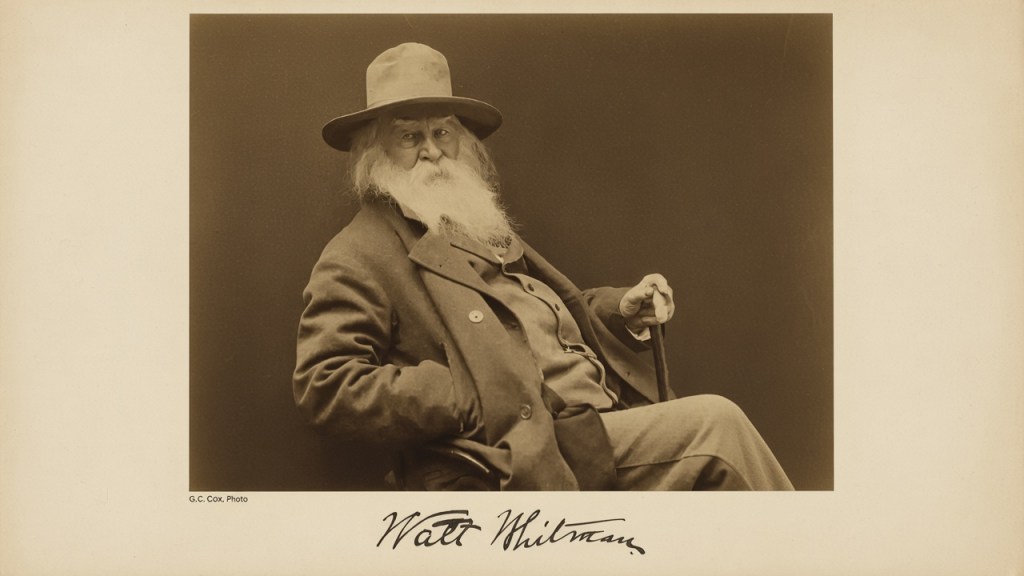
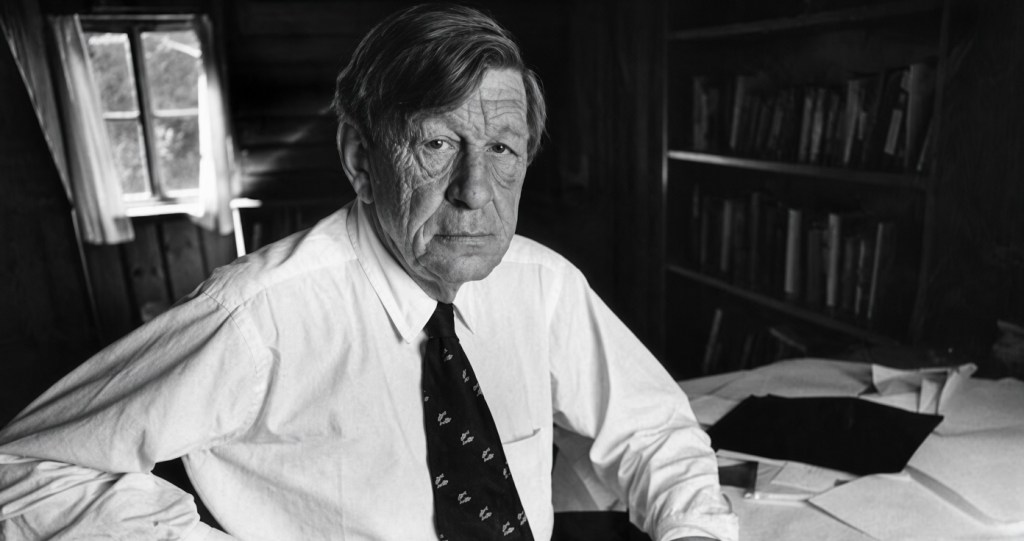
Image: Walt Whitman Library of Congress/Getty Images
Walt Whitman’s “I Hear America Singing”
In “I Hear America Singing,” Walt Whitman’s speaker is offering a musical tribute to the laborers of America as they “sing,” that is work, cheerfully. This 19th century hat-tip also recognizes the partiers who fill the night time with their good cheer.
Introduction and Text of “I Hear America Singing”
Walt Whitman’s “I Hear America Singing” is a song of praise. As a useful metaphor, “song” becomes the tool with which the speaker in Walt Whitman’s “I Hear America Singing” expresses the cheerful nature of the people he daily encounters in their labors and in also in their play.
By claiming to hear them “singing,” he is rendering them cheerful and skilled in their labor. The speaker’s heart is overflowing with praise for his fellow citizens. As the speaker commences his tribute, he reports that he hears “America singing.”
Each song he encounters is unique. Each “song” constitutes a different carol, not ordinary in the least, but each one offering praise and demonstrating joy in its being.
The joy and praise impress the speaker so much that he seems to be bursting with pride to be a part of such an honorable conglomeration of laboring folks. His admiration makes him abundantly happy as he sings himself, making his poem.
As the speaker observes his fellow citizens, he becomes optimistic, and his feelings no doubt color his reportage. He offers what one might consider to be an exaggeration of the joy and gratitude inspiring these people who are ordinary workers. These folks are certainly not likely to become sycophants of the nothing-to-lose-but-our-chains crowd.
Each of the eleven lines sprawls across the page and spills into the adjoining line to facilitate a new line. The elongated sentences must be broken in unusual ways to accommodate the thoughts that this speaker wishes to share. Whitman’s free verse style virtually always employs this rambling, sprawling form as he catalogs all the things his speakers see, hear, think, feel, or enjoy.
I Hear America Singing
I hear America singing, the varied carols I hear, Those of mechanics, each one singing his as it should be blithe and strong, The carpenter singing his as he measures his plank or beam, The mason singing his as he makes ready for work, or leaves off work, The boatman singing what belongs to him in his boat, the deckhand singing on the steamboat deck, The shoemaker singing as he sits on his bench, the hatter singing as he stands, The wood-cutter’s song, the ploughboy’s on his way in the morning, or at noon intermission or at sundown, The delicious singing of the mother, or of the young wife at work, or of the girl sewing or washing, Each singing what belongs to him or her and to none else, The day what belongs to the day—at night the party of young fellows, robust, friendly, Singing with open mouths their strong melodious songs.
Reading of “I Hear America Singing”
Commentary on“I Hear America Singing”
Walt Whitman’s “I Hear American Singing” features a speaker who is offering a musical tribute to the laborers of America; they cheerfully sing as they work. This 19th century effusion also recognizes the partiers who fill the night time with their good cheer.
First Movement: Varied Laborers
I hear America singing, the varied carols I hear, Those of mechanics, each one singing his as it should be blithe and strong, The carpenter singing his as he measures his plank or beam, The mason singing his as he makes ready for work, or leaves off work, The boatman singing what belongs to him in his boat, the deckhand singing on the steamboat deck, The shoemaker singing as he sits on his bench, the hatter singing as he stands,
The speaker then commences listing the varied laborers whom he hears singing their joyous, praise songs. First, he hears the mechanics. Each mechanic remains busy working in his own unique way. The speaker finds their manner “blithe and strong.” He then mentions the carpenter whose song sings out the measurement of “plank or beam.”
The mason is singing while he prepares himself for his workday even before he leaves for work. The speaker hears the boatman caroling about the items that he possesses, items that fill his boat, while the deckhand also is singing on the steamboat’s deck. The shoemaker is also singing, working at his bench, as the hat maker offers his carols where he stands.
Second Movement: A Mother’s Delicious Singing
The wood-cutter’s song, the ploughboy’s on his way in the morning, or at noon intermission or at sundown, The delicious singing of the mother, or of the young wife at work, or of the girl sewing or washing, Each singing what belongs to him or her and to none else,
Continuing his catalog, the speaker hears the “wood-cutter’s song” and the song of the farmer, who is plowing his fields in the morning, at noon, and even as the sun sets in the evening. A mother’s carols exemplify a “delicious” song.
The young wife is singing as she works, and a girl, who is likely serving as a maid, also sings as she sews and does the laundry. All of these ordinary folks are performing their tasks uniquely—each in his/her own unique way. They are not a faceless mass of working slobs.
They are priceless human beings living their American dreams. Thus, they deserve respect, affection, and attention, and this speaker is revealing the love and cheerful attitudes these hard-working Americans are portraying as they simply go about their daily work routines.
Third Movement: Young Fellows and Party Time
The day what belongs to the day—at night the party of young fellows, robust, friendly, Singing with open mouths their strong melodious songs.
There is a time for work, and there is a time for leisure. The speaker’s respect for work is equaled by his respect for party time. The time of fellowship is also important as the revelers sing their leisure time.
Just as workers, they have offered their service, now as partiers they demonstrate that time away from work is also valuable. The speaker describes a scene of the partiers as they sing open-mouthed. They are young, cordial, hale and hearty as they carouse singing their “melodious songs.”
While day time offers all the beautiful songs of various workers and service providers, night time offers a time for the beautiful songs of leisure, fellowship, and renewal of spirit. The sweet melodies of work and leisure are all significant and well worth noting.
William Butler Yeats’ “Sailing to Byzantium” is a profound meditation on aging, art, and the quest for spiritual transcendence, despite his failure to clearly grasp the Eastern religious/philosophical concepts he strived to portray.
Introduction and Excerpt from “Sailing to Byzantium”
William Butler Yeats’ “Sailing to Byzantium” is a profound meditation on aging, art, and the quest for spiritual transcendence. However, despite Yeats’ deep engagement with Eastern religion and philosophy, his interpretation and application of these concepts in his poetry often reveal a “Romantic misunderstanding,” as T.S. Eliot astutely observed.
This misunderstanding is clearly evident in “Sailing to Byzantium,” especially in its fourth stanza, where Yeats’ vision of eternal existence through art diverges significantly from Eastern religious/philosophical principles.
Yeats wrote “Sailing to Byzantium” in 1926, at the age of 61, as a reflection on the aging process and the spiritual journey required to maintain vitality in the face of physical decline.
Sailing to Byzantium
That is no country for old men. The young In one another’s arms, birds in the trees —Those dying generations—at their song, The salmon-falls, the mackerel-crowded seas, Fish, flesh, or fowl, commend all summer long Whatever is begotten, born, and dies. Caught in that sensual music all neglect Monuments of unageing intellect.
An aged man is but a paltry thing, A tattered coat upon a stick, unless Soul clap its hands and sing, and louder sing For every tatter in its mortal dress, Nor is there singing school but studying Monuments of its own magnificence; And therefore I have sailed the seas and come To the holy city of Byzantium.
O sages standing in God’s holy fire As in the gold mosaic of a wall, Come from the holy fire, perne in a gyre, And be the singing-masters of my soul. Consume my heart away; sick with desire And fastened to a dying animal It knows not what it is; and gather me Into the artifice of eternity.
Once out of nature I shall never take My bodily form from any natural thing, But such a form as Grecian goldsmiths make Of hammered gold and gold enamelling To keep a drowsy Emperor awake; Or set upon a golden bough to sing To lords and ladies of Byzantium Of what is past, or passing, or to come.
Commentary on “Sailing to Byzantium”
The poem “Sailing to Byzantium” uses a journey to Byzantium (Constantinople now Istanbul,) as a metaphor for a spiritual quest, with the speaker seeking to transcend the limitations of the mortal body and achieve a form of immortality through art.
First Stanza: Contrasting Vividly
That is no country for old men. The young In one another’s arms, birds in the trees —Those dying generations—at their song, The salmon-falls, the mackerel-crowded seas, Fish, flesh, or fowl, commend all summer long Whatever is begotten, born, and dies. Caught in that sensual music all neglect Monuments of unageing intellect.
The opening stanza of “Sailing to Byzantium” presents a vivid contrast between the vitality of youth and the poet’s sense of alienation from the natural world as he ages. Yeats paints a picture of a country teeming with life, where “The young / In one another’s arms, birds in the trees” and “the mackerel-crowded seas” represent the cyclical nature of life and death.
The phrase “Those dying generations” underscores the transient nature of all living things, a concept that aligns with Eastern philosophy’s emphasis on impermanence. However, Yeats’ reaction to this natural cycle reveals a departure from Eastern thought.
While Buddhism and Hinduism often advocate for acceptance of life’s impermanence, Yeats expresses a desire to escape it. His assertion that “all neglect / Monuments of unageing intellect” suggests a privileging of human intellect and art over the natural world, a distinctly Western perspective that contradicts the Eastern emphasis on harmony with nature.
Second Stanza: Aging and the Quest for Renewal
An aged man is but a paltry thing, A tattered coat upon a stick, unless Soul clap its hands and sing, and louder sing For every tatter in its mortal dress, Nor is there singing school but studying Monuments of its own magnificence; And therefore I have sailed the seas and come To the holy city of Byzantium.
In the second stanza, Yeats further develops the theme of aging and the quest for spiritual renewal. The image of an aged man as “a paltry thing, / A tattered coat upon a stick” vividly conveys the physical deterioration that comes with age. However, Yeats proposes that this decline can be transcended if the soul can “clap its hands and sing, and louder sing / For every tatter in its mortal dress.”
This concept of the soul triumphing over bodily decay echoes certain Eastern philosophical ideas, particularly the Hindu concept of the soul, which is the eternal self, transcending the physical body.
However, Yeats’ emphasis on the soul’s need to “sing” and study “Monuments of its own magnificence” reveals a more Western, ego-centric approach to spiritual transcendence. In contrast, many Eastern philosophies advocate for the dissolution of the ego and the realization of the soul’s unity with the Divine Reality.
Third Stanza: The Concept of Transformation
O sages standing in God’s holy fire As in the gold mosaic of a wall, Come from the holy fire, perne in a gyre, And be the singing-masters of my soul. Consume my heart away; sick with desire And fastened to a dying animal It knows not what it is; and gather me Into the artifice of eternity.
The third stanza introduces the “sages standing in God’s holy fire,” whom the speaker implores to be the “singing-masters of my soul.” This imagery draws on both Western and Eastern concepts, blending Christian imagery of holy fire with the Eastern idea of spiritual masters or gurus. The speaker’s desire to have his heart consumed away and to be gathered into “the artifice of eternity” reflects a yearning for spiritual transformation.
However, Yeats’ conception of this transformation as an “artifice” created by sages diverges from Eastern philosophical traditions. In many Eastern spiritual practices, enlightenment or liberation is seen not as an artificial state created by external forces, but as the realization of one’s true nature, of uniting the individual soul with the Oversoul, or God. Yeats’ portrayal suggests a more Western, interventionist approach to spiritual transformation.
Fourth Stanza: Romantic Misunderstanding
Once out of nature I shall never take My bodily form from any natural thing, But such a form as Grecian goldsmiths make Of hammered gold and gold enamelling To keep a drowsy Emperor awake; Or set upon a golden bough to sing To lords and ladies of Byzantium Of what is past, or passing, or to come.
The final stanza of “Sailing to Byzantium” most clearly demonstrates Yeats’ “Romantic misunderstanding” of Eastern philosophy. Here, the speaker envisions his eternal form not as a dissolution into God-consciousness (self-realization), as many Eastern traditions insist, but as a golden artifact created by “Grecian goldsmiths.” This vision of immortality through art is fundamentally at odds with Eastern concepts of liberation from the cycle of birth and death.
Yeats’ desire to take a form “Of hammered gold and gold enamelling” to entertain “lords and ladies of Byzantium” reveals a distinctly Western preoccupation with individual identity and artistic legacy. This contrasts sharply with Eastern religious/philosophical concepts such as the Buddhist non-self upon entering nirvana or the Hindu idea of samadhi or liberation from cycles of death and rebirth.
Furthermore, the speaker’s intention to “sing / To lords and ladies of Byzantium / Of what is past, or passing, or to come” suggests a linear view of time that is more aligned with Western thought than with the cyclical time concepts expounded in Eastern religion/philosophy.
While “Sailing to Byzantium” is undoubtedly a masterpiece of poetic craft, it also reveals the limitations of Yeats’ understanding and application of Eastern philosophical concepts.
His vision of spiritual transcendence, particularly as expressed in the fourth stanza, remains rooted in Western ideas of individual immortality and artistic legacy, rather than the Eastern concepts of ego dissolution and unity with the Divine Creator.
This “Romantic misunderstanding” of Eastern philosophy, as Eliot termed it, is indeed on full display in this poem, showcasing both the brilliance of Yeats’ poetic vision and the cultural limitations that shaped his interpretation of Eastern thought.
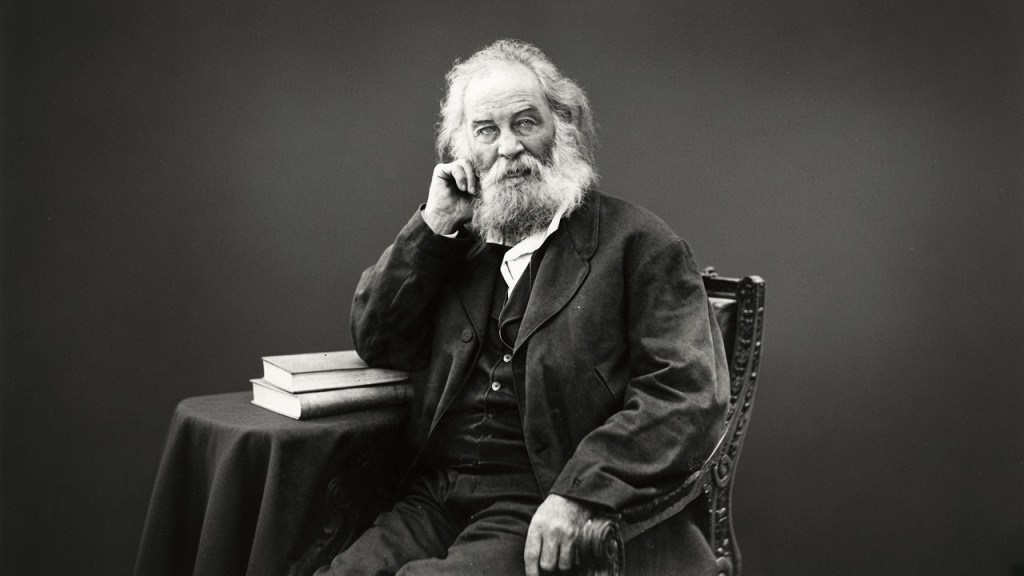
Image a: Walt Whitman – Mathew Brady – Walt Whitman Archive
Walt Whitman’s “When Lilacs Last in the Dooryard Bloom’d”
Walt Whitman’s admiration for President Lincoln is dramatized in the poet’s elegy “When Lilacs Last in the Dooryard Bloom’d,” mourning the death while celebrating the presidency of the sixteenth president, Abraham Lincoln.
Introduction and Text of “When Lilacs Last in the Dooryard Bloom’d”
In Walt Whitman’s “When Lilacs Last in the Dooryard Bloom’d,” the speaker laments the death of President Lincoln, but he does much more than merely offer his own sad and melancholy state of mind.
This speaker creates a sacred myth through which he not only offers a tribute to the fallen president but also creates a symbolic triad that will henceforth bring readers’ and listeners’ attention to the momentous event.
The speaker also composes a “Death Carol,” in which rests the irony of elevating death from the lamentation it usually brings for a celebrated friend whom all suffering humanity can afford the fealty of welcome.
It might be observed that poet Walt Whitman sectioned his elegy into 16 parts, symbolizing the fact that Abraham Lincoln, the heroic subject of the poem, had served as the sixteenth president of the United States.
When Lilacs Last in the Dooryard Bloom’d
1
When lilacs last in the dooryard bloom’d, And the great star early droop’d in the western sky in the night, I mourn’d, and yet shall mourn with ever-returning spring.
Ever-returning spring, trinity sure to me you bring, Lilac blooming perennial and drooping star in the west, And thought of him I love.
2
O powerful western fallen star! O shades of night—O moody, tearful night! O great star disappear’d—O the black murk that hides the star! O cruel hands that hold me powerless—O helpless soul of me! O harsh surrounding cloud that will not free my soul.
3 In the dooryard fronting an old farm-house near the white-wash’d palings, Stands the lilac-bush tall-growing with heart-shaped leaves of rich green, With many a pointed blossom rising delicate, with the perfume strong I love, With every leaf a miracle—and from this bush in the dooryard, With delicate-color’d blossoms and heart-shaped leaves of rich green, A sprig with its flower I break.
4
In the swamp in secluded recesses, A shy and hidden bird is warbling a song.
Solitary the thrush, The hermit withdrawn to himself, avoiding the settlements, Sings by himself a song.
Song of the bleeding throat, Death’s outlet song of life, (for well dear brother I know, If thou wast not granted to sing thou would’st surely die.)
5
Over the breast of the spring, the land, amid cities, Amid lanes and through old woods, where lately the violets peep’d from the ground, spotting the gray debris, Amid the grass in the fields each side of the lanes, passing the endless grass, Passing the yellow-spear’d wheat, every grain from its shroud in the dark-brown fields uprisen, Passing the apple-tree blows of white and pink in the orchards, Carrying a corpse to where it shall rest in the grave, Night and day journeys a coffin
6
Coffin that passes through lanes and streets, Through day and night with the great cloud darkening the land, With the pomp of the inloop’d flags with the cities draped in black, With the show of the States themselves as of crape-veil’d women standing, With processions long and winding and the flambeaus of the night, With the countless torches lit, with the silent sea of faces and the unbared heads, With the waiting depot, the arriving coffin, and the sombre faces, With dirges through the night, with the thousand voices rising strong and solemn, With all the mournful voices of the dirges pour’d around the coffin, The dim-lit churches and the shuddering organs—where amid these you journey, With the tolling tolling bells’ perpetual clang, Here, coffin that slowly passes, I give you my sprig of lilac.
7
(Nor for you, for one alone, Blossoms and branches green to coffins all I bring, For fresh as the morning, thus would I chant a song for you O sane and sacred death.
All over bouquets of roses, O death, I cover you over with roses and early lilies, But mostly and now the lilac that blooms the first, Copious I break, I break the sprigs from the bushes, With loaded arms I come, pouring for you, For you and the coffins all of you O death.)
8
O western orb sailing the heaven, Now I know what you must have meant as a month since I walk’d, As I walk’d in silence the transparent shadowy night, As I saw you had something to tell as you bent to me night after night, As you droop’d from the sky low down as if to my side, (while the other stars all look’d on,) As we wander’d together the solemn night, (for something I know not what kept me from sleep,) As the night advanced, and I saw on the rim of the west how full you were of woe, As I stood on the rising ground in the breeze in the cool transparent night, As I watch’d where you pass’d and was lost in the netherward black of the night, As my soul in its trouble dissatisfied sank, as where you sad orb, Concluded, dropt in the night, and was gone.
9
Sing on there in the swamp, O singer bashful and tender, I hear your notes, I hear your call, I hear, I come presently, I understand you, But a moment I linger, for the lustrous star has detain’d me, The star my departing comrade holds and detains me.
10
O how shall I warble myself for the dead one there I loved? And how shall I deck my song for the large sweet soul that has gone? And what shall my perfume be for the grave of him I love?
Sea-winds blown from east and west, Blown from the Eastern sea and blown from the Western sea, till there on the prairies meeting, These and with these and the breath of my chant, I’ll perfume the grave of him I love.
11
O what shall I hang on the chamber walls? And what shall the pictures be that I hang on the walls, To adorn the burial-house of him I love?
Pictures of growing spring and farms and homes, With the Fourth-month eve at sundown, and the gray smoke lucid and bright, With floods of the yellow gold of the gorgeous, indolent, sinking sun, burning, expanding the air, With the fresh sweet herbage under foot, and the pale green leaves of the trees prolific, In the distance the flowing glaze, the breast of the river, with a wind-dapple here and there, With ranging hills on the banks, with many a line against the sky, and shadows, And the city at hand with dwellings so dense, and stacks of chimneys, And all the scenes of life and the workshops, and the workmen homeward returning.
12
Lo, body and soul—this land, My own Manhattan with spires, and the sparkling and hurrying tides, and the ships, The varied and ample land, the South and the North in the light, Ohio’s shores and flashing Missouri, And ever the far-spreading prairies cover’d with grass and corn.
Lo, the most excellent sun so calm and haughty, The violet and purple morn with just-felt breezes, The gentle soft-born measureless light, The miracle spreading bathing all, the fulfill’d noon, The coming eve delicious, the welcome night and the stars, Over my cities shining all, enveloping man and land.
13
Sing on, sing on you gray-brown bird, Sing from the swamps, the recesses, pour your chant from the bushes, Limitless out of the dusk, out of the cedars and pines.
Sing on dearest brother, warble your reedy song, Loud human song, with voice of uttermost woe.
O liquid and free and tender! O wild and loose to my soul—O wondrous singer! You only I hear—yet the star holds me, (but will soon depart,) Yet the lilac with mastering odor holds me.
14
Now while I sat in the day and look’d forth, In the close of the day with its light and the fields of spring, and the farmers preparing their crops, In the large unconscious scenery of my land with its lakes and forests, In the heavenly aerial beauty, (after the perturb’d winds and the storms,) Under the arching heavens of the afternoon swift passing, and the voices of children and women, The many-moving sea-tides, and I saw the ships how they sail’d, And the summer approaching with richness, and the fields all busy with labor, And the infinite separate houses, how they all went on, each with its meals and minutia of daily usages, And the streets how their throbbings throbb’d, and the cities pent—lo, then and there, Falling upon them all and among them all, enveloping me with the rest, Appear’d the cloud, appear’d the long black trail, And I knew death, its thought, and the sacred knowledge of death.
Then with the knowledge of death as walking one side of me, And the thought of death close-walking the other side of me, And I in the middle as with companions, and as holding the hands of companions, I fled forth to the hiding receiving night that talks not, Down to the shores of the water, the path by the swamp in the dimness, To the solemn shadowy cedars and ghostly pines so still.
And the singer so shy to the rest receiv’d me, The gray-brown bird I know receiv’d us comrades three, And he sang the carol of death, and a verse for him I love.
From deep secluded recesses, From the fragrant cedars and the ghostly pines so still, Came the carol of the bird.
And the charm of the carol rapt me, As I held as if by their hands my comrades in the night, And the voice of my spirit tallied the song of the bird.
Death Carol
Come lovely and soothing death, Undulate round the world, serenely arriving, arriving, In the day, in the night, to all, to each, Sooner or later delicate death.
Prais’d be the fathomless universe, For life and joy, and for objects and knowledge curious, And for love, sweet love—but praise! praise! praise! For the sure-enwinding arms of cool-enfolding death.
Dark mother always gliding near with soft feet, Have none chanted for thee a chant of fullest welcome? Then I chant it for thee, I glorify thee above all, I bring thee a song that when thou must indeed come, come unfalteringly.
Approach strong deliveress, When it is so, when thou hast taken them I joyously sing the dead, Lost in the loving floating ocean of thee, Laved in the flood of thy bliss O death.
From me to thee glad serenades, Dances for thee I propose saluting thee, adornments and feastings for thee, And the sights of the open landscape and the high-spread sky are fitting, And life and the fields, and the huge and thoughtful night.
The night in silence under many a star, The ocean shore and the husky whispering wave whose voice I know, And the soul turning to thee O vast and well-veil’d death, And the body gratefully nestling close to thee.
Over the tree-tops I float thee a song, Over the rising and sinking waves, over the myriad fields and the prairies wide, Over the dense-pack’d cities all and the teeming wharves and ways, I float this carol with joy, with joy to thee O death.
15
To the tally of my soul, Loud and strong kept up the gray-brown bird, With pure deliberate notes spreading filling the night.
Loud in the pines and cedars dim, Clear in the freshness moist and the swamp-perfume, And I with my comrades there in the night.
While my sight that was bound in my eyes unclosed, As to long panoramas of visions.
And I saw askant the armies, I saw as in noiseless dreams hundreds of battle-flags, Borne through the smoke of the battles and pierc’d with missiles I saw them, And carried hither and yon through the smoke, and torn and bloody, And at last but a few shreds left on the staffs, (and all in silence,) And the staffs all splinter’d and broken.
I saw battle-corpses, myriads of them, And the white skeletons of young men, I saw them, I saw the debris and debris of all the slain soldiers of the war, But I saw they were not as was thought, They themselves were fully at rest, they suffer’d not, The living remain’d and suffer’d, the mother suffer’d, And the wife and the child and the musing comrade suffer’d, And the armies that remain’d suffer’d.
16
Passing the visions, passing the night Passing, unloosing the hold of my comrades’ hands, Passing the song of the hermit bird and the tallying song of my soul, Victorious song, death’s outlet song, yet varying ever-altering song, As low and wailing, yet clear the notes, rising and falling, flooding the night, Sadly sinking and fainting, as warning and warning, and yet again bursting with joy, Covering the earth and filling the spread of the heaven, As that powerful psalm in the night I heard from recesses, Passing, I leave thee lilac with heart-shaped leaves, I leave thee there in the door-yard, blooming, returning with spring.
I cease from my song for thee, From my gaze on thee in the west, fronting the west, communing with thee, O comrade lustrous with silver face in the night.
Yet each to keep and all, retrievements out of the night, The song, the wondrous chant of the gray-brown bird, And the tallying chant, the echo arous’d in my soul, With the lustrous and drooping star with the countenance full of woe, With the holders holding my hand nearing the call of the bird, Comrades mine and I in the midst, and their memory ever to keep, for the dead I loved so well, For the sweetest, wisest soul of all my days and lands—and this for his dear sake, Lilac and star and bird twined with the chant of my soul, There in the fragrant pines and the cedars dusk and dim.
Commentary on “When Lilacs Last in the Dooryard Bloom’d”
Walt Whitman was deeply affected by the assassination of President Lincoln on April 14, 1865. The poet’s admiration is dramatized in his elegy as it emphasizes three symbols: a lilac, a star, and a bird.
First Movement 1-6: Springtime when Lilacs Bloom
The speaker begins by setting the time frame in spring when lilacs bloom. He is in mourning and suggests that Americans will continue to mourn this time of year, when three events continue to come together: the lilacs bloom, the star Venus appears, and the speaker’s thoughts of the president he venerated return.
The lilacs and the star of Venus immediately become symbolic of the speaker’s feelings and the momentous event that has engendered them. In the second section of the first movement, the speaker offers a set of keening laments prefaced by “O”:
O powerful western fallen star! O shades of night—O moody, tearful night! O great star disappear’d—O the black murk that hides the star!
Each keen grows more intense as it progresses to the final, ” O hard surrounding cloud that will not free my soul.” He picks a sprig of lilac whose leaves are heart-shaped. This act indicates that the lilac will henceforth become symbolic for the speaker; the lilac will symbolize the love the speaker bears for the fallen president.
The speaker then introduces the singing hermit thrush whose song will elevate the bird to symbolic significance for the speaker, as well as the lilacs and star. In the final two sections of the first movement, the speaker describes the landscape through which President Lincoln’s casketed body moved to its final resting place in Illinois.
Second Movement 7: The Symbolic Offering
The second movement consists of a parenthetical offering of flowers to the casketed corpse of the president but also suggests that the speaker would overlay the coffins of all the war dead with roses and lilies, “But mostly and now the lilac that blooms the first.”
Again, the suggestion that the lilac will remain a symbol because it is the first flower to bloom every spring. While showering the coffins of the fallen, the speaker says he will “chant a song for you O sane and sacred death.”
Third Movement 8-9: The Star of Venus
The speaker now confronts the “western orb” that star of Venus that he had observed a month earlier. He imagines that the symbolic star had been speaking to him of the tragic events to come.
The star seemed to drop to the speaker’s side as the other stars watched. The speaker felt a sadness as the star “drops in the night, and was gone.” Now that the month has passed, the speaker feels that he was being forewarned by the symbolic star.
The speaker says that the “star of my departing comrade hold and detains me,” as he addresses the “singer bashful and tender,” that is, the hermit thrush who sings his solitary song from the covering of leaves.
Fourth Movement 10-13: A Personal Shrine to a Slain President
The speaker now muses on how he will be able to “warble . . . for the dead one there I loved.” He continues to lament but knows he must compose a “song for the large sweet soul that has gone.”
The speaker then considers what he will “hang on the chamber walls,” indicating he will erect a personal shrine to the slain president. He offers a number of items that he feels must decorate that shrine, as he catalogues them; for example, “Pictures of growing spring and farms and homes.”
The famous Whitman catalogue finds its way into several movements of this elegy. As it is the president of the country who has died, the speaker places scenes from the country in his elegy:
Lo, body and soul—this land, My own Manhattan with spires, and the sparkling and hurrying tides, and the ships, The varied and ample land, the South and the North in the light, Ohio’s shores and flashing Missouri, And ever the far-spreading prairies cover’d with grass and corn.
The speaker then commands the bird to sing as he prepares to offer a “Death Carol” in the next movement.
Fifth Movement 14: A Hymn to Death
The speaker creates a moving tribute to the president by replacing the sorrow of death with the dignity and necessity of death. Death becomes a friend who gives respite to the weary body—a fact often referenced by the “Father of Yoga in the West” Paramahansa Yogananda.
The speaker prefaces his “Death Carol” with a scene of himself walking between two friends: “knowledge of death” walked on one side of the speaker, and the “thought of death” occupied the other.
The “Death Carol” virtually lovingly addresses death, inviting it to “come lovely and soothing death.” He welcomes death to “undulate round the world.” He has almost fully accepted that death comes “in the day, in the night, to all, to each, / Sooner or later.”
The speaker’s lament has transformed death from a dreaded event to a sacred, sweet one to which he will float a song full of joy.
Sixth Movement 15-16: Entwining the Images and Symbols
The speaker credits the bird with the composition of the “Death Carol.” This crediting indicates that the speaker had become so closely in tune with the warbling bird that he cognizes a hymn from the singing.
The speaker then catalogues scenes that he had actually witnessed as he traveled the battlefields of the war during which time he had nursed the wounded and dying. He saw “battle-corpses, myriads of them.”
But he finally realizes something vital to the awareness of the reality of death: “. . . I saw they were not as was thought, / They themselves were fully at rest, they suffer’d not.” The speaker realized that it is the living who suffer the death of the deceased and not the deceased, who remained, “fully at rest.”
The speaker’s parting words offer his summation of the entwined images that now have become and will retain their symbolic significance for the speaker: “For the sweetest, wisest soul of all my days and lands—and this for his dear sake, / Lilac and star and bird twined with the chant of my soul.”
The deathbed edition of Walt Whitman’s “Passage to India” consists of nine parts, featuring his sprawling signature style, in which an omniscient speaker offers a colorful history of world civilization from earliest times to his own contemporary period.
Introduction and Text of “Passage to India”
The speaker in Walt Whitman’s “Passage to India” offers a marvelous drama, elucidating the many human achievements that have moved the citizens of the world from earliest times to contemporaneous civilization.
The speaker unveils the panorama of an ever-evolving world of individuals, who despite their flaws, have demonstrated their capabilities for bringing about a true “city on the hill [1],” where peace can reign and true joy can be established for every soul.
Walt Whitman’s classic poem is displayed in his wide-ranging, dramatic style, which includes his famous catalogues of people, places, events, and traditions. Into this poem, Whitman’s speaker packs the essence of world history, literature, and religion, as he sings his song of love for all peoples and all cultures that exist upon the Earth.
Passage to India
1
Singing my days, Singing the great achievements of the present, Singing the strong light works of engineers, Our modern wonders, (the antique ponderous Seven outvied,) In the Old World the east the Suez canal, The New by its mighty railroad spann’d, The seas inlaid with eloquent gentle wires; Yet first to sound, and ever sound, the cry with thee O soul, The Past! the Past! the Past!
The Past—the dark unfathom’d retrospect! The teeming gulf—the sleepers and the shadows! The past—the infinite greatness of the past! For what is the present after all but a growth out of the past?
(As a projectile form’d, impell’d, passing a certain line, still keeps on, So the present, utterly form’d, impell’d by the past.)
2
Passage O soul to India! Eclaircise the myths Asiatic, the primitive fables.
Not you alone proud truths of the world, Nor you alone ye facts of modern science, But myths and fables of eld, Asia’s, Africa’s fables, The far-darting beams of the spirit, the unloos’d dreams, The deep diving bibles and legends, The daring plots of the poets, the elder religions; O you temples fairer than lilies pour’d over by the rising sun! O you fables spurning the known, eluding the hold of the known, mounting to heaven! You lofty and dazzling towers, pinnacled, red as roses, burnish’d with gold! Towers of fables immortal fashion’d from mortal dreams! You too I welcome and fully the same as the rest! You too with joy I sing.
Passage to India! Lo, soul, seest thou not God’s purpose from the first? The earth to be spann’d, connected by network, The races, neighbors, to marry and be given in marriage, The oceans to be cross’d, the distant brought near, The lands to be welded together.
A worship new I sing, You captains, voyagers, explorers, yours, You engineers, you architects, machinists, yours, You, not for trade or transportation only, But in God’s name, and for thy sake O soul.
3
Passage to India! Lo soul for thee of tableaus twain, I see in one the Suez canal initiated, open’d, I see the procession of steamships, the Empress Eugenie’s leading the van, I mark from on deck the strange landscape, the pure sky, the level sand in the distance, I pass swiftly the picturesque groups, the workmen gather’d, The gigantic dredging machines.
In one again, different, (yet thine, all thine, O soul, the same,) I see over my own continent the Pacific railroad surmounting every barrier, I see continual trains of cars winding along the Platte carrying freight and passengers, I hear the locomotives rushing and roaring, and the shrill steam- whistle, I hear the echoes reverberate through the grandest scenery in the world, I cross the Laramie plains, I note the rocks in grotesque shapes, the buttes, I see the plentiful larkspur and wild onions, the barren, colorless, sage-deserts, I see in glimpses afar or towering immediately above me the great mountains, I see the Wind river and the Wahsatch mountains, I see the Monument mountain and the Eagle’s Nest, I pass the Promontory, I ascend the Nevadas, I scan the noble Elk mountain and wind around its base, I see the Humboldt range, I thread the valley and cross the river, I see the clear waters of lake Tahoe, I see forests of majestic pines, Or crossing the great desert, the alkaline plains, I behold enchanting mirages of waters and meadows, Marking through these and after all, in duplicate slender lines, Bridging the three or four thousand miles of land travel, Tying the Eastern to the Western sea, The road between Europe and Asia.
(Ah Genoese thy dream! thy dream! Centuries after thou art laid in thy grave, The shore thou foundest verifies thy dream.)
4
Passage to India! Struggles of many a captain, tales of many a sailor dead, Over my mood stealing and spreading they come, Like clouds and cloudlets in the unreach’d sky.
Along all history, down the slopes, As a rivulet running, sinking now, and now again to the surface rising, A ceaseless thought, a varied train—lo, soul, to thee, thy sight, they rise, The plans, the voyages again, the expeditions; Again Vasco de Gama sails forth, Again the knowledge gain’d, the mariner’s compass, Lands found and nations born, thou born America, For purpose vast, man’s long probation fill’d, Thou rondure of the world at last accomplish’d.
5
O vast Rondure, swimming in space, Cover’d all over with visible power and beauty, Alternate light and day and the teeming spiritual darkness, Unspeakable high processions of sun and moon and countless stars above, Below, the manifold grass and waters, animals, mountains, trees, With inscrutable purpose, some hidden prophetic intention, Now first it seems my thought begins to span thee.
Down from the gardens of Asia descending radiating, Adam and Eve appear, then their myriad progeny after them, Wandering, yearning, curious, with restless explorations, With questionings, baffled, formless, feverish, with never-happy hearts, With that sad incessant refrain, Wherefore unsatisfied soul? and Whither O mocking life?
Ah who shall soothe these feverish children? Who justify these restless explorations? Who speak the secret of impassive earth? Who bind it to us? what is this separate Nature so unnatural? What is this earth to our affections? (unloving earth, without a throb to answer ours, Cold earth, the place of graves.)
Yet soul be sure the first intent remains, and shall be carried out, Perhaps even now the time has arrived.
After the seas are all cross’d, (as they seem already cross’d,) After the great captains and engineers have accomplish’d their work, After the noble inventors, after the scientists, the chemist, the geologist, ethnologist, Finally shall come the poet worthy that name, The true son of God shall come singing his songs.
Then not your deeds only O voyagers, O scientists and inventors, shall be justified, All these hearts as of fretted children shall be sooth’d, All affection shall be fully responded to, the secret shall be told, All these separations and gaps shall be taken up and hook’d and link’d together, The whole earth, this cold, impassive, voiceless earth, shall be completely justified, Trinitas divine shall be gloriously accomplish’d and compacted by the true son of God, the poet, (He shall indeed pass the straits and conquer the mountains, He shall double the cape of Good Hope to some purpose,) Nature and Man shall be disjoin’d and diffused no more, The true son of God shall absolutely fuse them.
6
Year at whose wide-flung door I sing! Year of the purpose accomplish’d! Year of the marriage of continents, climates and oceans! (No mere doge of Venice now wedding the Adriatic,) I see O year in you the vast terraqueous globe given and giving all, Europe to Asia, Africa join’d, and they to the New World, The lands, geographies, dancing before you, holding a festival garland, As brides and bridegrooms hand in hand.
Passage to India! Cooling airs from Caucasus far, soothing cradle of man, The river Euphrates flowing, the past lit up again.
Lo soul, the retrospect brought forward, The old, most populous, wealthiest of earth’s lands, The streams of the Indus and the Ganges and their many affluents, (I my shores of America walking to-day behold, resuming all,) The tale of Alexander on his warlike marches suddenly dying, On one side China and on the other side Persia and Arabia, To the south the great seas and the bay of Bengal, The flowing literatures, tremendous epics, religions, castes, Old occult Brahma interminably far back, the tender and junior Buddha, Central and southern empires and all their belongings, possessors, The wars of Tamerlane, the reign of Aurungzebe, The traders, rulers, explorers, Moslems, Venetians, Byzantium, the Arabs, Portuguese, The first travelers famous yet, Marco Polo, Batouta the Moor, Doubts to be solv’d, the map incognita, blanks to be fill’d, The foot of man unstay’d, the hands never at rest, Thyself O soul that will not brook a challenge.
The mediaeval navigators rise before me, The world of 1492, with its awaken’d enterprise, Something swelling in humanity now like the sap of the earth in spring, The sunset splendor of chivalry declining.
And who art thou sad shade? Gigantic, visionary, thyself a visionary, With majestic limbs and pious beaming eyes, Spreading around with every look of thine a golden world, Enhuing it with gorgeous hues.
As the chief histrion, Down to the footlights walks in some great scena, Dominating the rest I see the Admiral himself, (History’s type of courage, action, faith,) Behold him sail from Palos leading his little fleet, His voyage behold, his return, his great fame, His misfortunes, calumniators, behold him a prisoner, chain’d, Behold his dejection, poverty, death.
(Curious in time I stand, noting the efforts of heroes, Is the deferment long? bitter the slander, poverty, death? Lies the seed unreck’d for centuries in the ground? lo, to God’s due occasion, Uprising in the night, it sprouts, blooms, And fills the earth with use and beauty.)
7
Passage indeed O soul to primal thought, Not lands and seas alone, thy own clear freshness, The young maturity of brood and bloom, To realms of budding bibles.
O soul, repressless, I with thee and thou with me, Thy circumnavigation of the world begin, Of man, the voyage of his mind’s return, To reason’s early paradise, Back, back to wisdom’s birth, to innocent intuitions, Again with fair creation.
8
O we can wait no longer, We too take ship O soul, Joyous we too launch out on trackless seas, Fearless for unknown shores on waves of ecstasy to sail, Amid the wafting winds, (thou pressing me to thee, I thee to me, O soul,) Caroling free, singing our song of God, Chanting our chant of pleasant exploration.
With laugh and many a kiss, (Let others deprecate, let others weep for sin, remorse, humiliation,) O soul thou pleasest me, I thee.
Ah more than any priest O soul we too believe in God, But with the mystery of God we dare not dally.
O soul thou pleasest me, I thee, Sailing these seas or on the hills, or waking in the night, Thoughts, silent thoughts, of Time and Space and Death, like waters flowing, Bear me indeed as through the regions infinite, Whose air I breathe, whose ripples hear, lave me all over, Bathe me O God in thee, mounting to thee, I and my soul to range in range of thee.
O Thou transcendent, Nameless, the fibre and the breath, Light of the light, shedding forth universes, thou centre of them, Thou mightier centre of the true, the good, the loving, Thou moral, spiritual fountain—affection’s source—thou reservoir, (O pensive soul of me—O thirst unsatisfied—waitest not there? Waitest not haply for us somewhere there the Comrade perfect?) Thou pulse—thou motive of the stars, suns, systems, That, circling, move in order, safe, harmonious, Athwart the shapeless vastnesses of space, How should I think, how breathe a single breath, how speak, if, out of myself, I could not launch, to those, superior universes?
Swiftly I shrivel at the thought of God, At Nature and its wonders, Time and Space and Death, But that I, turning, call to thee O soul, thou actual Me, And lo, thou gently masterest the orbs, Thou matest Time, smilest content at Death, And fillest, swellest full the vastnesses of Space.
Greater than stars or suns, Bounding O soul thou journeyest forth; What love than thine and ours could wider amplify? What aspirations, wishes, outvie thine and ours O soul? What dreams of the ideal? what plans of purity, perfection, strength? What cheerful willingness for others’ sake to give up all? For others’ sake to suffer all?
Reckoning ahead O soul, when thou, the time achiev’d, The seas all cross’d, weather’d the capes, the voyage done, Surrounded, copest, frontest God, yieldest, the aim attain’d, As fill’d with friendship, love complete, the Elder Brother found, The Younger melts in fondness in his arms.
9
Passage to more than India! Are thy wings plumed indeed for such far flights? O soul, voyagest thou indeed on voyages like those? Disportest thou on waters such as those? Soundest below the Sanscrit and the Vedas? Then have thy bent unleash’d.
Passage to you, your shores, ye aged fierce enigmas! Passage to you, to mastership of you, ye strangling problems! You, strew’d with the wrecks of skeletons, that, living, never reach’d you.
Passage to more than India! O secret of the earth and sky! Of you O waters of the sea! O winding creeks and rivers! Of you O woods and fields! of you strong mountains of my land! Of you O prairies! of you gray rocks! O morning red! O clouds! O rain and snows! O day and night, passage to you!
O sun and moon and all you stars! Sirius and Jupiter! Passage to you!
Passage, immediate passage! the blood burns in my veins! Away O soul! hoist instantly the anchor! Cut the hawsers—haul out—shake out every sail! Have we not stood here like trees in the ground long enough? Have we not grovel’d here long enough, eating and drinking like mere brutes? Have we not darken’d and dazed ourselves with books long enough?
Sail forth—steer for the deep waters only, Reckless O soul, exploring, I with thee, and thou with me, For we are bound where mariner has not yet dared to go, And we will risk the ship, ourselves and all.
O my brave soul! O farther farther sail! O daring joy, but safe! are they not all the seas of God? O farther, farther, farther sail!
Commentary on “Passage to India”
Walt Whitman’s “Passage to India” undertakes the mammoth task of presenting a wide-ranging historical account of world civilization through the accomplishments of a humanity for which the poet holds deep affection and admiration. As this poet’s speaker has elsewhere deemed everything a miracle, he also deems all humanity capable of miraculous achievements.
Part 1: Present Achievements
In the opening segment of the poem, the speaker celebrates the great achievements of the present: the building of the Suez Cana [2] l, the completion of which the speaker suggests heralds the completion the mission of the world-exploring Genoese, who was seeking a water route to the Far East. The speaker then celebrates the laying of the Atlantic cable, and the completion of the Transcontinental Railroad.
The speaker also pays tribute to the past, averring that the present is what it is because of what happened in the past. He emphasizes dependence of past experience by his repetition: “The Past! the Past! the Past!”
Part 2: Elucidating Myths and Fables
The first versagraph of Part 2 exclaims and commands his passage to India to elucidate the Asian myths and fables. He then suggests that it is not merely modern science that informs and delights the soul, but it is also myths and fables from around the entire world. He is deeply enthralled by the world religions, “The deep diving bibles and legends.”
Next, he then asserts through a rhetorical question the ancient rôle that India has played in the founding of the ways of knowing God and God’s purpose for humankind: “Passage to India! / Lo, soul, seest thou not God’s purpose from the first?”
Then the speaker praises the adventurous spirit [3] that spans the earth and connects the peoples. He especially pays homage to all those adventurers for making their journeys not merely for material purposes but also for spiritual enlightenment.
Part 3: The Great Explorer
After having merely mentioned the opening of the Suez Canal in Part 1, the speaker celebrates in detail that opening of that Canal and then turns to the Pacific railroad, for which he marvels at its ability to tie the two coasts together.
The speaker muses on the connections being made possible inside of the United States by the Transcontinental Railroad as well as the connections being made possible with the world through the construction of the Suez Canal.
He pays homage to the discoveries of the Italian explorer, the “Genoese,” who dreamed of reaching the Far East over a less dangerous route that earlier explorers had experienced. The speaker affirms that the idea of connecting East and West has now been accomplished after having been introduced in the great past by those of great vision.
Parts 4: Many Voyages
The musing speaker can be seen following the movements of the many sea captains and sailors who appear to him like “clouds” in a storm of historical theatre. These thoughts bring scenes of the voyages, the plans, the tempest-torn struggles that ultimately resulted in the discovery of new lands where new nations would be formed.
The speaker, whose soul seems to be flooding his vision with allusions filled with scenes of all those many voyages, including that of Vasco de Gama, to the New World which resulted in his native land’s opulence.
The speaker holds the belief that all those struggling explorers were fulfilling the promise that life on Earth holds for the children living a miraculous existence. Humankind, he suggests, continues to seek out ways to keep heavenly promises.
Part 5: Earth’s Vastness
Addressing the vast planet Earth as “O vast Rondure, swimming in space,” the speaker becomes especially emotional as he considers the grand processes of people and events that have taken place on the cosmic stage.
Throughout the historical play, the first pair of human beings—Adam and Eve—appeared, followed by “their myriad progeny.” And with them the many states of human longings and craving have continued to appear, as they motivate each generation to wander, to yearn, to remain curious as they restlessly explore their surroundings.
The speaker muses on the “never-happy hearts” that continue to question as they remain baffled in a formless feverishness. These souls continue to sally forth with a “sad incessant refrain” containing the queries, “Wherefore unsatisfied soul? and Whither O mocking life?” The speaker continues to wax cosmically as he marvels at the vastness of the earth and predicts that a poet will be instrumental in linking all the cultures.
Parts 6: Melding of Cultures
The speaker reveals that he sees the passage to India as the event to aid in the melding of “land, geographies,” and that passage continues to move rhythmically grasping metaphorically a “festival garland” as a couple at their wedding might do.
The speaker avers that his own soul will take a voyage to India: “Caroling free, singing our song of God, / Chanting our chant of pleasant exploration.” He remains in a celebratory mood as he brings into his catalogue activities that reveal the varied cultures and long-standing traditions of the world.
Part 7: Transcending Earth
But the speaker is transcending the physical earth and insists that the destination of his journey is not merely to a geographical place called India; his journey is a mystical one. He insists that humanity is on a journey “where mariner has not yet dared to go.” He suggests that the journey is so fundamental that humanity will take up that travel even at great risk.
The speaker is metaphorically imagining that he will “farther, farther, farther sail!” And he will, of course, be doing that “sailing” through the instrumentality of imagination and intuitive understanding.
He is suggesting that he has, in fact, transcended the very idea of “passage” or travel from one earthly location to another. He is now revealing the efficacy of soul experience, which even transcends mental experience.
Part 8: Mystical Journeying
Such spiritual journeying was brilliantly depicted in the quotation [4] by Swami Sri Yukteswar in Paramahansa Yogananda’s Autobiography of a Yogi: “What one does not trouble to find within will not be discovered by transporting the body hither and yon.” The speaker in Walt Whitman’s wide-ranging song of journey dramatizes the heart of that great swami’s message.
The Whitman speaker understands that as great as material, physical achievements are, the more important aspect of unity between the East and the West will be achieved through soul awareness, and not merely those physical and material exchange of ideas, material goods, or political diplomacy.
Part 9: Homage to All Travelers: Geographic and Soul
While honoring those travelers who have adventurously opened up the world to others, the speaker in Whitman’s poem also pays homage to those spiritual travelers who have opened up the spiritual level of being beyond this world. This Whitman speaker is dramatizing his ideas, his musings, and his knowledge of history to bring his insights to the citizens of the world.
He likely believes that if the members of his audience can engage their own imagination in understanding the miraculous and even divine nature of the earthly experience, they will be able to range farther and further also, not only over the earth but also far beyond it.
Sources
[1] King James Bible Online. Matthew 5:14. Accessed April 1, 2025. [2] J.R. LeMaster and Donald D. Kummings, eds. Walt Whitman: An Encyclopedia. (New York: Garland Publishing. 1998. Print. [3] Robin Ekiss. “Walt Whitman: ‘A Passage to India’.” Poetry Foundation. October 7, 2009. [4] Swami Sri Yukteswar in Paramahansa Yogananda’s Autobiography of a Yogi. Self-Realization Fellowship. Original publication date: 1946. This printing 2007. Print. Via Wikisource.
Superman did not wear his boots Like a rust belt robot. Rustbot strikes a blow for the humdrum: The “thou-shalt-nots” and the “thou-shalts” Drip no poetry. The carnivore shall Devour before being devoured & chase Each cent down the rodent hole: jump— Jump through the looking-glass.
Believe in only what you see, For beyond the rust belt, there Are shiny things, but they are not For us, they are for them People. We keep to ourselves Streetscape, river-bank, or pine-wood Where limbs scrape the clouds, And we all stay where we belong.
You don’t have to sell your soul To buy this advice. You have to rent It out on main street, where The clack of stilettos fuses With crack-heads, where gas-bag Gutter-crackers all sooner Hack as spit at you.
W. H. Auden’s politically influenced poem, “The Unknown Citizen,” portrays a character whose life has been stifled by “the State,” yet, who does not recognize his subjugation—making him a perfect citizen. In many respects, Auden’s speaker is foreshadowing the politics of 21st century America.
Introduction with Text of “The Unknown Citizen”
Poet W.H. Auden relocated from England to the United States in 1939. He experienced the stifling affects [1]of the New Deal legislation of the Franklin Delano Roosevelt administration.
The creeping socialistic policies were beginning to transform the once free nation into a ghetto of socialism. It has been calculated that those policies prolonged the Great Depression by as much as seven [2] years.
Once a country where the citizen was free to develop his talents and interests, the socialist policies of the FDR administration were beginning to stifle that character, placing the individual into a metaphoric, bureaucratic wall.
Auden’s dissatisfaction with this socialist trend plays out masterfully in his poem, “The Unknown Citizen.” The poem’s subtitle establishes a “citizen” without a name, who is thus characterless and without status as an individual.
The “citizen” has merely been designated by a vague string of letters and numbers which, however, are not without significance for the reader: “JS/07 M 378” likely alludes to the initials of the widely common name, “John Smith,” the “M” likely refers to “male,” while the numbers, station the man in the bureaucratic brick wall of similarity and conformity.
With bitter irony, this characterless individual is not an individual in the meaningful and humane sense of the word. That the state would erect a “marble monument” to such a brick-in-the-wall is risible.
Yet the designation—”unknown citizen”—is reminiscent of the term applied to those with high honor: “the unknown soldier,” whose remains cannot be identified but are granted honor for service to the country.
While honoring an unknown military serviceman, who lost his life defending his country has always been a high purpose for any country, no state would erect any kind of monument to the faceless, characterless individuals who make up the designated selection called “unknown citizen” as described in this highly symbolic and ironic poem.
The poem plays out in groups of rime with similar content, as it displays in eight movements.
The Unknown Citizen
(To JS/07 M 378 This Marble Monument Is Erected by the State)
He was found by the Bureau of Statistics to be One against whom there was no official complaint, And all the reports on his conduct agree That, in the modern sense of an old-fashioned word, he was a saint, For in everything he did he served the Greater Community. Except for the War till the day he retired He worked in a factory and never got fired, But satisfied his employers, Fudge Motors Inc. Yet he wasn’t a scab or odd in his views, For his Union reports that he paid his dues, (Our report on his Union shows it was sound) And our Social Psychology workers found That he was popular with his mates and liked a drink. The Press are convinced that he bought a paper every day And that his reactions to advertisements were normal in every way. Policies taken out in his name prove that he was fully insured, And his Health-card shows he was once in a hospital but left it cured. Both Producers Research and High-Grade Living declare He was fully sensible to the advantages of the Installment Plan And had everything necessary to the Modern Man, A phonograph, a radio, a car and a frigidaire. Our researchers into Public Opinion are content That he held the proper opinions for the time of year; When there was peace, he was for peace: when there was war, he went. He was married and added five children to the population, Which our Eugenist says was the right number for a parent of his generation. And our teachers report that he never interfered with their education. Was he free? Was he happy? The question is absurd: Had anything been wrong, we should certainly have heard.
Auden reading
Commentary on “The Unknown Citizen”
W. H. Auden’s widely anthologized classic poem portrays a pathetic character whose life has been stifled by “the State,” representing a form of government which seeks to subjugate the citizenry.
Auden employs irony to protest the state-owned life that goes against the basic American principle that the purpose of government is to protect “life, liberty, and the pursuit of happiness” for its citizens.
Auden’s wry description of his target reveals that this “unknown citizen” has had his independent ability to think and feel benumbed by the systemic, statist control under which he resides.
First Movement: A Bureaucrat Speaks
He was found by the Bureau of Statistics to be One against whom there was no official complaint, And all the reports on his conduct agree That, in the modern sense of an old-fashioned word, he was a saint, For in everything he did he served the Greater Community.
The speaker appears to be a bureaucrat who has found it important enough to file this report regarding the unknown individual, henceforth called “the unknown citizen.”
The speaker begins reporting that by a government agency no issues of resistance were ever detected by this “unknown citizen.” This unknown individual seemed to have functioned in a bureaucratically perfect manner throughout his life which resulted in his life “serv[ing] the Greater Community.”
The speaker offers a comic exaggeration of the citizen’s status by calling him a “saint”—but only in a “modern sense” of that “old-fashioned word,” indicating that any mystical or religious meaning be sucked out of that term. While a true saint remains a unique individual in his sainthood, this “saint” functions only for the state, not for his own unique relationship with the Divine.
Because the description of the citizen in this poem can be detected in the current political atmosphere of the USA, W. H. Auden has demonstrated a high level of prescience as his speaker reports on this state-obliging, willingly over-taxed citizen [3].
Such a citizen fits well the political ethos [4] of Manchurian Candidate Biden’s definition of a patriotic citizen [5], who, concurs with his former boss, Barack Obama, who insisted, “When you spread the wealth around, it’s good for everybody” [6].
The requirement for a controlling socialist state begins with citizens remaining willing pawns in the hands of government authority. Like sheep or lemmings, they follow and never question and that makes the statist overlord rich and satisfied with that citizenry.
Second Movement: An Unquestioning Joiner
Except for the War till the day he retired He worked in a factory and never got fired, But satisfied his employers, Fudge Motors Inc. Yet he wasn’t a scab or odd in his views, For his Union reports that he paid his dues, (Our report on his Union shows it was sound) And our Social Psychology workers found That he was popular with his mates and liked a drink.
This unknown citizen for his entire life labored in the factory or business concern called “Fudge Motor Inc.” He took time off as his patriotic duty called, such as serving in the military. He unquestioningly joined the “union” and paid his dues dutifully.
This unknown citizen enjoyed friends and a drink occasionally. Such a detail demonstrates the thorough intrusion of the state into the lives of individuals. The state has employed “Social Psychology workers” to determine the state-appropriate behavior of every aspect of every citizen’s life.
Auden’s prescience has foreshadowed the 21st century Democratic Party (USA) [7], which attempts to control every aspect of American lives today, from what people can eat and drink to how they use energy.
Third Movement: Controlling the Life of Everyman
The Press are convinced that he bought a paper every day And that his reactions to advertisements were normal in every way.
The unknown citizen read a daily newspaper. He responded properly to the commercial ads. Again, such a detail demonstrates the complete control that the government has over the individual.
The government is glad to report that this citizen had never lodged a complaint against it, as it is unlikely that he ever composed an editorial to the newspaper, detailing his dissatisfaction with any policies. He remained content with journalism, as well as with governmental bureaucracy, and he did not speak out against the social engineering.
Fourth Movement: Properly Insured
Policies taken out in his name prove that he was fully insured, And his Health-card shows he was once in a hospital but left it cured.
This subject of the state throughout his life bought the appropriate insurance policies. His health insurance covered his one hospital stay, and he left the facility returned to health again—and lucky for him, he was admitted to the hospital only once.
Fifth Movement: Alarming Information Possessed by the State
Both Producers Research and High-Grade Living declare He was fully sensible to the advantages of the Installment Plan And had everything necessary to the Modern Man, A phonograph, a radio, a car and a frigidaire.
The unknown citizen managed to procure all the modern conveniences, such as a record-player, a radio, an automobile, and even a refrigerator. Although this kind of information may be gleaned from survey companies that research such information, that the state is privy to it is alarming and unsatisfactory for a free society.
Sixth Movement: Proper Public Opinion
Our researchers into Public Opinion are content That he held the proper opinions for the time of year; When there was peace, he was for peace: when there was war, he went.
This citizen, according to “researchers into Public Opinion,” always maintained ways of thinking that pleased the state. He believed that there was peace if the state declared “there was peace.” But he accepted the state of war if the state reported that conflict broke out.
The governmental “Public Opinion” bureau would not be pleased if the citizen had bucked the system in any way, and no doubt bureaucratic sanctions of some sort would have been applied and reported. But this citizen passed the “Public Opinion” test.
Seventh Movement: Pleasing the State
He was married and added five children to the population, Which our Eugenist says was the right number for a parent of his generation. And our teachers report that he never interfered with their education.
This citizen’s family life also continued to please the state: the man took a wife and produced the appropriate number of children. That he did not “interfer[e] with their education” would be a blessing for the state, and of course, for the teachers’ unions [8]. The prescience of this poem is again observed as teachers’ unions currently are battling parents [9] to maintain power over those that they should serve.
Eighth Movement: The Struggle against a Faceless Bureaucracy
Was he free? Was he happy? The question is absurd: Had anything been wrong, we should certainly have heard.
Because this “unknown citizen” has been described as a non-thinker and a completely unfeeling individual, the inquiry into his status of freedom and happiness further demonstrates the irony of the situation. And yet, the final comment adds a further layer of ironic humor.
Because the bureaucratic offices had never heard any complaint from the man, they assume he was, in fact, free and happy, or at least thought himself to be thus. They reason that if anything were wrong, they would have heard.
Of course, the reader of this piece becomes painfully aware of the blandness and the dullness that the state has foisted upon this “citizen.” Following sheeplike the authoritative dictates of a powerful state was the status against which the Founding Fathers of the United States of America struggled to form the kind of government which would allow the most freedom for every citizen.
Poetry and Politics
While poetry and politics usually remain in an uneasy partnership, in the hands of an expert, a political statement can render itself workable in a poem. W. H. Auden was an expert at penning poems even of a political nature, even though he came to dislike many of his own political poems and “withdrew several from publication” [10].
Auden’s use of irony serves to carry “The Unknown Citizen” to a successful outcome. More important is the focus of the political poem; as political poems focus on merely damaging the reputation of an opponent or on falsehoods employed in propaganda, the pieces lose credibility.
But if, like “The Unknown Citizen,” the piece focuses on universal principles such as freedom and individuality, while dramatizing the results that failed policies bring about, the poem can work brilliantly.
Readers will note that the poem does not seek to disparage any government official’s reputation nor does it make propagandistic statements based on inaccuracies and blatant lies; it simply portrays the characteristics that the sheeplike citizen has assimilated in his desire to remain under the radar of state intrusion.
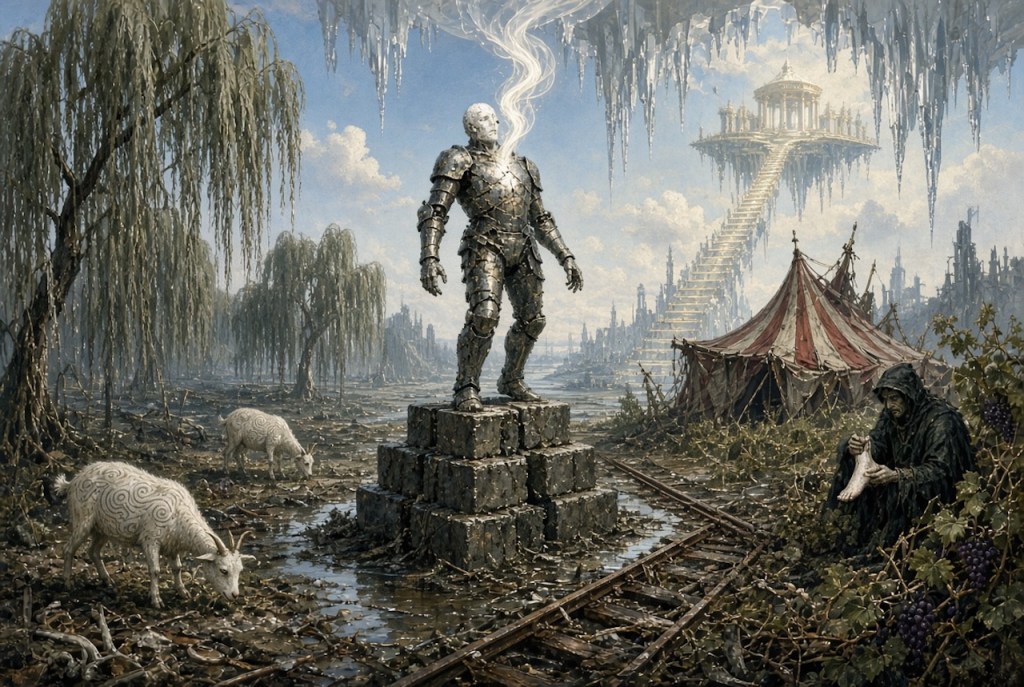
Unbuckled pride strains credulity On cinder blocks in the rain— Profit the man of steel Whose chalk mentality scratches Gold flecks of a summer night. Blank as the dank posted willows That slum the crum tide leeching The verbiage of metaphor walking Like sticks stuck down by the tracks.
In the brain waves of goats, they look For crystalline stalactites, But thiamine quelled the stretch As the Man of Steel hovered The neighborhood and plunged Into the hypocrisy of postmodern wit. Narrowing a brow, lifting a finger, Touting the untoutable, scraping The wilderness out of a circus town.
Night closes ultimately and Whimsy may fade But Dr. Frankenstink will cozy up to her lost foot As long as grapevines tangle on the waste land. Neither past nor future calls his name, and no island Brings comfort as much as departure without infamy. He left no logical heir to fan the flames of his poetry— That dust-drilled style of poetry that everybody reads Until morning echoes in the bottom of a bucket. Run on, Soul of the Man of Steel, to heaven’s loft.
The Sovereign-Citizen Movement: A Dangerous Fantasy
The sovereign-citizen movement claims that a citizen may, through the filing of the right document or the recitation of the right phrase, remain exempt from the jurisdiction of the government that protects him while still enjoying the roads, courts, and public safety that government through taxation of other citizens provides.
That contradiction is not a harmless eccentricity; instead it is a belief system that the FBI has formally classified as a domestic terrorist movement, one that has cost police officers their lives and landed ordinary practitioners in prison, foreclosure, or worse.
Example of a “sovereign citizen” being arrested in front of her daughter:
Introduction: A Movement without a Charter
Unlike a militia or a political party, and somewhat like Antifa, the sovereign-citizen movement has no headquarters, no membership card, and no single leader. Federal investigators describe sovereign-citizen extremists as a domestic terrorist movement that has persisted for decades, counting among its ranks Terry Nichols, a co-conspirator in the Oklahoma City bombing.
Sovereign citizens are not organized as an anarchist faction or a militia, though some acquire illegal weapons[1]; instead they act as individuals who occasionally cluster into loose, leaderless groups to trade paperwork tips and reinforce one another’s ideology. That looseness is precisely what makes the movement so difficult to track and so easy to underestimate.
The Ideology: Strawman, Freeman, Fictional Escape Hatch
At bottom, sovereign citizens reject the legitimacy of the government under which they live. Believers deny that government has any authority over them and insist they cannot be required to obey the law or answer for breaking it. In practice, this typically means refusing to register vehicles, obtain driver licenses, carry insurance, or pay taxes.
Adherents dress this refusal in pseudo-legal costume: invented “traveler’s” credentials, fictitious license plates from self-declared republics, and filings sprinkled with copyright symbols and phrases like “without prejudice” meant to strip a signature of legal force.
The FBI’s own reference materials catalog these habits—fraudulent plates and IDs, self-styled titles such as “freeman” or “flesh and blood,” and demands that officials produce an “oath of office” or “bond” before being obeyed—as red flags of the ideology in action.
None of it holds up in any American courtroom. Judges dismiss it, and dismiss it fast. The tragedy is how many people stake their liberty, their homes, and occasionally their lives on paperwork that can never work [2] .
Hazard One: Paper Terrorism
The mildest expression of the ideology is bureaucratic sabotage—so common it has earned its own name. Believers harass public officials with baseless legal threats intended to intimidate and to grind government functions to a halt. Sovereign citizens fabricate their own currency and legal documents, file frivolous or harassing lawsuits, and simply ignore court orders they dislike [3].
Clerks, judges, and county recorders bear the brunt of this—buried under liens filed against their personal property, threatened with private “arrest,” or accused of treason for doing their jobs. It is petty, but it is not nothing. It consumes court time, public resources, and the peace of mind of civil servants who signed up to process deeds, not fend off vigilante tribunals.
Hazard Two: Escalation to Violence
Paper terrorism is the entry point, not the ceiling. Sovereign citizens were connected to fifteen percent of FBI-designated domestic terrorism incidents recorded between 2015 and 2019, and most of those incidents turned violent.
The FBI itself warns that sovereign-citizen crime can escalate as far as assault or murder—a warning grimly confirmed on May 20, 2010, near West Memphis, Arkansas. A routine traffic stop turned lethal when Jerry Kane [4], a self-described sovereign citizen, and his sixteen-year-old son Joseph opened fire on the officers who had pulled them over, killing both officers.
Officer Bill Evans was struck fourteen times and Sergeant Brandon Paudert eleven, in an ambush that shocked a nation already wary of “deep state” paranoia and anti-government fury.
The Kanes died in a shootout hours later in a Walmart parking lot. Before the killings, Jerry Kane had made his intentions plain: he told an associate he did not want to kill anyone, but that if law enforcement kept “messing with me,” he would have to, and once he started, he would not be able to stop.
Those words are not the language of a harmless hobbyist filing strange paperwork. It is the language of a man who had convinced himself the badge on the officer’s chest carried no authority over him—and who acted accordingly.
Similar confrontations have unfolded from Louisiana to Texas to Wisconsin, a pattern sober enough that law enforcement magazines now train recruits specifically to recognize the movement’s warning signs [5].
Hazard Three: Financial Predation
Sovereignty is also a business. In one Nevada investigation, four men tied to the movement were arrested on federal money-laundering, tax-evasion, and weapons charges after allegedly laundering more than a million dollars while charging fees for their “services” [6].
The pitch is seductive: pay us, and we will show you how to erase your debts, evade your taxes, or file a lien that magically discharges your mortgage. It never works, and the believer is often left facing federal charges of his own, on top of whatever losses the scam artist pocketed along the way.
Toward Vigilance, Not Amusement
It is tempting to laugh off the sovereign citizen as a colorful crank—the fellow arguing with a judge that he is a “flesh-and-blood man” beyond the state’s jurisdiction. The temptation should be resisted. A belief system that convinces its adherents the law simply does not apply to them will, sooner or later, produce a Jerry Kane: someone prepared to treat an ordinary traffic stop as an act of war.
Law enforcement now trains for that possibility, and rightly so. The rest of us would do well to understand the ideology clearly enough to recognize it—not as satire, but as the domestic threat the FBI has long said it is.