In her customary fashion, poetaster Sharon Olds offers up this deeply flawed, dishonest hit-piece, “The Victims,” which does little more for humanity than showcase a handful of stark images.
Introduction with Text of “The Victims”
According to noted poetry critic, Helen Vendler, Sharon Olds’ poetry comes across as “self- indulgent, sensationalist, and even pornographic.” And as former poet laureate Billy Collins averred: Olds is “a poet of sex and the psyche” “infamous for her subject matter alone.”
And even though Collins attempted to add some faint praise, “but her closer readers know her as a poet of constant linguistic surprise,” those linguistic surprises consisting of stark images only function to undermine her attempt to produce any genuine poetry.
Although “The Victims” is one of Olds’ least “pornographic” efforts, the piece clearly demonstrates egotistical self-indulgence and egregious sensationalism. Such writing smacks more of loose-mused regurgitation than real cogitation on genuine emotion.
This unhappy piece consists of 26 uneven lines of free verse that sit in a lump chunk on the page and suffer from the customary Oldsian haphazard line breaks.
The Victims
When Mother divorced you, we were glad. She took it and took it in silence, all those years and then kicked you out, suddenly, and her kids loved it. Then you were fired, and we grinned inside, the way people grinned when Nixon’s helicopter lifted off the South Lawn for the last time. We were tickled to think of your office taken away, your secretaries taken away, your lunches with three double bourbons, your pencils, your reams of paper. Would they take your suits back, too, those dark carcasses hung in your closet, and the black noses of your shoes with their large pores? She had taught us to take it, to hate you and take it until we pricked with her for your annihilation, Father. Now I pass the bums in doorways, the white slugs of their bodies gleaming through slits in their suits of compressed silt, the stained flippers of their hands, the underwater fire of their eyes, ships gone down with the lanterns lit, and I wonder who took it and took it from them in silence until they had given it all away and had nothing left but this.
Commentary on “The Victims”
The piece breaks into two parts: the first is a description of how the speaker and her family felt way back a few decades when she was a child, and the second part jumps to what the speaker observes and thinks as an adult.
First Movement: Hindsight Sometimes Less Than 20/20
The speaker of the poem is an adult looking back at the break up of her family roughly around the time that her mother divorced her father. The speaker is addressing the father, telling him how glad she and the family were after the mother divorced the father.
The speaker and her siblings were glad because she “took it // in silence, all those years.” What she, and perhaps they, silently endured is left up to the reader to imagine, and that omission is a major flaw that leads the poem astray.
No two divorces are alike. By leaving such an important motive to the imagination of the reader, the speaker weakens the thrust of her accusations against the father. The only hint of the father’s misdeeds is that he enjoyed three alcoholic beverages with his lunch.
Admittedly, that could present a problem, but by no means does it always do so. Some individuals can handle a few drinks better than others, and the fact that the father seemed to have functioned in his job for a considerable period of time hints that he might have been competent in his job.
On the other hand, the mother influenced her children in a grossly negative way, causing them to hate their father and wish him dead.
Apparently, the mother teaches her children to hate their father simply because he had three double bourbons for lunch or so we must assume because no other accusation is leveled against the poor man.
Maybe the father was a cruel alcoholic, who beat the mother and children, but there is no evidence to support that idea. And if that were the case, stark images of bruises and broken bones would surely have made an appearance in the little drama.
The father was fired from his job, but only after the mother kicked him out. Would he have been able to keep his job to that point in his life, if he had been an out of control, cruel drunk? Perhaps he became depressed and without purpose after being forced to leave his family and sank further into alcohol.
The gratuitous allusion to “Nixon’s helicopter,” carrying the newly resigned president from office, further inserts the nastiness of a political hit-piece, adding nothing to the drama except the suggestion that the family likely voted for Democrats.
One has to wonder if the speaker and her fellow travelers would have “grinned” so readily, if a helicopter had lifted off the South Lawn carrying Jimmy Carter or Bill Clinton.
So the reader has no evidence that the father was guilty of anything, but the mother taught the kids to hate the father and wish for his death. The mother comes across as a less sympathetic character than the father.
Second Movement: Appalling Prejudice Revealed
The speaker now begins her report on what she sees and how she thinks in her current life situation that has been tainted by her past. She begins to observe homeless men sleeping in doorways.
It becomes clear that it is those homeless men in the doorway who are reminding the speaker of her father getting kicked out of their home and getting fired from his job.
The speaker then speculates about those men about whom readers can be sure she knows absolutely nothing. She wonders about the lives of those homeless men, whom she calls “bums.”
She wonders if their families “took it” from those men the way her family supposedly took it from her father. But again, the reader remains clueless about what it is the family “took.”
What an arrogant reaction! Without one whit of evidence that these “bums” did anything to anyone, the speaker simply presumes that they are like her father, who lost it all because of what he (and now they) supposedly did.
But the reader still does not even know what the father did. They do know what the mother did; she taught her children to hate the father and wish him dead.
Stark, Colorful Images
This poem, like many of Sharon Olds’ poems, offers some colorful descriptions. The father’s business suits are rendered “dark / caresses” hanging the closet. His shoes sport “black / noses //with their large pores.”
Those homeless men are name called “bums” because they are lying “in doorways.” Their bodies are dehumanized and portrayed as “white / slugs.”
Those slugs shine “through slits” in compacted dirt, revealing their compromised hygiene after being homeless for a protracted length of time. Their hands resemble “stained / flippers,” again dehumanized.
Their eyes remind this flippant speaker, who lacks compassion for her fellow human beings, of ships that have sunken with their “lanterns lit.”
Would that all of those colorful images resided in a better place and without the lack of humanity this speaker reveals about herself. Those “linguistic surprises,” however, function only to render the speaker and the so-called victims as the actual perpetrators of despicable acts.
Although the speaker wishes to foist bad behavior onto first her father and then onto homeless men, she cannot escape the rebuttal that she has failed to indict her father and that she knows nothing about those homeless “bums.”
This ugly piece remains questionable and appears to have been created solely for the purpose of showcasing a handful of stark, colorful images.
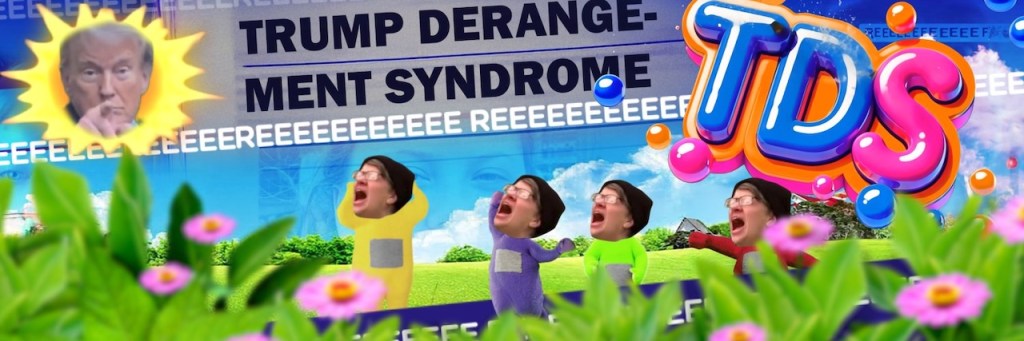
The phenomenon known as Trump Derangement Syndrome (TDS) has established a pattern of behavior and language applied by the political opposition of President Donald Trump. That outrage arises from ignoring facts or context, leveling unfair criticism, and engaging in melodramatic emotion, wherein calm reasoning is abandoned.
Introduction: Extreme Rhetoric
Trump Derangement Syndrome (TDS) has fostered an atmosphere in which contemporary political rhetoric and public discourse operate as fallacious argumentation, in which every statement or action becomes distorted and weaponized.
Political disagreement does not employ discussion, analysis, and explanation regarding policy differences but instead, it operates on disgust and indignation that the opponent even holds differing views.
TDS is often manifested in Trump’s opponents through ad hominem attacks, in which personal slander takes the place of logical argument—substituting name-calling and character assassination for substantive argument.
Trump has been called a Russian puppet, sexual predator, dictator, threat to democracy, racist, white supremacist, convicted felon, traitor, insurrectionist, clown, idiot, nazi, fascist, and the pièce de résistance—Hitler.
Even obvious joking sarcasm when spouted by Trump becomes fodder for re-interpretation and bad-faith reporting. For example, during the presidential election campaign of 2016, when Trump facetiously called on Russia/Putin to find Hillary Clinton’s 33,000 deleted emails, the following exemplary headline appeared on PBSNews :“Trump asked Russia to find Clinton’s emails. On or around the same day, Russians targeted her accounts,” suggesting that Trump was asking a foreign government to interfere in the election campaign.
In addition to ad hominem attacks, immediate condemnation of any policy issuing out of the Trump administration results in reasoning and careful inquiry being abandoned [1], resulting in the use of the most extreme, heated language.
However, Trump himself is not the only target of this invective; all of those terms and others are applied to his supporters: during the 2016 presidential campaign, Hillary Clinton called them “deplorables,” and during the 2024 campaign, Joe Biden called them “garbage.” Those who oppose Trump, his administration, and his supporters are not simply critical of them; they are obsessed them.
A dangerous mixture of outrage, exaggeration, and hypocrisy involved in attacking Trump has caused TDS sufferers to lack the ability to think clearly about issues. Any idea suggested by Trump is immediately railed against simply because it was suggested by Trump.
The Origin of Trump Derangement Syndrome
The phrase “Trump Derangement Syndrome” did not originate as a clinical diagnosis, although its predecessor “Bush Derangement Syndrome” was coined by the psychiatrist and political analyst Charles Krauthammer, who observed that extreme, irrational reactions to President George W. Bush often went far beyond substantive policy disagreement.
Krauthammer used the term to highlight how emotional fixation and hostility replaced reasoned analysis and proportional criticism. The revival of this concept during Donald Trump’s presidency reflects the same phenomenon, magnified by social media, a 24-hour news cycle, and an increasingly polarized political culture [2].
However much words do matter, Trump Derangement Syndrome (TDS) is more than rhetorical excess; it has real consequences that harm individuals, families, public institutions, and the broader political environment. The following examples illustrate how hyper-emotional fixation on Donald Trump—when divorced from clear reasoning and grounded fact—creates verifiable and dangerous effects on American society:
Escalation to Political Violence
The starkest danger of TDS is that it fuels political violence rather than dissent through words. During the 2024 campaign, Donald Trump survived at least two assassination attempts motivated by political hatred and extremism.
The first happened at a rally in Butler, Pennsylvania, [3] when a gunman shot at Trump, wounding him on his right ear. The gunman killed Corey Comperatore, a rally attendee and former fire chief, who took a bullet protecting his family. The gunman also wounded several other people before being killed by Secret Service.
A second assassination attempt was thwarted by authorities at Trump’s golf club in West Palm Beach, Florida [4]. This perpetrator was arrested, stood trial, and was found guilty of the assassination attempt; he awaits sentencing on February 4, 2026.
Another unmistakable instance of politically motivated violence occurred on September 10, 2025, when Turning Point USA founder Charlie Kirk was fatally shot during a public event at Utah Valley University in Orem, Utah. While speaking at an outdoor gathering, Kirk was struck in the neck by a single bullet fired from a distance, an attack that Utah officials and others characterized as a political assassination [5].
These incidents demonstrate how obsessive political animus can translate into lethal intent, transforming rhetoric into action and endangering not only public figures but bystanders, law enforcement, and the democratic process itself.
Political Polarization Breaking Family Bonds
TDS has also deeply strained familial relationships. In too many households across the country, deep political disagreements have resulted in personal and familial estrangement. A Time magazine feature documented families [6] who stopped speaking entirely during the Trump years, including one case in which a woman was uninvited from Thanksgiving and later cut off from close relatives solely because of her political views related to Donald Trump.
What had once remained ordinary disagreement has hardened into moral condemnation, with ideological choice being prioritized over blood relations. This dynamic tarnishes one of our most cherished and fundamental social units—the family—leaving emotional scars that persist long after the election cycle has passed.
Exploitation of Tragedy for Political Weaponization
Another disturbing example of how TDS has distorted reactions to violent events is evident in public opinion data following the July 2024 assassination attempt on Donald Trump.
In a snap poll conducted shortly after the attack, roughly one‑third of Democrat voters agreed with the statement “I wish Trump’s assassin hadn’t missed”[7]. That such a large proportion of the opposition political party actively wished that an opponent had been killed should place a huge red flag on the issue.
Such sentiments reflect a deeply disturbing willingness to engage in the ultimate violence in addressing political differences. This response illustrates how TDS can override basic empathy and moral restraint, further polarizing discourse and normalizing violent attitudes toward political opponents.
Rejection of Policy on Source Alone
TDS sufferers without thinking oppose any policy regardless of merit simply because it comes from Trump. During his presidency, Trump championed criminal justice reform through the First Step Act, a bipartisan measure that reduced sentences for nonviolent offenders and earned praise from figures like Van Jones [8]. Yet many on of his top opponents dismissed it outright, calling it a sham despite its tangible results in releasing thousands from prison.
Even as they voted for the bill, these congressional member expressed negative criticism of it as too limited, exclusionary, narrow: Sen. Bernie Sanders (I-VT), Sen. Kamala Harris (D-CA), Sen. Cory Booker (D-NJ), and Rep. Alexandria Ocasio-Cortez (D-NY).
This knee-jerk rejection ignores benefits to real people—mostly minorities—and poisons the well for future bipartisan efforts. The danger lies in discarding proven solutions, leaving societal problems festering while politics trumps progress.
Lawfare Weaponization against Citizens
Mainstream media outlets and Democrat officials, gripped by TDS, have pursued “lawfare” against ordinary Trump supporters, turning legal processes into political retribution.
After the January 6 riot, Attorney General Merrick Garland’s Justice Department charged hundreds of nonviolent participants—parents, grandparents, workers, small business owners, some individuals who were not even present at the capitol—with felonies carrying decades in prison, while ignoring similar or worse rioting by groups such as Antifa and BLM [9] .
This selective prosecution creates two tiers of justice: one for Trump opponents who face lenient treatment, another for his supporters treated as domestic terrorists. The danger lies in weaponizing the rule of law itself, eroding equal protection under the Constitution and fostering a climate where citizens fear political expression.
Families lose breadwinners to draconian sentences, communities fracture, and trust in impartial justice evaporates—leaving Americans vulnerable to future authoritarian overreach from any side that may promise a return to fairness under the law [10].
Economic Self-Sabotage through Hysteria
TDS has led opponents to sabotage policies that later prove beneficial [11], harming the economy they claim to champion. Tariffs on China, derided as reckless by TDS critics, pressured Beijing into trade concessions that revitalized American manufacturing jobs in key states. Critics who railed against them without nuance prolonged economic pain for workers.
By prioritizing anti-Trump animus over pragmatic assessment, this mind-set risks national prosperity. It endangers livelihoods when ideology blinds leaders to data-driven gains.
Suppression of Free Speech on Campuses
Universities, which formerly boasted their positions as bastions of open inquiry, have seen TDS manifest as censorship of Trump-related views [12]. Professors and students expressing support for Trump’s policies face shouting-downs, doxxing, low grades, or job threats, as seen in cases at Yale and NYU ,where conservative speakers were mobbed or disinvited.
This kind of unfair discrimination chills intellectual diversity, turning campuses into echo chambers. The danger is profound: it trains a generation to equate disagreement with moral failing, undermining the reasoned debate essential for maintaining a free society.
Foreign Policy Paralysis
TDS hampers coherent foreign policy by fixating on Trump over real threats facing the United States and other nations. While Trump brokered the Abraham Accords [13] normalizing Israel-Arab ties—hailed as historic by many—his opposition fixated on and imaginary “divisiveness,” denigrating and downplaying the breakthrough.
One might recall that the phrase “Abraham Accords” ran noticeably missing during the Biden administration’s four years. Instead of trying to build on the success of those Accords, the Biden administration essentially ignored them, and instead proceeded to cozy up to Iran just as President Barack Obama had done.
So it remains obvious that “The reason for the administration’s hostility to the Abraham Accords goes beyond jealousy or the desire to deny credit to a hated predecessor” [14]. The Biden administration’s reaction to the Abraham Accords demonstrates another blatant example of TDS causing its sufferer to bite off its nose to spite its face. World peace be damned, if Donald Trump has anything to do with it! (my emphasis added)
Such tunnel vision weakens America’s global stance. It allows adversaries like Iran to exploit divisions, endangering allies and U.S. interests when personal hatred eclipses strategic thinking.
Workplace Discrimination against Supporters
TDS has infiltrated some workplaces, where Trump voters have faced bias in hiring or promotions. Recent surveys indicate some hiring managers admit to bias against Trump supporters in hiring and promotions. Reports highlight concerns over social media scrutiny for political views, especially in tech sectors after the 2024 election.
A ResumeBuilder.com poll of over 750 U.S. managers found 1 in 6 less likely to hire Trump supporters, citing poor judgment (76%), lack of empathy (67%), or workplace tension risks (59%) [15]. One in 8 managers are less likely to promote such employees, with similar rationales; some even encourage quits.
Managers often check social media indirectly, as direct bias questions are avoided, amplifying unaddressed discrimination [16]. Post-2024 election, tech firms like Google and Meta tightened internal policies to curb activism, removing political posts and limiting discussions on elections or related symbols.
While no widespread firings for Trump support are documented in these sources, the surveys flag a “concerning trend” of political bias akin to other protected categories, urging HR to enforce objective evaluations. Broader DEI rollbacks under Trump policies (e.g., executive orders in 2025) shifted focus to merit, but hiring biases persist in certain areas.
Cultural Institutions Alienating Half the Nation
Hollywood and elite culture, steeped in TDS, produce content that vilifies Trump supporters as rubes or villains, deepening cultural rifts [17]. Films and shows routinely caricature “MAGA” hats as symbols for bigotry, alienating millions of viewers. This breeds mutual contempt, fracturing national cohesion. When culture wars replace dialogue, shared identity unravels, leaving society brittle and weakened against common challenges.
Tom Hanks played a Trump supporter named Doug on SNL’s “Black Jeopardy” during the 50th anniversary special in February 2025. The character wore a MAGA hat and an American flag shirt, hesitating to shake a black host’s hand, while speaking with a Southern drawl. Critics called it a racist caricature amid Trump’s growing support with black Americans.
In Bong Joon-ho’s “Mickey 17” (2025), a Trump-like politician rallies crowds with “First we survive! Then we thrive!” slogans. Supporters wear red hats, and the figure obsesses over image in a gaudy setup, reducing women to breeders. Even some Reddit users [18] noted it as Hollywood propaganda tying MAGA visuals to bigotry.
These depictions use MAGA hats as symbolic icons for backwardness or hate, alienating everyday Americans. Commentary points to “Trump Derangement Syndrome” in elite content driving rifts between supporters of Trump and his opposition.
Hypocrisy and TDS
One of the clearest markers of Trump Derangement Syndrome is not merely excess emotion, but selective memory—an amnesia that conveniently erases facts that negate the preferred narrative. This hypocrisy is especially evident when examining Donald Trump’s public reputation prior to his decision to run for president as a Republican. That distinction matters: does anyone really believe that if Trump had run for president as a Democrat, he would have received the same level of sustained media hostility and moral outrage, or would his celebrity excesses have been reframed as colorful flaws rather than disqualifying sins?
Before entering politics, Trump was not widely regarded as a pariah or an existential threat to democracy. On the contrary, he was a mainstream celebrity, a frequent guest on talk shows, a fixture in popular culture, and a recognizable brand associated with success and entertainment.
His television program The Apprentice was a major hit [19], running for fourteen seasons and drawing millions of viewers weekly. Trump was welcomed in elite social circles, praised by entertainers, courted by politicians, and treated as a cultural icon rather than a moral monster.
That history poses an uncomfortable question for TDS sufferers: if Trump was allegedly a racist, fascist, authoritarian, or “Hitler” all along, why was he celebrated so enthusiastically for decades [20]? The answer is obvious but rarely admitted—Trump became unacceptable only after he challenged the status quo of entrenched political power.
This hypocrisy is further illustrated by the now‑forgotten fact that Oprah Winfrey [21], one of the most influential cultural figures in America, once raised the prospect of a Trump presidential run on her nationally syndicated show. In a 1988 interview, Winfrey openly entertained the idea by asking Trump whether he would run for president, a notion that drew no negative response from the audience.
At the time, such a notion was not treated as dangerous or absurd, but as intriguing. No cries of impending dictatorship followed. No accusations of fascism emerged. The man has not changed; the political context has.
Similarly revealing is the selective outrage surrounding immigration enforcement. Tom Homan, who later became a senior immigration official under Trump, previously served in the Obama administration [22], where he oversaw large-scale deportations of illegal immigrants.
Under President Obama, deportations reached record levels, earning Obama the nickname “Deporter in Chief” among immigration activists. Yet Homan’s actions under Obama attracted no media hysteria and no moral condemnation.
Once those same policies—and in many cases, the same personnel—were associated with Donald Trump, they were suddenly recast as evidence of cruelty, racism, and authoritarianism [23]. The policy substance remained largely unchanged; only the political association shifted. This double standard exposes the core of TDS: opposition not to ideas or actions, but to the individual himself.
Such contradictions reveal that Trump Derangement Syndrome is propagated not by principle but by animosity. It is not driven by consistent moral reasoning, but by prejudicial hostility that rewrites history to justify present outrage.
When yesterday’s admired celebrity becomes today’s Hitlerian villain, yesterday’s lawful deportations become today’s unconstitutional atrocities, and yesterday’s encouragement becomes today’s horror, the problem is not Trump—it is the inability of his critics to apply standards with balance and proportion.
In this way, hypocrisy is not a side effect of TDS; it is one of its defining features.
Toward Official Recognition of TDS
Taken together, these examples demonstrate that Trump Derangement Syndrome is not a harmless turn of phrase or a bit of political snark; it is a corrosive mind-set with real-world, measurable consequences.
When outrage replaces analysis, disagreement hardens into dehumanization, and fixation eclipses fact, the result is not merely bad manners but real harm—to families torn apart, to public trust in institutions, to free expression, and even to human life.
The pattern remains consistent: an inability or refusal to separate Donald Trump the individual from objective evaluation of policies, principles, and people associated with him. In that environment, reason is not merely sidelined; it is treated with suspicion.
The growing recognition of this phenomenon has moved beyond commentary and into the realm of formal inquiry. The introduction of the Trump Derangement Syndrome (TDS) Research Act of 2025 by Representative Warren Davidson reflects an acknowledgment that the effects described here warrant serious examination rather than reflexive dismissal [24].
Whether one supports Trump or opposes him, a healthy republic depends on the ability to argue without hysteria, to criticize without hatred, and to reject violence, censorship, and collective punishment as political tools.
Ultimately, the danger of TDS lies in what it does to the culture of self-government. A nation cannot remain free if its citizens are trained to see political opponents as enemies to be destroyed rather than fellow Americans to be debated. Reclaiming proportion, restraint, and reason is not a concession to Donald Trump; it is a necessity for the survival of civil society itself.


 Linda's Literary Home