Speculative Literary Fiction Alert!
This text is speculative literary fiction.
It does not depict any real person or actual event.
Original Short Literary Fiction: “Transformation through the Ages: Two Letters to Myself“
The process of aging asks us to move from one version of ourselves into another—slowly learning how to carry memory, change, loss, wisdom, and time within the same person.
Dear Older Me,
I’m writing to you from age twenty, which feels impossibly young and impossibly certain all at once, right on the edge of adulthood. Everyone keeps telling me that life will change me, but I still wake up every morning believing I will somehow remain recognizable to myself forever. I wonder if you remember feeling that way.
Lately I’ve been thinking about aging—not in the dramatic sense of illness or endings, but in the quieter sense of becoming someone new over time. I look at photographs from just a few years ago and already feel strange about them.
The girl in those pictures is me, but also not entirely me anymore. Her worries were smaller. Her body was different, plumper, rosier, full of some kind of strange awareness. But her understanding of herself was unfinished.
I wonder what it’s like for you now, at nearly ninety, carrying six plus decades of former selves inside you.
Do you still feel connected to me? Or do I seem like a distant relative you remember fondly but imperfectly?
People talk so much about youth as though it’s the truest version of a person, and aging as though it’s some slow departure from that truth. But I’m beginning to suspect that every age is temporary, and every version of ourselves eventually becomes a kind of memory.
That thought frightens me sometimes.
I notice already how language changes around age. Adults speak of young people with nostalgia, impatience, envy, and tenderness all at once. And young people speak about aging as though it’s something abstract—something happening to other people. Yet every day we are all moving quietly toward another stage of ourselves.
I wonder what it feels like to look into the mirror at eighty plus. Do you still recognize your expressions even if the face has changed? Do you still feel young somewhere underneath everything time has altered?
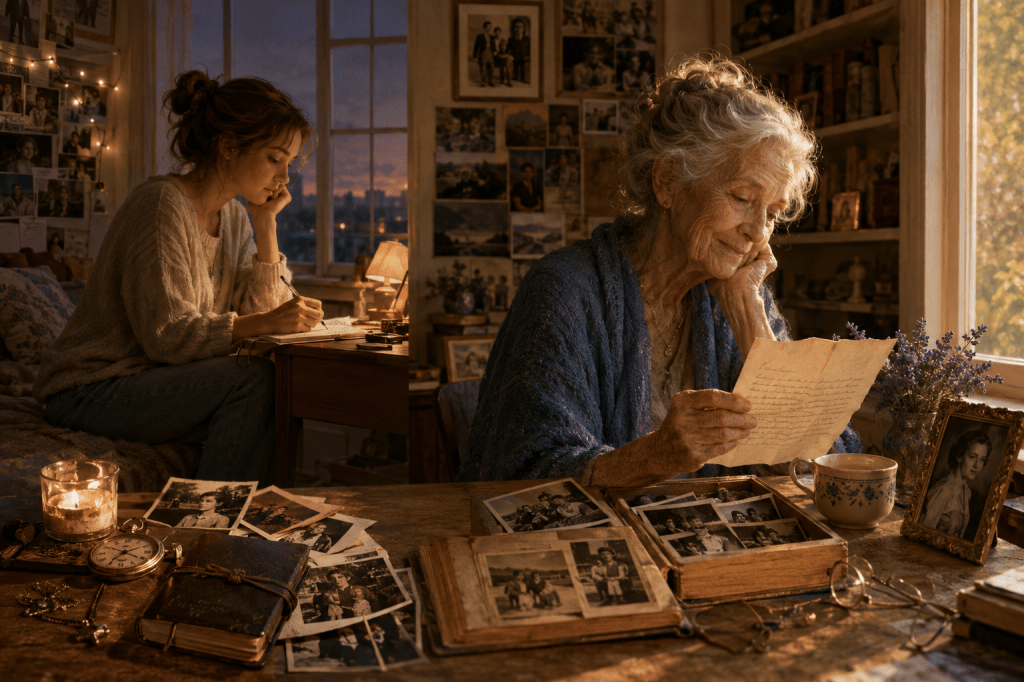
I’ve also been thinking about photographs and memories. Right now, my room is full of snapshots from childhood, school dances, birthdays, awkward haircuts, and vacations that already feel far away. I can’t imagine ever wanting to hide those versions of myself, even the embarrassing ones. But I wonder if, by your age, those images begin to feel less like evidence and more like archaeology.
Do old photographs comfort you, or do they ache? I hope you’ve kept them all anyway.
I hope you understand that the younger versions of yourself were not mistakes. I hope you speak kindly about us—the insecure teenager, the reckless twenty-year-old, the exhausted middle-aged woman trying to hold everything together. I hope you see all of them not as separate people, but as chapters in the same long story. Most of all, I hope you haven’t become embarrassed by change itself.
Right now, growing older seems terrifying because everything around me celebrates beginnings and quietly fears decline. But perhaps aging is not a process of disappearing. Maybe it’s a process of accumulation. Maybe the older face simply carries more life within it. If you could tell me anything from where you are now, I think I’d want reassurance that becoming older does not mean becoming less.
I hope you still laugh easily. I hope you still feel wonder. I hope you still believe your life mattered. And I hope, somehow, that you are grateful for me too—for this young girl standing at the beginning, trying so hard to understand time before she has truly lived it.
Love,
Your Former Self
Dear Former Self,
Your letter arrived like a voice carried across water—young, searching, and achingly sincere. I read it slowly, not because age has made me slower, though perhaps it has, but because your words reopened rooms in my memory I had not visited in years.
Yes, I remember you. More importantly, I remember being you.
At twenty, you believe identity is something you must discover once and then defend forever. What age eventually teaches is that the self is not a monument. It is weather. It shifts continuously—sometimes gently, sometimes violently—and survives through adaptation rather than permanence.
You ask whether I still feel connected to you. I do, though not in the simple way you imagine. You are not buried beneath the years; you are woven through them. I still recognize your idealism, your sensitivity, your fear of being forgotten or diminished by time. Those things remain, though softened now by experience.
And yes, there are moments when I look into the mirror and feel startled. Aging happens so gradually that you scarcely notice it while living through it, and then suddenly you catch sight of your mother’s face in your own reflection, or your grandmother’s hands resting in your lap.
The body changes first in obvious ways. The knees complain. The spine stiffens. Sleep becomes lighter. Faces hollow and soften simultaneously. But the deeper transformation is stranger: the realization that inside the aging body, consciousness remains largely untouched by chronology.
I am eighty-nine, yet some mornings I still feel eighteen until I stand up. That is one of the great hidden truths of aging: the young self never fully leaves. She simply becomes surrounded by additional selves gathered over a lifetime.
You asked whether old photographs comfort or ache. The answer is both. Photographs become less about appearance and more about vanished worlds. You stop focusing on how pretty you once were and begin noticing who is no longer standing beside you. An old picture can break your heart because time is visible there in a way it never feels while you are living it.
But keep the photographs anyway. Keep all of them. One day you will treasure the evidence that ordinary afternoons once existed at all.
You fear that aging may mean becoming less. I understand that fear because our culture speaks of aging almost entirely in the language of loss. Loss of beauty. Loss of relevance. Loss of strength. Loss of possibility.
And yes, there are losses. I will not lie to you about that. You will lose people you cannot imagine living without. You will lose certain ambitions. You will lose versions of your body that once felt effortless. But aging is not merely subtraction. It is also refinement.
At twenty, you experience life intensely because everything is new. At ninety, you experience life intensely because you finally understand how temporary everything always was. A simple morning light across the kitchen table can move you to tears. An ordinary conversation can feel sacred. Youth burns brightly, but age glows.
You asked whether I still laugh easily. I do—more easily, in fact. Young people often believe seriousness gives life meaning, but age teaches the opposite. Much of survival depends upon learning when to laugh at yourself gently.
And wonder? Yes, wonder remains too. Perhaps even more so. The older you become, the more miraculous existence itself begins to feel. Not because life becomes easier, but because you finally understand how improbable it always was.
As for whether your life mattered: meaning does not arrive as a grand declaration. It accumulates quietly through small acts of love, attention, endurance, forgiveness, and presence. A meaningful life rarely feels monumental from the inside.
You hoped I would be grateful for you. I am.
I am grateful for your impatience, your hunger for understanding, your belief that life must contain something beautiful and true. You carried us forward. Without your courage to begin, I would never have arrived here with so much tenderness intact.
So let me leave you with this:
Do not spend your youth mourning age in advance. Become fully each version of yourself when it arrives.
The frightened girl, the ambitious woman, the joyful grandmother—they all belong to you. None of them are failures of the others. They are simply the many forms a human life must take in order to become complete.
Love and blessings,
Myself Now
 Linda's Literary Home