Human Classification Is Tricky
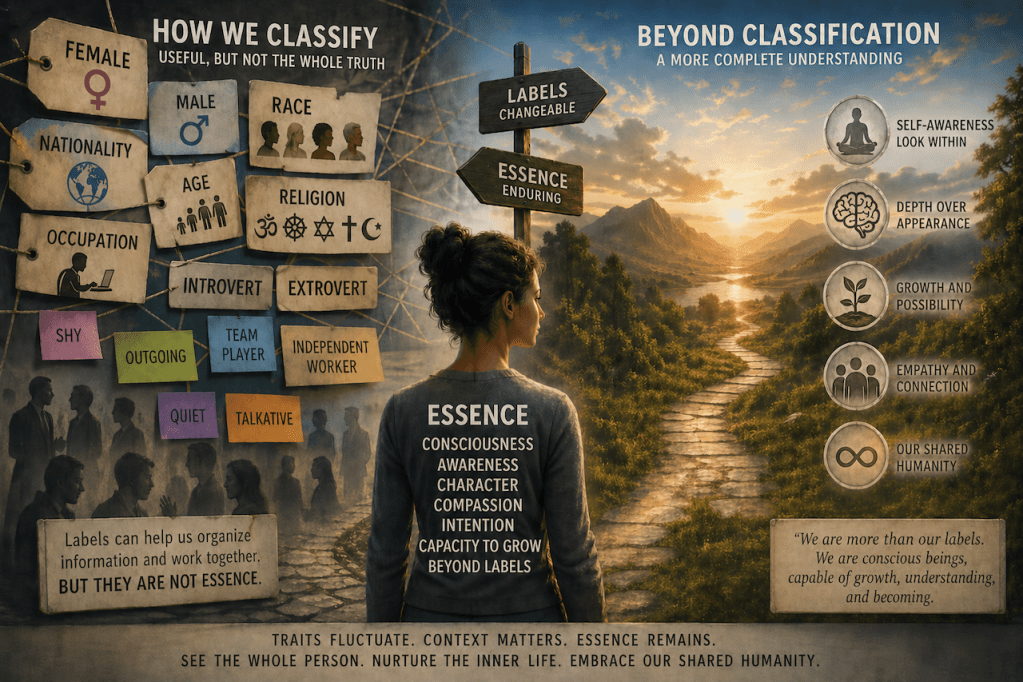
Human beings have a persistent tendency to classify themselves, often believing that such classifications clarify identity and improve understanding. Yet, when examined closely, many of these categories—whether rooted in physical identity, behavior, or personality—can obscure deeper truths about human nature.
Human Being: A Soul with a Body
While classification can offer a sense of order, it can also encourage individuals to identify too strongly with external labels, neglecting the deeper dimensions of consciousness, character, and inner development that define human experience.
According to Paramahansa Yogananda, the human being is essentially a soul who has a body. The human essence cannot be quantified, qualified, and classified. Any attempt to do so, simply limits the true nature of humanity to materialistic standards that remain incapable of distinguishing truth from fiction.
At the core of this argument is the distinction between essence and expression. The human being may be understood not merely as a physical organism, but as a conscious entity whose identity transcends bodily and social categories. When individuals define themselves primarily through classifications such as sex, race, or nationality, they risk losing sight of this deeper identity.
These classifications, though often fixed and socially reinforced, are ultimately temporary conditions of embodiment. For example, a person born in the United States, identified as female, and categorized within a particular racial group may spend much of her life navigating those labels. Yet none of these descriptors addresses her inner consciousness, moral capacity, or spiritual awareness.
A similar issue arises with psychological classifications such as “introvert” and “extrovert.” While these terms can describe tendencies, they often become limiting identities. Modern psychology acknowledges that personality exists on a spectrum, with most individuals exhibiting both introverted and extroverted traits depending on context [1].
For instance, a person who identifies as introverted may still display extroverted behavior when speaking on a subject of passion or when among trusted friends. Conversely, an extroverted individual may crave solitude after prolonged social interaction. These examples illustrate that such classifications are not fixed identities but fluctuating expressions of a more complex mind.
The broader philosophical concern is that classification often mistakes behavior for being. Actions, preferences, and tendencies are sometimes elevated to defining characteristics of the self, when in fact they represent only partial aspects of a person’s existence.
A person who prefers solitude is more than the label “introvert,” just as a person who engages in particular patterns of behavior cannot be reduced to those behaviors alone. Human identity encompasses thought, intention, awareness, and the capacity for change—qualities that resist rigid categorization.
Real-world examples further illustrate the limitations of classification. Consider the workplace: employees are often categorized as “team players” (extroverted) or “independent workers” (introverted).
While these distinctions can help with task allocation, they can also restrict growth. An employee labeled as introverted may be overlooked for leadership roles, despite possessing strong decision-making skills and emotional intelligence.
Research in organizational psychology shows that introverted leaders can be highly effective, particularly in environments that require careful listening and thoughtful strategy [2]. This demonstrates how labels, when taken too rigidly, can hinder both individual development and institutional success.
Another example arises in education. Students are frequently grouped by learning styles or personality traits, which can influence teacher expectations. A quiet student may be assumed disengaged, while a talkative student may be seen as more capable.
However, studies indicate that quieter students often process information deeply and may excel in written or reflective tasks [3]. Here again, classification simplifies what is actually a nuanced interplay of cognitive and emotional factors.
From a more reflective perspective, the danger of classification becomes even more pronounced when individuals neglect inner development. Practices such as meditation, contemplation, or prayer, which cultivate self-awareness and depth of understanding, often require stepping beyond labels altogether.
The inward turn associated with such practices resembles what is commonly labeled “introversion,” yet it is not a personality type so much as a universal human capacity. Even highly social individuals benefit from periods of silence and reflection, suggesting that the introvert-extrovert dichotomy reflects tendencies rather than fixed identities.
While classification can serve practical purposes, it becomes problematic when it is mistaken for essence. Both physical and psychological labels risk reducing the human being to partial truths, ignoring the deeper, unifying reality of human consciousness.
By recognizing that traits such as sociability, behavior, and identity categories are fluid and secondary, individuals can move toward a more integrated understanding of themselves. Such an understanding not only aligns with psychological evidence but also supports the broader view that the essence of the human being transcends all classification.
Sources
[1] American Psychological Association. “Personality Traits.”
[2] Adam Grant. Give and Take: Why Helping Others Drives Our Success. New York : Penguin Books. 2013.
[3] Susan Cain. Quiet: The Power of Introverts in a World That Can’t Stop Talking. New York : Crown Publishers. 2012.

